Watergate revisited: Is it fundamentally unethical to guarantee a source confidentiality?

A shorter version was published 22-6-15 in The Conversation as:

How surveillance is wrecking journalist-source confidentiality

By MARK PEARSON

Washington Post reporter Bob Woodward famously used cloak and dagger methods to communicate with his secret source – “Deep Throat” – in the 1972 Watergate investigation which led to the Nixon administration’s downfall.

https://twitter.com/julieposetti/status/612867415999971329

Woodward said he would move a pot plant on his balcony to signal to his confidential, high-level source that he wanted a meeting. If Deep Throat wanted a meeting, he would draw a clock face on page 20 of Woodward’s newspaper to indicate the time they should rendezvous in a disused underground car park.

These very 20th-century means of communication helped preserve the iconic source’s anonymity – until former FBI deputy director Mark Felt outed himself more than 30 years later.

It was significant, then, that Washington was the venue for the release of preliminary findings of a study by the University of Wollongong’s Julie Posetti into the threats to source confidentiality in a new era of sophisticated surveillance technologies and powers.

Leaving a trail

The study poses worrying questions about whether sources can ever be sure their communications with journalists remain confidential no matter how determined a reporter might be to protect them.

Journalists have a sacrosanct relationship with their confidential sources. It is enshrined in ethical codes internationally with some qualified protection under “shield laws” in Australia. Journalists don’t “rat” on their sources. In recent decades in Australia, three journalists have been jailed for refusing to reveal their sources in court – Tony Barrass, Joe Budd and Chris Nicholls.

Four decades on, in a digital era of surveillance and data storage, Watergate remains a useful yardstick for assessing the value of source confidentiality.

We can only speculate as to whether Woodward would have been able to preserve Deep Throat’s confidentiality with the surveillance tools and legislative reach agencies have at their disposal today. Some have argued that modern journalists need to return to those analogue means of communicating if they are to have a hope of protecting their sources, particularly when investigating national security, high-level corruption and matters embarrassing to governments.

Recently departed Guardian editor-in-chief Alan Rusbridger said:

I know investigative journalism happened before the invention of the phone, so I think maybe literally we’re going back to that age, when the only safe thing is face-to-face contact, brown envelopes, meetings in parks.

Associate editor at The Australian Cameron Stewart told me that investigative journalists had to leave their smartphones at the office when heading out to meet confidential sources. The 1970s Watergate methods were again becoming necessary.

However, following Woodward’s approach with Deep Throat would not, on its own, be enough in the digital surveillance era. CCTV footage and geolocation technology on mobile devices carried by either party could potentially link the journalist with their source.

As security expert Bruce Schneier explained, security agencies can also use device inactivity in a process of elimination to identify a source.

If they can account for the location of nine possible government sources’ phones over a set period – but the tenth has either been turned off for a long period or left at home – then that employee becomes the prime whistleblowing suspect. Despite their limitations, such primitive contact methods might make a one-off leak harder to trace than it would if there were email records and stored telco and internet provider metadata such as phone tower locations, call durations and IP addresses. These are all easily accessible under Australia’s new data retention laws. Stewart explained:

The thing I’ve got to my ear now [a smartphone] is your biggest enemy in every single sense, as the Snowden revelations have shown. The ability of authorities to track movements of journalists is really of great concern as far as protecting sources goes.

Veteran investigative journalist Ross Coulthart offered detailed insights into the detectable trail of communications between reporters and sources last month. He explained a major problem was the “first contact” from a whistleblower with a story.

If they contact me by phone or email now, though, I now warn them they’re compromised.

Coulthart also explained his use of encrypted communications and secure platforms in his efforts to disguise his contacts with sources or to expunge records of his contacts with sources. Guardian Australia’s Paul Farrell recently ran a masterclass on source and data protection for journalists teaching them about surveillance, encryption and freedom of information laws.

Paying the price

However, recent research by Curtin University associate professor Joseph Fernandez has shed light on how ignorant many journalists are of the risks of compromising their source confidentiality and even of whether recently legislated shield laws offer them any protection in the states or territories where they work. His survey of 154 journalists found that while almost all journalists expressed unreserved commitment to the confidentiality of their sources, three quarters were uncertain about the extent to which shield laws might cover them and almost half expressed no alarm at official surveillance of their communications. The price of a detected link can be high and many whistleblowers have paid the price of their liberty or careers.

They include the most infamous – Chelsea Manning – serving what is likely to be the rest of her life in a US military prison for her releases of information to Wikileaks.

In Australia, the list of discovered sources include former customs officer Allan Kessing, Victorian detective Simon Artz and design college part-timer Freya Newman.

If journalists are to have any hope of protecting confidential sources into the future it will require a multi-faceted approach along the lines recommended by Posetti in her UNESCO study.

It proposes an ambitious 11-point framework for enhancing free expression, strengthening legislative and policy shields for journalists and whistleblowers, and training reporters.

In 1989 Janet Malcolm used her long-form article ‘The Journalist and the Murderer’ in the New Yorker to question the ethics of the journalistic interview. She wrote:

“Every journalist who is not too stupid or too full of himself to notice what is going on knows that what he does is morally indefensible. He is a kind of confidence man, preying on people’s vanity, ignorance or loneliness, gaining their trust and betraying them without remorse.”

A quarter of a century later, the fundamental question facing journalists is whether the very act of promising confidentiality to a source (particularly a government whistleblower) is unethical, given the likelihood that agencies have the power, the will and the technology to detect and identify sources.

A 2015 Deep Throat would be unlikely to survive a week without detection, regardless of whether a journalist has promised them and even if a shield law allows the reporter to refuse to identify the source in court.

Sadly, despite such undertakings, the trail of metadata would likely produce enough evidence to nail the confidential source, further damaging the public’s right to know.

An abridged version of this article was originally published on The Conversation.

Read the original article.

© Mark Pearson 2015

Disclaimer: While I write about media law and ethics, nothing here should be construed as legal advice. I am an academic, not a lawyer. My only advice is that you consult a lawyer before taking any legal risks.
Leave a comment

Filed under national security, terrorism

Journalists, whistleblowers and the law – the end of the era of the confidential Watergate-style source? My #AusCERT2015 address

By MARK PEARSON

My speech to the AusCERT2015 conference on the Gold Coast, Queensland, on Friday June 5.

Abstract

The practicalities of protecting confidential sources are a huge challenge for journalists in the modern era. New shield laws excusing journalists revealing the identity of a whistleblower in court seem pointless if litigants or government agencies have already been able to detect them using the surveillance regime that is ubiquitous in modern society. It prompts the serious questions: Could the Watergate investigation by the Washington Post three decades ago happen in the modern era? How long would Carl Bernstein and Bob Woodward’s White House source ‘Deep Throat’ remain anonymous today? This presentation considers the toll of the era of geo-locational tracking, phone and social media e-records, CCTV in private and public spaces, email logs, surveillance technologies and drones on journalists and their sources. It reviews the key laws in the field of confidentiality, privacy and national security to assess the level of whistleblower and journalist protection they really offer.

Audio available here:

© Mark Pearson 2015

Disclaimer: While I write about media law and ethics, nothing here should be construed as legal advice. I am an academic, not a lawyer. My only advice is that you consult a lawyer before taking any legal risks.

Leave a comment

Filed under national security, terrorism, Uncategorized

Towards a mindful approach to media law and ethics

By MARK PEARSON

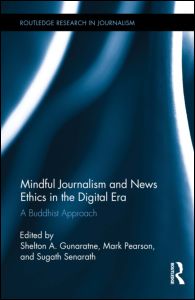
Our book Mindful Journalism and News Ethics in the Digital Era: A Buddhist Approach (Shelton Gunaratne, Mark Pearson and Sugath Senarath eds; Routledge, NY, 2015)  explored the possibilities of applying mindfulness techniques to journalism practice.

How might we begin to apply Buddhist ethical systems to the analysis of media law and ethics?

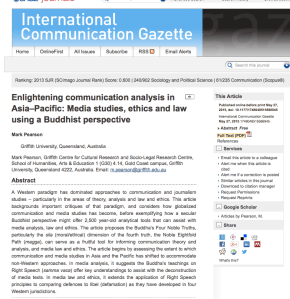
I explore this question in an article just published online and to appear in a forthcoming print edition of the International Communication Gazette.

It is titled ‘Enlightening communication analysis in Asia-Pacific: Media studies, ethics and law using a Buddhist perspective’. Its abstract and link to the full article is available here.

Screen Shot 2015-05-29 at 3.08.59 pmThe article backgrounds important critiques of the Western approach to communication  studies, and considers how globalized communication and media studies has become, before exemplifying how a secular Buddhist perspective might offer 2,500 year-old analytical tools that can assist with media analysis, law and ethics.

The article proposes the Buddha’s Four Noble Truths and their associated Noble Eightfold Path (magga) can be fruitful tools for informing communication theory and analysis, and media law and ethics.

The article begins by assessing the extent to which communication and media studies in Asia and the Pacific has shifted to accommodate non-Western approaches.

In media analysis, it suggests the Buddha’s teachings on Right Speech (samma vaca) offer key understandings to assist with the deconstruction of media texts. In media law and ethics, it extends the application of Right Speech principles to comparing defences to libel (defamation) as they have developed in four Western jurisdictions.

Here is a brief extract on that aspect:

In this globalised, multi-cultural and multi-jurisdictional Web 2.0 era there should be no reason why the Judeo-Christian lens should have a monopoly on our examination of communication law. A mindful reading of defamation law benefits from a consideration of both Right Speech principles and concepts of necessary truth-telling. While it is far-fetched to expect judges and legislators in the West would turn to Buddhism for the reform of defamation law, an effort to abide by truth-telling and Right Speech principles could operate effectively when professional communicators are attempting to avoid libel litigation when pursuing their stories. Further, they present excellent tools for an alternative analysis.

Analysis of the development of defamation defences in Canada, the UK, Australia and the U.S. benefit from a Buddhist reading. In Grant v. Torstar Corp., 2009 SCC 61, [2009] 3 S.C.R. 640, the Supreme Court of Canada developed a ‘responsible communication’ defence to defamation for matters which might not have been able to be proven absolutely as true, but were still diligently reported and were clearly in the public interest to be aired within the spirit of the Canadian Charter of Rights and Freedoms protection of free expression. ..

It is possible to implement a Buddhist approach using the Right Speech teachings from the Noble Eightfold Path to conduct an analysis in this area of communication law. The author proposes to do this more thoroughly in future work. However, for the purposes of this argument we might return to the Abhaya Sutta cited earlier and contrast these defences as they have been developed in these jurisdictions (Thanissaro, 1997). Crucial to the Canadian ‘responsible communication’ defence and its qualified privilege cousins in the UK and Australia is the extent to which reporters and publishers honestly believe in the truth of the defamatory material published, even though they might not have the firm evidence to prove this in court. They would pass the Buddhist (mindful journalism) test if they had an honest belief the material was “factual, true, beneficial” while perhaps being “unendearing and disagreeable to others”, as long as they had chosen the “proper time” for reporting it (Thanissaro, 1997). However, the U.S. defences driven by the First Amendment takes this liberty a step too far under this schema, because it allows unbeneficial, unendearing and disagreeable material to be published about public figures as long as it has not been done with malice. It also allows for untruthful gossip-mongering, as identified earlier in the Saleyyaka Sutta (Nanamoli, 1994) as ethically problematic. Such analysis shows promise in the field of media law analysis, reform and policy development because it provides a working ethical framework to apply to legislation and the fact scenarios of particular cases.

The article applies the ‘Right Speech’ principles of Buddhist ethics to analysis of the Royal family prank call episode which resulted in a High Court appeal in Australia and to a racial discrimination case heard in Australia’s Federal Court over comments on a West Australian news website.

———–

Disclaimer: While I write about media law and ethics, nothing here should be construed as legal advice. I am an academic, not a lawyer. My only advice is that you consult a lawyer before taking any legal risks.

© Mark Pearson 2015

2 Comments

Filed under blogging, Buddhism, citizen journalism, Eightfold Path, free expression, media ethics, mental health, social media, Uncategorized

Mindful Journalism in action – in dialogue with University of Canterbury students

By MARK PEARSON

Graduate students in journalism from the University of Canterbury studying under Associate Professor Donald Matheson interviewed me via Skype on the principles of mindful journalism.

With their permission, I provide the recording of that interview here for the interest of those exploring the application of Buddhist ethical systems to their journalism work.

Our book Mindful Journalism and News Ethics in the Digital Era: A Buddhist Approach (Shelton Gunaratne, Mark Pearson and Sugath Senarath eds; Routledge, NY) was published in February 2015.

Review copies are available from Routledge by filling out this request form. Please see the publisher’s synopsis.

MindfulJournalismCoverThe term ‘mindful journalism’ is a concept I introduced more than a year ago in the inaugural UNESCO World Press Freedom address at AUT University Auckland, drawing upon the earlier substantive work by my esteemed colleague (and lead editor of our book), Emeritus Professor Shelton Gunaratne, who has been working for decades on the intersection between Buddhism and journalism.

I developed my application of this in a paper to the International Association for Media and Communication Research (IAMCR) conference in Dublin in July 2014, which was revised for publication as an article in Ethical Space published in December 2014.

It is being published as part of the Routledge New York Research in Journalism series. My key point was that one does not have to be a Buddhist to incorporate the key principles of mindful journalism into one’s work. In fact, most of these very moral principles are evident in the teachings of all the world’s great religions. However, for those who lack a moral framework for their ethical decision-making, a secular application of these non-theistic principles can offer a moral compass. They offer a series of normative or aspirational goals we can strive for, but rarely reach. They also provide a schema for the analysis of ethical decision-making by journalists.

Interested? You can read further extracts from the book using the “Look Inside” interface at Amazon. Enjoy.

———–

Disclaimer: While I write about media law and ethics, nothing here should be construed as legal advice. I am an academic, not a lawyer. My only advice is that you consult a lawyer before taking any legal risks.

© Mark Pearson 2015

1 Comment

Filed under blogging, Buddhism, citizen journalism, Eightfold Path, free expression, media ethics, mental health, social media, Uncategorized

West Papua – the Indonesian media gag on Australia’s doorstep

Global Day of Action for Access to West Papua unites protestors across 20 cities

REPORTERS WITHOUT BORDERS / REPORTERS SANS FRONTIERES
PRESS RELEASE / COMMUNIQUÉ DE PRESSE

04.29.2015

ENG : http://en.rsf.org/indonesia-global-day-of-action-for-access-to-29-04-2015,47828.html

INDONESIA
Joint statement Published on Wednesday 29 April 2015.

See the the open letter to President Joko Widodo here.

London, 29 April 2014 – Dozens of demonstrators dressed in black gathered outside the Indonesian Embassy today to lead the global protest against West Papua’s 50-year long isolation. The demonstration was organised by TAPOL and Survival International, supported by Amnesty UK and the Free West Papua Campaign. The rally was one of 22 protests around the world calling for free and open access to Indonesia’s most secretive region. Since West Papua’s annexation in 1963, Indonesia has imposed a media blackout on the contested, resource-rich territory, allowing perpetrators of human rights violations to act with total impunity. West Papua is one of the world’s most isolated conflict spots. For decades, Indonesian security forces have brutally suppressed Papuan pro-independence movements.

The ‘Global Day of Action for Free and Open Access to Papua’ has sparked rallies in West Papua, Indonesia, Australia, New Zealand, the Solomon Islands, Scotland, Germany, France, Italy and Spain. Protests in Los Angeles, New York and San Francisco are planned to take place later today. This global coordinated effort, the first of its kind, shows that worldwide solidarity for West Papua has reached unprecedented levels.

Esther Cann from TAPOL, a London-based NGO coordinating the rally said, “This is the first time we’ve seen anything like this level of support for West Papua. NGOs, parliamentarians and solidarity groups all around the world are telling Indonesia that human rights abuses in Papua can no longer be ignored. Papuan voices must be heard. In this age of information, it’s astounding that there are blackspot regions like West Papua.

From the Solomon Islands to Scotland to San Francisco, hundreds of demonstrators from 22 cities in 10 different countries united to call for a free and open West Papua. Demonstrators wore black, representing the ongoing media blackout in West Papua. They gathered to demand that President Joko Widodo fulfill his presidential campaign promise of opening West Papua to international journalists, humanitarian and human rights organisations. A three-minute silence was observed to symbolize the silencing of the media in West Papua.

President Jokowi himself has said that there is nothing to hide in Papua. So why is it still virtually impossible for journalists and NGOs to report on Papua? We know that serious human rights violations are happening in Papua, but we still have no idea of the scale of the killings and torture over the last 50 years,” said Cann.

This global day of action is our way of telling the Indonesian government that the world is watching. Even though they’ve kept West Papua isolated for 50 years, the world has not forgotten. The truth must and will come out,” said human rights activist Peter Tatchell, who took part in the protest.

At the end of the demonstration, a joint letter to President Jokowi signed by 52 Papuan, Indonesian and international groups and parliamentarians was delivered to the Indonesian Embassy in London. The letter pointed out that ‘the media blackout denies the Papuan people the right to have their voices heard and allows human rights violations such as killings, torture and arbitrary arrests, to continue with impunity … The de-facto ban on foreign journalists, NGOs and humanitarian organisations contributes to the isolation of local journalists, and makes independent investigation and corroboration virtually impossible’. An Avaaz petition calling for media freedom in West Papua, launched by the Free West Papua Campaign and signed by over 47,000 people was delivered to President Jokowi by Papuan students in Jakarta today.

Reporters without Borders, a co-signatory to the joint letter, criticised Indonesia’s decline in media freedom. Benjamin Ismail, the Head of the Asia-Pacific Desk at Reporters without Borders said, “Indonesia’s ranking in the World Press Freedom Index has worsened dramatically in the last four years. In 2015, it ranked 138 out of 180 countries. This year’s position is mainly the result of the media blackout in West Papua orchestrated by the authorities.

Access for UN human rights observers has been closed for eight years. In recent years, international humanitarian agencies and NGOs have been pressured to close their field offices and leave Papua. International journalists and NGOs seeking to visit and work in Papua are currently required to undergo a stringent visa application process involving the unanimous approval of 18 separate government agencies known as the Clearing House committee.

In October last year, two French journalists were sentenced to 11 weeks in detention under immigration charges because they had tried to report the Papua conflict. During a UN Human Rights Council event last month, Valentine Bourrat, one of the two journalists detained stated that “…keeping Papua closed to journalists means that the Indonesian authorities are hiding human rights violations. As journalists we cannot let a murderous silence prevail.

Independent reporting by local and national journalists in Papua is dangerous and sometimes lethal. According to the Papuan branch of Indonesia’s Alliance of Independent Journalists (Aliansi Jurnalis Independen, AJI), in 2014 there were 20 reported cases of violence and intimidation against journalists in Papua.

Journalists must be able to work without intimidation, threats or restriction. We should be able to report independently and without fear for our security. Why is this not guaranteed to journalists in Papua? As Indonesian citizens, why are our rights not safeguarded?” said Oktovianus Pogau, a journalist with Suara Papua, a Papuan news site.

During his presidential campaign, President Jokowi publically stated that there was nothing to hide in Papua and promised to open the region. Yet six months into his presidency, Papua remains closed off to the international community. While President Jokowi has pledged his commitment to resolve past rights abuses, the execution of eight people for alleged drug trafficking offences less than 24 hours ago puts the future direction of Indonesia’s human rights into serious question.

Contact: Esther Cann, Coordinator, TAPOL, +44 7503 400308 esther.cann@tapol.org For photos of demonstrations in other cities please email campaigns@tapol.org

MORE INFO :

PACIFIC MEDIA CENTRE : WEST PAPUA: Open access now ’vital’, say NZ journalists, rights activists

WEST PAPUA MEDIA ALERTS : The Eyes of the Papuans: A video advocacy process

Benjamin Ismaïl
Head of Asia-Pacific Desk
Reporters Without Borders
CS 90247
75083 PARIS CEDEX 02
France
+33 1 44 83 84 70

Websites :
https://en.rsf.org/asia,2.html
https://surveillance.rsf.org/en/
http://index.rsf.org
https://www.wefightcensorship.org/index.html
Twitter :
@RSFAsiaPacific
@RSF_Asia (中文)
Facebook : facebook.com/reporterssansfrontieres
Skype : rsfasia
PGP : 0632 C9C7 8AC0 621A 92CC 9FEC 362F A254 1A54 54D7
KEY : 1A5454D7

1 Comment

Filed under national security, terrorism

Lessons in ‘Right Speech’ and mindful communication in Queensland defamation case

By MARK PEARSON

THE comedians on the Ten network’s ‘The Project’ had some fun with defamation last Friday when they used a fairly sobering Queensland case as the reason to interview me on the basics of that law.

First up, a clarification. Near the end of the segment they seemed to imply quite incorrectly that I am a lawyer which, of course, I am not!

Mark Pearson (@journlaw) interviewed on The Project about defamation 24.4.15 [At 33 mins 15 secs]

Mark Pearson (@journlaw) interviewed on The Project about defamation 24.4.15 [At 33 mins 15 secs]

There is a serious side to this. The Queensland case they used as the segue to my very rudimentary explanation of defamation law was Sierocki & Anor v Klerck & Ors (No 2) [2015] QSC 092 where Justice Flanagan had ordered a total of $260,000 in damages be awarded to the plaintiff and his company over various Internet slurs against them by his former business partner and others.

The defendants had earlier failed in their attempt to prove the truth of the imputations that the plaintiff was fraudulent; was a conman; had committed adultery; had used illegal drugs; was evil; was a thief; was a liar; and preyed on the innocent and that his company’s services were disreputable; unprofessional and encouraged threatening behaviour. Quite a slur indeed.

33671_GAZThe Courier Mail reported earlier that the plaintiff was also suing Google for $2.6 million over its search results linking him to the sites containing those imputations.

The case is interesting for media law students for a range of reasons – the large award of damages, the fact that they were Internet publications, and for the proposed action against Google.

But I find the most instructive lesson is the extent to which a dispute between business partners can escalate so far out of control that one should take to the Internet to cast these kinds of aspersions against the other.

Justice Flanagan noted in the judgment that the cause of the original dispute was unknown, but the result has been enormous financial and emotional cost to all parties.

Our new book Mindful Journalism and News Ethics in the Digital Era: A Buddhist Approach (Shelton Gunaratne, Mark Pearson and Sugath Senarath eds; Routledge, NY) examined some of the causes of such disputes and the damage that language can cause to reputations and relationships.

I take this further in a forthcoming article in a special issue of the academic journal International Communication Gazette, edited by my Mindful Journalism lead editor Shelton Gunaratne.

In that article I examine the religious origins of defamation law and proceed to link it to the Buddhist concept of “Right Speech”, writing:

In this globalised, multi-cultural and multi-jurisdictional Web 2.0 era there should be no reason why the Judeo-Christian lens should have a monopoly on our examination of communication law. A mindful reading of defamation law benefits from a consideration of both Right Speech principles and concepts of necessary truth-telling. While it is far-fetched to expect judges and legislators in the West would turn to Buddhism for the reform of defamation law, an effort to abide by truth-telling and Right Speech principles could operate effectively when professional communicators are attempting to avoid libel litigation when pursuing their stories. Further, they present excellent tools for an alternative analysis.

The basic premise of Right Speech in Buddhism is that words should not be spoken (or written or published) if they are not factual or true, or if they are unbeneficial, unendearing or disagreeable to others. All of these elements seemed to apply in this case, or at least that was the tenor of the judgment. Of course, sometimes hard truths do need to be told, but we need to ensure they are provable as true or that we can operate under some other defence excusing their publication.

The Internet offers inordinate opportunities to those seeking to defame others. This is the latest in a series of judgments demonstrating that even when one side wins a record damages payout for defamation, nobody is really a winner when reputations are damaged for no defensible reason.

We need to look to our moral compass when speaking or writing ill of others and ask whether we have an ethical foundation for doing so.

———–

Disclaimer: While I write about media law and ethics, nothing here should be construed as legal advice. I am an academic, not a lawyer. My only advice is that you consult a lawyer before taking any legal risks.

© Mark Pearson 2015

1 Comment

Filed under blogging, Buddhism, citizen journalism, Eightfold Path, free expression, media ethics, mental health, social media, Uncategorized

Forthcoming Pacific Journalism Review covers political journalism in the region

By MARK PEARSON

The May special edition of Pacific Journalism Review will include revised and refereed papers from the PJR2014 conference held in Auckland last November.

I was honoured to collaborate with Associate Professor Joseph Fernandez (@DrJM_Fernandez) from Curtin University on two of the articles in this forthcoming edition –  one on censorship in Australia and the reflection of this in world press freedom indices; and the other on recent developments in shield laws in Australia and on journalists’ attitudes to them and their confidential sources.

Interested? Here are the abstracts and citation details for both articles. Order your PJR copy now.


Pearson, M., and Fernandez, J. M. (2015). Censorship in Australia: Intrusions into media freedom flying beneath the international free expression radar. Pacific Journalism Review, 21(1): 40-60.

Australia has ranked among the top 30 nations in recent world press freedom surveys published by Reporters Without Borders (RSF) and Freedom House and is broadly regarded as a substantially free Western liberal democracy. This article considers how the methodologies of those organisations assess the impact upon media freedom of a range of recent decisions and actions by Australian politicians, judges and government agencies. There is considerable evidence of a shift towards official secrecy and suppression of information flow. However, according to this analysis such developments are unlikely to impact significantly on Australia’s international ranking in media freedom indices. This article uses the methodologies of RSF and Freedom House to explore whether the international free expression organisations’ criteria are justifiably weighted towards violence against journalists, their imprisonment and formal anti-press laws and might allow for a nuanced comparison of other evidence of constraints on the news media in developed democracies.


Fernandez, J. M., and Pearson, M. (2015). Shield laws in Australia: Legal and ethical implications for journalists and their confidential sources. Pacific Journalism Review, 21(1): 61-78.

This article examines whether Australia’s current shield law regime meets journalists’ expectations and whistleblower needs in an era of unprecedented official surveillance capabilities. According to the peak journalists’ organisation, the Media, Entertainment and Arts Alliance (MEAA), two recent Australian court cases ‘despite their welcome outcome for our members, clearly demonstrate Australia’s patchy and disparate journalist shields fail to do their job’ (MEAA, 2014a). Journalists’ recent court experiences exposed particular shield law inadequacies, including curious omissions or ambiguities in legislative drafting (Fernandez, 2014c, p. 131); the ‘unusual difficulty’ that a case may present (Hancock Prospecting No 2, 2014, para 7); the absence of definitive statutory protection in three jurisdictions—Queensland, South Australia and the Northern Territory (Fernandez, 2014b, p. 26); and the absence of uniform shield laws where such law is available (Fernandez, 2014b, pp. 26-28). This article examines the following key findings of a national survey of practising journalists: (a) participants’ general profile (b) familiarity with shield laws: (c) perceptions of shield law effectiveness and coverage: (d) perceptions of story outcomes when relying on confidential sources; and (e) concerns about official surveillance and enforcement. The conclusion briefly considers the significance and limitations of this research; future research directions; some reform and training directions; and notes that the considerable efforts to secure shield laws in Australia might be jeopardised without better training of journalists about the laws themselves and how surveillance technologies and powers might compromise source confidentiality.


© Mark Pearson 2015

Disclaimer: While I write about media law and ethics, nothing here should be construed as legal advice. I am an academic, not a lawyer. My only advice is that you consult a lawyer before taking any legal risks.

Leave a comment

Filed under national security, terrorism

For those who missed it – the @RNMediaReport story on the Bayley suppression order #auslaw

By MARK PEARSON

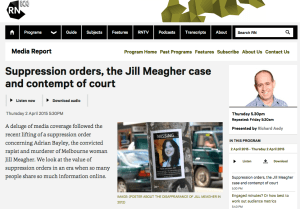
As most people were heading off for their Easter vacation, Radio National’s Media Report ran a segment on how we discovered the new edition of our textbook was in breach of a suppression order on the name of Adrian Bayley – the man who murdered Jill Meagher.

My article in  The Conversation (excerpted below) explained what happened, and RN Media Report’s Richard Aedy followed it up with this interview last week:

Screen Shot 2015-04-10 at 5.17.41 PM


March 27, 2015 blog:

How the Adrian Bayley suppression order forced the reprinting of our new media law book #auslaw ]

It is somewhat alarming when a media law academic finds himself on the wrong side of a media law. But that is exactly what happened to me when I discovered the new edition of our textbook was in breach of a suppression order on the name of Adrian Bayley – the man who murdered Jill Meagher.

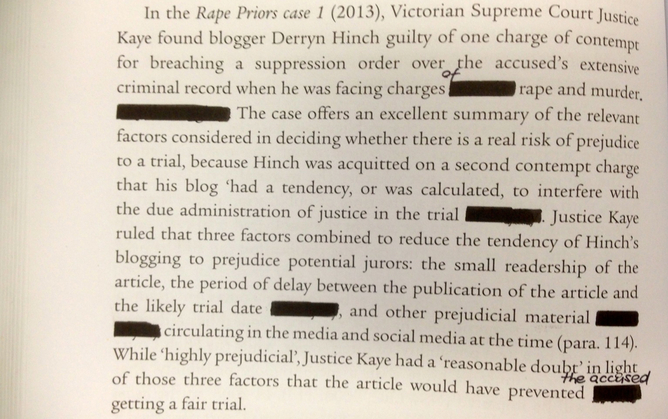
One of the manually redacted pages sent out to reviewers before our book was reprinted

One of the manually redacted pages sent out to reviewers before our book was reprinted

Our experience highlights serious problems with the system of suppression orders in the courts today as they try to grapple with the ever-increasing challenge of keeping internet-savvy jurors from having access to reports of the past trials or convictions of the accused.

Victorian County Court judge Sue Pullen issued the suppression order against anyone publishing “any information relating to previous convictions, sentences, or previous criminal cases of the accused”. The orders were lifted on Thursday after Bayley was convicted of raping three other women before he raped and murdered Meagher in September 2012.

On one view, Pullen’s orders constituted a “super injunction” because they suppressed mention of the proceedings – and therefore of the suppression order itself. Perhaps understandably, news of the order had not spread beyond the inner circle of lawyers and mainstream court reporters and editors, mainly in Victoria.

The suppression order only came to my knowledge as a Queensland-based academic when I happened to be sitting on a conference panel in Melbourne with a media lawyer and a judge last year discussing the futility of suppression orders in the modern era.

The media lawyer told the audience of court officers, lawyers, journalists and academics that he had recently appeared in court several times to try to have this particular suppression order overturned – without success. He said he could not be specific about the suppressed identity of the accused (wisely, as representatives of that court were sitting in the audience).

But when he mentioned the notorious crime itself my heart skipped a beat. It dawned on me that our new edition of The Journalist’s Guide to Media Law, which was sitting in the publisher’s warehouse awaiting distribution, was in clear breach of the order. Bayley had been named and linked to the Meagher murder on three pages of the book. He also appeared in its index.

Continue reading the full version of this commentary in The Conversation

Disclaimer: While I write about media law and ethics, nothing here should be construed as legal advice. I am an academic, not a lawyer. My only advice is that you consult a lawyer before taking any legal risks.

© Mark Pearson 2015

Leave a comment

Filed under blogging, citizen journalism, contempt of court, free expression, journalism, media ethics, media law, Media regulation, social media, sub judice

How the Adrian Bayley suppression order forced the reprinting of our new media law book #auslaw

By MARK PEARSON

It is somewhat alarming when a media law academic finds himself on the wrong side of a media law. But that is exactly what happened to me when I discovered the new edition of our textbook was in breach of a suppression order on the name of Adrian Bayley – the man who murdered Jill Meagher.

One of the manually redacted pages sent out to reviewers before our book was reprinted

One of the manually redacted pages sent out to reviewers before our book was reprinted

Our experience highlights serious problems with the system of suppression orders in the courts today as they try to grapple with the ever-increasing challenge of keeping internet-savvy jurors from having access to reports of the past trials or convictions of the accused.

Victorian County Court judge Sue Pullen issued the suppression order against anyone publishing “any information relating to previous convictions, sentences, or previous criminal cases of the accused”. The orders were lifted on Thursday after Bayley was convicted of raping three other women before he raped and murdered Meagher in September 2012.

On one view, Pullen’s orders constituted a “super injunction” because they suppressed mention of the proceedings – and therefore of the suppression order itself. Perhaps understandably, news of the order had not spread beyond the inner circle of lawyers and mainstream court reporters and editors, mainly in Victoria.

The suppression order only came to my knowledge as a Queensland-based academic when I happened to be sitting on a conference panel in Melbourne with a media lawyer and a judge last year discussing the futility of suppression orders in the modern era.

The media lawyer told the audience of court officers, lawyers, journalists and academics that he had recently appeared in court several times to try to have this particular suppression order overturned – without success. He said he could not be specific about the suppressed identity of the accused (wisely, as representatives of that court were sitting in the audience).

But when he mentioned the notorious crime itself my heart skipped a beat. It dawned on me that our new edition of The Journalist’s Guide to Media Law, which was sitting in the publisher’s warehouse awaiting distribution, was in clear breach of the order. Bayley had been named and linked to the Meagher murder on three pages of the book. He also appeared in its index.

Continue reading the full version of this commentary in The Conversation

Disclaimer: While I write about media law and ethics, nothing here should be construed as legal advice. I am an academic, not a lawyer. My only advice is that you consult a lawyer before taking any legal risks.

© Mark Pearson 2015

1 Comment

Filed under blogging, citizen journalism, contempt of court, free expression, journalism, media ethics, media law, Media regulation, social media, sub judice

New edition has a section on contract law for PR and new media entrepreneurs

By MARK PEARSON

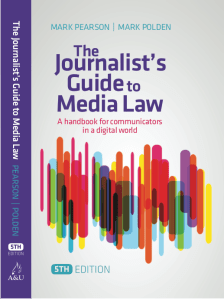
Our latest edition of The Journalist’s Guide to Media Law (Mark Pearson & Mark Polden, Allen & Unwin, 2015) has a whole chapter on law for public relations, freelancing and new media entrepreneurs.

the-journalist-s-guide-to-media-lawOne of the key topics arising for such people is the law of contract, which is a complex field requiring expert legal advice.

We’ve mapped out the very basics though for the benefit of such professional communicators. Here’s a short excerpt:

A breach of an important contract can be devastating to the financial viability of a public relations consultancy or freelance writer, and it can ruin the prospects of a start-up media venture getting off the ground. While the law of contract can get very complex, the basic concept of a contract is fairly simple: a contract is a legally enforceable promise. It is something crucial to the effective operation of a business, because our financial system operates on the principle of promises being kept rather than broken, so that there is an element of trust and predictability in our dealings. Contracts play a role in a variety of situations in the PR and news business. They can cover the terms of employment for a freelance journalist or other staff, the agreed price and timelines for professional services being offered, and the division of royalties that might flow to investors from a creative news product you are bringing to market. Gibson and Fraser (2011: 305–6) list the essential elements of a contract:

  • an intention to contract
  • an agreement between the parties (including an offer and acceptance)
  • ‘consideration’—what Gibson and Fraser (2011: 305–6) describe as ‘something of value passing from one party to another in return for a promise to do something’.

Contract law can be a specialised area, and constitutes a subject in law degrees—partly because there is a body of case law over the circumstances in which a contract might be deemed valid by a court. In determining a contract’s validity, a court will consider the legal capacity of the parties who have entered into the contract, evidence of their consent, the legality of the purpose of the contract and the form the contract takes (Gibson and Fraser, 2011: 307). The action for ‘breach of contract’ arises when one or more terms of the contract have not been met—which might include work not being completed within an agreed timeline. This is usually where lawyers enter the fray, and a contract dispute can involve long and expensive court action, although alternative forms of dispute resolution are becoming more common. Griggs, Clark and Iredale (2009: 85) recommend that managers follow these steps when they are drawing up a business contract:

  • reducing the agreement to writing and ensuring it contains all the agreed terms
  • drafting it in plain English that does not require interpretation
  • ensuring it contemplates obvious problems and presents a process for a solution
  • ensuring compliance with any relevant legislation
  • limiting exposure to liability
  • identifying the law that should apply, particularly in international contracts.

A complex sub-branch of the law of contract is the law of agency—the term used to describe the authority you might assign to someone to enter into contracts on behalf of your business. An example of a contract dispute over public relations services was a West Australian District Court case involving a consultant to a South African mining company considering buyouts or mergers with other mining companies (Mining PR case, 2004). The dispute surrounded a ‘partly written, partly oral and partly implied’ agreement to provide ‘public relations, lobbying, consulting, networking, facilitating and co-ordinating’ services. The problem was that very little was detailed in the agreement, forcing the judge to look at previous work done by the consultant and to come to an estimate of the number of hours he had worked and their value on this occasion. He awarded him $830 per day for eight weeks, totalling $33 200 plus expenses.

References

Gibson, A. and Fraser, I. 2011, Business Law, 6th edn, Pearson Education, Sydney.

Griggs, L., Clark, E. and Iredale, I. 2009, Managers and the Law: A Guide for Business Decision Makers, 3rd edn, Thomson Reuters, Sydney.

Cases

Mining PR case: Newshore Nominees Pty Ltd as trustee for the Commercial and Equities Trust v Durvan Roodepoort Deep, Limited [2004] WADC 57, <www.austlii.edu.au/cgi-bin/sinodisp/au/cases/wa/WADC/2004/57.html>.

© Mark Pearson 2015

Disclaimer: While I write about media law and ethics, nothing here should be construed as legal advice. I am an academic, not a lawyer. My only advice is that you consult a lawyer before taking any legal risks.

Leave a comment

Filed under Uncategorized