The media regulation debate in a democracy lacking a free expression guarantee

By MARK PEARSON

The latest edition of Pacific Journalism Review is out – a special issue edited by Chris Nash, David Robie and Johan Lidberg on ‘Rebuilding Public Trust’.

My contribution carries the same title as this blog. Here are the abstract and conclusion, but if you’re really interested you’ll need to get PJR for the body of the article and the references – and, of course, another 13 articles by some of the region’s top journalists and researchers.

Abstract

Two major inquiries into the Australian news media in 2011 and 2012 prompted a necessary debate over the extent to which rapidly converging and globalised news businesses and platforms require statutory regulation at a national level.  Three regulatory models emerged – a News Media Council backed by recourse to the contempt powers of courts; a super self-regulatory body with legislative incentives to join; and the status quo with a strengthened Australian Press Council policing both print and online media. This article reviews the proposals and explores further the suggestion that consumer laws could be better utilised in any reform. It concludes with an assessment of the impact of the inquiries and their recommendations upon free expression in a Western democracy lacking constitutional protection of the media.

 ——

Conclusion

The Convergence Review report cleverly proposed the removal of some existing protections instead of the imposition of draconian new regulations, but then failed to flesh out their possibilities. It needed to position its mechanism of privacy and consumer law exemptions for signatories to its new pan-media self-regulatory body as much more than hypothetical and to detail its plans for the implementation of these proposals.

Australia already has one statutory regulator with powers to punish ethical transgressions – the Australian Competition and Consumer Commission (ACCC). In an era of increasingly commercialised and converged media, it seems reasonable that at least some forms of irresponsible journalism might be addressed via the legislative mechanism prohibiting misleading and deceptive conduct by any corporation against media consumers.

Such a legislative solution already exists, as identified by the Convergence Review – and it only requires an amendment to the existing news organisation immunity from prosecution under the ‘misleading and deceptive conduct’ provisions at Section 18 of the Competition and Consumer Act 2010. The proposal to take away media exemptions from prosecution under this section would leave them accountable for misleading and deceptive claims and behaviour in their editorial functions.

While misleading and deceptive conduct does not take in all unethical behaviour by news organisations or the journalists who act as their agents, it could well be read to cover such sins as lies, inaccuracy, subterfuge, and lack of verification of the false claims of others. The amendment would mean both the ACCC (and private citizens) could launch prosecutions over such behaviour, with the force of the regulatory powers it already holds. The key to this would be an amendment of the ‘prescribed information provider’ exception (Section 19) so that news organisations would no longer have the blanket, almost unchallengeable protection for misleading and deceptive conduct which was introduced after their lobbying in the late 1970s and early 1980s. They would only earn this exemption if they were signatories to the new self-regulatory body and abiding by its requirements.

I have previously backgrounded this news media exemption to consumer law provisions under the predecessor to the existing legislation, the Trade Practices Act 1974 (Pearson, 2000). The media operated for more than a decade under that law without special exemptions from its misleading and deceptive conduct provisions. In 1984, Section 52 (the ‘misleading and deceptive conduct’ clause under the TPA) caused concern in the case of Global Sportsman v. Mirror Newspapers (1984) 2 FCR 82 when it was held that the publication of statements – including statements of opinion made in the ordinary course of news – could constitute conduct which was “misleading or deceptive”.

Successful lobbying by the media led to the government of the day introducing the exemption from the provision for “prescribed information providers” unless the deception occurred in relation to the publication of advertisements or in articles promoting the information providers’ own commercial interests. “Prescribed information providers” included “…a person who carries on a business of providing information” and included obviously newspapers, holders of broadcasting licenses, the Australian Broadcasting Corporation (ABC) and the Special Broadcasting Service Corporation (SBS).

The exemption – known as the ‘media safe harbour’ – acknowledged the fact that news organisations could not vouch for every claim made by those quoted in their news columns or stories (Applegarth, 2008). However, the instant news material was sponsored, or run in return for some compensation in cash or kind, or was used to promote the news organisation’s own operations (such as in a promo), it fell within the Act and left any misleading content open to prosecution of the media proprietor.

This rendered journalists and their organisations particularly vulnerable in the realm of advertorials, if it could be shown that space had been devoted to the promotion of a company’s products or services just because they happened to be advertising or they had reached some arrangement or understanding with some corporation to that effect.

If such claims were proven to be misleading or deceptive the media outlet was held responsible and could face an injunction preventing publication or a damages claim from those adversely affected.

The provision raised serious questions about media companies’ cross-promotion of their related corporate interests, particularly in an age where concentrated conglomerates had substantial shareholdings and sponsorships across industries. The exemption has been struck down by superior courts in two recent cases. The High Court found against a media organisation under the former Trade Practices Act in ACCC v. Channel Seven Brisbane Pty Ltd [2009] HCA 19.  That decision related to false claims on the tabloid television current affairs program ‘Today Tonight’ about goods and services. The reform would extend this to other ethical breaches. The NSW Court of Appeal had earlier ruled that Nine’s ‘A Current Affair’ did not qualify for the exemption over misleading claims made by their staff who posed as prospective customers in an expose of a home construction company. Their false claims were made in the course of their investigation – not while carrying on the business of providing information – and they had failed to reveal that they were in the information provision business during their inquiry. As Justice Applegarth has noted: “Statements made in the course of an investigation are said to lack such correspondence because they do not occur ‘in the course of carrying on’ a business of providing information.” (2008, p. 3).

Of course, the consumer laws apply to corporations rather than individuals, so journalists themselves would not be liable personally, well exemplified in the Current Affair case cited above. However, it is likely their employer organisations would pressure them to comply when faced with the prospect of ACCC prosecutions and contempt charges for disobeying any resulting orders.

The Convergence Review’s suggestion that a similar ‘carrot’ be applied to the exemptions to privacy law is more problematic. The ‘Journalism’ exemption to the Privacy Act 1988 at s. 7B(4) references privacy standards issued by the Australian Press Council as newspaper organisations’ ticket to a waiver (APC, 2011). Media organisations simply have to avow they are ‘publicly committed to observe standards’ on privacy as documented by their representative organisation. However, the proposed reform would require more of them than simply being ‘publicly committed to observe standards’ and to have published them.

If they refused to sign up for the Convergence Review’s ‘self-regulator’ they would have to follow in their journalism all of the privacy protocols applying to other corporations and marketers. Permissions would need to be sought and documented every time a citizen was named or identified visually in a news story or column and every time ‘private’ details about them and their lives were being published. It would be a logistical nightmare for a news organization. There are already a myriad of laws of defamation, trespass, data protection, surveillance, confidentiality, discrimination, consumer law, stalking, court publishing restrictions, suppression orders and copyright controlling the news media’s handling of private information. The recommendation comes at a time the government is also considering a proposal for a ‘statutory cause of action for a serious invasion of privacy’ – giving citizens the right to sue over a privacy breach and receive either an award of damages or an injunction to stop publication. If the statutory tort were introduced, then the removal of the Privacy Act exemption for media companies would appear to be overkill given the array of other laws in the field.

Reactions to the suggestion of a statutory regulator have certainly been strident and at times histrionic. Assistant to the Finkelstein inquiry, Professor Matthew Ricketson, responded in The Age to accusations that “… we would all be living in Stalinist Russia or even Hitler’s Nazi Germany with its Reich Press Chamber if the government acted on this recommendation”. He continued:

Really? What is actually recommended differs from the existing system in only one key aspect, namely government would fund the News Media Council. (Ricketson, 2012).

While he quite rightly took offence at such reactive rants, Ricketson was wrong to suggest that government funding of his proposed News Media Council was the only point of difference from the status quo.

Arms-length government funding of a self-regulator certainly sounds some alarm bells, but there may well be mechanisms to secure its independence, just as the ABC is publicly funded yet independent. The greater concern is with the body’s ultimate power to refer disobedient media outlets to courts with the distinct possibility they might face fines or a jail term if they continued to disobey the council’s order. Such powers place strong emphasis on the word ‘enforced’ in Finkelstein’s system of ‘enforced self-regulation’ and pushes it a long way towards the full government regulation its critics fear. The proposal would effectively convert ethical codes into laws – ultimately enforceable in the courts.

This has certainly been a long overdue debate in Australia, but it has occurred in a politicised context that has been counter-productive and has undermined the likelihood of the implementation of any of the proposals.  Several academics and small publishers stepped up to give the Finkelstein model their approval (The Conversation, 2012). Labor and Greens applauded it and pushed for its enactment, having demanded such an inquiry in the midst of the News of the World scandal in the UK and continued adverse coverage about them in News Limited publications locally (Kitney et.al, 2012).

Criticism of the recommendations by the larger media groups on free expression grounds were dismissed as a defence of their vested interests. It surprised nobody that News Limited chief executive Kim Williams opposed statutory regulation (Meade and Canning, 2012), but such pigeon-holing of Finkelstein’s serious critics is misplaced. History is littered with examples of politicians withdrawing citizens’ rights to free expression because they did not like what they had been saying about them at a particular moment in history.

And, while the concerns of the Left at Murdoch media treatment might have helped trigger the inquiries, despite public protestations against the proposals by Opposition figures (Kerr, 2012), it is questionable whether a Conservative government would act to dismantle a new statutory regulator and its ‘independence’ could well be tested. The Howard conservative government lacked an impressive free expression record. It famously appointed arch conservatives to the ‘independent’ ABC board, ramped up anti-terror laws and cynically exploited exemptions to freedom of information requests. That government’s foreign minister, Alexander Downer, confessed to newspaper publishers in 2006: “Freedom of information always seems a great idea when you are in Opposition but less so when you are in Government” (McNicoll, 2006).

The Australian Press Council – with a suitable name change – could become an effective pan-media self-regulator and fulfil similar functions to the one proposed by the Convergence Review. That review’s suggestion of encouraging membership with the carrot of consumer law exemptions is also a mechanism worth considering.

A uniform code of practice across all news media is a vital reform. It is essential that media outlets and journalists conform to ethical codes. It is in their interests that they do so, because it is these very ethical standards that distinguish them from the many new voices seeking audiences in the new media environment. But Australia has a confusing array of self-regulatory and co-regulatory documents guiding ethical standards of journalists and their outlets. No single journalist could possibly be expected to understand and operate effectively within deadline, paying heed to all that might apply to him or her, including the MEAA Code of Ethics, an in-house code, an industry code and the related laws and formal regulations that might apply.

This moots strongly for a single code of ethics applying to journalists and their employers across all media, similar to the existing MEAA Code of Ethics, addressing fundamental principles of truth, accuracy, verification, attribution, transparency, honesty, respect, equity, fairness, independence, originality and integrity, with exceptions only for matters of substantial legitimate public concern. Of course, this could be supplemented by industry or workplace ‘information and guidance’ documents to help explain to journalists and editors the fact scenarios and precedents applying to a particular medium or specialty, along the lines of the Australian Press Council’s guidance releases. As Ricketson (2012) has suggested, media outlets need to be more pro-active in developing better in-house processes for assessing ethical decisions and in explaining those decisions to their audiences. All reforms will, of course, need to be supplemented with better training of journalists about their rights and responsibilities and broader education of ordinary citizens to raise their level of media literacy.

Australia is rare among Western democracies in that it does not have free expression or media freedom enshrined in its Constitution and no federal bill of rights with such a protection. Other countries like the UK and New Zealand proposing similar regulating mechanisms have free expression as an explicit right informing their jurisprudence. The closest Australia has come to any such protection came in a series of decisions through the 1990s, starting with the Australian Capital Television Pty Ltd v. Commonwealth and Nationwide News v. Wills cases in 1992, where the High Court introduced and developed a so-called “implied freedom to communicate on matters of politics and government”. The court held this principle was fundamental to the system of representative government, but it demonstrated recently in Wotton v. Queensland (2011) that it was in no rush to progress this implied freedom. The Australian Capital Territory and Victoria have enacted limited charters of rights in the form of human rights acts, both of which enshrine free expression at the state and territory level, but neither applies to other jurisdictions and each is problematic even in its application in to its own jurisdiction (Pearson and Polden, 2011, pp. 38-39).

The lack of any formal written guarantee of a free media makes proposals for statutory regulators even more of a threat to democracy in Australia than in most comparable nations and this fact did not appear to weigh heavily enough with the architects of the Finkelstein report or those who rushed to support it. ‘Enforced self-regulation’ is not a suitable solution – at least not until free expression earns stronger protection from a more enthusiastic High Court or in a national bill of rights. Stronger self-regulation with the carrot of consumer law exemptions for compliant media outlets would strike the appropriate balance of freedoms and responsibilities in the interim.

© Mark Pearson 2012

Disclaimer: While I write about media law and ethics, nothing here should be construed as legal advice. I am an academic, not a lawyer. My only advice is that you consult a lawyer before taking any legal risks.
Leave a comment

Filed under Uncategorized

Sub judice – time to brush up on your Latin

By MARK PEARSON

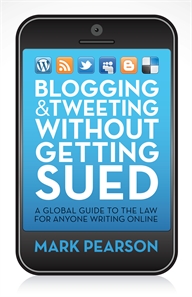
The arrest and court appearance of a man accused of the rape and murder of Melbourne ABC staffer Jill Meagher has sparked a spate of commentary on social media – much of it potentially prejudicial to the suspect’s upcoming trial. Here is an excerpt from my new book  – Blogging and Tweeting Without Getting Sued: A global guide to the law for anyone writing online (Allen & Unwin, 2012) – explaining the basic principles of sub judice contempt for lay users of social media. See also Julie Posetti’s innovative and useful Storify on this.

Victoria Police are also struggling to cope with prejudicial comments about the accused on their Facebook site. See my earlier blog on similar problems with the Queensland Police Facebook page where they have faced similar challenges trying to moderate prejudicial comments.

—————-

Sub judice – time to brush up on your Latin

The most frustrating area of contempt law for the traditional media has been sub judice contempt – publishing prejudicial material that might reduce the chance of a fair trial. First Amendment rights in the US have given the media immunity in recent times, but ‘trial by media’ can prompt a mistrial and lawyers can be disciplined if they make prejudicial statements during a trial. ‘Sub judice’ comes from the Latin meaning ‘under justice’ and has been prosecuted most often in the UK and Commonwealth countries, although some European countries like Denmark have laws against publications that might seriously damage a trial.

In 2011, the judge presiding over the trial of a conservative politician for a false expenses claim in Britain referred to the Attorney-General a potentially prejudicial tweet about the case by a rival politician. High-profile Labour peer Lord Sugar tweeted to his 300,000 followers on the second day of the trial: “Lord Taylor, Tory Peer in court on expenses fiddle. Wonder if he will get off in comparison to Labour MPs who were sent to jail?” The Telegraph quoted Justice Saunders saying: “I was concerned that if seen by a juror it might influence their approach to the case… I reported the matter to the Attorney-General not for the purpose of taking any action against Lord Sugar but to investigate whether entries on Twitter sites … posed a risk of prejudicing the fairness of a trial, and if so whether there were steps which could be taken to minimise that risk.”

International media law firm Taylor Wessing revealed in 2011 that they had defend a website against contempt allegations over prejudicial user-generated posts on a message board just a few weeks before a criminal fraud trial. They had to take down the messages and the jury had to be warned not to do Internet research. They pointed out that bloggers and social media users were liable for their publications even when they did not intend to damage a trial. From the moment someone has been arrested in a criminal case, reports about the matter are seriously limited in many countries. Authorities can prosecute for this kind of contempt if there is a ‘substantial risk’ that justice will be prejudiced in the case.

While the mainstream media are the most common targets of such actions, the size of the audience for many blogs and social media commentators will increasingly make them vulnerable. The Victorian Government Solicitor’s Office advises websites to take down materials related to an upcoming case in the lead-up to a trial. The most sensitive material is anything implying the guilt or innocence of the accused, confessions, photo identification of the accused, and republishing reports of earlier hearings. A public interest defence might be available for publication of material on a matter of overwhelming public importance, but you should never rely upon this defence without legal advice.

Blogging and Tweeting Without Getting Sued: A global guide to the law for anyone writing online is now available in print and ebook formats worldwide.

[Media: For review copies please contact publicity@allenandunwin.com or call +61 2 8425 0146]

© Mark Pearson 2012

Disclaimer: While I write about media law and ethics, nothing here should be construed as legal advice. I am an academic, not a lawyer. My only advice is that you consult a lawyer before taking any legal risks.

6 Comments

Filed under Uncategorized

My submission to the Tasmania Law Reform Institute on ID of sex crime victims

By MARK PEARSON

Here is my submission responding to the issues paper from the Tasmania Law Reform Institute – Protecting the Anonymity of Victims of Sexual Crimes.

For background to the inquiry, see my earlier blog here. It was triggered by this Hobart Mercury story (left).

—-

September 28, 2012

Submission in response to Issues Paper No 18 ‘Protecting the Anonymity of Victims of Sexual Crimes’

Please accept this personal submission in response to your issues paper, which I have prepared with research assistance from Bond University students enrolled in my media law and ethics subject. They have been required to read and discuss your report as part of an assignment for that subject and their scholarship and insights have informed the views I express here. I must stress, however, that this is a personal submission as an academic who teaches and researches in the field and my opinions do not necessarily reflect those of my employer, Bond University, or the international media freedom agency Reporters Without Borders, for whom I am the Australian representative.

By way of background, my research, teaching and industry consultancy focus on the interpretation of media law for journalists and other writers who might produce reportage as bloggers, ‘citizen journalists’ or social media users. I am co-author with barrister Mark Polden of The Journalist’s Guide to Media Law (4th edition, Allen & Unwin, 2011) and am sole author of Blogging and Tweeting Without Getting Sued – A Global Guide to the Law for Anyone Writing Online (Allen & Unwin, 2012). I have conducted media law training for Fairfax Media journalists at the Launceston Examiner and the Burnie Advocate newspapers. Our Centre for Law, Governance and Public Policy convened the national symposium ‘Courts and the Media in the Digital Era’ in 2011, which resulted in our co-edited book The Courts and the Media – Challenges in the Era of Digital and Social Media (Keyzer, Johnston and Pearson, Halstead Press, 2012). We are now collaborating with colleagues from other universities on a national research project examining the impact of social media upon the courts.

I have chosen to begin with some general observations about the tone and ambit of your issues paper before proposing a mechanism for reform.

Important contextual considerations

Issues Paper 18 is an excellent summary of comparative legislation and case law on the identification of sex crime victims. It canvasses numerous public policy issues at stake when contemplating a reform of s. 194K. However, it seems to demonstrate little understanding of media organisations’ news values and production values and does not acknowledge several important policy developments under way nationally and globally.

Journalists’ training

The paper offers a handful of examples where such laws have been breached by the news media in Australia, including only one in recent times in Tasmania that has proceeded to court. While we all would prefer there were no media breaches of identification laws, I suggest that court reporters are overwhelmingly aware of, and compliant with, both sub judice contempt guidelines and statutory reporting restrictions. This is due mainly to the media law education and training reporters receive in their university journalism degrees and in the workplace. Most media organisations also provide shorthand tuition to their staff and adhere to strict court reporting protocols where cases are followed through the court system and junior reporters ‘shadow’ experienced colleagues before starting on the round. One of the fundamental topics all court reporters learn is that there are restrictions on the identification of children and sexual assault victims involved in proceedings.

News values, open justice and the role of court reporting

Your issues paper devotes a small section to the principle of ‘open justice’ which quite rightly quotes important jurists and international human rights documents and legislation enshrining it (Part 2.1). Yet, it implies news organisations are motivated primarily by commercial interest when reporting upon the courts. At 4.3.3, your paper states: “Media outlets have an obvious interest in publishing material that will attract readers or viewers. A story that identifies the victim of sexual assault is likely to attract greater consumer interest than one that does not. There is a strong incentive for the media to publish such details.” I am aware of no research supporting this assertion and my informed view is that editors, sub-editors and court reporters strive to abide by the legal restrictions and ethical obligations forbidding identification. On rare occasions that determination is tested in the heat of competition for a particularly unusual story or one involving a celebrity – but such occasions have become even less common in the wake of strong national and international scrutiny of such media behaviour. It is, however, a mistake to view this story of this 12-year-old Tasmanian girl prostituted by her mother and the named accused as one of simply the media feeding a public titillation with sordid sexual detail. The story indeed featured the news values of ‘unusualness’ and sheer ‘human interest’ – but it also had the important public news value of what we call ‘consequence’ or ‘impact’ – many of which concern public policy benefits of the reportage of such matters.

Public policy benefits of media reportage of sexual and juvenile cases

There is a principle as ancient and as inherent in a democracy as open justice – and that is the role of the news media as the ‘Fourth Estate’. Key public policy reviews and reforms have ensued in Tasmania after this incident, and I suggest they might not have garnered the political traction to proceed if the public had been kept ignorant of the matters before the courts. These have included your own review of the defence of ‘mistake as to age’ and other important reviews of child protection. In short, court reporting by the news media and the public discussion and scrutiny it generates can fulfil many important functions in society beyond sheer entertainment; including deterrence from crime, education about justice, transparency of process, and as a watchdog on injustice and deficient public policy. Closed proceedings – or complex requirements involving media applications to cover certain matters – pose serious risks to such positive public policy outcomes.

Free expression and freedom of the press

A close relative of the principle of ‘open justice’ in a democracy is the human right of free expression and its derivative – freedom of the press. Your paper does not mention this principle, but it is crucial to note when comparing reporting restrictions across jurisdictions that Australia is unusual among western democracies in that it has no written constitutional guarantee of free expression or a free media. Each of the foreign jurisdictions your paper uses for comparison on sexual reporting restrictions – the United Kingdom, Canada and New Zealand – features such a guarantee in a charter of rights. Australia and Tasmania have no such statutory or constitutional mechanisms in place, which is an important point of difference because proposed restrictions trigger no formalised process of review on free expression grounds and courts here are not obliged to weigh free expression against other rights in their determinations. (There is, however, an argument that court reporting restrictions might breach the High Court’s implied constitutional freedom to communicate on matters of politics and government; see Nationwide News v. Wills [1992] HCA 46; (1992) 177 CLR 1).

Media ethics and regulation

I realise the your document focuses on the narrow question of whether S. 194K should be reformed, but highly relevant is the likelihood of media organisations being motivated to use a perceived legal ‘loophole’ to identify a vulnerable individual such as a child who has been subjected to sexual abuse. Such a motivation would represent a serious breach of the privacy provisions of the MEAA Journalists’ Code of Ethics and all self-regulatory and co-regulatory codes of practice in place throughout print, broadcast, television and online news media industries – including in-house codes, those of the Australian Press Council and the numerous broadcast sector codes ultimately policed by the Australian Communications and Media Authority (ACMA). The question of media adherence to such codes has been the subject of two major inquiries in the form of the Convergence Review and its subsidiary Independent Media Inquiry chaired by former Federal Court justice Ray Finkelstein – the recommendations of which are currently under consideration by the Federal Government. Regardless of whether they are adopted, an impact has been significant attempts by the news media to get their own ‘houses in order’ to avoid the prospect of strict government regulation of their ethical practices and complaints systems. The Australian Press Council has implemented significant improvements to its processes. All of this has been against the international backdrop of the UK inquiries into serious ethical and legal breaches by the Murdoch-owned News of the World newspaper.

Privacy regulation and factors impacting media privacy intrusion

Related to this inquiry have been important developments in the area of privacy law and regulation. You would be aware that the Commonwealth Government has already implemented privacy law reforms recommended by the Australian Law Reform Commission Report 108: For Your Information: Australian Privacy Law and Practice (http://www.alrc.gov.au/publications/report-108). The Gillard Government is reported to be seriously considering a recommendation for a statutory tort of invasion of privacy. Whether or not that is implemented, your own issues paper at p. 14 cites the case of Doe v. ABC (2007) VCC 282, where a journalist’s identification of a sexual assault victim led to both criminal charges and a civil suit where damages were awarded for the privacy invasion of the victim. Although this was an intermediate court decision, it stands as a precedent in a developing body of judge-made privacy law. Significant too is the ACMA’s 2011 review of its privacy guidelines (http://www.acma.gov.au/WEB/STANDARD/pc=PC_410273) for broadcasters which included important changes in the way broadcast media should deal with vulnerable interviewees, particularly children. The submission from an ARC Vulnerability Linkage Grant project on which I was a chief investigator seems to have been influential in helping frame these new provisions. (See our submission to that ACMA inquiry at http://www.acma.gov.au/webwr/_assets/main/lib410086/ifc28-2011_arc_linkage_grant.pdf ).  In short, my view is that media outlets are working to a higher level of internal, industry and public accountability when dealing with the vulnerable (particularly children) than they were two years ago when this court proceeding was reported.

The Internet, social media and the Tasmanian jurisdiction

Your issues paper makes some mention of the Internet, primarily with regard to the terminology and scope of s 194K at 5.4.2, but it mentions social media only as a footnote on page 32. My informed opinion, drawing upon research for my most recent book and for our courts and social media project at Bond University’s Centre for Law, Governance and Public Policy, is that it would be a grave error to proceed to legislative reform without due consideration of the extraordinary ways in which social media has changed the capacity for ordinary citizens to become publishers about court proceedings. Importantly, this allows for the exact reverse situation to occur in a trial to what happened in this case. Instead of the traditional media revealing, albeit indirectly, the identity of a child sexual crime victim to people who might otherwise not know her, social media allows for those who know the victim to reveal her identity to the wider world via their networks of Facebook ‘friends’ and Twitter ‘followers’. Here you are dealing with ordinary citizens who may be completely ignorant of legal restrictions on identifying such victims and may even be relying on second hand information from court proceedings they have not even attended. The reality is that the advent of social media means that  no tightening of restrictions such as those found in s.194K will be totally effective in protecting the identity of anyone involved in court proceedings – no matter how compliant journalists from traditional media might be. Web 2.0 means that secrets – particularly interesting ones – will not often be revealed, and those revealing them might not be identifiable or answerable. It has led to what I describe as a “two-speed” suppression regime in our justice systems – effectively one rule for traditional media and a different rule for citizens using social media who sometimes have an even larger audience than news outlets for their gossip and innuendo. For a recent example of this, see the remarkable situation where the mainstream media was prevented from reporting that the acting police minister faced serious sexual charges under the Evidence Act 1929, s 71A – but his name was all over the Internet and social media (See http://www.adelaidenow.com.au/news/south-australia/bernard-finnigans-name-was-all-over-the-internet-despite-suppression-order/story-e6frea83-1226480605607 and https://journlaw.com/2011/05/04/south-australias-antiquated-sex-id-law/ ).

A feature of Internet searches is that Google searches for certain terms group the results, leading to possible identification via a combination of factors across different results, whereas any single publication would not identify a victim. Similarly, an individual’s Facebook page or Twitter profile will list their ‘friends’ or associates, allowing social media to link an unnamed victim with a named accused if they have a close relationship. These factors present a challenge for reform of such legislation. A bizarre aspect of your inquiry is that the Law Reform Institute has in fact repeated the sin of the Mercury by itself republishing the name of the accused male offender, his suburb and his relationship to the girl in its own Issues Paper, which appears quite readily in a Google search on the matter. Further, it draws attention by headline to the actual article that has triggered the inquiry, thus facilitating readers to access the very material that identifies the victim. It is sad and ironic that someone who knew the family and those basic facts might well discover the victim’s identity via the Institute’s very own document.

The paper also seems to take a pre-Internet approach to jurisdictional sovereignty, suggesting that Tasmania’s reach might extend beyond its island borders to ‘the entire world’ (4.3.9). While the state might well achieve such reach in the most serious offences via extradition agreements, I suggest it is counter-productive and unrealistic to entertain the notion that a Tasmanian identification prohibition is going to have any real effect on individuals publishing material on the Internet from beyond the State’s borders.

Court closure and judicial censorship are a threat to open justice

Completely closing the court in such proceedings would be a draconian and retrograde step, counter to the principle of open justice and damaging to the important public policy outcomes I mentioned earlier in this submission. I understand the detailed mention in the Mercury article of the sexually transmitted diseases the girl had contracted was a special concern of those who wanted the DPP to press charges in this matter. Yet there is strong argument that there could be important public policy outcomes from the publication of such graphic details; such as deterring prostitution clients from engaging in unprotected intercourse and the incentive for the numerous clients in this case to seek treatment to prevent their spread through the broader community. A closed court would prevent such public messages being conveyed.

Just as concerning is the censorship regime proposed in Option 3, requiring at 5.2.4 “that the media outlet provide details of what they intend to publish to assist the court in determining whether to grant the order”. The following sentence reads like a dictum from a despotic regime on the Reporters Without Borders watch list: “The court could then decide whether to allow publication of the whole piece, some parts of the piece or to deny publication altogether”. Such an approach is anathema in a state of a progressive western democracy like Australia. It would breach the ancient rule against ‘prior restraint’ – defended so eloquently by the first Chief Justice of NSW, Sir Francis Forbes against Governor Darling in 1826 (See Spigelman, J., 2002 at http://www.lawlink.nsw.gov.au/lawlink/supreme_court/ll_sc.nsf/vwPrint1/SCO_speech_spigelman_201103).

My suggested mechanism for reform of s. 194K

Rather than debating the pros and cons of the various options foreshadowed in your paper, I will instead propose a workable solution that will minimise the likelihood of the recurrence of the circumstances that occurred in this case. As I suggested above, there is now no watertight legislative or procedural way to be absolutely certain of protecting the anonymity of victims of sexual crimes.

Your paper offered an excellent summary of sexual case reporting restrictions in Australia and in comparable foreign jurisdictions, but seemed to ignore the similar identification laws that apply to the identification of children in proceedings. The case prompting this inquiry involved both a juvenile and a sexual matter, which of course prompts the highest level of caution with identification. Our text, The Journalist’s Guide to Media Law (with Mark Polden, Allen & Unwin, 2011) features comparative tables of both juvenile and sexual proceedings reporting restrictions (at pp. 160-162 and pp.156-158 respectively). I feel S 104C of the NSW Children and Young Persons (Care and Protection) Act 1998 offers a promising solution in the form of a news media privilege to attend proceedings for reporting purposes:

104C   Entitlement of media to hear proceedings

At any time while the Children’s Court is hearing proceedings with respect to a child or young person, any person who is engaged in preparing a report of the proceedings for dissemination through a public news medium is, unless the Children’s Court otherwise directs, entitled to enter and remain in the place where the proceedings are being heard.

The news media have traditionally been extended certain privileges in courts as the ‘eyes and the ears’ of the broader citizenry – reserved seating at a press bench, access to court papers, and sometimes even standing to make a submission on a court order (Evidence Act (SA) s. 69A(5).) In NSW they are allowed to attend and report upon children’s court proceedings – but are of course expected to comply with identification restrictions. This is sensible, given journalists’ training in media law and court reporting matters and their understanding that it is only a privilege that a judicial officer might choose to withdraw. All this also prompts questions about the role and entitlements of reporters from non-traditional media – bloggers and ‘citizen journalists’ – who might choose to cover certain trials and report upon them on social media or upon specially constructed crime websites devoted to high profile proceedings. I suggest procedures could be applied to require ‘citizen journalists’ to satisfy the court that they deserve such a media privilege on a case-by-case basis.

In summary, and without extended further explanation, my proposal is:

  • Close the courts in matters involving children and sexual assault victims to the broader citizenry to limit social media ‘leakage’ of matters such as identification;
  • Allow authorised news media representatives to attend and report with the following identification restrictions;
  • Tighten the identification wording so that indirect identification is less likely. Prohibit the naming of the victim, of course. Require the court to rule upon the other identifying factors allowable in the particular case, with the working principle that a combination of factors does not identify the victim. (For example, allow her suburb and her age to be published if the suburb is populous enough, but not the sporting organisation of which she is a member.) Also prohibit visual identification of the accused in sexual assault cases where the accused has had an ongoing relationship with the victim (not necessary where the assault has been an attack by a stranger) so that those who have seen the accused with the victim do not identify her by this means.
  • Prohibit all photographs or footage of the victim being published or broadcast – even those pixelated or obscured in any way. (This practice is flawed.)

My final comments address two important points related to journalists. Firstly, I suggest there are excellent public policy reasons why victims should be permitted to self-identify as sexual assault victims at a reasonable time after proceedings have ended. I am not a psychologist, but I float the suggestion that a period of two years after the completion of proceedings might be a time when some victims might feel able to give ‘informed consent’ to a media outlet to tell their story – and that such a story could itself have major public policy benefits. Given that abuses of such a privilege are rare in jurisdictions that allow it, I suggest it be worded so that it is enough that the victim gives the journalist his or her permission in writing for publication, and that the onus of proof be on the prosecutor to demonstrate that the journalist “knew, or should have known” that the consent was not “informed” by the condition of the victim at the time and that financial inducements be prohibited.

Secondly, I offer my strong view that any penalties for breach of the reformed statute be dealt with as an offence against the statute itself, and with a fine and not a jail term. Breaches have been so rare in the past and are usually accidental, and it is an affront to democracy when states jail journalists for publishing offences. Contempt powers, particularly those wielded by superior court judges, are far too broad to justify their application to this type of publishing error.

I wish you well with your deliberations on this important matter and would be pleased to offer any further assistance if you should require it.

Yours sincerely,

Professor Mark Pearson

© Mark Pearson 2012

Disclaimer: While I write about media law and ethics, nothing here should be construed as legal advice. I am an academic, not a lawyer. My only advice is that you consult a lawyer before taking any legal risks.
Leave a comment

Filed under Uncategorized

Gillard government should step carefully with its push for privacy tort

By MARK PEARSON

A tort of privacy is on the agenda again, with the Gillard Government purportedly considering enacting such a right.

West Australian lawyer Ainslie Van Onselen has outlined many reasons why such a privacy tort could be dangerous to free expression in a democracy like Australia’s, but unfortunately her article is behind The Australian’s paywall, so I republish my earlier article and blog here for the benefit of students and researchers interested in that debate.

The right to privacy is a relatively modern international legal concept. Until the late 19th century gentlemen used the strictly codified practice of the duel to settle their disputes over embarrassing exposés of their private lives.

The first celebrity to convert his personal affront into a legal suit was the author of The Three Musketeers, Alexandre Dumas père, who in 1867 sued a photographer who had attempted to register copyright in some steamy images of Dumas with the ‘Paris Hilton’ of the day – 32-year-old actress Adah Isaacs Menken.

The court held his property rights had not been infringed but that he did have a right to privacy and that the photographer had infringed it.

Across the Atlantic in 1890 the top US jurist Samuel D. Warren teamed with future Supreme Court Justice Louis D. Brandeis to write the seminal Harvard Law Review article ‘The Right to Privacy’ after a newspaper printed the guest list of a party held at the Warren family mansion in Boston.

Warren and Brandeis wrote: “The press is overstepping in every direction the obvious bounds of propriety and of decency. Gossip is no longer the resource of the idle and of the vicious, but has become a trade, which is pursued with industry as well as effrontery.”

Thus celebrities, lawyers, paparazzi and the gossip media were there at the birth of the right to privacy – and the same players occupy that terrain today.

While both privacy and free expression are recognised in many national constitutions and in international human rights treaties, Australia is rare among Western democracies in that it has no constitutional or Bill of Rights protection for either.

That distinguishes us from the United States, United Kingdom, Canada and New Zealand which all have constitutional or rights charter requirements that proposed laws must be considered for their potential impact on free expression.

It is one of the main reasons for the complex array of legislation, court decisions and industry codes of practice limiting Australian journalists’ intrusion into the affairs of their fellow citizens.

The myriad of laws of defamation, trespass, data protection, surveillance, confidentiality, discrimination, consumer law, stalking, court publishing restrictions, suppression orders and copyright all have a privacy dimension. The Privacy Act controls the collection and storage of private information by corporations and government.

There are very few situations of media intrusion into privacy not covered by one of these laws or by the framework of codes of ethics and practice controlling journalists’ professional activities.

Proposals to replace the self-regulatory and co-regulatory ethics systems with a statutory news media regulator would add yet another layer to the regulation of privacy intrusions.

The crux of the proposed ‘statutory cause of action for a serious invasion of privacy’ is whether a citizen should have the right to sue over a privacy breach and receive either an award of damages or an injunction to stop publication.

Over the ditch, Kiwi journalists now have to navigate a judge-made right to privacy, developed interestingly from a celebrity suit in which the plaintiffs lost the case.

Mike and Marie Hosking were New Zealand media personalities who had adopted twins and later separated. They asked for their privacy, but a magazine photographer snapped the mother walking the twins in their stroller in a public place. They sued, claiming breach of privacy. The NZ Court of Appeal invented a new action for breach of privacy, but held it did not apply in that particular case. The Kiwi privacy invasion test requires “the existence of facts in respect of which there is a reasonable expectation of privacy” and that “publicity given to those private facts that would be considered highly offensive to an objective reasonable person”.

But this is set against the backdrop of the New Zealand Bill of Rights Act which protects free expression.

Australia’s High Court famously left the door open for a possible privacy tort in the ABC v. Lenah Game Meats case in 2001, when animal liberationists had secretly filmed the slaughter of possums in an abattoir in Tasmania and the ABC wanted to broadcast the footage – the fruits of the trespass.

It is hard to quarantine this latest push by the Federal Government from the News of the World scandal in the UK and the Greens-championed Finkelstein inquiry into media regulation.

The government had effectively sat upon the Australian Law Reform Commission’s proposal for the statutory cause of action for three years before progressing the matter with its Issues Paper last September in the wake of the phone hacking revelations from London. Now it has revisited it as part of its media regulation review which included both the Finkelstein report and the Convergence Review recommendations.

Few journalists or their media organisations object to the notion of their fellow citizens’ embarrassing private information being kept secret.

However, it is in the midst of a breaking story like that involving collar bomb extortion victim Madeleine Pulver, a celebrity scoop like the Sonny Bill Williams toilet tryst images or the case of the fake Pauline Hanson photos that genuine ‘public interest’ gives way to audience gratification and the resulting boost to circulation, ratings or page views.

Free expression is already greatly diminished by this mire of privacy-related laws and regulations without adding a new statutory cause of action for privacy.

But if this latest proposal is advanced further, journalists should insist upon:

–   a free expression and public interest defence reinforced in the strongest possible terms;

–   removal of the existing laws it would duplicate; and

–   strong ‘offer of amends’ defence like that now operating in defamation law and alternative dispute resolution provisions to deter celebrity gold diggers.

Short of a bill of rights enshrining freedom of the press and free expression, these demands amount to the minimum the news media deserve in a Western democracy.

* An earlier version of this article was published in May 2012 in the annual press freedom report by the Media Entertainment and Arts Alliance  – Kicking at the Cornerstone of Democracy.

© Mark Pearson 2012

Disclaimer: While I write about media law and ethics, nothing here should be construed as legal advice. I am an academic, not a lawyer. My only advice is that you consult a lawyer before taking any legal risks.

Leave a comment

Filed under Uncategorized

Tasmanian sex case ID proposals under scrutiny

By MARK PEARSON

An issues paper from the Tasmania Law Reform Institute – Protecting the Anonymity of Victims of Sexual Crimes – raises so many issues of relevance to my media law and ethics class that I have built a problem-based learning assignment around it.

The inquiry was triggered by coverage in the Hobart Mercury (see picture) in 2010 of prostitution of a 12-year-old girl by her mother and her mother’s male friend.

While the Mercury anonymised the identity of the girl and her mother, it named the accused male and listed several details that might have led readers with some knowledge of the accused or the family to identify the victim.

The barrister appointed as the girl’s representative in her care and protection proceedings, Mr Craig Mackie, wanted the newspaper charged for breach of the legislation prohibiting the identification of a sex crime victim (s194K of the Evidence Act 2001).

But the prosecutor’s office refused to act, arguing the identification was too indirect to breach the provision. Mr Mackie also sits on the Tasmanian Law Reform Institute board, and he referred the matter to that body for its review.

The issues paper covers some of the key topic areas covered in our media law and ethics subject –free expression, open justice, contempt of court, court reporting restrictions and privacy.

As part of our problem-based learning task, some students might file their own submissions before the September 28 deadline, while others will use their research to inform a reflective paper they submit as a class assignment a week later.

I might draw upon some of their research and insights in my personal submission to the inquiry – with due recognition to their efforts.

Media law tragics will find the Institute’s issues paper compelling reading.

On the one hand, it offers in a relatively brief 52 pages an excellent comparison of reporting restrictions in sexual crimes across several jurisdictions including most Australian states and the UK, New Zealand and Canada.

It also summarises the key cases in the field and quotes some of the leading judgments on the principle of open justice.

Yet my own submission will call into question several assumptions and gaps in the Issues Paper, including:

–       Evidence of anti-media language and stance, betraying a fundamental assumption that journalists are out to expose sexual assault victims despite there being relatively few cases where they have done so (often accidentally).

–       An old world ignorance of the advent of social media, citizen journalism and blogging, which have complicated the 20th century approach to regulating news media coverage of sex crime cases.

–       A similar pre-Internet approach to jurisdiction, seemingly working from the premise that publications about such matters are contained within Tasmanian borders.

–       Disregard of the fact that the Commonwealth Government is considering major reform proposals on privacy law and media regulation, all of which are relevant to the media’s exploitation and exposure of vulnerable victims of sex crimes.

–       Floating an extraordinarily proposition for prior restraint in such matters – that the media be totally banned from covering sexual cases and that a court should review and censor any proposed story about such a case pre-publication.

–       Ignoring the fact that free expression has no constitutional guarantee in this country – unlike in all of the foreign jurisdictions used as a yardstick for comparison, each of which features either a constitutional guarantee or one contained in a bill or charter of rights.

A bizarre aspect of the inquiry is that the Law Reform Institute has in fact repeated the sin of the Mercury by itself republishing the name of the accused male offender, his suburb and his relationship to the girl in its own Issues Paper, which appears quite readily in a Google search on the matter.

It is ironic that someone who knew the family and those basic facts might well discover her identity via the Institute’s very own document.

I’ll publish my submission in a future blog.

© Mark Pearson 2012

Disclaimer: While I write about media law and ethics, nothing here should be construed as legal advice. I am an academic, not a lawyer. My only advice is that you consult a lawyer before taking any legal risks.

2 Comments

Filed under Uncategorized

Legal responsibility online: are you left carrying the can? ( #defamation #blogging )

By MARK PEARSON

[Loosely adapted from my new book  – Blogging and Tweeting Without Getting Sued: A global guide to the law for anyone writing online (Allen & Unwin, 2012).]

—————-

The courts have long held that anyone having direct responsibility for a publication is legally liable for it, so if your blog or comment is on the website or social media site of another organisation, both you as the writer and whoever is hosting your work can be sued for defamation. (Some jurisdictions – most notably the US – offer strong defences to the hosts of third party comments.)

If someone edits or moderates your work before it is published, they too share the burden of legal liability. That happened recently to the News Limited website Perthnow, when it was ordered to pay $12,000 compensation to a West Australian mother over racist comments posted about her deceased teenage sons. The comments had been approved by a moderator.

If anyone republishes your work, through syndication or perhaps even through retweeting or forwarding your defamatory material, they also are also liable. Even someone who inserts a hyperlink to libellous material can be sued for defamation in some places, although the Supreme Court of Canada rejected this position in a landmark decision last year.

Plaintiffs will sue the writer, editor or host organisation for a range of reasons. Sometimes they just want to gag the discussion, so they issue a defamation writ to chill the criticism. This is known as a ‘SLAPP’ writ – ‘Strategic Lawsuits Against Public Participation’ – and in some countries they are simply thrown out of court as an affront to free expression. Others allow them. Plaintiffs often want to get the highest possible damages award from someone who can afford to pay it, so they might bypass the original impoverished blogger and sue the wealthier company that republished the material. Sometimes they enjoin all of them in their action, although this adds to their legal costs if they lose.

As the Australian High Court ruled in the Gutnick case in 2002, publication happens whenever and wherever someone downloads it. If you have published something defamatory about someone who is unknown in your own state or country you are probably safe from suit or prosecution until you travel to the place where they do have a reputation.

They would have to prove they could be identified from the material you posted. Of course, if you have named somebody they are identifiable, but what if you stop short of naming them but use other identifiers? For example, what if your blog questioned the ability of ‘a prominent 21st Avenue cosmetic surgeon responsible for the fat lips and lopsided breasts of at least three Oscar winners’? You would be much better taking legal advice first and actually naming the surgeon if you have a solid defence available to you. Why? Because there might well be other surgeons who meet this description, and you would have a hard time defending a suit from them if you didn’t even know they existed.

If your description is broad enough you will normally be reasonably safe. So if you had made your description fairly general – ‘an LA cosmetic surgeon’ – the group would be too large for any single surgeon to be able to prove you were talking about them. (They say there are almost as many cosmetic surgeons as lawyers in LA!)

Of course, if you decide after taking legal advice to actually name someone you need to ensure you use enough identifiers to ensure they will not be mistaken for someone else. That’s why court reports in the news usually state the full name, suburb, occupation and age of the accused person. Otherwise someone by the same name might show their reputation was damaged by proving their friends and colleagues thought they were the rapist, murderer or drug dealer you were writing about.

Your legal responsibility might even extend to pressing the ‘Like’ button on Facebook, as courts struggle with the legal status of this symbol – even in the US. See some useful analysis of this here.

See journlaw.com’s DEFAMATION update page for a range of recent defamation cases, many of which have involved social media.

© Mark Pearson 2012

Disclaimer: While I write about media law and ethics, nothing here should be construed as legal advice. I am an academic, not a lawyer. My only advice is that you consult a lawyer before taking any legal risks.

Leave a comment

Filed under Uncategorized

The Twelephant in the conference room – beware live unmoderated Tweet screening

By MARK PEARSON

The practice of screening live, unmoderated Twitter feeds as a backdrop to speakers and panels still happens at many conferences despite its potential to backfire.

I blogged about my own experiences with this practice after it triggered a series of embarrassments at a conference I attended at the end of 2010.

That opinion piece was published in full by the Pacific Media Centre here.

Let’s first get my definition straight. I am not as concerned by the screening of moderated tweets in conference rooms, and I am far less concerned about delegates, bloggers and journalists live tweeting the proceedings of conferences to the outside world – although both practices also have their risks.

My graver concerns are for the practice of the rolling live Twitter feed to a conference hashtag behind the speakers as they give their presentations.

Such a live feed happened at a journalism education conference I attended in Sydney in late 2010. (Incidentally, it also prompted a defamation threat from the editor of a national daily newspaper against a journalism academic over a series of tweets she had posted from the proceedings.)

As I recounted in my earlier piece, those of us who at the time were relatively new to Twitter were taken aback by the influence the live screened feed had on the conference proceedings from the moment ABC managing director Mark Scott began his opening address.

He noticed the Tweets rolling on the large screen behind him and interrupted his speech to say: “Is this a live Tweet feed that’s happening here? There’s nothing more frightening than a live Tweet feed. I’m going to turn my back to it and review later. Imagine if David and Margaret were reviewing half way through the film!” (For international readers, ‘David and Margaret’ are Australia’s most famous film reviewers who host a popular weekly movie criticism program on the ABC.)

Scott proceeded to sing the praises of his own public broadcaster’s innovative use of Twitter, but also acknowledged its hazards and quoted an editorial from The Australian describing it as “the dunny-door graffiti of the digital age”. Anyone holding  that view would have found it reinforced as that conference’s proceedings unfolded.

Immediately after his speech, Scott joined a panel of editorial executives from a cross-section of media to discuss journalism education, with the live Twitter feed rolling in the background.

That feed became a vocal de facto panellist as it ticked over on the screen behind the real panellists, with audience members tweeting criticisms of the size of the panel, the comments of speakers, the room lighting and even the camera work.

When one editor criticised the quality of graduates from a named journalism program, the screen behind him lit up, insisting the chair of the session (yours truly) give the head of that program a right of reply and joking that he should throw a shoe at his critic.

It was all taken in good humour at the time and offered some light relief to a somewhat tense session, but it was also a forewarning of a more alarming altercation later in the conference prompted by a cryptic tweet.
During a session on social media and journalism, one academic audience member described a panelist as ‘so male’. He didn’t notice the original tweet, but looked back at the screen to see it had been retweeted by a student reporter in the room.

“F*** (student’s name)”, he yelled in the midst of the session, and packed his things and stormed out, leaving the student in tears and the organisers scrambling to manage the awkward situation. Understandably, the organisers decided to suspend the live screening of Tweets for the final conference session.

I suggest it would be a rare conference host who would want this level of angst to unfold on their watch and I am sure my good colleagues who hosted that journalism conference have, like me, learned much more about the dynamics of Twitter in a public forum over the ensuing two years. Far worse situations can unfold, such as the hijacking of the hashtag by individuals or groups outside the conference wanting to damage proceedings.

Yet, strangely, some conferences continue to feature live screened Twitter feeds.

To my mind, the potential risks – disarray, discomfort, distraction and defamation – far outweigh any possible rewards.

© Mark Pearson 2012

Disclaimer: While I write about media law and ethics, nothing here should be construed as legal advice. I am an academic, not a lawyer. My only advice is that you consult a lawyer before taking any legal risks.

Leave a comment

Filed under Uncategorized

Digital #defamation: losing face on Facebook and the toll of trolls on Twitter

By MARK PEARSON

[Loosely adapted from my new book  – Blogging and Tweeting Without Getting Sued: A global guide to the law for anyone writing online (Allen & Unwin, 2012).]

—————-

Defamation law everywhere requires proof that your publication has lowered someone’s standing in the eyes of at least one other person.

It must go to this third person before the ‘reputation’ can be damaged, because your reputation is your standing in the eyes of others.

In other words, if you insult someone in a direct message (DM) to them alone on Twitter, you have not defamed them. But if you repeat the slur to just one other tweep your victim might then have an action in defamation.

From that point on the laws of defamation (libel and slander) vary across jurisdictions, with falsity required as a starting point in some places and defences varying widely.

In many countries defamation is also a crime – known broadly as ‘criminal libel’ – used by some repressive regimes as a weapon of the State against free expression.

We have all seen how a major newspaper or television network can destroy someone’s reputation in an instant, but you might have felt comfortable saying what you like about someone to your handful of blog followers, your 20 Facebook friends or your tribe of chirpy tweeps.

Sorry, but as soon as you say something nasty about someone to a single Facebook friend or to your single Twitter follower you have defamed the victim of your comments. Most of the time this will just cause a little embarrassment to both you and them if they find out, but occasionally a single publication to just one other person can be devastating – and expensive.

If your comment (or defamatory material in some other form like an image or even perhaps a ‘Like’ symbol!) goes to a client of the victim it could cost them a multi-million dollar contract – and you’d be facing that bill in damages if your lawyers can’t find you a good defence.

The name David Milum might not be familiar to you, but he was a pioneer in defamation law … for all the wrong reasons. He ran a political website in Forsyth County, Georgia, and became the first US blogger to lose a libel case when in 2004 he wrote that an attorney had delivered bribes from drug dealers to a judge. The attorney won $50,000 in damages and the appeal court held in 2007 that bloggers and podcasters were just as liable for defamation action as other publishers.

Since then we’ve had the advent of social media and a litany of defamation cases across most platforms worldwide.

Courts can – and do – award substantial damages to someone who has been injured in some way because of your nasty posting. Perhaps they have been traumatised, their relationships have been damaged or they might have lost a lucrative contract. Even the fact that you didn’t mean to defame them will not protect you in most places. In those countries just your act of publication needs to be intentional, not your intent to damage the person’s reputation.

There are several exceptions to this. For example, ISPs usually have a defence to defamation on the websites they host unless the material has been brought to their attention and they have refused to take it down. In the US, this goes further under s. 230 of the Communication Decency Act to give full protection to ‘interactive computer services’, even protecting blog hosts from liability for comments by users. Careful here, though, because the discussants can be sued over their comments if they are identifiable via their IP (Internet protocol) addresses and the host might cough yours up, particularly now that lawyers and private investigators are getting more sophisticated in their digital discovery processes.

Bloggers often mistakenly thought their ISP or host site would be sued for defamation instead of them. Lancashire academic Tracy Williams used a pseudonym to defame a UK Independence Party candidate on a Yahoo! discussion board in 2004. She called him a sexual offender, a racist bigot and a Nazi, and escalated her abuse when he started legal action. The politician won a court order against Yahoo! to reveal her identity and in 2006 she became the first blogger to lose a libel action in the UK High Court and it cost her £10,000 in damages. And in 2011 Twitter was ordered by a Californian court to reveal to South Tyneside Council in the UK the personal details of five users who had allegedly defamed three of its councillors.

See journlaw.com’s DEFAMATION update page for a range of recent defamation cases, many of which have involved social media.

© Mark Pearson 2012

Disclaimer: While I write about media law and ethics, nothing here should be construed as legal advice. I am an academic, not a lawyer. My only advice is that you consult a lawyer before taking any legal risks.

2 Comments

Filed under Uncategorized

SHIELD LAWS update – an experiment in collaborative scholarship

By MARK PEARSON

Both of my recent books are relatively up to date but anyone researching media law in traditional and new platforms knows how quickly the landscape is changing.

It’s for that reason I’m launching some collaborative update pages that take in some of the key chapters from both The Journalist’s Guide to Media Law (with Mark Polden, 2011) and Blogging and Tweeting Without Getting Sued (Allen & Unwin, 2012).

I’ve removed the copyright symbol © from these posts so these pages can serve as a resource for anyone in the fields of media law and social media law – students, journalists, lawyers, researchers, teachers … and even those writing competing books on the subject! (Remember, however, that we can’t steal the actual words of contributors when we write up the cases or materials they scout for us – we will need to verify the material and links and write them up using our own form of expression.) 

 I’ll get the project started with contributions from some of my own students and research assistants working on other projects and the material will appear in no particular order. Please offer your own alerts via the comments section of each topic’s blog post. (Remember there is word limit on comments so please keep contributions under 300 words).

We also have a DEFAMATION update and a CONTEMPT update.

Cheers, Mark Pearson.

—–

[contributed by Virginia Leighton-Jackson]

Australian journalism shield laws put to the test… and upheld –18.07.2012 and 20.07.2012

In the Federal Court, the Commonwealth and attorneys have accepted journalist privilege inherent in Australian evidentiary shield laws for journalists under federal law, enabling the journalist who broke the Slipper diary scandal to keep private documents which would reveal the identity of his source.

However, in an unusual move, hearsay evidence (in this case, text messages downloaded from Slipper staffer James Ashby’s mobile phone) will be used within the upcoming trial, both to substantiate Ashby’s claims of sexual harassment, and potentially prove that the person journalist Steve Lewis was trying to protect is Ashby himself.

Lewis initially tried to use the new shield laws to keep from providing assorted documents including text messages between himself and other parties involved in the scandal, part of a batch he was subpoenaed to provide to the court last week. 

Federal Court Justice Steven Rares initially rejected this first claim, arguing that journalistic privilege did not apply as it was likely that the public already knew the identity of Lewis’ informant:

 “The text messages suggested that Mr Lewis requested Mr Ashby to provide Mr Lewis with copies of extracts from Mr Slipper’s diary for the period between 31 December 2009 and 9 January 2010 and 10 and 11 November 2010 and that Mr Ashby had provided those to Mr Lewis. In effect, Mr Slipper’s argument amounted to asking Mr Lewis to confirm whether or not his source was Mr Ashby.”

The Justice also expressed mixed feelings about the new laws, saying that while they have created a statutory right for journalists to protect their sources, “I am of opinion that it would be unrealistic to construe s 126H(1) in a way that gave journalists, in effect, carte blanche to refuse to produce any documents or give evidence that disclosed the identity of a source…”

Links:

‘James Ashby v Commonwealth of Australia & Peter Slipper’, 18.07.2012, http://glj.com.au.ezproxy.bond.edu.au/1845-article

Ashby’s full affidavit, 08.06.2012, http://glj.com.au.ezproxy.bond.edu.au/files/ashbyaffidavit.pdf

Evidence Act 1995 – Sections 126G and 126H – Journalists Privilege Amendment 2011: http://www.austlii.edu.au/au/legis/cth/consol_act/ea199580/s126g.html http://www.austlii.edu.au/au/legis/cth/consol_act/ea199580/s126h.html 

 The Sydney Morning Herald

‘Peter Slipper: Ashby text messages allowed as evidence’, 20.07.2012: http://www.smh.com.au/opinion/political-news/ashby-text-messages-allowed-as-evidence-20120720-22efq.html

SBS.com.au

‘Ashby’s texts can be used in court: judge’, 20.07.2012, http://www.sbs.com.au/news/article/1670846/Ashbys-texts-can-be-used-in-court-judge

—-

Earlier: Slipper Diary debacle to test journalism Shield Laws – 13.07.2012

Lawyers for journalist Steve Lewis have argued that he should not have to provide documents to the court on the grounds that they may reveal a confidential source, the first real test of the ‘Shield Laws’ introduced by government last year.

Lewis, who was in court today, has been subpoenaed to produce emails, text messages and phone records to and from former Howard government minister Mal Brough; James Ashby’s media advisor, Anthony McClellan; and another staffer, Karen Doane, ie all the communications he had with Peter Slipper’s staffer James Ashby

In April Lewis wrote a newspaper article that revealed Slipper’s media adviser, James Ashby, had filed a sexual harassment case against his employer, prompting Slipper to claim the two had conspired to damage his reputation and publicise the case against him.

Both Slipper and the Federal government are trying to have the case declared an abuse of process.


Links:

“Slipper subpoena journalist seeks to protect source”, 13,07.2012: http://www.smh.com.au/opinion/political-news/slipper-subpoena-journalist-seeks-to-protect-source-20120713-22073.html#ixzz20U7QX63D

“Journo shield laws to face their first test”, 13.07.2012: http://www.theaustralian.com.au/media/journo-shield-laws-face-first-test- in-federal-court/story-e6frg996-1226424883301

“Slipper journalist fights to keep documents secret”, 13.07.2012: http://www.radioaustralia.net.au/international/2012-07-13/slipper-journalist-fights-to-keep-documents-secret/979622

“Slipper journalist fights to keep documents secret”, 13.07.2102:http://www.abc.net.au/news/2012-07-13/slipper-journalist-fights-to-keep-documents-secret/4129452

1 Comment

Filed under Uncategorized

DEFAMATION update – an experiment in collaborative scholarship

By MARK PEARSON

Both of my recent books are relatively up to date but anyone researching media law in traditional and new platforms knows how quickly the landscape is changing.

It’s for that reason I’m launching some collaborative update pages that take in some of the key chapters from both The Journalist’s Guide to Media Law (with Mark Polden, 2011) and Blogging and Tweeting Without Getting Sued (Allen & Unwin, 2012).

I’ve removed the copyright symbol © from these posts so these pages can serve as a resource for anyone in the fields of media law and social media law – students, journalists, lawyers, researchers, teachers … and even those writing competing books on the subject! (Remember, however, that we can’t steal the actual words of contributors when we write up the cases or materials they scout for us – we will need to verify the material and links and write them up using our own form of expression.) 

 I’ll get the project started with contributions from some of my own students and research assistants working on other projects and the material will appear in no particular order. Please offer your own alerts via the comments section of each topic’s blog post. (Remember there is word limit on comments so please keep contributions under 300 words). Australian and international cases and commentary are welcome.

I’ve already launched the CONTEMPT update page. Here is the DEFAMATION update page – with this first set of contributions from law and journalism student Fiona Self (thanks, Fiona!).

Cheers, Mark Pearson.

We also now have a  SHIELD LAWS update.

—–

(Update: These contributions from Virginia Leighton-Jackson, thanks.)


Caller, not broadcaster, responsible for defamation – 3.04.2012 – 27.07.2012

A man who called radio station 2HD Newcastle and made defamatory comments about an ABC reporter has been ordered to pay 80 per cent of the resulting pay out, plus the cost of two trials in the New South Wales Supreme Court.

The claims that caller Craig Stephens made were found to be “untrue in every respect” in the proceedings and prompted the ABC broadcaster to request an apology which was carried out on air.

In an assessment of the 2HD broadcaster who took the call, it was found that he had no reasonable suspicion to use the ‘kill button’ which was primed with a seven second delay, and thus should not be held entirely responsible for the resulting lawsuit; especially considering that Stephens was found not to be a ‘satisfactory witness’ in the proceedings, denying some of the evidence presented in court (including the email in which he threatened to kill himself in front of the head office of 2HD if he was sued, for the purpose of damaging the stations ratings and advertising).

Stephens also attempted to use the defences of fair comment/ honest opinion and qualified privilege, neither of which were upheld.

The court decided that Stephens should contribute to almost all of the damages settled upon, with 2HD paying the remaining 20 per cent, with the presiding judge saying:

“…2HD must share some responsibility simply as a result of enabling the publication by the talkback format.”

Links:

2HD Broadcasters Pty Ltd & Newcastle FM Pty Ltd v Wendy Stephens & Craig Stephens, 2.08.2012: http://glj.com.au.ezproxy.bond.edu.au/1853-article 

Supreme Court of New South Wales, full judgement, 27.07.2012: http://glj.com.au.ezproxy.bond.edu.au/files/2hdvstephensjudgment.pdf

2HD Broadcasters Pty Ltd & Newcastle FM Pty Ltd v Wendy Stephens & Craig Stephens trail report, 2.04.2012: http://glj.com.au.ezproxy.bond.edu.au/1781-article


Rafiq Ahmed v Nationwide News Pty Ltd & News Digital Media Pty Ltd, Yoni Bashan trial – 17.05.2012

In the ongoing trail playing out in the NSW District Court, Sunday Telegraph reporter Yoni Bashan has given evidence for Nationwide News in the defamation action brought by Rafiq Ahmed.

Ahmed, a fraud squad detective, is suing over an article published in the Sunday Telegraph.

The article in question was published in November of 2009 where Bashan has said he intended to convey that the detective was corrupt.

News is pleading using many defences including truth, fair report, fair comment, publication of documents, qualified privilege, honest opinion, and offer of amends.

Bashan said that the matters could not be disputed as Ahmed was found guilty during a Police Integrity Commission annual report.

However, Ahmed won an appeal in December of 2010, complicating the matter.

The trial is ongoing with Ahmed still taking action against all involved.

Links:

Gazette of Law and Journalism

Trial report 17 May: http://glj.com.au.ezproxy.bond.edu.au/1807-article

Trial report 15 May: http://glj.com.au.ezproxy.bond.edu.au/1805-article

Yoni Bashan’s article, “Rogues gallery of corrupt cops”

http://glj.com.au.ezproxy.bond.edu.au/files/dtroguesmco.pdf

AustLii database

            Ahmed v Nationwide News Pty Ltd [2010] NSWDC 183 (20 August 2010): http://www.austlii.edu.au/cgi-bin/sinodisp/au/cases/nsw/NSWDC/2010/183.html?stem=0&synonyms=0&query=Rafiq%20Ahmed

 —-

Contributions from FIONA SELF:

Twitter refuses to uncover Bankwest senior executive impersonator

Title: Social media can kill reputation

Author: Tony Boyd

Date: 28 August 2012

Type of source: The Australian Financial Review

Country: Australia

Link to source: http://afr.com/p/business/chanticleer/cba_twitter_nightmare_highlights_UeoWmvxkwSDRDBjNiPcylJ

Summary:

  • An unknown person impersonated a Bankwest senior executive on Twitter and tweeted inflammatory material.
  • If those things had been published in an outlet owned by Fairfax Media or News Ltd, an injunction could have been sought to track down the impersonator.
  • The Commonwealth Bank of Australia had to contact Twitter to have the account removed, which was a complex and costly process.
  • The process of getting a false account removed can take about two weeks, according to CBA’s general counsel and head of corporate affairs David Cohen.
  • Twitter refused to tell CBA the account details because it would have been a breach of their privacy rules.
  • Currently, it appears that anyone can steal another person’s identity and say whatever they want, without facing any of the consequences.
  • Many companies (such as NAB) use Twitter to deal with complaints and to inform customers of any technology outages.

—-

Defamed cricket player awarded $142,000 in damages for 24 word tweet

Title: Chris Cairns wins libel action against Lalit Modi

Authors: AFP

Date: 26 March 2012

Type of source: Newspaper article and full judgment

Country: United Kingdom (Royal Courts of Justice)

Link to source: http://www.judiciary.gov.uk/Resources/JCO/Documents/Judgments/cairns-v-modi-judgment.pdf

http://www.theaustralian.com.au/sport/cricket/chris-cairns-wins-libel-action-against-lalit-modi/story-e6frg7rx-1226310713029

Citation: Cairns v Modi [2012] EWHC 756 (QB)

Summary:

  • Libel case
  • Chris Cairns (UK cricket player) sued Lalit Modi, former chairman of the Indian Premier League, who tweeted on 10 January 2010 “Chris Cairns removed from the IPL auction list due to his past record in match fixing. This was done by the Governing Council today.”
  • The tweet was seen by less than 100 of Modi’s followers, but after the online cricket publication reported by essence of the tweet, it’s estimated to have been ready by somewhere between 450 – 1500 people.
  • UK Justice David Bean: Although publication was limited, that does not mean that damages should be reduced to trivial amounts.
    • Cairns endured a “sustained and aggressive” attack on his reputation
    • $142,000 damages plus legal costs

—-

Meggitt #suingtwitterbecause of Hardy tweet

Title: Twitter sued over Hardy Tweet

Author: Michelle Griffin

Date: 17 February 2012

Type of source: Newspaper (The Age)

Country: Australia

Link to source: http://www.theage.com.au/technology/technology-news/twitter-sued-over-hardy-tweet-20120216-1tbxz.html

Summary:

  • In November 2011, writer Marieke Hardy wrongly named Joshua Meggitt as the author of a hate blog via Twitter
  • Hardy and Meggitt settled out of court (estimated $15,000) and Hardy published an apology on her blog
  • Meggitt is now suing Twitter Inc
  • The original tweet appeared on Twitter’s homepage, was copied by some of Hardy’s 60,897 followers
  • Meggitt’s lawyers say they are suing for the retweets and the original tweet

—-

Bahraini activist three month Twitter defamation sentence overturned

Title: Bahraini activist cleared of defamation

Author: DPA

Date: 24 August 2012

Type of source: Newspaper article (Sydney Morning Herald)

Country: Bahrain

Link to source: http://news.smh.com.au/breaking-news-world/bahraini-activist-cleared-of-defamation-20120824-24ph7.html

Summary:

  • Bahraini activist Nabeel Rajab made some comments on Twitter calling for the resignation of Bahrain Prime Minister Khalifa bin Salman al-Khalifa
  • Sentenced to three months in jail
  • Sentence was overturned
  • Interesting points:
    • Rajab will stay in prison because he’s already serving a three-year term of taking part in anti-government protests
    • The report that the Court overturned his defamation sentence comes from the state-run Bahrain News Agency

—-

Poet sentenced to one year in jail for posting a defamatory poem on Facebook

Title: Oman sentences writer, poet, for defaming sultan

Author: Reuters

Date: 9 July 2012

Type of source: Online article (Yahoo! news)

Country: Oman

Link to source: http://news.yahoo.com/oman-sentences-writer-poet-defaming-sultan-150629428.html

Summary:

  • Omani poet Hamad al-Kharusi published a poem referring to the Sultan on his Facebook page
  • Sentenced to one year in jail for defamation and for violating information technology laws
  • Another three people were also convicted of defamation, one (author Hammoud Rashedi) held up a sign with certain sentences directed at Sultan Qaboos at a peaceful demonstration.
  • Rashedi was sentenced to six months in jail for defamation

—-

Comedian Mick Molloy loses appeal over not-so-funny defamation

Title: Molloy loses appeal over Cornes defamation

Author: Candice Marcus

Date: 24 August 2012

Type of source: ABC News and unreported judgment

Country: Australia

Link to source: http://www.abc.net.au/news/2012-08-24/molloy-loses-appeal-over-cornes-defamation/4221106?section=sa

http://www.austlii.edu.au/cgi-bin/sinodisp/au/cases/sa/SASCFC/2012/99.html?stem=0&synonyms=0&query=defamation

Citation: Cornes v The Ten Group Pty Ltd & Ors [2012] SASCFC 99 (24 August 2012)

Summary:

  • South Australia Supreme Court, appealed to Full Court
  • Defamatory comments made by comedian Mick Molloy on TV program Before The Game in 2008 about former federal Labor candidate Nicole Cornes.
  • Chief Justice Chris Kourakis said Molloy’s attempted joke “fell very flat.”
  • Molloy and Channel 10 had to pay Mrs Cornes $85,000 in damages plus interest and costs (total $93,000)

6 Comments

Filed under Uncategorized