Mental illness, journalism and court reporting – balancing the interests

By MARK PEARSON

Our book – Courts and the Media in the Digital Era – edited by Patrick Keyzer, Jane Johnston and me – will be published by Halstead Press early next year. We are in the final stages of production.

It stems from our symposium by that name we held on February 12, keynoting the Chief Justice of Queensland Paul de Jersey and News Limited chief executive John Hartigan.

We have chapters written by several speakers from that symposium as well as contributions from some other experts, including the Canadian Chief Justice Beverley McLachlin’s Supreme Court Oration on ‘Courts and the Media’, delivered on September 15.

My own chapter looks at the intersection between the courts, the media and mental health and includes several developments that have happened since I presented the paper in February and wrote an article for the Pacific Journalism Review, published in May. (Thanks to research assistants Kiri ten Dolle and Annabelle Cottee for helping make it possible, along with some generous funding under the Australian Government’s Mindframe National Media Initiative!)

The chapter stretches to about 8000 words (pending editor’s cuts) but I offer a summary here to whet your appetite …

The chapter considers the complex array of public interests competing in the contested terrain occupied by people with mental illness, journalists, lawyers and policy makers and illustrates via an examination of the legislation and three case studies that the ancient principle of open justice is at odds with more modern notions of privacy and a concern that media attention might be counter-productive in mental health cases.

It examines the intersection of those interests across Australia’s nine jurisdictions, where courts and parliaments have chosen to approach them in different ways, leading to a confusing cocktail of publication restrictions on the media’s reportage of matters involving citizens experiencing mental illness.

The three case studies, including a recent historic UK decision, highlight potential pitfalls that may operate to the detriment of both the media and those with mental illnesses.

The chapter concludes by foreshadowing some key areas requiring further research so that policymakers might be better informed in deciding how to minimise jurisdictional differences in an era when media outlets telling the stories of the mentally ill defy state and territory borders.

The intersection of mental health, the law and the media has had scant attention. The Mindframe project last year led to the development of a guide to the varied legislation for court reporters, hosted on the Mindframe site.

It is complicated further by varying guardianship and prisons laws and confidentiality restrictions. In summary, legislators in the various jurisdictions have found differing points of balance between the public interest in open, transparent and accountable proceedings for the involuntary treatment of psychiatric and forensic patients and their competing right to privacy. Conversely, the rights of their victims and the general community to be informed of the result of any such proceedings are also balanced differently. Of course it is not just a case of the patient’s privacy rights versus the public’s right to know.

Patients also have the important issue of their liberty at stake in such proceedings, which might well be compromised by a secret, unreportable tribunal or court process. These matters were at issue in three recent cases.

Haines case

Albert Laszlo Haines (identified in earlier proceedings as ‘AH’), now aged 52, was convicted of two counts of attempted wounding in 1986 when he tried to attack a doctor and a nurse with a machete and a knife. He had been held in high security institutions for almost a quarter of a century after being diagnosed at first with both a mental illness and a psychopathic disorder, which was later revised to a personality disorder alone. His antisocial behaviour included an incident where he armed himself with a fire extinguisher as a weapon and climbed into a roof space.

In 2009 he applied for discharge and for his appeal to be heard in public, “… so that the public could be aware of what he sees as failings in the system, especially in relation to his diagnosis”. The hospital opposed his application for a public hearing on the grounds it would adversely affect his health. In February 2011, after an initial ruling against a public hearing followed by two years of appeals, the Upper Tribunal (Administrative Appeals Chamber) upheld AH’s request for a public hearing of his appeal [AH v West London MHT [2011] UKUT 74 (AAC).].

Both judgments by the Upper Tribunal shed considerable light on the competing interests at stake in such matters. The earlier hearing had canvassed the potential adverse impact on the patient’s health from the process, with expert medical opinions varying on whether the public hearing might create ‘adverse or no publicity’ to the detriment of AH’s progress and on whether a refusal of the public hearing might be just as damaging [AH v West London MHT [2010] UKUT 264 (AAC), 46].

The appeals tribunal had first commissioned further data on the ‘practicalities and potential cost of providing a public hearing’, previous examples of applications for public hearings and their management, and practices elsewhere throughout Europe and common law nations. The default position under the tribunal’s rules was that all hearings should be held in private unless it considered ‘it is in the interest of justice for the hearing to be held in public’.

The tribunal said the ‘special factors for or against a public hearing’ were that the case was ‘out of the ordinary’, the patient had been detained in high security at public expense for more than 23 years, there had been a recent change in diagnosis and there was potentially ‘heightened public significance’.

The judgment reported that, of around 100,000 hearings over the seven years prior there had only been 10 applications for public hearings of the tribunal, of which only one had been allowed and that single opportunity had not been pursued.

The tribunal also considered the costs of a public hearing, both for Haines and future appellants.

The Mental Health Tribunal’s hearing on September 27-28, 2011 was historic because it became the first time the tribunal had sat in public and a month later it became the first time that one of its determinations had been published. Several media organisations attended and reported upon the hearing because of its unusualness and their coverage could be described as reasonably balanced and measured. The decision and its reasons attracted wide coverage on their release a week later. Family members said Haines planned to appeal the decision.

The case is instructive in that it involves a rare and comprehensive insight into the arguments for and against the publicity of such mental health proceedings and the reasons for decisions in a comparable jurisdiction to Australia’s.

‘XFJ’ case

Over the same time period a comparable case was proceeding in Australia, with significant differences in the outcomes. ‘XFJ’ was the subject of adverse tabloid media coverage, including headlines like ‘Killer allowed to drive taxis’, ‘Wife-killer cabbie’ and ‘insane killer’ after he was allowed to hold a taxi licence in Victoria, despite having stabbed his wife to death in 1990 and found not guilty by reason of insanity.

On October 11, 2011, the Court of Appeal of the Supreme Court of Victoria dismissed an appeal by the Director of Public Transport against a decision by the Victorian Civil and Administrative Tribunal (VCAT) to accredit XFJ as a taxi driver. The Director of Public Transport had already decided in 2008 that XFJ had the skills and fitness to drive a taxi and would meet the ‘public care objective’ by being able to provide cab services ‘with safety, comfort and convenience’.

Despite this, the director had decided it inappropriate to accredit a taxi driver who had caused the death of another because of the risk to public confidence in the taxi industry. [See Director of Public Transport v XFJ [2011] VSCA 302; XFJ v Director of Public Transport (Occupational and Business Regulation) [2009] VCAT 96, 55; Director of Public Transport v XFJ [2011] VSCA 302.]

As Appeal Court President Justice Chris Maxwell’s leading appeal judgment explained, XFJ was an Ethiopian refugee who had been persecuted in his home country and in Egypt before arriving in Australia in 1989. The following year he had suffered a serious depressive episode and killed his wife before attempting suicide.

His 1992 murder trial found him not guilty by reason of insanity. He was a model patient and his custodial supervision order was varied to non-custodial in 1998 and it was revoked entirely in 2003 after a court found he was living in a stable relationship, had friends and support, did not require medication, was coping with the stresses of daily life, and agreed to continue seeing his psychiatrists.

Over the following eight years he had several jobs including as a kitchen-hand, an aged carer and with a charity for the homeless. He had been sole carer of his 19 month old son who had leukaemia and wanted to work as a taxi driver for the flexibility of hours.

After reviewing the relevant legislation and the medical evidence, both the Supreme Court and the Court of Appeal concluded there was nothing that would render XFJ unsuitable for taxi driving and that sensationalised reporting of the case was ‘not conducive to public confidence in the industry’.

The Herald and Weekly Times had attempted unsuccessfully in 2009 to have earlier VCAT and Supreme Court orders suppressing XFJ’s identity lifted [XFJ v Director of Public Transport (Occupational and Business Regulation) [2009] VCAT 96, 5-9]. Counsel for the newspaper group, Justin Quill, cited the leading cases supporting the principle of open justice as a ‘fundamental and defining principle of our legal system’ and argued the suppression orders did not fulfil the ‘hurdle of necessity’ required in the case law. But Deputy President Michael Macnamara held ‘society’s interest in rehabilitating him as a useful citizen’ overrode any rights of potential passengers to know his identity.

He concluded with the statement that the express powers given to the Supreme Court to make suppression orders demonstrated that both Parliament and the Court accepted that rehabilitation of those acquitted on grounds of mental impairment ‘is an area which may properly be exempted from the Open Justice principle’.

So here it was determined that concerns over the ongoing mental health of the patient outweighed arguments for open justice and public safety.

Marlon Noble case

A case with some parallels to the above examples, but with important differences, came to public attention in Western Australia during 2011. Indigenous man Marlon James Noble had suffered irreversible cognitive difficulties since contracting meningitis during infancy. In 2001, at the age of 19, he had been charged with sexually assaulting two minors but was found unfit to stand trial’ due to his mental impairment. While ‘mental impairment’ is not ‘mental illness’, Western Australian law handles such cases and their review under the same legislation and processes, thus offering relevance to this study. Reviews of forensic cases of both types are handled by the Mentally Impaired Accused Review Board under the Criminal Law (Mentally Impaired Defendants) Act 1996 (WA) Part 6, with that body’s reports and recommendations going to the Attorney-General. Where mental impairment is not treatable and hospitalisation is not appropriate, the alleged offender is kept in prison. This is what happened to Marlon Noble. In 2003, he was remanded in custody indefinitely and detained at Greenough Regional Prison where he remained ten years later, aged 29, without conviction. This order was pursuant to section 19(5) of the Criminal Law (Mentally Impaired Defendants) Act 1996 (WA), now titled the Criminal Law (Mentally Impaired Accused) Act 1996 (WA).

Noble’s case was taken up by the Australian Medical Association, the WA Greens and was then the subject of an ABC Radio National Law Report on March 22, 2011. Much more detail on his case became available after a report to the Minister for Corrective Services prepared by Robert Cock QC was tabled in the WA Parliament on 18 August 2011.

The Cock Report revealed the Mentally Impaired Accused Review Board had in 2006 approved a five step plan to gradually release Noble back into the community. In 2010, Noble was allowed 48 hours’ leave of absence per week with the support of the Disability Service Commission. He had owned his own house for four years and held down a job outside of prison.

However, he tested positive for amphetamines on his return from weekly release on September 3, 2010. Despite a further urine test detecting no illicit drugs, and a declaration by Noble’s support worker that she had supplied him with a Sudafed tablet, he was charged under s70(d) of the Prisons Act 1981 (WA) with the aggravated prison offence of using an illicit drug and his leave of absence was suspended.

Mr Cock dealt with the oversights in the prisons and board processes leading to this decision which delayed for six months Noble’s the chance to work towards his eventual release. Noble was returned to that graduated release program on March 25 this year.

By late 2011 the Marlon Noble case was displaying characteristics of a miscarriage of justice. As Noble’s lawyer Matthew Holgate pointed out on the ABC’s Law Report, the charges his client faced remained only allegations for the decade of his incarceration, no evidence against him had been tested, nor had he been given the opportunity to enter a plea.

All of this was reportable through a combination of open justice principles, parliamentary privilege and West Australian legislation on mental impairment forensic cases. Section 171 of the WA Criminal Procedure Act 2004 provides for open court as the default position, although courts can suppress identities, and in cases like this other restrictions related to child witnesses and sexual assaults would come into play.

The Noble case demonstrates that the closing of proceedings, the lack of identification of parties and suppression of evidence in mental health proceedings diminishes the transparency of those proceedings and can lead to the ongoing incarceration of patients in circumstances where publicity about their cases might have resulted in different outcomes. Certainly, it was the publicity factor in this case that led to the increased scrutiny and review of the patient’s plight.

The way ahead through research and review

The three case studies of different instances across different jurisdictions serve to highlight the spectrum of competing private and public interests involved in such cases. On one side of the ledger there is open justice, transparency, and the public interest in the education of the community and policy makers about mental illness generally and also about the cost and processes of mental health justice and review processes. In forensic matters, open justice also implies the right of victims and the public to follow a matter through the system, even when the accused has been found not guilty on mental health grounds. Balancing these are quite legitimate concerns about the effective treatment of mental health clients, the risks of tabloid-style sensationalising of mental illness, patient-health professional confidentiality, and the privacy of patients and those with whom they interact.

The chapter concludes by calling for some uniformity in approaches, informed by some further research into both the policymaking and into the positive and adverse impacts of open processes. I hope you find it useful when the book is published.

* Mark Pearson is professor of journalism at Bond University and Australian correspondent for Reporters Without Borders. He tweets from @journlaw and blogs from journlaw.com

——–

Disclaimer: While I write about media law and ethics, nothing here should be construed as legal advice. I am an academic, not a lawyer! My only advice is that you consult a lawyer before taking any legal risks.

© Mark Pearson 2011
3 Comments

Filed under Uncategorized

Consumer law holds solution to grossly irresponsible journalism

By MARK PEARSON

Australia does not need a media tribunal with regulatory powers to punish ethical transgressions.

It already has one – in the form of the Australian Competition and Consumer Commission.

My personal submission to the Independent Media Inquiry filed last week suggests that in the era of increasingly commercialised and converged media, the best protection for responsible journalism is to punish unethical, misleading and deceptive conduct by any corporation against media consumers.

A legislative solution already exists – and just requires an amendment to the existing news organisation immunity from prosecution under the ‘misleading and deceptive conduct’ provisions  at Section 18 of the Competition and Consumer Act 2010.

My submission argues that the Federal Government could give teeth to the existing protections under Section 19 of that Act by recognising that the news media in the new era is ‘just another business’ while offering strong protection for responsible, ethical journalism inquiring into serious matters of legitimate public concern.

The most serious cases of ‘misleading and deceptive conduct’ under Section 18 of Schedule 2 of the Competition and Consumer Act 2010 – in blatant disregard of the a new ethical code detailed below and with inadequate public interest grounds – should be actionable by both the ACCC and private citizens like any other consumer complaint, with the force of the regulatory powers it already holds.

The key to this would be an amendment of the ‘prescribed information provider’ exception (Section 19) so that news organisations would no longer have the blanket, almost unchallengeable protection for misleading and deceptive conduct which was introduced after their lobbying in the late 1970s and early 1980s. (I traced the background to the provision’s predecessor under the Trade Practices Act 1974 in the Australian Journalism Review in 2001.)

Instead, it would be a rebuttable presumption that such corporations publish responsible news and current affairs material of legitimate public interest in accordance with a journalism code of practice.

In other words, they would not have to defend trivial complaints on these grounds – only those where a court has ruled there had been a clear breach of their ethical code in circumstances clearly contrary to the public interest – blatantly irresponsible ‘journalism’ committed in their content creation or publication which is clearly their stock in trade.

The reform would expose media organisations from all platforms to ACCC prosecution for heinous ethical breaches along the lines of the News of the World scandal in the UK.

Anything less than the most extreme and offensive ethical transgressions impacting detrimentally on the rights of other citizens would be handled via existing laws or self-regulatory processes because they would not meet the still high threshold to overcome the s.19 exception. In fact, frivolous proceedings on lesser transgressions could result in an award of costs against the complainant in finding that they should have followed the alternative dispute resolution avenues of the existing self-regulatory or co-regulatory bodies. (Interestingly, the ACCC already has powers to pursue corporations for ‘unconscionable conduct’ under section 20, to which the media exemption does not apply.)

The High Court recently found against a media organisation under the former Trade Practices Act in ACCC v. Channel Seven Brisbane Pty Ltd [2009] HCA 19.  That decision related to false claims on ‘Today Tonight’ about goods and services. The reform would extend this to other ethical breaches.

It is essential that media outlets and journalists conform to ethical codes. It is in their interests that they do so, because it is these very ethical standards that distinguish them from the many new voices seeking audiences in the new media environment. However, my last blog demonstrated the confusing array of self-regulatory and co-regulatory documents guiding ethical standards of journalists and their outlets in this country.

No single journalist could possibly be expected to understand and operate effectively within deadline, paying heed to all that might apply to him or her, including the MEAA Code of Ethics, an in-house code, an industry code and the related laws and formal regulations that might apply. This moots strongly for a single code of ethics applying to journalists and their employers across all media, similar to the existing MEAA Code of Ethics, addressing fundamental principles of truth, accuracy, verification, attribution, transparency, honesty, respect, equity, fairness, independence, originality and integrity, with exceptions only for matters of substantial legitimate public concern.

Of course, this could be supplemented by industry or workplace ‘information and guidance’ documents to help explain to journalists and editors the fact scenarios and precedents applying to a particular medium or specialty, along the lines of the Australian Press Council’s guidance releases.

There is already an oversupply of regulation of the media and free expression generally in this country – across all levels of government and via quasi-governmental and self-regulatory and co-regulatory bodies.

Added to this there is considerable censorship of free expression in government and the corporate sector in the form of ‘spin’ or media relations policies that carefully control the flow of information to the public via the media. It would be counter-productive at a number of levels to apply new gags on the traditional media in the Web 2.0 environment. Firstly, it would send the wrong message to the international community about Australia’s level of free expression. Secondly, it would place Australian traditional media at a competitive disadvantage to new media providers who might be based overseas but reporting on Australian news and current affairs.

That said, the regulatory systems should recognise that the Web 2.0 environment has motivated the traditional media to focus more strongly on commercial interests than it has ever had to do previously. Historic sources of revenue such as classified advertising (the ‘rivers of gold’) have migrated to online providers, new media platforms have earned a share of the display advertising budgets and smart phone, tablet and web-based advertising and marketing have morphed with news content, breaking down the traditional ‘firewall’ between advertising and editorial material. News corporations should now be seen for what they really are – ‘just another business’ –  seeking the eyeballs, hits and downloads of consumers in the competitive new media environment.

Thus, the regulatory oversight of those selling news content should come under the auspices of the Australian Competition and Consumer Commission, with strong protections in place for those pursuing legitimate responsible journalism on matters of public importance. A division within the ACCC could be established to act as a ‘one-stop shop’ for the referral of citizens’ complaints about media outlets to the self-regulatory and co-regulatory bodies which would continue their complaints procedures and research functions.

The purpose of this submission is not to go into the mechanics of such legislation or its drafting. There have been legislative precedents on the use of regulatory codes as a backdrop to such a provision. For example, in the UK s12(4)(b) of the Human Rights Act directs a court to take into account ‘any relevant privacy code’ when considering whether free expression rights should outweigh privacy rights in a given situation. The ‘Journalism’ exemption to the Privacy Act 1988 at s. 7B(4) references privacy standards issued by the Australian Press Council as news organisations’ ticket to a waiver. However, the proposed reform would require more of them than simply being ‘publicly committed to observe standards’ and to have published them.

We do not need a Press Council with powers to fine or some new over-arching media tribunal you might find in small repressive regimes. If such a reform is managed properly, Australia can preserve its reputation as a nation with a relatively free media, while demonstrating it will not tolerate heinously irresponsible actions like those used by News of the World.

© Mark Pearson 2011

Disclaimer: While I write about media law and ethics, nothing here should be construed as legal advice. I am an academic, not a lawyer! My only advice is that you consult a lawyer before taking any legal risks.

8 Comments

Filed under Uncategorized

Journalists and vulnerable sources: our submission to the Media Inquiry

Last month I blogged about the fact there were several concurrent inquiries into the Australian news media. I am a member of a collaborative research team with colleagues from five other universities and two mental health organisations working on ARC Linkage Grant LP0989758 ‘Vulnerability and the News Media’ Research Project. We have made submissions to three of these inquiries to date. The latest is to the Independent Inquiry into Media and Media Regulation. We sent it yesterday and it should appear shortly on their website at http://www.dbcde.gov.au/digital_economy/independent_media_inquiry/consultation .

Meanwhile, I reproduce it here for those of you interested in the interaction between the news media and vulnerable people in society…

———————————–

October 31, 2011

Submission on behalf of collaborative research team – ARC Linkage Grant LP0989758 “Vulnerability and the news media: Investigating print media coverage of groups deemed to be vulnerable in Australian society and the media’s understanding of their status”

Please accept this submission to the Independent Media Inquiry on behalf of our collaborative research team undertaking ARC Linkage Project LP0989758 “Vulnerability and the news media: Investigating print media coverage of groups deemed to be vulnerable in Australian society and the media’s understanding of their status”. Our three year investigation ends this year and we plan to publish our findings throughout 2012.

This submission addresses aspects of your Issues Paper and Terms of Reference (http://www.dbcde.gov.au/__data/assets/pdf_file/0004/139837/Independent_Media_Inquiry_Issues_Paper.pdf)

 Vulnerability research project

Our project explores the interface between journalists and sources at moments of vulnerability. It also studies journalists’ interaction with sources who, by definition, might be classed as ‘vulnerable’ in the situation of a journalistic interview or news event. These may include, for example, people who have been affected by suicide, people who are experiencing symptoms associated with mental illness, indigenous people and children.

Professor Kerry Green from the University of South Australia is project leader. Other Chief Investigators on the project include Professor Michael Meadows (Griffith University), Professor Stephen Tanner (University of Wollongong), Dr Angela Romano (Queensland University of Technology) and Professor Mark Pearson (Bond University). Industry Partner Investigators are Ms Jaelea Skehan (Hunter Institute of Mental Health) and Ms Cait McMahon (Dart Centre for Journalism and Trauma- Asia Pacific). Mr Jolyon Sykes is the research assistant for the larger project, while Associate Professor Roger Patching, Annabelle Cottee and Jasmine Griffiths from Bond University have assisted with the preparation of this submission.

As well as the HIMH and DART, other industry contributors to the project have been the Australian Press Council (importantly as a disclosure, the subject of your inquiry), the Australian Multicultural Foundation, the Journalism Education Association Australia (JEAA), Special Olympics Australia and the Media Entertainment and Arts Alliance (MEAA).

We are confident our findings will help inform your inquiry of the effectiveness of current media codes of practice for the following reasons:

* We have undertaken an extensive content analysis of newspaper reportage of situations involving vulnerable sources, and our focus group participants have commented on the issues of intrusion, vulnerability and privacy in relation to print media; and

* We have undertaken a small extension study looking at the co-regulatory and self-regulatory decisions involving media interaction with vulnerable sources.

We can provide a detailed methodology of our project if you require it, but here is a brief summary of our research steps for the purposes of this submission:

* A content analysis of newspaper articles published in selected national, metropolitan, regional and suburban newspapers on a randomly generated publication day during each month of 2009.

* A series of focus groups across four states held during 2010 and 2011, made up of social groups documented as being more ‘vulnerable’ during interactions with the news media (for example, people with mental illness, people who have experienced trauma, Indigenous people, people from a CALD/non-English speaking background, people with a disability) as well as mixed focus groups with participants from a range of groups that may be deemed vulnerable.

* Analysis of decisions of the Australian Press Council relating to complaints about media interaction with sources during ‘moments of vulnerability’.

Please note: Our submission to the Convergence Review filed on Friday, October 28, 2011, contains some of the material presented here, but this document also contains other material directly addressing questions raised in your Issues Paper. Some of the Chief Investigators from the project identified above may also be taking up the opportunity to make individual submissions to your inquiry. This submission is restricted to agreed information and insights from the Vulnerability Project team we believe is relevant to your work.

Insights and recommendations

We will still be undertaking our analysis and writing up our findings in the remaining months of our project, so we cannot provide you with conclusive findings at this stage. However, we can offer the following insights you might find relevant to your deliberations in your review of the effectiveness of current media codes of practice and the Australian Press Council, from the dynamic of the interaction between vulnerable sources and the news media. To that end, we have structured it to accord with the questions and issues as numbered in your Issues Paper, but have only addressed selected items.

1.2 Does this ‘marketplace of ideas’ theory assume that the market is open and readily accessible? Our research team was not established to consider broader policy and political aspects of its research into the interaction between the news media and vulnerable groups and individual sources. However, we offer the observation that the essence of sources’ vulnerability is often directly related to their relative powerlessness (real or perceived) when compared with the positions of power occupied by traditional media. Their interaction with individual journalists as representatives of these larger corporations is informed to some extent by that power imbalance, combined with other factors such as their ignorance of media practice and complaints procedures that might be open to them. Citizens’ vulnerability to journalism practices is not confined to their portrayal in the media or to their consumption of media products, but can also be impacted by the experiences of their interactions with journalists and researchers during the reporting and interview processes. Media intervention at crucial moments in the midst of a tragedy or even later when calling upon someone to recount a major event in their lives can be traumatic and can have long-term impacts on their emotional well being and mental health. It can also exacerbate existing psychological conditions.

2.1  If a substantial attack is made on the honesty, character, integrity or personal qualities of a person or group, is it appropriate for the person or group to have an opportunity to respond? The research group is of the view that an opportunity to respond to such attacks is only the starting point when considering this issue – and it is the common expectation of most laws related to serious attacks on individuals’ reputations as enshrined in defamation defences. But the technical adherence to such requirements by journalists and news organisations does not necessarily take account of the vulnerability of an individual source. While such citizens might be ‘offered’ a chance to respond they might not be in an appropriate state of mind or emotional position to either comprehend such an offer or to take advantage of it. Further, this relates to fundamental elements of ‘consent’ and to the common situation where such individuals are ignorant of media practice and incapable of understanding the consequences of their interaction with the media or feel powerless or overwhelmed when trying to amend their responses or to seek the complete withdrawal of their participation. In some ways it is not unlike the routine and formulaic ‘Miranda warning’ issued by police officers on the arrest of a suspect – the words might be stated but the implications might not be fully appreciated by the accused. Being able to “reply” or “complain” also implies a level of literacy or capacity on behalf of the person, which may be impaired in some sources who may be vulnerable (such as those from a non-English speaking background, some Indigenous persons and also some with an intellectual disability or mental illness and some highly traumatised persons). Currently, there is no other way to complain or to “reply” without a level of literacy, capacity and understanding of the processes that would make that happen. These considerations present a challenge to any ethical journalist or editor and to the regulators reviewing their behaviour: how can it be determined that the media organisation’s offer of an opportunity to respond was ‘reasonable in the circumstances’?

2.2 What factors should be considered in determining (a) whether there should be an opportunity to respond? (b) how that opportunity should be exercised? Would those factors differ depending on whether the attack is published in the print or the online media? Early in our own research project our group reached the important insight that, while there are certain groups in society whose members appear more likely to be ‘vulnerable’ in their interactions with the media (including the aged, people with a disability, people experiencing symptoms of mental illness, those impacted by the suicide of someone they know, people of non-English speaking background and Indigenous people) – other citizens who are not members of these groups can find themselves in situations of vulnerability through the circumstances of a news event. For example, the parents of an injured child will undoubtedly be traumatised by the event and might not be in a position to properly understand the offer of an opportunity to respond to a media inquiry, or the consequences of their decision to respond or not. This relates to other issues of consent discussed later. The group does not believe there is any difference between print or online media in such situations or in protocols that should be followed.

3. Is it appropriate that media outlets conform to standards of conduct or codes of practice? For example, should standards such as those in the Australian Press Council’s Statements of Principles apply to the proprietors of print and online media? 

Please see response to Q4 immediately below, which covers both Q3 and Q4.

4. Is it appropriate that journalists conform to standards of conduct or codes of practice?
If it is, are the standards in the Media Entertainment and Arts Alliance’s Code of Ethics (1999) an appropriate model? 
It is important that both individual journalists and their news organisations follow standards of conduct guiding their interaction with vulnerable sources. However, it seems inappropriate to have different sets of standards for the employers and their staff, when the staff are performing their journalistic roles as agents of the employers. Any separate standards for employers should relate only to that overarching administrative function – such as providing adequate resources for journalists to meet the conduct standards or obliging them to provide suitable space for corrections and apologies. As for the individual reporting behaviour, the employer organisation should simply be endorsing the expectations placed upon its journalistic staff by an agreed code of conduct/ethics.

5. Do existing standards of conduct or codes of practice such as those mentioned in 3 and 4, as well as those established by individual print and/or online media organisations, fulfil their goals?  We have come to the view after examining the variety of codes impacting upon journalists’ interaction with vulnerable sources that the era of converged media where journalists frequently work across platforms moots for either a single code of practice or at least uniform wording across the various codes. A reporter working for a single media outlet is often operating under the media outlet’s in-house code, the industry code, the MEAA Code of Ethics plus supplementary guidelines and the statutory and case laws that might apply to the particular interaction. As educators we know this is far too much for any single individual to absorb. Our submission to the Convergence Review identified at least six codes of practice and related documents that print journalists and editors need to navigate when dealing with ethical issues. This does not include the actual laws applicable or subsidiary documents such as the Australian Press Council’s Advisory Guidelines and Specific Standards, which may also be relevant to the circumstances. We are sure you will agree that a grasp on all these codes and their individual clauses is beyond the command of a single practitioner, particularly one facing a tough ethical decision under pressure from newsroom supervisors within a tight deadline. To illustrate the variation in wording, Table 1 groups the various codes of practice (excluding special guidelines developed by the Australian Press Council on many issues). [Blog readers: please email me at mpearson@bond.edu.au if you would like a copy of the comparative table.]

Our project’s focus on vulnerability and our work with psychologists specialising in the field prompts the following comments on the current codes of practice as they apply to sources in a situation of vulnerability:

o We suggest the term ‘consent’ requires further clarification by means of an explanation that some vulnerable interviewees might appear to be giving consent but in reality might be traumatised or in shock, might simply be responding to the authority of the reporter or might have a mental illness or intellectual disability which is not immediately apparent to the journalist.

o The various guidelines related to ‘Children and vulnerable people’ only address this in part. Our group agrees children are indeed worthy of special consideration but that other potentially vulnerable groups should be identified, including the aged, people with a disability, people experiencing symptoms of mental illness, those impacted by the suicide of someone they know, people of non-English speaking background and Indigenous people. Further, it should be noted that the circumstances of the news event itself can render an individual ‘vulnerable’ in its immediate (and longer term) aftermath, so journalists should be alert to signs that an individual might not be in any state to be giving an interview or revealing information. (Journalists could be provided with some additional information to help them decide how to proceed where it is possible that vulnerability has impacted their source’s ability to provide informed consent.)

o Dr Romano points out that additional care must be taken when the media deal with a vulnerable person, to recognise that children, and indeed many other categories of vulnerable people, may not have the confidence or social skills to decline a request by a media person for an interview. Children and other vulnerable people may not necessarily be able to anticipate the types of questions that they may face, thus not fully understand the consequences of consent. Once sensitive questions arise, they may not always feel as if they can control what they disclose and may feel pressured to answer questions that are disturbing to them.

o Consent must be considered ‘qualified’ rather than ‘absolute’. Dr Romano suggests the guidelines do not acknowledge the right to withdraw consent. Thus the guidelines may suggest inadvertently that consent is something that is only relevant at the beginning of a person’s interaction with the media. If a person has initially agreed to speak with the media, then it is also reasonable that they should be able to withdraw agreement at any time during an interview or other discussion intended for publication. Similarly, if a person agrees to have her/his personal details revealed, then s/he may rescind that agreement prior to the time that the information is published. This right should be respected unless a higher public interest is served by transmitting the material – such as exposure of a major crime or revelation of other matters of considerable public importance. Given the nature of news selection and production processes, it may not always be possible to withdraw content relating to a given individual if a request is made shortly before a newspaper is about to go to press. However, such requests should be accommodated unless time restrictions make it impossible to do so.

o Dr Romano also makes the observation that children and other vulnerable people may be less conscious of their rights to withdraw consent once they find their participation has caused discomfort. Even if children do have a sense of their right to withdraw, they may not have reached a stage in their development where they have sufficient confidence or social skills to express such preferences. As was discussed above, other vulnerable people may face a number of circumstances that similarly leave them less able to articulate a withdrawal of consent.

  • The codes could also recognise the fact that journalists themselves can be affected by trauma and in certain situations might unwittingly reveal private information about themselves or convey private emotions they would not want covered by other media. An example might be a reporter overcome by emotion while covering a tragic event, with other media publishing their very public breakdown, which happened this year in coverage of the Christchurch earthquake. The codes might accommodate guidelines to inform editorial decisions in this kind of scenario.

Media use of social media material: The Australian Communications and Media Authority (ACMA) recently published its ‘Review of Privacy Guidelines for Broadcasters’ (http://www.acma.gov.au/webwr/_assets/main/lib410086/ifc28-2011_privacy_guidelines.pdf). While the guidelines are aimed at broadcast media, their views on the use of material obtained from online social media are also relevant to print media. ACMA proposed that the publication of material obtained from online social media sites would not be an invasion of privacy ‘unless access restrictions have been breached’. This might be technically correct, however we suggest that the mainstream media’s use of social media material can deeply affect vulnerable and traumatised individuals and they should exercise caution in any use of such material. 

6. To what extent, if any, does the increased use of online platforms affect the applicability or usefulness of existing standards of conduct or codes of practice? The group believes the technology or platform being used is irrelevant to the expected standards of interaction with vulnerable sources. Of course, technology raises new issues such as that immediately above regarding the use of social media material, but fundamental ethical principles of truth, fairness, accuracy, transparency and equity should apply to content across all platforms. The research team particularly notes the challenges associated with allowing the ‘public’ to comment on stories that affect people who may be vulnerable. Editorial processes should be in place so that such comments sections – whether on the news media outlet’s website or social media presence – are moderated and comply with the media codes and other standards applying to situations where vulnerable sources are involved.

7. Can and should the standards of conduct or codes of practice that apply to the traditional print media also apply to the online media?  If this question relates to journalists working for news organisations operating in the online media environment, the response to question 6 applies. If, however, you are suggesting all online media content providers should follow journalistic codes of practice, serious issues arise regarding the definition of journalism and whether or not some new media providers identify with, and ascribe to, journalistic ethics and values. Our own study and views are restricted to those ascribing to such values.

9.1 Is there effective self-regulation of (a) print media and (b) online media by the Australian Press Council? Our research sheds some light on the Australian Press Council’s adjudication of complaints relating to newspapers’ dealings with sources in situations of vulnerability. ‘Effectiveness’ is a qualitative measure beyond the scope of our project and a thorough study would be needed. We have, however, identified only seven complaints regarding journalists’ interaction with ‘vulnerable sources’ adjudicated by the Australian Press Council over the 2008-2010 period. This indicates that either:

  • News media interaction with vulnerable sources is not as negative as our focus group members seemed to perceive;
  • Alternative dispute resolution techniques are effective; or
  • Complainants are not pursuing their complaints or are withdrawing them at an earlier stage.

On the latter point, it could well be that making a complaint to the Press Council requires knowledge that the complaints mechanism exists and a relatively high level of literacy about the steps involved in that process. Vulnerable sources may well have a desire to complain, but not the energy or competence at the time to do it.  This relies on third-party support to make the complaint – which is not always available. Dr Romano has noted that in training sessions with multicultural communities in South-East Queensland this year for another project that people often do not have much grasp of the processes, and when they get the documents that tell them how to reply or complain, people often do not have much sense of what to do with them. It is not just a question of literacy in terms of understanding English, but a real inability to grasp the complexity of the documents, the concepts that underlie them, and the resulting processes.

As noted in our disclosure of interests above, the Australian Press Council is an industry partner in this ARC Linkage Grant project.

We point out that ‘effective self-regulation’ might also include measures to increase the community’s understanding of media practices, including journalists’ interactions with vulnerable sources. This is not the only research the Australian Press Council has sponsored in recent decades. Many of its funded projects have explored issues of media ethics which have added to public and industry knowledge of practices, procedures, and problems. In addition, the APC has been a regular visitor to tertiary journalism programs, with its representatives running case studies in media ethics dilemmas, drawing upon its actual adjudications. As educators, we are confident this has impacted upon the workplace understandings and behaviours of our graduates. This is surely another element of self-regulation – helping train future practitioners in best ethical practice. A further aspect of self-regulation is the Press Council’s ongoing re-evaluation of its own role and guidelines in the form of the many submissions to parliamentary and other inquiries and the ongoing overhaul of its many principles and guidelines. Our point is that effective self-regulation can be defined more broadly than the simple adjudication of breaches.

9.3 Is it necessary to adopt new, and if so what, measures to strengthen the effectiveness of the Australian Press Council, including in the handling of complaints from members of the public (for example, additional resourcing, statutory powers)? Some of our focus group participants expressed the views that they were either ignorant of, unhappy with, or frustrated by the co-regulatory and self-regulatory systems in place when they made complaints or sought information about how they could complain. This indicates the current systems are either not working or that there is a perception within the community that they are not working. This supports an argument for the complaints procedures to be included in the codes of practice documents and advertised more broadly. This in turn relates to resourcing issues, but that is beyond the scope of our study. 

11. Would it be appropriate for such a model to include rules that would:

(a)               prohibit the publication of deliberately inaccurate statements

(b)               require a publisher to distinguish between comment and fact

(c)                prevent the unreasonable intrusion into an individual’s private life

(d)               prohibit the gathering of information by unfair means (for example, by subterfuge or harassment)

(e)                require disclosure of payment or offers of payment for stories

(f)                deal with other topics such as those currently covered in the Australian Press Council advisory guidelines? 

Any new model of regulation or self-regulation would surely need to strike a balance between media freedom/public interest and important rights, interests and vulnerabilities of other citizens. Our project is concerned more with items c and d in your list above. Our project has been informed by an agreed understanding that public interest considerations will sometimes excuse some intrusion into the lives of vulnerable sources, but that these occasions are rare and would need substantial justification. Our brief does not include extending this principle to firm recommendations on whether such models should be regulatory or self-regulatory. We ask only that the interests of the vulnerable be duly considered in the process, taking into account the issues we have raised above.

We are happy to provide further insights into our project and are available for further inquiries or assistance. Please feel free to email me at mpearson@bond.edu.au, project leader Professor Green at kerry.green@unisa.edu.au or Dr Romano at a.romano@qut.edu.au and we will refer you to our academic or industry colleagues who might best be able to help.

Yours sincerely,

Professor Mark Pearson

5 Comments

Filed under Uncategorized

How Steve Jobs helped us deliver some ‘NewSense’ and shaped our careers

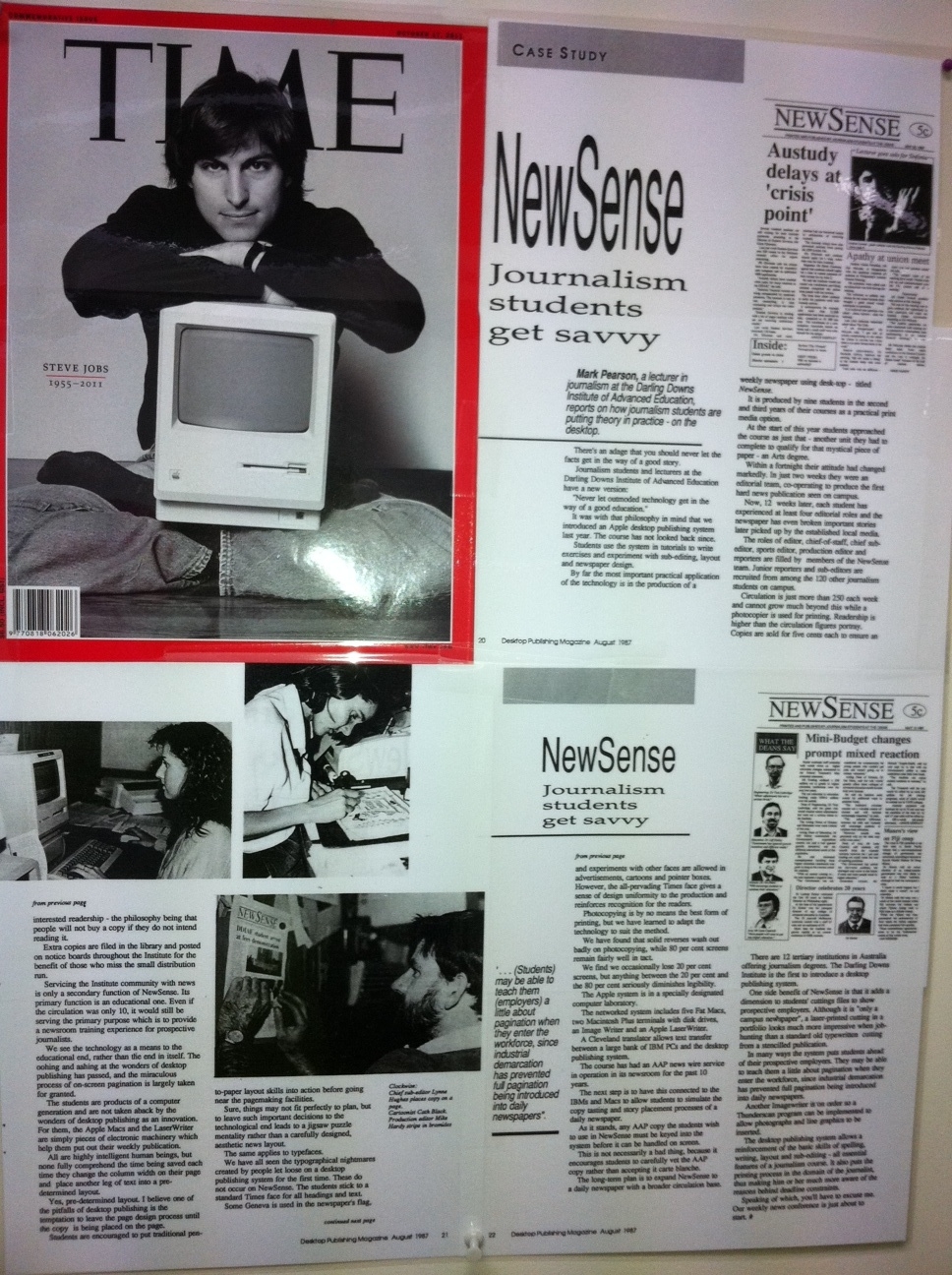
The Time cover pic of Jobs with the 1987 NewSense article

By MARK PEARSON

RIP Steve Jobs. I just laminated the Time magazine cover from October 17, 2011, depicting Jobs sitting on his lounge room floor in 1984, nursing an early Macintosh computer.

As you can see from the image, I’ve also laminated an August 1987 story I wrote for Desktop Publishing Magazine chronicling our experiences launching one of the first university journalism student newspapers using Macs.

I left the national daily The Australian to start my academic career just on a quarter of a century ago next month – at the end of 1986. Earlier that year I had attended an Apple marketing seminar in North Sydney where I was introduced to the magic of desktop publishing on PageMaker from within that tiny box – which appears quite large by today’s iPad standards.

Not long after working with my students to create our desktop newsletter I returned to The Australian to show the editor our creation. “It’ll never take off,” he told me. “It’s Mickey Mouse. Look at those fuzzy edges on the headlines – it just doesn’t look professional enough.” Little did he realise it heralded the start of the greatest challenge newspapers had faced.

Graduates from that program started their successful careers a step ahead of their industry colleagues – and many have remained at the cutting edge ever since.

For the historical record and as a tribute to Steve Jobs, to those students in my first journalism class, and in memory of my late colleague Dr Charles Stuart who initiated the project – I reproduce that article here today. I still have on my filing cabinet the mounted pair of white shoes those students gave me when I left that institution the following year to join the foundation staff here at Bond University. Why the white shoes? Well that’s another very Australian story. Enjoy.

————–

Desktop Publishing Magazine, August 1987: pp. 20-22

Case Study: NewSense – Journalism students get savvy

Mark Pearson, a lecturer in journalism at the Darling Downs Institute of Advanced Education, reports on how journalism students are putting theory into practice – on the desktop…

There’s an adage that you should never let the facts get in the way of a good story.

Journalism students and lecturers at the Darling Downs Institute of Advanced Education have a new version: “Never let outmoded technology get in the way of a good education.”

It was with that philosophy in mind that we introduced an Apple desktop publishing system last year. The course has not looked back since.

Students use the system in tutorials to write exercises and experiment with sub-editing, layout and newspaper design.

By far the most important practical application of the technology is in the production of a weekly newspaper using desk-top – titled NewSense.

It is produced by nine students in the second and third years of their courses as a practical print media option.

At the start of this year students approached the course as just that – another unit they had to complete to qualify for that mystical piece of paper – an Arts degree.

Within a fortnight their attitude had changed markedly. In just two weeks they were an editorial team, co-operating to produce the first hard news publication seen on campus.

Now, 12 weeks later, each student has experienced at least four editorial roles and the newspaper has even broken important stories later picked up by the established local media.

The roles of editor, chief-of-staff, chief sub-editor, sports editor, production editor and reporters are filled by members of the NewSense team. Junior reporters and sub-editors are recruited from among the 120 other journalism students on campus.

Circulation is just more than 250 each week and cannot grow much beyond this while a photocopier is used for printing. Readership is higher than the circulation figures portray. Copies are sold for five cents each to ensure an interested readership – the philosophy being that people will not buy a copy if they do not intend reading it.

Extra copies are filed in the library and posted on notice boards throughout the Institute for the benefit of those who miss the small distribution run.

Servicing the Institute community with news is only a secondary function of NewSense. Its primary function is an educational one. Even if the circulation was only 10, it would still be serving the primary purpose which is to provide a newsroom training experience for prospective journalists.

We see the technology as a means to the educational end, rather than the end in itself. The oohing and aahing at the wonders of desktop publishing has passed, and the miraculous process of on-screen pagination is largely taken for granted.

The students are products of a compuer generation and are not taken aback by the wonders of desktop publishing as an innovation. For them, the Apple Macs and the LaserWriter are simply pieces of electronic machinery which help them put out their weekly publication.

All are highly intelligent human beings, but none fully comprehend the time being saved each time they change the column width on their page and place another leg of text into a pre-determined layout.

Yes, pre-determined layout. I believe one of the pitfalls of desktop publishing is the temptation to leave the page design process until the copy is being placed on the page.

Students are encouraged to put traditional pen-to-paper layout skills into action before going near the pagemaking facilities.

Sure, things may not fit perfectly to plan, but to leave such important decisions to the technological end leads to a jigsaw puzzle mentality rather than a carefully designed, aesthetic news layout.

The same applies to typefaces.

We have all seen the typographical nightmares created by people let loose on a desktop publishing system for the first time. These do not occur on NewSense.  The students stick to standard Times face for all headings and text.

Some Geneva is used in the newspaper’s flag, and experiments with other faces are allowed in advertisements, cartoons and pointer boxes. However, the all-pervading Times face gives a sense of design uniformity to the production and reinforces recognition for the readers.

Photocopying is by no means the best form of printing, but we have learned to adapt the technology to suit the method.

We have found that solid reverses wash out badly on photocopying, while 80 per cent screens remain fairly well in tact.

We find we occasionally lose 20 per cent screens, but anything between the 20 per cent and the 80 per cent seriously diminishes legibility.

The Apple system is in a specially designated computer laboratory.

The networked system includes five Fat Macs, two Macintosh Plus terminals with disk drives, an Image Writer and an Apple LaserWriter.

A Cleveland translator allows text transfer between a large bank of IBM PCs and the desktop publishing system.

The course has had an AAP news wire service in operation in its newsroom for the past 10 years.

The next step is to have this connected to the IBMs and Macs to allow students to emulate the copy tasting and story placement processes of a daily newspaper.

As it stands, any AAP copy the students wish to use in NewSense must be keyed into the system before it can be handled on screen.

This is not necessarily a bad thing, because it encourages students to carefully vet the AAP copy rather than accepting it carte blanche.

The long-term plan is to expand NewSense to a daily newspaper with a broader circulation base. There are 12 tertiary institutions in Australia offering journalism degrees. The Darling Downs Institute is the first to introduce a desktop publishing system.

One side benefit of NewSense is that it adds a dimension to students’ cuttings files to show prospective employers. Although it is “only a campus newspaper”, a laser-printed cutting in a portfolio looks much more impressive when job-hunting than a standard old typewritten cutting from a stencilled publication.

In many ways the system puts students ahead of their prospective employers. They may be able to teach them a little about pagination when they enter the workforce, since industrial demarcation has prevented full pagination being introduced into daily newspapers.

Another Imagewriter is on order so a Thunderscan program can be implemented to allow photographs and line graphics to be inserted.

The desktop publishing system allows a reinforcement of the basic skills of spelling, writing, layout and sub-editing – all essential features of a journalism course. It also puts the printing process in the domain of the journalist, thus making him or her much more aware of the reasons behind deadline constraints.

Speaking of which, you’ll have to excuse me. Our weekly news conference is just about to start.

© Mark Pearson 1987 and 2011

Disclaimer: While I write about media law and ethics, nothing here should be construed as legal advice. I am an academic, not a lawyer. My only advice is that you consult a lawyer before taking any legal risks.

2 Comments

Filed under Uncategorized

My top five media law topics for country newspaper editors

By MARK PEARSON

Address to the annual conference of the Queensland Country Press Association at Palm Meadows Radisson, Gold Coast, October 15, 2011.

Big city newspaper editors might perceive their provincial peers as ‘oh so last century’, but their country cousins have the basic ingredients to outlast most other print media in the Web 2.0 era.

The 21st century publishing environment is all about niche markets with a strong sense of community – real and virtual. And country newspapers already have that in spades.

But the Internet and social media present legal traps a 1980s provincial newspaper journalist could never have imagined.

These are my top five.

  1. You’re liable wherever you’re downloaded. It’s old news now that Australia’s High Court was the first to decide that you could be sued wherever your material is downloaded in the 2002 case of Dow Jones v. Gutnick. But the message has still not gotten through to many editors and journalists who continue to think locally when their defamation and contempt is actually sailing through the ether to litigants and prosecutors in other jurisdictions. It moots for small country newspapers keeping their news in their print edition – at least you can contain your circulation to just one or two jurisdictions that way and your parent company won’t be sued or charged somewhere else over your online oversight. That goes for contempt, defamation, breach of suppression orders and other reporting restrictions in other states and territories. (It might also add value to your print edition if readers know they can read all that saucy material about over-the-border happenings in your small local newspaper.)
  2. Your website keeps you liable – take it down and boost the value of your print archives. There are, of course, all sorts of reasons why you want a Web or social media presence for your printed provincial newspaper. But you might think twice about leaving your news publicly available for too long after publication. That’s because if you leave the material on your servers it might be considered ‘republished’ each time it is downloaded, as Kiwi lawyer Steven Price has advised. Australia’s limitation period for defamation law suits is one year – but the clock starts ticking again every time someone downloads the story so you finish up having permanent liability if you leave it searchable within your site. This new permanence of stored material also creates problems for digital archives – as lawyers Minter Ellison have pointed out. Be especially careful not to link current matters – particularly court stories – to previous coverage. The best approach is to take all steps to withdraw any dubious material as soon as possible. If others choose to forward or republish your defamatory material, it has hopefully become their problem rather than yours.
  3. In Australia, you’re liable for the comments of your ‘friends’ and correspondents. Some countries like the US offer publishers and bloggers complete immunity from the comments of others on their sites, and Internet Service Providers get some protection in most Western democracies. But you will normally be required to take offensive or illegal material down once it has been brought to your attention. That’s certainly the case in Australia. Earlier this year an Australian Federal Court found a health company was responsible for Facebook and Twitter comments by fans on its account in defiance of a court order that the company not make misleading claims about its allergy treatments. The court ruled that the company should have taken steps to remove the comments as soon as it had become aware of them, as Addisons Lawyers explained. For country newspaper editors, this is a good argument for treating your website forums just like your good old fashioned letters pages – and vetting comments very carefully for legal issues before you post them. Moderate before publishing. Facebook makes this harder, but at the very least you should be deleting risky comments the instant they are posted. Queensland Police learned that lesson earlier this year when there was a spate of prejudicial comments from citizens about suspects on their Facebook wall. And just last week the Queensland Supreme Court ordered Google to reveal the identity of those behind a website defaming a Gold Coast entrepreneur and motivational speaker.
  4. ‘Pssst … off the record … source confidentiality is dead’. Much has been made of Australia’s new federal shield laws allowing journalists and bloggers to protect their confidential sources. For a start, it only applies to Commonwealth and NSW cases, and even there the courts still have a discretion to force journalists to reveal their sources if there is a greater public interest in the question being answered. But really, who can hope for any real level of confidentiality or secrecy in their dealing with sources in the modern era? The new surveillance regime means both the journalist and the whistleblower are traceable via a combination of technologies – phone calls, emails, location tracking, social media tagging and check-ins, and CCTV cameras to name just a few. It doesn’t take much for an organization or a government agency to be able to put two and two together to work out who was in communication with a reporter at a certain point in time. Even Bernstein and Woodward would have a hard time keeping Deep Throat confidential in 2011 with the phones in their pockets betraying their movements and the security cameras in the public park recording their secret rendezvous. Your top investigative reporters for national and international media outlets may have techniques to navigate all this, but I’d suggest your average provincial reporter deal with their sources on a strictly ‘on the record’ basis.
  5. Your copyright … get over it! Intellectual property law can get seriously nasty and complex, so I certainly wouldn’t recommend country newspaper editors ramping up their plagiarism of the work of others or cut-and-pasting web-based material into your own stories. While there are generous defences available in fair dealing for the purposes of news, commentary and parody, you’d need an IP lawyer to tell you whether you are working within them. But in this rampant international free exchange of information you’re sending all the wrong messages when if you try litigation to pursue your own organisation’s copyright in your news material. US newspaper group the Denver Post has ended up with egg on its face after outsourcing its IP litigation to a so-called ‘copyright troll’ called Righthaven. Their pursuit of small players for thousands of dollars in damages has backfired and looks like costing them dearly in reimbursements, lawyers’ fees and bad PR. Unless you are part of a large group taking on the blatant commercial pirating of your IP by another major operator, I think you’d be best focusing your attention on building your print and online markets by being first with the local news that matters. If someone steals your material afterwards, send them a letter politely asking for acknowledgment. Better to be a caring and sharing corporate citizen in your town than the ogre that takes the locals to court.

© Mark Pearson 2011

Disclaimer: While I write about media law and ethics, nothing here should be construed as legal advice. I am an academic, not a lawyer! My only advice is that you consult a lawyer before taking any legal risks.

1 Comment

Filed under Uncategorized

Update: FIVE Australian media inquiries at once: your guide to the mayhem

By MARK PEARSON

N.B.: ACMA privacy inquiry added as #5 below.

There are five major federal inquiries into Australian media regulation under way, with considerable duplication of their terms of reference.

The technological challenges of convergence and international concern over journalists’ privacy intrusion are informing the debate about the issues and will likely shape their outcomes.

The five simultaneous reviews have caused a duplication of time, effort and resources for those facing the consequences of their outcomes. Interested parties might need to file up to nine submissions covering the issues papers already released and also appear at the various hearings.

I am summarising the key elements of each of the five here for the benefit of journalists, lawyers and researchers who, like me, are confused by this national inquiry-fest on a multiple fronts.

The inquiries (with hyperlinked URL), their terms of reference, issues papers, and submission deadlines are as follows:


1. Convergence Review

The Australian Government’s Convergence Review of the regulation of media and communications was announced in December 2010.

  • Its terms of referencerequire it to review the current policy framework for the production and delivery of media content and communications services in the light of convergence and:
    • develop advice for the government on the appropriate policy framework for a converged environment;
    • advise on ways of achieving it, including implementation options and timeframes where appropriate; and
    • advise on the potential impact of reform options on industry, consumers and the community.

It also has to inquire into and advise on:

  • whether the existing regulatory objectives remain appropriate in a converging environment; and
  • if so, whether the regulatory approach embodied in the current policy framework remains the most effective and efficient, and
  • its preferred alternative regulatory or non-regulatory measures to form a new framework and the principles that will underpin it.

It is required to ensure that media and communications services are provided within an environment that fosters competition, is technology-neutral, encourages a diversity of voices, and protects Australian culture, community values and citizens’ rights.

On September 19, the review released five issues papers addressing:

Submissions close on October 28. The Convergence Review’s report is due by the end of March 2012.


2. Independent Media Inquiry

The Independent Media Inquiry was announced on September 14 (supplementary to the Convergence Review) to provide a “separate and distinct examination of the pressures facing newspapers, online publications and their newsrooms, as well as the operation of the Australian Press Council”. It is due to report by February 28, 2012. Its terms of reference require it to examine:

  • the effectiveness of the current media codes of practice in Australia, particularly in light of technological change that is leading to the migration of print media to digital and online platforms;
  • the impact of this technological change on the business model that has supported the investment by traditional media organisations in quality journalism and the production of news, and how such activities can be supported, and diversity enhanced, in the changed media environment;
  • ways of substantially strengthening the independence and effectiveness of the Australian Press Council, including in relation to online publications, and with particular reference to the handling of complaints;
  • any related issues pertaining to the ability of the media to operate according to regulations and codes of practice, and in the public interest.

On September 28, the inquiry released an issues paper detailing its priorities. Submissions are due by October 31.


3. National Classification Scheme review

The Attorney-General asked the Australian Law Reform Commission on March 24 to investigate the National Classification Scheme and review:

  • existing Commonwealth, State and Territory classification laws;
  • the current classification categories contained in the Classification Act, Code and Guidelines;
  • the rapid pace of technological change;
  • the need to improve classification information available to the community;
  • the effect of media on children; and
  • the desirability of a strong content and distribution industry in Australia.

It released a Discussion Paper on September 30, and has called for online submissions by November 18. The discussion paper notes that news and current affairs are likely to be exempt from any classification regime. The ALRC’s report is due by January 30, 2012.


4. Commonwealth Government’s Privacy Issues Paper

The Australian government finally released a Privacy Issues Paper on September 22 addressing recommendations for a new statutory tort of privacy proposed by the Australian Law Reform Commission in its 2008 report Report 108: For Your Information: Australian Privacy Law and Practice (2008).

The paper asks:

  • whether new technologies create a need for new laws to protect privacy;
  • whether there should be a statutory cause of action for serious privacy invasion;
  • what standards should apply;
  • how other interests should be balanced (particularly free expression);
  • what defences should apply; and
  • several other questions related to any implementation of a new tort.

Submissions are due by Friday, November 4.


**UPDATE: 5. The Australian Communications and Media Authority (ACMA) Review of privacy guidelines for broadcasters IFC28/2011

The ACMA is reviewing the privacy and intrusion provisions of its various broadcasting industry codes of practice. Its original guidelines were introduced in 2005, and this is their first review.

It has released reviewed guidelines for comment in Word (286 kb) and PDF (230 kb) formats, suggesting new provisions relating to privacy intrusion and stories involving vulnerable people and children.

Its recommendations are based upon its commissioned research reports Community research into broadcasting and media privacy (2011) and Australians’ views on privacy in broadcast news and current affairs (2011).

It states it has considered:

  • the relevant provisions of the broadcasting codes of practice
  • the ACMA’s broadcasting investigations concerning privacy since August 2005
  • qualitative and quantitative research into attitudes to privacy, commissioned by the ACMA between May and September 2010
  • the Australian Law Reform Commission’s report 108 For Your Information: Australian Privacy Law and Practice
  • developments in the law.

Submissions are due by October 7, so act fast if you have a comment!

Clear as mud now? I’m looking forward to reading your submissions. 😉

© Mark Pearson 2011

Disclaimer: While I write about media law and ethics, nothing here should be construed as legal advice. I am an academic, not a lawyer! My only advice is that you consult a lawyer before taking any legal risks.

4 Comments

Filed under Uncategorized

Judges and social media – lessons from the Canadian CJ’s oration: #law

By MARK PEARSON

My journalism law students were treated to a rare excursion in their first week of semester last Thursday (September 15) when we took the train to Brisbane to hear Canadian Chief Justice Beverley McLachlin speak on ‘Courts and the Media’.

It was the annual Supreme Court Oration, hosted by Queensland Chief Justice Paul de Jersey who my students heard speak on a similar topic in February this year at Bond University.

Chief Justice de Jersey has been a pioneer in embracing new technologies and advancing open justice and has allowed journalists’ recording of proceedings for accuracy purposes (not broadcast) as the default position in Queensland courts.

He gave us advance approval to report McLachlin CJ’s oration via a live Twitter feed to the #cjcqld stream which some of you might have followed.

It was a superb introduction to the subject for my students, as McLachlin CJ traced the basic principles of open justice and assessed the best and worst aspects of the relationship between the judiciary and the media.

It was interesting that the speech seemed to receive no media coverage – or at least none that I can find over the past week – so our Twitter feed seems to be the only record of the speech until the Chief Justice’s staff process and release the full text after her return to Canada.

I have republished all my own tweets from the speech below for your gratification. I deleted my students’ tweets simply because I wanted to get this blog posted and would want to seek their permission before posting them, but you might find them by searching for the #cjcqld hashtag within Twitter. (The tag stands for “Chief Justice of Canada in Queensland” but coincidentally echoes the acronym of a former anti-corruption body in this state – the Criminal Justice Commission.)

You can get the gist of the oration from the tweets below, but here I wanted to draw your attention to the only tweet where I editorialised on the Chief Justice’s comments.

It came at a point where she was questioning whether accuracy and fairness in the reporting of court proceedings would suffer in the era of new technologies and social media.

I tweeted: “McLachlin CJ: How can 140 characters of Twitter report a complex High Court case effectively? #cjcqld (Like this, CJ!)”

The chief justice admitted on several occasions during her insightful address that she did not claim expertise in new technologies – particularly social media.

But this particular comment proved the point. We proved it was quite feasible to report her oration via Tweets posted to a hashtag where anyone following could take in the complexities of her argument, albeit in bite-sized capsules.

We do not claim to be trailblazers – conference presentations are being covered via hashtags on Twitter throughout the world as you read this.

The same approach can quite easily apply to a complex court case, and has indeed already been allowed, pioneered here in Australia by a Federal Court judge in the iiNet piracy case in Sydney two years ago.

Picking up on this small point might appear pedantic, and certainly no disrespect to McLachlin CJ is intended.

I am in awe of the level of specialist knowledge senior judges need to absorb in almost every case in the modern era. They need to come to grips with the most technical aspects of obscure areas of the law, along with much of the expert knowledge so crucial to understanding the context of the facts and expert witness testimony in a host of areas.

New technology presents yet another challenge for them in what is already a daunting learning curve.

As Reuters has reported, US Supreme Court Justice Stephen Breyer set up both Facebook and Twitter accounts, which he used to monitor discussion rather than participate himself. But Justice John Roberts was reported in the Huffington Post in June this year admitting he did not even know what a tweet was.

Slate has followed the debate in the judiciary over the use of social networking.

Given the rate of uptake of social media in its various forms globally over the past five years, it is worrying that some leading judges in our highest courts remain relatively ignorant of its basic functions and applications.

We cannot expect them to become instant experts on everything, but they at least need to have a working lay knowledge of new technologies if we are to remain confident that they will make informed decisions when legal issues arise.

Disclaimer: While I write about media law and ethics, nothing here should be construed as legal advice. I am an academic, not a lawyer! My only advice is that you consult a lawyer before taking any legal risks.

© Mark Pearson 2011
 

@journlaw tweets of Canadian Chief Justice Beverley McLachlin’s Supreme Court of Queensland Oration on Thursday, September 15, 2011:

Canadian CJ Beverley McLachlin about to speak on ‘Courts and the Media’ in Brisbane. Coverage at #cjcqld

Qld CJ de Jersey introducing Canadian CJ McLachlin: Canada: ‘that other great democracy of the northern hemisphere’ #cjcqld

McLachlin CJ: court-media relationship not always comfortable: sometimes concentrate on prurient and sensational #cjcqld

McLachlin CJ: free press and independent judiciary combine to foster the rule of law. Media helps build confidence in judiciary #cjcqld

McLachlin CJ: “public confidence in the judiciary is essential to the rule of law” #cjcqld

McLachlin CJ: speaking about the Rule of Law Index and what it says about nations’ cultural acceptance of rule of law #cjcqld

McLachlin CJ: judiciary’s power rests in the confidence of the people #cjcqld

McLachlin CJ: fundamental to building confidence is to publicise what the courts and justice do. #cjcqld

McLachlin CJ: open justice helps educate the public and ensure judges’ accountability and has a therapeutic function #cjcqld

McLachlin CJ: qld cj is leading champion of open justice #cjcqld

McLachlin CJ: open courts principle works because of the media … the means of communicating proceedings to the public at large #cjcqld

McLachlin CJ: paradoxically media also uniquely placed to undermine public confidence in judiciary #cjcqld

McLachlin CJ: gives Canadian child pornography decision where media focussed on judge rather than issues. #cjcqld

McLachlin CJ: sensationalised media trials run parallel to courtroom trials #cjcqld

McLachlin CJ: Uses example of media coverage of Casey Anthony trial and impact on Florida justice system implying jury got it wrong. #cjcqld

McLachlin CJ: they promoted the tv verdict over the court verdict #cjcqld

McLachlin CJ: Where justice is sensationalised or trivialised the damage to confidence can be profound #cjcqld

McLachlin CJ: need to encourage fair and accurate coverage. Restricting info won’t work #cjcqld

McLachlin CJ: Holding reporters in contempt won’t build confidence either #cjcqld

McLachlin CJ: needs positive interactive approach to the media … Not seeing media as enemy to be avoided at all costs #cjcqld

McLachlin CJ: Court info officers play a useful role #cjcqld

McLachlin CJ: Canada has court-press liaison committee to foster positive relationships and improved coverage #cjcqld

McLachlin CJ: need coverage that is accurate, prompt and complete#cjcqld

McLachlin CJ: Canadian Executive Legal Officer has press briefings function as source of info and background briefings. 3yr term #cjcqld

McLachlin CJ: whatever cts can do to help journalists report accurately can only improve public confidence in justice #cjcqld

McLachlin CJ: Promptness vital to press. Canada has media ‘lockups’ where media allowed to arrive an hour early and read judgments #cjcqld

McLachlin CJ: third mutual interest: appropriately complete reporting of proceedings and decisions #cjcqld

McLachlin CJ: Qualified completeness because some restrictions needed on children, sexual matters etc #cjcqld

McLachlin CJ: Media technology in courts must not impact in any negative way on admin of justice #cjcqld

McLachlin CJ: TV cameras in court: gives several reasons against … Privacy, intimidation, disturbance, sensationalising #cjcqld

McLachlin CJ: But cameras also allow public to see and experience the court … Maximum open justice #cjcqld

McLachlin CJ: Canadian practice is to not allow tv cameras in trial courts, but allow stationary cameras in Supreme Court #cjcqld

McLachlin CJ: Appellate courts started to allow cameras, but networks not that interested #cjcqld

McLachlin CJ: closing on cautionary note: identifying which media to work with is becoming more difficult as social media takes off #cjcqld

McLachlin CJ: Profound cultural shift in how media is communicate signals shift in who reports court proceedings #cjcqld

McLachlin CJ: anyone with a keyboard and a blog can report their version of a court case and who is to say they shd not? #cjcqld

McLachlin CJ: blogs not always objective or thoughtful and sometimes hurtful. Will accuracy and fAirness be casualties of new era? #cjcqld

McLachlin CJ: How can 140 characters of Twitter report a complex High Court case effectively? #cjcqld (Like this, CJ!)

McLachlin CJ: “It is crucial we understand the technology and how it is being used.” “Personally, I struggle with it” #cjcqld

McLachlin CJ: relationship betwn crts and media “is one of inescapable interdependence” #cjcqld

McLachlin CJ: The media and the courts are locked in a sometimes uncomfortable embrace. #cjcqld

McLachlin CJ: “What is at stake is nothing less than the rule of law.”#cjcqld

Bond student @fionaself asked about the impact of social media on defamation. CJ: should be no relaxation in law for new media. #cjcqld

McLachlin CJ: Talks about the prickly issue of defamation via hyperlinks … Doesn’t know how it will be decided. #cjcqld

McLachlin CJ: We do not have a court blog. Consensus in Canada is that judges should not be on Facebook, but some pushing boundaries #cjcqld

Applegarth, J. asks whether instant access to transcripts shd be available via live streaming. She says maybe but cautious re impact#cjcqld

McLachlin CJ: Juries researching on web … We hope juries will follow instructions not to. Problems in jurors contacting accused #cjcqld

Q on judges becoming celebrities like Judge Judy. McLachlin CJ: Canada being what it is, I’m not a celebrity and am not recognised. #cjcqld

McLachlin CJ: “Courts are there to serve the public so they have to account to the public.” #cjcqld

McLachlin CJ oration has ended and so has our live Twitter stream. Thanks for following! : #cjcqld


1 Comment

Filed under Uncategorized

Why the Australian Government’s media inquiry is fraught

By MARK PEARSON

The Federal Government’s announcement of an ‘independent inquiry into the Australian media’ yesterday might well be a positive development if it were not politically driven, confused in its objectives and artificially narrow in its focus on the print media alone.

A ripple effect from the UK News of the World scandal combined with the machinations of a minority Australian Labor government to trigger this new inquiry, billed as a subsidiary of the existing Convergence Review of telecommunications and broadcast media regulation.

While it is described as ‘independent’ – chaired by retired judge Ray Finkelstein QC ‘assisted’ by University of Canberra journalism professor Matthew Ricketson – it has set off my press freedom alarm bells for other reasons.

Those individuals are excellent choices, but sadly the politician who announced it – the Minister for Broadband, Communications and the Digital Economy Stephen Conroy – has ‘form’.

He has long been the vocal advocate of an Internet filtering scheme for Australia and has only been prevented from introducing such an unworkable vehicle of web censorship by his lack of numbers in the existing Parliament.

Further, he has been at war with Rupert Murdoch’s News Limited over its coverage of his government and has accused it of pressing for ‘regime change’.

Yes, Prime Minister’s Sir Humphrey Appleby advised: ‘Never hold an inquiry unless you know what its outcomes will be’. If the minister’s advisers are working to that script, then media freedom advocates might well be worried.

While Senator Conroy announced the inquiry will focus on newspapers and their online operations, the terms of reference promise much broader objectives.

Focussing on the print media seems at odds with the overarching Convergence Review, particularly if other media and their codes of practice are not going to get the same level of attention as their newspaper cousins.

The terms of reference of this new media inquiry require it to report upon:

a) The effectiveness of the current media codes of practice in Australia, particularly in light of technological change that is leading to the migration of print media to digital and online platforms;

b) The impact of this technological change on the business model that has supported the investment by traditional media organisations in quality journalism and the production of news, and how such activities can be supported, and diversity enhanced, in the changed media environment;

c) Ways of substantially strengthening the independence and effectiveness of the Australian Press Council, including in relation to on-line publications, and with particular reference to the handling of complaints;

d) Any related issues pertaining to the ability of the media to operate according to regulations and codes of practice, and in the public interest.

These are important issues and worthy of considered investigation, but it is hard to see how an examination of the print media in isolation can resolve them. If there is a News of the World style of tabloid journalism in operation in Australia, you will find it in the two main commercial television networks’ evening ‘current affairs’ programs – Today Tonight and A Current Affair – not in genuine journalism and not in the print media.

There is a mishmash of in-house and industry codes of practice in operation as well as the Press Council’s Statement of Principles and the iconic but rarely enforced Media Alliance Journalists’ Code of Ethics.

Their review and a move to uniformity would be relatively easy. Most cover common values and ethical principles.

But the problem is not in their wording but in their dissemination and enforcement.

Most journalists operate under three such codes simultaneously – their own corporation’s code, an industry code, and the broader journalists’ code. Test any reporter on all three and my guess is they would fail dismally.

Your average citizen knows even less and does not really know where to file a complaint if they have one.

An important Press Council function has been the referral of complaints to other relevant bodies because they relate to different media or the behaviour of individual reporters rather than the outlets themselves.

The Press Council has done some great work over many years, particularly in its sponsorship of research and in its representations to parliamentary inquiries. But despite ramping up its complaints mechanisms it still cops cynical clichéd animal metaphors to describe its efforts, labels like ‘toothless tiger’ and ‘publisher’s poodle’.

Like much humour they are based on some truth, with the Council’s maximum penalty as a self-regulatory body being a request to the publication to publish its adverse finding, and its publisher-based funding raising questions about its independence. Funds have been slashed in recent years, as I have reported in The Australian.

The Council’s fundamental problem is that it has tried to be both an advocate of press freedom and an adjudicator of complaints against newspapers. While it has performed both tasks remarkably well with scant resources, it will be forever open to criticism until that dichotomy is addressed.

Its new chairman Professor Julian Disney is well aware of the problem and has been actively pressing for more funding and a cross-media regulatory role.

However, his expressed hope this week that the inquiry might lead to government funding should sound shrill alarm bells.

At what point does a government-funded body lose its ‘self-regulatory’ status? Would government funding of the Press Council trigger new animal metaphors as critics question the link between the government of the day and its self-regulatory decisions?

Perhaps ‘Labor’s lapdog’, the ‘Coalition’s fat cat’ or the ‘Greens’ gerbil’?

Seriously, though, there are some effective models for government funding of truly independent enterprises without government interference. The ABC is one that has worked relatively well for almost 80 years, although its board nominations and programming decisions have sometimes been questioned.

There are already hundreds of laws controlling the media in this country. I have built my research and publishing career around teaching and writing about them. We already have a government-funded regulator in the ACMA.

And we already have a government-funded self-regulator in the ABC’s Media Watch program. For mine, it is the most effective and best known of them all.

Instead of more regulation of the media, we need better public access to the complaints and legal mechanisms that already exist.

A better public ‘spend’ than greater regulation would be on more in-service training of journalists in sound legal and ethical practice, school and public education campaigns about media responsibility, and the establishment of media complaints referral services.

Government funding of self-regulatory bodies is a slippery slope and, despite its eminent leadership, this inquiry carries way too much baggage to inspire confidence.

© Mark Pearson 2011

Disclaimer: While I write about media law and ethics, nothing here should be construed as legal advice. I am an academic, not a lawyer! My only advice is that you consult a lawyer before taking any legal risks.

1 Comment

Filed under Uncategorized

Ancient lèse majesté laws an anachronism in the cyber era

By MARK PEARSON

Australian writer Harry Nicolaides was about to board the midnight flight from Bangkok to Melbourne on August 31, 2008 for a job interview with a major hotel group.

Officers approached him at passport control and he was then arrested and interrogated.

He recounted in The Monthly what happened next:

“In a dark, damp cell I stripped off my clothes and laid them on the floor, fashioning a bed with my shoes as a pillow. Sleep was impossible: I was thirsty and hungry, confused and alone.

“In the morning I made a short court appearance, before being handcuffed and shuffled onto an overcrowded prison bus bound for the Bangkok Remand Prison.”

Nicolaides was carrying no drugs or firearms and was not laundering money for international crime syndicates. As I wrote in The Australian at the time, his crime was that he had written a just few sentences deemed to be insulting to Thailand’s crown prince in a self-published work of fiction that had sold just a handful of copies.

Those words typed on a computer keyboard earned him a traumatic six month stay in an overcrowded ‘Bangkok Hilton’ as he tried to navigate court appearances and brief lawyers and diplomats trying to negotiate his freedom. He was ultimately released on a royal pardon.

Welcome to the law of lèse majesté – a crime dating back to Ancient Rome punishing a range of behaviours seen as insulting to a sovereign.

Other nations have lèse majesté laws or similar. Journalist Bashar Al-Sayegh spent three days in jail in 2007 just because someone else had posted insulting comments about the emir of Kuwait on his website. And Australian woman Nasrah Al Shamery spent five and a half months in prison in the same country in 2009 because she had allegedly insulted the emir during an argument in an airport terminal.

Brunei, Denmark, Netherlands, Spain and Morocco also have lèse majesté and each has used them to prosecute insults to their royal families in recent years.

Poland, Germany, Switzerland, the Maldives, Egypt, Syria, Kazakhstan, Belarus, Zimbabwe and Greece have crimes related to the denigration of heads of state of foreign countries or their own. They have been used several times this century, as the BBC has reported.

But the country most active in its lèse majesté prosecutions has been Thailand, a nation with an otherwise free and vibrant media.

As many as 100 people a year have been charged with the offence there in recent years, with several unsuspecting foreigners languishing in jail because of their published criticisms of royalty. US-Thai resident Joe Gordon from Colorado was formally charged in August after being detained for 84 days on a charge of translating an unauthorised biography critical of the king.

The prosecutions are so harsh and random that foreign academic experts who have criticized the law have decided not to visit Thailand for fear of arrest over their publications and statements.

US academic David Streckfuss has written a book on the issue and has criticised the political nature of the charge in the modern era, describing it as anachronistic and “a tawdry and naked attempt to use the institution to suppress views”.

He has called for its use only with the king’s consent because it directly contradicts the Thai constitution’s guarantee of free expression.

“Otherwise, the lèse majesté law in Thailand will ever be ready at hand to serve as a weapon in the political arena, always to the detriment of the institution the law intends to protect,” he wrote.

The critics point out that it is not the monarchy itself that pursues the lèse majesté charges, but rather the government of the day via its agencies.

Thailand has a complex political structure, with democracy, the military and royalty all in the mix. Its citizens have such a strong devotion to the royal family that lèse majesté arrests can be used as political devices to win popular support for those pressing the charges.

In an era of globalised products and a certain sameness about many travel experiences we celebrate distinctive cultural differences about countries like Thailand.

But sometimes we must take an international stand against laws that are depriving both the citizens of these countries and visiting foreigners of their liberty because something they have written or said has been targeted for political purposes.

In the meantime, if you are an author, academic, blogger or journalist who has written about lèse majesté – or, worse still, if you have criticised the monarchy in any of these countries – you should review your next travel itinerary carefully. Like Harry Nicolaides, you might not rate your stay at the ‘Bangkok Hilton’ very highly.

© Mark Pearson 2011

Disclaimer: While I write about media law and ethics, nothing here should be construed as legal advice. I am an academic, not a lawyer! My only advice is that you consult a lawyer before taking any legal risks.

1 Comment

Filed under Uncategorized

Why I just wrote my last #LinkedIn recommendation

The trendy online reference seems flawed – both professionally and legally.

By MARK PEARSON

I see it as an important responsibility of my position as a professor to act as a referee for my former students and colleagues when they are job hunting.

I stopped writing formal general references many years ago because the practice seemed to have lost almost all credibility with employers.

Instead, I now agree to be a ‘referee’ and will only write a formal reference when an employer requests one.

But over the past couple of years I have been getting more requests for ‘recommendations’ from my connections on the social-professional network LinkedIn.

Not wanting to offend my former students and colleagues, I have obliged. Until now. I’ve investigated it further and have just written my final LinkedIn recommendation.

There are all the standard HR reasons why such recommendations are not worth a pinch of salt: they are time consuming, too general, and always glowing.

In 2009, Silicon Valley web strategist Jeremiah Owyang described LinkedIn recommendations as ‘puffery’.

“When I see recommendations on LinkedIn, my alarm goes off,” he blogged.

“I know most are not objective.”

LinkedIn responded to his criticisms on their official blog, with Adam Nash highlighting the benefits that can come from recommendations. He claimed the process could be mutually rewarding for the recommender and recommendee.

Perhaps so, but others have explored the employment law issues of the practice.

Employment attorney Shay Zeemer Hable offers a host of reasons why such references are fraught in labor law – with claims of defamation and unfair dismissal heading the list.

“Every discrimination plaintiff seeks to prove his employer is lying about the reason for the firing,” he writes.

“As a result, savvy attorneys will search the Internet for any comment that is inconsistent with the company’s official message about the reason for the termination.

But the area that concerns me most is defamation.

It’s not because of the risk of defaming the person you are recommending. My understanding is that they have to approve your recommendation before posting it, so I can’t imagine someone letting a disparaging comment slip through.

My concern is more with the impact of a glowing LinkedIn recommendation on the defamation defence you need to protect your harsh comments in the real reference you give later.

What happens if you later contradict your original glowing recommendation in your frank verbal or written advice to the employer when they contact you about this person you have recommended?

Australian law provides a strong qualified privilege defence for the negative job reference -restricted to those who have a genuine legal interest in knowing the your truthful opinion about a prospective employee.

But, as the Legal Services Commission of South Australia explains, it requires the ‘publisher’ – he or she who has written the reference – to have acted in good faith and without malice. You also need to believe in the truth of the material you are providing about the individual.

That could be damaged in a major way if the plaintiff can point to your contradictory glowing recommendation on LinkedIn, particularly if it covers the same aspects of their character.

A court would be hard pressed to find you have acted in good faith if you have offered conflicting versions of your opinion about the employee in separate ‘publications’. Exactly when were you giving your honest opinion?

I might be drawing a long bow here – and perhaps some readers can point me to some cases where this has been tested – but for the moment I certainly won’t be writing any more LinkedIn recommendations, and I will be directing my colleagues and students to this blog to read my reasons.

I’d be interested to hear your views.

© Mark Pearson 2011

Disclaimer: While I write about media law and ethics, nothing here should be construed as legal advice. I am an academic, not a lawyer. My only advice is that you consult a lawyer before taking any legal risks.

1 Comment

Filed under Uncategorized