Tag Archives: law

Pressures on the media in a Western democracy #RSF #pressfreedom #censorship

By MARK PEARSON

Each year I file a report on key incidents and developments in the areas of media law and censorship as Australia’s correspondent for Reporters Without Borders.

This data, when combined with submissions from several journalism and academic colleagues in Australia and throughout the world, feeds into RSF’s annual World Press Freedom Index where most nations’ levels of media censorship are compared in a league table format.

I have just filed my 2011 report with the assistance of research assistant Kiri ten Dolle and share some of the highlights with you here, in reverse chronological order.

November 2011:

By far the most important threat to media freedoms in Australia came in the form of at least five government inquiries into media regulation conducted throughout the year, which I have blogged on previously. Between them they raised the prospects of tougher regulation regimes for print, broadcast and online media; a new tort of privacy; tough new classification systems across media; and the conversion of some self-regulatory bodies to regulatory status.  RSF was particularly concerned by suggestions at the hearings of the Independent Media Inquiry that journalists should be licensed or that the Australian Press Council should be given powers to fine media organizations for ethical breaches. See their release on the matter.

The trial of Victorian police officer Simon Artz for alleged leaks to The Australian newspaper about a counter-terrorism operation raised several media freedom issues, with Crikey senior journalist Andrew Crook allegedly breaching a suppression order by revealing the name of a former member of Victoria’s Special Intelligence Group involved in the hearing; warnings over Crikey journalist Margaret Simons live tweeting from the hearing; and The Australian’s Cameron Stewart being ordered to reveal his sources to the hearing.

In a separate matter Victorian Police were investigating an alleged hacking of an ALP electoral database by four journalists at The Age, including editor-in-chief Paul Ramage. The Age claims they received access to the private information of high-profile individuals through ‘appropriate journalistic methods’ and authorisation by a whistleblower.

October 2011

Leaks to the media were also central to a report by the Office of Police Integrity (OPI) found advisers to the Victorian police minister conspired to bring down the former police commissioner Simon Overland. Weston had allegedly leaked information to the media about Overland’s fallout with his former deputy, Ken Jones.

Government control over media access to detention centres prompted condemnation from the journalists’ union. Department of Immigration and Citizenship (DIAC) announced editorial control would be handed over to representatives of the immigration department under new guidelines introduced by DIAC that restrict reporting of and access to detention centres. Journalists and media organisations are required to sign a Deed of Agreement in accordance with the new policy which ultimately prohibits photography, film or interviews with individual detainees and rules that all footage must be submitted to department officials for approval before publication.

Defamation actions, even spurious ones, were alive and well despite uniform defamation laws introduced throughout Australia in 2005. Convicted killer Michael McGrane sought $30 million in damages from the Seven Network claiming he was defamed in a television show called “The Suspects: True Australian Thrillers”. A Queensland Supreme Court justice struck out the claim but gave McGrane leave to replead under a technical provision of the reformed laws.

The extent to which free expression should be trumped by hate speech laws was the subject of wide debate after a Federal Court judge ruled Herald Sun columnist Andrew Bolt breached the Racial Discrimination Act when he wrote that some fair-skinned people used their indigenous identity to further their careers.

September 2011

Fairfax Media group general counsel Gail Hambly and the editor-in-chief and publisher of The Sydney Morning Herald Peter Fray were summonsed by the Police Integrity Commission to produce documents on September 23 in relation to articles by the Herald journalists Linton Besser and Dylan Welch about the NSW Crime Commission. The inspector sought information about sources of information.

Fairfax Radio broadcaster Michael Smith’s contract was suspended in September when he tried to air an interview a former union official who claimed alleged fraudulent conduct by a former boyfriend of Prime Minister Julia Gillard. Smith took Fairfax Radio to court, contesting his ‘planned dismissal’ under the Fair Work Act and alleging he was victimised over his political beliefs.

August 2011

Two Brisbane journalists and a producer were dismissed by the Nine Network for faking live crosses to the Daniel Morcombe search site and ‘unfair dismissal’ litigation was foreshadowed.

July 2011

Cancer-stricken Hinch was sentenced to home detention in July after being found guilty of breaching four suppression orders by naming two sex offenders on his website and at a crime rally in 2008.

June 2011

Fairfax Media announced it would outsource the sub-editing of news, sport and business content to Pagemasters, a subsidiary of the Australian Associate Press (AAP), with a loss 44 jobs at The Sydney Morning Herald and 38 at The Age, despite calls from the NSW Upper Tribunal to abandon the decision.

May 2011

The Australian Broadcasting Corporation used a programming exemption to FOI laws to deny The Weekend Australian and Herald Sun access to its audience data and employee salaries.

Fairfax’s deputy technology editor Ben Grubb, 20, was arrested after reporting on a conference presenter’s alleged hacking at the AUSCert IT security conference. During the week, Grubb had published a story explaining a demonstration shown at the conference of acquiring private photos from a Facebook user without being a ‘friend’. Police seized his iPad but released Grubb after questioning him.

Sixty Minutes reporter Liam Bartlett and his crew’s attempt to enter the main detention centre at Christmas Island led to a police investigation. Bartlett and refugee advocate Kate Gauthier were denied access to the centre after it was alleged Gauthier’s baby, who was with them, was fitted with a recording device.

March-April 2011

Fairfax Media, publisher of the Sydney Morning Herald, and two of its senior journalists Linton Besser and Dylan Welch were issued with subpoenas by the NSW Crime Commission demanding them to surrender mobile phone records, sim cards and other communication related to an investigation of organised crime and corruption in NSW. The Crime Commission dropped the subpoenas in April.

February 2011

The NSW Supreme Court considered forcing three journalists from The Age to reveal their sources in a defamation trial centred around a story about former businesswoman Helen Liu and former defence minister Joel Fitzgibbon.

The Australian Communications and Media Authority found there had been no breach of privacy when Channel Seven’s coverage of NSW Transport Minister David Campbell’s resignation included footage of him leaving a gay club. While the ACMA acknowledged the privacy rights of Campbell, they ruled public interest outweighed his personal privacy because he was a public figure.

 ———–

Have we missed some? Please email me at journlaw@gmail.com if you think there are other important threats to free expression in Australia during 2011 and I’ll add them to our brief for RSF.

© Mark Pearson 2011

Disclaimer: While I write about media law and ethics, nothing here should be construed as legal advice. I am an academic, not a lawyer. My only advice is that you consult a lawyer before taking any legal risks.

Leave a comment

Filed under Uncategorized

Consumer law holds solution to grossly irresponsible journalism

By MARK PEARSON

Australia does not need a media tribunal with regulatory powers to punish ethical transgressions.

It already has one – in the form of the Australian Competition and Consumer Commission.

My personal submission to the Independent Media Inquiry filed last week suggests that in the era of increasingly commercialised and converged media, the best protection for responsible journalism is to punish unethical, misleading and deceptive conduct by any corporation against media consumers.

A legislative solution already exists – and just requires an amendment to the existing news organisation immunity from prosecution under the ‘misleading and deceptive conduct’ provisions  at Section 18 of the Competition and Consumer Act 2010.

My submission argues that the Federal Government could give teeth to the existing protections under Section 19 of that Act by recognising that the news media in the new era is ‘just another business’ while offering strong protection for responsible, ethical journalism inquiring into serious matters of legitimate public concern.

The most serious cases of ‘misleading and deceptive conduct’ under Section 18 of Schedule 2 of the Competition and Consumer Act 2010 – in blatant disregard of the a new ethical code detailed below and with inadequate public interest grounds – should be actionable by both the ACCC and private citizens like any other consumer complaint, with the force of the regulatory powers it already holds.

The key to this would be an amendment of the ‘prescribed information provider’ exception (Section 19) so that news organisations would no longer have the blanket, almost unchallengeable protection for misleading and deceptive conduct which was introduced after their lobbying in the late 1970s and early 1980s. (I traced the background to the provision’s predecessor under the Trade Practices Act 1974 in the Australian Journalism Review in 2001.)

Instead, it would be a rebuttable presumption that such corporations publish responsible news and current affairs material of legitimate public interest in accordance with a journalism code of practice.

In other words, they would not have to defend trivial complaints on these grounds – only those where a court has ruled there had been a clear breach of their ethical code in circumstances clearly contrary to the public interest – blatantly irresponsible ‘journalism’ committed in their content creation or publication which is clearly their stock in trade.

The reform would expose media organisations from all platforms to ACCC prosecution for heinous ethical breaches along the lines of the News of the World scandal in the UK.

Anything less than the most extreme and offensive ethical transgressions impacting detrimentally on the rights of other citizens would be handled via existing laws or self-regulatory processes because they would not meet the still high threshold to overcome the s.19 exception. In fact, frivolous proceedings on lesser transgressions could result in an award of costs against the complainant in finding that they should have followed the alternative dispute resolution avenues of the existing self-regulatory or co-regulatory bodies. (Interestingly, the ACCC already has powers to pursue corporations for ‘unconscionable conduct’ under section 20, to which the media exemption does not apply.)

The High Court recently found against a media organisation under the former Trade Practices Act in ACCC v. Channel Seven Brisbane Pty Ltd [2009] HCA 19.  That decision related to false claims on ‘Today Tonight’ about goods and services. The reform would extend this to other ethical breaches.

It is essential that media outlets and journalists conform to ethical codes. It is in their interests that they do so, because it is these very ethical standards that distinguish them from the many new voices seeking audiences in the new media environment. However, my last blog demonstrated the confusing array of self-regulatory and co-regulatory documents guiding ethical standards of journalists and their outlets in this country.

No single journalist could possibly be expected to understand and operate effectively within deadline, paying heed to all that might apply to him or her, including the MEAA Code of Ethics, an in-house code, an industry code and the related laws and formal regulations that might apply. This moots strongly for a single code of ethics applying to journalists and their employers across all media, similar to the existing MEAA Code of Ethics, addressing fundamental principles of truth, accuracy, verification, attribution, transparency, honesty, respect, equity, fairness, independence, originality and integrity, with exceptions only for matters of substantial legitimate public concern.

Of course, this could be supplemented by industry or workplace ‘information and guidance’ documents to help explain to journalists and editors the fact scenarios and precedents applying to a particular medium or specialty, along the lines of the Australian Press Council’s guidance releases.

There is already an oversupply of regulation of the media and free expression generally in this country – across all levels of government and via quasi-governmental and self-regulatory and co-regulatory bodies.

Added to this there is considerable censorship of free expression in government and the corporate sector in the form of ‘spin’ or media relations policies that carefully control the flow of information to the public via the media. It would be counter-productive at a number of levels to apply new gags on the traditional media in the Web 2.0 environment. Firstly, it would send the wrong message to the international community about Australia’s level of free expression. Secondly, it would place Australian traditional media at a competitive disadvantage to new media providers who might be based overseas but reporting on Australian news and current affairs.

That said, the regulatory systems should recognise that the Web 2.0 environment has motivated the traditional media to focus more strongly on commercial interests than it has ever had to do previously. Historic sources of revenue such as classified advertising (the ‘rivers of gold’) have migrated to online providers, new media platforms have earned a share of the display advertising budgets and smart phone, tablet and web-based advertising and marketing have morphed with news content, breaking down the traditional ‘firewall’ between advertising and editorial material. News corporations should now be seen for what they really are – ‘just another business’ –  seeking the eyeballs, hits and downloads of consumers in the competitive new media environment.

Thus, the regulatory oversight of those selling news content should come under the auspices of the Australian Competition and Consumer Commission, with strong protections in place for those pursuing legitimate responsible journalism on matters of public importance. A division within the ACCC could be established to act as a ‘one-stop shop’ for the referral of citizens’ complaints about media outlets to the self-regulatory and co-regulatory bodies which would continue their complaints procedures and research functions.

The purpose of this submission is not to go into the mechanics of such legislation or its drafting. There have been legislative precedents on the use of regulatory codes as a backdrop to such a provision. For example, in the UK s12(4)(b) of the Human Rights Act directs a court to take into account ‘any relevant privacy code’ when considering whether free expression rights should outweigh privacy rights in a given situation. The ‘Journalism’ exemption to the Privacy Act 1988 at s. 7B(4) references privacy standards issued by the Australian Press Council as news organisations’ ticket to a waiver. However, the proposed reform would require more of them than simply being ‘publicly committed to observe standards’ and to have published them.

We do not need a Press Council with powers to fine or some new over-arching media tribunal you might find in small repressive regimes. If such a reform is managed properly, Australia can preserve its reputation as a nation with a relatively free media, while demonstrating it will not tolerate heinously irresponsible actions like those used by News of the World.

© Mark Pearson 2011

Disclaimer: While I write about media law and ethics, nothing here should be construed as legal advice. I am an academic, not a lawyer! My only advice is that you consult a lawyer before taking any legal risks.

8 Comments

Filed under Uncategorized

Update: FIVE Australian media inquiries at once: your guide to the mayhem

By MARK PEARSON

N.B.: ACMA privacy inquiry added as #5 below.

There are five major federal inquiries into Australian media regulation under way, with considerable duplication of their terms of reference.

The technological challenges of convergence and international concern over journalists’ privacy intrusion are informing the debate about the issues and will likely shape their outcomes.

The five simultaneous reviews have caused a duplication of time, effort and resources for those facing the consequences of their outcomes. Interested parties might need to file up to nine submissions covering the issues papers already released and also appear at the various hearings.

I am summarising the key elements of each of the five here for the benefit of journalists, lawyers and researchers who, like me, are confused by this national inquiry-fest on a multiple fronts.

The inquiries (with hyperlinked URL), their terms of reference, issues papers, and submission deadlines are as follows:


1. Convergence Review

The Australian Government’s Convergence Review of the regulation of media and communications was announced in December 2010.

  • Its terms of referencerequire it to review the current policy framework for the production and delivery of media content and communications services in the light of convergence and:
    • develop advice for the government on the appropriate policy framework for a converged environment;
    • advise on ways of achieving it, including implementation options and timeframes where appropriate; and
    • advise on the potential impact of reform options on industry, consumers and the community.

It also has to inquire into and advise on:

  • whether the existing regulatory objectives remain appropriate in a converging environment; and
  • if so, whether the regulatory approach embodied in the current policy framework remains the most effective and efficient, and
  • its preferred alternative regulatory or non-regulatory measures to form a new framework and the principles that will underpin it.

It is required to ensure that media and communications services are provided within an environment that fosters competition, is technology-neutral, encourages a diversity of voices, and protects Australian culture, community values and citizens’ rights.

On September 19, the review released five issues papers addressing:

Submissions close on October 28. The Convergence Review’s report is due by the end of March 2012.


2. Independent Media Inquiry

The Independent Media Inquiry was announced on September 14 (supplementary to the Convergence Review) to provide a “separate and distinct examination of the pressures facing newspapers, online publications and their newsrooms, as well as the operation of the Australian Press Council”. It is due to report by February 28, 2012. Its terms of reference require it to examine:

  • the effectiveness of the current media codes of practice in Australia, particularly in light of technological change that is leading to the migration of print media to digital and online platforms;
  • the impact of this technological change on the business model that has supported the investment by traditional media organisations in quality journalism and the production of news, and how such activities can be supported, and diversity enhanced, in the changed media environment;
  • ways of substantially strengthening the independence and effectiveness of the Australian Press Council, including in relation to online publications, and with particular reference to the handling of complaints;
  • any related issues pertaining to the ability of the media to operate according to regulations and codes of practice, and in the public interest.

On September 28, the inquiry released an issues paper detailing its priorities. Submissions are due by October 31.


3. National Classification Scheme review

The Attorney-General asked the Australian Law Reform Commission on March 24 to investigate the National Classification Scheme and review:

  • existing Commonwealth, State and Territory classification laws;
  • the current classification categories contained in the Classification Act, Code and Guidelines;
  • the rapid pace of technological change;
  • the need to improve classification information available to the community;
  • the effect of media on children; and
  • the desirability of a strong content and distribution industry in Australia.

It released a Discussion Paper on September 30, and has called for online submissions by November 18. The discussion paper notes that news and current affairs are likely to be exempt from any classification regime. The ALRC’s report is due by January 30, 2012.


4. Commonwealth Government’s Privacy Issues Paper

The Australian government finally released a Privacy Issues Paper on September 22 addressing recommendations for a new statutory tort of privacy proposed by the Australian Law Reform Commission in its 2008 report Report 108: For Your Information: Australian Privacy Law and Practice (2008).

The paper asks:

  • whether new technologies create a need for new laws to protect privacy;
  • whether there should be a statutory cause of action for serious privacy invasion;
  • what standards should apply;
  • how other interests should be balanced (particularly free expression);
  • what defences should apply; and
  • several other questions related to any implementation of a new tort.

Submissions are due by Friday, November 4.


**UPDATE: 5. The Australian Communications and Media Authority (ACMA) Review of privacy guidelines for broadcasters IFC28/2011

The ACMA is reviewing the privacy and intrusion provisions of its various broadcasting industry codes of practice. Its original guidelines were introduced in 2005, and this is their first review.

It has released reviewed guidelines for comment in Word (286 kb) and PDF (230 kb) formats, suggesting new provisions relating to privacy intrusion and stories involving vulnerable people and children.

Its recommendations are based upon its commissioned research reports Community research into broadcasting and media privacy (2011) and Australians’ views on privacy in broadcast news and current affairs (2011).

It states it has considered:

  • the relevant provisions of the broadcasting codes of practice
  • the ACMA’s broadcasting investigations concerning privacy since August 2005
  • qualitative and quantitative research into attitudes to privacy, commissioned by the ACMA between May and September 2010
  • the Australian Law Reform Commission’s report 108 For Your Information: Australian Privacy Law and Practice
  • developments in the law.

Submissions are due by October 7, so act fast if you have a comment!

Clear as mud now? I’m looking forward to reading your submissions. 😉

© Mark Pearson 2011

Disclaimer: While I write about media law and ethics, nothing here should be construed as legal advice. I am an academic, not a lawyer! My only advice is that you consult a lawyer before taking any legal risks.
4 Comments

Filed under Uncategorized

Ancient lèse majesté laws an anachronism in the cyber era

By MARK PEARSON

Australian writer Harry Nicolaides was about to board the midnight flight from Bangkok to Melbourne on August 31, 2008 for a job interview with a major hotel group.

Officers approached him at passport control and he was then arrested and interrogated.

He recounted in The Monthly what happened next:

“In a dark, damp cell I stripped off my clothes and laid them on the floor, fashioning a bed with my shoes as a pillow. Sleep was impossible: I was thirsty and hungry, confused and alone.

“In the morning I made a short court appearance, before being handcuffed and shuffled onto an overcrowded prison bus bound for the Bangkok Remand Prison.”

Nicolaides was carrying no drugs or firearms and was not laundering money for international crime syndicates. As I wrote in The Australian at the time, his crime was that he had written a just few sentences deemed to be insulting to Thailand’s crown prince in a self-published work of fiction that had sold just a handful of copies.

Those words typed on a computer keyboard earned him a traumatic six month stay in an overcrowded ‘Bangkok Hilton’ as he tried to navigate court appearances and brief lawyers and diplomats trying to negotiate his freedom. He was ultimately released on a royal pardon.

Welcome to the law of lèse majesté – a crime dating back to Ancient Rome punishing a range of behaviours seen as insulting to a sovereign.

Other nations have lèse majesté laws or similar. Journalist Bashar Al-Sayegh spent three days in jail in 2007 just because someone else had posted insulting comments about the emir of Kuwait on his website. And Australian woman Nasrah Al Shamery spent five and a half months in prison in the same country in 2009 because she had allegedly insulted the emir during an argument in an airport terminal.

Brunei, Denmark, Netherlands, Spain and Morocco also have lèse majesté and each has used them to prosecute insults to their royal families in recent years.

Poland, Germany, Switzerland, the Maldives, Egypt, Syria, Kazakhstan, Belarus, Zimbabwe and Greece have crimes related to the denigration of heads of state of foreign countries or their own. They have been used several times this century, as the BBC has reported.

But the country most active in its lèse majesté prosecutions has been Thailand, a nation with an otherwise free and vibrant media.

As many as 100 people a year have been charged with the offence there in recent years, with several unsuspecting foreigners languishing in jail because of their published criticisms of royalty. US-Thai resident Joe Gordon from Colorado was formally charged in August after being detained for 84 days on a charge of translating an unauthorised biography critical of the king.

The prosecutions are so harsh and random that foreign academic experts who have criticized the law have decided not to visit Thailand for fear of arrest over their publications and statements.

US academic David Streckfuss has written a book on the issue and has criticised the political nature of the charge in the modern era, describing it as anachronistic and “a tawdry and naked attempt to use the institution to suppress views”.

He has called for its use only with the king’s consent because it directly contradicts the Thai constitution’s guarantee of free expression.

“Otherwise, the lèse majesté law in Thailand will ever be ready at hand to serve as a weapon in the political arena, always to the detriment of the institution the law intends to protect,” he wrote.

The critics point out that it is not the monarchy itself that pursues the lèse majesté charges, but rather the government of the day via its agencies.

Thailand has a complex political structure, with democracy, the military and royalty all in the mix. Its citizens have such a strong devotion to the royal family that lèse majesté arrests can be used as political devices to win popular support for those pressing the charges.

In an era of globalised products and a certain sameness about many travel experiences we celebrate distinctive cultural differences about countries like Thailand.

But sometimes we must take an international stand against laws that are depriving both the citizens of these countries and visiting foreigners of their liberty because something they have written or said has been targeted for political purposes.

In the meantime, if you are an author, academic, blogger or journalist who has written about lèse majesté – or, worse still, if you have criticised the monarchy in any of these countries – you should review your next travel itinerary carefully. Like Harry Nicolaides, you might not rate your stay at the ‘Bangkok Hilton’ very highly.

© Mark Pearson 2011

Disclaimer: While I write about media law and ethics, nothing here should be construed as legal advice. I am an academic, not a lawyer! My only advice is that you consult a lawyer before taking any legal risks.

1 Comment

Filed under Uncategorized

Why I just wrote my last #LinkedIn recommendation

The trendy online reference seems flawed – both professionally and legally.

By MARK PEARSON

I see it as an important responsibility of my position as a professor to act as a referee for my former students and colleagues when they are job hunting.

I stopped writing formal general references many years ago because the practice seemed to have lost almost all credibility with employers.

Instead, I now agree to be a ‘referee’ and will only write a formal reference when an employer requests one.

But over the past couple of years I have been getting more requests for ‘recommendations’ from my connections on the social-professional network LinkedIn.

Not wanting to offend my former students and colleagues, I have obliged. Until now. I’ve investigated it further and have just written my final LinkedIn recommendation.

There are all the standard HR reasons why such recommendations are not worth a pinch of salt: they are time consuming, too general, and always glowing.

In 2009, Silicon Valley web strategist Jeremiah Owyang described LinkedIn recommendations as ‘puffery’.

“When I see recommendations on LinkedIn, my alarm goes off,” he blogged.

“I know most are not objective.”

LinkedIn responded to his criticisms on their official blog, with Adam Nash highlighting the benefits that can come from recommendations. He claimed the process could be mutually rewarding for the recommender and recommendee.

Perhaps so, but others have explored the employment law issues of the practice.

Employment attorney Shay Zeemer Hable offers a host of reasons why such references are fraught in labor law – with claims of defamation and unfair dismissal heading the list.

“Every discrimination plaintiff seeks to prove his employer is lying about the reason for the firing,” he writes.

“As a result, savvy attorneys will search the Internet for any comment that is inconsistent with the company’s official message about the reason for the termination.

But the area that concerns me most is defamation.

It’s not because of the risk of defaming the person you are recommending. My understanding is that they have to approve your recommendation before posting it, so I can’t imagine someone letting a disparaging comment slip through.

My concern is more with the impact of a glowing LinkedIn recommendation on the defamation defence you need to protect your harsh comments in the real reference you give later.

What happens if you later contradict your original glowing recommendation in your frank verbal or written advice to the employer when they contact you about this person you have recommended?

Australian law provides a strong qualified privilege defence for the negative job reference -restricted to those who have a genuine legal interest in knowing the your truthful opinion about a prospective employee.

But, as the Legal Services Commission of South Australia explains, it requires the ‘publisher’ – he or she who has written the reference – to have acted in good faith and without malice. You also need to believe in the truth of the material you are providing about the individual.

That could be damaged in a major way if the plaintiff can point to your contradictory glowing recommendation on LinkedIn, particularly if it covers the same aspects of their character.

A court would be hard pressed to find you have acted in good faith if you have offered conflicting versions of your opinion about the employee in separate ‘publications’. Exactly when were you giving your honest opinion?

I might be drawing a long bow here – and perhaps some readers can point me to some cases where this has been tested – but for the moment I certainly won’t be writing any more LinkedIn recommendations, and I will be directing my colleagues and students to this blog to read my reasons.

I’d be interested to hear your views.

© Mark Pearson 2011

Disclaimer: While I write about media law and ethics, nothing here should be construed as legal advice. I am an academic, not a lawyer. My only advice is that you consult a lawyer before taking any legal risks.

1 Comment

Filed under Uncategorized

First Amendment doesn’t have a passport #law #blogging #media #defamation #censorship

By MARK PEARSON

It might only be 45 words long, but if you are an American journalist, blogger or  social media user you can’t pack the First Amendment in your luggage when you travel abroad.

The famous 14 word portion protecting free expression in the United States – ‘Congress shall make no law … abridging the freedom of speech, or of the press’ – does not travel well when your Web 2.0 material is viewed in foreign lands.

That shouldn’t worry you if you have published within US law and are happy to sit at home in North Dakota or Hawaii tapping away on the device of your choice.

But you should think twice before stepping on an aircraft and touching down in a jurisdiction where there are tougher gags on free expression.

Of course, you don’t have carte blanche at home, either. Even the US draws the line at criminal publications involving prohibited materials like child pornography or engaging in criminal activity such as fraud or terrorism.

But there are many things you can publish on social media or on blogs in America that can trigger lawsuits, harsh fines or jail terms in some countries.

Here are some situations where your First Amendment won’t help out:

  • Hate speech: A US District Court decision in 2011 reinforced the strong protections for angry and inflammatory words under the First Amendment. Judge Lynn Adelman had to consider the free expression rights of neo-Nazi Bill White who was charged over using a website to advocate violence against the ‘enemies’ of white supremacy, including a juror in the trial of a fellow extremist. Judge Adelman allowed his appeal on the grounds that he had not made a direct call to violence against the juror and that White’s speech had First Amendment protection. Judge Adelman explained that the US Constitution ‘…protects vehement, scathing, and offensive criticism of others, including individuals involved in the criminal justice system, such as Juror Hoffman’. He ruled that even speech advocating law-breaking was protected unless it was directed at inciting immediate lawless action and likely to prompt it. The decision sits with earlier Supreme Court hate speech judgments which have found that all but communications integral to criminal conduct – fighting words, threats and solicitations – have free expression protection in America. This is not the case in most other countries, where such comments can see you fined or jailed under laws of blasphemy, vilification or race hate. Australian historical revisionist Fredrick Toben was jailed in Germany for publishing Holocaust denial material on the Internet. In Nigeria, Algeria, Egypt, Tunisia, Sudan and some Middle Eastern countries offenders can be jailed or even executed for blasphemous statements or actions.
  • Immunity for comments of others: In the US, s. 230 of the US Communications Decency Act (1996) gives immunity to anyone hosting the comments of third parties. It states clearly: “No provider or user of an interactive computer service shall be treated as the publisher or speaker of any information provided by another information content provider.” Internet service providers (ISPs) and bloggers are protected from actions over material published without their knowledge on sites they host. This is not the case in many other countries. Earlier this year an Australian Federal Court found a health company was responsible for Facebook and Twitter comments by fans on its accounts in defiance of a court order that the company not make misleading claims about its allergy treatments. The court ruled that the company should have taken steps to remove the comments as soon as it had become aware of them, as Addisons Lawyers explained. The company and its director were fined $7500 each. In the Middle East, anonymous political comments by a blogger on the website of Bashar Al-Sayegh landed the Kuwaiti journalist in jail for three days in 2007.  He was charged with insulting the emir of Kuwait and called upon to explain how he allowed the comments to remain on his site for several hours.
  •  Defamation: Under special US protections, you can get away with false publications about celebrities and other public figures as long as you are not being malicious in your attacks. Again, you need to be wary of less forgiving laws in other places, particularly if the celebrity has a reputation they wish to defend elsewhere – people like British actor Hugh Grant or New Zealand film-maker Peter Jackson. The strong US defence stems from New York Times v. Sullivan (1964), where the Supreme Court invoked the First Amendment to rule that public officials had to meet tough new tests before they could succeed in a defamation action, even if the allegations were false. In the US, plaintiffs need to prove the falsity of the material, while in the UK and its former colonies the burden is on the publisher to prove the truth of libellous material. ‘Public figures’ in the US also have to prove the publication was malicious before they can win their cases. All this means you face much less chance of libel action in the US over your writing on important public matters, but you need to be careful if you are posting scandalous material about private citizens, particularly if you know the allegations are untrue. Rock icon Courtney Love learned this $430,000 lesson earlier this year. In Canada, the UK and Australia the ‘responsible communication’ or ‘qualified privilege’ defence requires the publisher to demonstrate that they made proper inquiries in the lead-up to their defamatory expose of an issue of public concern, even though they were ultimately unable to prove its truth.
  • Exotic foreign laws: The countries of the world with the highest level of censorship maintain tight control over expression and take firm action against online writers who use the Internet to question their authority. This is when the blogger becomes a ‘dissident’ and any use of new media for political expression – or even the use of certain media at all – can land the offender in jail. Reporters Without Borders has released a list of enemies of free Internet speech (pdf file): Burma, China, Cuba, Iran, North Korea, Saudi Arabia, Syria, Turkmenistan, Uzbekistan and Vietnam. They are countries where bloggers, journalists and other ‘dissidents’ have been imprisoned or tortured for daring to write what they think or for encouraging others to do so. Even Thailand, a nation with a relatively free and vibrant media, issues lengthy jail terms under its ‘lese majeste’ laws for any material critical of its royal family. Colorado resident Joe Gordon was detained for 84 days in Thailand this year and faces a charge of translating an unauthorised biography critical of the king.

So, what does it all mean for the average American journalist, blogger or microblogger? Quite simply: think before you publish, and think before you travel.

You won’t be extradited and tried by aliens if you keep within the law of your own country. But you should revise your travel itinerary to avoid countries whose governments or citizens may have been offended by your blogs or postings.

If you have been particularly provocative in your writing and you really must travel then consider your other 54 US state and territory jurisdictions or perhaps pack your bags for a Scandinavian vacation. While they don’t have a First Amendment, those countries usually come in well ahead of the US on the Freedom House and RSF free expression rankings.

© Mark Pearson 2011

Disclaimer: While I write about media law and ethics, nothing here should be construed as legal advice. I am an academic, not a lawyer! My only advice is that you consult a lawyer before taking any legal risks.

Leave a comment

Filed under Uncategorized

Why the #law stops you venting on #Facebook and #Twitter about the #Morcombe case

By MARK PEARSON

[For readers outside Australia, please see background and coverage links in the Courier-Mail]

Child sex crimes rank among the most offensive and upsetting actions of human beings upon each other, so it is little wonder that people want to vent on social media when an arrest occurs in a high profile case like the Daniel Morcombe murder.

Ordinary citizens need to realise that their comments on Facebook, Twitter and other websites are ‘publications’ in the eyes of the law, and there are three types of restrictions in Queensland applying to such cases.

1. Suppression order on identities of witnesses. In this case the main factor limiting publication of the accused’s identity was a non-identification order placed on the names of witnesses during an earlier inquest into the victim’s disappearance. The Queensland Coroner lifted this ban on the identification of the accused on the afternoon of August 16, after media representation, so he can now be named as part of a fair and accurate report of court proceedings. See: http://www.abc.net.au/news/2011-08-16/morcombes-alleged-killer-named/2842126

2.  Ban on identification of the accused in certain sex cases. The law in Queensland is similar to that of South Australia, which I have blogged about previously. In Queensland, the preliminary proceedings can be reported, but the identity of the accused must remain secret until after they have been committed for trial (Criminal Law (Sexual Offences) Act 1978, s. 7). It carries a two year jail term. The laws differ from those in other Australian states and territories where only the identity of the sex crime victim is suppressed. (In other states and territories, the accused in a sexual crime can be identified unless their identity might lead to the identification of the victim or unless a judge or magistrate decides to suppress the identity on other public interest grounds.)

3. Ban on prejudicial coverage. Once a suspect has been arrested OR charged with a crime, there are tough restrictions about what can be published about the matter in that jurisdiction. This is because our justice system works on the assumption that an accused is innocent until PROVEN guilty in a court of law. Just because police have arrested someone does not mean that person is guilty. There are too many examples of miscarriages of justice over the years for us ever to assume that an arrest means guilt. Until the person has been either convicted or acquitted, the matter is ‘sub judice’ (Latin for ‘under a judge’). You face serious fines and jail terms for sub judice contempt, as talkback hosts Derryn Hinch and John Laws have learned.

As we explain in The Journalist’s Guide to Media Law, the main areas of concern during the sub judice period include: any indication of prejudgment (whether as to guilt or innocence), publishing potentially inadmissible evidence, publishing witnesses’ statements beyond what is given in evidence in court, revealing criminal records and alleged confessions of the accused, or identification of the accused where it may be an issue in the trial (always assume it will be).

It is no defence to your sub judice contempt charge that others did the same thing (just as it is no defence to a speeding charge to say that you were following a car going 20 km/h faster).

Adverse publicity can even result in a mistrial or even an acquittal, which is the last thing most social media commentators would want in a sex or murder trial.

It is especially difficult for social media users and bloggers untrained in media law to navigate all these rules so the best policy is to avoid comment on any matters before the courts until the justice process has run its course. Leave that to the trained, professional journalists who report with the backing of experienced editors and legal advisers.

© Mark Pearson 2011

Disclaimer: While I write about media law and ethics, nothing here should be construed as legal advice. I am an academic, not a lawyer! My only advice is that you consult a lawyer before taking any legal risks.

Leave a comment

Filed under Uncategorized

Shorthand vs. new recording methods as evidence in court #journalism #medialaw #law

By MARK PEARSON

Just how do journalists’ shorthand notes stand up against other means of recording interviews as courtroom evidence?

That is a question that has puzzled many a journalist, editor, media lawyer and journalism educator, particularly in countries like Australia, New Zealand and the UK where shorthand is usually required of entry level journalists.

Guardian columnist Professor Roy Greenslade recently questioned its value in the modern era and gave examples of where its less than perfect use stood to damage media defendants’ cases.

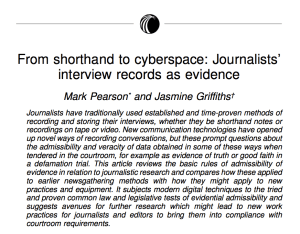
I worked with journalist and lawyer Jasmine Griffiths to examine this question in an article published in the latest issue of the Media and Arts Law Review ((2011) 16 Media and Arts Law Review).

We reviewed the laws of evidence and applied the Australian tests to compare the likely admissibility and weight of different journalistic records of interview. This is a summary of our findings…

New technologies have changed the way journalists gather news.

While the basic role of a journalist to find and report news remains unchanged, technology savvy reporters have embraced the digital age and are using technology to improve the way they operate.

Journalists now employ a variety of technologies during interviews to record notes:

  • Taking shorthand (or some hybrid shortform) in notebooks;
  • Typing notes directly into the computer;
  • Recording telephone conversations with listening devices;
  • Using digital recording devices to store audio on memory chips or downloading audio files on to computers;
  • Using mobile phone technology and voice recording applications;
  • Conducting interviews via email, text messaging (SMS) or instant messaging; and
  • Using Facebook, Twitter and other social media as a source of quotes and photos.

The prevalence of technology poses a unique problem to news organisations seeking to defend defamation proceedings. New technologies call for new interpretations of established rules. However, both the courts and the legislature have failed to keep pace with technological developments, leaving the legal status of some digital evidence uncertain.

During research we canvassed case law and the rules of evidence to determine the evidential status of common industry practices for recording and storing information.

An understanding of how evidence laws apply to journalists’ notes would allow journalists and media organisations to assess their own methods and develop better working practices to avoid the costly embarrassment of having their evidence struck out by a court.

But we found it was difficult to predict how a court would determine the question of admissibility of, or in the alternative, the weight prescribed to evidence. The decision in each case falls on the facts.

A journalist’s notebook may be compelling as evidence based on the fact it is likely to be the only contemporaneous record of an interview or conversation. However, even an impeccable notebook where every interview is dated and every page accounted for can be problematic for the courts if it cannot be read by an ordinary person.

Quotes recorded in shorthand require translation and while it is possible an expert might be engaged, it is far more time and cost effective for journalists to provide a transcript of their notes.

This is particularly so where journalists have developed their own unique or hybrid shorthand style.

Some news organisations have conducted comprehensive training and strict requirements on note-taking and storage, while these practices have been largely ignored in many others.

Practices also vary widely among individual journalists. This could be problematic for a media defendant’s case if a story written by a journalist whose notes did not lend themselves to being good evidence later became the subject of defamation proceedings.

Traditionally when it seemed a journalist or their work might become involved in legal proceedings, whether by what they saw or heard or by what they published, their notes of interviews and associated research materials were gathered and stored in case they were required as evidence in a trial.

A journalist’s notebook was viewed by the courts as compelling evidence based on the notion that records taken during or immediately after an incident or conversation were more likely to portray an accurate account of the facts than witness testimony given months or years after the event.

But reporters’ notebooks were not specially valued because they were kept by journalists, more because contemporaneous notes are valued when taken by any record-keeper.

Where it can be proven that a journalist (or any record-keeper) has an established system of recording information a court will likely place high value on such evidence. Former New South Wales education minister Terry Metherell’s daily diary accounts of conversations with then Premier Nick Greiner were found to be compelling evidence before the Independent Commission Against Corruption in 1992.

The court will look to the methods of the note-taker and veracity of the notes, regardless of the individual’s occupation.

It is not the fact that the interviewer is a journalist that adds weight – more the issues of whether shorthand speed and notebook management practices win the court’s confidence in the record of the interview.

In 2004 the Mosman Daily in suburban Sydney successfully defended a defamation action brought by the proprietors of a real estate business as a result of an article about a dispute with their co-tenants sharing the premises. During the hearing the court heard evidence from the journalist who wrote the story and the tenants who had contacted the paper, along with each of the plaintiffs. Justice Hoeben stated: “I did not find (the first and third plaintiffs) to be impressive witnesses. Their evidence was at times internally contradictory and evasive… Where (their) evidence is in conflict with that of (the tenants), I prefer the evidence of (the tenants)”.  The lesson for journalists who are called upon to give evidence in proceedings is that the court will look favourably upon witnesses who are honest and give a fair account of their version of events.

In Field v Nationwide News Pty Ltd, a Sunday Telegraph journalist reporting on a Blue Mountains hotel that had fallen into disrepair was forced to recount her conversation with the proprietor to the court in circumstances where their recollections were very different. The trial judge concluded the journalist was more likely to be telling the truth based on the fact that she took notes of the conversation soon after it occurred, separate witness testimony supported her version of events and, importantly, she was a “credible and straightforward witness”. This indicates that even a journalist’s recollection of the contents of an interview without supporting evidence might alone outweigh the recollection of the interviewee.

However, while a court may prefer a journalist’s recollection over that of another witness it may not be enough to convince a court to find in their favour. The matter of Zunter v John Fairfax Publications Pty Ltd involved a claim for defamation over an article published in the Sydney Morning Herald which suggested the plaintiff caused a bushfire by carrying out an illegal backburn. The journalist who wrote the article produced accurate notes of her conversations with the local fire chief, which were not in dispute. The problem for Fairfax was that the story had been edited at the last minute to include information provided by the photographer who interviewed the plaintiff in the absence of the journalist. The court accepted that “not being a reporter, (the photographer) did not take notes of the conversation he had with Mr Zunter” and concluded the photographer’s evidence was “more likely” to be accurate than the plaintiff’s. But the plaintiff was still awarded $100,000 in damages.

One of the key principles of the rules of evidence is that any evidence adduced must be capable of being tested in court. This means that evidence will be subject to examination, cross-examination and, if necessary, re-examination in order for the court to ascribe weight to evidence and determine witness credibility.

In the case of journalists’ notes, “real” evidence – that is, the physical notebook – will almost always be accompanied by testimonial evidence by the person who made the notes to provide context and translation as needed. This may indeed present the opportunity for expert evidence from a shorthand instructor on the translation of the notes.

This process can be a professional minefield for journalists called into the witness box. Their practices and credibility become subject to public scrutiny among their peers, as BBC journalists Susan Watts, Andrew Gilligan and Gavin Hewitt discovered when they were called upon to give evidence at the UK’s Hutton Inquiry in 2003 into the suicide death of British defence expert Dr David Kelly after he was exposed for leaking intelligence information.  During the hearing, the journalists were questioned and at times publicly criticised for their working practices, later prompting the BBC to issue new editorial guidelines on note-taking. The inquiry highlighted the importance of taking and keeping good notes.

The journalists’ shorthand, longhand and hybrid notes still sit at the inquiry’s website for the gratification of those interested in the subject.

As Greenslade illustrated, audio recordings of interviews and conversations are the most effective shield against accusations of sources being misquoted and, if dealt with properly, is convincing evidence in court.

If a media defendant can produce an original, unaltered recording of interviews given voluntarily it will be very difficult for a plaintiff to argue against the recording being admitted in evidence.

For this reason, the solicitors for Jack Thomas were unable to raise successful arguments against admitting an ABC Four Corners interview in evidence in an Australian terrorism trial. He had made certain admissions on tape in the media interview.

Difficulties arise when audio recordings have been compromised or recordings destroyed before a claim or writ has been served.

While in earlier times journalists were advised to archive tapes, modern day Dictaphones, mobile recording devices and smart phones are far more likely to record the contents of an interview on to a memory card, which can be difficult to preserve physically and expensive to replace.

The advantage of digital recordings is that they can be downloaded on to a computer using speciality software and stored electronically. In reality, time pressed journalists may be tempted to record the quotes they need and then erase interviews in order to free up memory on their recording devices.

This can have serious evidential implications.

One of the key traps journalists may face in having their audio recordings admitted as evidence is where questions are raised as to the legality of the recording.

Journalists may find themselves relying on recorded telephone exchanges or secret recordings of conversations in circumstances where the source was unaware they were being recorded. In most jurisdictions such recordings would be held to have been illegally obtained in contravention of surveillance or listening devices legislation.

If a court follows the black letter of the law, evidence of recordings which were illegally obtained would be rendered inadmissible. This is particularly so in criminal cases where the overriding interest is justice and a person’s constitutional right to a fair trial. However, civil cases may fall within a grey area where illegal recordings may be received in evidence.

It is not uncommon for journalists conducting telephone interviews to type notes of their conversations directly into the computer. Typically these notes are entered into a word processing program or recorded on screen using software employed by a newsroom to write, file and edit stories.

While this method may assist some journalists in taking down conversations and expediting the writing process, it presents a challenge to journalists who are called upon to defend their stories. Often the story itself will be the only evidence of a conversation having taken place.

Where notes have been preserved (i.e. the journalist saved the document in which they recorded the interview) it may be difficult to convince a court that the notes are in their original, unaltered state.

The potential problem with electronic records of interviews was raised in the Hutton Inquiry. Journalist Andrew Gilligan told the Inquiry that soon after an informal meeting with a defence official he recorded his recollection of the conversation on a personal digital assistant for later use in a story.

While ordinarily such evidence might be regarded highly because of its contemporaneous nature, in this case it was suggested he had later amended the notes when it became clear he would have to produce his notes to the inquiry.

As a result, two forensic computer analysts were called as expert witnesses to testify as to the reliability of the records at great expense and embarrassment to the BBC.

Lawmakers have sought to clarify the status of electronic evidence by introducing statutory provisions dealing specifically with computer-produced evidence.

While emails may be saved or archived, the same cannot always be said of more transient forms of communicating such as text messages on mobile devices or information gained from social networking sites. Facebook and Twitter provide fertile ground for journalists seeking information about a source.

However, the ephemeral nature of social networking combined with the ability of users to control the information that is shared publicly may present a problem for journalists who publish information gained via such means.

In these circumstances, a prudent journalist may print off the relevant information or store it in some other permanent form.

In addition to keeping good notes of interviews and conversations, journalists should keep a record of phone calls and other attempts made to contact a source or verify information before it is published.

In order to establish a defence of fair comment, honest opinion or qualified privilege in defamation proceedings, a journalist must prove good faith.

This can be difficult to prove without evidence to support the claim that a journalist acted fairly. The statutory defence of qualified privilege will also require evidence that a journalist at least made an attempt to provide a balanced story.

Section 30 of the Defamation Act 2005 (NSW version, but nationally uniform) states that when deciding whether a publisher’s behaviour was reasonable in the circumstances “a court may take into a range of factors including whether a reasonable attempt was made to obtain and publish a response from the individual being defamed and other steps taken to verify the information published”.

In other words, the Act effectively imposes record-keeping obligations on journalists who may wish to use the defence in potential legal proceedings. However, many journalists are unaware of these requirements until after the fact, at which point a lack of evidence may preclude them from successfully arguing a defence.

A basic understanding of the rules of evidence by news organisations and individual journalists would assist reporters and their editors in developing improved newsgathering and information storage practices.

While there are sometimes safety nets for journalists who have had less than meticulous note-taking and file storage practices, news organisations and tertiary programs should be emphasising best practice in notebook and file management and imbuing journalism students and graded reporters with the importance of preserving records of interviews.

While jurisdictional differences in evidence law might impact on the advice given by media lawyers, it should be sufficient for journalists and their news managers to understand the basic principles and incorporate them into their daily newsgathering and file management practice.

The challenge to journalists, their managers and their lawyers is that the laws of evidence are complex and remain unsettled, particularly in respect of technology-based evidence. As a result, it is difficult to anticipate how a court might receive a journalist’s evidence where new methods and technologies have been applied in practice, particularly if suitable records have not been kept or if some of the information has been obtained in breach of other law.

It would certainly be premature to call for the elimination of shorthand from industry entry requirements.

However, media outlets need to look carefully at their double standards. Newspaper companies insist upon 120 words per minute of shorthand for entry level recruits but do not apply the same requirement to the experienced reporters they hire and sometimes waive the shorthand speed for star rookies who excel in other areas.

It’s a little like a commercial airline poaching obese and sickly pilots from its competitors while insisting its entry level pilots pass a rigorous fitness test.

Whether or not they continue with shorthand, media outlets need to look carefully at their collection and storage of interview records in whatever format, and to train their staff in basic protocols for the recording and filing of interviews.

© Mark Pearson 2011

Disclaimer: While I write about media law and ethics, nothing here should be construed as legal advice. I am an academic, not a lawyer! My only advice is that you consult a lawyer before taking any legal risks.

1 Comment

Filed under Uncategorized

How #bloggers can apply the Kipling formula to social media #law

By MARK PEARSON

Rudyard Kipling explained the secret to good writing in his poem The Elephant’s Child:

“I keep six honest serving-men (they taught me all I knew);

Their names are What and Why and When and How and Where and Who.”

A century later, we still use those serving-men to teach news writing but they can also be used as a lens to consider cyberlaw and how it applies to the online writer. Each raises legal questions and highlights the risks you face.

Who? #YesYouAreLiable…

There are several ‘who’ elements to the online writing enterprise – and each can have an impact on your legal liability for what you write.

Identity and anonymity are important issues in the law of online authorship, and I devoted my last blog to the way courts have considered the latter.

Most bloggers cherish their independence, but this comes at a price. If you are the sole publisher of your material, then prosecutors and litigants will come looking for you personally. Those who write for larger organisations or companies share that responsibility. A litigant can still sue you as the writer, but they might choose to target your wealthier publisher – particularly if you are an impoverished freelancing blogger. In the 20th century, large media organisations would usually cover the legal costs of their reporters or columnists if they were sued and give them the services of their in-house counsel to guide them through any civil or criminal actions. Most of the so-called ‘legacy media’ still do that today, so if you are a mainstream journalist or columnist thinking of going solo with your blog you might factor this into your thinking. Another advantage of writing for a mainstream publisher is that your work will be checked by editors with some legal knowledge and perhaps reviewed by the company’s lawyers before being published.

A crucial ‘who’ element is your audience. Many areas of the law only require your publication to reach single person for you to be liable for its content. (In the case of libel, it needs to be a third person beyond you and the person you are defaming.) You might think you are just corresponding with your cosy group of Twitter followers or Facebook friends – all with a shared sense of humour or sarcasm – but your remark can be detected when it is forwarded or retweeted to someone else and can go viral very quickly. As soon as it comes to the attention of the authorities or counsel for the person you have offended, the courts will only look to the fact that you were responsible for the original publication.

If others add to your words with more inflammatory material of their own, they carry responsibility for the new publication. Think twice before retweeting or forwarding the legally dubious material of others, because this becomes a new publication under your own name, so at the very least you will share the legal liability with the original publisher. And of course never retweet, ‘like’ or forward anything without reviewing it thoroughly first.

Of course then there is the ‘who’ element related to the people you name in your blog or social media posting. These can present legal risks. Sometimes people cannot be named because their identities are protected under legislation because they are children, victims of sex crimes, or vulnerable in some other way. Courts can also suppress people’s identities for other reasons, and sometimes even suppress the fact that they have issued a suppression order, known as a ‘super injunction’, as journalists and Tweeters in the UK are well aware.


What? #…ForAlmostAnything

Lawyers and prosecutors will of course look closely at ‘what’ has been published to decide whether your work is a criminal offence or might be subject to a civil action.

Throughout the world all kinds of online material has been the subject of legal action. This has included the publication of words, symbols, still and moving images, sounds, illustrations, headlines, captions and links. Sometimes it is the very words alone that are banned (such as the name of a victim of a sex crime) while on other occasions it is the totality of the coverage that gives rise to a meaning that damages a reputation or intrudes (such as a photograph of someone accompanying a negative story). In some countries it is the publication without a licence that is banned.


When? #…NowAndThenAndForever?…

The instant nature of new media does not mix well with an online writer’s impulsiveness, carelessness or substance abuse. There is an old saying: ‘Doctors bury their mistakes. Lawyers jail theirs. But journalists publish theirs for all the world to see’. That can be applied to anyone writing online today. At least in bygone times these mistakes would gradually fade from memory. While they might linger in the yellowing editions of newspapers in library archives, it would take a keen researcher to find them several years later. Now your offensive or erroneous writing is only a Google search away for anyone motivated to look.

British actor Stephen Fry learned this in 2010 when he tweeted his two million followers, insulting Telegraph journalist Milo Yiannopoulos over a critical column.

“Fry quickly deleted the tweet once others started to latch on to it, but as we know that rarely helps when you’ve posted something injudicious online: the internet remembers,” Yiannopoulos wrote.

This also creates problems for digital archives – because if the material remains on the publisher’s servers it is considered ‘republished’ every time it is downloaded. This means that even where there might be some statutory time limitation on lawsuits, under some interpretations the clock starts ticking again with each download so you do not get to take advantage of the time limit until you have removed the material from your site.

A New York District Court considered whether material was actually ‘published’ when it was posted to the Internet. In Getaped.com Inc v. Cangemi, a motor scooter business claimed parts of its website had been copied. Cangemi argued the website was not a publication, but rather like a ‘public display’ or performance. Judge Alvin Hellerstein said ‘when a webpage goes live on the Internet, it is distributed and “published”’.


Where? #…JustAboutAnywhere…

The Dow Jones v. Gutnick decision by Australia’s High Court in 2002 showed just how long the arm of cyberlaw could be. In that case it stretched all the way from Melbourne, Australia, to allow a businessmen to take suit against a publisher based in New Jersey, USA. The same kind of thing happened this year when a Californian court ordered US-based Twitter to hand over the name, email address and phone number of a British-based local government councillor whose council wanted to sue him for defamation over comments he had allegedly posted anonymously. A year earlier the same South Tyneside council had also managed to have Google and the blogging site WordPress ordered to hand over IP addresses to identify a whistleblower.

While foreign countries cannot normally enforce their laws beyond their borders, you might be called to account for your blogs and postings under their laws if you happen to travel there. And citizens in other countries can go to court and get a declaration against you in your absence, perhaps ordering you to pay a certain sum in damages for something you have published.

Depending on the international legal agreements in place, the courts in your jurisdiction might be empowered to apply the laws of another state or territory in a case against you. The landmark US case in the field centred around two companies’ dispute over the use of the name ‘Zippo’ – one a manufacturing company and another an Internet news service provider. A Pennsylvania court developed a sliding scale to help it decide whether the web news service had enough commercial dealings in the state for the court to have jurisdiction.

Not that long ago you had to be served personally with a summons for a criminal charge or a writ for the launch of a civil action against you. In many places this can be done online – via email or even via a message to your social media account. The Supreme Court of the Australian Capital Territory became one of the world’s first courts to allow legal documents to be served on defendants via a personal message on their Facebook pages when they had defaulted on their home loan payments. Other methods of contacting them had failed and their house was about to be taken from them.


Why? #…EspeciallyIfYouAreMalicious…

Lawyers, prosecutors and judges will also look to your motives for publishing the material you have written. The motivation that will work against almost any defence in a publishing case is malice. Even the United States, which has one of the strongest defamation defences in the world under its First Amendment freedom of the press protection, will not excuse a slur against somebody if it can be proven to be false and malicious. Malice has a wide range of definitions in international law. Your online behaviour can be used as evidence in court, as well. Lawyers will dig for all kinds of proof that you have been less than honest about your behaviour or have shown a lack of good faith or malice in your dealings.


How? #…SomeMediaAreRiskier

Your method and your medium can be important factors in your legal exposure. The simple fact is that some publishing mechanisms are more law-friendly than others. Sometimes this will depend on the type of material you are publishing. For example, there is an argument that Twitter users may be less prone to copyright infringement because the very nature of the medium limits the amount of another person’s work they can borrow and the retweeting function implies that everyone expects their work to be recycled by others. Photographers and a US District Court judge disagree with this, however. Twitter users might leave themselves more exposed in the area of defamation because there is so little space in which to give context and balance to their criticism of others. Tweeting from an event as it unfolds, such as a conference or a court case, has its dangers because your tweets might contain errors in the quotes of others or might be taken out of context by someone just reading a tweet rather than the overall coverage.

The ‘How?’ legal element can be crucial to several defences. If you have written your blog fairly and accurately it can go a long way to establishing a defence to defamation or a contempt of court charge over a report of a court case.

——

You might like to look back over some of your recent blogs, tweets and Facebook postings and apply the 5Ws and the H of legal analysis to them. How well do they shape up? …And who is that knocking at your front door? 😉

© Mark Pearson 2011

Disclaimer: While I write about media law and ethics, nothing here should be construed as legal advice. I am an academic, not a lawyer! My only advice is that you consult a lawyer before taking any legal risks.

1 Comment

Filed under Uncategorized

#Law: How #courts decide whether to out #anonymous #Internet authors

By MARK PEARSON

Courts have taken a range of approaches on whether they will order the ‘outing’ of the identity of an anonymous Internet user. The super-rich have gone to court in the UK and the US to try to find the identities of bloggers who have caused them grief from behind the shield of pseudonyms (as Forbes reported).

In May 2011, a Utah court ruled in favour of 25 John Does known as ‘Youth for Climate Truth’ who had set up a fake website and issued press releases claiming the powerful Koch Industries would stop funding climate change deniers. The group is owned by Charles and David Koch who sit in the list of America’s top 10 wealthiest people. They were angered by the spoof site and its announcement so went to court to find out the identity of the protesters. But Judge Dale Kimball dismissed their motion for disclosure on the grounds that it did not meet the strict tests required to reveal the pranksters’ identities.

However, the High Court in England ruled in favour of another billionaire, Louis Bacon, who was attempting to force Wikipedia, the Denver Post and WordPress to cough up the identities of bloggers who had allegedly defamed him using pseudonyms. In late 2010, it had also ordered the revelation of another of Bacon’s critics who had created a website www.bahamascitizen.com. It seemed likely the US-based Wikipedia would protect its correspondent’s anonymity until it received an order from a US court with jurisdiction over its activities.

Even in the US, authorities can move with considerable speed and secrecy to demand account details on suspects. In 2010 the editor of the ‘Home in Henderson’ blog, Jason Feingold, was ordered by the North Carolina Superior Court to turn over identifying information on six anonymous commenters on his blog post ‘Arrest Made in Elder Abuse Case’. The identities of ‘Beautiful Dreamer’, ‘Fatboy’ and others were ruled actionable and disclosure ordered despite First Amendment and state shield law protections. Five of them later settled the defamation action.

In mid-2011, a Colorado District Court magistrate judge Boyd N. Boland produced an excellent summary of US decisions on discovery of anonymous sources and pieced together the criteria US judges apply before ordering their identification. The tough US tests pre-dated the Internet and were shaped by Supreme Court decisions over five decades protecting ‘anonymous speech’ as a First Amendment right. The landmark case was Talley v. California in 1960 where the court ruled a city ordinance was void because it required all leaflets to contain the name and address of the person who prepared, distributed or sponsored it. Delivering the judgment, Justice Black declared an identification requirement would restrict free expression. “Anonymous pamphlets, leaflets, brochures and even books have played an important role in the progress of mankind,” he declared. “Persecuted groups and sects from time to time throughout history have been able to criticize oppressive practices and laws either anonymously or not at all.”

In his 2011 decision, Judge Boland cited that case and explained that litigants seeking to ‘out’ an anonymous writer must:

–         give notice of their action;

–         identify the exact statements that constitute allegedly actionable speech;

–         establish a prima facie (“at first sight”) case against the defendant with enough evidence for each basic element of the action;

–         balance the defendant’s First Amendment right of anonymous free speech against the strength of the case;

–         show the disclosure serves a substantial governmental interest;

–         ensure it is narrowly tailored to serve that interest without unnecessarily interfering with First Amendment freedoms; and

–         convince the court that the case could not proceed without disclosure of the identity.

Judge Boland was ruling on an attempt by high-end tailor and fashion retailer Faconnable to force an ISP to reveal the identities of John Does who had posted entries on its Wikipedia entry claiming the company was a supporter of the Lebanese Shiite Islamist militia and political party. It wanted to sue them for trade libel and commercial disparagement. The disclosure order is on hold waiting appeal.

In early 2011, federal prosecutors had convinced a federal judge in Virginia to order Twitter to release account information on Julian Assange and other Wikileaks leaders as part of a grand jury probe into alleged criminal action. As Cnet reported, the judge rejected constitutional free expression and privacy arguments by Twitter, the Electronic Frontier Foundation and the American Civil Liberties Union that the details remain confidential. But the whole process had been kept secret until the judge ‘unsealed’ documents revealing the earlier stages of the prosecution processes. Appeals were under way in what promised to be a long legal struggle. As Cnet explained, the judge issued a 2703(d) order, allowing authorities to access materials from an Internet provider or website host “relevant and material to an ongoing criminal investigation.” The wide-ranging order requested all ‘contact information’ including “connection records, or records of session times and durations,” and “records of user activity for any connections made to or from the account along with IP addresses and all records or correspondence related to the accounts.

The decision followed a series of similar orders that courts unmask anonymous bloggers, Tweeters and Facebook users in both criminal and civil actions. The New York Supreme Court had ordered Google to identify an anonymous blogger in a defamation ‘fishing expedition’ in 2009. The Citizen Media Law Project explained how the operator of the ‘Skanks in NYC’ blog was unmasked on the petition of fashion model Liskula Cohen who had been denigrated in five postings about her sexual behaviour and ability.

Even a British local government body – the South Tyneside Council – managed to get a Californian order forcing Twitter to reveal the identity of anonymous bloggers who had been making ‘false and defamatory’ allegations about its councillors so they could launch defamation action against him. It was a surprising decision, given the strong First Amendment protections in the US, particularly for criticism of political figures. London’s Telegraph claimed Twitter had relented and handed over the identifying details of the users behind the accounts named @fatcouncillor, @cllrdavidpotts, @councillorahmedkhan, @councillorkhan and @ahmedkhan01. While Twitter had been among the most defensive of its users’ identity protection, a spokesperson said the most the company could be expected to do was to give anonymous bloggers advance warning that their details would be released so they had the chance to launch an appeal.

Lawyers for Welsh footballer Ryan Giggs were not as successful in discovering the anonymous Tweeters who had revealed the celebrity sportsman’s name in breach of a UK injunction issued to protect his privacy. They had gone to London’s High Court and won an order that Twitter reveal the details, but the US microblogging company seemed to have disregarded it because they were not obliged to comply with court orders from outside their jurisdiction.

Despite recent successes in the US, the Citizen Media Law Project lists several cases where litigants failed to meet the tough test needed to discover the identity of anonymous online writers, including:

–         In Pennsylvania, William McVicker lost in an attempt to subpoena Trib Total Media, publisher of the South Hills Record and YourSouthHills.com, for the identities behind seven screen names as part of an employment discrimination case.

–         In New Jersey, the President of the Galaxy Towers Condominium Association, Slava Lerner, failed to obtain pre-action discovery from Michael Deluca, publisher of GalaxyFacts, a website forum used by Galaxy Towers condominium owners.  Lerner sought the identities of commenters who ‘accused [him] of improprieties’.

–         In New York, an Orange County grand jury subpoenaed The (Chester) Chronicle for information about a schools superintendent by two anonymous posters to its website. A judge quashed the subpoena in 2010 because the identities were not crucial to the matter at hand.

–         A Missouri court denied a motion to compel The Springfield News-Leader to identify ‘bornandraisedhere’, a commenter on its website. It held the writer had First Amendment protections despite agreeing to the newspaper’s privacy policy before commenting on an upcoming civil case.

Even some traditional news organisations have tried to discover the identity of bloggers when defending their own interests. News America, publisher of the New York Post, sought a subpoena in California in 2005 to force Google to reveal the identity of a blogger who had breached its copyright by posting its entire Page Six column without advertisements, the Citizen Media Law Project reported.

UK courts draw on a decision made by the House of Lords almost two decades before mainstream use of the Internet. The 1973 case of Norwich Pharmacal v. Customs and Excise Commissioners centred on a company seeking the identity of those importing goods that infringed their patents. The customs commissioners were ordered to reveal the identity of the importers. As law firm Gillhams explains:  “The House of Lords found that where a third party had become involved in unlawful conduct, they were under a duty to assist the person suffering damage by giving them full information and disclosing the identity of wrongdoers.” In contrast to the US, disclosure becomes the starting point in Britain. The High Court of Justice applied the Norwich Pharmacal test in 2009 when it ordered Wikipedia to reveal the IP address of an anonymous party who had amended an article about a woman and her young child (‘G and G’) to include sensitive private information about them. The judge suppressed their names on confidentiality grounds because he believed the entries were part of a blackmail threat against the mother. Even though the owner of Wikipedia (Wikimedia) was based in Florida in the US, the court issued the disclosure order. Wikimedia complied, but insisted it was not legally bound to do so because it was in a different jurisdiction and had immunity under s. 230 of the US Communications Decency Act (1996) as a third party publishers of the comments of others.

However, disclosure is not automatic in the UK courts. In 2011, British woman Jane Clift failed in her attempt to get the High Court of Justice to order the editor of the Daily Mail’s website to reveal the identities of two anonymous commenters on an article about her. The newspaper and the website had run a sympathetic article about her winning a defamation action against the Slough Borough Council after they had published her name on a Violent Persons Register for merely reporting that a drunk had damaged a city flowerbed. However, when anonymous critical comments appeared at the base of the web article she tried to find their authors so she could sue them too. But Mrs Justice Sharp ruled that Clift had failed to meet the Norwich Pharmacal test. She said any libel action was unlikely to succeed because readers would not have taken the remarks seriously – they would have considered them mere ‘pub talk’. She gave greater weight to the privacy interests of the anonymous authors.

Canadian judges apply a different four-point test in deciding whether they will protect anonymous bloggers’ identities. Judges need to consider whether:

–         the unknown alleged wrongdoer could have a reasonable expectation of anonymity in the circumstances;

–         the litigant has established a prima facie (‘at first sight’) case against the unknown alleged wrongdoer and is acting in good faith;

–         the litigant has taken reasonable steps to identify the anonymous party and has been unable to do so; and

–         the public interest in disclosure outweighs the interests of free expression and right to privacy of the anonymous authors.

The test was developed in late 2010 by Justice Jennifer Blishen of the Ontario Superior Court of Justice in a case stemming from comments made on a political message board Freedominion. Two ‘John Does’ – ‘conscience’ and ‘HR-101’ – described human rights activist and lawyer Richard Warman as a sexual deviate and a Nazi in several postings to the site’s 9000 users. Justice Blishen ordered the site owners to hand over identifying details on the John Does, including their email addresses, IP addresses and personal information submitted when they registered for the forum.

But the same test had a different result in a case with similarities to the South Tyneside Council matter, when the Ontario Superior Court of Justice in July 2011 refused to order the unmasking of local bloggers who had criticized the Aurora city mayor. The Canadian Civil Liberties Union intervened to help protect the bloggers on the grounds that a prima facie defamation case had not been established and their free expression rights would be compromised.

A so-called anonymous ‘poison-penner’ was not so fortunate in Western Australia, however. As The Age revealed, a blogger using the pseudonym ‘witch’ launched a series of attacks on a stockmarket forum about technology security company Datamotion Asia Pacific Ltd and its Perth-based chairman and managing director, Ronald Moir. A court ordered the forum host HotCopper to hand over the blogger’s details which could only be traced to an interstate escort service. But private investigation by the plaintiff’s law firm eventually found the true author of the postings who was then hit with a $30,000 defamation settlement.

Many such cases involved legitimate criticism of major corporations or wealthy public figures, and there are strong First Amendment arguments that a blogger’s anonymity should be protected. CyberSLAPP.org was set up in 2002 by several free expression organisations to highlight the use of court actions by powerful litigants to ‘out’ anonymous critics. As their site explains, the groups propose a legal standard for courts to follow in deciding whether to compel the identification of anonymous speakers. They demand suitable notice, an opportunity to be heard, and the right to have claims of wrongdoing detailed before requiring identification. The coalition also sets out ‘best practices’ for ISPs. They feature scores of case examples of their website for the information of defendants. Coalition members include the American Civil Liberties Union, the Center for Democracy and Technology, the Electronic Frontier Foundation, the Electronic Privacy Information Center, and Public Citizen.

In some countries bloggers might face much more serious consequences if they operate under their true identities. ISPs and other hosts have been all too willing to hand over their details to litigants and governments. The most famous example was the case of Chinese journalist Shi Tao who used his Yahoo! email account to send information about censorship policies to a foreign source. Yahoo’s Hong Kong branch handed his details over to the Chinese government without even questioning their authority or warning its client. Shi Tao was jailed for 10 years in 2005 for ‘divulging state secrets’. Even India, with a better record of free expression, demands ISPs reveal anonymous users’ identities. As Reporters Without Borders revealed, an Indian high court ordered Google to release the true identity of blogger ‘Toxic Writer’ who had posted critical comments about construction company Gremach.

If there is a lesson in all this, it is that anonymity is never guaranteed and bloggers and social media users need to take legal advice to weigh up the risks before attempting to hide behind a nom de plume or nom de guerre online.

© Mark Pearson 2011

Disclaimer: While I write about media law and ethics, nothing here should be construed as legal advice. I am an academic, not a lawyer! My only advice is that you consult a lawyer before taking any legal risks.

Leave a comment

Filed under Uncategorized