Tag Archives: shield laws

Media freedom concerns over federal demands for ABC interview tapes

By MARK PEARSON

[Research assistance kindly provided by media freedom intern Mardi Reason]

JUST as the Australian Government proposes tougher national security powers for its agencies and penalties for whistleblowing we have learned this week that the Australian Federal Police has asked the ABC for unedited current affairs interview footage in its pursuit of a former spy and a lawyer.

Screen Shot 2014-09-04 at 7.57.38 PM

Senator Nick Xenophon’s questions of Attorney-General George Brandis about AFP investigation.

Attorney-General George Brandis confirmed in the Senate on Monday (see inset) that Australian Federal Police started an investigation into the sources of leaks of classified information after it was revealed Australia spied on East Timor during sensitive oil and gas treaty negotiations.

The targets of the investigation are reported to be lawyer Bernard Collaery (a former ACT Attorney-General now in London about to represent East Timor in The Hague) and a former Australian Secret Intelligence Service (ASIS) agent who was allegedly the whistleblower.

The Australian Security Intelligence Organisation (ASIO) raided Collaery’s Canberra office last December and seized documents.

Tom Allard reported in the Sydney Morning Herald on Monday that the latest investigation had prompted requests from the AFP for the raw footage of Mr Collaery’s interviews with programs including 7.30, Lateline and Four Corners.

A report by Conor Duffy on 7.30 last December also featured actors’ voices reading an affidavit from the former ASIS agent which the Herald has speculated could be important evidence the AFP needs for its investigation into the identity of the whistleblower.

However, in the Hansard record of Senator Brandis’ comments on Monday (inset), the Attorney-General claims there are some inaccuracies in the Herald report. In particular, he claims it is inaccurate that he ordered the AFP investigation. Rather, it was ASIO-driven, he told the Senate.

As reported earlier at journlaw.com, the Australian government introduced the National Security Legislation Amendment Bill (No. 1) 2014 on July 14 which would extend security agencies’ powers to search and use surveillance devices in the new communication environment, introduce a new ‘multiple warrants’ regime, offer immunity to intelligence personnel who break all but the most serious laws, while increasing penalties for whistleblowing and criminalising the reporting of leaked intelligence-related information.

Importantly, it would introduce a new offence carrying a five year jail term for anyone disclosing information relating to special intelligence operations.

This latest episode demonstrates how easily journalists and media organisations can get caught up in such investigations. It threatens to expose them to contempt penalties if they refuse to co-operate and will inevitably make sources reluctant to talk to reporters covering the important round of national security, particularly as it coincides with a push for even greater surveillance powers for federal agencies.

Sources:

Allard, T. 2014, ‘Government wants East Timor spy charged’, The Sydney Morning Herald, 31 August 2014, http://www.smh.com.au/federal-politics/political-news/government-wants-east-timor-spy-charged-20140831-10aoad.html

Safi, M. 2014 , ‘Timor-Leste spy case: Brandis denies referring lawyer to police’, The Guardian, 1 September 2014 http://www.theguardian.com/world/2014/sep/01/timor-leste-spy-case-brandis-denies-referring-lawyer-to-police

Fernandes, C. 2014, ‘Our land is girt by oil-rich sea … that we steal from East Timor’, Crikey, 2 September 2014 http://www.crikey.com.au/2014/09/02/our-land-is-girt-by-oil-rich-sea-that-we-steal-from-east-timor/

Commonwealth of Australia, 2014, September 1 (14:32). Hansard. Parliamentary Debates – Senate. Questions Without Notice – East Timor. (Senators Xenophon and Brandis). http://parlinfo.aph.gov.au/parlInfo/genpdf/chamber/hansards/49cdeae9-b762-449e-9e05-7239b8940f5f/0044/hansard_frag.pdf;fileType=application%2Fpdf

© Mark Pearson 2014

Disclaimer: While I write about media law and ethics, nothing here should be construed as legal advice. I am an academic, not a lawyer. My only advice is that you consult a lawyer before taking any legal risks.

Leave a comment

Filed under national security, terrorism, Uncategorized

Australian Government’s latest national security bill to stifle debate

By MARK PEARSON

The Australian Government has opted for censorship and secrecy over scrutiny and natural justice with its latest national security bill introduced in the Senate last week.

haneefcover

Haneef – A Question of Character, by Jacqui Ewart

The National Security Legislation Amendment Bill (No. 1) 2014 extends security agencies’ powers to search and use surveillance devices in the new communication environment, introduces a new ‘multiple warrants’ regime, offers immunity to intelligence personnel who break all but the most serious laws, while increasing penalties for whistleblowing and criminalising the reporting of leaked intelligence-related information.

Australian Attorney-General George Brandis introduced the legislation on Thursday (July 17).

The crucial section affecting journalists and bloggers is straightforward:

35P Unauthorised disclosure of information

(1)  A person commits an offence if:

(a)  the person discloses information; and

(b)  the information relates to a special intelligence operation.

Penalty: Imprisonment for 5 years.

It continues to set a 10 year jail term if the disclosure is deemed to “endanger the health or safety of any person or prejudice the effective conduct of a special intelligence operation.” A selective list of exemptions makes no mention of material being published in the public interest.

The provision is clearly aimed at preventing Wikileaks or Snowden-style leaks of recent years and their broad publication in the world’s media and across social media, to the embarrassment of governments including Australia’s.

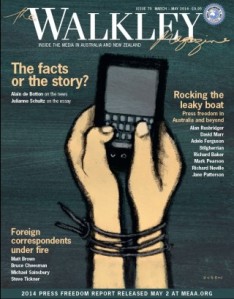
As I detailed in my recent Walkley Magazine article, ‘Terror on the books’ (May 29, 2014), Australian governments from both Labor and the conservative parties have contributed to the enactment of more than 50 pieces of legislation at national level (and many more at state level) since the 9/11 terrorist attacks on the US, many of which have impacted free expression and reportage. Colleagues Dr Jacqui Ewart, Joshua Lessing and I detailed this trend in a recent article in the Journal of Media Law.

The Haneef case in 2007 showed how national security laws could be used to restrict media access to information in an anti-terrorism matter. In that case, the accused was ultimately acquitted after a leak to the media showed how little evidence there really was against him. If this new law was in place, journalists might face jail for reporting such an injustice.

The proposed law is so draconian that it has prompted a release from Paris-Based Reporters Without Borders.

Without a bill of rights or constitutional amendment to protect free expression or media freedom in this country, it is left to those who care about free speech to make their objections clear. Please write to the Federal Attorney-General at senator.brandis@aph.gov.au opposing this legislation. Please also make submissions stating any concerns to parliamentary committees reviewing the legislation when it reaches the committee stage. Sadly, in Australia there will be no formal review of the free expression implications of the bill.

© Mark Pearson 2014

Disclaimer: While I write about media law and ethics, nothing here should be construed as legal advice. I am an academic, not a lawyer. My only advice is that you consult a lawyer before taking any legal risks.
1 Comment

Filed under national security, terrorism, Uncategorized

National security and anti-terror laws continue to threaten journalism

By MARK PEARSON

* This article was first published as ‘Terror on the books’ in the Walkley Magazine on May 29, 2014.

Walkley

More than 50 anti-terror laws have been introduced by the Australian government since the September 11 attacks in the US in 2001, and they continue to impact on our coverage of national security issues and place journalists and their sources at risk.

No Australian journalist would want to see lives lost in a terrorist attack, but there is evidence that existing laws give police, security agencies and the courts too much power in monitoring media activities and suppressing reports that are in the public interest. Two major reports now confirm some of these existing laws are over-reaching.

The long overdue Council of Australian Governments (COAG) Review of Counter-Terrorism Legislation was released in 2013.

As well as recommending changes to basic definitions of terrorist threats and harm, it proposes there be more opportunity for judicial reviews of the agencies’ search and seizure powers, and introducing some safeguards to the control order system (a control order restricts where a person goes and who they can meet).

The committee suggested that the communications restrictions be eased to allow a person subject to a control order access to a mobile phone, a landline phone and a computer with internet access.

Most importantly for journalists, the review recommended the repeal of Section 102.8 of the Criminal Code dealing with “associating with terrorist organisations”. This reform would put beyond any doubt the likelihood of a journalist being convicted of this serious offence by just undertaking normal reporting duties.

Another major report came in November 2013 from Bret Walker SC, the Independent National Security Legislation Monitor (INSLM). It was his third report since being appointed to the review role in 2011.Walker repeated his earlier recommendation that ASIO’s questioning and detention warrants should be abolished and suggested improvements to the definition of a “terrorist act”.

He called for a simpler system of listing terrorist organisations and inserting an exception to the “associating with terrorist organisations” provisions for humanitarian groups such as the Red Cross.

While both reports focused on issues of natural justice and human rights, neither the COAG review nor the INSLM addressed the stifling of journalism in the anti-terror laws.

Sadly, there was little in the way of media lobbying to do so either. The COAG counterterror review received 30 submissions which it posted to its website, none of which were from media-related companies or journalism or free expression organisations.

The ripples of international security operations were also felt in Australia. In 2013 the Media, Entertainment & Arts Alliance wrote to Prime Minister Tony Abbott asking for a review of the extent of metadata surveillance conducted by governments in the wake of former US National Security Agency (NSA) contractor Edward Snowden’s revelations.

There was good reason to be concerned. At least three cases in recent years have shown how the confidentiality of journalists’ sources can be compromised by surveillance by security agencies or anti-terror operations.

The retrial of “Jihad” Jack Thomas on terrorism charges in 2008 was based partly on interview materials gathered by Sally Neighbour from Four Corners and The Age’s Ian Munro and subpoenaed by the prosecution.

It emerged in the trial that up to 20 telephone calls between Neighbour and Thomas had been monitored by an ASIO agent.

The issue of confidentiality of whistleblowers’ identities also arose in the aftermath of the convictions of the Holsworthy Barracks bomb plot conspirators in 2011. The Australian had published an exclusive account on the raids in the hours before they occurred. (The three convicted plotters lost their appeals against their 18-year jail sentences last year.)

The Australian’s Victoria Police source, Simon Artz, paid for his leaks to the newspaper in the Victorian County Court with a four-month suspended sentence for unauthorised disclosure of information.

It was not a good year for whistleblowers internationally. WikiLeaks founder Julian Assange is holed up indefinitely in Ecuador’s embassy in London as he avoids extradition to Sweden on sex charges (and feared extradition to the US over security leaks). His US Army source – Private Chelsea (formerly Bradley) Manning – was sentenced by a military court to 35 years in jail for leaking classified documents. Meanwhile, Edward Snowden had fled to Russia to avoid prosecution over his leaks.

The whistleblower’s revelations about the extent of government surveillance continue to cause embarrassment, including in Australia where Prime Minister Tony Abbott reacted by attacking the ABC over its reportage. In an interview in early 2014, Abbott voiced his disapproval that the ABC had run stories about security services eavesdropping on Indonesian leaders’ phone conversations, a fact revealed by Snowden’s leaks.

The ABC then faced an “efficiency study”. It seems the Abbott government’s approach is to put the budgetary microscope on the ABC’s operations rather than wind back national security laws in the interests of media freedom.

The suppression of reporting on terrorism-related trials or evidence tendered in national security cases is an ongoing issue. The use of a closed court – combined with government media management – was central to the misplaced prosecution of Gold Coast Hospital registrar Dr Mohamed Haneef in 2007.

More than 30 suppression orders under anti-terror powers were imposed during the Benbrika trials in 2008 and 2009. In that case, Abdul Benbrika and 11 other Muslim men from Melbourne were charged with intentionally being members of a terrorist organisation. Their arrests in 2005 followed Operation Pendennis, a 16-month surveillance operation by Victoria Police, the Australian Federal Police and ASIO.

While by 2014 legislation covering suppression and non-publication orders had been introduced into only the Commonwealth, New South Wales, Victorian and South Australian jurisdictions, it appears that other states and territories are following suit to harmonise the laws.

© Mark Pearson 2014

Disclaimer: While I write about media law and ethics, nothing here should be construed as legal advice. I am an academic, not a lawyer. My only advice is that you consult a lawyer before taking any legal risks.
Leave a comment

Filed under national security, terrorism, Uncategorized

Journalists revert to age-old methods to protect sources, says @camstewarttheoz

By MARK PEARSON

National security reporter and associate editor at The Australian Cameron Stewart (@camstewarttheoz) says investigative journalists have to leave their smartphones back at their office when they are meeting confidential sources.

Stewart said the surveillance powers of national security agencies under anti-terror laws, combined with the geo-navigational features of Web 2.0 technologies, meant investigative reporters were reverting to 1970s techniques like those of Watergate reporters Carl Bernstein and Bob Woodward used when they met their famous source ‘Deep Throat’ in an underground car park.

“That is actually still the best way to get your information,” Stewart told me in the interview below.

“The thing I’ve got to my ear now [a smartphone] is your biggest enemy in every single sense as the Snowden revelations have shown.

“The ability of authorities to track movements of journalists is really of great concern as far as protecting sources goes.

“What they’re doing is quietly authorising metadata searches and things like that. What that does is give them every phone call you’ve made and I think they can piece together through your iPhone for example what your movements are over time.

“It’s not rocket science to work out what your movements are over a certain period of time and who you’ve been speaking to and who sources might be.”

Here Cameron Stewart talks with Professor Mark Pearson of Griffith University (@journlaw) about the impact of anti-terror laws on the reporting of national security issues. Stewart shares some of the methods he uses as a reporter when dealing with off the record information provided by whistleblowers  [15 minutes, recorded 1-5-14]

© Mark Pearson 2014

Disclaimer: While I write about media law and ethics, nothing here should be construed as legal advice. I am an academic, not a lawyer. My only advice is that you consult a lawyer before taking any legal risks.

4 Comments

Filed under Uncategorized

Meet Miles Heffernan (@Mileshef) – shield law campaigner and @journlaw guest

By MARK PEARSON

Miles Heffernan (@mileshef) is a journalist and features/opinion editor with the Star Observer.

When he was a freelancer he ran a campaign on change.org calling on mining magnate Gina Rinehart to withdraw her demands for two journalists to reveal their sources. See ‘http://www.change.org/en-AU/petitions/gina-rinehart-withdraw-your-subpoenas-against-adele-ferguson-and-steve-pennells-pressfreedom‘. See also my blog from 2013 on this.

It achieved close to 40,000 signatures.

Here Miles talks with Professor Mark Pearson of Griffith University (@journlaw) about that campaign and the battle for shield laws to protect journalists from having to reveal their sources in court. See more at journlaw.com. [12 minutes, recorded 16-4-14]

© Mark Pearson 2014

Disclaimer: While I write about media law and ethics, nothing here should be construed as legal advice. I am an academic, not a lawyer. My only advice is that you consult a lawyer before taking any legal risks.

Leave a comment

Filed under Uncategorized

The Guardian, GCHQ, the leaked security files and the airport arrest – an Australian view

By MARK PEARSON

It is fascinating when an area of your research suddenly launches into life in a real event.

That happened in the UK this week when Guardian editor Alan Rusbridger revealed senior government officials had ordered him to destroy computer hard drives containing leaked National  Security Agency (NSA) files or face court action which would almost inevitably result in an order to hand the material over.

We also learned the partner of a Guardian journalist was held at Heathrow Airport for nine hours under anti-terrorism laws, prompting the question ‘Could this happen in Australia?’.

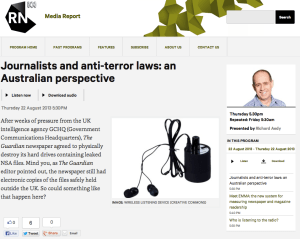
The answer – put simply – is ‘Yes’, as I explained to Richard Aedy on Radio National’s Media Report this week.

You can download that interview here.

Screen Shot 2013-08-24 at 9.13.34 AM

I’ve been working with Griffith University colleague Associate Professor Jacqui Ewart and lawyer Joshua Lessing in this space and our article on Australia’s anti-terrorism laws (including some comparison with  the UK situation) was published in the latest edition of the prestigious Journal of Media Law, edited by the legendary media law expert, Professor Eric Barendt.

Our article’s citation is: Ewart, Jacqui; Pearson, Mark; and Lessing, Joshua. ‘Anti-terror laws and the news media in Australia since 2001: how free expression and national security compete in a liberal democracy’. Journal of Media Law, Volume 5, Number 1, July 2013 , pp. 104-132(29).

The abstract follows below.

I hope you enjoy the Media Report interview, and I’m happy to correspond with other scholars interested in this space, and to have contact with students looking to pursue higher degree research in this area and other topics of media and social media law, ethics and regulation.

——-

“The 9/11 terrorist attacks in the United States triggered an escalation of national security laws globally, including at least 54 in Australia, with some having implications for news reporting and open justice. This article backgrounds the Australian experience with such laws at a time when the United Kingdom is in the midst of a debate over the free expression impacts of its Justice and Security Bill. It uses case studies to highlight tensions between Australia’s security laws and the media’s Fourth Estate role and compares the Australian and UK human rights contexts. The article asks whether anti-terror laws restricting free expression should continue indefinitely in a democracy when national security breaches are likely to remain a major issue of public concern and there is no constitutional or human rights guarantee of free expression. It suggests a cautious approach to the renewal of such laws, particularly those restricting public debate about national security and its impact on human rights.”

– Ewart, Jacqui; Pearson, Mark; and Lessing, Joshua. ‘Anti-terror laws and the news media in Australia since 2001: how free expression and national security compete in a liberal democracy’. Journal of Media Law, Volume 5, Number 1, July 2013 , pp. 104-132(29).

© Mark Pearson 2013

Disclaimer: While I write about media law and ethics, nothing here should be construed as legal advice. I am an academic, not a lawyer. My only advice is that you consult a lawyer before taking any legal risks.

Leave a comment

Filed under Uncategorized

Our ‘news media and anti-terror laws’ article published in Journal of Media Law

By MARK PEARSON

It’s great when you get the chance to work with other scholars, so I’m delighted our collaborative article has been published in the latest edition of the prestigious Journal of Media Law, edited by the legendary media law expert, Professor Eric Barendt.

It’s an even greater pleasure to have co-authored it with my new colleague at Griffith University, Associate Professor Jacqui Ewart (the lead author), with expert research assistance from lawyer Joshua Lessing (also co-author). [Joshua’s late father John became a close family friend after teaching me in the very first subject of my LLM – Company and Partnership Law – way back in 1990.]

Our article’s citation is: Ewart, Jacqui; Pearson, Mark; and Lessing, Joshua. ‘Anti-terror laws and the news media in Australia since 2001: how free expression and national security compete in a liberal democracy’. Journal of Media Law, Volume 5, Number 1, July 2013 , pp. 104-132(29).

Here is the abstract to give you a taste, but you’ll need to subscribe to the journal or borrow it from a library to read the full article.

I’m happy to correspond with other scholars interested in this space, and with students who might want to pursue higher degree research in this area and other topics of media and social media law, ethics and regulation.

——-

“The 9/11 terrorist attacks in the United States triggered an escalation of national security laws globally, including at least 54 in Australia, with some having implications for news reporting and open justice. This article backgrounds the Australian experience with such laws at a time when the United Kingdom is in the midst of a debate over the free expression impacts of its Justice and Security Bill. It uses case studies to highlight tensions between Australia’s security laws and the media’s Fourth Estate role and compares the Australian and UK human rights contexts. The article asks whether anti-terror laws restricting free expression should continue indefinitely in a democracy when national security breaches are likely to remain a major issue of public concern and there is no constitutional or human rights guarantee of free expression. It suggests a cautious approach to the renewal of such laws, particularly those restricting public debate about national security and its impact on human rights.”

– Ewart, Jacqui; Pearson, Mark; and Lessing, Joshua. ‘Anti-terror laws and the news media in Australia since 2001: how free expression and national security compete in a liberal democracy’. Journal of Media Law, Volume 5, Number 1, July 2013 , pp. 104-132(29).

© Mark Pearson 2013

Disclaimer: While I write about media law and ethics, nothing here should be construed as legal advice. I am an academic, not a lawyer. My only advice is that you consult a lawyer before taking any legal risks.

1 Comment

Filed under Uncategorized

Shield laws might not protect bloggers and citizen journalists

By MARK PEARSON

Q: When is a journalist not a journalist? A: When trying to earn a shield law privilege.

Sadly, that is too often the situation for those using confidential sources for their online reportage, even when it is exposing serious wrongdoing.

So-called ‘shield laws’ are limited protections offered to journalists trying to keep their sources confidential. But, even in the US, they are even more restricted when it comes to bloggers, ‘citizen journalists’ and social media users.

Shield laws vary widely in their scope, sometimes only applying to material that has already been ‘published’ and sometimes specifically naming ‘journalists’ and ‘news media’ as those protected.

Federal shield laws introduced in Australia in 2011 extended to bloggers and tweeters – but only to those ‘engaged and active in the publication of news’.

Some US state shield laws can be interpreted to cover new media users, while others are narrowly construed to apply to journalists in the mainstream media. Montana’s shield laws were held to apply to anonymous Internet commenters in 2008 when a former political candidate launched a defamation action over material on the Billings Gazette’s site.

But a blogger who was sued for defamation over comments on a message board failed to win protection under the New Jersey shield law in 2011. The former Citizen Media Law Project’s Justin Silverman  developed a useful state-by-state analysis of shield laws for bloggers.

The application of Californian shield laws to bloggers was questioned in 2010 when Gizmodo gadget blog editor Jason Chen appeared in a video on the site displaying a prototype of an Apple iPhone 4G which had been lost then purchased by an intermediary for about $5000. Police seized six computers and other items from Chen’s home. But the matter was not tested when charges against Chen were not pursued.

There were calls for a US federal shield law after travel bloggers Chris Elliott and Steve Frischling were subpoenaed in late 2009 to find the anonymous correspondent who had provided them with a Transportation Security Administration security directive they had posted after a failed terrorist attack. But the TSA backed off and withdrew its demands. 

The waters get murkier as the traditional media contract throughout the developed world and continue to retrench journalists, with many then turning to the Web and social media to continue their work. Some can only do it part-time and may not be defined as  ‘engaged and active in the publication of news’. The same goes for students who often produce excellent investigative journalism but are not yet doing it for a living. It is debatable whether they would earn the protection of shield laws under many definitions.

And then there is the serious blogger with an agenda – not meeting the usual definition of ‘journalist’ and perhaps even rejecting the term. Nevertheless, should such an individual’s claim to a shield law privilege be allowed? Policy makers in most jurisdictions think not.

What do you think? I welcome your comments below.

Parts of this blog have been excerpted from my recent book Blogging and Tweeting Without Getting Sued: A global guide to the law for anyone writing online (Allen & Unwin, 2012).

© Mark Pearson 2013

Disclaimer: While I write about media law and ethics, nothing here should be construed as legal advice. I am an academic, not a lawyer. My only advice is that you consult a lawyer before taking any legal risks.

5 Comments

Filed under Uncategorized

Surveillance and investigative reporting: How would Deep Throat stay anonymous today?

By MARK PEARSON

We might support shield laws for journalists and bloggers but the actual practicalities of protecting confidential sources are a huge challenge for journalists in the modern era.

It’s of little value having a shield law to excuse a journalist revealing the identity of a whistleblower in court if litigants or government agencies have already been able to detect them using the surveillance regime that is ubiquitous in modern society.

It prompts the serious question: Could the Watergate investigation by the Washington Post three decades ago happen in the modern era? How long would Carl Bernstein and Bob Woodward’s White House source ‘Deep Throat’ (senior FBI  official Mark Felt) remain anonymous today?

It would be interesting to hear from Bernstein and Woodward about how they would manage their top secret source in an era of geo-locational tracking, phone and social media e-records, CCTV in private and public spaces, and email logs.

Add to that new technologies like Google Glass and you start to wonder where a journalist could possibly meet in secret with a government source without being caught in the surveillance net.

The volumes of private information held on every citizen by governments and corporations was highlighted in the documentary Erasing David, where the lead character went into hiding and hired some of Britain’s top investigators to try to find him by discovering everything they could about him via public and private files. He found it was impossible to lead a private and anonymous existence in the 21st century.

Our digital trail extends wherever and whenever we conduct business on the Internet. The typical web browser allows countless ‘cookies’ that track many of our online activities. Search engines, app stores, airlines, travel booking agencies and countless other online entities hold all sorts of digital information about us that may or may not be secure or subject to legal discovery in the case of a court action. Some European experts are so concerned about the amount of information about us that is out there and its irretrievable nature that they are proposing a new ‘right to be forgotten’ allowing citizens to have personal data permanently erased.

Law enforcement authorities throughout the world are winning court orders to search suspects’ Internet records. Facebook is a popular hunting ground, with Reuters reporting federal judges in the US had approved more than two dozen applications to retrieve incriminating data from Facebook accounts between 2008 and 2011, leading to several arrests and convictions. The Electronic Frontier Foundation has published a useful online Know Your Rights! guide for US citizens faced with the threat of search and seizure of their devices by law enforcement authorities. EFF attorney Hanni Fakhoury explained the volumes of private information the average citizen holds on their personal devices. “With smart phones, tablet computers, and laptops, we carry around with us an unprecedented amount of sensitive personal information,” Fakhoury said. “That smart phone in your pocket right now could contain email from your doctor or your kid’s teacher, not to mention detailed contact information for all of your friends and family members. Your laptop probably holds even more data — your Internet browsing history, family photo albums, and maybe even things like an electronic copy of your taxes or your employment agreement. This is sensitive data that’s worth protecting from prying eyes.”

Of course, basic password selection and management is a fundamental starting point we often overlook. As the computer experts advise, choose your passwords carefully and change them often. Our laptops and smart devices also have geolocation capability, meaning our very movements can be recorded and abused, a point well explained by the Australian Privacy Foundation. This has serious implications for any meetings or communications we might have with confidential sources for our blogs or reporting.

As the Pew Research Center reported in 2011, more than half of people online had uploaded photos to be shared with others. As facial recognition (‘tagging’) is combined with geolocation capabilities, it means we are leaving a digital footprint via our images. That seem fine when we are just sharing an image with our small circle of friends on Facebook, but our ‘friends’ might choose to download and forward them and, depending on our privacy settings, these photos might well be viewable to the outside world.

Despite  whistleblower protection laws and shield laws, confidential sources face lengthy jail terms in most countries if they reveal state secrets because officials might not agree there was an ethical or public interest in the material being revealed. That was certainly the case with one of the most famous whistleblowers of the modern era – the military analyst Daniel Ellsberg who leaked the sensitive ‘Pentagon Papers’ about the true story of the US involvement in Vietnam to the press in 1971. Despite government efforts to stop the publication of the material, the Supreme Court allowed the New York Times and the Washington Post to go ahead with its release. Ellsberg and a co-accused later faced charges of conspiracy, theft of government property and espionage which were dismissed among allegations of FBI wiretapping.

Bernstein and Woodward operated using document drops at park benches and secluded places, coded phone messages and convoluted taxi rides to face-to-face meetings with Felt. In the modern era it is even harder to protect communications against detection by the authorities so you need to take extraordinary steps if you hope to keep your sources truly confidential. The international whistleblowing organisation Wikileaks became famous for revealing the 21st century equivalent of the Pentagon Papers when it released thousands of secret US government files on the Middle East conflicts and broader diplomatic relations throughout 2010 and 2011.

It reassured sources that its high security encrypted submission system using an electronic drop box protected their identity. US soldier Bradley Manning was arrested in 2010 and held in solitary confinement pending trial over the release of the classified material. CNN interviewed several experts about the spate of similar sites to Wikileaks who warned whistleblowers to examine their protocols very carefully if they wanted their identities to remain secret after the authorities discovered the leaks. Some reserved the right to disclose leakers’ identities if subpoenaed to do so.

Reporters, bloggers and citizen journalists should pay heed to the fact that their colleagues have served jail time throughout the world for either leaking secrets or refusing to name their off-the-record sources in court. Equally important are the measures you take to protect their identities in the first place.

Parts of this blog have been excerpted from my recent book Blogging and Tweeting Without Getting Sued: A global guide to the law for anyone writing online (Allen & Unwin, 2012).

© Mark Pearson 2013

Disclaimer: While I write about media law and ethics, nothing here should be construed as legal advice. I am an academic, not a lawyer. My only advice is that you consult a lawyer before taking any legal risks.

6 Comments

Filed under Uncategorized

Call for uniform shield laws is worth supporting, but not an easy fix

By MARK PEARSON

Five Australian journalists face possible contempt charges for refusing to reveal the identity of their sources in court.

The journalists’ union – the Media, Entertainment and Arts Alliance – has quite rightly called for the introduction of uniform shield laws for journalists throughout Australia.

Australia’s attorneys-general managed to reach agreement on uniform defamation laws in 2005, and it is within their power to bring some sanity to the differing shield laws at federal level and in NSW, Victoria and Western Australia.

The laws in the various jurisdiction were well summarised last year by the Queensland Parliamentary Library and Research Service, and WA has passed its shield law since then.

However, as noted in the ABC’s Media Report in March, even a unified system would not necessarily protect reporters because even the most generous shield laws give a discretion to a judge to compel a journalist to answer a question in court if an answer is seen as crucial to the interests of justice.

Three Australian journalists have been jailed and others fined and convicted for refusing to reveal their sources since the early 1990s.

Only one of those cases – that involving Courier-Mail journalist Joe Budd in the midst of a defamation case – might have had a different outcome if such a shield law was in place. The others involved criminal allegations or charges and it is doubtful the presiding judicial officer would have excused a journalist from answering a ‘relevant question’.

Courts throughout the world have long insisted on witnesses answering relevant questions, whether or not they are bound by some professional or ethical obligation of silence.

Lawyers are an exception. Throughout the UK, North America and the Commonwealth a legal professional (attorney-client) privilege protects lawyers from having to reveal to the court prejudicial statements a client might have confided in them. In some places the privilege has been extended to doctor-patient relationships and sometimes to priests whose parishioners who might confess criminal sins to them. Witnesses are excused from answering incriminating questions in court. Sometimes, as in the Australian state of NSW, judges are given a discretion to weigh up all professional confidences against the interests of justice in deciding whether a question must be answered.

Canada allows a promise of confidence to be protected in court if:

–   It originates with a non-disclosure agreement

–   It is essential to the relationship involved

–   The relationship is one that should be fostered ‘in the public good’; and

–   The public interest in protecting the identity of the informant outweighs the public interest at getting at the truth.

It was put to the test in Ontario in 2010, where a National Post newspaper was ordered to produce documents upon which it had based corruption allegations against the prime minister. Despite the newspaper’s claim of a journalist-source confidential relationship, the Supreme Court decided there was no such constitutional right and that a greater public interest lay in pursuing an investigation that the source had actually forged the documents in question.

Several western democratic nations have also introduced so-called ‘shield laws’ to specifically excuse journalists from having to identify their confidential sources in court and sometimes allowing them to refuse to hand up their interview records or other documents. According to the Reporters Committee for Freedom of the Press, 31 US states and the District of Columbia have shield laws protecting journalists’ confidential relationships with their sources, although several have quite serious limitations.

Britain offered a limited protection for journalists in its Contempt of Court Act 1981. New Zealand’s Evidence Act protects journalists’ sources, but gives the discretion to a judge to override this on public interest grounds.

France amended its 1881 press law in early 2010 to protect the confidentiality of journalists’ sources after pressure from Reporters Without Borders over several violations. This was enough for a Bordeaux appeal court to rule in 2011 that a prosecutor had wrongly allowed two Le Monde newspaper reporters’ phone records to be seized when they were covering a high-profile case involving L’Oréal heiress Liliane Bettencourt.

Yet a tough shield law in another European country was not enough to protect one reporter and blogger. Young Ukrainian journalist Olena Bilozerska had her cameras, computers, phone and other gear seized by police in Kiev despite article 17 of the press law stating ‘journalists may not be arrested or detained in connection with their professional activities and their equipment may not be confiscated’. She was interrogated after posting footage of someone throwing a Molotov cocktail at a building during a protest.

Journalists have been jailed in several countries for refusing to reveal their sources in courts or hand over documents that might break confidences. Between 1984 and 2011, 21 US journalists were jailed under such laws, including video blogger Josh Wolf who was released in 2007 after serving 226 days for refusing to hand over tape of protesters damaging a police car. New York Times journalist Judith Miller served 86 days in prison in 2005 for refusing to tell a grand jury who leaked the identity of CIA operative Valerie Plame to the media. The First Amendment Center features a useful timeline on jailed journalists.

The Committee to Protect Journalists records numerous other cases, including arrests in Ghana, Ethiopia and Kenya.

It is ridiculous that Australia should have so many variations on journalists’ shield laws in an era of cross-border reporting and publishing via a range of media, including the Internet and social media.

As the Media Alliance points out, it is an area of the law in dire need of reform.

The MEAA also supports the petition for reporter Adele Ferguson, who has been subpoenaed by Australia’s richest woman, miner Gina Rinehart, seeking information about Ferguson’s confidential sources. You can add your name here, but read the terms and conditions closely before volunteering a donation, which seems to be directed to change.org to generate further support for the cause online.

Parts of this blog have been excerpted from my recent book Blogging and Tweeting Without Getting Sued: A global guide to the law for anyone writing online (Allen & Unwin, 2012).

© Mark Pearson 2013

Disclaimer: While I write about media law and ethics, nothing here should be construed as legal advice. I am an academic, not a lawyer. My only advice is that you consult a lawyer before taking any legal risks.

1 Comment

Filed under Uncategorized