Tag Archives: defamation

Tasmanian sex case ID proposals under scrutiny

By MARK PEARSON

An issues paper from the Tasmania Law Reform Institute – Protecting the Anonymity of Victims of Sexual Crimes – raises so many issues of relevance to my media law and ethics class that I have built a problem-based learning assignment around it.

The inquiry was triggered by coverage in the Hobart Mercury (see picture) in 2010 of prostitution of a 12-year-old girl by her mother and her mother’s male friend.

While the Mercury anonymised the identity of the girl and her mother, it named the accused male and listed several details that might have led readers with some knowledge of the accused or the family to identify the victim.

The barrister appointed as the girl’s representative in her care and protection proceedings, Mr Craig Mackie, wanted the newspaper charged for breach of the legislation prohibiting the identification of a sex crime victim (s194K of the Evidence Act 2001).

But the prosecutor’s office refused to act, arguing the identification was too indirect to breach the provision. Mr Mackie also sits on the Tasmanian Law Reform Institute board, and he referred the matter to that body for its review.

The issues paper covers some of the key topic areas covered in our media law and ethics subject –free expression, open justice, contempt of court, court reporting restrictions and privacy.

As part of our problem-based learning task, some students might file their own submissions before the September 28 deadline, while others will use their research to inform a reflective paper they submit as a class assignment a week later.

I might draw upon some of their research and insights in my personal submission to the inquiry – with due recognition to their efforts.

Media law tragics will find the Institute’s issues paper compelling reading.

On the one hand, it offers in a relatively brief 52 pages an excellent comparison of reporting restrictions in sexual crimes across several jurisdictions including most Australian states and the UK, New Zealand and Canada.

It also summarises the key cases in the field and quotes some of the leading judgments on the principle of open justice.

Yet my own submission will call into question several assumptions and gaps in the Issues Paper, including:

–       Evidence of anti-media language and stance, betraying a fundamental assumption that journalists are out to expose sexual assault victims despite there being relatively few cases where they have done so (often accidentally).

–       An old world ignorance of the advent of social media, citizen journalism and blogging, which have complicated the 20th century approach to regulating news media coverage of sex crime cases.

–       A similar pre-Internet approach to jurisdiction, seemingly working from the premise that publications about such matters are contained within Tasmanian borders.

–       Disregard of the fact that the Commonwealth Government is considering major reform proposals on privacy law and media regulation, all of which are relevant to the media’s exploitation and exposure of vulnerable victims of sex crimes.

–       Floating an extraordinarily proposition for prior restraint in such matters – that the media be totally banned from covering sexual cases and that a court should review and censor any proposed story about such a case pre-publication.

–       Ignoring the fact that free expression has no constitutional guarantee in this country – unlike in all of the foreign jurisdictions used as a yardstick for comparison, each of which features either a constitutional guarantee or one contained in a bill or charter of rights.

A bizarre aspect of the inquiry is that the Law Reform Institute has in fact repeated the sin of the Mercury by itself republishing the name of the accused male offender, his suburb and his relationship to the girl in its own Issues Paper, which appears quite readily in a Google search on the matter.

It is ironic that someone who knew the family and those basic facts might well discover her identity via the Institute’s very own document.

I’ll publish my submission in a future blog.

© Mark Pearson 2012

Disclaimer: While I write about media law and ethics, nothing here should be construed as legal advice. I am an academic, not a lawyer. My only advice is that you consult a lawyer before taking any legal risks.

2 Comments

Filed under Uncategorized

Legal responsibility online: are you left carrying the can? ( #defamation #blogging )

By MARK PEARSON

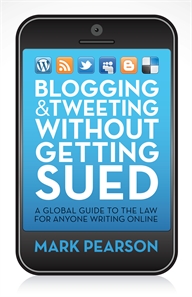
[Loosely adapted from my new book  – Blogging and Tweeting Without Getting Sued: A global guide to the law for anyone writing online (Allen & Unwin, 2012).]

—————-

The courts have long held that anyone having direct responsibility for a publication is legally liable for it, so if your blog or comment is on the website or social media site of another organisation, both you as the writer and whoever is hosting your work can be sued for defamation. (Some jurisdictions – most notably the US – offer strong defences to the hosts of third party comments.)

If someone edits or moderates your work before it is published, they too share the burden of legal liability. That happened recently to the News Limited website Perthnow, when it was ordered to pay $12,000 compensation to a West Australian mother over racist comments posted about her deceased teenage sons. The comments had been approved by a moderator.

If anyone republishes your work, through syndication or perhaps even through retweeting or forwarding your defamatory material, they also are also liable. Even someone who inserts a hyperlink to libellous material can be sued for defamation in some places, although the Supreme Court of Canada rejected this position in a landmark decision last year.

Plaintiffs will sue the writer, editor or host organisation for a range of reasons. Sometimes they just want to gag the discussion, so they issue a defamation writ to chill the criticism. This is known as a ‘SLAPP’ writ – ‘Strategic Lawsuits Against Public Participation’ – and in some countries they are simply thrown out of court as an affront to free expression. Others allow them. Plaintiffs often want to get the highest possible damages award from someone who can afford to pay it, so they might bypass the original impoverished blogger and sue the wealthier company that republished the material. Sometimes they enjoin all of them in their action, although this adds to their legal costs if they lose.

As the Australian High Court ruled in the Gutnick case in 2002, publication happens whenever and wherever someone downloads it. If you have published something defamatory about someone who is unknown in your own state or country you are probably safe from suit or prosecution until you travel to the place where they do have a reputation.

They would have to prove they could be identified from the material you posted. Of course, if you have named somebody they are identifiable, but what if you stop short of naming them but use other identifiers? For example, what if your blog questioned the ability of ‘a prominent 21st Avenue cosmetic surgeon responsible for the fat lips and lopsided breasts of at least three Oscar winners’? You would be much better taking legal advice first and actually naming the surgeon if you have a solid defence available to you. Why? Because there might well be other surgeons who meet this description, and you would have a hard time defending a suit from them if you didn’t even know they existed.

If your description is broad enough you will normally be reasonably safe. So if you had made your description fairly general – ‘an LA cosmetic surgeon’ – the group would be too large for any single surgeon to be able to prove you were talking about them. (They say there are almost as many cosmetic surgeons as lawyers in LA!)

Of course, if you decide after taking legal advice to actually name someone you need to ensure you use enough identifiers to ensure they will not be mistaken for someone else. That’s why court reports in the news usually state the full name, suburb, occupation and age of the accused person. Otherwise someone by the same name might show their reputation was damaged by proving their friends and colleagues thought they were the rapist, murderer or drug dealer you were writing about.

Your legal responsibility might even extend to pressing the ‘Like’ button on Facebook, as courts struggle with the legal status of this symbol – even in the US. See some useful analysis of this here.

See journlaw.com’s DEFAMATION update page for a range of recent defamation cases, many of which have involved social media.

© Mark Pearson 2012

Disclaimer: While I write about media law and ethics, nothing here should be construed as legal advice. I am an academic, not a lawyer. My only advice is that you consult a lawyer before taking any legal risks.

Leave a comment

Filed under Uncategorized

The Twelephant in the conference room – beware live unmoderated Tweet screening

By MARK PEARSON

The practice of screening live, unmoderated Twitter feeds as a backdrop to speakers and panels still happens at many conferences despite its potential to backfire.

I blogged about my own experiences with this practice after it triggered a series of embarrassments at a conference I attended at the end of 2010.

That opinion piece was published in full by the Pacific Media Centre here.

Let’s first get my definition straight. I am not as concerned by the screening of moderated tweets in conference rooms, and I am far less concerned about delegates, bloggers and journalists live tweeting the proceedings of conferences to the outside world – although both practices also have their risks.

My graver concerns are for the practice of the rolling live Twitter feed to a conference hashtag behind the speakers as they give their presentations.

Such a live feed happened at a journalism education conference I attended in Sydney in late 2010. (Incidentally, it also prompted a defamation threat from the editor of a national daily newspaper against a journalism academic over a series of tweets she had posted from the proceedings.)

As I recounted in my earlier piece, those of us who at the time were relatively new to Twitter were taken aback by the influence the live screened feed had on the conference proceedings from the moment ABC managing director Mark Scott began his opening address.

He noticed the Tweets rolling on the large screen behind him and interrupted his speech to say: “Is this a live Tweet feed that’s happening here? There’s nothing more frightening than a live Tweet feed. I’m going to turn my back to it and review later. Imagine if David and Margaret were reviewing half way through the film!” (For international readers, ‘David and Margaret’ are Australia’s most famous film reviewers who host a popular weekly movie criticism program on the ABC.)

Scott proceeded to sing the praises of his own public broadcaster’s innovative use of Twitter, but also acknowledged its hazards and quoted an editorial from The Australian describing it as “the dunny-door graffiti of the digital age”. Anyone holding  that view would have found it reinforced as that conference’s proceedings unfolded.

Immediately after his speech, Scott joined a panel of editorial executives from a cross-section of media to discuss journalism education, with the live Twitter feed rolling in the background.

That feed became a vocal de facto panellist as it ticked over on the screen behind the real panellists, with audience members tweeting criticisms of the size of the panel, the comments of speakers, the room lighting and even the camera work.

When one editor criticised the quality of graduates from a named journalism program, the screen behind him lit up, insisting the chair of the session (yours truly) give the head of that program a right of reply and joking that he should throw a shoe at his critic.

It was all taken in good humour at the time and offered some light relief to a somewhat tense session, but it was also a forewarning of a more alarming altercation later in the conference prompted by a cryptic tweet.
During a session on social media and journalism, one academic audience member described a panelist as ‘so male’. He didn’t notice the original tweet, but looked back at the screen to see it had been retweeted by a student reporter in the room.

“F*** (student’s name)”, he yelled in the midst of the session, and packed his things and stormed out, leaving the student in tears and the organisers scrambling to manage the awkward situation. Understandably, the organisers decided to suspend the live screening of Tweets for the final conference session.

I suggest it would be a rare conference host who would want this level of angst to unfold on their watch and I am sure my good colleagues who hosted that journalism conference have, like me, learned much more about the dynamics of Twitter in a public forum over the ensuing two years. Far worse situations can unfold, such as the hijacking of the hashtag by individuals or groups outside the conference wanting to damage proceedings.

Yet, strangely, some conferences continue to feature live screened Twitter feeds.

To my mind, the potential risks – disarray, discomfort, distraction and defamation – far outweigh any possible rewards.

© Mark Pearson 2012

Disclaimer: While I write about media law and ethics, nothing here should be construed as legal advice. I am an academic, not a lawyer. My only advice is that you consult a lawyer before taking any legal risks.

Leave a comment

Filed under Uncategorized

Digital #defamation: losing face on Facebook and the toll of trolls on Twitter

By MARK PEARSON

[Loosely adapted from my new book  – Blogging and Tweeting Without Getting Sued: A global guide to the law for anyone writing online (Allen & Unwin, 2012).]

—————-

Defamation law everywhere requires proof that your publication has lowered someone’s standing in the eyes of at least one other person.

It must go to this third person before the ‘reputation’ can be damaged, because your reputation is your standing in the eyes of others.

In other words, if you insult someone in a direct message (DM) to them alone on Twitter, you have not defamed them. But if you repeat the slur to just one other tweep your victim might then have an action in defamation.

From that point on the laws of defamation (libel and slander) vary across jurisdictions, with falsity required as a starting point in some places and defences varying widely.

In many countries defamation is also a crime – known broadly as ‘criminal libel’ – used by some repressive regimes as a weapon of the State against free expression.

We have all seen how a major newspaper or television network can destroy someone’s reputation in an instant, but you might have felt comfortable saying what you like about someone to your handful of blog followers, your 20 Facebook friends or your tribe of chirpy tweeps.

Sorry, but as soon as you say something nasty about someone to a single Facebook friend or to your single Twitter follower you have defamed the victim of your comments. Most of the time this will just cause a little embarrassment to both you and them if they find out, but occasionally a single publication to just one other person can be devastating – and expensive.

If your comment (or defamatory material in some other form like an image or even perhaps a ‘Like’ symbol!) goes to a client of the victim it could cost them a multi-million dollar contract – and you’d be facing that bill in damages if your lawyers can’t find you a good defence.

The name David Milum might not be familiar to you, but he was a pioneer in defamation law … for all the wrong reasons. He ran a political website in Forsyth County, Georgia, and became the first US blogger to lose a libel case when in 2004 he wrote that an attorney had delivered bribes from drug dealers to a judge. The attorney won $50,000 in damages and the appeal court held in 2007 that bloggers and podcasters were just as liable for defamation action as other publishers.

Since then we’ve had the advent of social media and a litany of defamation cases across most platforms worldwide.

Courts can – and do – award substantial damages to someone who has been injured in some way because of your nasty posting. Perhaps they have been traumatised, their relationships have been damaged or they might have lost a lucrative contract. Even the fact that you didn’t mean to defame them will not protect you in most places. In those countries just your act of publication needs to be intentional, not your intent to damage the person’s reputation.

There are several exceptions to this. For example, ISPs usually have a defence to defamation on the websites they host unless the material has been brought to their attention and they have refused to take it down. In the US, this goes further under s. 230 of the Communication Decency Act to give full protection to ‘interactive computer services’, even protecting blog hosts from liability for comments by users. Careful here, though, because the discussants can be sued over their comments if they are identifiable via their IP (Internet protocol) addresses and the host might cough yours up, particularly now that lawyers and private investigators are getting more sophisticated in their digital discovery processes.

Bloggers often mistakenly thought their ISP or host site would be sued for defamation instead of them. Lancashire academic Tracy Williams used a pseudonym to defame a UK Independence Party candidate on a Yahoo! discussion board in 2004. She called him a sexual offender, a racist bigot and a Nazi, and escalated her abuse when he started legal action. The politician won a court order against Yahoo! to reveal her identity and in 2006 she became the first blogger to lose a libel action in the UK High Court and it cost her £10,000 in damages. And in 2011 Twitter was ordered by a Californian court to reveal to South Tyneside Council in the UK the personal details of five users who had allegedly defamed three of its councillors.

See journlaw.com’s DEFAMATION update page for a range of recent defamation cases, many of which have involved social media.

© Mark Pearson 2012

Disclaimer: While I write about media law and ethics, nothing here should be construed as legal advice. I am an academic, not a lawyer. My only advice is that you consult a lawyer before taking any legal risks.

2 Comments

Filed under Uncategorized

DEFAMATION update – an experiment in collaborative scholarship

By MARK PEARSON

Both of my recent books are relatively up to date but anyone researching media law in traditional and new platforms knows how quickly the landscape is changing.

It’s for that reason I’m launching some collaborative update pages that take in some of the key chapters from both The Journalist’s Guide to Media Law (with Mark Polden, 2011) and Blogging and Tweeting Without Getting Sued (Allen & Unwin, 2012).

I’ve removed the copyright symbol © from these posts so these pages can serve as a resource for anyone in the fields of media law and social media law – students, journalists, lawyers, researchers, teachers … and even those writing competing books on the subject! (Remember, however, that we can’t steal the actual words of contributors when we write up the cases or materials they scout for us – we will need to verify the material and links and write them up using our own form of expression.) 

 I’ll get the project started with contributions from some of my own students and research assistants working on other projects and the material will appear in no particular order. Please offer your own alerts via the comments section of each topic’s blog post. (Remember there is word limit on comments so please keep contributions under 300 words). Australian and international cases and commentary are welcome.

I’ve already launched the CONTEMPT update page. Here is the DEFAMATION update page – with this first set of contributions from law and journalism student Fiona Self (thanks, Fiona!).

Cheers, Mark Pearson.

We also now have a  SHIELD LAWS update.

—–

(Update: These contributions from Virginia Leighton-Jackson, thanks.)


Caller, not broadcaster, responsible for defamation – 3.04.2012 – 27.07.2012

A man who called radio station 2HD Newcastle and made defamatory comments about an ABC reporter has been ordered to pay 80 per cent of the resulting pay out, plus the cost of two trials in the New South Wales Supreme Court.

The claims that caller Craig Stephens made were found to be “untrue in every respect” in the proceedings and prompted the ABC broadcaster to request an apology which was carried out on air.

In an assessment of the 2HD broadcaster who took the call, it was found that he had no reasonable suspicion to use the ‘kill button’ which was primed with a seven second delay, and thus should not be held entirely responsible for the resulting lawsuit; especially considering that Stephens was found not to be a ‘satisfactory witness’ in the proceedings, denying some of the evidence presented in court (including the email in which he threatened to kill himself in front of the head office of 2HD if he was sued, for the purpose of damaging the stations ratings and advertising).

Stephens also attempted to use the defences of fair comment/ honest opinion and qualified privilege, neither of which were upheld.

The court decided that Stephens should contribute to almost all of the damages settled upon, with 2HD paying the remaining 20 per cent, with the presiding judge saying:

“…2HD must share some responsibility simply as a result of enabling the publication by the talkback format.”

Links:

2HD Broadcasters Pty Ltd & Newcastle FM Pty Ltd v Wendy Stephens & Craig Stephens, 2.08.2012: http://glj.com.au.ezproxy.bond.edu.au/1853-article 

Supreme Court of New South Wales, full judgement, 27.07.2012: http://glj.com.au.ezproxy.bond.edu.au/files/2hdvstephensjudgment.pdf

2HD Broadcasters Pty Ltd & Newcastle FM Pty Ltd v Wendy Stephens & Craig Stephens trail report, 2.04.2012: http://glj.com.au.ezproxy.bond.edu.au/1781-article


Rafiq Ahmed v Nationwide News Pty Ltd & News Digital Media Pty Ltd, Yoni Bashan trial – 17.05.2012

In the ongoing trail playing out in the NSW District Court, Sunday Telegraph reporter Yoni Bashan has given evidence for Nationwide News in the defamation action brought by Rafiq Ahmed.

Ahmed, a fraud squad detective, is suing over an article published in the Sunday Telegraph.

The article in question was published in November of 2009 where Bashan has said he intended to convey that the detective was corrupt.

News is pleading using many defences including truth, fair report, fair comment, publication of documents, qualified privilege, honest opinion, and offer of amends.

Bashan said that the matters could not be disputed as Ahmed was found guilty during a Police Integrity Commission annual report.

However, Ahmed won an appeal in December of 2010, complicating the matter.

The trial is ongoing with Ahmed still taking action against all involved.

Links:

Gazette of Law and Journalism

Trial report 17 May: http://glj.com.au.ezproxy.bond.edu.au/1807-article

Trial report 15 May: http://glj.com.au.ezproxy.bond.edu.au/1805-article

Yoni Bashan’s article, “Rogues gallery of corrupt cops”

http://glj.com.au.ezproxy.bond.edu.au/files/dtroguesmco.pdf

AustLii database

            Ahmed v Nationwide News Pty Ltd [2010] NSWDC 183 (20 August 2010): http://www.austlii.edu.au/cgi-bin/sinodisp/au/cases/nsw/NSWDC/2010/183.html?stem=0&synonyms=0&query=Rafiq%20Ahmed

 —-

Contributions from FIONA SELF:

Twitter refuses to uncover Bankwest senior executive impersonator

Title: Social media can kill reputation

Author: Tony Boyd

Date: 28 August 2012

Type of source: The Australian Financial Review

Country: Australia

Link to source: http://afr.com/p/business/chanticleer/cba_twitter_nightmare_highlights_UeoWmvxkwSDRDBjNiPcylJ

Summary:

  • An unknown person impersonated a Bankwest senior executive on Twitter and tweeted inflammatory material.
  • If those things had been published in an outlet owned by Fairfax Media or News Ltd, an injunction could have been sought to track down the impersonator.
  • The Commonwealth Bank of Australia had to contact Twitter to have the account removed, which was a complex and costly process.
  • The process of getting a false account removed can take about two weeks, according to CBA’s general counsel and head of corporate affairs David Cohen.
  • Twitter refused to tell CBA the account details because it would have been a breach of their privacy rules.
  • Currently, it appears that anyone can steal another person’s identity and say whatever they want, without facing any of the consequences.
  • Many companies (such as NAB) use Twitter to deal with complaints and to inform customers of any technology outages.

—-

Defamed cricket player awarded $142,000 in damages for 24 word tweet

Title: Chris Cairns wins libel action against Lalit Modi

Authors: AFP

Date: 26 March 2012

Type of source: Newspaper article and full judgment

Country: United Kingdom (Royal Courts of Justice)

Link to source: http://www.judiciary.gov.uk/Resources/JCO/Documents/Judgments/cairns-v-modi-judgment.pdf

http://www.theaustralian.com.au/sport/cricket/chris-cairns-wins-libel-action-against-lalit-modi/story-e6frg7rx-1226310713029

Citation: Cairns v Modi [2012] EWHC 756 (QB)

Summary:

  • Libel case
  • Chris Cairns (UK cricket player) sued Lalit Modi, former chairman of the Indian Premier League, who tweeted on 10 January 2010 “Chris Cairns removed from the IPL auction list due to his past record in match fixing. This was done by the Governing Council today.”
  • The tweet was seen by less than 100 of Modi’s followers, but after the online cricket publication reported by essence of the tweet, it’s estimated to have been ready by somewhere between 450 – 1500 people.
  • UK Justice David Bean: Although publication was limited, that does not mean that damages should be reduced to trivial amounts.
    • Cairns endured a “sustained and aggressive” attack on his reputation
    • $142,000 damages plus legal costs

—-

Meggitt #suingtwitterbecause of Hardy tweet

Title: Twitter sued over Hardy Tweet

Author: Michelle Griffin

Date: 17 February 2012

Type of source: Newspaper (The Age)

Country: Australia

Link to source: http://www.theage.com.au/technology/technology-news/twitter-sued-over-hardy-tweet-20120216-1tbxz.html

Summary:

  • In November 2011, writer Marieke Hardy wrongly named Joshua Meggitt as the author of a hate blog via Twitter
  • Hardy and Meggitt settled out of court (estimated $15,000) and Hardy published an apology on her blog
  • Meggitt is now suing Twitter Inc
  • The original tweet appeared on Twitter’s homepage, was copied by some of Hardy’s 60,897 followers
  • Meggitt’s lawyers say they are suing for the retweets and the original tweet

—-

Bahraini activist three month Twitter defamation sentence overturned

Title: Bahraini activist cleared of defamation

Author: DPA

Date: 24 August 2012

Type of source: Newspaper article (Sydney Morning Herald)

Country: Bahrain

Link to source: http://news.smh.com.au/breaking-news-world/bahraini-activist-cleared-of-defamation-20120824-24ph7.html

Summary:

  • Bahraini activist Nabeel Rajab made some comments on Twitter calling for the resignation of Bahrain Prime Minister Khalifa bin Salman al-Khalifa
  • Sentenced to three months in jail
  • Sentence was overturned
  • Interesting points:
    • Rajab will stay in prison because he’s already serving a three-year term of taking part in anti-government protests
    • The report that the Court overturned his defamation sentence comes from the state-run Bahrain News Agency

—-

Poet sentenced to one year in jail for posting a defamatory poem on Facebook

Title: Oman sentences writer, poet, for defaming sultan

Author: Reuters

Date: 9 July 2012

Type of source: Online article (Yahoo! news)

Country: Oman

Link to source: http://news.yahoo.com/oman-sentences-writer-poet-defaming-sultan-150629428.html

Summary:

  • Omani poet Hamad al-Kharusi published a poem referring to the Sultan on his Facebook page
  • Sentenced to one year in jail for defamation and for violating information technology laws
  • Another three people were also convicted of defamation, one (author Hammoud Rashedi) held up a sign with certain sentences directed at Sultan Qaboos at a peaceful demonstration.
  • Rashedi was sentenced to six months in jail for defamation

—-

Comedian Mick Molloy loses appeal over not-so-funny defamation

Title: Molloy loses appeal over Cornes defamation

Author: Candice Marcus

Date: 24 August 2012

Type of source: ABC News and unreported judgment

Country: Australia

Link to source: http://www.abc.net.au/news/2012-08-24/molloy-loses-appeal-over-cornes-defamation/4221106?section=sa

http://www.austlii.edu.au/cgi-bin/sinodisp/au/cases/sa/SASCFC/2012/99.html?stem=0&synonyms=0&query=defamation

Citation: Cornes v The Ten Group Pty Ltd & Ors [2012] SASCFC 99 (24 August 2012)

Summary:

  • South Australia Supreme Court, appealed to Full Court
  • Defamatory comments made by comedian Mick Molloy on TV program Before The Game in 2008 about former federal Labor candidate Nicole Cornes.
  • Chief Justice Chris Kourakis said Molloy’s attempted joke “fell very flat.”
  • Molloy and Channel 10 had to pay Mrs Cornes $85,000 in damages plus interest and costs (total $93,000)

6 Comments

Filed under Uncategorized

Your SM medium can affect your legal risk

By MARK PEARSON

[Adapted from my new book  – Blogging and Tweeting Without Getting Sued: A global guide to the law for anyone writing online (Allen & Unwin, 2012).]

—————-

Your method and your medium can be important factors in your legal exposure. The simple fact is that some publishing platforms are more law-friendly than others. Sometimes this will depend on the type of material you are publishing. For example, there is an argument that Twitter users may be less prone to copyright infringement because the very nature of the medium limits the amount of another person’s work they can borrow and the retweeting function implies that everyone expects their work to be recycled by others.

However, on Twitter you may leave yourself more exposed in the area of defamation because there is so little space for you to give context and balance to your criticism of others. Longer, better argued critiques lend themselves to some of the fair comment defences in many countries.

Tweeting from an event as it unfolds, such as a conference or a court case, has its dangers because your tweets might contain errors in the quotes of others or might be taken out of context by someone just reading a single tweet rather than the overall coverage. And of course you tweet with the full expectation that your work will be spread far and wide, meaning any libellous material can cause considerable damage.

Publication on Facebook, however, might be restricted to just a few friends, particularly if your privacy settings are adjusted so that your comments are not viewable to the friends of your friends.

Remember, if someone reposts your work they are the ones republishing it, so they would in turn be liable. (A court may, of course, factor in to a damages claim the extent that you might have expected your material to be retweeted or reposted by others.)

The open blog has a potentially wide distribution network, but it also has quite cautious controls available to you when you use a host like WordPress. You should take advantage of opportunities to save drafts and proof-read your material in preview mode before proceeding to publication. Careful checking pre-publication can help you find accidental spelling mistakes and remind you of extra fact-checking you will need to carry out before pressing that magic ‘Send’ button.

If you have written your blog fairly and accurately it can go a long way to establishing a defence to defamation. Blogging is also about writing quality, so your mastery of the language and your selection of the most appropriate words can be crucial when defending a libel allegation if you have written a scathing review of a public event or performance.

You might take a moment to look over some of your recent blogs, tweets and Facebook postings. How well do they shape up?

And who is that trying to foist a legal document at you as your step out your front door? 😉

© Mark Pearson 2012

Disclaimer: While I write about media law and ethics, nothing here should be construed as legal advice. I am an academic, not a lawyer. My only advice is that you consult a lawyer before taking any legal risks.

Leave a comment

Filed under Uncategorized

Is your blog ‘in the public interest’ or just ‘interesting to the public’?

By MARK PEARSON

[Adapted from my new book  – Blogging and Tweeting Without Getting Sued: A global guide to the law for anyone writing online (Allen & Unwin, 2012).]

—————-

Is your blog ‘in the public interest’ or just ‘interesting to the public’?

If something you have posted becomes the subject of legal action, lawyers, prosecutors and judges will usually look to your motives for publishing the material. In some places those motives can actually form a defence, while on other occasions your motives can be your undoing. But two are worth considering here because of their very different impact on the law – ‘public interest’ and ‘malice’.

Many statutes and court rulings use the expression ‘public interest’ as an element of a defence to a range of publishing crimes and civil wrongs. In such matters you would have to convince the court that some greater public good came from the material you published and that society benefited in some way as a result. You would normally need to show that any public benefit outweighed the harm that was caused by the publication, which is normally the reason you are called to account. For example, your defence to a defamation action might be that it was in the public interest that your audience learned of your corruption allegations against a leading politician, even if you could not quite prove that the allegations were true.

Many jurisdictions offer a ‘public interest’ or ‘qualified privilege’ defence for defamatory material about extremely important public issues but the publisher might not have quite enough evidence available to prove truth and other defences might not apply.

It’s important to distinguish here between matters of legitimate ‘public interest’ and other matters such as celebrity gossip which might be just ‘interesting to the public’.

Even so, under special protections in the US writers can get away with false publications about celebrities and other public figures as long as you are not being malicious in your attacks. Again, you need to be wary of less forgiving laws in other places, particularly if the celebrity has a reputation they wish to defend elsewhere – perhaps the Australian actress Nicole Kidman or the New Zealand film-maker Peter Jackson.

In other countries the public interest or qualified privilege defence normally requires you to show that you acted in good faith and made proper enquiries in the lead-up to your defamatory publication, despite being unable to prove its truth.

Journalists may be better positioned to make use of this defence than so-called ‘citizen journalists’ or amateur bloggers because they have been trained in research skills and verification practices.

However, there has been nothing to indicate that bloggers or social media users will not qualify for the defence because of what they do. In fact, the Minnesota District Court granted a Republican blogger Michael Brodkorb the same rights as a traditional reporter when he had cited an anonymous source to accuse a Democratic political advisor of self-interest.

In some areas of the law the words ‘public interest’ are not used, but the defence itself has come from a balancing of public interests against other rights. For example, copyright law in most countries has a range of ‘fair use’ defences so that parts of copyright material can be republished for the purposes of education, news or critique.

The defences exist because politicians have decided that there is a greater ‘public interest’ in the community being educated and informed about such important matters than in protecting the intellectual property owned by the creator of the work. As many judges have pointed out, ‘public interest’ does not equate with ‘interesting to the public’, and you should not be allowed to destroy someone’s reputation or invade their privacy simply because your gossip is particularly saucy.

By far the best known right to free expression is the First Amendment to the US Constitution. It states: “Congress shall make no law … abridging the freedom of speech, or of the press.” The US Supreme Court has interpreted the First Amendment very broadly and has applied it across media to a whole range of publishing situations. It certainly applies to the material bloggers, Facebook users and tweeters create – particularly if you are commenting on matters of public importance.

In a series of media decisions throughout the 20th century the Supreme Court allowed newspapers and broadcasters to use the First Amendment to bolster their defences against laws affecting their publications. This was especially useful in defamation law where a whole defence developed allowing the media to publish libellous material about a public figure as long as they did not know it was false and they were not being malicious.

The First Amendment is so entrenched in US society that bloggers sometimes operate under the assumption this same protection will apply in other parts of the world. Unfortunately, it does not.

Is deception in the public interest?

Sometimes bloggers will use the age-old journalistic excuse for deception – that it was in the ‘public interest’. That was the argument Cuban exile Luis Dominguez gave for adopting the guise of a 27-year-old female Colombian sports journalist to trick Fidel Castro’s son into sharing details of his opulent lifestyle. As the BBC reported, the blogger posted images and documents taken from his online flirting with 40-year-old Antonio who had a penchant for both sports and women.

“I’m a Cuban and I’m a Cuban American and I have not been able to go back to my country since 1971 when I left,” he told the BBC. “I use whatever tools I have to be able to get back at these people. In Cuba people are put in prison for no reason at all. Their rights are violated… So, why can’t I do the same thing to them? I have no remorse whatsoever.”

While ‘public interest’ might be a worthy moral motivation for your deception, it will rarely work as a defence in its own right, particularly if your actions are criminal. Get sound legal advice before relying upon it.

© Mark Pearson 2012

Disclaimer: While I write about media law and ethics, nothing here should be construed as legal advice. I am an academic, not a lawyer. My only advice is that you consult a lawyer before taking any legal risks.

1 Comment

Filed under Uncategorized

Queensland’s biggest publisher – the police – try to calm the FB lynch mob

By MARK PEARSON

The resources of the Queensland Police Service Facebook fan page were stretched over the past 24 hours to cope with the public response to their announcement of an arrest of a suspect in one of Brisbane’s most compelling ‘whodunnit’ murder mysteries.

Mainstream and social media speculation about the case has been rampant since 43-year-old Allison Baden-Clay went missing on April 23. Her husband Gerard appeared in court today charged with her murder.

As I have blogged previously, the Queensland Police Service has a highly successful Facebook page which established the bulk of its 289,500 fan base during the devastating Brisbane floods in January last year. It proved an excellent community communication tool during the disaster and since then as a crime detection aid as the public volunteer leads on unsolved crimes and public safety.

But the challenge comes when Police Media announce on their Facebook page the apprehension of a suspect in a high profile case.

The problem with Facebook fan pages is that you must have the ‘comment’ function turned completely ‘on’ or ‘off’ – so the best the police can do is monitor the feed and remove offensive or prejudicial material after it has been posted.

That might be fine during an uneventful day when the police social media team can keep on top of the message flow – but when an arrest has been made in an emotion-charged crime like a murder or a child sex attack many fans want to ‘vent’.

That’s what happened with the arrest of a suspect in the murder of Sunshine Coast teenager Daniel Morcombe last August.

It happened again last night and today as, within 21 hours, more than 500 fans commented on the Police Media announcement that Baden-Clay had been charged with his wife’s murder and more than 1,500 ‘liked’ the announcement. Those 506 comments were the ones that survived the post-publication moderation process where officers in the social media unit trawl through the latest posts to delete the inappropriate ones.

The law of sub judice in Australia dictates that nothing can be published that might prejudice the trial of an accused after they have been arrested or charged. That includes any assumption of guilt (or even innocence), evidentiary material, theories about the crime, witness statements, prior convictions or character material about the accused. It even bans visual identification of the accused if that might be an issue in court. In a murder trial it usually is.

The penalty can be a criminal conviction on your record, a stiff fine and sometimes even a jail term for contempt of court.

Once the accused has appeared in court, journalists covering the matter are protected from both contempt and defamation action if they write a ‘fair and accurate’ report of the hearing, sticking to material stated in open court in the presence of the jury – if there is one.

It’s hard enough for reporters to get their heads around these rules – let alone the Facebook fans posting their theories on a murder to the police Facebook page.

Even some of the posts that have survived the police editing process to date push the boundaries of acceptable commentary on a pending case.

One stands out: “Ann Gray: Took long enough. It was obvious that he did it. Hope he rots in jail.”

That was six hours after the announcement, and obviously the moderators were running short on patience with their ‘fans’. The moderators took to calling those speculating on the crime “Facebook detectives”. One replied to Ms Gray: “Queensland Police Service: Ann Gray *sigh* Really? The third detective we have commenting on here that does not comprehend what it takes? I suggest you don’t pass judgement on something that you know nothing about!”, and then “Queensland Police Service: I am not sure ‘because it is obvious’ is suffice (sic) evidence in court, Facebook detectives. It is a matter before the courts. Enough!”

They also tried with a standard warning to commenters that was pasted into the discussion on several occasions: “Facebookers who are just joining this post, please do not speculate on this matter. Any posts which do are deleted and those who continue will be banned from our FB page. Please respect our rules. Thanks.”

One fan – Bec Mooney – suggested the police disable their comments function if they were so concerned about offensive and prejudicial material appearing, to which the police replied: “Queensland Police Service Bec Mooney – WE CAN’T DISABLE COMMENTS. Take that issue to Facebook. Even if we could, it would contradict the idea of social media.”

Do I sense a little attitude here? Clearly, the officers were getting tired and frustrated in the midst of the onslaught of the ‘lynch mob’, but surely the correspondent Ms Mooney had a valid point.

As I blogged earlier this week, Australian courts have ruled that the hosts of such fan pages are legally responsible for the comments of others on their sites and must act within a reasonable time to remove illegal or actionable material.

But they haven’t yet had to rule on a serious sub judice matter – so the key question is: How long is it reasonable for a prejudicial statement like the ‘obvious he did it’ and ‘rot in hell’ comment to remain on a public law enforcement agency’s Facebook page? It had been there 15 hours when we took our screen shot and may well still be there when you are reading this.

These rules apply to the mainstream media, and the police fan page has been so successful that it is now Queensland’s biggest publisher on some counts. Its fan base outstrips the Courier-Mail’s circulation, which peaks at 255,000 on a Saturday. And that newspaper – Queensland’s biggest – has fewer than 20,000 fans on its Facebook page. The ABC has just 91,000 nationally.

They aren’t allowed to publish this kind of prejudicial material.

Surely the police have even less excuse for hosting such comments even for a moment. The Queensland Police Service is the arresting and prosecuting authority whose job is to preserve the integrity of the justice process.

I fear it will not be long before a savvy defence lawyer seizes the opportunity to use such prejudicial commentary as grounds for appeal – perhaps resulting in a trial being aborted at great public expense or even a verdict quashed. That would be the exact opposite of what most of these commenters and the police would want.

Social media is clearly a superb resource for police and other agencies to use to connect with their communities and to build public trust. But let’s get sensible with this.

Instead of boasting to the whole world about a high profile arrest like this one, surely the police can hold back and let the mainstream media publish their announcement just as they have done for decades. The message would still get out and at least they would not then have the headache of the avalanche of comments in response to this kind of PR announcement.

The police argue that disabling comments might “contradict the idea of social media”, but surely their hosting of prejudicial material – even for a short time – contradicts the valued right to a fair trial of those they have arrested.  

© Mark Pearson 2012

Disclaimer: While I write about media law and ethics, nothing here should be construed as legal advice. I am an academic, not a lawyer. My only advice is that you consult a lawyer before taking any legal risks.

3 Comments

Filed under Uncategorized

The liability time bomb of comments on your FB fan page #medialaw

By MARK PEARSON

What if someone posted a comment to your Facebook fan page at 5.15pm on a Friday alleging a leading businessman in your community was a paedophile?

How long would it be before someone noticed it? Immediately? Perhaps 9am Monday?

I put this question to a group of suburban newspaper journalists recently, expecting most would not be checking their newspapers’ Facebook pages over the weekend.

I guessed right, but I was amazed when one replied that such a comment would have remained there for the three months since he last looked at his company’s fan page.

Facebook fan pages are a legal time bomb for corporations, particularly in Australia where the courts have yet to rule definitively on the owner’s liability for the comments of others.

In an earlier blog I looked more closely at the decision of Federal Court Justice Ray Finkelstein in the Allergy Pathways case last year.

Justice Finkelstein’s ruled that in a consumer law case a company would have to take reasonable steps to remove misleading and deceptive comments of others from their Facebook fan pages (and Twitter feeds) the instant they had been brought to their attention.

A more recent Federal Court case examined moderated comments on a newspaper’s website in the context of a racial discrimination claim.

In Clarke v. Nationwide News, Justice Michael Barker ordered the publishers of the Perth Now website to pay $12,000 to the mother of three indigenous boys who died after crashing a stolen car and to take down the racist comments about them from readers that had triggered the claim.

Central to the case was the fact that the newspaper employed an experienced journalist to moderate the comments on its site, meaning that it had taken on responsibility as ‘publisher’ of the comments. (The newspaper managing editor’s explanation of the moderation system at paras 170-178 makes for interesting reading too).

Justice Barker distinguished situations where the editors actively moderated readers’ comments from those where they did not (para 110), but restricted that distinction to the operation of s. 18C of the Racial Discrimination Act, which requires the “offensive behavior” to have been “because of the race, colour or national or ethnic origin”.

Unmoderated comments fall outside this because it cannot be proven the publisher shares the commenter’s racist motivation unless the publisher refuses to take down the comments once this has been brought to their attention.

Justice Barker stated:

“If the respondent publishes a comment which itself offends s18C, where the respondent has “moderated” the comment through a vetting process, for example, in order not to offend the general law (or to meet other media standards), then the offence will be given as much by the respondent in publishing the offensive comment as by the original author in writing it.

“In such circumstances, it will be no defence for the respondent media outlet to say, ‘But we only published what the reader sent us’.”

Some might read this to mean that it is safer to run all comments in an unmoderated form – just like a Facebook ‘fan’ page is structured – then take them down if you get a complaint.

Such an approach might sit okay with these decisions in consumer or racial discrimination law, but what happens when the time bomb lands – a shocking defamation imputation, a heinous allegation damaging a forthcoming trial, or the breach of a court order or publication restriction like the naming of a rape victim?

Defamation and contempt are matters of ‘strict liability’, where you might be liable even if you are ignorant of the defamatory or contemptuous content you are publishing. The only intent required is that you intended to publish your publication or were ‘reckless’ in the publishing of the material. And neither has offered protection for publishers providing a forum for the comments of others.

Which brings us back to the question at the very start. If the Federal Court has ruled you should remove unmoderated material breaching consumer or race law within a reasonable time of becoming aware of it, what will courts deem a ‘reasonable time’ for a serious allegation of child molestation about a prominent citizen to remain on a publisher’s Facebook fan page?

If the allegation were about me, I certainly wouldn’t want it remaining there over a weekend. Or even five minutes. Any period of time would be unreasonable for such a dreadful slur.

The High Court established 10 years ago in the Gutnick case that a publisher is responsible for defamation wherever their material is downloaded. As The Age revealed in 2010, a blogger using the pseudonym ‘witch’ launched a series of attacks on a stockmarket forum about technology security company Datamotion Asia Pacific Ltd and its Perth-based chairman and managing director, Ronald Moir. A court ordered the forum host HotCopper to hand over the blogger’s details which could only be traced to an interstate escort service. But private investigation by the plaintiff’s law firm eventually found the true author of the postings on the other side of the nation who was then hit with a $30,000 defamation settlement.

And what if it is a litany of allegations about the accused in an upcoming criminal trial? I have blogged previously about the awkward position the Queensland Police face with their very successful Facebook fan page when citizens comment prejudicially about the arrest of an accused in a criminal case. No matter how well those fan page comments are moderated by police media personnel, they could never keep pace with the prejudicial avalanche of material posted on the arrest of a suspect in a high profile paedophilia case.

That leads to the awkward situation of the key prosecutor of a crime hosting – albeit temporarily – sub judice material on their own site. It can’t be long before defence lawyers use this as a reason to quash a conviction.

The situation is different in many other countries – particularly in the US where s. 230 of the Communication Decency Act gives full protection to ‘interactive computer services’, even protecting blog hosts from liability for comments by users.

Much has changed in the three decades since I had my first letter to the editor published by the Sydney Morning Herald as an 18-year-old student.

I can clearly recall that newspaper’s letters editor phoning me in my suburban Sydney home to check that I really was the author of the letter and that I agreed with his minor edits.  No doubt he then initialled the relevant columns in the official letters log – the standard practice that continues in some newspaper newsrooms today.

But all that caution has been abandoned in the race for relevance in the digital and Web 2.0 eras.

First, it was news organisations’ websites allowing live comments from readers – still largely moderated. For a while, most insisted on identification details from their correspondents.

Next came their publication in hard copy of SMS messages received in response to their stories. My local newspaper – the Gold Coast Bulletin – sometimes publishes several pages of such short texts from readers using witty pseudonyms.

And now we have the Facebook fan pages, where the technology does not allow the pre-moderation of the comments of others. You need to have that facility switched completely ‘on’ or ‘off’ – and it defeats the purpose of engaging with readers for a media organisation to turn off the debate. I can post a Facebook comment from an Internet café under the name ‘Poison Pen’ and it may well be vetted by nobody.

The whole issue is symptomatic of the social media challenges facing both the traditional media and the courts.

Meanwhile, expect to wait a while to see your comments to this blog published. I’ve elected for full moderation of all comments, and have already rejected a couple that seem to leave me exposed as publisher. You can’t be too cautious now, can you?

© Mark Pearson 2012

Disclaimer: While I write about media law and ethics, nothing here should be construed as legal advice. I am an academic, not a lawyer. My only advice is that you consult a lawyer before taking any legal risks.

4 Comments

Filed under Uncategorized

Doctors bury their mistakes. Lawyers jail theirs. But bloggers publish theirs for the world to see

By MARK PEARSON

An excerpt from my new book  – Blogging and Tweeting Without Getting Sued: A global guide to the law for anyone writing online:

—————-

Time warps on the Internet. It is one of the most important aspects of new media, and one of the most complicating in legal terms. On the one hand, pressing the ‘Send’ or ‘Publish” button makes your work instant and irretrievable. While the newspaper publisher could always pulp an offensive edition before the trucks left the factory, as a blogger or micro-blogger you have to live with the consequences of your digital publishing errors. Yes, you can remove your blog, tweet or Facebook status within seconds of posting it, and request that it be taken down from search engines. But you can never be sure someone hasn’t captured, downloaded, and forwarded it in the meantime.

This permanent quality of new media does not mix well with an online writer’s impulsiveness, carelessness or substance abuse. There is an old saying: ‘Doctors bury their mistakes. Lawyers jail theirs. But journalists publish theirs for all the world to see’. That can be applied to anyone writing online today. At least in bygone times these mistakes would gradually fade from memory. While they might linger in the yellowing editions of newspapers in library archives, it would take a keen researcher to find them several years later. Now your offensive or erroneous writing is only a Google search away for anyone motivated to look.

British actor Stephen Fry learned this in 2010 when he tweeted his two million followers, insulting Telegraph journalist Milo Yiannopoulos over a critical column. “Fry quickly deleted the tweet once others started to latch on to it, but as we know that rarely helps when you’ve posted something injudicious online: the Internet remembers,” Yiannopoulos wrote.

This new permanence of stored material also creates problems for digital archives – because if the material remains on the publisher’s servers it may be considered ‘republished’ each time it is downloaded, as lawyer Steven Price has blogged. This means that even where there might be some statutory time limitation on lawsuits, the clock starts ticking again with each download so you do not get to take advantage of the time limit until you have removed the material from your site. The best policy is to take all steps to withdraw any dubious material as soon as possible. If others choose to forward or republish it, it has hopefully become their problem rather than yours.

Blogging and Tweeting Without Getting Sued: A global guide to the law for anyone writing online is now available in print format in Australia and New Zealand (UK release in July and US release in October) and as an ebook via Kindle, Google, Kobo and some other providers. [Order details here.]

[Media: Please contact Allen & Unwin direct for any requests for advance copies for review. Contact publicity@allenandunwin.com or call +61 2 8425 0146]

© Mark Pearson 2012

Disclaimer: While I write about media law and ethics, nothing here should be construed as legal advice. I am an academic, not a lawyer. My only advice is that you consult a lawyer before taking any legal risks.

2 Comments

Filed under Uncategorized