Tag Archives: journalism

Any Australian #privacy tort must feature strong free expression protections

By MARK PEARSON

The Media Entertainment and Arts Alliance has released its latest annual press freedom report – Kicking at the Cornerstone of Democracy – with some excellent articles covering the gamut of media law and censorship issues in Australia.

It is essential reading for journalists, media lawyers and students – updating the material covered in their media law textbooks in an accessible journalistic style.

My article is on privacy law, and I reproduce it here in its extended, unedited form for the benefit of my blog followers:

———

Privacy On Parade

The right to privacy is a relatively modern international legal concept. Until the late 19th century gentlemen used the strictly codified practice of the duel to settle their disputes over embarrassing exposés of their private lives.

The first celebrity to convert his personal affront into a legal suit was the author of The Three Musketeers, Alexandre Dumas père, who in 1867 sued a photographer who had attempted to register copyright in some steamy images of Dumas with the ‘Paris Hilton’ of the day – 32-year-old actress Adah Isaacs Menken.

The court held his property rights had not been infringed but that he did have a right to privacy and that the photographer had infringed it.

Across the Atlantic in 1890 the top US jurist Samuel D. Warren teamed with future Supreme Court Justice Louis D. Brandeis to write the seminal Harvard Law Review article ‘The Right to Privacy’ after a newspaper printed the guest list of a party held at the Warren family mansion in Boston.

Warren and Brandeis wrote: “The press is overstepping in every direction the obvious bounds of propriety and of decency. Gossip is no longer the resource of the idle and of the vicious, but has become a trade, which is pursued with industry as well as effrontery.”

Thus celebrities, lawyers, paparazzi and the gossip media were there at the birth of the right to privacy – and the same players occupy that terrain today.

While both privacy and free expression are recognised in many national constitutions and in international human rights treaties, Australia is rare among Western democracies in that it has no constitutional or Bill of Rights protection for either.

That distinguishes us from the United States, United Kingdom, Canada and New Zealand which all have constitutional or rights charter requirements that proposed laws must be considered for their potential impact on free expression.

It is one of the main reasons for the complex array of legislation, court decisions and industry codes of practice limiting Australian journalists’ intrusion into the affairs of their fellow citizens.

The myriad of laws of defamation, trespass, data protection, surveillance, confidentiality, discrimination, consumer law, stalking, court publishing restrictions, suppression orders and copyright all have a privacy dimension. The Privacy Act controls the collection and storage of private information by corporations and government.

There are very few situations of media intrusion into privacy not covered by one of these laws or by the framework of codes of ethics and practice controlling journalists’ professional activities.

Proposals to replace the self-regulatory and co-regulatory ethics systems with a statutory news media regulator would add yet another layer to the regulation of privacy intrusions.

The crux of the proposed ‘statutory cause of action for a serious invasion of privacy’ is whether a citizen should have the right to sue over a privacy breach and receive either an award of damages or an injunction to stop publication.

Over the ditch, Kiwi journalists now have to navigate a judge-made right to privacy, developed interestingly from a celebrity suit in which the plaintiffs lost the case.

Mike and Marie Hosking were New Zealand media personalities who had adopted twins and later separated. They asked for their privacy, but a magazine photographer snapped the mother walking the twins in their stroller in a public place. They sued, claiming breach of privacy. The NZ Court of Appeal invented a new action for breach of privacy, but held it did not apply in that particular case. The Kiwi privacy invasion test requires “the existence of facts in respect of which there is a reasonable expectation of privacy” and that “publicity given to those private facts that would be considered highly offensive to an objective reasonable person”.

But this is set against the backdrop of the New Zealand Bill of Rights Act which protects free expression.

Australia’s High Court famously left the door open for a possible privacy tort in the ABC v. Lenah Game Meats case in 2001, when animal liberationists had secretly filmed the slaughter of possums in an abattoir in Tasmania and the ABC wanted to broadcast the footage – the fruits of the trespass.

It is hard to quarantine this latest push by the Federal Government from the News of the World scandal in the UK and the Greens-championed Finkelstein inquiry into media regulation.

The government had effectively sat upon the Australian Law Reform Commission’s proposal for the statutory cause of action for three years before progressing the matter with its Issues Paper last September in the wake of the phone hacking revelations from London.

Few journalists or their media organisations object to the notion of their fellow citizens’ embarrassing private information being kept secret.

However, it is in the midst of a breaking story like that involving collar bomb extortion victim Madeleine Pulver, a celebrity scoop like the Sonny Bill Williams toilet tryst images or the case of the fake Pauline Hanson photos that genuine ‘public interest’ gives way to audience gratification and the resulting boost to circulation, ratings or page views.

Free expression is already greatly diminished by this mire of privacy-related laws and regulations without adding a new statutory cause of action for privacy.

But if this latest proposal is advanced further, journalists should insist upon:

–   a free expression and public interest defence reinforced in the strongest possible terms;

–   removal of the existing laws it would duplicate; and

–   strong ‘offer of amends’ defence like that now operating in defamation law and alternative dispute resolution provisions to deter celebrity gold diggers.

Short of a bill of rights enshrining freedom of the press and free expression, these demands amount to the minimum the news media deserve in a Western democracy.

© Mark Pearson 2012

Disclaimer: While I write about media law and ethics, nothing here should be construed as legal advice. I am an academic, not a lawyer. My only advice is that you consult a lawyer before taking any legal risks.

2 Comments

Filed under Uncategorized

Don’t shoot the messenger #RSF #UN #censorship

By MARK PEARSON

Don’t shoot the messenger

(My closing address to Brisbane Model United Nations conference, Queensland Conservatorium, 15 April 2012)

———

What a wonderful concept this is – students from a diverse array of disciplines having the opportunity to put your knowledge and abilities into practice over three days in this model United Nations setting – and to gain so much more understanding and skills through the process.

I have no doubt many of you will look back on this conference as an important landmark in your lives and will take many of the lessons and friendships into successful careers, wherever they may lead you.

You have applied your minds to important and innovative challenges – crimes against humanity, a right to death, impoverished nations, new weaponry, space rights, the economics of polio and the international criminal court. Journalists from the international press gallery have reported on proceedings while representatives of non-government organisations have attempted to negotiate suitable outcomes for their constituencies.

My address to you relates to these latter elements and how one Paris-based NGO – Reporters Without Borders – has worked since 1985 to defend the interests of journalists and cyber-dissidents attempting to report on these kinds of issues internationally and to promote the global right to free expression.

Reporters Without Borders is registered in France as a non-profit organisation and has consultant status at the United Nations.

For the past several years I have been Australian correspondent for RSF, filing regular reports to my colleagues in Paris on the threats to media freedom in this liberal Western democracy.

Sadly, I have had much to report because there has been a legislative creep factor at play which means that politicians will pay lipservice to free expression and media freedom yet continue to propose and pass laws that impinge upon that core democratic value.

Australia is rare among liberal democracies in that we do not have free expression explicitly enshrined in our Constitution and we lack the bills and charters of rights of comparable nations where it stands alongside other important human rights.

Of course we are not among the worst offenders.

But it made news recently when RSF demoted Australia from 18th to 30th position in its World Press Freedom Index among the 179 countries ranked.

First to the latest ranking: what factors contributed to Australia’s decline in its media freedom status since 2010? For a start, the fact that there were five simultaneous government inquiries into news media regulation at the time it was being compiled sent a message to the international community that, for a Western democratic nation, the Australian government and its agencies were entertaining tougher regulatory measures.

They included the Convergence Review, its subsidiary Independent Media Inquiry, the National Classification Scheme Review, the Commonwealth Government’s Privacy Issues Paper and the Australian Communications and Media Authority’s review of privacy guidelines for broadcasters.

Between them they raised the prospects of new controls on print, broadcast and online media; a new tort of privacy; tough new classification systems across media; and the conversion of some self-regulatory bodies to regulatory status.

RSF was specially concerned by suggestions at the hearings of the Independent Media Inquiry that journalists should be licensed and at that inquiry’s recommendation that a government-funded statutory regulator be established, with ultimate powers to refer editors to courts on contempt charges with potential fines and jail terms as punishment.

The trial of Victorian police officer Simon Artz for alleged leaks to The Australian newspaper about a counter- terrorism operation raised several media freedom issues, with Crikey senior journalist Andrew Crook allegedly breaching a suppression order by revealing the name of a former member of Victoria’s Special Intelligence Group involved in the hearing; warnings over Crikey journalist Margaret Simons’ live tweeting from the hearing; and The Australian’s Cameron Stewart being ordered to reveal his sources.

Victorian Police launched an investigation into an alleged hacking of an ALP electoral database by four journalists at The Age, including editor-in-chief Paul Ramage.

Government control over media access to detention centres prompted condemnation from the journalists’ union and RSF issued a release. The Department of Immigration introduced new guidelines to restrict reporting of, and access to, detention centres.

The Federal Court’s ruling that hate speech laws should trump free expression was of concern when a judge ruled Herald Sun columnist Andrew Bolt breached the Racial Discrimination Act in his criticisms of fair-skinned indigenous people.

Senior Fairfax executives were summonsed by the Police Integrity Commission to produce documents revealing sources in September in relation to articles by Herald journalists Linton Besser and Dylan Welch about the NSW Crime Commission.

Fairfax’s deputy technology editor Ben Grubb, 20, was arrested after reporting on a conference presenter’s alleged hacking at the AUSCert IT security conference.

RSF has also expressed concern for some years at the Federal Government’s determination to introduce an Internet filtering scheme.

RSF does not claim its index is a precise scientific measure. It could never be, given the enormous variables at stake, and has to rely on an element of expert qualitative judgment when making the final determinations of a country’s comparative ranking.

The process centres upon a questionnaire sent to partner organisations (18 freedom of expression groups in all five continents), to its network of 150 correspondents around the world, and to journalists, researchers, jurists and human rights activists.

The questionnaire features 44 main criteria indicative of the state of press freedom. It asks questions about every kind of violation directly affecting journalists and ‘netizens’ (including murders, imprisonment, physical attacks and threats) and news media (censorship, confiscation of newspaper issues, searches and harassment).

It also measures the level of self-censorship in each country and the ability of the media to investigate and criticise.

Many countries’ rankings change from year to year but there is little movement at the extremes. Europe typically dominates the top 10, with Scandinavian countries like Norway and Finland among the top few, while the usual suspects feature at the other end of the scale: Iran, North Korea, Vietnam, China, Burma, Turkmenistan and Eritrea.

Free expression is not absolute, although its opposite, censorship, can be.

The major difference is in what the lawyers call ‘prior restraint’ – censorship before publication or broadcast. Those at the top of the scale have high levels of transparency and welcome media scrutiny of government processes, with a minimum of licensing, suppression and no physical intimidation of journalists. At the other extreme journalists are murdered, jailed and tortured, publishers of all kinds require a licence, and Internet access is restricted.

Over the past five years, Australia’s ranking has fluctuated between 16 and 30 of the 179 countries surveyed, typically ahead of the United States but well behind New Zealand in the level of media freedom.

Governments might take issue with the methodology and dispute their nations’ rankings, but the index draws on the energies of experts throughout the world and in Paris and is thus taken seriously in international circles.

It serves to raise awareness about media and Internet freedom, which cannot be a bad thing in an age of government spin.

And there are almost 150 nations RSF ranks lower than Australia in its index.

I devote a chapter of my recent book – Blogging and Tweeting Without Getting Sued – to the difficulties you can encounter when writing about them online.

There I explain that the only country outside the US, Europe and the Commonwealth to rank highly in free expression rankings over recent years has been Japan. Despite having regional charters of human rights, several countries in Africa and Central and South America have shown little respect for Internet or media freedom.

The so-called ‘Twitter revolutions’ throughout the Middle East and North Africa in 2010 and 2011 showed how social media could help accelerate movements for better human rights.

But despite the impact of ‘people power’ in such countries there is still evidence of censorship and intimidation throughout much of the world. No regional human rights convention exists in Asia and the Hong Kong-based Asian Human Rights Commission provides an ongoing chronicle of abuses, many involving the gagging of journalists, bloggers and dissidents.

The countries of the world with the highest level of censorship maintain tight control over expression and take firm action against online writers who use the Internet to question their authority.

These are places where you get labelled a ‘dissident’ and face jail if you blog or tweet to express your political views. Reporters Without Borders has released a list of enemies of free Internet speech: Bahrain, Belarus, Burma, China, Cuba, Iran, North Korea, Saudi Arabia, Syria, Turkmenistan, Uzbekistan and Vietnam. They are countries where bloggers, journalists and other ‘dissidents’ have been imprisoned or tortured for daring to write what they think or for encouraging others to do so.

Governments in such countries block access to full Internet use via systems like the so-called ‘Great Firewall of China’. While the Internet is seen by many as a wonderful new tool for democracy, there is a downside to the use of social media and blogs if your nation does not value free speech: your Web-based activities can be monitored quite easily by security forces and your careless use of such media can leave you dangerously exposed.

Blogger Nay Phone Latt was only released from a Burmese jail in January after reporting in his blog about the unfolding demonstrations against the government in Rangoon in 2007 and for describing how hard it was for young Burmese to express themselves freely.

Chinese blogger Ran Yunfei was among several arrested in a crackdown on dissent by government authorities in 2011. He spent six months in prison and was released on the condition he did not speak with the media or continue to share his political views online.

Many more languish in jails throughout such countries today for expressing themselves freely.

Repressive regimes also engage in modern age propaganda techniques such as cyber-attacks on target websites and on ‘phishing’ to steal dissident password information to access their email addresses and other contact details. The US has declared cyberspace the new ‘fifth sphere of war’ after land, air, sea and space.

Some countries have laws making it an offence to insult the royal family, with Thailand, a nation with an otherwise free and vibrant media, the most active in its use. It is called ‘lèse majesté’, and in that country it can carry a maximum jail term of 15 years.

Authorities have charged as many as 100 people a year with the offence in recent years, with several unsuspecting foreigners including an Australian jailed because of their published criticisms of royalty. Many other nations have lèse majesté laws or similar.

As you enter your international careers, you need to be concerned for both your own safety and the liberty of others in your blogging and social media activity.

In my book I explain how you need to be extra careful that your words or images do not implicate someone in a country with a stronger censorship regime than your own. Remember, your blogs, tweets and Facebook pages can be accessed by authorities in other countries, even if they have an Internet firewall in place for their citizens. Also you need to be careful with what you write about the activities of your friends and colleagues from other countries. I’m sure you would not want another blogger’s imprisonment or torture on your conscience if the security agencies in their home country arrest them over something you have posted from the cyber-safety of your free expression haven. You need to bear this in mind because your new networks may well extend to vulnerable individuals living in such regimes.

So what can you do to help elevate free expression as a fundamental human right?

I would encourage student journalists to sign up with RSF and perhaps one of the other free expression NGOs like Article 19 or Index on Censorship. The rest of you might become more active within Amnesty International which also has a strong free expression chapter.

Free expression is a right Amnesty regards as “important for the personal development and dignity of every individual and vital for the fulfillment of other human rights”.

And rightly so. For without free expression, victims of human rights abuses would be unable to communicate their predicament and their supporters would be prevented from issuing their rally cries for change.

While the United Nations Universal Declaration of Human Rights enshrined free expression for all the world’s citizens at Article 19 in 1948, it was only ever meant to be a declaration of a lofty goal and has many limitations.

Better safeguards came internationally in 1966 when the UN adopted the International Covenant on Civil and Political Rights, which also protected free expression, again at Article 19.

But many countries have not ratified the covenant and you are left without regulatory bite. Complaints about individual countries’ breaches can be brought to the Office for the High Commissioner for Human Rights, but the processes can take several years and are often unresolved.

The journalists among you should have truth-seeking and truth-telling as your absolute mission.

The rest of you might sometimes have other obligations which sometimes limit your ability to reveal everything about a topic, but you should make it your own mission to defend the rights of others to speak their minds.

In journalism we use the expression ‘don’t shoot the messenger’ – and we mean it both literally and metaphorically.

While the world has changed markedly since the UN was established in 1945, a constant has been the natural tendency of those in power to gag their critics.

Active membership of organisations like Reporters Without Borders and Amnesty International can at the very least remind those who abuse their positions that they are being watched, and at best motivate them to change their ways.

© Mark Pearson 2012

Disclaimer: While I write about media law and ethics, nothing here should be construed as legal advice. I am an academic, not a lawyer. My only advice is that you consult a lawyer before taking any legal risks.
Leave a comment

Filed under Uncategorized

Canadian CJ headlines ‘Courts and the Media: Challenges in the Era of Digital and Social Media’

By MARK PEARSON

Our book – Courts and the Media: Challenges in the Era of Digital and Social Media – edited by Patrick Keyzer, Jane Johnston and me – has been published by Halstead Press. Order details are here. The book was launched by Queensland Chief Justice Paul de Jersey (below) on March 29.

It stems from our symposium Courts and the Media in the Digital Era held on February 12, 2011, keynoting the Chief Justice of Queensland Paul de Jersey, News Limited chief executive John Hartigan (who has since retired) and shadow attorney-general Senator George Brandis.

We have chapters written by several speakers from that symposium as well as contributions from some other experts, including the Canadian Chief Justice Beverley McLachlin’s Supreme Court Oration on ‘Courts and the Media’, delivered in Brisbane on September 15, 2011. We thank Her Honour for agreeing to make it available to us as our opening chapter.

My own chapter looks at the intersection between the courts, the media and mental health and includes several developments that have happened since I presented the paper in February and wrote an article for the Pacific Journalism Review, published in May. (Thanks to research assistants Kiri ten Dolle and Annabelle Cottee for helping make it possible, along with some generous funding under the Australian Government’s Mindframe National Media Initiative!) You can get a sneak preview from my earlier blog.

The convergence of media and technologies have had resounding implications for the justice system, particularly with the advent of blogging and social media such as Facebook and Twitter. This, combined with broader, faster and more portable access to websites with Web 2.0 devices, has challenged traditional conceptions of jurisdiction, open justice and transparency while raising serious definitional questions about journalism and journalists. The release of tranches of documents by Wikileaks and subsequent legal action in recent months served to highlight many of those issues as pundits debated issues of confidentiality, espionage, whistleblowers, freedom of information, international relations, secret hearings, suppression, journalism, public interest and social media in the courtroom.

The papers presented at the Courts and the Media in the Digital Era Symposium and the chapters of this book address those questions from a range of perspectives – judicial, political,  administrative, journalistic, academic, and corporate – with some offering insightful hybrid views of each.

You will find a variety of voices in the chapters, reflecting the background of the authors and the circumstances of their contributions. Some bear the rhetorical hallmarks of keynote addresses, others reflect the meticulous research and documentation of academic scholarship, while some reflect a more conversational tone of a contribution to a conference panel. Such variation happens in such edited volumes, and in many ways it adds to their flavour and appeal.

While all chapters acknowledge the intersection of justice, journalism and new technologies as the focal point of the ‘Courts and the Media in the Digital Era’ theme, some are focussed less on the new media elements. All pay strong attention to the issue of open justice and its interpretations in laws and policy in the 21st century.

McLachlin CJ’s opening chapter explores the relationship between the courts and the media in the modern age by drawing upon the historical and philosophical traditions of open justice and itemising the shared interests of journalism and justice. Her conclusion foreshadowing the challenges posed by the communications revolution lays a suitable foundation for the subsequent articles to explore them in depth.

The keynote address by the Chief Justice of Queensland, the Hon Paul de Jersey, grapples with the competing interests at stake when the news media cover courts and explains several initiatives in his own jurisdiction to balance those interests in the digital era, including establishing free wi-fi in court houses, permission for journalists to tweet proceedings and the uploading of civil judgments and criminal sentencing remarks to the court webpage.

News Limited chief executive John Hartigan (who recently retired) proposed the following four reforms to enhance open justice: allowing cameras in courts for openings and sentencings; real time access to transcripts and court documents; rejection of the current suppression model and removal of take-down orders.

Co-editor Jane Johnston from Bond University surveys the international field to offer examples of the impact of social media on the courts and focuses on some recent Australian examples where tweeting from court has prompted differing judicial outcomes. She also reports on the attitudes of court information officers to social media.

Griffith University’s Jacqui Ewart draws upon her expertise as journalist, researcher and author of Haneef: A Question of Character, to analyse the implications of national security laws for coverage of anti-terror trials and to assess the new dynamic of social media in the mix.

Law academic Daniel Stepniak from the University of Western Australia traces the use of cameras in courtrooms and offers insights into the attitudes of the judiciary to audio-visual technologies in their various forms.

University of Technology, Sydney, law lecturer Geoff Holland illustrates the complex research issues at play when considering the influence of prejudicial publicity upon jurors, offering a comprehensive review of theories and cases.

Bond University legal scholars Elizabeth Greene and Jodie O’Leary apply this in the Web 2.0 environment and call for the introduction of the option of judge alone trials in jurisdictions that do not yet permit them to deal with extreme cases of prejudicial publicity.

Bond University journalism academic and leading ethics text author Roger Patching has kept abreast of the News of the World scandal and assesses the extent to which it has fuelled calls for a new tort of privacy invasion in Australia.

Federal Court director of public information Bruce Phillips traces that court’s use of technology through live broadcasts in the 1990s through live Internet streaming and more recently the use of social media for reportage from some cases.

Criminologists Alyce McGovern and Murray Lee examine the ways Australian police media units have embraced social media and conclude it has offered them a direct channel of communication with the public on a par with their more traditional media liaison.

Former court media officer, journalist and member of the Australian Press Council Prue Innes reviews courts’ use of suppression orders two years after her authorship of Report of the Review of Suppression Orders and the Media Access to Court Documents for Australia’s Right to Know Coalition and makes some other insightful observations about media access to court information.

Finally, academics Geraldine Mackenzie, Caroline Siranovic and Kate Warner from Bond University and the University of Tasmania share findings from their ARC Discovery project researching the association between Australian citizens’ media consumption habits and their level of confidence in the courts and the sentencing process.

Such a work, particularly in print format, could never provide a comprehensive account of the state of the courts-media-technology nexus as it stands today. And neither should it. That relationship is a dynamic, attempting to balance a range of rights and interests of all stakeholders against the important and historic notion of open justice.

While the technologies might change and fresh cases might test the boundaries, this book will have served its purpose if it helps us understand the core principles at stake and if it aids judges, policymakers and journalists as they try to adapt to each innovation and news scenario.

——————-

* Mark Pearson is professor of journalism at Bond University and Australian correspondent for Reporters Without Borders. He tweets from @journlaw and blogs from journlaw.com

——–

Disclaimer: While I write about media law and ethics, nothing here should be construed as legal advice. I am an academic, not a lawyer! My only advice is that you consult a lawyer before taking any legal risks.

© Mark Pearson 2012

Leave a comment

Filed under Uncategorized

Inquiry’s #Finkelstein was judge who fined company for contempt over comments by its Facebook fans

By MARK PEARSON

Independent Media Inquiry chair Ray Finkelstein had already broken new legal ground and fined an online publisher for contempt for hosting misleading comments on its Facebook page before he was appointed to the inquiry last year.

His decision as a Federal Court judge in Australian Competition and Consumer Commission v Allergy Pathway Pty Ltd (No 2) [2011] FCA 74 in January 2011 established the leading Australian precedent on publishers’ responsibility for the comments of others on their websites, Facebook pages and Twitter feeds.

He found the alternative health company’s actions in not removing ‘misleading and deceptive’ claims about its allergy treatments by ‘fans’ on its Facebook page (and ‘Twitter pages’) was in breach of earlier court orders to desist from making claims that it could ‘diagnose and treat allergies’.

As Crikey reported at the time, he fined both the company and its director, Mr Paul Keir, $7500 each for the disobedience contempt.

He has now chaired an inquiry which has a core recommendation with exactly that potential outcome – along with possible jail terms – for news bloggers and media outlets that refuse to publish corrections or apologies as directed by a new statutory News Media Council.

Of course there are key differences here, too. Allergy Pathway was not a news publisher – and it was disobeying an earlier court order under consumer law.

However, then Justice Finkelstein broke new ground on an issue where other jurisdictions like the US and the UK have offered protection to ISPs and blog hosts over the words of commenters on their sites.

Until a higher court decides otherwise, his decision means every Facebook user and website host (and Twitter user! – see below) is legally responsible for ‘publishing’ the comments of others on their sites.

The extent to which they might be immediately liable for an offending comment or whether they would be protected by taking it down within a ‘reasonable’ time has not yet been determined.

Certainly, Justice Finkelstein’s decision established that they would need to take reasonable steps to remove any such comments the instant they had been brought to their attention.

The Allergy Pathways decision goes to some lengths (paras 14-17) to define a Facebook ‘profile’ and ‘fan page’ and a Twitter feed.

But at paragraph 18 Justice Finkelstein seems to show a misunderstanding of Twitter by stating the ACCC’s argument as “once Allergy Pathway is aware of the statement having been placed on its Facebook or Twitter page and does not remove it, then it is liable for contempt”.

Call me an ignoramus, but I am left wondering: What is my “Twitter page”, and how can someone else post something there? Does he mean my own list of tweets, for which I am clearly responsible myself? Does he mean a #hashtag I have established on a topic? Surely I could not be responsible for others’ comments there? Or does he mean someone putting my handle in their tweet, for which I could surely not be held responsible?

He proceeds to track the legal precedents for host liability through defamation posted on golf club noticeboards, through to bulletin board hosts and Internet Service Provider liability.

“The effect of these cases is that merely facilitating the commission of a wrong will not result in liability but it is another thing to procure or conspire in the commission of the wrong, in which case liability may be imposed, particularly if the procurer is aware of the material being published and has accepted general responsibility for its publication,” Justice Finkelstein wrote.

He concluded: “It has been shown, indeed it was not disputed, that Allergy Pathway knew that persons had published testimonials on its Twitter and Facebook pages and that it took no steps to have them removed. …

“While it cannot be said that Allergy Pathway was responsible for the initial publication of the testimonials (the original publisher was the third party who posted the testimonials on Allergy Pathway’s Twitter and Facebook pages) it is appropriate to conclude that Allergy Pathway accepted responsibility for the publications when it knew of the publications and decided not to remove them.

“Hence it became the publisher of the testimonials. In any event it is clear that it caused them to continue to be published from the time it became aware of their existence, which is enough to put Allergy Pathway in breach of the second limb of its undertaking.”

I might be missing something here, but the good judge appears to have bundled the company’s responsibility for comments by others on its “Twitter page” in with responsibility for comments on its Facebook page.

I can live with the latter – and as a result of this decision media organisations and public sector groups like the Queensland Police are now monitoring their Facebook comments very carefully – but how on earth can we control the former? And what is a ‘Twitter page’ upon which others might comment?

Please enlighten me in the comments section below.

Another theory is that Mr Finkelstein and his advisers were not quite as expert on the workings of the Internet and social media as punters might expect from a $1 million-plus government inquiry. The have already been criticized for using the term ‘hits’ rather than ‘page views’.

As for the fact that Mr Finkelstein already had ‘form’ in the fining of publishers for contempt is not that great a surprise. It is what senior judges are sometimes called upon to do.

However, it puts into context his core recommendation for a statutory solution with appeal to a judge like him with the power to fine or jail a news publisher or relatively small blogger for disobedience contempt.

Mark Pearson is professor of journalism at Bond University and Australian correspondent for Reporters Without Borders. His views here do not purport to represent those of either of those organisations.

© Mark Pearson 2012

Disclaimer: While I write about media law and ethics, nothing here should be construed as legal advice. I am an academic, not a lawyer. My only advice is that you consult a lawyer before taking any legal risks.
5 Comments

Filed under Uncategorized

Attack by The Australian supports case against ‘enforced self-regulation’ #Finkelstein

By MARK PEARSON

The Australian’s associate editor Cameron Stewart has argued that the immediate endorsement of the proposal for a statutory media regulator by some media academics was indicative of the irrelevance, ineptitude and Leftist bias of journalism educators generally.

Like any piece of attack journalism, it used carefully selected truths and sources to develop a positional and very political assault on the journalism education sector and the former (and current) journalists who teach, research and publish there. It is an old and flawed argument.

While I disagree with this kind of journalism and its use by a leading masthead, I think it presents a unique lesson on why Finkelstein’s core proposal for a News Media Council with statutory powers to order corrections and apologies is so wrong.

Journalism educators have quite rightly taken umbrage at the article in the Weekend Australian and, as I blog, are composing a unified response to the attack.

This is the right course of action – to first seek redress and a right of reply from the publisher of the offending article.

If the identified individuals felt strongly enough about the imputations it contained about them – and if they had the resources available to them – they might take legal advice and perhaps sue for defamation.

For reasons I have outlined previously in Crikey, most principled journalists and editors do not resort to this measure because they value the free exchange of ideas too highly and do not wish to set such an example for others.

If the aggrieved journalism educators are dissatisfied with The Australian’s response, under the current regime they might instead make a complaint to the Australian Press Council over any unfairness, bias or inaccuracies in Stewart’s article they feel breaches that body’s Statement of Principles.

If the Council is unable to mediate a resolution, this would then be adjudicated by its complaints panel of (mainly) non-affiliated citizens and journalists, chaired by legal academic Julian Disney (or its vice-chair).

If the Council found The Australian had indeed been unfair, biased or inaccurate, or had unfairly refused to run a right of reply, the Council might decide to uphold the complaint and demand The Australian run its adjudication in full. As that newspaper’s parent company, News Limited, is an abiding member of the Council, it is likely that adjudication would be published. If not, it would at least appear on the Council’s website and among its regular releases on adjudications.

As outlined in several submissions to the Finkelstein inquiry, and noted at length in its final report, these processes could do with considerable improvement.

But consider the course of events under the proposed statutory body detailed in the report.

The early steps in the process would be fairly similar to the Council’s system, although the proposal would have the whole matter conducted ‘on the papers’, without legal representation, within a few days.

The ‘independent’ panel would be chaired by a retired judge or eminent lawyer appointed by the government of the day, and would have a different constituency with fewer media members.

However, rather than being told to publish the decision, The Australian might well be ordered under statutory powers to publish a correction, apology, retraction or right of reply.

The Australian might feel so strongly about its claims that it refuses to do so. After all, to ‘correct’, ‘apologise’ or ‘retract’ something over which you hold the heartfelt belief is true, however misguided, is itself an affront to those who hold such beliefs so strongly. Indeed, to be forced to apologise when you do not mean it is to be compelled to state a falsity.

The Australian’s refusal would be the disobedience of a statutory body and, under the Finkelstein proposals, would trigger a charge of contempt to be adjudicated by a court of law, with the usual penalties for contempt available to a judge – a fine or a jail term. (The report flags some opportunity to appeal the Council’s decision within that process – with all the accompanying legal costs for both sides.)

Some of my journalism education colleagues might be feeling so angry about the article that they might want Stewart or his editor-in-chief Chris Mitchell fined or jailed over this story. I suspect, however, that most would share my disdain for the possibility of such an outcome in a free democratic society which has no protection for free expression in its Constitution or Bill of Rights.

However, no matter how misleading and misplaced we may feel Cameron Stewart’s piece may be, there is no disputing the fact that some journalism academics immediately supported the proposal for a statutory regulator with such powers and potential consequences.

The ground seems to be shifting somewhat on that front. One of those attacked, Johan Lidberg from Monash University, initially (cautiously) supported the core recommendation but now states “A statutory based media regulator is highly problematic” (email to journalism educators, 10.3.12).

UTS Professor Wendy Bacon, and Swinburne’s Margaret Simons, have each written strong and well documented endorsements of Finkelstein’s criticisms of the mainstream media’s ineffective self-regulation, but have stopped short of endorsing the statutory enforcement option.

And so they should.

Wind the clock back to late 2010, and we had this very editor-in-chief of The Australian, Chris Mitchell, threatening to sue journalism educator Julie Posetti for defamation over her tweets covering comments made by a former staffer from The Australian at a Journalism Education Association conference – the now infamous #twitdef episode.

Allow me a little licence with the scenario because the Finkelstein reforms might not cover tweets and the actual case was contentious partly because of its twitter brevity.

But let’s say a UTS student had reported the comments in that university’s student newspaper, and Mitchell had not sued, but had instead complained to the proposed ‘independent’ News Media Council about the article, on the same grounds of unfairness, inaccuracy and bias.

And what if, like Posetti, the student newspaper had stood by its article and refused to publish a retraction, correction or apology?

Well – assuming the newspaper met the definitional criteria of the new body as ‘news media’ which are far from clear – then we might well be facing the prospect of a journalism student or editor being jailed for what would otherwise may have been a defamation damages payment, and for which a defamation defence might well have applied.

Hypotheticals I know, but you need them to flesh out the potential implications of a new media regulator that would instantly convert ethical codes into punishable laws.

Only by using examples close to home can we understand the intransigence of both complainants and publishers. An analysis of both APC and ACMA complaints over recent years will reveal complaints over political views – a disproportionate number related to the Israel-Palestine dispute – where opinions are held so strongly that some proponents would face jail rather than retract or apologise.

One of the academics informing the Finkelstein inquiry, Denis Muller, has written a defence of the proposal on smh.com.au. It is worth quoting his final two paragraphs in full:

“It is proposed that the new council would have power to order corrections, apologies and rights of reply, and say where they should be published. The question of fairness arises here: if wrongful harm was done in a page one story, why shouldn’t at least the first two or three paragraphs of the remedial material also appear on page one? If a sanction was ignored or refused, the council would have the right to apply to a court for an order of compliance. The media company concerned could argue its case. Only if it lost and still refused to comply would it become legally liable — not to the council but to the court for contempt.

“Ideally, the media would do all this themselves: make a legally binding arrangement to set up an accountability body, properly funded, with transparent processes, credible sanctions and agreement to comply. History tells us it is unlikely, but maybe this report will act like a cattle prod on their collective hide.”

I might be wrong, but I read that final sentence as a hint that the whole statutory regulator proposal might be a trumped up threat to the mainstream media to get their regulatory house in order – not unlike David Calcutt’s 1990 warning to the British tabloids that they were ‘drinking at the last chance saloon’.

That may well be the case, and if so it seems to be already having an effect, with publishers meeting last week to discuss a revamp of the Press Council.

But if it is true, what a shame that Finkelstein should send such a message of endorsement of statutory media regulation to the regimes throughout the world who have already adopted it.


Mark Pearson is professor of journalism at Bond University and Australian correspondent for Reporters Without Borders. His views here do not purport to represent those of either of those organisations.

© Mark Pearson 2012

Disclaimer: While I write about media law and ethics, nothing here should be construed as legal advice. I am an academic, not a lawyer. My only advice is that you consult a lawyer before taking any legal risks.
3 Comments

Filed under Uncategorized

News Media Council proposal: be careful what you wish for #ausmedia #MediaInquiry #Finkelstein

By MARK PEARSON

The Finkelstein (and Ricketson) Independent Media Inquiry report released yesterday is a substantial and well researched document with a dangerously flawed core recommendation.

An impressive distillation of legal, philosophical and media scholarship (compulsory reading for journalism students) and worthy recommendations for simpler codes and more sensitivity to the needs of the vulnerable are overshadowed by the proposal that an ‘independent’ News Media Council be established, bankrolled by at least $2 million of government funding annually.

This Council would have the ‘power’ to order corrections and apologies – but not to fine or jail journalists. That would be left to a higher court if a media outlet did not comply.

Several academics and small publishers have given it their approval. Even the Greens have applauded it, having demanded such an inquiry in the midst of the News of the World scandal in the UK and continued adverse coverage in News Limited publications locally.

The politicised circumstances of the inquiry’s birth fuelled a cry of ‘something must be done’ about the news media – for once and for all.

Criticism of the recommendations by the larger media groups on free expression grounds have been dismissed as a defence of their vested interests. It should surprise nobody that News Limited chief executive Kim Williams holds such a view, but such pigeon-holing of Finkelstein’s serious critics is a great shame. History is littered with examples of politicians withdrawing citizens’ rights to free expression because they did not like what they had been saying about them at a particular moment in history.

Scratch the surface of this proposal and you will find a harsh new regime which stands to damage Australia’s reputation as a democracy and might well come back to bite the politicians, academics and publishers who are supporting it today.

The key problems are with independence, enforcement and duplication.

The report details a process whereby the Council would be funded by the government, yet kept at arms length from it via an ‘independent’ board headed by an appointed ‘independent’ chair.

Only the chronically naïve would believe true independence could be established and maintained through such an appointment process in a relatively small government-funded instrumentality. It would, after all, be the government selecting the initial appointments committee.

Even the appointment process to the High Court suffers criticism from time to time, and the independence of the Australian Broadcasting Corporation’s chair and board has been questioned in recent history by the same academics and politicians applauding this new ‘independent’ body.

Those very people argue that News Corporation editors do not need explicit directions from Rupert Murdoch  – that their very appointment implies they will toe the line. That may well be the case, so why would it be different here?

Although this statutory body will not have the power to fine or jail journalists, its appeal lies in its ‘regulatory teeth’, powers that the Australian Press Council has lacked and the Australian Communication and Media Authority has been loathe to use.

At face value, the News Media Council would only have the power to “require a news media outlet to publish an apology, correction or retraction, or afford a person a right to reply”.

However, what if a news blogger or publisher should disagree with such a direction so strongly that they refused to comply with such an order?

Well, then they would be cited for contempt and tried in a court which would have the power to fine or jail them. Several Australian journalists have suffered that fate in recent years. Such a court would be charged with the relatively straightforward task of determining whether the publisher has disobeyed an order of the statutory council.

Only then might publishers get the opportunity for an appeal – again by a judge in court:

11.78   In order to preserve the ability of the News Media Council to act swiftly, there should be no internal appeal from, or internal merits review of, a determination. Nor should there be external merits review via the Administrative Appeals Tribunal.

11.79   It would, however, be neither desirable nor possible to preclude all judicial supervision of determinations. In any event, because enforcement may need to be by way of court order, judicial supervision would be built into the process. In the course of enforcement proceedings a collateral challenge to a determination may be available and this would provide a sufficient mechanism for judicial supervision.

And who can guess what such appeals might cost your impoverished blogger or start-up publisher in legal fees – pitted against publicly funded prosecutors and their team of silks? So much for a quick and cheap dispute resolution process.

It’s a slippery slope – all rosy for its supporters who can only see themselves calling to account the multinational News Corporation and its anti-Left line.

But they might consider how this might operate under a change of government, perhaps under a Howard-like government with individuals sitting on the Council like those appointed to the ‘independent’ ABC board during that period?

And what if such a Council orders a leading environmental news site or magazine to publish an apology to a mining magnate for the ethical breach of publishing a ‘biased’ and inaccurate report about the company’s waste disposal practices, based on sensitive material from confidential sources? Where would the power and resources rest in a court appeals process in that situation?

To publish such an apology or retraction would be an affront to the blogger, and in their principled belief it would be a lie to do so.

Yet, they would face a hefty fine or jail – or risk losing their home in an expensive court appeal process – if they chose to stand their ground.

This proposal effectively converts the MEAA Code of Ethics and the scores of in-house and industry codes of practice into laws – enforceable, ultimately, in the courts.

I suggested in my personal submission (PDF) to the inquiry and in my appearance at its Melbourne hearings that Australia already has enough of those laws. Hundreds of them. I suggested alternative mechanisms using existing laws. I argued that we did not need more media laws and more expensive legal actions and that a government-funded statutory regulator would send the wrong message to the international community. It is the approach adopted by the world’s most repressive regimes.

Which brings us to the matter of duplication. I have seen few serious ethical breaches that could not be handled by existing laws like defamation, contempt, consumer law, confidentiality, injurious falsehood, trespass and discrimination. There are existing mechanisms to pursue them properly through established legal processes.

All of the serious examples cited at 11.11 of the report could have been addressed using other laws such as defamation, ACMA remedies or breach of confidence (or the proposed privacy tort). But the new regulator would do away with all the normal trappings of natural justice, dealing speedily with matters on the papers only without legal representation a media defendant would expect in a court of law.

Small publishers and bloggers might well be bullied into corrections or apologies because they would not have the time, energy or resources to counter a contempt charge in the courts.

This proposal (bizarrely titled “enforced self-regulation” at 11.33) risks duplicating the offences via ethical code breaches, with a big stick of a contempt charge hanging over a media offender who might well have been able to defend an action taken through the traditional channels.

The cost of this inquiry and its $2 million proposed annual funding would be much better spent on media literacy campaigns for the community, law and ethics training programs for journalists and bloggers, and the establishment of a one-stop referral service within the ACMA so complainants can get help in making their complaints through existing channels.

The budget would probably even cover a means-tested advocacy service to help poorer complainants pursue the most serious breaches of existing laws through the courts.

Australia is rare among Western democracies in that we do not have free expression or media freedom enshrined in our Constitution or in a Bill of Rights. Other countries like Britain and New Zealand proposing similar regulating mechanisms have free expression as an explicit right informing their jurisprudence.

The High Court demonstrated this week (PDF) that it is in no rush to progress its so-called “freedom to communicate on matters of politics and government”.

While rejecting the notion of licensing news media, the proposal quite rightly points out the problems in deciding the ‘news media’ that will be policed – in itself a defacto system of licensing journalists. It admits it could have no jurisdiction over foreign news outlets, which means the paparazzi and hundreds of offensive bloggers need only operate under an offshore enterprise.

Supporters of this News Media Council proposal should look again at the scenarios that could play out under a tough new regime of media regulation duplicating the court system. They might well heed that lyric from Australian songwriter Paul Kelly: “Be careful what you pray for. You might just get it.”

Mark Pearson is professor of journalism at Bond University and Australian correspondent for Reporters Without Borders. His views here do not purport to represent those of either of those organisations.

© Mark Pearson 2012

Disclaimer: While I write about media law and ethics, nothing here should be construed as legal advice. I am an academic, not a lawyer. My only advice is that you consult a lawyer before taking any legal risks.

14 Comments

Filed under Uncategorized

Media regulation: my interview with @RichardAedy on @RNmediareport

By MARK PEARSON


I was interviewed for the ABC Radio National Media Report program last week on the upcoming Independent Media Inquiry report.

You can hear the full program here,  where you can also view the complete transcript.

I’ve just copied below the segment of the transcript featuring my own comments:

———–

ABC Radio National Media Report 

Finkelstein Inquiry into Newspapers

Broadcast:Friday 24 February 2012 5:30PM 

…Richard Aedy: …There are other perspectives beyond those of the Press Council and the publishers. Mark Pearson’s Professor of Journalism at Bond University on the Gold Coast. He’s particularly interested in that intersection between journalism and the law and he’s come up with one of the most novel submissions to the inquiry.


Mark Pearson: There are already so many laws controlling the behaviour of news organisations and journalists, we don’t really need any more. We need to make those that exist more effective. But if there had to be something more, the consumer law that exists at the moment, and already applies to the media in many ways, could be extended to cover heinous ethical breaches.


Richard Aedy: Didn’t the media used to be subject to those laws?


Mark Pearson: Yes they were the old Trade Practices Act. It’s now changed its name to the Competition and Consumer Act. It was introduced in 1974 and it has a provision, basically banning misleading and deceptive conduct, which is normally applying to advertising. But for the first few years, some court decisions held that it might also apply to misleading claims made in news stories; the editorial columns of newspapers and their equivalent in broadcast. So because they didn’t want this impingement on free expression and because of lobbying by the major media groups, they had an exemption to that introduced for prescribed news providers which basically, unless it was in advertising or promoting their own products and so on, they would be exempted from these misleading and deceptive conduct provisions.


Richard Aedy: Right. So to clarify. You don’t think we need additional laws. You don’t even think we need tougher existing laws. What you think we need is a much better understanding of what the laws are and perhaps getting rid of this exemption the media has had to what is effectively, I think, corporations law?


Mark Pearson: Well I certainly wouldn’t propose getting rid of that exemption because otherwise we’d be back to that 1970s position where the media were being prosecuted for their news columns. But I don’t think some tinkering with that would do any great harm which would cover the most drastic ethical breaches, clearly contrary to the public interest, where there’s been real misleading and deceptive conduct involved, of the order of your cash for comment kind of situation.


Richard Aedy: Right. I was going to say give me an example. Well all right that’s a good one. And who would be the regulator? Would it be what, the ACCC?


Mark Pearson: Well it would be the ACCC. The more the media is moving towards breaking down that firewall between editorial and advertising the more they need to be treated like just another business except where they’re doing genuine public interest journalism.


Richard Aedy: So what about the Press Council and Julian Disney asking for greater powers and saying, well look we could do with some government money for this?


Mark Pearson: I think it’s always dangerous to start introducing government funding for media self-regulatory bodies. The instant the government starts funding such things, the instant you have genuine government regulation.


Richard Aedy: But what’s wrong with that? I know editors and journalists always say this would be terrible, real government regulations. But lots of industries are regulated by the government. Why shouldn’t the media be?


Mark Pearson: Well one of our biggest problems in Australia is that we don’t have a Bill of Rights. We don’t have a Constitution with any formal protection of free expression. So it means that these other laws as they’re applied, the courts don’t have something else to look to. The High Court’s made a few decisions introducing freedom to communicate on political matters but all of that’s a little vague. And so there’s really no underpinning of free expression in this country other than a tradition that we’ve had which has been intruded upon time and time again through these hundreds of laws.


Richard Aedy: Mark Pearson from Bond University. He too opposes any move by the Press Council to accept money from the government. But the big worry for the industry isn’t really that the Press Council will get some of its funding from Canberra. It’s that Mr. Finkelstein will recommend that Canberra becomes altogether more involved.


 —————

Mark Pearson is professor of journalism at Bond University and Australian correspondent for Reporters Without Borders. His views here do not purport to represent those of either of those organisations.

© Mark Pearson 2012

Disclaimer: While I write about media law and ethics, nothing here should be construed as legal advice. I am an academic, not a lawyer. My only advice is that you consult a lawyer before taking any legal risks.

Leave a comment

Filed under Uncategorized

The Privacy Mandala: A tool for ethical newsroom decision-making

By MARK PEARSON Follow @Journlaw

Amidst the international fallout from the News of the World scandal, and as the Australian media braces for the release of new proposals for regulation, I thought I would showcase a newsroom ethical decision making tool I developed some years ago which seems to have even more relevance today.

True self-regulation must happen at the moment a journalist, editor, news director or producer is confronted with an ethical dilemma. Whether to intrude into the privacy of an individual, perhaps at a moment of extreme vulnerability, is a decision journalists should make on an informed basis, having weighed legitimate public interest concerns against the potential harm they might cause the person involved.

While the courts have been active in considering privacy actions against the media in recent years, many more privacy cases have been dealt with by self-regulatory bodies, particularly the Australian Press Council. As well as the Press Council, a further five Australian media bodies feature privacy guidelines as part of their ethical codes.

Whether or not a court or a self-regulatory body ultimately reviews a journalist’s decisions in privacy matters, reporters and news directors are frequently called to account for such decisions by other media or by their own audiences.

Journalists would be better equipped to engage in such debate, answer such challenges and defend their decisions if they had more effective and transparent processes in place when handling an ethical decision in the newsroom. There is no doubt the daily editorial conferences in major news organizations sometimes feature ethical discussion over whether a particular photograph should be used and whether certain facts about a person should be revealed. A full anthropological study of such meetings might give an insight into the processes and language used when discussing such decisions. This author’s experience of such meetings is that they would benefit from some basic tools to help guide discussion and ensure all bases are covered when reaching a privacy-related news decision.

The different legal approaches to privacy throughout the world reflect different cultural approaches to the notion of personal privacy and the different weightings accorded to free expression as a competing value. The topic is a complex one, as evidenced by the closeness of decisions of the highest courts and regulatory bodies of Europe, the UK, Australia and New Zealand when trying to adjudicate cases where the media have infringed upon individuals’ privacy.

Those very courts have looked to the internal mechanisms of news organizations and the codes of their self-regulatory bodies in trying to determine whether credible and professional decision-making processes have been followed in deciding whether to publish ethically dubious material. In fact, in the UK the courts are required to look to “any relevant privacy code” for guidance in balancing public interest vs. privacy disputes in their determinations under s.12 of the Human Rights Act 1998.

It is difficult in the cut and thrust of pressing deadlines for editors and journalist to adopt comprehensive and detailed checking processes. Sometimes there are just minutes available for key ethical decisions about whether to use a photograph, to crop it in a certain way, or to include a particular paragraph in a story. That said, there are codes of practice we can look to for general guidance in such matters. In Australia they include the MEAA (AJA) Code of Ethics, the Australian Press Council’s Statement of Principles and its accompanying Privacy Standards, the codes of the various broadcasting co-regulatory bodies, and various in-house codes adopted by major news organizations.

While all these are useful documents, they are either sparse in their directions or are not worded in a form which would be readily accessible for working journalists and therefore unlikely to be a reference point for editorial conferences or regulatory hearings where such matters are under debate. Further, many media organizations work under several sets of guidelines simultaneously. All operate with reference to their journalists’ ethical code and at least their own industry’s code of practice.

I have taken several self-regulatory codes and developed from them a more useful schema of situations, actions, and individuals which might in turn lead into a workable device for journalists (reporters, editors, news directors, and photographers) and regulatory bodies and perhaps even courts seeking to weigh up the competing privacy-public interest elements of a story. It aims to help journalists cover the main avenues of consideration when reaching their own decisions and, in turn, offer them a tool for explaining their decisions logically and systematically. I have called it the “Privacy Mandala”.

The ethical and industry codes typically flag potential danger zones for privacy material, including journalistic use of rumour, confidential information, offensive material particularly photographs and file footage.

The codes also identify several methods of privacy intrusion. They deal with individuals’ status as public figures or, alternatively, with their naivety of media practice in dealing with whether intrusion of their privacy might be more or less justifiable. These also deal with the kinds of individuals involved, with special concern over the intrusion into the lives of children. Some suggest public figures should be prepared to sacrifice their right to privacy “where public scrutiny is in the public interest”, while others say intrusion may be justified when it relates to a person’s “public duties”. Some warn journalists not to exploit those who may be “vulnerable or unaware of media practice”. Some counsel journalists against intruding into the lives of innocent third parties. Some make special mention of the vulnerability of children and recommend protocols for getting consent.

All this concern over the category of individual whose privacy might be intruded upon links with Chadwick’s (Chadwick 2004) notion of a “taxonomy of fame”. Former Victorian Privacy Commissioner (now ABC Director of Editorial Policies) Paul Chadwick devised a useful starting point for weighing up whether someone is deserving of a certain level of privacy. He called it the ‘five categories of fame’, each justifying different levels of protection. He argued that public figures who had courted fame or sought a public position deserved less privacy than those who found themselves in the public spotlight by the hand of fate or because they have been born into a famous family. His five distinct categories include: fame by election or appointment, fame by achievement, fame by chance, fame by association and royal fame. He suggested the tension over media exposure of private details of an individual can be “eased” by the use of such categories. Nevertheless, even the codes seem to go further than Chadwick’s list which does not account for the special circumstances of children in the news.

Clearly the potential damage to an individual resulting from a privacy invasion is an important consideration, however it gains scant attention in the codes themselves. This may be because much of the damage of a gross invasion of privacy might be incalculable, such as emotional scarring and other traumas.

The “public interest” exception to many of these requirements almost always features in media codes, with varying degrees of explanation. Public interest is the trump card in many of our decisions, but we need to explain why a photo of Nicole Kidman collecting her children from school is of such social importance if we are to justify our intrusion into her privacy. Perhaps it is of social importance because she has publicly criticized formal schooling, or perhaps because she has publicly claimed to be home-schooling them, or perhaps it is not of social importance but just mere curiosity and we have no right publishing this photo at all.

The Australian Press Council suggests an important further step publications should take when relying on public interest exemption: they should explain the basis of that decision to their readers.

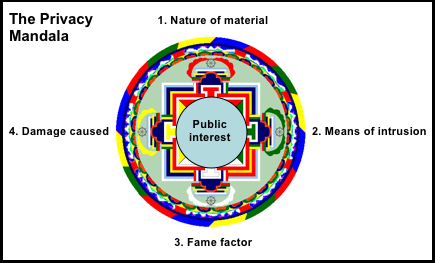
How do we combine these multifarious considerations into a useful device for journalists and editors to use in a newsroom when confronted with a privacy dilemma? We can start by identifying the main spheres of concern with privacy issues, including a version of Chadwick’s categories of fame. As a final consideration we feed in the public interest / social importance of the material.

This means we can feature the following key factors for a journalist or editor to consider when weighing up a privacy intrusion:

  1. The nature of private material.
  2. The means of intrusion:
  3. The fame of individual (adaptation of Chadwick’s categories of fame): Red flag items here include children and the “media vulnerable”.
  4. The damage caused. That is, the level of directly predictable monetary loss, shock or embarrassment (variable according to individual’s circumstances and cultural factors) and potential for future loss or harm.

We then need to factor into the consideration the crucial “public interest” value, presented as a counterpoint to the above. This would operate on a scale from the prevention of death or injury and exposure of crime or corruption through the exposure of hypocrisy, setting the record straight, exposure of waste or inefficiency, preventing death or injury, or something merely of curiosity or gossip value. Part of the social importance decision-making process requires a decision on the level of centrality of the private material to the story.

The web of relationships and considerations is illustrated here as the Privacy Mandala.


A “mandala” metaphor has been borrowed from Buddhist terminology to aid with the analysis of the media-privacy issue here, but also ultimately with analysis of a matter in the newsroom. It would have been simpler, perhaps, to choose a more straightforward metaphor like a compass. However, there are aspects of the mandala which add value to our discussion. Like the Western concepts of privacy and reputation, it relates to an individual’s value of the self, often a deeply spiritual phenomenon. Mandala, which can take a range of forms, are also meant to be vehicles for meditation, and here ours provides a mechanism to do just that as we meditate in the professional workplace upon the values of privacy and press freedom. The intercultural nature of the metaphor is also no accident. In an increasingly globalised and multicultural society, media organizations occasionally need reminders that there are numerous interpretations of “privacy” among their audiences and news sources which might require special respect or consideration. Further, mandala are inherently complex. The Tibetan mandala are laden with meaning at a multitude of levels. So too is the privacy debate, with each of the four axes listed here representing a series of subsidiary factors needing to be considered in any decision to intrude. While there may be occasional clear-cut cases where privacy or the public interest are overwhelming “winners”, the majority of news situations fall into a negotiable zone where the most we can ask of a media organization is that it has considered the relative values carefully before deciding to, first intrude on a citizen’s privacy, and, secondly, publish the result of such an intrusion. The mandala can be used effectively to help with decision-making at both of those key moments in the news process.

When presented in this graphical form, some of the first four realms of privacy could further be displayed in shades of pink, with some listed as “code red” items. From the above discussion, it is clear that it would take a matter of overwhelming public interest to successfully counter a “code red” matter like the invasion of privacy of a child or a grieving relative of someone killed in tragic circumstances. These would need to have their social importance factors clearly articulated by an editor choosing to go ahead and publish the item.

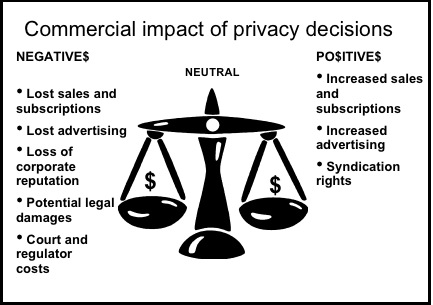
Quite separate from the mandala graphic is an independent area of consideration which is rarely mentioned in the ethics textbooks: the commercial impact of a story.  It is rarely addressed because theorists seem to work on the assumption that media organizations should be motivated primarily by a public or social good which is forever being compromised by a commercial imperative. However, the reality is that editors and news directors are motivated at least as much by circulation, ratings and page views as by a public duty to deliver the news. Their own tenure depends on their success in this regard, and it has been demonstrated that celebrity news and gossip sells newspapers and magazines and that hidden cameras and consumer advocacy doorstops boost current affairs television ratings. That said, the commercial impact of privacy decisions might be positive, negative or neutral, as illustrated by the following graphic.


The table takes account of the fact that there may be a range of potential profits or costs resulting from a story involving a privacy intrusion, including gained or lost circulation or ratings, advertising, syndication rights, corporate reputations, legal damages, and court or regulator costs. The courts would frown upon news organizations formally weighing up the potential monetary outcomes against the intangible human damage which could be caused by a privacy invasion. That said, there is little doubt journalists go through such a process, either formally or informally, when deciding whether to run with a story which pushes the privacy margins.

While there is little doubt many media organizations go through considerable angst in deciding whether or not to run a story which features some level of privacy intrusion, they have been inclined to keep the reasons for those decisions to themselves unless there is an ensuing disciplinary hearing or court case. News organizations should be encouraged to explain their ethical decision-making to their readers, viewers and listeners. It would take only a few paragraphs in a newspaper to accompany an intrusive photograph with an account of why there is an overwhelming public interest in readers seeing the material in question. Similarly, a news or current affairs anchor could devote a couple of sentences to say: “We realize this story involves a compromise of Miss X’s privacy, but we feel there is a greater public interest served by audiences viewing first-hand the emotional impact of a tragic event.” Such transparency would demonstrate to regulators and courts that a decision had been considered carefully and might well minimize the groundswell of protest from readers and audiences which often follows a privacy intrusion.

Here we have covered considerable terrain on the topic of privacy and journalism. We have distilled from Australian media regulations the key elements of privacy as they apply to the practice of journalism. We have grouped them into five key categories, covering the nature of the private material, the means of intrusion, the relative fame of those intruded upon, the level of damage caused, and the level of public interest or social importance of the story at hand. We have pointed to the importance of commercial considerations through increased ratings, circulation, or advertising sales as an additional consideration editors and news directors might taken into account before finalizing their privacy decisions. Finally, we have demonstrated that transparency in ethical decisions can provide some benefits to news organizations.

It is not claimed that the Privacy Mandala holds all the answers for a journalist faced with a privacy decision. Other factors might deserve inclusion.

This research should serve to demonstrate that there are workable models for ethical decision-making in the newsroom which can elevate discussion in editorial conferences above the gut feelings of news executives and force the articulated justification of decisions to intrude. Further, such a model might even help journalists proceed through an ethical minefield like privacy confident they have at least considered carefully the implications of their actions. That, surely, is in the public interest.

* Note: An earlier fully referenced version of this blog was presented as a conference paper at the Journalism Education Association conference on the Gold Coast, Australia in 2005. The research was undertaken with funding from the Australian Press Council. For a full-text version of the original article please visit the Proceedings of the 2005 Journalism Education Association Conference, Editors: Associate Professor Stephen Stockwell and Mr Ben Isakhan, ISBN: 1920952551.

© Mark Pearson 2012

Disclaimer: While I write about media law and ethics, nothing here should be construed as legal advice. I am an academic, not a lawyer. My only advice is that you consult a lawyer before taking any legal risks.

Leave a comment

Filed under Uncategorized

My Online Opinion piece explains Australia’s fall to #30 in RSF World Press Freedom Index

By MARK PEARSON

The international media freedom group Reporters Sans Frontières (RSF – Reporters Without Borders) has released its 2011-12 World Press Freedom Index and Australia has slipped 12 places from 18th to 30th among the 179 countries ranked.

That result and the organisation’s methodology deserve explanation and debate, which I offer in my article in Online Opinion today.

As RSF’s Australian correspondent for the past six years, I offer some insights on both fronts.

First I assess the factors contributing to Australia’s decline in its media freedom status since 2010.

Then I explain why the RSF ranking process is indicative rather than scientifically precise.

Interested? Read my piece in Online Opinion today.

© Mark Pearson 2012

Disclaimer: While I write about media law and ethics, nothing here should be construed as legal advice. I am an academic, not a lawyer. My only advice is that you consult a lawyer before taking any legal risks.

2 Comments

Filed under Uncategorized

A Journalist’s ‘If’ (with apologies to Kipling)

By MARK PEARSON

Way back in 1975 the Sydney television newsreader Roger Climpson delivered a memorable rendition of Rudyard Kipling’s inspirational poem ‘If’ at my Caringbah High School speech night.

It prompted me to buy a poster of the famous verse and hang it next to Kahlil Gibran’s ‘Desiderata’ on my bedroom wall.

Thirty years later I was moved to bend and stretch Kipling’s precious words for the benefit of my Newspaper Reporting class. Each year I start my first lecture for that subject with its recital.

Today I share the product of that desecration of rhyme and meter with my Journlaw.com readers.

Perhaps your own J-students or junior colleagues might be inspired – if they can forgive my literary sins.

Or maybe you’d like to add a verse by way of ‘Comment’?

————————————-

A JOURNALIST’S ‘IF’ (with apologies to Rudyard Kipling)

By MARK PEARSON Follow @Journlaw

If you can make some sense out of a complicated mess

And craft a bright, clear lead of 20 words or less

If you can take pride in the words that stand beneath your name

But know a byline carries more responsibility than fame


If you can stay well beyond your shift and burn the midnight oil

Just to get the story done, expecting nothing for your toil

When all your friends are partying the wee small hours away

While you’re still at the office – just because you want to stay.


If you can realise journalism holds a place for every type,

The quiet golden retriever and the terrier with its bark and hype

That there are many ways to chase a story and do our very best

We match our methods to our type and aim to beat the rest.


If you can drive to work not knowing where you’ll finish up that day

And accept that some disaster might be just an hour away

Or that you might be with a sporting star or chatting with Tom Cruise

Or editing the tidal charts and checking crossword clues.


If you can interview a president and then a homeless soul

And learn to listen to them both to make your story whole

Because listening and questioning are the golden pair

Then accuracy, a nose for news, and a commitment to be fair.


If you learn writing is important, but it’s not the florid kind

“Keep it simple stupid” is the motto to bear in mind.

There’s scope for creativity with the angle, not the facts,

And adjectives and adverbs are bound to get the axe.


If you shelve your own opinions, despite how heartfelt they may be
Allowing others their full say, erasing that word “me”.

Remember readers own the press – it’s not there for you

It’s not your job to impress, but to seek another view.

If you can rise above the pressure of all your precious peers

And snatch a story from beneath their noses which burns their lazy ears

But still realise that sometimes you need to hunt in packs

Ever mindful of the need to keep arm’s length from all the hacks.


If you can take a newsroom full of cynics – crusty, gnarled and tired

And ignite them with that passion for which you have been hired

And see them reinvent themselves and restart their careers

All because your zest for life is music to their ears.


And then if a disaster strikes, if you can set aside your fears

And focus on the story amidst the blood and gore and tears

While many of your readers may be floating upside down

You get the presses rolling with the news to that wet town.


If you can defy the speed of sound and take a steady note

When all around are struggling to record a simple quote

And sit and watch the television replay those words you heard

Quoted on your own front page – exactly word for word.


If you can convince the toughest source you are someone they can trust

And don’t go off the record unless you truly must

And if you do, assure them that your honour will not fail

Even when you’re threatened with a lengthy stay in jail.


If you take yourself to places you would normally not go

In search of fresh new contacts – people you don’t know

Because stories lie in wait of you in clubs and shops and bars

Folks with different interests, who might well come from Mars.


If you can build a contact book others would kill to access

And keep it safe because that may be truer than you guess

Double check the spelling of even the simplest name

Cos even Jonny Smyth might not be spelt the same.


If you know when to knock upon the door of a grieving mother

And, equally, when to leave that same job to another

Yet show her it was worthwhile letting others see her tears

Because that’s the way we change the world and allay each other’s fears.


If you can stand at the dinner table among the chattering classes

And defend the freedom of the press as they snigger in their glasses

As they try to shoot the messenger for all and sundry ills

Remind them that it’s not the pen, but the crooked sword that kills.


And finally, if you can craft a masterpiece, and have it chopped from the end
Yours is the world and everything that’s in it, and – which is more – you’ll be a journalist, my friend!


© Mark Pearson 2005

Leave a comment

Filed under Uncategorized