Category Archives: contempt of court

New @journlaw updates posted in privacy, anti-terror and confidentiality of sources #MLGriff

By MARK PEARSON

We have just posted numerous updates to the fifth edition of The Journalist’s Guide to Media Law – A handbook for communicators in a digital world (Mark Pearson & Mark Polden, A&U, 2015) on the journlaw.com blog.

Thanks to Leanne O’Donnell (mslods.com / @mslods), Virginia Leighton-Jackson and Griffith University media freedom interns and students we have been posting fresh material via this blog’s Media Law Updates menu.

You can find updates on recent cases, legislation and Australian and international media law news on the following topic areas:

Social Media Law

Free Expression

Legal and regulatory systems

Open Justice and Freedom of Information

Contempt of Court

Covering Court

Defamation

Secrets, Confidentiality and Sources

Anti-terror and hate laws

IP and copyright

Privacy

Law of PR, Freelancing and New Media Entrepreneurship

The sheer pace of change in all areas of media law is astounding so we have have built several mentions of journlaw.com into the chapters and discussion questions as a go-to resource for media law students.

We would also appreciate your input – whether you are a student, journalist, academic or lawyer.

Please email any contributions to these update sections to me, Mark Pearson, at journlaw@gmail.com .

Of course, the book and the journlaw.com examples are not meant to offer actual legal advice. Professional communicators must seek that advice from a lawyer when confronted with a legal problem. The most we claim to do is offer an introduction to each area of media law so that journalists, PR consultants and bloggers can identify an emerging issue and thus know when to call for help.

Order via Booktopia: http://www.booktopia.com.au/the-journalist-s-guide-to-media-law-mark-pearson/prod9781743316382.html

Disclaimer: While I write about media law and ethics, nothing here should be construed as legal advice. I am an academic, not a lawyer. My only advice is that you consult a lawyer before taking any legal risks.

© Mark Pearson 2015

Leave a comment

Filed under blogging, citizen journalism, contempt of court, free expression, journalism, media ethics, media law, Media regulation, social media, sub judice, Uncategorized

Journlaw running updates to The Journalist’s Guide to Media Law

By MARK PEARSON

OUR fifth edition of The Journalist’s Guide to Media Law – A handbook for communicators in a digital world (Mark Pearson & Mark Polden, A&U, 2015) is now in bookshops and I will be running updates on each topic area via journlaw.com as we work towards the next edition.

Thanks to Leanne O’Donnell (mslods.com / @mslods), Virginia Leighton-Jackson and Griffith University media freedom interns and students we will be posting fresh material via this blog’s Media Law Updates menu.

There will be updates on recent cases, legislation and Australian and international media law news on the following topic areas:

Social Media Law

Free Expression

Legal and regulatory systems

Open Justice and Freedom of Information

Contempt of Court

Covering Court

Defamation

Secrets, Confidentiality and Sources

Anti-terror and hate laws

IP and copyright

Privacy

Law of PR, Freelancing and New Media Entrepreneurship

The sheer pace of change in all areas of media law is astounding so we have have built several mentions of journlaw.com into the chapters and discussion questions as a go-to resource for media law students.

We would also appreciate your input – whether you are a student, journalist, academic or lawyer.

Please email any contributions to these update sections to me, Mark Pearson, at journlaw@gmail.com .

Of course, the book and the journlaw.com examples are not meant to offer actual legal advice. Professional communicators must seek that advice from a lawyer when confronted with a legal problem. The most we claim to do is offer an introduction to each area of media law so that journalists, PR consultants and bloggers can identify an emerging issue and thus know when to call for help.

Order via Booktopia: http://www.booktopia.com.au/the-journalist-s-guide-to-media-law-mark-pearson/prod9781743316382.html

Disclaimer: While I write about media law and ethics, nothing here should be construed as legal advice. I am an academic, not a lawyer. My only advice is that you consult a lawyer before taking any legal risks.

© Mark Pearson 2015

Leave a comment

Filed under blogging, citizen journalism, contempt of court, free expression, journalism, media ethics, media law, Media regulation, social media, sub judice, Uncategorized

Hot off the press – our 5th edition of The Journalist’s Guide to Media Law

By MARK PEARSON

I was delighted to receive from publisher Allen & Unwin my first copy of the fifth edition of The Journalist’s Guide to Media Law (co-authored with Mark Polden).

Much has changed since our last edition in 2011, particularly in the fields of news media, communication technologies and practices, tertiary education and the law. We have reshaped and updated this edition of the book to accommodate those developments.

The book is still titled The Journalist’s Guide to Media Law, but its new subtitle—‘A handbook for communicators in a digital world’—encapsulates the seismic shifts that have prompted our considerable revisions. Our target audience has broadened with each edition as technologies like the internet and social media have combined to transform journalism and its allied professional communication careers. Thus our prime audience of Australian journalists working for traditional media outlets has widened to embrace public relations consultants, bloggers, social media editors and new media entrepreneurs,  as they fill new professional occupations dealing with media law, once the domain of mainstream reporters and editors.  Crucial questions which recur through the book include: ‘What is a journalist?’, ‘Who is a publisher?’, ‘How does media law affect this new communication form?’ and ‘Who qualifies for this protection?’ Some of the answers are still evolving, as legislators, the judiciary and the community grapple with the implications of every citizen now having international publishing technology literally at their fingertips on mobile devices.

Such shifts have prompted major new inclusions in the content of the book. So much publishing now transcends Australia’s borders via social media, blogs and other online platforms that we have expanded this edition to contain many more international comparisons and cases. This has been accommodated by reducing some of the forensic examination of precise legislation in various Australian states and territories, found in previous editions. Instead of attempting to document every statutory instrument in all nine Australian jurisdictions, we have directed readers to the resources that contain those details.

All of this has necessitated design and pedagogical changes to the book’s format and contents. While the chapter structure is generally in accord with previous editions, there are new sections within the chapters addressing these issues. Their order varies slightly according to topic, but most chapters now include some key concepts defined at the start, some international background and context to the media law topic, a more detailed account tailored to Australian legislation and case law, a review of the ‘digital dimensions’ of the topic with special focus on internet and social media cases and examples, an account of self-regulatory processes if they apply to that topic, some tips for journalists and other professional communicators for mindful practice in the area, a nutshell summary, some discussion questions, and relevant readings and case references.

The introduction of ‘tips for mindful practice’ encapsulates the authors’ aim that professional communicators need to build into their work practices and routines an informed reflection upon the legal and ethical implications of their reportage, commentary, editing, publishing and social media usage. This approach is explained in greater detail in Chapter 2, but it essentially links safe legal practice and the responsible and strategic use of free expression with the personal moral framework and professional ethical strictures of the digital communicator—whether a journalist, public relations consultant, media relations officer or serious blogger.


Those changing roles are reflected in a new final chapter, Chapter 13, which deals with the law of PR, freelancing and media entrepreneurship. It replaces a chapter on self-regulation in earlier editions. (The role and application of the various industry regulatory, co-regulatory and self-regulatory bodies, such as the Australian Communications and Media Authority (ACMA) and the Australian Press Council (APC), are now introduced in Chapter 3, but they are then referred to in the chapters where their functions and decisions seem most relevant). We saw this area of media law as significant because those who occupy those roles  are now grappling with special dimensions of media law—and several other legal topics relevant to their work—and deserve a new chapter dedicated to their roles and the legal dilemmas that are emerging in relation to them. The chapter also reflects the fact that many former journalists are now working in these allied occupations, and that student journalists need to start their careers with a broad understanding of the legal considerations which govern allied professional communication industries.

The sheer pace of change in all areas of media law is astounding. Many changes were mooted as this edition was going to press—including important developments in the laws of privacy, copyright, hate speech and court reporting. Rather than render the book dated as soon as it is printed, we have opted to use co-author Professor Mark Pearson’s journlaw.com blog (this one!) as the venue for updates to material, and have built several mentions of that resource into the chapters and discussion questions.

Apart from an array of new cases and examples—many from the international arena and many more from social media—some highlights of important new content covered in this edition include the following:

  • There are significant cases on increased statutory powers, allowing courts to make suppression and non-publication orders, and on the relationship between free speech, open justice and the right of parties to settle disputes privately. Recent cases at the borderline between ridicule and defamation, and on the application of freedom of information laws to immigration detention centres are included, as are cases on the application of sub judice contempt to internet content hosts and ‘celebrity’ claims of privacy invasion.
  • Recommendations of the ALRC on copyright reform are included, together with a discussion of the new copyright fair dealing defence that applies to satire. The book presents a wide range of examples, across different legal categories, relating to the use of the internet and social media, which will be of growing importance for current and future professional practise in communication, reportage and media advice.
  • A separate chapter on secrets (Chapter 9) covers the new journalists’ shield laws and their relevance to micro-bloggers and non-traditional publishers.
  • Chapter 10, on anti-terrorism and hate laws, includes the recommendations for reform of anti-terror laws and discusses the high-profile Andrew Bolt case and related proposals for reform of the Commonwealth Racial Discrimination Act 1975.
  • The recommendations of the Leveson Inquiry in the United Kingdom, and the Finkelstein Inquiry and Convergence Review in Australia, are subjected to critical analysis in view of their potential impact upon notions of a free press.

There is also an increased emphasis on real-time reportage, as the traditional print media increase their online presence and depth of click-through coverage in a 24/7 news cycle, with concomitant risks in the areas of defamation and contempt in their own work and that of third-party commentators on their websites and social media pages.

Without going into exhaustive detail on all of these matters, the book remains true to its original aim: to provide professional communicators and students with a basic working understanding of the key areas of media law and ethical regulation likely to affect them in their research, writing and publishing across the media. It tries to do this by introducing basic legal concepts while exploring the ways in which a professional communicator’s work practices can be adapted to withstand legal challenges.

In designing this edition, we have tried to pay heed to the needs of both professional communicators and media students. The book is best read from front to back, given the progressive introduction of legal concepts. However, it will also serve as a ready reference for those wanting guidance on an emerging problem in a newsroom or PR consultancy. The cases cited illustrate both the legal and media points at issue; in addition, wherever possible, recent, practical examples have been used instead of archaic cases from the dusty old tomes in the law library. Rather than training reporters, bloggers and PR practitioners to think like lawyers, this book will achieve its purpose if it prompts a professional communicator to pause and reflect mindfully upon their learning here when confronted with a legal dilemma, and decide on the appropriate course of action. Often that will just mean sounding the alarm bells and consulting a supervisor or seeking legal advice.

Of course, the book is not meant to offer actual legal advice. Professional communicators must seek that advice from a lawyer when confronted with a legal problem. The most we claim to do is offer an introduction to each area of media law so that journalists, PR consultants and bloggers can identify an emerging issue and thus know when to call for help.

Booktopia is offering pre-orders on their website: http://www.booktopia.com.au/the-journalist-s-guide-to-media-law-mark-pearson/prod9781743316382.html

Disclaimer: While I write about media law and ethics, nothing here should be construed as legal advice. I am an academic, not a lawyer. My only advice is that you consult a lawyer before taking any legal risks.

© Mark Pearson 2014

https://twitter.com/mattcdef2000/status/514585070149988352

https://twitter.com/MsLods/status/514583564600373250

3 Comments

Filed under blogging, citizen journalism, contempt of court, free expression, journalism, media ethics, media law, Media regulation, social media, sub judice, Uncategorized

Court restrictions on identifying children in Australia – a guide for journalists

By MARK PEARSON

We have removed the comparative reporting restrictions tables from the  fifth edition of The Journalist’s Guide to Media Law (Allen & Unwin, 2014) which will be published later this year.

Co-author Mark Polden and I have decided to move these comparative tables on reporting restrictions throughout Australia across to this blog – journlaw.com – so we could free up space in the new edition to discuss other important issues such as media law for public relations consultants and the implications of digital and social media.

We will work to update the reporting and publishing restrictions tables over coming months, but for the moment I am publishing them as they stood at the date of our fourth edition in 2011.

As I upload them over coming weeks I would appreciate any students or colleagues using the comments section below to advise of any updates in your jurisdictions and I will act to update the tables accordingly.

Looking forward to your collaborative input!

——

Restrictions on reports of proceedings involving children

Note: NO identification of parties or witnesses in any way under the Commonwealth Family Law Act s. 121.

Jurisdiction Law  Exceptions  Legislation 
ACT  Reports of proceedings: Media allowed to report. ID: Cannot be identified. Cannot publish account of family group conference— None mentioned.  Criminal Code 2002, s. 712A. Children and Young People Act 2008, s. 77. 
NSW Reports of proceedings: Media allowed to stay and report. ID: No ID of child mentioned or otherwise involved (including victims and witnesses) living or dead, during or after proceedings, or their siblings.— Court may close proceedings. Court may allow ID or children aged 16 or over can authorise.(Seek legal advice on this.) Or senior next of kin or court (if deceased).


Children (Criminal Proceedings)Act 1987, s. 15A; Children and Young Persons (Care and Protection) Act 1998, ss. 104 and 105; Young Offenders Act 1997, s. 65. 
NT  Reports of proceedings: Open court and reports allowed. ID: No restriction.— Magistrate may close court or order suppression.  Youth Justice Act 2005, ss. 49, 50. 
Qld  Reports of proceedings: No. ID: No ID of child accused without court’s permission. No ID of child witness in sexual matter. ID of child witness okay in other matters unless ordered otherwise. Cannot ID authorised officer or police officer in matters with child witnesses. No ID info about child victims. No ID of children subject to allegations of harm or risk of harm or in state custody or guardianship.— Judge may order publication of identifying information for heinous crimes. Court can permit reporting when otherwise prohibited.Child victim can consent after becoming adult if fully informed of publication matter, audience and reason. Youth Justice Act 1992, ss. 234, 301. Child Protection Act 1999, ss. 189, 192, 193. 
SA  Reports of proceedings: Court open to ‘genuine representatives of news media’. No family care proceedings reports. ID: No ID of child parties, witnesses or victims,or other persons other than in official capacity without their permission, including name, address or school. Documentaries may be approved under strict conditions.— Courts can authorise some reports and ID.  Youth Court Act 1993, s. 24; Young Offenders Children’s   Protection Act 1993, s. 59, Children’s Protection Act 1993, s. 13; 59A. 
Jurisdiction  Law  Exceptions  Legislation 
Tas Reports of proceedings: No provision for media to be present without permission of court. ID: No ID of youths or youth witnesses.— Permission of court.  Youth Justice Act 1997, ss. 30, 31; Magistrates Court (Children’s Division) Act 1998, ss. 11, 12. 
Vic Reports of proceedings: Open court and media allowed to report. ID: No identification of child accused or any witnesses to case. No mention of court venue. Long list of banned ID particulars for children and witnesses including: name, title, pseudonym, alias of the person, home or work address or localit0, school or locality; physical description or style of dress; occupation or calling; relationship to identified others; interests or beliefs; real or personal property. No photos.— Permission of court.  Children, Youth and Families Act   2005, ss. 523, 534. 
WA  Reports of proceedings: Yes ID: No ID on child involved in proceedings in any way. No ID of child subject of a protection application or order.— Court can exclude persons. Supreme Court can authorise ID of child.  Children’s Court of Western Australia Act 1988, ss. 31, 35, 36, 36A. Children and Community Services Act 2004, s. 234 

—————

Disclaimer: While I write about media law and ethics, nothing here should be construed as legal advice. I am an academic, not a lawyer. My only advice is that you consult a lawyer before taking any legal risks.

© Mark Pearson 2014
3 Comments

Filed under blogging, contempt of court, courts, media ethics, mental health, social media, Uncategorized

Careful with your coverage of the Redfern murder case – especially pics #Wran

By MARK PEARSON

A media scrum gathered outside a Sydney court this morning where Harriet Wran – the youngest daughter of the former premier of New South Wales Neville Wran who died this year – was charged with murder and other offences.

I will not go into the details of the crimes Harriet Wran is alleged to have committed with a co-accused – to which she is pleading not guilty – but they relate to the death of 48-year-old Daniel McNulty and the stabbing of another man, Brett Fitzgerald, at an inner Sydney apartment block on Sunday night.

Celebrity is a driving news value and leads reporters into dangerous territory in cases like this, as co-author Mark Polden and I explain in the fifth edition of The Journalist’s Guide to Media Law, to be published later this year.

I have already seen numerous images of the accused – which is problematic if identification of either accused has any likelihood of being at issue in the trial. Any potential impact on witness identification – or any indication of the guilt of an accused – can be deemed sub judice contempt of court over which publishers can face hefty fines and jail terms if a court deems their coverage represented a real risk of prejudice to a trial.

The Latin phrase sub judice literally means ‘under or before a judge or court’ and applies to the period during which there are limitations placed on what the media may report about a case. The restrictions start from the moment someone has been arrested or charged.

In this case that period is well and truly under way, with court proceedings having commenced.

The courts have attempted to balance the competing rights and interests of those involved in court cases and those reporting on them by restricting what may be published about a case while it is before the courts. The restrictions are considered necessary to avoid ‘trial by media’, where free speech interferes with the usual safeguards of the legal system with dire consequences for the case at hand and for the public confidence in the administration of justice.

The practical concern the courts have here is the potential influence such a media trial might have on prospective jurors (and, to a lesser degree, on witnesses). The fear is that their judgment (or testimony) might be tainted by media coverage of the case before or during trial, to ‘poison the fountain of justice before it begins to flow’, as one judge expressed it in Parke’s case in 1903. The courts place stringent tests on the admissibility of evidence and respect certain rules of procedure known as ‘natural justice’, protocols that have no tradition in media coverage.

There is a ‘public interest’ defence – but that is highly unlikely to apply in a case where the only real public interest is the fact that one of the accused happens to have come from a famous family.

When deciding whether a publication is in contempt, the courts look to its ‘tendency’ to interfere with pending proceedings. As the NSW Law Reform Commission expressed it in 2000:

To amount to contempt, a publication must be shown to have a real and definite tendency, as a matter of practical reality, to prejudice or embarrass particular legal proceedings.

When considering whether the publication has the ‘tendency’ to interfere with proceedings, the courts gauge the potential effect of the sub judice material, not whether the material actually caused harm, with the test applied at the time of publication rather than at some later date. Even if the accused in the publicised trial eventually pleads guilty or even dies before the trial, the publication can still be held in contempt.

The courts take into account a number of relevant factors in determining whether there is such a real possibility of prejudice, including the prominence of the item printed or broadcast; the images accompanying it; the time lapse between publication and likely trial; the social prominence of the maker of contemptuous statements; and the extent or area of publication. In other words, a prominent sensational account of an imminent trial published in a major newspaper in the very area from which the jury would be selected would be much more likely to be held in contempt than a sober account in a small community radio news bulletin in a provincial town, some distance from the likely trial venue. This should not be taken as advice to knowingly publish a contempt in such cases. On the contrary: there is a tendency for prosecuting authorities to charge all media outlets that published contemptu­ous stories at the same time as the main sensational item that prompted their action.

Internet and social media coverage complicates the matter of course – particularly when publishers from far afield are publishing into the very jurisdiction where the jurors and witnesses live.

Watch those images of the accused

In 1994 Time Inc., publisher of the magazine Who Weekly, and the magazine’s editor were both fined for publishing on its front cover a photo­graph of Ivan Milat, the man accused (and later convicted) of murdering seven backpackers.

The publication came in another crucial time zone—after Milat had been arrested and charged but before his trial. Identification was going to be a crucial issue. In finding Who Weekly in contempt, the NSW Supreme Court held that the photograph tended to interfere with the due course of justice in the prosecution of Milat. It ran the risk of polluting the recollection of witnesses in that they may not be able to distinguish between what they had witnessed at the crucial time and their recollection of the image in the photograph.

While it was unlikely to have influenced the two key witnesses, who were overseas at the time of publi­cation, the photograph ran the risk of affecting the testimony of witnesses who had not yet come forward. Even if the publication prompted new witnesses to contact the police, their testimony would be questionable because it had been influenced by the photograph.

The court ruled that publication of a picture of an accused person would normally be regarded as carrying a risk of interference with the due course of justice, unless the iden­tification were so clear-cut that neither party would dispute it.

And don’t think that because everyone else is doing it you’ll be safe. In the Mason case in 1990 the NSW Attorney-General charged two newspapers and four television stations with contempt over their coverage of an alleged murderer’s confession to police after he had been charged, but before the trial. The outlets with the less sensational reports attracted lower fines ($75,000 as against $200,000), and the question arises: would they have been charged at all if their competitors had not published these more sensational accounts?

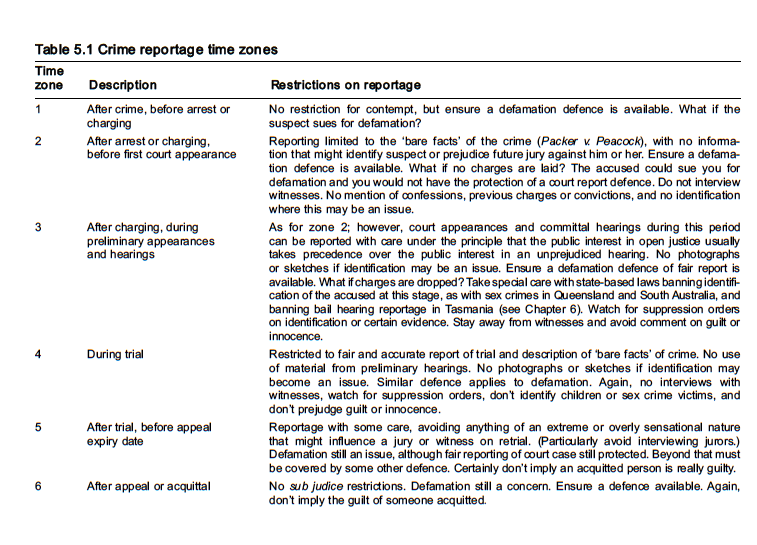
It is vital that media outlets work within these time zone restrictions when reporting on newsworthy cases like this one.

Screen Shot 2014-08-14 at 1.00.09 PM

Table: Crime reportage time zones, from Pearson, M. (2007) The Journalist’s Guide to Media Law (3rd ed, Allen & Unwin, Sydney)

Disclaimer: While I write about media law and ethics, nothing here should be construed as legal advice. I am an academic, not a lawyer. My only advice is that you consult a lawyer before taking any legal risks.

© Mark Pearson 2014
4 Comments

Filed under blogging, citizen journalism, contempt of court, free expression, journalism, media ethics, media law, Media regulation, social media, sub judice, Uncategorized

Sexual offences publishing restrictions in Australia – a guide for journalists

By MARK PEARSON

Our fifth edition of The Journalist’s Guide to Media Law (Allen & Unwin, 2014) goes to the printer this week for publication later this year.

Co-author Mark Polden and I have decided to move some of the comparative tables on reporting restrictions throughout Australia across to this blog – journlaw.com – so we could free up space in the new edition to discuss other important issues such as media law for public relations consultants and the implications of digital and social media.

We will work to update the reporting and publishing restrictions tables over coming months, but for the moment I am publishing them as they stood at the date of our fourth edition in 2011.

As I upload them over coming weeks I would appreciate any students or colleagues using the comments section below to advise of any updates in your jurisdictions and I will act to update the tables accordingly.

Looking forward to your collaborative input!


Sexual offences publication restrictions

Jurisdiction  Law Exception Legislation
ACT Complainant must not be identified by name, ‘reference or allusion’, including allowing someone to find out their ‘private, business or official address, email address or telephone number’.


Complainant may consent. (Seek legal advice on proving consent.) Evidence (Miscellaneous Provisions) Act 1999, s. 40.
New South Wales
Complainant must not be identified, even after proceedings disposed of. With permission of court. Consent of complainant aged over 14. (Seek legal advice.) With consent of court for   complainants aged under 16.


Crimes Act 1900, s. 578A; Children (Criminal Proceedings) Act 1987, s. 15A.
Northern Territory
Complainant must not be identified at all. Accused cannot be identified until after committal. No mention of ‘name, address, school or place of employment’ for either.


With permission of court. Sexual Offences (Evidence and Procedure) Act 1983, ss. 6, 7 and 11(2).
Queensland Complainant must not be identified at all. Accused cannot be identified until after committal. No mention of ‘name, address, school or place of employment’ for either. With permission of court.Protection for accused only applies to ‘prescribed sexual offences’:
(a) rape;
(b) attempt to commit rape;
(c) assault with intent to commit rape;
(d) an offence defined in the Criminal Code, section 352.1. Seek legal advice about other offences.


Criminal Law (Sexual Offences) Act 1978, ss. 6 and 7.
South Australia Case and related proceedings including identity of accused cannot be reported until accused has been committed for trial. Complainant must not be identified at any stage.Publishers must publish prominent report of result of proceedings they have covered at earlier stage when accused has been identified.


  • Pre-committal reports can be made with permission of accused. (Seek advice.)
  • Complainant can be identified with his/her permission or order of court unless child victim.
Evidence Act 1929, ss. 71A and B.
Tasmania Complainant and witnesses other than defendant must not be identified, even if dead. Also bans ‘any picture purporting to be a picture of any of those persons’.


Court may allow identification ‘in the public interest’. Evidence Act 2001, s. 194K.
Victoria Complainant must not be identified, even if proceedings not pending. If proceedings not pending, with permission of court or complainant (seek legal advice) or on proof that no complaint of offence had yet been made to police. If proceedings pending, with permission of court only.


Judicial Proceedings Reports Act 1958, s. 4.
Western Australia Complainant and their school must not be identified. With authorisation in writing by complainant aged over 18 and mentally capable of making decision. (Seek legal advice.)


Evidence Act 1906, s. 36c.

—————

Disclaimer: While I write about media law and ethics, nothing here should be construed as legal advice. I am an academic, not a lawyer. My only advice is that you consult a lawyer before taking any legal risks.

© Mark Pearson 2014
Leave a comment

Filed under blogging, contempt of court, courts, media ethics, mental health, social media, Uncategorized

Announcing the fifth edition of The Journalist’s Guide to Media Law

By MARK PEARSON

Co-author Mark Polden and I are in the final stages of production of the fifth edition of The Journalist’s Guide to Media Law, to be published later this year.

We are re-engaging with the print medium as we apply our eagle eyes to the final hard copy galley proofs – our last chance for amendments and updates – before it goes to the printer for the production process.

Much has changed since our last edition in 2011, particularly in the fields of news media, communication technologies and practices, tertiary education and the law. We have reshaped and updated this edition of the book to accommodate those developments.

The book is still titled The Journalist’s Guide to Media Law, but its new subtitle—‘A handbook for communicators in a digital world’—encapsulates the seismic shifts that have prompted our considerable revisions. Our target audience has broadened with each edition as technologies like the internet and social media have combined to transform journalism and its allied professional communication careers. Thus our prime audience of Australian journalists working for traditional media outlets has widened to embrace public relations consultants, bloggers, social media editors and new media entrepreneurs,  as they fill new professional occupations dealing with media law, once the domain of mainstream reporters and editors.  Crucial questions which recur through the book include: ‘What is a journalist?’, ‘Who is a publisher?’, ‘How does media law affect this new communication form?’ and ‘Who qualifies for this protection?’ Some of the answers are still evolving, as legislators, the judiciary and the community grapple with the implications of every citizen now having international publishing technology literally at their fingertips on mobile devices.

Such shifts have prompted major new inclusions in the content of the book. So much publishing now transcends Australia’s borders via social media, blogs and other online platforms that we have expanded this edition to contain many more international comparisons and cases. This has been accommodated by reducing some of the forensic examination of precise legislation in various Australian states and territories, found in previous editions. Instead of attempting to document every statutory instrument in all nine Australian jurisdictions, we have directed readers to the resources that contain those details.

All of this has necessitated design and pedagogical changes to the book’s format and contents. While the chapter structure is generally in accord with previous editions, there are new sections within the chapters addressing these issues. Their order varies slightly according to topic, but most chapters now include some key concepts defined at the start, some international background and context to the media law topic, a more detailed account tailored to Australian legislation and case law, a review of the ‘digital dimensions’ of the topic with special focus on internet and social media cases and examples, an account of self-regulatory processes if they apply to that topic, some tips for journalists and other professional communicators for mindful practice in the area, a nutshell summary, some discussion questions, and relevant readings and case references.

The introduction of ‘tips for mindful practice’ encapsulates the authors’ aim that professional communicators need to build into their work practices and routines an informed reflection upon the legal and ethical implications of their reportage, commentary, editing, publishing and social media usage. This approach is explained in greater detail in Chapter 2, but it essentially links safe legal practice and the responsible and strategic use of free expression with the personal moral framework and professional ethical strictures of the digital communicator—whether a journalist, public relations consultant, media relations officer or serious blogger.

Those changing roles are reflected in a new final chapter, Chapter 13, which deals with the law of PR, freelancing and media entrepreneurship. It replaces a chapter on self-regulation in earlier editions. (The role and application of the various industry regulatory, co-regulatory and self-regulatory bodies, such as the Australian Communications and Media Authority (ACMA) and the Australian Press Council (APC), are now introduced in Chapter 3, but they are then referred to in the chapters where their functions and decisions seem most relevant). We saw this area of media law as significant because those who occupy those roles  are now grappling with special dimensions of media law—and several other legal topics relevant to their work—and deserve a new chapter dedicated to their roles and the legal dilemmas that are emerging in relation to them. The chapter also reflects the fact that many former journalists are now working in these allied occupations, and that student journalists need to start their careers with a broad understanding of the legal considerations which govern allied professional communication industries.

The sheer pace of change in all areas of media law is astounding. Many changes were mooted as this edition was going to press—including important developments in the laws of privacy, copyright, hate speech and court reporting. Rather than render the book dated as soon as it is printed, we have opted to use co-author Professor Mark Pearson’s journlaw.com blog (this one!) as the venue for updates to material, and have built several mentions of that resource into the chapters and discussion questions.

Apart from an array of new cases and examples—many from the international arena and many more from social media—some highlights of important new content covered in this edition include the following:

  • There are significant cases on increased statutory powers, allowing courts to make suppression and non-publication orders, and on the relationship between free speech, open justice and the right of parties to settle disputes privately. Recent cases at the borderline between ridicule and defamation, and on the application of freedom of information laws to immigration detention centres are included, as are cases on the application of sub judice contempt to internet content hosts and ‘celebrity’ claims of privacy invasion.
  • Recommendations of the ALRC on copyright reform are included, together with a discussion of the new copyright fair dealing defence that applies to satire. The book presents a wide range of examples, across different legal categories, relating to the use of the internet and social media, which will be of growing importance for current and future professional practise in communication, reportage and media advice.
  • A separate chapter on secrets (Chapter 9) covers the new journalists’ shield laws and their relevance to micro-bloggers and non-traditional publishers.
  • Chapter 10, on anti-terrorism and hate laws, includes the recommendations for reform of anti-terror laws and discusses the high-profile Andrew Bolt case and related proposals for reform of the Commonwealth Racial Discrimination Act 1975.
  • The recommendations of the Leveson Inquiry in the United Kingdom, and the Finkelstein Inquiry and Convergence Review in Australia, are subjected to critical analysis in view of their potential impact upon notions of a free press.

There is also an increased emphasis on real-time reportage, as the traditional print media increase their online presence and depth of click-through coverage in a 24/7 news cycle, with concomitant risks in the areas of defamation and contempt in their own work and that of third-party commentators on their websites and social media pages.

Without going into exhaustive detail on all of these matters, the book remains true to its original aim: to provide professional communicators and students with a basic working understanding of the key areas of media law and ethical regulation likely to affect them in their research, writing and publishing across the media. It tries to do this by introducing basic legal concepts while exploring the ways in which a professional communicator’s work practices can be adapted to withstand legal challenges.

In designing this edition, we have tried to pay heed to the needs of both professional communicators and media students. The book is best read from front to back, given the progressive introduction of legal concepts. However, it will also serve as a ready reference for those wanting guidance on an emerging problem in a newsroom or PR consultancy. The cases cited illustrate both the legal and media points at issue; in addition, wherever possible, recent, practical examples have been used instead of archaic cases from the dusty old tomes in the law library. Rather than training reporters, bloggers and PR practitioners to think like lawyers, this book will achieve its purpose if it prompts a professional communicator to pause and reflect mindfully upon their learning here when confronted with a legal dilemma, and decide on the appropriate course of action. Often that will just mean sounding the alarm bells and consulting a supervisor or seeking legal advice.

Of course, the book is not meant to offer actual legal advice. Professional communicators must seek that advice from a lawyer when confronted with a legal problem. The most we claim to do is offer an introduction to each area of media law so that journalists, PR consultants and bloggers can identify an emerging issue and thus know when to call for help.

Booktopia is offering pre-orders on their website: http://www.booktopia.com.au/the-journalist-s-guide-to-media-law-mark-pearson/prod9781743316382.html

Disclaimer: While I write about media law and ethics, nothing here should be construed as legal advice. I am an academic, not a lawyer. My only advice is that you consult a lawyer before taking any legal risks.

© Mark Pearson 2014
Leave a comment

Filed under blogging, citizen journalism, contempt of court, free expression, journalism, media ethics, media law, Media regulation, social media, sub judice, Uncategorized

Barrister and co-author Mark Polden chats with @journlaw on #defamation defences: #MLGriff

By MARK PEARSON

Defamation laws can be intimidating for journalists, bloggers and other professional communicators. The key, according to barrister Mark Polden, is in researching and writing to the basic defences.

Mark Polden was in-house counsel at Fairfax Media for many years before going to the Bar, and is my co-author of The Journalist’s Guide to Media Law (Allen & Unwin).

In this 11 minute interview with @journlaw, he outlines in simple terms the three ‘bread and butter’ defences used by writers and publishers – truth, fair report and honest opinion (fair comment).

———–

Disclaimer: While I write about media law and ethics, nothing here should be construed as legal advice. I am an academic, not a lawyer. My only advice is that you consult a lawyer before taking any legal risks.

© Mark Pearson 2014
Leave a comment

Filed under blogging, contempt of court, courts, free expression, media ethics, Media freedom, media law, Press freedom, sub judice, suppression, Uncategorized

On Skype with @journlaw – barrister and co-author Mark Polden on #defamation basics: #MLGriff

By MARK PEARSON

Exactly what is defamation and how does it apply to your average journalist or blogger?

That’s what I asked barrister Mark Polden in this short interview on defamation basics. Mark Polden was in-house counsel at Fairfax Media for many years before going to the Bar, and is my co-author of The Journalist’s Guide to Media Law (Allen & Unwin).

Here he offers a lay definition of defamation and gives some examples of how journalists, bloggers and other professional communicators might write to minimise the threat of legal action.

———–

Disclaimer: While I write about media law and ethics, nothing here should be construed as legal advice. I am an academic, not a lawyer. My only advice is that you consult a lawyer before taking any legal risks.

© Mark Pearson 2014

Leave a comment

Filed under blogging, contempt of court, courts, free expression, media ethics, Media freedom, media law, Press freedom, sub judice, suppression, Uncategorized

15 mins with @journlaw – Peter Gregory on the art of court reporting #MLGriff #medialaw

By MARK PEARSON

What is the secret to good court reporting? Highly experienced court reporter and academic Peter Gregory [@petergregory17] – author of Court Reporting in Australia (Cambridge University Press, 2005) – tells @journlaw the essential techniques needed by a journalist wanting to cover the court reporting round.

CourtReportinginAustraliacoverGregory explains how he recently returned to duty when he filled in to cover the sentencing of Adrian Bayley for the murder of Jill Meagher – in a marathon 12 hour shift!

He discusses the court reporter’s difficulties in writing fair and accurate reports of trials, particularly when they might be unfolding in different courtrooms at the same time.

He also gives tips on how a journalist might stand up in court to oppose a suppression order being imposed by a judge or magistrate.

Useful viewing for journalism and law students – and for anyone wanting an insight into the work of the court reporter.

———–

Disclaimer: While I write about media law and ethics, nothing here should be construed as legal advice. I am an academic, not a lawyer. My only advice is that you consult a lawyer before taking any legal risks.

© Mark Pearson 2014

1 Comment

Filed under blogging, contempt of court, courts, free expression, media ethics, Media freedom, media law, Press freedom, sub judice, suppression, Uncategorized