Category Archives: Media regulation

How startups focus on the execution of business plans, with less intent on controlling IP

By MARK PEARSON

Entrepreneurs might undertake strategies that abandon formal IP protection in favour of being quicker to market and investing in capabilities – that is, focussing on an idea’s execution – University of Toronto Professor Joshua Gans told the 2015 IP and Media Law Conference, in his keynote address at the University of Melbourne Law School today (November 23).

JoshuaGandCMCL

Professor Joshua Gans delivering the keynote to the Media and IP Law Conference at the University of Melbourne.

He unveiled an economic model developed with colleagues Scott Stern and Kenny Ching featuring two key propositions.

“Execution allows you to maintain market leadership so control buys you only delay,” he said.

“Control only is cost in that regard. It only delays you without giving you additional benefit.

“Even aside from resource constraint issues, control and execution are substitute strategies. The whole is not greater than the sum of the parts. You want to advise firms to pursue control or execution but not both.”

He explained execution-oriented firms will hit key milestones more quickly and will be less dependent on significant venture capital investment.

He argued against what he said was the common assumption of IP analysis that the strength and use of IP is exogenous.

CMCLlogoforblog19-11-15“Here I argue that is is endogenous and depends on the choices of entrepreneurs/innovators in their business strategy,” he promised in his abstract.

“I demonstrate that entrepreneurs can undertake strategies that abandon formal IP protection in favour of being quicker to market and investing in capabilities — that is, focussing on execution.”

Joshua Gans is a Professor of Strategic Management and holder of the Jeffrey S. Skoll Chair of Technical Innovation and Entrepreneurship at the Rotman School of Management, University of Toronto (with a cross appointment in the Department of Economics). Since 2013, he has also been Area Coordinator of Strategic Management. He is also Chief Economist of the University of Toronto’s Creative Destruction Lab. In 2012, Joshua was appointed as a Research Associate of the NBER in the Productivity, Innovation and Entrepreneurship Program.

He has also co-authored (with Stephen King and Robin Stonecash) the Australasian edition of Greg Mankiw’s Principles of Economics (published by Cengage), Core Economics for Managers (Cengage), Finishing the Job (MUP) and Parentonomics (New South/MIT Press). Most recently, he has written an eBook, Information Wants to be Shared (Harvard Business Review Press).

The full conference program is here. Our paper (Pearson, Bennett and Morton) is titled ‘Mental health and the media: a case study in open justice’ (see earlier blog here).

———–

Disclaimer: While I write about media law and ethics, nothing here should be construed as legal advice. I am an academic, not a lawyer. My only advice is that you consult a lawyer before taking any legal risks.

© Mark Pearson 2015

Leave a comment

Filed under free expression, intellectual property, media ethics, media law, Media regulation, Uncategorized

For those who missed it – the @RNMediaReport story on the Bayley suppression order #auslaw

By MARK PEARSON

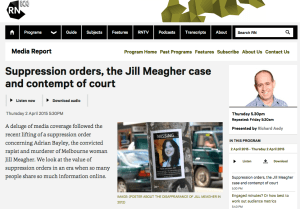
As most people were heading off for their Easter vacation, Radio National’s Media Report ran a segment on how we discovered the new edition of our textbook was in breach of a suppression order on the name of Adrian Bayley – the man who murdered Jill Meagher.

My article in  The Conversation (excerpted below) explained what happened, and RN Media Report’s Richard Aedy followed it up with this interview last week:

Screen Shot 2015-04-10 at 5.17.41 PM


March 27, 2015 blog:

How the Adrian Bayley suppression order forced the reprinting of our new media law book #auslaw ]

It is somewhat alarming when a media law academic finds himself on the wrong side of a media law. But that is exactly what happened to me when I discovered the new edition of our textbook was in breach of a suppression order on the name of Adrian Bayley – the man who murdered Jill Meagher.

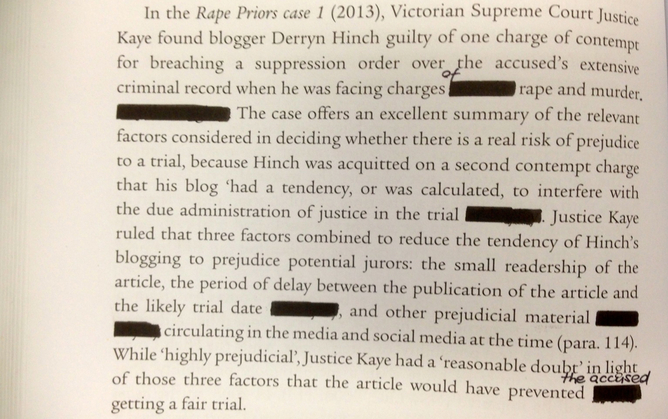
One of the manually redacted pages sent out to reviewers before our book was reprinted

One of the manually redacted pages sent out to reviewers before our book was reprinted

Our experience highlights serious problems with the system of suppression orders in the courts today as they try to grapple with the ever-increasing challenge of keeping internet-savvy jurors from having access to reports of the past trials or convictions of the accused.

Victorian County Court judge Sue Pullen issued the suppression order against anyone publishing “any information relating to previous convictions, sentences, or previous criminal cases of the accused”. The orders were lifted on Thursday after Bayley was convicted of raping three other women before he raped and murdered Meagher in September 2012.

On one view, Pullen’s orders constituted a “super injunction” because they suppressed mention of the proceedings – and therefore of the suppression order itself. Perhaps understandably, news of the order had not spread beyond the inner circle of lawyers and mainstream court reporters and editors, mainly in Victoria.

The suppression order only came to my knowledge as a Queensland-based academic when I happened to be sitting on a conference panel in Melbourne with a media lawyer and a judge last year discussing the futility of suppression orders in the modern era.

The media lawyer told the audience of court officers, lawyers, journalists and academics that he had recently appeared in court several times to try to have this particular suppression order overturned – without success. He said he could not be specific about the suppressed identity of the accused (wisely, as representatives of that court were sitting in the audience).

But when he mentioned the notorious crime itself my heart skipped a beat. It dawned on me that our new edition of The Journalist’s Guide to Media Law, which was sitting in the publisher’s warehouse awaiting distribution, was in clear breach of the order. Bayley had been named and linked to the Meagher murder on three pages of the book. He also appeared in its index.

Continue reading the full version of this commentary in The Conversation

Disclaimer: While I write about media law and ethics, nothing here should be construed as legal advice. I am an academic, not a lawyer. My only advice is that you consult a lawyer before taking any legal risks.

© Mark Pearson 2015

Leave a comment

Filed under blogging, citizen journalism, contempt of court, free expression, journalism, media ethics, media law, Media regulation, social media, sub judice

How the Adrian Bayley suppression order forced the reprinting of our new media law book #auslaw

By MARK PEARSON

It is somewhat alarming when a media law academic finds himself on the wrong side of a media law. But that is exactly what happened to me when I discovered the new edition of our textbook was in breach of a suppression order on the name of Adrian Bayley – the man who murdered Jill Meagher.

One of the manually redacted pages sent out to reviewers before our book was reprinted

One of the manually redacted pages sent out to reviewers before our book was reprinted

Our experience highlights serious problems with the system of suppression orders in the courts today as they try to grapple with the ever-increasing challenge of keeping internet-savvy jurors from having access to reports of the past trials or convictions of the accused.

Victorian County Court judge Sue Pullen issued the suppression order against anyone publishing “any information relating to previous convictions, sentences, or previous criminal cases of the accused”. The orders were lifted on Thursday after Bayley was convicted of raping three other women before he raped and murdered Meagher in September 2012.

On one view, Pullen’s orders constituted a “super injunction” because they suppressed mention of the proceedings – and therefore of the suppression order itself. Perhaps understandably, news of the order had not spread beyond the inner circle of lawyers and mainstream court reporters and editors, mainly in Victoria.

The suppression order only came to my knowledge as a Queensland-based academic when I happened to be sitting on a conference panel in Melbourne with a media lawyer and a judge last year discussing the futility of suppression orders in the modern era.

The media lawyer told the audience of court officers, lawyers, journalists and academics that he had recently appeared in court several times to try to have this particular suppression order overturned – without success. He said he could not be specific about the suppressed identity of the accused (wisely, as representatives of that court were sitting in the audience).

But when he mentioned the notorious crime itself my heart skipped a beat. It dawned on me that our new edition of The Journalist’s Guide to Media Law, which was sitting in the publisher’s warehouse awaiting distribution, was in clear breach of the order. Bayley had been named and linked to the Meagher murder on three pages of the book. He also appeared in its index.

Continue reading the full version of this commentary in The Conversation

Disclaimer: While I write about media law and ethics, nothing here should be construed as legal advice. I am an academic, not a lawyer. My only advice is that you consult a lawyer before taking any legal risks.

© Mark Pearson 2015

1 Comment

Filed under blogging, citizen journalism, contempt of court, free expression, journalism, media ethics, media law, Media regulation, social media, sub judice

New @journlaw updates posted in privacy, anti-terror and confidentiality of sources #MLGriff

By MARK PEARSON

We have just posted numerous updates to the fifth edition of The Journalist’s Guide to Media Law – A handbook for communicators in a digital world (Mark Pearson & Mark Polden, A&U, 2015) on the journlaw.com blog.

Thanks to Leanne O’Donnell (mslods.com / @mslods), Virginia Leighton-Jackson and Griffith University media freedom interns and students we have been posting fresh material via this blog’s Media Law Updates menu.

You can find updates on recent cases, legislation and Australian and international media law news on the following topic areas:

Social Media Law

Free Expression

Legal and regulatory systems

Open Justice and Freedom of Information

Contempt of Court

Covering Court

Defamation

Secrets, Confidentiality and Sources

Anti-terror and hate laws

IP and copyright

Privacy

Law of PR, Freelancing and New Media Entrepreneurship

The sheer pace of change in all areas of media law is astounding so we have have built several mentions of journlaw.com into the chapters and discussion questions as a go-to resource for media law students.

We would also appreciate your input – whether you are a student, journalist, academic or lawyer.

Please email any contributions to these update sections to me, Mark Pearson, at journlaw@gmail.com .

Of course, the book and the journlaw.com examples are not meant to offer actual legal advice. Professional communicators must seek that advice from a lawyer when confronted with a legal problem. The most we claim to do is offer an introduction to each area of media law so that journalists, PR consultants and bloggers can identify an emerging issue and thus know when to call for help.

Order via Booktopia: http://www.booktopia.com.au/the-journalist-s-guide-to-media-law-mark-pearson/prod9781743316382.html

Disclaimer: While I write about media law and ethics, nothing here should be construed as legal advice. I am an academic, not a lawyer. My only advice is that you consult a lawyer before taking any legal risks.

© Mark Pearson 2015

Leave a comment

Filed under blogging, citizen journalism, contempt of court, free expression, journalism, media ethics, media law, Media regulation, social media, sub judice, Uncategorized

Journlaw running updates to The Journalist’s Guide to Media Law

By MARK PEARSON

OUR fifth edition of The Journalist’s Guide to Media Law – A handbook for communicators in a digital world (Mark Pearson & Mark Polden, A&U, 2015) is now in bookshops and I will be running updates on each topic area via journlaw.com as we work towards the next edition.

Thanks to Leanne O’Donnell (mslods.com / @mslods), Virginia Leighton-Jackson and Griffith University media freedom interns and students we will be posting fresh material via this blog’s Media Law Updates menu.

There will be updates on recent cases, legislation and Australian and international media law news on the following topic areas:

Social Media Law

Free Expression

Legal and regulatory systems

Open Justice and Freedom of Information

Contempt of Court

Covering Court

Defamation

Secrets, Confidentiality and Sources

Anti-terror and hate laws

IP and copyright

Privacy

Law of PR, Freelancing and New Media Entrepreneurship

The sheer pace of change in all areas of media law is astounding so we have have built several mentions of journlaw.com into the chapters and discussion questions as a go-to resource for media law students.

We would also appreciate your input – whether you are a student, journalist, academic or lawyer.

Please email any contributions to these update sections to me, Mark Pearson, at journlaw@gmail.com .

Of course, the book and the journlaw.com examples are not meant to offer actual legal advice. Professional communicators must seek that advice from a lawyer when confronted with a legal problem. The most we claim to do is offer an introduction to each area of media law so that journalists, PR consultants and bloggers can identify an emerging issue and thus know when to call for help.

Order via Booktopia: http://www.booktopia.com.au/the-journalist-s-guide-to-media-law-mark-pearson/prod9781743316382.html

Disclaimer: While I write about media law and ethics, nothing here should be construed as legal advice. I am an academic, not a lawyer. My only advice is that you consult a lawyer before taking any legal risks.

© Mark Pearson 2015

Leave a comment

Filed under blogging, citizen journalism, contempt of court, free expression, journalism, media ethics, media law, Media regulation, social media, sub judice, Uncategorized

International studies point to best practice for reporting Islam and stories involving Muslims

By MARK PEARSON

Three key international studies counsel journalists to reflect carefully on their practice when they are reporting news and issues involving Islam and people who follow it.

Griffith University colleague Dr Jacqui Ewart and I have been funded to explore the best practice in reporting upon the Islamic religion and Muslim people with a view to developing educational resources and training materials.

The project has involved a literature review of the field, the identification of case studies in the Australian media highlighting different approaches to such coverage, and the analysis of extended interviews we are conducting with journalists, educators, students, media relations personnel and other experts the topic.

An important part of the literature review has been to identify similar studies conducted internationally on the topic – ably conducted by one of our research assistants, experienced journalist Guy Healy.

We have identified these three reports as offering excellent guidance to journalists and educators working in this space and we would appreciate hearing from those of you willing to engage in dialogue on the topic.


Screen Shot 2014-11-13 at 6.36.02 PMRupar, Verica (2012). Getting the facts right: Reporting ethnicity and religion. A study of media coverage of ethnicity and religion in Denmark, France, Germany, Greece, Hungary, Italy, Lithuania, Slovakia and the United Kingdom.[Project Report]. Brussels: International Federation of Journalists. Available at: http://ethicaljournalisminitiative.org/en/contents/eji-study-2012

This report from Associate Professor Dr Verica Rupar of Cardiff University (now with AUT University, Auckland) aims to improve “…the media’s ability to accurately and fairly report on people, events and issues that touch upon ethnicity and religion.” It draws upon interviews with 117 journalists in nine EU countries and the analysis of almost 200 news stories.

While its scope goes well beyond the reporting of Islam and Muslims, many of its examples and recommendations apply to this religion and its followers.

The study highlights immigration as a topic conflated with Muslims and Islam.

The report suggests the main obstacles to good reporting are the poor financial state of the media, overloading of reporters, lack of time, lack of knowledge, and lack of in-house training.

Overall, it identifies the media’s tasks as:

* Reporting factually and accurately on acts of racism and intolerance

* Being sensitive when writing about tensions between communities

* Avoiding derogatory stereotypical depiction of members of religious groups

* Challenging the assumptions underlying intolerant remarks made by speakers in the course of interviews, reports, and discussion programs.

It calls upon journalists to become more familiar with with anti-discrimination legislation, use broader networks of expert sources, ensure facts are put in context, avoid negative labels, portray people as human beings instead of members of an ethnic or religious group, organize in-house training and adopt internal editorial guidelines.


Screen Shot 2014-11-13 at 6.39.00 PMGreater London Authority (2007). The Search for Common Ground: Muslims, non-Muslims and the UK media. A report commissioned by the Mayor of London. London: Greater London Authority. Available at: http://www.insted.co.uk/search-for-common-ground.pdf

This major study on British media coverage of Islam and Muslims was commissioned by the Greater London Authority in the wake of the London bombings and perceived polarisation of coverage in the media.

It involved opinion poll reviews, studies of recent books and stories, a randomised survey of one week’s news stories, examination of stories about political correctness, interviews with Muslim journalists, and analysis of a television documentary. The researchers were commissioned to inquire into whether the media stimulated informed debate about building a multicultural society, or oversimplified and provided insufficient background that pandered to reader anxieties and prejudices. Other key questions focused on whether stories fostered anxiety, fear and hostility between non-Muslims and Muslims, and whether reportage increased or decreased a sense of common ground, shared belonging and civic responsibility.

Its principal recommendations included (at p. 133):

  • News organisations should review their coverage of issues and events involving Muslims and Islam.
  • They should consider drawing up codes of professional conduct and style guides about use of terminology.
  • News organisations should recruit more journalists of Muslim heritage.
Screen Shot 2014-11-13 at 6.40.35 PMPintak, Lawrence and Franklin, Stephen (eds) (2013). Islam for Journalists; A Primer on Covering Muslim Communities in America. [Digital newsbook]. US Social Science Research Council; Edward R Murrow College of Communication, Washington State University. Available at: http://www.rjionline.org/newsbooks/islam-for-journalists

This 343-page e-book was released in 2011 and has since been updated. It contains chapters by several journalists and educators and is presented as an online course in covering stories related to Islam and Muslims. It features a useful glossary of Arabic terms and an extended list of resources.

In his afterward, titled ‘Islam on Main Street’ Lawrence Pintak states that the coverage of Islam is in many ways no different than the coverage of other topics, except that it is potentially inflammatory.

He suggests:

* carefully assess the bona fides of so-called experts, and make sure the audience is provided with the information they need to weigh the credibility of speakers.

* provide background and context when quoting non-academic “experts” and be transparent about their sponsorships and allegiances.

* turn to academics for guidance because many will offer a more researched and balanced perspective on the topic.


We look forward to hearing from others working in this space.

———–

Disclaimer: While I write about media law and ethics, nothing here should be construed as legal advice. I am an academic, not a lawyer. My only advice is that you consult a lawyer before taking any legal risks.

© Mark Pearson 2014

1 Comment

Filed under blogging, citizen journalism, free expression, Islam, journalism, journalism education, media ethics, Media regulation, Muslim, Press freedom, social media, Uncategorized

Hot off the press – our 5th edition of The Journalist’s Guide to Media Law

By MARK PEARSON

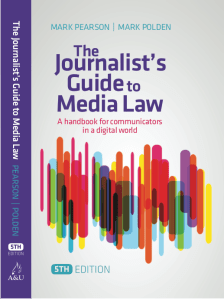
I was delighted to receive from publisher Allen & Unwin my first copy of the fifth edition of The Journalist’s Guide to Media Law (co-authored with Mark Polden).

Much has changed since our last edition in 2011, particularly in the fields of news media, communication technologies and practices, tertiary education and the law. We have reshaped and updated this edition of the book to accommodate those developments.

The book is still titled The Journalist’s Guide to Media Law, but its new subtitle—‘A handbook for communicators in a digital world’—encapsulates the seismic shifts that have prompted our considerable revisions. Our target audience has broadened with each edition as technologies like the internet and social media have combined to transform journalism and its allied professional communication careers. Thus our prime audience of Australian journalists working for traditional media outlets has widened to embrace public relations consultants, bloggers, social media editors and new media entrepreneurs,  as they fill new professional occupations dealing with media law, once the domain of mainstream reporters and editors.  Crucial questions which recur through the book include: ‘What is a journalist?’, ‘Who is a publisher?’, ‘How does media law affect this new communication form?’ and ‘Who qualifies for this protection?’ Some of the answers are still evolving, as legislators, the judiciary and the community grapple with the implications of every citizen now having international publishing technology literally at their fingertips on mobile devices.

Such shifts have prompted major new inclusions in the content of the book. So much publishing now transcends Australia’s borders via social media, blogs and other online platforms that we have expanded this edition to contain many more international comparisons and cases. This has been accommodated by reducing some of the forensic examination of precise legislation in various Australian states and territories, found in previous editions. Instead of attempting to document every statutory instrument in all nine Australian jurisdictions, we have directed readers to the resources that contain those details.

All of this has necessitated design and pedagogical changes to the book’s format and contents. While the chapter structure is generally in accord with previous editions, there are new sections within the chapters addressing these issues. Their order varies slightly according to topic, but most chapters now include some key concepts defined at the start, some international background and context to the media law topic, a more detailed account tailored to Australian legislation and case law, a review of the ‘digital dimensions’ of the topic with special focus on internet and social media cases and examples, an account of self-regulatory processes if they apply to that topic, some tips for journalists and other professional communicators for mindful practice in the area, a nutshell summary, some discussion questions, and relevant readings and case references.

The introduction of ‘tips for mindful practice’ encapsulates the authors’ aim that professional communicators need to build into their work practices and routines an informed reflection upon the legal and ethical implications of their reportage, commentary, editing, publishing and social media usage. This approach is explained in greater detail in Chapter 2, but it essentially links safe legal practice and the responsible and strategic use of free expression with the personal moral framework and professional ethical strictures of the digital communicator—whether a journalist, public relations consultant, media relations officer or serious blogger.


Those changing roles are reflected in a new final chapter, Chapter 13, which deals with the law of PR, freelancing and media entrepreneurship. It replaces a chapter on self-regulation in earlier editions. (The role and application of the various industry regulatory, co-regulatory and self-regulatory bodies, such as the Australian Communications and Media Authority (ACMA) and the Australian Press Council (APC), are now introduced in Chapter 3, but they are then referred to in the chapters where their functions and decisions seem most relevant). We saw this area of media law as significant because those who occupy those roles  are now grappling with special dimensions of media law—and several other legal topics relevant to their work—and deserve a new chapter dedicated to their roles and the legal dilemmas that are emerging in relation to them. The chapter also reflects the fact that many former journalists are now working in these allied occupations, and that student journalists need to start their careers with a broad understanding of the legal considerations which govern allied professional communication industries.

The sheer pace of change in all areas of media law is astounding. Many changes were mooted as this edition was going to press—including important developments in the laws of privacy, copyright, hate speech and court reporting. Rather than render the book dated as soon as it is printed, we have opted to use co-author Professor Mark Pearson’s journlaw.com blog (this one!) as the venue for updates to material, and have built several mentions of that resource into the chapters and discussion questions.

Apart from an array of new cases and examples—many from the international arena and many more from social media—some highlights of important new content covered in this edition include the following:

  • There are significant cases on increased statutory powers, allowing courts to make suppression and non-publication orders, and on the relationship between free speech, open justice and the right of parties to settle disputes privately. Recent cases at the borderline between ridicule and defamation, and on the application of freedom of information laws to immigration detention centres are included, as are cases on the application of sub judice contempt to internet content hosts and ‘celebrity’ claims of privacy invasion.
  • Recommendations of the ALRC on copyright reform are included, together with a discussion of the new copyright fair dealing defence that applies to satire. The book presents a wide range of examples, across different legal categories, relating to the use of the internet and social media, which will be of growing importance for current and future professional practise in communication, reportage and media advice.
  • A separate chapter on secrets (Chapter 9) covers the new journalists’ shield laws and their relevance to micro-bloggers and non-traditional publishers.
  • Chapter 10, on anti-terrorism and hate laws, includes the recommendations for reform of anti-terror laws and discusses the high-profile Andrew Bolt case and related proposals for reform of the Commonwealth Racial Discrimination Act 1975.
  • The recommendations of the Leveson Inquiry in the United Kingdom, and the Finkelstein Inquiry and Convergence Review in Australia, are subjected to critical analysis in view of their potential impact upon notions of a free press.

There is also an increased emphasis on real-time reportage, as the traditional print media increase their online presence and depth of click-through coverage in a 24/7 news cycle, with concomitant risks in the areas of defamation and contempt in their own work and that of third-party commentators on their websites and social media pages.

Without going into exhaustive detail on all of these matters, the book remains true to its original aim: to provide professional communicators and students with a basic working understanding of the key areas of media law and ethical regulation likely to affect them in their research, writing and publishing across the media. It tries to do this by introducing basic legal concepts while exploring the ways in which a professional communicator’s work practices can be adapted to withstand legal challenges.

In designing this edition, we have tried to pay heed to the needs of both professional communicators and media students. The book is best read from front to back, given the progressive introduction of legal concepts. However, it will also serve as a ready reference for those wanting guidance on an emerging problem in a newsroom or PR consultancy. The cases cited illustrate both the legal and media points at issue; in addition, wherever possible, recent, practical examples have been used instead of archaic cases from the dusty old tomes in the law library. Rather than training reporters, bloggers and PR practitioners to think like lawyers, this book will achieve its purpose if it prompts a professional communicator to pause and reflect mindfully upon their learning here when confronted with a legal dilemma, and decide on the appropriate course of action. Often that will just mean sounding the alarm bells and consulting a supervisor or seeking legal advice.

Of course, the book is not meant to offer actual legal advice. Professional communicators must seek that advice from a lawyer when confronted with a legal problem. The most we claim to do is offer an introduction to each area of media law so that journalists, PR consultants and bloggers can identify an emerging issue and thus know when to call for help.

Booktopia is offering pre-orders on their website: http://www.booktopia.com.au/the-journalist-s-guide-to-media-law-mark-pearson/prod9781743316382.html

Disclaimer: While I write about media law and ethics, nothing here should be construed as legal advice. I am an academic, not a lawyer. My only advice is that you consult a lawyer before taking any legal risks.

© Mark Pearson 2014
https://twitter.com/mattcdef2000/status/514585070149988352

https://twitter.com/MsLods/status/514583564600373250

3 Comments

Filed under blogging, citizen journalism, contempt of court, free expression, journalism, media ethics, media law, Media regulation, social media, sub judice, Uncategorized

Careful with your coverage of the Redfern murder case – especially pics #Wran

By MARK PEARSON

A media scrum gathered outside a Sydney court this morning where Harriet Wran – the youngest daughter of the former premier of New South Wales Neville Wran who died this year – was charged with murder and other offences.

I will not go into the details of the crimes Harriet Wran is alleged to have committed with a co-accused – to which she is pleading not guilty – but they relate to the death of 48-year-old Daniel McNulty and the stabbing of another man, Brett Fitzgerald, at an inner Sydney apartment block on Sunday night.

Celebrity is a driving news value and leads reporters into dangerous territory in cases like this, as co-author Mark Polden and I explain in the fifth edition of The Journalist’s Guide to Media Law, to be published later this year.

I have already seen numerous images of the accused – which is problematic if identification of either accused has any likelihood of being at issue in the trial. Any potential impact on witness identification – or any indication of the guilt of an accused – can be deemed sub judice contempt of court over which publishers can face hefty fines and jail terms if a court deems their coverage represented a real risk of prejudice to a trial.

The Latin phrase sub judice literally means ‘under or before a judge or court’ and applies to the period during which there are limitations placed on what the media may report about a case. The restrictions start from the moment someone has been arrested or charged.

In this case that period is well and truly under way, with court proceedings having commenced.

The courts have attempted to balance the competing rights and interests of those involved in court cases and those reporting on them by restricting what may be published about a case while it is before the courts. The restrictions are considered necessary to avoid ‘trial by media’, where free speech interferes with the usual safeguards of the legal system with dire consequences for the case at hand and for the public confidence in the administration of justice.

The practical concern the courts have here is the potential influence such a media trial might have on prospective jurors (and, to a lesser degree, on witnesses). The fear is that their judgment (or testimony) might be tainted by media coverage of the case before or during trial, to ‘poison the fountain of justice before it begins to flow’, as one judge expressed it in Parke’s case in 1903. The courts place stringent tests on the admissibility of evidence and respect certain rules of procedure known as ‘natural justice’, protocols that have no tradition in media coverage.

There is a ‘public interest’ defence – but that is highly unlikely to apply in a case where the only real public interest is the fact that one of the accused happens to have come from a famous family.

When deciding whether a publication is in contempt, the courts look to its ‘tendency’ to interfere with pending proceedings. As the NSW Law Reform Commission expressed it in 2000:

To amount to contempt, a publication must be shown to have a real and definite tendency, as a matter of practical reality, to prejudice or embarrass particular legal proceedings.

When considering whether the publication has the ‘tendency’ to interfere with proceedings, the courts gauge the potential effect of the sub judice material, not whether the material actually caused harm, with the test applied at the time of publication rather than at some later date. Even if the accused in the publicised trial eventually pleads guilty or even dies before the trial, the publication can still be held in contempt.

The courts take into account a number of relevant factors in determining whether there is such a real possibility of prejudice, including the prominence of the item printed or broadcast; the images accompanying it; the time lapse between publication and likely trial; the social prominence of the maker of contemptuous statements; and the extent or area of publication. In other words, a prominent sensational account of an imminent trial published in a major newspaper in the very area from which the jury would be selected would be much more likely to be held in contempt than a sober account in a small community radio news bulletin in a provincial town, some distance from the likely trial venue. This should not be taken as advice to knowingly publish a contempt in such cases. On the contrary: there is a tendency for prosecuting authorities to charge all media outlets that published contemptu­ous stories at the same time as the main sensational item that prompted their action.

Internet and social media coverage complicates the matter of course – particularly when publishers from far afield are publishing into the very jurisdiction where the jurors and witnesses live.

Watch those images of the accused

In 1994 Time Inc., publisher of the magazine Who Weekly, and the magazine’s editor were both fined for publishing on its front cover a photo­graph of Ivan Milat, the man accused (and later convicted) of murdering seven backpackers.

The publication came in another crucial time zone—after Milat had been arrested and charged but before his trial. Identification was going to be a crucial issue. In finding Who Weekly in contempt, the NSW Supreme Court held that the photograph tended to interfere with the due course of justice in the prosecution of Milat. It ran the risk of polluting the recollection of witnesses in that they may not be able to distinguish between what they had witnessed at the crucial time and their recollection of the image in the photograph.

While it was unlikely to have influenced the two key witnesses, who were overseas at the time of publi­cation, the photograph ran the risk of affecting the testimony of witnesses who had not yet come forward. Even if the publication prompted new witnesses to contact the police, their testimony would be questionable because it had been influenced by the photograph.

The court ruled that publication of a picture of an accused person would normally be regarded as carrying a risk of interference with the due course of justice, unless the iden­tification were so clear-cut that neither party would dispute it.

And don’t think that because everyone else is doing it you’ll be safe. In the Mason case in 1990 the NSW Attorney-General charged two newspapers and four television stations with contempt over their coverage of an alleged murderer’s confession to police after he had been charged, but before the trial. The outlets with the less sensational reports attracted lower fines ($75,000 as against $200,000), and the question arises: would they have been charged at all if their competitors had not published these more sensational accounts?

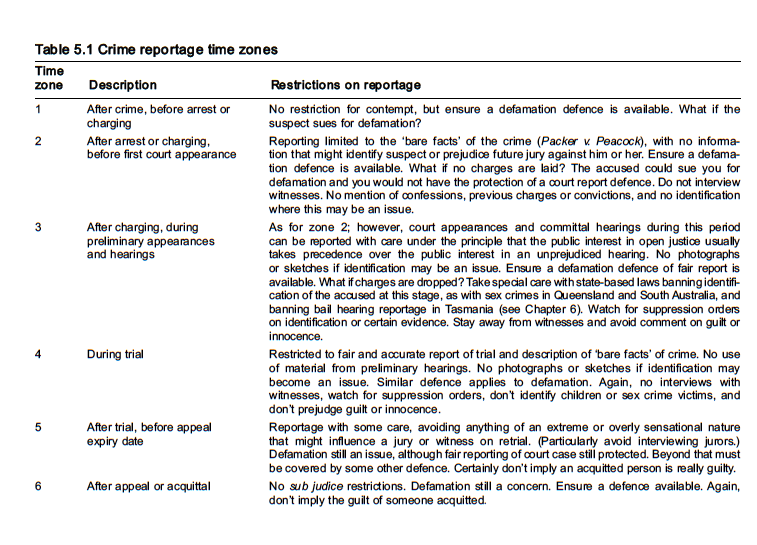
It is vital that media outlets work within these time zone restrictions when reporting on newsworthy cases like this one.

Screen Shot 2014-08-14 at 1.00.09 PM

Table: Crime reportage time zones, from Pearson, M. (2007) The Journalist’s Guide to Media Law (3rd ed, Allen & Unwin, Sydney)

Disclaimer: While I write about media law and ethics, nothing here should be construed as legal advice. I am an academic, not a lawyer. My only advice is that you consult a lawyer before taking any legal risks.

© Mark Pearson 2014

4 Comments

Filed under blogging, citizen journalism, contempt of court, free expression, journalism, media ethics, media law, Media regulation, social media, sub judice, Uncategorized

New Australian Press Council standards start August 1

Guest report from JASMINE LINCOLN, Griffith University media freedom intern

THE Australian Press Council (APC) has released its new Statement of General Principles as part of its Standards Project where it is reviewing its Standards of Practice and creating new ones.

It applies to all print and online news material from August 1, 2014.

Mark Pearson ( ) recently had the chance to interview Australian Press Council chair Professor Julian Disney on the role and direction of the Council.

In this interview he discussed the recent reforms to the Council, the move to improve its editorial standards, and the future for media ‘self-regulation’ as broadcast, print, online and social media formats continue to converge.

(12 mins, recorded 17 March 2014). Apologies for some audio sync issues!

The Council states on its site:

The revised Statement of General Principles does not seek to change substantially the general approach which has been taken previously by the Council. The main purposes are to ensure that the Principles accurately reflect that approach, are as clear as possible and are succinct.

Amongst other things, the new Statement of General Principles clarifies

• the principle that reasonable steps must be taken to ensure that factual material is accurate and not misleading applies to material of that kind in all types of article;

• the principle of reasonable fairness and balance applies to presentation of facts (including presentation of other people’s opinions) but not to writers’ expressions of their own opinion.

The Principles focus on four sets of key values:

• accuracy and clarity;

• fairness and balance;

• privacy and avoidance of harm;

• integrity and transparency.

The first phase of the Council’s ongoing changes has involved a review of the General Principles and the development of Specific Standards.

The next phase of the project includes a number of developments, including reviews of Privacy Principles and new Specific Standards on technological media outlets.

Also amongst these developments is a “systemic monitoring of compliance” (Australian Press Council, 2014) regarding the practice of the new standards.

This will directly affect the work of journalists because they will have their articles examined by the APC.

According to Press Council chair Professor Julian Disney, there are two main reasons for this Standards Project: so that the Standards of Practice are clearer and so they appropriately reflect the modern media context.

As a result of this project, the APC hopes that the new standards “will deal more effectively” with numerous complaints that they receive each year.

Sources:

Australian Press Council (2014). The Standards Project. Retrieved from: http://www.presscouncil.org.au/the-standards-project/

Robin, M (July 2014). Higher standards for opinion writing as Press Council refocuses for digital age. Retrieved from: http://www.crikey.com.au/2014/07/22/higher-standards-for-opinion-writing-as-press-council-refocuses-for-digital-age/

© Jasmine Lincoln 2014

Disclaimer: While this blog is about media law and ethics, nothing here should be construed as legal advice. I am an academic, not a lawyer. My only advice is that you consult a lawyer before taking any legal risks.

Leave a comment

Filed under free expression, journalism, media ethics, Media freedom, Media regulation, Press freedom, Uncategorized

Announcing the fifth edition of The Journalist’s Guide to Media Law

By MARK PEARSON

Co-author Mark Polden and I are in the final stages of production of the fifth edition of The Journalist’s Guide to Media Law, to be published later this year.

We are re-engaging with the print medium as we apply our eagle eyes to the final hard copy galley proofs – our last chance for amendments and updates – before it goes to the printer for the production process.

Much has changed since our last edition in 2011, particularly in the fields of news media, communication technologies and practices, tertiary education and the law. We have reshaped and updated this edition of the book to accommodate those developments.

The book is still titled The Journalist’s Guide to Media Law, but its new subtitle—‘A handbook for communicators in a digital world’—encapsulates the seismic shifts that have prompted our considerable revisions. Our target audience has broadened with each edition as technologies like the internet and social media have combined to transform journalism and its allied professional communication careers. Thus our prime audience of Australian journalists working for traditional media outlets has widened to embrace public relations consultants, bloggers, social media editors and new media entrepreneurs,  as they fill new professional occupations dealing with media law, once the domain of mainstream reporters and editors.  Crucial questions which recur through the book include: ‘What is a journalist?’, ‘Who is a publisher?’, ‘How does media law affect this new communication form?’ and ‘Who qualifies for this protection?’ Some of the answers are still evolving, as legislators, the judiciary and the community grapple with the implications of every citizen now having international publishing technology literally at their fingertips on mobile devices.

Such shifts have prompted major new inclusions in the content of the book. So much publishing now transcends Australia’s borders via social media, blogs and other online platforms that we have expanded this edition to contain many more international comparisons and cases. This has been accommodated by reducing some of the forensic examination of precise legislation in various Australian states and territories, found in previous editions. Instead of attempting to document every statutory instrument in all nine Australian jurisdictions, we have directed readers to the resources that contain those details.

All of this has necessitated design and pedagogical changes to the book’s format and contents. While the chapter structure is generally in accord with previous editions, there are new sections within the chapters addressing these issues. Their order varies slightly according to topic, but most chapters now include some key concepts defined at the start, some international background and context to the media law topic, a more detailed account tailored to Australian legislation and case law, a review of the ‘digital dimensions’ of the topic with special focus on internet and social media cases and examples, an account of self-regulatory processes if they apply to that topic, some tips for journalists and other professional communicators for mindful practice in the area, a nutshell summary, some discussion questions, and relevant readings and case references.

The introduction of ‘tips for mindful practice’ encapsulates the authors’ aim that professional communicators need to build into their work practices and routines an informed reflection upon the legal and ethical implications of their reportage, commentary, editing, publishing and social media usage. This approach is explained in greater detail in Chapter 2, but it essentially links safe legal practice and the responsible and strategic use of free expression with the personal moral framework and professional ethical strictures of the digital communicator—whether a journalist, public relations consultant, media relations officer or serious blogger.

Those changing roles are reflected in a new final chapter, Chapter 13, which deals with the law of PR, freelancing and media entrepreneurship. It replaces a chapter on self-regulation in earlier editions. (The role and application of the various industry regulatory, co-regulatory and self-regulatory bodies, such as the Australian Communications and Media Authority (ACMA) and the Australian Press Council (APC), are now introduced in Chapter 3, but they are then referred to in the chapters where their functions and decisions seem most relevant). We saw this area of media law as significant because those who occupy those roles  are now grappling with special dimensions of media law—and several other legal topics relevant to their work—and deserve a new chapter dedicated to their roles and the legal dilemmas that are emerging in relation to them. The chapter also reflects the fact that many former journalists are now working in these allied occupations, and that student journalists need to start their careers with a broad understanding of the legal considerations which govern allied professional communication industries.

The sheer pace of change in all areas of media law is astounding. Many changes were mooted as this edition was going to press—including important developments in the laws of privacy, copyright, hate speech and court reporting. Rather than render the book dated as soon as it is printed, we have opted to use co-author Professor Mark Pearson’s journlaw.com blog (this one!) as the venue for updates to material, and have built several mentions of that resource into the chapters and discussion questions.

Apart from an array of new cases and examples—many from the international arena and many more from social media—some highlights of important new content covered in this edition include the following:

  • There are significant cases on increased statutory powers, allowing courts to make suppression and non-publication orders, and on the relationship between free speech, open justice and the right of parties to settle disputes privately. Recent cases at the borderline between ridicule and defamation, and on the application of freedom of information laws to immigration detention centres are included, as are cases on the application of sub judice contempt to internet content hosts and ‘celebrity’ claims of privacy invasion.
  • Recommendations of the ALRC on copyright reform are included, together with a discussion of the new copyright fair dealing defence that applies to satire. The book presents a wide range of examples, across different legal categories, relating to the use of the internet and social media, which will be of growing importance for current and future professional practise in communication, reportage and media advice.
  • A separate chapter on secrets (Chapter 9) covers the new journalists’ shield laws and their relevance to micro-bloggers and non-traditional publishers.
  • Chapter 10, on anti-terrorism and hate laws, includes the recommendations for reform of anti-terror laws and discusses the high-profile Andrew Bolt case and related proposals for reform of the Commonwealth Racial Discrimination Act 1975.
  • The recommendations of the Leveson Inquiry in the United Kingdom, and the Finkelstein Inquiry and Convergence Review in Australia, are subjected to critical analysis in view of their potential impact upon notions of a free press.

There is also an increased emphasis on real-time reportage, as the traditional print media increase their online presence and depth of click-through coverage in a 24/7 news cycle, with concomitant risks in the areas of defamation and contempt in their own work and that of third-party commentators on their websites and social media pages.

Without going into exhaustive detail on all of these matters, the book remains true to its original aim: to provide professional communicators and students with a basic working understanding of the key areas of media law and ethical regulation likely to affect them in their research, writing and publishing across the media. It tries to do this by introducing basic legal concepts while exploring the ways in which a professional communicator’s work practices can be adapted to withstand legal challenges.

In designing this edition, we have tried to pay heed to the needs of both professional communicators and media students. The book is best read from front to back, given the progressive introduction of legal concepts. However, it will also serve as a ready reference for those wanting guidance on an emerging problem in a newsroom or PR consultancy. The cases cited illustrate both the legal and media points at issue; in addition, wherever possible, recent, practical examples have been used instead of archaic cases from the dusty old tomes in the law library. Rather than training reporters, bloggers and PR practitioners to think like lawyers, this book will achieve its purpose if it prompts a professional communicator to pause and reflect mindfully upon their learning here when confronted with a legal dilemma, and decide on the appropriate course of action. Often that will just mean sounding the alarm bells and consulting a supervisor or seeking legal advice.

Of course, the book is not meant to offer actual legal advice. Professional communicators must seek that advice from a lawyer when confronted with a legal problem. The most we claim to do is offer an introduction to each area of media law so that journalists, PR consultants and bloggers can identify an emerging issue and thus know when to call for help.

Booktopia is offering pre-orders on their website: http://www.booktopia.com.au/the-journalist-s-guide-to-media-law-mark-pearson/prod9781743316382.html

Disclaimer: While I write about media law and ethics, nothing here should be construed as legal advice. I am an academic, not a lawyer. My only advice is that you consult a lawyer before taking any legal risks.

© Mark Pearson 2014

Leave a comment

Filed under blogging, citizen journalism, contempt of court, free expression, journalism, media ethics, media law, Media regulation, social media, sub judice, Uncategorized