Careful with your coverage of the Redfern murder case – especially pics #Wran

By MARK PEARSON

A media scrum gathered outside a Sydney court this morning where Harriet Wran – the youngest daughter of the former premier of New South Wales Neville Wran who died this year – was charged with murder and other offences.

I will not go into the details of the crimes Harriet Wran is alleged to have committed with a co-accused – to which she is pleading not guilty – but they relate to the death of 48-year-old Daniel McNulty and the stabbing of another man, Brett Fitzgerald, at an inner Sydney apartment block on Sunday night.

Celebrity is a driving news value and leads reporters into dangerous territory in cases like this, as co-author Mark Polden and I explain in the fifth edition of The Journalist’s Guide to Media Law, to be published later this year.
I have already seen numerous images of the accused – which is problematic if identification of either accused has any likelihood of being at issue in the trial. Any potential impact on witness identification – or any indication of the guilt of an accused – can be deemed sub judice contempt of court over which publishers can face hefty fines and jail terms if a court deems their coverage represented a real risk of prejudice to a trial.

The Latin phrase sub judice literally means ‘under or before a judge or court’ and applies to the period during which there are limitations placed on what the media may report about a case. The restrictions start from the moment someone has been arrested or charged.

In this case that period is well and truly under way, with court proceedings having commenced.

The courts have attempted to balance the competing rights and interests of those involved in court cases and those reporting on them by restricting what may be published about a case while it is before the courts. The restrictions are considered necessary to avoid ‘trial by media’, where free speech interferes with the usual safeguards of the legal system with dire consequences for the case at hand and for the public confidence in the administration of justice.

The practical concern the courts have here is the potential influence such a media trial might have on prospective jurors (and, to a lesser degree, on witnesses). The fear is that their judgment (or testimony) might be tainted by media coverage of the case before or during trial, to ‘poison the fountain of justice before it begins to flow’, as one judge expressed it in Parke’s case in 1903. The courts place stringent tests on the admissibility of evidence and respect certain rules of procedure known as ‘natural justice’, protocols that have no tradition in media coverage.

There is a ‘public interest’ defence – but that is highly unlikely to apply in a case where the only real public interest is the fact that one of the accused happens to have come from a famous family.

When deciding whether a publication is in contempt, the courts look to its ‘tendency’ to interfere with pending proceedings. As the NSW Law Reform Commission expressed it in 2000:

To amount to contempt, a publication must be shown to have a real and definite tendency, as a matter of practical reality, to prejudice or embarrass particular legal proceedings.

When considering whether the publication has the ‘tendency’ to interfere with proceedings, the courts gauge the potential effect of the sub judice material, not whether the material actually caused harm, with the test applied at the time of publication rather than at some later date. Even if the accused in the publicised trial eventually pleads guilty or even dies before the trial, the publication can still be held in contempt.

The courts take into account a number of relevant factors in determining whether there is such a real possibility of prejudice, including the prominence of the item printed or broadcast; the images accompanying it; the time lapse between publication and likely trial; the social prominence of the maker of contemptuous statements; and the extent or area of publication. In other words, a prominent sensational account of an imminent trial published in a major newspaper in the very area from which the jury would be selected would be much more likely to be held in contempt than a sober account in a small community radio news bulletin in a provincial town, some distance from the likely trial venue. This should not be taken as advice to knowingly publish a contempt in such cases. On the contrary: there is a tendency for prosecuting authorities to charge all media outlets that published contemptu­ous stories at the same time as the main sensational item that prompted their action.

Internet and social media coverage complicates the matter of course – particularly when publishers from far afield are publishing into the very jurisdiction where the jurors and witnesses live.

Watch those images of the accused

In 1994 Time Inc., publisher of the magazine Who Weekly, and the magazine’s editor were both fined for publishing on its front cover a photo­graph of Ivan Milat, the man accused (and later convicted) of murdering seven backpackers.

The publication came in another crucial time zone—after Milat had been arrested and charged but before his trial. Identification was going to be a crucial issue. In finding Who Weekly in contempt, the NSW Supreme Court held that the photograph tended to interfere with the due course of justice in the prosecution of Milat. It ran the risk of polluting the recollection of witnesses in that they may not be able to distinguish between what they had witnessed at the crucial time and their recollection of the image in the photograph.

While it was unlikely to have influenced the two key witnesses, who were overseas at the time of publi­cation, the photograph ran the risk of affecting the testimony of witnesses who had not yet come forward. Even if the publication prompted new witnesses to contact the police, their testimony would be questionable because it had been influenced by the photograph.

The court ruled that publication of a picture of an accused person would normally be regarded as carrying a risk of interference with the due course of justice, unless the iden­tification were so clear-cut that neither party would dispute it.

And don’t think that because everyone else is doing it you’ll be safe. In the Mason case in 1990 the NSW Attorney-General charged two newspapers and four television stations with contempt over their coverage of an alleged murderer’s confession to police after he had been charged, but before the trial. The outlets with the less sensational reports attracted lower fines ($75,000 as against $200,000), and the question arises: would they have been charged at all if their competitors had not published these more sensational accounts?

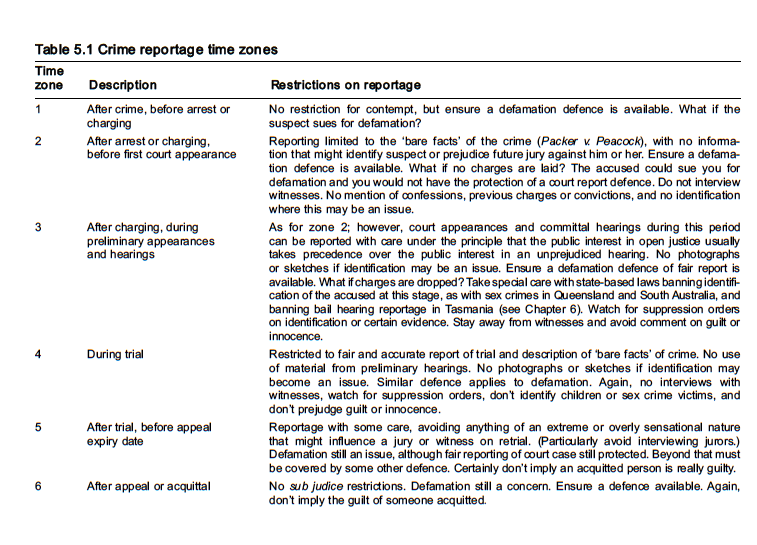
It is vital that media outlets work within these time zone restrictions when reporting on newsworthy cases like this one.
Screen Shot 2014-08-14 at 1.00.09 PM

Table: Crime reportage time zones, from Pearson, M. (2007) The Journalist’s Guide to Media Law (3rd ed, Allen & Unwin, Sydney)

Disclaimer: While I write about media law and ethics, nothing here should be construed as legal advice. I am an academic, not a lawyer. My only advice is that you consult a lawyer before taking any legal risks.

© Mark Pearson 2014
4 Comments

Filed under blogging, citizen journalism, contempt of court, free expression, journalism, media ethics, media law, Media regulation, social media, sub judice, Uncategorized

Sexual offences publishing restrictions in Australia – a guide for journalists

By MARK PEARSON

Our fifth edition of The Journalist’s Guide to Media Law (Allen & Unwin, 2014) goes to the printer this week for publication later this year.

Co-author Mark Polden and I have decided to move some of the comparative tables on reporting restrictions throughout Australia across to this blog – journlaw.com – so we could free up space in the new edition to discuss other important issues such as media law for public relations consultants and the implications of digital and social media.

We will work to update the reporting and publishing restrictions tables over coming months, but for the moment I am publishing them as they stood at the date of our fourth edition in 2011.

As I upload them over coming weeks I would appreciate any students or colleagues using the comments section below to advise of any updates in your jurisdictions and I will act to update the tables accordingly.

Looking forward to your collaborative input!


Sexual offences publication restrictions

Jurisdiction  Law Exception Legislation
ACT Complainant must not be identified by name, ‘reference or allusion’, including allowing someone to find out their ‘private, business or official address, email address or telephone number’.


Complainant may consent. (Seek legal advice on proving consent.) Evidence (Miscellaneous Provisions) Act 1999, s. 40.
New South Wales
Complainant must not be identified, even after proceedings disposed of. With permission of court. Consent of complainant aged over 14. (Seek legal advice.) With consent of court for   complainants aged under 16.


Crimes Act 1900, s. 578A; Children (Criminal Proceedings) Act 1987, s. 15A.
Northern Territory
Complainant must not be identified at all. Accused cannot be identified until after committal. No mention of ‘name, address, school or place of employment’ for either.


With permission of court. Sexual Offences (Evidence and Procedure) Act 1983, ss. 6, 7 and 11(2).
Queensland Complainant must not be identified at all. Accused cannot be identified until after committal. No mention of ‘name, address, school or place of employment’ for either. With permission of court.Protection for accused only applies to ‘prescribed sexual offences’:
(a) rape;
(b) attempt to commit rape;
(c) assault with intent to commit rape;
(d) an offence defined in the Criminal Code, section 352.1. Seek legal advice about other offences.


Criminal Law (Sexual Offences) Act 1978, ss. 6 and 7.
South Australia Case and related proceedings including identity of accused cannot be reported until accused has been committed for trial. Complainant must not be identified at any stage.Publishers must publish prominent report of result of proceedings they have covered at earlier stage when accused has been identified.


  • Pre-committal reports can be made with permission of accused. (Seek advice.)
  • Complainant can be identified with his/her permission or order of court unless child victim.
Evidence Act 1929, ss. 71A and B.
Tasmania Complainant and witnesses other than defendant must not be identified, even if dead. Also bans ‘any picture purporting to be a picture of any of those persons’.


Court may allow identification ‘in the public interest’. Evidence Act 2001, s. 194K.
Victoria Complainant must not be identified, even if proceedings not pending. If proceedings not pending, with permission of court or complainant (seek legal advice) or on proof that no complaint of offence had yet been made to police. If proceedings pending, with permission of court only.


Judicial Proceedings Reports Act 1958, s. 4.
Western Australia Complainant and their school must not be identified. With authorisation in writing by complainant aged over 18 and mentally capable of making decision. (Seek legal advice.)


Evidence Act 1906, s. 36c.

—————

Disclaimer: While I write about media law and ethics, nothing here should be construed as legal advice. I am an academic, not a lawyer. My only advice is that you consult a lawyer before taking any legal risks.

© Mark Pearson 2014

Leave a comment

Filed under blogging, contempt of court, courts, media ethics, mental health, social media, Uncategorized

When ‘off the record’ becomes ‘I am secretly recording’

By MARK PEARSON

We heard this week that Victorian Labor Party staff destroyed an Age reporter’s dictaphone earlier this year after listening to its contents and hearing secretly recorded conversations.

Screen Shot 2014-08-01 at 7.58.49 PMAs I blogged in NoFibs, The Conversation and Mumbrella this week, it is a sad day when senior political figures steal a journalist’s recording device and destroy its contents. But it is an even sadder day when we hear a major newspaper – The Age – justifying a senior reporter secretly recording their conversations with sources.

That newspaper’s editorial thundered at state opposition leader Daniel Andrews:

Here is a lesson in the law, Mr Andrews: it is not illegal in this state to record people without their consent if you are a party to the call.

The journalist involved – Sunday Age state political editor Farrah Tomazin – went even further in her account:

It is not illegal or against our code of ethics to record private conversations for the accuracy of note-taking – but it was my responsibility to keep that information secure.

While I accept the mea culpa on the lack of information security, I am sceptical that the newspaper and the reporter are on solid ground legally or ethically. But before we go into a quick review of the relevant law and ethics let me tell you why I think it is such a sad day.

There is not much new that the community has learned about its politicians and their minders from this mess: they cheat and lie for political advantage. The far more newsworthy – and depressing – news in this story is that journalists’ sources can never be sure whether their trusted reporter is secretly recording their telephone or face-to-face conversation.

https://twitter.com/mumbrella/status/494712420124721153

We are coming to expect that of our federal policing and security agencies, particularly as they are given progressively more legal powers to do this, but there are laws, ethical codes and damn good reasons to stop journalists doing it.

This kind of practice is selling out the brand of quality journalism as we knew it – that trust between a journalist and a source was a two-way street and that a contact could confide in a reporter with background or off-the-record comments or information knowing it was as safe as houses. They would go to jail to keep it secret.

We continually hear that the future of the legacy media is in the trust capital they have earned with audiences over centuries of fair and accurate reporting. This incident seriously erodes that – particularly when we hear a major newspaper excusing it as acceptable practice for its journalists.

In that commentary, I proceed to analyse the journalist’s actions in recording the conversations secretly in the context of The Age’s own Code of Conduct and the MEAA’s Journalists’ Code of Ethics.

I then proceed to consider its legal implications, federally under section 7(1) of the Telecommunications (Interception and Access) Act 1979, and under Victorian legislation at Section 11 of the Surveillance Devices Act 1999.

Interested in my analysis? Feel free to read the full blog at NoFibs, The Conversation or Mumbrella.

Thanks to colleagues for being so welcoming of my analysis.

© Mark Pearson 2014

Disclaimer: While I write about media law and ethics, nothing here should be construed as legal advice. I am an academic, not a lawyer. My only advice is that you consult a lawyer before taking any legal risks.

1 Comment

Filed under Uncategorized

New Australian Press Council standards start August 1

Guest report from JASMINE LINCOLN, Griffith University media freedom intern

THE Australian Press Council (APC) has released its new Statement of General Principles as part of its Standards Project where it is reviewing its Standards of Practice and creating new ones.

It applies to all print and online news material from August 1, 2014.

Mark Pearson ( ) recently had the chance to interview Australian Press Council chair Professor Julian Disney on the role and direction of the Council.

In this interview he discussed the recent reforms to the Council, the move to improve its editorial standards, and the future for media ‘self-regulation’ as broadcast, print, online and social media formats continue to converge.

(12 mins, recorded 17 March 2014). Apologies for some audio sync issues!

The Council states on its site:

The revised Statement of General Principles does not seek to change substantially the general approach which has been taken previously by the Council. The main purposes are to ensure that the Principles accurately reflect that approach, are as clear as possible and are succinct.

Amongst other things, the new Statement of General Principles clarifies

• the principle that reasonable steps must be taken to ensure that factual material is accurate and not misleading applies to material of that kind in all types of article;

• the principle of reasonable fairness and balance applies to presentation of facts (including presentation of other people’s opinions) but not to writers’ expressions of their own opinion.

The Principles focus on four sets of key values:

• accuracy and clarity;

• fairness and balance;

• privacy and avoidance of harm;

• integrity and transparency.

The first phase of the Council’s ongoing changes has involved a review of the General Principles and the development of Specific Standards.

The next phase of the project includes a number of developments, including reviews of Privacy Principles and new Specific Standards on technological media outlets.

Also amongst these developments is a “systemic monitoring of compliance” (Australian Press Council, 2014) regarding the practice of the new standards.

This will directly affect the work of journalists because they will have their articles examined by the APC.

According to Press Council chair Professor Julian Disney, there are two main reasons for this Standards Project: so that the Standards of Practice are clearer and so they appropriately reflect the modern media context.

As a result of this project, the APC hopes that the new standards “will deal more effectively” with numerous complaints that they receive each year.

Sources:

Australian Press Council (2014). The Standards Project. Retrieved from: http://www.presscouncil.org.au/the-standards-project/

Robin, M (July 2014). Higher standards for opinion writing as Press Council refocuses for digital age. Retrieved from: http://www.crikey.com.au/2014/07/22/higher-standards-for-opinion-writing-as-press-council-refocuses-for-digital-age/

© Jasmine Lincoln 2014

Disclaimer: While this blog is about media law and ethics, nothing here should be construed as legal advice. I am an academic, not a lawyer. My only advice is that you consult a lawyer before taking any legal risks.

Leave a comment

Filed under free expression, journalism, media ethics, Media freedom, Media regulation, Press freedom, Uncategorized

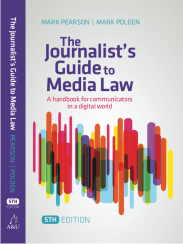
Announcing the fifth edition of The Journalist’s Guide to Media Law

By MARK PEARSON

Co-author Mark Polden and I are in the final stages of production of the fifth edition of The Journalist’s Guide to Media Law, to be published later this year.

We are re-engaging with the print medium as we apply our eagle eyes to the final hard copy galley proofs – our last chance for amendments and updates – before it goes to the printer for the production process.

Much has changed since our last edition in 2011, particularly in the fields of news media, communication technologies and practices, tertiary education and the law. We have reshaped and updated this edition of the book to accommodate those developments.

The book is still titled The Journalist’s Guide to Media Law, but its new subtitle—‘A handbook for communicators in a digital world’—encapsulates the seismic shifts that have prompted our considerable revisions. Our target audience has broadened with each edition as technologies like the internet and social media have combined to transform journalism and its allied professional communication careers. Thus our prime audience of Australian journalists working for traditional media outlets has widened to embrace public relations consultants, bloggers, social media editors and new media entrepreneurs,  as they fill new professional occupations dealing with media law, once the domain of mainstream reporters and editors.  Crucial questions which recur through the book include: ‘What is a journalist?’, ‘Who is a publisher?’, ‘How does media law affect this new communication form?’ and ‘Who qualifies for this protection?’ Some of the answers are still evolving, as legislators, the judiciary and the community grapple with the implications of every citizen now having international publishing technology literally at their fingertips on mobile devices.

Such shifts have prompted major new inclusions in the content of the book. So much publishing now transcends Australia’s borders via social media, blogs and other online platforms that we have expanded this edition to contain many more international comparisons and cases. This has been accommodated by reducing some of the forensic examination of precise legislation in various Australian states and territories, found in previous editions. Instead of attempting to document every statutory instrument in all nine Australian jurisdictions, we have directed readers to the resources that contain those details.

All of this has necessitated design and pedagogical changes to the book’s format and contents. While the chapter structure is generally in accord with previous editions, there are new sections within the chapters addressing these issues. Their order varies slightly according to topic, but most chapters now include some key concepts defined at the start, some international background and context to the media law topic, a more detailed account tailored to Australian legislation and case law, a review of the ‘digital dimensions’ of the topic with special focus on internet and social media cases and examples, an account of self-regulatory processes if they apply to that topic, some tips for journalists and other professional communicators for mindful practice in the area, a nutshell summary, some discussion questions, and relevant readings and case references.

The introduction of ‘tips for mindful practice’ encapsulates the authors’ aim that professional communicators need to build into their work practices and routines an informed reflection upon the legal and ethical implications of their reportage, commentary, editing, publishing and social media usage. This approach is explained in greater detail in Chapter 2, but it essentially links safe legal practice and the responsible and strategic use of free expression with the personal moral framework and professional ethical strictures of the digital communicator—whether a journalist, public relations consultant, media relations officer or serious blogger.

Those changing roles are reflected in a new final chapter, Chapter 13, which deals with the law of PR, freelancing and media entrepreneurship. It replaces a chapter on self-regulation in earlier editions. (The role and application of the various industry regulatory, co-regulatory and self-regulatory bodies, such as the Australian Communications and Media Authority (ACMA) and the Australian Press Council (APC), are now introduced in Chapter 3, but they are then referred to in the chapters where their functions and decisions seem most relevant). We saw this area of media law as significant because those who occupy those roles  are now grappling with special dimensions of media law—and several other legal topics relevant to their work—and deserve a new chapter dedicated to their roles and the legal dilemmas that are emerging in relation to them. The chapter also reflects the fact that many former journalists are now working in these allied occupations, and that student journalists need to start their careers with a broad understanding of the legal considerations which govern allied professional communication industries.

The sheer pace of change in all areas of media law is astounding. Many changes were mooted as this edition was going to press—including important developments in the laws of privacy, copyright, hate speech and court reporting. Rather than render the book dated as soon as it is printed, we have opted to use co-author Professor Mark Pearson’s journlaw.com blog (this one!) as the venue for updates to material, and have built several mentions of that resource into the chapters and discussion questions.

Apart from an array of new cases and examples—many from the international arena and many more from social media—some highlights of important new content covered in this edition include the following:

  • There are significant cases on increased statutory powers, allowing courts to make suppression and non-publication orders, and on the relationship between free speech, open justice and the right of parties to settle disputes privately. Recent cases at the borderline between ridicule and defamation, and on the application of freedom of information laws to immigration detention centres are included, as are cases on the application of sub judice contempt to internet content hosts and ‘celebrity’ claims of privacy invasion.
  • Recommendations of the ALRC on copyright reform are included, together with a discussion of the new copyright fair dealing defence that applies to satire. The book presents a wide range of examples, across different legal categories, relating to the use of the internet and social media, which will be of growing importance for current and future professional practise in communication, reportage and media advice.
  • A separate chapter on secrets (Chapter 9) covers the new journalists’ shield laws and their relevance to micro-bloggers and non-traditional publishers.
  • Chapter 10, on anti-terrorism and hate laws, includes the recommendations for reform of anti-terror laws and discusses the high-profile Andrew Bolt case and related proposals for reform of the Commonwealth Racial Discrimination Act 1975.
  • The recommendations of the Leveson Inquiry in the United Kingdom, and the Finkelstein Inquiry and Convergence Review in Australia, are subjected to critical analysis in view of their potential impact upon notions of a free press.

There is also an increased emphasis on real-time reportage, as the traditional print media increase their online presence and depth of click-through coverage in a 24/7 news cycle, with concomitant risks in the areas of defamation and contempt in their own work and that of third-party commentators on their websites and social media pages.

Without going into exhaustive detail on all of these matters, the book remains true to its original aim: to provide professional communicators and students with a basic working understanding of the key areas of media law and ethical regulation likely to affect them in their research, writing and publishing across the media. It tries to do this by introducing basic legal concepts while exploring the ways in which a professional communicator’s work practices can be adapted to withstand legal challenges.

In designing this edition, we have tried to pay heed to the needs of both professional communicators and media students. The book is best read from front to back, given the progressive introduction of legal concepts. However, it will also serve as a ready reference for those wanting guidance on an emerging problem in a newsroom or PR consultancy. The cases cited illustrate both the legal and media points at issue; in addition, wherever possible, recent, practical examples have been used instead of archaic cases from the dusty old tomes in the law library. Rather than training reporters, bloggers and PR practitioners to think like lawyers, this book will achieve its purpose if it prompts a professional communicator to pause and reflect mindfully upon their learning here when confronted with a legal dilemma, and decide on the appropriate course of action. Often that will just mean sounding the alarm bells and consulting a supervisor or seeking legal advice.

Of course, the book is not meant to offer actual legal advice. Professional communicators must seek that advice from a lawyer when confronted with a legal problem. The most we claim to do is offer an introduction to each area of media law so that journalists, PR consultants and bloggers can identify an emerging issue and thus know when to call for help.

Booktopia is offering pre-orders on their website: http://www.booktopia.com.au/the-journalist-s-guide-to-media-law-mark-pearson/prod9781743316382.html

Disclaimer: While I write about media law and ethics, nothing here should be construed as legal advice. I am an academic, not a lawyer. My only advice is that you consult a lawyer before taking any legal risks.

© Mark Pearson 2014

Leave a comment

Filed under blogging, citizen journalism, contempt of court, free expression, journalism, media ethics, media law, Media regulation, social media, sub judice, Uncategorized

Australian Government’s latest national security bill to stifle debate

By MARK PEARSON

The Australian Government has opted for censorship and secrecy over scrutiny and natural justice with its latest national security bill introduced in the Senate last week.

haneefcover

Haneef – A Question of Character, by Jacqui Ewart

The National Security Legislation Amendment Bill (No. 1) 2014 extends security agencies’ powers to search and use surveillance devices in the new communication environment, introduces a new ‘multiple warrants’ regime, offers immunity to intelligence personnel who break all but the most serious laws, while increasing penalties for whistleblowing and criminalising the reporting of leaked intelligence-related information.

Australian Attorney-General George Brandis introduced the legislation on Thursday (July 17).

The crucial section affecting journalists and bloggers is straightforward:

35P Unauthorised disclosure of information

(1)  A person commits an offence if:

(a)  the person discloses information; and

(b)  the information relates to a special intelligence operation.

Penalty: Imprisonment for 5 years.

It continues to set a 10 year jail term if the disclosure is deemed to “endanger the health or safety of any person or prejudice the effective conduct of a special intelligence operation.” A selective list of exemptions makes no mention of material being published in the public interest.

The provision is clearly aimed at preventing Wikileaks or Snowden-style leaks of recent years and their broad publication in the world’s media and across social media, to the embarrassment of governments including Australia’s.

As I detailed in my recent Walkley Magazine article, ‘Terror on the books’ (May 29, 2014), Australian governments from both Labor and the conservative parties have contributed to the enactment of more than 50 pieces of legislation at national level (and many more at state level) since the 9/11 terrorist attacks on the US, many of which have impacted free expression and reportage. Colleagues Dr Jacqui Ewart, Joshua Lessing and I detailed this trend in a recent article in the Journal of Media Law.

The Haneef case in 2007 showed how national security laws could be used to restrict media access to information in an anti-terrorism matter. In that case, the accused was ultimately acquitted after a leak to the media showed how little evidence there really was against him. If this new law was in place, journalists might face jail for reporting such an injustice.

The proposed law is so draconian that it has prompted a release from Paris-Based Reporters Without Borders.

Without a bill of rights or constitutional amendment to protect free expression or media freedom in this country, it is left to those who care about free speech to make their objections clear. Please write to the Federal Attorney-General at senator.brandis@aph.gov.au opposing this legislation. Please also make submissions stating any concerns to parliamentary committees reviewing the legislation when it reaches the committee stage. Sadly, in Australia there will be no formal review of the free expression implications of the bill.

© Mark Pearson 2014

Disclaimer: While I write about media law and ethics, nothing here should be construed as legal advice. I am an academic, not a lawyer. My only advice is that you consult a lawyer before taking any legal risks.

1 Comment

Filed under national security, terrorism, Uncategorized

Maintain the rage: support for Greste heartening, but needs to be escalated. Sign up. #FreeAJStaff

By MARK PEARSON

Additional research by journalism student MELANIE WHITING

AS Australian journalist Peter Greste languishes in an Egyptian jail just three weeks into his seven year sentence for simply doing his job reporting for Al Jazeera, it was heartening to see friends and colleagues rally in his support in Melbourne yesterday (July 14).

Clearly, the problem faced by all such political prisoners is that pressure for their release can diminish after their initial sentence disappears from the news agenda.

Almost 11,000 people have now signed the Canadian Journalists for Free Expression (CJFE) petition for the release of Greste and his colleagues, which will be sent tomorrow (July 16). Please go to http://www.thepetitionsite.com/583/945/591/fr/ and sign it.

In the days following the verdict political leaders including US Secretary of State John Kerry and Australian Prime Minister Tony Abbott expressed shock and condemnation over the Egyptian court’s decision on June 23.

Labor foreign affairs spokesperson Tanya Plibersek has been supportive and Greens leader Christine Milne has called upon the Abbott Government to escalate its diplomatic efforts on Greste’s behalf.

Media companies, unions and free expression groups have been united in their push for the release of Greste and his Al Jazeera colleagues.

Representatives of News Corp Australia and Fairfax Media told AdNews they saw the  sentence as a threat to press freedom.

The Media Entertainment and Arts Alliance (MEAA) issued a statement on their website condemning the verdict and maintained that Greste had acted as an ethical and responsible journalist.

A group of top international journalists united to send a letter to the Egyptian President asking for Greste and his colleagues to be released.

Petitions are important, so please sign any or all of these:

Go ahead – please sign them all NOW!

[The MEAA petition at http://www.alliance.org.au/peter-greste-petition has now closed.]

© Mark Pearson 2014

Disclaimer: While I write about media law and ethics, nothing here should be construed as legal advice. I am an academic, not a lawyer. My only advice is that you consult a lawyer before taking any legal risks.

Leave a comment

Filed under free expression, journalism, Media freedom, Media regulation, national security, Press freedom, suppression, terrorism, Uncategorized

Australian Press Council Chair Julian Disney with @journlaw

By MARK PEARSON

I recently had the chance to interview Australian Press Council chair Professor Julian Disney on the role and direction of the Council.

In this interview he discusses the recent reforms to the Council, the move to improve its editorial standards, and the future for media ‘self-regulation’ as broadcast, print, online and social media formats continue to converge.

(12 mins, recorded 17 March 2014). Apologies for some audio sync issues!

© Mark Pearson 2014

Disclaimer: While I write about media law and ethics, nothing here should be construed as legal advice. I am an academic, not a lawyer. My only advice is that you consult a lawyer before taking any legal risks.

Leave a comment

Filed under free expression, journalism, media ethics, Media freedom, Media regulation, Press freedom, Uncategorized

MsLods’ news round-up: law + technology

Great regular roundup from @mslods. Note #MLGriff students, one to follow!

mslods's avatarMsLods

Copyright

 Why Australia should sign the Marrakesh Treaty: Trish Hepworth. | ALIA | http://bit.ly/1j5iNkF

“Australia does not have an obligation … to impose liability on internet access providers for their users’ copyright infringements”:  Associate Professor Kimberlee Weatherall. | ZDNet | http://zd.net/1p9BnAc

Australian Digital Alliance submission to JSCOT on the Intellectual Property provisions of Korea-Australia Free Trade Agreement. | ADA | http://bit.ly/1m4rz2s

iiNet’s Steve Dalby to Village Roadshow: “It’s not our job to stop online infringers”. | Gizmodo | http://bit.ly/1lj1AZF

Choice Australia on piracy and access to content. | Choice | http://bit.ly/1pH1D4h

New copyright infringement laws will increase piracy: Paul Budde. | Buddle Blog | http://bit.ly/1j5pvY7

7th Circuit confirms Sherlock Holmes is in the public domain. | The IPKat | http://bit.ly/1jIWlxX

Athletes’ tattoo artists file copyright suits, leave indelible mark. | WSJ | http://on.wsj.com/1uAjd81

Defamation and media law

 East Timor elites try to muddle media. | Crikey News | http://bit.ly/1jIRxsq

$600,000…

View original post 267 more words

Leave a comment

Filed under Uncategorized

National security and anti-terror laws continue to threaten journalism

By MARK PEARSON

* This article was first published as ‘Terror on the books’ in the Walkley Magazine on May 29, 2014.

Walkley

More than 50 anti-terror laws have been introduced by the Australian government since the September 11 attacks in the US in 2001, and they continue to impact on our coverage of national security issues and place journalists and their sources at risk.

No Australian journalist would want to see lives lost in a terrorist attack, but there is evidence that existing laws give police, security agencies and the courts too much power in monitoring media activities and suppressing reports that are in the public interest. Two major reports now confirm some of these existing laws are over-reaching.

The long overdue Council of Australian Governments (COAG) Review of Counter-Terrorism Legislation was released in 2013.

As well as recommending changes to basic definitions of terrorist threats and harm, it proposes there be more opportunity for judicial reviews of the agencies’ search and seizure powers, and introducing some safeguards to the control order system (a control order restricts where a person goes and who they can meet).

The committee suggested that the communications restrictions be eased to allow a person subject to a control order access to a mobile phone, a landline phone and a computer with internet access.

Most importantly for journalists, the review recommended the repeal of Section 102.8 of the Criminal Code dealing with “associating with terrorist organisations”. This reform would put beyond any doubt the likelihood of a journalist being convicted of this serious offence by just undertaking normal reporting duties.

Another major report came in November 2013 from Bret Walker SC, the Independent National Security Legislation Monitor (INSLM). It was his third report since being appointed to the review role in 2011.Walker repeated his earlier recommendation that ASIO’s questioning and detention warrants should be abolished and suggested improvements to the definition of a “terrorist act”.

He called for a simpler system of listing terrorist organisations and inserting an exception to the “associating with terrorist organisations” provisions for humanitarian groups such as the Red Cross.

While both reports focused on issues of natural justice and human rights, neither the COAG review nor the INSLM addressed the stifling of journalism in the anti-terror laws.

Sadly, there was little in the way of media lobbying to do so either. The COAG counterterror review received 30 submissions which it posted to its website, none of which were from media-related companies or journalism or free expression organisations.

The ripples of international security operations were also felt in Australia. In 2013 the Media, Entertainment & Arts Alliance wrote to Prime Minister Tony Abbott asking for a review of the extent of metadata surveillance conducted by governments in the wake of former US National Security Agency (NSA) contractor Edward Snowden’s revelations.

There was good reason to be concerned. At least three cases in recent years have shown how the confidentiality of journalists’ sources can be compromised by surveillance by security agencies or anti-terror operations.

The retrial of “Jihad” Jack Thomas on terrorism charges in 2008 was based partly on interview materials gathered by Sally Neighbour from Four Corners and The Age’s Ian Munro and subpoenaed by the prosecution.

It emerged in the trial that up to 20 telephone calls between Neighbour and Thomas had been monitored by an ASIO agent.

The issue of confidentiality of whistleblowers’ identities also arose in the aftermath of the convictions of the Holsworthy Barracks bomb plot conspirators in 2011. The Australian had published an exclusive account on the raids in the hours before they occurred. (The three convicted plotters lost their appeals against their 18-year jail sentences last year.)

The Australian’s Victoria Police source, Simon Artz, paid for his leaks to the newspaper in the Victorian County Court with a four-month suspended sentence for unauthorised disclosure of information.

It was not a good year for whistleblowers internationally. WikiLeaks founder Julian Assange is holed up indefinitely in Ecuador’s embassy in London as he avoids extradition to Sweden on sex charges (and feared extradition to the US over security leaks). His US Army source – Private Chelsea (formerly Bradley) Manning – was sentenced by a military court to 35 years in jail for leaking classified documents. Meanwhile, Edward Snowden had fled to Russia to avoid prosecution over his leaks.

The whistleblower’s revelations about the extent of government surveillance continue to cause embarrassment, including in Australia where Prime Minister Tony Abbott reacted by attacking the ABC over its reportage. In an interview in early 2014, Abbott voiced his disapproval that the ABC had run stories about security services eavesdropping on Indonesian leaders’ phone conversations, a fact revealed by Snowden’s leaks.

The ABC then faced an “efficiency study”. It seems the Abbott government’s approach is to put the budgetary microscope on the ABC’s operations rather than wind back national security laws in the interests of media freedom.

The suppression of reporting on terrorism-related trials or evidence tendered in national security cases is an ongoing issue. The use of a closed court – combined with government media management – was central to the misplaced prosecution of Gold Coast Hospital registrar Dr Mohamed Haneef in 2007.

More than 30 suppression orders under anti-terror powers were imposed during the Benbrika trials in 2008 and 2009. In that case, Abdul Benbrika and 11 other Muslim men from Melbourne were charged with intentionally being members of a terrorist organisation. Their arrests in 2005 followed Operation Pendennis, a 16-month surveillance operation by Victoria Police, the Australian Federal Police and ASIO.

While by 2014 legislation covering suppression and non-publication orders had been introduced into only the Commonwealth, New South Wales, Victorian and South Australian jurisdictions, it appears that other states and territories are following suit to harmonise the laws.

© Mark Pearson 2014

Disclaimer: While I write about media law and ethics, nothing here should be construed as legal advice. I am an academic, not a lawyer. My only advice is that you consult a lawyer before taking any legal risks.

Leave a comment

Filed under national security, terrorism, Uncategorized