
By MARK PEARSON Follow @Journlaw
The sixth edition of The Journalist’s Guide to Media Law (Allen & Unwin, 2019) which I co-author with Mark Polden is well into production so it will be ready for the 2019 academic year.
We are making corrections and last minute updates to the first proofs of pages which were delivered for our scrutiny last week.
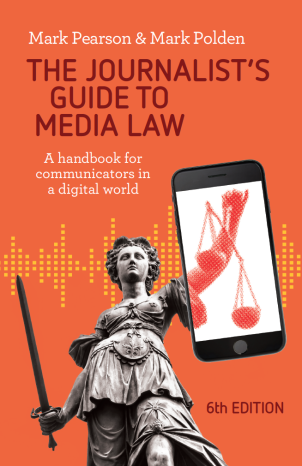 In it we try to offer a mindful approach to assessing media law risks so practitioners can navigate legal and ethical barriers to publishing in mainstream and social media.
The sixth edition has been substantially revised to reflect recent developments in litigation, and the impact of national security laws and the rising gig economy where graduates might work in the news media, PR, new media start-ups, or as freelancers. It covers defamation, contempt, confidentiality, privacy, trespass, intellectual property, and ethical regulation, as well as the special challenges of commenting on criminal allegations and trials. Recent cases and examples from social media, journalism and public relations are used to illustrate key points and new developments.
One of the most exciting aspects of media law is its dynamic and ever-evolving nature. It is shaped by the changing face of communication careers, rapid developments in technologies and the social dynamics of politics, economics and culture.
In no period of human history have such changes come about as quickly as in these first two decades of the twenty-first century. We have updated this book to reflect the many changes that have occurred in media law and its interpretation since our last edition in 2015.
Our target audience has broadened with each edition as technologies such as the internet and social media have combined to transform journalism and its allied professional communication careers, including public relations, strategic communication, social media management, professional blogging and their many hybrids.
While the book is Australian in its orientation, media law is now international in its application as the internet and its resultant communication platforms leave Australian communicators and their employers subject to publishing laws across hundreds of jurisdictions internationally. The book tries to offer a taste of such risks faced by those working internationally, while still detailing the most important restrictions and defences in Australia’s nine jurisdictions at the national, state and territory levels.
Professional communicators are now working in the so-called ‘gig economy’. Their contract work might see them working as a freelance journalist on one assignment, as a media adviser in the next stage of their career, or perhaps as a new media entrepreneur hosting public comments on some innovative news platform. At a secondary level, they are also in a ‘gig economy’ because their outputs can involve many gigabytes of communication in an instant—presenting dangers for those ignorant of the laws and regulations that might apply.
The new edition retains the basic chapter structure of its predecessor, but the content within those chapters has been revised to include fresh and ground-breaking new cases, legislative amendments and important new laws and interpretations of some issues. Recent research has shown that media law is no longer a contest between large media organisations and the rich and famous of society. There is a much larger proportion of litigation between ordinary citizens over what they have said about each other on social media or on private websites. This is also reflected in the kinds of cases we profile.
Some highlights of important new content covered in the sixth edition include:
-
consideration of several recent High Court decisions impacting on free expression, publication and media law defences
-
legal implications of ‘fake’ or false news
-
a new table summarising the mindful approach to media law practice, mapping situations against approaches
-
major criminal cases challenging the boundaries of open justice, including those involving high profile church figures and celebrities
-
new case studies in navigating crime reporting with a focus on the Yahoo!7 story that prompted the discharge of a jury in a murder trial
-
significant developments in defamation law, including record damages awards to actor Rebel Wilson (reduced after appeal) and barrister Lloyd Rayney, and litigation involving actor Geoffrey Rush
-
important new research showing that many more defamation actions are being brought by private individuals over internet and social media publications, as distinct from celebrities suing the media
-
examination of publisher liability for the comments of third parties in the wake of several new cases, with some holding publishers responsible
-
an update on confidentiality of sources, including some new breach of confidence actions and some cases testing the limits of new shield laws for journalists
-
a review of the suite of new anti-terrorism laws impacting the media’s reporting of crime and national security and jeopardising the confidentiality of their sources
-
key new intellectual property cases that have shed light on the media’s use of material sourced from the internet and social media
-
significant cases showing the rapidly developing body of privacy law in the digital era
-
new material in the law of freelancing, public relations and new media entrepreneurship showing the growing legal risks and responsibilities at the business end of communication practice.
There is also an increased emphasis on the higher pressure and pace of the 24/7 news cycle across a range of media, exacerbating the risks to communicators and publishers through their own work and the contributions of third-party commenters on their social media feeds and sites.
Like earlier editions, the book aims to give professional communicators and students a basic working understanding of the key areas of media law and ethical regulation likely to affect them in their research, writing and publishing across media platforms. It tries to do this by introducing the basic legal concepts while exploring the ways in which a professional communicator’s work practices can be adapted to withstand legal challenges.
If you wish to request a copy for course inspection or media review please contact the publisher, Allen & Unwin, who will have printed copies available from late November.
Disclaimer: While I write about media law and ethics, nothing here should be construed as legal advice. I am an academic, not a lawyer. My only advice is that you consult a lawyer before taking any legal risks.
© Mark Pearson 2018





 journlaw
Privacy as a value for democratic societies – Beate Roessler #mediaiplaw
By MARK PEARSON Follow @Journlaw
It is only in the past twenty or so years that the societal value of privacy has become of interest and still more recently that there has been a particular focus on the value of privacy for democracies, University of Amsterdam Professor of Ethics Beate Roessler proposed to the 2015 IP and Media Law Conference at the University of Melbourne Law School today (November 24).
“Privacy protection is necessary not only for individual freedom and autonomy but also for the functioning of the democratic society,” she said.
Professor Beate Roessler from the University of Amsterdam
Professor Roessler pointed to statements by Edward Snowden in 2013 and 2015 as an interesting focus upon the democratic value of privacy, where he had justified his revelations partly upon the contest between the state’s surveillance and the individual citizen’s privacy.
She listed three steps in the conceptualisation of privacy – firstly, the classic conception of Warren and Brandeis as the right to be let alone, the fundamental idea being that the right to freedom is protected by, and dependent upon, the right to privacy.
She explained that the value of privacy has for the most part of the last hundred years been conceived of in purely individual terms: the protection of privacy being important or even constitutive for the protection of individual freedom and autonomy.
The third step after Warren and Brandeis was the significance of privacy for democracy.
“I want to argue that it is precisely this social and democratic value of privacy which is at stake in the digitized society,” she proposed.
The full conference program is here. Our paper (Pearson, Bennett and Morton) was titled ‘Mental health and the media: a case study in open justice’ (see earlier blog here) and was presented yesterday (November 23).
Those interested in privacy as a topic might also see my timeline of privacy in Australia here.
———–
Disclaimer: While I write about media law and ethics, nothing here should be construed as legal advice. I am an academic, not a lawyer. My only advice is that you consult a lawyer before taking any legal risks.
© Mark Pearson 2015
Leave a comment
Filed under Privacy, Uncategorized
Tagged as Australian media, free expression, journalism, law, mark pearson, media, media ethics, media history, media law, political commentary, press freedom, privacy, privacy law, right to privacy, social media law