Tag Archives: communication ethics

‘Right Speech’ and media law – mindful journalism as an analytical tool

By MARK PEARSON

Our book Mindful Journalism and News Ethics in the Digital Era: A Buddhist Approach (Shelton Gunaratne, Mark Pearson and Sugath Senarath eds; Routledge, NY, 2015)  explored the possibilities of applying mindfulness techniques to journalism practice.
Screen Shot 2015-05-29 at 3.08.59 pm

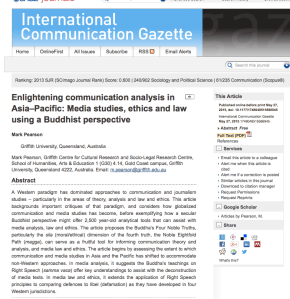
I  recently wrote an article on the “Right Speech” aspect of mindful journalism for the International Communication Gazette titled ‘Enlightening communication analysis in Asia-Pacific: Media studies, ethics and law using a Buddhist perspective’. Its abstract and link to the full article is available here.

The article backgrounds important critiques of the Western approach to communication  studies, and considers how globalized communication and media studies has become, before exemplifying how a secular Buddhist perspective might offer 2,500 year-old analytical tools that can assist with media analysis, law and ethics.

The article proposes the Buddha’s Four Noble Truths and their associated Noble Eightfold Path (magga) can be fruitful tools for informing communication theory and analysis, and media law and ethics.

In media analysis, it suggests the Buddha’s teachings on Right Speech (samma vaca) offer key understandings to assist with the deconstruction of media texts. In media law and ethics, it extends the application of Right Speech principles to comparing defences to libel (defamation) as they have developed in four Western jurisdictions.

Here is a brief extract showing the potential for exploring media law using a Buddhist/mindful journalism framework:

The ultimate contest over media talk and Right Speech happens in the courts when media texts face charges for their criminality or are the subject of civil suits over their alleged infringement on citizens’ rights like copyright, confidentiality and defamation. There is also value in applying a mindful, Buddhist approach to the study of communication and media law. We can hardly reject the teachings of the founder of one of the world’s greatest religions as inappropriate in a communication law context on exclusively secular grounds because that would imply our so-called secular approaches to communication and media theory and ethics have no religious roots. No Western academic could deny deep-seated Abrahamic influences upon the cultural origins of media law and its scholarship. A whole body of literature on the philosophy of science and religion attests to it. In media law and ethics, libertarian approaches to press freedom espoused by the likes of Milton, Mill and Jefferson arose in an era when political, cultural and religious notions of rights were intertwined. For example, the most famous treatise against licensing of the press – Milton’s Areopagitica – was prefaced with an explanation that Moses, David and Paul the Apostle were all learned because they were able to read widely. Milton wrote:

…as good almost kill a Man as kill a good Book; who kills a Man kills a reasonable creature, Gods Image; but hee who destroyes a good Booke, kills reason it selfe, kills the Image of God, as it were in the eye (Milton, 1644).

The U.S. Supreme Court cited Areopagitica in the landmark defamation case of New York Times v. Sullivan (1964) 376 US 254, when explaining why it would be counter-productive to move the burden of proving truth to the defendant (NY Times v. Sullivan, Footnote 19). Thus, by only two degrees of separation, we find Judeo-Christian teachings informing a key decision on news media talk in one of the most purportedly secular of institutions – the U.S. Supreme Court. Related to this, as Rolph (2008: 38-43) notes, defamation as the tort used to contest objectionable speech, first arose in England in 1222 in the ecclesiastical (church) courts where it remained a spiritual offence for about four centuries. Damage to a reputation was seen to be an offence to the target’s soul – a right that only God should possess – to be judged only by God’s earthly adjudicators, the clergy. There was even recourse for appeals from English ecclesiastical court judgments to the Pope (Rolph, 2008: 45). From the 16th century, defamation actions were increasingly brought in the common law courts, with the courts developing a list of allegations with which they would deal, without needing proof of actual damage being caused by the defamation (Morison & Sappideen 1989: 173). Even today the Catechism of the Catholic Church lists ‘detraction’ (essentially gossip – or disclosing ‘another’s faults and failings to persons who did not know them’) as a sin – or an ‘offense against truth’ (Catechism of the Catholic Church, para 2477). Thus, defamation action – the legal action available to those subjected to damaging media talk – has a traceable Christian genealogy.

In this globalised, multi-cultural and multi-jurisdictional Web 2.0 era there should be no reason why the Judeo-Christian lens should have a monopoly on our examination of communication law. A mindful reading of defamation law benefits from a consideration of both Right Speech principles and concepts of necessary truth-telling. While it is far-fetched to expect judges and legislators in the West would turn to Buddhism for the reform of defamation law, an effort to abide by truth-telling and Right Speech principles could operate effectively when professional communicators are attempting to avoid libel litigation when pursuing their stories. Further, they present excellent tools for an alternative analysis.

Analysis of the development of defamation defences in Canada, the UK, Australia and the U.S. benefit from a Buddhist reading. In Grant v. Torstar Corp., 2009 SCC 61, [2009] 3 S.C.R. 640, the Supreme Court of Canada developed a ‘responsible communication’ defence to defamation for matters which might not have been able to be proven absolutely as true, but were still diligently reported and were clearly in the public interest to be aired within the spirit of the Canadian Charter of Rights and Freedoms protection of free expression. Chief Justice McLachlin summed up the relevant factors of the ‘responsible communication’ defence on a demonstrable matter of public interest in these terms:

  • seriousness of the allegation
  • public importance of the matter
  • urgency of the matter
  • status and reliability of the source
  • whether the plaintiff’s side of the story was sought and accurately reported
  • whether the inclusion of the defamatory material was justifiable
  • whether a defamatory statement’s public interest lay in the fact that it had been made rather than whether it was truthful
  • other relevant circumstances

The court drew upon similar criteria to those developed earlier in the UK case of Reynolds v. Times Newspapers Ltd [2001] 2 AC 127 as part of the common law qualified privilege defence and elements of the statutory qualified privilege defence in Australia’s uniform Defamation Acts 2005.

The most significant First Amendment case in recent decades was New York Times v. Sullivan (1964) 376 US 254 where it was ruled that public of­ficials had to meet tough new tests before they could succeed in a defamation action even if the allegations in the article were proven false. It established that plaintiffs who were ‘public officials’ had to prove a media defendant had acted with ‘actual malice’ if they were to win a defamation action, even if the defamatory allegation was untrue. The test has since been expanded to apply to any ‘public figure’— essentially anyone who is well known to the public, has taken on some public role or who has participated voluntarily in some controversy. While the prin­ciple has some difficulties in definition and application, it has meant the media in the United States have been free to publish criticism of virtually anyone in the public domain, even if the criticism proves to be unfounded, just so long as they have not acted maliciously or in ‘reckless disregard’ of the truth.

It is possible to implement a Buddhist approach using the Right Speech teachings from the Noble Eightfold Path to conduct an analysis in this area of communication law. The author proposes to do this more thoroughly in future work. However, for the purposes of this argument we might return to the Abhaya Sutta … and contrast these defences as they have been developed in these jurisdictions (Thanissaro, 1997). Crucial to the Canadian ‘responsible communication’ defence and its qualified privilege cousins in the UK and Australia is the extent to which reporters and publishers honestly believe in the truth of the defamatory material published, even though they might not have the firm evidence to prove this in court. They would pass the Buddhist (mindful journalism) test if they had an honest belief the material was “factual, true, beneficial” while perhaps being “unendearing and disagreeable to others”, as long as they had chosen the “proper time” for reporting it (Thanissaro, 1997). However, the U.S. defences driven by the First Amendment takes this liberty a step too far under this schema, because it allows unbeneficial, unendearing and disagreeable material to be published about public figures as long as it has not been done with malice. It also allows for untruthful gossip-mongering, as identified earlier in the Saleyyaka Sutta (Nanamoli, 1994) as ethically problematic. Such analysis shows promise in the field of media law analysis, reform and policy development because it provides a working ethical framework to apply to legislation and the fact scenarios of particular cases.

I’ve also written a shorter account of the basic principles of mindful journalism in the journal Ethical Space: The International Journal of Communication Ethics, and the editors have been kind enough to make that article available for free viewing as a feature item on their website here. You might also want to explore some of their other fascinating articles on media ethics here and perhaps subscribe.

———–

Disclaimer: While I write about media law and ethics, nothing here should be construed as legal advice. I am an academic, not a lawyer. My only advice is that you consult a lawyer before taking any legal risks.

© Mark Pearson 2016

Leave a comment

Filed under blogging, Buddhism, citizen journalism, Eightfold Path, free expression, media ethics, mental health, social media

Drilling down on suppression orders – with a call for reform #mediaiplaw

By MARK PEARSON

Suppression orders should be precise and address imminent publications likely to prejudice the case, not be futile and should only follow a request for removal, University of Melbourne senior lecturer Jason Bosland explained to the 2015 IP and Media Law Conference at the University of Melbourne Law School today (November 23).

Melbourne University's Jason Bosland calls for reform of suppression orders

Melbourne University’s Jason Bosland calls for reform of suppression orders

However, the courts continue to issue broad suppression orders that lack these qualities. Presenting a paper co-authored with Timothy Kyriakou, he explained that most suppression orders covered prior convictions and the vast majority were made against the “world at large” rather than at specific individuals or organisations.

“This indicates that orders are being made as a general precaution in a lot of cases rather than in response to an imminent publication,” he said.

He suggested reforms limiting magistrates’ court powers, giving all levels of the court system the same suppression order powers. Another anomaly was that the Supreme Court lacked power to issue a suppression order to ensure the safety of a person, a power held by the Magistrate’s Court.

His abstract explained:

In recent years, decisions in Victoria and New South Wales have considered the power of courts under the common law to restrain the publication of prejudicial material by the media, particularly in light of such material being published, or potentially published, on the internet.

This paper distills the principles established in those cases. It also considers whether and to what extent they continue to be relevant following the introduction of the Open Courts Act 2013 in Victoria and the Court Suppression and Non-publication Orders Act 2010 in New South Wales. It then examines the making of such orders in Victoria and assesses whether the courts have been complying with the relevant principles. Finally, some suggestions for reform are presented.

In his paper ‘The media’s standing to challenge departures from open justice’, Curtin Law School’s Michael Douglas argued the media was disadvantaged by suppression orders in ways most other parties were not.

Departures from open justice directly affect the legal rights and interests of media organisations. He argued that at common law, media organisations may intervene as of right, as a matter of natural justice, in any proceedings contemplating a departure from open justice.

“Open justice is essential to the integrity of our justice system. When a court departs from open justice, it is appropriate that media organisations are able to question whether the circumstances warrant the departure,” his paper stated. The paper addressed the issue of non-party media organisations’ standing to challenge departures from open justice.

In several jurisdictions, the issue is resolved by statute, but the position is not uniform around Australia.

The paper explained the position under the differing statutes and at common law. It focused on the common law position which remained in some jurisdictions, where the standing of media organisations was controversial.

“The orthodox view, expressed in older NSW authorities, is that media organisations have no absolute right to be heard at common law,” he stated, challenging that orthodoxy, following a contrary, Western Australian line of authority. The paper explored the link between principles of standing and the principles of natural justice drawn from High Court decisions.

The full conference program is here. Our paper (Pearson, Bennett and Morton) is titled ‘Mental health and the media: a case study in open justice’ (see earlier blog here).

———–

Disclaimer: While I write about media law and ethics, nothing here should be construed as legal advice. I am an academic, not a lawyer. My only advice is that you consult a lawyer before taking any legal risks.

© Mark Pearson 2015

Leave a comment

Filed under free expression, intellectual property, media ethics, media law, Media regulation, Uncategorized

How startups focus on the execution of business plans, with less intent on controlling IP

By MARK PEARSON

Entrepreneurs might undertake strategies that abandon formal IP protection in favour of being quicker to market and investing in capabilities – that is, focussing on an idea’s execution – University of Toronto Professor Joshua Gans told the 2015 IP and Media Law Conference, in his keynote address at the University of Melbourne Law School today (November 23).

JoshuaGandCMCL

Professor Joshua Gans delivering the keynote to the Media and IP Law Conference at the University of Melbourne.

He unveiled an economic model developed with colleagues Scott Stern and Kenny Ching featuring two key propositions.

“Execution allows you to maintain market leadership so control buys you only delay,” he said.

“Control only is cost in that regard. It only delays you without giving you additional benefit.

“Even aside from resource constraint issues, control and execution are substitute strategies. The whole is not greater than the sum of the parts. You want to advise firms to pursue control or execution but not both.”

He explained execution-oriented firms will hit key milestones more quickly and will be less dependent on significant venture capital investment.

He argued against what he said was the common assumption of IP analysis that the strength and use of IP is exogenous.

CMCLlogoforblog19-11-15“Here I argue that is is endogenous and depends on the choices of entrepreneurs/innovators in their business strategy,” he promised in his abstract.
“I demonstrate that entrepreneurs can undertake strategies that abandon formal IP protection in favour of being quicker to market and investing in capabilities — that is, focussing on execution.”

Joshua Gans is a Professor of Strategic Management and holder of the Jeffrey S. Skoll Chair of Technical Innovation and Entrepreneurship at the Rotman School of Management, University of Toronto (with a cross appointment in the Department of Economics). Since 2013, he has also been Area Coordinator of Strategic Management. He is also Chief Economist of the University of Toronto’s Creative Destruction Lab. In 2012, Joshua was appointed as a Research Associate of the NBER in the Productivity, Innovation and Entrepreneurship Program.

He has also co-authored (with Stephen King and Robin Stonecash) the Australasian edition of Greg Mankiw’s Principles of Economics (published by Cengage), Core Economics for Managers (Cengage), Finishing the Job (MUP) and Parentonomics (New South/MIT Press). Most recently, he has written an eBook, Information Wants to be Shared (Harvard Business Review Press).

The full conference program is here. Our paper (Pearson, Bennett and Morton) is titled ‘Mental health and the media: a case study in open justice’ (see earlier blog here).

———–

Disclaimer: While I write about media law and ethics, nothing here should be construed as legal advice. I am an academic, not a lawyer. My only advice is that you consult a lawyer before taking any legal risks.

© Mark Pearson 2015

Leave a comment

Filed under free expression, intellectual property, media ethics, media law, Media regulation, Uncategorized

How to challenge a ban on naming a mental health patient

By MARK PEARSON

UTS colleague Associate Professor Tom Morton, ABC lawyer Hugh Bennett and I will deliver a paper in Melbourne next week on our experiences applying to the Mental Health Tribunal of NSW for permission to name a forensic mental health patient in an ABC documentary and in our academic works.

CMCLlogoforblog19-11-15The occasion is the 2015 IP and Media Law Conference, hosted by the Centre for Media and Communications Law at the University of Melbourne Law School, November 23-24. The full program is here. I plan to blog a few of the highlights of the sessions I attend.

Our paper is titled ‘Mental health and the media: a case study in open justice’ and we present on the first morning of the conference. Here is its abstract:

News and current affairs reportage about forensic mental health cases raises a host of competing interests, including the public’s right to know about mental health tribunal processes; a patient’s right to privacy, treatment, and recovery; and victims’ and the broader community’s interest in learning the longer term consequences of a publicised serious criminal act. This article details a case study of the legal processes involved in applications for permissions to identify a forensic mental health patient in NSW in an Australian Broadcasting Corporation Radio National Background Briefing documentary ‘The Man Without a Name’ and in subsequent research blogs and scholarly works including this article. It begins by backgrounding the restrictions on publicising mental health tribunal cases in Australia, summarising the case study, examining the specific restrictions applying to the Mental Health Review Tribunal in NSW, detailing the processes followed in the successful application by the authors to name the patient, comparing the case with Australian and British cases, and making some recommendations for further research and reform.

Tom and I recently co-authored an article on the ethics of that same experience in Pacific Journalism Review, titled ‘Zones of silence: Forensic patients, radio documentary, and a mindful approach to journalism ethics’. Here is our abstract. Full contents of the edition and subscription details can be seen here. Reference: Morton, T. and Pearson, M. (2015). Zones of silence: Forensic patients, radio documentary, and a mindful approach to journalism ethics. Pacific Journalism Review, 21(2), 11-32.

———–

Disclaimer: While I write about media law and ethics, nothing here should be construed as legal advice. I am an academic, not a lawyer. My only advice is that you consult a lawyer before taking any legal risks.

© Mark Pearson 2015

3 Comments

Filed under blogging, Buddhism, citizen journalism, Eightfold Path, free expression, media ethics, mental health, social media, Uncategorized

Zones of silence: Forensic patients, radio documentary, and a mindful approach to journalism ethics

By MARK PEARSON

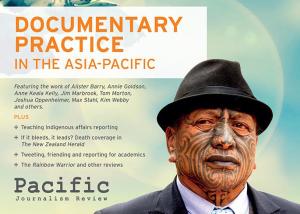
Congratulations to Pacific Journalism Review editors David Robie, Annie Goldson and Barry King on their newly released special edition ‘Documentary Practice in the Asia-Pacific’.

I was honoured to be invited by research colleague Associate Professor Tom Morton from UTS to co-write an article centred upon the law and ethics behind his ABC Background Briefing documentary ‘The Man Without A Name’, broadcast in 2014. In the article we detail the story behind the documentary and the legal and ethical challenges we faced in navigating the publishing restrictions of the NSW Mental Health Act and some related legislation.

PJR Special Edition vol21(2) OP FINAL CORRECTED 685wide_0

Cover of the special Pacific Journalism Review edition Volume 21 (2)

Here is our abstract:

This article explains a collaborative and critically reflective journalism research project stemming from the wish of an incarcerated forensic mental health patient to be named in public communication about his case. The authors are academics and journalists who embarked upon a combination of journalism, legal processes and academic research to win the right to name Patient A in a radio documentary and in academic works—including this journal article and research blogs. As a case study, it explains the theoretical and ethical considerations informing the journalism and the academic research, drawing upon traditions of documentary production, the principle of open justice and the ethical framework of ‘mindful journalism’. It concludes by drawing lessons from the project that might inform future practitioners and researchers embarking upon works of journalism and research involving vulnerable people and a competing set of rights and public interests.

Full contents of the edition and subscription details can be seen here.

———–

Disclaimer: While I write about media law and ethics, nothing here should be construed as legal advice. I am an academic, not a lawyer. My only advice is that you consult a lawyer before taking any legal risks.

© Mark Pearson 2015

Leave a comment

Filed under blogging, Buddhism, citizen journalism, Eightfold Path, free expression, media ethics, mental health, social media, Uncategorized

Mindful journalism in focus on @RNmediareport

By MARK PEARSON

Mindful journalism was the focus of a segment on Radio National’s Media Report (@RNmediareport) this week (September 3, 2015) when I was interviewed by host Richard Aedy (@richardaedy) on the application of Buddhist ethics to reporting.

Interested? You can listen to the 10 minute segment here.

Screen Shot 2015-09-04 at 9.46.24 am

Our book Mindful Journalism and News Ethics in the Digital Era: A Buddhist Approach (Shelton Gunaratne, Mark Pearson and Sugath Senarath eds; Routledge, NY, 2015)  explored the possibilities of applying mindfulness techniques to journalism practice.

I’ve also written a shorter account of the basic principles in the journal Ethical Space: The International Journal of Communication Ethics, and the editors have been kind enough to make that article available for free viewing as a feature item on their website here. You might also want to explore some of their other fascinating articles on media ethics here and perhaps subscribe.

I’ve also written an article on the “Right Speech” aspect of mindful journalism for the International Communication Gazette titled ‘Enlightening communication analysis in Asia-Pacific: Media studies, ethics and law using a Buddhist perspective’. Its abstract and link to the full article is available here.

Screen Shot 2015-05-29 at 3.08.59 pmThe article backgrounds important critiques of the Western approach to communication  studies, and considers how globalized communication and media studies has become, before exemplifying how a secular Buddhist perspective might offer 2,500 year-old analytical tools that can assist with media analysis, law and ethics.

The article proposes the Buddha’s Four Noble Truths and their associated Noble Eightfold Path (magga) can be fruitful tools for informing communication theory and analysis, and media law and ethics.

The article begins by assessing the extent to which communication and media studies in Asia and the Pacific has shifted to accommodate non-Western approaches.

In media analysis, it suggests the Buddha’s teachings on Right Speech (samma vaca) offer key understandings to assist with the deconstruction of media texts. In media law and ethics, it extends the application of Right Speech principles to comparing defences to libel (defamation) as they have developed in four Western jurisdictions.

Here is a brief extract on that aspect:

In this globalised, multi-cultural and multi-jurisdictional Web 2.0 era there should be no reason why the Judeo-Christian lens should have a monopoly on our examination of communication law. A mindful reading of defamation law benefits from a consideration of both Right Speech principles and concepts of necessary truth-telling. While it is far-fetched to expect judges and legislators in the West would turn to Buddhism for the reform of defamation law, an effort to abide by truth-telling and Right Speech principles could operate effectively when professional communicators are attempting to avoid libel litigation when pursuing their stories. Further, they present excellent tools for an alternative analysis.

Analysis of the development of defamation defences in Canada, the UK, Australia and the U.S. benefit from a Buddhist reading. In Grant v. Torstar Corp., 2009 SCC 61, [2009] 3 S.C.R. 640, the Supreme Court of Canada developed a ‘responsible communication’ defence to defamation for matters which might not have been able to be proven absolutely as true, but were still diligently reported and were clearly in the public interest to be aired within the spirit of the Canadian Charter of Rights and Freedoms protection of free expression. ..

It is possible to implement a Buddhist approach using the Right Speech teachings from the Noble Eightfold Path to conduct an analysis in this area of communication law. The author proposes to do this more thoroughly in future work. However, for the purposes of this argument we might return to the Abhaya Sutta cited earlier and contrast these defences as they have been developed in these jurisdictions (Thanissaro, 1997). Crucial to the Canadian ‘responsible communication’ defence and its qualified privilege cousins in the UK and Australia is the extent to which reporters and publishers honestly believe in the truth of the defamatory material published, even though they might not have the firm evidence to prove this in court. They would pass the Buddhist (mindful journalism) test if they had an honest belief the material was “factual, true, beneficial” while perhaps being “unendearing and disagreeable to others”, as long as they had chosen the “proper time” for reporting it (Thanissaro, 1997). However, the U.S. defences driven by the First Amendment takes this liberty a step too far under this schema, because it allows unbeneficial, unendearing and disagreeable material to be published about public figures as long as it has not been done with malice. It also allows for untruthful gossip-mongering, as identified earlier in the Saleyyaka Sutta (Nanamoli, 1994) as ethically problematic. Such analysis shows promise in the field of media law analysis, reform and policy development because it provides a working ethical framework to apply to legislation and the fact scenarios of particular cases.

The article applies the ‘Right Speech’ principles of Buddhist ethics to analysis of the Royal family prank call episode which resulted in a High Court appeal in Australia and to a racial discrimination case heard in Australia’s Federal Court over comments on a West Australian news website.

———–

Disclaimer: While I write about media law and ethics, nothing here should be construed as legal advice. I am an academic, not a lawyer. My only advice is that you consult a lawyer before taking any legal risks.

© Mark Pearson 2015

Leave a comment

Filed under blogging, Buddhism, citizen journalism, Eightfold Path, free expression, media ethics, mental health, social media

Towards a mindful approach to media law and ethics

By MARK PEARSON

Our book Mindful Journalism and News Ethics in the Digital Era: A Buddhist Approach (Shelton Gunaratne, Mark Pearson and Sugath Senarath eds; Routledge, NY, 2015)  explored the possibilities of applying mindfulness techniques to journalism practice.

How might we begin to apply Buddhist ethical systems to the analysis of media law and ethics?

I explore this question in an article just published online and to appear in a forthcoming print edition of the International Communication Gazette.

It is titled ‘Enlightening communication analysis in Asia-Pacific: Media studies, ethics and law using a Buddhist perspective’. Its abstract and link to the full article is available here.

Screen Shot 2015-05-29 at 3.08.59 pmThe article backgrounds important critiques of the Western approach to communication  studies, and considers how globalized communication and media studies has become, before exemplifying how a secular Buddhist perspective might offer 2,500 year-old analytical tools that can assist with media analysis, law and ethics.

The article proposes the Buddha’s Four Noble Truths and their associated Noble Eightfold Path (magga) can be fruitful tools for informing communication theory and analysis, and media law and ethics.

The article begins by assessing the extent to which communication and media studies in Asia and the Pacific has shifted to accommodate non-Western approaches.

In media analysis, it suggests the Buddha’s teachings on Right Speech (samma vaca) offer key understandings to assist with the deconstruction of media texts. In media law and ethics, it extends the application of Right Speech principles to comparing defences to libel (defamation) as they have developed in four Western jurisdictions.

Here is a brief extract on that aspect:

In this globalised, multi-cultural and multi-jurisdictional Web 2.0 era there should be no reason why the Judeo-Christian lens should have a monopoly on our examination of communication law. A mindful reading of defamation law benefits from a consideration of both Right Speech principles and concepts of necessary truth-telling. While it is far-fetched to expect judges and legislators in the West would turn to Buddhism for the reform of defamation law, an effort to abide by truth-telling and Right Speech principles could operate effectively when professional communicators are attempting to avoid libel litigation when pursuing their stories. Further, they present excellent tools for an alternative analysis.

Analysis of the development of defamation defences in Canada, the UK, Australia and the U.S. benefit from a Buddhist reading. In Grant v. Torstar Corp., 2009 SCC 61, [2009] 3 S.C.R. 640, the Supreme Court of Canada developed a ‘responsible communication’ defence to defamation for matters which might not have been able to be proven absolutely as true, but were still diligently reported and were clearly in the public interest to be aired within the spirit of the Canadian Charter of Rights and Freedoms protection of free expression. ..

It is possible to implement a Buddhist approach using the Right Speech teachings from the Noble Eightfold Path to conduct an analysis in this area of communication law. The author proposes to do this more thoroughly in future work. However, for the purposes of this argument we might return to the Abhaya Sutta cited earlier and contrast these defences as they have been developed in these jurisdictions (Thanissaro, 1997). Crucial to the Canadian ‘responsible communication’ defence and its qualified privilege cousins in the UK and Australia is the extent to which reporters and publishers honestly believe in the truth of the defamatory material published, even though they might not have the firm evidence to prove this in court. They would pass the Buddhist (mindful journalism) test if they had an honest belief the material was “factual, true, beneficial” while perhaps being “unendearing and disagreeable to others”, as long as they had chosen the “proper time” for reporting it (Thanissaro, 1997). However, the U.S. defences driven by the First Amendment takes this liberty a step too far under this schema, because it allows unbeneficial, unendearing and disagreeable material to be published about public figures as long as it has not been done with malice. It also allows for untruthful gossip-mongering, as identified earlier in the Saleyyaka Sutta (Nanamoli, 1994) as ethically problematic. Such analysis shows promise in the field of media law analysis, reform and policy development because it provides a working ethical framework to apply to legislation and the fact scenarios of particular cases.

The article applies the ‘Right Speech’ principles of Buddhist ethics to analysis of the Royal family prank call episode which resulted in a High Court appeal in Australia and to a racial discrimination case heard in Australia’s Federal Court over comments on a West Australian news website.

———–

Disclaimer: While I write about media law and ethics, nothing here should be construed as legal advice. I am an academic, not a lawyer. My only advice is that you consult a lawyer before taking any legal risks.

© Mark Pearson 2015

2 Comments

Filed under blogging, Buddhism, citizen journalism, Eightfold Path, free expression, media ethics, mental health, social media, Uncategorized