By MARK PEARSON
[Professor of Journalism and Social Media, Griffith University, Australia]
Public lecture presented August 27, 2013 at the Ship Inn Function Room, South Bank, as part of the Griffith University Arts, Education and Law Professional Development Series.
 Firstly, I wish to acknowledge the people who are the Traditional Custodians of the Land and pay genuine respect to the Elders, past and present, and extend that respect to other Indigenous Australians.
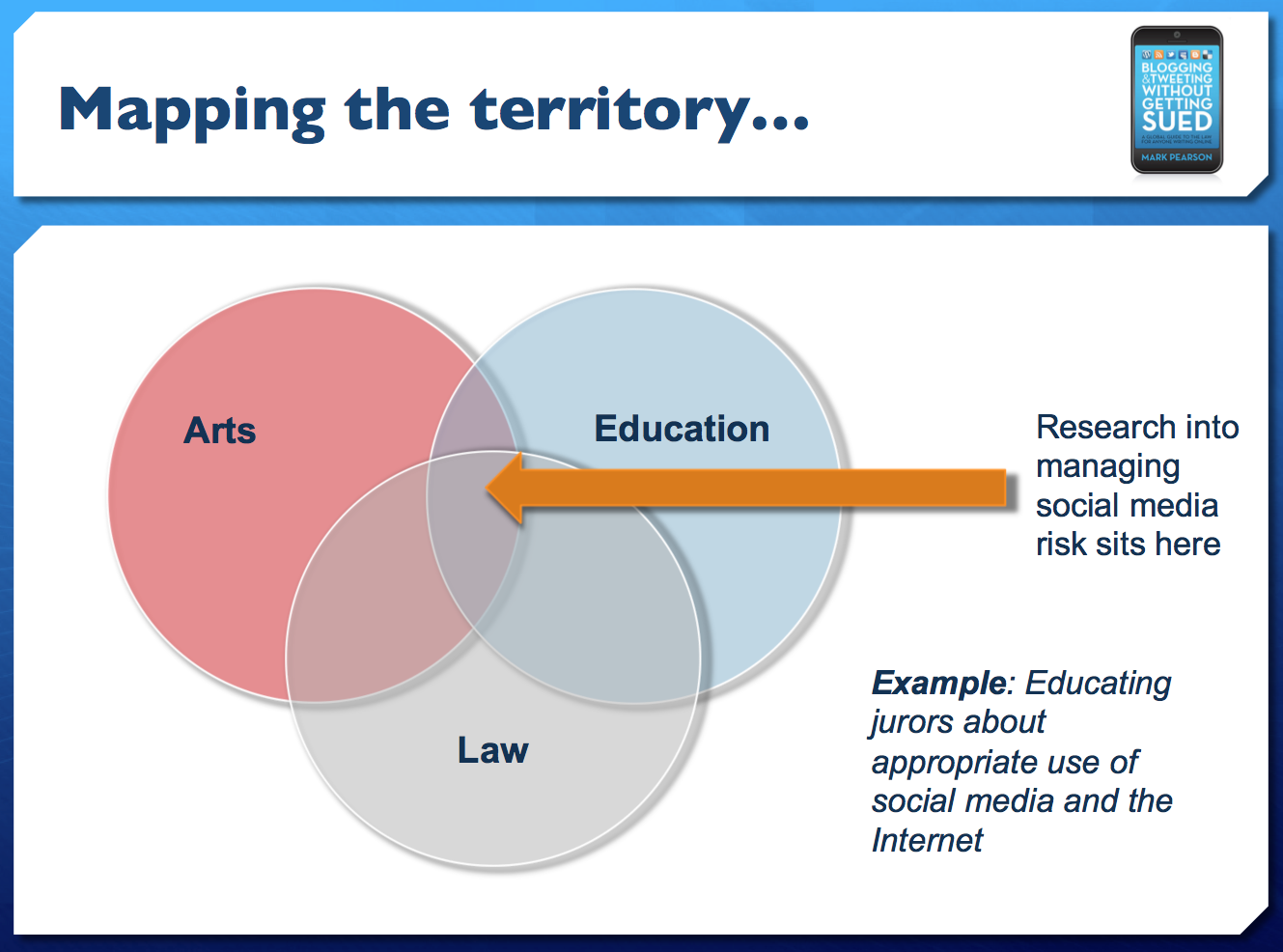
AS a new staff member at Griffith University I feel a strong sense of identity with our host Arts, Education and Law Group because those three words – arts, education and law – represent my higher degrees and research interests. Today’s lecture considers their point of juncture in the relatively new terrain of social media.
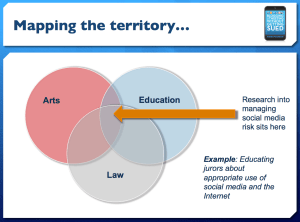 New technologies have long been the focus of research in many arts disciplines including in my own field of journalism and communication studies. Social media are of special interest to educators as we grapple with the risks and rewards of these new applications in the context of schools and universities and as we look for solutions to some of the curricular, pedagogical and administrative challenges they present. Their intersection with the law raises important questions about the capacity of existing laws and regulations to cope with the ways individuals are using social media to commit crimes and infringe upon the rights of others. Just a fortnight ago a research colleague and I were invited to address the annual training retreat for Queensland’s 27 Supreme Court judges on our research into social media and juries (Johnston and Pearson, 2013). Earlier this year our team of from five universities conducted commissioned research on this topic for the Standing Council on Law and Justice – the eight attorneys-general nationwide – and our key recommendation was for better education of jurors – through training modules and directions – about the use and misuse of the Internet and social media (Keyzer et. al, 2013). The problem for the courts is that jurors – being a cross-section of ordinary citizens – have been getting themselves into trouble for misusing the Internet and social media in the court, the jury room, and at home after a day’s jury duty. Some have been jailed for contempt of court for their blatant abuse of social media in defiance of judicial directions while the postings and Web research of others have triggered appeals and retrials at enormous public expense. One British juror – Joanne Fraill – was sentenced to eight months in jail by London’s High Court in 2011 for exchanging Facebook messages with the accused in a drug trial while she was serving on the jury (Attorney General v Fraill [2011] EWCA Crim 1570 (16 June 2011).).
None of this would be a surprise to the teachers here today who have to deal with social media use and abuse by the cross section of younger people in their classrooms. I hope to update you on the scale of these new platforms, review a few key examples of their risks and rewards, to put social media abuse into perspective, and to suggest some strategies for managing risk in this exciting yet challenging space.
First, some key stats …
 Social media and the broader devices and applications associated with Web 2.0 have become part of our lives over the past decade. It is exactly 10 years ago – August 2003 – that a social networking platform you might remember – called ‘MySpace’ – was launched in California. It was the number one social networking site in the world from 2005 until 2008, when it was surpassed in popularity by Facebook, which now has more than a billion people using it at least once per month. Youtube started in 2005 and now boasts more than 4 billion video downloads per day. The microblogging service Twitter was launched in 2006 but only really gained traction from 2008. It now claims more than 200 million active users. As Figure 1 shows, Google Plus – launched just two years ago – has overtaken both Youtube and Twitter. Twitter claims 60 per cent of its users log in via a mobile device at least once a month (Schreiner, 2013). And that’s the other story. The iPhone was only launched in 2007 and now two thirds of Australians own a smartphone (AAP, 2013). The iPad was born in mid-2010 into a market segment that many experts thought did not exist. Now more than five million Australians carry a tablet computer (Moses, 2013).
My purpose is not to bombard you with statistics, but to impress upon you both the scale and pace of change in human communication over the past five years – the period in which these technologies and platforms have penetrated the daily lives of most Australians. We do not incorporate such technologies into our routines without good reason. They obviously meet many needs – real or perceived. Convenience, connectedness, security and knowledge are but a few. Their use has enhanced people’s work, study and leisure pursuits in many ways.
My own career is just one example. Three years ago I researched, taught and consulted in the relatively narrow field of media law for journalists (Pearson and Polden, 2011). The advent of social media has allowed me to broaden that brief so that I now also research and write in this developing area of social media law and ethics, risk and regulation. The new communication medium means that everyone is now a publisher and subject to the laws that were once the near exclusive preserve of journalists, editors and traditional publishers. Even academics not researching directly in the field benefit in a host of ways from social media. Many blog about their research in progress, connect via Twitter and Facebook with colleagues to discuss new developments, and access the public discussions occurring there on a gamut of topics as a rich new field of data for analysis.
Our students also benefit in multiple ways, and have begun to work in emerging careers – at the same time as opportunities in the legacy media are declining. We now have positions like ‘online producer’, ‘social media editor’, ‘social media manager’, ‘digital media administrator’ and ‘social media strategist’ arising in new media startups, government media relations and corporate public relations which call upon the application of old journalism skills like verification and attribution and new ones like audience comment moderation and social media policy development. A simple seek.com.au search tells the story. A search yesterday for the term “social media” as the job descriptor prompted 1322 results, whereas a search for “journalist” generated just 127 positions, “editor” scored 48 and the term “public relations” managed to find 293 jobs, some overlapping with the social media roles. It is a contested employment space, with graduates from marketing, public relations, journalism, HR, IT and other backgrounds competing for these roles.
Social media risks
 Whatever their backgrounds and qualifications, these people are tasked with managing the engagement of their employers – corporations, government entities and non-government organisations – with their various stakeholders, the bulk of whom are ordinary citizens with a new-found voice at their fingertips. At its extreme we have seen the huge challenges this can pose for governments and private enterprise. We have witnessed the so-called ‘Arab Spring’ of civil upheaval throughout the Middle East over the past three years. While it is certainly wrong to say that social media caused the unrest – there is no doubt that social media platforms were an important means of communication among protestors during most of those events, leading to those in Iran, Tunisia and Egypt to be dubbed the ‘Twitter Revolution’.
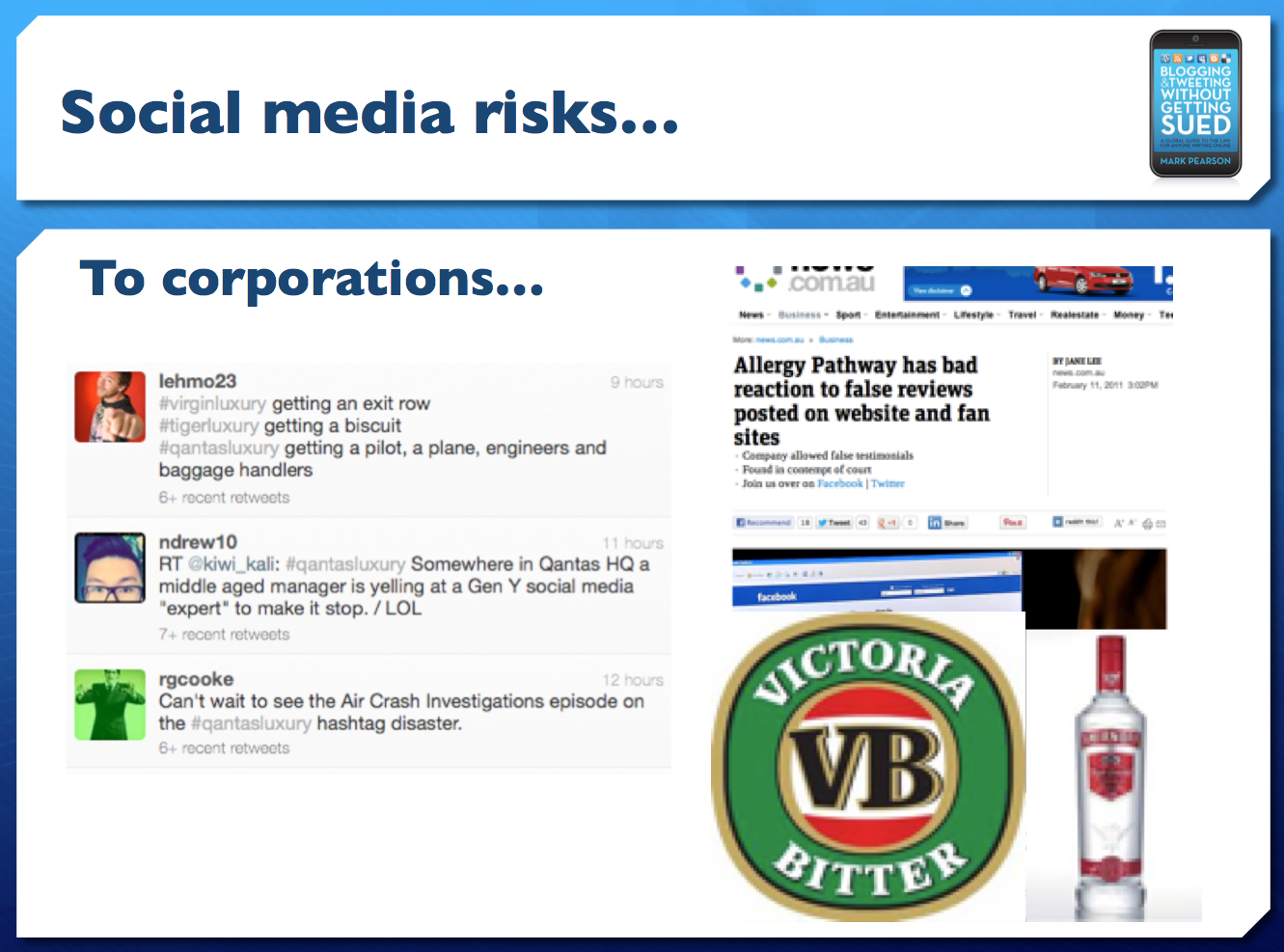
Major corporations like Qantas and McDonalds have learned social media lessons the hard way as their publicity campaigns centred on Twitter hashtags have gone awry because disgruntled customers have used them to post satirical comments and outright insults about their products and services. On a lesser scale, our own Australian Electoral Commission (AEC) had its Twitter account hijacked by phishing spam at the start of this campaign, but they were quick to respond as my correspondence with them shows (see slide).
 Courts and other regulators have been forced to adjudicate on the various rights and interests affected by these new media forms and some of the decisions have taken private enterprise by surprise. The pioneering decision on corporate responsibility for the comments of third parties in social media was an Australian Federal Court case in 2011 involving an alternative health provider called Allergy Pathway and the consumer regulator, the ACCC (ACCC v Allergy Pathway Pty Ltd and Anor (No 2) [2011] FCA 74.) Clients were continuing to make claims about the miraculous nature of the company’s allergy treatments as comments on its website and on Facebook and Twitter, despite Allergy Pathway having been ordered to desist from making such claims. Justice Finkelstein ruled the company was responsible for these statements by others it was hosting. The Advertising Standards Board also ruled the Facebook pages of VB and Smirnoff Vodka were effectively advertisements and that those companies were responsible for the discriminatory and obscene comments made there by customers (Smith, 2012, pp 4-5).
These major corporations are learning quickly from such decisions and are adapting their practices and policies to take into account social media risk management. However, it is a far more difficult task educating the broader community about social media risks.
 I tried to make a small contribution to improving the social media literacy of the broader public with my recent book Blogging and Tweeting Without Getting Sued (Pearson, 2012) – where I attempted to summarise and exemplify the legal risks for bloggers and social media users internationally. The core message was that we are all now publishers in the eyes of the law when we publish a blog or post to a social media platform and we are subject to the laws that have affected journalists and publishers for hundreds of years. Further, the instantaneous and global nature of the media mean that we are the subject of laws internationally, particularly if we choose to travel to a place where our posts might have broken the law or infringed upon someone’s rights. These include the laws of defamation, contempt of court, intellectual property, confidentiality, discrimination and national security. The book included examples of all. I mentioned the juror Joanne Fraill who was jailed for contempt of court for friending the accused on Facebook (p. 45). The book also talks about lawyer Tad DiBiase posted a Denver Post article to his nobodymurdercases.com criminal law blog and found himself being sued for breach of copyright (pp. xiii – xiv). Then there was 16-year-old Texan teenager Alison Chang who flashed a ‘V’ sign in a travel snap taken by her church youth counsellor. Her image was lifted from Flickr and posted on a bus stop on the other side of the world as part of a Virgin Mobile advertising campaign, triggering an international legal action by her parents over privacy, libel, contract, negligence, and copyright. Virgin had put the caption ‘Free text virgin to virgin’ right under the teenager’s image (p.1). The platforms are configured so you think you are just corresponding with your cosy group of social media friends – all with a shared sense of humour or sarcasm – when in reality your remarks can go viral and get picked up by the mainstream media. Up-and-coming fashion designer Dawn Simorangkir was delighted when she was asked to create some clothing for Courtney Love but ended up getting $430,000 in defamation damages from the rock celebrity after she angered Love by sending her an invoice. The troubled star had fired off scores of blog and Twitter rants, accusing the designer of being a thief, burglar, felon, drug addict, prostitute, embezzler, cocaine dealer and an unfit mother. Love issued an unconditional apology as part of a mediated court settlement, only to be sued by her former lawyers over another series of tweets where she had claimed they had taken a bribe (p.19).
 Sometimes even fun turns sour – and it is alarming when it involves children. A satirical swipe at redheads on the Simpsons television series prompted a 14-year-old Canadian boy to set up a Facebook ‘Kick a Ginger’ campaign, rapidly ‘friended’ by more than 5000 fans. Dozens of children posted comments on the page claiming to have attacked redheads (p. 128). Brisbane ‘troll’ Bradley Hampson served 220 days in jail in 2011 for plastering obscene images and comments on Facebook tribute pages dedicated to the memory of two children who had died in tragic circumstances. Sadly, Hampson was a 29-year-old with autism and had already been convicted of a similar offence three years earlier (p. 219).
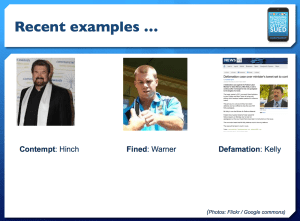
There have been numerous other examples of celebrities and ordinary citizens getting into legal strife over their posts since my book was published. ‘Human headline’ Derryn Hinch is due to face trial next month over contempt of court charges stemming from blog and Twitter comments he made about the Melbourne murder of Irish woman Jill Meagher (ABC, 2013). Test cricketer David Warner was fined by Cricket Australia over a Twitter rant against two journalists (Otto, 2013). And federal Labor MP Mike Kelly is being sued for defamation over a tweet accusing Liberal pollsters Linton Crosby and Mark Textor of the practice of ”push polling” (Maley, 2013).
Why does such behaviour continue?
Researchers internationally are attempting to fathom the crucial question of why people – particularly celebrities whose public images are so crucial to their sponsorship deals – continue to let down their guard and publish comments and images on social media that they would never offer publicly to the mainstream media.
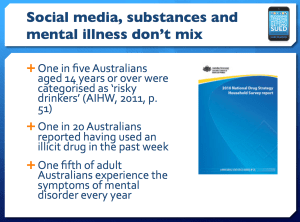 The cognitive factors inherent in this are for the behavioural science researchers to investigate. A strong hypothesis is that the very raison d’etre of the social media platform – gathering with friends to chat, gossip, joke and share just as you would in a pub or café – is so absorbing that it is difficult to remind oneself in the midst of an evolving conversation that you are likely publishing the material beyond the narrow friendship circle you imagine. Add to this mix the statistics on substance abuse and mental illness. According to the 2010 National Drug Strategy household survey, one in five Australians aged 14 years or over were categorised as ‘risky drinkers’ (AIHW, 2011, p.51) and one in 20 Australians reported having used an illicit drug in the past week (p. 85). Also, one fifth of adult Australians experience the symptoms of mental disorder every year according to another Australian Institute of Health and Welfare report (2010, p. iii). All this amounts to the statistical reality that at any moment on social media there will inevitably be people publishing material in a state not conducive to sober, reflective, considered authorship.
Once the psychologists have determined the factors contributing to this propensity to throw caution to the wind on social media it will be up to the educationalists to develop effective pedagogical techniques to teach children and adults how to pause and reflect before publishing on social media. And, of course, a warning not to engage in social media after imbibing in drugs or alcohol would be wise counsel.
Effective social media policies
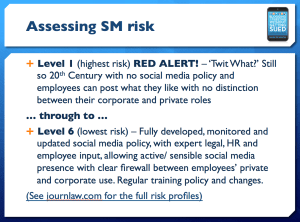 The growing list of social media casualties makes it easy to develop an argument to limit a medium that is so readily abused and has been used as a vehicle to cause so much suffering in people’s lives. Yet, as a free expression advocate and a keen student of the introduction of all new technologies I suggest the rewards of social media far outweigh the risks involved. All new technologies – the printing press, radio, television, the telephone, the internet, and social media – have been misused by people to wreak havoc on the lives of others. Actor Russell Crowe proved that quite literally when he threw a telephone at a concierge in a New York hotel in 2005 (Ramirez, 2005). Nobody suggested telephones should be banned from hotels in the wake of this incident. Rather, his behavior was punished in court and it served to highlight the consequences for citizens who cannot manage their anger.
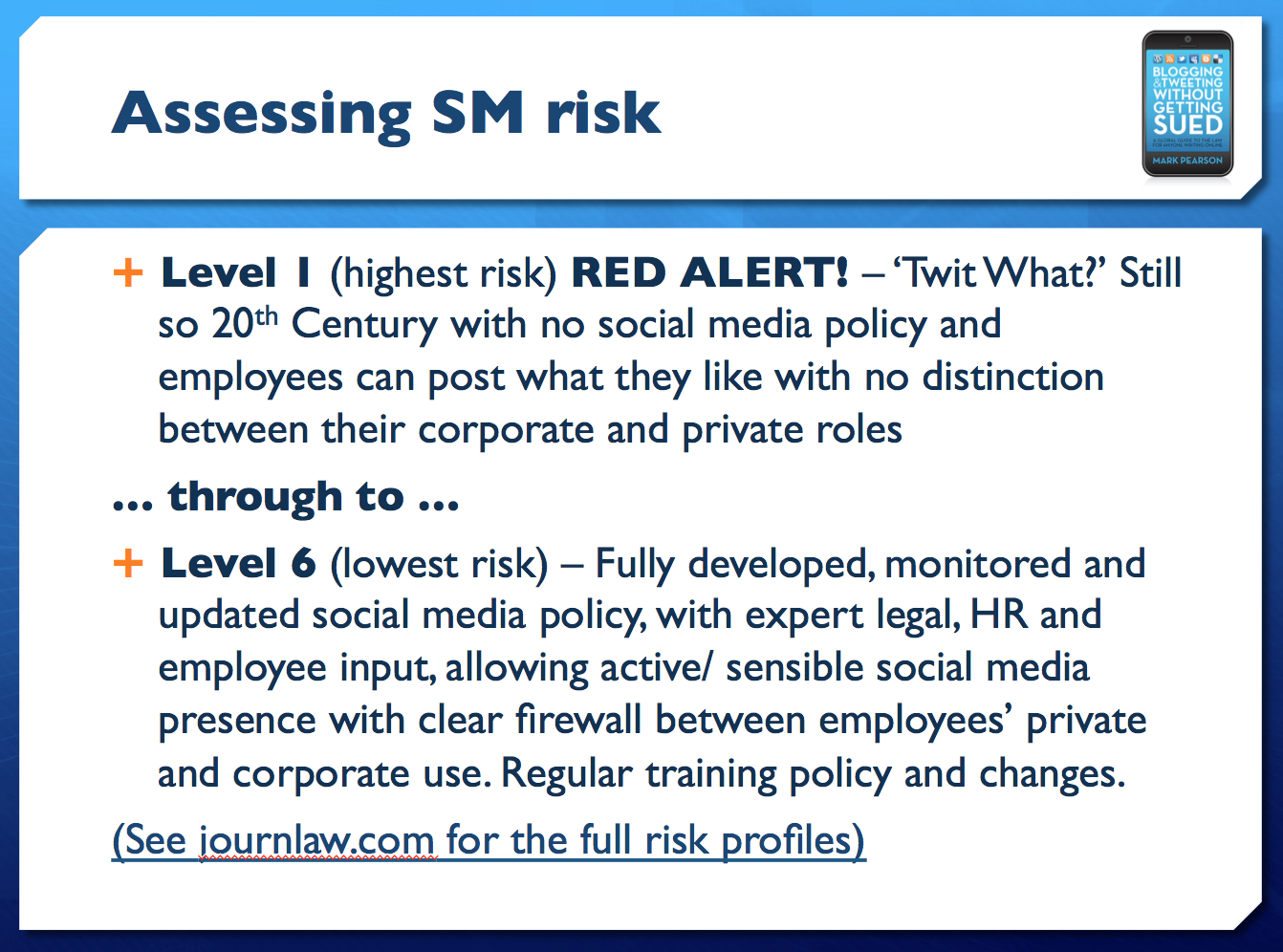
The same can be true for social media and I am hopeful that eventually it will be. The solutions lie in the development of sensible social media policies in our organisations, raising community literacy about their use, and applying the law in extreme cases of their abuse.
There have been rapid developments on all fronts in short space of time. Decisions by Fair Work Australia (now the Fair Work Commission) have offered guidance to employers on what constitutes an effective social media policy. Two key decisions there involving the companies Linfox and the Good Guys established that a dismissal of an employee for insulting the employer and colleagues on social media will be ruled unfair if the company does not have a clear and reasonable social media policy which it has drawn to the attention of its staff (Bunch, 2012).
Schools and social media
Several members of the audience today are teachers, so we might look at schools as a mini case study. We hear a great deal about the downside of social media use in schools. There have been well publicised examples of cyberbullying, defamation of teachers and principals, stalking of children by online sexual predators, and the dismissal of teachers for their own misuse of the medium. As a journalism academic, I can tell you that these make news because they involve deviant behavior, they result from important changes in society, they typically involve some sort of conflict or intrigue, and they are unusual enough to be interesting to audiences. They are not the norm, which explains their newsworthiness.
The norm is actually the millions of social media postings that are either mundane – like YouTube clips of cats – or are actually performing some public good – providing online counseling and support to those in need; creating useful communication channels between children, peer groups and parents; and opening a wealth of learning opportunities if managed appropriately. Of course, none of this means that we should ignore the risks – only that we should take steps to manage them and work with the medium within a relatively safe environment.
One Gold Coast private school made the local television news earlier this month with its principal’s bold announcement that he was banning social media use by students while at school. The school’s published policy also prohibits mobile phones and other entertainment devices (ASAS, 2009). This policy is known in the literature as the ‘lock and block’ approach. It is clearly one option available to schools and is risk averse in that it reduces the likelihood of the misuse of social media platforms during school hours. But is it a little like the Mercer Hotel in New York banning the use of telephones because Russell Crowe happened to disconnect a faulty one and hurl it at a worker in the foyer?
 If we seek to assess the educational opportunity cost of such a policy measure, we can look to the academic literature tracking the teaching and learning benefits of social media platforms. The European eTwinning project was established in 2005 as the main action of the European Commission’s eLearning Programme. Its Central Support Service is operated by European Schoolnet, an international partnership of 33 European Ministries of Education developing learning for schools, and its portal has 170,000 members and over 5300 projects between two or more schools across Europe. Its profile states:
Whenever we talk about internet safety we must also talk about responsible use. Similarly, when we talk about the safe use of social media we must also talk about the responsible use of social media. Unfortunately some people still believe that the only way to keep children safe online is to ‘lock and block’ access to parts of the internet though web filtering. The reality of this is that this doesn’t remove the actual dangers (perceived or otherwise) and it also makes it almost impossible for educators to deliver key internet safety and responsible use messages. The fundamental requirement to keeping children and young people safe online is to make sure that they have received an appropriate education in how to use tools and services appropriately. (eTwinning, 2012).
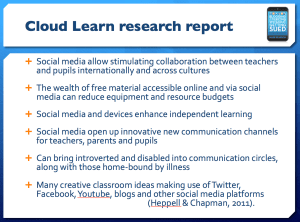 Some teachers have become quite activist in their opposition to a ‘lock and block’ approach, with the arguments of UK schools challenging this approach articulated in the Cloud Learn Research Report. Their main points are:
– social media allow stimulating collaboration between teachers and pupils internationally and across cultures
– the wealth of free material accessible online and via social media can reduce equipment and resource budgets
– social media and devices enhance independent learning
– social media open up innovative new communication channels for teachers, parents and pupils
– they can bring introverted and disabled students into communication circles, along with those home-bound by illness
– there are too many creative classroom ideas making use of Twitter, Facebook, Youtube, blogs and other social media platforms – to document (Heppell & Chapman, 2011).
 European Schoolnet’s SMILE (Social Media In Learning and Education) action research project offered some examples of effective in-class use of social media, including:
– A Twitter snow lesson where a teacher’s Twitter network was asked where they lived and if it was snowing. The tweets were plotted on to Google Map and imported into Google Earth where real-time satellite imagery could be overlaid onto the map. The pattern that emerged provided an excellent context for discussing the weather, weather patterns and weather systems;
– Google Plus in classrooms with a free ten-seat videoconference solution to allow face-to-face collaboration with peers and experts across geography and time zones;
– YouTube used to create a school television station;
– Developing research skills by collecting data using tools like SurveyMonkey and Facebook Polls;
– Classroom blogs or blogs used as an ePortfolio used to generate audiences for young writers. (European Schoolnet, 2013).
This latter example raises the issue of the importance of written expression, particularly via blogs, for students. Writing in the journal The Psychiatrist, researchers Wuyts, Broome and McGuire (2011) cited several studies that demonstrated that keeping a personal blog could ‘have a therapeutic effect, by reducing stress and improving subjective well-being, and could be considered especially useful for people experiencing mental health problems’. This was because self-disclosure on a blog could impact on someone’s perception of their social integration and their so-called ‘bonding social capital’. The study focused on extended written blogs rather than social networking or ‘micro-blogging’ like Twitter and Facebook, but the sensible use of social media could have the same benefits, as found recently by a team of researchers from the Australian Catholic University here in Brisbane. They concluded:
“Facebook use may provide the opportunity to develop and maintain social connectedness in the online environment, and that Facebook connectedness is associated with lower depression and anxiety and greater satisfaction with life (Grieve et al, 2013).”
Cyberbullying policies
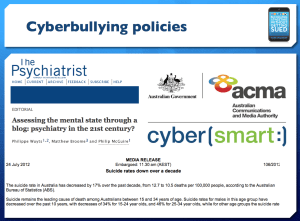 Despite the benefits, there is no disputing the sad fact that practices like cyberbullying continue. It is indeed that sensible or ‘mindful’ use of social media that should inform social media policies in schools, education departments, and in other government and corporate organisations. Cyberbullying has been a key point of focus and education systems have now developed policies in this area. The Australian Communications and Media Authority (ACMA) has an excellent ‘cyber(smart):’ site with a wealth of resources and lists the various education systems’ social media and cyberbullying policies (ACMA, 2013). For example, the Queensland Department of Education, Training and Employment features guides for parents, teachers and students at its Cybersafety site (DETE, 2012). At least the Education Department does not devolve the responsibility for cyber-safety to an automated Internet filter. Its site states: “Being cybersafe and a good cybercitizen is primarily about learning how to behave in the online environment. While technical solutions are part of ensuring safety and security, cybersafety in schools depends on people acting appropriately.” (DETE, 2012).
It is sage advice. Administrators and parents are indeed concerned about social media – partly because the little they know about it has been informed via the lens of the news media and war stories like those I have related above. Their perceptions are also skewed by the new industry of cyber-safety – everything from net nanny systems for your IT system through to speakers and consultants ready to advise on the evils of trolls and cyber-predators. I am not suggesting such inputs are unnecessary, but I wonder about their impact on policy at a time when parents and administrators are already approaching Web 2.0 with trepidation.
With all these resources committed to it, one might be excused for believing cyberbullying had driven young people to the depths of depression and anxiety and were consequently taking their own lives at an alarming rate. The fact is that in the decade 2000-2010 – a period during which both Internet and social media usage grew rapidly – youth suicide in Australia actually declined. It declined across the whole 15-24 year age group, with suicides among males in that age group decreasing by 34 per cent. That is not to say, however, that the rate of youth suicide is not alarming. The number of suicides is still far too high and like all stats this figure can have a range of explanations – better counselling, changes in media coverage, the efforts of campaigns like Beyond Blue and RU OK? (partly on social media), and improved medicines for psychiatric conditions. Indeed, the policy measures noted above might well have helped save a few young lives. While it is tragic for any young person to take their life for such a reason, there seems to be no hard data that Internet and social media usage is driving more young people to this level of despair (ABS, 2012).
After all, social media is in many ways just a microcosm of our broader lives, and problems like bullying have always existed. These platforms present new channels for the demonstration of such behaviours, replacing or supplementing replacing the schoolyard taunts, the prank calls, the practical jokes and the toilet graffiti.
Mindful use of social media
As I researched my book and encountered more examples of people exposing themselves to legal risks and public humiliation through their social media and Internet use – and as I answered journalists’ questions in interviews about the book – I found myself concluding that this was as much a matter of our citizens’ morality and ethics as it was about ignorance of the law. When asked for expert advice on the legally safe use of social media I started to talk about being mindful of the impact of one’s posts upon others, pausing to calm down and think before you respond, and of course desisting from using social media when drunk or high. I found myself counseling people to draw upon the moral framework from whatever religion or secular ethical system they may follow when using social media.
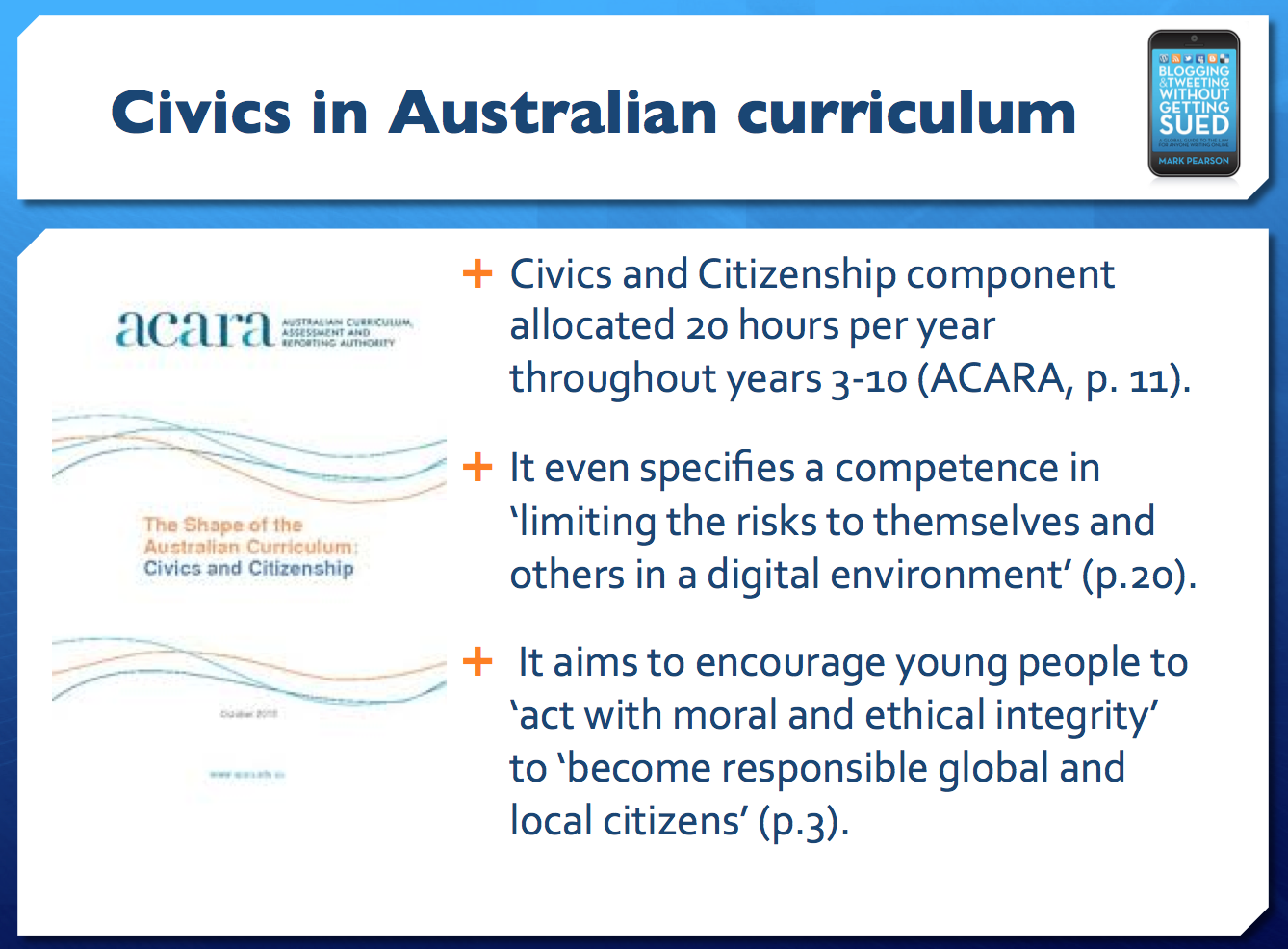
 At the very least an important foundational literacy one must have to empower one to assess social media risk – especially the legal risks involved – is an education in civics that explains the rights and responsibilities of individuals, the legal consequences of actions, and the systems in which these operate. Australia has lacked a consistent approach to civics education but fortunately the new Australian curriculum has a Civics and Citizenship component covering these kinds of issues at an allocated 20 hours per year throughout years 3-10 (ACARA, p. 11). It even specifies a competence in ‘limiting the risks to themselves and others in a digital environment’ (p.20). It aims to encourage young people to ‘act with moral and ethical integrity’ to ‘become responsible global and local citizens’ (p.3).
Frankly, this is where I believe the best approach lies. If we are going to reap the potential of new technologies we cannot become so risk averse that we ‘lock and block’ the opportunities as we try to minimise the dangers. That Gold Coast private school I mentioned earlier allows its students to engage in contact sports with far greater potential risks to their minds and bodies than any Internet platform might present. They do so because they perceive the ongoing social and educational benefits of team sports as outweighing the very real risk of physical injuries. They invest in the expert staff to coach, they qualify them with first aid training, and they teach the children the code of behavior expected on a sporting field. And I would not for a moment suggest they should not. Yet they choose to ‘lock and block’ some of the most valuable communication tools developed in the history of human invention.
I suggest the answer is not in deprivation and censorship, but in sensible social media guidelines and foreshadowed consequences for misuse, accompanied by a foundation in moral and ethics education of citizenship presented in the new Australian curriculum. The educational theory of ‘reflective practice’ coined by Donald Schön two decades ago invokes a mindful approach to learning where professionals ‘reflect-in-action’ upon their learning as they face technical and ethical decisions in their working careers. There is no reason why a properly invoked civics and citizenship curriculum should not do the same for our pupils as they engage with new media as a laboratory for the greater challenges that real life presents.
Important social and research questions
All this brings us back to that intersection of the arts, education and law I noted in my opening remarks. Here is a new cultural form which presents us with enormous headaches which we associate with damage to many people’s lives and relationships but at the same time is simply forcing us to address important social questions – most of which actually existed well before the advent of social media. These are questions like:
– Are schools responsible for what students do after hours?
– Why do people bully each other and what can we do about it?
– What value is a new law or policy if it is difficult to regulate?
– When certain behaviours have been absorbed into the lives of students, employees or even jurors what power or right do we have to restrict them?
I suggest to you that the single biggest reward of social media is that it is prompting us to take such questions by the horns and grapple with them as teachers, parents, researchers, lawyers and journalists. Every use and misuse of social media centres upon a right or norm we have previously taken for granted – our privacy, confidentiality, reputation, identity, security, and our sense of justice. A reflective approach to technology demands us to consider the impact of our actions upon others. But it also behoves us to be mindful of the underlying social questions it reveals. Many of those questions can be addressed by research conducted in this fascinating research space where the arts, education and law intersect.
References
AAP (2013). A third of Aussies prefer smartphone over TV. Financial Review. Retrieved on August 25, 2013 from http://www.afr.com/p/technology/third_of_aussies_prefer_smartphone_glnX1KRWbe9HRZLdm56XnN
ABC (2013, July 16). Broadcaster Derryn Hinch to face trial in September over contempt charges. ABC News. Retrieved August 25, 2013 from http://www.abc.net.au/news/2013-07-16/broadcaster-to-plead-not-guilty-to-contempt-charges/4822854
ABS (2012). Australian Bureau of Statistics. 3309.0 – Suicides, Australia, 2010 . LATEST ISSUE Released at 11:30 AM (CANBERRA TIME) 24/07/2012 Retrieved on August 22, 2013 from http://www.abs.gov.au/ausstats/abs@.nsf/Latestproducts/3309.0Media%20Release12010?opendocument&tabname=Summary&prodno=3309.0&issue=2010&num=&view
ACARA (2012). The shape of the Australian curriculum: civics and citizenship. Australian Curriculum, Assessment and Reporting Authority, Sydney. Retrieved on August 22, 2013 from http://www.acara.edu.au/verve/_resources/Shape_of_the_Australian_Curriculum__Civics_and_Citizenship_251012.pdf
ACMA (2013). National state and territory cybersafety policies. Cyber(smart:) Australian Communication and Media Authority: Canberra. Retrieved August 25, 2013 from http://www.cybersmart.gov.au/Schools/Cybersafety%20policy%20guidance/National%20state%20and%20territory%20cybersafety%20policies/QLD%20policies.aspx
ASAS (2009). All Saints Anglican School Policies and Procedures. Retrieved August 25, 2013 from http://www.asas.qld.edu.au/information_policies_and_procedures.html
Australian Institute of Health and Welfare (AIHW). (2010). Mental health services in Australia 2007–08. Mental health series no. 12. Cat. no. HSE 88. Canberra: AIHW. Available: http://www.aihw.gov.au/publications/hse/88/11415.pdf .
Australian Institute of Health and Welfare (AIHW). (2011). 2010 National Drug Strategy Household Survey report. Drug Statistics Series No. 25. AIHW, Canberra. Retrieved August 25, 2013 from http://www.aihw.gov.au/WorkArea/DownloadAsset.aspx?id=10737421314
Bunch, M. (2012, February). Employee sacked for Facebook comments wins reinstatement. Aitken Legal Employment Update. (pp. 1-4.) Retrieved August 25, 2013, from http://www.aitkenlegal.com.au/userfiles/files/14_%20Employment%20Update%20-%20February%202012%20-%20Employee%20sacked%20for%20facebook%20comments%20wins%20reinstatement%20(AL00063971).pdf
DETE (2012). Cybersafety and schools. Web resource site. Department of Education, Training and Employment, Brisbane. Retrieved on August 25, 2013 from http://education.qld.gov.au/studentservices/behaviour/qsaav/cybersafety.html
European Schoolnet (2013). SMILE. Social media in learning and education. Challenges and opportunities for schools and teachers in a digital world. Brussels: European Schoolnet. Retrieved August 25, 2013 from http://www.eun.org/c/document_library/get_file?uuid=232671ea-32ca-4272-8b24-20328aafe8bb&groupId=43887
eTwinning. (2012). Using social media responsibly. eTwinning. Retrieved August 25, 2013 from http://www.etwinning.net/it/pub/profile.cfm?f=2&l=en&n=81637.
Grieve, R., Indian, M., Witteveen, K., Anne Tolan, G., & Marrington, J. (2013). Face-to-face or Facebook: Can social connectedness be derived online?. Computers in Human Behavior, 29(3), 604-609. Retrieved August 26, 2013, from http://www.sciencedirect.com/science/article/pii/S0747563212003226
Heppell, S. & Chapman, C. (2011). Cloudlearn report: phase 1. Effective practice for schools moving to end locking and blocking in the classroom. Nominet Trust, Oxford. Retrieved August 25, 2013 from http://rubble.heppell.net/cloudlearn/media/Cloudlearn_Report.pdf
Johnston, J. and Pearson, M. (2013). Social media and jury trials. Presentation to the 2013, Supreme Court Judges’ Seminar, 12 – 13 August 2013, Judges’ Conference Room, 415 George Street, Brisbane.
Keyzer, P., Johnston, J., Holland, G., Pearson, M. Rodrick, S. & Wallace, A. (2013) Juries and Social Media, Centre for Law, Governance and Public Policy, a report commissioned by the Victorian Department of Justice on behalf of the Standing Council on Law and Justice, 16 April 2013, [1.2]. Retrieved August 25, 2013 from www.sclj.gov.au/agdbasev7wr/sclj/documents/pdf/juries%20and%20social%20media%20-%20final.pdf.
Moses, A. (2013, March 13). Tablets to reach 70% of Australians by 2017. smh.com.au. Retrieved August 25, 2013 from http://www.smh.com.au/digital-life/tablets/tablets-to-reach-70-of-australians-by-2017-20130313-2fz9o.html.
Otto, T. (2013, May 23). Cricket Australia fines David Warner $5750 over Twitter rant. The Telegraph. Retrieved August 25, 2013 from http://www.dailytelegraph.com.au/sport/cricket/cricket-australia-fines-david-warner-5750-over-twitter-rant/story-fni2fnmo-1226648382977
Pearson, M., K. Green, S. Tanner & J. Sykes. (2010). Researching Journalists and Vulnerable Sources – Issues in the Design and Implementation of a National Study In Pasadeos, Y. (ed) Advances in Communication and Mass Media Research. ATINER, Athens: 87-96.
Pearson, M. (1987). ‘Interviewing Aborigines: A Cross-Cultural Dilemma’, Australian Journalism Review, Vol. 9 (Nos 1 and 2) January-December. pp. 113-117.
Pearson, M. (2012). Blogging and Tweeting Without Getting Sued – A global guide to the law for anyone writing online. Allen & Unwin, Sydney.
Pearson, M. & Polden, M. (2011). The journalist’s guide to media law, Fourth edition, Allen & Unwin, Sydney.
Ramirez, A. (2005, November 19). Russell Crowe Pleads Guilty to Assaulting Hotel Clerk. New York Times. Retrieved August 25, 2013, from http://www.nytimes.com/2005/11/19/nyregion/19crowe.html?_r=1&
Schön, D. (1987) Educating the reflective practitioner. Toward a new design for teaching and learning in the professions. Jossey-Bass: San Francisco.
Schreiner, Taylor. (2013, February 13). New complete study: primary mobile users on Twitter. [Twitter blog]. Retrieved on August 25, 2013 from https://blog.twitter.com/2013/new-compete-study-primary-mobile-users-twitter.
Smith, D. (2012, September). Social media marketing. E-Commerce law reports. 12 (4): 4-5.
Wuyts, P., Broome, M. and McGuire, P. (2011). Assessing the mental state through a blog: psychiatry in the 21st century? The Psychiatrist (2011) 35: 361-363. Retrieved on August 25, 2013 from http://pb.rcpsych.org/content/35/10/361
…
https://twitter.com/MsLods/status/373912276757004288
© Mark Pearson 2013
Disclaimer: While I write about media law and ethics, nothing here should be construed as legal advice. I am an academic, not a lawyer. My only advice is that you consult a lawyer before taking any legal risks.










 journlaw