Tag Archives: investigative journalism

RIP Bob Howarth: journalist, mentor and legend

By MARK PEARSON

Australia and the Asia-Pacific region lost an important figure last month – journalist, trainer and media freedom advocate Bob Howarth.

Over his 81 years Bob changed countless lives for the better, firstly through his newspaper journalism and production skills, and then via his editorship, management, training, mentorship, philanthropy and service as an RSF (Reporters Without Borders) correspondent.

I first met Bob in the early 1990s when my students were reporting under his editorship for the PANPA Chronicles – a conference newspaper produced for the Pacific Area Newspaper Publishers’ Association.

Bob was a keen scuba diver at that stage, and I remember him capturing the front page photograph 10m underwater. His caring and encouraging approach made him an ideal trainer of newspaper cadets and personnel and tutor of my university students after his retirement. He also ran courses and projects for Australian Business Volunteers in Indonesia, Timor Leste and PNG.

I’ll always remember his wry smile and quiet manner of speech as he related anecdotes from his adventurous career – from his recommissioning of old computer terminals and a printing press to assist the rebirth of the Timor Post through to his pistol-wielding adventures as managing director of the  Post-Courier in Port Moresby.

I interviewed Bob for this blog back in 2014, where he spoke about media freedom issues in Timor Leste and the broader Pacific.

Bob and I would catch up for coffee occasionally, and it was in response to my SMS invitation for a cuppa that his beloved partner Di let me know of his passing that morning.

While we were good mates, others knew Bob much better than me, and there have been several testimonials written about him over recent weeks.

For an insight into his philanthropy and his fondness for Timor-Leste, which he visited more than 30 times, I recommend the moving tribute by his protege Mouzinho Lopes de Araujo, republished by esteemed colleague David Robie on his Cafe Pacific site, here.

For Bob’s own account of his role in setting up the Timor Post, see his piece from 2019 in the Asia Pacific Report here.

And for an account of Bob’s training prowess and influence on Pacific journalism, see the memorial by Robert Luke Iroga, editor and publisher of Solomon Business Magazine, also published in the Asia Pacific Report, here.

Vale Bob Howarth. You made a huge difference.

Disclaimer: While I write about media law and ethics, nothing here should be construed as legal advice. I am an academic, not a lawyer. My only advice is that you consult a lawyer before taking any legal risks.

© Mark Pearson 2025 – the moral right of the author has been asserted.

Leave a comment

Filed under censorship, confidentiality, free expression, global journalism, journalism, journalism education, libel, media ethics, Media freedom, media law, mindful journalism, Pacific journalism, Pacific Journalism Review, Press freedom, privacy, Whistleblowing

Pacific Media Conference panel session evaluates global research journal model and defends regional niche titles

By MARK PEARSON

A panel session discussing the merits and perils of academic journal publishing featured in the Pacific Media Conference at the University of the South Pacific in Suva, Fiji on July 4-6. 

This article republished with permission from Pacific Media Watch reviews the panel and its key points of discussion.

Pacific media academics slam global research journal model, defend regional niche titles

Pacific Media Watch

Pacific media academics have criticised the economics of global research journal publication models and defended independent publications such as Pacific Journalism Review carving out niche markets.

"Publish of perish?"
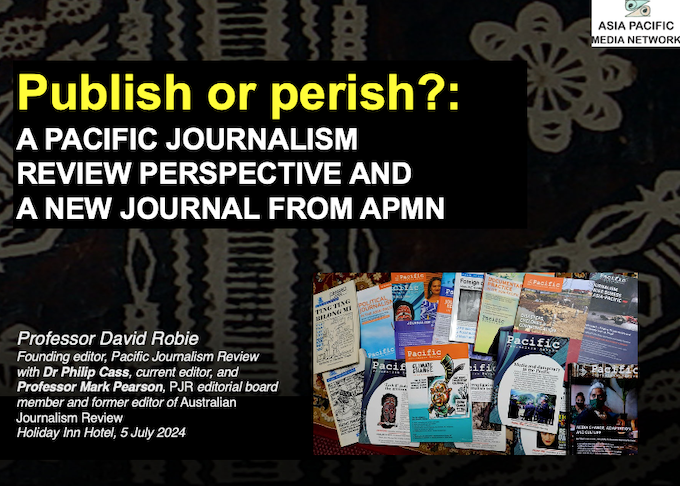
“Publish of perish?” A Pacific Journalism review perspective and new journal from APMN. Image: Screenshot APR

Speaking in a panel titled “Publish or Perish” at the recent Pacific International Media 2024 conference in Suva, Fiji, the academics warned that changes in the international research publishing arena were not necessarily an improvement.

In fact, in some cases the changes threatened independent journals and opened the door to “paper mills, AI and sham publications”.

The panel was moderated by adjunct professor in governance Vijay Naidu of The University of the South Pacific and featured a former editor of the Australian Journalism Review, Professor Mark Pearson of Griffith University; founding Pacific Journalism Review editor professor David Robie, and current editor and former PNG newspaper editor and journalism educator Dr Philip Cass.

Introducing the speakers, Professor Naidu said the “Publish or Perish” topic was a pivotal panel and he congratulated conference chair Associate Professor Shailendra Singh, a PJR editorial board member, for the success of the three-day event.

“This panel for media scholars focuses on the ‘heart of the matter’ relating to journalism and the media,” Dr Naidu said.

Researching and writing about the media were critical for both scholars and media practitioners as pertinent topics on current and future development of journalism and the media were covered.

Publishing outlets crucial
Outlets for publishing research findings were crucial for media academics.

Professor Pearson spoke about five key points: the impact of rankings; open access and vanity publishing; “paper mills” and sham journals; the demise of small independent journals; and academic versus journalism outputs.

The "Publish or Perish" panel
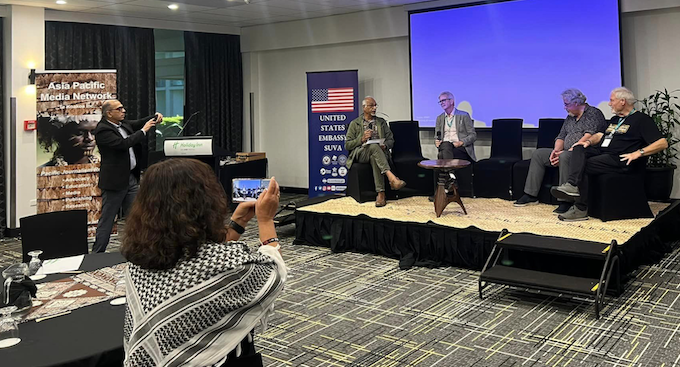
The “Publish or Perish” panel . . . convenor Professor Vijay Naidu (from left), Professor Mark Pearson, Dr Philip Cass and Professor David Robie. Taking photos are Associate Professor Shailendra Singh and PJR designer Del Abcede. Image: APMN

Discussing global journal rankings, Dr Pearson said the limited level of interest in Pacific issues internationally reduced potential for “prestigious journal” acceptance of papers.

“Journalism researchers ought to avoiding having too many eggs in one basket – and to be aware of the impact of rankings and events on your CV. Decide whether to play the game or not?”

Speaking about open access as a game changer in academic publishing, he said that  the flipside was that open access had paved the way for a completely new way to earn a profit.

However, it had meant that  journals would not necessarily have any financial incentives to ensure appropriate peer review or quality control  — “as long as they can make the researchers pay”.

He cited research by Norwegian academic Martin Hagve who argued in Tidsskriftet that most academic publishers produce content paid for by research funds, including salaries and the expenses of researching.

Editors work for ‘symbolic pay’
“My own experience is that most academic editors work for merely symbolic pay and that quality control and fact-checking are done through peer review, which is unpaid voluntary work,” Hagve wrote.

In 2023, the annual number of papers retracted by research journals had topped 10,000 for the first time, said Dr Pearson. Most analysts believed that the figure was only the tip of an iceberg of scientific fraud.

Dr Pearson lamented the demise of many small independent journals and others becoming vulnerable in the face of the global academic publishing model, such as Pacific Journalism Review that celebrated 30 years of publication at this conference.

PJR editor Dr Philip Cass reaffirmed that it was “incredibly important” to have such a journal because of its “unique position covering the region”.

He also argued strongly for the continuation of print journals at a time when many academic publications are retreating to online only editions.

Professor Robie gave an overview of Pacific Journalism Review and how it had evolved through several design and content styles from when it was first published at the University of Papua New Guinea in 1994.

Del Abcede had played a key role in the design in recent years.

Innovative ‘journalism as research’
Dr Robie spoke about the innovative PJR “journalism as research” model resisted by many academic faculties and described how the journal’s Frontline section, pioneered by Professor Wendy Bacon, had set a benchmark for investigative journalism being recognised by the academe.

He also touched briefly on the Asia Pacific Media Network’s new publishing strategy which includes a new title, Pacific Media, publishing on AUT’s Tuwhera indigenous research platform. Although this publication will feature the usual journal attributes, it will focus more on community outcomes.

Pacific Journalism Review has been featured by Australian National University’s Devpolicy Blog.

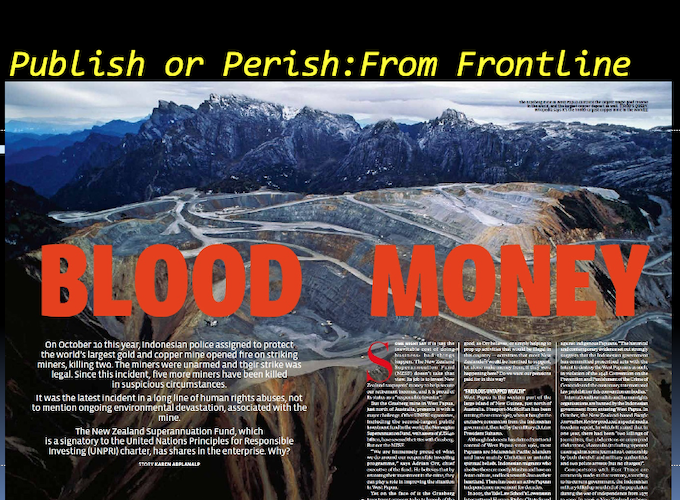
“Blood Money” . . . featuring one of the series of Frontline investigative journalism-as-research artIcles about West Papua published by Pacific Journalism Review. Image: PJR screenshot APR

Disclaimer: While I write about media law and ethics, nothing here should be construed as legal advice. I am an academic, not a lawyer. My only advice is that you consult a lawyer before taking any legal risks.

© Mark Pearson 2024 – the moral right of the author has been asserted.

Leave a comment

Filed under censorship, confidentiality, free expression, global journalism, journalism, journalism education, libel, media ethics, Media freedom, media law, mindful journalism, Pacific journalism, Pacific Journalism Review, Press freedom, privacy, Whistleblowing

Pacific Media Conference to celebrate 30th birthday of Pacific Journalism Review

By MARK PEARSON

Journalists, publishers, academics, diplomats and NGO representatives from throughout the Asia-Pacific region will gather for the Pacific Media Conference at the University of the South Pacific in Suva, Fiji on July 4-6. 

A notable part of the conference will be the celebration of the 30th anniversary of the journal Pacific Journalism Review – founded by the energetic pioneer of journalism studies in the Pacific, Professor David Robie, who was recently honoured in the NZ King’s Birthday Honours list as a Member of the New Zealand Order of Merit. I have been on the editorial board of PJR for two of its three decades.

As well as delivering a keynote address titled “Frontline Media Faultlines: How Critical Journalism can Survive Against the Odds”, Dr Robie will join me and the current editor of PJR, Dr Philip Cass on a panel examining the challenges faced by journalism journals in the Global South/Asia Pacific.

In addition, I will be delivering a conference paper titled “Intersections between media law and ethics – a new pedagogy and curriculum”.

Media law and ethics have often been taught as separate courses in the journalism and communication curriculum or have been structured as two distinct halves of a hybrid course.

My paper explains an integrated approach expounded in my new textbook, The Communicator’s Guide to Media Law and Ethics, where each key media law topic is introduced via a thorough exploration of its moral, ethical, religious, philosophical and human rights underpinnings.

The argument is exemplified via an approach to the ethical and legal topic of confidentiality, central to the relationship between journalists and their sources.

After defining the term and distinguishing it from the related topic of privacy, the paper explains the approach in the textbook and curriculum which traces the religious and philosophical origins of confidentiality sourced to Hippocrates (460-370BC), via confidentiality in the priesthood (from Saint Aphrahat to the modern Catholic Code of Canon Law), and through the writings of Kant, Bentham, Stuart Mill, Sidgwick and Rawls until we reach the modern philosopher Sissela Bok’s examination of investigative journalism and claims of a public’s ‘right to know’.

This leads naturally into an examination of the handling of confidentiality in both public relations and journalism ethical codes internationally and their distinctive approaches, opening the way to the examination of law, cases and examples internationally in confidentiality and disclosure and, ultimately, to a closer examination in the author’s own jurisdiction of Australia.

Specific laws covered include breach of confidence, disobedience contempt, shield laws, whistleblower laws and freedom of information laws – with the latter having a strong foundation in international human rights instruments.

The approach gives ethical studies a practical legal dimension, while enriching students’ legal knowledge with a backbone of its philosophical, religious and human rights origins.

Details about the conference can be found on its USP website.

Disclaimer: While I write about media law and ethics, nothing here should be construed as legal advice. I am an academic, not a lawyer. My only advice is that you consult a lawyer before taking any legal risks.

© Mark Pearson 2024 – the moral right of the author has been asserted.

Leave a comment

Filed under censorship, confidentiality, free expression, global journalism, journalism, journalism education, libel, media ethics, Media freedom, media law, mindful journalism, Pacific journalism, Pacific Journalism Review, Press freedom, privacy, Whistleblowing

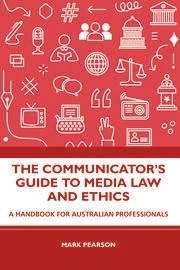
The Communicator’s Guide to Media Law and Ethics – A Handbook for Australian Professionals

By MARK PEARSON

My latest book has been published, covering both media law and ethics for communication students and practitioners. 

The Communicator’s Guide to Media Law and Ethics – A Handbook for Australian Professionals (Routledge, London and NY, 2023) offers an introduction to the key legal and ethical topics confronting Australian journalists and strategic communicators both at home and internationally and offers a suite of reflective techniques for navigating them.

It starts by positioning morals, ethics, and the law in their historical and philosophical frameworks by tracing the evolution of free expression and professional media ethics. Media law and ethics are then contextualised in their modern international human rights framework.

Readers are equipped with a skill set for reflecting on the law and ethics of professional media dilemmas – including mindful reflection, the Potter Box, journaling, concept mapping, and discussion.

Such approaches are then applied to key topic areas, including free expression; reputation; confidentiality; privacy; justice; intellectual property; national security; discrimination and harassment; and conflicted interests.

Each is examined in terms of its philosophical underpinnings, relationship to human rights, professional ethical context, international examples, legal principles, key Australian laws, legal cases, and strategies for applying reflective practice techniques. It concludes on a confident note – imploring communicators to engage in constructive and mindful strategic communication with the authority and confidence that results from a working knowledge of media law and ethics.

This handbook is for professional communicators and students in all fields, but particularly in journalism, public relations, corporate communication, media relations, and marketing.

Academics can request inspection copies here.

Disclaimer: While I write about media law and ethics, nothing here should be construed as legal advice. I am an academic, not a lawyer. My only advice is that you consult a lawyer before taking any legal risks.

© Mark Pearson 2024 – the moral right of the author has been asserted.

2 Comments

Filed under censorship, communication, cyberbullying, defamation, First Amendment, free expression, global journalism, journalism, journalism education, libel, media ethics, Media freedom, media law, Media regulation, online safety, Press freedom, social media

Abuse of Stan Grant highlights law and policy of cyberbullying and online harassment #MLGriff

By MARK PEARSON

The debate surrounding indigenous journalist Stan Grant standing down after harassment from some traditional media and cyberbullying underscores the importance of our research into the online safety of diverse journalists. 

The research project by our joint team from Griffith University and Macquarie University was titled ‘Online Safety of Diverse Journalists’.

It was commissioned by Media Diversity Australia (MDA) and funded by the Australian Broadcasting Corporation (ABC), Meta (Facebook), Google News Initiative, the e-Safety Commissioner and Twitter.

The main findings were well explained in this Conversation piece by my research colleagues Bronwyn Carlson, Susan Forde, Madi Day and Faith Valencia-Forester.

My role in the project was to write a law and policy summary about cyberbullying and online safety of diverse journalists and a 15,000 word appendix to the report.

The extended policy report (see Appendix A of the report) reviews the legal, regulatory and self-regulatory landscape of the online safety of diverse news media workers/journalists in Australia – that is, media workers living with disability, culturally and linguistically diverse (CALD), Aboriginal and Torres Strait Islander, and/or LGBTQIA+. It benchmarks those policies against comparable Western democracies.

The summary of the policy landscape in the area contains 28 key law and policy measures with varying utility and availability, ranging from international human rights instruments down to criminal laws of particular jurisdictions.

Disclaimer: While I write about media law and ethics, nothing here should be construed as legal advice. I am an academic, not a lawyer. My only advice is that you consult a lawyer before taking any legal risks.

© Mark Pearson 2023 – the moral right of the author has been asserted.

Leave a comment

Filed under censorship, communication, cyberbullying, defamation, First Amendment, free expression, global journalism, journalism, journalism education, libel, media ethics, Media freedom, media law, Media regulation, online safety, Press freedom, social media

New public interest defamation defence the subject of chapter in investigative journalism book #MLGriff

By MARK PEARSON

A forthcoming book on changes to investigative journalism across three key liberal democracies features a chapter I have written on the new Australian public interest defence to defamation.

CoatneyCoverInvestigative Journalism in Changing Times – Australian and Anglo-American Reporting, is edited by University of Southern Queensland lecturer Dr Caryn Coatney, who has written five of the 12 chapters.

The book offers new insights into the crucial role of investigative journalism at a pivotal time of technological changes and upheavals.

It surveys innovations and unexpected impacts of the field, from past and present challenges, and what may be in store for the future of the industry.

It is due for publication by Routledge on December 30, 2022.

As explained in its cover notes, the book starts by exploring the increasingly investigative innovations in political and independent reporting, along with a comparison of the rhetoric and reality of a so-called “golden era” of investigative journalism in the past and the present.

The book proceeds to analyse the growth of creative and sports investigative reporting, as well as the ability of contemporary conflict journalism to overcome surmounting challenges.

It also examines the capacity of groundbreaking investigations, including data reporting, to expose injustices involving women, indigenous communities and other minorities.

It features interviews with key industry and research professionals, presenting the reactions of four media experts to the crises faced by investigative journalism in a digital environment of escalating disinformation, legal restrictions and popular interest in the news.

The book concludes by reflecting on previous and current challenges and offers insights into the prospect for investigative journalism of the future.

Presenting unique views on the diversity, resilience and transformative power of investigative journalism, this book will be a valuable resource to students and scholars of journalism, communication, media and politics, as well as professionals already operating within the field of journalism.

My chapter examines the fourth estate principle of the ‘public interest’ as informing important reforms to defamation law in Australia.

It offers an historical and international context to the law around investigative and public interest journalism and tracks some of the financial and legal hurdles investigative journalists and their publishers face when defending defamatory material in their reports.

Shortcomings of the key defences to defamation are highlighted with case examples.

It then details an important recent defamation law reform in Australia – the introduction of a new ‘public interest’ defence modelled on a 2013 UK predecessor – and considers the extent to which it might benefit the enterprise of investigative journalism using historical and international comparisons.

The chapter concludes by speculating how the new defence might have applied hypothetically to a current high-profile trial as a means of examining its potential utility for public interest journalism.

Disclaimer: While I write about media law and ethics, nothing here should be construed as legal advice. I am an academic, not a lawyer. My only advice is that you consult a lawyer before taking any legal risks.

© Mark Pearson 2022 – the moral right of the author has been asserted.

Leave a comment

Filed under censorship, communication, defamation, First Amendment, free expression, global journalism, journalism, journalism education, libel, media ethics, Media freedom, media law, Media regulation, national security, Press freedom, reflective practice, social media, Whistleblowing

Abbott’s attack on ABC proves politicians are free press chameleons

By MARK PEARSON

Politicians are free expression chameleons. Regardless of their political colours, they are inevitably staunch advocates of a free media and the free flow of information while in opposition.

When they win government they tend to shut down criticism and negative press by implementing policies and passing laws to limit scrutiny.

Tony_Abbott

Australian Prime Minister Tony Abbott … called the ABC ‘unpatriotic’. [Image: Google free usage]

We saw this happen in Australia this week Prime Minister Tony Abbott’s criticisms of the Australian Broadcasting Corporation on the eve of his government’s announcement of an ‘efficiency study’ on the independent national broadcaster.

Less than a year ago, the former Gillard Labor government’s proposed media regulations which risked journalists and media organisations being shackled by a new privacy bureaucracy.

Less than two years ago the Finkelstein Report had journalists potentially being jailed or fined for disobedience of its proposed regulatory regime.

At the time I blogged about the potential implications of the Finkelstein recommendations (The Drum: ‘Media Inquiry: Be Careful What You Wish For’) and then communications minister Stephen Conroy’s poorly named News Media (Self-Regulation) Bill. [Also see my commentary in The Conversation putting all this in an international media freedom context.]

Those proposals arose in a highly politicised context where the then government believed some media outlets were biased against them.

The new Abbott conservative government – despite having opposed those reforms under the banner of press freedom – now seems to have adopted the public soap box and budgetary strategies with the ABC directly in its sights.

Prime Minister Abbott used a populist radio program to label the ABC ‘unpatriotic’ following the broadcaster’s publication of claims by asylum seekers that they had suffered burns during an Australian navy operation. [Well detailed by former ABC Media Watch host Jonathan Holmes here in The Age.]

In the same radio interview Mr Abbott criticised the ABC’s reportage of the Edward Snowden NSA leaks, including the revelation that Australia’s spy agency had secretly tapped the phones of Indonesian president Susilo Bambang Yudohoyono and his wife in 2009. He questioned the funding of the ABC’s FactCheck Unit which a few days earlier disproved his claim asylum seekers who alleged mistreatment by the Navy were breaking the law.

His criticisms came only hours prior to the Minister for Communications Malcolm Turnbull announcing an “efficiency review” of the ABC and its sister national broadcaster SBS (Special Broadcasting Service). The review will be looking for cost-saving measures in the lead-up to the May budget.

Reporters Without Borders has a long history of dealing with governments that demand national broadcasters be more patriotic in their coverage under threats to withdraw funding. But these cases rarely occur in Western democracies with a relatively high media freedom ranking. (Australia’s was 26/179 in 2013).

A free news media and a truly independent national broadcaster should be neither patriotic nor unpatriotic – such calls to nationalism are anathema to genuine truth-seeking and truth-telling in society.

An independent national broadcaster is not the equivalent of the marketing arm of a large corporation.

The ABC’s reportage of both the asylum seeker allegations and the spying scandal is understandable given the Australian Government’s policy of withholding information about the fate of asylum seekers who have attempted to reach Australian shores by boat.

The Australian Government’s policy of refusing to provide the media with details of such operations and in limiting media access to detention centres deprives Australian citizens and the international community of important information on a key human rights issue.

When journalists are deprived of basic information they are within their rights to publish serious allegations like those of the asylum seekers who claimed to have been injured at the hands of Australian defence forces, particularly if government sources are refusing to offer information about the circumstances.

They are simply reporting the truth that the allegations have been made. Authorities and other media or citizen journalists can set the record straight with evidence if the allegations are unfounded.

It is quite different from false allegations about an individual citizen – where that person could sue for defamation.

There is a policy reason large corporates and government entities like the Navy cannot sue for defamation over such allegations: in a democratic society such assertions deserve circulation so citizens can weigh their credibility.

Even if ultimately proven false, the allegations of mistreatment of asylum seekers had an element of plausibility when made because the Australian authorities – including the Navy, national security agencies and the border protection regime – had ‘form’.

It may be unpatriotic to say this, but documented incidents suggest it would be naïve to give Australian governments (of whatever persuasion) and agencies the benefit of the doubt in such situations.

They include (at the very least):

  • The ‘Children Overboard’ Affair in 2001 where Howard Government and defence claims about events concerning the Norwegian freighter MV Tampa proved to be politicised and misleading.
  • The recent revelations that Australian agents eavesdropped on the Indonesian President and spied on East Timor during oil and gas negotiations.
  • The Howard Government’s dogged determination to pursue Gold Coast doctor Mohamed Haneef, damage his reputation and cancel his visa as its terrorism allegations against him evaporated in 2007.
  • A litany of examples of unpublicized incidents at immigration detention centres, evident only months after the event through Freedom of Information requests and appeals by determined citizen journalists.
  • Recent allegations of ritual sexual abuse by Australian Navy personnel on board ships used for border protection duties.

The free flow of information is crucial to the democratic standing of a country like Australia. Such attacks by political leaders and calls for patriotism are what we expect from nations ranking much lower on RSF’s World Press Freedom Index.

The Australian Government should direct its energies to improving the free flow of information in society and granting better access and information to journalists and other citizens instead of name-calling, threats of fund cuts, and bizarre calls for media patriotism.

Hear my ABC 91.7 local radio interview on the issue:

Screen Shot 2014-02-04 at 1.24.20 PM


© Mark Pearson 2014

Disclaimer: While I write about media law and ethics, nothing here should be construed as legal advice. I am an academic, not a lawyer. My only advice is that you consult a lawyer before taking any legal risks.

5 Comments

Filed under Freedom of Information, Media regulation, Uncategorized

Immigration case shows process can take the news out of FOI requests

By MARK PEARSON

A recent decision by the Australian Information Commissioner has demonstrated that persistence with a Freedom of Information application can pay off – if you are willing to wait the year or more for the appeal process to take its course. 

Farrell and Department of Immigration and Border Protection [2013] AICmr 81  (21 November 2013) was decided recently and may well be subject to further appeal.

GlobalMailDetention

FOI data used in The Global Mail multimedia coverage

On November 15, 2012, he applied to the Department of Immigration and Border Protection for access to a series of incident reports about five self-harming events logged on the department’s FI disclosure log.

On January 14, 2013, the Department provided Mr Farrell with edited copies of five documents totalling 23 pages related to his request, citing its ‘operations of agency’ and ‘personal privacy’ exemptions under sections 47E and 47F of the Commonwealth FOI Act as its reasons for the deletion of material. On February 14, 2013, Mr Farrell applied to the Information Commissioner for review of the information exempted by the Department under s 47E.

The Privacy Commissioner ruled on November 21, 2013 that the Department’s decision should be set aside and the exempted information should be released to Mr Farrell. The exemption under  Section 47E(d) provides: ‘[a] document is conditionally exempt if its disclosure under this Act would, or could reasonably be expected to…(d) have a substantial adverse effect on the proper and efficient conduct of the operations of an agency’.

The Department had argued its operations would have been adversely affected if details had been released about an incident of self-harm while an individual was about to be deported from Australia on a scheduled commercial flight. It argued the information might help others avoid deportation by adopting the same behaviours. The Privacy Commissioner ruled (at paras 12 and 13):

“Much of the information exempted by the Department in document 1 is already in the public domain in the form of media articles relating to similar instances where disruptive behaviour had led to individuals being unable to be deported on commercial flights and charter flights having to be subsequently arranged. I have examined an unedited copy of document 1. Given that information of this nature is already publicly available, I do not consider that its disclosure would, or could reasonably be expected to have, a substantial adverse effect on the proper and efficient conduct of the Department’s operations or would result in the Department being required to alter its processes for deporting individuals.”

Lessons for journalists

The case holds important lessons about the workings of FOI and the exemptions that are available.

On the one hand, Farrell and his colleagues were able to publish a substantial body of material on their detentionlogs.com.au site as a result of numerous FOI requests – information later published as stories, searchable databases and graphics on other news sites including The Guardian, The Global Mail and New Matilda.

However, the case also provides an insight into the bureaucratic, technical and time-consuming side of the FOI application process. A request had taken a full year to be filed, rejected and reviewed, and the Department still had 28 days to appeal to have the Privacy Commissioner’s decision reviewed by the Administrative Appeals Tribunal. That would then open the way to a series of court appeals over the decision if either party chose to pursue them.

Theoretically, it could take years before the release of the information which might then be only of historical value rather than of news value.

© Mark Pearson 2013

Disclaimer: While I write about media law and ethics, nothing here should be construed as legal advice. I am an academic, not a lawyer. My only advice is that you consult a lawyer before taking any legal risks.

1 Comment

Filed under Freedom of Information, Media regulation, Uncategorized

Mental illness, the news media and open justice: the Australian experience

By MARK PEARSON

I’m in Chicago to present a paper tomorrow to the Association for Educators in Journalism and Mass Communication (AEJMC) convention – one of the world’s largest gatherings of journalism academics.

My paper is an extension of earlier work stemming from research grants from the Australian Government’s Mindframe National Media Initiative, published as an article in the May 2011 edition of the Pacific Journalism Review, and as a chapter in our book Courts and the Media: Challenges in the era of digital and social media (with Patrick Keyzer and Jane Johnston (eds), Halstead Press, 2012). You can find my summary of that chapter in an earlier blog.

In this paper, I canvas a complex array of public interests which compete in the contested terrain shared by people with mental illness, journalists, lawyers and policy makers.

Ancient principles of open justice are at odds with more modern notions of privacy and concerns that media attention might be counter-productive to the treatment of mental health patients. The paper looks at the intersection of those interests across Australia’s nine jurisdictions, where courts and parliaments have chosen to approach them in different ways, leading to a confusing cocktail of publication restrictions on the media’s reportage of matters involving citizens experiencing mental illness.

The paper canvasses the differences between jurisdictions and considers three case studies, including a recent landmark decision in the UK, illustrating the competing interests at stake.

It concludes by foreshadowing some key research needs so that policymakers might be better informed in an era when the news media outlets telling the stories of the mentally ill are not confined within jurisdictional borders.

The three case studies of different instances across different jurisdictions serve to highlight the spectrum of competing private and public interests involved in such cases.

On one side of the ledger there is open justice, transparency, and the public interest in the education of the community and policy makers about mental illness generally and also about the cost and processes of mental health justice and review processes. In forensic matters, open justice also implies the right of victims and the public to follow a matter through the system, even when the accused has been found not guilty on mental health grounds.

Balancing these are quite legitimate concerns about the effective treatment of mental health clients, the risks of tabloid-style sensationalising of mental illness, patient-health professional confidentiality, and the privacy of patients and those with whom they interact.

I use three case studies to illustrate different approaches to open justice in the mental health system:

  • The UK case of high security patient Albert Laszlo Haines who appealed to have his discharge hearing heard in public shows that not all mental health patients value their privacy over publicity about their cases and that there are lessons to be learned from transparent public appeal processes.
  • The Victorian case of the taxi driver XFJ (allowed to hold a cab licence in Victoria despite having stabbed his wife to death in 1990 and being found not guilty by reason of insanity) demonstrates that media outlets can indeed sensationalise some cases, but it also shows that important matters of legitimate public concern can be debated when proceedings are reported thoroughly using pseudonyms.
  • Western Australia’s case of mentally impaired indigenous man Marlon Noble case who had been detained for almost a decade without trial on sex charges, illustrates that open media reportage can inform the public about the mental health and corrective services systems and the plight of vulnerable individuals who might be the victims of miscarriages of justice or simply lost in the red tape of intersecting bureaucracies.

The paper concludes by arguing the competing rights and interests in the cases help explain the variations in the way lawmakers have approached the issue of publicity of mental illness processes in different jurisdictions. However, while it might explain the variations, it also highlights the need for research-driven reform in the area.

Further research can be undertaken into the attitudes of policymakers and judicial officers to transparent proceedings, longitudinal studies into the impacts of publicity upon all stakeholders, analysis of the views of forensic patients’ victims and families about open proceedings, as well as content analysis of court and tribunal decisions to assess the points at which proceedings are closed or suppression orders are issued.

The advent of the Internet, Web 2.0 and its inevitable advancements render major jurisdictional differences an anachronism. Neither the news media nor social media are contained within traditional state, territory or national borders.

Mental health patients and journalists cross borders frequently – both physically and virtually.  The time is ripe for policymakers, mental health professionals, journalists and legal professionals to address these unnecessary jurisdictional differences and work towards a research-driven model allowing for reasonably open media scrutiny of mental health processes while respecting the privacy rights and treatment needs of the vulnerable.

——–

Disclaimer: While I write about media law and ethics, nothing here should be construed as legal advice. I am an academic, not a lawyer! My only advice is that you consult a lawyer before taking any legal risks.

© Mark Pearson 2012

1 Comment

Filed under Uncategorized

Canadian CJ headlines ‘Courts and the Media: Challenges in the Era of Digital and Social Media’

By MARK PEARSON

Our book – Courts and the Media: Challenges in the Era of Digital and Social Media – edited by Patrick Keyzer, Jane Johnston and me – has been published by Halstead Press. Order details are here. The book was launched by Queensland Chief Justice Paul de Jersey (below) on March 29.

It stems from our symposium Courts and the Media in the Digital Era held on February 12, 2011, keynoting the Chief Justice of Queensland Paul de Jersey, News Limited chief executive John Hartigan (who has since retired) and shadow attorney-general Senator George Brandis.

We have chapters written by several speakers from that symposium as well as contributions from some other experts, including the Canadian Chief Justice Beverley McLachlin’s Supreme Court Oration on ‘Courts and the Media’, delivered in Brisbane on September 15, 2011. We thank Her Honour for agreeing to make it available to us as our opening chapter.

My own chapter looks at the intersection between the courts, the media and mental health and includes several developments that have happened since I presented the paper in February and wrote an article for the Pacific Journalism Review, published in May. (Thanks to research assistants Kiri ten Dolle and Annabelle Cottee for helping make it possible, along with some generous funding under the Australian Government’s Mindframe National Media Initiative!) You can get a sneak preview from my earlier blog.

The convergence of media and technologies have had resounding implications for the justice system, particularly with the advent of blogging and social media such as Facebook and Twitter. This, combined with broader, faster and more portable access to websites with Web 2.0 devices, has challenged traditional conceptions of jurisdiction, open justice and transparency while raising serious definitional questions about journalism and journalists. The release of tranches of documents by Wikileaks and subsequent legal action in recent months served to highlight many of those issues as pundits debated issues of confidentiality, espionage, whistleblowers, freedom of information, international relations, secret hearings, suppression, journalism, public interest and social media in the courtroom.

The papers presented at the Courts and the Media in the Digital Era Symposium and the chapters of this book address those questions from a range of perspectives – judicial, political,  administrative, journalistic, academic, and corporate – with some offering insightful hybrid views of each.

You will find a variety of voices in the chapters, reflecting the background of the authors and the circumstances of their contributions. Some bear the rhetorical hallmarks of keynote addresses, others reflect the meticulous research and documentation of academic scholarship, while some reflect a more conversational tone of a contribution to a conference panel. Such variation happens in such edited volumes, and in many ways it adds to their flavour and appeal.

While all chapters acknowledge the intersection of justice, journalism and new technologies as the focal point of the ‘Courts and the Media in the Digital Era’ theme, some are focussed less on the new media elements. All pay strong attention to the issue of open justice and its interpretations in laws and policy in the 21st century.

McLachlin CJ’s opening chapter explores the relationship between the courts and the media in the modern age by drawing upon the historical and philosophical traditions of open justice and itemising the shared interests of journalism and justice. Her conclusion foreshadowing the challenges posed by the communications revolution lays a suitable foundation for the subsequent articles to explore them in depth.

The keynote address by the Chief Justice of Queensland, the Hon Paul de Jersey, grapples with the competing interests at stake when the news media cover courts and explains several initiatives in his own jurisdiction to balance those interests in the digital era, including establishing free wi-fi in court houses, permission for journalists to tweet proceedings and the uploading of civil judgments and criminal sentencing remarks to the court webpage.

News Limited chief executive John Hartigan (who recently retired) proposed the following four reforms to enhance open justice: allowing cameras in courts for openings and sentencings; real time access to transcripts and court documents; rejection of the current suppression model and removal of take-down orders.

Co-editor Jane Johnston from Bond University surveys the international field to offer examples of the impact of social media on the courts and focuses on some recent Australian examples where tweeting from court has prompted differing judicial outcomes. She also reports on the attitudes of court information officers to social media.

Griffith University’s Jacqui Ewart draws upon her expertise as journalist, researcher and author of Haneef: A Question of Character, to analyse the implications of national security laws for coverage of anti-terror trials and to assess the new dynamic of social media in the mix.

Law academic Daniel Stepniak from the University of Western Australia traces the use of cameras in courtrooms and offers insights into the attitudes of the judiciary to audio-visual technologies in their various forms.

University of Technology, Sydney, law lecturer Geoff Holland illustrates the complex research issues at play when considering the influence of prejudicial publicity upon jurors, offering a comprehensive review of theories and cases.

Bond University legal scholars Elizabeth Greene and Jodie O’Leary apply this in the Web 2.0 environment and call for the introduction of the option of judge alone trials in jurisdictions that do not yet permit them to deal with extreme cases of prejudicial publicity.

Bond University journalism academic and leading ethics text author Roger Patching has kept abreast of the News of the World scandal and assesses the extent to which it has fuelled calls for a new tort of privacy invasion in Australia.

Federal Court director of public information Bruce Phillips traces that court’s use of technology through live broadcasts in the 1990s through live Internet streaming and more recently the use of social media for reportage from some cases.

Criminologists Alyce McGovern and Murray Lee examine the ways Australian police media units have embraced social media and conclude it has offered them a direct channel of communication with the public on a par with their more traditional media liaison.

Former court media officer, journalist and member of the Australian Press Council Prue Innes reviews courts’ use of suppression orders two years after her authorship of Report of the Review of Suppression Orders and the Media Access to Court Documents for Australia’s Right to Know Coalition and makes some other insightful observations about media access to court information.

Finally, academics Geraldine Mackenzie, Caroline Siranovic and Kate Warner from Bond University and the University of Tasmania share findings from their ARC Discovery project researching the association between Australian citizens’ media consumption habits and their level of confidence in the courts and the sentencing process.

Such a work, particularly in print format, could never provide a comprehensive account of the state of the courts-media-technology nexus as it stands today. And neither should it. That relationship is a dynamic, attempting to balance a range of rights and interests of all stakeholders against the important and historic notion of open justice.

While the technologies might change and fresh cases might test the boundaries, this book will have served its purpose if it helps us understand the core principles at stake and if it aids judges, policymakers and journalists as they try to adapt to each innovation and news scenario.

——————-

* Mark Pearson is professor of journalism at Bond University and Australian correspondent for Reporters Without Borders. He tweets from @journlaw and blogs from journlaw.com

——–

Disclaimer: While I write about media law and ethics, nothing here should be construed as legal advice. I am an academic, not a lawyer! My only advice is that you consult a lawyer before taking any legal risks.

© Mark Pearson 2012

Leave a comment

Filed under Uncategorized