Tag Archives: media law

Forthcoming Pacific Journalism Review covers political journalism in the region

By MARK PEARSON

The May special edition of Pacific Journalism Review will include revised and refereed papers from the PJR2014 conference held in Auckland last November.

I was honoured to collaborate with Associate Professor Joseph Fernandez (@DrJM_Fernandez) from Curtin University on two of the articles in this forthcoming edition –  one on censorship in Australia and the reflection of this in world press freedom indices; and the other on recent developments in shield laws in Australia and on journalists’ attitudes to them and their confidential sources.

Interested? Here are the abstracts and citation details for both articles. Order your PJR copy now.


Pearson, M., and Fernandez, J. M. (2015). Censorship in Australia: Intrusions into media freedom flying beneath the international free expression radar. Pacific Journalism Review, 21(1): 40-60.

Australia has ranked among the top 30 nations in recent world press freedom surveys published by Reporters Without Borders (RSF) and Freedom House and is broadly regarded as a substantially free Western liberal democracy. This article considers how the methodologies of those organisations assess the impact upon media freedom of a range of recent decisions and actions by Australian politicians, judges and government agencies. There is considerable evidence of a shift towards official secrecy and suppression of information flow. However, according to this analysis such developments are unlikely to impact significantly on Australia’s international ranking in media freedom indices. This article uses the methodologies of RSF and Freedom House to explore whether the international free expression organisations’ criteria are justifiably weighted towards violence against journalists, their imprisonment and formal anti-press laws and might allow for a nuanced comparison of other evidence of constraints on the news media in developed democracies.


Fernandez, J. M., and Pearson, M. (2015). Shield laws in Australia: Legal and ethical implications for journalists and their confidential sources. Pacific Journalism Review, 21(1): 61-78.

This article examines whether Australia’s current shield law regime meets journalists’ expectations and whistleblower needs in an era of unprecedented official surveillance capabilities. According to the peak journalists’ organisation, the Media, Entertainment and Arts Alliance (MEAA), two recent Australian court cases ‘despite their welcome outcome for our members, clearly demonstrate Australia’s patchy and disparate journalist shields fail to do their job’ (MEAA, 2014a). Journalists’ recent court experiences exposed particular shield law inadequacies, including curious omissions or ambiguities in legislative drafting (Fernandez, 2014c, p. 131); the ‘unusual difficulty’ that a case may present (Hancock Prospecting No 2, 2014, para 7); the absence of definitive statutory protection in three jurisdictions—Queensland, South Australia and the Northern Territory (Fernandez, 2014b, p. 26); and the absence of uniform shield laws where such law is available (Fernandez, 2014b, pp. 26-28). This article examines the following key findings of a national survey of practising journalists: (a) participants’ general profile (b) familiarity with shield laws: (c) perceptions of shield law effectiveness and coverage: (d) perceptions of story outcomes when relying on confidential sources; and (e) concerns about official surveillance and enforcement. The conclusion briefly considers the significance and limitations of this research; future research directions; some reform and training directions; and notes that the considerable efforts to secure shield laws in Australia might be jeopardised without better training of journalists about the laws themselves and how surveillance technologies and powers might compromise source confidentiality.


© Mark Pearson 2015

Disclaimer: While I write about media law and ethics, nothing here should be construed as legal advice. I am an academic, not a lawyer. My only advice is that you consult a lawyer before taking any legal risks.
Leave a comment

Filed under national security, terrorism

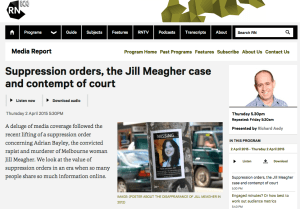
For those who missed it – the @RNMediaReport story on the Bayley suppression order #auslaw

By MARK PEARSON

As most people were heading off for their Easter vacation, Radio National’s Media Report ran a segment on how we discovered the new edition of our textbook was in breach of a suppression order on the name of Adrian Bayley – the man who murdered Jill Meagher.

My article in  The Conversation (excerpted below) explained what happened, and RN Media Report’s Richard Aedy followed it up with this interview last week:

Screen Shot 2015-04-10 at 5.17.41 PM


March 27, 2015 blog:

How the Adrian Bayley suppression order forced the reprinting of our new media law book #auslaw ]

It is somewhat alarming when a media law academic finds himself on the wrong side of a media law. But that is exactly what happened to me when I discovered the new edition of our textbook was in breach of a suppression order on the name of Adrian Bayley – the man who murdered Jill Meagher.

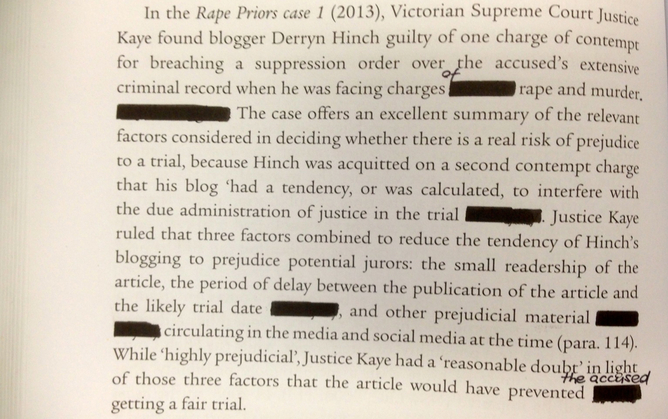
One of the manually redacted pages sent out to reviewers before our book was reprinted

One of the manually redacted pages sent out to reviewers before our book was reprinted

Our experience highlights serious problems with the system of suppression orders in the courts today as they try to grapple with the ever-increasing challenge of keeping internet-savvy jurors from having access to reports of the past trials or convictions of the accused.

Victorian County Court judge Sue Pullen issued the suppression order against anyone publishing “any information relating to previous convictions, sentences, or previous criminal cases of the accused”. The orders were lifted on Thursday after Bayley was convicted of raping three other women before he raped and murdered Meagher in September 2012.

On one view, Pullen’s orders constituted a “super injunction” because they suppressed mention of the proceedings – and therefore of the suppression order itself. Perhaps understandably, news of the order had not spread beyond the inner circle of lawyers and mainstream court reporters and editors, mainly in Victoria.

The suppression order only came to my knowledge as a Queensland-based academic when I happened to be sitting on a conference panel in Melbourne with a media lawyer and a judge last year discussing the futility of suppression orders in the modern era.

The media lawyer told the audience of court officers, lawyers, journalists and academics that he had recently appeared in court several times to try to have this particular suppression order overturned – without success. He said he could not be specific about the suppressed identity of the accused (wisely, as representatives of that court were sitting in the audience).

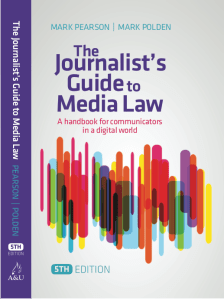
But when he mentioned the notorious crime itself my heart skipped a beat. It dawned on me that our new edition of The Journalist’s Guide to Media Law, which was sitting in the publisher’s warehouse awaiting distribution, was in clear breach of the order. Bayley had been named and linked to the Meagher murder on three pages of the book. He also appeared in its index.

Continue reading the full version of this commentary in The Conversation

Disclaimer: While I write about media law and ethics, nothing here should be construed as legal advice. I am an academic, not a lawyer. My only advice is that you consult a lawyer before taking any legal risks.
© Mark Pearson 2015

Leave a comment

Filed under blogging, citizen journalism, contempt of court, free expression, journalism, media ethics, media law, Media regulation, social media, sub judice

How the Adrian Bayley suppression order forced the reprinting of our new media law book #auslaw

By MARK PEARSON

It is somewhat alarming when a media law academic finds himself on the wrong side of a media law. But that is exactly what happened to me when I discovered the new edition of our textbook was in breach of a suppression order on the name of Adrian Bayley – the man who murdered Jill Meagher.

One of the manually redacted pages sent out to reviewers before our book was reprinted

One of the manually redacted pages sent out to reviewers before our book was reprinted

Our experience highlights serious problems with the system of suppression orders in the courts today as they try to grapple with the ever-increasing challenge of keeping internet-savvy jurors from having access to reports of the past trials or convictions of the accused.

Victorian County Court judge Sue Pullen issued the suppression order against anyone publishing “any information relating to previous convictions, sentences, or previous criminal cases of the accused”. The orders were lifted on Thursday after Bayley was convicted of raping three other women before he raped and murdered Meagher in September 2012.

On one view, Pullen’s orders constituted a “super injunction” because they suppressed mention of the proceedings – and therefore of the suppression order itself. Perhaps understandably, news of the order had not spread beyond the inner circle of lawyers and mainstream court reporters and editors, mainly in Victoria.

The suppression order only came to my knowledge as a Queensland-based academic when I happened to be sitting on a conference panel in Melbourne with a media lawyer and a judge last year discussing the futility of suppression orders in the modern era.

The media lawyer told the audience of court officers, lawyers, journalists and academics that he had recently appeared in court several times to try to have this particular suppression order overturned – without success. He said he could not be specific about the suppressed identity of the accused (wisely, as representatives of that court were sitting in the audience).

But when he mentioned the notorious crime itself my heart skipped a beat. It dawned on me that our new edition of The Journalist’s Guide to Media Law, which was sitting in the publisher’s warehouse awaiting distribution, was in clear breach of the order. Bayley had been named and linked to the Meagher murder on three pages of the book. He also appeared in its index.

Continue reading the full version of this commentary in The Conversation

Disclaimer: While I write about media law and ethics, nothing here should be construed as legal advice. I am an academic, not a lawyer. My only advice is that you consult a lawyer before taking any legal risks.
© Mark Pearson 2015

1 Comment

Filed under blogging, citizen journalism, contempt of court, free expression, journalism, media ethics, media law, Media regulation, social media, sub judice

New edition has a section on contract law for PR and new media entrepreneurs

By MARK PEARSON

Our latest edition of The Journalist’s Guide to Media Law (Mark Pearson & Mark Polden, Allen & Unwin, 2015) has a whole chapter on law for public relations, freelancing and new media entrepreneurs.

the-journalist-s-guide-to-media-lawOne of the key topics arising for such people is the law of contract, which is a complex field requiring expert legal advice.

We’ve mapped out the very basics though for the benefit of such professional communicators. Here’s a short excerpt:

A breach of an important contract can be devastating to the financial viability of a public relations consultancy or freelance writer, and it can ruin the prospects of a start-up media venture getting off the ground. While the law of contract can get very complex, the basic concept of a contract is fairly simple: a contract is a legally enforceable promise. It is something crucial to the effective operation of a business, because our financial system operates on the principle of promises being kept rather than broken, so that there is an element of trust and predictability in our dealings. Contracts play a role in a variety of situations in the PR and news business. They can cover the terms of employment for a freelance journalist or other staff, the agreed price and timelines for professional services being offered, and the division of royalties that might flow to investors from a creative news product you are bringing to market. Gibson and Fraser (2011: 305–6) list the essential elements of a contract:

  • an intention to contract
  • an agreement between the parties (including an offer and acceptance)
  • ‘consideration’—what Gibson and Fraser (2011: 305–6) describe as ‘something of value passing from one party to another in return for a promise to do something’.

Contract law can be a specialised area, and constitutes a subject in law degrees—partly because there is a body of case law over the circumstances in which a contract might be deemed valid by a court. In determining a contract’s validity, a court will consider the legal capacity of the parties who have entered into the contract, evidence of their consent, the legality of the purpose of the contract and the form the contract takes (Gibson and Fraser, 2011: 307). The action for ‘breach of contract’ arises when one or more terms of the contract have not been met—which might include work not being completed within an agreed timeline. This is usually where lawyers enter the fray, and a contract dispute can involve long and expensive court action, although alternative forms of dispute resolution are becoming more common. Griggs, Clark and Iredale (2009: 85) recommend that managers follow these steps when they are drawing up a business contract:

  • reducing the agreement to writing and ensuring it contains all the agreed terms
  • drafting it in plain English that does not require interpretation
  • ensuring it contemplates obvious problems and presents a process for a solution
  • ensuring compliance with any relevant legislation
  • limiting exposure to liability
  • identifying the law that should apply, particularly in international contracts.

A complex sub-branch of the law of contract is the law of agency—the term used to describe the authority you might assign to someone to enter into contracts on behalf of your business. An example of a contract dispute over public relations services was a West Australian District Court case involving a consultant to a South African mining company considering buyouts or mergers with other mining companies (Mining PR case, 2004). The dispute surrounded a ‘partly written, partly oral and partly implied’ agreement to provide ‘public relations, lobbying, consulting, networking, facilitating and co-ordinating’ services. The problem was that very little was detailed in the agreement, forcing the judge to look at previous work done by the consultant and to come to an estimate of the number of hours he had worked and their value on this occasion. He awarded him $830 per day for eight weeks, totalling $33 200 plus expenses.

References

Gibson, A. and Fraser, I. 2011, Business Law, 6th edn, Pearson Education, Sydney.

Griggs, L., Clark, E. and Iredale, I. 2009, Managers and the Law: A Guide for Business Decision Makers, 3rd edn, Thomson Reuters, Sydney.

Cases

Mining PR case: Newshore Nominees Pty Ltd as trustee for the Commercial and Equities Trust v Durvan Roodepoort Deep, Limited [2004] WADC 57, <www.austlii.edu.au/cgi-bin/sinodisp/au/cases/wa/WADC/2004/57.html>.

© Mark Pearson 2015

Disclaimer: While I write about media law and ethics, nothing here should be construed as legal advice. I am an academic, not a lawyer. My only advice is that you consult a lawyer before taking any legal risks.
Leave a comment

Filed under Uncategorized

New @journlaw updates posted in privacy, anti-terror and confidentiality of sources #MLGriff

By MARK PEARSON

We have just posted numerous updates to the fifth edition of The Journalist’s Guide to Media Law – A handbook for communicators in a digital world (Mark Pearson & Mark Polden, A&U, 2015) on the journlaw.com blog.

Thanks to Leanne O’Donnell (mslods.com / @mslods), Virginia Leighton-Jackson and Griffith University media freedom interns and students we have been posting fresh material via this blog’s Media Law Updates menu.

You can find updates on recent cases, legislation and Australian and international media law news on the following topic areas:

Social Media Law

Free Expression

Legal and regulatory systems

Open Justice and Freedom of Information

Contempt of Court

Covering Court

Defamation

Secrets, Confidentiality and Sources

Anti-terror and hate laws

IP and copyright

Privacy

Law of PR, Freelancing and New Media Entrepreneurship

The sheer pace of change in all areas of media law is astounding so we have have built several mentions of journlaw.com into the chapters and discussion questions as a go-to resource for media law students.

We would also appreciate your input – whether you are a student, journalist, academic or lawyer.

Please email any contributions to these update sections to me, Mark Pearson, at journlaw@gmail.com .

Of course, the book and the journlaw.com examples are not meant to offer actual legal advice. Professional communicators must seek that advice from a lawyer when confronted with a legal problem. The most we claim to do is offer an introduction to each area of media law so that journalists, PR consultants and bloggers can identify an emerging issue and thus know when to call for help.

Order via Booktopia: http://www.booktopia.com.au/the-journalist-s-guide-to-media-law-mark-pearson/prod9781743316382.html

Disclaimer: While I write about media law and ethics, nothing here should be construed as legal advice. I am an academic, not a lawyer. My only advice is that you consult a lawyer before taking any legal risks.

© Mark Pearson 2015

Leave a comment

Filed under blogging, citizen journalism, contempt of court, free expression, journalism, media ethics, media law, Media regulation, social media, sub judice, Uncategorized

Journlaw running updates to The Journalist’s Guide to Media Law

By MARK PEARSON

OUR fifth edition of The Journalist’s Guide to Media Law – A handbook for communicators in a digital world (Mark Pearson & Mark Polden, A&U, 2015) is now in bookshops and I will be running updates on each topic area via journlaw.com as we work towards the next edition.

Thanks to Leanne O’Donnell (mslods.com / @mslods), Virginia Leighton-Jackson and Griffith University media freedom interns and students we will be posting fresh material via this blog’s Media Law Updates menu.

There will be updates on recent cases, legislation and Australian and international media law news on the following topic areas:

Social Media Law

Free Expression

Legal and regulatory systems

Open Justice and Freedom of Information

Contempt of Court

Covering Court

Defamation

Secrets, Confidentiality and Sources

Anti-terror and hate laws

IP and copyright

Privacy

Law of PR, Freelancing and New Media Entrepreneurship

The sheer pace of change in all areas of media law is astounding so we have have built several mentions of journlaw.com into the chapters and discussion questions as a go-to resource for media law students.

We would also appreciate your input – whether you are a student, journalist, academic or lawyer.

Please email any contributions to these update sections to me, Mark Pearson, at journlaw@gmail.com .

Of course, the book and the journlaw.com examples are not meant to offer actual legal advice. Professional communicators must seek that advice from a lawyer when confronted with a legal problem. The most we claim to do is offer an introduction to each area of media law so that journalists, PR consultants and bloggers can identify an emerging issue and thus know when to call for help.

Order via Booktopia: http://www.booktopia.com.au/the-journalist-s-guide-to-media-law-mark-pearson/prod9781743316382.html

Disclaimer: While I write about media law and ethics, nothing here should be construed as legal advice. I am an academic, not a lawyer. My only advice is that you consult a lawyer before taking any legal risks.
© Mark Pearson 2015

Leave a comment

Filed under blogging, citizen journalism, contempt of court, free expression, journalism, media ethics, media law, Media regulation, social media, sub judice, Uncategorized

‘Mindful Journalism’ out Feb 24: excerpt and review copy request form here

By MARK PEARSON

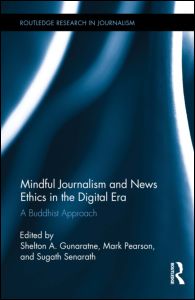
We are excited that our book Mindful Journalism and News Ethics in the Digital Era: A Buddhist Approach (Shelton Gunaratne, Mark Pearson and Sugath Senarath eds; Routledge, NY) will be available from February 24.

Review copies are available from Routledge by filling out this request form. Please see the publisher’s synopsis.

MindfulJournalismCoverThe term ‘mindful journalism’ is a concept I introduced more than a year ago in the inaugural UNESCO World Press Freedom address at AUT University Auckland, drawing upon the earlier substantive work by my esteemed colleague (and lead editor of our book), Emeritus Professor Shelton Gunaratne, who has been working for decades on the intersection between Buddhism and journalism.

I developed my application of this in a paper to the International Association for Media and Communication Research (IAMCR) conference in Dublin in July 2014, which was revised for publication as an article in Ethical Space published in December 2014.

It is being published as part of the Routledge New York Research in Journalism series. My key point was that one does not have to be a Buddhist to incorporate the key principles of mindful journalism into one’s work. In fact, most of these very moral principles are evident in the teachings of all the world’s great religions. However, for those who lack a moral framework for their ethical decision-making, a secular application of these non-theistic principles can offer a moral compass. They offer a series of normative or aspirational goals we can strive for, but rarely reach. They also provide a schema for the analysis of ethical decision-making by journalists.

To give you a taste of mindful journalism, I offer this short extract from my chapter on ‘The Journalist and Mental Cultivation’ in Mindful Journalism where I explore the possibilities of Buddhism’s ‘Right Mindfulness’ (meditation) for journalism:

A journalist could find value in several elements of this process – from the pausing to think about the duration of a single breath for calming purposes, followed by a self-assessment of thoughts, perspectives and feelings about the story or matter at hand, including breaths to acknowledge the changing nature of things, the separation of the journalist’s ego from the story, and breaths devoted to the implications of the story for those it might impact upon, from the individual who might suffer through their actions being exposed through to others who might benefit by learning from that person’s experience. Thinking about those thoughts might bring clarity to decisions related to the story – suitable priorities, whom to interview, what to check, questions to be asked, and how the facts might best be presented. Recording those thoughts – in a note or audio form – might offer a retrospective justification for the journalist’s actions if they are later called to account. Such metacognition can even become evidence in some court proceedings resulting from a story to demonstrate a journalist has acted in good faith in making “reasonable inquiries,” even if the publisher cannot prove the truth of the reputation-damaging material, as is the case with criteria for the qualified privilege defence in some jurisdictions.

Interested? You can read further extracts from the book using the “Look Inside” interface at Amazon. Enjoy.

———–

Disclaimer: While I write about media law and ethics, nothing here should be construed as legal advice. I am an academic, not a lawyer. My only advice is that you consult a lawyer before taking any legal risks.

© Mark Pearson 2015

Leave a comment

Filed under blogging, Buddhism, citizen journalism, Eightfold Path, free expression, media ethics, mental health, social media, Uncategorized

Greste release is welcome, as would be a free media in Australia #FreeAJStaff

By MARK PEARSON

My contribution to the Griffith Red Couch blog, first published here. Follow the Red Couch Blog for commentary from Griffith University academics.

Australian Prime Minister Tony Abbott celebrated the release of journalist Peter Greste after 400 days in an Egyptian prison with these words at the National Press Club in Canberra on February 2:

 “…sometimes as Australians we do take our most precious freedoms for granted. And as a former journalist myself it would be remiss of me at such a gathering of journalists not to express my personal delight and our nation’s relief at the overnight release of Peter Greste and to reiterate our support as a government and as a people for a free media and a free press.”

Peter_Greste_2012_WikiCommons

Australian journalist Peter Greste – jailed for a year in Egypt. Photo: Wikimedia Commons

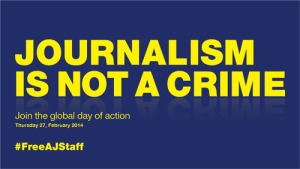
GlobalFreeAJSTAFFactionThe Prime Minister was quite correct in stating Australians often take free expression for granted, but they might take the lead from both his government and the former Labor government in doing so. The Paris-based NGO Reporters Without Borders (RSF) ranked Australia 28th of 180 countries on its World Press Freedom Index last year.

That is relatively high in the league table, and Australia rarely jails its journalists and has never murdered them. Such acts are more common in nations much lower down the press freedom ladder.

According to the Committee to Protect Journalists, Peter Greste and his al Jazeera colleagues were among 221 imprisoned globally in 2014 and already this year 15 journalists have lost their lives in the course of their work.

However, Mr Abbott’s expressed “support as a government and as a people for a free media and a free press” rings somewhat hollow in the context of recent moves by Australian governments to shackle that freedom.

It is ironic that in the same week he made that statement the Prime Minister was calling for bipartisan support for his data retention laws which would force telecommunications companies to retain – and make available to government agencies – metadata including the time and location of phone calls, texts, emails, internet browsing, social media discussions and webcam communications.

That step alone – taken in the name of better national security – stands to damage irreparably the confidentiality of journalists’ sources.

This is just one of several indicators that Australia has recently embarked upon a shift towards a “state of secrecy”.

It comes against the backdrop that, unlike the United States, the United Kingdom, Canada, New Zealand and even Papua New Guinea, Australia has no national Bill of Rights or written constitutional or legislative protection of free expression or a free media.

Australia has only an “implied freedom” that our High Court justices have sadly read down over many decisions.

In its first year in office, the Abbott Government:

This is not simply an Abbott Liberal-National conservative government phenomenon. Governments have a natural inclination to control public debate. If they have the resources, mechanisms and opportunities available to them they will do so.

Australia’s previous Labor government wanted a new mechanism of media accountability because they were copping so much unfair criticism from the Murdoch press. Their knee-jerk reaction was to try to install a regulatory mechanism that any government of whatever political persuasion could use in the future.

All these measures undermine the role of Australia as a beacon of free expression in the Asia-Pacific region.

Whistleblowers are being snared by the various surveillance laws and the technologies available to detect them. They are being found and they are going to court. The proposed data retention laws will increase that likelihood.

In the area of spin, the media finds it very hard to gain access to and report upon asylum seekers and detainees – stories that are really an international human rights issue of legitimate public interest.

Australia has at least purported to be some sort of exemplar to the region of media freedom, transparency and good governance. It has spent millions on aid projects designed to enhance such values internationally. But sadly Australia is moving towards a “state of secrecy” with no constitutional brake on censorship.

A perfect storm of factors has contributed to this including the rise of spin (we now have more PR practitioners than journalists), the demise of traditional media and its budgets to defend and lobby for media freedom, and the political capital available to parties of all political persuasions in getting tough on terrorism and immigration.

We can quite rightly celebrate free expression with the release of Peter Greste after more than a year of imprisonment for simply doing his job as a journalist.

But my great fear is that fragile freedom is seriously under threat in the very country he calls home.

© Mark Pearson 2015

Disclaimer: While I write about media law and ethics, nothing here should be construed as legal advice. I am an academic, not a lawyer. My only advice is that you consult a lawyer before taking any legal risks.

4 Comments

Filed under national security, terrorism, Uncategorized

Mindful Journalism in a nutshell: @journlaw keynote to JEANZ

By MARK PEARSON

EARLIER this month I had the honour of delivering the keynote address to the Journalism Education Association of New Zealand annual conference in Christchurch.

MindfulJournalismCoverThe topic was “Mindful Journalism: towards a new ethics of compassion”, and I offer the summary here (pdf: JEANZMindfulJsm2014) in the form of my Powerpoint slides presented at that conference.

The term ‘mindful journalism’ is a concept I introduced more than a year ago in the inaugural UNESCO World Press Freedom address at AUT University Auckland, drawing upon the earlier substantive work by esteemed colleague, Emeritus Professor Shelton Gunaratne, who has been working for decades on the intersection between Buddhism and journalism.

I developed my application of this in a paper to the International Association for Media and Communication Research (IAMCR) conference in Dublin in July 2014, which was revised for publication as a forthcoming article in Ethical Space due to be published this month (December).

Professor Gunaratne and I refined our thoughts further in a book co-edited with Sri Lankan colleague Dr Sugath Senarath [pdf file] from the University of Colombo, with Professor Gunaratne as lead editor and contributions from a range of other scholars.

Routledge New York accepted our proposal for hard cover publication in March 2015 as part of its Research in Journalism series.

Our book is titled Mindful Journalism and News Ethics in the Digital Era: A Buddhist Approach and it features chapters by several scholars from Asia, North America, Australia and Europe. Please see the publisher’s synopsis.

My address to journalism education colleagues in Christchurch this month picked up on some of the key themes of Mindful Journalism, particularly those linked to the Eightfold Path.

My key point was that one does not have to be a Buddhist to incorporate the key principles of mindful journalism into one’s work. In fact, most of these same moral principles are evident in the teachings of all the world’s great religions. However, for those who lack a moral framework for their ethical decision-making, a secular application of these non-theistic principles can offer a moral compass to those who feel they lack one because they offer a series of normative or aspirational goals we can strive for, but rarely reach. They also provide a schema for the analysis of ethical decision-making by journalists.

———–

Disclaimer: While I write about media law and ethics, nothing here should be construed as legal advice. I am an academic, not a lawyer. My only advice is that you consult a lawyer before taking any legal risks.
© Mark Pearson 2014

1 Comment

Filed under blogging, Buddhism, citizen journalism, Eightfold Path, free expression, media ethics, mental health, social media, Uncategorized

Is Australia an emerging Secret State?

By MARK PEARSON

My speech to the Pacific Journalism Review 20th Anniversary conference in Auckland, on November 27, 2014 was titled: ‘Suppression, sentences, surveillance, security and cynical spin: Is Australia an emerging Secret State?’

PJR Review Conf Notice 2014 550wideYou can read an abridged version of that speech in The Conversation here.

You can also hear the full audio of my presentation here.

In it I track the first year in office the Abbott Government, where it has:

  • blocked the media from information on the important human rights issue of the fate of asylum seekers
  • initiated major budget cuts on the publicly funded ABC
  • used anti-terror laws to win a ‘super injunction’ on court proceedings that might damage its international relations
  • ramped up surveillance powers of national security agencies and banning reporting of security operations
  • proposed increased jail terms for leaks about security matters
  • moved to stop not-for-profits advocating against government policy in their service agreements
  • abolished the Office of the Information Commissioner for abolition, promising tardy FOI appeals
  • proposed the taxing of telcos to pay for its new surveillance measures, potentially a modern version of licensing the press.

Australia has at least purported to be an exemplar of media freedom, transparency and good governance throughout the region, but continues to censor those who teach and counsel on those initiatives throughout the region. Here is the standard gag clause from the most current ($3 million Transparency International) contract:

Gagclause

My conclusion is that Australia might not be a secret state like North Korea but it is certainly moving towards a “state of secrecy” and it is doing so with no constitutional brake in our country on censorship.

It is now sending a mixed message to the region on free expression, transparency and good governance.

You can read an abridged version of that speech in The Conversation here.

You can also hear the full audio of my presentation here.

© Mark Pearson 2014

Disclaimer: While I write about media law and ethics, nothing here should be construed as legal advice. I am an academic, not a lawyer. My only advice is that you consult a lawyer before taking any legal risks.

Leave a comment

Filed under national security, terrorism, Uncategorized