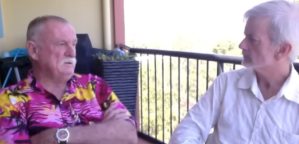
Australia and the Asia-Pacific region lost an important figure last month – journalist, trainer and media freedom advocate Bob Howarth.
Over his 81 years Bob changed countless lives for the better, firstly through his newspaper journalism and production skills, and then via his editorship, management, training, mentorship, philanthropy and service as an RSF (Reporters Without Borders) correspondent.
I first met Bob in the early 1990s when my students were reporting under his editorship for the PANPA Chronicles – a conference newspaper produced for the Pacific Area Newspaper Publishers’ Association.
Bob was a keen scuba diver at that stage, and I remember him capturing the front page photograph 10m underwater. His caring and encouraging approach made him an ideal trainer of newspaper cadets and personnel and tutor of my university students after his retirement. He also ran courses and projects for Australian Business Volunteers in Indonesia, Timor Leste and PNG.
I’ll always remember his wry smile and quiet manner of speech as he related anecdotes from his adventurous career – from his recommissioning of old computer terminals and a printing press to assist the rebirth of the Timor Post through to his pistol-wielding adventures as managing director of the Post-Courier in Port Moresby.
I interviewed Bob for this blog back in 2014, where he spoke about media freedom issues in Timor Leste and the broader Pacific.
Bob and I would catch up for coffee occasionally, and it was in response to my SMS invitation for a cuppa that his beloved partner Di let me know of his passing that morning.
While we were good mates, others knew Bob much better than me, and there have been several testimonials written about him over recent weeks.
For an insight into his philanthropy and his fondness for Timor-Leste, which he visited more than 30 times, I recommend the moving tribute by his protege Mouzinho Lopes de Araujo, republished by esteemed colleague David Robie on his Cafe Pacific site, here.
For Bob’s own account of his role in setting up the Timor Post, see his piece from 2019 in the Asia Pacific Reporthere.
And for an account of Bob’s training prowess and influence on Pacific journalism, see the memorial by Robert Luke Iroga, editor and publisher of Solomon Business Magazine, also published in the Asia Pacific Report, here.
Vale Bob Howarth. You made a huge difference.
—
Disclaimer: While I write about media law and ethics, nothing here should be construed as legal advice. I am an academic, not a lawyer. My only advice is that you consult a lawyer before taking any legal risks.
A panel session discussing the merits and perils of academic journal publishing featured in the Pacific Media Conference at the University of the South Pacific in Suva, Fiji on July 4-6.
This article republished with permission from Pacific Media Watch reviews the panel and its key points of discussion.
Pacific media academics have criticised the economics of global research journal publication models and defended independent publications such as Pacific Journalism Review carving out niche markets.
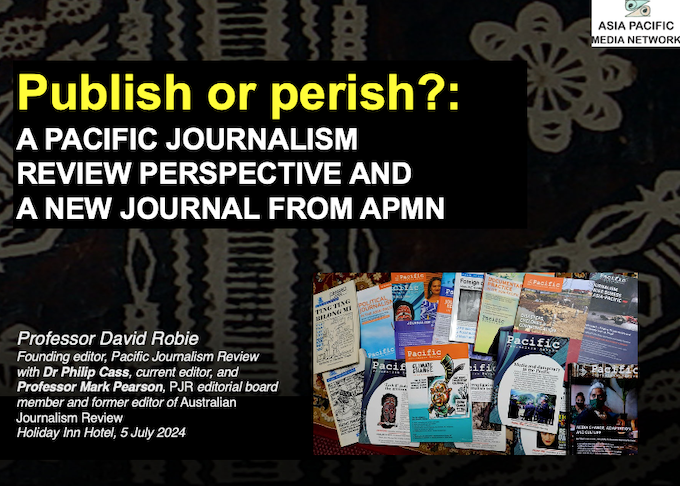
“Publish of perish?” A Pacific Journalism review perspective and new journal from APMN. Image: Screenshot APR
Speaking in a panel titled “Publish or Perish” at the recent Pacific International Media 2024 conference in Suva, Fiji, the academics warned that changes in the international research publishing arena were not necessarily an improvement.
In fact, in some cases the changes threatened independent journals and opened the door to “paper mills, AI and sham publications”.
The panel was moderated by adjunct professor in governance Vijay Naidu of The University of the South Pacific and featured a former editor of the Australian Journalism Review, Professor Mark Pearson of Griffith University; founding Pacific Journalism Review editor professor David Robie, and current editor and former PNG newspaper editor and journalism educator Dr Philip Cass.
Introducing the speakers, Professor Naidu said the “Publish or Perish” topic was a pivotal panel and he congratulated conference chair Associate Professor Shailendra Singh, a PJR editorial board member, for the success of the three-day event.
“This panel for media scholars focuses on the ‘heart of the matter’ relating to journalism and the media,” Dr Naidu said.
Researching and writing about the media were critical for both scholars and media practitioners as pertinent topics on current and future development of journalism and the media were covered.
Publishing outlets crucial
Outlets for publishing research findings were crucial for media academics.
Professor Pearson spoke about five key points: the impact of rankings; open access and vanity publishing; “paper mills” and sham journals; the demise of small independent journals; and academic versus journalism outputs.
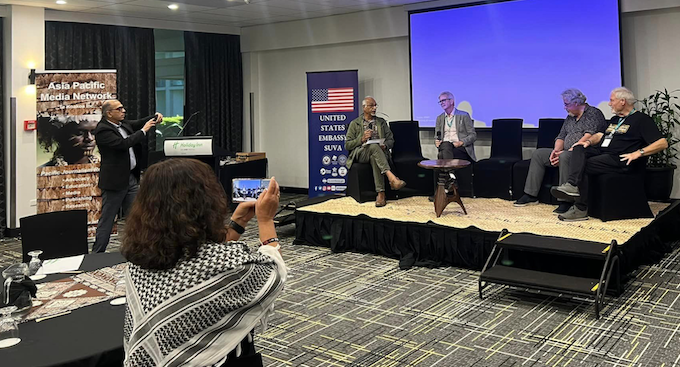
The “Publish or Perish” panel . . . convenor Professor Vijay Naidu (from left), Professor Mark Pearson, Dr Philip Cass and Professor David Robie. Taking photos are Associate Professor Shailendra Singh and PJR designer Del Abcede. Image: APMN
Discussing global journal rankings, Dr Pearson said the limited level of interest in Pacific issues internationally reduced potential for “prestigious journal” acceptance of papers.
“Journalism researchers ought to avoiding having too many eggs in one basket – and to be aware of the impact of rankings and events on your CV. Decide whether to play the game or not?”
Speaking about open access as a game changer in academic publishing, he said that the flipside was that open access had paved the way for a completely new way to earn a profit.
However, it had meant that journals would not necessarily have any financial incentives to ensure appropriate peer review or quality control — “as long as they can make the researchers pay”.
Editors work for ‘symbolic pay’
“My own experience is that most academic editors work for merely symbolic pay and that quality control and fact-checking are done through peer review, which is unpaid voluntary work,” Hagve wrote.
In 2023, the annual number of papers retracted by research journals had topped 10,000 for the first time, said Dr Pearson. Most analysts believed that the figure was only the tip of an iceberg of scientific fraud.
Dr Pearson lamented the demise of many small independent journals and others becoming vulnerable in the face of the global academic publishing model, such as Pacific Journalism Review that celebrated 30 years of publication at this conference.
PJR editor Dr Philip Cass reaffirmed that it was “incredibly important” to have such a journal because of its “unique position covering the region”.
He also argued strongly for the continuation of print journals at a time when many academic publications are retreating to online only editions.
Professor Robie gave an overview of Pacific Journalism Review and how it had evolved through several design and content styles from when it was first published at the University of Papua New Guinea in 1994.
Del Abcede had played a key role in the design in recent years.
Innovative ‘journalism as research’
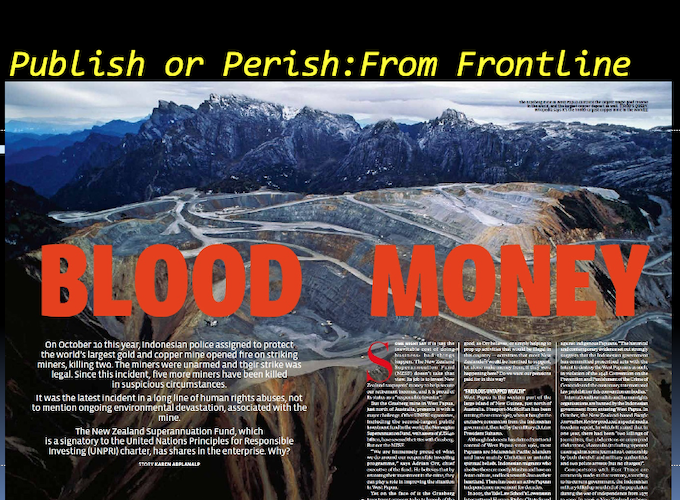
Dr Robie spoke about the innovative PJR “journalism as research” model resisted by many academic faculties and described how the journal’s Frontline section, pioneered by Professor Wendy Bacon, had set a benchmark for investigative journalism being recognised by the academe.
He also touched briefly on the Asia Pacific Media Network’s new publishing strategy which includes a new title, Pacific Media, publishing on AUT’s Tuwhera indigenous research platform. Although this publication will feature the usual journal attributes, it will focus more on community outcomes.
“Blood Money” . . . featuring one of the series of Frontline investigative journalism-as-research artIcles about West Papua published by Pacific Journalism Review. Image: PJR screenshot APR
Disclaimer: While I write about media law and ethics, nothing here should be construed as legal advice. I am an academic, not a lawyer. My only advice is that you consult a lawyer before taking any legal risks.
As I started to disappear into the vortex of 24/7 media coverage of the US election, I recalled the news anxiety I experienced in 2020 at the start of the COVID-19 pandemic which prompted me to write an article for The Conversation titled “Coronavirus: 5 ways to manage your news consumption in times of crisis“.
I republish an edited version here for readers …
Following events in the US while habitually checking the news on devices – and allowing 24/7 news channels to play non-stop in the background – might erode your productivity and increase stress and anxiety.
A foundational element of media literacy in the digital era is striking an appropriate balance between news consumption and other activities. Even before COVID-19, Australian research demonstrated news avoidance had risen among news consumers from 57% in 2017 to 62% in 2019, driven by a sense of news fatigue.
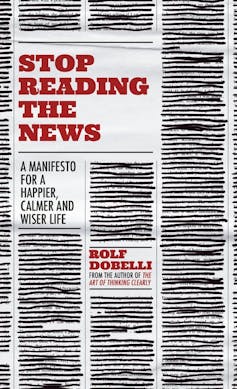
Self-help expert Rolf Dobelli implores us to stop reading the news. While he advocates going cold turkey and abandoning all packaged news consumption, Dobelli makes exceptions for long-form journalism and documentaries.
So too does philosopher Alain de Botton in The News – A User’s Manual, while proposing more positive news and journalism’s examination of life’s deeper issues, emotions and aesthetics.
Of course, it would be a mistake to abstain from all news of an election in the world’s leading democracy given its unpredictable economic and social consequences.
Often it is best to navigate a middle path, so here are five suggestions on how you can stay in the loop while still maintaining your mental health.
1. Switch off
Avoid the 24/7 news channels and feeds unless it is your business to do so, or unless the information is likely to impact you directly.
Try to develop a routine of checking in on the main headlines once, twice or three times a day so you stay informed about the most important events without being sucked by click bait and news of incremental changes.
2. Dive deep
Look for long-form journalism and in-depth commentary on the topics that most interest you. Articles by experts (Editor’s note: like those in The Conversation!) include the most important facts you need to know, and are likely to have a constructive angle presenting incisive analysis and a pathway to a solution or best practice.
Spend your time engaging with well-researched and accurate stories. Eugene Zhyvchik/Unsplash
On radio and television, look for big picture current affairs programs like the ABC’s AM and 7.30 – or on a lighter and more positive note Ten’s The Project – so you don’t have to be assaulted by a disturbing litany of petrol station hold-ups, motorway chases and celebrity gossip in the packaged morning and evening news.
3. Connect
Use social media wisely – for communicating with family and friends. But avoid the suggested and sponsored news feeds with dubious and unfiltered information (often shared as spam by social media illiterates).
Keep your social media commentary civil, empathetic and supportive – mindful of everyone’s mental health during a crisis.
4. Interrogate
Ask the key question: “What is the best source of the information I absolutely need to know?”
Go to primary sources where possible. Subscribe to official and authoritative information feeds.
5. Be mindful
Bear in mind the well being of any children in your household with the timing and selection of your hard/live news consumption. International research has shown more constructive news stories have fewer negative mental health impacts on children, particularly when combined with the opportunity to discuss the contents with their peers.
It’s important to think about where your children get their news, too. Shutterstock.com
Finally, you might also aim to build your own media literacy – by pausing to reflect carefully upon what news you really need in your family’s life. This might vary markedly according to your work, interests and passions.
For many of us it will mean a much more critical diet of what we call “traditional hard news” – allowing us the time to read and view material that better contributes to the quality of our own lives and to our varied roles as informed citizens in a democracy.
Mark Pearson, Professor of Journalism and Social Media, Griffith Centre for Social and Cultural Research, Griffith University, Griffith University
This article is an adaptation of an article in The Conversation and reproduced under a Creative Commons license. Read the original article.
Journalists, publishers, academics, diplomats and NGO representatives from throughout the Asia-Pacific region will gather for the Pacific Media Conference at the University of the South Pacific in Suva, Fiji on July 4-6.
A notable part of the conference will be the celebration of the 30th anniversary of the journal Pacific Journalism Review – founded by the energetic pioneer of journalism studies in the Pacific, Professor David Robie, who was recently honoured in the NZ King’s Birthday Honours list as a Member of the New Zealand Order of Merit. I have been on the editorial board of PJR for two of its three decades.
As well as delivering a keynote address titled “Frontline Media Faultlines: How Critical Journalism can Survive Against the Odds”, Dr Robie will join me and the current editor of PJR, Dr Philip Cass on a panel examining the challenges faced by journalism journals in the Global South/Asia Pacific.
In addition, I will be delivering a conference paper titled “Intersections between media law and ethics – a new pedagogy and curriculum”.
Media law and ethics have often been taught as separate courses in the journalism and communication curriculum or have been structured as two distinct halves of a hybrid course.
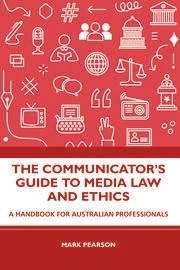
My paper explains an integrated approach expounded in my new textbook, The Communicator’s Guide to Media Law and Ethics, where each key media law topic is introduced via a thorough exploration of its moral, ethical, religious, philosophical and human rights underpinnings.
The argument is exemplified via an approach to the ethical and legal topic of confidentiality, central to the relationship between journalists and their sources.
After defining the term and distinguishing it from the related topic of privacy, the paper explains the approach in the textbook and curriculum which traces the religious and philosophical origins of confidentiality sourced to Hippocrates (460-370BC), via confidentiality in the priesthood (from Saint Aphrahat to the modern Catholic Code of Canon Law), and through the writings of Kant, Bentham, Stuart Mill, Sidgwick and Rawls until we reach the modern philosopher Sissela Bok’s examination of investigative journalism and claims of a public’s ‘right to know’.
This leads naturally into an examination of the handling of confidentiality in both public relations and journalism ethical codes internationally and their distinctive approaches, opening the way to the examination of law, cases and examples internationally in confidentiality and disclosure and, ultimately, to a closer examination in the author’s own jurisdiction of Australia.
Specific laws covered include breach of confidence, disobedience contempt, shield laws, whistleblower laws and freedom of information laws – with the latter having a strong foundation in international human rights instruments.
The approach gives ethical studies a practical legal dimension, while enriching students’ legal knowledge with a backbone of its philosophical, religious and human rights origins.
Details about the conference can be found on its USP website.
Disclaimer: While I write about media law and ethics, nothing here should be construed as legal advice. I am an academic, not a lawyer. My only advice is that you consult a lawyer before taking any legal risks.
My latest book has been published, covering both media law and ethics for communication students and practitioners.
The Communicator’s Guide to Media Law and Ethics – A Handbook for Australian Professionals (Routledge, London and NY, 2023) offers an introduction to the key legal and ethical topics confronting Australian journalists and strategic communicators both at home and internationally and offers a suite of reflective techniques for navigating them.
It starts by positioning morals, ethics, and the law in their historical and philosophical frameworks by tracing the evolution of free expression and professional media ethics. Media law and ethics are then contextualised in their modern international human rights framework.
Readers are equipped with a skill set for reflecting on the law and ethics of professional media dilemmas – including mindful reflection, the Potter Box, journaling, concept mapping, and discussion.
Such approaches are then applied to key topic areas, including free expression; reputation; confidentiality; privacy; justice; intellectual property; national security; discrimination and harassment; and conflicted interests.
Each is examined in terms of its philosophical underpinnings, relationship to human rights, professional ethical context, international examples, legal principles, key Australian laws, legal cases, and strategies for applying reflective practice techniques. It concludes on a confident note – imploring communicators to engage in constructive and mindful strategic communication with the authority and confidence that results from a working knowledge of media law and ethics.
This handbook is for professional communicators and students in all fields, but particularly in journalism, public relations, corporate communication, media relations, and marketing.
Disclaimer: While I write about media law and ethics, nothing here should be construed as legal advice. I am an academic, not a lawyer. My only advice is that you consult a lawyer before taking any legal risks.
Mark Pearson, Griffith UniversityThe blame for the recent assault on the US Capitol and President Donald Trump’s broader dismantling of democratic institutions and norms can be laid at least partly on misinformation and conspiracy theories.
Shutterstock
Those who spread misinformation, like Trump himself, are exploiting people’s lack of media literacy — it’s easy to spread lies to people who are prone to believe what they read online without questioning it.
We are living in a dangerous age where the internet makes it possible to spread misinformation far and wide and most people lack the basic fact-checking abilities to discern fact from fiction — or, worse, the desire to develop a healthy skepticism at all.
Journalists are trained in this sort of thing — that is, the responsible ones who are trying to counter misinformation with truth.
Here are five fundamental lessons from Journalism 101 that all citizens can learn to improve their media literacy and fact-checking skills:
1. Distinguishing verified facts from myths, rumours and opinions
Cold, hard facts are the building blocks for considered and reasonable opinions in politics, media and law.
And there are no such things as “alternative facts” — facts are facts. Just because a falsity has been repeated many times by important people and their affiliates does not make it true.
We cannot expect the average citizen to have the skills of an academic researcher, journalist or judge in determining the veracity of an asserted statement. However, we can teach people some basic strategies before they mistake mere assertions for actual facts.
Does a basic internet search show these assertions have been confirmed by usually reliable sources – such as non-partisan mainstream news organisations, government websites and expert academics?
Students are taught to look to the URL of more authoritative sites — such as .gov or .edu — as a good hint at the factual basis of an assertion.
Searches and hashtags in social media are much less reliable as verification tools because you could be fishing within the “bubble” (or “echo chamber”) of those who share common interests, fears and prejudices – and are more likely to be perpetuating myths and rumours.
2. Mixing up your media and social media diet
We need to be break out of our own “echo chambers” and our tendencies to access only the news and views of those who agree with us, on the topics that interest us and where we feel most comfortable.
For example, over much of the past five years, I have deliberately switched between various conservative and liberal media outlets when something important has happened in the US.
By looking at the coverage of the left- and right-wing media, I can hope to find a common set of facts both sides agree on — beyond the partisan rhetoric and spin. And if only one side is reporting something, I know to question this assertion and not just take it at face value.
3. Being skeptical and assessing the factual premise of an opinion
Journalism students learn to approach the claims of their sources with a “healthy skepticism”. For instance, if you are interviewing someone and they make what seems to be a bold or questionable claim, it’s good practice to pause and ask what facts the claim is based on.
Students are taught in media law this is the key to the fair comment defence to a defamation action. This permits us to publish defamatory opinions on matters of public interest as long as they are reasonably based on provable facts put forth by the publication.
The ABC’s Media Watch used this defence successfully (at trial and on appeal) when it criticised a Sydney Sun-Herald journalist’s reporting that claimed toxic materials had been found near a children’s playground.
This assessment of the factual basis of an opinion is not reserved for defamation lawyers – it is an exercise we can all undertake as we decide whether someone’s opinion deserves our serious attention and republication.
4. Exploring the background and motives of media and sources
A key skill in media literacy is the ability to look behind the veil of those who want our attention — media outlets, social media influencers and bloggers — to investigate their allegiances, sponsorships and business models.
For instance, these are some key questions to ask:
who is behind that think tank whose views you are retweeting?
who owns the online newspaper you read and what other commercial interests do they hold?
is your media diet dominated by news produced from the same corporate entity?
why does someone need to be so loud or insulting in their commentary; is this indicative of their neglect of important facts that might counter their view?
what might an individual or company have to gain or lose by taking a position on an issue, and how might that influence their opinion?
Just because someone has an agenda does not mean their facts are wrong — but it is a good reason to be even more skeptical in your verification processes.
We live in an era of instant republication. We immediately retweet and share content we see on social media, often without even having read it thoroughly, let alone having fact-checked it.
Mindful reflection before pressing that sharing button would allow you to ask yourself, “Why am I even choosing to share this material?”
You could also help shore up democracy by engaging in the fact-checking processes mentioned above to avoid being part of the problem by spreading misinformation.
Mark Pearson, Professor of Journalism and Social Media, Griffith Centre for Social and Cultural Research, Griffith University, Griffith University
Disclaimer: While I write about media law and ethics, nothing here should be construed as legal advice. I am an academic, not a lawyer. My only advice is that you consult a lawyer before taking any legal risks.
Thousands of employees internationally are already working from home in COVID-19 self-isolation because of their recent travel, related symptoms or immune system vulnerability.
But to do so while habitually checking the news on devices – and allowing 24/7 news channels to play non-stop in the background – might erode your productivity and increase stress and anxiety.
A foundational element of media literacy in the digital era is striking an appropriate balance between news consumption and other activities. Even before the current crises, Australian research demonstrated news avoidance had risen among news consumers from 57% in 2017 to 62% in 2019, driven by a sense of news fatigue.
Self-help expert Rolf Dobelli implores us to stop reading the news. While he advocates going cold turkey and abandoning all packaged news consumption, Dobelli makes exceptions for long-form journalism and documentaries.
So too does philosopher Alain de Botton in The News – A User’s Manual, while proposing more positive news and journalism’s examination of life’s deeper issues, emotions and aesthetics.
Please read the full article – including my five tips on how you can stay in the loop at home while you get your work done (and help maintain your mental health) here.
Disclaimer: While I write about media law and ethics, nothing here should be construed as legal advice. I am an academic, not a lawyer. My only advice is that you consult a lawyer before taking any legal risks.

 Over his 81 years Bob changed countless lives for the better, firstly through his newspaper journalism and production skills, and then via his editorship, management, training, mentorship, philanthropy and service as an RSF (Reporters Without Borders) correspondent.


 Specific laws covered include breach of confidence, disobedience contempt, shield laws, whistleblower laws and freedom of information laws – with the latter having a strong foundation in international human rights instruments.




 journlaw