Tag Archives: social media law

On Skype with @journlaw – barrister and co-author Mark Polden on #defamation basics: #MLGriff

By MARK PEARSON

Exactly what is defamation and how does it apply to your average journalist or blogger?

That’s what I asked barrister Mark Polden in this short interview on defamation basics. Mark Polden was in-house counsel at Fairfax Media for many years before going to the Bar, and is my co-author of The Journalist’s Guide to Media Law (Allen & Unwin).

Here he offers a lay definition of defamation and gives some examples of how journalists, bloggers and other professional communicators might write to minimise the threat of legal action.

———–

Disclaimer: While I write about media law and ethics, nothing here should be construed as legal advice. I am an academic, not a lawyer. My only advice is that you consult a lawyer before taking any legal risks.

© Mark Pearson 2014

Leave a comment

Filed under blogging, contempt of court, courts, free expression, media ethics, Media freedom, media law, Press freedom, sub judice, suppression, Uncategorized

15 mins with @journlaw – Peter Gregory on the art of court reporting #MLGriff #medialaw

By MARK PEARSON

What is the secret to good court reporting? Highly experienced court reporter and academic Peter Gregory [@petergregory17] – author of Court Reporting in Australia (Cambridge University Press, 2005) – tells @journlaw the essential techniques needed by a journalist wanting to cover the court reporting round.

CourtReportinginAustraliacoverGregory explains how he recently returned to duty when he filled in to cover the sentencing of Adrian Bayley for the murder of Jill Meagher – in a marathon 12 hour shift!

He discusses the court reporter’s difficulties in writing fair and accurate reports of trials, particularly when they might be unfolding in different courtrooms at the same time.

He also gives tips on how a journalist might stand up in court to oppose a suppression order being imposed by a judge or magistrate.

Useful viewing for journalism and law students – and for anyone wanting an insight into the work of the court reporter.

———–

Disclaimer: While I write about media law and ethics, nothing here should be construed as legal advice. I am an academic, not a lawyer. My only advice is that you consult a lawyer before taking any legal risks.

© Mark Pearson 2014

1 Comment

Filed under blogging, contempt of court, courts, free expression, media ethics, Media freedom, media law, Press freedom, sub judice, suppression, Uncategorized

Blended learning and instructional scaffolding in a Media Law course

By MARK PEARSON

I’m thoroughly enjoying a revitalised enthusiasm for my media law teaching thanks to the Blended Learning team at Griffith University.

I’ve recently been a student in an Online Course Development course run by expert faculty in my Arts, Education and Law group and have been keenly trying to build the various blended learning strategies into the Blackboard interface for both the on-campus and Open Universities Australia versions of my Media Law course.

The Media Law course’s pedagogy and assessment tasks are built around both problem-based learning and instructional scaffolding.

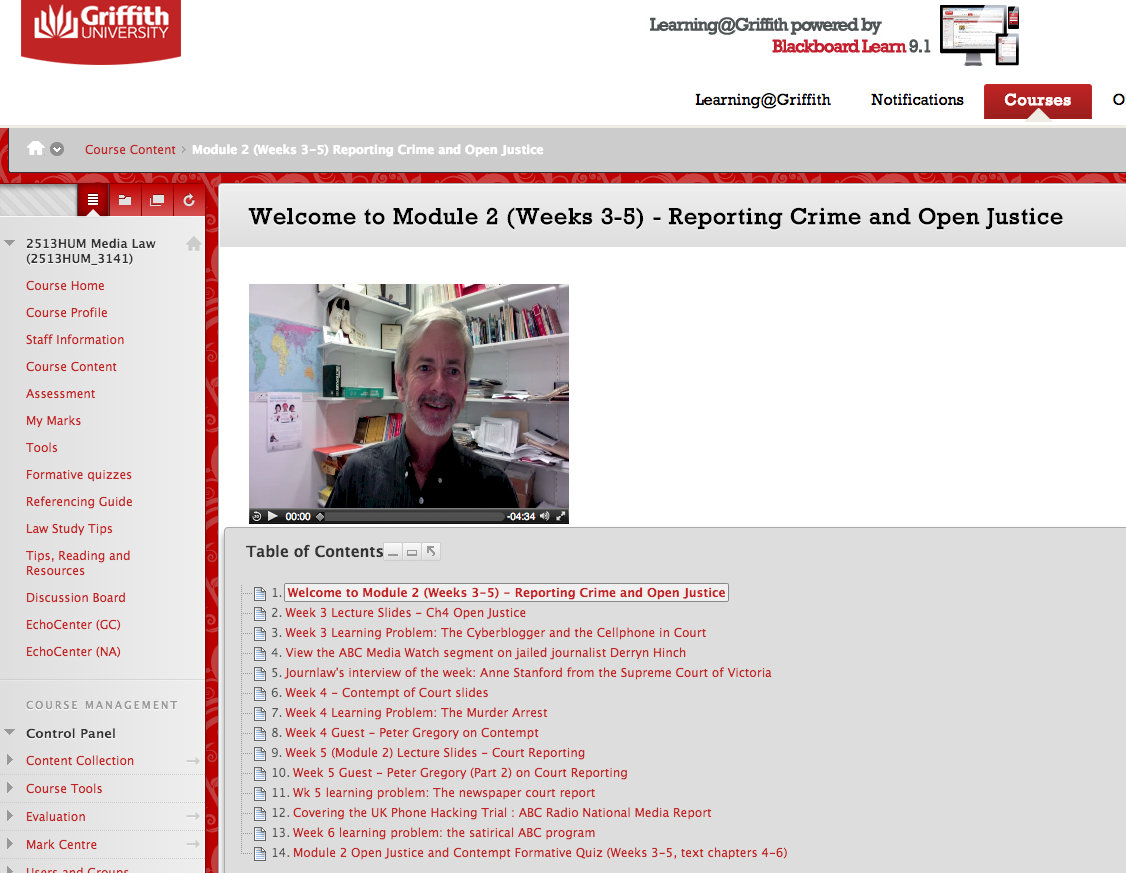
It is module-based, with each module’s integrated learning tools and materials contained in the Course Content area (see screen capture).

The Course Content part of the Learning@Griffith site for the Media Law course

The Course Content part of the Learning@Griffith site for the Media Law course

The modules are designed so that students progressively learn the material and work towards their assessment as the semester unfolds, whether they are studying on-campus or online, or via a combination of the two (‘blended learning’).

They are aware that their learning tasks each week feed directly into their end of semester examination, which is essentially requires them to demonstrate summatively their skills and understandings they have already been workshopping in a formative sense throughout the semester.

Each week’s problem is centred upon the module’s readings (including a textbook chapter) and other learning activities, including lectures, short video introductions to each module, tutorials, video interviews of 10-15 mins with an expert ‘guest of the week’, and  discussion board and social media engagement. [Some of these techniques I have also refined through my recent  enrolment in ‘Massive Open Online Courses’ offered by Coursera and Canvas.]

The instructional scaffolding approach to assessment links attendance and online participation with assessment items that relate directly to those activities.

For example, students complete Weekly Learning Reflections about the media law problem of the week (submitted and assessed twice in the semester as collated portfolios). These then form the basis of questions in students’ end of semester examination and their written preparation for their weekly learning problem rubrics become their actual study notes for their open-book final exam. This leads to a purposive approach to student weekly readings and other learning tasks, aimed to enrich their learning through its focus on a problem and an ultimate assessment reward.

Similarly, students complete a short multiple choice online quiz at the end of each learning module – which is at that stage non-assessable (formative) and is only available for a two week period after that module has ended. They know their final end of semester summative multiple choice quiz will later be drawn from the pool of these very questions, rewarding students who have completed their reading and undertaken the formative assessment along the way.

Do you have other techniques you have been using effectively in teaching media law? Please let me know via the Comments section here or via Twitter at @journlaw.

© Mark Pearson 2014

Disclaimer: While I write about media law and ethics, nothing here should be construed as legal advice. I am an academic, not a lawyer. My only advice is that you consult a lawyer before taking any legal risks.

Leave a comment

Filed under Media regulation, Uncategorized

15 mins with @journlaw – Peter Gregory on ‘contempt and the court reporter’ #MLGriff #medialaw

By MARK PEARSON

We hear about the many types of contempt affecting the role of the court reporter – but how does a journalist manage this in practice?

That is exactly the issue I raised with veteran court reporter (now academic) Peter Gregory [@petergregory17] in this interview covering the main types of contempt of court affecting court reporting – contempt in the face of the court, disobedience contempt, sub judice (prejudicial reporting) and interference with the deliberations of jurors.

Gregory – author of Court Reporting in Australia (Cambridge University Press, 2005) – explains how court reporters might be affected by such forms of contempt, offers examples from his own career, and suggests how journalists might adjust their own practice to minimise risk.

CourtReportinginAustraliacoverHe looks at the impact of new technologies – particularly social media – in the courtroom. Finally, he assesses the dynamics of social media and traditional media at play in the major Victorian trial of the murderer of Irishwoman Jill Meagher (Adrian Bayley) which resulted in the jailing of blogger Derryn Hinch on a contempt charge after disobeying a suppression order.

———–

Disclaimer: While I write about media law and ethics, nothing here should be construed as legal advice. I am an academic, not a lawyer. My only advice is that you consult a lawyer before taking any legal risks.

© Mark Pearson 2014

Leave a comment

Filed under blogging, contempt of court, courts, free expression, media ethics, Media freedom, media law, Press freedom, sub judice, suppression, Uncategorized

Ten minutes with @journlaw – Anne Stanford from @SCVSupremeCourt talks open justice #MLGriff

By MARK PEARSON

In this week’s interview (actually 14 minutes!) I chat with the Strategic Communication Manager at the Supreme Court of Victoria, Anne Stanford, about open justice, suppression orders and general court reporting guidelines.

Listen to Supreme Court of Victoria Strategic Communication Manager Anne Stanford on open justice.

Listen to Supreme Court of Victoria Strategic Communication Manager Anne Stanford on open justice.

———–

Disclaimer: While I write about media law and ethics, nothing here should be construed as legal advice. I am an academic, not a lawyer. My only advice is that you consult a lawyer before taking any legal risks.

© Mark Pearson 2014

Leave a comment

Filed under blogging, contempt of court, courts, free expression, media ethics, Media freedom, media law, Press freedom, sub judice, suppression, Uncategorized

Now that’s how you review a book! Thanks Prof

By MARK PEARSON

BloggingTweetingNewCover

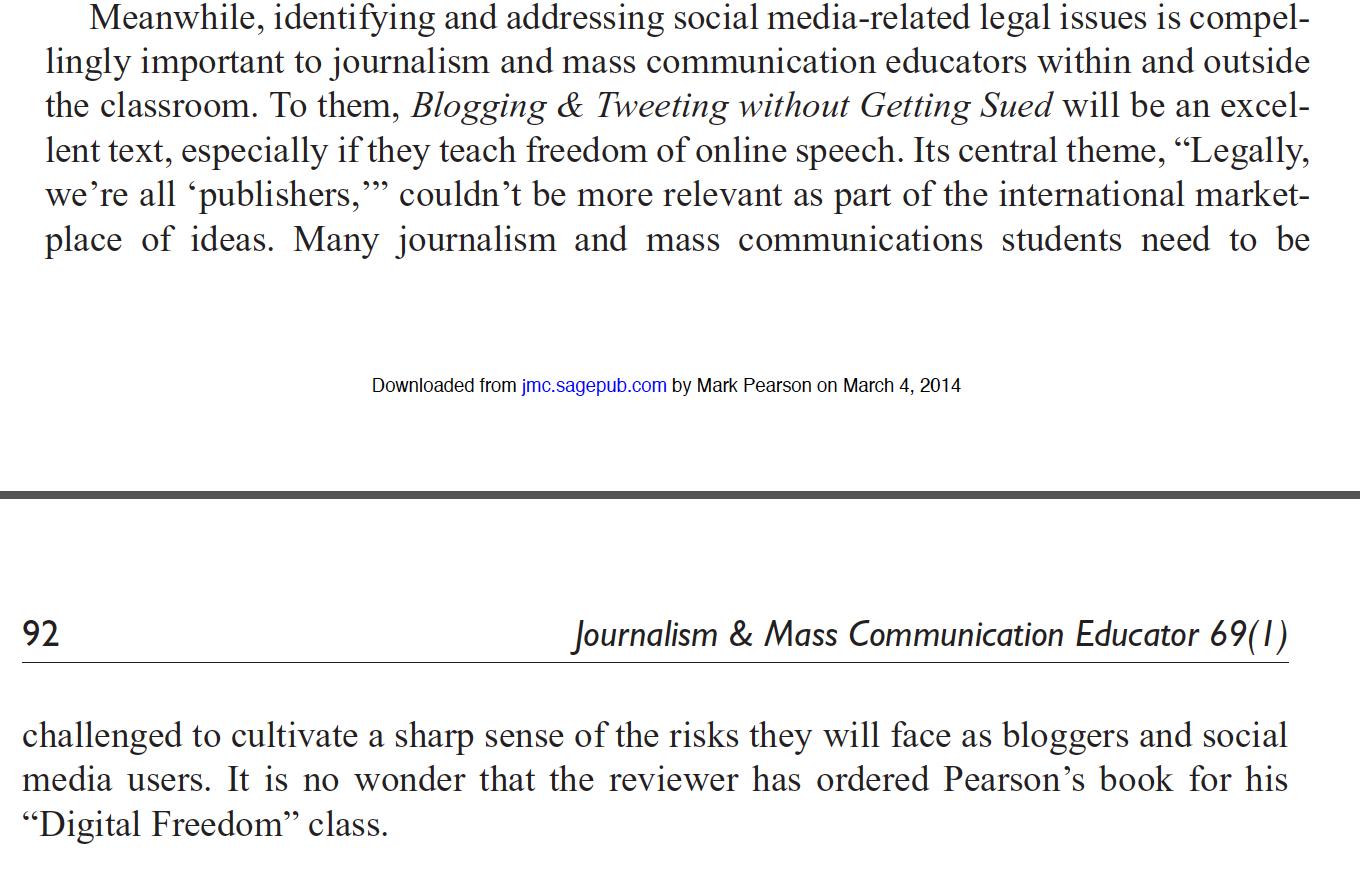
The top media law academic in the US, Professor Kyu Ho Youm, has just reviewed my recent book Blogging and Tweeting Without Getting Sued in the leading journal Journalism & Mass Communication Educator.

Prof Youm is Jonathan Marshall First Amendment Chair at the University of Oregon School of Journalism and Communication and immediate past president of the 3700 member Association for Education in Journalism and Mass Communication.

His review was a lesson in academic book reviewing. He did considerably more than just criticise or praise the book (though he did both at various points!). Prof Youm manage to inject new gems of knowledge and insight about the field in the process, including the suggestion of additional reading and cases that have been since decided.

He concludes by recommending it as a text:-).

Screen Shot 2014-03-06 at 5.23.20 PM

Read the full review at http://jmc.sagepub.com/content/69/1/90.citation.

© Mark Pearson 2014

Disclaimer: While I write about media law and ethics, nothing here should be construed as legal advice. I am an academic, not a lawyer. My only advice is that you consult a lawyer before taking any legal risks.

Leave a comment

Filed under Media regulation, Uncategorized

Republished: We all must learn from the #CharlotteDawson saga

With the sad news of the death of television personality Charlotte Dawson over the weekend,  I repost this commentary I wrote for The Australian in September, 2012 after she had attempted to take her own life.

———-

By MARK PEARSON

[Note: First published in The Australian on September 3, 2012.]

THERE are important lessons for us all in the near tragic saga of TV personality Charlotte Dawson and Twitter. [2014 note: clearly, it is now tragic]

And those lessons must be learnt not just by the media, but also by policymakers and the broader community.

The story of Dawson’s hospitalisation [in 2012] after receiving a torrent of life-threatening and demeaning tweets contained all the contradictions of our Web 2.0 world: risk versus reward, connection versus alienation, celebrity versus anonymity and freedom versus censorship.

When Dawson revealed a Monash University staffer was the source of some earlier postings and the employee was suspended, that “outing” triggered the final spate of insults and threats, and Dawson’s own sad messages from her @MsCharlotteD handle before her hospitalisation. The tweets raised the contentious legal issues of defamation, cyber-bullying, confidentiality, privacy, racial discrimination, jurisdiction and even unfair dismissal.

Dawson is [was] a former fashion model who has traded on her own harsh comments to contestants in a reality-TV program and in newspaper interviews where she has pilloried her home country of New Zealand.

Like many celebrities she has established a strong Twitter following of 21,450 [in 2012]- now seen as a crucial dimension to any wannabe A-lister’s public profile. In May, she tweeted a call for someone to “please kill” a fashion blogger, @BryanBoy, which she defended as a joke.

Of course, none of this justifies anonymous trolls threatening her life or urging her to kill herself, but it provides some context to the vitriol. It also defies the simplistic media story line of “evil social media causes real-life tragedy”. Dawson has previously spoken of life events that have rendered her emotionally vulnerable.

The issue of the media’s interaction with the vulnerable in our society recently gained traction with changes to journalism ethical codes in the wake of the federal government’s Mindframe media training initiative and associated research projects.

Some of that research demonstrated the flow-on effect of celebrity suicides and threats upon their vulnerable fans, making this example even more concerning.

Mindframe has been extended to schools, public relations courses and the courts, but social media proves the sensitivities of the vulnerable have not yet pierced the consciousness of many ordinary citizens.

It’s just one example of the rift between traditional and digital media in the Dawson event and its reportage. Journalists and executives in the old media are frustrated by the two-speed regulatory system. News organisations face legal and ethical brakes on their coverage while rumour, gossip and vitriol run wild on social media in defiance of legal prohibitions. Despite the predictable opportunism of some politicians, the case does not call for tougher laws to “control” social media. They already exist.

Earlier this year [2012], the Federal Court ordered News Limited to pay $12,000 to the mother of indigenous boys killed in a car accident over anonymous comments it hosted on its website Perthnow.

A Queensland “troll” was jailed last year [2011] for defacing the Facebook tribute pages of two slain children. In 2010, an anonymous poison penner in Victoria was hit with a $30,000 defamation judgment over comments about a Perth businessman.

[Former] Communications Minister Stephen Conroy has lobbied US-based social media platforms such as Twitter and Facebook to provide speedier action over breaches of their terms of use.

But legal proceedings are unlikely to have any effect given the First Amendment and legislative protection for internet hosts in the US.

Instead of introducing more gags on free expression and policing them, politicians should invest those resources in funding education and training initiatives for responsible social media use in schools, tertiary institutions and the broader community.

For information about cyberbullying go to cybersmart.gov.au or contact Lifeline on 13 11 14.

© Mark Pearson 2012 and 2014

Disclaimer: While I write about media law and ethics, nothing here should be construed as legal advice. I am an academic, not a lawyer. My only advice is that you consult a lawyer before taking any legal risks.

6 Comments

Filed under Media regulation, mental health, social media, Uncategorized

Abbott’s attack on ABC proves politicians are free press chameleons

By MARK PEARSON

Politicians are free expression chameleons. Regardless of their political colours, they are inevitably staunch advocates of a free media and the free flow of information while in opposition.

When they win government they tend to shut down criticism and negative press by implementing policies and passing laws to limit scrutiny.

Tony_Abbott

Australian Prime Minister Tony Abbott … called the ABC ‘unpatriotic’. [Image: Google free usage]

We saw this happen in Australia this week Prime Minister Tony Abbott’s criticisms of the Australian Broadcasting Corporation on the eve of his government’s announcement of an ‘efficiency study’ on the independent national broadcaster.

Less than a year ago, the former Gillard Labor government’s proposed media regulations which risked journalists and media organisations being shackled by a new privacy bureaucracy.

Less than two years ago the Finkelstein Report had journalists potentially being jailed or fined for disobedience of its proposed regulatory regime.

At the time I blogged about the potential implications of the Finkelstein recommendations (The Drum: ‘Media Inquiry: Be Careful What You Wish For’) and then communications minister Stephen Conroy’s poorly named News Media (Self-Regulation) Bill. [Also see my commentary in The Conversation putting all this in an international media freedom context.]

Those proposals arose in a highly politicised context where the then government believed some media outlets were biased against them.

The new Abbott conservative government – despite having opposed those reforms under the banner of press freedom – now seems to have adopted the public soap box and budgetary strategies with the ABC directly in its sights.

Prime Minister Abbott used a populist radio program to label the ABC ‘unpatriotic’ following the broadcaster’s publication of claims by asylum seekers that they had suffered burns during an Australian navy operation. [Well detailed by former ABC Media Watch host Jonathan Holmes here in The Age.]

In the same radio interview Mr Abbott criticised the ABC’s reportage of the Edward Snowden NSA leaks, including the revelation that Australia’s spy agency had secretly tapped the phones of Indonesian president Susilo Bambang Yudohoyono and his wife in 2009. He questioned the funding of the ABC’s FactCheck Unit which a few days earlier disproved his claim asylum seekers who alleged mistreatment by the Navy were breaking the law.

His criticisms came only hours prior to the Minister for Communications Malcolm Turnbull announcing an “efficiency review” of the ABC and its sister national broadcaster SBS (Special Broadcasting Service). The review will be looking for cost-saving measures in the lead-up to the May budget.

Reporters Without Borders has a long history of dealing with governments that demand national broadcasters be more patriotic in their coverage under threats to withdraw funding. But these cases rarely occur in Western democracies with a relatively high media freedom ranking. (Australia’s was 26/179 in 2013).

A free news media and a truly independent national broadcaster should be neither patriotic nor unpatriotic – such calls to nationalism are anathema to genuine truth-seeking and truth-telling in society.

An independent national broadcaster is not the equivalent of the marketing arm of a large corporation.

The ABC’s reportage of both the asylum seeker allegations and the spying scandal is understandable given the Australian Government’s policy of withholding information about the fate of asylum seekers who have attempted to reach Australian shores by boat.

The Australian Government’s policy of refusing to provide the media with details of such operations and in limiting media access to detention centres deprives Australian citizens and the international community of important information on a key human rights issue.

When journalists are deprived of basic information they are within their rights to publish serious allegations like those of the asylum seekers who claimed to have been injured at the hands of Australian defence forces, particularly if government sources are refusing to offer information about the circumstances.

They are simply reporting the truth that the allegations have been made. Authorities and other media or citizen journalists can set the record straight with evidence if the allegations are unfounded.

It is quite different from false allegations about an individual citizen – where that person could sue for defamation.

There is a policy reason large corporates and government entities like the Navy cannot sue for defamation over such allegations: in a democratic society such assertions deserve circulation so citizens can weigh their credibility.

Even if ultimately proven false, the allegations of mistreatment of asylum seekers had an element of plausibility when made because the Australian authorities – including the Navy, national security agencies and the border protection regime – had ‘form’.

It may be unpatriotic to say this, but documented incidents suggest it would be naïve to give Australian governments (of whatever persuasion) and agencies the benefit of the doubt in such situations.

They include (at the very least):

  • The ‘Children Overboard’ Affair in 2001 where Howard Government and defence claims about events concerning the Norwegian freighter MV Tampa proved to be politicised and misleading.
  • The recent revelations that Australian agents eavesdropped on the Indonesian President and spied on East Timor during oil and gas negotiations.
  • The Howard Government’s dogged determination to pursue Gold Coast doctor Mohamed Haneef, damage his reputation and cancel his visa as its terrorism allegations against him evaporated in 2007.
  • A litany of examples of unpublicized incidents at immigration detention centres, evident only months after the event through Freedom of Information requests and appeals by determined citizen journalists.
  • Recent allegations of ritual sexual abuse by Australian Navy personnel on board ships used for border protection duties.

The free flow of information is crucial to the democratic standing of a country like Australia. Such attacks by political leaders and calls for patriotism are what we expect from nations ranking much lower on RSF’s World Press Freedom Index.

The Australian Government should direct its energies to improving the free flow of information in society and granting better access and information to journalists and other citizens instead of name-calling, threats of fund cuts, and bizarre calls for media patriotism.

Hear my ABC 91.7 local radio interview on the issue:

Screen Shot 2014-02-04 at 1.24.20 PM


© Mark Pearson 2014

Disclaimer: While I write about media law and ethics, nothing here should be construed as legal advice. I am an academic, not a lawyer. My only advice is that you consult a lawyer before taking any legal risks.

5 Comments

Filed under Freedom of Information, Media regulation, Uncategorized

Immigration case shows process can take the news out of FOI requests

By MARK PEARSON

A recent decision by the Australian Information Commissioner has demonstrated that persistence with a Freedom of Information application can pay off – if you are willing to wait the year or more for the appeal process to take its course. 

Farrell and Department of Immigration and Border Protection [2013] AICmr 81  (21 November 2013) was decided recently and may well be subject to further appeal.

GlobalMailDetention

FOI data used in The Global Mail multimedia coverage

On November 15, 2012, he applied to the Department of Immigration and Border Protection for access to a series of incident reports about five self-harming events logged on the department’s FI disclosure log.

On January 14, 2013, the Department provided Mr Farrell with edited copies of five documents totalling 23 pages related to his request, citing its ‘operations of agency’ and ‘personal privacy’ exemptions under sections 47E and 47F of the Commonwealth FOI Act as its reasons for the deletion of material. On February 14, 2013, Mr Farrell applied to the Information Commissioner for review of the information exempted by the Department under s 47E.

The Privacy Commissioner ruled on November 21, 2013 that the Department’s decision should be set aside and the exempted information should be released to Mr Farrell. The exemption under  Section 47E(d) provides: ‘[a] document is conditionally exempt if its disclosure under this Act would, or could reasonably be expected to…(d) have a substantial adverse effect on the proper and efficient conduct of the operations of an agency’.

The Department had argued its operations would have been adversely affected if details had been released about an incident of self-harm while an individual was about to be deported from Australia on a scheduled commercial flight. It argued the information might help others avoid deportation by adopting the same behaviours. The Privacy Commissioner ruled (at paras 12 and 13):

“Much of the information exempted by the Department in document 1 is already in the public domain in the form of media articles relating to similar instances where disruptive behaviour had led to individuals being unable to be deported on commercial flights and charter flights having to be subsequently arranged. I have examined an unedited copy of document 1. Given that information of this nature is already publicly available, I do not consider that its disclosure would, or could reasonably be expected to have, a substantial adverse effect on the proper and efficient conduct of the Department’s operations or would result in the Department being required to alter its processes for deporting individuals.”

Lessons for journalists

The case holds important lessons about the workings of FOI and the exemptions that are available.

On the one hand, Farrell and his colleagues were able to publish a substantial body of material on their detentionlogs.com.au site as a result of numerous FOI requests – information later published as stories, searchable databases and graphics on other news sites including The Guardian, The Global Mail and New Matilda.

However, the case also provides an insight into the bureaucratic, technical and time-consuming side of the FOI application process. A request had taken a full year to be filed, rejected and reviewed, and the Department still had 28 days to appeal to have the Privacy Commissioner’s decision reviewed by the Administrative Appeals Tribunal. That would then open the way to a series of court appeals over the decision if either party chose to pursue them.

Theoretically, it could take years before the release of the information which might then be only of historical value rather than of news value.

© Mark Pearson 2013

Disclaimer: While I write about media law and ethics, nothing here should be construed as legal advice. I am an academic, not a lawyer. My only advice is that you consult a lawyer before taking any legal risks.
1 Comment

Filed under Freedom of Information, Media regulation, Uncategorized

‘Dinosaur Wrangler’ sacked from ‘Jurassic Park’: Fair Work Commission upholds dismissal over Facebook abuse

By MARK PEARSON

Australia’s Fair Work Commission  this week (December 10) added to its developing body of social media case law by upholding the sacking of a worker who described himself as a ‘dinosaur wrangler’ at ‘Jurassic Park’.

The latest is cited as:

Cameron Little v. Credit Corp Group Ltd [2013] FWC 9642 (U2013/11522) 10 December 2013. < http://decisions.fwc.gov.au/ >

jurassic

‘Dinosaur Wrangler’ sacked from ‘Jurassic Park’. Photo: Flickr (free to use or share)

C.L. had worked as a customer relationship manager for Credit Corp Group for three years when in June 2013 he used his personal Facebook account to criticise an organisation he dealt with on behalf of his employer (Christians Against Poverty (CAP)) and to make sexually suggestive comments about a new colleague. L. had listed his employment on his Facebook account as a ‘Dinosaur Wrangler’ at ‘Jurassic Park’ but other details on his page made it possible to identify him as an employee of the Credit Corp Group. He dealt with Christians Against Poverty when the not-for-profit group was negotiating new debt arrangements with Credit Corp on behalf of their clients. He posted to their page:

‘For reals bro, you should put a little more of funding into educating consumers on how the world works rather than just weaseling them out of debt, blah blah blah, give a man a fish/teach a man to fish.’

and

‘No thanks, just take my advice and try to educate people about things like ‘interest’ and ‘liability’ rather than just weasel them out of contracts. #simple’

L. posted the following comment about his new work colleague:

 ‘On behalf of all the staff at The Credit Corp Group I would like to welcome our newest victim of butt rape, [colleague’s name]. I’m looking Forward to sexually harassing you behind the stationary cupboard big boy.’

The day after the posts came to the attention of his employer, he was called to a meeting where his employment was terminated. Two weeks later he filed a claim for unfair dismissal.

Fair Work Commission Deputy President Peter Sams ruled the dismissal had been fair, pointing to the following relevant factors:

  • L. had been issued with the Employee Handbook and the Employee Code of Conduct and made aware of their contents.
  • He had attended an induction at the commencement of his employment in 2010 and a ‘Working Together’ module in August 2012.
  • His employment contract stated that the company’s policies and procedures were directions from the employer to the employee.
  • He had the ability to access and change the privacy settings for his account.
  • It was irrelevant that L. had created the social media posts out of work hours.
  • It was implausible that L. believed his Facebook page was ‘private’ and he did not understand how Facebook worked.
  • He had been formally warned about an earlier incident where he had posted an inappropriate comment to a website.

The decision affirmed earlier Fair Work decisions in the Good Guys case (2011) and the Linfox case (2012). Those in the position of employer need to ensure all staff are fully aware of – and trained in – your organisation’s social media policy and that it is fair and up to date. Employees need to keep abreast of their organisation’s social media policy and ensure their social media accounts are set to private and that they do not post material related in any way to their work – and certainly not anything that is discriminatory or critical of colleagues, management or clients. This applies both during work hours and when off duty.

Co-author Mark Polden and I will be using this as a Key Case in a new chapter on Law for PR, Freelancers and New Media Entrepreneurs in our forthcoming fifth edition of The Journalist’s Guide to Media Law (Allen & Unwin, 2014), due for release mid-year.

© Mark Pearson 2013

Disclaimer: While I write about media law and ethics, nothing here should be construed as legal advice. I am an academic, not a lawyer. My only advice is that you consult a lawyer before taking any legal risks.

Leave a comment

Filed under Media regulation, Uncategorized