
By MARK PEARSON Follow @Journlaw
Three key international studies counsel journalists to reflect carefully on their practice when they are reporting news and issues involving Islam and people who follow it.
Griffith University colleague Dr Jacqui Ewart and I have been funded to explore the best practice in reporting upon the Islamic religion and Muslim people with a view to developing educational resources and training materials.
The project has involved a literature review of the field, the identification of case studies in the Australian media highlighting different approaches to such coverage, and the analysis of extended interviews we are conducting with journalists, educators, students, media relations personnel and other experts the topic.
An important part of the literature review has been to identify similar studies conducted internationally on the topic – ably conducted by one of our research assistants, experienced journalist Guy Healy.
We have identified these three reports as offering excellent guidance to journalists and educators working in this space and we would appreciate hearing from those of you willing to engage in dialogue on the topic.
 Rupar, Verica (2012). Getting the facts right: Reporting ethnicity and religion. A study of media coverage of ethnicity and religion in Denmark, France, Germany, Greece, Hungary, Italy, Lithuania, Slovakia and the United Kingdom.[Project Report]. Brussels: International Federation of Journalists. Available at: http://ethicaljournalisminitiative.org/en/contents/eji-study-2012
This report from Associate Professor Dr Verica Rupar of Cardiff University (now with AUT University, Auckland) aims to improve “…the media’s ability to accurately and fairly report on people, events and issues that touch upon ethnicity and religion.” It draws upon interviews with 117 journalists in nine EU countries and the analysis of almost 200 news stories.
While its scope goes well beyond the reporting of Islam and Muslims, many of its examples and recommendations apply to this religion and its followers.
The study highlights immigration as a topic conflated with Muslims and Islam.
The report suggests the main obstacles to good reporting are the poor financial state of the media, overloading of reporters, lack of time, lack of knowledge, and lack of in-house training.
Overall, it identifies the media’s tasks as:
* Reporting factually and accurately on acts of racism and intolerance
* Being sensitive when writing about tensions between communities
* Avoiding derogatory stereotypical depiction of members of religious groups
* Challenging the assumptions underlying intolerant remarks made by speakers in the course of interviews, reports, and discussion programs.
It calls upon journalists to become more familiar with with anti-discrimination legislation, use broader networks of expert sources, ensure facts are put in context, avoid negative labels, portray people as human beings instead of members of an ethnic or religious group, organize in-house training and adopt internal editorial guidelines.
 Greater London Authority (2007). The Search for Common Ground: Muslims, non-Muslims and the UK media. A report commissioned by the Mayor of London. London: Greater London Authority. Available at: http://www.insted.co.uk/search-for-common-ground.pdf
This major study on British media coverage of Islam and Muslims was commissioned by the Greater London Authority in the wake of the London bombings and perceived polarisation of coverage in the media.
It involved opinion poll reviews, studies of recent books and stories, a randomised survey of one week’s news stories, examination of stories about political correctness, interviews with Muslim journalists, and analysis of a television documentary. The researchers were commissioned to inquire into whether the media stimulated informed debate about building a multicultural society, or oversimplified and provided insufficient background that pandered to reader anxieties and prejudices. Other key questions focused on whether stories fostered anxiety, fear and hostility between non-Muslims and Muslims, and whether reportage increased or decreased a sense of common ground, shared belonging and civic responsibility.
Its principal recommendations included (at p. 133):
- News organisations should review their coverage of issues and events involving Muslims and Islam.
- They should consider drawing up codes of professional conduct and style guides about use of terminology.
- News organisations should recruit more journalists of Muslim heritage.
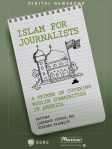 Pintak, Lawrence and Franklin, Stephen (eds) (2013). Islam for Journalists; A Primer on Covering Muslim Communities in America. [Digital newsbook]. US Social Science Research Council; Edward R Murrow College of Communication, Washington State University. Available at: http://www.rjionline.org/newsbooks/islam-for-journalists
This 343-page e-book was released in 2011 and has since been updated. It contains chapters by several journalists and educators and is presented as an online course in covering stories related to Islam and Muslims. It features a useful glossary of Arabic terms and an extended list of resources.
In his afterward, titled ‘Islam on Main Street’ Lawrence Pintak states that the coverage of Islam is in many ways no different than the coverage of other topics, except that it is potentially inflammatory.
He suggests:
* carefully assess the bona fides of so-called experts, and make sure the audience is provided with the information they need to weigh the credibility of speakers.
* provide background and context when quoting non-academic “experts” and be transparent about their sponsorships and allegiances.
* turn to academics for guidance because many will offer a more researched and balanced perspective on the topic.
We look forward to hearing from others working in this space.
———–
Disclaimer: While I write about media law and ethics, nothing here should be construed as legal advice. I am an academic, not a lawyer. My only advice is that you consult a lawyer before taking any legal risks.
© Mark Pearson 2014





 journlaw