Category Archives: Media regulation

Maintain the rage: support for Greste heartening, but needs to be escalated. Sign up. #FreeAJStaff

By MARK PEARSON

Additional research by journalism student MELANIE WHITING

AS Australian journalist Peter Greste languishes in an Egyptian jail just three weeks into his seven year sentence for simply doing his job reporting for Al Jazeera, it was heartening to see friends and colleagues rally in his support in Melbourne yesterday (July 14).

Clearly, the problem faced by all such political prisoners is that pressure for their release can diminish after their initial sentence disappears from the news agenda.

Almost 11,000 people have now signed the Canadian Journalists for Free Expression (CJFE) petition for the release of Greste and his colleagues, which will be sent tomorrow (July 16). Please go to http://www.thepetitionsite.com/583/945/591/fr/ and sign it.

In the days following the verdict political leaders including US Secretary of State John Kerry and Australian Prime Minister Tony Abbott expressed shock and condemnation over the Egyptian court’s decision on June 23.

Labor foreign affairs spokesperson Tanya Plibersek has been supportive and Greens leader Christine Milne has called upon the Abbott Government to escalate its diplomatic efforts on Greste’s behalf.

Media companies, unions and free expression groups have been united in their push for the release of Greste and his Al Jazeera colleagues.

Representatives of News Corp Australia and Fairfax Media told AdNews they saw the  sentence as a threat to press freedom.

The Media Entertainment and Arts Alliance (MEAA) issued a statement on their website condemning the verdict and maintained that Greste had acted as an ethical and responsible journalist.

A group of top international journalists united to send a letter to the Egyptian President asking for Greste and his colleagues to be released.

Petitions are important, so please sign any or all of these:

Go ahead – please sign them all NOW!

[The MEAA petition at http://www.alliance.org.au/peter-greste-petition has now closed.]

© Mark Pearson 2014

Disclaimer: While I write about media law and ethics, nothing here should be construed as legal advice. I am an academic, not a lawyer. My only advice is that you consult a lawyer before taking any legal risks.

Leave a comment

Filed under free expression, journalism, Media freedom, Media regulation, national security, Press freedom, suppression, terrorism, Uncategorized

Australian Press Council Chair Julian Disney with @journlaw

By MARK PEARSON

I recently had the chance to interview Australian Press Council chair Professor Julian Disney on the role and direction of the Council.

In this interview he discusses the recent reforms to the Council, the move to improve its editorial standards, and the future for media ‘self-regulation’ as broadcast, print, online and social media formats continue to converge.

(12 mins, recorded 17 March 2014). Apologies for some audio sync issues!

© Mark Pearson 2014

Disclaimer: While I write about media law and ethics, nothing here should be construed as legal advice. I am an academic, not a lawyer. My only advice is that you consult a lawyer before taking any legal risks.

Leave a comment

Filed under free expression, journalism, media ethics, Media freedom, Media regulation, Press freedom, Uncategorized

ABC RN Law Report host @damien_carrick talks privacy with @journlaw

By MARK PEARSON

The interviewer became the interviewee when I had the opportunity to chat with the host of the ABC Radio National Law Report (@LawReportRN), Damien Carrick (@damien_carrick), about the law of privacy and the media in Australia and the UK.

Damien was a visiting journalist fellow at the Reuters Institute for the Study of Journalism at Oxford University where he attended the Leveson Inquiry and interviewed journalists and media lawyers to prepare a report titled ‘Privacy, Regulation and the Public Interest’ which is available at https://reutersinstitute.politics.ox…. .

In this interview he discusses the interaction between the rights of free expression and privacy, the scope for coverage of celebrity news if there is a tort of privacy invasion, the difference between the UK and the Australian contexts, and the feasibility of the Australian Law Reform Commission’s proposal of a new statutory tort for the serious invasion of privacy.


[Recorded 19 May 2014, length 14 mins 54 secs]

© Mark Pearson 2014

Disclaimer: While I write about media law and ethics, nothing here should be construed as legal advice. I am an academic, not a lawyer. My only advice is that you consult a lawyer before taking any legal risks.

Leave a comment

Filed under Media regulation, Uncategorized

The lowdown on IP from expert Angus Macinnis @AequoEtBono – 15 mins with @journlaw

By MARK PEARSON


Intellectual property law – particularly copyright – can be one of the most complex areas of the law for journalists, bloggers and other professional communicators.

Thankfully, commercial lawyer Angus Macinnis from StevensVuaran Lawyers (@AequoEtBono) makes Australian IP law all a bit clearer in this short interview with me, @journlaw, covering everything from the basics of IP through to whether a simple Tweet might be actionable for breach of copyright.

[Recorded 5-5-14, 14 mins 50 secs]

© Mark Pearson 2014

Disclaimer: While I write about media law and ethics, nothing here should be construed as legal advice. I am an academic, not a lawyer. My only advice is that you consult a lawyer before taking any legal risks.

Leave a comment

Filed under Media regulation, Uncategorized

Diary of a cyberbullying victim

By MARK PEARSON

My research and writing on social media law got all too personal last week when a cyberbully threatened to open a website claiming I am a rapist.

Some months ago I posted to my research blog journlaw.com a fair and accurate report of a Fair Work Commission (FWC) decision that this individual had been fairly dismissed from his workplace.

It was an interesting case in social media law because his termination resulted from his offensive Facebook remarks about his workplace, a client and a prospective colleague.

According to the judgment, he had previously been warned about using company time and resources to start a private website.

Tellingly, the Commission’s decision stated the individual had shown no apology or regret for his behaviour and had maintained he was entitled to do it, offering his employer and the Commission ‘little comfort that similar incidents would not occur in the future’.

Other legal and HR experts posted summaries of the decision to their blogs and websites, including some of Australia’s leading law firms.

A fortnight ago he wrote to several of us asking that we change some elements of our coverage detailing the Commission’s finding that he had written sexually harassing comments about a colleague. He also wrote to senior staff at my university about the matter.

I responded that I believed my report of the case constituted a fair and accurate report of material on the public record.

However, I explained that I understood the blogs might be causing him ongoing angst and that their appearance on search engines could have other implications for him. I had therefore replaced his name throughout my post with the initials of his name, although I had left his full name in the case citation.

I said I was keen to correct any inaccuracies and asked him to point out any errors in my reporting. I ended the note by suggesting he seek counselling if the episode had caused him undue distress and I provided the Beyond Blue and Lifeline toll free numbers.

A few days later this bombshell landed in my inbox:

“Your article makes it seem like I sexually harassed a work colleague and it appears that you do not understand the impact this can have.

“To help give you a little perspective I am currently registering markpearsonisarapist@wordpress

“If you have a change of heart please feel free to send me an email.”

Attached to the message was this graphic illustrating the availability of the website he was threatening to establish:

GraphicOfWordpressRapistPearsonThreatI have written books and articles citing scores of examples where cyberbullies have attacked other victims.

But you only appreciate the anxiety and powerlessness of cyber-victimhood when you are the direct target of such a threat and your own name and reputation are on the line.

My recent research and writing has been exploring ‘mindful’ approaches to journalism and social media law and ethics, so I did not want to engage in an email flame war with this individual or give a heated kneejerk response.

The official cyberbullying sites like the Australian Government’s cyber(smart) recommend a “talk, report, support” approach, advising a victim should talk about the threat to someone they trust, avoid retaliating or responding, block the bully and change privacy settings, report the abuse to the service, and collect the evidence.

I took some of this advice by discussing it with family and friends, screen capturing the correspondence, and advising the other bloggers who had reported the case that he had issued this serious threat against me.

However, given he had not yet registered the offensive site, I thought I would appraise him of the illegality of his threat and give him 24 hours to withdraw it and apologise.

I wrote explaining his email threat was likely in breach of several state and federal laws carrying the risk of substantial fines and jail terms, including blackmail, misuse of a carriage service, stalking and harassment and that I was prepared to press such charges against him.

Five hours later he responded:

“Your panic is not needed. I have not registered any accounts citing that you are a rapist, I simply exclaimed that I would to wonderfully illustrate my point about making damaging claims against others.

“Isn’t it a little funny how you’re happy to publish articles that insinuate that an individual is a sexual predator but once somebody propositions you with the same action you instantly threaten to contact the authorities?

“I understand that you have no intention of taking this matter any further, are probably just a little bored and like myself enjoy sticking to your principles and engaging in a good argument. I would have thought that you’d have something more important to be working on but I guess I was wrong, either way, I have a lot of time also. 😛

“Please advise when [my original blog post] has been removed entirely.”

So there it stands. It seems the threat has dissipated, but I’m unsure of what – if anything – I should do next.

A mindful approach involves reflecting upon the implications of one’s actions for all stakeholders and seeking counsel.

I thought it would be a useful learning experience for the 200 students in my Media Law course, so I put my dilemma to them in last week’s lecture. I also asked them to vote on which of three courses of action they recommended I should take.

Here are the options, with some of the students’ observations:

  1. Have him charged. About half the students in the lecture voted for this option. They felt that’s how you should deal with cyberbullies. The guy has ‘form’ and has clearly not learnt his lesson. He has escalated his tactics with this serious and intimidating threat. Next time his victim might be a much more vulnerable individual than a university professor who researches and publishes in the field. It might be someone in a fragile emotional state and there could be tragic consequences – just like we saw in the royal prank call episode.
  2. Do nothing and let it drop. About one quarter of students voted for this. I’ve made my point and he may well be terrified. While you cannot excuse his actions, you can certainly empathise with his despair at this digital archive of his transgressions available with a simple Google search of his name. Perhaps my response has been enough to make him stop his anti-social online behaviour. My original blog post on his dismissal remains live, so prospective employers are still on notice about him. Besides which, he himself might be vulnerable and further pressure might be detrimental to him. The research shows cyberbullies often have a mental illness, a personality disorder or engage during substance abuse. Worse still, it might prompt him to escalate the matter and perhaps retaliate by carrying out that threat or something worse.
  3. Blog about it. The remaining quarter of students thought this was the best course of action. It spreads the message to other potential bullies, educates the community about the problem, and it’s what I do best. It could be as little as writing a piece like this.

Of course, the other options are still available to me now I have posted this blog, and I can still proceed with pressing charges. I’d appreciate your advice if you’d care to comment below.

For information about cyberbullying go to cybersmart.gov.au or contact Lifeline on 13 11 14.

Thanks to these tweeps for your supportive comments:

https://twitter.com/gvandersee/status/465682966652260353

© Mark Pearson 2014

Disclaimer: While I write about media law and ethics, nothing here should be construed as legal advice. I am an academic, not a lawyer. My only advice is that you consult a lawyer before taking any legal risks.

9 Comments

Filed under Media regulation, mental health, social media, Uncategorized

Cyberbullying and the law in Australia: key legislation and cases

By MARK PEARSON

If you are looking for an excellent summary of the main laws controlling cyberbullying in Australia you need look no further than here:

Where does Cyber-bullying fit in the Current Australian Criminal Framework?.

It covers key Commonwealth and State laws including misuse of telecommunications services, stalking and harassment, and criminal defamation.

See also these previous posts on journlaw.com:

…  from my public lecture ‘Social Media – Risks and Rewards’] We hear a great deal about the downside of social media …  in schools. There have been well publicised examples of cyberbullying, defamation of teachers and principals, stalking of children by …
…  sad news of the death of television personality Charlotte Dawson over the weekend,  I repost this commentary I wrote for The …  in the near tragic saga of TV personality Charlotte Dawson and Twitter. [2014 note: clearly, it is now tragic] Andthose lessons must …
…  from my public lecture ‘Social Media – Risks and Rewards’] Administrators andparents are indeed concerned about social media – partly because the …  committed to it, one might be excused for believing cyberbullying had driven young people to the depths of depression and anxiety …
…  MARK PEARSON Follow @Journlaw [Professor of Journalism and Social Media, Griffith University, Australia] Public lecture presented …  in schools. There have been well publicised examples of cyberbullying, defamation of teachers and principals, stalking of children by …
…  issue of discriminatory abuse in my new book  – Blogging and Tweeting Without Getting Sued: A global guide to the law for anyone writing …  to their type, scale, andjurisdiction. They include: cyberbullying, cyberstalking, online trolling, malicious online content, using …


For information about cyberbullying go to cybersmart.gov.au or contact Lifeline on 13 11 14.

© Mark Pearson 2012 and 2014

Disclaimer: While I write about media law and ethics, nothing here should be construed as legal advice. I am an academic, not a lawyer. My only advice is that you consult a lawyer before taking any legal risks.

1 Comment

Filed under Media regulation, mental health, social media, Uncategorized

Blended learning and instructional scaffolding in a Media Law course

By MARK PEARSON

I’m thoroughly enjoying a revitalised enthusiasm for my media law teaching thanks to the Blended Learning team at Griffith University.

I’ve recently been a student in an Online Course Development course run by expert faculty in my Arts, Education and Law group and have been keenly trying to build the various blended learning strategies into the Blackboard interface for both the on-campus and Open Universities Australia versions of my Media Law course.

The Media Law course’s pedagogy and assessment tasks are built around both problem-based learning and instructional scaffolding.

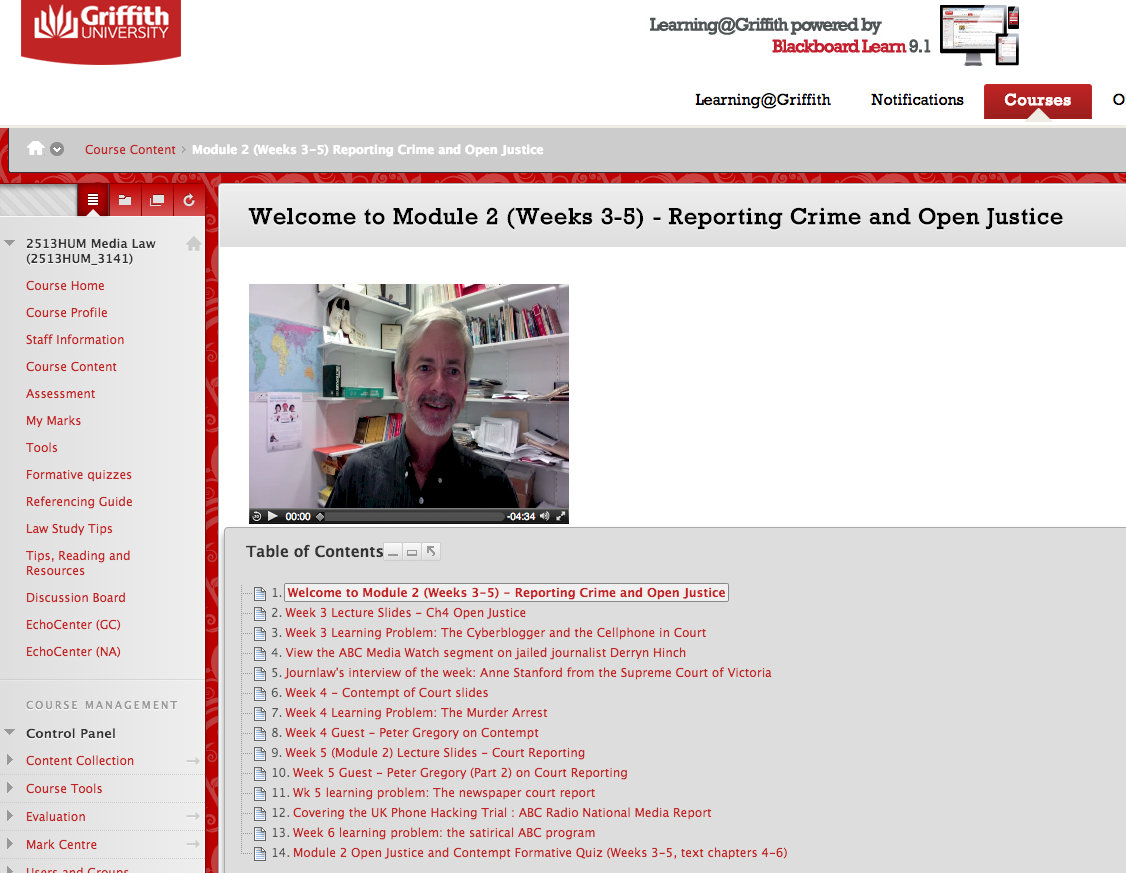
It is module-based, with each module’s integrated learning tools and materials contained in the Course Content area (see screen capture).

The Course Content part of the Learning@Griffith site for the Media Law course

The Course Content part of the Learning@Griffith site for the Media Law course

The modules are designed so that students progressively learn the material and work towards their assessment as the semester unfolds, whether they are studying on-campus or online, or via a combination of the two (‘blended learning’).

They are aware that their learning tasks each week feed directly into their end of semester examination, which is essentially requires them to demonstrate summatively their skills and understandings they have already been workshopping in a formative sense throughout the semester.

Each week’s problem is centred upon the module’s readings (including a textbook chapter) and other learning activities, including lectures, short video introductions to each module, tutorials, video interviews of 10-15 mins with an expert ‘guest of the week’, and  discussion board and social media engagement. [Some of these techniques I have also refined through my recent  enrolment in ‘Massive Open Online Courses’ offered by Coursera and Canvas.]

The instructional scaffolding approach to assessment links attendance and online participation with assessment items that relate directly to those activities.

For example, students complete Weekly Learning Reflections about the media law problem of the week (submitted and assessed twice in the semester as collated portfolios). These then form the basis of questions in students’ end of semester examination and their written preparation for their weekly learning problem rubrics become their actual study notes for their open-book final exam. This leads to a purposive approach to student weekly readings and other learning tasks, aimed to enrich their learning through its focus on a problem and an ultimate assessment reward.

Similarly, students complete a short multiple choice online quiz at the end of each learning module – which is at that stage non-assessable (formative) and is only available for a two week period after that module has ended. They know their final end of semester summative multiple choice quiz will later be drawn from the pool of these very questions, rewarding students who have completed their reading and undertaken the formative assessment along the way.

Do you have other techniques you have been using effectively in teaching media law? Please let me know via the Comments section here or via Twitter at @journlaw.

© Mark Pearson 2014

Disclaimer: While I write about media law and ethics, nothing here should be construed as legal advice. I am an academic, not a lawyer. My only advice is that you consult a lawyer before taking any legal risks.

Leave a comment

Filed under Media regulation, Uncategorized

Threatening letters from officialdom chill free expression – @journlaw blog #MLGriff

By MARK PEARSON Follow @Journlaw

[With research assistance from RSF interns Toni Mackey and Eve Soliman]

Intimidating letters sent by two of Australia’s most senior public servants in recent weeks sound alarm bells for free expression and a free media.

The first – from the secretary for the Department of Immigration and Border Protection Martin Bowles – was directed to freelance journalist Asher Wolf following her co-written article for the Guardian Australia on February  19, 2014 titled ‘Immigration Department data lapse reveals asylum seekers’ personal details‘.

The database Wolf had sourced via the Department’s own public website contained personal details of one third of all asylum seekers held in Australia – almost 10,000 adults and children.

The department secretary’s letter implied Wolf had obtained the material on which the article was based by ‘dishonest or unfair means’. She says the data was simply sitting on the department’s website. Bowles demanded Wolf agree not to publish the contents and ‘return all hard and soft copies of the information’ including any her storage devices.

You can view the letter here: WolfDIBP to The Guardian – A Wolf.

And in this 11 minute interview Wolf explains the episode in her own words:

On advice from her lawyers she wrote back, refusing to provide the department with anything and cited her ethical obligation as a journalist to protect her sources. To date there has been no further word from the department since that February 26 reply.

Wolf explained to @journlaw: “The response from the Government was to reframe the issue rather than sort of saying ‘whoops we made a mistake, sorry, let’s fix it up’. It was to frame it as though it had been illicitly accessed, that the confidential information had to be given back, that the files had to be given back.”

The second intimidating letter was to a politician rather than a journalist, but is no less alarming for its potential chilling effect on free expression – and all the more alarming because it involved a military chief writing direct to a senator-elect.

Chief of the Australian Defence Force General David Hurley wrote to Palmer United Party senator-elect Jacqui Lambie on March 7, following the Tasmanian politician’s claims in a media release that sexual abuse in the military was ‘an intractable problem’.

His letter stated he was disappointed she issued a media release before raising her concerns with him and encouraged her to first provide him an opportunity to reply to any such claims in the future. See the letter here: HurleyToLambieLetter

In her response (LambieReply to Australia’s Chief of Defence’s letter of complaint), Lambie – a former soldier – described General Hurley’s letter as disrespectful, condescending and improper.

“For you as the head of our defence force to take the unprecedented and extraordinary step of trying to influence an elected member of parliament by sending a letter with such a patronizing and condescending tone is a disgrace,” she wrote.

She raised the possibility of the letter constituting a contempt of parliament as an improper interference “with the free performance by a senator of the senator’s duties as a senator”.

Of course, that might be too long a stretch, but it is certainly of concern when top military and immigration officials start writing direct to journalists and politicians chiding them for their public statements and implying some wrongdoing on their part.

It is spin and ‘media management’ gone way too far – and is symptomatic of nations far lower down Reporters Without Borders’ World Press Freedom Index than Australia’s.

Both Immigration Secretary Bowles and General Hurley undoubtedly have a host of excuses for penning those letters. Bowles was clearly trying to limit the damage from the privacy leak, and indeed has obligations under the Privacy Act to demonstrate his department has done what it can to retrieve leaked information and minimise any damage caused. Hurley was clearly frustrated by a politician’s insistence on making unspecified claims of abuse when there were inquiries and other avenues for complaints to be made.

But many other strategies were available to them to deal with these issues short of writing stern reprimands from their own desks, directly to a journalist and a politician. The democratic doctrine of ‘separation of powers’ is somewhat blurry in Australia, and it is made all the more so when senior members of the executive engage in public spats with the media and politicians.

I cannot imagine that such high level officials would not realise, or be advised, that their intimidating letters would not reach the public domain. If they thought they would remain secret, then we must ask important questions about how frequently this technique is being used. If they understood their letters would likely go public, then the threat to free expression is all the more chilling.

Disclaimer: While I write about media law and ethics, nothing here should be construed as legal advice. I am an academic, not a lawyer. My only advice is that you consult a lawyer before taking any legal risks.

© Mark Pearson 2014

Leave a comment

Filed under free expression, Media freedom, Media regulation, Uncategorized

Now that’s how you review a book! Thanks Prof

By MARK PEARSON

BloggingTweetingNewCover

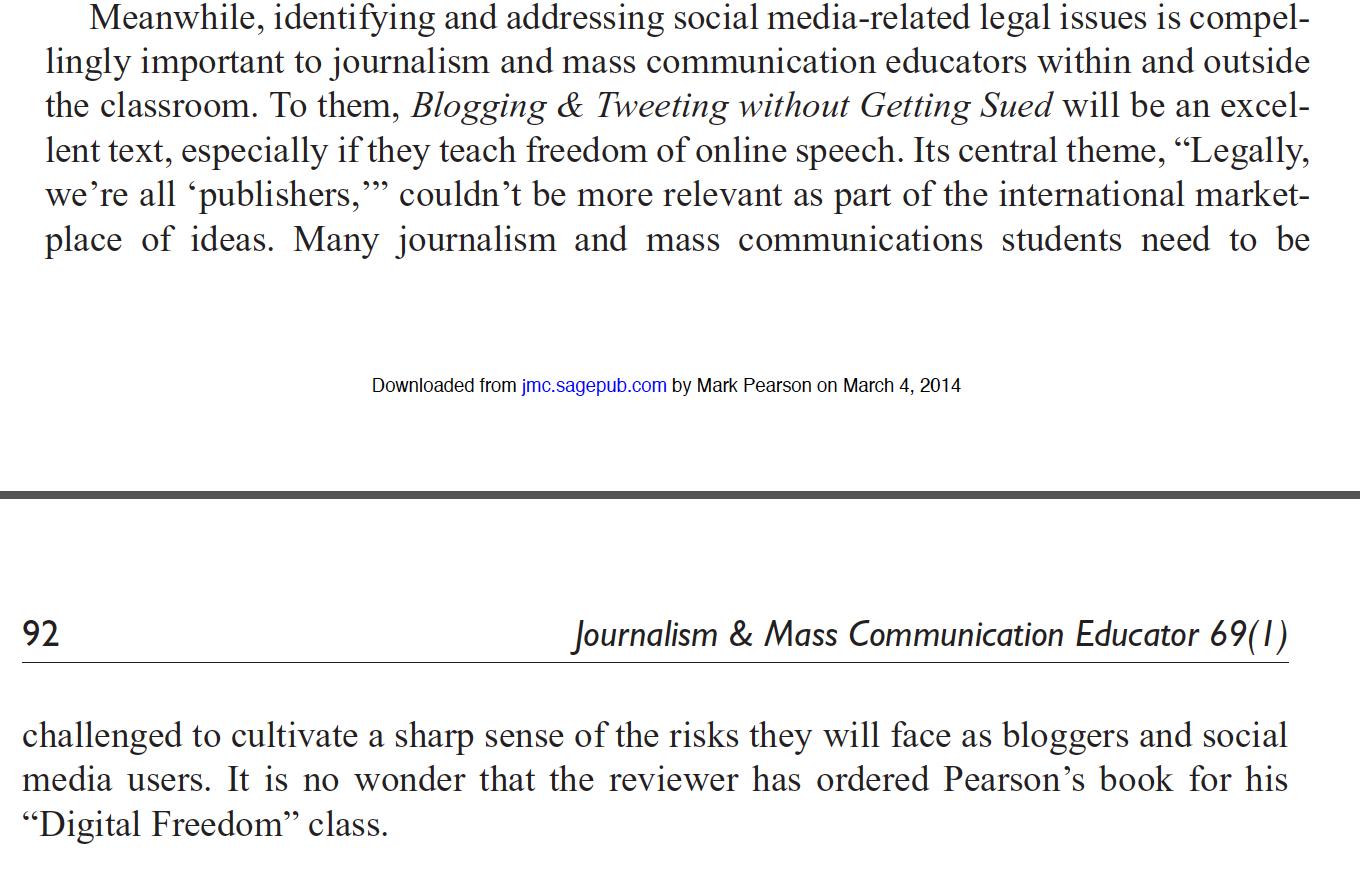
The top media law academic in the US, Professor Kyu Ho Youm, has just reviewed my recent book Blogging and Tweeting Without Getting Sued in the leading journal Journalism & Mass Communication Educator.

Prof Youm is Jonathan Marshall First Amendment Chair at the University of Oregon School of Journalism and Communication and immediate past president of the 3700 member Association for Education in Journalism and Mass Communication.

His review was a lesson in academic book reviewing. He did considerably more than just criticise or praise the book (though he did both at various points!). Prof Youm manage to inject new gems of knowledge and insight about the field in the process, including the suggestion of additional reading and cases that have been since decided.

He concludes by recommending it as a text:-).

Screen Shot 2014-03-06 at 5.23.20 PM

Read the full review at http://jmc.sagepub.com/content/69/1/90.citation.

© Mark Pearson 2014

Disclaimer: While I write about media law and ethics, nothing here should be construed as legal advice. I am an academic, not a lawyer. My only advice is that you consult a lawyer before taking any legal risks.

Leave a comment

Filed under Media regulation, Uncategorized

Republished: We all must learn from the #CharlotteDawson saga

With the sad news of the death of television personality Charlotte Dawson over the weekend,  I repost this commentary I wrote for The Australian in September, 2012 after she had attempted to take her own life.

———-

By MARK PEARSON

[Note: First published in The Australian on September 3, 2012.]

THERE are important lessons for us all in the near tragic saga of TV personality Charlotte Dawson and Twitter. [2014 note: clearly, it is now tragic]

And those lessons must be learnt not just by the media, but also by policymakers and the broader community.

The story of Dawson’s hospitalisation [in 2012] after receiving a torrent of life-threatening and demeaning tweets contained all the contradictions of our Web 2.0 world: risk versus reward, connection versus alienation, celebrity versus anonymity and freedom versus censorship.

When Dawson revealed a Monash University staffer was the source of some earlier postings and the employee was suspended, that “outing” triggered the final spate of insults and threats, and Dawson’s own sad messages from her @MsCharlotteD handle before her hospitalisation. The tweets raised the contentious legal issues of defamation, cyber-bullying, confidentiality, privacy, racial discrimination, jurisdiction and even unfair dismissal.

Dawson is [was] a former fashion model who has traded on her own harsh comments to contestants in a reality-TV program and in newspaper interviews where she has pilloried her home country of New Zealand.

Like many celebrities she has established a strong Twitter following of 21,450 [in 2012]- now seen as a crucial dimension to any wannabe A-lister’s public profile. In May, she tweeted a call for someone to “please kill” a fashion blogger, @BryanBoy, which she defended as a joke.

Of course, none of this justifies anonymous trolls threatening her life or urging her to kill herself, but it provides some context to the vitriol. It also defies the simplistic media story line of “evil social media causes real-life tragedy”. Dawson has previously spoken of life events that have rendered her emotionally vulnerable.

The issue of the media’s interaction with the vulnerable in our society recently gained traction with changes to journalism ethical codes in the wake of the federal government’s Mindframe media training initiative and associated research projects.

Some of that research demonstrated the flow-on effect of celebrity suicides and threats upon their vulnerable fans, making this example even more concerning.

Mindframe has been extended to schools, public relations courses and the courts, but social media proves the sensitivities of the vulnerable have not yet pierced the consciousness of many ordinary citizens.

It’s just one example of the rift between traditional and digital media in the Dawson event and its reportage. Journalists and executives in the old media are frustrated by the two-speed regulatory system. News organisations face legal and ethical brakes on their coverage while rumour, gossip and vitriol run wild on social media in defiance of legal prohibitions. Despite the predictable opportunism of some politicians, the case does not call for tougher laws to “control” social media. They already exist.

Earlier this year [2012], the Federal Court ordered News Limited to pay $12,000 to the mother of indigenous boys killed in a car accident over anonymous comments it hosted on its website Perthnow.

A Queensland “troll” was jailed last year [2011] for defacing the Facebook tribute pages of two slain children. In 2010, an anonymous poison penner in Victoria was hit with a $30,000 defamation judgment over comments about a Perth businessman.

[Former] Communications Minister Stephen Conroy has lobbied US-based social media platforms such as Twitter and Facebook to provide speedier action over breaches of their terms of use.

But legal proceedings are unlikely to have any effect given the First Amendment and legislative protection for internet hosts in the US.

Instead of introducing more gags on free expression and policing them, politicians should invest those resources in funding education and training initiatives for responsible social media use in schools, tertiary institutions and the broader community.

For information about cyberbullying go to cybersmart.gov.au or contact Lifeline on 13 11 14.

© Mark Pearson 2012 and 2014

Disclaimer: While I write about media law and ethics, nothing here should be construed as legal advice. I am an academic, not a lawyer. My only advice is that you consult a lawyer before taking any legal risks.

6 Comments

Filed under Media regulation, mental health, social media, Uncategorized