Category Archives: Uncategorized

Prejudging justice – lessons from the US

By MARK PEARSON

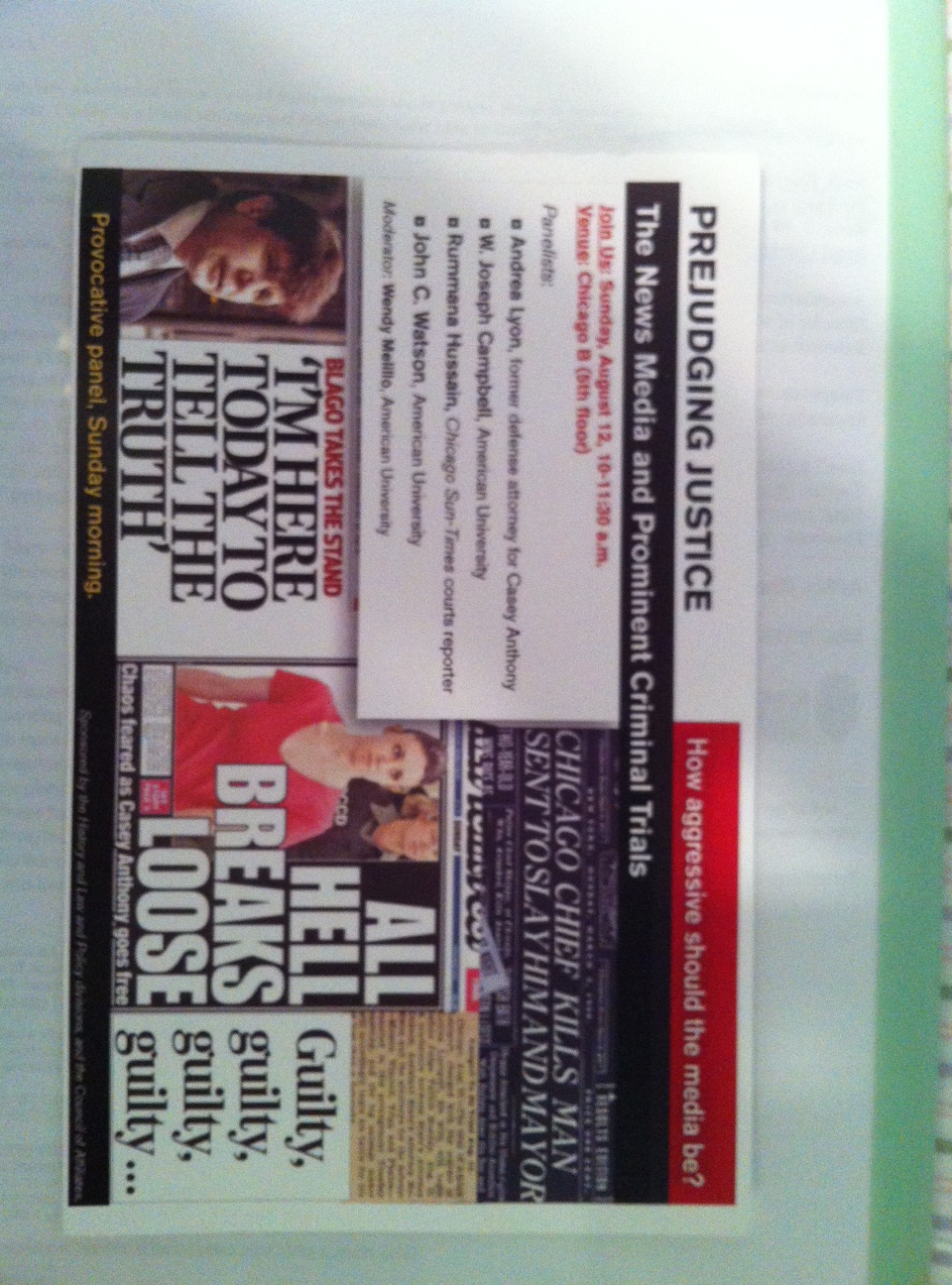
A riveting session at this week’s AEJMC convention in Chicago was billed “Prejudging Justice: The News Media and Prominent Criminal Trials”, featuring high profile defence attorney Andrea D. Lyon – known as the ‘angel of death row’.

Lyon won a murder acquittal last year for Casey Anthony who was accused of killing her two-year-old daughter Caylee, a trial attracting global media attention.

Her experience in that case and many others has informed her critical view of the US approach to high profile trials, which she explains in detail in a recent article in the Reynolds Courts and Media Law Journal.

Lyon has formed the view that publicity generally hurts a criminal defendant and leads to a presumption of guilt rather than innocence in the minds of jurors.

It is worth considering the views of Lyon and her fellow panelists at a time when courts in Australia and other Commonwealth jurisdictions are looking to the US example as a potential salve to their growing concerns about prejudicial Web 2.0 coverage of trials.

One view is that the only option is to move to a US system where the solution is via instruction to jurors to avoid accessing social media materials related to the case, sequestering juries or moving trials to a new location distant from the heat of publicity.

Professor W. Joseph Campbell from American University gave an insight into the lengths US journalists have been willing to go in their coverage of sensational crimes.

The antics of newspaper journalists during the 1897 ‘sausage murder’ trial in Chicago far outstrip the more recent phone hacking sins of News of the World reporters and private eyes.

As Campbell explained, journalists were so desperate to hear the deliberations of the locked jury in this case that they lowered a reporter from the Independent by rope down an air shaft from the attic of the courthouse building so he could listen to the jurors’ discussions and relay them back to his co-conspirators using a hose.

Chicago Sun-Times courts reporter Rummana Hussain explained this would never be attempted or tolerated today, given the hurdles presented to her and other media in the recent Balfour murder trial where the victims were relatives of celebrity Jennifer Hudson, prompting substantial media attention.

Hussain was left to negotiate with the judge the reporting permissions of the whole press contingent and was able to extract the privilege of using cellphones to communicate from the court to their newsrooms via text messages.

But she could not convince him to allow live tweeting from the courtroom – only from the overflow room where the proceedings were televised.

Even that arrangement was suspended for a day by the irate beak after a reporter’s phone sounded in the court after his numerous warnings to place them in silent mode. Hussain explained she even had to play attorney and present to the court an argument on why the media should be granted access to tapes played during proceedings.

American University journalism professor John C. Watson drew upon communication news framing theory to propose that journalists should frame their court and crime stories in terms of what citizens needed to know instead of merely what the public wanted to know.

“The press create a scenario in which the defendant is assumed to be guilty,” he told the audience. “The press has framed the case from the prosecutorial perspective.”

He said the judiciary was potentially the most dangerous branch of government with real potential to deprive citizens of their constitutional rights to life, liberty and their ability to pursue happiness.

“The judicial process can kill innocent people and the press are the first line of defence against that,” he said.

“Journalists have to remember they are reporting for the primary purpose of protecting the people against their government.”

He pointed to an emerging crisis with the coverage of trials on social media, and suggested the British system where there was “no reporting until afterward” might be a preferable alternative to the US approach.

But the panel’s “star witness”, Andrea Lyon, took the line that open coverage was important to the judicial process, but must be exercised responsibly.

“The prosecution already has a lot of power – there are almost no brakes on it,” she said. “There are no brakes on framing someone. The only way we’ll have brakes is through fair reporting.”

She took issue with the privacy invasion and voyeurism of coverage in sensational trials.

“I’m sick of my clients’ and victims’ terrible stories becoming fodder for cheap entertainment,” she said.

She was physically assaulted twice during the Casey Anthony trial and was angered when a major newspaper republished a blog detailing the time she would arrive at court and contemptlated “the trouble they would get in for just hitting me rather than hitting me with a bat”.

She wrote in the Reynolds Courts and Media Law Journal article: “What is troubling is the public’s fascination with this case, the need to make Anthony a villain, and how the media helped feed this mob mentality.”

“They landed, heavily, on any witness who spoke up in Anthony’s favor, making witnesses extraordinarily difficult to find and interview because everyone was afraid of the backlash from the public and the prosecution,” Lyon continued.

She told the seminar she regretted the negative influence of the television program “Law and Order” on the public perception of courts and trials, as well as the rise of “expert” court commenters who typically knew little about the specific cases they were discussing but were fodder for television commentary because of their legal training.

Social media aggravated the situation, she said, with more than 100 blogs devoted to the Casey Anthony case.

Australian, New Zealand and British policymakers could learn much from this session as they contemplate a future of more open public discussion of prominent trials in social media – even if tough restrictions on the legacy media are maintained.

This “two-speed” approach might well keep the pages of the press and the airwaves of radio and television free of prejudicial material.

But it is naive to think that prospective jurors and witnesses will not venture onto blogs, Facebook and Twitter to get every salacious detail on a celebrity accused in the next big Whodunnit.

Short of effective controls across jurisdictions in cyberspace, which appears unlikely, it seems the integrity of the jury system will rely on effective instructions to jurors and better justice education for the broader citizenry.

© Mark Pearson 2012

Disclaimer: While I write about media law and ethics, nothing here should be construed as legal advice. I am an academic, not a lawyer. My only advice is that you consult a lawyer before taking any legal risks.

2 Comments

Filed under Uncategorized

Mental illness, the news media and open justice: the Australian experience

By MARK PEARSON

I’m in Chicago to present a paper tomorrow to the Association for Educators in Journalism and Mass Communication (AEJMC) convention – one of the world’s largest gatherings of journalism academics.

My paper is an extension of earlier work stemming from research grants from the Australian Government’s Mindframe National Media Initiative, published as an article in the May 2011 edition of the Pacific Journalism Review, and as a chapter in our book Courts and the Media: Challenges in the era of digital and social media (with Patrick Keyzer and Jane Johnston (eds), Halstead Press, 2012). You can find my summary of that chapter in an earlier blog.

In this paper, I canvas a complex array of public interests which compete in the contested terrain shared by people with mental illness, journalists, lawyers and policy makers.

Ancient principles of open justice are at odds with more modern notions of privacy and concerns that media attention might be counter-productive to the treatment of mental health patients. The paper looks at the intersection of those interests across Australia’s nine jurisdictions, where courts and parliaments have chosen to approach them in different ways, leading to a confusing cocktail of publication restrictions on the media’s reportage of matters involving citizens experiencing mental illness.

The paper canvasses the differences between jurisdictions and considers three case studies, including a recent landmark decision in the UK, illustrating the competing interests at stake.

It concludes by foreshadowing some key research needs so that policymakers might be better informed in an era when the news media outlets telling the stories of the mentally ill are not confined within jurisdictional borders.

The three case studies of different instances across different jurisdictions serve to highlight the spectrum of competing private and public interests involved in such cases.

On one side of the ledger there is open justice, transparency, and the public interest in the education of the community and policy makers about mental illness generally and also about the cost and processes of mental health justice and review processes. In forensic matters, open justice also implies the right of victims and the public to follow a matter through the system, even when the accused has been found not guilty on mental health grounds.

Balancing these are quite legitimate concerns about the effective treatment of mental health clients, the risks of tabloid-style sensationalising of mental illness, patient-health professional confidentiality, and the privacy of patients and those with whom they interact.

I use three case studies to illustrate different approaches to open justice in the mental health system:

  • The UK case of high security patient Albert Laszlo Haines who appealed to have his discharge hearing heard in public shows that not all mental health patients value their privacy over publicity about their cases and that there are lessons to be learned from transparent public appeal processes.
  • The Victorian case of the taxi driver XFJ (allowed to hold a cab licence in Victoria despite having stabbed his wife to death in 1990 and being found not guilty by reason of insanity) demonstrates that media outlets can indeed sensationalise some cases, but it also shows that important matters of legitimate public concern can be debated when proceedings are reported thoroughly using pseudonyms.
  • Western Australia’s case of mentally impaired indigenous man Marlon Noble case who had been detained for almost a decade without trial on sex charges, illustrates that open media reportage can inform the public about the mental health and corrective services systems and the plight of vulnerable individuals who might be the victims of miscarriages of justice or simply lost in the red tape of intersecting bureaucracies.

The paper concludes by arguing the competing rights and interests in the cases help explain the variations in the way lawmakers have approached the issue of publicity of mental illness processes in different jurisdictions. However, while it might explain the variations, it also highlights the need for research-driven reform in the area.

Further research can be undertaken into the attitudes of policymakers and judicial officers to transparent proceedings, longitudinal studies into the impacts of publicity upon all stakeholders, analysis of the views of forensic patients’ victims and families about open proceedings, as well as content analysis of court and tribunal decisions to assess the points at which proceedings are closed or suppression orders are issued.

The advent of the Internet, Web 2.0 and its inevitable advancements render major jurisdictional differences an anachronism. Neither the news media nor social media are contained within traditional state, territory or national borders.

Mental health patients and journalists cross borders frequently – both physically and virtually.  The time is ripe for policymakers, mental health professionals, journalists and legal professionals to address these unnecessary jurisdictional differences and work towards a research-driven model allowing for reasonably open media scrutiny of mental health processes while respecting the privacy rights and treatment needs of the vulnerable.

——–

Disclaimer: While I write about media law and ethics, nothing here should be construed as legal advice. I am an academic, not a lawyer! My only advice is that you consult a lawyer before taking any legal risks.

© Mark Pearson 2012

1 Comment

Filed under Uncategorized

Is your blog ‘in the public interest’ or just ‘interesting to the public’?

By MARK PEARSON

[Adapted from my new book  – Blogging and Tweeting Without Getting Sued: A global guide to the law for anyone writing online (Allen & Unwin, 2012).]

—————-

Is your blog ‘in the public interest’ or just ‘interesting to the public’?

If something you have posted becomes the subject of legal action, lawyers, prosecutors and judges will usually look to your motives for publishing the material. In some places those motives can actually form a defence, while on other occasions your motives can be your undoing. But two are worth considering here because of their very different impact on the law – ‘public interest’ and ‘malice’.

Many statutes and court rulings use the expression ‘public interest’ as an element of a defence to a range of publishing crimes and civil wrongs. In such matters you would have to convince the court that some greater public good came from the material you published and that society benefited in some way as a result. You would normally need to show that any public benefit outweighed the harm that was caused by the publication, which is normally the reason you are called to account. For example, your defence to a defamation action might be that it was in the public interest that your audience learned of your corruption allegations against a leading politician, even if you could not quite prove that the allegations were true.

Many jurisdictions offer a ‘public interest’ or ‘qualified privilege’ defence for defamatory material about extremely important public issues but the publisher might not have quite enough evidence available to prove truth and other defences might not apply.

It’s important to distinguish here between matters of legitimate ‘public interest’ and other matters such as celebrity gossip which might be just ‘interesting to the public’.

Even so, under special protections in the US writers can get away with false publications about celebrities and other public figures as long as you are not being malicious in your attacks. Again, you need to be wary of less forgiving laws in other places, particularly if the celebrity has a reputation they wish to defend elsewhere – perhaps the Australian actress Nicole Kidman or the New Zealand film-maker Peter Jackson.

In other countries the public interest or qualified privilege defence normally requires you to show that you acted in good faith and made proper enquiries in the lead-up to your defamatory publication, despite being unable to prove its truth.

Journalists may be better positioned to make use of this defence than so-called ‘citizen journalists’ or amateur bloggers because they have been trained in research skills and verification practices.

However, there has been nothing to indicate that bloggers or social media users will not qualify for the defence because of what they do. In fact, the Minnesota District Court granted a Republican blogger Michael Brodkorb the same rights as a traditional reporter when he had cited an anonymous source to accuse a Democratic political advisor of self-interest.

In some areas of the law the words ‘public interest’ are not used, but the defence itself has come from a balancing of public interests against other rights. For example, copyright law in most countries has a range of ‘fair use’ defences so that parts of copyright material can be republished for the purposes of education, news or critique.

The defences exist because politicians have decided that there is a greater ‘public interest’ in the community being educated and informed about such important matters than in protecting the intellectual property owned by the creator of the work. As many judges have pointed out, ‘public interest’ does not equate with ‘interesting to the public’, and you should not be allowed to destroy someone’s reputation or invade their privacy simply because your gossip is particularly saucy.

By far the best known right to free expression is the First Amendment to the US Constitution. It states: “Congress shall make no law … abridging the freedom of speech, or of the press.” The US Supreme Court has interpreted the First Amendment very broadly and has applied it across media to a whole range of publishing situations. It certainly applies to the material bloggers, Facebook users and tweeters create – particularly if you are commenting on matters of public importance.

In a series of media decisions throughout the 20th century the Supreme Court allowed newspapers and broadcasters to use the First Amendment to bolster their defences against laws affecting their publications. This was especially useful in defamation law where a whole defence developed allowing the media to publish libellous material about a public figure as long as they did not know it was false and they were not being malicious.

The First Amendment is so entrenched in US society that bloggers sometimes operate under the assumption this same protection will apply in other parts of the world. Unfortunately, it does not.

Is deception in the public interest?

Sometimes bloggers will use the age-old journalistic excuse for deception – that it was in the ‘public interest’. That was the argument Cuban exile Luis Dominguez gave for adopting the guise of a 27-year-old female Colombian sports journalist to trick Fidel Castro’s son into sharing details of his opulent lifestyle. As the BBC reported, the blogger posted images and documents taken from his online flirting with 40-year-old Antonio who had a penchant for both sports and women.

“I’m a Cuban and I’m a Cuban American and I have not been able to go back to my country since 1971 when I left,” he told the BBC. “I use whatever tools I have to be able to get back at these people. In Cuba people are put in prison for no reason at all. Their rights are violated… So, why can’t I do the same thing to them? I have no remorse whatsoever.”

While ‘public interest’ might be a worthy moral motivation for your deception, it will rarely work as a defence in its own right, particularly if your actions are criminal. Get sound legal advice before relying upon it.

© Mark Pearson 2012

Disclaimer: While I write about media law and ethics, nothing here should be construed as legal advice. I am an academic, not a lawyer. My only advice is that you consult a lawyer before taking any legal risks.

1 Comment

Filed under Uncategorized

Lost cause? The Convergence Review model for news media self-regulation

By MARK PEARSON

Australia’s news media regulatory framework has been the subject of two recommendations for major overhauls in recent months.

It was the $2.7 million Convergence Review, announced in late 2010, that was meant to develop the definitive regulatory model in its final report released in April, 2012.

But along the way political pressures (or opportunism, depending on who you want to believe) prompted the announcement last September of an offshoot – the $1.2 million Independent Media Inquiry – specifically briefed to deal with the self-regulation of print media ethics.

Its architects – former Federal Court judge Ray Finkelstein and journalism professor Matthew Ricketson – argued they could not decouple print news self-regulation from broadcast ‘co-regulation’ in the digital era, so came up with a statutory model including both.

Their News Media Council, proposed in their report of February 28, 2012, would take over from the existing Australian Press Council and Australian Communications and Media Authority with a streamlined news media ethics complaints system with teeth. Refusal to obey an order to correct or apologise could see a media outlet dealt with for contempt of court and ultimately face a hefty fine or a jail term.

I have written previously on my concerns about the implications of these recommendations on Australia’s international standing as a democratic nation with a free media, particularly in light of our lack of any written constitutional protection of free expression.

The ‘Finkelstein report’ – as it became known – was only ever meant to be an advisory to its parent Convergence Review, which ultimately acknowledged but rejected its simplistic model in favour of its own innovative and less draconian one.

But the Convergence Review left it to others to put flesh on its more complex reform proposals, leaving the Finkelstein statutory regulation model to fill the void for Labor and Green politicians riding the wave of concern about media ethics in the wake of the UK’s News of the World inquiry and arguing that ‘something must be done’ in Australia.

According to news reports, the parliamentary winter recess will be used by Prime Minister Julia Gillard, Communications Minister Stephen Conroy and the Greens to rally support for the enactment of a version of the Finkelstein model.

Experts argue they will lack the numbers to drive it home, and it is unlikely a 2013 conservative government would take up the cause, given the antipathy of leading Opposition figures Malcolm Turnbull and George Brandis.

Meanwhile, the Convergence Review’s innovative ‘carrot and stick’ model of self-regulation has all but disappeared from public commentary, overshadowed by the stark divide over Finkelstein’s statutory regulation proposal between the Opposition (and major media players) and the Government, Greens and anti-Murdoch intellectuals.

It is a shame the debate has been reduced to this black and white (red versus blue) battle.

I am working on a longer academic article examining the Convergence Review’s novel but sparsely articulated attempt at dealing with the evolving regulatory demands of Web 2.0 (and 3.0 and 4.0…), but I will share some preliminary thoughts here.

First, to review the Convergence Review’s proposed model. While its final report shared Finkelstein’s concerns about shortcomings with existing regulatory systems, it proposed that ‘direct statutory mechanisms … be considered only after the industry has been given the full opportunity to develop and enforce an effective, cross-platform self-regulatory scheme’. In other words, it was offering the media industry ‘drinks at the last chance saloon’ for a three year period under its model (p. 53).

Its mechanism centres upon the establishment of a new ‘news standards body’ operating across all media platforms – reinforcing the overall review’s preference for ‘platform neutrality’ (p.51).

The news standards body ‘would administer a self-regulatory media code aimed at promoting standards, adjudicating complaints, and providing timely remedies’ (p. 153).

The Convergence Review decided not to be prescriptive about the constitution or operational requirements for such a body, beyond some broad requirements.

The largest news media providers – those it deemed ‘content service providers’ – would be required by legislation to become members of a standards body. Most funding for the new body should come from industry, while taxpayer funds might be drawn upon to meet shortfalls or special projects. (p. xiv). It should feature:

–       a board of directors, with a majority independent from the members;

–       establishment of standards for news and commentary, with specific requirements for fairness and accuracy;

–       implementation and maintenance of an ‘efficient and effective’ complaints handling system;

–       a range of remedies and sanctions, including the requirement that findings be published on the respective platform. (p. 51)

The review’s definition of ‘content service enterprises’ (control over their content, a large number of Australian users, and a high level of revenue drawn from Australia) would catch about 15 media operators in its net.

Others might be encouraged to join the body with a threat to remove their current news media exemptions to privacy laws and consumer law ‘misleading and deceptive conduct’ provisions.

To my mind, this is the most innovative element of the Convergence Review’s proposal, and is something I proposed in my personal submission to the Independent Media Inquiry and blogged about at the time.

The review only deals with this aspect as a hypothetical, and refers readers in a footnote to pages 127-136 of the Independent Media Inquiry report for extended explanation of the exemptions. The review offers just a single sentence by way of explanation:

“In particular, it seems reasonable that only those organisations that have committed to an industry self-regulatory scheme for upholding journalistic standards of fairness and accuracy should be entitled to the exemptions from the provisions of the Competition and Consumer Act 2010 concerning misleading and deceptive statements and from the obligations of the Privacy Act 1988 that would otherwise apply to those organisations.” (p. 51).

My article will explore these further, going into the history of the exemptions and important case law covering on their application.

Take these away, and the review’s recommendations are relatively meek, and unlikely to appease those wanting stricter controls over news content.

The Australian Press Council has been moving quickly to ramp up its purview and powers over its members, and can meet most of the requirements except these. It has already locked its members into four year commitments and has established an independent panel to advise on its review of its content standards.

It is poised to apply this across all media if broadcasters and online providers decide it offers the simplest mechanism to meet the Convergence Review’s recommendations. Either way, it can quite rightly argue that newspaper and online news readers are being serviced by a superior complaints handling system than that which existed before the inquiries.

In my view, the Convergence Review report needed to position its privacy and consumer law exemptions as much more than hypotheticals and to detail its plans for the implementation of these proposals.

But I suspect its members were caught short on time and resources when the Independent Media Inquiry went too far for its liking with its statutory regulation solution.

It’s a shame that a multi-million dollar inquiry like this one has left it to academics like me to dot its i’s and cross its t’s on detail.

It’s a greater shame that politicians wish to capitalise on a moment of public antipathy to the media to introduce a draconian, simplistic solution in a democratic nation with no documented right to free expression.

© Mark Pearson 2012

Disclaimer: While I write about media law and ethics, nothing here should be construed as legal advice. I am an academic, not a lawyer. My only advice is that you consult a lawyer before taking any legal risks.

Leave a comment

Filed under Uncategorized

Regulating the interaction between journalists and the vulnerable

By MARK PEARSON

This week I am in Shah Alam, Malaysia, for the 2012 Asian Media Information and Communication Centre Conference. The paper I am presenting Thursday is titled ‘Regulating the interaction between the news media and the vulnerable – the Australian experience’.

It will eventually be published in an academic journal, but I provide a summary here.

It reports on a selection of findings from a national collaborative research project examining the interaction between the Australian news media and so-called ‘vulnerable sources’.

It surveys the codes controlling journalists’ behaviour via in-house industry-based codes of practice and those administered by the Media Entertainment and Arts Alliance (MEAA), the Australian Press Council (APC) and the Australian Communications and Media Authority (ACMA).

It looks particularly at codes and regulations controlling privacy, intrusion, grief, children, mental illness and discriminatory reportage. It considers the vulnerable source issue in stories collected during a year’s selective sampling of the national daily newspaper, The Australian.

Special attention is paid to three years of decisions by the APC and the ACMA which have been coded and analysed according to the type of vulnerability involved, the guideline allegedly breached, and the result of the complaint.

It explains that there are many ‘moments of vulnerability’ that escape the hard and fast letter of laws and codes that seem to be left to the moral and ethical judgment of individual reporters and editing teams, demanding a fresh approach to in-house self-regulation.

I collaborated with five other academics and industry partners (listed below) in a $92,000 Australian Research Council Linkage project over two years to examine how journalists interacted with those who might belong to a ‘vulnerable group’ (such as the disabled, indigenous, children, those who have undergone trauma or grief, or those with a disability or mental illness) or those who might simply be ‘vulnerable’ because of the circumstances of the news event.

We decided instead to direct our inquiries, particularly during the newspaper content analyses, to identifying potential ‘moments of vulnerability’ rather than restricting our search to mentions of the pre-identified source groups.

Similarly, the analysis of the complaints decisions of the APC and the ACMA worked to the principle of moments of vulnerability rather than being driven particularly by a source’s membership of a pre-determined vulnerable group.

Taken at its broadest definition, all citizens are ‘vulnerable’ when they engage in any media interview. There is a potential for that interview or its resulting publication to go wrong, with associated embarrassment, emotional pain and in extreme cases even physical retribution from hostile audience members.

A total of 33 items were identified as depicting ‘moments of vulnerability’ from the coverage analysed for The Australian newspaper on the selected day in each of the 12 months of the 2009 calendar year. The sample was too small for quantitative analysis, so no statistical breakdown of the findings will be provided other than a simple count on some criteria. The analysis mainly takes the form of a qualitative study of the items, selecting key examples to explore the ‘moments of vulnerability’ and to offer a backdrop to the matters raised before the complaints bodies examined in the subsequent section.

We identified 33 ‘moments of vulnerability’ identified in the published stories, based upon 31 stories on the selected 12 days’ coverage in The Australian.

The 33 moments of vulnerability were categorised into PTSD/grief (14), mental illness/suicide (9), children (3), disabled (3), privacy (2), aged (1) and discrimination (1). All such moments were also assessed for the level of competing public interest/social importance value evident in the matter being reported to eliminate examples where the public interest arguments were so strong that it could be seen that editors could easily argue their decisions were driven by legitimate matters of social importance.

A process of elimination left us with seven key ‘moments of vulnerability’, centred on Australia-based stories, where public interest issues did not clearly excuse the type of coverage or interaction with vulnerable sources as presented.

The seven selected are summarised in Table 1, grouped according to the type of vulnerability, and each is then considered as a brief case study.

Table 1: ‘Moments of vulnerability’ identified in The Australian on selected days during 2009

Date Page Headline Type of vulnerability Summary and issues
3-2-09 3 DOCS urges fugitive mother to return Child This was a custody issue where a mother had allegedly kidnapped her son and fled overseas. Potential impact of comments by child welfare expert upon mother’s decision to remain at large.
9-4-09 16 D’Arcy puts head down amid crisis Mental illness/suicide Both articles juxtapose champion swimmer’s axing from the national team with that week’s suicide of top cyclist.
9-4-09 16-15 No repeat of headline acts which delivered day of shame Mental illness/suicide
6-6-09 43-44 The night Symonds was cut adrift / Symonds comes to end of the road Mental illness/suicide Links champion cricketer’s alcohol problems with allusions to suicide possibility, with risk of prompting that outcome.
13-11-09 3 Suspect may have killed himself Mental illness/suicide Speculates murder suspect may have self-harmed or suicided, potentially triggering that course of action.
11-8-09 3 Son dead, mother acute PTSD/grief Clearly a ‘death knock’ telephone attempt to speak to family or close colleagues after murder-suicide attempt.
9-9-09 3 Sandilands offends again Discrimination Story repeats a radio host’s offensive remarks about the weight and race of a female comedian in its own recount of the matter.


The conference paper explores each in detail. It then goes on to analyse five years of APC decisions between 2006-2010 and three years of ACMA decisions in 2008-10 in a similar approach to that undertaken for The Australian newspaper analysis, with interesting results.

Australian Press Council does not use the word ‘vulnerable’ or ‘vulnerability’ in its Statement of Principles, which addresses other criteria, many of which go to the issues we address in our study. Thus, we are placing (retrospectively) a different lens of analysis on the items of complaint.

The fact that we identified only 12 complaints regarding journalists’ interaction with ‘vulnerable sources’ adjudicated by the Australian Press Council over the 2006-2010 period indicated either:

  • News media interaction with vulnerable sources is not as negative as portrayed by inquiries such as the Independent Media Inquiry;
  • Alternative dispute resolution techniques offered by the APC in the earlier stages of the hundreds of complaints it receives annually are effective; or
  • Complainants are not pursuing their complaints or are withdrawing them at an earlier stage.

Vulnerable sources may well have a desire to complain, but not the energy or competence at the time to do it. Reforms to the Australian Press Council’s structure processes recently announced by its chairman, Professor Julian Disney, might consider some of these concerns.

Our study also examined the reports of the ACMA investigations in the 2007-10 period and identified the following 11 as pertinent to our study of the interaction between the news media and vulnerable sources.

A key problem of the ACMA process is that journalists are working under a variety of codes of practice controlling similar behaviours. Added to this are various ‘guidelines’ documents issued by the ACMA providing further counsel for broadcasters in their handling of sensitive issues. One such set of guidelines is the Privacy Guidelines for Broadcasters. These were reviewed during 2011 and our ARC team made submissions to that review on issues of interactions with the vulnerable, and particularly with issues of consent and withdrawal of consent by the vulnerable, particularly children. Their revised guidelines addressed these issues.

The regulatory, co-regulatory and self-regulatory mechanisms in operation in Australia have been under serious review in 2012, with new models proposed by the Independent Media Inquiry for a statutory News Media Council and by the Convergence Review for an independent self-regulatory news standards body.

There is a separate government proposal for statutory tort of privacy which extends beyond the news media but may include media or public interest exemptions. All acknowledge public concern at the confusing array of ethical codes and processes across media platforms and workplaces.

The news media interact with vulnerable sources in a range of circumstances, but the rules controlling that interaction vary markedly across media platforms and employment groups. The small sample of case studies from The Australian newspaper serves to demonstrate that some interactions with the vulnerable are not prevented by in-house codes and escape the attention of the relevant self-regulatory bodies unless a complaint has been made and remains unresolved. The APC and ACMA cases show that the outcomes of complaints are far from predictable and that sometimes elements of vulnerability appear obvious but are not even examined by the inquiring body. The examples demonstrate there are many ‘moments of vulnerability’ that escape the hard and fast letter of laws and codes that seem to be left to the moral and ethical judgment of individual reporters and editing teams.

Whatever new regulatory system is put in place requires a simple statement of ethical principles covering the usual fairness and accuracy elements, with an additional responsibility placed upon journalists and editors to identify individuals who are particularly ‘vulnerable’ in a news media interaction so that warning bells sound and informed decisions are taken on issues like consent and privacy.

This can only be achieved via genuine newsroom-driven training programs, accompanied up by routine protocols for assessing individual cases of vulnerability as they arise in the field and in the production process. Decisions taken in such circumstances should be documented thoroughly for later review and any rationale on ‘public interest’ grounds should carry justification well beyond audience curiosity, going to serious matters of public importance that could not be offered by less intrusive or traumatising ways.

Line-ball decisions should be made only after consultation with an independent psychologist and an explanation for the decision should be published on the outlet’s website. Only then – when ethical decision-making can be audited in a publicly accountable way – can Australian media organisations lay legitimate claim to effective self-regulation.

Research team

Professor Kerry Green from the University of South Australia led the ARC Linkage Project LP0989758. Other chief investigators on the project included Professor Michael Meadows (Griffith University), Professor Stephen Tanner (University of Wollongong), Dr Angela Romano (Queensland University of Technology) and this author, Professor Mark Pearson (Bond University). Industry partner investigators were Ms Jaelea Skehan (Hunter Institute of Mental Health) and Ms Cait McMahon (Dart Centre for Journalism and Trauma- Asia Pacific). Mr Jolyon Sykes was the research assistant for the larger project, while Mr John Burns, Mr Jordan Lester, Mr Roger Patching, Ms Kiri ten Dolle and Mrs Leisal DenHerder provided research assistance for my AMIC paper.

© Mark Pearson 2012

Disclaimer: While I write about media law and ethics, nothing here should be construed as legal advice. I am an academic, not a lawyer. My only advice is that you consult a lawyer before taking any legal risks.

Leave a comment

Filed under Uncategorized

Queensland’s biggest publisher – the police – try to calm the FB lynch mob

By MARK PEARSON

The resources of the Queensland Police Service Facebook fan page were stretched over the past 24 hours to cope with the public response to their announcement of an arrest of a suspect in one of Brisbane’s most compelling ‘whodunnit’ murder mysteries.

Mainstream and social media speculation about the case has been rampant since 43-year-old Allison Baden-Clay went missing on April 23. Her husband Gerard appeared in court today charged with her murder.

As I have blogged previously, the Queensland Police Service has a highly successful Facebook page which established the bulk of its 289,500 fan base during the devastating Brisbane floods in January last year. It proved an excellent community communication tool during the disaster and since then as a crime detection aid as the public volunteer leads on unsolved crimes and public safety.

But the challenge comes when Police Media announce on their Facebook page the apprehension of a suspect in a high profile case.

The problem with Facebook fan pages is that you must have the ‘comment’ function turned completely ‘on’ or ‘off’ – so the best the police can do is monitor the feed and remove offensive or prejudicial material after it has been posted.

That might be fine during an uneventful day when the police social media team can keep on top of the message flow – but when an arrest has been made in an emotion-charged crime like a murder or a child sex attack many fans want to ‘vent’.

That’s what happened with the arrest of a suspect in the murder of Sunshine Coast teenager Daniel Morcombe last August.

It happened again last night and today as, within 21 hours, more than 500 fans commented on the Police Media announcement that Baden-Clay had been charged with his wife’s murder and more than 1,500 ‘liked’ the announcement. Those 506 comments were the ones that survived the post-publication moderation process where officers in the social media unit trawl through the latest posts to delete the inappropriate ones.

The law of sub judice in Australia dictates that nothing can be published that might prejudice the trial of an accused after they have been arrested or charged. That includes any assumption of guilt (or even innocence), evidentiary material, theories about the crime, witness statements, prior convictions or character material about the accused. It even bans visual identification of the accused if that might be an issue in court. In a murder trial it usually is.

The penalty can be a criminal conviction on your record, a stiff fine and sometimes even a jail term for contempt of court.

Once the accused has appeared in court, journalists covering the matter are protected from both contempt and defamation action if they write a ‘fair and accurate’ report of the hearing, sticking to material stated in open court in the presence of the jury – if there is one.

It’s hard enough for reporters to get their heads around these rules – let alone the Facebook fans posting their theories on a murder to the police Facebook page.

Even some of the posts that have survived the police editing process to date push the boundaries of acceptable commentary on a pending case.

One stands out: “Ann Gray: Took long enough. It was obvious that he did it. Hope he rots in jail.”

That was six hours after the announcement, and obviously the moderators were running short on patience with their ‘fans’. The moderators took to calling those speculating on the crime “Facebook detectives”. One replied to Ms Gray: “Queensland Police Service: Ann Gray *sigh* Really? The third detective we have commenting on here that does not comprehend what it takes? I suggest you don’t pass judgement on something that you know nothing about!”, and then “Queensland Police Service: I am not sure ‘because it is obvious’ is suffice (sic) evidence in court, Facebook detectives. It is a matter before the courts. Enough!”

They also tried with a standard warning to commenters that was pasted into the discussion on several occasions: “Facebookers who are just joining this post, please do not speculate on this matter. Any posts which do are deleted and those who continue will be banned from our FB page. Please respect our rules. Thanks.”

One fan – Bec Mooney – suggested the police disable their comments function if they were so concerned about offensive and prejudicial material appearing, to which the police replied: “Queensland Police Service Bec Mooney – WE CAN’T DISABLE COMMENTS. Take that issue to Facebook. Even if we could, it would contradict the idea of social media.”

Do I sense a little attitude here? Clearly, the officers were getting tired and frustrated in the midst of the onslaught of the ‘lynch mob’, but surely the correspondent Ms Mooney had a valid point.

As I blogged earlier this week, Australian courts have ruled that the hosts of such fan pages are legally responsible for the comments of others on their sites and must act within a reasonable time to remove illegal or actionable material.

But they haven’t yet had to rule on a serious sub judice matter – so the key question is: How long is it reasonable for a prejudicial statement like the ‘obvious he did it’ and ‘rot in hell’ comment to remain on a public law enforcement agency’s Facebook page? It had been there 15 hours when we took our screen shot and may well still be there when you are reading this.

These rules apply to the mainstream media, and the police fan page has been so successful that it is now Queensland’s biggest publisher on some counts. Its fan base outstrips the Courier-Mail’s circulation, which peaks at 255,000 on a Saturday. And that newspaper – Queensland’s biggest – has fewer than 20,000 fans on its Facebook page. The ABC has just 91,000 nationally.

They aren’t allowed to publish this kind of prejudicial material.

Surely the police have even less excuse for hosting such comments even for a moment. The Queensland Police Service is the arresting and prosecuting authority whose job is to preserve the integrity of the justice process.

I fear it will not be long before a savvy defence lawyer seizes the opportunity to use such prejudicial commentary as grounds for appeal – perhaps resulting in a trial being aborted at great public expense or even a verdict quashed. That would be the exact opposite of what most of these commenters and the police would want.

Social media is clearly a superb resource for police and other agencies to use to connect with their communities and to build public trust. But let’s get sensible with this.

Instead of boasting to the whole world about a high profile arrest like this one, surely the police can hold back and let the mainstream media publish their announcement just as they have done for decades. The message would still get out and at least they would not then have the headache of the avalanche of comments in response to this kind of PR announcement.

The police argue that disabling comments might “contradict the idea of social media”, but surely their hosting of prejudicial material – even for a short time – contradicts the valued right to a fair trial of those they have arrested.  

© Mark Pearson 2012

Disclaimer: While I write about media law and ethics, nothing here should be construed as legal advice. I am an academic, not a lawyer. My only advice is that you consult a lawyer before taking any legal risks.

3 Comments

Filed under Uncategorized

The liability time bomb of comments on your FB fan page #medialaw

By MARK PEARSON

What if someone posted a comment to your Facebook fan page at 5.15pm on a Friday alleging a leading businessman in your community was a paedophile?

How long would it be before someone noticed it? Immediately? Perhaps 9am Monday?

I put this question to a group of suburban newspaper journalists recently, expecting most would not be checking their newspapers’ Facebook pages over the weekend.

I guessed right, but I was amazed when one replied that such a comment would have remained there for the three months since he last looked at his company’s fan page.

Facebook fan pages are a legal time bomb for corporations, particularly in Australia where the courts have yet to rule definitively on the owner’s liability for the comments of others.

In an earlier blog I looked more closely at the decision of Federal Court Justice Ray Finkelstein in the Allergy Pathways case last year.

Justice Finkelstein’s ruled that in a consumer law case a company would have to take reasonable steps to remove misleading and deceptive comments of others from their Facebook fan pages (and Twitter feeds) the instant they had been brought to their attention.

A more recent Federal Court case examined moderated comments on a newspaper’s website in the context of a racial discrimination claim.

In Clarke v. Nationwide News, Justice Michael Barker ordered the publishers of the Perth Now website to pay $12,000 to the mother of three indigenous boys who died after crashing a stolen car and to take down the racist comments about them from readers that had triggered the claim.

Central to the case was the fact that the newspaper employed an experienced journalist to moderate the comments on its site, meaning that it had taken on responsibility as ‘publisher’ of the comments. (The newspaper managing editor’s explanation of the moderation system at paras 170-178 makes for interesting reading too).

Justice Barker distinguished situations where the editors actively moderated readers’ comments from those where they did not (para 110), but restricted that distinction to the operation of s. 18C of the Racial Discrimination Act, which requires the “offensive behavior” to have been “because of the race, colour or national or ethnic origin”.

Unmoderated comments fall outside this because it cannot be proven the publisher shares the commenter’s racist motivation unless the publisher refuses to take down the comments once this has been brought to their attention.

Justice Barker stated:

“If the respondent publishes a comment which itself offends s18C, where the respondent has “moderated” the comment through a vetting process, for example, in order not to offend the general law (or to meet other media standards), then the offence will be given as much by the respondent in publishing the offensive comment as by the original author in writing it.

“In such circumstances, it will be no defence for the respondent media outlet to say, ‘But we only published what the reader sent us’.”

Some might read this to mean that it is safer to run all comments in an unmoderated form – just like a Facebook ‘fan’ page is structured – then take them down if you get a complaint.

Such an approach might sit okay with these decisions in consumer or racial discrimination law, but what happens when the time bomb lands – a shocking defamation imputation, a heinous allegation damaging a forthcoming trial, or the breach of a court order or publication restriction like the naming of a rape victim?

Defamation and contempt are matters of ‘strict liability’, where you might be liable even if you are ignorant of the defamatory or contemptuous content you are publishing. The only intent required is that you intended to publish your publication or were ‘reckless’ in the publishing of the material. And neither has offered protection for publishers providing a forum for the comments of others.

Which brings us back to the question at the very start. If the Federal Court has ruled you should remove unmoderated material breaching consumer or race law within a reasonable time of becoming aware of it, what will courts deem a ‘reasonable time’ for a serious allegation of child molestation about a prominent citizen to remain on a publisher’s Facebook fan page?

If the allegation were about me, I certainly wouldn’t want it remaining there over a weekend. Or even five minutes. Any period of time would be unreasonable for such a dreadful slur.

The High Court established 10 years ago in the Gutnick case that a publisher is responsible for defamation wherever their material is downloaded. As The Age revealed in 2010, a blogger using the pseudonym ‘witch’ launched a series of attacks on a stockmarket forum about technology security company Datamotion Asia Pacific Ltd and its Perth-based chairman and managing director, Ronald Moir. A court ordered the forum host HotCopper to hand over the blogger’s details which could only be traced to an interstate escort service. But private investigation by the plaintiff’s law firm eventually found the true author of the postings on the other side of the nation who was then hit with a $30,000 defamation settlement.

And what if it is a litany of allegations about the accused in an upcoming criminal trial? I have blogged previously about the awkward position the Queensland Police face with their very successful Facebook fan page when citizens comment prejudicially about the arrest of an accused in a criminal case. No matter how well those fan page comments are moderated by police media personnel, they could never keep pace with the prejudicial avalanche of material posted on the arrest of a suspect in a high profile paedophilia case.

That leads to the awkward situation of the key prosecutor of a crime hosting – albeit temporarily – sub judice material on their own site. It can’t be long before defence lawyers use this as a reason to quash a conviction.

The situation is different in many other countries – particularly in the US where s. 230 of the Communication Decency Act gives full protection to ‘interactive computer services’, even protecting blog hosts from liability for comments by users.

Much has changed in the three decades since I had my first letter to the editor published by the Sydney Morning Herald as an 18-year-old student.

I can clearly recall that newspaper’s letters editor phoning me in my suburban Sydney home to check that I really was the author of the letter and that I agreed with his minor edits.  No doubt he then initialled the relevant columns in the official letters log – the standard practice that continues in some newspaper newsrooms today.

But all that caution has been abandoned in the race for relevance in the digital and Web 2.0 eras.

First, it was news organisations’ websites allowing live comments from readers – still largely moderated. For a while, most insisted on identification details from their correspondents.

Next came their publication in hard copy of SMS messages received in response to their stories. My local newspaper – the Gold Coast Bulletin – sometimes publishes several pages of such short texts from readers using witty pseudonyms.

And now we have the Facebook fan pages, where the technology does not allow the pre-moderation of the comments of others. You need to have that facility switched completely ‘on’ or ‘off’ – and it defeats the purpose of engaging with readers for a media organisation to turn off the debate. I can post a Facebook comment from an Internet café under the name ‘Poison Pen’ and it may well be vetted by nobody.

The whole issue is symptomatic of the social media challenges facing both the traditional media and the courts.

Meanwhile, expect to wait a while to see your comments to this blog published. I’ve elected for full moderation of all comments, and have already rejected a couple that seem to leave me exposed as publisher. You can’t be too cautious now, can you?

© Mark Pearson 2012

Disclaimer: While I write about media law and ethics, nothing here should be construed as legal advice. I am an academic, not a lawyer. My only advice is that you consult a lawyer before taking any legal risks.

4 Comments

Filed under Uncategorized

Celebrities’ social media strife a lesson for us all

By MARK PEARSON

[First published in the Gold Coast Bulletin, Monday, June 4, 2012, p. 33]

Every week we hear about yet another celebrity finding themselves on the wrong side of the law because of their misuse of social media.

We’ve had comedian Catherine Deveny sparking a defamation threat against Twitter by Catholic Archbishop George Pell, writer Marieke Hardy paying a man damages over a false cyberstalking allegation on Twitter, and celebrities threatened with consumer litigation over their sponsored plugs for companies.

In my book ‘Blogging and Tweeting Without Getting Sued’  (Allen & Unwin, 2012) I tell the story of fashion designer Dawn Simorangkir who was asked to create some clothing for rock diva Courtney Love.

Love was furious when Simorangkir sent her an invoice for her work under the Boudoir Queen label. The troubled star fired off scores of blog and Twitter rants, accusing the designer of being a thief, burglar, felon, drug addict, prostitute, embezzler, cocaine dealer and an unfit mother.

Love had to pay her $430,000 in defamation damages and make a grovelling apology as part of a mediated court settlement, only to find her former lawyers had filed suit over other tweets where she had claimed they had taken a bribe.

It is not just celebrities who find themselves in legal strife on social media. Brisbane ‘Internet troll’ Bradley Paul Hampson served 220 days in jail last year for plastering obscene images and comments on Facebook tribute pages dedicated to the memory of two children who had died in tragic circumstances. Hampson had already been convicted of a similar offence three years earlier.

While a newspaper publisher can pulp an offensive edition before the trucks left the factory, as a blogger or micro-blogger you have to live with the consequences of your digital publishing errors.

Yes, you can remove your blog, tweet or Facebook status within seconds of posting it, and request that it be taken down from search engines – but you can never be sure someone hasn’t captured, downloaded, and forwarded it in the meantime.

This permanent quality of new media does not mix well with an online writer’s impulsiveness, carelessness, anger or substance abuse.

There is an old saying: ‘Doctors bury their mistakes. Lawyers jail theirs. But journalists publish theirs for all the world to see’. That can be applied to anyone writing online today.

At least in bygone times these mistakes would gradually fade from memory. While they might linger in the yellowing editions of newspapers in library archives, it would take a keen researcher to find them several years later. Now your offensive or erroneous writing is only a Google search away for anyone motivated to look.

If you have posted something you regret, you should act to withdraw any dubious material as soon as possible. If others choose to forward or republish it, it has hopefully become their problem rather than yours.

Whether you have millions of Twitter followers, hundreds of friends on Facebook or just a single figure readership for your Pinterest postings on tapestries, in the eyes of the law you are now a ‘publisher’.

That means you have to comply with those same communication laws that big media outlets have been forced to obey since Gutenberg invented the printing press 575 years ago. The big difference is that for most of that time publishers only had to worry about the laws in their own country.

You have hundreds of legal systems or ‘jurisdictions’ to consider because the courts have decided you are liable wherever your material is downloaded.

That might be especially dangerous if you plan to visit a country like Thailand, Vietnam or Fiji – popular tourist spots with far less tolerance of the free and vigorous expression we allow here.

© Mark Pearson 2012

Disclaimer: While I write about media law and ethics, nothing here should be construed as legal advice. I am an academic, not a lawyer. My only advice is that you consult a lawyer before taking any legal risks.

Leave a comment

Filed under Uncategorized

Social media, you and the law: Transcript of the @lawreportrn interview with @journlaw & @julieposetti

By MARK PEARSON

Transcript of the @lawreportrn interview with @journlaw and @julieposetti on May 22, 2012.

To listen, go to the ABC Radio National Law Report website for podcast download.

Anita Barraud: you’re probably all well acquainted with that advice that you shouldn’t put anything on the internet that you wouldn’t want your employer or your mother to see. There are those posts that can lead you to missing out on that great job, but some might even land you in court. James Pattison reports on the legal dangers of your online life.

James Pattison: Have you got a phone in your pocket? Or what about a laptop in your bag? Well, if you use social media, you’re now a publisher, whether you know it or not. Mark Pearson is professor of journalism at Bond University. He’s written a book that’s very aptly named Blogging and Tweeting Without Getting Sued.

Mark Pearson: The book stemmed from 30 years of looking at the law, as it relates to journalists and journalism students, and coming to the realisation a couple of years ago that of course this whole development in social media meant that everybody out there using it is now a publisher, just like journalists have been, and therefore come under the laws of both media law and many others that might apply to citizens who publish things.

James Pattison: And trying to be funny online can land you in some serious trouble.

Mark Pearson: And only last year we had a British gentleman who posted a witty tweet, or what he thought was a witty tweet, about blowing up an airport, and he was just expressing it as satire, he said, because he was frustrated that snow had stopped flights from this particular airport, but unfortunately national security and police agencies don’t always have a sense of humour, and they certainly didn’t in that case, and his house was raided, he was arrested, he was charged with national security offence and he finished up being released, of course, but he suffered a whole lot through the process and spent some time in the big house, at least temporarily, as a result of it. Something none of us need in our lives.

James Pattison: There’s been a lot of changes with media that’s available to us as individuals; a student on their mobile phone posting witty tweets about the lecturer at the front of their lecture theatre, so we now have this instant public communication. Have the laws changed to cover the instant nature of this communication?

Mark Pearson: The basic laws are pretty much the same as they applied to journalists and media organisations in the past. So, your fundamental law of defamation, contempt, confidentiality, all of these areas, you know, the core law is still the same, it’s just that some circumstances have changed with new media and social media.

James Pattison: If the core law is still the same, if the underlying principles are still the same, how’s the adaptation been? Is it exposing perhaps that there’s some principles upon which our legal system is founded, that don’t quite weigh up in 2012?

Mark Pearson: Indeed, it is already demonstrating that, and when it comes to social media law decisions, well, it’s problematic. For example, only last year we had the retired judge Finkelstein presiding over a consumer law case known as the Allergy Pathways case where a company had been directed not to make certain misleading comments about its health treatments, and what had happened was that some of these claims had continued to be made on their website and some by Facebook fans on their Facebook page, and some in a Twitter feed. So Justice Finkelstein was placed with a situation where he had to rule whether the fact that they…some of these comments had been hosted on the company’s Facebook fan page, meant that they were in breach of the order. He held that they were, and he found them in contempt, because of that breach, they were fined. He also made the interesting direction that they should remove all such comments from their Twitter page, whatever a Twitter page is. I don’t know what a Twitter page is, but nevertheless Justice Finkelstein made that direction in that case, so all I’m saying is that judges themselves are still trying to come to grips with social media and its implications, both in the court system and in particular cases where old law should apply, but it has to be adapted to these new technological circumstances.

James Pattison: Professor Mark Pearson. Julie Posetti is a journalist and assistant professor at the University of Canberra. She’s writing a PhD about the impact of social media on professional journalism. Posetti has firsthand knowledge of the troubles that you may encounter when using online platforms like Twitter. A couple of years ago she found herself at the centre of a legal stoush involving the editor of The Australian newspaper, Chris Mitchell.

Julie Posetti: This whole episode, which eventually became the subject of large headlines and news tickers and coverage ad nauseam in the mainstream media, at least as far as The Australian was concerned, started with the live tweeting of a conference about journalism which was being held at the University of Technology in Sydney in late 2010. It was a particularly newsworthy session because it involved the launching of brand new research into the global reporting of the environment and climate change, which was being released in the context of this particular session, and one of the speakers was Asa Wahlquist, who, and I had heard from others, had left The Australian in difficult circumstances, and she was talking about her experience of trying to report climate change and environmental issues generally within the remit of being the rural reporter for The Australian. She was a very…highly respected, very experienced award-winning journalist, so a very trusted source, and somebody who was exceptionally media literate. So, in my mind there were no impediments to reporting what she was saying, and other than to think about the context of the event, which was a public event, there were many journalists present, so there I was, live reporting what Asa Wahlquist was saying. She had some very newsworthy, very interesting, very challenging things to say about what it was like to work at The Australian under its current editorship, and she made comments that were eminently newsworthy, and I felt were appropriate to distribute to the people who were following me on Twitter, and as I live tweeted, I had a couple of people who saw those comments who were at the conference who redistributed them via process which is called re-tweeting, and people who follow me who were not at the conference did the same. So they redistributed those comments, about four or five people I think redistributed those 140 character tweets to their own audiences, so…

James Pattison: What came about as a result of publishing these comments on Twitter?

Julie Posetti: Well, as I understand it somebody at The Australian had been monitoring my tweets, and within I think it was 12 hours of those tweets, 12 to 24 hours of those tweets being published I was sitting on a panel, and there was a live Twitter feed running behind me, and people started gasping and pointing, and somebody sent me a direct message on Twitter on my phone, so I’m sitting at this panel looking at an audience that seemed to be erupting inexplicably, and it became evident that they were reacting to a headline that had been posted by The Australian via their Twitter feed which was being rapidly redistributed which stated that Chris Mitchell, the editor-in-chief of The Australian would sue me, named me, Julie Posetti, as though I was some sort of household name, and that created an immediate explosion, and of course triggered all of the usual legal ramifications. So I had to seek legal advice from my employer, because I was there in my professional capacity as an academic. That resulted in me being effectively silenced because I couldn’t engage in any public discussion while legal advice was being sought, particularly in light of it being a threat to sue for liable or defamation. That’s where it began, and it got a life of its own on social media, it became know as Twitdef, what it came down to was, in any kind of defamation case, in very traditional terms, whether or not there was a defence against defamation, and the protection that the university, myself and our lawyers were relying on was that this was a fair and accurate report of public proceedings, which is a very familiar defence to journalists. So it was quite a tumultuous experience, but one that demonstrated to me both the power and the risk of an active online life.

James Pattison: Julie Posetti, and 18 months later nothing further has come of the threatened legal action. Posetti posted her online comments on her personal Twitter account under her own name, but what if you don’t? There are lots of anonymous internet users who tweet, blog and post comments under a pseudonym. Is this enough of a protection from a possible lawsuit? Mark Pearson.

Mark Pearson: Well, the law is still undecided in that area. Certainly in criminal cases there’s a very strong argument, but we have yet to get enough decisions to really base any real judgement on there, but even if the courts are reluctant, because of IP addresses and so on, the lawyers and the discovery process can often actually find the suspect as it were, or the defendant in a civil action. It happened in Australia only a couple of years ago, where an anonymous poison penner in Western Australia was using the pseudonym Witch to attack a technology security company and its chairman. Well, the court ordered the forum host Hot Copper to hand over the blogger’s details, and at first the details could only be tracked to an interstate escort service, but the law firm conducted its own private investigation and eventually found the true author of the postings and then that author was hit with a $30,000 damages verdict.

James Pattison: So, let’s say that you’re living in Australia, you post a comment albeit witty about somebody in the United States.

Mark Pearson: You raise a really interesting point, and that is to do with the whole area of jurisdiction, and that’s why I’ve, you know, very boldly targeted the book internationally, because really it’s silly talking about the laws of just one jurisdiction when social media defies all jurisdictional boundaries. My own blog, Journlaw, journlaw.com, is…doesn’t have a huge following, it doesn’t have a huge readership, on any day there might be 50 or 60 people looking at it, but on any day, while 90 per cent of them will be looking at it from Australia, there are these outliers. There will be someone who’s accessed it from Thailand, someone else from Finland, someone else from Kuwait, and what it means is that if I have written something on my blog, which thankfully normally wouldn’t be offensive, but if for example I’d insulted the king in Thailand or perhaps written something blasphemous about Mohammed in Kuwait, then if I ever chose to travel to that place, I could face consequences, and as we learnt a couple of years ago with a Melbourne man who breached the Thai lese-majesty laws, he actually spent six months in one of the so-called Bangkok Hiltons, suffering away with all of the other prisoners, because he had dared to write something about the royal family there.

James Pattison: Julie Posetti, we are sort of caught up in the social aspect of social media and not the media aspect of social media; that what was once a social comment to make, a comment to make amongst friends in a social setting has now become broadcast, and that we do that every single day without realising the consequences of it. What does this present for young people who believe that they’re just having a bit of fun, and fair enough, just wanting to have a laugh with some friends, but are publishing these things in a public forum?

Julie Posetti: When we have situations where people who are very new to these mediums find themselves saying something that they might say in their lounge room but publishing it broadly, and it might be, you know, terribly defamatory or terribly contemptuous, and find themselves at the end of a threat from a big corporation or a powerful individual, what is the law going to do with that? I think these are all, you know, very interesting questions, and many of these cases have settled out of court, and case law hasn’t necessarily caught up, and it may not catch up and it may not need to catch up, but in the intervening period we have a need, I think, for a lot more communication about these issues and a lot more education about these issues, for the general public in particular.

I have a rule that I share with anybody who I’m teaching or training with regards to social media, which I borrow from my broadcasting experience which goes to the mute button and the capacity for a seven-second delay to exist, so if anything seems to you to be slightly, even slightly risky, don’t hit that send button on Twitter or Facebook, step back for seven seconds, then go and have another look at it. And if you’re still angry, if what you’re doing is about to post in anger or contempt, then step back for another seven seconds.

Anita Barraud: Julie Posetti and Mark Pearson’s book Blogging and Tweeting Without Getting Sued is published by Allen & Unwin. James Pattison with that report, and speaking of social media, on Friday, how Twitter is affecting sports journalism. Some reporters love it, some hate it, it’s certainly causing some conflict in the competitive world of British sports journalists. That’s coming up on the Media Report with Richard Aedy, Friday at 5:30 pm. That’s it for the program this week, thanks to producer James Pattison and to technical producer Angie Grant, and I’m Anita Barraud.

Guests

Mark Pearson
Professor of journalism at Bond University and author of Blogging & Tweeting Without Getting Sued
(@JournLaw)
Julie Posetti
Journalist and assistant professor at the University of Canberra (@JuliePosetti)

Publications

Title: Blogging & Tweeting Without Getting Sued: a global guide to the law for anyone writing online

Author: Professor Mark Pearson
Publisher: Allen & Unwin
Released: 01 Apr 2012
Description: Every time you blog or tweet you may be subject to the laws of more than 200 jurisdictions. As more than a few bloggers or tweeters have discovered, you can be sued in your own country, or arrested in a foreign airport as you’re heading off on vacation – just for writing something that wouldn’t raise an eyebrow if you said it in a bar or a cafe.
© Mark Pearson 2012

Disclaimer: While I write about media law and ethics, nothing here should be construed as legal advice. I am an academic, not a lawyer. My only advice is that you consult a lawyer before taking any legal risks.

Leave a comment

Filed under Uncategorized

Doctors bury their mistakes. Lawyers jail theirs. But bloggers publish theirs for the world to see

By MARK PEARSON

An excerpt from my new book  – Blogging and Tweeting Without Getting Sued: A global guide to the law for anyone writing online:

—————-

Time warps on the Internet. It is one of the most important aspects of new media, and one of the most complicating in legal terms. On the one hand, pressing the ‘Send’ or ‘Publish” button makes your work instant and irretrievable. While the newspaper publisher could always pulp an offensive edition before the trucks left the factory, as a blogger or micro-blogger you have to live with the consequences of your digital publishing errors. Yes, you can remove your blog, tweet or Facebook status within seconds of posting it, and request that it be taken down from search engines. But you can never be sure someone hasn’t captured, downloaded, and forwarded it in the meantime.

This permanent quality of new media does not mix well with an online writer’s impulsiveness, carelessness or substance abuse. There is an old saying: ‘Doctors bury their mistakes. Lawyers jail theirs. But journalists publish theirs for all the world to see’. That can be applied to anyone writing online today. At least in bygone times these mistakes would gradually fade from memory. While they might linger in the yellowing editions of newspapers in library archives, it would take a keen researcher to find them several years later. Now your offensive or erroneous writing is only a Google search away for anyone motivated to look.

British actor Stephen Fry learned this in 2010 when he tweeted his two million followers, insulting Telegraph journalist Milo Yiannopoulos over a critical column. “Fry quickly deleted the tweet once others started to latch on to it, but as we know that rarely helps when you’ve posted something injudicious online: the Internet remembers,” Yiannopoulos wrote.

This new permanence of stored material also creates problems for digital archives – because if the material remains on the publisher’s servers it may be considered ‘republished’ each time it is downloaded, as lawyer Steven Price has blogged. This means that even where there might be some statutory time limitation on lawsuits, the clock starts ticking again with each download so you do not get to take advantage of the time limit until you have removed the material from your site. The best policy is to take all steps to withdraw any dubious material as soon as possible. If others choose to forward or republish it, it has hopefully become their problem rather than yours.

Blogging and Tweeting Without Getting Sued: A global guide to the law for anyone writing online is now available in print format in Australia and New Zealand (UK release in July and US release in October) and as an ebook via Kindle, Google, Kobo and some other providers. [Order details here.]

[Media: Please contact Allen & Unwin direct for any requests for advance copies for review. Contact publicity@allenandunwin.com or call +61 2 8425 0146]

© Mark Pearson 2012

Disclaimer: While I write about media law and ethics, nothing here should be construed as legal advice. I am an academic, not a lawyer. My only advice is that you consult a lawyer before taking any legal risks.

2 Comments

Filed under Uncategorized