Tag Archives: contempt

Memo #RSF Paris: Australian media freedom at risk from anti-terror laws

By MARK PEARSON

[Research assistance from media freedom intern Jasmine Lincoln]

Memo to: Benjamin Ismail, Bureau Asie-Pacifique, Reporters sans frontiers (RSF – Reporters Without Borders), Paris.

From: Mark Pearson, RSF correspondent, Australia

RSFlogo-enI regret to advise that several events and policy proposals have impacted negatively on the state of media freedom in Australia.

They are highly likely to threaten Australia’s ranking on your forthcoming RSF World Press Freedom Index.

A raft of new laws and policies proposed by the conservative Abbott Government has placed its stamp on media law and free and open public commentary.

https://twitter.com/JournLaw/status/504463626552373249

The initiatives follow in the steps of the prior Labor Government that had proposed a new media regulatory regime with potentially crippling obligations under the Privacy Act.

In the course of its first year in office the Abbott Government has:

– imposed a media blackout on vital information on the important human rights issue of the fate of asylum seekers;

– initiated major budget cuts on the publicly funded ABC;

– used anti-terror laws to win a ‘super injunction’ on court proceedings that might damage its international relations (see your earlier RSF release on this, which I cannot legally reproduce here for fear of a contempt charge);

– moved to stop not-for-profits advocating against government policy in their service agreements, meaning they lose funding if they criticise the government;

– slated the Office of the Information Commissioner for abolition, promising tardy FOI appeals;

– proposed the taxing of telcos to pay for its new surveillance measures, potentially a modern version of licensing the press;

– proposed ramped up surveillance powers of national security agencies and banning reporting of security operations (See Prime Minister’s August 5 release here);

– proposed increased jail terms for leaks about security matters (you issued a release on July 22 the impact for whistleblowers);

– mooted a new gag on ‘incitement to terrorism’;

– proposed new laws reversing the onus of proof about the purpose of their journey for anyone, including journalists, travelling to Syria or Iraq.

Major media groups have expressed their alarm at the national security proposals in a joint submission stating that the new surveillance powers and measures against whistleblowers would represent an affront to a free press.

Over the same period the judiciary has presided over the jailing of a journalist for breaching a suppression order, the conviction of a blogger for another breach, and several instances of journalists facing contempt charges over refusal to reveal their sources. There have also been numerous suppression orders issued, including this one over a Victorian gangland trial.

Other disturbing signs have been actions by police and departmental chiefs to intimidate journalists and media outlets.

  • The Australian Federal Police raided the Seven Network headquarters in Sydney in February, purportedly in search of evidence of chequebook journalism, triggering an official apology this week.
  • Defence Chief General David Hurley wrote to newly elected Palmer United Party Senator Jacqui Lambie in March, warning her not to use the media to criticise the military.
  • Freelance journalist Asher Wolf received a threatening letter from the secretary for the Department of Immigration and Border Protection (DIBP) Martin Bowles following her co-written article for the Guardian Australia on February  19, 2014 titled ‘Immigration Department data lapse reveals asylum seekers’ personal details.’ The public service mandarin’s letter implied Wolf had obtained the material on which the article was based by ‘dishonest or unfair means’ and demanded Wolf agree not to publish the contents and ‘return all hard and soft copies of the information’ including any her storage devices. See the letter here: WolfDIBP to The Guardian – A Wolf. The Sydney Morning Herald later reported that the DIBP was hiring private contractors to trawl social media and order pro-asylum seeker activists to remove their protesting posts.

I am sure you will agree that these developments are not what we would expect to be unfolding in a Western democracy like Australia where media freedom has previously been at a level respected by the international community.

Kind regards,

Mark Pearson (@journlaw)

—–

Sources for further detail on the national security reforms:

(6 August, 2014). Inquiry into the National Security Legislation Amendment Bill (No. 1) 2014 Submission. Retrieved from: file:///C:/Users/jasmine/Downloads/17.%20Joint%20media%20organisations%20(1).pdf.

Criminal Code Act 1995 (Qld) s. 5.4 (Austl.).

Grubb, B. (19 August, 2014). Anti-leak spy laws will only target ‘reckless’ journalists: Attorney-General’s office. Retrieved from: http://www.smh.com.au/federal-politics/political-news/antileak-spy-laws-will-only-target-reckless-journalists-attorneygenerals-office-20140818-1059c7.html.

Grubb, B. (30 July, 2014). Edward Snowden’s lawyer blasts Australian law that would jail journalists reporting on spy leaks. Retrieved from: http://www.smh.com.au/digital-life/consumer-security/edward-snowdens-lawyer-blasts-australian-law-that-would-jail-journalists-reporting-on-spy-leaks-20140730-zyn95.html.

Hopewell, L. (17 July, 2014). New Aussie Security Laws Would Jail Journalists for Reporting on Snowden Style-Leaks. Retrieved from: http://www.gizmodo.com.au/2014/07/new-aussie-security-laws-would-jail-journalists-for-reporting-on-snowden-style-leaks/.

Murphy, K. (17 August, 2014). David Leyonhjelm believes security changes restrict ordinary Australians. Retrieved from: http://www.theguardian.com/world/2014/aug/17/david-leyonhjelm-security-changes-restrict-australians.

Parliament of Australia (15 August, 2014). Parliamentary Joint Committee on Intelligence and Security, 15/08/2014, National Security Legislation Amendment Bill (No. 1) 2014. Retrieved from: http://parlinfo.aph.gov.au/parlInfo/search/display/display.w3p;adv=yes;db=COMMITTEES;id=committees%2Fcommjnt%2F2066f963-ee87-4000-9816-ebc418b47eb4%2F0002;orderBy=priority,doc_date-rev;query=Dataset%3AcomJoint;rec=0;resCount=Default.

The Greens (1 August, 2014). Brandis presumption of terror guilt could trap journalists, aid workers. Retrieved from: http://greens.org.au/node/5617.

https://twitter.com/richardaedy/status/504514808532566018

https://twitter.com/deanprocter/status/504516241269071874

https://twitter.com/RobMax4/status/504522206290788352

https://twitter.com/JournLaw/status/504547130518679552

https://twitter.com/MmichaelLlucy/status/504514567515287552

https://twitter.com/apicot/status/504514324786728960

https://twitter.com/JLLLOW/status/504514037825019904

https://twitter.com/NadyatEl/status/504489933776510976

https://twitter.com/bjbrike/status/504472790842355712


© Mark Pearson 2014

Disclaimer: While I write about media law and ethics, nothing here should be construed as legal advice. I am an academic, not a lawyer. My only advice is that you consult a lawyer before taking any legal risks.

4 Comments

Filed under free expression, national security, Press freedom, terrorism, Uncategorized

Court restrictions on identifying children in Australia – a guide for journalists

By MARK PEARSON

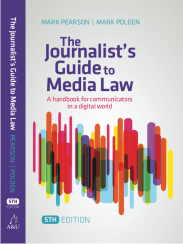
We have removed the comparative reporting restrictions tables from the  fifth edition of The Journalist’s Guide to Media Law (Allen & Unwin, 2014) which will be published later this year.

Co-author Mark Polden and I have decided to move these comparative tables on reporting restrictions throughout Australia across to this blog – journlaw.com – so we could free up space in the new edition to discuss other important issues such as media law for public relations consultants and the implications of digital and social media.

We will work to update the reporting and publishing restrictions tables over coming months, but for the moment I am publishing them as they stood at the date of our fourth edition in 2011.

As I upload them over coming weeks I would appreciate any students or colleagues using the comments section below to advise of any updates in your jurisdictions and I will act to update the tables accordingly.

Looking forward to your collaborative input!

——

Restrictions on reports of proceedings involving children

Note: NO identification of parties or witnesses in any way under the Commonwealth Family Law Act s. 121.

Jurisdiction Law  Exceptions  Legislation 
ACT  Reports of proceedings: Media allowed to report. ID: Cannot be identified. Cannot publish account of family group conference— None mentioned.  Criminal Code 2002, s. 712A. Children and Young People Act 2008, s. 77. 
NSW Reports of proceedings: Media allowed to stay and report. ID: No ID of child mentioned or otherwise involved (including victims and witnesses) living or dead, during or after proceedings, or their siblings.— Court may close proceedings. Court may allow ID or children aged 16 or over can authorise.(Seek legal advice on this.) Or senior next of kin or court (if deceased).


Children (Criminal Proceedings)Act 1987, s. 15A; Children and Young Persons (Care and Protection) Act 1998, ss. 104 and 105; Young Offenders Act 1997, s. 65. 
NT  Reports of proceedings: Open court and reports allowed. ID: No restriction.— Magistrate may close court or order suppression.  Youth Justice Act 2005, ss. 49, 50. 
Qld  Reports of proceedings: No. ID: No ID of child accused without court’s permission. No ID of child witness in sexual matter. ID of child witness okay in other matters unless ordered otherwise. Cannot ID authorised officer or police officer in matters with child witnesses. No ID info about child victims. No ID of children subject to allegations of harm or risk of harm or in state custody or guardianship.— Judge may order publication of identifying information for heinous crimes. Court can permit reporting when otherwise prohibited.Child victim can consent after becoming adult if fully informed of publication matter, audience and reason. Youth Justice Act 1992, ss. 234, 301. Child Protection Act 1999, ss. 189, 192, 193. 
SA  Reports of proceedings: Court open to ‘genuine representatives of news media’. No family care proceedings reports. ID: No ID of child parties, witnesses or victims,or other persons other than in official capacity without their permission, including name, address or school. Documentaries may be approved under strict conditions.— Courts can authorise some reports and ID.  Youth Court Act 1993, s. 24; Young Offenders Children’s   Protection Act 1993, s. 59, Children’s Protection Act 1993, s. 13; 59A. 
Jurisdiction  Law  Exceptions  Legislation 
Tas Reports of proceedings: No provision for media to be present without permission of court. ID: No ID of youths or youth witnesses.— Permission of court.  Youth Justice Act 1997, ss. 30, 31; Magistrates Court (Children’s Division) Act 1998, ss. 11, 12. 
Vic Reports of proceedings: Open court and media allowed to report. ID: No identification of child accused or any witnesses to case. No mention of court venue. Long list of banned ID particulars for children and witnesses including: name, title, pseudonym, alias of the person, home or work address or localit0, school or locality; physical description or style of dress; occupation or calling; relationship to identified others; interests or beliefs; real or personal property. No photos.— Permission of court.  Children, Youth and Families Act   2005, ss. 523, 534. 
WA  Reports of proceedings: Yes ID: No ID on child involved in proceedings in any way. No ID of child subject of a protection application or order.— Court can exclude persons. Supreme Court can authorise ID of child.  Children’s Court of Western Australia Act 1988, ss. 31, 35, 36, 36A. Children and Community Services Act 2004, s. 234 

—————

Disclaimer: While I write about media law and ethics, nothing here should be construed as legal advice. I am an academic, not a lawyer. My only advice is that you consult a lawyer before taking any legal risks.
© Mark Pearson 2014

3 Comments

Filed under blogging, contempt of court, courts, media ethics, mental health, social media, Uncategorized

Sexual offences publishing restrictions in Australia – a guide for journalists

By MARK PEARSON

Our fifth edition of The Journalist’s Guide to Media Law (Allen & Unwin, 2014) goes to the printer this week for publication later this year.

Co-author Mark Polden and I have decided to move some of the comparative tables on reporting restrictions throughout Australia across to this blog – journlaw.com – so we could free up space in the new edition to discuss other important issues such as media law for public relations consultants and the implications of digital and social media.

We will work to update the reporting and publishing restrictions tables over coming months, but for the moment I am publishing them as they stood at the date of our fourth edition in 2011.

As I upload them over coming weeks I would appreciate any students or colleagues using the comments section below to advise of any updates in your jurisdictions and I will act to update the tables accordingly.

Looking forward to your collaborative input!


Sexual offences publication restrictions

Jurisdiction  Law Exception Legislation
ACT Complainant must not be identified by name, ‘reference or allusion’, including allowing someone to find out their ‘private, business or official address, email address or telephone number’.


Complainant may consent. (Seek legal advice on proving consent.) Evidence (Miscellaneous Provisions) Act 1999, s. 40.
New South Wales
Complainant must not be identified, even after proceedings disposed of. With permission of court. Consent of complainant aged over 14. (Seek legal advice.) With consent of court for   complainants aged under 16.


Crimes Act 1900, s. 578A; Children (Criminal Proceedings) Act 1987, s. 15A.
Northern Territory
Complainant must not be identified at all. Accused cannot be identified until after committal. No mention of ‘name, address, school or place of employment’ for either.


With permission of court. Sexual Offences (Evidence and Procedure) Act 1983, ss. 6, 7 and 11(2).
Queensland Complainant must not be identified at all. Accused cannot be identified until after committal. No mention of ‘name, address, school or place of employment’ for either. With permission of court.Protection for accused only applies to ‘prescribed sexual offences’:
(a) rape;
(b) attempt to commit rape;
(c) assault with intent to commit rape;
(d) an offence defined in the Criminal Code, section 352.1. Seek legal advice about other offences.


Criminal Law (Sexual Offences) Act 1978, ss. 6 and 7.
South Australia Case and related proceedings including identity of accused cannot be reported until accused has been committed for trial. Complainant must not be identified at any stage.Publishers must publish prominent report of result of proceedings they have covered at earlier stage when accused has been identified.


  • Pre-committal reports can be made with permission of accused. (Seek advice.)
  • Complainant can be identified with his/her permission or order of court unless child victim.
Evidence Act 1929, ss. 71A and B.
Tasmania Complainant and witnesses other than defendant must not be identified, even if dead. Also bans ‘any picture purporting to be a picture of any of those persons’.


Court may allow identification ‘in the public interest’. Evidence Act 2001, s. 194K.
Victoria Complainant must not be identified, even if proceedings not pending. If proceedings not pending, with permission of court or complainant (seek legal advice) or on proof that no complaint of offence had yet been made to police. If proceedings pending, with permission of court only.


Judicial Proceedings Reports Act 1958, s. 4.
Western Australia Complainant and their school must not be identified. With authorisation in writing by complainant aged over 18 and mentally capable of making decision. (Seek legal advice.)


Evidence Act 1906, s. 36c.

—————

Disclaimer: While I write about media law and ethics, nothing here should be construed as legal advice. I am an academic, not a lawyer. My only advice is that you consult a lawyer before taking any legal risks.
© Mark Pearson 2014

Leave a comment

Filed under blogging, contempt of court, courts, media ethics, mental health, social media, Uncategorized

Australian Government’s latest national security bill to stifle debate

By MARK PEARSON

The Australian Government has opted for censorship and secrecy over scrutiny and natural justice with its latest national security bill introduced in the Senate last week.

haneefcover

Haneef – A Question of Character, by Jacqui Ewart

The National Security Legislation Amendment Bill (No. 1) 2014 extends security agencies’ powers to search and use surveillance devices in the new communication environment, introduces a new ‘multiple warrants’ regime, offers immunity to intelligence personnel who break all but the most serious laws, while increasing penalties for whistleblowing and criminalising the reporting of leaked intelligence-related information.

Australian Attorney-General George Brandis introduced the legislation on Thursday (July 17).

The crucial section affecting journalists and bloggers is straightforward:

35P Unauthorised disclosure of information

(1)  A person commits an offence if:

(a)  the person discloses information; and

(b)  the information relates to a special intelligence operation.

Penalty: Imprisonment for 5 years.

It continues to set a 10 year jail term if the disclosure is deemed to “endanger the health or safety of any person or prejudice the effective conduct of a special intelligence operation.” A selective list of exemptions makes no mention of material being published in the public interest.

The provision is clearly aimed at preventing Wikileaks or Snowden-style leaks of recent years and their broad publication in the world’s media and across social media, to the embarrassment of governments including Australia’s.

As I detailed in my recent Walkley Magazine article, ‘Terror on the books’ (May 29, 2014), Australian governments from both Labor and the conservative parties have contributed to the enactment of more than 50 pieces of legislation at national level (and many more at state level) since the 9/11 terrorist attacks on the US, many of which have impacted free expression and reportage. Colleagues Dr Jacqui Ewart, Joshua Lessing and I detailed this trend in a recent article in the Journal of Media Law.

The Haneef case in 2007 showed how national security laws could be used to restrict media access to information in an anti-terrorism matter. In that case, the accused was ultimately acquitted after a leak to the media showed how little evidence there really was against him. If this new law was in place, journalists might face jail for reporting such an injustice.

The proposed law is so draconian that it has prompted a release from Paris-Based Reporters Without Borders.

Without a bill of rights or constitutional amendment to protect free expression or media freedom in this country, it is left to those who care about free speech to make their objections clear. Please write to the Federal Attorney-General at senator.brandis@aph.gov.au opposing this legislation. Please also make submissions stating any concerns to parliamentary committees reviewing the legislation when it reaches the committee stage. Sadly, in Australia there will be no formal review of the free expression implications of the bill.

© Mark Pearson 2014

Disclaimer: While I write about media law and ethics, nothing here should be construed as legal advice. I am an academic, not a lawyer. My only advice is that you consult a lawyer before taking any legal risks.

1 Comment

Filed under national security, terrorism, Uncategorized

National security and anti-terror laws continue to threaten journalism

By MARK PEARSON

* This article was first published as ‘Terror on the books’ in the Walkley Magazine on May 29, 2014.

Walkley

More than 50 anti-terror laws have been introduced by the Australian government since the September 11 attacks in the US in 2001, and they continue to impact on our coverage of national security issues and place journalists and their sources at risk.

No Australian journalist would want to see lives lost in a terrorist attack, but there is evidence that existing laws give police, security agencies and the courts too much power in monitoring media activities and suppressing reports that are in the public interest. Two major reports now confirm some of these existing laws are over-reaching.

The long overdue Council of Australian Governments (COAG) Review of Counter-Terrorism Legislation was released in 2013.

As well as recommending changes to basic definitions of terrorist threats and harm, it proposes there be more opportunity for judicial reviews of the agencies’ search and seizure powers, and introducing some safeguards to the control order system (a control order restricts where a person goes and who they can meet).

The committee suggested that the communications restrictions be eased to allow a person subject to a control order access to a mobile phone, a landline phone and a computer with internet access.

Most importantly for journalists, the review recommended the repeal of Section 102.8 of the Criminal Code dealing with “associating with terrorist organisations”. This reform would put beyond any doubt the likelihood of a journalist being convicted of this serious offence by just undertaking normal reporting duties.

Another major report came in November 2013 from Bret Walker SC, the Independent National Security Legislation Monitor (INSLM). It was his third report since being appointed to the review role in 2011.Walker repeated his earlier recommendation that ASIO’s questioning and detention warrants should be abolished and suggested improvements to the definition of a “terrorist act”.

He called for a simpler system of listing terrorist organisations and inserting an exception to the “associating with terrorist organisations” provisions for humanitarian groups such as the Red Cross.

While both reports focused on issues of natural justice and human rights, neither the COAG review nor the INSLM addressed the stifling of journalism in the anti-terror laws.

Sadly, there was little in the way of media lobbying to do so either. The COAG counterterror review received 30 submissions which it posted to its website, none of which were from media-related companies or journalism or free expression organisations.

The ripples of international security operations were also felt in Australia. In 2013 the Media, Entertainment & Arts Alliance wrote to Prime Minister Tony Abbott asking for a review of the extent of metadata surveillance conducted by governments in the wake of former US National Security Agency (NSA) contractor Edward Snowden’s revelations.

There was good reason to be concerned. At least three cases in recent years have shown how the confidentiality of journalists’ sources can be compromised by surveillance by security agencies or anti-terror operations.

The retrial of “Jihad” Jack Thomas on terrorism charges in 2008 was based partly on interview materials gathered by Sally Neighbour from Four Corners and The Age’s Ian Munro and subpoenaed by the prosecution.

It emerged in the trial that up to 20 telephone calls between Neighbour and Thomas had been monitored by an ASIO agent.

The issue of confidentiality of whistleblowers’ identities also arose in the aftermath of the convictions of the Holsworthy Barracks bomb plot conspirators in 2011. The Australian had published an exclusive account on the raids in the hours before they occurred. (The three convicted plotters lost their appeals against their 18-year jail sentences last year.)

The Australian’s Victoria Police source, Simon Artz, paid for his leaks to the newspaper in the Victorian County Court with a four-month suspended sentence for unauthorised disclosure of information.

It was not a good year for whistleblowers internationally. WikiLeaks founder Julian Assange is holed up indefinitely in Ecuador’s embassy in London as he avoids extradition to Sweden on sex charges (and feared extradition to the US over security leaks). His US Army source – Private Chelsea (formerly Bradley) Manning – was sentenced by a military court to 35 years in jail for leaking classified documents. Meanwhile, Edward Snowden had fled to Russia to avoid prosecution over his leaks.

The whistleblower’s revelations about the extent of government surveillance continue to cause embarrassment, including in Australia where Prime Minister Tony Abbott reacted by attacking the ABC over its reportage. In an interview in early 2014, Abbott voiced his disapproval that the ABC had run stories about security services eavesdropping on Indonesian leaders’ phone conversations, a fact revealed by Snowden’s leaks.

The ABC then faced an “efficiency study”. It seems the Abbott government’s approach is to put the budgetary microscope on the ABC’s operations rather than wind back national security laws in the interests of media freedom.

The suppression of reporting on terrorism-related trials or evidence tendered in national security cases is an ongoing issue. The use of a closed court – combined with government media management – was central to the misplaced prosecution of Gold Coast Hospital registrar Dr Mohamed Haneef in 2007.

More than 30 suppression orders under anti-terror powers were imposed during the Benbrika trials in 2008 and 2009. In that case, Abdul Benbrika and 11 other Muslim men from Melbourne were charged with intentionally being members of a terrorist organisation. Their arrests in 2005 followed Operation Pendennis, a 16-month surveillance operation by Victoria Police, the Australian Federal Police and ASIO.

While by 2014 legislation covering suppression and non-publication orders had been introduced into only the Commonwealth, New South Wales, Victorian and South Australian jurisdictions, it appears that other states and territories are following suit to harmonise the laws.

© Mark Pearson 2014

Disclaimer: While I write about media law and ethics, nothing here should be construed as legal advice. I am an academic, not a lawyer. My only advice is that you consult a lawyer before taking any legal risks.

Leave a comment

Filed under national security, terrorism, Uncategorized

Journalists revert to age-old methods to protect sources, says @camstewarttheoz

By MARK PEARSON

National security reporter and associate editor at The Australian Cameron Stewart (@camstewarttheoz) says investigative journalists have to leave their smartphones back at their office when they are meeting confidential sources.

Stewart said the surveillance powers of national security agencies under anti-terror laws, combined with the geo-navigational features of Web 2.0 technologies, meant investigative reporters were reverting to 1970s techniques like those of Watergate reporters Carl Bernstein and Bob Woodward used when they met their famous source ‘Deep Throat’ in an underground car park.

“That is actually still the best way to get your information,” Stewart told me in the interview below.

“The thing I’ve got to my ear now [a smartphone] is your biggest enemy in every single sense as the Snowden revelations have shown.

“The ability of authorities to track movements of journalists is really of great concern as far as protecting sources goes.

“What they’re doing is quietly authorising metadata searches and things like that. What that does is give them every phone call you’ve made and I think they can piece together through your iPhone for example what your movements are over time.

“It’s not rocket science to work out what your movements are over a certain period of time and who you’ve been speaking to and who sources might be.”

Here Cameron Stewart talks with Professor Mark Pearson of Griffith University (@journlaw) about the impact of anti-terror laws on the reporting of national security issues. Stewart shares some of the methods he uses as a reporter when dealing with off the record information provided by whistleblowers  [15 minutes, recorded 1-5-14]

© Mark Pearson 2014

Disclaimer: While I write about media law and ethics, nothing here should be construed as legal advice. I am an academic, not a lawyer. My only advice is that you consult a lawyer before taking any legal risks.

4 Comments

Filed under Uncategorized

Meet Miles Heffernan (@Mileshef) – shield law campaigner and @journlaw guest

By MARK PEARSON

Miles Heffernan (@mileshef) is a journalist and features/opinion editor with the Star Observer.

When he was a freelancer he ran a campaign on change.org calling on mining magnate Gina Rinehart to withdraw her demands for two journalists to reveal their sources. See ‘http://www.change.org/en-AU/petitions/gina-rinehart-withdraw-your-subpoenas-against-adele-ferguson-and-steve-pennells-pressfreedom‘. See also my blog from 2013 on this.

It achieved close to 40,000 signatures.

Here Miles talks with Professor Mark Pearson of Griffith University (@journlaw) about that campaign and the battle for shield laws to protect journalists from having to reveal their sources in court. See more at journlaw.com. [12 minutes, recorded 16-4-14]

© Mark Pearson 2014

Disclaimer: While I write about media law and ethics, nothing here should be construed as legal advice. I am an academic, not a lawyer. My only advice is that you consult a lawyer before taking any legal risks.

Leave a comment

Filed under Uncategorized

If #cyberbullying is up, why is youth #suicide down?

By MARK PEARSON

[Extracted from my public lecture ‘Social Media – Risks and Rewards’]

Administrators and parents are indeed concerned about social media – partly because the little they know about it has been informed via the lens of the news media and war stories like those I have related above. Their perceptions are also skewed by the new industry of cyber-safety – everything from net nanny systems for your IT system through to speakers and consultants ready to advise on the evils of trolls and cyber-predators. I am not suggesting such inputs are unnecessary, but I wonder about their impact on policy at a time when parents and administrators are already approaching Web 2.0 with trepidation.

With all these resources committed to it, one might be excused for believing cyberbullying had driven young people to the depths of depression and anxiety and were consequently taking their own lives at an alarming rate. The fact is that in the decade 2000-2010 – a period during which both Internet and social media usage grew rapidly – youth suicide in Australia actually declined. It declined across the whole 15-24 year age group, with suicides among males in that age group decreasing by 34 per cent. That is not to say, however, that the rate of youth suicide is not alarming. The number of suicides is still far too high and like all stats this figure can have a range of explanations – better counselling, changes in media coverage, the efforts of campaigns like Beyond Blue and RU OK? (partly on social media),  and improved medicines for psychiatric conditions. …While it is tragic for any young person to take their life for such a reason, there seems to be no hard data that Internet and social media usage is driving more young people to this level of despair (ABS, 2012).

After all, social media is in many ways just a microcosm of our broader lives, and problems like bullying have always existed. These platforms present new channels for the demonstration of such behaviours, replacing or supplementing replacing the schoolyard taunts, the prank calls, the practical jokes and the toilet graffiti.

See the full lecture at: https://journlaw.com/2013/08/29/social-media-risks-and-rewards-journlaws-public-lecture/

© Mark Pearson 2013

Disclaimer: While I write about media law and ethics, nothing here should be construed as legal advice. I am an academic, not a lawyer. My only advice is that you consult a lawyer before taking any legal risks.
2 Comments

Filed under courts, media law, Media regulation, social media

Social media risk and literacy in the new Australian civics curriculum

By MARK PEARSON

[Extracted from my public lecture ‘Social Media – Risks and Rewards’]

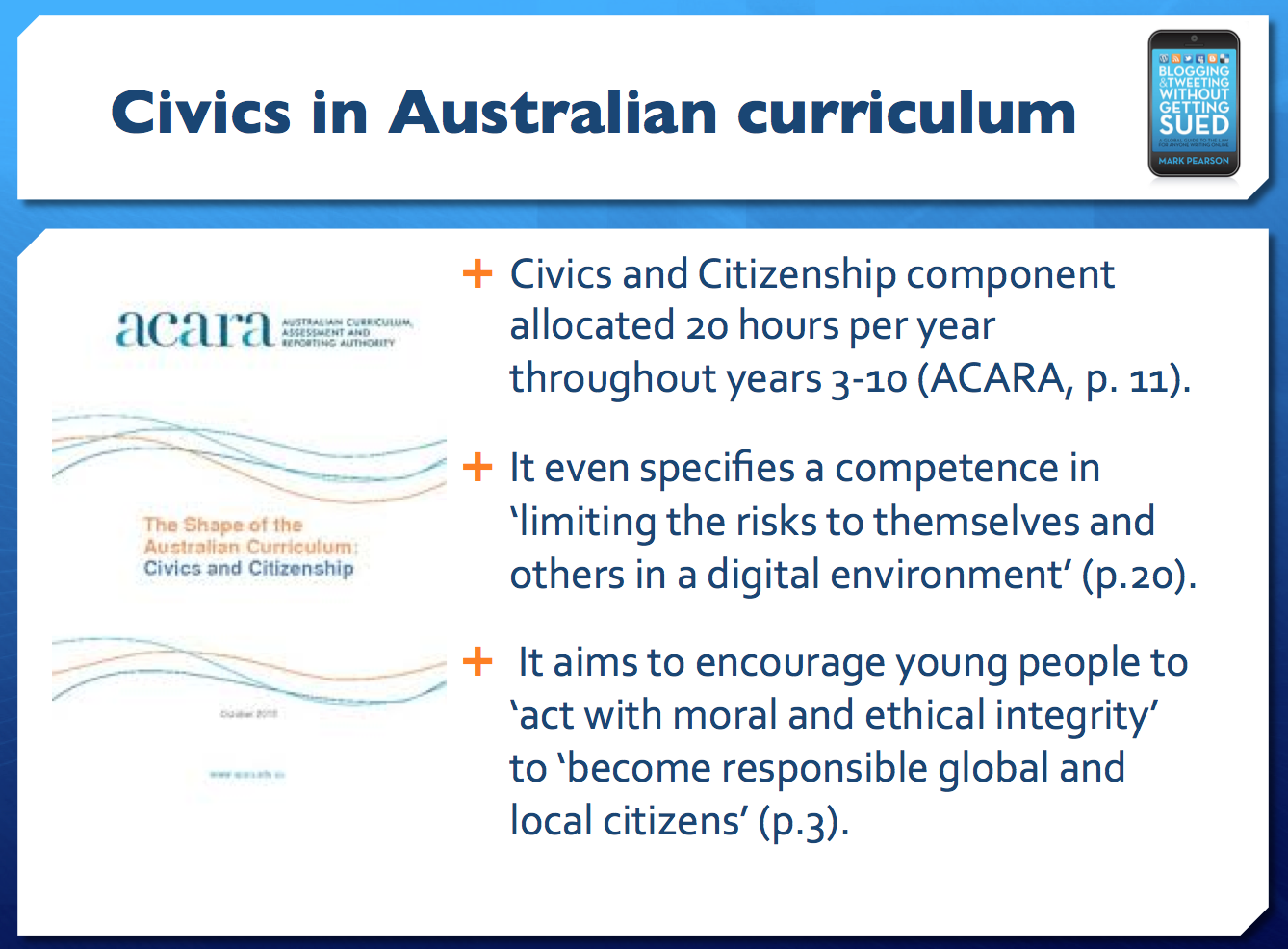
Screen Shot 2013-08-28 at 9.21.21 AMAt the very least an important foundational literacy one must have to empower one to assess social media risk – especially the legal risks involved – is an education in civics that explains the rights and responsibilities of individuals, the legal consequences of actions, and the systems in which these operate. Australia has lacked a consistent approach to civics education but fortunately the new Australian curriculum has a Civics and Citizenship component covering these kinds of issues at an allocated 20 hours per year throughout years 3-10 (ACARA, p. 11). It even specifies a competence in ‘limiting the risks to themselves and others in a digital environment’ (p.20). It aims to encourage young people to ‘act with moral and ethical integrity’ to ‘become responsible global and local citizens’ (p.3).

Frankly, this is where I believe the best approach lies. If we are going to reap the potential of new technologies we cannot become so risk averse that we ‘lock and block’ the opportunities as we try to minimise the dangers. The Gold Coast private school that recently banned its students from using social media on its grounds continues to allow its students to engage in contact sports with far greater potential risks to their minds and bodies than any Internet platform might present. They do so because they perceive the ongoing social and educational benefits of team sports as outweighing the very real risk of physical injuries. They invest in the expert staff to coach, they qualify them with first aid training, and they teach the children the code of behavior expected on a sporting field. And I would not for a moment suggest they should not. Yet they choose to ‘lock and block’ some of the most valuable communication tools developed in the history of human invention.

I suggest the answer is not in deprivation and censorship, but in sensible social media guidelines and foreshadowed consequences for misuse, accompanied by a foundation in moral and ethics education of citizenship presented in the new Australian curriculum. The educational theory of ‘reflective practice’ coined by Donald Schön two decades ago invokes a mindful approach to learning where professionals ‘reflect-in-action’ upon their learning as they face technical and ethical decisions in their working careers. There is no reason why a properly invoked civics and citizenship curriculum should not do the same for our pupils as they engage with new media as a laboratory for the greater challenges that real life presents.

See the full lecture at: https://journlaw.com/2013/08/29/social-media-risks-and-rewards-journlaws-public-lecture/

© Mark Pearson 2013

Disclaimer: While I write about media law and ethics, nothing here should be construed as legal advice. I am an academic, not a lawyer. My only advice is that you consult a lawyer before taking any legal risks.

Leave a comment

Filed under courts, media law, Media regulation, social media

Schools, social media and cyberbullying

By MARK PEARSON

[Extracted from my public lecture ‘Social Media – Risks and Rewards’]

We hear a great deal about the downside of social media use in schools. There have been well publicised examples of cyberbullying, defamation of teachers and principals, stalking of children by online sexual predators, and the dismissal of teachers for their own misuse of the medium. As a journalism academic, I can tell you that these make news because they involve deviant behavior, they result from important changes in society, they typically involve some sort of conflict or intrigue, and they are unusual enough to be interesting to audiences. They are not the norm, which explains their newsworthiness.

The norm is actually the millions of social media postings that are either mundane – like YouTube clips of cats – or are actually performing some public good – providing online counseling and support to those in need; creating useful communication channels between children, peer groups and parents; and opening a wealth of learning opportunities if managed appropriately. Of course, none of this means that we should ignore the risks – only that we should take steps to manage them and work with the medium within a relatively safe environment.

One Gold Coast private school made the local television news earlier this month with its principal’s bold announcement that he was banning social media use by students while at school. The school’s published policy also prohibits mobile phones and other entertainment devices (ASAS, 2009). This policy is known in the literature as the ‘lock and block’ approach. It is clearly one option available to schools and is risk averse in that it reduces the likelihood of the misuse of social media platforms during school hours. But is it a little like the Mercer Hotel in New York banning the use of telephones because Russell Crowe happened to disconnect a faulty one and hurl it at a worker in the foyer?

Screen Shot 2013-08-28 at 9.20.43 AMIf we seek to assess the educational opportunity cost of such a policy measure, we can look to the academic literature tracking the teaching and learning benefits of social media platforms. The European eTwinning project was established in 2005 as the main action of the European Commission’s eLearning Programme. Its Central Support Service is operated by European Schoolnet, an international partnership of 33 European Ministries of Education developing learning for schools, and its portal has 170,000 members and over 5300 projects between two or more schools across Europe. Its profile states:

Whenever we talk about internet safety we must also talk about responsible use. Similarly, when we talk about the safe use of social media we must also talk about the responsible use of social media. Unfortunately some people still believe that the only way to keep children safe online is to ‘lock and block’ access to parts of the internet though web filtering. The reality of this is that this doesn’t remove the actual dangers (perceived or otherwise) and it also makes it almost impossible for educators to deliver key internet safety and responsible use messages. The fundamental requirement to keeping children and young people safe online is to make sure that they have received an appropriate education in how to use tools and services appropriately. (eTwinning, 2012).

Screen Shot 2013-08-28 at 9.20.54 AMSome teachers have become quite activist in their opposition to a ‘lock and block’ approach, with the arguments of UK schools challenging this approach articulated in the Cloud Learn Research Report. Their main points are:

–       social media allow stimulating collaboration between teachers and pupils internationally and across cultures

–       the wealth of free material accessible online and via social media can reduce equipment and resource budgets

–       social media and devices enhance independent learning

–       social media open up innovative new communication channels for teachers, parents and pupils

–       they can bring introverted and disabled students into communication circles, along with those home-bound by illness

–       there are too many creative classroom ideas making use of Twitter, Facebook, Youtube, blogs and other social media platforms – to document (Heppell & Chapman, 2011).

Screen Shot 2013-08-28 at 9.21.03 AMEuropean Schoolnet’s SMILE (Social Media In Learning and Education) action research project offered some examples of effective in-class use of social media, including:

–       A Twitter snow lesson where a teacher’s Twitter network was asked where they lived and if it was snowing. The tweets were plotted on to Google Map and imported into Google Earth where real-time satellite imagery could be overlaid onto the map. The pattern that emerged provided an excellent context for discussing the weather, weather patterns and weather systems;

–       Google Plus in classrooms with a free ten-seat videoconference solution to allow face-to-face collaboration with peers and experts across geography and time zones;

–       YouTube used to create a school television station;

–       Developing research skills by collecting data using tools like SurveyMonkey and Facebook Polls;

–       Classroom blogs or blogs used as an ePortfolio used to generate audiences for young writers. (European Schoolnet, 2013).

This latter example raises the issue of the importance of written expression, particularly via blogs, for students. Writing in the journal The Psychiatrist, researchers Wuyts, Broome and McGuire (2011) cited several studies that demonstrated that keeping a personal blog could ‘have a therapeutic effect, by reducing stress and improving subjective well-being, and could be considered especially useful for people experiencing mental health problems’. This was because self-disclosure on a blog could impact on someone’s perception of their social integration and their so-called ‘bonding social capital’. The study focused on extended written blogs rather than social networking or ‘micro-blogging’ like Twitter and Facebook, but the sensible use of social media could have the same benefits, as found recently by a team of researchers from the Australian Catholic University here in Brisbane. They concluded:

“Facebook use may provide the opportunity to develop and maintain social connectedness in the online environment, and that Facebook connectedness is associated with lower depression and anxiety and greater satisfaction with life (Grieve et al, 2013).”

Screen Shot 2013-08-28 at 9.21.12 AMDespite the benefits, there is no disputing the sad fact that practices like cyberbullying continue. It is indeed that sensible or ‘mindful’ use of social media that should inform social media policies in schools, education departments, and in other government and corporate organisations. Cyberbullying has been a key point of focus and education systems have now developed policies in this area. The Australian Communications and Media Authority (ACMA) has an excellent ‘cyber(smart):’ site with a wealth of resources and lists the various education systems’ social media and cyberbullying policies (ACMA, 2013). For example, the Queensland Department of Education, Training and Employment features guides for parents, teachers and students at its Cybersafety site (DETE, 2012). At least the Education Department does not devolve the responsibility for cyber-safety to an automated Internet filter. Its site states: “Being cybersafe and a good cybercitizen is primarily about learning how to behave in the online environment. While technical solutions are part of ensuring safety and security, cybersafety in schools depends on people acting appropriately.” (DETE, 2012).

It is sage advice. Administrators and parents are indeed concerned about social media – partly because the little they know about it has been informed via the lens of the news media and war stories like those I have related above. Their perceptions are also skewed by the new industry of cyber-safety – everything from net nanny systems for your IT system through to speakers and consultants ready to advise on the evils of trolls and cyber-predators. I am not suggesting such inputs are unnecessary, but I wonder about their impact on policy at a time when parents and administrators are already approaching Web 2.0 with trepidation.

With all these resources committed to it, one might be excused for believing cyberbullying had driven young people to the depths of depression and anxiety and were consequently taking their own lives at an alarming rate. The fact is that in the decade 2000-2010 – a period during which both Internet and social media usage grew rapidly – youth suicide in Australia actually declined. It declined across the whole 15-24 year age group, with suicides among males in that age group decreasing by 34 per cent. That is not to say, however, that the rate of youth suicide is not alarming. The number of suicides is still far too high and like all stats this figure can have a range of explanations – better counselling, changes in media coverage, the efforts of campaigns like Beyond Blue and RU OK? (partly on social media),  and improved medicines for psychiatric conditions. Indeed, the policy measures noted above might well have helped save a few young lives. While it is tragic for any young person to take their life for such a reason, there seems to be no hard data that Internet and social media usage is driving more young people to this level of despair (ABS, 2012).

After all, social media is in many ways just a microcosm of our broader lives, and problems like bullying have always existed. These platforms present new channels for the demonstration of such behaviours, replacing or supplementing replacing the schoolyard taunts, the prank calls, the practical jokes and the toilet graffiti.


See the full lecture at: https://journlaw.com/2013/08/29/social-media-risks-and-rewards-journlaws-public-lecture/

© Mark Pearson 2013

Disclaimer: While I write about media law and ethics, nothing here should be construed as legal advice. I am an academic, not a lawyer. My only advice is that you consult a lawyer before taking any legal risks.

2 Comments

Filed under courts, media law, Media regulation, social media