Tag Archives: defamation

‘Right Speech’ and media law – mindful journalism as an analytical tool

By MARK PEARSON

Our book Mindful Journalism and News Ethics in the Digital Era: A Buddhist Approach (Shelton Gunaratne, Mark Pearson and Sugath Senarath eds; Routledge, NY, 2015)  explored the possibilities of applying mindfulness techniques to journalism practice.
Screen Shot 2015-05-29 at 3.08.59 pm

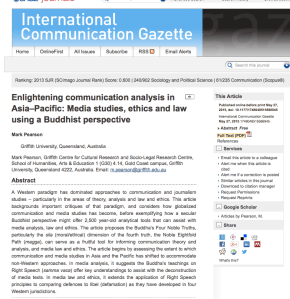
I  recently wrote an article on the “Right Speech” aspect of mindful journalism for the International Communication Gazette titled ‘Enlightening communication analysis in Asia-Pacific: Media studies, ethics and law using a Buddhist perspective’. Its abstract and link to the full article is available here.

The article backgrounds important critiques of the Western approach to communication  studies, and considers how globalized communication and media studies has become, before exemplifying how a secular Buddhist perspective might offer 2,500 year-old analytical tools that can assist with media analysis, law and ethics.

The article proposes the Buddha’s Four Noble Truths and their associated Noble Eightfold Path (magga) can be fruitful tools for informing communication theory and analysis, and media law and ethics.

In media analysis, it suggests the Buddha’s teachings on Right Speech (samma vaca) offer key understandings to assist with the deconstruction of media texts. In media law and ethics, it extends the application of Right Speech principles to comparing defences to libel (defamation) as they have developed in four Western jurisdictions.

Here is a brief extract showing the potential for exploring media law using a Buddhist/mindful journalism framework:

The ultimate contest over media talk and Right Speech happens in the courts when media texts face charges for their criminality or are the subject of civil suits over their alleged infringement on citizens’ rights like copyright, confidentiality and defamation. There is also value in applying a mindful, Buddhist approach to the study of communication and media law. We can hardly reject the teachings of the founder of one of the world’s greatest religions as inappropriate in a communication law context on exclusively secular grounds because that would imply our so-called secular approaches to communication and media theory and ethics have no religious roots. No Western academic could deny deep-seated Abrahamic influences upon the cultural origins of media law and its scholarship. A whole body of literature on the philosophy of science and religion attests to it. In media law and ethics, libertarian approaches to press freedom espoused by the likes of Milton, Mill and Jefferson arose in an era when political, cultural and religious notions of rights were intertwined. For example, the most famous treatise against licensing of the press – Milton’s Areopagitica – was prefaced with an explanation that Moses, David and Paul the Apostle were all learned because they were able to read widely. Milton wrote:

…as good almost kill a Man as kill a good Book; who kills a Man kills a reasonable creature, Gods Image; but hee who destroyes a good Booke, kills reason it selfe, kills the Image of God, as it were in the eye (Milton, 1644).

The U.S. Supreme Court cited Areopagitica in the landmark defamation case of New York Times v. Sullivan (1964) 376 US 254, when explaining why it would be counter-productive to move the burden of proving truth to the defendant (NY Times v. Sullivan, Footnote 19). Thus, by only two degrees of separation, we find Judeo-Christian teachings informing a key decision on news media talk in one of the most purportedly secular of institutions – the U.S. Supreme Court. Related to this, as Rolph (2008: 38-43) notes, defamation as the tort used to contest objectionable speech, first arose in England in 1222 in the ecclesiastical (church) courts where it remained a spiritual offence for about four centuries. Damage to a reputation was seen to be an offence to the target’s soul – a right that only God should possess – to be judged only by God’s earthly adjudicators, the clergy. There was even recourse for appeals from English ecclesiastical court judgments to the Pope (Rolph, 2008: 45). From the 16th century, defamation actions were increasingly brought in the common law courts, with the courts developing a list of allegations with which they would deal, without needing proof of actual damage being caused by the defamation (Morison & Sappideen 1989: 173). Even today the Catechism of the Catholic Church lists ‘detraction’ (essentially gossip – or disclosing ‘another’s faults and failings to persons who did not know them’) as a sin – or an ‘offense against truth’ (Catechism of the Catholic Church, para 2477). Thus, defamation action – the legal action available to those subjected to damaging media talk – has a traceable Christian genealogy.

In this globalised, multi-cultural and multi-jurisdictional Web 2.0 era there should be no reason why the Judeo-Christian lens should have a monopoly on our examination of communication law. A mindful reading of defamation law benefits from a consideration of both Right Speech principles and concepts of necessary truth-telling. While it is far-fetched to expect judges and legislators in the West would turn to Buddhism for the reform of defamation law, an effort to abide by truth-telling and Right Speech principles could operate effectively when professional communicators are attempting to avoid libel litigation when pursuing their stories. Further, they present excellent tools for an alternative analysis.

Analysis of the development of defamation defences in Canada, the UK, Australia and the U.S. benefit from a Buddhist reading. In Grant v. Torstar Corp., 2009 SCC 61, [2009] 3 S.C.R. 640, the Supreme Court of Canada developed a ‘responsible communication’ defence to defamation for matters which might not have been able to be proven absolutely as true, but were still diligently reported and were clearly in the public interest to be aired within the spirit of the Canadian Charter of Rights and Freedoms protection of free expression. Chief Justice McLachlin summed up the relevant factors of the ‘responsible communication’ defence on a demonstrable matter of public interest in these terms:

  • seriousness of the allegation
  • public importance of the matter
  • urgency of the matter
  • status and reliability of the source
  • whether the plaintiff’s side of the story was sought and accurately reported
  • whether the inclusion of the defamatory material was justifiable
  • whether a defamatory statement’s public interest lay in the fact that it had been made rather than whether it was truthful
  • other relevant circumstances

The court drew upon similar criteria to those developed earlier in the UK case of Reynolds v. Times Newspapers Ltd [2001] 2 AC 127 as part of the common law qualified privilege defence and elements of the statutory qualified privilege defence in Australia’s uniform Defamation Acts 2005.

The most significant First Amendment case in recent decades was New York Times v. Sullivan (1964) 376 US 254 where it was ruled that public of­ficials had to meet tough new tests before they could succeed in a defamation action even if the allegations in the article were proven false. It established that plaintiffs who were ‘public officials’ had to prove a media defendant had acted with ‘actual malice’ if they were to win a defamation action, even if the defamatory allegation was untrue. The test has since been expanded to apply to any ‘public figure’— essentially anyone who is well known to the public, has taken on some public role or who has participated voluntarily in some controversy. While the prin­ciple has some difficulties in definition and application, it has meant the media in the United States have been free to publish criticism of virtually anyone in the public domain, even if the criticism proves to be unfounded, just so long as they have not acted maliciously or in ‘reckless disregard’ of the truth.

It is possible to implement a Buddhist approach using the Right Speech teachings from the Noble Eightfold Path to conduct an analysis in this area of communication law. The author proposes to do this more thoroughly in future work. However, for the purposes of this argument we might return to the Abhaya Sutta … and contrast these defences as they have been developed in these jurisdictions (Thanissaro, 1997). Crucial to the Canadian ‘responsible communication’ defence and its qualified privilege cousins in the UK and Australia is the extent to which reporters and publishers honestly believe in the truth of the defamatory material published, even though they might not have the firm evidence to prove this in court. They would pass the Buddhist (mindful journalism) test if they had an honest belief the material was “factual, true, beneficial” while perhaps being “unendearing and disagreeable to others”, as long as they had chosen the “proper time” for reporting it (Thanissaro, 1997). However, the U.S. defences driven by the First Amendment takes this liberty a step too far under this schema, because it allows unbeneficial, unendearing and disagreeable material to be published about public figures as long as it has not been done with malice. It also allows for untruthful gossip-mongering, as identified earlier in the Saleyyaka Sutta (Nanamoli, 1994) as ethically problematic. Such analysis shows promise in the field of media law analysis, reform and policy development because it provides a working ethical framework to apply to legislation and the fact scenarios of particular cases.

I’ve also written a shorter account of the basic principles of mindful journalism in the journal Ethical Space: The International Journal of Communication Ethics, and the editors have been kind enough to make that article available for free viewing as a feature item on their website here. You might also want to explore some of their other fascinating articles on media ethics here and perhaps subscribe.

———–

Disclaimer: While I write about media law and ethics, nothing here should be construed as legal advice. I am an academic, not a lawyer. My only advice is that you consult a lawyer before taking any legal risks.

© Mark Pearson 2016
Leave a comment

Filed under blogging, Buddhism, citizen journalism, Eightfold Path, free expression, media ethics, mental health, social media

Mindful journalism in focus on @RNmediareport

By MARK PEARSON

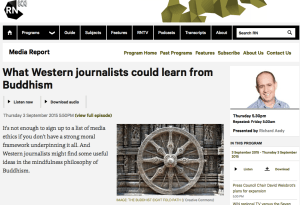
Mindful journalism was the focus of a segment on Radio National’s Media Report (@RNmediareport) this week (September 3, 2015) when I was interviewed by host Richard Aedy (@richardaedy) on the application of Buddhist ethics to reporting.

Interested? You can listen to the 10 minute segment here.

Screen Shot 2015-09-04 at 9.46.24 am

Our book Mindful Journalism and News Ethics in the Digital Era: A Buddhist Approach (Shelton Gunaratne, Mark Pearson and Sugath Senarath eds; Routledge, NY, 2015)  explored the possibilities of applying mindfulness techniques to journalism practice.

I’ve also written a shorter account of the basic principles in the journal Ethical Space: The International Journal of Communication Ethics, and the editors have been kind enough to make that article available for free viewing as a feature item on their website here. You might also want to explore some of their other fascinating articles on media ethics here and perhaps subscribe.

I’ve also written an article on the “Right Speech” aspect of mindful journalism for the International Communication Gazette titled ‘Enlightening communication analysis in Asia-Pacific: Media studies, ethics and law using a Buddhist perspective’. Its abstract and link to the full article is available here.

Screen Shot 2015-05-29 at 3.08.59 pmThe article backgrounds important critiques of the Western approach to communication  studies, and considers how globalized communication and media studies has become, before exemplifying how a secular Buddhist perspective might offer 2,500 year-old analytical tools that can assist with media analysis, law and ethics.

The article proposes the Buddha’s Four Noble Truths and their associated Noble Eightfold Path (magga) can be fruitful tools for informing communication theory and analysis, and media law and ethics.

The article begins by assessing the extent to which communication and media studies in Asia and the Pacific has shifted to accommodate non-Western approaches.

In media analysis, it suggests the Buddha’s teachings on Right Speech (samma vaca) offer key understandings to assist with the deconstruction of media texts. In media law and ethics, it extends the application of Right Speech principles to comparing defences to libel (defamation) as they have developed in four Western jurisdictions.

Here is a brief extract on that aspect:

In this globalised, multi-cultural and multi-jurisdictional Web 2.0 era there should be no reason why the Judeo-Christian lens should have a monopoly on our examination of communication law. A mindful reading of defamation law benefits from a consideration of both Right Speech principles and concepts of necessary truth-telling. While it is far-fetched to expect judges and legislators in the West would turn to Buddhism for the reform of defamation law, an effort to abide by truth-telling and Right Speech principles could operate effectively when professional communicators are attempting to avoid libel litigation when pursuing their stories. Further, they present excellent tools for an alternative analysis.

Analysis of the development of defamation defences in Canada, the UK, Australia and the U.S. benefit from a Buddhist reading. In Grant v. Torstar Corp., 2009 SCC 61, [2009] 3 S.C.R. 640, the Supreme Court of Canada developed a ‘responsible communication’ defence to defamation for matters which might not have been able to be proven absolutely as true, but were still diligently reported and were clearly in the public interest to be aired within the spirit of the Canadian Charter of Rights and Freedoms protection of free expression. ..

It is possible to implement a Buddhist approach using the Right Speech teachings from the Noble Eightfold Path to conduct an analysis in this area of communication law. The author proposes to do this more thoroughly in future work. However, for the purposes of this argument we might return to the Abhaya Sutta cited earlier and contrast these defences as they have been developed in these jurisdictions (Thanissaro, 1997). Crucial to the Canadian ‘responsible communication’ defence and its qualified privilege cousins in the UK and Australia is the extent to which reporters and publishers honestly believe in the truth of the defamatory material published, even though they might not have the firm evidence to prove this in court. They would pass the Buddhist (mindful journalism) test if they had an honest belief the material was “factual, true, beneficial” while perhaps being “unendearing and disagreeable to others”, as long as they had chosen the “proper time” for reporting it (Thanissaro, 1997). However, the U.S. defences driven by the First Amendment takes this liberty a step too far under this schema, because it allows unbeneficial, unendearing and disagreeable material to be published about public figures as long as it has not been done with malice. It also allows for untruthful gossip-mongering, as identified earlier in the Saleyyaka Sutta (Nanamoli, 1994) as ethically problematic. Such analysis shows promise in the field of media law analysis, reform and policy development because it provides a working ethical framework to apply to legislation and the fact scenarios of particular cases.

The article applies the ‘Right Speech’ principles of Buddhist ethics to analysis of the Royal family prank call episode which resulted in a High Court appeal in Australia and to a racial discrimination case heard in Australia’s Federal Court over comments on a West Australian news website.

———–

Disclaimer: While I write about media law and ethics, nothing here should be construed as legal advice. I am an academic, not a lawyer. My only advice is that you consult a lawyer before taking any legal risks.

© Mark Pearson 2015

Leave a comment

Filed under blogging, Buddhism, citizen journalism, Eightfold Path, free expression, media ethics, mental health, social media

Techniques and challenges of new models for journalism: The Undercurrent

By MARK PEARSON

As legacy media outlets grapple with the challenges of retaining and engaging their audiences, new media entrepreneurs experiment with new forms of journalism and novel ways of winning funding.

My guest this week in our Introduction to Journalism class was Jen Dainer, Head Writer and Co-Producer at The Undercurrent
[Twitter: @TheUCNews | @jendainer ] who has developed with co-founder Dan Graetz a new model of satirical advocacy journalism drawing upon their considerable creativity, skill base, and life and work experience.

Our interview spanned a range of topics including Jen’s own background, the objectives of The Undercurrent, how it differs from other news and current affairs products, the importance of impeccable research in avoiding legal action, and how they plan to gain traction and financial support.

You can view the interview here:

[Aug 4, 2015 / 26 mins. Camera work: Bevan Bache ]

Please contact Jen Dainer direct @jendainer / jen@theundercurrent.com if you would like to be involved in the project or support it in some way.

https://twitter.com/MarkTordai/status/628358500016455680

https://twitter.com/NeverForTheFall/status/628358062307348481

© Mark Pearson 2015

Disclaimer: While I write about media law and ethics, nothing here should be construed as legal advice. I am an academic, not a lawyer. My only advice is that you consult a lawyer before taking any legal risks.

Leave a comment

Filed under Uncategorized

Benefits of using Twitter from Day One in a news writing class

By MARK PEARSON

Almost 30 years ago my first colleague in journalism education – the late Charles Stuart – summarised the curriculum of a journalism degree.

“In the first year you teach them how to write an intro (lead),” he said.

“In year two you teach them how to write the body of the story.

“And in their final year you revise the intro.”

While Charles’ advice was delivered tongue in cheek, he certainly hit upon one of the greatest challenges facing students of basic news reporting – how to sum up the key elements of a story in an interesting way in just a few words.

I recalled that conversation as I set the in-class exercises for my Introduction to Journalism tutorials this week and turned to Twitter to help out.

Twitter has its pluses and minuses as a social medium, but there is no doubting its value as a platform for clear and concise expression.

Its 140 character format equates to 20-22 words and thus it lends itself to an exercise where students can try their hand at a basic news lead.

Our 300 first year students were prepped on the basics in their lecture and briefed on the importance of Twitter in modern day journalism as a means of communication with colleagues and sources, finding useful news angles, and in accessing contacts and basic information when a news event unfolds.

We decided the course code #1508HUM made a suitable class hashtag and assigned students to live tweet the lecture to reinforce its value.

https://twitter.com/MarkTordai/status/625820992963645442

As an example of an effective use of Twitter in journalism I showed them the Twitter feed from ABC PM presenter Mark Colvin’s to the 85,000 followers of his @Colvinius handle and explained that it was a badge of honour for Twitter users if Colvinius ever retweeted your tweets.

One of my live tweeters approached me in the lecture break to show me his dialogue with @Colvinius during my class.

Quite a coup. Clearly Jake gets it. (BTW, thanks @Colvinius).

Students who did not have Twitter accounts signed up for them prior to the tute and we started the session with an exercise requiring students to interview a classmate and introduce them to the group by spelling their name very clearly and stating an interesting fact about them.

We then talked about news values and what might make news for a campus community.

We embarked on our Twitter news hunt, wandering the campus in search of stories using our five normal senses plus the students’ evolving “news sense”.

Some of the stories came from noticeboards, although I explained a journalist would call to verify any information found there.

Others were based on interesting happenings around the campus during our 20 minute walk, including a cheerleader squad practice, an interview with a student events officer, and an array of photos and interviews from the student clubs sign-on stalls.

The exercise has the following benefits:

  • It teaches students the art of summing up a story in just a few words in an era when the attention span of news audiences is just a few seconds.
  • It introduces them to one use of social media in modern journalism.
  • It allows students to experiment with multi-media reportage if they attach photos, sound or vision.
  • It allows debate over the news value of campus-based stories.
  • And it does all of this within the comfort of a hashtag that allows them to experience publishing their first news story that technically all the world can see while in reality very few people other than their peers and tutors will actually view it.

You can see some highlights below, or even visit the #1508HUM hashtag if you are really interested.

I’d certainly recommend such an exercise to colleagues not already doing something similar in their first news writing classes.

https://twitter.com/MarkTordai/status/625856023958392833

https://twitter.com/tomobrien1997/status/626936785415745536

https://twitter.com/ByronRedpath/status/626267774445223936

© Mark Pearson 2015

Disclaimer: While I write about media law and ethics, nothing here should be construed as legal advice. I am an academic, not a lawyer. My only advice is that you consult a lawyer before taking any legal risks.

2 Comments

Filed under Uncategorized

Towards a mindful approach to media law and ethics

By MARK PEARSON

Our book Mindful Journalism and News Ethics in the Digital Era: A Buddhist Approach (Shelton Gunaratne, Mark Pearson and Sugath Senarath eds; Routledge, NY, 2015)  explored the possibilities of applying mindfulness techniques to journalism practice.

How might we begin to apply Buddhist ethical systems to the analysis of media law and ethics?

I explore this question in an article just published online and to appear in a forthcoming print edition of the International Communication Gazette.

It is titled ‘Enlightening communication analysis in Asia-Pacific: Media studies, ethics and law using a Buddhist perspective’. Its abstract and link to the full article is available here.

Screen Shot 2015-05-29 at 3.08.59 pmThe article backgrounds important critiques of the Western approach to communication  studies, and considers how globalized communication and media studies has become, before exemplifying how a secular Buddhist perspective might offer 2,500 year-old analytical tools that can assist with media analysis, law and ethics.

The article proposes the Buddha’s Four Noble Truths and their associated Noble Eightfold Path (magga) can be fruitful tools for informing communication theory and analysis, and media law and ethics.

The article begins by assessing the extent to which communication and media studies in Asia and the Pacific has shifted to accommodate non-Western approaches.

In media analysis, it suggests the Buddha’s teachings on Right Speech (samma vaca) offer key understandings to assist with the deconstruction of media texts. In media law and ethics, it extends the application of Right Speech principles to comparing defences to libel (defamation) as they have developed in four Western jurisdictions.

Here is a brief extract on that aspect:

In this globalised, multi-cultural and multi-jurisdictional Web 2.0 era there should be no reason why the Judeo-Christian lens should have a monopoly on our examination of communication law. A mindful reading of defamation law benefits from a consideration of both Right Speech principles and concepts of necessary truth-telling. While it is far-fetched to expect judges and legislators in the West would turn to Buddhism for the reform of defamation law, an effort to abide by truth-telling and Right Speech principles could operate effectively when professional communicators are attempting to avoid libel litigation when pursuing their stories. Further, they present excellent tools for an alternative analysis.

Analysis of the development of defamation defences in Canada, the UK, Australia and the U.S. benefit from a Buddhist reading. In Grant v. Torstar Corp., 2009 SCC 61, [2009] 3 S.C.R. 640, the Supreme Court of Canada developed a ‘responsible communication’ defence to defamation for matters which might not have been able to be proven absolutely as true, but were still diligently reported and were clearly in the public interest to be aired within the spirit of the Canadian Charter of Rights and Freedoms protection of free expression. ..

It is possible to implement a Buddhist approach using the Right Speech teachings from the Noble Eightfold Path to conduct an analysis in this area of communication law. The author proposes to do this more thoroughly in future work. However, for the purposes of this argument we might return to the Abhaya Sutta cited earlier and contrast these defences as they have been developed in these jurisdictions (Thanissaro, 1997). Crucial to the Canadian ‘responsible communication’ defence and its qualified privilege cousins in the UK and Australia is the extent to which reporters and publishers honestly believe in the truth of the defamatory material published, even though they might not have the firm evidence to prove this in court. They would pass the Buddhist (mindful journalism) test if they had an honest belief the material was “factual, true, beneficial” while perhaps being “unendearing and disagreeable to others”, as long as they had chosen the “proper time” for reporting it (Thanissaro, 1997). However, the U.S. defences driven by the First Amendment takes this liberty a step too far under this schema, because it allows unbeneficial, unendearing and disagreeable material to be published about public figures as long as it has not been done with malice. It also allows for untruthful gossip-mongering, as identified earlier in the Saleyyaka Sutta (Nanamoli, 1994) as ethically problematic. Such analysis shows promise in the field of media law analysis, reform and policy development because it provides a working ethical framework to apply to legislation and the fact scenarios of particular cases.

The article applies the ‘Right Speech’ principles of Buddhist ethics to analysis of the Royal family prank call episode which resulted in a High Court appeal in Australia and to a racial discrimination case heard in Australia’s Federal Court over comments on a West Australian news website.

———–

Disclaimer: While I write about media law and ethics, nothing here should be construed as legal advice. I am an academic, not a lawyer. My only advice is that you consult a lawyer before taking any legal risks.

© Mark Pearson 2015

2 Comments

Filed under blogging, Buddhism, citizen journalism, Eightfold Path, free expression, media ethics, mental health, social media, Uncategorized

Lessons in ‘Right Speech’ and mindful communication in Queensland defamation case

By MARK PEARSON

THE comedians on the Ten network’s ‘The Project’ had some fun with defamation last Friday when they used a fairly sobering Queensland case as the reason to interview me on the basics of that law.

First up, a clarification. Near the end of the segment they seemed to imply quite incorrectly that I am a lawyer which, of course, I am not!

Mark Pearson (@journlaw) interviewed on The Project about defamation 24.4.15 [At 33 mins 15 secs]

Mark Pearson (@journlaw) interviewed on The Project about defamation 24.4.15 [At 33 mins 15 secs]

There is a serious side to this. The Queensland case they used as the segue to my very rudimentary explanation of defamation law was Sierocki & Anor v Klerck & Ors (No 2) [2015] QSC 092 where Justice Flanagan had ordered a total of $260,000 in damages be awarded to the plaintiff and his company over various Internet slurs against them by his former business partner and others.

The defendants had earlier failed in their attempt to prove the truth of the imputations that the plaintiff was fraudulent; was a conman; had committed adultery; had used illegal drugs; was evil; was a thief; was a liar; and preyed on the innocent and that his company’s services were disreputable; unprofessional and encouraged threatening behaviour. Quite a slur indeed.

33671_GAZThe Courier Mail reported earlier that the plaintiff was also suing Google for $2.6 million over its search results linking him to the sites containing those imputations.

The case is interesting for media law students for a range of reasons – the large award of damages, the fact that they were Internet publications, and for the proposed action against Google.

But I find the most instructive lesson is the extent to which a dispute between business partners can escalate so far out of control that one should take to the Internet to cast these kinds of aspersions against the other.

Justice Flanagan noted in the judgment that the cause of the original dispute was unknown, but the result has been enormous financial and emotional cost to all parties.

Our new book Mindful Journalism and News Ethics in the Digital Era: A Buddhist Approach (Shelton Gunaratne, Mark Pearson and Sugath Senarath eds; Routledge, NY) examined some of the causes of such disputes and the damage that language can cause to reputations and relationships.

I take this further in a forthcoming article in a special issue of the academic journal International Communication Gazette, edited by my Mindful Journalism lead editor Shelton Gunaratne.

In that article I examine the religious origins of defamation law and proceed to link it to the Buddhist concept of “Right Speech”, writing:

In this globalised, multi-cultural and multi-jurisdictional Web 2.0 era there should be no reason why the Judeo-Christian lens should have a monopoly on our examination of communication law. A mindful reading of defamation law benefits from a consideration of both Right Speech principles and concepts of necessary truth-telling. While it is far-fetched to expect judges and legislators in the West would turn to Buddhism for the reform of defamation law, an effort to abide by truth-telling and Right Speech principles could operate effectively when professional communicators are attempting to avoid libel litigation when pursuing their stories. Further, they present excellent tools for an alternative analysis.

The basic premise of Right Speech in Buddhism is that words should not be spoken (or written or published) if they are not factual or true, or if they are unbeneficial, unendearing or disagreeable to others. All of these elements seemed to apply in this case, or at least that was the tenor of the judgment. Of course, sometimes hard truths do need to be told, but we need to ensure they are provable as true or that we can operate under some other defence excusing their publication.

The Internet offers inordinate opportunities to those seeking to defame others. This is the latest in a series of judgments demonstrating that even when one side wins a record damages payout for defamation, nobody is really a winner when reputations are damaged for no defensible reason.

We need to look to our moral compass when speaking or writing ill of others and ask whether we have an ethical foundation for doing so.

———–

Disclaimer: While I write about media law and ethics, nothing here should be construed as legal advice. I am an academic, not a lawyer. My only advice is that you consult a lawyer before taking any legal risks.

© Mark Pearson 2015

1 Comment

Filed under blogging, Buddhism, citizen journalism, Eightfold Path, free expression, media ethics, mental health, social media, Uncategorized

New course helps manage social media risk

By MARK PEARSON

Griffith University has issued the following release on our fully online global social media law course which I will be teaching from March 2015.

social-media-law-risk-management-postgraduate-degree-griffith

New course helps manage social media risk

Managing your social media risk and protecting your brand is the focus of a fully online global social media law course to be offered at Griffith University from March 2015.

Social Media Law and Risk Management is aimed at professional communicators internationally who want an introduction to the laws impacting on social media use and other strategies for strategic social media management.

“It addresses one of the key organisational and crisis communication phenomena of the modern era – engaging effectively and internationally with a range of stakeholders using social media while being cognisant of laws, risks and policies,’’ says course convenor Professor Mark Pearson.

“The course examines the dynamic role of social media law and risk management in a range of social and political contexts internationally, particularly in averting communication crises.

“It provides advanced knowledge and skills in the use of social media by government, non-governmental organisations, business and the general public.”

Professor Pearson is the author of Blogging and Tweeting Without Getting Sued – A Global guide to the Law for Anyone Writing Online, co-author (with Mark Polden) of The Journalist’s Guide to Media Law and the Australian correspondent for Reporters Without Borders. His Twitter handle is @journlaw.

Social Media Law and Risk Management is offered online as a stand-alone course or as part of a suite of four courses in the Graduate Certificate in Crisis Communication for students who can visit Griffith University’s Gold Coast or Nathan campuses for their other three courses.

Media Contact: Deborah Marshall, 0409 613 992, d.marshall@griffith.edu.au

—-

Please drop me a line at m.pearson@griffith.edu.au if you would like further information after reading the course brochure available here.

© Mark Pearson 2014

Disclaimer: While I write about media law and ethics, nothing here should be construed as legal advice. I am an academic, not a lawyer. My only advice is that you consult a lawyer before taking any legal risks.

Leave a comment

Filed under Uncategorized

Course outline for global social media law course starting in March

By MARK PEARSON

WE have now posted the course profile for our fully online global social media law course which I will be teaching from Griffith University, starting in March 2015.

social-media-law-risk-management-postgraduate-degree-griffith


Titled ‘Social Media Law and Risk Management’, the course is targeted at professional communicators internationally who want an introduction to the laws impacting on social media use and other strategies for strategic social media management including social media policies and risk analysis.

The course can be undertaken as a fully online, stand-alone unit if you just want these skills and may not be able to attend in person, or as part of a suite of four courses in the Graduate Certificate in Crisis Management for students who can visit Griffith University’s Gold Coast or Nathan campuses for their other three courses.

You can read more about the entry requirements, application procedures and fees for the social media law course here.

The course outline, including the learning activities and assessment, can be viewed here.

The course examines the dynamic role of social media law and risk management in a range of social and political contexts internationally, particularly in the averting of communication crises. It provides advanced knowledge and skills in the use of social media by government, non-governmental organisations, business, and the general public. Its special focus is on law and risk management in social media in a global context.

After explaining the basic legal concepts required for effective analysis and understanding, and the elements of stakeholder theory underpinning the course, we then proceed to examine key areas of the law arising internationally when professional communicators use social media. These include defamation, contempt of court, privacy, confidentiality, discrimination, copyright, consumer law and censorship. This feeds into a critical examination of the terms of use of social media providers, effective social media policy formulation and social media risk management – all key skills and understandings for crisis communication.

The course can be completed online with no requirement for on-campus attendance. For on-campus students two meetings per semester will be held on the Nathan and Gold Coast campuses for students to meet colleagues and workshop material with instructors. Learning activities will include video lectures, readings, online discussion board activity, social media interaction, multiple choice quizzes and problem-based learning. Each module is focused upon a social media law or risk scenario where students are challenged to draw upon their readings, case studies and professional experience to map out an appropriate diagnosis and strategic course of action.

‘Social Media Law and Risk Management’ addresses one of the key organisational and crisis communication phenomena of the modern era – engaging effectively and internationally with a range of stakeholders using social media while being cognisant of laws, risks and policies.
The course integrates theory and practice by introducing both stakeholder theory and jurisprudential theory of legal systems in the first module and then applying both in the balance of the course throughout learning activities and assessment tasks. The readings, learning problems and portfolio are designed to allow students to find recent cases from within their own jurisdictions internationally to make their learning most relevant to their particular nation, state or territory of professional practice.

Of course, social media is an international medium and therefore all students need to be broadly aware of the laws and risks applying globally. The course bears a direct relationship to students’ professional needs as crisis communicators in a variety of career roles – public relations, journalism, government communications, corporate communications, social media moderation, marketing, human resources and law.

Assessment includes a reflective learning journal, online multiple choice quizzes, and a written assignment involving the critical appraisal of a social media policy.

Please drop me a line at m.pearson@griffith.edu.au if you would like further information after reading the course brochure available here.

© Mark Pearson 2015

Disclaimer: While I write about media law and ethics, nothing here should be construed as legal advice. I am an academic, not a lawyer. My only advice is that you consult a lawyer before taking any legal risks.

Leave a comment

Filed under Uncategorized

Griffith Uni to offer online global social media law course

By MARK PEARSON

WE are now taking applications for a fully online global social media law course which I will be teaching from Griffith University, starting in March 2015.

social-media-law-risk-management-postgraduate-degree-griffith


Titled ‘Social Media Law and Risk Management’, the course is targeted at professional communicators internationally who want an introduction to the laws impacting on social media use and other strategies for strategic social media management including social media policies and risk analysis.

The course can be undertaken as a fully online, stand-alone unit if you just want these skills and may not be able to attend in person, or as part of a suite of four courses in the Graduate Certificate in Crisis Management for students who can visit Griffith University’s Gold Coast or Nathan campuses for their other three courses.

You can read more about the entry requirements, application procedures and fees for the social media law course here.

The course examines the dynamic role of social media law and risk management in a range of social and political contexts internationally, particularly in the averting of communication crises. It provides advanced knowledge and skills in the use of social media by government, non-governmental organisations, business, and the general public. Its special focus is on law and risk management in social media in a global context.

After explaining the basic legal concepts required for effective analysis and understanding, and the elements of stakeholder theory underpinning the course, we then proceed to examine key areas of the law arising internationally when professional communicators use social media. These include defamation, contempt of court, privacy, confidentiality, discrimination, copyright, consumer law and censorship. This feeds into a critical examination of the terms of use of social media providers, effective social media policy formulation and social media risk management – all key skills and understandings for crisis communication.

The course can be completed online with no requirement for on-campus attendance. For on-campus students two meetings per semester will be held on the Nathan and Gold Coast campuses for students to meet colleagues and workshop material with instructors. Learning activities will include video lectures, readings, online discussion board activity, social media interaction, multiple choice quizzes and problem-based learning. Each module is focused upon a social media law or risk scenario where students are challenged to draw upon their readings, case studies and professional experience to map out an appropriate diagnosis and strategic course of action.

‘Social Media Law and Risk Management’ addresses one of the key organisational and crisis communication phenomena of the modern era – engaging effectively and internationally with a range of stakeholders using social media while being cognisant of laws, risks and policies.

The course integrates theory and practice by introducing both stakeholder theory and jurisprudential theory of legal systems in the first module and then applying both in the balance of the course throughout learning activities and assessment tasks. The readings, learning problems and portfolio are designed to allow students to find recent cases from within their own jurisdictions internationally to make their learning most relevant to their particular nation, state or territory of professional practice.

Of course, social media is an international medium and therefore all students need to be broadly aware of the laws and risks applying globally. The course bears a direct relationship to students’ professional needs as crisis communicators in a variety of career roles – public relations, journalism, government communications, corporate communications, social media moderation, marketing, human resources and law.

Assessment includes a reflective learning journal, online multiple choice quizzes, and a written assignment involving the critical appraisal of a social media policy.

Please drop me a line at m.pearson@griffith.edu.au if you would like further information after reading the course brochure available here.

© Mark Pearson 2014

Disclaimer: While I write about media law and ethics, nothing here should be construed as legal advice. I am an academic, not a lawyer. My only advice is that you consult a lawyer before taking any legal risks.

Leave a comment

Filed under Uncategorized

‘Mindful Journalism’ – the topic of our forthcoming book with Routledge

By MARK PEARSON

THE term ‘mindful journalism’ is a concept I introduced more than a year ago in the inaugural UNESCO World Press Freedom address at AUT University Auckland.

I fleshed it out further in a paper delivered to the International Association for Media and Communication Research (IAMCR) conference in Dublin in July 2014, which was revised for publication as a forthcoming article in Ethical Space to be published in December.

Screen Shot 2014-09-19 at 4.18.23 PM

Our book preview on the Routledge website

My esteemed colleague, Emeritus Professor Shelton Gunaratne has been working for decades on the intersection between of Buddhism and journalism, and I was honoured to be invited onto a book project he was developing with Sri Lankan colleague Dr Sugath Senarath [pdf file] from the University of Colombo.

We were delighted when Routledge New York accepted our proposal for hard cover publication in March 2015 as part of its Research in Journalism series.

Our book is titled Mindful Journalism and News Ethics in the Digital Era: A Buddhist Approach and it features chapters by several scholars from Asia, North America, Australia and Europe.

As outlined in the publisher’s synopsis:

“This book aims to be the first comprehensive exposition of “mindful journalism”—drawn from core Buddhist ethical principles—as a fresh approach to journalism ethics. It suggests that Buddhist mindfulness strategies can be applied purposively in journalism to add clarity, fairness and equity to news decision-making and to offer a moral compass to journalists facing ethical dilemmas in their work. It comes at a time when ethical values in the news media are in crisis from a range of technological, commercial and social factors, and when both Buddhism and mindfulness have gained considerable acceptance in Western societies. Further, it aims to set out foundational principles to assist journalists dealing with vulnerable sources and recovering from traumatic assignments.”

My chapter on ‘The Journalist and Mental Cultivation’ addresses the application to journalism of the final three steps of the Buddha’s Noble Eightfold Path – the mental cultivation (or concentration) dimension of the magga; namely Right Effort (samma vayama), Right Mindfulness (samma sati) and Right Concentration (samma samadhi).

The section on Right Effort calls for journalists to apply a steady, patient and purposeful path to the achievement of ethical practice. It suggests the need for an effort to find and implement sound perspectives and practices that one lacks and to shore up those that one already possesses.

The section on Right Mindfulness explains how journalists might take time out of a stressful situation to focus upon breathing; to pause to meditate upon the rationale for pursuing a story in a certain way, to weigh implications of reportage on stakeholders and to find peace for strategic planning and clarifying context for one’s role and career trajectory.

The section on Right Concentration compares the phenomenon the expression “grace under fire” that is required of consummate professionals in the midst of covering a major news event. It is at this time that top journalists actually enter “the zone” and are able to draw on core ethical values and ingrained professional skills to report within deadline.

The chapter offers several examples from journalism to illustrate the approach and suggests techniques that can be implemented in a secular way by journalists from a range of cultural and religious backgrounds to enhance their ethical practice and the public significance of their reportage.

We are excited at the potential for the project – particularly in a period when journalists and bloggers are accused of having lost their ‘moral compass’ – and we are on track to submit all chapters within the publisher’s October 1 deadline.

https://twitter.com/prbizdaily/status/512866457156194304

———–

Disclaimer: While I write about media law and ethics, nothing here should be construed as legal advice. I am an academic, not a lawyer. My only advice is that you consult a lawyer before taking any legal risks.

© Mark Pearson 2014

Leave a comment

Filed under blogging, Buddhism, citizen journalism, Eightfold Path, free expression, media ethics, mental health, social media, Uncategorized