Tag Archives: defamation

‘Right speech’, media law and mindful journalism – a work in progress

By MARK PEARSON

Media law is much more than a set of edicts in the form of cases and legislation as presented in many texts and as taught in many courses.

Professional communicators and students can gain insights into the law as it stands – and into how it might be reformed – by tracing it to its origins, revisiting it in its modern context, and by applying fresh perspectives to its analysis. It can also inform their newsroom decision-making on legal and ethical matters.

Screen Shot 2014-02-08 at 10.44.34 AM

Gunaratne’s seminal text – The Dao of the Press. A Humanocentric Theory

Defamation is a good example. Historically, people’s reputations were seen as part of their spiritual beings. As such, defamation proceedings were often brought in the ecclesiastical courts of the Church of England before the Reformation (Rolph, 2008, pp. 39-48.

A stab at someone’s reputation was viewed as an attack on their soul – to be judged only by God’s earthly adjudicators, the clergy. From the 16th century, defamation actions were increasingly brought in the common law courts, with the courts developing a list of allegations with which they would deal, without needing proof of actual damage being caused by the defamation (Morison & Sappideen 1989, p. 173). Yet even today the Catechism of the Catholic Church lists ‘detraction’ (essentially gossip – or disclosing ‘another’s faults and failings to persons who did not know them’) as a sin – or an ‘offense against truth’.

Modern defences to defamation – like truth and qualified privilege – have been shaped by changing cultural, philosophical and political values, with truth as a defence heavily influenced by libertarians like Locke, Mill and Jefferson.

My recent work has involved the investigation of the ways Buddhist ethics might offer a useful framework for both journalism and media law. You can find an excerpt on my paper on ‘mindful journalism’ I presented to last year’s IAMCR convention in Dublin here.

I am not a Buddhist but I have seen the value of its application to modern phenomena and clinical situations like ‘Mindfulness Based Cognitive Therapy’ where meditation techniques have assisted with the treatment of anxiety and depression (Segal et. al, 2013).

Back in 2005 I attempted to use the Tibetan Buddhist mandala as a device to explain the complex competing interests involved when weighing up an issue involving privacy in the newsroom. (Pearson, 2005, see here.)

I have recently attempted to apply a Buddhist framework to the contexts of political blogging and election reportage. Colleague Tom Morton from UTS and I are using mindful journalism as a framework for examining a case study of an individual who wants a ban on his identity overturned by the Mental Health Review Tribunal in NSW.

My interest has come to the attention of a pioneer in the application of Buddhist systems theories to journalism – Professor Shelton Gunaratne – who wrote the seminal work in the field – The Dao of the Press – A Humanocentric Theory – in 2005.

He has compared his designated goals of Buddhist journalism with many of the traits of modern Western journalism in his insightful article in Javnost – The Public in 2009: ‘Buddhist goals of journalism and the news paradigm’.

Prof. Gunaratne has generously asked me to collaborate in a new project on mindful journalism also involving Dr Sugath Senarath from the University of Colombo.

Meanwhile, I will be attempting to articulate some of these principles – particularly the relationship between Buddhist notions of ‘right speech’ to defamation and celebrity journalism – in a paper I’ll be delivering to the Media Talk Symposium to be hosted by Associate Professor Jacqui Ewart in Brisbane on April 23-24 (schedule TBA).

That paper will be titled “Mindful media talk: exploring a Buddhist ‘right speech’ ethic in journalism and social media”. Its abstract reads:

Defamation and privacy laws – and journalism ethics codes – are problematic as guidance tools for news communication in the globalised, multi-cultural and multi-jurisdictional Web 2.0 era. This paper draws upon systems methodology (Gunaratne, 2005) to foreshadow an application of the Buddhist ethic of ‘right speech’ to journalistic and social media communication. The path of ‘right speech’ (samma vaca) was one step in Buddha’s Eightfold Path to enlightenment. However, taken at a secular level, it offers a useful theoretical framework by which to analyse media talk and guidance for those engaging in reportage and citizen journalism. Right speech invokes the avoidance of falsehood, divisive and abusive speech and gossip mongering. This paper explains its elements, distinguishes them from media laws and professional ethical codes, and uses examples to examine the extent to which it might accommodate ‘public interest’ / Fourth Estate journalism and celebrity news.

Watch this space for more posts on ‘mindful journalism’ as we explore its value as an analytical device and – perhaps more importantly – as a newsroom tool for ethical decision-making.

——————–

Key references

Gunaratne, S. A. (2005). The Dao of the Press: A humanocentric theory. Cresskill, NJ: Hampton Press.

Gunaratne, S. A. (2007). A Buddhist view of Journalism: Emphasis on mutual causality. Communication for Development and Social Change 1 (3): 17-38. (Paper originally presented at the University of Queensland on March 8, 2006.)

Gunaratne, S. A. (Feb. 15, 2009). Buddhist principles can revolutionize news and journalism. The Buddhist Channel.  Available at <http://www.buddhistchannel.tv/index.php?id=70,7781,0,0,1,0#.UuMttWTnb-k&gt;

Morison, W.L. & Sappideen, C. (1989) Torts: Commentary and Materials, 7th edn.

Sydney: Law Book Company.

Pearson, M. (2005) The privacy mandala: Towards a newsroom checklist for ethical decisions. Refereed paper presented to the Journalism Education Conference, Griffith University, Tuesday 29th November – Friday 2nd December, 2005, Gold Coast International Hotel, Surfers Paradise, QLD Australia. Available: http://epublications.bond.edu.au/cgi/viewcontent.cgi?article=1263&context=hss_pubs

Rolph, D. (2008). Reputation, Celebrity and Defamation Law. Ashgate: Aldershot. Available: http://books.google.com.au/books?id=d7YO44MvD8QC&source=gbs_navlinks_s

Segal, Z., Williams, M., Teasdale, J. and Kabat-Zinn, J. (2013). Mindfulness-Based Cognitive Therapy for Depression, Second Edition. Guilford Publications: NY.

———–

Disclaimer: While I write about media law and ethics, nothing here should be construed as legal advice. I am an academic, not a lawyer. My only advice is that you consult a lawyer before taking any legal risks.

© Mark Pearson 2014

3 Comments

Filed under blogging, Buddhism, citizen journalism, Eightfold Path, free expression, media ethics, mental health, social media, Uncategorized

Updated: Privacy in Australia – a timeline from colonial capers to racecourse snooping, possum perving and delving drones

By MARK PEARSON

The interplay between the Australian media and privacy laws has always been a struggle between free expression and the ordinary citizen’s desire for privacy. I have developed this timeline to illustrate that tension.

1827: NSW Chief Justice Francis Forbes rejects Governor Ralph Darling’s proposal for legislation licensing the press, stating: “That the press of this Colony is licentious may be readily admitted; but that does not prove the necessity of altering the laws.” (Historical Records of Australia, Series 1, Vol. 13, pp. 290-297)

PrivacySydneyGazetteExtract1830

The extract from the Sydney Gazette in 1830

1830: The Sydney Gazette and New South Wales Advertiser publishes an extract from London’s New Monthly Magazine on the prying nature of the British press compared with its European counterparts, stating: “The foreign journals never break in upon the privacy of domestic life”. But the London newspapers would hound a ‘lady of fashion’ relentlessly: “They trace her from the breakfast table to the Park, from the Park to the dinner-table, from thence to the Opera or the ball, and from her boudoir to her bed. They trace her every where. She may make as many doubles as a hare, but they are all in vain; it is impossible to escape pursuit.”

1847: NSW becomes the first Australian state to add a ‘public benefit’ element to the defence of truth for libel – essentially adding a privacy requirement to defamation law (ALRC Report 11, p. 117)

1882: First identified use of the phrase ‘right to privacy’ in an Australian newspaper. Commenting on a major libel case, the South Australian Weekly Chronicle (22.4.1882, p.5) states: “A contractor having dealings with the Government or with any public body has no right to privacy as far as those dealings go.”

1890: In a landmark Harvard Law Review article, the great US jurist Samuel D. Warren and future Supreme Court Justice Louis D. Brandeis announce a new ‘right to privacy’ in an article by that very name. There is a ripple effect in Australia with several mentions of the term in articles between 1890-1900.

1937: A radio station used a property owner’s land overlooking a racecourse to build a platform from which it broadcast its call of the horse races. The High Court rules the mere overlooking of the land did not consti­tute an unlawful interference with the racing club’s use of its property. The decision viewed as a rejection of a common law right to privacy: Victoria Park Racing and Recreation Grounds Co. Ltd v. Taylor (1937) 58 CLR 479.

1948: Universal Declaration of Human Rights is proclaimed in Paris. Article 12 provides: “No one shall be subjected to arbitrary interference with his privacy, family, home or correspondence, nor to attacks upon his honour and reputation. Everyone has the right to the protection of the law against such interference or attacks” (United Nations Universal Declaration of Human Rights, GA. Res 217A(III), UN Doc A/Res/810 (1948).)

1966: The International Covenant on Civil and Political Rights (ICCPR) is proclaimed, protecting privacy at Article 17. (16 December 1966, [1980] ATS 23, entered into force generally on 23 March 1976)

1972: Australia signs the ICCPR.

1979: Australian Law Reform Commission releases its first major report on privacy – Unfair Publication: Defamation and Privacy, ALRC 11. It recommends a person be allowed to sue for damages or an injunction if ‘sensitive private facts’, relating to health, private behaviour, home life, and personal or family relationships, were published about him or her which were likely in all the circumstances to cause distress, annoyance or embarrassment to a person in the position of the individual. Wide defences were proposed allowing publication of personal information if the publication was relevant to the topic of public interest. (pp. 124-125).

1980: Australia ratifies the ICCPR and the Organisation for Economic Co-operation and Development (OECD) expert group led by Australian Justice Michael Kirby issues its Guidelines on the Protection of Privacy and Transborder Flows of Personal Data.

1983: Australian Law Reform Commission releases its Privacy (ALRC Report 22), recommending the establishment of a Privacy Act to establish information privacy principles and the appointment of a Privacy Commissioner.

1984: Australian Journalists’ Association (AJA) revises its 1944 Code of Ethics to include a new clause (9) requiring journalists to “respect private grief and personal privacy and shall have the right to resist compulsion to intrude on them”.

1988: The Privacy Act 1988 is enacted, applying initially only to the protection of personal information in the possession of Australian Government departments and agencies.

1999: Media Entertainment and Arts Alliance (MEAA) issues another revised Code of Ethics preserving the grief and privacy elements in clause 11.

2000: Privacy Act 1988 provisions are extended to larger private sector organisations, and 10 National Privacy Principles (NPPs) are introduced, determining how companies must collect, use and disclose, keep secure, provide access to and correct personal information. Media organisations are exempted from the provisions as long as they ascribe to privacy standards published by their representative bodies.

2001: High Court rejects an argument for a company’s right to privacy after animal liberationists trespass to film the slaughter of possums in a Tasmanian abattoir and someone gives the footage to the ABC, but the court leaves the door open for a possible personal privacy tort: Australian Broadcasting Corporation v. Lenah Game Meats (2001) 208 CLR 199.

2003: A Queensland District Court judge rules the privacy of the former Sunshine Coast mayor Alison Grosse had been invaded by an ex-lover who continued to harass her after their affair had ended. She is awarded $108,000 in damages: Grosse v. Purvis [2003] QDC 151.

2007: Victorian County Court Judge Felicity Hampel SC holds that a rape victim’s privacy was invaded when ABC Radio broadcast her identity in a news report despite state laws banning the identification of sexual assault complainants. She is awarded $110,000 damages: Jane Doe v ABC & Ors [2007] VCC 281.

2008: Australian Law Reform Commission releases its For Your Information: Australian Privacy Law and Practice (ALRC Report 108) recommending a cause of action for breach of privacy where an individual has a ‘reasonable expectation of privacy’, with a cap for non-economic loss of $150,000.

2011: Federal Government releases an Issues Paper floating a proposal for a Commonwealth cause of action for a serious invasion of privacy.

2012

  • The Privacy Amendment (Enhancing Privacy Protection) Act 2012 (Privacy Amendment Act) passed, to take effect in 2014, featuring new Australian Privacy Principles (APPs), more powers for the Australian Information Commissioner, tougher credit reporting rules and new dispute resolution processes. Media exemption remains unchanged.
  • Independent Media Inquiry (Finkelstein Review) releases its report recommending a News Media Council take over from the existing Australian Press Council and Australian Communications and Media Authority with a streamlined news media ethics complaints system with teeth. Refusal to obey an order to correct or apologise could see a media outlet dealt with for contempt of court. Privacy breaches cited as a reason for the move.
  • Commonwealth Government’s Convergence Review releases its final report rejecting the Finkelstein model but instead proposing a ‘news standards body’ operating across all media platforms, flagging the withdrawal of the privacy and consumer law exemptions from media outlets who refuse to sign up to the new system.

2013

  • The federal attorney-general directs the Australian Law Reform Commission to conduct an inquiry into the protection of privacy in the digital era. The inquiry will address both prevention and remedies for serious invasions of privacy with a deadline of June 2014.
  • At the same time the government introduces legislation to establish a Public Interest Media Advocate with the power to strip media outlets of their Privacy Act exemptions. That part of the legislation is later withdrawn.
  • The federal attorney-general seeks state and territory input on the regulation of drones following the Privacy Commissioner’s concerns that their operation by individuals was not covered by the Privacy Act.

2014

  • The Australian Law Reform Commission (ALRC) releases a Discussion Paper, Serious Invasions of Privacy in the Digital Era (DP 80, 2014)The proposed elements of the action include that the invasion of privacy must occur by: a. Intrusion into the plaintiff’s seclusion or private affairs (including by unlawfulsurveillance); or b. Misuse or disclosure of private information about the plaintiff. The invasion of privacy must be either intentional or reckless. A person in the position of the plaintiff would have had a reasonable expectation of privacy in all of the circumstance. The court must consider that the invasion of privacy was ‘serious’, in all the circumstances, having regard to, among other things, whether the invasion was likely to be highly offensive, distressing or harmful to a person of ordinary sensibilities in the position of the plaintiff. The court must be satisfied that the plaintiff’s interest in privacy outweighs the defendant’s interest in freedom of expression and any broader public interest in the defendant’s conduct.

———–

Disclaimer: While I write about media law and ethics, nothing here should be construed as legal advice. I am an academic, not a lawyer. My only advice is that you consult a lawyer before taking any legal risks.

© Mark Pearson 2013/2014

2 Comments

Filed under Privacy, Uncategorized

Media law basics for election bloggers

By MARK PEARSON

[This blog was first published on the citizen journalism election site No Fibs, edited by Margo Kingston.]

Countless laws might apply to the serious blogger and citizen journalist because Web 2.0 communications transcend borders into places where expression is far from free.  

Even in Australia there are nine jurisdictions with a complex array of laws affecting writers and online publishers, including defamation, contempt, confidentiality, discrimination, privacy, intellectual property and national security.

If you plan on taking the ‘publish and be damned’ approach coined by the Duke of Wellington in 1824, then you might also take the advice of Tex Perkins from The Cruel Sea in 1995: “Better get a lawyer, son. Better get a real good one.”

(A quick disclaimer: My words here do not constitute legal advice. I’m not a lawyer.)

The problem is that most bloggers can’t afford legal advice and certainly don’t have the luxury of in-house counsel afforded to journalists still working for legacy media.

So if you’re going to pack a punch in your writing you at least need a basic grasp of the main areas of the law, including the risks involved and the defences available to you.

Defamation remains the most common concern of serious writers and commentators because blog posts so often risk damage to someone’s reputation – but it does have some useful defences.

Political commentary has been much livelier over the past two decades since the High Court handed down a series of decisions conveying upon all citizens a freedom to communicate on matters of politics and government.

However, it is still refining its own decisions on the way this affects political defamation, and most of us aren’t as fortunate as Darryl Kerrigan in The Castle – we don’t all befriend a QC willing to run our High Court appeal pro bono.

That leaves us trying to work within the core defamation defences of truth and ‘honest opinion’ (also known as ‘fair comment’). (Of course there is also the defence protecting a fair and accurate report of court, parliament and other public occasions if you are engaging in straight reporting of such a major case or debate and a range of other less common defences).

Truth as a defence has its challenges because you need admissible evidence to prove the truth of defamatory facts you are stating – and you also need evidence of defamatory meanings that might be read into your words (known as ‘imputations’).

That can be difficult. You might have the photograph of a shonky developer handing a politician some cash – but you’d need more evidence than that to prove she is corrupt.

Serious allegations like these need to be legalled.

Harsh criticism of public figures can usually be protected by the defence of honest opinion or fair comment if you review the criteria carefully each time you blog.

This defence is based on the idea that anyone who has a public role or who puts their work out into a public forum should expect it to be criticised and even lampooned by others.

To earn it you will normally need to ensure that the target of your critique is indeed in the public domain. This covers criticism of such things as the quality and service of hotels and restaurants; reviews of creative works like music, books and artworks; critiques of sports and entertainment performances; and reflections on the role and statements of politicians and other public officials.

Your defamatory material needs to be your honest opinion, based upon provable facts stated in the material.

While facts might be provable, you obviously can’t prove the truth or falsity of opinions themselves, which are much more subjective in their nature.

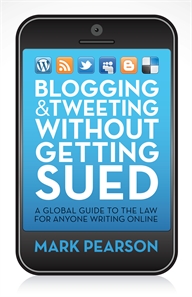
As I explain in Blogging and Tweeting Without Getting Sued (Allen & Unwin, 2012) the law will not allow you to parade a fact as an opinion. For example, you could not write “In my opinion, Jones is a rapist and the judge must be demented”. In such a case, the court would view both allegations as statements of fact, and you would need to prove the truth of each. However, if you had drawn on provable facts to prove Jones had indeed committed serious sexual offences and had just been convicted of rape, you might write your honest opinion.

You might write something like: “The one year jail sentence Jones received for this rape is grossly inadequate. It is hard to imagine how someone who has caused such damage to this woman will walk free in just 12 months. Judge Brown’s sentencing decision is mind-boggling and out of all proportion to sentences by other judges for similar crimes. His appointment is up for renewal in February and, if this sentence is any indication, it is high time he retired.” This way you can express a very strong opinion within the bounds of this defence as long as you are basing your comments on a foundation of provable facts.

That is not to say that you can just say what you like and just add the clause ‘This is just my opinion’. The defence will succeed only where the opinion clearly is an opinion, rather than a statement of fact.

It must be based on true (provable with evidence) facts or absolutely privileged material (for example, parliamentary debate) stated or adequately referred to in the publication.

It must be an honestly held opinion, the subject to which it relates matter must be in the public domain or a matter of public interest, and the comment must be fair (not neces­sarily balanced, but an opinion which could be held, based on the stated facts).

Matters like the private conduct of a public official do not earn the defence unless the conduct affects the official’s fitness for office.

If the facts on which the opinion is based are not provable as true or not protected in some other way, you stand to lose the case. The facts or privileged material on which the opinion is based should normally appear in our piece, so the audience can see clearly where the opinion has originated and judge for themselves whether they agree or disagree with it. They can also be based on matters of ‘notoriety’, not expressed in the publication, although it is safer to include them.

The defence is defeated by malice or a lack of good faith, so forget it if you’re a disgruntled former staffer trying to take revenge on your old boss.

Do all that and you can give that pollie the serve they deserve.

Fail to do it and you could lose your house and savings.

On a brighter note, the Media, Entertainment and Arts Alliance offers its freelance members professional indemnity and public liability insurance. See the details here.

———–

Disclaimer: While I write about media law and ethics, nothing here should be construed as legal advice. I am an academic, not a lawyer. My only advice is that you consult a lawyer before taking any legal risks.

© Mark Pearson 2013

Leave a comment

Filed under Uncategorized

A taste of PR law #publicrelations #auslaw

By MARK PEARSON

I have just completed a legal chapter for a public relations text edited by colleague Jane Johnston. In researching the chapter I came across several Australian cases where PR practitioners had found themselves in legal tangles. Here is a taste of them, but you’ll have to wait for Jane’s new book to get more detail!

According to the Australasian Legal Information Institute (www.austlii.edu.au), the term ‘public relations’ has only been spoken 10 times in High Court judgments, with none of the cases having public relations as a key factor in the decision-making. The mentions did, however, give some indication of the way our leading justices viewed the profession and some hints of the legalities of PR. For example, the 2004 case of Zhu v Treasurer of NSW [2004] 218 CLR 530 involved a dispute between the Sydney Organising Committee of the Olympic Games (SOCOG) in 2000 and a sub-contractor who had been licensed to market an “Olympics Club” package to residents of China. ‘Public relations’ formed part of the intellectual property he was licensed to use, which included “letterheads, stationery, display materials and other advertising, promotional and public relations materials approved by SOCOG to promote the Olympic Club” (para 59).  The case establishes both contract law and intellectual property law as important to the role of PR professionals.

In Sankey v Whitlam (1978) 142 CLR 1, the High Court identified the importance of keeping secrets and confidentiality in government media relations.  Acting Chief Justice Gibbs quoted an earlier British case where Chief Justice Lord Widgery had acknowledged the practice of ‘leaking’ as a PR tool: “To leak a Cabinet decision a day or so before it is officially announced is an accepted exercise in public relations, but to identify the Ministers who voted one way or another is objectionable.”(para 41).

The term ‘public relations’ has been used much more frequently in other courts and tribunals, with Austlii returning 1387 mentions of the term across all its case law databases. It was used in a host of contexts, including defamation, confidentiality, industrial relations, PR advice as lawyer-client privilege and whether public relations expenses could be claimed as part of a damages claim.

Here is a sampler:

Defamation

Words spoken at a media conference in Adelaide were at the centre of a defamation action in 2012. A Hindley Street nightclub owner sued a neighbouring travel agency operator over a statement she had uttered almost two years earlier in the midst of a media conference he had called to announce an initiative to increase public safety and reduce violence in the central Adelaide precinct. He alleged the travel agency owner had announced loudly to the media gathered at the conference that he – the nightclub owner – was responsible for all the violence in Hindley Street. After hearing from several witnesses (including the nightclub’s public relations consultant) the District Court judge found for the defendant. He said it was more likely the interjector had not made such a blatant defamatory allegation against the nightclub owner and, even if she had, he would only have awarded $7500 in damages. There was no evidence of any actual recording of the words she had spoken despite numerous media representatives being present at the time: Tropeano v. Karidis [2012] SADC 29.

In a Western Australian case in 2006, the consultancy Professional Public Relations (PPR) was ordered to provide all records they had about a DVD recording criticising a proposed brickworks which the director of a building materials company claimed made defamatory statements about him and his company. He suspected a rival building materials company – a client of PPR – was behind the production, and wanted this confirmed so that he could commence legal action: Bgc (Australia) Pty Ltd v Professional  Public Relations  Pty Ltd & Anor [2006] WASC 175.

Contempt

The most famous sub judice breach in a PR context came in 1987 when former NSW Premier Neville Wran called a media conference where he stated that he believed his friend – High Court Justice Lionel Murphy – was innocent of serious charges he was facing. Sydney’s Daily Telegraph published the comments under the heading ‘Murphy innocent—Wran. Court orders retrial’. Both Wran and the Daily Telegraph were convicted of contempt, with Wran fined $25,000 and the newspaper $200,000: Director of Public Prosecutions (Cth) v. Wran (1987) 7 NSWLR 616.

Trespass

Nine Network’s A Current Affair program had to pay $25,000 in damages to a property owner in 2002 after they had been invited by the Environment Protection Authority to accompany them when raiding his property for suspected environmental offences. The crew had cameras rolling as they entered the property and confronted the owner. The court held there was an implied licence for journalists to enter the land to request permission to film, but not to film without permission. The court also warned public authorities not to invite journalists on such raids, known as ‘ride-alongs’: TCN Channel Nine Pty Ltd v. Anning [2002] NSWCA 82.

Contract law

A West Australian District Court case involved a consultant to a South African mining company considering buyouts or mergers with other mining companies. The dispute surrounded a “partly written, partly oral and partly implied” agreement to provide “public relations, lobbying, consulting, networking, facilitating and co-ordinating” services: Newshore Nominees Pty Ltd as trustee for the Commercial and Equities Trust v. Durvan Roodepoort Deep, Limited [2004] WADC 57. The problem was that very little was detailed in the agreement, forcing the judge to look at previous work done by the consultant and to come to an estimate of the number of hours he had worked and their value on this occasion. He accepted that an agreement had been reached, and concluded that $250 per hour was a reasonable sum for the services provided, but could not accept that the consultant had worked 14 hour days for 64 days. Instead, he awarded him $830 per day for eight weeks, totalling $33,200 plus expenses.

Consumer law

The public relations consultancy Essential Media Communications used Victorian consumer law to win a Supreme Court injunction to stop another PR firm – EMC2 – from using that abbreviation of their name. They claimed it could ‘mislead and deceive’ their clients, some of whom knew them by that acronym. The court also accepted Essential Media Communications’ argument that EMC2 might have been ‘passing off’ their business as that of the plaintiff:  Essential Media Communications Pty Ltd v EMC2 & Partners [2002] VSC 554. The Federal Court issued an injunction in similar circumstances in an earlier case to stop a public relations company using the name “Weston”, when an existing consultancy was already operating under that name: Re Weston Communications Pty Ltd v Fortune Communications Holdings Limited and the Weston Company Limited [1985] FCA 426.

© Mark Pearson 2013

Disclaimer: While I write about media law and ethics, nothing here should be construed as legal advice. I am an academic, not a lawyer. My only advice is that you consult a lawyer before taking any legal risks.

1 Comment

Filed under Uncategorized

I’m heading to Griffith U as Professor of Journalism and Social Media

By MARK PEARSON

After 24 fulfilling years at Bond University I am leaving to take up a position as Professor of Journalism and Social Media at neighbouring Griffith University.

This Friday, December 21, will be my last day at Bond U and I will take a few device-free weeks of long service leave before starting at Griffith U on February 4, 2013.

You would appreciate my mixed emotions after almost a quarter of a century at the one institution.

I was lucky to be part of the foundation staff at Australia’s first private university in 1989 and have worked with a host of great people over those years to build a credible Journalism program, culminating in the wonderful ‘J-team’ of colleagues I’m leaving this week.

That said, I’m excited by the role I’ll be taking up at Griffith U and am looking forward to joining the faculty there. I’ve collaborated with at least four of my Griffith colleagues on research projects previously and am keen to resume old friendships and start new ones.

As a journalist I am hesitant to claim ‘firsts’, but I can’t find another “Professor of Journalism and Social Media” on a Google-search, although there are a few professors of social media internationally. Please let me know if you find one out there! Of course, I’ll be specialising in the social media law, ethics, risk and policy space in my social media research and teaching and make no claim to be expert in all things social media.

My teaching timetable has already been decided and I’m able to devote my first semester to lecturing and tutoring in my primary field of media law.

My new email address will be m.pearson@griffith.edu.au , but meanwhile you can contact me at journlaw@gmail.com.

I’ve packed 24 years worth of books and papers into boxes to move up the motorway to my new office at Griffith U’s Gold Coast campus, just a 30 minute drive away.

Then it’s Christmas festivities with the family and three weeks of R&R in our motorhome exploring the north coast of New South Wales over summer.

It’s a great life, and I wish you a peaceful and safe festive season.

My journlaw.com blog will resume in February and I’ll also return to the Twittersphere about then @journlaw from my new home at Griffith U.

Best wishes!

Mark (@journlaw)

© Mark Pearson 2012

4 Comments

Filed under Uncategorized

The @journlaw slide presentation to the World Public Relations Forum #wprf

By MARK PEARSON

The World Public Relations Forum was held in Melbourne this week and I participated (with Claire O’Rourke from Essential Media) in a feature presentation on social media law and ethics for public relations practitioners. Here are my slides from my presentation on ‘Blogging and Tweeting Without Getting Sued’ for your use (with full attribution, of course). I hope you find them helpful.

—————-

WorldPRForumMarkPearson(@journlaw)presentation19-11-12

© Mark Pearson 2012

Disclaimer: While I write about media law and ethics, nothing here should be construed as legal advice. I am an academic, not a lawyer. My only advice is that you consult a lawyer before taking any legal risks.

Leave a comment

Filed under Uncategorized

Social media legal risks for journalists – the journlaw.com guide to staying safe in the Web 2.0 era

By MARK PEARSON

The latest edition of the Walkley Magazine is out – with the issue in the mail to subscribers and articles gradually being posted to its website. As a teaser, here’s my contribution on the legal risks of social media for journalists:

—————-

Journalists and bloggers face new legal pitfalls in the Web 2.0 publishing environment, writes MARK PEARSON

Industry upheaval has prompted many journalists to retool as bloggers, multimedia producers and social media editors – each with its own set of legal risks.

These roles present exciting new dimensions to journalism – conversations and engagement with audiences, instant global publishing at the press of a button, and new opportunities to share content. But they also present levels of legal exposure most twentieth century journalists did not envisage.

Most of the principles covered in the dusty old media law tomes on a journalist’s bookshelf still hold true for defamation, contempt and confidentiality, but their Web 2.0 application is still being clarified by the courts and reporters and editors need to be aware of their personal legal liability across a range of risk categories.

Old laws, new contexts

Defamation and contempt are still high risk areas for all publishers and numerous judgments in Australia and abroad have established the rules apply just as readily to web and social media postings. Of course, damages awards might be limited if you tarnish someone’s reputation on your Facebook page to your small group of friends. But if your post prompts just one of them to cancel a lucrative contract with the victim, those damages might escalate quickly.

Twitter is still relatively new and the courts are grappling with its implications. For example, judges are yet to decide whether you face any special liability when others retweet your message.  A conservative view would be that a retweeter takes over your liability by republishing – just as anyone forwarding an email did previously. But if your nasty remark goes viral on Twitter the courts might well decide that you should have anticipated republication when you tweeted the original message – because the retweet is so central to the medium. This is virgin territory.

There is still no actionable right to privacy in Australia, although several court decisions and law reform recommendations are moving towards a new statutory tort of privacy invasion. Breach of confidence certainly exists as a legal action and this has been extended in the UK to private information and circumstances.

Facebook comes into play here as journalists download and republish private data and photographs of individuals in the wake of a tragedy or in the midst of a controversy.

That practice also brings us to the murky world of intellectual property and copyright in social media where the media and bloggers have adopted a cut and paste approach to the words and images of others online. This defies the clear international legal position which is that ‘freely viewed does not equal freely used’.

Intellectual property is a double-edged sword. It’s amazing how some publishers will complain about the theft of their own words or images while their staff are madly appropriating the words and images of others online.

New risks in old newsrooms

The new roles journalists have embraced in their existing newsrooms and the changing ways their organisations work with user-generated content across platforms present other hazards.

Moderation of website and social media comment threads has become a new position description – with inherent legal responsibilities.

A recent West Australian case centred upon racist comments on News Limited’s Perth Now website about indigenous youths who had died in a car accident. The fact that the comments were seen and approved by a moderator influenced the Federal Court’s decision to order the publisher to pay the boys’ mother $12,000 compensation for her humiliation under the Racial Discrimination Act.

The landmark case in the field was ACCC v Allergy Pathways in 2011 where then Federal Court Justice Ray Finkelstein (yes, that Ray Finkelstein of media inquiry fame) held that a company was responsible for comments made by others on its corporate Facebook page.

He suggested the comments – in breach of consumer law – should have been removed within a reasonable time during a routine review process.

But what is a ‘reasonable time’ – and does that period differ in serious defamation, contempt or race hate examples? This raises the legal and industrial issue of whether social media editors should be expected to conduct 24/7 monitoring of comments by other citizens (perhaps nasty trolls) on their social media sites.

Journalists would be well advised to clarify this and other aspects of their social media use in the terms of their contracts and to seek input into the social media policies of their employers.

Some columnists have had their services terminated over their inappropriate social media use, but journalists struggle with the confusion over their workplace and private social media persona, given the fact they publish, blog and tweet under their real names.

Special exposure in new contexts

While some are taking on new digital roles in mainstream media outfits, many are offering their services on freelance or contract terms and others are taking up newly created positions in private enterprise or government.

These work environments typically lack the traditional media’s history of daily engagement with media law, including on-call advice from in-house legal counsel and a generous budget line for courtroom stoushes.

If you are a freelancer or contractor you would be wise to take advice on your own exposure and professional indemnity insurance options – something you didn’t need when you were on the payroll of a large media enterprise.

If you are taking up a new media position in a corporation or government department you should review your work contract carefully for evidence of the industrial consequences you might face if your writing, editing or production triggers legal action.

A defamation threat that might have appeared routine to your managing editor at a newspaper or television network might well be viewed as a crisis by your new corporate boss or public service chief and it might even place your job on the line.

As we wave goodbye to journalism as we knew it, opportunities are arising in the mainstream media and beyond.

Media law was always a core training requirement for cadets and journalism students. Now all journalists need to update and extend that knowledge so they can assess their legal exposure across a broader range of work environments and functions.

© Mark Pearson 2012

Disclaimer: While I write about media law and ethics, nothing here should be construed as legal advice. I am an academic, not a lawyer. My only advice is that you consult a lawyer before taking any legal risks.

2 Comments

Filed under Uncategorized

Why #Assange and journalists should not sue for #defamation

By MARK PEARSON


It is always sad to see journalists and free expression advocates threatening to sue over the reportage and commentary of others.


Of course, journalists and freedom fighters are citizens too – so they certainly have the right to resort to defamation action to achieve their ends and to help restore reputational damage they may have suffered.


But we have heard today that two Australians – Wikileaks’ Julian Assange and Sunday Telegraph reporter Jonathan Marshall – are threatening defamation action over commentary about their respective roles as public figures. That is a great shame.


Two years ago – soon after the editor of a national daily newspaper threatened to sue a journalism academic – I penned a piece for Crikey! outlining my reasons editors should refrain from resorting to litigation when they take umbrage at comments made in the cut and thrust of public debate. I’ve those comments here to adapt them to the circumstances of these latest threats.


The reality is that any media outlet worth its salt – and Wikileaks more than most! – is in the defamation business. The columns of newspapers, news websites and the broadcast news outlets should be laden thick with defamation every day if their journalists are doing their jobs properly.


Lord Northcliffe is supposed to have said: “News is what somebody somewhere wants to suppress; all the rest is advertising.” But the bulk of that defamatory material is — or should be — defensible. The defences vary somewhat between countries, and between jurisdictions within countries, but most allow truthful defamation, defamation in the public interest published reasonably, defamatory opinions on public matters based on provable facts, and fair and accurate defamatory reportage of important public gatherings.


Law in the United States developed further under its constitutional First Amendment protection of a free press to allow even untruths about public figures to be published, so long as they were not published maliciously.


Journalists and free expression warriors like Julian Assange do not normally sue over public commentary — for a host of reasons.


  • Given they are in the defamation business themselves, most see it as part of the cut and thrust of public debate.
  • Many understand the defences and realise that the reputational slur will often be protected.
  • Journalists are used to telephoning people and having it out with them at an intellectual level. Many disputes are resolved that way, both for and against the media.
  • Most realise there are other avenues of recourse, perhaps through their own medium and perhaps via some mechanism for complaint.
  • Most are too poor, and defamation litigation can be unpredictable and costly, particularly if it reaches the appeal stage.


To balance this, of course, occasionally someone will make the most heinous false allegation about a journalist of a sexual nature, and everyone would understand them pursuing the matter through the courts, particularly if there were no other means of recourse.


But most have an editor or a news director who will counsel them against using libel laws to resolve a dispute, which brings us to the additional reasons editors rarely sue. (Remember, Assange has carried the title ‘editor-in-chief’ of Wikileaks).


  • Most have editorialised countless times about press freedom and it runs, like ink, through their veins. Most have quoted Voltaire, Milton, Mill, Jefferson and Burke in their editorials espousing how truth will win out and defending all citizens’ right to free expression. This extends to even allowing untruths to be aired and demolished in the marketplace of ideas. As Milton wrote: “Let her and falsehood grapple; who ever knew truth put to the worse, in a free and open encounter.’ Assange himself stands on a free expression platform, and recently drew upon that principle in his call for the US to cease its pursuit of him.
  • Editors fear their own example in suing for defamation will encourage more lawsuits against their own media outlet by others. It sends a message to the rich and powerful everywhere that even editors believe libel action is a superior method of dispute resolution to a Press Council, ACMA or journalists’ union complaint.
  • Most editors and news directors have been involved in litigation themselves or have witnessed how time-consuming and distracting it can be for their journalists. Four Corners investigative reporter Chris Masters laments the decade he spent in the courts justifying his Moonlight State expose of corruption in Queensland. Most see lawyers and litigation as enormous time wasters, distracting them from their greater purpose.
  • That said, some have been at the forefront of pursuing free expression through the courts. The Australian, through its parent company Nationwide News, was crucial in 1994 convincing the High Court to overturn a law that banned criticism of the Industrial Relations Commission or its members. This was one plank in the court’s development of an implied constitutional freedom to communicate on matters of politics and government and an historic victory for media freedom.
  • Most editors and news directors would be loath to expose their own behaviour and their companies’ past performance to the scrutiny that is inevitable in the discovery process and trial. They might be purer than the Pope or the Dalai Lama, but lawyers will inevitably find, or create, examples in their past that erode their case. Most have seen this happen in countless pyrrhic victories in the courts where the “winner” has had all sorts of character slurs made against them.
  • Related to this is the media coverage attached to the case itself, which normally increases a hundredfold the repetition of the original slur. Many a successful plaintiff has later said they regretted the whole process.
  • Most have belonged to industry groups fighting for free expression in society.
  • Most abhor the use of libel as a weapon in despotic regimes throughout the world and many are members of organisations fighting against this.
  • Most in Western democratic countries secretly covet the US First Amendment, which makes public figures fair game, particularly when the defamation — even falsities — relates to their performance.


Finally, and most importantly, unlike doctors, lawyers, sportspeople or politicians, the very act of suing for libel sends a reputational message about the journalist, editor or freedom fighter himself or herself: that they are the kind of person who would use a defamation action to pursue someone else who has exercised free expression.


Unlike any other, that very act puts their reputation as a journalist on the line among their peers and the broader thinking community. Most would prefer to be remembered for their accomplishments as a journalist or editor than to become a textbook case as one of the few who sued to shut someone else up.


—————-

See journlaw.com’s DEFAMATION update page for a range of recent defamation cases, many of which have involved social media.

© Mark Pearson 2012

Disclaimer: While I write about media law and ethics, nothing here should be construed as legal advice. I am an academic, not a lawyer. My only advice is that you consult a lawyer before taking any legal risks.

2 Comments

Filed under Uncategorized

Sub judice – time to brush up on your Latin

By MARK PEARSON

The arrest and court appearance of a man accused of the rape and murder of Melbourne ABC staffer Jill Meagher has sparked a spate of commentary on social media – much of it potentially prejudicial to the suspect’s upcoming trial. Here is an excerpt from my new book  – Blogging and Tweeting Without Getting Sued: A global guide to the law for anyone writing online (Allen & Unwin, 2012) – explaining the basic principles of sub judice contempt for lay users of social media. See also Julie Posetti’s innovative and useful Storify on this.

Victoria Police are also struggling to cope with prejudicial comments about the accused on their Facebook site. See my earlier blog on similar problems with the Queensland Police Facebook page where they have faced similar challenges trying to moderate prejudicial comments.

—————-

Sub judice – time to brush up on your Latin

The most frustrating area of contempt law for the traditional media has been sub judice contempt – publishing prejudicial material that might reduce the chance of a fair trial. First Amendment rights in the US have given the media immunity in recent times, but ‘trial by media’ can prompt a mistrial and lawyers can be disciplined if they make prejudicial statements during a trial. ‘Sub judice’ comes from the Latin meaning ‘under justice’ and has been prosecuted most often in the UK and Commonwealth countries, although some European countries like Denmark have laws against publications that might seriously damage a trial.

In 2011, the judge presiding over the trial of a conservative politician for a false expenses claim in Britain referred to the Attorney-General a potentially prejudicial tweet about the case by a rival politician. High-profile Labour peer Lord Sugar tweeted to his 300,000 followers on the second day of the trial: “Lord Taylor, Tory Peer in court on expenses fiddle. Wonder if he will get off in comparison to Labour MPs who were sent to jail?” The Telegraph quoted Justice Saunders saying: “I was concerned that if seen by a juror it might influence their approach to the case… I reported the matter to the Attorney-General not for the purpose of taking any action against Lord Sugar but to investigate whether entries on Twitter sites … posed a risk of prejudicing the fairness of a trial, and if so whether there were steps which could be taken to minimise that risk.”

International media law firm Taylor Wessing revealed in 2011 that they had defend a website against contempt allegations over prejudicial user-generated posts on a message board just a few weeks before a criminal fraud trial. They had to take down the messages and the jury had to be warned not to do Internet research. They pointed out that bloggers and social media users were liable for their publications even when they did not intend to damage a trial. From the moment someone has been arrested in a criminal case, reports about the matter are seriously limited in many countries. Authorities can prosecute for this kind of contempt if there is a ‘substantial risk’ that justice will be prejudiced in the case.

While the mainstream media are the most common targets of such actions, the size of the audience for many blogs and social media commentators will increasingly make them vulnerable. The Victorian Government Solicitor’s Office advises websites to take down materials related to an upcoming case in the lead-up to a trial. The most sensitive material is anything implying the guilt or innocence of the accused, confessions, photo identification of the accused, and republishing reports of earlier hearings. A public interest defence might be available for publication of material on a matter of overwhelming public importance, but you should never rely upon this defence without legal advice.

Blogging and Tweeting Without Getting Sued: A global guide to the law for anyone writing online is now available in print and ebook formats worldwide.

[Media: For review copies please contact publicity@allenandunwin.com or call +61 2 8425 0146]

© Mark Pearson 2012

Disclaimer: While I write about media law and ethics, nothing here should be construed as legal advice. I am an academic, not a lawyer. My only advice is that you consult a lawyer before taking any legal risks.

6 Comments

Filed under Uncategorized

My submission to the Tasmania Law Reform Institute on ID of sex crime victims

By MARK PEARSON

Here is my submission responding to the issues paper from the Tasmania Law Reform Institute – Protecting the Anonymity of Victims of Sexual Crimes.

For background to the inquiry, see my earlier blog here. It was triggered by this Hobart Mercury story (left).

—-

September 28, 2012

Submission in response to Issues Paper No 18 ‘Protecting the Anonymity of Victims of Sexual Crimes’

Please accept this personal submission in response to your issues paper, which I have prepared with research assistance from Bond University students enrolled in my media law and ethics subject. They have been required to read and discuss your report as part of an assignment for that subject and their scholarship and insights have informed the views I express here. I must stress, however, that this is a personal submission as an academic who teaches and researches in the field and my opinions do not necessarily reflect those of my employer, Bond University, or the international media freedom agency Reporters Without Borders, for whom I am the Australian representative.

By way of background, my research, teaching and industry consultancy focus on the interpretation of media law for journalists and other writers who might produce reportage as bloggers, ‘citizen journalists’ or social media users. I am co-author with barrister Mark Polden of The Journalist’s Guide to Media Law (4th edition, Allen & Unwin, 2011) and am sole author of Blogging and Tweeting Without Getting Sued – A Global Guide to the Law for Anyone Writing Online (Allen & Unwin, 2012). I have conducted media law training for Fairfax Media journalists at the Launceston Examiner and the Burnie Advocate newspapers. Our Centre for Law, Governance and Public Policy convened the national symposium ‘Courts and the Media in the Digital Era’ in 2011, which resulted in our co-edited book The Courts and the Media – Challenges in the Era of Digital and Social Media (Keyzer, Johnston and Pearson, Halstead Press, 2012). We are now collaborating with colleagues from other universities on a national research project examining the impact of social media upon the courts.

I have chosen to begin with some general observations about the tone and ambit of your issues paper before proposing a mechanism for reform.

Important contextual considerations

Issues Paper 18 is an excellent summary of comparative legislation and case law on the identification of sex crime victims. It canvasses numerous public policy issues at stake when contemplating a reform of s. 194K. However, it seems to demonstrate little understanding of media organisations’ news values and production values and does not acknowledge several important policy developments under way nationally and globally.

Journalists’ training

The paper offers a handful of examples where such laws have been breached by the news media in Australia, including only one in recent times in Tasmania that has proceeded to court. While we all would prefer there were no media breaches of identification laws, I suggest that court reporters are overwhelmingly aware of, and compliant with, both sub judice contempt guidelines and statutory reporting restrictions. This is due mainly to the media law education and training reporters receive in their university journalism degrees and in the workplace. Most media organisations also provide shorthand tuition to their staff and adhere to strict court reporting protocols where cases are followed through the court system and junior reporters ‘shadow’ experienced colleagues before starting on the round. One of the fundamental topics all court reporters learn is that there are restrictions on the identification of children and sexual assault victims involved in proceedings.

News values, open justice and the role of court reporting

Your issues paper devotes a small section to the principle of ‘open justice’ which quite rightly quotes important jurists and international human rights documents and legislation enshrining it (Part 2.1). Yet, it implies news organisations are motivated primarily by commercial interest when reporting upon the courts. At 4.3.3, your paper states: “Media outlets have an obvious interest in publishing material that will attract readers or viewers. A story that identifies the victim of sexual assault is likely to attract greater consumer interest than one that does not. There is a strong incentive for the media to publish such details.” I am aware of no research supporting this assertion and my informed view is that editors, sub-editors and court reporters strive to abide by the legal restrictions and ethical obligations forbidding identification. On rare occasions that determination is tested in the heat of competition for a particularly unusual story or one involving a celebrity – but such occasions have become even less common in the wake of strong national and international scrutiny of such media behaviour. It is, however, a mistake to view this story of this 12-year-old Tasmanian girl prostituted by her mother and the named accused as one of simply the media feeding a public titillation with sordid sexual detail. The story indeed featured the news values of ‘unusualness’ and sheer ‘human interest’ – but it also had the important public news value of what we call ‘consequence’ or ‘impact’ – many of which concern public policy benefits of the reportage of such matters.

Public policy benefits of media reportage of sexual and juvenile cases

There is a principle as ancient and as inherent in a democracy as open justice – and that is the role of the news media as the ‘Fourth Estate’. Key public policy reviews and reforms have ensued in Tasmania after this incident, and I suggest they might not have garnered the political traction to proceed if the public had been kept ignorant of the matters before the courts. These have included your own review of the defence of ‘mistake as to age’ and other important reviews of child protection. In short, court reporting by the news media and the public discussion and scrutiny it generates can fulfil many important functions in society beyond sheer entertainment; including deterrence from crime, education about justice, transparency of process, and as a watchdog on injustice and deficient public policy. Closed proceedings – or complex requirements involving media applications to cover certain matters – pose serious risks to such positive public policy outcomes.

Free expression and freedom of the press

A close relative of the principle of ‘open justice’ in a democracy is the human right of free expression and its derivative – freedom of the press. Your paper does not mention this principle, but it is crucial to note when comparing reporting restrictions across jurisdictions that Australia is unusual among western democracies in that it has no written constitutional guarantee of free expression or a free media. Each of the foreign jurisdictions your paper uses for comparison on sexual reporting restrictions – the United Kingdom, Canada and New Zealand – features such a guarantee in a charter of rights. Australia and Tasmania have no such statutory or constitutional mechanisms in place, which is an important point of difference because proposed restrictions trigger no formalised process of review on free expression grounds and courts here are not obliged to weigh free expression against other rights in their determinations. (There is, however, an argument that court reporting restrictions might breach the High Court’s implied constitutional freedom to communicate on matters of politics and government; see Nationwide News v. Wills [1992] HCA 46; (1992) 177 CLR 1).

Media ethics and regulation

I realise the your document focuses on the narrow question of whether S. 194K should be reformed, but highly relevant is the likelihood of media organisations being motivated to use a perceived legal ‘loophole’ to identify a vulnerable individual such as a child who has been subjected to sexual abuse. Such a motivation would represent a serious breach of the privacy provisions of the MEAA Journalists’ Code of Ethics and all self-regulatory and co-regulatory codes of practice in place throughout print, broadcast, television and online news media industries – including in-house codes, those of the Australian Press Council and the numerous broadcast sector codes ultimately policed by the Australian Communications and Media Authority (ACMA). The question of media adherence to such codes has been the subject of two major inquiries in the form of the Convergence Review and its subsidiary Independent Media Inquiry chaired by former Federal Court justice Ray Finkelstein – the recommendations of which are currently under consideration by the Federal Government. Regardless of whether they are adopted, an impact has been significant attempts by the news media to get their own ‘houses in order’ to avoid the prospect of strict government regulation of their ethical practices and complaints systems. The Australian Press Council has implemented significant improvements to its processes. All of this has been against the international backdrop of the UK inquiries into serious ethical and legal breaches by the Murdoch-owned News of the World newspaper.

Privacy regulation and factors impacting media privacy intrusion

Related to this inquiry have been important developments in the area of privacy law and regulation. You would be aware that the Commonwealth Government has already implemented privacy law reforms recommended by the Australian Law Reform Commission Report 108: For Your Information: Australian Privacy Law and Practice (http://www.alrc.gov.au/publications/report-108). The Gillard Government is reported to be seriously considering a recommendation for a statutory tort of invasion of privacy. Whether or not that is implemented, your own issues paper at p. 14 cites the case of Doe v. ABC (2007) VCC 282, where a journalist’s identification of a sexual assault victim led to both criminal charges and a civil suit where damages were awarded for the privacy invasion of the victim. Although this was an intermediate court decision, it stands as a precedent in a developing body of judge-made privacy law. Significant too is the ACMA’s 2011 review of its privacy guidelines (http://www.acma.gov.au/WEB/STANDARD/pc=PC_410273) for broadcasters which included important changes in the way broadcast media should deal with vulnerable interviewees, particularly children. The submission from an ARC Vulnerability Linkage Grant project on which I was a chief investigator seems to have been influential in helping frame these new provisions. (See our submission to that ACMA inquiry at http://www.acma.gov.au/webwr/_assets/main/lib410086/ifc28-2011_arc_linkage_grant.pdf ).  In short, my view is that media outlets are working to a higher level of internal, industry and public accountability when dealing with the vulnerable (particularly children) than they were two years ago when this court proceeding was reported.

The Internet, social media and the Tasmanian jurisdiction

Your issues paper makes some mention of the Internet, primarily with regard to the terminology and scope of s 194K at 5.4.2, but it mentions social media only as a footnote on page 32. My informed opinion, drawing upon research for my most recent book and for our courts and social media project at Bond University’s Centre for Law, Governance and Public Policy, is that it would be a grave error to proceed to legislative reform without due consideration of the extraordinary ways in which social media has changed the capacity for ordinary citizens to become publishers about court proceedings. Importantly, this allows for the exact reverse situation to occur in a trial to what happened in this case. Instead of the traditional media revealing, albeit indirectly, the identity of a child sexual crime victim to people who might otherwise not know her, social media allows for those who know the victim to reveal her identity to the wider world via their networks of Facebook ‘friends’ and Twitter ‘followers’. Here you are dealing with ordinary citizens who may be completely ignorant of legal restrictions on identifying such victims and may even be relying on second hand information from court proceedings they have not even attended. The reality is that the advent of social media means that  no tightening of restrictions such as those found in s.194K will be totally effective in protecting the identity of anyone involved in court proceedings – no matter how compliant journalists from traditional media might be. Web 2.0 means that secrets – particularly interesting ones – will not often be revealed, and those revealing them might not be identifiable or answerable. It has led to what I describe as a “two-speed” suppression regime in our justice systems – effectively one rule for traditional media and a different rule for citizens using social media who sometimes have an even larger audience than news outlets for their gossip and innuendo. For a recent example of this, see the remarkable situation where the mainstream media was prevented from reporting that the acting police minister faced serious sexual charges under the Evidence Act 1929, s 71A – but his name was all over the Internet and social media (See http://www.adelaidenow.com.au/news/south-australia/bernard-finnigans-name-was-all-over-the-internet-despite-suppression-order/story-e6frea83-1226480605607 and https://journlaw.com/2011/05/04/south-australias-antiquated-sex-id-law/ ).

A feature of Internet searches is that Google searches for certain terms group the results, leading to possible identification via a combination of factors across different results, whereas any single publication would not identify a victim. Similarly, an individual’s Facebook page or Twitter profile will list their ‘friends’ or associates, allowing social media to link an unnamed victim with a named accused if they have a close relationship. These factors present a challenge for reform of such legislation. A bizarre aspect of your inquiry is that the Law Reform Institute has in fact repeated the sin of the Mercury by itself republishing the name of the accused male offender, his suburb and his relationship to the girl in its own Issues Paper, which appears quite readily in a Google search on the matter. Further, it draws attention by headline to the actual article that has triggered the inquiry, thus facilitating readers to access the very material that identifies the victim. It is sad and ironic that someone who knew the family and those basic facts might well discover the victim’s identity via the Institute’s very own document.

The paper also seems to take a pre-Internet approach to jurisdictional sovereignty, suggesting that Tasmania’s reach might extend beyond its island borders to ‘the entire world’ (4.3.9). While the state might well achieve such reach in the most serious offences via extradition agreements, I suggest it is counter-productive and unrealistic to entertain the notion that a Tasmanian identification prohibition is going to have any real effect on individuals publishing material on the Internet from beyond the State’s borders.

Court closure and judicial censorship are a threat to open justice

Completely closing the court in such proceedings would be a draconian and retrograde step, counter to the principle of open justice and damaging to the important public policy outcomes I mentioned earlier in this submission. I understand the detailed mention in the Mercury article of the sexually transmitted diseases the girl had contracted was a special concern of those who wanted the DPP to press charges in this matter. Yet there is strong argument that there could be important public policy outcomes from the publication of such graphic details; such as deterring prostitution clients from engaging in unprotected intercourse and the incentive for the numerous clients in this case to seek treatment to prevent their spread through the broader community. A closed court would prevent such public messages being conveyed.

Just as concerning is the censorship regime proposed in Option 3, requiring at 5.2.4 “that the media outlet provide details of what they intend to publish to assist the court in determining whether to grant the order”. The following sentence reads like a dictum from a despotic regime on the Reporters Without Borders watch list: “The court could then decide whether to allow publication of the whole piece, some parts of the piece or to deny publication altogether”. Such an approach is anathema in a state of a progressive western democracy like Australia. It would breach the ancient rule against ‘prior restraint’ – defended so eloquently by the first Chief Justice of NSW, Sir Francis Forbes against Governor Darling in 1826 (See Spigelman, J., 2002 at http://www.lawlink.nsw.gov.au/lawlink/supreme_court/ll_sc.nsf/vwPrint1/SCO_speech_spigelman_201103).

My suggested mechanism for reform of s. 194K

Rather than debating the pros and cons of the various options foreshadowed in your paper, I will instead propose a workable solution that will minimise the likelihood of the recurrence of the circumstances that occurred in this case. As I suggested above, there is now no watertight legislative or procedural way to be absolutely certain of protecting the anonymity of victims of sexual crimes.

Your paper offered an excellent summary of sexual case reporting restrictions in Australia and in comparable foreign jurisdictions, but seemed to ignore the similar identification laws that apply to the identification of children in proceedings. The case prompting this inquiry involved both a juvenile and a sexual matter, which of course prompts the highest level of caution with identification. Our text, The Journalist’s Guide to Media Law (with Mark Polden, Allen & Unwin, 2011) features comparative tables of both juvenile and sexual proceedings reporting restrictions (at pp. 160-162 and pp.156-158 respectively). I feel S 104C of the NSW Children and Young Persons (Care and Protection) Act 1998 offers a promising solution in the form of a news media privilege to attend proceedings for reporting purposes:

104C   Entitlement of media to hear proceedings

At any time while the Children’s Court is hearing proceedings with respect to a child or young person, any person who is engaged in preparing a report of the proceedings for dissemination through a public news medium is, unless the Children’s Court otherwise directs, entitled to enter and remain in the place where the proceedings are being heard.

The news media have traditionally been extended certain privileges in courts as the ‘eyes and the ears’ of the broader citizenry – reserved seating at a press bench, access to court papers, and sometimes even standing to make a submission on a court order (Evidence Act (SA) s. 69A(5).) In NSW they are allowed to attend and report upon children’s court proceedings – but are of course expected to comply with identification restrictions. This is sensible, given journalists’ training in media law and court reporting matters and their understanding that it is only a privilege that a judicial officer might choose to withdraw. All this also prompts questions about the role and entitlements of reporters from non-traditional media – bloggers and ‘citizen journalists’ – who might choose to cover certain trials and report upon them on social media or upon specially constructed crime websites devoted to high profile proceedings. I suggest procedures could be applied to require ‘citizen journalists’ to satisfy the court that they deserve such a media privilege on a case-by-case basis.

In summary, and without extended further explanation, my proposal is:

  • Close the courts in matters involving children and sexual assault victims to the broader citizenry to limit social media ‘leakage’ of matters such as identification;
  • Allow authorised news media representatives to attend and report with the following identification restrictions;
  • Tighten the identification wording so that indirect identification is less likely. Prohibit the naming of the victim, of course. Require the court to rule upon the other identifying factors allowable in the particular case, with the working principle that a combination of factors does not identify the victim. (For example, allow her suburb and her age to be published if the suburb is populous enough, but not the sporting organisation of which she is a member.) Also prohibit visual identification of the accused in sexual assault cases where the accused has had an ongoing relationship with the victim (not necessary where the assault has been an attack by a stranger) so that those who have seen the accused with the victim do not identify her by this means.
  • Prohibit all photographs or footage of the victim being published or broadcast – even those pixelated or obscured in any way. (This practice is flawed.)

My final comments address two important points related to journalists. Firstly, I suggest there are excellent public policy reasons why victims should be permitted to self-identify as sexual assault victims at a reasonable time after proceedings have ended. I am not a psychologist, but I float the suggestion that a period of two years after the completion of proceedings might be a time when some victims might feel able to give ‘informed consent’ to a media outlet to tell their story – and that such a story could itself have major public policy benefits. Given that abuses of such a privilege are rare in jurisdictions that allow it, I suggest it be worded so that it is enough that the victim gives the journalist his or her permission in writing for publication, and that the onus of proof be on the prosecutor to demonstrate that the journalist “knew, or should have known” that the consent was not “informed” by the condition of the victim at the time and that financial inducements be prohibited.

Secondly, I offer my strong view that any penalties for breach of the reformed statute be dealt with as an offence against the statute itself, and with a fine and not a jail term. Breaches have been so rare in the past and are usually accidental, and it is an affront to democracy when states jail journalists for publishing offences. Contempt powers, particularly those wielded by superior court judges, are far too broad to justify their application to this type of publishing error.

I wish you well with your deliberations on this important matter and would be pleased to offer any further assistance if you should require it.

Yours sincerely,

Professor Mark Pearson

© Mark Pearson 2012

Disclaimer: While I write about media law and ethics, nothing here should be construed as legal advice. I am an academic, not a lawyer. My only advice is that you consult a lawyer before taking any legal risks.

Leave a comment

Filed under Uncategorized