Tag Archives: Griffith University

Mindful journalism explained in Q&A style

By MARK PEARSON

It is heartening to see fellow journalism academics taking an interest in ‘mindful journalism’ – an important area of my research over recent years.

I was honored to be interviewed on the topic by lecturer in journalism and electronic media from the University of Tennessee, Melanie Faizer, and she kindly allowed me to record the interview to screen via this blog.

UPDATE: View Melanie Faizer’s article in Columbia Journalism Review here:

So here it is for those of you interested in mindful journalism as I see it a few years into my journey…

Our book Mindful Journalism and News Ethics in the Digital Era: A Buddhist Approach (Shelton Gunaratne, Mark Pearson and Sugath Senarath eds; Routledge, NY, 2015)  explored the possibilities of applying mindfulness techniques to journalism practice.

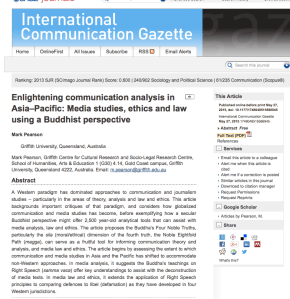
Screen Shot 2015-05-29 at 3.08.59 pmI  recently wrote an article on the “Right Speech” aspect of mindful journalism for the International Communication Gazette titled ‘Enlightening communication analysis in Asia-Pacific: Media studies, ethics and law using a Buddhist perspective’. Its abstract and link to the full article is available here.

The article backgrounds important critiques of the Western approach to communication  studies, and considers how globalized communication and media studies has become, before exemplifying how a secular Buddhist perspective might offer 2,500 year-old analytical tools that can assist with media analysis, law and ethics.

I’ve also written a shorter account of the basic principles of mindful journalism in the journal Ethical Space: The International Journal of Communication Ethics, and the editors have been kind enough to make that article available for free viewing as a feature item on their website here. You might also want to explore some of their other fascinating articles on media ethics here and perhaps subscribe.

———–

Disclaimer: While I write about media law and ethics, nothing here should be construed as legal advice. I am an academic, not a lawyer. My only advice is that you consult a lawyer before taking any legal risks.

© Mark Pearson 2017

Leave a comment

Filed under blogging, Buddhism, Eightfold Path, free expression, journalism, media ethics, mental health, mindful journalism, social media

Reporting Islam panel and workshop at #newnewsau

By MARK PEARSON

We were honoured to have our Reporting Islam project showcased at this year’s New News forum hosted by the University of Melbourne’s Centre for Advancing Journalism (October 29).

Our project manager Dr Abdi Hersi and I conducted a workshop centred around the reporting of a mosque proposal in a regional community and later joined lawyer and South Sudanese community leader Kot Monoah on a panel chaired by Denise Ryan-Costello, journalism lecturer at Swinburne University.

The discussion has been ably reported here on The Citizen by Master of Journalism student Emily Porello.

Here is the Twitter coverage of the session:

https://twitter.com/Melita_Ferguson/status/792238794049069056

https://twitter.com/Melita_Ferguson/status/792233882414227456

Our Griffith University project (co-led by colleague Associate Professor Jacqui Ewart) recently won the 2016 Queensland Multicultural Award for our ground-breaking Reporting Islam Project.

Since its inception in 2014, our team has created a suite of research-based multi-media training and education resources for Australian media practitioners and tertiary institutions.

———–

Disclaimer: While I write about media law and ethics, nothing here should be construed as legal advice. I am an academic, not a lawyer. My only advice is that you consult a lawyer before taking any legal risks.

© Mark Pearson 2016

Leave a comment

Filed under free expression, Islam, journalism, journalism education, media ethics, Muslim, Reporting Islm

Reporting Islam project wins Queensland Multicultural Award

By MARK PEARSON

Our Reporting Islam project team won the Communication and Media Achievement Award category of the Queensland Multicultural Awards on Saturday (August 20, 2016).

My co-investigator Associate Professor Jacqui Ewart and project manager Abdi Hersi accepted the award on behalf of our team.

Here are the award details, as outlined in media statements from Griffith University and the Minister for Multicultural Affairs, Grace Grace.

For more information about the project and its resources, please see www.reportingislam.org.


Reporting Islam Project wins Qld Multicultural Award

[Griffith University media statement]

Griffith University has won a 2016 Queensland Multicultural Award for its ground-breaking Reporting Islam Project.

Led by Associate Professor Jacqui Ewart and Professor Mark Pearson from the School of Humanities, Languages and Social Science, the world-first project aims to combat the negative stereotyping of Islam and Muslims in the media.

Since its inception in 2014, the project team has created a suite of research-based multi-media training and education resources for Australian media practitioners and tertiary institutions.

“The Queensland Multicultural Awards are a great initiative and we are honoured to be this year’s winners in the communication and media achievement category,” Associate Professor Jacqui Ewart said.

“Our project is about improving the quality of mainstream news media relating to Islam through the development of research-based best practice resources for journalists to encourage more mindful and accurate reporting of Muslims and the Islamic faith.”

“Our team has developed an app, a website, a reporting handbook, audio visual materials and two training packages.”

Find out more: Multicultural Awards finalists

Muslims negatively stereotyped

Associate Professor Ewart said the idea for the project was sparked by research showing that Islam and Muslims were routinely and negatively stereotyped in Australian news media.

“There is ample evidence of the negative impact of this news media coverage on Australian Muslims.

“We believe that fair, ethical and accurate reporting on matters involving Islam and Muslims will help promote social cohesion and feelings of inclusiveness for Muslim people and help build community confidence and resilience.”

Developed in consultation with south east Queensland Muslim community leaders and Australian news media organisations, the project team is delivering targeted training courses nationally.Strong partnerships have also been formed with Australian Muslim community members, international academic experts, educators and media industry personnel. The project team’s innovative and proactive approach promotes acceptance and understanding of Islam across diverse cultural groups and the wider community.

The 2016 Queensland Multicultural Awards were announced at the Logan Entertainment Centre on Saturday, August 20 as part of Queensland’s Multicultural Month celebrations.


Media statement from Minister for Employment and Industrial Relations, Minister for Racing and Minister for Multicultural Affairs, The Honourable Grace Grace:

Saturday, August 20, 2016

Awards recognise Queensland’s brightest multicultural achievers

Queensland’s brightest multicultural achievers have been recognised at today’s Queensland Multicultural Awards, held in Logan.

Multicultural Affairs Minister Grace Grace announced the eight winners and congratulated all 27 finalists during a gala luncheon that was also attended by Health Minister and Member for Woodridge Cameron Dick.

“These awards recognise some of the outstanding organisations and individuals who are such a vital part of Queensland’s multicultural success story,” she said.

“Community groups, volunteers, businesses and sporting organisations are just some of those recognised by these prestigious awards.

“I want to congratulate all finalists for their efforts to create a harmonious and inclusive Queensland.

“It really is the icing on the cake to be having these awards during Queensland Multicultural Month, Queensland’s largest multicultural celebration.”

Ms Grace said all finalists were setting a great example and providing inspiration to all Queenslanders.

“They remind us that Queensland always has, and always will, depend on the skill and talent of people drawn from all parts of the globe,” she said.

Communication and Media Achievement Award – Reporting Islam Project Team (Nathan). They aimed to combat the negative stereotyping of Islam and Muslims in the media through the development of a research-based, best practice guide for journalists reporting on stories about Islam and Muslims

Queensland Multicultural Award winners:

  • Minister’s Multicultural Award – Multicultural Community Centre (Newmarket). The centre assists migrants, refugees and disadvantaged members of the community through settlement services, training and employment support
  • Outstanding Volunteer – Naseema Mustapha (Highgate Hill). She was involved in causes such as blanket and clothing drives to assist asylum seekers, English tutoring, fundraising for orphanages in Africa and the Griffith University Refugee Students’ Association Refugee Day Festival.
  • Business Excellence Award – Townsville Hospital and Health Service (Townsville). The hospital partnered with TAFE North Queensland to provide work experience to 18 refugee and migrant job seekers. The program also gave participants their first experience in gardening, painting, food preparation, cleaning and plumbing at Townsville Hospital.
  • Communication and Media Achievement Award – Reporting Islam Project Team (Nathan). They aimed to combat the negative stereotyping of Islam and Muslims in the media through the development of a research-based, best practice guide for journalists reporting on stories about Islam and Muslims
  • Employment, Education and Training Innovation Award – Private Enterprise – The Multicultural Sports Club (Logan) is an initiative of Multicultural Youth Queensland, a youth-led innovative, not-for-profit organisation which provides targeted services, programs and projects to improve life outcomes for young people aged 12 to 30 years old.
  • Employment, Education and Training Innovation Award – Public Sector – Queensland Police Service Academy – ROLE program (Oxley). The program pairs police with students from a Brisbane high school where they work with mentors and encourage Year 9 students to participate in team building activities
  • Services and Communities Award – Individual – Regina Samykanu-Vuthapanich (Gatton). She set up the first Youth Council in the Lockyer Valley, established the Gatton Multicultural Festival and the Overseas Students Association Support Group. She also founded the Lockyer Valley Multicultural Association and the Somerset Migrant Resource Centre.
  • Services and Communities Award – Organisation – The Friends of HEAL Foundation (Yeronga). The organisation provides creative arts therapy to young people from refugee backgrounds and also helps refugee children settle into their new community

For more details on Queensland Multicultural Month head to www.qld.gov.au/multiculturalmonth

———–

Disclaimer: While I write about media law and ethics, nothing here should be construed as legal advice. I am an academic, not a lawyer. My only advice is that you consult a lawyer before taking any legal risks.

© Mark Pearson 2016

Leave a comment

Filed under free expression, Islam, journalism, journalism education, media ethics, Muslim, Reporting Islm

Reporting Islam in the spotlight at #AEJMC16

By MARK PEARSON

My sabbatical semester travels now have me in Minneapolis for the annual convention of the Association for Education in Journalism and Mass Communication – #AEJMC16.

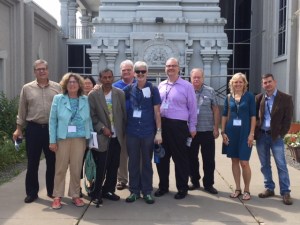
Visiting the Hindu temple in Minneapolis with the Religion and Media interest group from AEJMC with my Mindful Journalism co-author Shelton Gunaratne (front row, second from left).

Visiting the Hindu temple in Minneapolis with the Religion and Media interest group from AEJMC with my Mindful Journalism co-author Shelton Gunaratne (front row, second from left). [Photo: Julie Pearson]

I’m presenting a paper titled “Perspectives of journalists, educators, trainers and experts on news media reporting of Islam and Muslim communities in Australia and New Zealand”, showcasing research from our @ReportingIslam project, written with colleagues Jacqui Ewart (@jacquiewart) and Guy Healy.

Our paper uses data from an Australian study to ascertain issues associated with news media coverage of Islam and Muslims from the perspectives of journalists, journalism educators and media trainers. We draw on data from interviews with 37 journalists, editors, educators, media trainers, Muslim community leaders and other experts located in Australia and New Zealand to explore their understandings of the ways stories about Islam and Muslims are reported and why.

We’re looking forward to the feedback from colleagues after two interesting sessions on similar topics yesterday.

On Wednesday we visited Muslim, Hindu and Christian places of worship in Minnesota with the Media and Religion interest group from the conference (pictured left).

———–

Disclaimer: While I write about media law and ethics, nothing here should be construed as legal advice. I am an academic, not a lawyer. My only advice is that you consult a lawyer before taking any legal risks.

© Mark Pearson 2016

Leave a comment

Filed under blogging, Buddhism, citizen journalism, Eightfold Path, free expression, Islam, journalism, journalism education, media ethics, mental health, mindful journalism, social media, terrorism

Gearing up for a stimulating and mindful #wjec16

By MARK PEARSON

Many of the leading lights in journalism education internationally gather in Auckland next week for the fourth World Journalism Education Congress at AUT Auckland.

WJECWebsiteScreenshotFor me, it will be a busy start to a sabbatical semester and I am looking forward to chairing a session, being respondent for another, a panellist in a 21st century ethics discussion, and presenting two conference papers with @ReportingIslam project colleague Jacqui Ewart (@jacquiewart).

Interested? Here are the session descriptions and abstracts. See the full program here.

WJEC preconference of the Journalism Education and Research Association of Australia (JERAA), AUT Pacific Media Centre (PMC) and Media Educators Pacific (MEP), Wednesday, 13 July 2016, 4-5.30pm

A Research-driven Approach to Developing a Best Practice Checklist for Journalists Reporting upon Islam and Muslims

Prof Mark Pearson and Prof Jacqui Ewart (Griffith University, Australia)

This paper explains the processes undertaken to research, develop and trial a checklist for journalists or journalism students for the ethical and mindful reporting of stories involving Islam as a religion or Muslim people. The presenters outline an innovative approach to such a task where the international literature in the field and follow-up research informed the creation of an extended checklist which was then refined according to the perceived needs and priorities of the journalists and students who were presented with it.

This paper presents the methodology and results of the study implementing exactly that approach, which might inform future approaches to the development of such guidelines across a broad range of reporting topics. The study formed part of a major Australian Government funded project involving the creation of research-based resources on the mindful reporting of Islam and Muslim people.

Academic research papers stemming from international studies on reporting Islam and journalism ethics were searched. We also undertook 29 interviews with journalists, journalism educators, journalism students and academics with expertise in the media and Islam in Australia and New Zealand. Topics covered included best and poor practice and curricular and pedagogical approaches to educating journalists for more mindful reporting. We analysed this data – previous studies and the interview transcripts – as a crucial part of the development of an extended list of 30 questions journalists and editors might ask themselves when covering a story related to Islam or Muslim people. Journalists, educators and journalism students (n = 123) attending workshops throughout 2015 were presented with the 30 questions and were asked to nominate the 10 they felt were most important (in no particular order), using a variation of “forced choice” testing in survey methodology (Frederick, 2004, pp. 397-398). The responses were then ranked in order of importance into a “Top Ten” checklist and subsequently built into the project’s resources and curricula which were in turn trialled with journalists, journalism educators and students at several sites in four Australian states and in Canberra. This paper explains that the approach has at least three benefits – the pedagogical advantage of the embedded learning happening while the participants perform the ranking; the reassurance for the teaching resource developers that the selected guidelines are considered the most important by the target groups; and the enhanced credibility of the resulting guidelines for those subsequently using them. The paper details the methodological and educational research underpinning the approach and presents the resulting refined checklist.

Frederick, R. (2004). Forced-choice testing. In M. Lewis-Beck, A. Bryman, & T. Liao (Eds.), Encyclopedia of social science research methods. (pp. 397-398). Thousand Oaks, CA: Sage.

WJEC Conference, July 14, 11am-12.30pm

Panel 2: 21st century ethical issues in journalism
WG404
This panel explores the ethics of journalism in an environment where journalistic authority is diminished and new relationships with news publics are being sought. The speakers, drawing on a range of philosophical positions, will explore arguments around journalistic independence, engagement with the public good, transparency and sincerity. In doing so, the panel members will trace some of the major fault lines in contemporary journalism ethics around truth-telling and accountability and assess ways through which journalists can morally justify their work.
Chair: Donald Matheson, Canterbury University (New Zealand)
Panelists:
Mark Pearson, Griffith University (Australia)
Cherian George, Hong Kong Baptist University (Hong Kong)
Linda Steiner, University of Maryland (United States)
Respondent: Stephen Ward, University of British Columbia/University of Wisconsin-Madison (Canada)
WJEC Conference, July 16, 11-12.30pm
Paper session: 21st Century Ethical Issues in Journalism 3
WG607

Eliciting Best Practice in Reporting Islam: Case studies from Australia

Mark Pearson and Jacqui Ewart, Griffith University

Much is known about the poor practices adopted by some news media outlets in their coverage of Islam and Muslims, but relatively little research has been conducted into what might constitute best practice in this important area of reportage (Pintak & Franklin, 2013; Rupar, 2012). In this presentation we discuss two case studies from Australia, involving a range of approaches to reporting stories involving Islam and Muslims. These case studies were part of the first stage of a projected three-stage project aimed at developing best practice resources to encourage the more mindful reporting of Islam and Muslims. The first case study includes a set of examples of news media reporting of proposed and existing mosques and prayer rooms. We chose this particular case study because the international literature revealed that mosque proposals and construction projects frequently became the focus of negative news media coverage (DeHansas and Pieri 2011; Dunn, 2001; Alleivi, 2009). Key journalistic lessons to emerge from the examination of the articles about coverage of planned, proposed or existing mosques included the need to: pay attention to the type of language used in news reports; focus on using non-inflammatory language; ensure a range of voices are heard in reports; avoid giving attention to extreme points of view held by a minority; ensure images are in context; verify the veracity of protestors’ claims; assess the proportion of protesting residents in the particular community; embed ongoing coverage of issues affecting Muslim communities into the news schedule; and consider the broader social and current affairs context when covering stories about Islam and Muslims.

The second case study focuses on two approaches to national media coverage of radicalisation and association of Muslim people with violence and terrorism because the international body of research highlights the tendency of news media to make connections between, or conflate, these issues (Altheide, 2007; Murphy et al, 2015; Pintak and Franklin, 2013; Rupar, 2012).

There were some similarities and some differences between the approaches of the two national media outlets (newspaper and public television) to essentially the same topic of radicalisation of Australian Muslim men at approximately the same point of history. Both used a range of sources including some experts, mainstream Muslims and radicalised militants and/or their friends or associates; demonstrated a lack of detail on the sponsorship of their key expert sources; and simplified and sensationalised the issue in key aspects. Differences included: a generalised headline damaging the credibility of the newspaper’s overall coverage and the television program’s use of a moment of conflict in its promo; the newspaper’s use of a single expert source and the television program’s use of several; the newspaper’s profile of a single Muslim suburban woman for its ‘typical’ or ‘mainstream’ Muslim perspective as opposed to the television program’s inclusion of a range of diverse Muslim voices from different ethnic groups and locations; and the newspaper’s delay in offering Muslim community leaders’ perspectives until its follow-up coverage the next day as distinct from the television program including several such voices.

Using the international literature about best practice in reporting Islam and Muslims and the findings from our analysis of the case studies, we draw upon the research, our case studies and selected data from a series of interviews with experts to present a schema of 30 best practice questions journalists might reflect upon when reporting Islam and Muslims.

References

Allievi, S. (2009). ‘Conflicts Over Mosques in Europe: Policy Issues and Trends–NEF Initiative on Religion and Democracy in Europe’, Network of European Foundations.

Altheide, D.L. (2007). The Mass Media and Terrorism, Discourse and Communication, 1(3): 287-308.

De Hanas, D.N., and Pieri, Z.P. (2011). Olympic Proportions: The Expanding Scalar Politics of the London ‘Olympics Mega-Mosque’, Sociology 45(5): 798-814.

Dunn, K. M. (2001), Representations of Islam in the politics of mosque development in Sydney. Tijdschrift voor economische en sociale geografie, 92: 291–308.

Murphy, K., Cherney, A., and Barkworth, J., (2015), forthcoming). Avoiding Community Backlash in the fight against terrorism: Research Report.

Pintak, Lawrence and Franklin, Stephen (eds) (2013). Islam for Journalists; A Primer on Covering Muslim Communities in America. [Digital newsbook]. US Social Science Research Council; Edward R Murrow College of Communication, Washington State University. Available: https://www.rjionline.org/downloads/islam-for-journalists

Rupar, V. (2012). Getting the facts right: Reporting ethnicity and religion. A study of media coverage of ethnicity and religion in Denmark, France, Germany, Greece, Hungary, Italy, Lithuania, Slovakia and the United Kingdom.[Project Report]. Brussels: International Federation of Journalists. Available: http://ethicaljournalisminitiative.org/en/contents/eji-study-2012

—-

RELATED:

More on the Reporting Islam Project:

Griffith University Red Couch interview: Spotlight on Reporting Islam

ALSO RELATED:

Related to my ethics panel presentation, our recent book Mindful Journalism and News Ethics in the Digital Era: A Buddhist Approach (Shelton Gunaratne, Mark Pearson and Sugath Senarath eds; Routledge, NY, 2015)  explored the possibilities of applying mindfulness techniques to journalism practice.

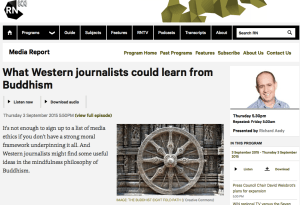
Interested? You can listen to my 10 minute interview on Radio National’s Media Report here.

Screen Shot 2015-09-04 at 9.46.24 am

See also my account of the basic principles of mindful journalism in the journal Ethical Space: The International Journal of Communication Ethics, and the editors have been kind enough to make that article available for free viewing as a feature item on their website here. You might also want to explore some of their other fascinating articles on media ethics here and perhaps subscribe.

———–

Disclaimer: While I write about media law and ethics, nothing here should be construed as legal advice. I am an academic, not a lawyer. My only advice is that you consult a lawyer before taking any legal risks.

© Mark Pearson 2016

2 Comments

Filed under blogging, Buddhism, citizen journalism, Eightfold Path, free expression, Islam, journalism, journalism education, media ethics, mental health, mindful journalism, social media, terrorism

Crystal ball gazing 101: Media Club event triggers flashback to 1995

By MARK PEARSON

Huffington Post Australia CEO Chris Janz addressed the Gold Coast Media Club at Griffith University yesterday (17/6/16) and offered fascinating insights into how the leading international news brand is forging success in an ever-changing mediascape.

My Griffith University journalism and public relations colleagues and I quizzed him on the implications for our students and programs. His essential toolkit for the journalism graduate in the new era?  All the basics of good reporting (fairness, accuracy, fact-checking etc) plus a good measure of curiosity, enthusiasm and the ability to cope with change.

The event and topic triggered a flashback to my own address to what was then the Gold Coast Media Industry Club way back in 1995 when the “Net” was first taking off as a mainstream medium. As I recall, only the Melbourne Age had an online version. Amazingly, I just found an ancient text file of that speech in my backups folder, and thought I would reproduce it here for those interested in checking whether my  crystal ball gazing was accurate – or way off beam – two decades ago. (You’ll see how early it was in the growth of the Internet at the time, with fewer than 9,000 commercial websites in existence internationally.)

Apologies for the missing graphics. I’m not sure I had access to Powerpoint back then, and my ‘slides’ were transparencies displayed on an overhead projector [OHPs/OHTs] .

I hope you enjoy the journey back in time and would love to hear your reactions.

—-

“The Media and the Internet: Threat or Opportunity?”

Gold Coast Media Industry Club address by Mark Pearson

Gold Coast Arts Centre, July 14, 1995

Where do you think you’d find these things if you really needed to access them?

  • The share price for Zeolite
  • The weather in Nairobi
  • Program details for a Croatian film
  • Photographs of women in G-strings and in steamy shower scenes.
  • The value of the Cyprus pound
  • The world mosquito-killing record, as set in Finland.

The Internet? … No, actually all those things appeared in this issue of the Gold Coast Bulletin.

It’s amazing what you’ll find in your daily newspaper.

I’m a great fan of newspapers. My whole career has been built upon them. Production-wise it’s easy to see why they’re called the ‘daily miracle’. I still can’t fathom how those two rolls of paper arrive on my front lawn every morning… the human and physical resources that have gone into them … the efforts of correspondents in Finland relayed to news agencies, where sub-editors process copy and send it thousands of kilometres to other news agencies who forward it to newspapers where it is selected, edited and placed alongside photographs and advertisements which have been through equally complex processes. And somehow it’s all printed and transported and passed through many more hands before it arrives next to my letterbox and I have to fight my wife and 14 year old son to read it.

But that still doesn’t mean I’m interested in the weather in Nairobi or the value of the Cyprus pound. I find enough in the newspaper to keep me buying it and its advertisers must find enough buyers in the newspaper to keep sponsoring it.

There are a few lessons for us here when we start to think about a new technology like the Internet. And this talk’s devoted to three of those lessons:

  1. The value of information is relative. What’s trivia to me might be important to you. What’s fun to me might offend you.We can’t impose our own values on other people’s information.
  2. All media have their advantages and disadvantages.
  3. No matter what the medium, the audience comes first.

And I’m going to apply all of that to the Internet: discuss the material we find on it, talk about its pros and cons; and take a look at the demographics of its audience.

I’m going to try to do all that without using the hype that’s being bandied about when it is discussed. We’ll assess it as a medium, decide whether it’s useful to us, and have a bit of fun along the way.

  1. The Internet as a Medium

Technological developments such as the telegraph, radio and television prompted changes in both the gathering and distribution of news. But only the advent of the computer and advances in telecommunications have redefined mass communication. The convergence of media, computing and telecommunications is allowing audiences a degree of independence and interactivity not possible with traditional media.

Newspapers, magazines, radio and television were all one-to-many communication media, with single products or programs being distributed to mass audiences. Presenting news to such audiences was a matter of determining the topics of greatest interest to the largest number of readers, listeners and viewers. Audience choice was limited to the selection of the medium and the news product. From that point on audiences had to take what they were offered. The new media allow for a significantly greater degree of choice and interactivity, prompting questions about the suitability of mass media techniques of reportage and distribution.

What are the new media? Obviously, the “new” media will change with time. Newspapers comprised the “new medium” of the 18th century; television the “new medium” of the 1950s. To me, the new media are those which involve some convergence of traditional media to offer audiences a greater level of choice and interactivity. Examples include the Internet and its permutations (such as the World Wide Web and on-line discussion groups); broadband distribution services providing interactive television services in homes; and virtual reality technology offering the user some electronic experience which appears real.

The Internet is the linking of computers at thousands of academic, governmental and commercial institutions worldwide into a wide area computing network (WAN). Figures are in dispute, but conservative estimates put full Internet access at more than 30 million and simple electronic mail access at 120 million world-wide.

But it’s built on chaos. The whole system – originally a US defence initiative – was premised on the notion that no single link would be crucial to the network, so that if any single computer was taken out by a military strike the other nodes could still communicate. It’s this interconnectivity that makes the whole network so difficult to count – and just as difficult to regulate.

The most exciting part of the Internet today is the world wide web of computers using a common language to publish material to computers with different architectures throughout the world. Hundreds of traditional media outlets – newspapers, magazines, radio and television stations – are now producing Web versions of their products.

Other new players are creating tailor-made services for Web presentation. And hundreds of thousands of individuals are publishing their own Web pages as a hobby.

Whereas a newspaper might have previously been competing on the news stand against a handful of other newspapers and scores of magazines, on the Internet it is competing against hundreds, perhaps thousands of other newspapers and magazines and millions of independently initiated documents and multi-media presentations, each of which has varying relevance to its separate readers’ needs.

This makes the function and purpose of a traditional media provider problematic from both a communication and an economic perspective. For example, how useful and viable is the entity known as The Age newspaper when published in an electronic form on the World Wide Web? At the same time, how useful and viable does the print version of the same newspaper continue to be to its traditional audience? Such questions strike at the heart of the dilemma facing traditional providers as they confront the ramifications of a large-scale move towards the new media.

At the same time, traditional journalism can be enhanced by adept use of new technologies in reportage. New resources are now at the finger tips of the journalist wanting to use the Internet for reporting. Computer aided reporting involves electronic access to government documents, court reports, articles, and specialist opinions, adding to the depth of coverage of an issue and the discovery of angles on stories which might never have been contemplated. So, while new media might represent a threat to the medium in which the journalist currently works, the journalism itself can be enriched by using the new media proficiently.

Newspapers and the journalism which evolved through their pages owe their very existence to a technological innovation which, when harnessed by the intellectual pursuits of modern humanity, has provided the catalyst for the spread of knowledge. That invention was the printing press. The evolution of the printing process from the archaic machinery of the seventeenth and eighteenth centuries, through the era of hot metal type to computer typesetting and finally to electronic pagination and distribution has affected the time frames within which newspaper journalism has been expected to be conducted and the audiences which it has been able to reach.

The introduction of the telegraph, radio and television each brought their own challenges to media practices.

The fleeting 1980s technologies of videotext/teletext news services were a flop because they expected audiences to sit in front of television sets and read text over which they had no control.

The new media make no such mistakes. They are premised on interactivity and user choice. The theory is you get the information or entertainment you request … when and where you want it. The mass media is becoming individually tailored. That’s the main point of difference of both the Internet and the broadband interactive services promised with the next phase of digital television.

So, what does it look like?

Here’s a new publication I started with my students last week: the first daily journalism student production targeted exclusively at a Web audience…

Explain background to Bond student project. (OHPs1-3) (explain how it beat SMH with main news by 16 hours and television stations by 4 hours). People in Anchorage can be reading our news hours before Australians are accessing the mainstream media.

Ours is one site of more than 2000 Australian sites on the World Wide Web. There are more than 5 million of them internationally. Just like the daily newspaper, there’s a lot of guff out there in cyberspace. There’s the trivial and the bizarre…

(Read two from .net directory)

(Explain toilet one.)

There are entertaining sites: (Sound and video clips from the latest movies, fan club pages, even interactive chess – Daniel).

There are educational sites, places to do courses and research material for projects and essays. (Ancient Egypt page, Library catalogues, interactive classrooms.)

But is it useful???

Explain my usage: checking references, politicians’ names/contact numbers, multi-media course outline.

But for Mrs Allen over the road … probably not just yet. As the sites build up locally I could see her accessing catalogues, getting quotes and ordering products by email, downloading and printing a map of Fraser Island for her next trip, booking her camping permit there, and dragging some puzzles off the Net to entertain her kids on the long drive there.

For Mrs Allen, it will be a matter of being educated as to its possibilities. For her children, it or some version of it will be second nature.

You’ve seen our fairly modest news production. Here’s the kind of product being produced exclusively for Web distribution…

[OHP: Hotwired home page.]

  1. Commercial potential

Commercial use of the World Wide Web can take three main forms:

  • Passive presence

A Web site used for PR or low-key corporate presence. This might simply give information about the company and its activities and structure.

  • Spot advertising

Actual display advertising on someone else’s Web site. (OHP: MacMillan site).

(Explain Infoseek’s search page: Cathay Pacific giveaway, Alamo freeways online rentacar, Species, the sci-fi thriller from MGM/UA, Sun Microsystems, Metricom Wireless Data Technologies, MacMillan Information Superlibrary, Internet Shopping Network, NECX Direct computer products, Dealernet – the source of new car information)

  • Designated sales site

A whole Web site specifically designed to sell a product. (OHP: First National example.)

US market research group ActivMedia has produced one of the first reports on Internet marketing.

It reported there were 588 commercial World Wide Web (www) sites at the end of September 1994. Eight months later, the index listed more than 6,000, an average monthly growth rate of 34%. Even if growth slows considerably, 9,000 commercial websites will exist before the end of August, 1995. ActivMedia surveyed 195 of these active Internet marketers, and projected the responses to reveal an industry worth more than $300 million.

(OHP: Activmedia graph)

Interestingly, it showed that the average website was generating more than US$7000 per month in sales for the average active marketer, with 18 per cent reporting five figure turnover generated to their websites.

  1. Demographics

Cyberspace (Show William Gibson Neuromancer book cover).

Cyberspace…. A graphic representation of data abstracted from the banks of every computer in the human system. Unthinkable complexity. Lines of light ranged in the nonspace of the mind, clusters and constellations of data. Like city lights, receding…

Gibson’s cyberspace was an incredibly violent and masculine place, with the direct neural connection between humans and computers both exhilarating and painful.

The non-fiction cyberspace is rarely violent, often exhilarating, but is notably masculine.

The Graphics, Visualization, & Usability Center at the College of Computing, Georgia Institute of Technology surveyed 13,000 Web users and came up with the following demographic data:

  • Average age across all users was 35.
  • More than 80% of users were men, but female use was increasing.
  • More than half of the users were married or had been.
  • 60% of users had no dependents.
  • Average income of users was US$69,000
  • 70% used their computers for “fun” for more than five hours per week. (Time they might otherwise be watching television.)
  • Women did less fun computing than men.
  • 30% had been on the Internet for less than 6 months.
  • Almost half owned only one computer.
  • Only 31% were in the computing profession, with the next largest occupational groups education, professional and management.
  • 22% said they would not pay fees to access Web sites.
  • 85% of users shared their computers with others.
  • About 20% use their computer for work for more than 30 hours per week.

The advertising and marketing people will know much more about that demographic than I do. I’ll make two blatantly obvious comments: They’re not all tech-heads, or nerds, as they have been portrayed, and they have money to spend. You can figure out the rest.

  1. Problems

[OHP] Load: technical difficulties of speed and quality.

Access: Information rich vs. information poor

Control: large vs. small players. Delphi on line within month. Microsoft to launch its exclusive Web access under the long awaited Windows 95 release.

Legal hazards: Copyright and stealing images, Defamation (WA academic who sued over Internet libel), trade practices (consumer fraud), and the common legal problem of trans-jurisdictional infringements.

Pornography

Down side – rape in cyberspace, child pornography arrest.

Fun side: ‘teledildonics’; erotica.

In conclusion ………………

Some say this whole Web thing is like the gold rush era: the only ones who’ll make any money out of it will be those who supply the miners with rations, rum and rump.

Others call it the ‘world’s largest zero billion dollar industry’.

Experts who claim to predict the future have only one thing in common – they’re always wrong.

But I’ve got a feeling there’s gold in them there hills for any media player with a good eye for an audience and the right product to market.

Just remember that audiences are human beings with their own problems and passions. Technology on its own holds no power. The power is in your ability to use it to help people solve their problems and to ignite their passions.

The Internet will prove to be a threat to those of you who don’t understand your audiences. And perhaps an opportunity to those who do.

© Mark Pearson 1995 and 2016

Disclaimer: While I write about media law and ethics, nothing here should be construed as legal advice. I am an academic, not a lawyer. My only advice is that you consult a lawyer before taking any legal risks.

Leave a comment

Filed under blogging, Internet, Media regulation, Uncategorized

A reflection on the ‘Media Wars’ 20 years on

By MARK PEARSON

It has been 20 years since the start of the so-called ‘Media Wars’ – the spat between cultural studies and journalism educators triggered by the provocative (and likely tongue-in-cheek) proclamation by cultural studies academic John Hartley that journalism research was a ‘terra nullius’ of epistemology and Keith Windschuttle’s retaliatory attack on the ‘obscurantism’ of cultural studies as an academic discipline.

I have partnered with two colleagues – Roger Patching and Lisa Wilshere-Cumming – to write a reflection on that episode and an assessment of the path of journalism research since that debate.

Our article appears in the August 2015 edition of Media International Australia (No. 156, just released), the contents of which are viewable here.

Here is our abstract:

A conceptual matrix of journalism as research two decades after ‘Media Wars’

Mark Pearson, Roger Patching and Lisa Wilshere-Cumming

It is 20 years since John Hartley (1995) positioned journalism as the subject of academic research rather than as a research method in its own right. In 1999, Media International Australia devoted a themed edition to the debate over journalism in the academy (‘Media Wars’), which prompted further scholarly discourse over the role and location of journalism as a field of study. This article reassesses that debate in the light of the acknowledgement of journalism studies and journalism creative works in the Excellence in Research for Australia (ERA) system, the use of journalism methods as a research methodology and the development of conceptual paradigms for journalism as research. The article surveys the relationship between journalism and research over the ensuing two decades and proposes a conceptual matrix of the journalism–research nexus.

© Mark Pearson 2015

Disclaimer: While I write about media law and ethics, nothing here should be construed as legal advice. I am an academic, not a lawyer. My only advice is that you consult a lawyer before taking any legal risks.

Leave a comment

Filed under journalism, journalism education, Uncategorized

Techniques and challenges of new models for journalism: The Undercurrent

By MARK PEARSON

As legacy media outlets grapple with the challenges of retaining and engaging their audiences, new media entrepreneurs experiment with new forms of journalism and novel ways of winning funding.

My guest this week in our Introduction to Journalism class was Jen Dainer, Head Writer and Co-Producer at The Undercurrent
[Twitter: @TheUCNews | @jendainer ] who has developed with co-founder Dan Graetz a new model of satirical advocacy journalism drawing upon their considerable creativity, skill base, and life and work experience.

Our interview spanned a range of topics including Jen’s own background, the objectives of The Undercurrent, how it differs from other news and current affairs products, the importance of impeccable research in avoiding legal action, and how they plan to gain traction and financial support.

You can view the interview here:

[Aug 4, 2015 / 26 mins. Camera work: Bevan Bache ]

Please contact Jen Dainer direct @jendainer / jen@theundercurrent.com if you would like to be involved in the project or support it in some way.

https://twitter.com/MarkTordai/status/628358500016455680

https://twitter.com/NeverForTheFall/status/628358062307348481

© Mark Pearson 2015

Disclaimer: While I write about media law and ethics, nothing here should be construed as legal advice. I am an academic, not a lawyer. My only advice is that you consult a lawyer before taking any legal risks.

Leave a comment

Filed under Uncategorized

Benefits of using Twitter from Day One in a news writing class

By MARK PEARSON

Almost 30 years ago my first colleague in journalism education – the late Charles Stuart – summarised the curriculum of a journalism degree.

“In the first year you teach them how to write an intro (lead),” he said.

“In year two you teach them how to write the body of the story.

“And in their final year you revise the intro.”

While Charles’ advice was delivered tongue in cheek, he certainly hit upon one of the greatest challenges facing students of basic news reporting – how to sum up the key elements of a story in an interesting way in just a few words.

I recalled that conversation as I set the in-class exercises for my Introduction to Journalism tutorials this week and turned to Twitter to help out.

Twitter has its pluses and minuses as a social medium, but there is no doubting its value as a platform for clear and concise expression.

Its 140 character format equates to 20-22 words and thus it lends itself to an exercise where students can try their hand at a basic news lead.

Our 300 first year students were prepped on the basics in their lecture and briefed on the importance of Twitter in modern day journalism as a means of communication with colleagues and sources, finding useful news angles, and in accessing contacts and basic information when a news event unfolds.

We decided the course code #1508HUM made a suitable class hashtag and assigned students to live tweet the lecture to reinforce its value.

https://twitter.com/MarkTordai/status/625820992963645442

As an example of an effective use of Twitter in journalism I showed them the Twitter feed from ABC PM presenter Mark Colvin’s to the 85,000 followers of his @Colvinius handle and explained that it was a badge of honour for Twitter users if Colvinius ever retweeted your tweets.

One of my live tweeters approached me in the lecture break to show me his dialogue with @Colvinius during my class.

Quite a coup. Clearly Jake gets it. (BTW, thanks @Colvinius).

Students who did not have Twitter accounts signed up for them prior to the tute and we started the session with an exercise requiring students to interview a classmate and introduce them to the group by spelling their name very clearly and stating an interesting fact about them.

We then talked about news values and what might make news for a campus community.

We embarked on our Twitter news hunt, wandering the campus in search of stories using our five normal senses plus the students’ evolving “news sense”.

Some of the stories came from noticeboards, although I explained a journalist would call to verify any information found there.

Others were based on interesting happenings around the campus during our 20 minute walk, including a cheerleader squad practice, an interview with a student events officer, and an array of photos and interviews from the student clubs sign-on stalls.

The exercise has the following benefits:

  • It teaches students the art of summing up a story in just a few words in an era when the attention span of news audiences is just a few seconds.
  • It introduces them to one use of social media in modern journalism.
  • It allows students to experiment with multi-media reportage if they attach photos, sound or vision.
  • It allows debate over the news value of campus-based stories.
  • And it does all of this within the comfort of a hashtag that allows them to experience publishing their first news story that technically all the world can see while in reality very few people other than their peers and tutors will actually view it.

You can see some highlights below, or even visit the #1508HUM hashtag if you are really interested.

I’d certainly recommend such an exercise to colleagues not already doing something similar in their first news writing classes.

https://twitter.com/MarkTordai/status/625856023958392833

https://twitter.com/tomobrien1997/status/626936785415745536

https://twitter.com/ByronRedpath/status/626267774445223936

© Mark Pearson 2015

Disclaimer: While I write about media law and ethics, nothing here should be construed as legal advice. I am an academic, not a lawyer. My only advice is that you consult a lawyer before taking any legal risks.

2 Comments

Filed under Uncategorized

Stakeholder theory as a way of viewing social media policies and risk

By MARK PEARSON

My Skype guest of the week for our Social Media Law and Risk Management course this week is Professor Andrew Crane from York University in Toronto, Canada, the author of one of our key readings for the week on stakeholder theory.

The article is co-authored with Trish Ruebottom and is titled ‘Stakeholder Theory and Social Identity: Rethinking Stakeholder Identification’, Journal of Business Ethics, Vol. 102, Supplement 1: Ethics, Corporations, and Governance (2011), pp. 77-87

We discussed the application of stakeholder theory to social media risk management and policy development. Professor Crane starts by explaining the basics of stakeholder theory (video and transcript below). Enjoy!

INTERVIEW TRANSCRIPT

Mark Pearson (@Journlaw): I am delighted to be joined here today by Professor Andrew Crane who is the George R Gardiner Professor of Business Ethics and Director of the Centre of Excellence in Responsible Business at the Schulich School of Business in the York University in Toronto, Canada. Welcome Andy.

Professor Andrew Crane: Thank you Mark, it’s a pleasure to meet you.

MP: Well you’ve done a lot of research and writing in Stakeholder Theory, and my students have actually been reading one of your co-authored articles on the topic. And for postgrad students who are relatively new to this theory, would you mind just giving a nutshell summary for them?

AC: Sure. Stakeholder Theory is a pretty simple idea in many respects, you know. It’s really about the idea that corporations in particular are not just there to serve the interests of shareholders. So Stakeholder Theory was designed to give us a way of thinking about other ways of understanding both the ownership of corporations, but in particular how decisions should be made. So, who should be involved in decision making, and how should the benefits that are, driven by corporations, the value that is created by them; who should it go to? So Stakeholder Theory is really about those sorts of questions, so who can affect organisations, but also who is affected by them, and what sort of rights do they have in respect to that stake they have, how should they be consulted, how should they be involved in the decision making, and those sorts of things. So it’s a very broad theory, and I saw that in one of your other readings you had the paper What Stakeholder Theory is Not, because there is a whole sort of set of different ways of understanding what it is – you know, it’s a very simple idea: there are multiple constituencies in any organisation, but then when it comes to [the question] of well, who is actually included and what are the implications of that, then it becomes a much broader discussion of the purpose of corporations.

MP: Yes, and we see that at its simplest level, I guess it’s just simply a matter of stakeholders being there to serve the interests of a company, and the main stakeholders being the shareholders and the customers and the corporate directors. But really your article and the other one you mentioned certainly extends that a lot further and it enters that corporate ethics field, where a company and its decisions have so many more stakeholders interests at play.

AC: Exactly

MP: So, coming to your article which starts to talk about social identity and basically presenting a grid which shows some intersection of what might be seen as a traditional role in relation to a corporation, and other social roles someone might play. Would you mind just talking us through the basic principles there and your spin on that?

AC: The basic way we understand stakeholders is the kinds of interactions that they have with the firm; so we think about them as either customers or employees and suppliers, regulators or NGOs or whatever else they might be. That’s typical kind of transactional view of who those different constituencies are. But the reason why different groups may actually mobilise or try and gain legitimacy in relation to firm, how they might press their claims, the kind of stake that they think they have, is not always about those simple transactions that they are engaged with. The reasons that people do things, the reasons people collect together to collaborate and press their claims upon firms are also about who people believe they are, about their social identity. So what are the bonds that connect me to other people that means these are the things that bring people together and make them mobilise in a social movement or some sort of pressure towards companies. So it may well be that I’m a customer of a firm, but I’m might simultaneously also be an employee, I might also hold shares in that firm; and I’ve got all kinds of different relationships with that firm at any one time. What we are trying to do with (Stakeholder) Theory with our paper is to say well, when people actually do try and press their claims, it is often about who we feel connected to that’s important. So the fact that I’m a white, British male for example who lives in Canada, that is very important for why I may be involved, why I might connect with certain firms. For example, it might be very different if I was a woman or a person of colour, or any other kind of quality which might impact on how I connect with companies.

MP: Well it seems, because of that very reason, to lend itself to an examination of social media in relation to a corporation; and particularly in the case of an emerging crisis because people with different social identities might fluctuate more towards social media for different reasons and in different places. Have you thought yourself about the interaction of Stakeholder Theory and social media in the corporation?

AC: I think one of the important ways of connecting up Stakeholder Theory and social media as well if a firm is trying to work out who it should be communicating with through social media; who the constituencies who are important; Stakeholder Theory provides a framework for that, because it gives us a way of thinking through who are the legitimate constituencies that we should be connecting with, how can we distinguish between legitimate and illegitimate, and also between who are the more powerful or less powerful that we should be connecting with. Stakeholder Theory is often seen in very instrumental terms in that sense; it is a strong instrumental approach there which says firms will care about stakeholders that matter – those that have power, those that have legitimacy, those whose stakes are very urgent. So social media is all about power in many respects; it’s about who you can influence, who you can connect to, how many people in your list of Twitter followers and what have you. So for firms it provides a framework for them to establish who matters in terms of their different constituencies. If we take it in an ethical dimension, take it in a more normative perspective, we say well ‘what rights do those people then have’? What sort of rights do you have as an employee, as a consumer, as a broader stakeholder of an organisation in relation to how it is going to communicate to you – in terms of protection of privacy, protection of various rights in terms of bullying and other things through social media?

MP: Yes – and also I think it can catch some corporations by surprise if they haven’t thought through particular social media stakeholders, or people who are using social media who may be stakeholders. And we see this with these grassroots campaigns against major corporations where they’ve underestimated the power of public momentum and social conscious using social media – which fits with your social identity perspective on that, doesn’t it?

AC: Absolutely. I think one of the interesting things here is that we tend to think of stakeholders in terms of a hub with spokes, right? Here’s the firm, here’s the decision making unit, and here’s the employees, here’s the consumers, here’s the suppliers, here’s the others; but social media is all about interconnections between different stakeholders and between different groups. You can’t think in those terms anymore if you’re trying to understand social media. Stakeholder Theory has limits in its traditional view and understanding it, unless you take it to a much more networked, much more nuanced kind of understanding of the types of environments that firms are interacting with.

MP: Well, while Stakeholder Theory might be very useful in research and the academic and looking at corporations and their interaction with various stakeholders, how useful is it as a practical tool in an organisation? So if you were a marketing manager or a public relations manager and you wished to avert some crisis in your company by trying to ascertain who the various stakeholders are and their respective interests.

AC: It can be very useful. It depends how you use it. It can be very effective at helping firms become prepared for identifying the various constituencies they need to be concerned about. If you take it seriously you need to be creative about trying to imagine who those constituencies are, because it is not just who is going to affect you now, when you think about a particular decision, who is going to be affected further down the line. So it can help you to identify these constituencies, but it can also help you to start thinking about, well, how can we predict what the type of response will be from those constituencies, depending upon how much power they have, how much influence, leverage, whether they are connected to other stakeholders in ways that mean they can leverage even greater influence and those sorts of things. So you can start to predict the kind of responses that may happen based on simple stakeholder framework that then gets into the idea of who has power, who can influence what is going to happen in the firm.

MP: And could you see it fitting in any way into the planning and drafting of a social media policy within an organisation?

AC: Certainly, yes. Both in terms of identifying who should be included in that policy, but perhaps more importantly, who should actually be involved in even devising the policy. Stakeholder Theory is all about who should be involved in decision making, so the question will be can we just set up a policy and then kind of send it out and everyone is going to abide by it. Well, realistically, that is not how social media works is it? It is a very unruly phenomenon. So it’s also thinking about who should be involved in the decision making. Who are the parties who are affected by this, and with our social identity card on it. So it’s not just ‘okay we need to involve our employees, or we need to involve our consumers’, but what particular subgroups of those employees or consumers might we need to be concerned with? So Facebook had its big issues with lesbian, gay, bisexual and trans community a couple of years ago by making sure that everyone had their real name as part of their Facebook profiles. This community was saying that they wanted also to express other identities as part of their names. So if you don’t have those groups involved when you’re setting up that policy in the first place, you’ve got all sorts of problems down the line when you realise you’ve upset core constituencies without thinking what it is that bind us all together in terms of our identity.

MP: Well that’s terrific, thanks Professor Crane. It’s great to have one of the authors of our readings talking to us about the subject matter at hand, and I would really thank you for your time today.

AC: It’s been a pleasure, thank you very much.

© Mark Pearson 2015

Disclaimer: While I write about media law and ethics, nothing here should be construed as legal advice. I am an academic, not a lawyer. My only advice is that you consult a lawyer before taking any legal risks.

Leave a comment

Filed under Uncategorized