Tag Archives: law

Legal responsibility online: are you left carrying the can? ( #defamation #blogging )

By MARK PEARSON

[Loosely adapted from my new book  – Blogging and Tweeting Without Getting Sued: A global guide to the law for anyone writing online (Allen & Unwin, 2012).]

—————-

The courts have long held that anyone having direct responsibility for a publication is legally liable for it, so if your blog or comment is on the website or social media site of another organisation, both you as the writer and whoever is hosting your work can be sued for defamation. (Some jurisdictions – most notably the US – offer strong defences to the hosts of third party comments.)

If someone edits or moderates your work before it is published, they too share the burden of legal liability. That happened recently to the News Limited website Perthnow, when it was ordered to pay $12,000 compensation to a West Australian mother over racist comments posted about her deceased teenage sons. The comments had been approved by a moderator.

If anyone republishes your work, through syndication or perhaps even through retweeting or forwarding your defamatory material, they also are also liable. Even someone who inserts a hyperlink to libellous material can be sued for defamation in some places, although the Supreme Court of Canada rejected this position in a landmark decision last year.

Plaintiffs will sue the writer, editor or host organisation for a range of reasons. Sometimes they just want to gag the discussion, so they issue a defamation writ to chill the criticism. This is known as a ‘SLAPP’ writ – ‘Strategic Lawsuits Against Public Participation’ – and in some countries they are simply thrown out of court as an affront to free expression. Others allow them. Plaintiffs often want to get the highest possible damages award from someone who can afford to pay it, so they might bypass the original impoverished blogger and sue the wealthier company that republished the material. Sometimes they enjoin all of them in their action, although this adds to their legal costs if they lose.

As the Australian High Court ruled in the Gutnick case in 2002, publication happens whenever and wherever someone downloads it. If you have published something defamatory about someone who is unknown in your own state or country you are probably safe from suit or prosecution until you travel to the place where they do have a reputation.

They would have to prove they could be identified from the material you posted. Of course, if you have named somebody they are identifiable, but what if you stop short of naming them but use other identifiers? For example, what if your blog questioned the ability of ‘a prominent 21st Avenue cosmetic surgeon responsible for the fat lips and lopsided breasts of at least three Oscar winners’? You would be much better taking legal advice first and actually naming the surgeon if you have a solid defence available to you. Why? Because there might well be other surgeons who meet this description, and you would have a hard time defending a suit from them if you didn’t even know they existed.

If your description is broad enough you will normally be reasonably safe. So if you had made your description fairly general – ‘an LA cosmetic surgeon’ – the group would be too large for any single surgeon to be able to prove you were talking about them. (They say there are almost as many cosmetic surgeons as lawyers in LA!)

Of course, if you decide after taking legal advice to actually name someone you need to ensure you use enough identifiers to ensure they will not be mistaken for someone else. That’s why court reports in the news usually state the full name, suburb, occupation and age of the accused person. Otherwise someone by the same name might show their reputation was damaged by proving their friends and colleagues thought they were the rapist, murderer or drug dealer you were writing about.

Your legal responsibility might even extend to pressing the ‘Like’ button on Facebook, as courts struggle with the legal status of this symbol – even in the US. See some useful analysis of this here.

See journlaw.com’s DEFAMATION update page for a range of recent defamation cases, many of which have involved social media.

© Mark Pearson 2012

Disclaimer: While I write about media law and ethics, nothing here should be construed as legal advice. I am an academic, not a lawyer. My only advice is that you consult a lawyer before taking any legal risks.

Leave a comment

Filed under Uncategorized

Digital #defamation: losing face on Facebook and the toll of trolls on Twitter

By MARK PEARSON

[Loosely adapted from my new book  – Blogging and Tweeting Without Getting Sued: A global guide to the law for anyone writing online (Allen & Unwin, 2012).]

—————-

Defamation law everywhere requires proof that your publication has lowered someone’s standing in the eyes of at least one other person.

It must go to this third person before the ‘reputation’ can be damaged, because your reputation is your standing in the eyes of others.

In other words, if you insult someone in a direct message (DM) to them alone on Twitter, you have not defamed them. But if you repeat the slur to just one other tweep your victim might then have an action in defamation.

From that point on the laws of defamation (libel and slander) vary across jurisdictions, with falsity required as a starting point in some places and defences varying widely.

In many countries defamation is also a crime – known broadly as ‘criminal libel’ – used by some repressive regimes as a weapon of the State against free expression.

We have all seen how a major newspaper or television network can destroy someone’s reputation in an instant, but you might have felt comfortable saying what you like about someone to your handful of blog followers, your 20 Facebook friends or your tribe of chirpy tweeps.

Sorry, but as soon as you say something nasty about someone to a single Facebook friend or to your single Twitter follower you have defamed the victim of your comments. Most of the time this will just cause a little embarrassment to both you and them if they find out, but occasionally a single publication to just one other person can be devastating – and expensive.

If your comment (or defamatory material in some other form like an image or even perhaps a ‘Like’ symbol!) goes to a client of the victim it could cost them a multi-million dollar contract – and you’d be facing that bill in damages if your lawyers can’t find you a good defence.

The name David Milum might not be familiar to you, but he was a pioneer in defamation law … for all the wrong reasons. He ran a political website in Forsyth County, Georgia, and became the first US blogger to lose a libel case when in 2004 he wrote that an attorney had delivered bribes from drug dealers to a judge. The attorney won $50,000 in damages and the appeal court held in 2007 that bloggers and podcasters were just as liable for defamation action as other publishers.

Since then we’ve had the advent of social media and a litany of defamation cases across most platforms worldwide.

Courts can – and do – award substantial damages to someone who has been injured in some way because of your nasty posting. Perhaps they have been traumatised, their relationships have been damaged or they might have lost a lucrative contract. Even the fact that you didn’t mean to defame them will not protect you in most places. In those countries just your act of publication needs to be intentional, not your intent to damage the person’s reputation.

There are several exceptions to this. For example, ISPs usually have a defence to defamation on the websites they host unless the material has been brought to their attention and they have refused to take it down. In the US, this goes further under s. 230 of the Communication Decency Act to give full protection to ‘interactive computer services’, even protecting blog hosts from liability for comments by users. Careful here, though, because the discussants can be sued over their comments if they are identifiable via their IP (Internet protocol) addresses and the host might cough yours up, particularly now that lawyers and private investigators are getting more sophisticated in their digital discovery processes.

Bloggers often mistakenly thought their ISP or host site would be sued for defamation instead of them. Lancashire academic Tracy Williams used a pseudonym to defame a UK Independence Party candidate on a Yahoo! discussion board in 2004. She called him a sexual offender, a racist bigot and a Nazi, and escalated her abuse when he started legal action. The politician won a court order against Yahoo! to reveal her identity and in 2006 she became the first blogger to lose a libel action in the UK High Court and it cost her £10,000 in damages. And in 2011 Twitter was ordered by a Californian court to reveal to South Tyneside Council in the UK the personal details of five users who had allegedly defamed three of its councillors.

See journlaw.com’s DEFAMATION update page for a range of recent defamation cases, many of which have involved social media.

© Mark Pearson 2012

Disclaimer: While I write about media law and ethics, nothing here should be construed as legal advice. I am an academic, not a lawyer. My only advice is that you consult a lawyer before taking any legal risks.

2 Comments

Filed under Uncategorized

SHIELD LAWS update – an experiment in collaborative scholarship

By MARK PEARSON

Both of my recent books are relatively up to date but anyone researching media law in traditional and new platforms knows how quickly the landscape is changing.

It’s for that reason I’m launching some collaborative update pages that take in some of the key chapters from both The Journalist’s Guide to Media Law (with Mark Polden, 2011) and Blogging and Tweeting Without Getting Sued (Allen & Unwin, 2012).

I’ve removed the copyright symbol © from these posts so these pages can serve as a resource for anyone in the fields of media law and social media law – students, journalists, lawyers, researchers, teachers … and even those writing competing books on the subject! (Remember, however, that we can’t steal the actual words of contributors when we write up the cases or materials they scout for us – we will need to verify the material and links and write them up using our own form of expression.) 

 I’ll get the project started with contributions from some of my own students and research assistants working on other projects and the material will appear in no particular order. Please offer your own alerts via the comments section of each topic’s blog post. (Remember there is word limit on comments so please keep contributions under 300 words).

We also have a DEFAMATION update and a CONTEMPT update.

Cheers, Mark Pearson.

—–

[contributed by Virginia Leighton-Jackson]

Australian journalism shield laws put to the test… and upheld –18.07.2012 and 20.07.2012

In the Federal Court, the Commonwealth and attorneys have accepted journalist privilege inherent in Australian evidentiary shield laws for journalists under federal law, enabling the journalist who broke the Slipper diary scandal to keep private documents which would reveal the identity of his source.

However, in an unusual move, hearsay evidence (in this case, text messages downloaded from Slipper staffer James Ashby’s mobile phone) will be used within the upcoming trial, both to substantiate Ashby’s claims of sexual harassment, and potentially prove that the person journalist Steve Lewis was trying to protect is Ashby himself.

Lewis initially tried to use the new shield laws to keep from providing assorted documents including text messages between himself and other parties involved in the scandal, part of a batch he was subpoenaed to provide to the court last week. 

Federal Court Justice Steven Rares initially rejected this first claim, arguing that journalistic privilege did not apply as it was likely that the public already knew the identity of Lewis’ informant:

 “The text messages suggested that Mr Lewis requested Mr Ashby to provide Mr Lewis with copies of extracts from Mr Slipper’s diary for the period between 31 December 2009 and 9 January 2010 and 10 and 11 November 2010 and that Mr Ashby had provided those to Mr Lewis. In effect, Mr Slipper’s argument amounted to asking Mr Lewis to confirm whether or not his source was Mr Ashby.”

The Justice also expressed mixed feelings about the new laws, saying that while they have created a statutory right for journalists to protect their sources, “I am of opinion that it would be unrealistic to construe s 126H(1) in a way that gave journalists, in effect, carte blanche to refuse to produce any documents or give evidence that disclosed the identity of a source…”

Links:

‘James Ashby v Commonwealth of Australia & Peter Slipper’, 18.07.2012, http://glj.com.au.ezproxy.bond.edu.au/1845-article

Ashby’s full affidavit, 08.06.2012, http://glj.com.au.ezproxy.bond.edu.au/files/ashbyaffidavit.pdf

Evidence Act 1995 – Sections 126G and 126H – Journalists Privilege Amendment 2011: http://www.austlii.edu.au/au/legis/cth/consol_act/ea199580/s126g.html http://www.austlii.edu.au/au/legis/cth/consol_act/ea199580/s126h.html 

 The Sydney Morning Herald

‘Peter Slipper: Ashby text messages allowed as evidence’, 20.07.2012: http://www.smh.com.au/opinion/political-news/ashby-text-messages-allowed-as-evidence-20120720-22efq.html

SBS.com.au

‘Ashby’s texts can be used in court: judge’, 20.07.2012, http://www.sbs.com.au/news/article/1670846/Ashbys-texts-can-be-used-in-court-judge

—-

Earlier: Slipper Diary debacle to test journalism Shield Laws – 13.07.2012

Lawyers for journalist Steve Lewis have argued that he should not have to provide documents to the court on the grounds that they may reveal a confidential source, the first real test of the ‘Shield Laws’ introduced by government last year.

Lewis, who was in court today, has been subpoenaed to produce emails, text messages and phone records to and from former Howard government minister Mal Brough; James Ashby’s media advisor, Anthony McClellan; and another staffer, Karen Doane, ie all the communications he had with Peter Slipper’s staffer James Ashby

In April Lewis wrote a newspaper article that revealed Slipper’s media adviser, James Ashby, had filed a sexual harassment case against his employer, prompting Slipper to claim the two had conspired to damage his reputation and publicise the case against him.

Both Slipper and the Federal government are trying to have the case declared an abuse of process.


Links:

“Slipper subpoena journalist seeks to protect source”, 13,07.2012: http://www.smh.com.au/opinion/political-news/slipper-subpoena-journalist-seeks-to-protect-source-20120713-22073.html#ixzz20U7QX63D

“Journo shield laws to face their first test”, 13.07.2012: http://www.theaustralian.com.au/media/journo-shield-laws-face-first-test- in-federal-court/story-e6frg996-1226424883301

“Slipper journalist fights to keep documents secret”, 13.07.2012: http://www.radioaustralia.net.au/international/2012-07-13/slipper-journalist-fights-to-keep-documents-secret/979622

“Slipper journalist fights to keep documents secret”, 13.07.2102:http://www.abc.net.au/news/2012-07-13/slipper-journalist-fights-to-keep-documents-secret/4129452

1 Comment

Filed under Uncategorized

DEFAMATION update – an experiment in collaborative scholarship

By MARK PEARSON

Both of my recent books are relatively up to date but anyone researching media law in traditional and new platforms knows how quickly the landscape is changing.

It’s for that reason I’m launching some collaborative update pages that take in some of the key chapters from both The Journalist’s Guide to Media Law (with Mark Polden, 2011) and Blogging and Tweeting Without Getting Sued (Allen & Unwin, 2012).

I’ve removed the copyright symbol © from these posts so these pages can serve as a resource for anyone in the fields of media law and social media law – students, journalists, lawyers, researchers, teachers … and even those writing competing books on the subject! (Remember, however, that we can’t steal the actual words of contributors when we write up the cases or materials they scout for us – we will need to verify the material and links and write them up using our own form of expression.) 

 I’ll get the project started with contributions from some of my own students and research assistants working on other projects and the material will appear in no particular order. Please offer your own alerts via the comments section of each topic’s blog post. (Remember there is word limit on comments so please keep contributions under 300 words). Australian and international cases and commentary are welcome.

I’ve already launched the CONTEMPT update page. Here is the DEFAMATION update page – with this first set of contributions from law and journalism student Fiona Self (thanks, Fiona!).

Cheers, Mark Pearson.

We also now have a  SHIELD LAWS update.

—–

(Update: These contributions from Virginia Leighton-Jackson, thanks.)


Caller, not broadcaster, responsible for defamation – 3.04.2012 – 27.07.2012

A man who called radio station 2HD Newcastle and made defamatory comments about an ABC reporter has been ordered to pay 80 per cent of the resulting pay out, plus the cost of two trials in the New South Wales Supreme Court.

The claims that caller Craig Stephens made were found to be “untrue in every respect” in the proceedings and prompted the ABC broadcaster to request an apology which was carried out on air.

In an assessment of the 2HD broadcaster who took the call, it was found that he had no reasonable suspicion to use the ‘kill button’ which was primed with a seven second delay, and thus should not be held entirely responsible for the resulting lawsuit; especially considering that Stephens was found not to be a ‘satisfactory witness’ in the proceedings, denying some of the evidence presented in court (including the email in which he threatened to kill himself in front of the head office of 2HD if he was sued, for the purpose of damaging the stations ratings and advertising).

Stephens also attempted to use the defences of fair comment/ honest opinion and qualified privilege, neither of which were upheld.

The court decided that Stephens should contribute to almost all of the damages settled upon, with 2HD paying the remaining 20 per cent, with the presiding judge saying:

“…2HD must share some responsibility simply as a result of enabling the publication by the talkback format.”

Links:

2HD Broadcasters Pty Ltd & Newcastle FM Pty Ltd v Wendy Stephens & Craig Stephens, 2.08.2012: http://glj.com.au.ezproxy.bond.edu.au/1853-article 

Supreme Court of New South Wales, full judgement, 27.07.2012: http://glj.com.au.ezproxy.bond.edu.au/files/2hdvstephensjudgment.pdf

2HD Broadcasters Pty Ltd & Newcastle FM Pty Ltd v Wendy Stephens & Craig Stephens trail report, 2.04.2012: http://glj.com.au.ezproxy.bond.edu.au/1781-article


Rafiq Ahmed v Nationwide News Pty Ltd & News Digital Media Pty Ltd, Yoni Bashan trial – 17.05.2012

In the ongoing trail playing out in the NSW District Court, Sunday Telegraph reporter Yoni Bashan has given evidence for Nationwide News in the defamation action brought by Rafiq Ahmed.

Ahmed, a fraud squad detective, is suing over an article published in the Sunday Telegraph.

The article in question was published in November of 2009 where Bashan has said he intended to convey that the detective was corrupt.

News is pleading using many defences including truth, fair report, fair comment, publication of documents, qualified privilege, honest opinion, and offer of amends.

Bashan said that the matters could not be disputed as Ahmed was found guilty during a Police Integrity Commission annual report.

However, Ahmed won an appeal in December of 2010, complicating the matter.

The trial is ongoing with Ahmed still taking action against all involved.

Links:

Gazette of Law and Journalism

Trial report 17 May: http://glj.com.au.ezproxy.bond.edu.au/1807-article

Trial report 15 May: http://glj.com.au.ezproxy.bond.edu.au/1805-article

Yoni Bashan’s article, “Rogues gallery of corrupt cops”

http://glj.com.au.ezproxy.bond.edu.au/files/dtroguesmco.pdf

AustLii database

            Ahmed v Nationwide News Pty Ltd [2010] NSWDC 183 (20 August 2010): http://www.austlii.edu.au/cgi-bin/sinodisp/au/cases/nsw/NSWDC/2010/183.html?stem=0&synonyms=0&query=Rafiq%20Ahmed

 —-

Contributions from FIONA SELF:

Twitter refuses to uncover Bankwest senior executive impersonator

Title: Social media can kill reputation

Author: Tony Boyd

Date: 28 August 2012

Type of source: The Australian Financial Review

Country: Australia

Link to source: http://afr.com/p/business/chanticleer/cba_twitter_nightmare_highlights_UeoWmvxkwSDRDBjNiPcylJ

Summary:

  • An unknown person impersonated a Bankwest senior executive on Twitter and tweeted inflammatory material.
  • If those things had been published in an outlet owned by Fairfax Media or News Ltd, an injunction could have been sought to track down the impersonator.
  • The Commonwealth Bank of Australia had to contact Twitter to have the account removed, which was a complex and costly process.
  • The process of getting a false account removed can take about two weeks, according to CBA’s general counsel and head of corporate affairs David Cohen.
  • Twitter refused to tell CBA the account details because it would have been a breach of their privacy rules.
  • Currently, it appears that anyone can steal another person’s identity and say whatever they want, without facing any of the consequences.
  • Many companies (such as NAB) use Twitter to deal with complaints and to inform customers of any technology outages.

—-

Defamed cricket player awarded $142,000 in damages for 24 word tweet

Title: Chris Cairns wins libel action against Lalit Modi

Authors: AFP

Date: 26 March 2012

Type of source: Newspaper article and full judgment

Country: United Kingdom (Royal Courts of Justice)

Link to source: http://www.judiciary.gov.uk/Resources/JCO/Documents/Judgments/cairns-v-modi-judgment.pdf

http://www.theaustralian.com.au/sport/cricket/chris-cairns-wins-libel-action-against-lalit-modi/story-e6frg7rx-1226310713029

Citation: Cairns v Modi [2012] EWHC 756 (QB)

Summary:

  • Libel case
  • Chris Cairns (UK cricket player) sued Lalit Modi, former chairman of the Indian Premier League, who tweeted on 10 January 2010 “Chris Cairns removed from the IPL auction list due to his past record in match fixing. This was done by the Governing Council today.”
  • The tweet was seen by less than 100 of Modi’s followers, but after the online cricket publication reported by essence of the tweet, it’s estimated to have been ready by somewhere between 450 – 1500 people.
  • UK Justice David Bean: Although publication was limited, that does not mean that damages should be reduced to trivial amounts.
    • Cairns endured a “sustained and aggressive” attack on his reputation
    • $142,000 damages plus legal costs

—-

Meggitt #suingtwitterbecause of Hardy tweet

Title: Twitter sued over Hardy Tweet

Author: Michelle Griffin

Date: 17 February 2012

Type of source: Newspaper (The Age)

Country: Australia

Link to source: http://www.theage.com.au/technology/technology-news/twitter-sued-over-hardy-tweet-20120216-1tbxz.html

Summary:

  • In November 2011, writer Marieke Hardy wrongly named Joshua Meggitt as the author of a hate blog via Twitter
  • Hardy and Meggitt settled out of court (estimated $15,000) and Hardy published an apology on her blog
  • Meggitt is now suing Twitter Inc
  • The original tweet appeared on Twitter’s homepage, was copied by some of Hardy’s 60,897 followers
  • Meggitt’s lawyers say they are suing for the retweets and the original tweet

—-

Bahraini activist three month Twitter defamation sentence overturned

Title: Bahraini activist cleared of defamation

Author: DPA

Date: 24 August 2012

Type of source: Newspaper article (Sydney Morning Herald)

Country: Bahrain

Link to source: http://news.smh.com.au/breaking-news-world/bahraini-activist-cleared-of-defamation-20120824-24ph7.html

Summary:

  • Bahraini activist Nabeel Rajab made some comments on Twitter calling for the resignation of Bahrain Prime Minister Khalifa bin Salman al-Khalifa
  • Sentenced to three months in jail
  • Sentence was overturned
  • Interesting points:
    • Rajab will stay in prison because he’s already serving a three-year term of taking part in anti-government protests
    • The report that the Court overturned his defamation sentence comes from the state-run Bahrain News Agency

—-

Poet sentenced to one year in jail for posting a defamatory poem on Facebook

Title: Oman sentences writer, poet, for defaming sultan

Author: Reuters

Date: 9 July 2012

Type of source: Online article (Yahoo! news)

Country: Oman

Link to source: http://news.yahoo.com/oman-sentences-writer-poet-defaming-sultan-150629428.html

Summary:

  • Omani poet Hamad al-Kharusi published a poem referring to the Sultan on his Facebook page
  • Sentenced to one year in jail for defamation and for violating information technology laws
  • Another three people were also convicted of defamation, one (author Hammoud Rashedi) held up a sign with certain sentences directed at Sultan Qaboos at a peaceful demonstration.
  • Rashedi was sentenced to six months in jail for defamation

—-

Comedian Mick Molloy loses appeal over not-so-funny defamation

Title: Molloy loses appeal over Cornes defamation

Author: Candice Marcus

Date: 24 August 2012

Type of source: ABC News and unreported judgment

Country: Australia

Link to source: http://www.abc.net.au/news/2012-08-24/molloy-loses-appeal-over-cornes-defamation/4221106?section=sa

http://www.austlii.edu.au/cgi-bin/sinodisp/au/cases/sa/SASCFC/2012/99.html?stem=0&synonyms=0&query=defamation

Citation: Cornes v The Ten Group Pty Ltd & Ors [2012] SASCFC 99 (24 August 2012)

Summary:

  • South Australia Supreme Court, appealed to Full Court
  • Defamatory comments made by comedian Mick Molloy on TV program Before The Game in 2008 about former federal Labor candidate Nicole Cornes.
  • Chief Justice Chris Kourakis said Molloy’s attempted joke “fell very flat.”
  • Molloy and Channel 10 had to pay Mrs Cornes $85,000 in damages plus interest and costs (total $93,000)

6 Comments

Filed under Uncategorized

CONTEMPT update – experiment in collaborative scholarship

By MARK PEARSON

Both of my recent books are relatively up to date but anyone researching media law in traditional and new platforms knows how quickly the landscape is changing.

It’s for that reason I’m launching some collaborative update pages that take in some of the key chapters from both The Journalist’s Guide to Media Law (with Mark Polden, 2011) and Blogging and Tweeting Without Getting Sued (Allen & Unwin, 2012).

I’ve removed the copyright symbol © from these posts so these pages can serve as a resource for anyone in the fields of media law and social media law – students, journalists, lawyers, researchers, teachers … and even those writing competing books on the subject! (Remember, however, that we can’t steal the actual words of contributors when we write up the cases or materials they scout for us – we will need to verify the material and links and write them up using our own form of expression.) 

 I’ll get the project started with contributions from some of my own students and research assistants working on other projects and the material will appear in no particular order. Please offer your own alerts via the comments section of each topic’s blog post. (Remember there is word limit on comments so please keep contributions under 300 words).

Let’s get started with this update on Contempt law – both Australian and international – with this first set of contributions from law and journalism student Edward Fleetwood (thanks, Edward!).

We now also have a DEFAMATION update.

Cheers, Mark Pearson.

—–

Update September 18, 2012 from Edward Fleetwood:

The Mail Online was ordered to remove articles that contained information expressly excluded from the trial of police officer Simon Harwood

Title: Regina v Simon Harwood

Authors: Mr Justice Fulford

Date: 20 July 2012

Location: Southwark Crown Court

Link: http://www.judiciary.gov.uk/media/judgments/2012/simon-harwood-judgment-20072012

–          PC Harwood was charged with the manslaughter of Ian Tomlinson the G20 protest in London

–          Judgement concerns two reports on Mail’s Online concerning alleged incidents of violence on the part of defendant, PC Harwood

–          On 22 May 2012 – Justice Fulford decided that the prosecution was not entitled present evidence related to two previous incidents so as not to prejudice the jury

  • 25 May 2005 when the defendant allegedly used unnecessary force in the arrest of Mr Owusu-Afriye
  • 24 November 2008 defendant allegedly twisted the arm of Mr Samms when arresting him

–          However, a number of newspaper websites had articles that included details about the 2 incidents

  • Additionally social networking sites such as Facebook had published “posts” that referred to these allegations and websites and blogs run by particular individuals also expressed their own personal opinions

–          31 May 2012 – Justice Fulford sent a letter to the main websites advising them to remove the relevant articles otherwise they can make submissions before the judge

–          15 June 2012 – Justice Fulford after hearing media submissions ordered publications to be removed by 8:00am Monday 18 June 2012 before the jurors began to arrive, otherwise those responsible would be in contempt

–          Once the trial began, most news sites, Wikipedia and most “bloggers” had complied, EXCEPT The Mail Online which still had 2 articles online, dated 23 July 2010 and 4 September 2010

–          Paras [22]-[35] detail the submissions of the Mail Online and the Crown Prosecution Service

–          Justice Fulford posed two questions to determine whether the Mail Online was in contempt

  • Are the two articles in the Mail Online publications for the purposes of Contempt of Court Act (CCA) section 2(1)?
    • Section 2(3) of CCA “at the time of the publication” encompasses the entire period during which the material is available on a website from the moment of its first appearance through to when it was withdrawn
    • 2 articles continued to be “published” whilst the proceedings were active
  • Do the two articles in the Mail Online create substantial risk that the course of justice in the proceedings in question will be seriously impeded or prejudiced?
    • In determining whether PC Harwood’s push of Ian Tomlinson was reasonable force the jurors had to assess his state of mind at the time
      • If jurors discovered that PC Harwood had an alleged history of violent and irrational behaviour then their judgement of him may be prejudiced
      • A juror, looking for contemporary articles on the trial, could easily come across the 2 articles THEREFORE the publication constituted a substantial risk of impeding or prejudicing the course of justice

–          What steps should the court take?

  • Approach taken by court will depend on circumstances
    • Judge may refer matter to Attorney General for possible prosecution
    • Judge may suggest to party to make an application to the High Court for an injunction
    • However, Justice Fulford believes that Crown Court (trail court) should deal with the matter as any other remedy will likely cause “delay, expense and prejudice to the defendant and the witnesses”
  • Justice Fulford satisfied issuing an injunction for relatively short period of the trial was necessary and proportionate
    • Also not incompatible with the right of freedom of expression under Article 10 (1) of the European Convention on the Protection of Human Rights and Fundamental Freedoms
  • On 16 July 2012 – Justice Fulford ordered the removal of the two articles

House Committee looking into embattled MP Craig Thomson was concerned confidential information was leaked to a journalist

Title: Report concerning the possible unauthorised disclosure of the internal proceedings of the Committee

Authors: House of Representatives Standing Committee of Privileges and Members’ Interests

Date: August 2012

Location: Canberra, Australia

Link:

–          On 24 May 2012 Michelle Gratten, a journalist, published articles in the online version of The Age and in the print edition of The Age of 24 May 2012 (Appendix A)

–          The articles included unauthorised disclosure of the internal proceedings of the Committee’s private meeting held on 23 May 2012

  • Committee was meeting to discuss embattled MP Craig Thomson’s address to parliament

–          Asked by the Committee about the sources, Ms Gratten would not discuss any matters to do with sources

  • Ms Gratten stated: “…the whole question of sourcing of material involves confidentiality and that journalists do not breach that confidentiality. This is how we operate in my trade… We accept the consequences of them.”

–          Committee reiterates the view from a 1994 report that “it is also important that where it is necessary to do so the Houses are willing to proceed against those who knowingly publish the material”

–          Committee made it clear to the Press Gallery journalists and their publishers that a potential contempt can be committed in the act of publishing material from parliamentary committees that has not been authorised for publication

–          As noted in 1994 Report the House has a number of remedies available for contempt

  • Withdrawal of access to the building
  • Briefing for members of the Parliamentary Press Gallery on the authorised disclosure of committee evidence and proceedings

Committee recommends

–          Adoption of Appendix C

  • (1)(f) Where an unauthorised disclosurehas been made the Committee should consider
    • (i) Whether it is appropriate to make a finding of contempt in relation to the publication of evidence or proceedings
    • AND (ii) whether recommendations are made to the House for the imposition of appropriate penalties on the journalists or news media involved

–          Process of approval of Parliamentary Press Gallery/Media Pass so that all pass holders are aware of prohibition of unauthorised disclosure of committee proceedings

—–

California has passed a law prohibiting jurors from using social media and the Internet to research or disseminate information

Title: New California Law Prohibits Jurors’ Social Media Use

Author: Eric P. Robinson

Date: 1 September 2011

Location: California, USA

Link: http://www.citmedialaw.org/blog/2011/new-california-law-prohibits-jurors-social-media-use

–          The new statute 2011 Cal. Laws chap. 181 expands the state’s existing jury instructions by barring jurors from communicating outside the jury room

–          Sponsor of the legislation, Assembly Member Felipe Fuentes said “Although current law arguably prohibits the use of electronic/wireless communication devices to improperly communicate, disseminate information or research, the fact that this kind of communication is not expressly included in current law has resulted in increased problems in courts across the county.”

–          The new law has been in effect since 1 January 2012

—-

Mauritian newspaper editor appealed directly to the Privy Council after being found in contempt for scandalising the court

Title: Mauritian editor in scandalising case seeks Privy Council appeal

Authors: Media Lawyer

Date: 10 August 2012

Location: Mauritius

Link: http://www.societyofeditors.co.uk/page-view.php?pagename=Courts&parent_page_id=149&news_id=4334&numbertoprintfrom=1&language={language}

–          Dharmanand Dhooharika, Editor-in-Chief of Mauritian French-language Samedi Plus has appealed directly to the Privy Council

–          Mr Dhooharika was sentenced to three months imprisonment for scandalising the court after his paper ran articles that contained allegations about how the Chief Justice handled a particular case, Paradise litigation

  • Articles contained allegations made by one of the parties to the case, Dev Hurnam and his comments about his attempt to have the Chief Justice charged with contempt of court

–          In this petition to appeal to the Privy Council Mr Dhooharika is arguing that

  • The offence of scandalising the court is contrary to the right to freedom of speech guaranteed in the Mauritian constitution
  • Mr Dhooharika was unable to give evidence in his defence
  • The Supreme Court accepted without question that the Mr Hurnam’s comments were “highly defamatory”
  • The charges were only brought against Mr Dhooharika and Samedi Plus even though other Mauritian media outlets report Mr Hurnam’s allegations

 —-

Ignorance of the law no defence for a journalist who did not ask for permission to communicate with backpacker murderer

Title: Reporter has no conviction recorded for jail interview

Authors: Kristy O’Brien

Date: 22 August 2012

Location: Darwin, NT Australia

Link: http://www.abc.net.au/news/2012-08-22/rahni-sadler-bond-no-conviction-murdoch-tv-interview-darwin/4215634

–          Bradley John Murdoch is serving a 28-jail sentence for the murder of British backpacker Peter Falconio in 2001

–          July 2011 permission was granted for Murdoch to communicate with his lawyer Andrew Fraser

  • Under Northern Territory law, a prisoner requires permission to make and receive calls from the Director of Correctional Services

–          During the call, Mr Fraser handed the phone to journalist Rahni Sadler

  • Ms Sadler conducted an interview with Murdoch which was then aired on Channel Seven’s Sunday Night program

–          Ms Sadler was subsequently charged with communicating with a prisoner without permission from the Director of Corrective Services

–          In the Darwin Magistrates Court, her lawyer argued that Ms Sadler sought advice from her employer who instructed who that as she was speaking form another jurisdiction it was legal

–          However, Ms Sadler was convicted and given a 12-month good-behaviour bond with no conviction recorded

 —

High Court of Australia has indicated that directions given by a trial judge are essential in addressing media publicity

Title: Dupas v The Queen (2010) 241 CLR 237

Authors: French CJ, Gummow, Hayne, Heydon, Crennan, Kiefel and Bell CJ

Date: 2010

Location: Victoria, Australia

Link: http://www.austlii.edu.au/au/cases/cth/HCA/2010/20.html

–          Before Peter Norris Dupas’ murder trial in the Supreme Court of Victoria an application was made on his behalf for a permanent stay of the trial due to pre-trial publicity

–          Trial judge, Cummins J rejected the application and his Honour gave detailed directions to the jury before, during and after the trial to exclude all information other than evidence presented during the trial

–          Jury found the accused guilty

–          He appealed and the Victorian Court of Appeal ordered a new trial

–          He then appealed to the High Court on the question of whether a stay of the trial or a retrial should have been granted

–          There was substantial media publicity for Dupas’ trial as a result of two prior murder convictions, appeals for those convictions and the third murder charge

–          Over seven years coverage included

  • Information on seven internet sites
  • Approximately 120 newspaper articles
  • Four books
  • A number of television programs

–          Although there was substantial pre-trial publicity, trial judge Cummins J concluded that he had “very responsible confidence that the jury, appropriately directed, will firewall its deliberations and verdict from extraneous considerations and from prejudice in this case.”

–          At paragraph 21, the High Court includes the direction that Cummins J gave to the jury

  • Among other directions, his Honour instructed the jury that they should not decide the case on anything outside the court, do their own homework or look up anything on the internet

–          In his application to the High Court, Dupas sought to rely on the example given by Deane, Gaudron and McHugh in R v Glennon that there could be an ‘extreme’ or ‘singular’ case where a stay would be granted due to a “sustained media campaign of vilification and prejudgment”

–          However, the High Court dismissed this application and said:

  • “In seeking to apply the relevant principle in Glennon, the question to be asked in any given case is not so much whether the case can be characterised as extreme, or singular, but rather, whether an apprehended defect in a trial is “of such a nature that nothing that a trial judge can do in the conduct of the trial can relieve against its unfair consequences”

 —

 Even Lords may be in contempt for their tweets

Title: Judge ordered Lord Sugar to remove expenses ‘tweet’

Authors: BBC News

Date: 26 May 2011

Location: United Kingdom

Link: http://www.bbc.co.uk/news/uk-politics-13560438

–          Lord Taylor was on trial for expenses fraud, the last in a series of trials of the an expenses scandal

–          Trial judge, Justice Saunders suppressed any reporting on the trial

–          However, Lord Sugar, a Labour peer and host of the UK version of the Apprentice, on the second day of the trial tweeted:

  • ‘Lord Taylor, Tory peer, in court over alleged expenses fiddle. Wonder if he will get off as he is a Tory compared to Labour MP who was sent to jail.’

–          When Justice Saunders was informed of the tweet he cleared the court and said “can someone contact Lord Sugar and get that removed”.

–          A spokesman for Lord Sugar said he was unaware of any reporting restrictions as he was out of the country and he removed the tweet within 20 minutes

–          His Honour also referred the matter to Attorney General Dominic Grieve who ultimately decided not to bring charges against Lord Sugar

–          In referring the matter, Justice Saunders said “I reported the matter to the attorney general not for the purpose of taking any action against Lord Sugar but to investigate whether entries on Twitter sites of high profile figures relating to trials which were going to take place or were taking place posed a risk of prejudicing the fairness of a trial.

–          “And if so whether there were steps that could be taken to minimise that risk.”

—-

Twitter may be in contempt for not handing over the tweets of an Occupy Wall Street protester

Title: Twitter’s in ‘contempt’: DA

Authors: Garett Sloane

Date: 8 September 2012

Location: New York City, NY USA

Link:http://www.nypost.com/p/news/business/twitter_in_contempt_da_IhsRlQ7Cp93GAZdLRvpMhJ

–          Malcolm Harris, an Occupy Wall Street protester is facing misdemeanour charges following an arrest during a march over the Brooklyn Bridge

–          The Manhattan District Attorney’s office has requested Twitter to hand over three months’ worth of messages tweeted by Mr Harris

–          In June 2012 Judge Matthew Sciarrino Jr. ruled that the Tweets had to be handed over

–          Although Twitter has appealed that decision, it may still be in contempt for not handing over the tweets

–          Twitter argues that users own their own tweets and that users should fight requests for information

–          However, Judge Sciarrino ruled Twitter, and not Mr Harris, had to fight the subpoena

—-

Man behind the iconic Obama ‘Hope’ poster has narrowly missed a jail term for destroying documents on his computer

Title: Shepard Fairey gets two years’ probation in Obama ‘Hope’ poster case

Authors: David Ng

Date: 7 September 2012

Location: New York City, NY USA

Link: http://www.latimes.com/entertainment/arts/culture/la-et-cm-shepard-fairey-associated-press-obama-20120905,0,7012633.story

–          Shepard Fairey, a Los Angeles street artist, created the iconic Barack Obama “Hope” poster from a 2006 an Associate Press photograph of the former senator

–          Mr Fairey claimed he had used a photo from another source

–          However, in 2009 he admitted to destroying documents and submitting false images in his legal battle with AP

–          In February 2012, Mr Fairey pleaded guilty to once count of criminal contempt for destroying documents, manufacturing evidence and other evidence

–          7 September 2012, Mr Fairey received a sentence of two years’ probation, a $25,000 fine and 300 hours of community service

–          In a statement he said that his actions had not only been “financially and psychologically costly to myself and my family, but also helped to obscure what I was fighting for in the first place — the ability of artists everywhere to be inspired and freely create art without reprisal.”

 —-

Media outlets need to be cautious about the information they publish when juries are still deliberating

Title: HM Attorney General v Associated Newspapers Ltd & Anor [2012] EWHC 2029 (Admin)

Authors: President of the Queen’s Bench Division – Sir John Thomas

Date: 18 July 2012

Location: United Kindgom

Link: http://www.bailii.org/ew/cases/EWHC/Admin/2012/2029.html

–          Levi Bellfield was on trial for the attempted kidnapping of Rachel Cowles, aged 11, on 20 March 2002 and the kidnapping and murder of Milly Dowler, aged 12, on 21 march 2002

  • As a side note – allegations that News of the World reporters had accessed Milly Dowler’s voicemail led to the News of the World phone-hacking scandal

–          The jury retired on 22 June 2011 and returned the next day to convict Bellfield for the kidnapping and murder of Milly Dowler

–          However, the jury continued their deliberations in relation to the attempted kidnaping of Rachel Cowles

–          The assistant head of communications at the Crown Prosecution Service sent e-mails to various media organisation reminding them that proceedings were still active and nothing should be reported

–          However, articles the following morning in the Daily Mail and the Daily Mirror contained information that had not been before the jury

–          On 24 June 2011 counsel for Bellfield applied to have the jury discharged from giving a verdict in respect of the attempted kidnapping of Rachel Cowles

  • The judge agreed finding that there had been “… an avalanche of material which strayed far beyond either the facts of what happened yesterday or the facts of the offences”

–          The matter was then referred to the Attorney General to determine wither the publication of the material on 24 June 2011 contravened the strict liability rule under the Contempt of Court Act 1981

–          Analysing the articles

  • Articles in the Daily Mailcontained information that
    • Bellfield may have committed the murders of Lin and Megan Russell
    • Police may have tenuous evidence connecting Bellfield to the drug induced rape of girls aged between 14 and 16
  • Articles in the Daily Mirrorcontained information that
    • Bellfield sexually abusing previous partners Johanna Collings and Emma Mills
    • His boasting about raping a disabled girl on a car bonnet

–          From the information published in the respective papers, his Honour determined that there was a real risk that the jury would have thought that the additional material was relevant to the remaining count of attempting to abduct Rachel Cowles

  • Essentially, the allegations of Belfield’s interest in and depraved conduct to young girls was highly prejudicial to the count that the jury was still considering

–          Finding the papers in contempt of court the judge invited submissions from the Attorney General and counsel for the two newspaper on the penalty

—-

(Posted earlier)

New Zealand Courts will temporarily postpone open justice to ensure a fair trial

Title: Siemer v Solicitor-General [20120 NZCA 188 (11 May 2012)

Authors: O’Regan P, Harrison and Wild JJ

Date: 11 May 2012

Type of source – case of the Court of Appeal of New Zealand

Country: New Zealand

Link to source: http://www.nzlii.org/nz/cases/NZCA/2012/188.html

–          9 December 2010 Winkelmann J, Chief High Court Judge, delivered a judgement in R v B, which was a pre-trial ruling as part of the highly published Hamed proceedings

–          At the top of the 9 December judgement read:

  • THE JUDGMENT IS NOT TO BE PUBLISHED (INCLUDING ANY COMMENTARY, SUMMARY OR DESCRIPTION OF IT) IN NEWS MEDIA OR ON INTERNET OR OTHER PUBLICLY ACCESSIBLE DATABASE OR OTHERWISE DISSEMINATED TO THE PUBLIC UNTIL FINAL DISPOSITION OF TRIAL OR FURTHER ORDER OF THE COURT. PUBLICATION IN LAW REPORT OR LAW DIGEST IS PERMITTED.

–          Vincent Siemer, who owns two identical websites, published an article Judge or be Judged on his website that discussed the case, the suppression order and included a hyperlink to the judgement

–          The judgement discusses the differences between the courts in New Zealand and England

  • New Zealand – “In recognising the inherent power to postpone publication, New Zealand law has settled on striking the balance in favour of the right to a fair trial whenever it conflicts with freedom of expression and the principle of open justice, and then only on a limited and temporary basis. And, significantly, as we shall explain, the legislature has not chosen to intervene.” [78]
  • English position – courts do not have an inherent power to make non-publication orders and can only do so when it is authorised by statute (Contempt of Court Act 1981)

–          Explanation at [71] that criminal proceedings have become subject of increasingly intense public scrutiny due to established and social media

–          Result – appeal dismissed, Siemer was given a sentence of 6 weeks imprisonment

—-

Similar to shredding of important documents, destruction of material on social media may amount to contempt

Title: Discovery in the information Age – The interaction of ESI, Cloud Computing and Social Media with Discovery, Depositions and Privilege

Authors: Michael Legg and Lara Dopson

Type of source: Journal Article – referenced as [2012] UNSWLRS 11

Country: Australia

Link to source: http://www.austlii.edu.au/cgi-bin/sinodisp/au/journals/UNSWLRS/2012/11.html?stem=0&synonyms=0&query=Contempt%20AND%20social%20media

–          Paper focused on how the legal profession needs address the rise in discovery documents as a result of electronically stored information (ESI)

–          Average social media profile contains many potentially useful and discoverable details, including

  • Person’s hometown, date of birth, address, occupation, ethnicity, height, relationship status, income, education, associations, “likes,” and comments, messages, photos and videos

–          Although Facebook and Twitter have strengthened their privacy settings, the sites may pass on any material to the justice system

–          Similar to shredding or burning paper documents, deleting relevant material on social media sites may amount to contempt of court

–          Social media sites may even be forced to provide evidence of material being deleted

  • Palavi v Radio 2UE Sydney Pty Ltd – plaintiff’s Facebook page stated: “This is gonna sound stupid but how do I get pics of my iphone that I don’t want? Like ones that have synced from computer?

–          Admissibility – as social media becomes more mainstream evidentiary issues of authentication and hearsay may arise

 —-

English Courts will not find a person in contempt of court when they are discussing a trial before a magistrate or judge

Title: John Terry trial: Twitter’s contempt for the rules

Authors: David Banks

Date: 9 July 2012

Location: UK

Link to source: http://www.guardian.co.uk/media/2012/jul/09/john-terry-case-twitter

–          Rio Ferdinand, Manchester United player, tweeted about the trial of John Terry

  • John Terry had been accused of racial vilifying Anton Ferdinand, Rio’s brother

–          Rio has more than 3 million followers and more than 3,287 had retweeted his comments with 355 making it their favourite

–          However, Rio will most likely not face contempt charges as a John Terry’s trial is by magistrate alone

–          Therefore, the tweet fails the “substantial risk of serious prejudice or serious impediment to active proceedings” as the judiciary are expected to be impartial

–          UK Law Commission is looking at issue of contempt and the internet with a report due in 2014

 —-

A young teenager may faces contempt charges for tweeting the names of the two boys who sexually assaulted her

Title: Teen fights back with Twitter

Authors: APN New Zealand Ltd – The Daily Post (New Zealand)

Date: 23 July 2012

Location: Louisville, Kentucky, USA

Link to source: http://global.factiva.com.ezproxy.bond.edu.au/redir/default.aspx?P=sa&NS=18&AID=9BON000400&an=APNTDP0020120723e87n00017&cat=a&ep=ASI

–          A teenage girl was the victim of sexual assault after she passed out at a party

–          The attackers, two teenage boys were charged with first-degree sexual assault and misdemeanour voyeurism

–          Although the matter was in juvenile court, the girl tweeted the boys’ names in frustration with her attackers’ plea bargain

–          Her tweets read

  • “They said I can’t talk about it or I’ll be lock up”
  • “So I’m waiting for them to read this and lock me up. – justice”
  • “Protect rapist is more important than getting justice for the victim in Louisville”

–          She could face a US$ 500 find and up to 180 days in jail if found guilty of contempt of court

… then ….  Due to public pressure contempt charges against a teenager who tweeted the names of her attackers were dropped

Title: Kentucky teen Savannah spared contempt charge after naming attackers on Twitter

Authors: AP

Location: Louisville, Kentucky, USA

Link to source: http://www.cbsnews.com/8301-201_162-57478443/kentucky-teen-savannah-dietrich-spared-contempt-charge-after-naming-attackers-on-twitter/

–          On 23 July 2012 Savannah X was spared a contempt of court charge

–          Attorneys for the boys dropped their motion to charge her with contempt

–          The story attracted national and international attention after she was at risk of being found in contempt

–          In one day, an online petition on Change.org gathered 62,000 signatures in support of her actions

 —-

To respond to the Googling juror alternatives besides sub judice contempt and suppression orders should be considered

Title: Protecting the right to a fair trial in the 21st century – has trial by jury been caught in the world wide web?

Authors: Roxanne Burd and Jacqueline Horan

Type of Source: Journal Article in Criminal Law Journal – (2012) 36 Crim LJ 103

Country: Australia

Link to source: (may need to go into Legal Online – browse Criminal Law Journal Volume 36)

http://legalonline.thomson.com.au/jour/resultDetailed.jsp?curRequestedHref=journals/CRIMLJ/volumes/36&contentSourceHref=journals/CRIMLJ/volumes/36/parts/2/articles/103/fulltext&tocType=fullText&hitListPageContext=http://legalonline.thomson.com.au/jour/resultSummary.jsp?tocType=fullText___curRequestedHref=journals%2FCRIMLJ%2Fvolumes%2F36___start=21&searchId=2&hit=21&hits=25&articleType=fulltext&freeText=&titleCode=Ptrtaftit2chtbjbcitwww

–          The rise of the Googling juror has challenged the administration of criminal justice

–          Since January 2009 in the US alone, 21 trials have been overturned or ordered for re-trial because of jurors conducting online searches

–          Authors propose that the system needs to acknowledge, accept and work from a starting point that once empanelled, some jurors will conduct online searches

–          Three Australian states have legislated to penalise jurors if they conduct online searches

–          However, the authors believes that such legislation encourages defence counsel to seek out inquisitive jurors and it also infringes the rights of jurors

–          They instead propose

  • A national suppression order scheme – although difficult to implement a national scheme would avoid the Underbelly sage
  • Remedial procedures – Voir dire, sequestration of jurors, change the trial venue/delay the trial, permanent stay of proceedings, increase media sanction
  • Alternatives to trial by jury – mixed jury, trial by judge alone

–          While sub judice contempt and suppression orders have a role to play in criminal proceedings, they are ill-equipped to deal with the Googling juror

—-

Signing an e-petition multiple times may constitute contempt of parliament

Title: Trigger-happy petition backers warned of contempt

Authors: Daniel Hurst

Date: 20 June 2012

Location: Brisbane, Australia

Link to source: http://www.brisbanetimes.com.au/queensland/triggerhappy-petition-backers-warned-of-contempt-20120619-20m07.html

–          Queensland Speaker Fiona Simpson warned that the signing of an e-petition multiple times could constitute contempt of parliament

–          The Speaker said that she saw that on an e-petition to preserve the current Civil Partnerships legislation a person’s name had appeared 17 times

–          She instructed the Clerk of the Parliament, Neil Laurie to contact the person and warn them that their actions may constitute contempt

–          Ms Simpson said “I am satisfied at this time with the action taken. However, should these persons attempt to undertake such an action again, I will refer the matter to the Ethics Committee as a breach of privilege and contempt.”

–           Contempt of Parliament can attract a fine, and if not paid, imprisonment

—-

UK Law Commission will be examining contempt laws as it believes they are unsatisfactory in dealing with social media

Title: Contempt

Authors: UK Law Commission

Date: 2012

Location: UK

Link: http://lawcommission.justice.gov.uk/areas/contempt.htm

–          New report on contempt

–          Consultation will open winter 2012 and a final report in spring 2014

–          Different forms of contempt

  • Common law
  • Strict liability offence in Contempt of Court Act 1981

–          However, law has failed to take into account cultural and technological advances –

  • Blogs and social networking has enabled public the opportunity to publish opinions and information about imminent and on-going criminal proceedings

–          Project (report) will consider how current law on contempt can be reformed so that it takes into account and deals with the internet

  • It will also rationalise and simply criminal offences related to contempt

—-

 Twitter may face censoring in India

Title: Indian government warns Twitter over not censoring tweets

Authors: Dara Kerr

Date: 21 August 2012

Location: India

Link: http://news.cnet.com/8301-1023_3-57497828-93/indian-government-warns-twitter-over-not-censoring-tweets/

–          After censoring Facebook and Google, the Indian government is pressuring Twitter

–          Requests for censorship follow recent violence between Muslims and indigenous communities in northeast India allegedly fuelled by social-media

–          If Twitter does not censor certain content then the In

–          In blocking Web sites and social networks the government hopes to prevent threatening messages that have incited violence

–          In January, Twitter announced that it would be willing to remove tweets on a country-by-country basis when there are local restrictions

… and …

Indian Government has defended its censorship of the Internet, including Twitter, in order to prevent civil unrest

Title: Indian Government Defends Social Media Crackdown

Authors: Gardiner Harris and Malavika Vyawahare

Date: 24 August 2012

Location: India

Link: http://india.blogs.nytimes.com/2012/08/24/indian-government-defends-social-media-crackdown/

–          Indian Government demands for censorship follows unrest in India’s northeast and riots in Mumbai

–          Some of the sites blocked have included general news sites – British newspaper The Telegraph and TV network Al Jezeera

–          Kuldeep Singh Dhatwalia, spokesman for India’s Home Ministry, said that the government has sought to remove/block 310 web pages and sites with most providers agreeing to the request

–          However, Twitter has expressed technical difficulty with finding and removing these sites

–          Harish Khare, media advisor to the Indian PM from June 2009 to January 2012 said that changing technology has put new demands on the government

–          “If someone sits in Morocco or Boston and says we should have absolute freedom, just to satisfy them we cannot have riots in our country,” he said.

—-

Social media users with an interest in cold cases need to be cautious about the information that they post

Title: Police: Don’t use social media to post about case

Authors: Victoria Grabner

Date: 26 August 2012

Location: Henderson County, Kentucky, USA

Link: http://www.courierpress.com/news/2012/aug/26/police-dont-use-social-media-to-post-about-case/

–          It has been 17 years since Heather Teague disappeared

–          She was 23 when she was pulled by her hair into the underbrush of Newburgh Beach in Henderson County

–          On the anniversary, police have warned local residents that making false statements on social media sites Topix, Facebook and Twitter is unacceptable

–          “Unfortunately, upon investigation, these claims proved to be false. Those who make false statements about any open or cold cases on social sites need to be aware that charges may be sought for falsely reporting an incident.” (Kentucky State Police Trooper Corey King)

—-

Be very careful about the content on a Facebook page that you create and administer

Title: Bendigo Facebook sex rater gets jail

Authors: Elise Snashall-Woodhams

Date: 22 August 2012

Location: Bendigo Magistrates Court, Victoria, AUS

Link: http://www.bendigoadvertiser.com.au/story/237376/bendigo-facebook-sex-rater-gets-jail/?cs=80

–          Two male accused set up Benders Root Rate Facebook page in June2011

–          The page encourage people to rate the sexual performance of past partners and included sexually explicit and degrading comments about girls as young as 13

–          In Bendigo Magistrates Court, Leading Senior Constable Lindsay Riley explained how a young girl, who is still under 18, had come to police with a complaint about being named and slandered on the site

–          The police followed the complaint and one defendant gave full admission about creating and administering the site

–          He was charged with and pleaded guilty to using a carriage service to offend and using an online information service to publish objectionable material

  • He also pleaded guilty to a series of unrelated traffic and theft offences

–          In sentencing, Magistrate Wright said “I need to send you and others a message”

–          Magistrate Wright sentenced him to 4 months jail on each of the two Facebook related charges as well separate charges of obtaining property by deception

  • The terms will be served concurrently for an effective sentence of 4 months

–          He will appeal the sentence (NB: watch for appeal in the Victorian County Court)

2 Comments

Filed under Uncategorized

Your SM medium can affect your legal risk

By MARK PEARSON

[Adapted from my new book  – Blogging and Tweeting Without Getting Sued: A global guide to the law for anyone writing online (Allen & Unwin, 2012).]

—————-

Your method and your medium can be important factors in your legal exposure. The simple fact is that some publishing platforms are more law-friendly than others. Sometimes this will depend on the type of material you are publishing. For example, there is an argument that Twitter users may be less prone to copyright infringement because the very nature of the medium limits the amount of another person’s work they can borrow and the retweeting function implies that everyone expects their work to be recycled by others.

However, on Twitter you may leave yourself more exposed in the area of defamation because there is so little space for you to give context and balance to your criticism of others. Longer, better argued critiques lend themselves to some of the fair comment defences in many countries.

Tweeting from an event as it unfolds, such as a conference or a court case, has its dangers because your tweets might contain errors in the quotes of others or might be taken out of context by someone just reading a single tweet rather than the overall coverage. And of course you tweet with the full expectation that your work will be spread far and wide, meaning any libellous material can cause considerable damage.

Publication on Facebook, however, might be restricted to just a few friends, particularly if your privacy settings are adjusted so that your comments are not viewable to the friends of your friends.

Remember, if someone reposts your work they are the ones republishing it, so they would in turn be liable. (A court may, of course, factor in to a damages claim the extent that you might have expected your material to be retweeted or reposted by others.)

The open blog has a potentially wide distribution network, but it also has quite cautious controls available to you when you use a host like WordPress. You should take advantage of opportunities to save drafts and proof-read your material in preview mode before proceeding to publication. Careful checking pre-publication can help you find accidental spelling mistakes and remind you of extra fact-checking you will need to carry out before pressing that magic ‘Send’ button.

If you have written your blog fairly and accurately it can go a long way to establishing a defence to defamation. Blogging is also about writing quality, so your mastery of the language and your selection of the most appropriate words can be crucial when defending a libel allegation if you have written a scathing review of a public event or performance.

You might take a moment to look over some of your recent blogs, tweets and Facebook postings. How well do they shape up?

And who is that trying to foist a legal document at you as your step out your front door? 😉

© Mark Pearson 2012

Disclaimer: While I write about media law and ethics, nothing here should be construed as legal advice. I am an academic, not a lawyer. My only advice is that you consult a lawyer before taking any legal risks.

Leave a comment

Filed under Uncategorized

Prejudging justice – lessons from the US

By MARK PEARSON

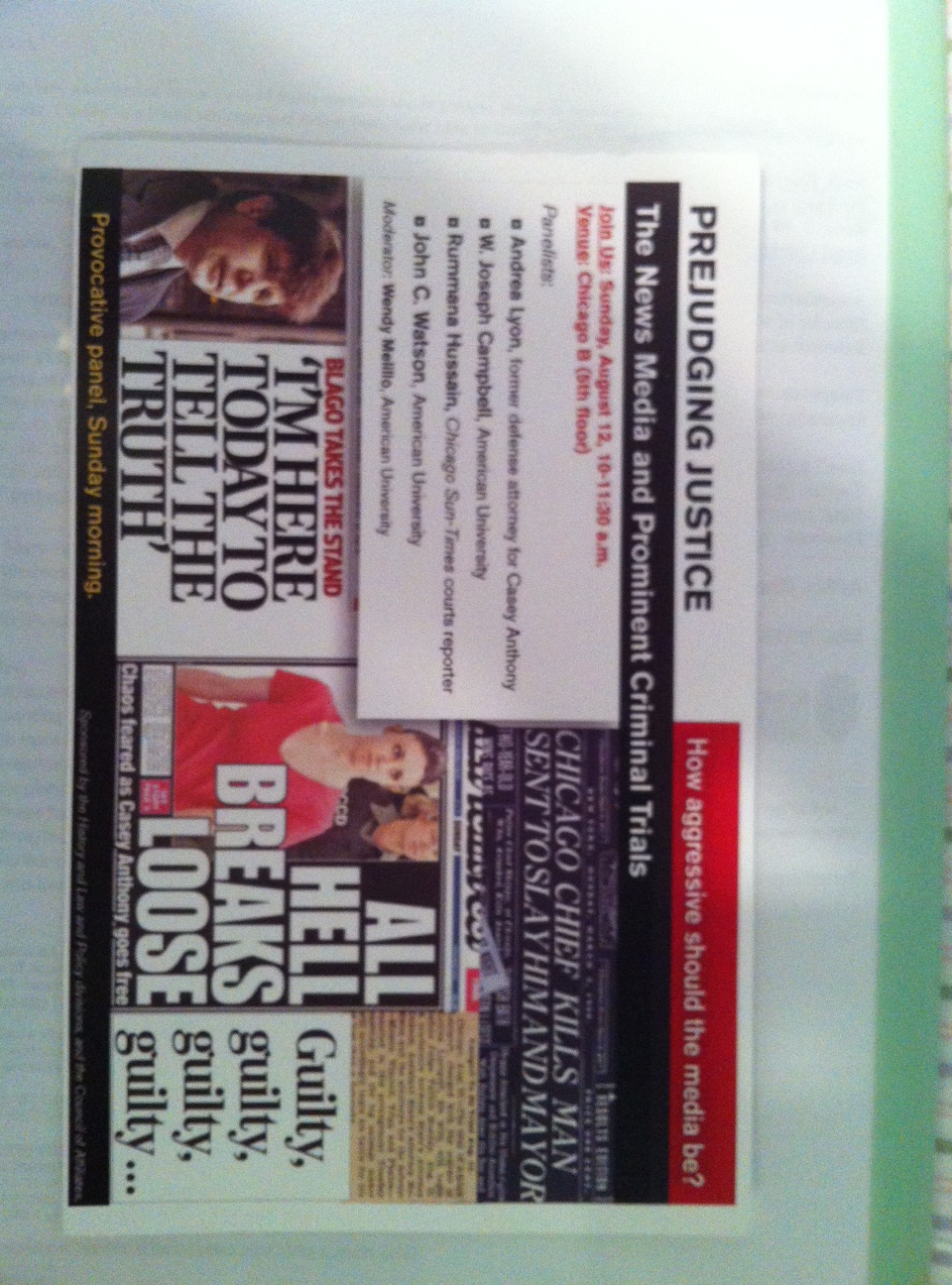
A riveting session at this week’s AEJMC convention in Chicago was billed “Prejudging Justice: The News Media and Prominent Criminal Trials”, featuring high profile defence attorney Andrea D. Lyon – known as the ‘angel of death row’.

Lyon won a murder acquittal last year for Casey Anthony who was accused of killing her two-year-old daughter Caylee, a trial attracting global media attention.

Her experience in that case and many others has informed her critical view of the US approach to high profile trials, which she explains in detail in a recent article in the Reynolds Courts and Media Law Journal.

Lyon has formed the view that publicity generally hurts a criminal defendant and leads to a presumption of guilt rather than innocence in the minds of jurors.

It is worth considering the views of Lyon and her fellow panelists at a time when courts in Australia and other Commonwealth jurisdictions are looking to the US example as a potential salve to their growing concerns about prejudicial Web 2.0 coverage of trials.

One view is that the only option is to move to a US system where the solution is via instruction to jurors to avoid accessing social media materials related to the case, sequestering juries or moving trials to a new location distant from the heat of publicity.

Professor W. Joseph Campbell from American University gave an insight into the lengths US journalists have been willing to go in their coverage of sensational crimes.

The antics of newspaper journalists during the 1897 ‘sausage murder’ trial in Chicago far outstrip the more recent phone hacking sins of News of the World reporters and private eyes.

As Campbell explained, journalists were so desperate to hear the deliberations of the locked jury in this case that they lowered a reporter from the Independent by rope down an air shaft from the attic of the courthouse building so he could listen to the jurors’ discussions and relay them back to his co-conspirators using a hose.

Chicago Sun-Times courts reporter Rummana Hussain explained this would never be attempted or tolerated today, given the hurdles presented to her and other media in the recent Balfour murder trial where the victims were relatives of celebrity Jennifer Hudson, prompting substantial media attention.

Hussain was left to negotiate with the judge the reporting permissions of the whole press contingent and was able to extract the privilege of using cellphones to communicate from the court to their newsrooms via text messages.

But she could not convince him to allow live tweeting from the courtroom – only from the overflow room where the proceedings were televised.

Even that arrangement was suspended for a day by the irate beak after a reporter’s phone sounded in the court after his numerous warnings to place them in silent mode. Hussain explained she even had to play attorney and present to the court an argument on why the media should be granted access to tapes played during proceedings.

American University journalism professor John C. Watson drew upon communication news framing theory to propose that journalists should frame their court and crime stories in terms of what citizens needed to know instead of merely what the public wanted to know.

“The press create a scenario in which the defendant is assumed to be guilty,” he told the audience. “The press has framed the case from the prosecutorial perspective.”

He said the judiciary was potentially the most dangerous branch of government with real potential to deprive citizens of their constitutional rights to life, liberty and their ability to pursue happiness.

“The judicial process can kill innocent people and the press are the first line of defence against that,” he said.

“Journalists have to remember they are reporting for the primary purpose of protecting the people against their government.”

He pointed to an emerging crisis with the coverage of trials on social media, and suggested the British system where there was “no reporting until afterward” might be a preferable alternative to the US approach.

But the panel’s “star witness”, Andrea Lyon, took the line that open coverage was important to the judicial process, but must be exercised responsibly.

“The prosecution already has a lot of power – there are almost no brakes on it,” she said. “There are no brakes on framing someone. The only way we’ll have brakes is through fair reporting.”

She took issue with the privacy invasion and voyeurism of coverage in sensational trials.

“I’m sick of my clients’ and victims’ terrible stories becoming fodder for cheap entertainment,” she said.

She was physically assaulted twice during the Casey Anthony trial and was angered when a major newspaper republished a blog detailing the time she would arrive at court and contemptlated “the trouble they would get in for just hitting me rather than hitting me with a bat”.

She wrote in the Reynolds Courts and Media Law Journal article: “What is troubling is the public’s fascination with this case, the need to make Anthony a villain, and how the media helped feed this mob mentality.”

“They landed, heavily, on any witness who spoke up in Anthony’s favor, making witnesses extraordinarily difficult to find and interview because everyone was afraid of the backlash from the public and the prosecution,” Lyon continued.

She told the seminar she regretted the negative influence of the television program “Law and Order” on the public perception of courts and trials, as well as the rise of “expert” court commenters who typically knew little about the specific cases they were discussing but were fodder for television commentary because of their legal training.

Social media aggravated the situation, she said, with more than 100 blogs devoted to the Casey Anthony case.

Australian, New Zealand and British policymakers could learn much from this session as they contemplate a future of more open public discussion of prominent trials in social media – even if tough restrictions on the legacy media are maintained.

This “two-speed” approach might well keep the pages of the press and the airwaves of radio and television free of prejudicial material.

But it is naive to think that prospective jurors and witnesses will not venture onto blogs, Facebook and Twitter to get every salacious detail on a celebrity accused in the next big Whodunnit.

Short of effective controls across jurisdictions in cyberspace, which appears unlikely, it seems the integrity of the jury system will rely on effective instructions to jurors and better justice education for the broader citizenry.

© Mark Pearson 2012

Disclaimer: While I write about media law and ethics, nothing here should be construed as legal advice. I am an academic, not a lawyer. My only advice is that you consult a lawyer before taking any legal risks.

2 Comments

Filed under Uncategorized

Is your blog ‘in the public interest’ or just ‘interesting to the public’?

By MARK PEARSON

[Adapted from my new book  – Blogging and Tweeting Without Getting Sued: A global guide to the law for anyone writing online (Allen & Unwin, 2012).]

—————-

Is your blog ‘in the public interest’ or just ‘interesting to the public’?

If something you have posted becomes the subject of legal action, lawyers, prosecutors and judges will usually look to your motives for publishing the material. In some places those motives can actually form a defence, while on other occasions your motives can be your undoing. But two are worth considering here because of their very different impact on the law – ‘public interest’ and ‘malice’.

Many statutes and court rulings use the expression ‘public interest’ as an element of a defence to a range of publishing crimes and civil wrongs. In such matters you would have to convince the court that some greater public good came from the material you published and that society benefited in some way as a result. You would normally need to show that any public benefit outweighed the harm that was caused by the publication, which is normally the reason you are called to account. For example, your defence to a defamation action might be that it was in the public interest that your audience learned of your corruption allegations against a leading politician, even if you could not quite prove that the allegations were true.

Many jurisdictions offer a ‘public interest’ or ‘qualified privilege’ defence for defamatory material about extremely important public issues but the publisher might not have quite enough evidence available to prove truth and other defences might not apply.

It’s important to distinguish here between matters of legitimate ‘public interest’ and other matters such as celebrity gossip which might be just ‘interesting to the public’.

Even so, under special protections in the US writers can get away with false publications about celebrities and other public figures as long as you are not being malicious in your attacks. Again, you need to be wary of less forgiving laws in other places, particularly if the celebrity has a reputation they wish to defend elsewhere – perhaps the Australian actress Nicole Kidman or the New Zealand film-maker Peter Jackson.

In other countries the public interest or qualified privilege defence normally requires you to show that you acted in good faith and made proper enquiries in the lead-up to your defamatory publication, despite being unable to prove its truth.

Journalists may be better positioned to make use of this defence than so-called ‘citizen journalists’ or amateur bloggers because they have been trained in research skills and verification practices.

However, there has been nothing to indicate that bloggers or social media users will not qualify for the defence because of what they do. In fact, the Minnesota District Court granted a Republican blogger Michael Brodkorb the same rights as a traditional reporter when he had cited an anonymous source to accuse a Democratic political advisor of self-interest.

In some areas of the law the words ‘public interest’ are not used, but the defence itself has come from a balancing of public interests against other rights. For example, copyright law in most countries has a range of ‘fair use’ defences so that parts of copyright material can be republished for the purposes of education, news or critique.

The defences exist because politicians have decided that there is a greater ‘public interest’ in the community being educated and informed about such important matters than in protecting the intellectual property owned by the creator of the work. As many judges have pointed out, ‘public interest’ does not equate with ‘interesting to the public’, and you should not be allowed to destroy someone’s reputation or invade their privacy simply because your gossip is particularly saucy.

By far the best known right to free expression is the First Amendment to the US Constitution. It states: “Congress shall make no law … abridging the freedom of speech, or of the press.” The US Supreme Court has interpreted the First Amendment very broadly and has applied it across media to a whole range of publishing situations. It certainly applies to the material bloggers, Facebook users and tweeters create – particularly if you are commenting on matters of public importance.

In a series of media decisions throughout the 20th century the Supreme Court allowed newspapers and broadcasters to use the First Amendment to bolster their defences against laws affecting their publications. This was especially useful in defamation law where a whole defence developed allowing the media to publish libellous material about a public figure as long as they did not know it was false and they were not being malicious.

The First Amendment is so entrenched in US society that bloggers sometimes operate under the assumption this same protection will apply in other parts of the world. Unfortunately, it does not.

Is deception in the public interest?

Sometimes bloggers will use the age-old journalistic excuse for deception – that it was in the ‘public interest’. That was the argument Cuban exile Luis Dominguez gave for adopting the guise of a 27-year-old female Colombian sports journalist to trick Fidel Castro’s son into sharing details of his opulent lifestyle. As the BBC reported, the blogger posted images and documents taken from his online flirting with 40-year-old Antonio who had a penchant for both sports and women.

“I’m a Cuban and I’m a Cuban American and I have not been able to go back to my country since 1971 when I left,” he told the BBC. “I use whatever tools I have to be able to get back at these people. In Cuba people are put in prison for no reason at all. Their rights are violated… So, why can’t I do the same thing to them? I have no remorse whatsoever.”

While ‘public interest’ might be a worthy moral motivation for your deception, it will rarely work as a defence in its own right, particularly if your actions are criminal. Get sound legal advice before relying upon it.

© Mark Pearson 2012

Disclaimer: While I write about media law and ethics, nothing here should be construed as legal advice. I am an academic, not a lawyer. My only advice is that you consult a lawyer before taking any legal risks.

1 Comment

Filed under Uncategorized

Lost cause? The Convergence Review model for news media self-regulation

By MARK PEARSON

Australia’s news media regulatory framework has been the subject of two recommendations for major overhauls in recent months.

It was the $2.7 million Convergence Review, announced in late 2010, that was meant to develop the definitive regulatory model in its final report released in April, 2012.

But along the way political pressures (or opportunism, depending on who you want to believe) prompted the announcement last September of an offshoot – the $1.2 million Independent Media Inquiry – specifically briefed to deal with the self-regulation of print media ethics.

Its architects – former Federal Court judge Ray Finkelstein and journalism professor Matthew Ricketson – argued they could not decouple print news self-regulation from broadcast ‘co-regulation’ in the digital era, so came up with a statutory model including both.

Their News Media Council, proposed in their report of February 28, 2012, would take over from the existing Australian Press Council and Australian Communications and Media Authority with a streamlined news media ethics complaints system with teeth. Refusal to obey an order to correct or apologise could see a media outlet dealt with for contempt of court and ultimately face a hefty fine or a jail term.

I have written previously on my concerns about the implications of these recommendations on Australia’s international standing as a democratic nation with a free media, particularly in light of our lack of any written constitutional protection of free expression.

The ‘Finkelstein report’ – as it became known – was only ever meant to be an advisory to its parent Convergence Review, which ultimately acknowledged but rejected its simplistic model in favour of its own innovative and less draconian one.

But the Convergence Review left it to others to put flesh on its more complex reform proposals, leaving the Finkelstein statutory regulation model to fill the void for Labor and Green politicians riding the wave of concern about media ethics in the wake of the UK’s News of the World inquiry and arguing that ‘something must be done’ in Australia.

According to news reports, the parliamentary winter recess will be used by Prime Minister Julia Gillard, Communications Minister Stephen Conroy and the Greens to rally support for the enactment of a version of the Finkelstein model.

Experts argue they will lack the numbers to drive it home, and it is unlikely a 2013 conservative government would take up the cause, given the antipathy of leading Opposition figures Malcolm Turnbull and George Brandis.

Meanwhile, the Convergence Review’s innovative ‘carrot and stick’ model of self-regulation has all but disappeared from public commentary, overshadowed by the stark divide over Finkelstein’s statutory regulation proposal between the Opposition (and major media players) and the Government, Greens and anti-Murdoch intellectuals.

It is a shame the debate has been reduced to this black and white (red versus blue) battle.

I am working on a longer academic article examining the Convergence Review’s novel but sparsely articulated attempt at dealing with the evolving regulatory demands of Web 2.0 (and 3.0 and 4.0…), but I will share some preliminary thoughts here.

First, to review the Convergence Review’s proposed model. While its final report shared Finkelstein’s concerns about shortcomings with existing regulatory systems, it proposed that ‘direct statutory mechanisms … be considered only after the industry has been given the full opportunity to develop and enforce an effective, cross-platform self-regulatory scheme’. In other words, it was offering the media industry ‘drinks at the last chance saloon’ for a three year period under its model (p. 53).

Its mechanism centres upon the establishment of a new ‘news standards body’ operating across all media platforms – reinforcing the overall review’s preference for ‘platform neutrality’ (p.51).

The news standards body ‘would administer a self-regulatory media code aimed at promoting standards, adjudicating complaints, and providing timely remedies’ (p. 153).

The Convergence Review decided not to be prescriptive about the constitution or operational requirements for such a body, beyond some broad requirements.

The largest news media providers – those it deemed ‘content service providers’ – would be required by legislation to become members of a standards body. Most funding for the new body should come from industry, while taxpayer funds might be drawn upon to meet shortfalls or special projects. (p. xiv). It should feature:

–       a board of directors, with a majority independent from the members;

–       establishment of standards for news and commentary, with specific requirements for fairness and accuracy;

–       implementation and maintenance of an ‘efficient and effective’ complaints handling system;

–       a range of remedies and sanctions, including the requirement that findings be published on the respective platform. (p. 51)

The review’s definition of ‘content service enterprises’ (control over their content, a large number of Australian users, and a high level of revenue drawn from Australia) would catch about 15 media operators in its net.

Others might be encouraged to join the body with a threat to remove their current news media exemptions to privacy laws and consumer law ‘misleading and deceptive conduct’ provisions.

To my mind, this is the most innovative element of the Convergence Review’s proposal, and is something I proposed in my personal submission to the Independent Media Inquiry and blogged about at the time.

The review only deals with this aspect as a hypothetical, and refers readers in a footnote to pages 127-136 of the Independent Media Inquiry report for extended explanation of the exemptions. The review offers just a single sentence by way of explanation:

“In particular, it seems reasonable that only those organisations that have committed to an industry self-regulatory scheme for upholding journalistic standards of fairness and accuracy should be entitled to the exemptions from the provisions of the Competition and Consumer Act 2010 concerning misleading and deceptive statements and from the obligations of the Privacy Act 1988 that would otherwise apply to those organisations.” (p. 51).

My article will explore these further, going into the history of the exemptions and important case law covering on their application.

Take these away, and the review’s recommendations are relatively meek, and unlikely to appease those wanting stricter controls over news content.

The Australian Press Council has been moving quickly to ramp up its purview and powers over its members, and can meet most of the requirements except these. It has already locked its members into four year commitments and has established an independent panel to advise on its review of its content standards.

It is poised to apply this across all media if broadcasters and online providers decide it offers the simplest mechanism to meet the Convergence Review’s recommendations. Either way, it can quite rightly argue that newspaper and online news readers are being serviced by a superior complaints handling system than that which existed before the inquiries.

In my view, the Convergence Review report needed to position its privacy and consumer law exemptions as much more than hypotheticals and to detail its plans for the implementation of these proposals.

But I suspect its members were caught short on time and resources when the Independent Media Inquiry went too far for its liking with its statutory regulation solution.

It’s a shame that a multi-million dollar inquiry like this one has left it to academics like me to dot its i’s and cross its t’s on detail.

It’s a greater shame that politicians wish to capitalise on a moment of public antipathy to the media to introduce a draconian, simplistic solution in a democratic nation with no documented right to free expression.

© Mark Pearson 2012

Disclaimer: While I write about media law and ethics, nothing here should be construed as legal advice. I am an academic, not a lawyer. My only advice is that you consult a lawyer before taking any legal risks.

Leave a comment

Filed under Uncategorized

Regulating the interaction between journalists and the vulnerable

By MARK PEARSON

This week I am in Shah Alam, Malaysia, for the 2012 Asian Media Information and Communication Centre Conference. The paper I am presenting Thursday is titled ‘Regulating the interaction between the news media and the vulnerable – the Australian experience’.

It will eventually be published in an academic journal, but I provide a summary here.

It reports on a selection of findings from a national collaborative research project examining the interaction between the Australian news media and so-called ‘vulnerable sources’.

It surveys the codes controlling journalists’ behaviour via in-house industry-based codes of practice and those administered by the Media Entertainment and Arts Alliance (MEAA), the Australian Press Council (APC) and the Australian Communications and Media Authority (ACMA).

It looks particularly at codes and regulations controlling privacy, intrusion, grief, children, mental illness and discriminatory reportage. It considers the vulnerable source issue in stories collected during a year’s selective sampling of the national daily newspaper, The Australian.

Special attention is paid to three years of decisions by the APC and the ACMA which have been coded and analysed according to the type of vulnerability involved, the guideline allegedly breached, and the result of the complaint.

It explains that there are many ‘moments of vulnerability’ that escape the hard and fast letter of laws and codes that seem to be left to the moral and ethical judgment of individual reporters and editing teams, demanding a fresh approach to in-house self-regulation.

I collaborated with five other academics and industry partners (listed below) in a $92,000 Australian Research Council Linkage project over two years to examine how journalists interacted with those who might belong to a ‘vulnerable group’ (such as the disabled, indigenous, children, those who have undergone trauma or grief, or those with a disability or mental illness) or those who might simply be ‘vulnerable’ because of the circumstances of the news event.

We decided instead to direct our inquiries, particularly during the newspaper content analyses, to identifying potential ‘moments of vulnerability’ rather than restricting our search to mentions of the pre-identified source groups.

Similarly, the analysis of the complaints decisions of the APC and the ACMA worked to the principle of moments of vulnerability rather than being driven particularly by a source’s membership of a pre-determined vulnerable group.

Taken at its broadest definition, all citizens are ‘vulnerable’ when they engage in any media interview. There is a potential for that interview or its resulting publication to go wrong, with associated embarrassment, emotional pain and in extreme cases even physical retribution from hostile audience members.

A total of 33 items were identified as depicting ‘moments of vulnerability’ from the coverage analysed for The Australian newspaper on the selected day in each of the 12 months of the 2009 calendar year. The sample was too small for quantitative analysis, so no statistical breakdown of the findings will be provided other than a simple count on some criteria. The analysis mainly takes the form of a qualitative study of the items, selecting key examples to explore the ‘moments of vulnerability’ and to offer a backdrop to the matters raised before the complaints bodies examined in the subsequent section.

We identified 33 ‘moments of vulnerability’ identified in the published stories, based upon 31 stories on the selected 12 days’ coverage in The Australian.

The 33 moments of vulnerability were categorised into PTSD/grief (14), mental illness/suicide (9), children (3), disabled (3), privacy (2), aged (1) and discrimination (1). All such moments were also assessed for the level of competing public interest/social importance value evident in the matter being reported to eliminate examples where the public interest arguments were so strong that it could be seen that editors could easily argue their decisions were driven by legitimate matters of social importance.

A process of elimination left us with seven key ‘moments of vulnerability’, centred on Australia-based stories, where public interest issues did not clearly excuse the type of coverage or interaction with vulnerable sources as presented.

The seven selected are summarised in Table 1, grouped according to the type of vulnerability, and each is then considered as a brief case study.

Table 1: ‘Moments of vulnerability’ identified in The Australian on selected days during 2009

Date Page Headline Type of vulnerability Summary and issues
3-2-09 3 DOCS urges fugitive mother to return Child This was a custody issue where a mother had allegedly kidnapped her son and fled overseas. Potential impact of comments by child welfare expert upon mother’s decision to remain at large.
9-4-09 16 D’Arcy puts head down amid crisis Mental illness/suicide Both articles juxtapose champion swimmer’s axing from the national team with that week’s suicide of top cyclist.
9-4-09 16-15 No repeat of headline acts which delivered day of shame Mental illness/suicide
6-6-09 43-44 The night Symonds was cut adrift / Symonds comes to end of the road Mental illness/suicide Links champion cricketer’s alcohol problems with allusions to suicide possibility, with risk of prompting that outcome.
13-11-09 3 Suspect may have killed himself Mental illness/suicide Speculates murder suspect may have self-harmed or suicided, potentially triggering that course of action.
11-8-09 3 Son dead, mother acute PTSD/grief Clearly a ‘death knock’ telephone attempt to speak to family or close colleagues after murder-suicide attempt.
9-9-09 3 Sandilands offends again Discrimination Story repeats a radio host’s offensive remarks about the weight and race of a female comedian in its own recount of the matter.


The conference paper explores each in detail. It then goes on to analyse five years of APC decisions between 2006-2010 and three years of ACMA decisions in 2008-10 in a similar approach to that undertaken for The Australian newspaper analysis, with interesting results.

Australian Press Council does not use the word ‘vulnerable’ or ‘vulnerability’ in its Statement of Principles, which addresses other criteria, many of which go to the issues we address in our study. Thus, we are placing (retrospectively) a different lens of analysis on the items of complaint.

The fact that we identified only 12 complaints regarding journalists’ interaction with ‘vulnerable sources’ adjudicated by the Australian Press Council over the 2006-2010 period indicated either:

  • News media interaction with vulnerable sources is not as negative as portrayed by inquiries such as the Independent Media Inquiry;
  • Alternative dispute resolution techniques offered by the APC in the earlier stages of the hundreds of complaints it receives annually are effective; or
  • Complainants are not pursuing their complaints or are withdrawing them at an earlier stage.

Vulnerable sources may well have a desire to complain, but not the energy or competence at the time to do it. Reforms to the Australian Press Council’s structure processes recently announced by its chairman, Professor Julian Disney, might consider some of these concerns.

Our study also examined the reports of the ACMA investigations in the 2007-10 period and identified the following 11 as pertinent to our study of the interaction between the news media and vulnerable sources.

A key problem of the ACMA process is that journalists are working under a variety of codes of practice controlling similar behaviours. Added to this are various ‘guidelines’ documents issued by the ACMA providing further counsel for broadcasters in their handling of sensitive issues. One such set of guidelines is the Privacy Guidelines for Broadcasters. These were reviewed during 2011 and our ARC team made submissions to that review on issues of interactions with the vulnerable, and particularly with issues of consent and withdrawal of consent by the vulnerable, particularly children. Their revised guidelines addressed these issues.

The regulatory, co-regulatory and self-regulatory mechanisms in operation in Australia have been under serious review in 2012, with new models proposed by the Independent Media Inquiry for a statutory News Media Council and by the Convergence Review for an independent self-regulatory news standards body.

There is a separate government proposal for statutory tort of privacy which extends beyond the news media but may include media or public interest exemptions. All acknowledge public concern at the confusing array of ethical codes and processes across media platforms and workplaces.

The news media interact with vulnerable sources in a range of circumstances, but the rules controlling that interaction vary markedly across media platforms and employment groups. The small sample of case studies from The Australian newspaper serves to demonstrate that some interactions with the vulnerable are not prevented by in-house codes and escape the attention of the relevant self-regulatory bodies unless a complaint has been made and remains unresolved. The APC and ACMA cases show that the outcomes of complaints are far from predictable and that sometimes elements of vulnerability appear obvious but are not even examined by the inquiring body. The examples demonstrate there are many ‘moments of vulnerability’ that escape the hard and fast letter of laws and codes that seem to be left to the moral and ethical judgment of individual reporters and editing teams.

Whatever new regulatory system is put in place requires a simple statement of ethical principles covering the usual fairness and accuracy elements, with an additional responsibility placed upon journalists and editors to identify individuals who are particularly ‘vulnerable’ in a news media interaction so that warning bells sound and informed decisions are taken on issues like consent and privacy.

This can only be achieved via genuine newsroom-driven training programs, accompanied up by routine protocols for assessing individual cases of vulnerability as they arise in the field and in the production process. Decisions taken in such circumstances should be documented thoroughly for later review and any rationale on ‘public interest’ grounds should carry justification well beyond audience curiosity, going to serious matters of public importance that could not be offered by less intrusive or traumatising ways.

Line-ball decisions should be made only after consultation with an independent psychologist and an explanation for the decision should be published on the outlet’s website. Only then – when ethical decision-making can be audited in a publicly accountable way – can Australian media organisations lay legitimate claim to effective self-regulation.

Research team

Professor Kerry Green from the University of South Australia led the ARC Linkage Project LP0989758. Other chief investigators on the project included Professor Michael Meadows (Griffith University), Professor Stephen Tanner (University of Wollongong), Dr Angela Romano (Queensland University of Technology) and this author, Professor Mark Pearson (Bond University). Industry partner investigators were Ms Jaelea Skehan (Hunter Institute of Mental Health) and Ms Cait McMahon (Dart Centre for Journalism and Trauma- Asia Pacific). Mr Jolyon Sykes was the research assistant for the larger project, while Mr John Burns, Mr Jordan Lester, Mr Roger Patching, Ms Kiri ten Dolle and Mrs Leisal DenHerder provided research assistance for my AMIC paper.

© Mark Pearson 2012

Disclaimer: While I write about media law and ethics, nothing here should be construed as legal advice. I am an academic, not a lawyer. My only advice is that you consult a lawyer before taking any legal risks.

Leave a comment

Filed under Uncategorized