Tag Archives: media law

Privacy then and now – a French connection to supplement #Leveson’s history lesson

By MARK PEARSON

Lord Justice Brian Leveson – who delivered his 2,000 page report on the British press on November 29 – addressed us in Sydney yesterday on ‘Privacy and the Internet’.

He steered well clear of commentary about his landmark report and its recommendations.

Instead, he drew upon some of the historical foundations of privacy law as a platform for an exploration of the issues surrounding privacy regulation in the Internet era.

His concluding comments demonstrated that link:

“(W)hile established legal norms are in many respects capable of application to the internet, it is likely that new ones and new laws will need to be developed.

“The rise of the media produced Warren and Brandeis’s famous dissertation on privacy law.

“The internet may well – and no doubt will – require us to think as creatively as they did.

“Only if we do so will we properly understand the role and values which underpin privacy and freedom of expression, the balance to be struck between them and the means to ensure that they are both safeguarded in an internet age.

“The answers we reach might differ from those we have reached in the past.”

Lord Justice Leveson devoted the first several minutes of his speech backgrounding the interface between nineteenth century technological innovations contributing to the famous Harvard Law Review article – ‘The Right to Privacy’ – by lawyers Samuel Warren and Louis Brandeis.

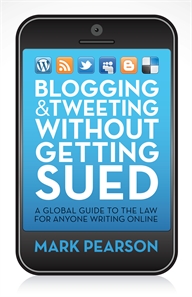
I also recently explored some of the historical background to privacy in my book Blogging and Tweeting Without Getting Sued: A global guide to the law for anyone writing online (Allen & Unwin, 2012) – and discovered a French connection in the process.

Here is an edited excerpt for those who may be interested.

Privacy rights and protections are a fairly recent legal development. For centuries gentlemen in Europe (and later North America) settled personal embarrassments and insults using the strictly codified practice of the duel – well documented in Best Served Cold – Studies in Revenge. Even today the tribal laws of many indigenous peoples invoke a physical punishment such as a beating or stoning for causing another to ‘lose face’ in a community – actions covered by both privacy and defamation laws in the developed world. While French courts were developing privacy law in the 1860s there was no notion of a formal ‘right to privacy’ in the English speaking world. Laws in the US, Britain and its former colonies had evolved over centuries to protect the individual’s space and reputation in several ways, including defamation, copyright, trespass, nuisance and confidentiality.

Let’s journey back to Paris in 1867, when gentlemen still duelled to the death over matters of pride. The practice was masterfully recorded by the writer Alexandre Dumas père in his novel The Three Musketeers. In real life, Dumas lived the extravagant lifestyle of the famous author in an era when the stars of print were the equivalent of screen idols today. He was besotted with 32-year-old actress Adah Isaacs Menken – the Paris Hilton of her time – regarded by some as the first female cult celebrity. The lovebirds posed for some saucy photographs (she in her underwear and he without the compulsory gentleman’s jacket) but the photographer then tried to trade on their celebrity by registering copyright in the images. Dumas felt aggrieved but, as James Q. Whitman explained in the Yale Law Journal, the court held his property rights had not been infringed. However, the judge decided Dumas did have a right in privacy that trumped any property right the photographer might have held. With that decision, privacy was born as a right in the legal world.

Across the Atlantic two decades later, in 1888, Michigan Supreme Court Justice Thomas Cooley wrote of a ‘right to be let alone’. Then, in a landmark Harvard Law Review article in December 1890, the great US jurist Samuel D. Warren and future Supreme Court Justice Louis D. Brandeis announced a new ‘right to privacy’ in an article by that very name. Warren had been angered when a daily newspaper had published the guest list of a high society dinner party his family had hosted at his Boston mansion, which he saw as a gross invasion of his privacy. The right to privacy owes its existence to a wealthy lawyer who resented the media prying into his personal life.

Warren and Brandeis wrote: ‘The press is overstepping in every direction the obvious bounds of propriety and of decency. Gossip is no longer the resource of the idle and of the vicious, but has become a trade, which is pursued with industry as well as effrontery’. Their words were chillingly similar to those used by the critics of celebrity gossip mags and websites today, particularly in the wake of London’s News of the World scandal which triggered the Leveson Inquiry.

Blogging and Tweeting Without Getting Sued: A global guide to the law for anyone writing online is now available in print and ebook formats worldwide.

[Media: For review copies please contact publicity@allenandunwin.com or call +61 2 8425 0146]

© Mark Pearson 2012

Disclaimer: While I write about media law and ethics, nothing here should be construed as legal advice. I am an academic, not a lawyer. My only advice is that you consult a lawyer before taking any legal risks.

Leave a comment

Filed under Uncategorized

Terror is no laughing matter – lessons from the #twitterjoketrial

By MARK PEARSON

Twitter and Facebook are great outlets for one-liners and satire, but police and security agencies are not known for their sense of humour. Trainee accountant Paul Chambers, 27, learned that the hard way when he was arrested on UK terrorism charges for jokingly tweeting a threat to blow up a British airport. Air traffic was delayed by a heavy snowfall and Chambers was desperate to visit a female friend in Northern Ireland, so he light-heartedly tweeted to her and his 650 followers: ‘C***! Robin Hood Airport closed. You have got a week to get your s*** together, otherwise I’m blowing the airport sky high!’ Police swooped a week later and he was questioned on the terrorism charges before being convicted and fined £1,000 on a lesser charge of causing nuisance. He later won an appeal in the High Court when the Lord Chief Justice agreed it had been a humorous remark rather than a threat. The case became known as the ‘Twitter joke trial’. I’m fairly confident Chambers would not go through all that angst again over a not so witty one-liner.

Journalist, blogger, tweeter and lawyer David Allen Green ( @DavidAllenGreen ‘Jack of Kent’ ) spoke recently on the issue to the Open Rights Group.

Across the English Channel, 23-year-old unemployed Frenchman François Cousteix was surprised one evening to find French police and US FBI agents arrive at his front door. Operating under the name ‘Hacker Croll’, he had made it his hobby to access celebrities’ social media accounts just for fun. He had accessed the social media account of celebrity Britney Spears but came to international security agencies’ attention when he hacked into the Twitter account of US President Barack Obama. He escaped with a five month parole sentence.

There is a simple lesson from these cases: do not joke about national security matters.

Governments throughout the world ramped up their national security laws in the wake of the terrorist attacks on the US in September 2001. Even in countries with a high regard for civil liberties and free expression, new powers were handed to security agencies and police to aid in the detection and arrest of suspected terrorists. Pressure mounted in western democracies for even tougher laws after the Bali bombings in 2002 and 2005 and the 7/7 London attacks in 2005.

Publishing restrictions in the name of national security existed long before 9/11. Sedition and treason laws encouraging public unrest, violence and the overthrow of rulers date back to feudal times when governments tried to enforce loyalty upon ordinary citizens. While many countries have phased out these ancient crimes, such laws are still used in some places as mechanisms for intimidation and repression. Anti-terrorism laws were also used in western democracies well prior to 2001. The UK passed special laws to respond to Irish Republican Army terrorism throughout the 20th century, while New Zealand introduced new restrictions after the French bombing of the Greenpeace boat the Rainbow Warrior in 1985.

But the early 21st century attacks on the West triggered a wave of new anti-terror laws impacting on the free expression of journalists and Internet users. Hundreds of anti-terror laws were introduced in the first decade of the 21st century under the banner of the so-called ‘War on Terror’.

America led the way with its USA ‘Patriot’ Act of 2001, in which the letters stand for: ‘Uniting (and) Strengthening America (by) Providing Appropriate Tools Required (to) Intercept (and) Obstruct Terrorism’. President Barack Obama’s administration extended the legislation for a further four years from 2011.

Others followed suit, including the UK, Canada, Australia and New Zealand. Ottawa software developer Momin Khawaja became the first person charged under Canada’s anti-terror laws but in 2011 challenged his conviction on constitutional grounds. In Australia, Belal Saadalah Khazaal was sentenced to 12 years in jail in 2009 for ‘making a document connected with assistance in a terrorist act’ after he created an e-book titled “Provisions on the Rules of Jihad” which allegedly targeted foreign governments and leaders. The High Court upheld his conviction in 2012.

There were too many anti-terror laws introduced internationally to detail here, but some can impact upon you if you are a cyber-journalist or blogger. They include:

  • Increased surveillance powers for spy agencies and police;
  • New detention and questioning regimes;
  • Seizure of notes and computer archives;
  • Exposing confidential sources to identification;
  • Closing certain court proceedings so they are unreportable;
  • Exposing bloggers to fines and jail if they report on some anti-terror operations;
  • Making it an offence to merely ‘associate’ or ‘communicate’ with those suspected of security crimes; and
  • Exposing bloggers and social media users to criminal charges if you publish anything seen as inciting terrorism.

Governments also go straight to search engines and ISPs and demand they remove material and, as Google’s Transparency Report documents, they often comply. But some have complained Google and Youtube have not responded quickly enough when asked to take down terrorism material. Burst.net certainly acted fast when the FBI advised it that some blogs it hosted under the free WordPress blogetery.com site contained terrorist material suspected of being used by the group al-Qaeda. It shut the site down, along with the 70,000 blogs it hosted. Blogetery resurfaced a month later under a different host.

The United Nations introduced a range of protocols that countries adopt minimum standards for combating terrorism. At the same time, the OECD acted to encourage Internet freedom by asking nations to open up cyberspace to freer and speedier communication. To the average blogger, the two positions might seem at odds.

A Mexican radio commentator and a maths tutor were jailed and faced a maximum 30 year prison sentence in 2011 on terrorism and sabotage charges after they tweeted false reports that gunmen were attacking schools in the city of Veracruz. The misinformation prompted parents to panic and some were involved motor accidents as they rushed to fetch their children.

“Here, there were 26 car accidents, or people left their cars in the middle of the streets to run and pick up their children, because they thought these things were occurring at their kids’ schools,” an official told Associated Press. The false reports followed weeks of gangland violence in the city.

“My sister-in-law just called me all upset, they just kidnapped five children from the school,” tutor Gilberto Martinez Vera allegedly tweeted. He followed that message with: “I don’t know what time it happened, but it’s true.” The other accused had retweeted the false reports to her followers. Experts described the tweeting as poor use of the medium, but not deserving of terrorism charges.

[Adapted from my book, Blogging and Tweeting Without Getting Sued. A Global Guide to the Law for Anyone Writing Online. (Allen & Unwin, 2012).

Disclaimer: While I write about media law and ethics, nothing here should be construed as legal advice. I am an academic, not a lawyer. My only advice is that you consult a lawyer before taking any legal risks.

© Mark Pearson 2012

Leave a comment

Filed under Uncategorized

A question and tweet-driven approach to deeper media law learning

By MARK PEARSON

What’s in a question? A whole lot of learning, if you ask students in my Ethical and Legal Strategies for the Media class this semester.

It has always been a challenge to get students to digest and understand the relevant chapter readings for the week’s lecture topic. Over the years I have experimented with a range of assessment tools to do so, including the traditional law school ‘fictitious fact scenario’ problem-based approach, end of chapter exercises and responses, and mini-quizzes on the chapter contents.

This semester I have developed a two-step weekly assignment which has generated some lively in-class discussions based upon a genuine depth of understanding of the material among most students.

Students are required to read the week’s chapter of the text and a. Compose a tweet including the subject code #hashtag referring their peers to a recent case, news report or commentary on the topic; and b. Compose an analytical extension question, demonstrating they have understood the chapter readings and have posed a question worthy of class discussion during the lecture session. They are graded on the quality of the question, as outlined in the rubric below.

I spend a few moments arranging the students’ questions into themes and then pose them, leading class discussion in place of the traditional Powerpoint-driven slideshow lecture. The slides are there as a backup, of course, to return to key foundational learning points, but most time is spent debating the potential answers to the questions students have raised. Here are some examples from the semester’s crop thus far:

  • As social media continues to satisfy society’s appetite for news and court reporting, will judge-only trials become more commonplace to ensure justice is done?
  • Can technology ever replace the role of court reporters?
  • Why would anyone decide not to sue for defamation after they have been defamed?
  • Are there any changes proposed for defamation laws to focus more closely on social media, particularly trolls?
  • What matters most – closed courts in sex cases to fully protect the ID of the victim or open courts to protect open justice?

Every one of these questions shows the student has understood the topic and grappled with a dilemma arising from it. Each could be the subject of a research project in its own right.

Universities are meant to be about constructing, researching and attempting to resolve such deeper questions. This exercise rewards students who apply analytical skills to journalism and social media law topics, and elevates the subject above the ‘black letter law’ approach that was the hallmark of media law courses in the 20th century.

I offer you the rubric for the assignment below. Feel free to use it, critique it and adapt it. File any feedback below. Cheers.

JOUR12-230 Ethical and Legal Strategies for the Media  (2 copies needed at start of lecture – one for your reference and one to submit. Not accepted by email, sorry.)

Date and topic this week:

Name:  

Your tweet on this week’s topic. (Compulsory). Must include insightful comment and/or link to recent case or article on topic TWEET:


…#JOUR12-230 @journlaw

ANALYTICAL EXTENSION QUESTION criteria.


ANALYTICAL EXTENSION QUESTION:
Criterion Poor Fair Good Excellent
Understanding of chapter readings        
Important extension of inquiry BEYOND those readings        
Clear and simple question structure        
Other comments:


%

Example of EXCELLENT question on Defamation: “How has the High Court dealt with the political qualified privilege defence since the textbook was published in 2011?”

Example of POOR question on Defamation: “What is defamation and give an example?”

Example of defamation tweet:

#Defamation suit pits casino owner against creator of ‘Girls Gone Wild’ – bit.ly/OXX3bq #freespeech #JOUR12-230 @journlaw

© Mark Pearson 2012

Disclaimer: While I write about media law and ethics, nothing here should be construed as legal advice. I am an academic, not a lawyer. My only advice is that you consult a lawyer before taking any legal risks.

2 Comments

Filed under Uncategorized

Courting trouble naming sex crime victims on social media: ignorance no excuse

By MARK PEARSON

News that nine Facebook and Twitter users in the UK have been ordered to pay compensation to a rape victim after identifying her on social media sounds a warning that we are all now publishers and subject to the same laws as mainstream media. Here is an edited excerpt from my new book  – Blogging and Tweeting Without Getting Sued: A global guide to the law for anyone writing online (Allen & Unwin, 2012) – explaining the basic principles of court reporting restrictions for lay users of social media.

—————-

Courting secrecy

Despite the existence of the ‘open justice’ principle, online writers face restrictions on their reporting of crimes and other matters before the court. Your behaviour, postings and comments can lead to substantial fines or even jail terms if you breach the laws of contempt of court and the many and varied bans on reporting certain court matters and identifying certain people in the courtroom. Reporters who cover court every day know these restrictions well and are trained to deal with them – although sometimes they slip up as happened recently in a Tasmanian case prompting a push for law reform. The challenge for bloggers and social media writers is that you might be unaware of the fact that certain names and other identifying matters cannot be published in particular kinds of cases. In fact, some cases are closed to the public and cannot be reported at all.

The rules vary markedly between countries, but the most common restrictions are on identifying victims of sex crimes (and sometimes the sex accused), juvenile offenders and witnesses, jurors, and parties to family law disputes. Sometimes the whole court is closed for these and other proceedings such as preliminary hearings, military and national security trials and mental illness hearings.

The temptation for the gossip or sports blogger might be to mention some of these matters in postings about celebrities, perhaps via family or friends, without being aware of the court restrictions on identification. Heavy fines and even jail terms apply in some places if you break these prohibitions. At the very least you need to check what bans apply in both your own jurisdiction and the place of the court proceedings before firing off those words or images.

Gags, but not the funny kind

Sometimes a judge will use their power to issue orders prohibiting publication of some aspect of a court case and occasionally even the whole case. These are known as injunctions, suppression orders, gag orders and stop writs. Last month a Victorian magistrate issued such an order against publication of information about the man accused of murdering Melbourne ABC worker Jill Meagher – although Michael Bradley from Marque Lawyers highlighted some problems with that one.

When the orders ban you from revealing even the fact that the order has been issued, they are known as ‘super injunctions’. These prompted a social media nightmare for the English courts when they were issued in relation to privacy matters in 2010 and 2011. It came to a head in May, 2011, when footballer Ryan Giggs was named in the House of Commons as the person at the centre of an anonymity injunction after 75,000 Twitter users had already tweeted his name. A Times journalist was threatened with a contempt of court charge for tweeting the footballer’s name to his followers in breach of the order. It was believed to be the first time the Attorney-General had been formally asked to consider contempt charges against a social media user.

Gags like super injunctions have also been used in the US. The New York Times reported in 2008 that the owners of political website Room 8 received a grand jury subpoena to disclose the authors of some of their anonymous bloggers. They were threatened with prosecution if they revealed they had even received the subpoena. In another example, Florida-based legal blogger David O. Markus explained the frustrations of dealing with a gag order on his Southern District of Florida Blog after a judge in a terrorism trial issued one and then partially lifted it in 2008. Markus was then allowed to blog about some aspects of an ongoing immigration case without going into the details of the alleged bombing plot which shared many of the same facts.

Blogs covering sensitive national security information or sexual taboos are much more likely to be gagged, sometimes permanently. In 2009 Seattle University postgraduate law student Danielle M. Cross explained how Californian courts were able to uphold permanent injunctions against websites set up by a paedophile to track the movements of young girls at public events.

Take down notices

Sometimes the injunction is in the form of a notice to ‘take down’ certain material from a site or to shut down the whole site. This is sometimes issued to the ISP or search engine host. In 2011 Google complied with a ‘preventative closure’ order from an Italian court to remove an English language blog titled ‘Perugia Shock’ criticising aspects of the prosecution of an alleged murder of a British exchange student by her US roommate. (The accused, Amanda Knox, was later acquitted.)  The blog reappeared elsewhere, the Washington Post reported. In Australia, media organisations were ordered to remove from their searchable archives material related to the upcoming trial of a prominent criminal figure. Former News Limited chief executive John Hartigan criticised such take down notices for their expense and unrealistic application in an address to our Courts and the Media in the Digital Era symposium at Bond University last year.

Blogging and Tweeting Without Getting Sued: A global guide to the law for anyone writing online is now available in print and ebook formats worldwide.

[Media: For review copies please contact publicity@allenandunwin.com or call +61 2 8425 0146]

© Mark Pearson 2012

Disclaimer: While I write about media law and ethics, nothing here should be construed as legal advice. I am an academic, not a lawyer. My only advice is that you consult a lawyer before taking any legal risks.

Leave a comment

Filed under Uncategorized

Counter-terror laws under review – our appearance at COAG

By MARK PEARSON

Griffith University colleague Associate Professor Jacqui Ewart (@jacquiewart) and I appeared before the Council of Australian Governments (COAG) hearing into the review of counter-terrorism laws conducted in Brisbane yesterday.

We explained our collaborative research on the subject, and called upon the committee to take account of the importance of free expression, open justice and transparency of process to a democracy like Australia.

The laws under review are listed here.

I began by explaining that national security laws introduced since September 2001 affected the ability of journalists to investigate into and report upon particular incidents, identify and communicate with sources of information for such reportage, preserve the confidentiality of such sources, report fairly and accurately court proceedings related to counter-terrorism, expose miscarriages of justice, and  to draw upon actual examples when covering the broader issues of national security and counter-terrorism.

Australia differed from other democratic nations in that it lacks written constitutional protection of free expression.

I suggested that given the absence of any such free expression protection here, there was a crucial need for public interest or media exemptions to provisions threatening free expression.

Perhaps the committee could appoint an independent adviser or a representative from a body such as the Australian Press Council to review any proposed legislation with an eye to its implications for free expression.

Dr Ewart made the following points in our submission:

When the anti-terrorism legislation was introduced in 2004 and 2005 there was much discussion about the potential impacts these laws would have on journalists and the public right to know about terrorism cases, but much of that discussion was at the time speculation. Since then we have seen demonstrable evidence of the impacts of those laws on the ability of journalists to report on national security matters and to inform the public. These impacts include but are not limited to:

  • Suppression orders are now routinely invoked in terrorism-related court cases to prevent journalists’ from reporting details of cases that may be in the public interest and may not be against national security interests. While there was recently a move towards cooperation between the media and the judiciary in relation to suppression orders (Operation Pendennis court trials under J Bongiorno), this is not standard practice.
  • Sedition laws have restricted freedom of expression in the media. The legal provisions regarding journalists reporting the detention of suspects under the ASIO Act have implications for journalists, and much broader consequences for individuals’ freedom of speech.
  • Media reliance on official spokespeople has increased because of arrest, questioning and detention restrictions once a suspect has been arrested, as evidenced by the controls of information flows by the Australian Federal Police in the arrest and charging of Dr Mohamed Haneef.
  • Recent demands by judges for journalists to reveal their sources of counter-terror stories, evidenced by the making of such demands upon The Australian’s Cameron Stewart regarding leaks from the Federal Police over the Holsworthy Barracks raids.
  • Further to the preceding point, the freezing of information about counter-terror operations by government agencies after the above incident where The Australian published an account of one operation before it started. This led to police/media protocols for future counter-terrorism stories.
  • The potential for the confidentiality of a journalist’s source being compromised through the investigative powers of anti-terror agencies. This may erode the public’s confidence in the media, preventing members of the public from approaching journalists with stories or information.
  • The readiness of counter-terror agencies and prosecutors to make use of raw footage and interview material captured by journalists as prosecution evidence in their cases against terror suspects, as per the Jack Thomas trial.
  •  A warning from an Attorney-General to an academic about his research involving the interviews with suspected terrorists overseas renders journalists’ interviews with terrorists on foreign territory problematic.

We are also unaware of potential problems for those arrested or questioned under the ASIO Act because of the restrictions placed on individuals in relation to telling others including the media they have been arrested or questioned and those restrictions extend to journalists.

This means that the ability of the media to freely – real national security implications notwithstanding – fairly and accurately report terrorism cases has been at times severely hindered by the legislation.

We concluded by recommending the review of the legislation specifically examines the question of the impacts of the legislation on journalists’ ability to cover terrorism cases and terrorism-related court cases, in order to ensure the protection of the public interest in such cases. We provided the committee with an extended explanation in the form of an article on the topic we recently submitted to an international refereed journal.

© Mark Pearson and Jacqueline Ewart 2012

Leave a comment

Filed under Uncategorized

The media regulation debate in a democracy lacking a free expression guarantee

By MARK PEARSON

The latest edition of Pacific Journalism Review is out – a special issue edited by Chris Nash, David Robie and Johan Lidberg on ‘Rebuilding Public Trust’.

My contribution carries the same title as this blog. Here are the abstract and conclusion, but if you’re really interested you’ll need to get PJR for the body of the article and the references – and, of course, another 13 articles by some of the region’s top journalists and researchers.

Abstract

Two major inquiries into the Australian news media in 2011 and 2012 prompted a necessary debate over the extent to which rapidly converging and globalised news businesses and platforms require statutory regulation at a national level.  Three regulatory models emerged – a News Media Council backed by recourse to the contempt powers of courts; a super self-regulatory body with legislative incentives to join; and the status quo with a strengthened Australian Press Council policing both print and online media. This article reviews the proposals and explores further the suggestion that consumer laws could be better utilised in any reform. It concludes with an assessment of the impact of the inquiries and their recommendations upon free expression in a Western democracy lacking constitutional protection of the media.

 ——

Conclusion

The Convergence Review report cleverly proposed the removal of some existing protections instead of the imposition of draconian new regulations, but then failed to flesh out their possibilities. It needed to position its mechanism of privacy and consumer law exemptions for signatories to its new pan-media self-regulatory body as much more than hypothetical and to detail its plans for the implementation of these proposals.

Australia already has one statutory regulator with powers to punish ethical transgressions – the Australian Competition and Consumer Commission (ACCC). In an era of increasingly commercialised and converged media, it seems reasonable that at least some forms of irresponsible journalism might be addressed via the legislative mechanism prohibiting misleading and deceptive conduct by any corporation against media consumers.

Such a legislative solution already exists, as identified by the Convergence Review – and it only requires an amendment to the existing news organisation immunity from prosecution under the ‘misleading and deceptive conduct’ provisions at Section 18 of the Competition and Consumer Act 2010. The proposal to take away media exemptions from prosecution under this section would leave them accountable for misleading and deceptive claims and behaviour in their editorial functions.

While misleading and deceptive conduct does not take in all unethical behaviour by news organisations or the journalists who act as their agents, it could well be read to cover such sins as lies, inaccuracy, subterfuge, and lack of verification of the false claims of others. The amendment would mean both the ACCC (and private citizens) could launch prosecutions over such behaviour, with the force of the regulatory powers it already holds. The key to this would be an amendment of the ‘prescribed information provider’ exception (Section 19) so that news organisations would no longer have the blanket, almost unchallengeable protection for misleading and deceptive conduct which was introduced after their lobbying in the late 1970s and early 1980s. They would only earn this exemption if they were signatories to the new self-regulatory body and abiding by its requirements.

I have previously backgrounded this news media exemption to consumer law provisions under the predecessor to the existing legislation, the Trade Practices Act 1974 (Pearson, 2000). The media operated for more than a decade under that law without special exemptions from its misleading and deceptive conduct provisions. In 1984, Section 52 (the ‘misleading and deceptive conduct’ clause under the TPA) caused concern in the case of Global Sportsman v. Mirror Newspapers (1984) 2 FCR 82 when it was held that the publication of statements – including statements of opinion made in the ordinary course of news – could constitute conduct which was “misleading or deceptive”.

Successful lobbying by the media led to the government of the day introducing the exemption from the provision for “prescribed information providers” unless the deception occurred in relation to the publication of advertisements or in articles promoting the information providers’ own commercial interests. “Prescribed information providers” included “…a person who carries on a business of providing information” and included obviously newspapers, holders of broadcasting licenses, the Australian Broadcasting Corporation (ABC) and the Special Broadcasting Service Corporation (SBS).

The exemption – known as the ‘media safe harbour’ – acknowledged the fact that news organisations could not vouch for every claim made by those quoted in their news columns or stories (Applegarth, 2008). However, the instant news material was sponsored, or run in return for some compensation in cash or kind, or was used to promote the news organisation’s own operations (such as in a promo), it fell within the Act and left any misleading content open to prosecution of the media proprietor.

This rendered journalists and their organisations particularly vulnerable in the realm of advertorials, if it could be shown that space had been devoted to the promotion of a company’s products or services just because they happened to be advertising or they had reached some arrangement or understanding with some corporation to that effect.

If such claims were proven to be misleading or deceptive the media outlet was held responsible and could face an injunction preventing publication or a damages claim from those adversely affected.

The provision raised serious questions about media companies’ cross-promotion of their related corporate interests, particularly in an age where concentrated conglomerates had substantial shareholdings and sponsorships across industries. The exemption has been struck down by superior courts in two recent cases. The High Court found against a media organisation under the former Trade Practices Act in ACCC v. Channel Seven Brisbane Pty Ltd [2009] HCA 19.  That decision related to false claims on the tabloid television current affairs program ‘Today Tonight’ about goods and services. The reform would extend this to other ethical breaches. The NSW Court of Appeal had earlier ruled that Nine’s ‘A Current Affair’ did not qualify for the exemption over misleading claims made by their staff who posed as prospective customers in an expose of a home construction company. Their false claims were made in the course of their investigation – not while carrying on the business of providing information – and they had failed to reveal that they were in the information provision business during their inquiry. As Justice Applegarth has noted: “Statements made in the course of an investigation are said to lack such correspondence because they do not occur ‘in the course of carrying on’ a business of providing information.” (2008, p. 3).

Of course, the consumer laws apply to corporations rather than individuals, so journalists themselves would not be liable personally, well exemplified in the Current Affair case cited above. However, it is likely their employer organisations would pressure them to comply when faced with the prospect of ACCC prosecutions and contempt charges for disobeying any resulting orders.

The Convergence Review’s suggestion that a similar ‘carrot’ be applied to the exemptions to privacy law is more problematic. The ‘Journalism’ exemption to the Privacy Act 1988 at s. 7B(4) references privacy standards issued by the Australian Press Council as newspaper organisations’ ticket to a waiver (APC, 2011). Media organisations simply have to avow they are ‘publicly committed to observe standards’ on privacy as documented by their representative organisation. However, the proposed reform would require more of them than simply being ‘publicly committed to observe standards’ and to have published them.

If they refused to sign up for the Convergence Review’s ‘self-regulator’ they would have to follow in their journalism all of the privacy protocols applying to other corporations and marketers. Permissions would need to be sought and documented every time a citizen was named or identified visually in a news story or column and every time ‘private’ details about them and their lives were being published. It would be a logistical nightmare for a news organization. There are already a myriad of laws of defamation, trespass, data protection, surveillance, confidentiality, discrimination, consumer law, stalking, court publishing restrictions, suppression orders and copyright controlling the news media’s handling of private information. The recommendation comes at a time the government is also considering a proposal for a ‘statutory cause of action for a serious invasion of privacy’ – giving citizens the right to sue over a privacy breach and receive either an award of damages or an injunction to stop publication. If the statutory tort were introduced, then the removal of the Privacy Act exemption for media companies would appear to be overkill given the array of other laws in the field.

Reactions to the suggestion of a statutory regulator have certainly been strident and at times histrionic. Assistant to the Finkelstein inquiry, Professor Matthew Ricketson, responded in The Age to accusations that “… we would all be living in Stalinist Russia or even Hitler’s Nazi Germany with its Reich Press Chamber if the government acted on this recommendation”. He continued:

Really? What is actually recommended differs from the existing system in only one key aspect, namely government would fund the News Media Council. (Ricketson, 2012).

While he quite rightly took offence at such reactive rants, Ricketson was wrong to suggest that government funding of his proposed News Media Council was the only point of difference from the status quo.

Arms-length government funding of a self-regulator certainly sounds some alarm bells, but there may well be mechanisms to secure its independence, just as the ABC is publicly funded yet independent. The greater concern is with the body’s ultimate power to refer disobedient media outlets to courts with the distinct possibility they might face fines or a jail term if they continued to disobey the council’s order. Such powers place strong emphasis on the word ‘enforced’ in Finkelstein’s system of ‘enforced self-regulation’ and pushes it a long way towards the full government regulation its critics fear. The proposal would effectively convert ethical codes into laws – ultimately enforceable in the courts.

This has certainly been a long overdue debate in Australia, but it has occurred in a politicised context that has been counter-productive and has undermined the likelihood of the implementation of any of the proposals.  Several academics and small publishers stepped up to give the Finkelstein model their approval (The Conversation, 2012). Labor and Greens applauded it and pushed for its enactment, having demanded such an inquiry in the midst of the News of the World scandal in the UK and continued adverse coverage about them in News Limited publications locally (Kitney et.al, 2012).

Criticism of the recommendations by the larger media groups on free expression grounds were dismissed as a defence of their vested interests. It surprised nobody that News Limited chief executive Kim Williams opposed statutory regulation (Meade and Canning, 2012), but such pigeon-holing of Finkelstein’s serious critics is misplaced. History is littered with examples of politicians withdrawing citizens’ rights to free expression because they did not like what they had been saying about them at a particular moment in history.

And, while the concerns of the Left at Murdoch media treatment might have helped trigger the inquiries, despite public protestations against the proposals by Opposition figures (Kerr, 2012), it is questionable whether a Conservative government would act to dismantle a new statutory regulator and its ‘independence’ could well be tested. The Howard conservative government lacked an impressive free expression record. It famously appointed arch conservatives to the ‘independent’ ABC board, ramped up anti-terror laws and cynically exploited exemptions to freedom of information requests. That government’s foreign minister, Alexander Downer, confessed to newspaper publishers in 2006: “Freedom of information always seems a great idea when you are in Opposition but less so when you are in Government” (McNicoll, 2006).

The Australian Press Council – with a suitable name change – could become an effective pan-media self-regulator and fulfil similar functions to the one proposed by the Convergence Review. That review’s suggestion of encouraging membership with the carrot of consumer law exemptions is also a mechanism worth considering.

A uniform code of practice across all news media is a vital reform. It is essential that media outlets and journalists conform to ethical codes. It is in their interests that they do so, because it is these very ethical standards that distinguish them from the many new voices seeking audiences in the new media environment. But Australia has a confusing array of self-regulatory and co-regulatory documents guiding ethical standards of journalists and their outlets. No single journalist could possibly be expected to understand and operate effectively within deadline, paying heed to all that might apply to him or her, including the MEAA Code of Ethics, an in-house code, an industry code and the related laws and formal regulations that might apply.

This moots strongly for a single code of ethics applying to journalists and their employers across all media, similar to the existing MEAA Code of Ethics, addressing fundamental principles of truth, accuracy, verification, attribution, transparency, honesty, respect, equity, fairness, independence, originality and integrity, with exceptions only for matters of substantial legitimate public concern. Of course, this could be supplemented by industry or workplace ‘information and guidance’ documents to help explain to journalists and editors the fact scenarios and precedents applying to a particular medium or specialty, along the lines of the Australian Press Council’s guidance releases. As Ricketson (2012) has suggested, media outlets need to be more pro-active in developing better in-house processes for assessing ethical decisions and in explaining those decisions to their audiences. All reforms will, of course, need to be supplemented with better training of journalists about their rights and responsibilities and broader education of ordinary citizens to raise their level of media literacy.

Australia is rare among Western democracies in that it does not have free expression or media freedom enshrined in its Constitution and no federal bill of rights with such a protection. Other countries like the UK and New Zealand proposing similar regulating mechanisms have free expression as an explicit right informing their jurisprudence. The closest Australia has come to any such protection came in a series of decisions through the 1990s, starting with the Australian Capital Television Pty Ltd v. Commonwealth and Nationwide News v. Wills cases in 1992, where the High Court introduced and developed a so-called “implied freedom to communicate on matters of politics and government”. The court held this principle was fundamental to the system of representative government, but it demonstrated recently in Wotton v. Queensland (2011) that it was in no rush to progress this implied freedom. The Australian Capital Territory and Victoria have enacted limited charters of rights in the form of human rights acts, both of which enshrine free expression at the state and territory level, but neither applies to other jurisdictions and each is problematic even in its application in to its own jurisdiction (Pearson and Polden, 2011, pp. 38-39).

The lack of any formal written guarantee of a free media makes proposals for statutory regulators even more of a threat to democracy in Australia than in most comparable nations and this fact did not appear to weigh heavily enough with the architects of the Finkelstein report or those who rushed to support it. ‘Enforced self-regulation’ is not a suitable solution – at least not until free expression earns stronger protection from a more enthusiastic High Court or in a national bill of rights. Stronger self-regulation with the carrot of consumer law exemptions for compliant media outlets would strike the appropriate balance of freedoms and responsibilities in the interim.

© Mark Pearson 2012

Disclaimer: While I write about media law and ethics, nothing here should be construed as legal advice. I am an academic, not a lawyer. My only advice is that you consult a lawyer before taking any legal risks.

Leave a comment

Filed under Uncategorized

Gillard government should step carefully with its push for privacy tort

By MARK PEARSON

A tort of privacy is on the agenda again, with the Gillard Government purportedly considering enacting such a right.

West Australian lawyer Ainslie Van Onselen has outlined many reasons why such a privacy tort could be dangerous to free expression in a democracy like Australia’s, but unfortunately her article is behind The Australian’s paywall, so I republish my earlier article and blog here for the benefit of students and researchers interested in that debate.

The right to privacy is a relatively modern international legal concept. Until the late 19th century gentlemen used the strictly codified practice of the duel to settle their disputes over embarrassing exposés of their private lives.

The first celebrity to convert his personal affront into a legal suit was the author of The Three Musketeers, Alexandre Dumas père, who in 1867 sued a photographer who had attempted to register copyright in some steamy images of Dumas with the ‘Paris Hilton’ of the day – 32-year-old actress Adah Isaacs Menken.

The court held his property rights had not been infringed but that he did have a right to privacy and that the photographer had infringed it.

Across the Atlantic in 1890 the top US jurist Samuel D. Warren teamed with future Supreme Court Justice Louis D. Brandeis to write the seminal Harvard Law Review article ‘The Right to Privacy’ after a newspaper printed the guest list of a party held at the Warren family mansion in Boston.

Warren and Brandeis wrote: “The press is overstepping in every direction the obvious bounds of propriety and of decency. Gossip is no longer the resource of the idle and of the vicious, but has become a trade, which is pursued with industry as well as effrontery.”

Thus celebrities, lawyers, paparazzi and the gossip media were there at the birth of the right to privacy – and the same players occupy that terrain today.

While both privacy and free expression are recognised in many national constitutions and in international human rights treaties, Australia is rare among Western democracies in that it has no constitutional or Bill of Rights protection for either.

That distinguishes us from the United States, United Kingdom, Canada and New Zealand which all have constitutional or rights charter requirements that proposed laws must be considered for their potential impact on free expression.

It is one of the main reasons for the complex array of legislation, court decisions and industry codes of practice limiting Australian journalists’ intrusion into the affairs of their fellow citizens.

The myriad of laws of defamation, trespass, data protection, surveillance, confidentiality, discrimination, consumer law, stalking, court publishing restrictions, suppression orders and copyright all have a privacy dimension. The Privacy Act controls the collection and storage of private information by corporations and government.

There are very few situations of media intrusion into privacy not covered by one of these laws or by the framework of codes of ethics and practice controlling journalists’ professional activities.

Proposals to replace the self-regulatory and co-regulatory ethics systems with a statutory news media regulator would add yet another layer to the regulation of privacy intrusions.

The crux of the proposed ‘statutory cause of action for a serious invasion of privacy’ is whether a citizen should have the right to sue over a privacy breach and receive either an award of damages or an injunction to stop publication.

Over the ditch, Kiwi journalists now have to navigate a judge-made right to privacy, developed interestingly from a celebrity suit in which the plaintiffs lost the case.

Mike and Marie Hosking were New Zealand media personalities who had adopted twins and later separated. They asked for their privacy, but a magazine photographer snapped the mother walking the twins in their stroller in a public place. They sued, claiming breach of privacy. The NZ Court of Appeal invented a new action for breach of privacy, but held it did not apply in that particular case. The Kiwi privacy invasion test requires “the existence of facts in respect of which there is a reasonable expectation of privacy” and that “publicity given to those private facts that would be considered highly offensive to an objective reasonable person”.

But this is set against the backdrop of the New Zealand Bill of Rights Act which protects free expression.

Australia’s High Court famously left the door open for a possible privacy tort in the ABC v. Lenah Game Meats case in 2001, when animal liberationists had secretly filmed the slaughter of possums in an abattoir in Tasmania and the ABC wanted to broadcast the footage – the fruits of the trespass.

It is hard to quarantine this latest push by the Federal Government from the News of the World scandal in the UK and the Greens-championed Finkelstein inquiry into media regulation.

The government had effectively sat upon the Australian Law Reform Commission’s proposal for the statutory cause of action for three years before progressing the matter with its Issues Paper last September in the wake of the phone hacking revelations from London. Now it has revisited it as part of its media regulation review which included both the Finkelstein report and the Convergence Review recommendations.

Few journalists or their media organisations object to the notion of their fellow citizens’ embarrassing private information being kept secret.

However, it is in the midst of a breaking story like that involving collar bomb extortion victim Madeleine Pulver, a celebrity scoop like the Sonny Bill Williams toilet tryst images or the case of the fake Pauline Hanson photos that genuine ‘public interest’ gives way to audience gratification and the resulting boost to circulation, ratings or page views.

Free expression is already greatly diminished by this mire of privacy-related laws and regulations without adding a new statutory cause of action for privacy.

But if this latest proposal is advanced further, journalists should insist upon:

–   a free expression and public interest defence reinforced in the strongest possible terms;

–   removal of the existing laws it would duplicate; and

–   strong ‘offer of amends’ defence like that now operating in defamation law and alternative dispute resolution provisions to deter celebrity gold diggers.

Short of a bill of rights enshrining freedom of the press and free expression, these demands amount to the minimum the news media deserve in a Western democracy.

* An earlier version of this article was published in May 2012 in the annual press freedom report by the Media Entertainment and Arts Alliance  – Kicking at the Cornerstone of Democracy.

© Mark Pearson 2012

Disclaimer: While I write about media law and ethics, nothing here should be construed as legal advice. I am an academic, not a lawyer. My only advice is that you consult a lawyer before taking any legal risks.

Leave a comment

Filed under Uncategorized

Mental illness, the news media and open justice: the Australian experience

By MARK PEARSON

I’m in Chicago to present a paper tomorrow to the Association for Educators in Journalism and Mass Communication (AEJMC) convention – one of the world’s largest gatherings of journalism academics.

My paper is an extension of earlier work stemming from research grants from the Australian Government’s Mindframe National Media Initiative, published as an article in the May 2011 edition of the Pacific Journalism Review, and as a chapter in our book Courts and the Media: Challenges in the era of digital and social media (with Patrick Keyzer and Jane Johnston (eds), Halstead Press, 2012). You can find my summary of that chapter in an earlier blog.

In this paper, I canvas a complex array of public interests which compete in the contested terrain shared by people with mental illness, journalists, lawyers and policy makers.

Ancient principles of open justice are at odds with more modern notions of privacy and concerns that media attention might be counter-productive to the treatment of mental health patients. The paper looks at the intersection of those interests across Australia’s nine jurisdictions, where courts and parliaments have chosen to approach them in different ways, leading to a confusing cocktail of publication restrictions on the media’s reportage of matters involving citizens experiencing mental illness.

The paper canvasses the differences between jurisdictions and considers three case studies, including a recent landmark decision in the UK, illustrating the competing interests at stake.

It concludes by foreshadowing some key research needs so that policymakers might be better informed in an era when the news media outlets telling the stories of the mentally ill are not confined within jurisdictional borders.

The three case studies of different instances across different jurisdictions serve to highlight the spectrum of competing private and public interests involved in such cases.

On one side of the ledger there is open justice, transparency, and the public interest in the education of the community and policy makers about mental illness generally and also about the cost and processes of mental health justice and review processes. In forensic matters, open justice also implies the right of victims and the public to follow a matter through the system, even when the accused has been found not guilty on mental health grounds.

Balancing these are quite legitimate concerns about the effective treatment of mental health clients, the risks of tabloid-style sensationalising of mental illness, patient-health professional confidentiality, and the privacy of patients and those with whom they interact.

I use three case studies to illustrate different approaches to open justice in the mental health system:

  • The UK case of high security patient Albert Laszlo Haines who appealed to have his discharge hearing heard in public shows that not all mental health patients value their privacy over publicity about their cases and that there are lessons to be learned from transparent public appeal processes.
  • The Victorian case of the taxi driver XFJ (allowed to hold a cab licence in Victoria despite having stabbed his wife to death in 1990 and being found not guilty by reason of insanity) demonstrates that media outlets can indeed sensationalise some cases, but it also shows that important matters of legitimate public concern can be debated when proceedings are reported thoroughly using pseudonyms.
  • Western Australia’s case of mentally impaired indigenous man Marlon Noble case who had been detained for almost a decade without trial on sex charges, illustrates that open media reportage can inform the public about the mental health and corrective services systems and the plight of vulnerable individuals who might be the victims of miscarriages of justice or simply lost in the red tape of intersecting bureaucracies.

The paper concludes by arguing the competing rights and interests in the cases help explain the variations in the way lawmakers have approached the issue of publicity of mental illness processes in different jurisdictions. However, while it might explain the variations, it also highlights the need for research-driven reform in the area.

Further research can be undertaken into the attitudes of policymakers and judicial officers to transparent proceedings, longitudinal studies into the impacts of publicity upon all stakeholders, analysis of the views of forensic patients’ victims and families about open proceedings, as well as content analysis of court and tribunal decisions to assess the points at which proceedings are closed or suppression orders are issued.

The advent of the Internet, Web 2.0 and its inevitable advancements render major jurisdictional differences an anachronism. Neither the news media nor social media are contained within traditional state, territory or national borders.

Mental health patients and journalists cross borders frequently – both physically and virtually.  The time is ripe for policymakers, mental health professionals, journalists and legal professionals to address these unnecessary jurisdictional differences and work towards a research-driven model allowing for reasonably open media scrutiny of mental health processes while respecting the privacy rights and treatment needs of the vulnerable.

——–

Disclaimer: While I write about media law and ethics, nothing here should be construed as legal advice. I am an academic, not a lawyer! My only advice is that you consult a lawyer before taking any legal risks.

© Mark Pearson 2012

1 Comment

Filed under Uncategorized

Lost cause? The Convergence Review model for news media self-regulation

By MARK PEARSON

Australia’s news media regulatory framework has been the subject of two recommendations for major overhauls in recent months.

It was the $2.7 million Convergence Review, announced in late 2010, that was meant to develop the definitive regulatory model in its final report released in April, 2012.

But along the way political pressures (or opportunism, depending on who you want to believe) prompted the announcement last September of an offshoot – the $1.2 million Independent Media Inquiry – specifically briefed to deal with the self-regulation of print media ethics.

Its architects – former Federal Court judge Ray Finkelstein and journalism professor Matthew Ricketson – argued they could not decouple print news self-regulation from broadcast ‘co-regulation’ in the digital era, so came up with a statutory model including both.

Their News Media Council, proposed in their report of February 28, 2012, would take over from the existing Australian Press Council and Australian Communications and Media Authority with a streamlined news media ethics complaints system with teeth. Refusal to obey an order to correct or apologise could see a media outlet dealt with for contempt of court and ultimately face a hefty fine or a jail term.

I have written previously on my concerns about the implications of these recommendations on Australia’s international standing as a democratic nation with a free media, particularly in light of our lack of any written constitutional protection of free expression.

The ‘Finkelstein report’ – as it became known – was only ever meant to be an advisory to its parent Convergence Review, which ultimately acknowledged but rejected its simplistic model in favour of its own innovative and less draconian one.

But the Convergence Review left it to others to put flesh on its more complex reform proposals, leaving the Finkelstein statutory regulation model to fill the void for Labor and Green politicians riding the wave of concern about media ethics in the wake of the UK’s News of the World inquiry and arguing that ‘something must be done’ in Australia.

According to news reports, the parliamentary winter recess will be used by Prime Minister Julia Gillard, Communications Minister Stephen Conroy and the Greens to rally support for the enactment of a version of the Finkelstein model.

Experts argue they will lack the numbers to drive it home, and it is unlikely a 2013 conservative government would take up the cause, given the antipathy of leading Opposition figures Malcolm Turnbull and George Brandis.

Meanwhile, the Convergence Review’s innovative ‘carrot and stick’ model of self-regulation has all but disappeared from public commentary, overshadowed by the stark divide over Finkelstein’s statutory regulation proposal between the Opposition (and major media players) and the Government, Greens and anti-Murdoch intellectuals.

It is a shame the debate has been reduced to this black and white (red versus blue) battle.

I am working on a longer academic article examining the Convergence Review’s novel but sparsely articulated attempt at dealing with the evolving regulatory demands of Web 2.0 (and 3.0 and 4.0…), but I will share some preliminary thoughts here.

First, to review the Convergence Review’s proposed model. While its final report shared Finkelstein’s concerns about shortcomings with existing regulatory systems, it proposed that ‘direct statutory mechanisms … be considered only after the industry has been given the full opportunity to develop and enforce an effective, cross-platform self-regulatory scheme’. In other words, it was offering the media industry ‘drinks at the last chance saloon’ for a three year period under its model (p. 53).

Its mechanism centres upon the establishment of a new ‘news standards body’ operating across all media platforms – reinforcing the overall review’s preference for ‘platform neutrality’ (p.51).

The news standards body ‘would administer a self-regulatory media code aimed at promoting standards, adjudicating complaints, and providing timely remedies’ (p. 153).

The Convergence Review decided not to be prescriptive about the constitution or operational requirements for such a body, beyond some broad requirements.

The largest news media providers – those it deemed ‘content service providers’ – would be required by legislation to become members of a standards body. Most funding for the new body should come from industry, while taxpayer funds might be drawn upon to meet shortfalls or special projects. (p. xiv). It should feature:

–       a board of directors, with a majority independent from the members;

–       establishment of standards for news and commentary, with specific requirements for fairness and accuracy;

–       implementation and maintenance of an ‘efficient and effective’ complaints handling system;

–       a range of remedies and sanctions, including the requirement that findings be published on the respective platform. (p. 51)

The review’s definition of ‘content service enterprises’ (control over their content, a large number of Australian users, and a high level of revenue drawn from Australia) would catch about 15 media operators in its net.

Others might be encouraged to join the body with a threat to remove their current news media exemptions to privacy laws and consumer law ‘misleading and deceptive conduct’ provisions.

To my mind, this is the most innovative element of the Convergence Review’s proposal, and is something I proposed in my personal submission to the Independent Media Inquiry and blogged about at the time.

The review only deals with this aspect as a hypothetical, and refers readers in a footnote to pages 127-136 of the Independent Media Inquiry report for extended explanation of the exemptions. The review offers just a single sentence by way of explanation:

“In particular, it seems reasonable that only those organisations that have committed to an industry self-regulatory scheme for upholding journalistic standards of fairness and accuracy should be entitled to the exemptions from the provisions of the Competition and Consumer Act 2010 concerning misleading and deceptive statements and from the obligations of the Privacy Act 1988 that would otherwise apply to those organisations.” (p. 51).

My article will explore these further, going into the history of the exemptions and important case law covering on their application.

Take these away, and the review’s recommendations are relatively meek, and unlikely to appease those wanting stricter controls over news content.

The Australian Press Council has been moving quickly to ramp up its purview and powers over its members, and can meet most of the requirements except these. It has already locked its members into four year commitments and has established an independent panel to advise on its review of its content standards.

It is poised to apply this across all media if broadcasters and online providers decide it offers the simplest mechanism to meet the Convergence Review’s recommendations. Either way, it can quite rightly argue that newspaper and online news readers are being serviced by a superior complaints handling system than that which existed before the inquiries.

In my view, the Convergence Review report needed to position its privacy and consumer law exemptions as much more than hypotheticals and to detail its plans for the implementation of these proposals.

But I suspect its members were caught short on time and resources when the Independent Media Inquiry went too far for its liking with its statutory regulation solution.

It’s a shame that a multi-million dollar inquiry like this one has left it to academics like me to dot its i’s and cross its t’s on detail.

It’s a greater shame that politicians wish to capitalise on a moment of public antipathy to the media to introduce a draconian, simplistic solution in a democratic nation with no documented right to free expression.

© Mark Pearson 2012

Disclaimer: While I write about media law and ethics, nothing here should be construed as legal advice. I am an academic, not a lawyer. My only advice is that you consult a lawyer before taking any legal risks.

Leave a comment

Filed under Uncategorized

Regulating the interaction between journalists and the vulnerable

By MARK PEARSON

This week I am in Shah Alam, Malaysia, for the 2012 Asian Media Information and Communication Centre Conference. The paper I am presenting Thursday is titled ‘Regulating the interaction between the news media and the vulnerable – the Australian experience’.

It will eventually be published in an academic journal, but I provide a summary here.

It reports on a selection of findings from a national collaborative research project examining the interaction between the Australian news media and so-called ‘vulnerable sources’.

It surveys the codes controlling journalists’ behaviour via in-house industry-based codes of practice and those administered by the Media Entertainment and Arts Alliance (MEAA), the Australian Press Council (APC) and the Australian Communications and Media Authority (ACMA).

It looks particularly at codes and regulations controlling privacy, intrusion, grief, children, mental illness and discriminatory reportage. It considers the vulnerable source issue in stories collected during a year’s selective sampling of the national daily newspaper, The Australian.

Special attention is paid to three years of decisions by the APC and the ACMA which have been coded and analysed according to the type of vulnerability involved, the guideline allegedly breached, and the result of the complaint.

It explains that there are many ‘moments of vulnerability’ that escape the hard and fast letter of laws and codes that seem to be left to the moral and ethical judgment of individual reporters and editing teams, demanding a fresh approach to in-house self-regulation.

I collaborated with five other academics and industry partners (listed below) in a $92,000 Australian Research Council Linkage project over two years to examine how journalists interacted with those who might belong to a ‘vulnerable group’ (such as the disabled, indigenous, children, those who have undergone trauma or grief, or those with a disability or mental illness) or those who might simply be ‘vulnerable’ because of the circumstances of the news event.

We decided instead to direct our inquiries, particularly during the newspaper content analyses, to identifying potential ‘moments of vulnerability’ rather than restricting our search to mentions of the pre-identified source groups.

Similarly, the analysis of the complaints decisions of the APC and the ACMA worked to the principle of moments of vulnerability rather than being driven particularly by a source’s membership of a pre-determined vulnerable group.

Taken at its broadest definition, all citizens are ‘vulnerable’ when they engage in any media interview. There is a potential for that interview or its resulting publication to go wrong, with associated embarrassment, emotional pain and in extreme cases even physical retribution from hostile audience members.

A total of 33 items were identified as depicting ‘moments of vulnerability’ from the coverage analysed for The Australian newspaper on the selected day in each of the 12 months of the 2009 calendar year. The sample was too small for quantitative analysis, so no statistical breakdown of the findings will be provided other than a simple count on some criteria. The analysis mainly takes the form of a qualitative study of the items, selecting key examples to explore the ‘moments of vulnerability’ and to offer a backdrop to the matters raised before the complaints bodies examined in the subsequent section.

We identified 33 ‘moments of vulnerability’ identified in the published stories, based upon 31 stories on the selected 12 days’ coverage in The Australian.

The 33 moments of vulnerability were categorised into PTSD/grief (14), mental illness/suicide (9), children (3), disabled (3), privacy (2), aged (1) and discrimination (1). All such moments were also assessed for the level of competing public interest/social importance value evident in the matter being reported to eliminate examples where the public interest arguments were so strong that it could be seen that editors could easily argue their decisions were driven by legitimate matters of social importance.

A process of elimination left us with seven key ‘moments of vulnerability’, centred on Australia-based stories, where public interest issues did not clearly excuse the type of coverage or interaction with vulnerable sources as presented.

The seven selected are summarised in Table 1, grouped according to the type of vulnerability, and each is then considered as a brief case study.

Table 1: ‘Moments of vulnerability’ identified in The Australian on selected days during 2009

Date Page Headline Type of vulnerability Summary and issues
3-2-09 3 DOCS urges fugitive mother to return Child This was a custody issue where a mother had allegedly kidnapped her son and fled overseas. Potential impact of comments by child welfare expert upon mother’s decision to remain at large.
9-4-09 16 D’Arcy puts head down amid crisis Mental illness/suicide Both articles juxtapose champion swimmer’s axing from the national team with that week’s suicide of top cyclist.
9-4-09 16-15 No repeat of headline acts which delivered day of shame Mental illness/suicide
6-6-09 43-44 The night Symonds was cut adrift / Symonds comes to end of the road Mental illness/suicide Links champion cricketer’s alcohol problems with allusions to suicide possibility, with risk of prompting that outcome.
13-11-09 3 Suspect may have killed himself Mental illness/suicide Speculates murder suspect may have self-harmed or suicided, potentially triggering that course of action.
11-8-09 3 Son dead, mother acute PTSD/grief Clearly a ‘death knock’ telephone attempt to speak to family or close colleagues after murder-suicide attempt.
9-9-09 3 Sandilands offends again Discrimination Story repeats a radio host’s offensive remarks about the weight and race of a female comedian in its own recount of the matter.


The conference paper explores each in detail. It then goes on to analyse five years of APC decisions between 2006-2010 and three years of ACMA decisions in 2008-10 in a similar approach to that undertaken for The Australian newspaper analysis, with interesting results.

Australian Press Council does not use the word ‘vulnerable’ or ‘vulnerability’ in its Statement of Principles, which addresses other criteria, many of which go to the issues we address in our study. Thus, we are placing (retrospectively) a different lens of analysis on the items of complaint.

The fact that we identified only 12 complaints regarding journalists’ interaction with ‘vulnerable sources’ adjudicated by the Australian Press Council over the 2006-2010 period indicated either:

  • News media interaction with vulnerable sources is not as negative as portrayed by inquiries such as the Independent Media Inquiry;
  • Alternative dispute resolution techniques offered by the APC in the earlier stages of the hundreds of complaints it receives annually are effective; or
  • Complainants are not pursuing their complaints or are withdrawing them at an earlier stage.

Vulnerable sources may well have a desire to complain, but not the energy or competence at the time to do it. Reforms to the Australian Press Council’s structure processes recently announced by its chairman, Professor Julian Disney, might consider some of these concerns.

Our study also examined the reports of the ACMA investigations in the 2007-10 period and identified the following 11 as pertinent to our study of the interaction between the news media and vulnerable sources.

A key problem of the ACMA process is that journalists are working under a variety of codes of practice controlling similar behaviours. Added to this are various ‘guidelines’ documents issued by the ACMA providing further counsel for broadcasters in their handling of sensitive issues. One such set of guidelines is the Privacy Guidelines for Broadcasters. These were reviewed during 2011 and our ARC team made submissions to that review on issues of interactions with the vulnerable, and particularly with issues of consent and withdrawal of consent by the vulnerable, particularly children. Their revised guidelines addressed these issues.

The regulatory, co-regulatory and self-regulatory mechanisms in operation in Australia have been under serious review in 2012, with new models proposed by the Independent Media Inquiry for a statutory News Media Council and by the Convergence Review for an independent self-regulatory news standards body.

There is a separate government proposal for statutory tort of privacy which extends beyond the news media but may include media or public interest exemptions. All acknowledge public concern at the confusing array of ethical codes and processes across media platforms and workplaces.

The news media interact with vulnerable sources in a range of circumstances, but the rules controlling that interaction vary markedly across media platforms and employment groups. The small sample of case studies from The Australian newspaper serves to demonstrate that some interactions with the vulnerable are not prevented by in-house codes and escape the attention of the relevant self-regulatory bodies unless a complaint has been made and remains unresolved. The APC and ACMA cases show that the outcomes of complaints are far from predictable and that sometimes elements of vulnerability appear obvious but are not even examined by the inquiring body. The examples demonstrate there are many ‘moments of vulnerability’ that escape the hard and fast letter of laws and codes that seem to be left to the moral and ethical judgment of individual reporters and editing teams.

Whatever new regulatory system is put in place requires a simple statement of ethical principles covering the usual fairness and accuracy elements, with an additional responsibility placed upon journalists and editors to identify individuals who are particularly ‘vulnerable’ in a news media interaction so that warning bells sound and informed decisions are taken on issues like consent and privacy.

This can only be achieved via genuine newsroom-driven training programs, accompanied up by routine protocols for assessing individual cases of vulnerability as they arise in the field and in the production process. Decisions taken in such circumstances should be documented thoroughly for later review and any rationale on ‘public interest’ grounds should carry justification well beyond audience curiosity, going to serious matters of public importance that could not be offered by less intrusive or traumatising ways.

Line-ball decisions should be made only after consultation with an independent psychologist and an explanation for the decision should be published on the outlet’s website. Only then – when ethical decision-making can be audited in a publicly accountable way – can Australian media organisations lay legitimate claim to effective self-regulation.

Research team

Professor Kerry Green from the University of South Australia led the ARC Linkage Project LP0989758. Other chief investigators on the project included Professor Michael Meadows (Griffith University), Professor Stephen Tanner (University of Wollongong), Dr Angela Romano (Queensland University of Technology) and this author, Professor Mark Pearson (Bond University). Industry partner investigators were Ms Jaelea Skehan (Hunter Institute of Mental Health) and Ms Cait McMahon (Dart Centre for Journalism and Trauma- Asia Pacific). Mr Jolyon Sykes was the research assistant for the larger project, while Mr John Burns, Mr Jordan Lester, Mr Roger Patching, Ms Kiri ten Dolle and Mrs Leisal DenHerder provided research assistance for my AMIC paper.

© Mark Pearson 2012

Disclaimer: While I write about media law and ethics, nothing here should be construed as legal advice. I am an academic, not a lawyer. My only advice is that you consult a lawyer before taking any legal risks.

Leave a comment

Filed under Uncategorized