Tag Archives: privacy

Drones and media law and ethics in Australia – our #ANZCA2015 paper

By MARK PEARSON

Postgraduate student Sam Worboys produced some excellent work for his research project looking at the state of news media use of drones in Australia and the regulatory, legal and ethical implications. I have worked with Sam to develop this into a conference presentation at the Australia and New Zealand Communication Association (ANZCA) conference in Queenstown, New Zealand, on July 8.

Image credit: Parrot AR Drone 2.0 – Wikimedia image

Image credit: Parrot AR Drone 2.0 – Wikimedia image

Abstract

‘Emerging dilemmas in the law and ethics of media use of ‘drones’ (unmanned aerial vehicles)’

Sam Worboys and Mark Pearson

Use of ‘drones’ [also known as Unmanned Aerial Vehicles (UAVs), ‘Unmanned Aircraft Systems’ (UASs) or ‘Remotely Piloted Aircraft’ (RPA) ] by the news media has prompted a host of ethical, legal and regulatory dilemmas internationally. While they have clear utility as newsgathering devices, their operation triggers ethical dilemmas of public safety and privacy, legal issues of trespass, nuisance, privacy and confidentiality, and regulatory challenges for aviation authorities tasked with defining and policing their safe use in civil airspace. This paper surveys international developments in the journalistic use of drones and categorises the key ethical, legal and regulatory considerations before applying them to the Australian legal and regulatory context and mapping the prospects for news media use of drones in Australia. It reports on the emergence of a ‘two-tier’ regulatory system where hobbyists and citizen journalists can effectively fly their drones ‘under the regulatory radar’ and gather footage during unfolding news events where regulations preclude media outlets and other commercial operators from drone operation. The paper discusses the resulting legal and ethical questions over whether journalists should take advantage of this loophole by appropriating – and taking commercial advantage of – the footage captured by citizen journalists under the pretext of unrestricted non-commercial use.

An expanded and revised version of the paper will be published in an upcoming edition of Australian Journalism Review.

© Mark Pearson 2015

Disclaimer: While I write about media law and ethics, nothing here should be construed as legal advice. I am an academic, not a lawyer. My only advice is that you consult a lawyer before taking any legal risks.

Leave a comment

Filed under national security, terrorism

Threatening letters from officialdom chill free expression – @journlaw blog #MLGriff

By MARK PEARSON Follow @Journlaw

[With research assistance from RSF interns Toni Mackey and Eve Soliman]

Intimidating letters sent by two of Australia’s most senior public servants in recent weeks sound alarm bells for free expression and a free media.

The first – from the secretary for the Department of Immigration and Border Protection Martin Bowles – was directed to freelance journalist Asher Wolf following her co-written article for the Guardian Australia on February  19, 2014 titled ‘Immigration Department data lapse reveals asylum seekers’ personal details‘.

The database Wolf had sourced via the Department’s own public website contained personal details of one third of all asylum seekers held in Australia – almost 10,000 adults and children.

The department secretary’s letter implied Wolf had obtained the material on which the article was based by ‘dishonest or unfair means’. She says the data was simply sitting on the department’s website. Bowles demanded Wolf agree not to publish the contents and ‘return all hard and soft copies of the information’ including any her storage devices.

You can view the letter here: WolfDIBP to The Guardian – A Wolf.

And in this 11 minute interview Wolf explains the episode in her own words:

On advice from her lawyers she wrote back, refusing to provide the department with anything and cited her ethical obligation as a journalist to protect her sources. To date there has been no further word from the department since that February 26 reply.

Wolf explained to @journlaw: “The response from the Government was to reframe the issue rather than sort of saying ‘whoops we made a mistake, sorry, let’s fix it up’. It was to frame it as though it had been illicitly accessed, that the confidential information had to be given back, that the files had to be given back.”

The second intimidating letter was to a politician rather than a journalist, but is no less alarming for its potential chilling effect on free expression – and all the more alarming because it involved a military chief writing direct to a senator-elect.

Chief of the Australian Defence Force General David Hurley wrote to Palmer United Party senator-elect Jacqui Lambie on March 7, following the Tasmanian politician’s claims in a media release that sexual abuse in the military was ‘an intractable problem’.

His letter stated he was disappointed she issued a media release before raising her concerns with him and encouraged her to first provide him an opportunity to reply to any such claims in the future. See the letter here: HurleyToLambieLetter

In her response (LambieReply to Australia’s Chief of Defence’s letter of complaint), Lambie – a former soldier – described General Hurley’s letter as disrespectful, condescending and improper.

“For you as the head of our defence force to take the unprecedented and extraordinary step of trying to influence an elected member of parliament by sending a letter with such a patronizing and condescending tone is a disgrace,” she wrote.

She raised the possibility of the letter constituting a contempt of parliament as an improper interference “with the free performance by a senator of the senator’s duties as a senator”.

Of course, that might be too long a stretch, but it is certainly of concern when top military and immigration officials start writing direct to journalists and politicians chiding them for their public statements and implying some wrongdoing on their part.

It is spin and ‘media management’ gone way too far – and is symptomatic of nations far lower down Reporters Without Borders’ World Press Freedom Index than Australia’s.

Both Immigration Secretary Bowles and General Hurley undoubtedly have a host of excuses for penning those letters. Bowles was clearly trying to limit the damage from the privacy leak, and indeed has obligations under the Privacy Act to demonstrate his department has done what it can to retrieve leaked information and minimise any damage caused. Hurley was clearly frustrated by a politician’s insistence on making unspecified claims of abuse when there were inquiries and other avenues for complaints to be made.

But many other strategies were available to them to deal with these issues short of writing stern reprimands from their own desks, directly to a journalist and a politician. The democratic doctrine of ‘separation of powers’ is somewhat blurry in Australia, and it is made all the more so when senior members of the executive engage in public spats with the media and politicians.

I cannot imagine that such high level officials would not realise, or be advised, that their intimidating letters would not reach the public domain. If they thought they would remain secret, then we must ask important questions about how frequently this technique is being used. If they understood their letters would likely go public, then the threat to free expression is all the more chilling.

Disclaimer: While I write about media law and ethics, nothing here should be construed as legal advice. I am an academic, not a lawyer. My only advice is that you consult a lawyer before taking any legal risks.

© Mark Pearson 2014

Leave a comment

Filed under free expression, Media freedom, Media regulation, Uncategorized

Updated: Privacy in Australia – a timeline from colonial capers to racecourse snooping, possum perving and delving drones

By MARK PEARSON

The interplay between the Australian media and privacy laws has always been a struggle between free expression and the ordinary citizen’s desire for privacy. I have developed this timeline to illustrate that tension.

1827: NSW Chief Justice Francis Forbes rejects Governor Ralph Darling’s proposal for legislation licensing the press, stating: “That the press of this Colony is licentious may be readily admitted; but that does not prove the necessity of altering the laws.” (Historical Records of Australia, Series 1, Vol. 13, pp. 290-297)

PrivacySydneyGazetteExtract1830

The extract from the Sydney Gazette in 1830

1830: The Sydney Gazette and New South Wales Advertiser publishes an extract from London’s New Monthly Magazine on the prying nature of the British press compared with its European counterparts, stating: “The foreign journals never break in upon the privacy of domestic life”. But the London newspapers would hound a ‘lady of fashion’ relentlessly: “They trace her from the breakfast table to the Park, from the Park to the dinner-table, from thence to the Opera or the ball, and from her boudoir to her bed. They trace her every where. She may make as many doubles as a hare, but they are all in vain; it is impossible to escape pursuit.”

1847: NSW becomes the first Australian state to add a ‘public benefit’ element to the defence of truth for libel – essentially adding a privacy requirement to defamation law (ALRC Report 11, p. 117)

1882: First identified use of the phrase ‘right to privacy’ in an Australian newspaper. Commenting on a major libel case, the South Australian Weekly Chronicle (22.4.1882, p.5) states: “A contractor having dealings with the Government or with any public body has no right to privacy as far as those dealings go.”

1890: In a landmark Harvard Law Review article, the great US jurist Samuel D. Warren and future Supreme Court Justice Louis D. Brandeis announce a new ‘right to privacy’ in an article by that very name. There is a ripple effect in Australia with several mentions of the term in articles between 1890-1900.

1937: A radio station used a property owner’s land overlooking a racecourse to build a platform from which it broadcast its call of the horse races. The High Court rules the mere overlooking of the land did not consti­tute an unlawful interference with the racing club’s use of its property. The decision viewed as a rejection of a common law right to privacy: Victoria Park Racing and Recreation Grounds Co. Ltd v. Taylor (1937) 58 CLR 479.

1948: Universal Declaration of Human Rights is proclaimed in Paris. Article 12 provides: “No one shall be subjected to arbitrary interference with his privacy, family, home or correspondence, nor to attacks upon his honour and reputation. Everyone has the right to the protection of the law against such interference or attacks” (United Nations Universal Declaration of Human Rights, GA. Res 217A(III), UN Doc A/Res/810 (1948).)

1966: The International Covenant on Civil and Political Rights (ICCPR) is proclaimed, protecting privacy at Article 17. (16 December 1966, [1980] ATS 23, entered into force generally on 23 March 1976)

1972: Australia signs the ICCPR.

1979: Australian Law Reform Commission releases its first major report on privacy – Unfair Publication: Defamation and Privacy, ALRC 11. It recommends a person be allowed to sue for damages or an injunction if ‘sensitive private facts’, relating to health, private behaviour, home life, and personal or family relationships, were published about him or her which were likely in all the circumstances to cause distress, annoyance or embarrassment to a person in the position of the individual. Wide defences were proposed allowing publication of personal information if the publication was relevant to the topic of public interest. (pp. 124-125).

1980: Australia ratifies the ICCPR and the Organisation for Economic Co-operation and Development (OECD) expert group led by Australian Justice Michael Kirby issues its Guidelines on the Protection of Privacy and Transborder Flows of Personal Data.

1983: Australian Law Reform Commission releases its Privacy (ALRC Report 22), recommending the establishment of a Privacy Act to establish information privacy principles and the appointment of a Privacy Commissioner.

1984: Australian Journalists’ Association (AJA) revises its 1944 Code of Ethics to include a new clause (9) requiring journalists to “respect private grief and personal privacy and shall have the right to resist compulsion to intrude on them”.

1988: The Privacy Act 1988 is enacted, applying initially only to the protection of personal information in the possession of Australian Government departments and agencies.

1999: Media Entertainment and Arts Alliance (MEAA) issues another revised Code of Ethics preserving the grief and privacy elements in clause 11.

2000: Privacy Act 1988 provisions are extended to larger private sector organisations, and 10 National Privacy Principles (NPPs) are introduced, determining how companies must collect, use and disclose, keep secure, provide access to and correct personal information. Media organisations are exempted from the provisions as long as they ascribe to privacy standards published by their representative bodies.

2001: High Court rejects an argument for a company’s right to privacy after animal liberationists trespass to film the slaughter of possums in a Tasmanian abattoir and someone gives the footage to the ABC, but the court leaves the door open for a possible personal privacy tort: Australian Broadcasting Corporation v. Lenah Game Meats (2001) 208 CLR 199.

2003: A Queensland District Court judge rules the privacy of the former Sunshine Coast mayor Alison Grosse had been invaded by an ex-lover who continued to harass her after their affair had ended. She is awarded $108,000 in damages: Grosse v. Purvis [2003] QDC 151.

2007: Victorian County Court Judge Felicity Hampel SC holds that a rape victim’s privacy was invaded when ABC Radio broadcast her identity in a news report despite state laws banning the identification of sexual assault complainants. She is awarded $110,000 damages: Jane Doe v ABC & Ors [2007] VCC 281.

2008: Australian Law Reform Commission releases its For Your Information: Australian Privacy Law and Practice (ALRC Report 108) recommending a cause of action for breach of privacy where an individual has a ‘reasonable expectation of privacy’, with a cap for non-economic loss of $150,000.

2011: Federal Government releases an Issues Paper floating a proposal for a Commonwealth cause of action for a serious invasion of privacy.

2012

  • The Privacy Amendment (Enhancing Privacy Protection) Act 2012 (Privacy Amendment Act) passed, to take effect in 2014, featuring new Australian Privacy Principles (APPs), more powers for the Australian Information Commissioner, tougher credit reporting rules and new dispute resolution processes. Media exemption remains unchanged.
  • Independent Media Inquiry (Finkelstein Review) releases its report recommending a News Media Council take over from the existing Australian Press Council and Australian Communications and Media Authority with a streamlined news media ethics complaints system with teeth. Refusal to obey an order to correct or apologise could see a media outlet dealt with for contempt of court. Privacy breaches cited as a reason for the move.
  • Commonwealth Government’s Convergence Review releases its final report rejecting the Finkelstein model but instead proposing a ‘news standards body’ operating across all media platforms, flagging the withdrawal of the privacy and consumer law exemptions from media outlets who refuse to sign up to the new system.

2013

  • The federal attorney-general directs the Australian Law Reform Commission to conduct an inquiry into the protection of privacy in the digital era. The inquiry will address both prevention and remedies for serious invasions of privacy with a deadline of June 2014.
  • At the same time the government introduces legislation to establish a Public Interest Media Advocate with the power to strip media outlets of their Privacy Act exemptions. That part of the legislation is later withdrawn.
  • The federal attorney-general seeks state and territory input on the regulation of drones following the Privacy Commissioner’s concerns that their operation by individuals was not covered by the Privacy Act.

2014

  • The Australian Law Reform Commission (ALRC) releases a Discussion Paper, Serious Invasions of Privacy in the Digital Era (DP 80, 2014)The proposed elements of the action include that the invasion of privacy must occur by: a. Intrusion into the plaintiff’s seclusion or private affairs (including by unlawfulsurveillance); or b. Misuse or disclosure of private information about the plaintiff. The invasion of privacy must be either intentional or reckless. A person in the position of the plaintiff would have had a reasonable expectation of privacy in all of the circumstance. The court must consider that the invasion of privacy was ‘serious’, in all the circumstances, having regard to, among other things, whether the invasion was likely to be highly offensive, distressing or harmful to a person of ordinary sensibilities in the position of the plaintiff. The court must be satisfied that the plaintiff’s interest in privacy outweighs the defendant’s interest in freedom of expression and any broader public interest in the defendant’s conduct.

———–

Disclaimer: While I write about media law and ethics, nothing here should be construed as legal advice. I am an academic, not a lawyer. My only advice is that you consult a lawyer before taking any legal risks.

© Mark Pearson 2013/2014

2 Comments

Filed under Privacy, Uncategorized

Gillard government should step carefully with its push for privacy tort

By MARK PEARSON

A tort of privacy is on the agenda again, with the Gillard Government purportedly considering enacting such a right.

West Australian lawyer Ainslie Van Onselen has outlined many reasons why such a privacy tort could be dangerous to free expression in a democracy like Australia’s, but unfortunately her article is behind The Australian’s paywall, so I republish my earlier article and blog here for the benefit of students and researchers interested in that debate.

The right to privacy is a relatively modern international legal concept. Until the late 19th century gentlemen used the strictly codified practice of the duel to settle their disputes over embarrassing exposés of their private lives.

The first celebrity to convert his personal affront into a legal suit was the author of The Three Musketeers, Alexandre Dumas père, who in 1867 sued a photographer who had attempted to register copyright in some steamy images of Dumas with the ‘Paris Hilton’ of the day – 32-year-old actress Adah Isaacs Menken.

The court held his property rights had not been infringed but that he did have a right to privacy and that the photographer had infringed it.

Across the Atlantic in 1890 the top US jurist Samuel D. Warren teamed with future Supreme Court Justice Louis D. Brandeis to write the seminal Harvard Law Review article ‘The Right to Privacy’ after a newspaper printed the guest list of a party held at the Warren family mansion in Boston.

Warren and Brandeis wrote: “The press is overstepping in every direction the obvious bounds of propriety and of decency. Gossip is no longer the resource of the idle and of the vicious, but has become a trade, which is pursued with industry as well as effrontery.”

Thus celebrities, lawyers, paparazzi and the gossip media were there at the birth of the right to privacy – and the same players occupy that terrain today.

While both privacy and free expression are recognised in many national constitutions and in international human rights treaties, Australia is rare among Western democracies in that it has no constitutional or Bill of Rights protection for either.

That distinguishes us from the United States, United Kingdom, Canada and New Zealand which all have constitutional or rights charter requirements that proposed laws must be considered for their potential impact on free expression.

It is one of the main reasons for the complex array of legislation, court decisions and industry codes of practice limiting Australian journalists’ intrusion into the affairs of their fellow citizens.

The myriad of laws of defamation, trespass, data protection, surveillance, confidentiality, discrimination, consumer law, stalking, court publishing restrictions, suppression orders and copyright all have a privacy dimension. The Privacy Act controls the collection and storage of private information by corporations and government.

There are very few situations of media intrusion into privacy not covered by one of these laws or by the framework of codes of ethics and practice controlling journalists’ professional activities.

Proposals to replace the self-regulatory and co-regulatory ethics systems with a statutory news media regulator would add yet another layer to the regulation of privacy intrusions.

The crux of the proposed ‘statutory cause of action for a serious invasion of privacy’ is whether a citizen should have the right to sue over a privacy breach and receive either an award of damages or an injunction to stop publication.

Over the ditch, Kiwi journalists now have to navigate a judge-made right to privacy, developed interestingly from a celebrity suit in which the plaintiffs lost the case.

Mike and Marie Hosking were New Zealand media personalities who had adopted twins and later separated. They asked for their privacy, but a magazine photographer snapped the mother walking the twins in their stroller in a public place. They sued, claiming breach of privacy. The NZ Court of Appeal invented a new action for breach of privacy, but held it did not apply in that particular case. The Kiwi privacy invasion test requires “the existence of facts in respect of which there is a reasonable expectation of privacy” and that “publicity given to those private facts that would be considered highly offensive to an objective reasonable person”.

But this is set against the backdrop of the New Zealand Bill of Rights Act which protects free expression.

Australia’s High Court famously left the door open for a possible privacy tort in the ABC v. Lenah Game Meats case in 2001, when animal liberationists had secretly filmed the slaughter of possums in an abattoir in Tasmania and the ABC wanted to broadcast the footage – the fruits of the trespass.

It is hard to quarantine this latest push by the Federal Government from the News of the World scandal in the UK and the Greens-championed Finkelstein inquiry into media regulation.

The government had effectively sat upon the Australian Law Reform Commission’s proposal for the statutory cause of action for three years before progressing the matter with its Issues Paper last September in the wake of the phone hacking revelations from London. Now it has revisited it as part of its media regulation review which included both the Finkelstein report and the Convergence Review recommendations.

Few journalists or their media organisations object to the notion of their fellow citizens’ embarrassing private information being kept secret.

However, it is in the midst of a breaking story like that involving collar bomb extortion victim Madeleine Pulver, a celebrity scoop like the Sonny Bill Williams toilet tryst images or the case of the fake Pauline Hanson photos that genuine ‘public interest’ gives way to audience gratification and the resulting boost to circulation, ratings or page views.

Free expression is already greatly diminished by this mire of privacy-related laws and regulations without adding a new statutory cause of action for privacy.

But if this latest proposal is advanced further, journalists should insist upon:

–   a free expression and public interest defence reinforced in the strongest possible terms;

–   removal of the existing laws it would duplicate; and

–   strong ‘offer of amends’ defence like that now operating in defamation law and alternative dispute resolution provisions to deter celebrity gold diggers.

Short of a bill of rights enshrining freedom of the press and free expression, these demands amount to the minimum the news media deserve in a Western democracy.

* An earlier version of this article was published in May 2012 in the annual press freedom report by the Media Entertainment and Arts Alliance  – Kicking at the Cornerstone of Democracy.

© Mark Pearson 2012

Disclaimer: While I write about media law and ethics, nothing here should be construed as legal advice. I am an academic, not a lawyer. My only advice is that you consult a lawyer before taking any legal risks.

Leave a comment

Filed under Uncategorized

Any Australian #privacy tort must feature strong free expression protections

By MARK PEARSON

The Media Entertainment and Arts Alliance has released its latest annual press freedom report – Kicking at the Cornerstone of Democracy – with some excellent articles covering the gamut of media law and censorship issues in Australia.

It is essential reading for journalists, media lawyers and students – updating the material covered in their media law textbooks in an accessible journalistic style.

My article is on privacy law, and I reproduce it here in its extended, unedited form for the benefit of my blog followers:

———

Privacy On Parade

The right to privacy is a relatively modern international legal concept. Until the late 19th century gentlemen used the strictly codified practice of the duel to settle their disputes over embarrassing exposés of their private lives.

The first celebrity to convert his personal affront into a legal suit was the author of The Three Musketeers, Alexandre Dumas père, who in 1867 sued a photographer who had attempted to register copyright in some steamy images of Dumas with the ‘Paris Hilton’ of the day – 32-year-old actress Adah Isaacs Menken.

The court held his property rights had not been infringed but that he did have a right to privacy and that the photographer had infringed it.

Across the Atlantic in 1890 the top US jurist Samuel D. Warren teamed with future Supreme Court Justice Louis D. Brandeis to write the seminal Harvard Law Review article ‘The Right to Privacy’ after a newspaper printed the guest list of a party held at the Warren family mansion in Boston.

Warren and Brandeis wrote: “The press is overstepping in every direction the obvious bounds of propriety and of decency. Gossip is no longer the resource of the idle and of the vicious, but has become a trade, which is pursued with industry as well as effrontery.”

Thus celebrities, lawyers, paparazzi and the gossip media were there at the birth of the right to privacy – and the same players occupy that terrain today.

While both privacy and free expression are recognised in many national constitutions and in international human rights treaties, Australia is rare among Western democracies in that it has no constitutional or Bill of Rights protection for either.

That distinguishes us from the United States, United Kingdom, Canada and New Zealand which all have constitutional or rights charter requirements that proposed laws must be considered for their potential impact on free expression.

It is one of the main reasons for the complex array of legislation, court decisions and industry codes of practice limiting Australian journalists’ intrusion into the affairs of their fellow citizens.

The myriad of laws of defamation, trespass, data protection, surveillance, confidentiality, discrimination, consumer law, stalking, court publishing restrictions, suppression orders and copyright all have a privacy dimension. The Privacy Act controls the collection and storage of private information by corporations and government.

There are very few situations of media intrusion into privacy not covered by one of these laws or by the framework of codes of ethics and practice controlling journalists’ professional activities.

Proposals to replace the self-regulatory and co-regulatory ethics systems with a statutory news media regulator would add yet another layer to the regulation of privacy intrusions.

The crux of the proposed ‘statutory cause of action for a serious invasion of privacy’ is whether a citizen should have the right to sue over a privacy breach and receive either an award of damages or an injunction to stop publication.

Over the ditch, Kiwi journalists now have to navigate a judge-made right to privacy, developed interestingly from a celebrity suit in which the plaintiffs lost the case.

Mike and Marie Hosking were New Zealand media personalities who had adopted twins and later separated. They asked for their privacy, but a magazine photographer snapped the mother walking the twins in their stroller in a public place. They sued, claiming breach of privacy. The NZ Court of Appeal invented a new action for breach of privacy, but held it did not apply in that particular case. The Kiwi privacy invasion test requires “the existence of facts in respect of which there is a reasonable expectation of privacy” and that “publicity given to those private facts that would be considered highly offensive to an objective reasonable person”.

But this is set against the backdrop of the New Zealand Bill of Rights Act which protects free expression.

Australia’s High Court famously left the door open for a possible privacy tort in the ABC v. Lenah Game Meats case in 2001, when animal liberationists had secretly filmed the slaughter of possums in an abattoir in Tasmania and the ABC wanted to broadcast the footage – the fruits of the trespass.

It is hard to quarantine this latest push by the Federal Government from the News of the World scandal in the UK and the Greens-championed Finkelstein inquiry into media regulation.

The government had effectively sat upon the Australian Law Reform Commission’s proposal for the statutory cause of action for three years before progressing the matter with its Issues Paper last September in the wake of the phone hacking revelations from London.

Few journalists or their media organisations object to the notion of their fellow citizens’ embarrassing private information being kept secret.

However, it is in the midst of a breaking story like that involving collar bomb extortion victim Madeleine Pulver, a celebrity scoop like the Sonny Bill Williams toilet tryst images or the case of the fake Pauline Hanson photos that genuine ‘public interest’ gives way to audience gratification and the resulting boost to circulation, ratings or page views.

Free expression is already greatly diminished by this mire of privacy-related laws and regulations without adding a new statutory cause of action for privacy.

But if this latest proposal is advanced further, journalists should insist upon:

–   a free expression and public interest defence reinforced in the strongest possible terms;

–   removal of the existing laws it would duplicate; and

–   strong ‘offer of amends’ defence like that now operating in defamation law and alternative dispute resolution provisions to deter celebrity gold diggers.

Short of a bill of rights enshrining freedom of the press and free expression, these demands amount to the minimum the news media deserve in a Western democracy.

© Mark Pearson 2012

Disclaimer: While I write about media law and ethics, nothing here should be construed as legal advice. I am an academic, not a lawyer. My only advice is that you consult a lawyer before taking any legal risks.

2 Comments

Filed under Uncategorized

The Privacy Mandala: A tool for ethical newsroom decision-making

By MARK PEARSON Follow @Journlaw

Amidst the international fallout from the News of the World scandal, and as the Australian media braces for the release of new proposals for regulation, I thought I would showcase a newsroom ethical decision making tool I developed some years ago which seems to have even more relevance today.

True self-regulation must happen at the moment a journalist, editor, news director or producer is confronted with an ethical dilemma. Whether to intrude into the privacy of an individual, perhaps at a moment of extreme vulnerability, is a decision journalists should make on an informed basis, having weighed legitimate public interest concerns against the potential harm they might cause the person involved.

While the courts have been active in considering privacy actions against the media in recent years, many more privacy cases have been dealt with by self-regulatory bodies, particularly the Australian Press Council. As well as the Press Council, a further five Australian media bodies feature privacy guidelines as part of their ethical codes.

Whether or not a court or a self-regulatory body ultimately reviews a journalist’s decisions in privacy matters, reporters and news directors are frequently called to account for such decisions by other media or by their own audiences.

Journalists would be better equipped to engage in such debate, answer such challenges and defend their decisions if they had more effective and transparent processes in place when handling an ethical decision in the newsroom. There is no doubt the daily editorial conferences in major news organizations sometimes feature ethical discussion over whether a particular photograph should be used and whether certain facts about a person should be revealed. A full anthropological study of such meetings might give an insight into the processes and language used when discussing such decisions. This author’s experience of such meetings is that they would benefit from some basic tools to help guide discussion and ensure all bases are covered when reaching a privacy-related news decision.

The different legal approaches to privacy throughout the world reflect different cultural approaches to the notion of personal privacy and the different weightings accorded to free expression as a competing value. The topic is a complex one, as evidenced by the closeness of decisions of the highest courts and regulatory bodies of Europe, the UK, Australia and New Zealand when trying to adjudicate cases where the media have infringed upon individuals’ privacy.

Those very courts have looked to the internal mechanisms of news organizations and the codes of their self-regulatory bodies in trying to determine whether credible and professional decision-making processes have been followed in deciding whether to publish ethically dubious material. In fact, in the UK the courts are required to look to “any relevant privacy code” for guidance in balancing public interest vs. privacy disputes in their determinations under s.12 of the Human Rights Act 1998.

It is difficult in the cut and thrust of pressing deadlines for editors and journalist to adopt comprehensive and detailed checking processes. Sometimes there are just minutes available for key ethical decisions about whether to use a photograph, to crop it in a certain way, or to include a particular paragraph in a story. That said, there are codes of practice we can look to for general guidance in such matters. In Australia they include the MEAA (AJA) Code of Ethics, the Australian Press Council’s Statement of Principles and its accompanying Privacy Standards, the codes of the various broadcasting co-regulatory bodies, and various in-house codes adopted by major news organizations.

While all these are useful documents, they are either sparse in their directions or are not worded in a form which would be readily accessible for working journalists and therefore unlikely to be a reference point for editorial conferences or regulatory hearings where such matters are under debate. Further, many media organizations work under several sets of guidelines simultaneously. All operate with reference to their journalists’ ethical code and at least their own industry’s code of practice.

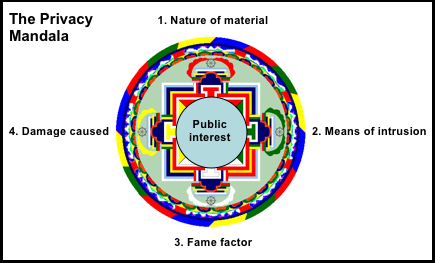
I have taken several self-regulatory codes and developed from them a more useful schema of situations, actions, and individuals which might in turn lead into a workable device for journalists (reporters, editors, news directors, and photographers) and regulatory bodies and perhaps even courts seeking to weigh up the competing privacy-public interest elements of a story. It aims to help journalists cover the main avenues of consideration when reaching their own decisions and, in turn, offer them a tool for explaining their decisions logically and systematically. I have called it the “Privacy Mandala”.

The ethical and industry codes typically flag potential danger zones for privacy material, including journalistic use of rumour, confidential information, offensive material particularly photographs and file footage.

The codes also identify several methods of privacy intrusion. They deal with individuals’ status as public figures or, alternatively, with their naivety of media practice in dealing with whether intrusion of their privacy might be more or less justifiable. These also deal with the kinds of individuals involved, with special concern over the intrusion into the lives of children. Some suggest public figures should be prepared to sacrifice their right to privacy “where public scrutiny is in the public interest”, while others say intrusion may be justified when it relates to a person’s “public duties”. Some warn journalists not to exploit those who may be “vulnerable or unaware of media practice”. Some counsel journalists against intruding into the lives of innocent third parties. Some make special mention of the vulnerability of children and recommend protocols for getting consent.

All this concern over the category of individual whose privacy might be intruded upon links with Chadwick’s (Chadwick 2004) notion of a “taxonomy of fame”. Former Victorian Privacy Commissioner (now ABC Director of Editorial Policies) Paul Chadwick devised a useful starting point for weighing up whether someone is deserving of a certain level of privacy. He called it the ‘five categories of fame’, each justifying different levels of protection. He argued that public figures who had courted fame or sought a public position deserved less privacy than those who found themselves in the public spotlight by the hand of fate or because they have been born into a famous family. His five distinct categories include: fame by election or appointment, fame by achievement, fame by chance, fame by association and royal fame. He suggested the tension over media exposure of private details of an individual can be “eased” by the use of such categories. Nevertheless, even the codes seem to go further than Chadwick’s list which does not account for the special circumstances of children in the news.

Clearly the potential damage to an individual resulting from a privacy invasion is an important consideration, however it gains scant attention in the codes themselves. This may be because much of the damage of a gross invasion of privacy might be incalculable, such as emotional scarring and other traumas.

The “public interest” exception to many of these requirements almost always features in media codes, with varying degrees of explanation. Public interest is the trump card in many of our decisions, but we need to explain why a photo of Nicole Kidman collecting her children from school is of such social importance if we are to justify our intrusion into her privacy. Perhaps it is of social importance because she has publicly criticized formal schooling, or perhaps because she has publicly claimed to be home-schooling them, or perhaps it is not of social importance but just mere curiosity and we have no right publishing this photo at all.

The Australian Press Council suggests an important further step publications should take when relying on public interest exemption: they should explain the basis of that decision to their readers.

How do we combine these multifarious considerations into a useful device for journalists and editors to use in a newsroom when confronted with a privacy dilemma? We can start by identifying the main spheres of concern with privacy issues, including a version of Chadwick’s categories of fame. As a final consideration we feed in the public interest / social importance of the material.

This means we can feature the following key factors for a journalist or editor to consider when weighing up a privacy intrusion:

  1. The nature of private material.
  2. The means of intrusion:
  3. The fame of individual (adaptation of Chadwick’s categories of fame): Red flag items here include children and the “media vulnerable”.
  4. The damage caused. That is, the level of directly predictable monetary loss, shock or embarrassment (variable according to individual’s circumstances and cultural factors) and potential for future loss or harm.

We then need to factor into the consideration the crucial “public interest” value, presented as a counterpoint to the above. This would operate on a scale from the prevention of death or injury and exposure of crime or corruption through the exposure of hypocrisy, setting the record straight, exposure of waste or inefficiency, preventing death or injury, or something merely of curiosity or gossip value. Part of the social importance decision-making process requires a decision on the level of centrality of the private material to the story.

The web of relationships and considerations is illustrated here as the Privacy Mandala.


A “mandala” metaphor has been borrowed from Buddhist terminology to aid with the analysis of the media-privacy issue here, but also ultimately with analysis of a matter in the newsroom. It would have been simpler, perhaps, to choose a more straightforward metaphor like a compass. However, there are aspects of the mandala which add value to our discussion. Like the Western concepts of privacy and reputation, it relates to an individual’s value of the self, often a deeply spiritual phenomenon. Mandala, which can take a range of forms, are also meant to be vehicles for meditation, and here ours provides a mechanism to do just that as we meditate in the professional workplace upon the values of privacy and press freedom. The intercultural nature of the metaphor is also no accident. In an increasingly globalised and multicultural society, media organizations occasionally need reminders that there are numerous interpretations of “privacy” among their audiences and news sources which might require special respect or consideration. Further, mandala are inherently complex. The Tibetan mandala are laden with meaning at a multitude of levels. So too is the privacy debate, with each of the four axes listed here representing a series of subsidiary factors needing to be considered in any decision to intrude. While there may be occasional clear-cut cases where privacy or the public interest are overwhelming “winners”, the majority of news situations fall into a negotiable zone where the most we can ask of a media organization is that it has considered the relative values carefully before deciding to, first intrude on a citizen’s privacy, and, secondly, publish the result of such an intrusion. The mandala can be used effectively to help with decision-making at both of those key moments in the news process.

When presented in this graphical form, some of the first four realms of privacy could further be displayed in shades of pink, with some listed as “code red” items. From the above discussion, it is clear that it would take a matter of overwhelming public interest to successfully counter a “code red” matter like the invasion of privacy of a child or a grieving relative of someone killed in tragic circumstances. These would need to have their social importance factors clearly articulated by an editor choosing to go ahead and publish the item.

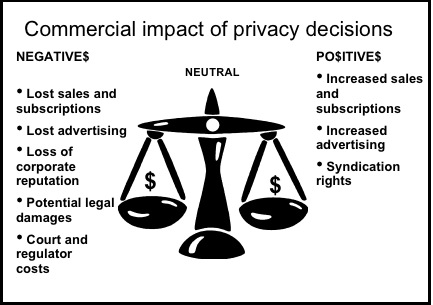
Quite separate from the mandala graphic is an independent area of consideration which is rarely mentioned in the ethics textbooks: the commercial impact of a story.  It is rarely addressed because theorists seem to work on the assumption that media organizations should be motivated primarily by a public or social good which is forever being compromised by a commercial imperative. However, the reality is that editors and news directors are motivated at least as much by circulation, ratings and page views as by a public duty to deliver the news. Their own tenure depends on their success in this regard, and it has been demonstrated that celebrity news and gossip sells newspapers and magazines and that hidden cameras and consumer advocacy doorstops boost current affairs television ratings. That said, the commercial impact of privacy decisions might be positive, negative or neutral, as illustrated by the following graphic.


The table takes account of the fact that there may be a range of potential profits or costs resulting from a story involving a privacy intrusion, including gained or lost circulation or ratings, advertising, syndication rights, corporate reputations, legal damages, and court or regulator costs. The courts would frown upon news organizations formally weighing up the potential monetary outcomes against the intangible human damage which could be caused by a privacy invasion. That said, there is little doubt journalists go through such a process, either formally or informally, when deciding whether to run with a story which pushes the privacy margins.

While there is little doubt many media organizations go through considerable angst in deciding whether or not to run a story which features some level of privacy intrusion, they have been inclined to keep the reasons for those decisions to themselves unless there is an ensuing disciplinary hearing or court case. News organizations should be encouraged to explain their ethical decision-making to their readers, viewers and listeners. It would take only a few paragraphs in a newspaper to accompany an intrusive photograph with an account of why there is an overwhelming public interest in readers seeing the material in question. Similarly, a news or current affairs anchor could devote a couple of sentences to say: “We realize this story involves a compromise of Miss X’s privacy, but we feel there is a greater public interest served by audiences viewing first-hand the emotional impact of a tragic event.” Such transparency would demonstrate to regulators and courts that a decision had been considered carefully and might well minimize the groundswell of protest from readers and audiences which often follows a privacy intrusion.

Here we have covered considerable terrain on the topic of privacy and journalism. We have distilled from Australian media regulations the key elements of privacy as they apply to the practice of journalism. We have grouped them into five key categories, covering the nature of the private material, the means of intrusion, the relative fame of those intruded upon, the level of damage caused, and the level of public interest or social importance of the story at hand. We have pointed to the importance of commercial considerations through increased ratings, circulation, or advertising sales as an additional consideration editors and news directors might taken into account before finalizing their privacy decisions. Finally, we have demonstrated that transparency in ethical decisions can provide some benefits to news organizations.

It is not claimed that the Privacy Mandala holds all the answers for a journalist faced with a privacy decision. Other factors might deserve inclusion.

This research should serve to demonstrate that there are workable models for ethical decision-making in the newsroom which can elevate discussion in editorial conferences above the gut feelings of news executives and force the articulated justification of decisions to intrude. Further, such a model might even help journalists proceed through an ethical minefield like privacy confident they have at least considered carefully the implications of their actions. That, surely, is in the public interest.

* Note: An earlier fully referenced version of this blog was presented as a conference paper at the Journalism Education Association conference on the Gold Coast, Australia in 2005. The research was undertaken with funding from the Australian Press Council. For a full-text version of the original article please visit the Proceedings of the 2005 Journalism Education Association Conference, Editors: Associate Professor Stephen Stockwell and Mr Ben Isakhan, ISBN: 1920952551.

© Mark Pearson 2012

Disclaimer: While I write about media law and ethics, nothing here should be construed as legal advice. I am an academic, not a lawyer. My only advice is that you consult a lawyer before taking any legal risks.

Leave a comment

Filed under Uncategorized