Tag Archives: social media law

Australian Government’s latest national security bill to stifle debate

By MARK PEARSON

The Australian Government has opted for censorship and secrecy over scrutiny and natural justice with its latest national security bill introduced in the Senate last week.

haneefcover

Haneef – A Question of Character, by Jacqui Ewart

The National Security Legislation Amendment Bill (No. 1) 2014 extends security agencies’ powers to search and use surveillance devices in the new communication environment, introduces a new ‘multiple warrants’ regime, offers immunity to intelligence personnel who break all but the most serious laws, while increasing penalties for whistleblowing and criminalising the reporting of leaked intelligence-related information.

Australian Attorney-General George Brandis introduced the legislation on Thursday (July 17).

The crucial section affecting journalists and bloggers is straightforward:

35P Unauthorised disclosure of information

(1)  A person commits an offence if:

(a)  the person discloses information; and

(b)  the information relates to a special intelligence operation.

Penalty: Imprisonment for 5 years.

It continues to set a 10 year jail term if the disclosure is deemed to “endanger the health or safety of any person or prejudice the effective conduct of a special intelligence operation.” A selective list of exemptions makes no mention of material being published in the public interest.

The provision is clearly aimed at preventing Wikileaks or Snowden-style leaks of recent years and their broad publication in the world’s media and across social media, to the embarrassment of governments including Australia’s.

As I detailed in my recent Walkley Magazine article, ‘Terror on the books’ (May 29, 2014), Australian governments from both Labor and the conservative parties have contributed to the enactment of more than 50 pieces of legislation at national level (and many more at state level) since the 9/11 terrorist attacks on the US, many of which have impacted free expression and reportage. Colleagues Dr Jacqui Ewart, Joshua Lessing and I detailed this trend in a recent article in the Journal of Media Law.

The Haneef case in 2007 showed how national security laws could be used to restrict media access to information in an anti-terrorism matter. In that case, the accused was ultimately acquitted after a leak to the media showed how little evidence there really was against him. If this new law was in place, journalists might face jail for reporting such an injustice.

The proposed law is so draconian that it has prompted a release from Paris-Based Reporters Without Borders.

Without a bill of rights or constitutional amendment to protect free expression or media freedom in this country, it is left to those who care about free speech to make their objections clear. Please write to the Federal Attorney-General at senator.brandis@aph.gov.au opposing this legislation. Please also make submissions stating any concerns to parliamentary committees reviewing the legislation when it reaches the committee stage. Sadly, in Australia there will be no formal review of the free expression implications of the bill.

© Mark Pearson 2014

Disclaimer: While I write about media law and ethics, nothing here should be construed as legal advice. I am an academic, not a lawyer. My only advice is that you consult a lawyer before taking any legal risks.
1 Comment

Filed under national security, terrorism, Uncategorized

Australian Press Council Chair Julian Disney with @journlaw

By MARK PEARSON

I recently had the chance to interview Australian Press Council chair Professor Julian Disney on the role and direction of the Council.

In this interview he discusses the recent reforms to the Council, the move to improve its editorial standards, and the future for media ‘self-regulation’ as broadcast, print, online and social media formats continue to converge.

(12 mins, recorded 17 March 2014). Apologies for some audio sync issues!

© Mark Pearson 2014

Disclaimer: While I write about media law and ethics, nothing here should be construed as legal advice. I am an academic, not a lawyer. My only advice is that you consult a lawyer before taking any legal risks.
Leave a comment

Filed under free expression, journalism, media ethics, Media freedom, Media regulation, Press freedom, Uncategorized

National security and anti-terror laws continue to threaten journalism

By MARK PEARSON

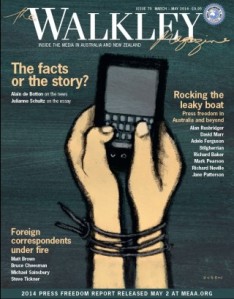
* This article was first published as ‘Terror on the books’ in the Walkley Magazine on May 29, 2014.

Walkley

More than 50 anti-terror laws have been introduced by the Australian government since the September 11 attacks in the US in 2001, and they continue to impact on our coverage of national security issues and place journalists and their sources at risk.

No Australian journalist would want to see lives lost in a terrorist attack, but there is evidence that existing laws give police, security agencies and the courts too much power in monitoring media activities and suppressing reports that are in the public interest. Two major reports now confirm some of these existing laws are over-reaching.

The long overdue Council of Australian Governments (COAG) Review of Counter-Terrorism Legislation was released in 2013.

As well as recommending changes to basic definitions of terrorist threats and harm, it proposes there be more opportunity for judicial reviews of the agencies’ search and seizure powers, and introducing some safeguards to the control order system (a control order restricts where a person goes and who they can meet).

The committee suggested that the communications restrictions be eased to allow a person subject to a control order access to a mobile phone, a landline phone and a computer with internet access.

Most importantly for journalists, the review recommended the repeal of Section 102.8 of the Criminal Code dealing with “associating with terrorist organisations”. This reform would put beyond any doubt the likelihood of a journalist being convicted of this serious offence by just undertaking normal reporting duties.

Another major report came in November 2013 from Bret Walker SC, the Independent National Security Legislation Monitor (INSLM). It was his third report since being appointed to the review role in 2011.Walker repeated his earlier recommendation that ASIO’s questioning and detention warrants should be abolished and suggested improvements to the definition of a “terrorist act”.

He called for a simpler system of listing terrorist organisations and inserting an exception to the “associating with terrorist organisations” provisions for humanitarian groups such as the Red Cross.

While both reports focused on issues of natural justice and human rights, neither the COAG review nor the INSLM addressed the stifling of journalism in the anti-terror laws.

Sadly, there was little in the way of media lobbying to do so either. The COAG counterterror review received 30 submissions which it posted to its website, none of which were from media-related companies or journalism or free expression organisations.

The ripples of international security operations were also felt in Australia. In 2013 the Media, Entertainment & Arts Alliance wrote to Prime Minister Tony Abbott asking for a review of the extent of metadata surveillance conducted by governments in the wake of former US National Security Agency (NSA) contractor Edward Snowden’s revelations.

There was good reason to be concerned. At least three cases in recent years have shown how the confidentiality of journalists’ sources can be compromised by surveillance by security agencies or anti-terror operations.

The retrial of “Jihad” Jack Thomas on terrorism charges in 2008 was based partly on interview materials gathered by Sally Neighbour from Four Corners and The Age’s Ian Munro and subpoenaed by the prosecution.

It emerged in the trial that up to 20 telephone calls between Neighbour and Thomas had been monitored by an ASIO agent.

The issue of confidentiality of whistleblowers’ identities also arose in the aftermath of the convictions of the Holsworthy Barracks bomb plot conspirators in 2011. The Australian had published an exclusive account on the raids in the hours before they occurred. (The three convicted plotters lost their appeals against their 18-year jail sentences last year.)

The Australian’s Victoria Police source, Simon Artz, paid for his leaks to the newspaper in the Victorian County Court with a four-month suspended sentence for unauthorised disclosure of information.

It was not a good year for whistleblowers internationally. WikiLeaks founder Julian Assange is holed up indefinitely in Ecuador’s embassy in London as he avoids extradition to Sweden on sex charges (and feared extradition to the US over security leaks). His US Army source – Private Chelsea (formerly Bradley) Manning – was sentenced by a military court to 35 years in jail for leaking classified documents. Meanwhile, Edward Snowden had fled to Russia to avoid prosecution over his leaks.

The whistleblower’s revelations about the extent of government surveillance continue to cause embarrassment, including in Australia where Prime Minister Tony Abbott reacted by attacking the ABC over its reportage. In an interview in early 2014, Abbott voiced his disapproval that the ABC had run stories about security services eavesdropping on Indonesian leaders’ phone conversations, a fact revealed by Snowden’s leaks.

The ABC then faced an “efficiency study”. It seems the Abbott government’s approach is to put the budgetary microscope on the ABC’s operations rather than wind back national security laws in the interests of media freedom.

The suppression of reporting on terrorism-related trials or evidence tendered in national security cases is an ongoing issue. The use of a closed court – combined with government media management – was central to the misplaced prosecution of Gold Coast Hospital registrar Dr Mohamed Haneef in 2007.

More than 30 suppression orders under anti-terror powers were imposed during the Benbrika trials in 2008 and 2009. In that case, Abdul Benbrika and 11 other Muslim men from Melbourne were charged with intentionally being members of a terrorist organisation. Their arrests in 2005 followed Operation Pendennis, a 16-month surveillance operation by Victoria Police, the Australian Federal Police and ASIO.

While by 2014 legislation covering suppression and non-publication orders had been introduced into only the Commonwealth, New South Wales, Victorian and South Australian jurisdictions, it appears that other states and territories are following suit to harmonise the laws.

© Mark Pearson 2014

Disclaimer: While I write about media law and ethics, nothing here should be construed as legal advice. I am an academic, not a lawyer. My only advice is that you consult a lawyer before taking any legal risks.

Leave a comment

Filed under national security, terrorism, Uncategorized

ABC RN Law Report host @damien_carrick talks privacy with @journlaw

By MARK PEARSON

The interviewer became the interviewee when I had the opportunity to chat with the host of the ABC Radio National Law Report (@LawReportRN), Damien Carrick (@damien_carrick), about the law of privacy and the media in Australia and the UK.

Damien was a visiting journalist fellow at the Reuters Institute for the Study of Journalism at Oxford University where he attended the Leveson Inquiry and interviewed journalists and media lawyers to prepare a report titled ‘Privacy, Regulation and the Public Interest’ which is available at https://reutersinstitute.politics.ox…. .

In this interview he discusses the interaction between the rights of free expression and privacy, the scope for coverage of celebrity news if there is a tort of privacy invasion, the difference between the UK and the Australian contexts, and the feasibility of the Australian Law Reform Commission’s proposal of a new statutory tort for the serious invasion of privacy.


[Recorded 19 May 2014, length 14 mins 54 secs]

© Mark Pearson 2014

Disclaimer: While I write about media law and ethics, nothing here should be construed as legal advice. I am an academic, not a lawyer. My only advice is that you consult a lawyer before taking any legal risks.

Leave a comment

Filed under Media regulation, Uncategorized

The lowdown on IP from expert Angus Macinnis @AequoEtBono – 15 mins with @journlaw

By MARK PEARSON


Intellectual property law – particularly copyright – can be one of the most complex areas of the law for journalists, bloggers and other professional communicators.

Thankfully, commercial lawyer Angus Macinnis from StevensVuaran Lawyers (@AequoEtBono) makes Australian IP law all a bit clearer in this short interview with me, @journlaw, covering everything from the basics of IP through to whether a simple Tweet might be actionable for breach of copyright.

[Recorded 5-5-14, 14 mins 50 secs]

© Mark Pearson 2014

Disclaimer: While I write about media law and ethics, nothing here should be construed as legal advice. I am an academic, not a lawyer. My only advice is that you consult a lawyer before taking any legal risks.

Leave a comment

Filed under Media regulation, Uncategorized

Diary of a cyberbullying victim

By MARK PEARSON

My research and writing on social media law got all too personal last week when a cyberbully threatened to open a website claiming I am a rapist.

Some months ago I posted to my research blog journlaw.com a fair and accurate report of a Fair Work Commission (FWC) decision that this individual had been fairly dismissed from his workplace.

It was an interesting case in social media law because his termination resulted from his offensive Facebook remarks about his workplace, a client and a prospective colleague.

According to the judgment, he had previously been warned about using company time and resources to start a private website.

Tellingly, the Commission’s decision stated the individual had shown no apology or regret for his behaviour and had maintained he was entitled to do it, offering his employer and the Commission ‘little comfort that similar incidents would not occur in the future’.

Other legal and HR experts posted summaries of the decision to their blogs and websites, including some of Australia’s leading law firms.

A fortnight ago he wrote to several of us asking that we change some elements of our coverage detailing the Commission’s finding that he had written sexually harassing comments about a colleague. He also wrote to senior staff at my university about the matter.

I responded that I believed my report of the case constituted a fair and accurate report of material on the public record.

However, I explained that I understood the blogs might be causing him ongoing angst and that their appearance on search engines could have other implications for him. I had therefore replaced his name throughout my post with the initials of his name, although I had left his full name in the case citation.

I said I was keen to correct any inaccuracies and asked him to point out any errors in my reporting. I ended the note by suggesting he seek counselling if the episode had caused him undue distress and I provided the Beyond Blue and Lifeline toll free numbers.

A few days later this bombshell landed in my inbox:

“Your article makes it seem like I sexually harassed a work colleague and it appears that you do not understand the impact this can have.

“To help give you a little perspective I am currently registering markpearsonisarapist@wordpress

“If you have a change of heart please feel free to send me an email.”

Attached to the message was this graphic illustrating the availability of the website he was threatening to establish:

GraphicOfWordpressRapistPearsonThreatI have written books and articles citing scores of examples where cyberbullies have attacked other victims.

But you only appreciate the anxiety and powerlessness of cyber-victimhood when you are the direct target of such a threat and your own name and reputation are on the line.

My recent research and writing has been exploring ‘mindful’ approaches to journalism and social media law and ethics, so I did not want to engage in an email flame war with this individual or give a heated kneejerk response.

The official cyberbullying sites like the Australian Government’s cyber(smart) recommend a “talk, report, support” approach, advising a victim should talk about the threat to someone they trust, avoid retaliating or responding, block the bully and change privacy settings, report the abuse to the service, and collect the evidence.

I took some of this advice by discussing it with family and friends, screen capturing the correspondence, and advising the other bloggers who had reported the case that he had issued this serious threat against me.

However, given he had not yet registered the offensive site, I thought I would appraise him of the illegality of his threat and give him 24 hours to withdraw it and apologise.

I wrote explaining his email threat was likely in breach of several state and federal laws carrying the risk of substantial fines and jail terms, including blackmail, misuse of a carriage service, stalking and harassment and that I was prepared to press such charges against him.

Five hours later he responded:

“Your panic is not needed. I have not registered any accounts citing that you are a rapist, I simply exclaimed that I would to wonderfully illustrate my point about making damaging claims against others.

“Isn’t it a little funny how you’re happy to publish articles that insinuate that an individual is a sexual predator but once somebody propositions you with the same action you instantly threaten to contact the authorities?

“I understand that you have no intention of taking this matter any further, are probably just a little bored and like myself enjoy sticking to your principles and engaging in a good argument. I would have thought that you’d have something more important to be working on but I guess I was wrong, either way, I have a lot of time also. 😛

“Please advise when [my original blog post] has been removed entirely.”

So there it stands. It seems the threat has dissipated, but I’m unsure of what – if anything – I should do next.

A mindful approach involves reflecting upon the implications of one’s actions for all stakeholders and seeking counsel.

I thought it would be a useful learning experience for the 200 students in my Media Law course, so I put my dilemma to them in last week’s lecture. I also asked them to vote on which of three courses of action they recommended I should take.

Here are the options, with some of the students’ observations:

  1. Have him charged. About half the students in the lecture voted for this option. They felt that’s how you should deal with cyberbullies. The guy has ‘form’ and has clearly not learnt his lesson. He has escalated his tactics with this serious and intimidating threat. Next time his victim might be a much more vulnerable individual than a university professor who researches and publishes in the field. It might be someone in a fragile emotional state and there could be tragic consequences – just like we saw in the royal prank call episode.
  2. Do nothing and let it drop. About one quarter of students voted for this. I’ve made my point and he may well be terrified. While you cannot excuse his actions, you can certainly empathise with his despair at this digital archive of his transgressions available with a simple Google search of his name. Perhaps my response has been enough to make him stop his anti-social online behaviour. My original blog post on his dismissal remains live, so prospective employers are still on notice about him. Besides which, he himself might be vulnerable and further pressure might be detrimental to him. The research shows cyberbullies often have a mental illness, a personality disorder or engage during substance abuse. Worse still, it might prompt him to escalate the matter and perhaps retaliate by carrying out that threat or something worse.
  3. Blog about it. The remaining quarter of students thought this was the best course of action. It spreads the message to other potential bullies, educates the community about the problem, and it’s what I do best. It could be as little as writing a piece like this.

Of course, the other options are still available to me now I have posted this blog, and I can still proceed with pressing charges. I’d appreciate your advice if you’d care to comment below.

For information about cyberbullying go to cybersmart.gov.au or contact Lifeline on 13 11 14.

Thanks to these tweeps for your supportive comments:

https://twitter.com/gvandersee/status/465682966652260353

© Mark Pearson 2014

Disclaimer: While I write about media law and ethics, nothing here should be construed as legal advice. I am an academic, not a lawyer. My only advice is that you consult a lawyer before taking any legal risks.

9 Comments

Filed under Media regulation, mental health, social media, Uncategorized

Cyberbullying and the law in Australia: key legislation and cases

By MARK PEARSON

If you are looking for an excellent summary of the main laws controlling cyberbullying in Australia you need look no further than here:

Where does Cyber-bullying fit in the Current Australian Criminal Framework?.

It covers key Commonwealth and State laws including misuse of telecommunications services, stalking and harassment, and criminal defamation.

See also these previous posts on journlaw.com:

…  from my public lecture ‘Social Media – Risks and Rewards’] We hear a great deal about the downside of social media …  in schools. There have been well publicised examples of cyberbullying, defamation of teachers and principals, stalking of children by …
…  sad news of the death of television personality Charlotte Dawson over the weekend,  I repost this commentary I wrote for The …  in the near tragic saga of TV personality Charlotte Dawson and Twitter. [2014 note: clearly, it is now tragic] Andthose lessons must …
…  from my public lecture ‘Social Media – Risks and Rewards’] Administrators andparents are indeed concerned about social media – partly because the …  committed to it, one might be excused for believing cyberbullying had driven young people to the depths of depression and anxiety …
…  MARK PEARSON Follow @Journlaw [Professor of Journalism and Social Media, Griffith University, Australia] Public lecture presented …  in schools. There have been well publicised examples of cyberbullying, defamation of teachers and principals, stalking of children by …
…  issue of discriminatory abuse in my new book  – Blogging and Tweeting Without Getting Sued: A global guide to the law for anyone writing …  to their type, scale, andjurisdiction. They include: cyberbullying, cyberstalking, online trolling, malicious online content, using …


For information about cyberbullying go to cybersmart.gov.au or contact Lifeline on 13 11 14.

© Mark Pearson 2012 and 2014

Disclaimer: While I write about media law and ethics, nothing here should be construed as legal advice. I am an academic, not a lawyer. My only advice is that you consult a lawyer before taking any legal risks.

1 Comment

Filed under Media regulation, mental health, social media, Uncategorized

Journalists revert to age-old methods to protect sources, says @camstewarttheoz

By MARK PEARSON

National security reporter and associate editor at The Australian Cameron Stewart (@camstewarttheoz) says investigative journalists have to leave their smartphones back at their office when they are meeting confidential sources.

Stewart said the surveillance powers of national security agencies under anti-terror laws, combined with the geo-navigational features of Web 2.0 technologies, meant investigative reporters were reverting to 1970s techniques like those of Watergate reporters Carl Bernstein and Bob Woodward used when they met their famous source ‘Deep Throat’ in an underground car park.

“That is actually still the best way to get your information,” Stewart told me in the interview below.

“The thing I’ve got to my ear now [a smartphone] is your biggest enemy in every single sense as the Snowden revelations have shown.

“The ability of authorities to track movements of journalists is really of great concern as far as protecting sources goes.

“What they’re doing is quietly authorising metadata searches and things like that. What that does is give them every phone call you’ve made and I think they can piece together through your iPhone for example what your movements are over time.

“It’s not rocket science to work out what your movements are over a certain period of time and who you’ve been speaking to and who sources might be.”

Here Cameron Stewart talks with Professor Mark Pearson of Griffith University (@journlaw) about the impact of anti-terror laws on the reporting of national security issues. Stewart shares some of the methods he uses as a reporter when dealing with off the record information provided by whistleblowers  [15 minutes, recorded 1-5-14]

© Mark Pearson 2014

Disclaimer: While I write about media law and ethics, nothing here should be construed as legal advice. I am an academic, not a lawyer. My only advice is that you consult a lawyer before taking any legal risks.

4 Comments

Filed under Uncategorized

Meet Miles Heffernan (@Mileshef) – shield law campaigner and @journlaw guest

By MARK PEARSON

Miles Heffernan (@mileshef) is a journalist and features/opinion editor with the Star Observer.

When he was a freelancer he ran a campaign on change.org calling on mining magnate Gina Rinehart to withdraw her demands for two journalists to reveal their sources. See ‘http://www.change.org/en-AU/petitions/gina-rinehart-withdraw-your-subpoenas-against-adele-ferguson-and-steve-pennells-pressfreedom‘. See also my blog from 2013 on this.

It achieved close to 40,000 signatures.

Here Miles talks with Professor Mark Pearson of Griffith University (@journlaw) about that campaign and the battle for shield laws to protect journalists from having to reveal their sources in court. See more at journlaw.com. [12 minutes, recorded 16-4-14]

© Mark Pearson 2014

Disclaimer: While I write about media law and ethics, nothing here should be construed as legal advice. I am an academic, not a lawyer. My only advice is that you consult a lawyer before taking any legal risks.

Leave a comment

Filed under Uncategorized

Barrister and co-author Mark Polden chats with @journlaw on #defamation defences: #MLGriff

By MARK PEARSON

Defamation laws can be intimidating for journalists, bloggers and other professional communicators. The key, according to barrister Mark Polden, is in researching and writing to the basic defences.

Mark Polden was in-house counsel at Fairfax Media for many years before going to the Bar, and is my co-author of The Journalist’s Guide to Media Law (Allen & Unwin).

In this 11 minute interview with @journlaw, he outlines in simple terms the three ‘bread and butter’ defences used by writers and publishers – truth, fair report and honest opinion (fair comment).

———–

Disclaimer: While I write about media law and ethics, nothing here should be construed as legal advice. I am an academic, not a lawyer. My only advice is that you consult a lawyer before taking any legal risks.

© Mark Pearson 2014

Leave a comment

Filed under blogging, contempt of court, courts, free expression, media ethics, Media freedom, media law, Press freedom, sub judice, suppression, Uncategorized