Category Archives: blogging

Former ombudsman offers insights into defamation #MLGriff

By MARK PEARSON

A former ombudsman who sued a major newspaper for defamation offers his insights into the experience in Episode #009 of our occasional Griffith University SMALL podcast – Social Media and Law Livestream.

Griffith University Media Law students Emily Soccol and Anna Swann interview Professor John McMillan AO about his successful defamation action against the Canberra Times in 2016.

Mr McMillan has held positions of Commonwealth Ombudsman, Integrity Commissioner for the Australian Commission for Law Enforcement Integrity, Australian Information Commissioner, NSW Ombudsman and a member of the Australian Copyright Tribunal.

He is also a legal consultant and an Emeritus Professor at the Australian National University. Drawing on his expertise over a five decade career, Professor McMillan offers his perspective on defamation laws and the legal risks associated with publishing damaging material.

The case was settled after mediation. The court judgment on the imputations can be viewed at https://www.austlii.edu.au/cgi-bin/viewdoc/au/cases/act/ACTSC/2016/286.html. [McMillan v The Federal Capital Press of Australia Pty Ltd [2016] ACTSC 286 (22 September 2016) ]

[Listen here: 14:26 min].


If you are a communication professional wanting to study in this area, please consider enrolling in our online courses Social Media Law and Risk Management (postgraduate, fully online) or Media Law (undergraduate, available online or on campus).

Disclaimer: While I write about media law and ethics, nothing here should be construed as legal advice. I am an academic, not a lawyer. My only advice is that you consult a lawyer before taking any legal risks.

© Mark Pearson 2023 – the moral right of the author has been asserted.

Leave a comment

Filed under blogging, communication, contempt of court, defamation, Internet, journalism, journalism education, libel, media law, media literacy, online education, open justice, podcast, public relations, reflective practice, risk, risk management, social media, social media law, strategic communication, sub judice, suppression, Whistleblowing

Retired magistrate offers advice to court reporters #MLGriff

By MARK PEARSON

Decades of experience as a magistrate and lawyer inform the advice offered to court reporters in Episode #008 of our occasional Griffith University SMALL podcast – Social Media and Law Livestream.

Retired magistrate Antoine Bloemen. Photo: Anne Bloemen.

Griffith University Media Law student Elizabeth Heseltine interviews retired Western Australian magistrate Antoine Bloemen about the traps faced by novice court reporters, with some fascinating examples.

He draws upon his 40 years of expertise as a legal professional to share his insights into courtroom etiquette and the potential legal ramifications of a poorly researched and written article [Listen here: 14:26 min].


If you are a communication professional wanting to study in this area, please consider enrolling in our online courses Social Media Law and Risk Management (postgraduate, fully online) or Media Law (undergraduate, available online or on campus).

Disclaimer: While I write about media law and ethics, nothing here should be construed as legal advice. I am an academic, not a lawyer. My only advice is that you consult a lawyer before taking any legal risks.

© Mark Pearson 2022 – the moral right of the author has been asserted.

Leave a comment

Filed under blogging, communication, contempt of court, defamation, Internet, journalism, journalism education, libel, media law, media literacy, online education, open justice, podcast, public relations, reflective practice, risk, risk management, social media, social media law, strategic communication, sub judice, suppression, Whistleblowing

Podcast offers rare inside view of FOI process

By MARK PEARSON

Episode #007 of our occasional Griffith University SMALL podcast – Social Media and Law Livestream – looks at Freedom of Information processes from a different perspective – that of a lawyer managing the Commonwealth Government’s FOI approvals and exemptions.

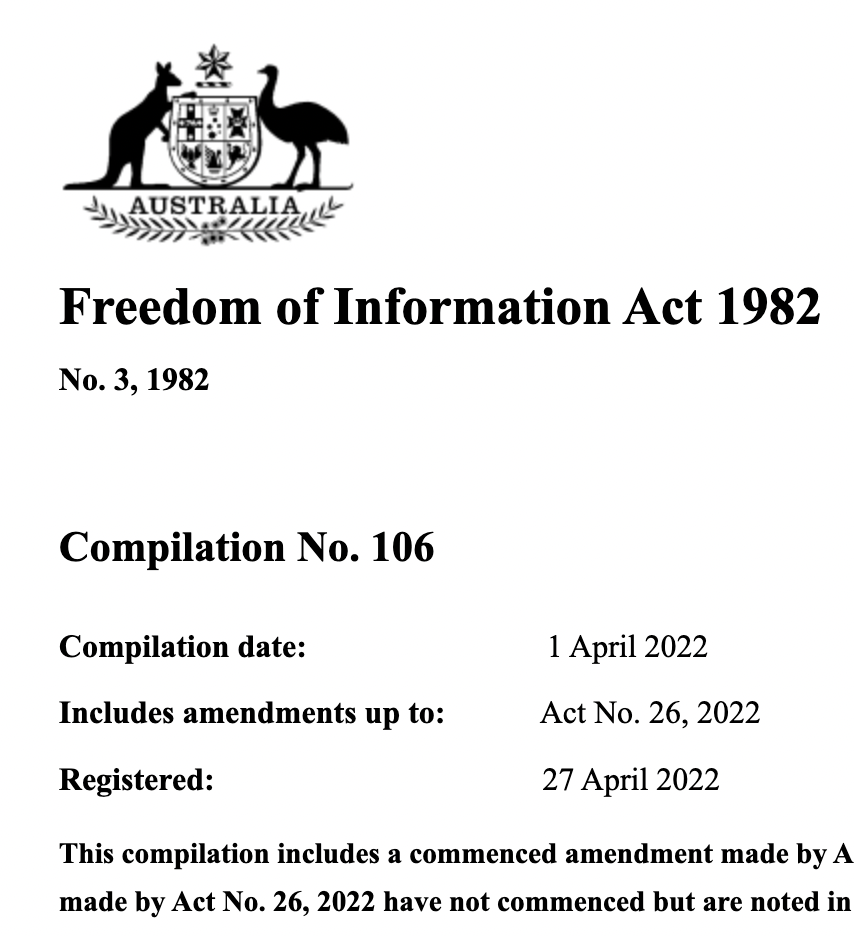
FOI Act imageGriffith University Media Law student Mia Durnan interviews Senior Lawyer Rodney Durnan about Freedom of Information laws (FOI); covering basic topics like ‘what is FOI?’, the process of an application, some of the exemptions that can apply and how the FOI laws interact with privacy laws from a practical perspective.

Mr Durnan is part of In-House Counsel for a large Federal Government agency.

With more than 15 years of experience, he and his team specialise in administrative law which includes Freedom of Information and Privacy. [15:25 min] Find Mia’s interview here.


If you are a communication professional wanting to study in this area, please consider enrolling in our online courses Social Media Law and Risk Management (postgraduate, fully online) or Media Law (undergraduate, available online or on campus).

Disclaimer: While I write about media law and ethics, nothing here should be construed as legal advice. I am an academic, not a lawyer. My only advice is that you consult a lawyer before taking any legal risks.

© Mark Pearson 2022 – the moral right of the author has been asserted.

Leave a comment

Filed under blogging, communication, contempt of court, defamation, Internet, journalism, journalism education, libel, media law, media literacy, online education, open justice, podcast, public relations, reflective practice, risk, risk management, social media, social media law, strategic communication, sub judice, suppression, Whistleblowing

Our SMALL podcast guest: Whistleblower expert Professor AJ Brown

By MARK PEARSON

In episode #006 of our occasional SMALL podcast – Social Media and Law Livestream – I speak with academic whistleblowing expert Professor A J Brown.

AJBrown-e1489729940533Professor Brown is leader of the Centre for Governance and Public Policy’s public integrity and anti-corruption research program in Griffith University’s School of Government and International Relations.

He is on the global board of the world anti-corruption organisation Transparency International and a leading expert on public interest whistleblowing. He talks about the legal framework for whistleblowers and the implications for journalists and their confidential sources. Find our interview here [21:49min].


If you are a communication professional wanting to study in this area, please consider enrolling in our online courses Social Media Law and Risk Management (postgraduate, fully online) or Media Law (undergraduate, available online or on campus).

Disclaimer: While I write about media law and ethics, nothing here should be construed as legal advice. I am an academic, not a lawyer. My only advice is that you consult a lawyer before taking any legal risks.

© Mark Pearson 2022 – the moral right of the author has been asserted.

Leave a comment

Filed under blogging, communication, contempt of court, defamation, Internet, journalism, journalism education, libel, media law, media literacy, online education, open justice, podcast, public relations, reflective practice, risk, risk management, social media, social media law, strategic communication, sub judice, suppression, Whistleblowing

Latest SMALL podcast gets Amy Remeikis’ take on social media law

By MARK PEARSON

Episode #005 of our occasional SMALL podcast – Social Media and Law Livestream – features Guardian Australia political reporter Amy Remeikis talking media law with tutor Susan Grantham.

From court and police rounds, to reporting on Australian federal politicians, Amy (pictured below) discusses how she navigates legal risks while reporting in a wired world.

This latest episode [22:11 mins] – published on The Source News – canvasses Amy’s views on recent defamation cases including the High Court judgment against media outlets’ hosted social media comments in the Dylan Voller case. Enjoy!

If you are a communication professional wanting to study in this area, please consider enrolling in our online courses Social Media Law and Risk Management (postgraduate, fully online) or Media Law (undergraduate, available online or on campus).

Disclaimer: While I write about media law and ethics, nothing here should be construed as legal advice. I am an academic, not a lawyer. My only advice is that you consult a lawyer before taking any legal risks.

© Mark Pearson 2022 – the moral right of the author has been asserted.

Leave a comment

Filed under blogging, communication, contempt of court, defamation, Internet, journalism, journalism education, libel, media law, media literacy, online education, open justice, podcast, public relations, reflective practice, risk, risk management, social media, social media law, strategic communication, sub judice, suppression

Latest SMALL podcast looks at Israel Folau matter

By MARK PEARSON

Episode #004 of our occasional SMALL podcast – Social Media and Law Livestream – is now available for listening.

Social Media Risk and the Law.inddThis latest episode [15:00 mins] – published on The Source News – is hosted by Griffith University Media Law student Brandon McMahon.

Brandon talks with Attwood Marshall lawyer Laura Dolan about the discrimination, religious freedom, unfair dismissal and contract dimensions of the case involving former Test rugby union player Israel Folau and his social media posts. [SMALL #004].

Enjoy!


If you are a communication professional wanting to study in this area, please consider enrolling in our online courses Social Media Law and Risk Management (postgraduate, fully online) or Media Law (undergraduate, available online or on campus).

Disclaimer: While I write about media law and ethics, nothing here should be construed as legal advice. I am an academic, not a lawyer. My only advice is that you consult a lawyer before taking any legal risks.

© Mark Pearson 2021 – the moral right of the author has been asserted.

Leave a comment

Filed under blogging, communication, contempt of court, defamation, Internet, journalism, journalism education, libel, media law, media literacy, online education, open justice, podcast, public relations, reflective practice, risk, risk management, social media, social media law, strategic communication, sub judice, suppression

Two more SMALL podcasts on our Social Media And Law Livestream

By MARK PEARSON

Episodes #002 and #003 of our occasional SMALL podcast – Social Media and Law Livestream – are now available for listening.

Social Media Risk and the Law.inddThese episodes – published on The Source News – are hosted by Media Law students Amy Sauvarin and Camille Chorley.

In Episode #002 [16:37 mins], Amy chats with veteran journalist and author Uli Schmetzer about freedom of expression and his encounters with censorship over his four decade career as a foreign correspondent. For more information on his books and reportage, see http://www.uli-schmetzer.com/index.html.

In Episode #003  [20 mins], Camille talks with ABC Landline producer and ABC News cadet trainer John Taylor about free expression issues in foreign correspondence, court reporting, social media and training journalists in media law. See his bio at https://www.abc.net.au/news/john-taylor/167072.

Enjoy!


If you are a communication professional wanting to study in this area, please consider enrolling in our online courses Social Media Law and Risk Management (postgraduate, fully online) or Media Law (undergraduate, available online or on campus).

Disclaimer: While I write about media law and ethics, nothing here should be construed as legal advice. I am an academic, not a lawyer. My only advice is that you consult a lawyer before taking any legal risks.

© Mark Pearson 2021 – the moral right of the author has been asserted.

Leave a comment

Filed under blogging, communication, contempt of court, defamation, Internet, journalism, journalism education, libel, media law, media literacy, online education, open justice, podcast, public relations, reflective practice, risk, risk management, social media, social media law, strategic communication, sub judice, suppression

Welcome to our SMALL podcast – Social Media And Law Livestream

By MARK PEARSON

The first episode of our occasional SMALL podcast – Social Media and Law Livestream – is now available for listening.

Social Media Risk and the Law.inddIn this first 11 minute episode – hosted on The Source News – I interview co-author Dr Susan Grantham about issues in social media risk and the law covered in our new book, Social Media Risk and the Law – A Guide for Global Communicators, published in September 2021 by Routledge.

We discuss the intersection of social media risk theory and the law, the tools available to assess social media risk, the point at which brand and reputation damage become defamatory, the role of stakeholder theory in assessing social media risk, and the legal risks for employees who use their private social media channels to criticise their organisations.

We plan to feature a wide variety of short interviews with social media law experts on a range of topics over coming weeks and months, with many of the interviews conducted by students undertaking our media law and social media law classes.

SMALL podcast #001 – Dr Susan Grantham – ‘Social media risk and the law’ – interviewed by Mark Pearson [11 min]


If you are a communication professional wanting to study in this area, please consider enrolling in our online courses Social Media Law and Risk Management (postgraduate, fully online) or Media Law (undergraduate, available online or on campus).

Disclaimer: While I write about media law and ethics, nothing here should be construed as legal advice. I am an academic, not a lawyer. My only advice is that you consult a lawyer before taking any legal risks.

© Mark Pearson 2021 – the moral right of the author has been asserted.

Leave a comment

Filed under blogging, communication, contempt of court, defamation, Internet, journalism, journalism education, libel, media law, media literacy, online education, open justice, podcast, public relations, reflective practice, risk, risk management, social media, social media law, strategic communication, sub judice, suppression

Why study media law? #MLGriff

By MARK PEARSON

More than 200 new media law students embark on our seven week summer intensive course next week, so I thought it timely to reflect upon what might be gained from studying media law.

About two thirds will be attending classes in person, while the balance will be undertaking the course online. The cohort is almost evenly divided between journalism, law and communication students, with a few others taking it as an elective.

Here are 10 key benefits of media law study:

  1. Identifying and assessing risks in publishing is the new digital literacy. Traditionally only journalists and some lawyers really needed to know about media law, but now every citizen must know the risks of publishing because we are all now publishers as we post to social media, send emails and release our blogs, videos, films, games, software and images.
  2. Many areas of the law coalesce in ‘media law’, making it an excellent introduction to the legal system for journalists and public relations practitioners and a fertile field of revision and practice for law students.
  3. Media law presents a wonderful opportunity to explore the many competing rights and interests in society as the rights to free expression, information, and a free media compete with other important rights including reputation, a fair trial, privacy, confidentiality, intellectual property and national security, along with the right to be free from discrimination in all its forms.
  4. It affords us a superb showcase of the role of the news media in the varied political systems internationally as governments select different points where free expression should be curtailed. You learn that free expression is a continuum, with fewer restrictions in some nations and alarming censorship in others. International students get to compare Australia’s media laws with those in their home countries.
  5. Just as truth might be shackled by some governments and individuals, media law offers insights into so-called ‘fake news’ and ‘false news’ by demonstrating how fair and accurate reporting and publications can earn special protections and how ethical research and reporting can be rewarded by the courts.
  6. Media law cases are often fascinating portrayals of human foibles, egos and temptations and sometimes have elements of the Shakespearean tragedy where good reporting exposes the abuse of power.
  7. The laws and examples encourage the exercise of mindfulness in communication practice. A few moments spent reflecting upon risk and harm before publication might save you many dollars in fines or damages and perhaps even time in jail. Also, many a media law case could have been avoided by a simple utterance of the word ‘sorry’ and a heart-felt offer of amends (both on legal advice!).
  8. Problem-based media law learning offers a vivid insight into how a prickly legal situation might arise, and helps you navigate a course of action after assessing the legal risks. Robust and truthful journalism can still be produced within the bounds of the law, in some countries at least.
  9. Media law cases and reforms are in the news on a regular basis, adding relevance and topicality to your studies as you watch cases involving real people contested in the courts and covered in the news media.
  10. Finally, you learn that all laws can be improved, so you engage with the continuous process of media law reform. You learn about the reform process, access historical reform recommendations in your research, and have the opportunity to recommend your own reforms in areas of your interest. You are even encouraged to make submissions to current law reform commission and parliamentary inquiries.

Disclaimer: While I write about media law and ethics, nothing here should be construed as legal advice. I am an academic, not a lawyer. My only advice is that you consult a lawyer before taking any legal risks.

© Mark Pearson 2018

2 Comments

Filed under blogging, contempt of court, courts, defamation, free expression, journalism, journalism education, media ethics, media law, mindful journalism, online education, reflective practice, social media, terrorism

Social media developments have legal implications and require a new literacy

By MARK PEARSON

Every new development in Internet and social media communication renders countless new people ‘publishers’ –  exposed to risky media law situations they might never have anticipated. 

Advances in communication technology in this new millennium have redefined the ways in which most of us share news and information. Industry upheaval and technological disruption have prompted many journalists to retool as bloggers, public relations consultants, multimedia producers and social media editors.

These roles add exciting new dimensions to journalism and strategic communications—including conversations and engagement with audiences and instant global publishing at the press of a button. But they also present new legal risks that most professional communicators – and even ordinary citizens – did not envisage in the twentieth century.

The changes have been so profound that they have impacted the ways we live and organise our lives and work practices. It is only when we review some of the milestones of the internet and Web 2.0, together with the legal and regulatory changes they have prompted, that we start to appreciate the need for all professional communicators to be knowledgeable about media law.

While the worldwide connection of computers, giving rise to the phenomenon we know as the internet, dates back to the early 1980s, it did not start to impact the lives of ordinary citizens until the mid-1990s. Melbourne’s Age newspaper became one of the first in the world to offer an online edition in 1995 (van Niekerk, 2005). Over the ensuing years, entrepreneurs started to embrace the commercial potential of the World Wide Web, just as consumers began to use it to source products and services, and students began to engage with it as an educational tool—predominantly from their desktop computers.

By the end of 2016, there were approximately 13.5 million internet subscribers in Australia (ABS, 2017). It was not until August 2003 that the first major social networking platform, MySpace, was launched in California. It was the leading social networking site in the world from 2005 until 2008, when it was surpassed in popularity by Facebook, which by 2017 had almost two billion monthly users, including 15 million in Australia (Media Watch, 2017). In the six months to June 2016, 93 per cent of internet users aged 18 to 24 used social networking sites (ACMA, 2016:  58). Streaming of entertainment and news has also become part of daily life.

In June 2016, 39 per cent of Australian adults had watched Netflix in the previous seven days, while 27 per cent had watched professional content on YouTube and 16 per cent had viewed the pay television service Foxtel (ACMA, 2016: 82). In the United States by 2017, six out of ten young adults were primarily using online streaming to watch television (Rainie, 2017). Associated with this was the remarkable uptake of the mobile telephone and other devices. The iPhone was only launched in 2007, but by 2016 more than three-quarters of Australians owned a smartphone (ACMA, 2016: 18). The iPad was born in mid-2010 into a market segment that many experts thought did not exist, but by 2016 more than half of Australians used or owned a tablet device (ACMA, 2016: 55).

Even more technologies are unfolding rapidly, with implications for both the media and the law, with the increasing use of drone devices for news-gathering purposes and the awe-inspiring Internet of Things (IoT), where everyday devices are all interconnected, offering novel news-gathering and delivery systems for the media but also complex legal ramifications—particularly in the realm of privacy and security law.

Governments, courts and other regulators have been forced to decide on the various rights and interests affected by these new media forms, and some of their decisions have taken private enterprise by surprise. It is a far more difficult task, however, to educate the broader community about social media legal risks.

The core message is that we are all publishers in the eyes of the law when we publish a blog or post to a social media platform, and in that role all citizens are subject to the same laws that have affected journalists and publishers for centuries.

Further, the instantaneous and global nature of the media means that we may also be the subject of foreign laws of countries other than Australia—particularly if we work for a multinational corporation, or choose to travel to, or have had material we wrote downloaded in, a place where our posts might have broken the law or infringed upon someone’s rights. These laws include defamation, contempt of court, intellectual property, confidentiality, privacy, discrimination and national security.

All this makes a strong argument for greater social media literacy among professional communicators and the wider community.

[Excerpted from Pearson, M. and Polden, M. (2019, 6th edition, forthcoming). The Journalist’s Guide to Media Law. A Legal Handbook for Digital Communicators. (Allen & Unwin, Sydney).]

References

Australian Associated Press (AAP) 2017, ‘Changes to media ownership laws’, SBS, 14 September, <www.sbs.com.au/news/article/2017/09/14/changes-media-ownership-laws>.

Australian Bureau of Statistics] 2017, Internet Activity, Australia, December 2016, cat. no. 8153, ABS, Canberra, <www.abs.gov.au/ausstats/abs@.nsf/mf/8153.0>.

Australian Communications and Media Authority] 2016, Communications Report 2015–2016. ACMA, Sydney, <www.acma.gov.au/theACMA/Library/researchacma/Research-reports/communications-report-2015-16>.

van Niekerk, M. 2005, ‘Online to the future’, The Age, 28 January, <www.theage.com.au/news/National/Online-to-the-future/2005/01/27/1106415726255.html>.


Disclaimer: While I write about media law and ethics, nothing here should be construed as legal advice. I am an academic, not a lawyer. My only advice is that you consult a lawyer before taking any legal risks.

© Mark Pearson 2018

Leave a comment

Filed under blogging, defamation, free expression, journalism, journalism education, media ethics, media law, mindful journalism, online education, reflective practice, social media, terrorism