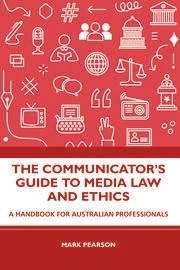
Category Archives: citizen journalism

Mindful Journalism in action – in dialogue with University of Canterbury students

By MARK PEARSON

Graduate students in journalism from the University of Canterbury studying under Associate Professor Donald Matheson interviewed me via Skype on the principles of mindful journalism.

With their permission, I provide the recording of that interview here for the interest of those exploring the application of Buddhist ethical systems to their journalism work.

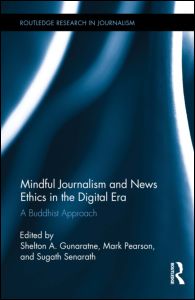
Our book Mindful Journalism and News Ethics in the Digital Era: A Buddhist Approach (Shelton Gunaratne, Mark Pearson and Sugath Senarath eds; Routledge, NY) was published in February 2015.

Review copies are available from Routledge by filling out this request form. Please see the publisher’s synopsis.

MindfulJournalismCoverThe term ‘mindful journalism’ is a concept I introduced more than a year ago in the inaugural UNESCO World Press Freedom address at AUT University Auckland, drawing upon the earlier substantive work by my esteemed colleague (and lead editor of our book), Emeritus Professor Shelton Gunaratne, who has been working for decades on the intersection between Buddhism and journalism.

I developed my application of this in a paper to the International Association for Media and Communication Research (IAMCR) conference in Dublin in July 2014, which was revised for publication as an article in Ethical Space published in December 2014.

It is being published as part of the Routledge New York Research in Journalism series. My key point was that one does not have to be a Buddhist to incorporate the key principles of mindful journalism into one’s work. In fact, most of these very moral principles are evident in the teachings of all the world’s great religions. However, for those who lack a moral framework for their ethical decision-making, a secular application of these non-theistic principles can offer a moral compass. They offer a series of normative or aspirational goals we can strive for, but rarely reach. They also provide a schema for the analysis of ethical decision-making by journalists.

Interested? You can read further extracts from the book using the “Look Inside” interface at Amazon. Enjoy.

———–

Disclaimer: While I write about media law and ethics, nothing here should be construed as legal advice. I am an academic, not a lawyer. My only advice is that you consult a lawyer before taking any legal risks.

© Mark Pearson 2015

1 Comment

Filed under blogging, Buddhism, citizen journalism, Eightfold Path, free expression, media ethics, mental health, social media, Uncategorized

Lessons in ‘Right Speech’ and mindful communication in Queensland defamation case

By MARK PEARSON

THE comedians on the Ten network’s ‘The Project’ had some fun with defamation last Friday when they used a fairly sobering Queensland case as the reason to interview me on the basics of that law.

First up, a clarification. Near the end of the segment they seemed to imply quite incorrectly that I am a lawyer which, of course, I am not!

Mark Pearson (@journlaw) interviewed on The Project about defamation 24.4.15 [At 33 mins 15 secs]

Mark Pearson (@journlaw) interviewed on The Project about defamation 24.4.15 [At 33 mins 15 secs]

There is a serious side to this. The Queensland case they used as the segue to my very rudimentary explanation of defamation law was Sierocki & Anor v Klerck & Ors (No 2) [2015] QSC 092 where Justice Flanagan had ordered a total of $260,000 in damages be awarded to the plaintiff and his company over various Internet slurs against them by his former business partner and others.

The defendants had earlier failed in their attempt to prove the truth of the imputations that the plaintiff was fraudulent; was a conman; had committed adultery; had used illegal drugs; was evil; was a thief; was a liar; and preyed on the innocent and that his company’s services were disreputable; unprofessional and encouraged threatening behaviour. Quite a slur indeed.

33671_GAZThe Courier Mail reported earlier that the plaintiff was also suing Google for $2.6 million over its search results linking him to the sites containing those imputations.

The case is interesting for media law students for a range of reasons – the large award of damages, the fact that they were Internet publications, and for the proposed action against Google.

But I find the most instructive lesson is the extent to which a dispute between business partners can escalate so far out of control that one should take to the Internet to cast these kinds of aspersions against the other.

Justice Flanagan noted in the judgment that the cause of the original dispute was unknown, but the result has been enormous financial and emotional cost to all parties.

Our new book Mindful Journalism and News Ethics in the Digital Era: A Buddhist Approach (Shelton Gunaratne, Mark Pearson and Sugath Senarath eds; Routledge, NY) examined some of the causes of such disputes and the damage that language can cause to reputations and relationships.

I take this further in a forthcoming article in a special issue of the academic journal International Communication Gazette, edited by my Mindful Journalism lead editor Shelton Gunaratne.

In that article I examine the religious origins of defamation law and proceed to link it to the Buddhist concept of “Right Speech”, writing:

In this globalised, multi-cultural and multi-jurisdictional Web 2.0 era there should be no reason why the Judeo-Christian lens should have a monopoly on our examination of communication law. A mindful reading of defamation law benefits from a consideration of both Right Speech principles and concepts of necessary truth-telling. While it is far-fetched to expect judges and legislators in the West would turn to Buddhism for the reform of defamation law, an effort to abide by truth-telling and Right Speech principles could operate effectively when professional communicators are attempting to avoid libel litigation when pursuing their stories. Further, they present excellent tools for an alternative analysis.

The basic premise of Right Speech in Buddhism is that words should not be spoken (or written or published) if they are not factual or true, or if they are unbeneficial, unendearing or disagreeable to others. All of these elements seemed to apply in this case, or at least that was the tenor of the judgment. Of course, sometimes hard truths do need to be told, but we need to ensure they are provable as true or that we can operate under some other defence excusing their publication.

The Internet offers inordinate opportunities to those seeking to defame others. This is the latest in a series of judgments demonstrating that even when one side wins a record damages payout for defamation, nobody is really a winner when reputations are damaged for no defensible reason.

We need to look to our moral compass when speaking or writing ill of others and ask whether we have an ethical foundation for doing so.

———–

Disclaimer: While I write about media law and ethics, nothing here should be construed as legal advice. I am an academic, not a lawyer. My only advice is that you consult a lawyer before taking any legal risks.

© Mark Pearson 2015

1 Comment

Filed under blogging, Buddhism, citizen journalism, Eightfold Path, free expression, media ethics, mental health, social media, Uncategorized

For those who missed it – the @RNMediaReport story on the Bayley suppression order #auslaw

By MARK PEARSON

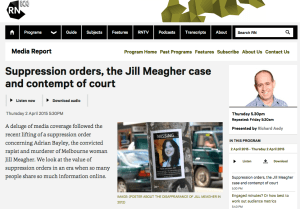
As most people were heading off for their Easter vacation, Radio National’s Media Report ran a segment on how we discovered the new edition of our textbook was in breach of a suppression order on the name of Adrian Bayley – the man who murdered Jill Meagher.

My article in  The Conversation (excerpted below) explained what happened, and RN Media Report’s Richard Aedy followed it up with this interview last week:

Screen Shot 2015-04-10 at 5.17.41 PM


March 27, 2015 blog:

How the Adrian Bayley suppression order forced the reprinting of our new media law book #auslaw ]

It is somewhat alarming when a media law academic finds himself on the wrong side of a media law. But that is exactly what happened to me when I discovered the new edition of our textbook was in breach of a suppression order on the name of Adrian Bayley – the man who murdered Jill Meagher.

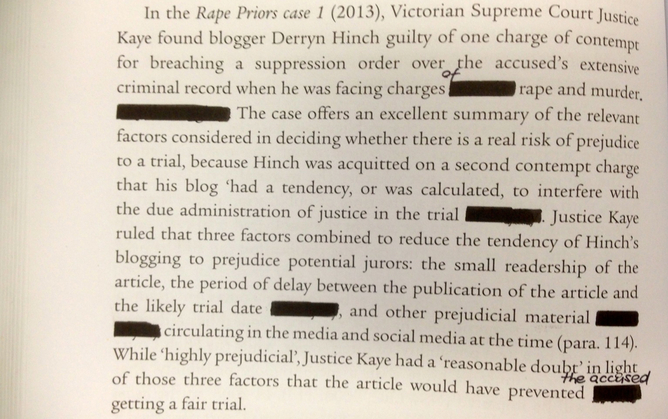
One of the manually redacted pages sent out to reviewers before our book was reprinted

One of the manually redacted pages sent out to reviewers before our book was reprinted

Our experience highlights serious problems with the system of suppression orders in the courts today as they try to grapple with the ever-increasing challenge of keeping internet-savvy jurors from having access to reports of the past trials or convictions of the accused.

Victorian County Court judge Sue Pullen issued the suppression order against anyone publishing “any information relating to previous convictions, sentences, or previous criminal cases of the accused”. The orders were lifted on Thursday after Bayley was convicted of raping three other women before he raped and murdered Meagher in September 2012.

On one view, Pullen’s orders constituted a “super injunction” because they suppressed mention of the proceedings – and therefore of the suppression order itself. Perhaps understandably, news of the order had not spread beyond the inner circle of lawyers and mainstream court reporters and editors, mainly in Victoria.

The suppression order only came to my knowledge as a Queensland-based academic when I happened to be sitting on a conference panel in Melbourne with a media lawyer and a judge last year discussing the futility of suppression orders in the modern era.

The media lawyer told the audience of court officers, lawyers, journalists and academics that he had recently appeared in court several times to try to have this particular suppression order overturned – without success. He said he could not be specific about the suppressed identity of the accused (wisely, as representatives of that court were sitting in the audience).

But when he mentioned the notorious crime itself my heart skipped a beat. It dawned on me that our new edition of The Journalist’s Guide to Media Law, which was sitting in the publisher’s warehouse awaiting distribution, was in clear breach of the order. Bayley had been named and linked to the Meagher murder on three pages of the book. He also appeared in its index.

Continue reading the full version of this commentary in The Conversation

Disclaimer: While I write about media law and ethics, nothing here should be construed as legal advice. I am an academic, not a lawyer. My only advice is that you consult a lawyer before taking any legal risks.

© Mark Pearson 2015

Leave a comment

Filed under blogging, citizen journalism, contempt of court, free expression, journalism, media ethics, media law, Media regulation, social media, sub judice

How the Adrian Bayley suppression order forced the reprinting of our new media law book #auslaw

By MARK PEARSON

It is somewhat alarming when a media law academic finds himself on the wrong side of a media law. But that is exactly what happened to me when I discovered the new edition of our textbook was in breach of a suppression order on the name of Adrian Bayley – the man who murdered Jill Meagher.

One of the manually redacted pages sent out to reviewers before our book was reprinted

One of the manually redacted pages sent out to reviewers before our book was reprinted

Our experience highlights serious problems with the system of suppression orders in the courts today as they try to grapple with the ever-increasing challenge of keeping internet-savvy jurors from having access to reports of the past trials or convictions of the accused.

Victorian County Court judge Sue Pullen issued the suppression order against anyone publishing “any information relating to previous convictions, sentences, or previous criminal cases of the accused”. The orders were lifted on Thursday after Bayley was convicted of raping three other women before he raped and murdered Meagher in September 2012.

On one view, Pullen’s orders constituted a “super injunction” because they suppressed mention of the proceedings – and therefore of the suppression order itself. Perhaps understandably, news of the order had not spread beyond the inner circle of lawyers and mainstream court reporters and editors, mainly in Victoria.

The suppression order only came to my knowledge as a Queensland-based academic when I happened to be sitting on a conference panel in Melbourne with a media lawyer and a judge last year discussing the futility of suppression orders in the modern era.

The media lawyer told the audience of court officers, lawyers, journalists and academics that he had recently appeared in court several times to try to have this particular suppression order overturned – without success. He said he could not be specific about the suppressed identity of the accused (wisely, as representatives of that court were sitting in the audience).

But when he mentioned the notorious crime itself my heart skipped a beat. It dawned on me that our new edition of The Journalist’s Guide to Media Law, which was sitting in the publisher’s warehouse awaiting distribution, was in clear breach of the order. Bayley had been named and linked to the Meagher murder on three pages of the book. He also appeared in its index.

Continue reading the full version of this commentary in The Conversation

Disclaimer: While I write about media law and ethics, nothing here should be construed as legal advice. I am an academic, not a lawyer. My only advice is that you consult a lawyer before taking any legal risks.

© Mark Pearson 2015

1 Comment

Filed under blogging, citizen journalism, contempt of court, free expression, journalism, media ethics, media law, Media regulation, social media, sub judice

New @journlaw updates posted in privacy, anti-terror and confidentiality of sources #MLGriff

By MARK PEARSON

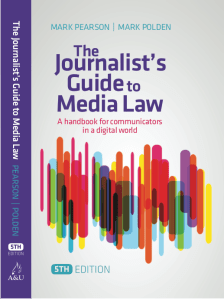
We have just posted numerous updates to the fifth edition of The Journalist’s Guide to Media Law – A handbook for communicators in a digital world (Mark Pearson & Mark Polden, A&U, 2015) on the journlaw.com blog.

Thanks to Leanne O’Donnell (mslods.com / @mslods), Virginia Leighton-Jackson and Griffith University media freedom interns and students we have been posting fresh material via this blog’s Media Law Updates menu.

You can find updates on recent cases, legislation and Australian and international media law news on the following topic areas:

Social Media Law

Free Expression

Legal and regulatory systems

Open Justice and Freedom of Information

Contempt of Court

Covering Court

Defamation

Secrets, Confidentiality and Sources

Anti-terror and hate laws

IP and copyright

Privacy

Law of PR, Freelancing and New Media Entrepreneurship

The sheer pace of change in all areas of media law is astounding so we have have built several mentions of journlaw.com into the chapters and discussion questions as a go-to resource for media law students.

We would also appreciate your input – whether you are a student, journalist, academic or lawyer.

Please email any contributions to these update sections to me, Mark Pearson, at journlaw@gmail.com .

Of course, the book and the journlaw.com examples are not meant to offer actual legal advice. Professional communicators must seek that advice from a lawyer when confronted with a legal problem. The most we claim to do is offer an introduction to each area of media law so that journalists, PR consultants and bloggers can identify an emerging issue and thus know when to call for help.

Order via Booktopia: http://www.booktopia.com.au/the-journalist-s-guide-to-media-law-mark-pearson/prod9781743316382.html

Disclaimer: While I write about media law and ethics, nothing here should be construed as legal advice. I am an academic, not a lawyer. My only advice is that you consult a lawyer before taking any legal risks.

© Mark Pearson 2015

Leave a comment

Filed under blogging, citizen journalism, contempt of court, free expression, journalism, media ethics, media law, Media regulation, social media, sub judice, Uncategorized

Journlaw running updates to The Journalist’s Guide to Media Law

By MARK PEARSON

OUR fifth edition of The Journalist’s Guide to Media Law – A handbook for communicators in a digital world (Mark Pearson & Mark Polden, A&U, 2015) is now in bookshops and I will be running updates on each topic area via journlaw.com as we work towards the next edition.

Thanks to Leanne O’Donnell (mslods.com / @mslods), Virginia Leighton-Jackson and Griffith University media freedom interns and students we will be posting fresh material via this blog’s Media Law Updates menu.

There will be updates on recent cases, legislation and Australian and international media law news on the following topic areas:

Social Media Law

Free Expression

Legal and regulatory systems

Open Justice and Freedom of Information

Contempt of Court

Covering Court

Defamation

Secrets, Confidentiality and Sources

Anti-terror and hate laws

IP and copyright

Privacy

Law of PR, Freelancing and New Media Entrepreneurship

The sheer pace of change in all areas of media law is astounding so we have have built several mentions of journlaw.com into the chapters and discussion questions as a go-to resource for media law students.

We would also appreciate your input – whether you are a student, journalist, academic or lawyer.

Please email any contributions to these update sections to me, Mark Pearson, at journlaw@gmail.com .

Of course, the book and the journlaw.com examples are not meant to offer actual legal advice. Professional communicators must seek that advice from a lawyer when confronted with a legal problem. The most we claim to do is offer an introduction to each area of media law so that journalists, PR consultants and bloggers can identify an emerging issue and thus know when to call for help.

Order via Booktopia: http://www.booktopia.com.au/the-journalist-s-guide-to-media-law-mark-pearson/prod9781743316382.html

Disclaimer: While I write about media law and ethics, nothing here should be construed as legal advice. I am an academic, not a lawyer. My only advice is that you consult a lawyer before taking any legal risks.

© Mark Pearson 2015

Leave a comment

Filed under blogging, citizen journalism, contempt of court, free expression, journalism, media ethics, media law, Media regulation, social media, sub judice, Uncategorized

‘Mindful Journalism’ out Feb 24: excerpt and review copy request form here

By MARK PEARSON

We are excited that our book Mindful Journalism and News Ethics in the Digital Era: A Buddhist Approach (Shelton Gunaratne, Mark Pearson and Sugath Senarath eds; Routledge, NY) will be available from February 24.

Review copies are available from Routledge by filling out this request form. Please see the publisher’s synopsis.

MindfulJournalismCoverThe term ‘mindful journalism’ is a concept I introduced more than a year ago in the inaugural UNESCO World Press Freedom address at AUT University Auckland, drawing upon the earlier substantive work by my esteemed colleague (and lead editor of our book), Emeritus Professor Shelton Gunaratne, who has been working for decades on the intersection between Buddhism and journalism.

I developed my application of this in a paper to the International Association for Media and Communication Research (IAMCR) conference in Dublin in July 2014, which was revised for publication as an article in Ethical Space published in December 2014.

It is being published as part of the Routledge New York Research in Journalism series. My key point was that one does not have to be a Buddhist to incorporate the key principles of mindful journalism into one’s work. In fact, most of these very moral principles are evident in the teachings of all the world’s great religions. However, for those who lack a moral framework for their ethical decision-making, a secular application of these non-theistic principles can offer a moral compass. They offer a series of normative or aspirational goals we can strive for, but rarely reach. They also provide a schema for the analysis of ethical decision-making by journalists.

To give you a taste of mindful journalism, I offer this short extract from my chapter on ‘The Journalist and Mental Cultivation’ in Mindful Journalism where I explore the possibilities of Buddhism’s ‘Right Mindfulness’ (meditation) for journalism:

A journalist could find value in several elements of this process – from the pausing to think about the duration of a single breath for calming purposes, followed by a self-assessment of thoughts, perspectives and feelings about the story or matter at hand, including breaths to acknowledge the changing nature of things, the separation of the journalist’s ego from the story, and breaths devoted to the implications of the story for those it might impact upon, from the individual who might suffer through their actions being exposed through to others who might benefit by learning from that person’s experience. Thinking about those thoughts might bring clarity to decisions related to the story – suitable priorities, whom to interview, what to check, questions to be asked, and how the facts might best be presented. Recording those thoughts – in a note or audio form – might offer a retrospective justification for the journalist’s actions if they are later called to account. Such metacognition can even become evidence in some court proceedings resulting from a story to demonstrate a journalist has acted in good faith in making “reasonable inquiries,” even if the publisher cannot prove the truth of the reputation-damaging material, as is the case with criteria for the qualified privilege defence in some jurisdictions.

Interested? You can read further extracts from the book using the “Look Inside” interface at Amazon. Enjoy.

———–

Disclaimer: While I write about media law and ethics, nothing here should be construed as legal advice. I am an academic, not a lawyer. My only advice is that you consult a lawyer before taking any legal risks.

© Mark Pearson 2015

Leave a comment

Filed under blogging, Buddhism, citizen journalism, Eightfold Path, free expression, media ethics, mental health, social media, Uncategorized

Mindful Journalism in a nutshell: @journlaw keynote to JEANZ

By MARK PEARSON

EARLIER this month I had the honour of delivering the keynote address to the Journalism Education Association of New Zealand annual conference in Christchurch.

MindfulJournalismCoverThe topic was “Mindful Journalism: towards a new ethics of compassion”, and I offer the summary here (pdf: JEANZMindfulJsm2014) in the form of my Powerpoint slides presented at that conference.

The term ‘mindful journalism’ is a concept I introduced more than a year ago in the inaugural UNESCO World Press Freedom address at AUT University Auckland, drawing upon the earlier substantive work by esteemed colleague, Emeritus Professor Shelton Gunaratne, who has been working for decades on the intersection between Buddhism and journalism.

I developed my application of this in a paper to the International Association for Media and Communication Research (IAMCR) conference in Dublin in July 2014, which was revised for publication as a forthcoming article in Ethical Space due to be published this month (December).

Professor Gunaratne and I refined our thoughts further in a book co-edited with Sri Lankan colleague Dr Sugath Senarath [pdf file] from the University of Colombo, with Professor Gunaratne as lead editor and contributions from a range of other scholars.

Routledge New York accepted our proposal for hard cover publication in March 2015 as part of its Research in Journalism series.

Our book is titled Mindful Journalism and News Ethics in the Digital Era: A Buddhist Approach and it features chapters by several scholars from Asia, North America, Australia and Europe. Please see the publisher’s synopsis.

My address to journalism education colleagues in Christchurch this month picked up on some of the key themes of Mindful Journalism, particularly those linked to the Eightfold Path.

My key point was that one does not have to be a Buddhist to incorporate the key principles of mindful journalism into one’s work. In fact, most of these same moral principles are evident in the teachings of all the world’s great religions. However, for those who lack a moral framework for their ethical decision-making, a secular application of these non-theistic principles can offer a moral compass to those who feel they lack one because they offer a series of normative or aspirational goals we can strive for, but rarely reach. They also provide a schema for the analysis of ethical decision-making by journalists.

———–

Disclaimer: While I write about media law and ethics, nothing here should be construed as legal advice. I am an academic, not a lawyer. My only advice is that you consult a lawyer before taking any legal risks.

© Mark Pearson 2014

1 Comment

Filed under blogging, Buddhism, citizen journalism, Eightfold Path, free expression, media ethics, mental health, social media, Uncategorized

International studies point to best practice for reporting Islam and stories involving Muslims

By MARK PEARSON

Three key international studies counsel journalists to reflect carefully on their practice when they are reporting news and issues involving Islam and people who follow it.

Griffith University colleague Dr Jacqui Ewart and I have been funded to explore the best practice in reporting upon the Islamic religion and Muslim people with a view to developing educational resources and training materials.

The project has involved a literature review of the field, the identification of case studies in the Australian media highlighting different approaches to such coverage, and the analysis of extended interviews we are conducting with journalists, educators, students, media relations personnel and other experts the topic.

An important part of the literature review has been to identify similar studies conducted internationally on the topic – ably conducted by one of our research assistants, experienced journalist Guy Healy.

We have identified these three reports as offering excellent guidance to journalists and educators working in this space and we would appreciate hearing from those of you willing to engage in dialogue on the topic.


Screen Shot 2014-11-13 at 6.36.02 PMRupar, Verica (2012). Getting the facts right: Reporting ethnicity and religion. A study of media coverage of ethnicity and religion in Denmark, France, Germany, Greece, Hungary, Italy, Lithuania, Slovakia and the United Kingdom.[Project Report]. Brussels: International Federation of Journalists. Available at: http://ethicaljournalisminitiative.org/en/contents/eji-study-2012

This report from Associate Professor Dr Verica Rupar of Cardiff University (now with AUT University, Auckland) aims to improve “…the media’s ability to accurately and fairly report on people, events and issues that touch upon ethnicity and religion.” It draws upon interviews with 117 journalists in nine EU countries and the analysis of almost 200 news stories.

While its scope goes well beyond the reporting of Islam and Muslims, many of its examples and recommendations apply to this religion and its followers.

The study highlights immigration as a topic conflated with Muslims and Islam.

The report suggests the main obstacles to good reporting are the poor financial state of the media, overloading of reporters, lack of time, lack of knowledge, and lack of in-house training.

Overall, it identifies the media’s tasks as:

* Reporting factually and accurately on acts of racism and intolerance

* Being sensitive when writing about tensions between communities

* Avoiding derogatory stereotypical depiction of members of religious groups

* Challenging the assumptions underlying intolerant remarks made by speakers in the course of interviews, reports, and discussion programs.

It calls upon journalists to become more familiar with with anti-discrimination legislation, use broader networks of expert sources, ensure facts are put in context, avoid negative labels, portray people as human beings instead of members of an ethnic or religious group, organize in-house training and adopt internal editorial guidelines.


Screen Shot 2014-11-13 at 6.39.00 PMGreater London Authority (2007). The Search for Common Ground: Muslims, non-Muslims and the UK media. A report commissioned by the Mayor of London. London: Greater London Authority. Available at: http://www.insted.co.uk/search-for-common-ground.pdf

This major study on British media coverage of Islam and Muslims was commissioned by the Greater London Authority in the wake of the London bombings and perceived polarisation of coverage in the media.

It involved opinion poll reviews, studies of recent books and stories, a randomised survey of one week’s news stories, examination of stories about political correctness, interviews with Muslim journalists, and analysis of a television documentary. The researchers were commissioned to inquire into whether the media stimulated informed debate about building a multicultural society, or oversimplified and provided insufficient background that pandered to reader anxieties and prejudices. Other key questions focused on whether stories fostered anxiety, fear and hostility between non-Muslims and Muslims, and whether reportage increased or decreased a sense of common ground, shared belonging and civic responsibility.

Its principal recommendations included (at p. 133):

  • News organisations should review their coverage of issues and events involving Muslims and Islam.
  • They should consider drawing up codes of professional conduct and style guides about use of terminology.
  • News organisations should recruit more journalists of Muslim heritage.

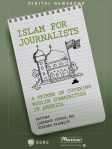
Screen Shot 2014-11-13 at 6.40.35 PMPintak, Lawrence and Franklin, Stephen (eds) (2013). Islam for Journalists; A Primer on Covering Muslim Communities in America. [Digital newsbook]. US Social Science Research Council; Edward R Murrow College of Communication, Washington State University. Available at: http://www.rjionline.org/newsbooks/islam-for-journalists

This 343-page e-book was released in 2011 and has since been updated. It contains chapters by several journalists and educators and is presented as an online course in covering stories related to Islam and Muslims. It features a useful glossary of Arabic terms and an extended list of resources.

In his afterward, titled ‘Islam on Main Street’ Lawrence Pintak states that the coverage of Islam is in many ways no different than the coverage of other topics, except that it is potentially inflammatory.

He suggests:

* carefully assess the bona fides of so-called experts, and make sure the audience is provided with the information they need to weigh the credibility of speakers.

* provide background and context when quoting non-academic “experts” and be transparent about their sponsorships and allegiances.

* turn to academics for guidance because many will offer a more researched and balanced perspective on the topic.


We look forward to hearing from others working in this space.

———–

Disclaimer: While I write about media law and ethics, nothing here should be construed as legal advice. I am an academic, not a lawyer. My only advice is that you consult a lawyer before taking any legal risks.

© Mark Pearson 2014

1 Comment

Filed under blogging, citizen journalism, free expression, Islam, journalism, journalism education, media ethics, Media regulation, Muslim, Press freedom, social media, Uncategorized

Presenting the best of @Griffith_Uni student news blogs

By MARK PEARSON

THE greatest reward for a teacher at any level of education is in celebrating your students’ successes. Colleague Mic Smith and I did this today as we announced the winners of various awards to our students in the course Online News Production, where students were assigned to create multimedia news content and post them to their own news blogs.

I hope you agree as you browse the winners’ work that there are some outstanding examples of multimedia journalism and social media engagement here across a host of topics.

Congratulations students on aiming for excellence … and achieving it!

Cheers,

Mark (@journlaw)

NathanWinners2014

Brisbane students of Griffith University celebrate their Online News Production Golden Mouse Awards for excellence in news blogs. Photo: Jimmy Wall

GCwinners2014-2

Gold Coast Griffith University students proudly display their Golden Mouse awards for excellence in news blogging. Photo: Kirsty Schmitt

Golden Mouse Awards 2014 – Brisbane 

Golden Mouse Award for Best Overall Blog

Screen Shot 2014-10-29 at 1.37.11 PMErin Maclean

Lady Game Bug

http://ladygamebug.wordpress.com/


Golden Mouse Award for Best Multimedia News Story
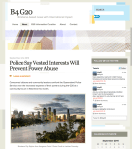
Screen Shot 2014-10-29 at 1.38.37 PMNatasha Hoppner

‘Police say vested interests will prevent power abuse’

B4G20 blog

http://b4g20.wordpress.com/2014/09/24/84/


Golden Mouse Awards – Gold Coast

Golden Mouse Award for Best Overall Blog

Screen Shot 2014-10-29 at 1.42.41 PMPaul Eyers, James Laidler and Tom Mann

Waterways News Gold Coast

http://waterwaysnewsgoldcoast.wordpress.com/about/


Golden Mouse Award for Best Multimedia News Story

Screen Shot 2014-10-29 at 1.44.21 PMDanielle Laing

‘Food safety, fraud and what it means for organic farming in China’

Organic in China blog

http://organicinchina.tumblr.com/post/98375795557/food-safety-fraud-and-what-it-means-for-organic


Other category finalists and winners (Brisbane)

Best education or arts blog finalists

A Reel Film Focus http://areelfilmfocus.wordpress.com/

Jordan Towning, Jane Orme, Joshua Wells, Riley Jackson

Best education or arts blog winner

 Art Student Q : artstudentq.wordpress.com

Tara Ingham

Best human rights / international blog

Tamara Sydenham and Gabrielle Smith

Brisbane Universities Amnesty International Clubs

http://brisuniamnesty.wordpress.com/

Best community blog

Emma McCluney

Ambush the Airwaves

http://communityradiocompanion.wordpress.com/

Most mindful blog on social issues finalist

Jimmy Wall

Fork: Privacy and Cryptography News http://fork.dokterw.me/

 Most mindful blog on social issues winner

Christopher Da Silva and Tim Noyes (NA)

Hard Core Truth Australia

http://hardcoretruthaustralia.wordpress.com/

 Best multicultural or indigenous issues blog

Audrey Courty

Indigenous Pulse
http://
indigenouspulse.wordpress.com

Best mental health blog finalist

Daniel Conaghan: A Different Perspective

http://dcmentalhealth.wordpress.com/

Best mental health blog winner

Talkin‘ About Mental Health 

http://talkinaboutmentalhealth.wordpress.com/

Krystal Gordon and Rachel Harding

Best sports blog

Nickolas Feldon and Jonathan Najarro

Round 13

www.13thround.wordpress.com

Best nature, science or environment blog finalist

Amy Mitchell-Whittington: Fishes for Thought

fishesforthought.wordpress.com

Best nature, science or environment blog winner

Simon Graham: Returning Cuckoo

http://returningcuckoo.wordpress.com/


Finalists and winners (Gold Coast)

Best education or arts blog finalists

Lydia Collins Donlon – Chasing Swell – http://chasingswell.wordpress.com/

Phil Kimmins Ubud Letters – ubudletters.com

 Kirsty Schmitt – Educating Alice- http://educatingalice.wordpress.com

 Best education or arts blog winner

 Janis Hanley

Digital storytelling for learning

https://digitalstorytellingforlearning.wordpress.com

Best human rights / international blog finalists

Gold Coast Refugee Australia

 http://goldcoastrefugee.wordpress.com

Pratsiri Setthapong

Best human rights / international blog winner

Africa: The Real Picture

Ruth Goodwin, Uduakobong Etukudo, Ohimai Longe

http://africatherealpicture.wordpress.com/

Best community blog finalist

Sophie Wood 

Do Good Brisbane

dogoodbrisbane.wordpress.com

Best community blog winners

Gabrielle Quinn and Jayde Austin

The Hidden Wonders

thehiddenwonders.squarespace.com/home

Most mindful blog on social issues finalists

Maleika Halpin: appleadayblog.com

Courtney Kelly  and Daphne Maresca: http://boundbyculture.wordpress.com/

Most mindful blog on social issues winner

Samuel Turner:

What are the Odds: Gambling in Australia

http://gamblinginaustralia.wordpress.com/

Best multicultural or indigenous issues finalists

Courtney Kelly – Bound By Culture –  http://boundbyculture.wordpress.com/

Best multicultural or indigenous issues blog winner

Kaylene Lawson

Street Culture

www.stculture.com

Best health, nutrition and fitness blog

Jessica O’Donnell

Healthy Mind and Body

http://healthymindandbodyblog.com/

Best mental health blog finalists

Sarra Davis – Sincerely Sarra http://www.sincerelysarra.wix.com/sincerelysarra  

Crystal-Rose Fleming- Youthful Health – http://youthfulhealth.wordpress.com/

Best mental health blog winners

Jo-Anne Wormald and Emma Lasker (GC)

Golden Oldies News

www.goldenoldienews.wordpress.com

Best sports blog finalists

Brooke Dalton and Alexandra Purser

SEQ Sports Report

http://seqsportsreport.wordpress.com 

Best sports blog winner

Mathilda Andersson

The Sunny Side of Hockey

http://www.thesunnysideofhockey.wordpress.com

Best nature, science or environment blog finalists

Bjorg Hildrum Saltveit and Tone Skredderbakken

UniUniverse

http://uniuniverse.wordpress.com 

Best nature, science or environment blog winner

Kelly Campbell

Plastic For Fence Sitters
http://kellyanncampbellwp.wordpress.com/

Best fashion or lifestyle finalist

Gabriella Ruiz

Brisbane Fashion Bloom

http://brisbanefashionbloom.wordpress.com/

Best fashion or lifestyle winner

Casey Brown

The Fashion Connection 2014

http://thefashionconnection2014.wordpress.com/

———–

Disclaimer: While I write about media law and ethics, nothing here should be construed as legal advice. I am an academic, not a lawyer. My only advice is that you consult a lawyer before taking any legal risks.

© Mark Pearson 2014

1 Comment

Filed under blogging, citizen journalism, journalism, journalism education, media ethics, social media, Uncategorized