Category Archives: defamation

Designing a media law course for reflection in action

By MARK PEARSON


Griffith University doctoral candidate David Costin recently interviewed me as part of his research into engaging with the online environment in higher education and has kindly allowed me to reproduce sections of that interview transcript in my blog. Here, in the first edited installment, we discuss my design of an online / on campus course in media law.

Q:        In the online environment, what theory and pedagogical knowledge do you draw upon when you’re operating in the online environment?

A:         I can mention a principal theory that’s driven a lot of my career and I carry into the online environment… My first major point is that I believe theory and pedagogical understanding and approaches are crucial to teaching in the online environment. But they are not necessarily something that you are conscious of every day of your teaching. I think it’s fundamental to your learning in the area, it’s fundamental that you revise that occasionally, revisit it, but my own experience is it’s not something that is at the forefront of your mind as you’re teaching every class. So, the main pedagogical approach which is entrenched in a theory that I’ve used since the 1980s and have carried into the online environment is Donald Schon’s work in teaching – The Reflective Practitioner. My area of journalism education is very much about preparing students to do what Donald Schon called ‘reflect-in-action’, which is basically when they are confronted with new situations in the newsroom (or these days in various professional communication environments), that they will also be able to reflect, sometimes innately (like I do on pedagogies and theories). In that same way, one should be confident that they can reflect on what I have taught them and be able to solve their own problems, whatever they may be, technologically and ethically and professionally in changing environments. So to my mind, if that is done properly, then you effectively have someone who is a change agent and is able to reflect in action upon their education, no matter how long ago that may have been, to shape and be able to come to a consciously right decision in their work in a new context. And that’s my take on the Schon approach.
I have something to add to that though and that is in more recent years, since 2013, I’ve developed what – I’ve worked with colleagues and have coined the expression ‘mindful journalism’. Because in my undergraduate years, I did explore some Eastern philosophies and so on and in more recent times I’ve used meditation practises for various reasons in my life and have rediscovered Buddhism, but from a secular perspective. So in other words, some of the foundation stones of Buddhism are actually very secular, reflection in action practices. So mindful journalism is something I’ve actually built into my media law classes, teaching students how to reflect in action because my biggest worry in teaching media law is that a graduate who may have only passed with 50 per cent result, may not be able to recognise in the newsroom the legal risk that should be apparent to them. So I’m using this as a way of embedding an approach that hopefully deepens their knowledge at the tertiary level enough to be able to carry with them into the workplace.

Q:        So your basis, then, is working from that practical on-the-ground reflection status, would that be correct?

A:         That is correct. Obviously media law has two major components to it. One is enough knowledge about and familiarity or literacy to do with the language of law, to be able to understand what defamation or contempt of court or confidentiality, these sorts of things are. And the second element is the actual putting that into practice, to be able to navigate those laws effectively in a highly competitive, under resourced, time poor, stressful news environment where there are other imperatives, in fact there are very significant rewards for pushing the boundaries of the law in a technological era based on clickbait and page views. So the challenge within that is being able to do that both in the classroom environment, but also in an online environment, so there’s no reason why media law, from that content end of the equation, can’t be taught very effectively both in the classroom and online or in a hybrid way.

Q:        Okay.

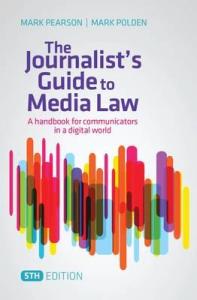
A:         It’s only recently we’ve really ramped up the online offering of the course and so I’ve had to encounter the challenges of being able to capture that for students just working in a fully online environment as well. …So the course, as I’ve redeveloped it for this year, well for the past few years, but I’ve really refined it for this year, has a dovetailed knowledge-problem based approach. So it’s textbook driven. The Journalist’s Guide to Media Law is the main textbook used in the field throughout Australia … which has little exercises and things in the back of it. Clearly in law you just have to cover certain topics, but unlike a standard legal text, you would already see in the textbook itself, being The Journalist’s Guide, a handbook for communicators with the chapters and headings reflecting – it’s not what they – typically a law textbook is what they call black letter law. … It’s multi-dimensional.

So the second element is a problem based approach and it used to be we had a problem a week that they were dealing with a scenario and now we’ve narrowed that down so they are having more time to work with particular problems and they’re getting guidance within that. So there are, over the course, four or five problems that they work with over the 12 weeks and the first three are submitted as a learning journal approach to the problems. Not learning journal as in “what did I learn from it?”, but learning journal as in a record of their answers to key newsroom law questions that they would need to answer about these things. So if you go to the actual course itself, all of this material is available to the students who are on campus and online.

Q:        Okay.

A:         And I mean we have a very good – within our group here, we have a very good blended learning team based out of Mt Gravatt and they run various courses and a couple of years ago I did the online learning course. A lot of this has been developed with their curriculum design assistance. But the idea is that the students – there’s a certain suite of activities and a lot of it is to do with developing their understanding of reflecting on their learning, even from the very early stages. So in the early slides, it explains the actual – this is just the mini lecture, so there are only three slides here, but it has the study plan of what they’re expected to do as part of their course.

Q:        Yeah, yeah.

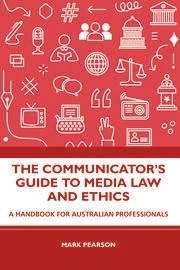
A:         So it’s a little, just like a five to 10 minute mini lecture, there’s a learning problem that they preview early on and there are online discussion boards or tutorials or both that they can attend. They read the relevant chapters and the study guide and earlier on it was starting to get to the point that even the textbook talks about mindful practice and the textbook navigates what I call the “legalities and the realities” of media law. In other words, it’s not just about what’s legal and illegal, it’s about how one might navigate legal risk within a work environment and not just for journalists but for public relations practitioners, other new media entrepreneurs, those sorts of things. So they read the chapters, there’s an online study guide as well …

Some people prefer the print material, so they get just a basic run through the main areas. The learning problems are set up with each learning problem the student having to consider the scenario that is put to them in the terms of what are the main media law issues arising in this scenario, what laws and defences might apply, what cases or examples would you draw upon or talk about or to make your decisions there and assuming your goal is to publish as much of it as is legally allowable, you know, what are you going to do in this situation. Or there’s a longer one here, the really prickly things that we normally really hone in on are ones to do with situations involving defamation and contempt of court. There should be really problem two here somewhere, it was like the arrest of a sex murderer on Moreton Island, … – with little study tasks for the online students, which are normally quite similar to the ones at the back of the textbook chapters, although there are a couple of variations in there. So they answer the end of chapter questions, the study guide and the textbook, complete the formative quiz, so that’s something I picked up from the blended learning people, that the – and also just a bit of reading around that area of knowledge, because there’s that knowledge base component.

At the end of each of the five modules, there’s a 20-question quiz. On the actual substantive knowledge where the students have 30 minutes to be able to look up the textbook to get their answers as to what defamation is and that kind of stuff. But what I learnt through my reading around this kind of thing was that the learning is embedded more in that context if the students are presented with the same question again and so for the more important topics like defamation and contempt, those questions are geared to repeat in the later formative quizzes and the formative quizzes are non-assessable but the final one is worth 20 per cent of the assessment and is done in a single hit of 20 randomly generated questions from the others with no backtracking allowed.

Q:        The thing I like with what you’ve just done is that you’ve actually, in some ways, you’ve talked about your problems and then how you’ve set it out, in some ways you’re actually catering for that diversity of the learner too. …If they don’t want the audio, they can go to this to look at the problem or they’ve got that visual …

A:         Yeah and that’s something that’s been drilled home by our blended learning people through the various online development courses, is to try to cater to those different learning styles. And so while on the slide I’m saying they should do all of these things and always return to the learning problems, so preview the learning problem, come back to it later, engage in the tutorial discussion or discussions about it and find and reflect upon the recent readings. Because in media law there’s always new cases unfolding and stuff, people find and so we share that on our Twitter, #MLGriff Twitter feed, which is just a hashtag that people put on it. So this Rebel Wilson’s in the news, all the students are throwing that there. I tweet to that when I’m at seminars and things like that. And you know, it becomes almost like a really useful summary of media law because there are more than 400 students [per year] doing this course … and I’ve got them all integrated into the same program. OUA is a different site just because there’s just slightly different terminology and everything that they use.

Q:        Yeah, that’s right, yeah.

A:         So at any one time, through some of the activities such as the discussion board, you’ll get three of those four cohorts all there on the discussion board, discussing the learning problem or having general course questions or the tutors are engaging with them in their discussion about the answer.

Q:        Okay, so it’s practical – so I suppose what you’ve done is you’ve set up so it’s a practical, interactive course with reflection at the same time, which would then assist them in their development down the track with it, I suppose.

NEXT WEEK: A mindful dimension to the media law course

———–

Disclaimer: While I write about media law and ethics, nothing here should be construed as legal advice. I am an academic, not a lawyer. My only advice is that you consult a lawyer before taking any legal risks.

© Mark Pearson 2017
Leave a comment

Filed under blogging, defamation, free expression, journalism, journalism education, media ethics, media law, mindful journalism, online education, reflective practice, social media, terrorism

Fake news prompts a mindful approach to teaching media law in a ‘post-truth’ context – #MLGriff

By MARK PEARSON

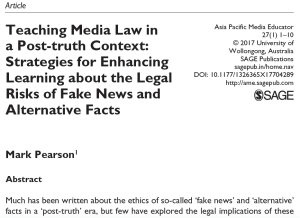
My article ‘Teaching media law in a ‘post truth context’ has just been published in the Sage journal Asia Pacific Media Educator, edited by Professor Stephen Tanner from the University of Wollongong.

Much has been written about the ethics of so-called ‘fake news’ and ‘alternative’ facts in a ‘post-truth’ era, but few have explored the legal implications of these and the flow-on to education in media law.

This article suggests there are clear legal risks for journalists adopting the hallmark practices of ‘fake news’ – particularly in linking identifiable individuals to reputationally damaging falsities (defamation) and in making misleading or deceptive claims in the course of business (consumer law).

Whether or not such an ethically dubious practice is actionable will depend on a host of factors including the strength of publishing defences, the availability of legal advice, and the jurisdictional reach of any legal suit.

This article suggests a problem-based approach – including recent examples and classical media law principles – might encourage a ‘mindful’ (reflective) practice when assessing media law risks in the news room.

When a graduate makes the news for a serious legal error – as one Yahoo!7 journalist did in Australia in 2016 (DPP v Johnson & Yahoo!7 [2016] VSC 699 (28 November 2016) ) – journalism educators are deceiving themselves if they think such a fate might not await their own graduates.

If we accept there is no guarantee our students will retain the key knowledge they need in an important area like media law, we need to at least ensure they are equipped with the requisite skills to pause and reflect in the midst of their news reporting and production to assess their capacity for reporting a particular story or addressing a legal or ethical dilemma.

We have developed and refined one approach to achieving this over recent years which we have called ‘mindful journalism’. I’ve  written a short account of the basic principles of mindful journalism in the journal Ethical Space: The International Journal of Communication Ethics, and the editors have been kind enough to make that article available for free viewing as a feature item on their website here. Our book Mindful Journalism and News Ethics in the Digital Era: A Buddhist Approach (Shelton Gunaratne, Mark Pearson and Sugath Senarath eds; Routledge, NY, 2015)  explored the possibilities of applying mindfulness techniques to journalism practice.

The Asia Pacific Media Educator article explains that in applying the mindful journalism approach to media law, students are taught to work through an eight-point checklist to self-assess their capacity for dealing with an ethical or legal dilemma. When applied to the proposed construction and/or publication of ‘fake news’, the eight points of questioning and reflection might appear as follows:

Understanding – What is my understanding of the media laws relevant to this situation? What are the legal implications of publishing something false – even the false words or constructions of others? What are the risks of publishing something true, which might still be in breach of a law (for example, in breach of a suppression order or in breach of sub judice contempt rules)?

Intent – Why do I even want to report this story? What public interest does it serve? What am I intending to achieve by my involvement in its production?

Livelihood – Am I in the right occupation here? Where does the task I am approaching (‘fake news’) sit within my career definition?

Speech – What is the factual basis to the words I am selecting and how are they best selected and crafted to demonstrate truth, accuracy and good faith? Whose voices are in my story and is there a sufficient range of voices and perspective to earn the relevant defences? What needs to be said that is not being said in this story, contributing to falsities, misunderstandings, or imputations about others?

Actions – What aspects of my behavior in this reporting and publishing sit within the bounds of the law and the defences to which I aspire? How do I manage the fact-checking of the words others are saying here and how do I explain any falsities to my audience? Can the publication of my story be delayed until I can substantiate any claims with further evidence?

Effort – To what extent am I trying to follow both the letter and spirit of the law in the pursuit of this story? How hard have I worked to gather evidence to prove the truth of the facts in my story, and to give all key stakeholders the opportunity to speak and respond?

Mindfulness – What techniques of self-reflection and micro-meditation upon media law risks and approaches have I learned and implemented? What time have I devoted to working through each of the other factors here and in applying them to my situation at hand?

Concentration – How accomplished is my concentration upon the multiplicity of legal dimensions to the story in focus? How well have I focused upon each of them and worked systematically through its elements and the extent to which I have addressed them?

Interested? Please go to the Sage site to access the full article.

If you are interested in reading more about my application of mindful journalism to media law and ethics, please see my treatment of its relationship to defamation in the International Communication Gazette in my article titled ‘Enlightening communication analysis in Asia-Pacific: Media studies, ethics and law using a Buddhist perspective’. Its abstract and link to the full article is available here. See also the mindful approach to navigating mental health reporting restrictions I used with colleague Tom Morton, reported in the Pacific Journalism Review article “Zones of Silence”, accessible here.

———————-

Disclaimer: While I write about media law and ethics, nothing here should be construed as legal advice. I am an academic, not a lawyer. My only advice is that you consult a lawyer before taking any legal risks.

© Mark Pearson 2017
Leave a comment

Filed under Buddhism, contempt of court, defamation, Eightfold Path, free expression, journalism, journalism education, media ethics, mindful journalism, Uncategorized

DEFAMATION CASE UPDATE: Zoef v Nationwide News Pty Ltd – identification and offer of amends appealed #MLGriff

By MARK PEARSON

CASE UPDATE: Zoef v Nationwide News Pty Ltd – 2015, 2016 and 2017

I blogged in 2016 about a case where the mistaken identification of an innocent octogenarian tailor in place of his alleged gun-running son produced a useful case study for media law educators trying to explain the basic elements of defamation.

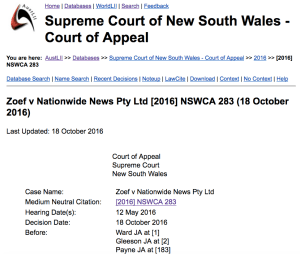
Indeed, the NSW District Court case of Zoef v Nationwide News Pty Limited & Ors [2015] NSWDC 232 remains an excellent introduction to defamation, although in October 2016 the NSW Court of Appeal overturned the publisher’s defence of “offer of amends” which was originally granted by the lower court, in the appeal case of Zoef v Nationwide News Pty Ltd [2016] NSWCA 283, and awarded the plaintiff $150,000 in damages. The appellant, Mr Tony Zoef, also had a partial victory in a more recent appeal over the backdating of the damages award, costs and interest owing in Zoef v Nationwide News Pty Ltd (No 2) [2017] NSWCA 2.
The first appeal is useful for educators explaining identification issues in defamation and the “offer of amends” defence requirements under s 18 of the Defamation Act 2005 (NSW) (Defamation Act) – and its equivalent in other Australian jurisdictions – while the 2017 appeal holds little value for media law teachers.

The case centred upon an article published in The Daily Telegraph on 22 August 2013.

It appeared a relatively straightforward case of confused identity, where the reporter mistakenly attributed to the older Mr Zoef – a suburban Sydney tailor – the alleged crimes of his son who lived at the same address. At trial, the sole basis on which Mr Zoef’s claim was dismissed was the newspaper’s defence that Mr Zoef had failed unreasonably to accept its offer of amends.

The article in the Telegraph (22-8-13, p. 9) carried the heading “Tailor’s alter ego as a gunrunner”, which might also make an interesting topic of discussion for students around the issue of sub judice contempt: Does such a heading carry a presumption of the accused’s guilt when accompanying a report of a preliminary court appearance? [The article in question is attached to the judgment as a pdf file.]

The article portrayed a then 81-year-old suburban tailor (with a distinctive surname ‘Zoef’) as a gun-runner who had been arrested, charged and appeared in court facing charges related to him holding a huge cache of weapons and ammunition at his home.

Police had indeed raided his premises and had found weapons and ammunition in the house’s garage, occupied by the tailor’s 43-year-old son, who shared his father’s name and was the actual individual who had appeared in court facing those charges.

As I blogged in 2016, the trial judgment by District Court Judge Leonard Levy is a fascinating one for student discussion because several basic concepts in defamation were contested and resolved, including:

  • imputations – how they are worded and presented
  • the misidentification’s impact on the plaintiff’s relationships, business and emotional state
  • the question of identification and case law establishing the extent of defamation of a second person with the same name and address as the first [*** considered on appeal].
  • whether a claim for defamation will hold when some other identifying factors do not match one of the named individuals. [In this case, while the headline identified the plaintiff as a tailor, the article featured a small photograph of his 43 year old son and mentioned the younger man’s age]. [*** considered on appeal].
  • whether the defences of a fair report of proceedings of public concern could apply when there were serious inaccuracies in the article
  • whether an offer of amends had been reasonable and whether it had been accepted by the plaintiff [***the trial judge’s decision which was subsequently overturned on appeal].

The trial judge had held that, despite the serious errors in the reporting of the story and a dispute over whether the publisher’s offer of amends was reasonable and had been withdrawn, the newspaper was entitled to the offer of amends defence.

In the leading appeal judgment, Justice Fabian Gleeson stated:

Taking into account the seriousness of the defamatory imputations and the significant hurt they caused the appellant, the damage to his business as a tailor, the unequal prominence the respondent afforded to the proposed correction and apology and their resultant inadequacy, the modest monetary component of the offer, and the likelihood of the proceedings being successful, the offer of amends was not reasonable. His Honour was in error in finding to the contrary and upholding the respondent’s defence under s 18 of the Defamation Act. (at para 78).

His reasons for that decision involved a step-by-step appraisal of the offer of amends defence and thus make useful instructional material for educators wanting to explain this defence to students. It should also serve to remind journalists that the offer of amends is very much a ‘lawyers’ defence’ – not something that should be handled by journalists or editors independent of legal advice – and given its time constraints it means that counsel from lawyers on the efficacy and wording of any such offer should be sought promptly.

The publisher also challenged the trial judge’s findings on whether the plaintiff had been identified in the article when it carried a photograph of his son and stated his age as 43 years old.

The Court of Appeal affirmed the trial judge’s decision that Mr Zoef Sr had been identified in the article despite those countering factors. Justice Gleeson ruled:

The article in this case contained a prominent and sensational headline, which, when read together with the first paragraph (par 29), would be reasonably understood to refer to the appellant. The strength of the general impression thereby created surpasses and dominates that of the subsequent reference in par 30 to a “43 year old” which is not something the ordinary reasonable reader might be expected to have focused on, let alone re-read or reviewed. It lacked the prominence of the sensational headline and the focus on the local, relatable indicia of the identified person’s name, profession and locality in the foregoing paragraph.

In respect of the photograph, his Honour’s finding that it was “immaterial” is supported by three considerations. One is that the photograph was small, cropped, and, as his Honour found, “less than distinct”. Next, the appellant gave unchallenged evidence in cross-examination that his son was not known to his customers. No identification would therefore have been made on a visual basis by the appellant’s customers. Finally, the use of historical photographs in newspaper articles is not so uncommon as to render unreasonable a conclusion by the ordinary reasonable reader that the article (with an unfamiliar photo) referred yet to the appellant. (paras 159-160).

So there you have it. The Zoef case – both at trial and on appeal – holds valuable lessons for media law students and educators are encouraged to use it as a case study. I have done so successfully with both journalists and tertiary students.

———–

Disclaimer: While I write about media law and ethics, nothing here should be construed as legal advice. I am an academic, not a lawyer. My only advice is that you consult a lawyer before taking any legal risks.

© Mark Pearson 2017

1 Comment

Filed under blogging, contempt of court, courts, defamation, free expression, media ethics, Media freedom, media law, Press freedom, sub judice, suppression, Uncategorized

Identification error leads to a useful case for teaching the basic elements of defamation

**See UPDATE after appeal**

By MARK PEARSON

[research assistance from Virginia Leighton-Jackson]

The morphed identification of an innocent octogenarian tailor and his alleged gun-running son produces a useful case study for teachers and trainers trying to explain the basic elements of defamation.

The NSW District Court case of Zoef v Nationwide News Pty Limited & Ors [2015] NSWDC 232 centred upon an article in Sydney’s Daily Telegraph (22-8-13, p. 9) with the heading “Tailor’s alter ego as a gunrunner”. [The article in question is attached to the judgment as a pdf file.]

The article portrayed an 86-year-old suburban tailor with a distinctive name as a gun-runner who had been arrested, charged and appeared in court facing charges related to him holding a huge cache of weapons and ammunition at his home.

Police had indeed raided his premises and had found weapons and ammunition in the house’s garage, occupied by the tailor’s 43-year-old son, who shared his father’s name and was the actual individual who had appeared in court facing those charges.

The case is a fascinating one for student discussion because several basic concepts in defamation were contested and resolved, including:

  • imputations – how they are worded and presented
  • the misidentification’s impact on the plaintiff’s relationships, business and emotional state
  • the question of identification and case law establishing the extent of defamation of a second person with the same name and address as the first
  • whether a claim for defamation will hold when some other identifying factors do not match one of the named individuals. [In this case, while the headline identified the plaintiff as a tailor, the article featured a small photograph of his 43 year old son and mentioned the younger man’s age].
  • whether the defences of a fair report of proceedings of public concern could apply when there were serious inaccuracies in the article
  • whether an offer of amends had been reasonable and whether it had been accepted by the plaintiff.

On the question of identification, Judge Leonard Levy ruled:

Para 37   …where a plaintiff has actually been named in a defamatory publication it is not necessary for the plaintiff to show that those to whom the material was published knew the plaintiff: Mirror Newspapers Ltd v World Hosts Pty Ltd (1978 – 1979) 141 CLR 632, at 639.

38   Even so, the plaintiff must establish that the defamatory matter should be understood to be referring to him: Consolidated Trust Co Ltd v Browne (1948) 49 SR (NSW) 86, at 91. The determination of that question of identification is not to be decided by a consideration of what the publisher intended: Hutton v Jones [1910] AC 20.

39   In cases where a defamatory publication names one person but another person of the same name has been defamed, this can give rise to more than one claim: Lee v Wilson and Mackinnon (1934) 51 CLR 276, as cited in Australian Defamation Law and Practice, Volume 1, TK Tobin QC, MG Sexton SC, eds, 2003, at [6050].

40   In determining the question of identification, the question is, would a sensible reader reasonably identify the plaintiff as the person defamed: Morgan v Odhams Press Ltd [1971] 1 WLR 1239. …

49   In my view, the combined context … serves to adequately identify the plaintiff….

52   …the article strings together the plaintiff’s name, his profession, the fact that he lives in his home in the Sutherland Shire, and has a business altering the clothes of locals all point strongly to the article mentioning the plaintiff by his name and is sufficient of his personal situation to indicate it was him who was the subject of the article.

53   Those details all follow the sensational headline “Tailor’s alter ego as a gunrunner” thereby making a connection between the plaintiff and the described illegal activity concerning the cache of weapons and ammunition found at the premises.

54   The fact that an unclear undated photograph of Tony Zoef appears in the article (at par 38) is immaterial. The fact the article identifies the age of the person the subject of the article as being a 43 year old does introduce an element of possible confusion (par 30) along with the indistinct photograph (at par 38), but inaccuracy of some details appearing in a newspaper article is not an unknown phenomenon.

55   The salient feature is that the plaintiff was named in the article with sufficient of his personal details to suggest he was thereby identified, although the latter details are not essential to that finding.

56   As the article in question named the plaintiff, in my view thereby identifying him, this forms the basis of his right to bring the proceedings without more being shown by him. The fact that there were two persons at the premises named Tony Zoef is immaterial. Both persons of that name could bring proceedings for defamation in their own names: Lee v Wilson and Mackinnon (1934) 51 CLR 276.

59   …I am nevertheless satisfied that the material complained of should be understood as referring to the plaintiff even though the publisher may not have intended that to be so: Consolidated Trust Co Ltd v Browne (1948) 49 SR (NSW) 86, at 91.

60   I consider that … an ordinary sensible reader would identify the plaintiff as the person the subject of the material complained of because of the specific of his name, profession, and locality as already explained. Such a reader… would not read such a sensational article as the one in question with critical and analytical care.

61   The article would be approached by such a reader with the permissible amount of loose thinking, and that reader would be reasonably entitled to draw the conclusion that the article was referring to the plaintiff, even though there were some elements of confusion such as a less than distinct photograph and a different age mentioned to that of the plaintiff. An ordinary reasonable reader would not necessarily know the plaintiff’s age or his level of interest in matters to do with space. The headline of “Tailor’s alter ego as a gunrunner” would catch the attention of such a reader and permit the general impression of the story being a reference to the plaintiff: Mirror Newspapers Limited v World Hosts Proprietary Limited [1978 – 1979] 141 CLR 632, at p 646; Morgan v Odhams Press Ltd [1971] 1 WLR 1239.

The judge also considered the important question of the impact of headlines:

44   In cases involving headlines, it must be borne in mind that the ordinary reasonable reader will draw conclusions from general impressions when reading the matter complained of. Such general impressions are necessarily formed by the technique of using prominent headlines to communicate the principal message of the publication, and it must be recognised that in that process, such material may diminish the reputations of those affected: Chakravarti v Advertiser Newspapers Limited (1998) 193 CLR 519, at p 575.

A large portion of the judgment centred upon whether a defence of ‘offer of amends’ should be upheld under s 18(1)(c) of the Defamation Act. The judge held that, despite the serious errors in the reporting of the story and a dispute over whether the offer of amends was reasonable and had been withdrawn, the newspaper was entitled to the offer of amends defence.

———–

Disclaimer: While I write about media law and ethics, nothing here should be construed as legal advice. I am an academic, not a lawyer. My only advice is that you consult a lawyer before taking any legal risks.

© Mark Pearson 2016

1 Comment

Filed under blogging, courts, defamation, free expression, journalism education, media ethics, Media freedom, media law, Press freedom, sub judice, suppression, Uncategorized