Category Archives: Eightfold Path

Keynote: Strategies for building mindful reflection into communication and education

By MARK PEARSON

My keynote address last week to the international research conference at the University of Colombo, Sri Lanka, introduced strategies for enabling students and colleagues to reflect mindfully in the course of their communication and education.

The edited shorter address follows. The full version is available from the organisers (udari@spc.cmb.ac.lk ) and will be published in the conference proceedings later this year.

Thank you for the honour of delivering this keynote address. I thank and acknowledge the conference organisers, chair, university officials, invited dignatories, delegates and students.

I wish to acknowledge the traditional owners of this land where I have written and delivered this address – the Kombumerri people of the Yugambeh language group of indigenous peoples in Australia – and to their elders past, present and emerging.

I also acknowledge the communication, ethical and legal codes and practices they developed over tens of thousands of years, and to the cultural rules underpinning human communication in all communities internationally, including in Sri Lanka.

This paper introduces some strategies for enabling students and colleagues to reflect mindfully when engaging in their communication and education. In doing so it attempts to lay some foundation stones for proposing such strategies – offering the intellectual narrative of their conception and development.

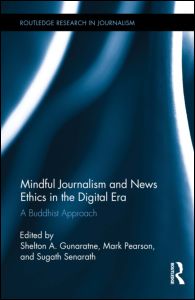
Over the past decade I have been exploring the possibilities for mindful reflection in journalism – a concept I first raised in my UNESCO World Press Freedom Address in Auckland in 2013. That – and a follow-up article on mindful journalism in an academic journal led to an approach by the pioneer of this field, the late Professor Shelton Gunaratne to join him and our colleague Dr Sugath Senarath in the editing and authorship of the book Mindful Journalism in 2015, where we expounded upon how the various steps of Buddhism’s Noble Eightfold Path could underpin a more mindful approach to news gathering, selection and reporting. In the nine years since its publication I have attempted to develop strategies for applying mindfulness strategies in journalism, communication and legal education – to help students and colleagues forge solutions to ethical dilemmas that might constitute a genuine ‘middle way’. I thank Dr Senarath and the organising committee for inviting me here today to discuss some of those practical tools for use in the communication and education contexts.

As my new book explains, professional communicators and educators can draw upon a range of reflective tools including variations of mindfulness-based meditation techniques expounded by the Buddha 2500 years ago to help them take a considered and purposive approach to ethical and legal decision-making.

Buddhism does not have an historical monopoly on the art of reflection. Socrates described self-examination as central to a virtuous life. The English philosopher John Locke (1632–1704) summed up the practice we now know as ‘metacognition’ (Tarricone, 2011) – being consciously aware of one’s own thinking and doing.

This is similar to the secular approach developed three centuries later by educationalist Donald Schön, whose research aimed to equip professionals with the ability to make crucial decisions in the midst of practice, which he called ‘reflection-in-action’ .

The application of MBM to morality and by extension to professional ethics echoes the step of ‘Right Conduct’ in the Noble Eightfold Path – samma kammanto – which involves ‘a call to understand one’s behaviour more objectively before trying to improve it’ and ‘to reflect on actions with an eye to the motives that prompted them’ (Smith and Novak, 2003: 43).

Communicators and educators need to ‘reflect-in-action’ upon ethical dilemmas as they arise in the midst of their work (Schön, 1987: 26).

The lack of reflection can lead to unnecessary harm to others. Unethical behaviour can exacerbate the trauma that victims have already encountered in shocking news events. Unlawful practice can bring reputational or financial damage to others and awards of damages or even jail terms for the offending communicators (Pearson, 2024, p.50).

Another crucial reason why it is important to engage in some method of careful reflection before making an ethical or legal decision is the mental health of the communication professionals and educators themselves.

In my recent book I stress the importance of students identifying their own unique ‘moral compass’ – their sense of right and wrong behaviour that can stem from a combination of a host of factors including one’s upbringing, religion, and values along with their professional ethical codes (Pearson, 2024, p.16).

As an exercise, I ask students to sit for a few moments to reflect upon influences upon their own moral decision-making and then draw their unique moral compasses, attributing the four main points on the compass to the four prime influences on their moral decisions, with the lesser points representing other factors.

I suggest this is a worthwhile exercise for all of us – teachers, students and practitioners.

Interconnections between MBM and mental health

Psychological studies of trauma have uncovered the notion of ‘moral injury’ – where individuals feel they have compromised their moral compasses through their unethical behaviour and blame themselves for the harm that has resulted when the professional expectations of an employee was at odds with that individual’s moral principles.

So students need a toolkit of techniques for inward reflection they can use to assess their thought processes, emotional states, workplace situations, learning and, most importantly, their ethical and legal decision-making (Pearson, 2024, p. 60).

The answer to pausing to identify the ‘red flags’ that might represent an ethical or legal dilemma lies in a developing a routine system of reflection. These might be situations or emotions, identifiable via mindful reflection.

Obviously, the key here is being able to identify a problematic emotion or situation, red flag it, then pause to weigh an appropriate ethical and legal course of action.

The approach calls upon students and communicators to pause to adopt the elements of the Eightfold Path into these eight steps of mindful reflection:

Stage of reflection Explanation
How might I improve this communication to minimise risk? [Wise Speech – Samma vaca ] Reconsider your words in any communication you are undertaking and refine and edit them to conform with legal requirements.

We put this into practice in the classroom in a pilot research project (Pearson, 2023) where mindfulness-based reflections were offered regularly during a media law course, with a strong emphasis upon emotional and situational analysis of media law dilemmas .

There were a variety of responses from 90 students to the mindfulness reflection experience. Some saw it as invaluable for their learning, lives and careers.

They said they were “reviewing in more depth”, “raising a mental flag on sections which were still unclear”, giving “a moment to understand the course better”, “consolidate learning”, helping “info to sink in”, and “consolidating the information” (Pearson, 2023).

Numerous respondents highlighted the mental health benefits of the practice.

Some students commented on the pause to reflect function and its benefits:

It made me realise that many times before making a decision or judgement, did I not stop to think or consider my actions.

Another said it trained them to “step back and assess an area, or myself, before venturing into a position, or stance or opinion”. This was metacognition in evidence (Flavell 1976; Tarricone 2011) – thinking about their own thinking – and ‘reflection-in-action’ actually happening (Schön 1987).

Such accounts offer encouragement to those incorporating pause and reflect exercises in their textbooks (Baker 2020; Pearson 2024). They give hope that some instruction in this might assist students to actually execute those strategies when encountering occupational dilemmas after graduation.

In this summary of my full paper – available from the organisers – we have journeyed through definitions of mindfulness in its modern educational context having established its roots in Buddhism and philosophy. We have learned how we might map our own moral compasses. We have looked at the relationship between MBM and mental health, and its potential for offering resilience to post-traumatic stress for journalists reporting tragic and gruesome stories. We have outlined MBM as a tool for ethical decision making. And we have reviewed a recent pilot project where students reported the pros and cons of engaging in MBM in the media law curriculum. Much is still to be explored in the application of this two millennia-old practice to tertiary education and communication and educational practice. I hope some of you are interested enough to undertake research to shed further light on this enlightening path with so many potential benefits.

References

Baker, S (2020) ‘The Ethics of Advocacy: Moral Reasoning in the Practice of Public Relations’, in Wilkins L and Christians CG (eds) The Routledge Handbook of Mass Media Ethics, 2nd edition, Taylor and Francis, NY. https://doi.org/10.4324/9781315545929

Bhikkhu, T. 2018, ‘The Buddha’s original teachings on mindfulness’, Tricycle – The Buddhist Review, 5 March, <https://tricycle.org/article/satipatthana-sutta-mindfulness/&gt;.

Blum, L. 2022, ‘Iris Murdoch’, The Stanford Encyclopedia of Philosophy, Winter 2022 Edition, Zalta, E.N. and Nodelman, U. eds, <https://plato.stanford.edu/archives/win2022/entries/murdoch/&gt;.

Bok, S. 1978, Lying: Moral Choice in Public and Private Life, Pantheon Books, New York.

Drumwright, M. and Murphy, P. 2013, ‘How advertising practitioners view ethics: Moral muteness, moral myopia, and moral imagination’, Journal of Advertising, 33 (2), 7– 24.

Feinstein, A. and Storm, H. 2017, The Emotional Toll on Journalists Covering The Refugee Crisis, Reuters Institute for the Study of Journalism, Oxford.

Germer CK, Siegel RD and Fulton PR (2005) Mindfulness and Psychotherapy, New York: Guilford Press.

Gunaratne, Shelton A., Mark Pearson and Sugath Senarath, (2015). Mindful Journalism and News Ethics in the Digital Era – A Buddhist Approach. Routledge, NY.

Gunaratne, S. A. (2005) The Dao of the press: A humanocentric theory, Cresskill, NJ, Hampton

Gunaratne, S. A. (2007) Let many journalisms bloom: Cosmology, Orientalism and freedom, China Media Research, Vol. 3, No. 4 pp 60-73

Gunaratne, S. A. (2009) A Buddhist view of journalism: Emphasis on mutual causality, Javnost: The Public, Vol. 16, No. 2 pp 61-75

Litz, B. T., Stein, N., Delaney, E., Lebowitz, L., Nash, W. P., Silva, C., & Maguen, S. 2009, ‘Moral injury and moral repair in war veterans: A preliminary model and intervention strategy’, Clinical Psychology Review, 29(8), 695–706. <https://doi.org/10.1016/j.cpr.2009.07.003&gt;

Locke, J. 1959, An Essay Concerning Human Understanding, Dover Publications, NY.

Merriam-Webster (2022) [online dictionary]. https://www.merriam-webster.com/dictionary/mindfulness

Pearson, M. (2024). The Communicator’s Guide to Media Law and Ethics – A Handbook for Australian Professionals. Routledge, London and New York.

Pearson, M. (2023). Student perceptions of mindful reflection as a media law teaching tool. Australian Journalism Review. 45 (2) pp. 197–211.

Pearson, M., McMahon, C., O’Donovan, A., & O’Shannessy, D. (2021). Building journalists’ resilience through mindfulness strategies. Journalism22(7), 1647-1664. https://doi.org/10.1177/1464884919833253

Pearson, M., McMahon, C., and O’Donovan, A. (2018) ‘Potential benefits of teaching mindfulness to journalism students’. Asia Pacific Media Educator (December). 28:2: https://doi.org/10.1177/1326365X18800080

Pearson, M. (2014). Towards ‘mindful journalism’: Applying Buddhism’s Eightfold Path as an ethical framework for modern journalism, Ethical Space 11 (4): 38 – 46.

Pearson, M. (May 5, 2013). Press freedom, social media and the citizen. Inaugural NZ UNESCO World Press Freedom Day Lecture 2013. Pacific Media Centre, AUT Auckland. Available: https://journlaw.com/2013/05/05/press-freedom-social-media-and-the-citizen-my-2013-unesco-world-press-freedom-day-lecture/

Riskin, LL and Wohl, RA (2015). ‘Mindfulness in the Heat of Conflict: Taking STOCK’ Harvard Negotiation Law Review, 20. https://ssrn.com/abstract=2754646

Schön, D. 1987, Educating the Reflective Practitioner: Toward a New Design for Teaching and Learning the Professions, Jossey-Bass, San Francisco.

Shay J. 2014.Moral injury’. Psychoanalytic Psychology, 31(2), 182–191.

Smith, H. and Novak, P. (2003) Buddhism: A concise introduction, New York, Harper San Francisco

Tarricone P (2011) The Taxonomy of Metacognition. Psychology Press, East Sussex.

Trammel RC (2015) ‘Mindfulness as Enhancing Ethical Decision-Making and the Christian Integration of Mindful Practice’, Social Work and Christianity 42(2): 165–177.

Disclaimer: While I write about media law and ethics, nothing here should be construed as legal advice. I am an academic, not a lawyer. My only advice is that you consult a lawyer before taking any legal risks.

© Mark Pearson 2024 – the moral right of the author has been asserted.

Leave a comment

Filed under Buddhism, cognitive reflection, defamation, Eightfold Path, journalism, journalism education, media ethics, media literacy, meditation, mindful journalism, privacy, reflective practice

Plenary address: Applying Buddhist principles to communication law and ethics – a mindful approach

By MARK PEARSON

 I had the honour of delivering an online plenary address on mindful communication last week to a seminar organised by the Bhawanipur Education Society College in Kolkata, India.

Coverage of the seminar in Edugraph

The seminar’s coverage in Edugraph

The topic was ‘Applying Buddhist principles to communication law and ethics: a mindful approach’.

The paper linked key principles from Buddhism’s Noble Eightfold Path to best practice in communication law and ethics.

It explained how a mindful and reflective approach to the ethical and legal consequences of professional communication can strengthen the credibility of communication and journalism and serve to minimise suffering and karmic consequences – both for the practitioner and the audience.

Special attention was paid to the practical and secular application of the key Buddhist principles of wise intent, wise speech, wise action and wise mindfulness in the professional communication process. Techniques for reflection in the midst of busy communication workplaces – including brief mindful reflections, journalling and mindmapping – were flagged and considered.

I drew upon my authored and co-authored books and research articles to offer illustrative examples of the application of such tools to legal and ethical problems including defamation, invasion of privacy, and breach of confidentiality.

Different religious approaches to truthfulness and honesty were also considered.

The starting point for students to identify their own ‘moral compass’ – the key biographical influences that inform their own system of morality –  was explained.

Also crucial is the ability to recognise the point at which an ethical or legal dilemma is arising and then to pause to reflect upon its implications and a suitable course of action.

The elements of Buddhism’s Noble Eightfold Path offer a starting point for this analysis because they are straightforward principles that can be distilled from most religions and philosophies but can be presented in a simple list form to offer a moral lens through which the professional ethical rules and the media laws of society can be assessed.

For some of my related research, please see:

Pearson, M. (2024). Chapter 3: Tools for reflection in a communication context. In Pearson, M. (2024). The Communicator’s Guide to Media Law and Ethics – A Handbook for Australian Professionals (Routledge, London and NY). Pp. 49-76. https://doi.org/10.4324/9781003372752-4

Pearson, M. (2014). Towards ‘mindful journalism’: Applying Buddhism’s Eightfold Path as an ethical framework for modern journalism, Ethical Space 11 (4): 38 – 46. http://www.communicationethics.net/journal/v11n4/feat1.pdf

Gunaratne, S.A; Pearson, M. and Senarath, S. (eds) (2015). Mindful Journalism and News Ethics in the Digital Era: A Buddhist Approach (Routledge, NY). https://doi.org/10.4324/9781315723341

Morton, T. and Pearson, M. (2015), Zones of silence: Forensic patients, radio documentary, and a mindful approach to journalism ethics. Pacific Journalism Review. 21 (2): 11-32. https://doi.org/10.24135/pjr.v21i2.113

Pearson, M. (2015). Enlightening communication analysis in Asia-Pacific: Media studies, ethics and law using a Buddhist perspective. International Communication Gazette, 77 (5): 456-470. https://doi.org/10.1177/1748048515586945

Pearson, M. (2019). “Spirituality in Journalism”, in Bernadette Flanagan and Lazlo Zsolnai (eds) (2019) The Routledge International Handbook of Spirituality and Society, Routledge, London. pp. 419-426 [ISBN 9781138214675 ] https://doi.org/10.4324/9781315445489

Pearson, M., McMahon, C., O’Donovan, A., & O’Shannessy, D. (2021). Building journalists’ resilience through mindfulness strategies. Journalism22(7), 1647–1664. https://doi.org/10.1177/1464884919833253

Pearson, M. (2023). Student perceptions of mindful reflection as a media law teaching tool. Australian Journalism Review. 45 (2) pp. 197–211. https://doi.org/10.1386/ajr_00132_1

Disclaimer: While I write about media law and ethics, nothing here should be construed as legal advice. I am an academic, not a lawyer. My only advice is that you consult a lawyer before taking any legal risks.

© Mark Pearson 2024 – the moral right of the author has been asserted.
Leave a comment

Filed under Buddhism, cognitive reflection, defamation, Eightfold Path, journalism, journalism education, media ethics, media literacy, meditation, mindful journalism, privacy, reflective practice

‘Global Justice, Factual Reporting and Advocacy Journalism’: my chapter in global ethics handbook

By MARK PEARSON

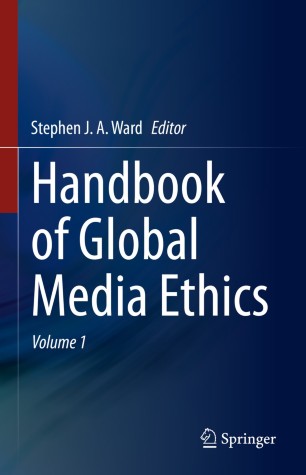
The long awaited Handbook of Global Media Ethics, edited by the internationally lauded Professor Stephen Ward, has now been published and includes my chapter on global justice, factual reporting and advocacy journalism.

It sits among 71 chapters by media ethics experts including Australia’s own Susan Forde, Kristy Hess and Ian Richards, Cait McMahon and Matthew RicketsonJohan Lidberg, Beate Josephi and Jahnnabi Das, Kerry McCallum and Lisa Waller, Andrew Fowler and Catriona Bonfiglioli.

WardEthicsbook coverMy chapter argues global justice can be a legitimate ethical objective of journalism, requiring factuality as a platform, achievable in some situations through advocacy journalism.

It explores definitional boundaries and ethical dimensions of the three terms ‘global justice’, ‘factual reporting’ and ‘advocacy journalism’.

It compares and contrasts legal and jurisprudential notions of global justice from its meanings to international journalism, offering examples of some works of investigation and reportage that might pursue global justice goals but which have been contested in the courts over their factuality or partisanship.

It explains that while judicial cases are only one approach to the analysis of underlying ethical issues, their systematic approach based on laws and precedents offers some useful insights.

The chapter explains that some works of advocacy journalism might fall outside the law, or broadly accepted journalism ethical guidelines, but perhaps still encourage ‘ethical flourishing’.

Indeed, as Ward argues, some stories require journalists to “adopt the perspective of global justice and to consider what is best for the global community”.

The chapter explores the notion of ‘factual reporting’, distinguishing it from false news and from a legal standard of factuality, and introduces a taxonomy of factuality in ethical reporting, which includes a spectrum of fact sourcing, selection, verification, inclusion, exclusion, ordering, ramifications and revisiting. It examines the dimensions of ‘advocacy journalism’ and exemplifies how the notions of factuality and advocacy are not mutually exclusive.

It links this with the mindful exploration of intent and livelihood suggested in the foundational principles of ‘mindful journalism’.

I explain there:

Purposive reflection on one’s intent – and one’s livelihood – is examined in the relatively new area of ‘mindful journalism’, where Buddhist ethics and phenomenology are applied to journalism. Such structured meditation on these considerations – sitting to reflect upon the intent of a work of journalism, taking into account the implications for a range of stakeholders, along with a mental review of where the particular assignment and techniques sit with one’s livelihood – together form three of the eight steps involved in the mindful journalism approach.

The chapter offers an approach for reporters and editors to examine carefully the motivational roots (‘intent’) of a work of journalism to identify the source of any advocacy and its purpose, and to reflect upon how this sits with their professional identity and values.

It suggests all journalism is by some definitions ‘advocacy journalism’, but that not all advocacy journalism meets aspirational standards of global justice or factuality.

If the mindful journalism approach is adopted, then the journalist’s perception of their livelihood and its professional ethical framework is crucial to the examination of intent and to the decision over the ethics of a particular course of action. The protagonist must decide whether they are first and foremost a journalist or an advocate. Central questions include: Are you a journalist using a factual base to advocate for a human right? Or, alternatively, are you an advocate using some journalistic techniques to advocate for a human right? This self-identification with a particular occupation or profession invokes a particular ethical framework to the investigation and publishing enterprise. If the self-perception of livelihood is that of a journalist, then the protagonist should abide by a journalistic ethical code such as the MEAA or SPJ code. If, however, the methods are journalistic but the protagonist identifies as an advocate, then other ethical frameworks might be invoked, such as professional ethics of activist organisations (such as Greenpeace), governing bodies (like the UNHRC) or a public relations association like the PRIA.

The mindful examination of intent must begin with the acceptance that all journalism has elements of advocacy journalism, but that it can be alleviated by disclosing agendas and allegiances and being transparent about funding and influences. Such an approach can assist the ethical journalist in carefully navigating the fault lines of global justice, factual reporting and advocacy journalism.

The chapter includes examples of international works of journalism involving advocacy for global justice, premised upon factual reporting, which navigate the ethical fault lines inherent in the hybrid term ‘advocacy journalism’.

Disclaimer: While I write about media law and ethics, nothing here should be construed as legal advice. I am an academic, not a lawyer. My only advice is that you consult a lawyer before taking any legal risks.

© Mark Pearson 2022 – the moral right of the author has been asserted.
Leave a comment

Filed under Eightfold Path, global journalism, journalism, journalism education, media ethics, media law, mindful journalism, online education, reflective practice, social media

A mindful approach to introducing defamation to students #MLGriff

By MARK PEARSON

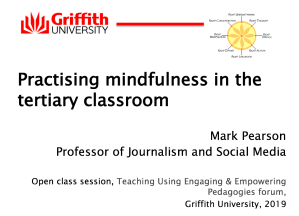
Colleagues from Griffith University gathered for a celebration of teaching and learning this week and I had the honour of presenting an open class session.

The forum was called ‘Teaching Using Engaging and Empowering Pedagogies’ and my class was titled ‘Practising mindfulness in the tertiary classroom’.

It was an attempt at putting into practice some of the research we have been undertaking in this space in recent years.

For the research underpinning it, please see:

Pearson, M., McMahon, C., O’Donovan, A. and O’Shannessy, D. (2019), ‘Building journalists’ resilience through mindfulness strategies’. Journalism. https://journals.sagepub.com/doi/abs/10.1177/1464884919833253

Pearson, M., McMahon, C., and O’Donovan, A. (2018) ‘Potential benefits of teaching mindfulness to journalism students’. Asia Pacific Media Educator (December). 28:2: https://doi.org/10.1177/1326365X18800080

You should get the gist of the mindfulness-based activities involved from the slide show captured below.

Enjoy.

Disclaimer: While I write about media law and ethics, nothing here should be construed as legal advice. I am an academic, not a lawyer. My only advice is that you consult a lawyer before taking any legal risks.

© Mark Pearson 2019 – the moral right of the author has been asserted.


Leave a comment

Filed under defamation, Eightfold Path, journalism, journalism education, media ethics, media law, mindful journalism, online education, reflective practice, social media

Mindfulness strategies explained at Asian Media conference

By MARK PEARSON

Our work on mindfulness-based meditation in the journalism education pedagogy was presented to the Asian Media Information and Communication Centre (AMIC) conference in Bangkok last month to an enthusiastic audience.

Here is the abstract of our presentation for interested blog readers.

“Mindful journalism in action: applications for resilience, learning and ethics”, presented at AMIC Bangkok, June 17, 2019

Mark Pearson, Griffith University

Cait McMahon, Dart Centre Asia Pacific

Analise O’Donovan, Griffith University

The term ‘mindful journalism’ – coined in 2013 (Pearson, 2013) and theorised in 2014 and 2015 (Pearson, 2014; Gunaratne et. al, 2015) – shares some features with other modern ‘journalisms’ (‘solutions’ (Solutions Journalism Network, 2016), ‘peace’ (Lynch, 2010) and ‘inclusive’ (Rupar & Pesic, 2012)). However, it is distinguished by the fact that it includes elements of secular Buddhist approaches to mindfulness-based meditation and ethics (Pearson, 2014; Gunaratne et. al, 2015).

This paper uses a recently released conceptual map (Pearson et. al., 2019) to explain the potentialities of mindful journalism to strengthen journalism students’ resilience, deepen their learning, and shore up their moral compasses as they enter occupations where their work can expose them to trauma (Drevo, 2016) and industry disruption can subject them to stress, burnout and other mental health challenges (O’Donnell, 2017). It details some key ways mindful journalism (and mindfulness-based meditation) have been introduced to the curriculum and pedagogy in a media law course, with a strong emphasis upon emotional and situational analysis of media law dilemmas, as an alternative to a black-letter style of teaching media law cases, legislation and topics (Pearson et. al, 2018). The approach offers a useful extension to problem-based learning and provides the tools by which educators can encourage their students to engage in ‘reflective practice’ or ‘reflection in action’ by which they can purposively reflect upon their learning when confronted with new ethical or technological dilemmas  (Schön, 1987).

Students and journalists are equipped with a toolkit of techniques for inward reflection which they can use to assess their thought processes, emotional state, situation, ethics and learning. The approach is in accord with the research on metacognition in psychology and education (Flavell, 1976; Tarricone, 2011) which has found that reflection upon one’s thinking, knowledge and experiences can deepen learning and – we argue – in a mindful journalism context can help engage in professional conduct with both wisdom and compassion. It also builds on the research in a range of occupations showing the potential for mindfulness-based meditation in improving resilience which can help minimise the risks of post-traumatic stress disorder, stress and burnout (Chaukos et al., 2017; Hölzel et al., 2011; Keng et al., 2011; Trammel (2015)).

Disclaimer: While I write about media law and ethics, nothing here should be construed as legal advice. I am an academic, not a lawyer. My only advice is that you consult a lawyer before taking any legal risks.

© Mark Pearson 2019 – the moral right of the author has been asserted.


Leave a comment

Filed under Eightfold Path, journalism, journalism education, media ethics, media law, mindful journalism, online education, reflective practice, social media

Vale Shelton Gunaratne

By MARK PEARSON

Esteemed journalism education colleague Emeritus Professor Dhavalasri Shelton Abeywickreme Gunaratne died in Minnesota on March 8.

Emeritus Professor Shelton Gunaratne

Many journalism educators knew Shelton through his active membership of the (then) Journalism Education Association during and after his term at Central Queensland University from 1976-1985, where he had been the founding lecturer in journalism at what was then known as the Capricornia Institute of Advanced Education (CIAE). He was later appointed professor of mass communications at Minnesota State University Moorhead.

Shelton was an active member of numerous international journalism and communication organisations, including the AEJMC, ICA, IAMCR and AMIC – which in 2016 awarded him the AMIC Asia Communication Award for 2016 in recognition of his “ground-breaking scholarship and intellectual contribution to Asian media and communication research.”

I am particularly indebted to Shelton for his mentorship on the relationship between journalism and Buddhist ethics and phenomenology, which he introduced to the literature with The Dao of the Press : A Humanocentric Theory (Hampton Press, 2005) – a deeply theoretical and cerebral exploration of the inter-connectedness of all things, modelling the media’s role in that process.

He kindly invited me to co-edit (with his former PhD student Sugath Senarath) our book Mindful Journalism and News Ethics in the Digital Era: A Buddhist Approach (Routledge, 2015). That project continues, and I acknowledge his input into my work as my mentor and friend.

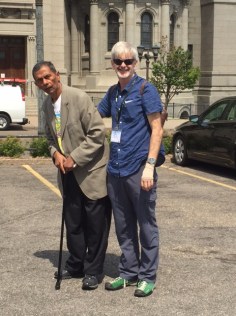
The author (right) with his mentor, Emeritus Professor Shelton Gunaratne, at the AEJMC convention in Minneapolis in 2016

I spoke on the phone with his widow Yoke-Sim who had loyally nursed him through the final stages of Parkinson’s Disease. She reported that Shelton was sharp to the very end.

Shelton believed strongly in the ripple effect of one’s actions upon others, and I know his intellectual outputs will have a lasting impact upon journalism and mass communication scholarship, educators and students.

For the information of US colleagues, a memorial service has been organized for March 15 (Friday) at Minnesota State University Moorhead, Comstock Memorial Union 205 between 6-8 p.m. An almsgiving (dania) will be held at the Gunaratne residence (3215 Village Green Drive, Moorhead, MN 56560) on March 16.

RIP Shelton, and thanks for your legacy.

Disclaimer: While I write about media law and ethics, nothing here should be construed as legal advice. I am an academic, not a lawyer. My only advice is that you consult a lawyer before taking any legal risks.

© Mark Pearson 2019 – the moral right of the author has been asserted.


Leave a comment

Filed under Eightfold Path, journalism, journalism education, media ethics, mindful journalism

Building journalists’ resilience through mindfulness strategies: article published in ‘Journalism’

By MARK PEARSON

Our article on the potential applications for mindfulness-based meditation in journalism has now been published in the top-ranked international academic journal Journalism.

The publication is the fruit of more than two years of project collaboration with my colleagues from Griffith University (Professor Analise O’Donovan) and the Dart Centre Asia Pacific (Dr Cait McMahon OAM). Co-author Dustin O’Shannessy provided valuable research assistance and co-authorship.
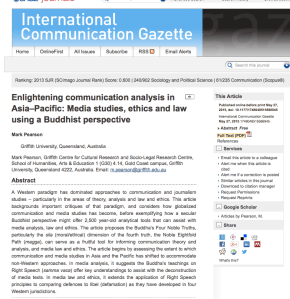
Here is the abstract for the article, with the full text available via the Sage site (best accessed via your library if you are a student or academic):

Pearson, M., McMahon, C., O’Donovan, A., & O’Shannessy, D. (2019). Building journalists’ resilience through mindfulness strategies. Journalismhttps://doi.org/10.1177/1464884919833253

Mindfulness-based meditation has earned its place in a variety of settings after studies reporting the benefits of mindfulness-based interventions for the treatment of a range of psychological and health disorders and for building resilience and well-being in a variety of occupational groups. In the field of journalism, the realities of journalists’ exposure to trauma while reporting have been well documented. This article is the first to link those areas of research – suggesting that mindfulness-based meditation offers promise to help journalists build resilience to post-traumatic stress. It also presents a conceptual map to theorise the broader potential benefits of journalists using mindfulness-based meditation, including help with industry-related stresses such as job insecurity, coping with emotions and battling potential ‘moral injury’ in reporting. It explains that pedagogical approaches for equipping journalists with mechanisms for working with their emotions, thoughts and professional values have been lacking. Some media organisations and universities have experimented with meditation practice for a range of reported reasons, but evidence-based research into the efficacy of such programmes for journalists is overdue. This article bridges the knowledge gap that brings together mindfulness-based meditation practice, journalists’ resilience and well-being, and the potential for enhanced work practice.

Disclaimer: While I write about media law and ethics, nothing here should be construed as legal advice. I am an academic, not a lawyer. My only advice is that you consult a lawyer before taking any legal risks.

© Mark Pearson 2019 – the moral right of the author has been asserted.


Leave a comment

Filed under Eightfold Path, journalism, journalism education, media ethics, mindful journalism, online education, reflective practice, social media

Mindful journalism featured in MediaShift article

By MARK PEARSON

Journalism education colleague at  the University of Tennessee, Melanie Faizer, has had a second article on mindful journalism published – this time in the leading media-technology outlet MediaShift.

In it she profiles a fascinating experiment at Ryerson University’s School of Journalism in Toronto where a course in mindful meditation and journalism is being launched in January.

Faizer writes:

Practicing mindfulness may help journalists better withstand the unrelenting stresses of the job. …And although mindfulness can help reduce human suffering, Ryerson’s mission is really about creating a methodology for young journalists that helps them resist falling into the storytelling traps of negativity and sensationalism.

Faizer’s first article on the topic appeared in Columbia Journalism Review and can be viewed here.

Her quotes from me for both articles stem from this interview we conducted over Skype in May:

Our book Mindful Journalism and News Ethics in the Digital Era: A Buddhist Approach (Shelton Gunaratne, Mark Pearson and Sugath Senarath eds; Routledge, NY, 2015)  explored the possibilities of applying mindfulness techniques to journalism practice.

Screen Shot 2015-05-29 at 3.08.59 pmI  penned an article on the “Right Speech” aspect of mindful journalism for the International Communication Gazette titled ‘Enlightening communication analysis in Asia-Pacific: Media studies, ethics and law using a Buddhist perspective’. Its abstract and link to the full article is available here.

The article backgrounds important critiques of the Western approach to communication  studies, and considers how globalized communication and media studies has become, before exemplifying how a secular Buddhist perspective might offer 2,500 year-old analytical tools that can assist with media analysis, law and ethics.

I’ve also written a shorter account of the basic principles of mindful journalism in the journal Ethical Space: The International Journal of Communication Ethics, and the editors have been kind enough to make that article available for free viewing as a feature item on their website here. You might also want to explore some of their other fascinating articles on media ethics here and perhaps subscribe.

———–

Disclaimer: While I write about media law and ethics, nothing here should be construed as legal advice. I am an academic, not a lawyer. My only advice is that you consult a lawyer before taking any legal risks.

© Mark Pearson 2017

Leave a comment

Filed under blogging, Buddhism, Eightfold Path, free expression, journalism, media ethics, mental health, mindful journalism, social media

A ‘Mindful Journalism’ Approach to News and Emotion

By MARK PEARSON

The News Reporting and Emotions conference was held at the University of Adelaide last week (September 4-6 2017) and I presented a paper titled “A ‘Mindful Journalism’ Approach to News and Emotion”. Here is the abstract, along with the audio and Powerpoint slides for the presentation if you are interested.

A ‘Mindful Journalism’ Approach to News and Emotion

Mark Pearson, Griffith University

Awareness of – and systematic reflection upon – emotions in the news enterprise can be beneficial for all stakeholders – including journalists, their sources and their audiences. ‘Mindful journalism’ is a secular application of foundational Buddhist ethical principles to the news research and reporting process, where journalists are encouraged to engage in purposive reflection upon a range of factors that might influence their story selection, angle, language and behaviour.

The approach is premised upon Buddhism’s Four Noble Truths and Noble Eightfold Path, invoking journalists to invest time and meditative effort to consider their intent, actions and communications when planning and pursuing a story; to reflect upon how it sits with their conception of their livelihood; and how it might use wisdom and compassion to minimise suffering and acknowledge interdependence.

Such reflection upon the emotional implications of a work of journalism might take the form of a timetabled session of meditation (self or guided) or (in acknowledgment of the pressures of time and resources) as little as a mini ‘reflection-in-action’ – a pause for a few breaths to check in to the journalist’s own emotional state and the potential impact on the emotions of others.

This paper positions this emotional reflection and calibration in the body of the author’s recent work on mindful journalism, including a co-authored book and several journal articles and suggests that, while journalists might not be expected to adopt the lotus position in the news room, a systemised routine of reflection upon their ethics and practices might improve the calibre of their work and minimise the suffering it might otherwise inflict upon themselves and others.

———–

Disclaimer: While I write about media law and ethics, nothing here should be construed as legal advice. I am an academic, not a lawyer. My only advice is that you consult a lawyer before taking any legal risks.

© Mark Pearson 2017

1 Comment

Filed under blogging, Buddhism, defamation, Eightfold Path, free expression, journalism, journalism education, media ethics, media law, mental health, mindful journalism, reflective practice, social media

Interview Part 4 – Strengths and pitfalls of online courses

By MARK PEARSON

This is the fourth and final edited transcript of my interview with Griffith University doctoral candidate David Costin, who recently interviewed me as part of his research into engaging with the online environment in higher education.  Over the past three installments we have discussed my design of an online / on campus course in media law (Part 1), how principles of ‘mindful journalism’ have influenced the course design (Part 2) and some suggested strategies to embed online learning (Part 3). This week we explore the strengths and pitfalls of online courses.


Q (David Costin):        What are the gaps and barriers that you see that hinder you as being an effective online operator? You’ve mentioned one about rules, about the boundaries of …. of the uni itself, but what other gaps are you seeing, or barriers?

A (Mark Pearson):         Time is a barrier, the time element, because the ideal, the face-to-face environment commits you to so many hours in the classroom, the students know you will be there, certain consultation hours, they know they can come to see you. The online environment is meant to be amenable to the learner, but it doesn’t necessarily sit with the teachers’ availability. So you know, whatever the learning problem, whether it’s just a technical thing with the quiz not working or whatever, the online student might encounter that at 3:00 a.m. because it suits their schedule, but to maintain one’s own sanity and life balance, one can’t be available 24/7 to online students. And sometimes they’ll get frustrated that they’ve had to wait to get a response. That doesn’t happen very often, but nevertheless, the ideal would be for them to get immediate responses to such problems, but that’s – until we get teaching bots – that’s some way away.

Q:        Yeah, yeah.

A:         So that springs to mind as one constraint. Another is, I mean I talked about institutional barriers to the design, but there’s also the industrial labour issue of teaching online. And (my School) … has been very good with this and I have online tutors that are compensated comparably with the on-campus versions. For academic staff, there is the workload issue and that’s looking reasonable at the moment for online development, but it’s, you know, the risk is trying to force fit online to traditional models and to under-allow for all of this development and nurturing and engagement that has to happen for online to work, to undervalue that in workload and in rewards within the system.

Q:        Okay, so you’re saying so therefore part of that is I suppose a lot of your work is developing that relationship with students, but that’s not really fixed into any particular workload or that you could put a monetary value on it or anything else like that.

A:         Well it is, it’s so many hours of workload per week that you would devote to that and the jury is out as to whether that’s enough to cater to that many online students, isn’t it? I mean teaching is somewhat of a calling and you suffer angst if you think your students are being underserviced, but the more hours you put into it, the lower your hourly rate becomes, you know, for whether you’re a casual worker on so much per hour, you’ve done your hours that were allocated, but there’s some student crying for help. You know, what do you do? Your calling tells you, you offer the help.

Q:        That’s right.

A:         You then become a volunteer and that’s nice for you and me at this stage of our careers, maybe we can afford to be volunteers a little bit, but the struggling young mum or dad that’s trying to feed the family on sessional …

Q:        Yeah, wages.

A:         … rates or whatever, it becomes a – I believe if it’s managed poorly and it’s undercompensated, it’s an exploitation of people in those situations.

Q:        Well it becomes an ethical type of practice I suppose.

A:         Mm.

Q:        You mentioned before, you’ve done a couple of courses within . about supporting – about the development of online. What are the support structures that you’ve found have really helped you in the development of your online course?

A:         Workload allowance for the development. So I mean academic workload is done on a formula that changes regularly within institutions. It’s a points-based formula at the moment, but it’s meant that I haven’t had to teach a full load of classroom teaching in the semesters that I’ve been developing or … revising the (online) courses. So the institution’s been willing to take a full professor out of the classroom to invest in the design and then the offering of such courses.

Q:        Okay.

A:         The other – not so much constraint but important impediment – in this area is the fact that a lot of work is done in the establishment of online courses, but there has to be, just as in vehicle maintenance, there has to be a schedule of service maintenance updating, freshening. And unless that is allowed for in the budgetary and workload approaches of the institution, what you get is what sadly has become the fate of online distance correspondence courses through the ages, is that you just get people who may or may not care about it anymore and the course is just getting rustier and rustier, the readings getting older and older, the technology is being further and further behind the state-of-the-art at the moment and this obviously is going to impact both enrolments but more important on the learning that’s happening in the course – rusty courses.

Q:        It’s a good term, I like that term, ‘rusty courses’. And I’ll go back to – and this is, of course, I suppose one other question I was going to ask, you mentioned at the start you believe there was more courses adapted to the online environment. In your opinion, what do you think, is it more, like this particular course is more gravity, more orientated towards online? Are there other courses you think are more orientated towards the online than others, in what you’ve experienced so far?

A:         The term ‘hybrid courses’ or ‘hybrid learning’ is bandied around.

Q:        Yeah.

A:         I haven’t seen a very strict definition of it. For some people it seems to mean some online components to a standard course. To others, it means a course that can be undertaken fully online or on campus. With this one, it is the latter and I’ve tried to make it so that it is as valuable a learning experience to the online student and also that opportunity is fully available to the on-campus students.

Q:        Flexibility, yeah, comes through all the time. And I suppose, you know, this kind of comes on to the last question in that in the course that you’re developing for the online, but you’ve taken your own thinking processes and you’ve I suppose looked at where you want the kids to be, the students to be, but what other things do you do that strengthens your own skills in that teaching and learning environment, the students’ environment?

A:         What do I do that strengthens my own skills?

Q:        Mm, what do you do? Obviously you reflect upon your teaching.

A:         Yes.

Q:        Which is one of those – knowing things that work.

A:         Yeah.

Q:        But do you depend on – do you go and talk to your other colleagues about other strategies you can utilise or do you go and experiment on a MOOC (Massive Open Online Course) and come back and incorporate those things?

A:         Well I’ve done both of those things. I write about some of these experiences and practises in the academic literature. I maintain a blog, which I’ve been doing for about five or six years now, with – it varies, but with like a monthly contribution, but there’s been two in the last two weeks, you know, it’s just according to time and what happens, called Journlaw, which has a mixture of things to do with commentary or snippets about media law, abstracts and excerpts from my writings or articles, just referring people to those things. And when I do those guest interviews, I’ll throw them on there, so there’s sort of a central place where students and others can go there. And I’ll do mini reports or live blogs of conferences with relevance to that area, so instead of just going to sleep as a delegate at a conference, I’ll keep myself awake by taking a couple of photos and writing a news story about the presentation and whacking it onto the blog, those sorts of things. So there’s that, there’s the academic output. I have done a few of the MOOCs as you mention. What else do I do? The academic’s life, I’ve noticed, the pressures and demands over many years has become more intense in recent years than it was in the earlier stages of my career. So I don’t do as many sort of learning and teaching grant applications, writing about learning and teaching in learning and teaching sorts of journals or got to many of the seminars for staff and that sort of thing, just because there’s only so many hours in the day and certain priorities, KPIs you’re rewarded for.

Q:        Yeah, so what you’re saying is you’re prioritising what you believe as part of the important strategies that will help you through the parts of your course.

A:         Yeah and I do some leisure reading about it. In other words, if I’m an airport bookshop and there’s a – I mean that thing with the formative quizzes and repeating the question just came from some random popular book on embedding learning that I found in an airport bookshop and I was interested in reading about, but it’s not something – I mean the thing I do read a lot about at the moment is Buddhist ethical principles and mindfulness and that kind of thing, so that is influencing me a lot at the moment.

Q:        But you’re adapting too.

A:         Yeah, whenever I do those things, I think is there a way that that has relevance to either my research or my writing. And I build some of the principles into the research. So we did a big ‘Reporting Islam’ project which is just finishing up now. I finished in December, but it’s about a $900,000 over three years that we’ve just done. It had many dimensions to it, but part of it was developing this app …. And so my colleague has continued with the project, is negotiating with future hosts for it and everything. But associated with this were a lot of training courses we developed for journalists, a handbook on Reporting Islam, a newsroom handbook that is there in PDF version as well as we printed a few copies for our expert panellists and so on. But I guess my point is, this thinking around the online stuff has also led to a very practical research project which has academic outputs but also newsroom and social application. [Calls up www.reportingislam.org ]. So you start to get, like I recorded this interview with (journalist Peter Greste) – I didn’t record it, I took a cameraman to report it and it talks about the importance of reporting upon Islam accurately, basic information about the religion and things that get commonly confused, some basic myths about some of the common things like the different types of headdress or whatever. And then so going from that, basic terminology and then putting it into practice with a checklist for journalists to identify, like a little quiz on how inclusive their newsroom is, basic reporting tips, protocols they should follow when reporting Islam and the voices of journalists who are respected from a range of media about pitfalls in misreporting of Islam. Then very importantly, driving home with students the effects of misreporting …

(Audio visual playing)

A:         … the impact on people in the community and what bad reporting or negative reporting, associating them all as terrorists and whatever can have. And so this is taken from another body of literature with permission with our actors’ voices talking about their focus group.

(Audio visual playing)

Q:        Okay.

A:         But we had actors and photo stock images to capture the person that’s said those things in those research projects. And I have recorded these interviews with different experts about the research.

(Audio visual playing)

Q:        Mm.

A:         So journalists and students can get that actual research base to the effects and then similar to what I’ve done in the media law thing, we’ve developed scenarios that actually have all of the components here for practice reporting on a Muslim issue. So the scenario is explained, there are tasks that they have to do within a two-hour class, you know, council papers about a proposed mosque, tips that they would follow in reporting some images that we’ve had taken that they choose from for it and a selection of quotes, including some of which are actually live acted.

(Audio visual playing)

A:         That kind of stuff and a similar one on a terror arrest, because that’s a commonly misreported scenario with an actual court case following it and so on. And then a list of resources and people, journalists can go to. So that was quite an achievement, but the reason I mention it is a lot of these same principles have gone into there. So there are the mindfulness principles, – what’s my intent with this story?, why am I going to cover in this?, what’s the language I’m going to be using?. All of that’s built in to some of the resources.

Q:        It’s also that lived experience, isn’t it?

A:         Mm.

Q:        You’re there, so from where I sit, you’ve got that lived experience of what you’re seeing. You’ve got your background as to that journalism component, plus the ethics coming in on top of that, plus the mindfulness.

A:         Mm.

Q:        So it comes together in a product, one way, that can be practically and which people can then access and I suppose that end point for where they want to be.

A:         That’s the idea of it. We won the Queensland Multicultural Award last year for media, communication.

Q:        Wow, well done indeed. Well thank you very much for your time.

A:         Alright, okay, absolute pleasure.

Q:        I’ve enjoyed it.

———–

Disclaimer: While I write about media law and ethics, nothing here should be construed as legal advice. I am an academic, not a lawyer. My only advice is that you consult a lawyer before taking any legal risks.

© Mark Pearson 2017

Leave a comment

Filed under blogging, Buddhism, defamation, Eightfold Path, free expression, journalism, journalism education, media ethics, media law, mental health, mindful journalism, online education, reflective practice, social media, terrorism