Category Archives: Press freedom

On Skype with @journlaw – barrister and co-author Mark Polden on #defamation basics: #MLGriff

By MARK PEARSON

Exactly what is defamation and how does it apply to your average journalist or blogger?

That’s what I asked barrister Mark Polden in this short interview on defamation basics. Mark Polden was in-house counsel at Fairfax Media for many years before going to the Bar, and is my co-author of The Journalist’s Guide to Media Law (Allen & Unwin).

Here he offers a lay definition of defamation and gives some examples of how journalists, bloggers and other professional communicators might write to minimise the threat of legal action.

———–

Disclaimer: While I write about media law and ethics, nothing here should be construed as legal advice. I am an academic, not a lawyer. My only advice is that you consult a lawyer before taking any legal risks.

© Mark Pearson 2014

Leave a comment

Filed under blogging, contempt of court, courts, free expression, media ethics, Media freedom, media law, Press freedom, sub judice, suppression, Uncategorized

15 mins with @journlaw – Peter Gregory on the art of court reporting #MLGriff #medialaw

By MARK PEARSON

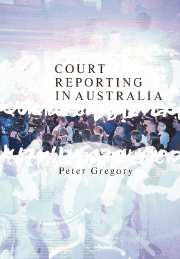
What is the secret to good court reporting? Highly experienced court reporter and academic Peter Gregory [@petergregory17] – author of Court Reporting in Australia (Cambridge University Press, 2005) – tells @journlaw the essential techniques needed by a journalist wanting to cover the court reporting round.

CourtReportinginAustraliacoverGregory explains how he recently returned to duty when he filled in to cover the sentencing of Adrian Bayley for the murder of Jill Meagher – in a marathon 12 hour shift!

He discusses the court reporter’s difficulties in writing fair and accurate reports of trials, particularly when they might be unfolding in different courtrooms at the same time.

He also gives tips on how a journalist might stand up in court to oppose a suppression order being imposed by a judge or magistrate.

Useful viewing for journalism and law students – and for anyone wanting an insight into the work of the court reporter.

———–

Disclaimer: While I write about media law and ethics, nothing here should be construed as legal advice. I am an academic, not a lawyer. My only advice is that you consult a lawyer before taking any legal risks.

© Mark Pearson 2014

1 Comment

Filed under blogging, contempt of court, courts, free expression, media ethics, Media freedom, media law, Press freedom, sub judice, suppression, Uncategorized

15 mins with @journlaw – Peter Gregory on ‘contempt and the court reporter’ #MLGriff #medialaw

By MARK PEARSON

We hear about the many types of contempt affecting the role of the court reporter – but how does a journalist manage this in practice?

That is exactly the issue I raised with veteran court reporter (now academic) Peter Gregory [@petergregory17] in this interview covering the main types of contempt of court affecting court reporting – contempt in the face of the court, disobedience contempt, sub judice (prejudicial reporting) and interference with the deliberations of jurors.

Gregory – author of Court Reporting in Australia (Cambridge University Press, 2005) – explains how court reporters might be affected by such forms of contempt, offers examples from his own career, and suggests how journalists might adjust their own practice to minimise risk.

CourtReportinginAustraliacoverHe looks at the impact of new technologies – particularly social media – in the courtroom. Finally, he assesses the dynamics of social media and traditional media at play in the major Victorian trial of the murderer of Irishwoman Jill Meagher (Adrian Bayley) which resulted in the jailing of blogger Derryn Hinch on a contempt charge after disobeying a suppression order.

———–

Disclaimer: While I write about media law and ethics, nothing here should be construed as legal advice. I am an academic, not a lawyer. My only advice is that you consult a lawyer before taking any legal risks.

© Mark Pearson 2014

Leave a comment

Filed under blogging, contempt of court, courts, free expression, media ethics, Media freedom, media law, Press freedom, sub judice, suppression, Uncategorized

Ten minutes with @journlaw – Anne Stanford from @SCVSupremeCourt talks open justice #MLGriff

By MARK PEARSON

In this week’s interview (actually 14 minutes!) I chat with the Strategic Communication Manager at the Supreme Court of Victoria, Anne Stanford, about open justice, suppression orders and general court reporting guidelines.

Listen to Supreme Court of Victoria Strategic Communication Manager Anne Stanford on open justice.

Listen to Supreme Court of Victoria Strategic Communication Manager Anne Stanford on open justice.

———–

Disclaimer: While I write about media law and ethics, nothing here should be construed as legal advice. I am an academic, not a lawyer. My only advice is that you consult a lawyer before taking any legal risks.
© Mark Pearson 2014

Leave a comment

Filed under blogging, contempt of court, courts, free expression, media ethics, Media freedom, media law, Press freedom, sub judice, suppression, Uncategorized

#Hinch (@HumanHeadline), #Morcombe and open justice – lessons in media law

By MARK PEARSON

It is timely that in the space of a week we should see the Human Headline (@HumanHeadline) Derryn Hinch released from jail for a publication offence and a serial offender receive a life sentence for the sex murder of teenager Daniel Morcombe.

CatchingTheDevil(Morcombefrontpage14-3-14)C-M

Courier Mail front page 14-3-14

We learned yesterday after Brett Peter Cowan was convicted of that 2003 crime that he had served time twice earlier for similar offences.

He is exactly the kind of individual that Hinch wants placed on a public sex offender register for exactly the reason most talkback callers and social media commenters are asking this question: How can we release such individuals anonymously into our communities when we cannot be sure they will not strike again?

Hinch asked it again this morning:

Hinch became the first Australian journalist jailed this millennium for a publishing offence when he was jailed for 50 days refusing to pay a $100,000 fine for breaching a suppression order on the prior convictions of Adrian Ernest Bayley – the accused sex murderer of ABC worker Jill Meagher in Melbourne in 2012.

In 2011 he was sentenced to five months of home detention for publicly naming two sex offenders at a rally and on his website in defiance of such anonymity orders.

In 1987 he was jailed on a contempt of court charge after broadcasting the criminal record of a former priest Michael Glennon accused of child sex offences and implying his guilt in his high rating Melbourne radio program.

It was only by a 4-3 majority that the High Court later stopped short of overturning Glennon’s conviction on those sex charges on the grounds of Hinch prejudicing his fair trial. (Glennon died in jail this year.)

Journalists and media law students have much to learn from the events of the past week.

While the crimes themselves left a trail of human destruction, the Hinch and Morcombe stories make for ideal case studies in a media law module covering open justice, contempt of court and court reporting – the exact module my students will be starting next week.

They will get to research and debate these kinds of important questions that arise from the week’s events:

  • What public policy issues are at play that see a journalist jailed for reporting the past convictions of an individual convicted of a high profile crime?
  • What does such a penalty say about Australia’s standard of media freedom?
  • Why is Australia’s approach to this level of suppression different from that applying in the United States?
  • Why should the mainstream media be prevented from reporting such material when social media platforms and certain websites are full of it?
  • Why would Hinch’s blog and Twitter feed where he breached the suppression orders over Bayley not represent a ‘real risk of prejudice’ to the trial, when mainstream media coverage might do so?
  • How can juries be quarantined from such information and – if they can’t – why shouldn’t the media be allowed to publish it?
  • Do other methods of dealing with juries – judges’ instructions, training, sequestering etc – mean we no longer need to suppress such material?
  • Are the past offences of such criminals matters of such overwhelming social importance and public concern that suppression of the details should be considered contrary to the public interest?
  • Should the Courier-Mail’s front page heading of February 21, 2014 – ‘Daniel’s Killer’ – have forced the trial to be aborted? Should it be grounds for a sub judice contempt charge? Should it be grounds for Cowan’s appeal?
  • How can a journalist report upon such proceedings in an interesting and timely way while navigating the various restrictions that apply?
  • How ‘open’ should ‘open justice’ be in such high profile trials? Should cameras and smartphone recordings be allowed in court? Should tweeting and other social media usage be allowed in court?
  • Is it appropriate in the modern era of communication that a major television network has to rely on a presenter standing outside a courthouse relaying sentencing information to the audience from a court reporter on the inside via telephone?
  • How much social media commentary should be tolerated about such cases while an accused is facing trial?

I’m sure many other questions arise too – and would be keen for other educators, journalists, lawyers and students to use the Comments section here to pose them so my students can take them up in lecture and tutorial discussions.

———–

Disclaimer: While I write about media law and ethics, nothing here should be construed as legal advice. I am an academic, not a lawyer. My only advice is that you consult a lawyer before taking any legal risks.
© Mark Pearson 2014

Leave a comment

Filed under blogging, contempt of court, courts, free expression, media ethics, Media freedom, media law, Press freedom, sub judice, suppression, Uncategorized

The Human Headline legacy – the jailed Hinch, suppression and free expression

By MARK PEARSON

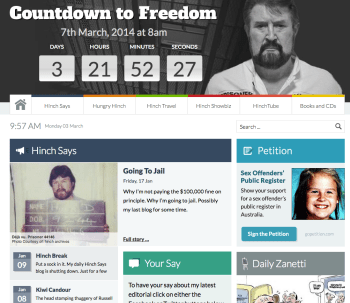
Broadcaster, tweeter, blogger and veteran journalist Derryn Hinch – the self-proclaimed ‘Human Headline’ – has been released from jail after serving a 50 day sentence for breaching a suppression order. 

Derryn Hinch's 'Human Headline' blog - Countdown to Freedom

Derryn Hinch’s ‘Human Headline’ blog – Countdown to Freedom

Hinch had refused to pay a $100,000 fine over his blog and Twitter comments including suppressed background material on Adrian Ernest Bayley, accused of the Melbourne murder of Irish woman Jill Meagher.

Hinch has been jailed twice, fined and sentenced to home detention for his contemptuous reportage and commentary about sex offenders over more than a quarter of a century.

While much of the coverage of his prosecutions and trials has focused on his cavalier and principled stance in the vein of his ‘Human Headline’ moniker, he has also been responsible for a body of case law covering sub judice contempt, the naming of a child sexual assault victim and the defiance of suppression orders – in his television and talkback radio programs, blogs and Twitter feeds.

I am preparing a paper for the ANZCA conference in Melbourne in July, reporting on a legal and textual analysis of eight key Victorian and High Court cases involving Hinch as a party in 1986, 1987, 1996, 2011 and 2013.

It reviews these key cases involving Hinch as a defendant and an appellant since 1986 – including Magistrates, Supreme Court, Court of Appeal and two High Court judgments – and identifies the key media law principles shaped in the process.

It concludes that the Hinch legacy is far more significant than his shallow ‘Human Headline’ title suggests – and ventures into important human rights questions arising in the complex legal and moral terrain where free expression, the ‘public interest’ and the ‘public right to know’ compete with an accused’s right to a fair trial, an ex-prisoner’s right to rehabilitation and a child’s right to protection from sexual predators.

For example, Hinch’s appeal to the High Court over his contempt conviction in 1987 was unsuccessful but resulted in a broadening of the public interest defence to sub judice contempt.

His latest case offers an excellent summary of the relevant factors considered in deciding whether there is a real risk of prejudice to a trial, because Hinch was acquitted on a second contempt charge that his blog ‘had a tendency, or was calculated, to interfere with the due administration of justice in the trial of Bayley’.

Victorian Supreme Court Justice Stephen Kaye ruled that three factors combined to reduce the tendency of Hinch’s blogging to prejudice potential jurors: the small readership of the article, the period of delay between the publication of the article and the likely trial date of Bayley, and other prejudicial material about Bayley circulating in the media and social media at the time (para 114). While ‘highly prejudicial’, Justice Kaye had a ‘reasonable doubt’ in light of those three factors that the article would have prevented Bayley getting a fair trial.

I will post updates on this paper as the research and writing unfolds. Meanwhile, no matter what you think of Hinch’s bravado in his naming and shaming of sex offenders, at least this week we should be able to celebrate the release of an Australian journalist from jail.

———–

Disclaimer: While I write about media law and ethics, nothing here should be construed as legal advice. I am an academic, not a lawyer. My only advice is that you consult a lawyer before taking any legal risks.

© Mark Pearson 2014

3 Comments

Filed under blogging, contempt of court, courts, free expression, media ethics, Media freedom, media law, Press freedom, sub judice, suppression, Uncategorized

The MEAA Code of Ethics: all spin and no stick

By MARK PEARSON

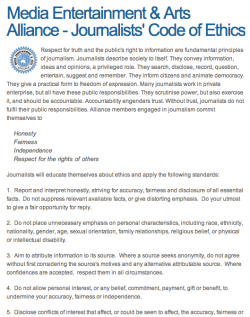
The go-to document for journalists refusing to ‘fess up their sources or taking the high ethical ground is the MEAA Journalists’ Code of Ethics – but the irony is that the journalists’ union uses notoriously ineffective and opaque processes to police this high profile code.

Screen Shot 2013-11-26 at 12.40.47 PMUnlike the Australian Press Council, the ethics panel of the Media, Entertainment and Arts Alliance (MEAA) has actual disciplinary powers at its disposal for use against individual journalists who breach its Code of Ethics – but it has rarely used them. Its powers extend to any journalists who are members of the Alliance. However, these days large numbers of journalists throughout the industry are not members.

In 1999, the alliance updated the code to a twelve-item document, requiring honesty, fairness, independence and respect for the rights of others. The alliance’s ethical complaints procedures are outlined in Section 8 of the Rules of the  MEAA (2009), summarised on the union’s website. Complaints must be in writing stating the name of the journalist, the unethical act and the points of the Code that have been breached. The judiciary committee (made up of experienced journalists elected every two years by state branch members) then meets to consider the complaint. They can dismiss or uphold the complaint without hearing further evidence, call for further evidence and hold hearings. Hearings involve the committee, the complainant and the journalist and follow the rules of natural justice. Lawyers are excluded. Penalties available to the committee include a censure or rebuke for the journalist, a fine of up to $1000 for each offence, and expulsion from the union. Both parties have 28 days to appeal to an appeals committee of three senior journalists in each state elected every four years and then to a national appeals committee of five journalists.

Because of the secrecy surrounding the cases and their outcomes there are few ethics panel case studies to work with. In 2003 Chris Warren provided me with the judgment of a 2002 case involving a complaint against a Sydney cartoonist who, the complainant alleged, portrayed the then opposition leader Kim Beazley as a person with a ‘physical and intellectual disability’, in breach of clause 2 of the code. The complaint also suggested the depiction was ‘inaccurate, unfair and dishonest’ and denied Mr Beazley a ‘right of reply’, in breach of clause 1. He also complained of a ‘continuing and malicious campaign of denigration of Labor leaders by this cartoonist’. The cartoonist’s defence was that all cartoonists regularly breached the letter of several clauses every time they did their work, but that this was the nature of artistic expression and satire. The complaint of unethical behaviour was dismissed on the basis that there was no ‘malicious bias’ and that any inaccuracy ‘was consistent with the satirical traditions of newspaper cartoons’.

Under Rule 67(h), the decisions and recommendations of the ethics panel shall be published in accordance with any guidelines that may be issued by the National Journalists’ Section Committee. When I interviewed MEAA federal secretary Chris Warren in 2003, he said the issue of publication of adjudications was a difficult one because of potential defamation action by participants. This makes it difficult to get information about MEAA ethics panel cases. Muller (2005: 185) wrote: ‘The practical result of this is that no one other than the parties, the panel and the MEAA executive ever hear about the complaints that are lodged, or what happens to them. This not only severely circumscribes the effectiveness of the procedure as a mechanism of accountability, but it offends against the principles of free expression, openness and transparency, and leaves the profession open to accusations of hypocrisy.’

While the MEAA’s website outlines the complaints procedures, it does not feature any records of complaints against journalists. Thus, both its journalist members and the general public remain ignorant of the nature and progress of any complaints against its members. In 2003 Chris Warren confirmed that the organisation received very few complaints each year, and that most were referred to the Australian Press Council. The Walkley Magazine in 2006 noted that the committee received only 67 original complaints and held five appeals between 2000 and January 2006, but could not deal with 34 of the complaints because they were to do with journalists who were not MEAA members. This meant only 33 complaints were handled in five years, an average of just over six per year. A separate tally of complaints to the Victorian branch of the MEAA by Muller (2005: 183) found that over the ten years 1993–2002 inclusive, just 23 complaints were received by the ethics panel of the Victorian branch. He provided a summary of each of them (Muller 2005: 187-8).

MEAA National Secretary Chris Warren told the Independent Media Inquiry last year that since the revised code was adopted in 1999 only three members had been censured or rebuked and that no member had been expelled for almost four decades (Finkelstein, 2012, p. 195). The reality is that with membership voluntary, the MEAA needs someone else to discipline its members when they act unethically. Its return to Press Council membership in 2005 opened the way for the MEAA to refer most complaints to that body or to the ACMA rather than having its own ethics panel deal with them at the risk of an embarrassing finding and the potential loss of a member.

There are scores of ethical codes of practice and guidance documents across the various media industry platforms – far too many for a single journalist to reflect upon while encountering a particular ethical dilemma. The irony is that the MEAA ‘Code of Ethics’ is the best known and most highly regarded ethical statement for the profession but there is a remarkably ineffective mechanism for its enforcement.

———–

Disclaimer: While I write about media law and ethics, nothing here should be construed as legal advice. I am an academic, not a lawyer. My only advice is that you consult a lawyer before taking any legal risks.
© Mark Pearson 2013

2 Comments

Filed under Media freedom, Media regulation, Press freedom

Whither media reform under Abbott?

By MARK PEARSON

Where will the new Liberal-National Coalition government led by Prime Minister Tony Abbott head with the reform of media regulation? Communications Minister Malcolm Turnbull and Attorney-General George Brandis were vocal opponents of the former Gillard Government’s proposals to merge press self-regulation with broadcast co-regulation into a new framework.

TurnbullCommons

Communications Minister Malcolm Turnbull … can he concoct the magic media self-regulation formula? [Image: commons.wikimedia.org]

Recent inquiries into media regulation in the UK (Leveson, 2012), Australia (Finkelstein, 2012) and New Zealand (Law Commission, 2013) have recommended major changes to the regulation of media corporations and the ethical practices of journalists. Their motivation for doing so stemmed from public angst – and subsequent political pressure – over a litany of unethical breaches of citizens’ privacy over several years culminating in the News of the World scandal in the UK and the subsequent revelations at the Leveson Inquiry (2012) with an undoubted ripple effect in the former colonies.

Many contextual factors have informed the move for reform, including some less serious ethical breaches by the media in both Australia and New Zealand, evidence of mainstream media owners using their powerful interests for political and commercial expediency, and the important public policy challenge facing regulators in an era of multi-platform convergence and citizen-generated content.  Minister Turnbull is an expert on the latter element and it is hard to imagine him not proposing some new, perhaps ‘light-touch’, unified regulatory system during this term in office.

By way of background, two major inquiries into the Australian news media in 2011 and 2012 prompted a necessary debate over the extent to which rapidly converging and globalised news businesses and platforms require statutory regulation at a national level.  Four regulatory models emerged – a News Media Council backed by recourse to the contempt powers of courts; a super self-regulatory body with legislative incentives to join; a strengthened Australian Press Council policing both print and online media; and a government-appointed  ‘Public Interest Media Advocate’.

The $2.7 million Convergence Review, announced in late 2010, was meant to map out the future of media regulation in the digital era (Conroy, 2010). However, revelations of the UK phone hacking scandal and Labor and Green disaffection with Rupert Murdoch’s News Limited in Australia, prompted the announcement in September 2011 of a subsidiary inquiry – the $1.2 million Independent Media Inquiry – specifically briefed to deal with the self-regulation of print media ethics. Its architects – former Federal Court judge Ray Finkelstein assisted by University of Canberra journalism professor Matthew Ricketson – argued they could not decouple print news self-regulation from broadcast ‘co-regulation’ in the digital era, so devised a statutory model including both in their report of February 28, 2012, two months prior to the release of the report of its parent Convergence Review (Finkelstein, 2012).

The Independent Media Inquiry (Finkelstein) report was an impressive distillation of legal, philosophical and media scholarship. Among many sensible proposals, it called for simpler codes of practice and more sensitivity to the needs of the vulnerable. But its core recommendation for the ‘enforced self-regulation’ of ethical standards prompted fierce debate. It proposed a News Media Council to take over from the existing self-regulatory Australian Press Council and co-regulatory Australian Communications and Media Authority to set journalistic standards with a streamlined complaints system with teeth (Finkelstein, 2012, pp. 8-9) The body would cover print, online, radio and television standards and complaints. It would have a full-time independent chair (a retired judge or ‘eminent lawyer’) and 20 part-time members evenly representing the media and the general citizenry, appointed by an independent committee (Finkelstein, 2012, pp. 290-291). The government’s role would be limited to securing the body’s funding and ensuring its decisions were enforced, but “the establishment of a council is not about increasing the power of government or about imposing some form of censorship” (Finkelstein, 2012, p. 9).

The report stressed the model would be ‘enforced self-regulation’ rather than ‘full government regulation’;

…an independent system of regulation that allows the regulated parties to participate in the setting and enforcement of standards (as is presently the case), but with participation being required, rather than voluntary (Finkelstein, 2012, p. 287).

Nevertheless, refusal to obey an order to correct or apologise would see a media outlet referred to a court which could issue an order to comply with further refusal – triggering a contempt charge and fines or jail terms for recalcitrant publishers. (Finkelstein, 2012, p. 298). Such a court would be charged with the relatively straightforward task of determining whether the publisher had disobeyed an order of the statutory News Media Council. Only then might publishers get the opportunity for an appeal – again by a judge in court.

The ‘Finkelstein inquiry’ was only ever meant to be an advisory to its parent Convergence Review, chaired by former IBM Australia managing director Glen Boreham, which released its final report in April, 2012 (Convergence Review, 2012).  News media regulation represented a much smaller element of the Convergence Review’s overall brief, particularly after this topic had been hived off to the Finkelstein inquiry, so this matter constituted a relatively small part of its report. While the Convergence Review report shared Finkelstein’s concerns about shortcomings with existing regulatory systems, it proposed that ‘direct statutory mechanisms … be considered only after the industry has been given the full opportunity to develop and enforce an effective, cross-platform self-regulatory scheme’. In other words, it was offering the media industry ‘drinks at the last chance saloon’ for a three year period under its model (Convergence Review, 2012, p. 53). Its mechanism centred upon the establishment of a ‘news standards body’ operating across all media platforms – reinforcing the overall review’s preference for ‘platform neutrality’ (Convergence Review, 2012, p.51). The news standards body ‘would administer a self-regulatory media code aimed at promoting standards, adjudicating complaints, and providing timely remedies’ (Convergence Review, 2012, p. 153).

Unlike Finkelstein, the Convergence Review decided not to be prescriptive about the constitution or operational requirements for such a body, beyond some broad requirements. The largest news media providers – those it deemed ‘content service providers’ – would be required by legislation to become members of a standards body. Most funding for the new body should come from industry, while taxpayer funds might be drawn upon to meet shortfalls or special projects (Convergence Review, 2012, p. xiv). It would feature:

–       a board of directors, with a majority independent from the members;

–       establishment of standards for news and commentary, with specific requirements for fairness and accuracy;

–       implementation and maintenance of an ‘efficient and effective’ complaints handling system;

–       a range of remedies and sanctions, including the requirement that findings be published on the respective platform. (Convergence Review, 2012, p. 51)

The review’s definition of ‘content service enterprises’ (control over their content, a large number of Australian users, and a high level of revenue drawn from Australia) would catch about 15 media operators in its net. Others might be encouraged to join the body with a threat to remove their current news media exemptions to privacy laws and consumer law ‘misleading and deceptive conduct’ provisions (Convergence Review, 2012).

Both inquiries acknowledged – and rejected – the notion of a revamped Australian Press Council proposed in various submissions and appearances by its chair, Professor Julian Disney. (The Press Council was established in 1976 as a newspaper industry ‘self-regulatory’ body – a purely voluntary entity with no powers under law.) Nevertheless, during and after the reports, and with new support from most of its members, the Press Council moved quickly to ramp up its purview and powers to address many of its documented shortcomings such as the refusal of some member newspapers to publish its findings and the threat of withdrawal of funding from others (Simpson, 2012). It locked its members into four year commitments and established an independent panel to advise on its review of its content standards. Those standards are due to be announced soon.

In 2013 the Gillard Labor Government introduced a ‘News Media (Self-regulation) Bill’ to establish a new role of ‘Public Interest Media Advocate’ with the power to deregister bodies, like the Australian Press Council, if they failed to police effectively the ethical standards of their newspaper and online members. Ultimately, the proposal might leave media outlets without their current exemptions from compliance with the Privacy Act in their newsgathering operations. The Labor government later withdrew the proposal when it could not garner enough support in the Parliament – in the face of strong opposition from the mainstream media and the Coalition (now government) with Turnbull and Brandis as the lead naysayers.

The big question now centres upon not if, but when, they choose to propose some new regulatory system where serious media ethical breaches across all media platforms are channelled through a single – self-regulatory? – body. And the further – and crucial issue – will be whether they can do this without ultimate recourse to criminal sanctions for recalcitrant journalists and media groups. It is vital that they do so, given that Australia is rare among Western democracies in that free expression is not enshrined in our Constitution.

Australia’s global free press standing depends upon them devising the magic formula the earlier inquiries failed to concoct.    

References

Conroy, S. (2010, December 14). Convergence Review. Terms of Reference (media release). Available: http://www.minister.dbcde.gov.au/media/media_releases/2010/115

Convergence Review (2012). Convergence Review. Final Report. Department of Broadband, Communications and the Digital Economy: Canberra. Available: http://www.dbcde.gov.au/__data/assets/pdf_file/0007/147733/Convergence_Review_Final_Report.pdf

Convergence Review (2012). Convergence Review. Final Report. Department of Broadband, Communications and the Digital Economy: Canberra. Available: http://www.dbcde.gov.au/__data/assets/pdf_file/0007/147733/Convergence_Review_Final_Report.pdf

Day, M. (2012, April 9.) A shame Seven West should quit Press Council. The Australian. Available: http://www.theaustralian.com.au/business/opinion/a-shame-seven-west-should-quit-press-council/story-e6frg9tf-1226321637864

Finkelstein, R. (2012). Report of the Independent Inquiry Into the Media and Media Regulation. Department of Broadband, Communications and the Digital Economy: Canberra Available: http://www.dbcde.gov.au/__data/assets/pdf_file/0006/146994/Report-of-the-Independent-Inquiry-into-the-Media-and-Media-Regulation-web.pdf

Law Commission (NZ) (2013). The news media meets ‘new media’: rights, responsibilities and
 regulation in the digital age. 
(Law Commission report 128). Law Commission: Wellington.

Leveson, B. (2012). Report of An Inquiry into the Culture, Practice and Ethics of the Press (The Stationery Office, 2012) [Leveson Report].

Simpson, K. (2012, July 20). Journalism standards set for an updating. smh.com.au Available: http://www.smh.com.au/business/journalism-standards-set-for-an-updating-20120719-22czm.html

———–

Disclaimer: While I write about media law and ethics, nothing here should be construed as legal advice. I am an academic, not a lawyer. My only advice is that you consult a lawyer before taking any legal risks.
© Mark Pearson 2013

2 Comments

Filed under Media freedom, Media regulation, Press freedom

Speech in Timor Leste – top ten media regulation lessons from Australia

By MARK PEARSON

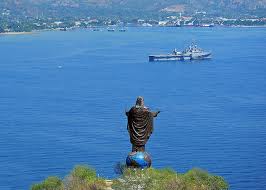
I’ve arrived in Dili, Timor Leste, to deliver an address tomorrow (Friday, October 25) to this small nation’s National Congress of Journalists. The congress is working towards introducing a new code of ethics and a press council. Here is a preview of some highlights from my speech…

Dili, Timor Leste. (Credit: Google free use search / Flickr)

Dili, Timor Leste. (Google free use / Flickr)

Firstly I wish to thank the organisers and sponsors for allowing me the privilege of being here for this important congress. I also wish to formally pay my respects to the six journalists who were killed here in 1975 – including three Australians – and the countless Timorese people who have over decades paid a high price for daring to seek and tell the truth.

As journalists and editors you are so often in competition for your stories and for your audiences that it is a rare treat to see you gather as a professional group in a spirit of collaboration to progress the elevation of ethical standards through self-regulation.

…As a developed western democracy Australia drew heavily upon British and US traditions of politics and government, resulting in a relatively high level of free expression by international standards. It usually ranks in the top 30 countries of the world in the various media freedom indices such as those issued by Reporters Without Borders in Paris and Freedom House in New York.

But Australia is certainly not a shining light of media freedom. In at least two important ways Australia actually has lessons to learn from Timor Leste. One is that, unlike most democracies, the Australian Constitution makes no reference to freedom of expression or a free press. This distinguishes it from Timor Leste, where your Constitution goes to some length to spell out the freedom of speech and information at section 40 and the freedom of the press and mass media at section 41. A second important indicator is that Australia still has criminal defamation on the books in most states. This is a law abused by governments internationally throughout history, and Timor Leste should be applauded for removing it in 2009.

… Two major inquiries into the Australian news media in 2011 and 2012, followed by the Australian government’s attempts to introduce legislative reforms in 2013, prompted a necessary debate over the extent to which rapidly converging and globalised news businesses and platforms require statutory regulation at a national level. Four regulatory models emerged – a News Media Council backed by recourse to the contempt powers of courts; a super self-regulatory body with legislative incentives to join; a federal government proposal for a new Public Interest Media Advocate with control over the self-regulators; and the status quo with a strengthened Australian Press Council policing both print and online media.

… There are several ways journalists in other countries considering regulatory models can learn from this recent experience in Australia.

  1. Comparisons can be dangerous. Even in a democracy with a long history of relatively free expression politicians and governments will seek out and seize any opportunity to regulate the media. International comparisons can be dangerous because we operate within different political and cultural frameworks. When they were arguing for their media reforms, both Communications Minister Stephen Conroy and Prime Minister Julia Gillard cited RSF’s World Press Freedom Index, using the argument that Finland remained in number one position there despite having a statutory mechanism for its press regulation. They failed to mention that Finland also has a section in its Constitution guaranteeing free expression and the free flow of information so all laws are formed and applied against that backdrop. It also lacks the Australia’s hundreds of other media laws that impact on free expression, which place it at number 26 on that same Index. Australia languishes there partly because of the very threats to media freedom posed by these recent inquiries.
  2. Beware regulation creep. Existing laws such as defamation and contempt that apply to all citizens go a long way towards controlling media behavior. I have seen few serious ethical breaches that could not be handled by existing laws. Once media laws have been introduced it is hard to claw back eroded freedoms. Australia passed more than 50 new anti-terror laws after the September 2001 attacks on the US – many impacting on the media – and few of those have been wound back (Ewart et. al, 2013).
  3. Don’t trade press freedom. Well meaning journalists and academics are sometimes willing to sacrifice media freedom because of the misbehavior of some media personnel. Several academics and small publishers stepped up to give the Finkelstein model their approval and a leading journalism educator helped draft it (Conversation, 2012). When you offer governments new powers to control the misbehaviour of some elements in the media you need to accept that those same powers might be used against you at some later stage.
  4. Beware de facto licensing. There is the temptation to issue journalists with accreditation and registration in actual or de facto licensing schemes. The narrow defining of journalists and journalism by governments presents a real danger to free expression because it privileges some citizens over others as communicators. This gives those issuing and revoking such licenses influence over the message itself. It is even less appropriate in a new era of blogging and social media because the nature of news and journalism is even harder to define. Citizens might become reporters temporarily because of the scale of an event or issue or on an ongoing basis in a narrow field of interest that might momentarily become of broader public interest. It is inappropriate that they should have to seek registration or licensing as a journalist or that they should be punished for reporting without such official licence. Rather, their words or actions should be subject only to the communication limitations placed on all citizens, and in a working democracy they should be limited to only extreme breaches
  5. Look to the ultimate sanction. The best test when trying to gauge the potential impact of new media regulations is not the assurances of their proponents that they will be used only rarely and only in extreme cases. The real test is to look at the ultimate sanctions available and if these involve the potential jailing or fining of journalists then they are anathema to press freedom in a democracy.
  6. Media freedom is above politics. This was certainly a long overdue debate in Australia, but it was politicised from the outset which undermined the likelihood of the implementation of any of the proposals. Labor and Greens applauded it and pushed for its enactment, having demanded such an inquiry in the midst of the News of the World scandal in the UK and continued adverse coverage about them in News Limited publications locally (Kitney et.al, 2012). A basic human right like free expression are above politics, yet most governments will strive to limit it.
  7. Media freedom is above commercial interest. Opponents of media regulation need to be careful they are not being seen as simply protecting their own commercial enterprises. Criticism of the recommendations by the larger Australian media groups on free expression grounds – particularly by Murdoch executives – were dismissed as a defence of their vested interests (Meade and Canning, 2012). Such pigeon-holing of all advocates of media freedom and critics of regulation proposals is misplaced. It helps to recruit other senior intellectuals in defence of media freedom – including academics, business leaders and other public intellectuals.
  8. Look to carrots instead of sticks. The Convergence Review’s suggestion that some existing media exemptions to certain laws (particularly consumer law) might be linked to their membership of a media council is worth exploring because it avoids introducing new sanctions on the media. However, these must be carefully scrutinised to ensure they are not stemming the free flow of information or establishing a de facto licensing system.
  9. Adopt a universal ethics code. A uniform code of practice across all news media is a vital. It is in journalists’ best interests that they have one, because it is these very ethical standards that distinguish them from the many new voices seeking audiences in the new media environment. Australia has far too many self-regulatory and co-regulatory documents guiding ethical standards of journalists and their outlets.
  10. Training and education in law and ethics is crucial. Media outlets need to be more pro-active in developing better in-house processes for assessing ethical decisions and in explaining those decisions to their audiences. All reforms will, of course, need to be supplemented with better training of journalists about their rights and responsibilities and broader education of ordinary citizens to raise their understanding of the important role of the media in a democracy.

Nowhere in the world has there ever been unshackled free speech or a free media. Media regulatory systems and ethical frameworks are on the agenda in many countries, and we are challenged to accommodate free expression and its close relative press freedom within new technological and cultural contexts.

Some countries justify their stricter regulation of the press, and limitations of media freedom, on religious, cultural or economic grounds. There has been an ongoing debate about the lack of press freedom in the Asia-Pacific region. China, Vietnam, Malaysia, Singapore, Brunei, Fiji and some others have state licensing systems in place for their media.

The argument by governments in such countries is that the economy and political system are too fragile to allow freedom of the press. The reality is that freedom of the press is too fragile to allow governments to limit it. Censorship can only shackle democracy which is itself dependent upon the free flow of information and opinion to inform the voting citizen.

Too often journalists and academics get so caught up in devising new ethical codes that they start to invite governments into the control of sanctions for their breach. But the moment we let governments get involved we rarely have self-regulation. We then have what are commonly known as ‘laws’ – legislated by governments and enforced by the courts – and that is called regulation. The most important lesson from Australia is that it is all too easy to give away basic liberties in our pursuit of recalcitrant colleagues and in our scramble for public acknowledgment of the status of journalism as a profession.

© Mark Pearson 2013

Disclaimer: While I write about media law and ethics, nothing here should be construed as legal advice. I am an academic, not a lawyer. My only advice is that you consult a lawyer before taking any legal risks.

2 Comments

Filed under death penalty, Media freedom, Media regulation, Press freedom, Uncategorized

Press freedom, social media and the citizen: My 2013 UNESCO World Press Freedom Day Lecture

By MARK PEARSON (@journlaw)

[This is the full text of my 2013 UNESCO World Press Freedom Day Lecture, delivered at the Pacific Media Centre, AUT University, Auckland on May 3, 2013. Further details, interviews about the material, and vision of the address can be accessed at the PMC’s website.]

Press freedom, social media and the citizen

Mark Pearson*

UNESCO World Press Freedom Day 2013 lecture

Pacific Media Centre, Sir Paul Reeves Building, AUT University, Auckland, New Zealand

May 3, 2013

Firstly I wish to acknowledge the tangata whenua of Tamaki Makaurau and to thank UNESCO, my hosts here at AUT’s Pacific Media Centre and the School of Communication Studies for your hospitality this week.


The Pacific region can lay claim to several ‘press freedom warriors’ over recent decades. It would be a mistake to try to name such individuals in a forum like this because you inevitably leave someone off the list – and they are usually sitting in the very room where you are giving your address!

A ‘press freedom warrior’ is someone who has made a substantial sacrifice in the name of free expression and a free media.

For some, that sacrifice has taken the form of physical injury or danger – perhaps even death. According to the Committee to Protect Journalists, more than 100 journalists died in the course of their work internationally last year, and more than 20 have been killed already in 2013 (CPJ, 2013). Some were relatively close to home in the Asia-Pacific region, with at least 72 Philippine journalists killed over the past decade.

Throughout the Pacific islands, many others have suffered physical violence or have been imprisoned in recent years because of what they have reported.

I also include in my definition of a ‘press freedom warrior’ those who have suffered in other ways because of their commitment to truth-seeking and truth-telling. Some have been the victims of lawsuits and have had to pay damages to those who have set out to gag them. Others have forsaken lucrative positions in government or public relations so they can continue as Fourth Estate watchdogs in preference to becoming political or corporate lapdogs.

We are honored to be in the company of press freedom warriors in this room today or watching via webcast and I ask you to join with me in a round of applause to salute them. [APPLAUSE].

I am not a press freedom warrior. I have made none of these sacrifices. I prefer to describe myself as a “press freedom worrier” – because much of my work has centred upon my public expressions of worry about a continuing array of regulatory, technological, economic, corporate and ethical threats to free expression and a free media.

I shall try to address some of these here tonight and I look forward to some robust discussion afterwards.

Before we proceed too far, however, we need to position the concept of free expression – and its offspring, ‘press freedom’ – in the modern world.

The free expression of certain facts and views has always been a dangerous practice in most societies.

There have been countless millions put to death for their attempted expression of their so-called ‘dissident’ religious or political views throughout history. Many more have been imprisoned, tortured or punished in other ways for such expression.

A classical free expression martyr was Socrates, who in 399 BC was forced to drink hemlock poison by the government of the day because he refused to recant his philosophical questioning of the official deities of the time (Brasch and Ulloth, 1986, p. 9).

It was the invention of the printing press and the burgeon­ing of the publishing industry over the 16th and 17th centuries in the form of newsbooks and the ‘pamphleteers’ that first prompted repressive laws and then the movement for press freedom (Feather, 1988: 46). It is interesting that these individuals were the forerunners of the citizen journalists and bloggers we know today – often highly opinionated and quick to publish speculation and rumour.

But the pamphleteers took umbrage at government attempts at imposing a licensing system for printers from the mid-16th century (Overbeck, 2001: 34) Political philosopher and poet John Milton very publicly took aim at this in 1644 with his missive Areopagitica, a speech to the parliament appeal­ing for freedom of the presses. He went on to utter the famous free speech quote (Patrides 1985: 241):  “Give me the liberty to know, to utter, and to argue freely according to conscience, above all liberties. “

Milton was an early free press warrior because he boldly inscribed his name on the title page of his unlicensed work, in defiance of the very law he was criticising. So with this series of events the notion of free expression spawned its offspring – press freedom – which we celebrate today.

Of course, the definitive example of that development was the enactment of the First Amendment to the US Constitution as part of the Bill of Rights in 1791. The relevant 14 words would fit comfortably within a modern day 140 character tweet: “Congress shall make no law … abridging the freedom of speech, or of the press.” The US Supreme Court has applied a broad interpretation of those words to an array of writing and publishing scenarios. It has been held to cover the gamut of traditional and online expression, by ordinary citizens, journalists and bloggers – particularly if they are addressing a matter of genuine public concern. But even in the US the First Amendment cannot guard against government erosion of media freedoms, and that nation languishes at number 32 behind Ghana and Suriname on the Reporters Without Borders World Press Freedom Index (RSF, 2013).

In fact, nowhere in the world has there ever been unshackled free speech or a free media. We operate on an international and historical continuum of press freedom or censorship, from whichever perspective you wish to view it.

It is only over the past half century that the notion of free expression and a free media has gained traction on a broader scale internationally.

The key international document is the United Nations Universal Declaration of Human Rights, which in 1948 enshrined free expression at Article 19: “Everyone has the right to freedom of opinion and expression; this right includes freedom to hold opinions without interference and to seek, receive and impart information and ideas through any media regardless of frontiers.”

At face value, this statement seems to give all the world’s citizens a right to free expression. But it was only ever meant to be a declaration of a lofty goal and has many limitations.

Stronger protections came internationally in 1966 when the UN adopted the International Covenant on Civil and Political Rights, prompting a series of binding treaties. The covenant introduces a right to free expression for the world’s citizens, again at Article 19: “Everyone shall have the right to freedom of expression; this right shall include freedom to seek, receive and impart information and ideas of all kinds, regardless of frontiers, either orally, in writing or in print, in the form of art, or through any other media of his choice.”

It sounds like it was almost written for bloggers and citizen journalists. However, the right is limited because the covenant imposes special duties for the respect of the rights and reputations of others and for the protection of national security, public order, public health or morals. Add to this the fact that many countries have not ratified the covenant and you are left without much real protection at this level. Complaints about individual countries’ breaches can be brought to the Office for the High Commissioner for Human Rights, but the processes can take several years and are often not resolved, as their annual reports demonstrate.

A positive of the UN right was that it fed through into regional conventions and in turn into the laws of their nations. Rights charters exist in Africa, the Americas and Europe and free expression or a free press is guaranteed by the constitutions of many countries internationally.

In the Pacific region we have no such rights charter, although many nations including Papua New Guinea and New Zealand have either constitutional or legislative rights protections for free expression. Pacific Media Centre director David Robie (2004) has critiqued the ease with which governments in Fiji and Tonga have changed such provisions when this has suited their political ends.

Theorists have attempted to group different functions of the press within government systems. Most notable was Frederick Siebert’s Four Theories of the Press (Siebert et al. 1963), which categorised press systems into ‘Authoritarian’, ‘Libertarian’, ‘Soviet-Communist’ or ‘Social Responsibility’. Others have criti­cised the Siebert approach for its simplicity and outdatedness, with Denis McQuail (1987) adding two further categories: the development model and the democratic-participant model.

Some countries justify their stricter regulation of the press, and limitations of media freedom, on religious, cultural or economic grounds. There has been an ongoing debate about the lack of press freedom in the Asia-Pacific region. Malaysia, Singapore, Brunei and Fiji have state licensing systems in place for their newspapers. Malaysia also has its Internal Security Act 1960, restricting publications on such topics as the position of rulers, the position of Malays and natives, the status of Malay as the national language and citizenship (Syed, 1998: 124).

As Rejinal Dutt noted in 2010, ‘Singaporeans have been led to believe that their model of news media suits the interests of their wider society and that the media’s role is to support the government in its quest to promote harmony, solidarity, tolerance and prosperity, rather than to question the existing social, political and economic structures’ (Dutt, 2010, p. 90). He showed how the Fijian regime had modelled its own approach to media regulation on the Singapore structure in its Media Industry Development Decree (Dutt, 2010).

As a ‘press freedom worrier’ my concerns are not limited to Singapore and Fiji.

My major worry is the ever-increasing government regulation of media and social media everywhere. My observation has been that governments are quick to enact laws to control emerging social and technological situations but are loathe to wind them back when they prove unjust or the reasons for their existence have long gone. Examples of such laws that are an anachronism in the modern era – and still exist in many Pacific nations – are laws of sedition, criminal libel and blasphemy.

Add to these the spate of anti-terror laws introduced since 9/11 and you start to get a potential armory of tools available to governments and their security agencies for surveillance or intimidation of the media.

Even laws endowing journalists with special privileges are worrying because they require a definition of who or what constitutes a ‘journalist’. Shield laws are a good example. At their best they offer journalists sanctuary when being pressed to reveal their confidential sources in court. However, the downside is that a shield law for journalists requires a court to deem who is, or is not, a ‘journalist’ – a process which, when taken to its extreme, can constitute a licensing system.

It is even more problematic now that citizen journalists and bloggers are covering stories of public importance when they might not meet a government’s definition of ‘journalist’.

As a press freedom worrier I am also concerned by the technological intrusions into free expression and a free media. As an avid blogger and social media user I can attest to the utility and reach of these media and we have seen via the Twitter revolutions in North Africa how social media can be a useful tool for dissident mobilization in autocratic regimes.

Web 2.0 communication has further empowered ordinary citizens who can now publish at their whim in the form of blogs, tweets, podcasts, Facebook postings and Instagram and Flickr images. Citizen journalists can crowdsource funding for important stories and not-for-profits can operate their own news platforms to compete with the legacy media.

Yet at the same time the Internet has given audiences and advertisers so many new choices that the financial model of those traditional media is under chronic stress. The important Fourth Estate journalism once funded by the ‘rivers of gold’ in the form of classified advertising to newspapers has all but lost its funding base.

Investigative reporting calling governments to account does not come cheaply. It involves weeks of groundwork by senior journalists, photojournalists and videojournalists and funding of their salaries, travel expenses and equipment. It typically requires further investment in the time of expert editors and production staff.

But the former multinational newspaper companies that once funded this investigative enterprise have been shedding staff, rationalizing operations and slashing budgets. There is a ripple effect throughout the Pacific of the impact of such measures in major Australian, New Zealand and North American newsrooms.

It is not just their domestic investigative reportage that suffers – but also their international reportage and foreign correspondence. This means the policies of governments in Pacific island nations are exposed to less international scrutiny and that breaking news is more likely to be covered ‘on the cheap’ by so-called ‘parachute journalists’ who fly in and out to report in a superficial way.

An unfortunate byproduct of the financial demise of big media is that they no longer have the deep pockets to fund the lobbying for media freedom they have conducted over recent decades. Tighter budgets mean less funding for submissions to government opposing media threats, appeals to higher courts on points of law and free press principle, and a greater tendency to settle out of court to reduce court costs and potential exposure to higher damages. Bloggers and citizen journalists are left stranded without the resources to defend legal threats unless they can garner the support of a union or an international NGO.

Another downside to the technological revolution is the level of surveillance of the journalistic enterprise available to governments and their agencies. Anti-terror laws introduced internationally – modeled on the US PATRIOT Act – typically give intelligence agencies unprecedented powers to monitor the communications of all citizens.

There is also an inordinate level of surveillance, logging and tracking technologies in use in the private sector – often held in computer clouds or multinational corporate servers in jurisdictions subject to search and seizure powers of foreign governments.

This has disturbing implications for journalists’ protection of their confidential sources – typically government or corporate ‘whistleblowers’ who risk their reputations, jobs and even lives if they reveal information to reporters. I blogged recently asking whether the Watergate investigation could even happen in this modern surveillance era because it was premised upon the absolute confidentiality of the White House source known as ‘Deep Throat’ (recently revealed as FBI executive Mark Felt) (Pearson, 2013). Today the Washington Post reporters Carl Bernstein and Bob Woodward and their secret source would have to contend with geo-locational tracking of their phones and vehicles, tollpoint capture of their motorway entry and exit, easily accessible phone, email and social media records, CCTV in private and public places, and facial recognition in other people’s images, perhaps posted to Facebook. The use of new technologies like drones and Google Glass will equip journalists with significant newsgathering capabilities but will at the same time risk further compromising the identities of their confidential sources.

All this might sound terribly pessimistic, but despite my ‘press freedom worrier’ status I am actually an inherent optimist, although probably not quite as hopeful as the stated theme for today’s UNESCO World Press Freedom Day – “Safe to speak: Securing freedom of expression in all media”. While we might aim to secure the ideal of freedom of expression in all media it can only ever be an aspiration – there is always a looming threat of censorship in even the most liberal societies.

Perhaps it is time for a new approach to media ethics and regulation. While I do not approve of the Malaysian, Singaporean and Fijian application of the ‘development model’, I am not sure the libertarian model strongly identified with British and US media in the 20th century is the only workable approach.

Winston Churchill once described democracy as the ‘least worst’ option? (House of Commons, 11 November 1947). Is the libertarian model of press freedom also the ‘least worst option’? Or can we have press freedom within some other system of regulation, implying a different ethical framework for truth seeking and truth telling?

There is no doubt that press freedom is entrenched in the libertarian traditions of western democracies and it is sometimes seen as another feature of colonialism that has been imposed upon societies – including those here in the Pacific – as a compulsory add-on to democracy.

But that implies that truth-seeking and truth-telling can only be part of Western culture, and that is clearly not the case.

My very first academic article in 1987 took up the issue of information sharing in indigenous Australian societies and questioned whether the techniques of modern journalism were well suited to interviewing and reporting upon indigenous issues. Information exchange in indigenous societies had cultural implications related to the status of the parties involved and the period of time allowed for the communication process (Pearson, 1987).

Veteran New Zealand journalism educator Murray Masterton had already noted codes of practice within Samoan society, where in some situations it was even a taboo to ask a question of an individual with a higher social status (Masterton, 1985, p. 114). Countering that, Samoa also had the tradition of the revered ‘tusitala’ or ‘story teller’ – the name conferred on the great author Robert Louis Stevenson when he lived there for the four years before his death in 1894 (Spencer, 1994, p. 7-A).

Papuan tribal societies also valued communication highly and can in some ways be seen as the consummate news reporters through their use of the garamut and the smaller kundu drum to send clear and simple messages across hilltops and through dense jungle. However, journalists in Papua New Guinea face challenges through their own cultural practices of wantok and payback which imply both an obligation to members of their own social network and retribution against others for wrongs done to their kin (Trompf, p. 392). It renders the roles of whistleblower and investigative reporter even more isolating and socially reprehensible despite a clear constitutional guarantee of a free media in that nation’s constitution.

When used to describe approaches of governments to media regulation, the libertarian model has been most commonly associated with the private ownership of newspapers and their active watchdog role as the Fourth Estate in a Western democratic society. Even liberal democratic societies have adopted a ‘social responsibility’ approach to the regulation of broadcast media, given the public or collective interest in control of a scarce resource, given the traditionally limited number of radio and television frequencies available for allocation (Feintuck & Varney, 2006, p. 57).

Recent inquiries into media regulation in the UK (Leveson, 2012), Australia (Finkelstein, 2012) and New Zealand (Law Commission, 2013) have proposed extending that social responsibility model to print and new media regulation, despite the fact that the scarcity of resource argument is diminishing. Rather than taking a libertarian approach and reducing the government regulation of the broadcasters because the frequency scarcity and media concentration arguments are diminishing, the reform bodies have recommended mechanisms to bring newspaper companies within the ambit of stronger government control.

Their motivation for doing so stems from public angst – and subsequent political pressure – over a litany of unethical breaches of citizens’ privacy over several years culminating in the News of the World scandal in the UK with an undoubted ripple effect in the former colonies. I am at grave risk of over-simplifying this important issue because many other factors are at play, including some less serious ethical breaches by the media in both Australia and New Zealand, evidence of mainstream media owners using their powerful interests for political and commercial expediency, and the important public policy challenge facing regulators in an era of multi-platform convergence and citizen-generated content.

So press systems and ethical frameworks are on the agenda in all societies, and we are challenged to accommodate free expression and its close relative press freedom within new technological and cultural contexts.

If we are to stick with the libertarian model and continue with ‘light touch’ media regulation by governments, we clearly need more meaningful ethical guidelines than the ones that do not always seem to work in mainstream journalism.

Pacific Media Centre director Professor David Robie (2011, p. 237) has been among those exploring how a ‘peace journalism’ model could be applied to the reporting of conflict in the South Pacific and to the education of journalists in this region. It requires a deeper understanding of the context and causes of a conflict, a commitment to ensuring the views of all sides are reported, comments from those condemning any violence, reducing emphasis on blame or ethnicity, and offering suggestions for solutions.

This kind of approach has great merit – and I am currently examining ways it might be extended to a new framework for reporting more generally by implementing some of the key principles of the world’s great religions in a secular context. When you look closely at Christianity, Islam, Hinduism, Confucianism and Buddhism you find common moral and ethical principles that we might reasonably expect journalists to follow in their work, including all of those attributes of peace journalism identified by Robie.  The Dalai Lama’s recent book – Beyond Religion – explores how core ethical values can offer a sound moral framework for modern society while accommodating diverse religious views and cultural traditions.

I believe this sits well with a modern trend to apply basic principles of mindfulness and compassion to a range of human endeavors and I will be exploring and applying this to journalism in a conference paper I will be presenting in Dublin next month where I call it ‘Mindful Journalism’. It suggests we should educate journalists, serious bloggers and citizen journalists to adopt a mindful approach to their news and commentary which requires a reflection upon the implications of their truth-seeking and truth-telling as a routine part of the process.

They would be prompted to pause and think carefully about the consequences of their reportage and commentary for the stakeholders involved, including their audiences. Truth-seeking and truth-telling would still be the primary goal, but only after gauging the social good that might come from doing so.

The recent inquiries into poor journalism ethics have demonstrated that journalism within the libertarian model appears to have lost its moral compass and we need to recapture this.

Even today, young people choose journalism as a career with a view to ‘make a difference’ in society. Like teaching and nursing, the choice of the occupation of truth-seeking and truth-telling in our societies has an element of a ‘mission’ or a ‘calling’ about it. I this in a secular rather than a religious way – a deep sense of social responsibility to expose wrongdoing and injustice and to facilitate the exchange of ideas on important social issues.

All societies need their ‘tusitalas’ – their storytellers – in whatever form they might take.

With the advent of citizen journalism and the widespread use of social media we can no longer claim this as the exclusive preserve of journalism and journalists.

Social media and blogging seems to have spawned an era of the new super-pamphleteer – the ordinary citizen with the power to disseminate news and commentary internationally in an instant.

We are quickly losing the distinction between journalists and other communicators, accelerated by the fact that their traditional employers forcing journalists into the blogosphere as the old model suffers under the strain. Journalists’ codes of ethics have long been associated with the traditional mainstream media and have usually been documented and administered by unions or professional associations. But we now have many ordinary citizens producing the reportage and commentary that was once the preserve of those who called themselves ‘journalists’. We need new ethical codes of practice that are inclusive of these new serious bloggers and citizen journalists.

The printing press spawned free expression’s offspring – the right of ‘press freedom’ – as pamphleteers fought censorship by governments in the ensuing centuries.

Events are unfolding much more quickly now. It would be an historic irony and a monumental shame if press freedom met its demise through the sheer pace of irresponsible truth-seeking and truth-telling today.

Our challenge is to educate our fellow citizens on the mindful use of this fragile freedom before their elected representatives take further steps to erode it.

—-

* Professor of Journalism and Social Media, Griffith University, Australia and Australian correspondent for Reporters Without Borders

REFERENCES

Brasch, W.M. & Ulloth, D.R. (1986). The Press and the State: Sociohistorical and Contemporary Interpretations. Lanham: University Press of America.

CPJ (2013). Committee to Protect Journalists – Defending Journalists Worldwide. Retrieved from http://www.cpj.org/killed/2012/.

Dalai Lama, (2011). Beyond Religion – Ethics for a whole world. London: Rider.

Dutt, R. (2010). The Fiji media decree: A push towards collaborative journalism. Pacific Journalism Review, 16(2): 81-98.

Feather, John (1988). A History of British Publishing. London: Routledge.

Feintuck, M. and Varney, M. (2006). Media Regulation, Public Interest and the Law, second edition. Edinburgh: Edinburgh University Press.

Finkelstein, R. (2012). Report of the independent inquiry into the media and me­dia regulation. Canberra: Department of Broadband, Communications and the Digital Economy.

Law Commission (NZ) (2013). The news media meets ‘new media’: rights, responsibilities and
 regulation in the digital age. 
(Law Commission report 128). Law Commission: Wellington.

Leveson, B. (2012). Report of An Inquiry into the Culture, Practice and Ethics of the Press (The Stationery Office, 2012) [Leveson Report].

Masterton, M. (1985). Samoa, where questioning is taboo. Australian Journalism Review 7 (1&2): 114-115.

Pearson, M. (2013, April 26). Surveillance and investigative reporting: How would Deep Throat stay anonymous today? Journlaw.com blog. Retrieved from: jourlaw.com/2013/04/26/surveillance-and-investigative-reporting-how-would-deep-throat-stay-anonymous-today/

Pearson, M. (2012). The media regulation debate in a democracy lacking a free expression guarantee. Pacific Journalism Review, 18(2): 89-101.

Pearson, M. (1987). Interviewing Aborigines: a cross-cultural dilemma. Australian Journalism Review, 9 (1&2): 113-117.

Robie, D. (2011). Conflict reporting in the South Pacific – Why peace journalism has a chance, The Journal of Pacific Studies, 31 (2): 221–240. Retrieved from: http://www.academia.edu/1374720/Conflict_reporting_in_the_South_Pacific_Why_peace_journalism_has_a_chance

Robie, D. (2004). The sword of Damocles in the South Pacific: Two media regulatory case studies. Pacific Journalism Review, 10(1): 103-122. Retrieved from http://www.pjreview.info/articles/sword-damocles-south-pacific-two-media-regulatory-case-studies-617

RSF. (2013). Reporters Without Borders World Press Freedom Index. Retrieved from http://en.rsf.org/press-freedom-index-2013,1054.html

McQuail, D. (1987) Mass Communication Theory: An Introduction. London: Sage Publications.

Siebert, F.S., Peterson, T. & Schramm, W. (1963) Four Theories of the Press. Urbana: University of Illinois Press.

Spencer, G. (1994). Samoa rediscovers ‘Tusitala’ Stevenson. Daily News (Bowling Green, Kentucky). July 19, p. 7A.

Syed, Arabi Idid (1998) Malaysia. In Asad Latif (ed.) Walking the Tightrope: Press Freedom and Professional Standards in Asia. Singapore: Asian Media Information and Communication Centre, pp. 119–27.

Overbeck, Wayne (2001) Major Principles of Media Law, Fort Worth, TX: Harcourt College Publishers.

Patrides, C.A. (ed.) (1985) John Milton: Selected Prose, New and Revised Edition. Columbia: University of Missouri Press.

Trompf, G.W (1994). Payback: The Logic of Retribution in Melanesian Regions. Cambridge University Press: Cambridge.

© Mark Pearson 2013

Disclaimer: While I write about media law and ethics, nothing here should be construed as legal advice. I am an academic, not a lawyer. My only advice is that you consult a lawyer before taking any legal risks.

3 Comments

Filed under free expression, Media freedom, media law, Media regulation, Press freedom, Uncategorized