Category Archives: sub judice

Be wary of the legal risks of a media conference

By MARK PEARSON

Press conferences might seem fairly straightforward opportunities for a source or client to get their side of the story across, but they can have considerable legal risks attached.

We explore these situations in the forthcoming sixth edition of The Journalist’s Guide to Media Law (Allen & Unwin, 2019) and I share some of those here.

Words uttered at media conferences in Adelaide and Perth were at the centre of defamation actions in 2012 and 2017. In the Nightclub case, a Hindley Street nightclub owner called a press conference to announce an initiative to increase public safety and reduce violence in the central Adelaide precinct. Almost two years later, he sued a neighbouring travel agency operator over a statement he alleged she had uttered in the midst of that media conference. He claimed the travel agency owner had announced loudly to the media gathered at the conference that he—the nightclub owner—was responsible for all the violence in Hindley Street. After hearing from several witnesses (including the nightclub’s public relations consultant), the District Court judge found for the defendant. He said it was more likely the interjector had not made such a blatant defamatory allegation against the nightclub owner and, even if she had, he would only have awarded $7500 in damages. There was no evidence of a recording having been made of the words she had spoken.

However, words spoken by a detective in a media conference resulted in Western Australia’s highest award of defamation damages in 2017. Detective Senior Sergeant Jack Lee had described Perth barrister Lloyd Rayney as the ‘prime’ and ‘only’ suspect in widely broadcast press conferences about the investigation into his wife Corryn’s 2007 murder (Barrister’s wife case, 2017). Rayney was acquitted of her murder in 2012 in one of the state’s highest profile cases. He then proceeded to sue the state over the detective’s comments in those media conferences back in 2007 and won $2.623 million in damages. The Western Australian Supreme Court held that the state should not qualify for the qualified privilege defence because Detective Lee had gone far beyond what was appropriate in the circumstances with which he was confronted, and, especially having regards to the seriousness of the offence being investigated and the obvious professional damage that loose language would inflict on Mr Rayney (para. 165). Errors and misstatements meant the detective had not exercised reasonable care in his responses to questions, losing the statutory qualified privilege defence, and went beyond a police officer’s duty to keep the public informed, thus forfeiting the common law qualified privilege defence (para. 173). (The quantum of damages may be subject to appeal.)

This followed the line of reasoning by the South Australian Supreme Court’s Full Court when it rejected the SA Police use of the qualified privilege defence in a defamation case brought by a former newspaper photographer who was a suspect in a murder (Murder suspect case, 2015). The court held that a media release and a press conference hosted by police ‘fell wholly outside the interest or duty of the police to provide information necessary to obtain such assistance from the public as may potentially be available and outside the interest of members of the public to receive such information’. There was no public interest to be served by police going into the details of the crime or the state of their investigation or the fact of their suspicions at that time in relation to the suspect (at paras 437–8).

The NSW Supreme Court held in the Councillor’s case (2017) that giving an interview to a journalist or hosting a press conference renders whoever is speaking responsible for any defamatory material conveyed in that interview or press conference because they ‘both intended its republication and understood it would be republished, either in whole or in part’ (at para. 64). The court ruled that, ‘In the circumstances of a press conference, or interview by the press, express authority or a request to publish is not necessary’ (at para. 65).

Disclaimer: While I write about media law and ethics, nothing here should be construed as legal advice. I am an academic, not a lawyer. My only advice is that you consult a lawyer before taking any legal risks.

© Mark Pearson 2018
 

1 Comment

Filed under citizen journalism, contempt of court, free expression, journalism, local government, media ethics, media law, Media regulation, social media, sub judice

Why the public isn’t allowed to know specifics about the George Pell case #MLGriff

By MARK PEARSON

This article was originally published on The Conversation. Read the original article.

File 20180320 31614 7icnee.jpg?ixlib=rb 1.1
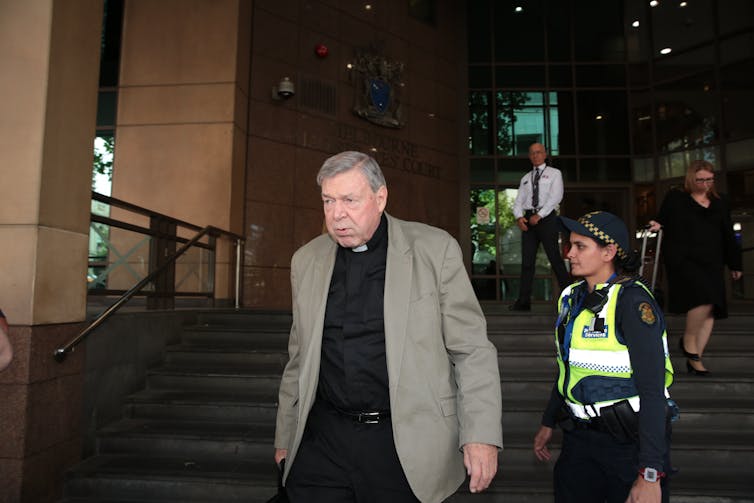
George Pell emerges from court during his committal hearing on historical sexual offences.
AAP/Stefan Postles

Mark Pearson, Griffith University

Many Australians are left perplexed when media coverage of high-profile criminal cases is suddenly suspended or abbreviated “for legal reasons”. The current committal hearing of Catholic Cardinal George Pell on historical sexual offences engages the principle of “open justice” and some of its most important exceptions.

Coverage of such matters is restricted at various stages of criminal trials. This is because of the relative priority the courts and lawmakers have assigned to the principles of open justice and the administration of justice, and the competing rights of free expression, privacy and a fair trial.

What is ‘open justice’?

The principle of open justice dates back to at least the 12th century; it involves people’s access to observe the goings-on in a courtroom. It was later extended to the media as “the eyes and ears of the public” in court.

Australia’s High Court has ruled that open justice is of constitutional significance, and nothing should be done to discourage the media from publishing fair and accurate reports of what occurs in the courtroom. But, it added, the principle is not absolute.

An open court involving fair and accurate media coverage is thus the default position for Australian courts. The common law recognises only a limited number of well-defined exceptions. Lawmakers have developed hundreds more.

One important common law limitation is in the area of sub judice contempt. This puts a halt to prejudicial coverage of a criminal matter from the moment an accused is arrested or charged right through until the appeal period has expired.

Important restrictions here are upon any suggestion an accused might be guilty (or innocent), coverage of contested evidence that may or may not be put to a jury, coverage of earlier proceedings (such as preliminary hearings and royal commissions), interviews with key witnesses, details of any confessions, the criminal history or character evidence about the accused, and visual identification of the accused if that might be at issue in a trial.

Specific restrictions on court cases

Legislation in all Australian jurisdictions has placed a litany of further restrictions on attendance at – and reporting on – a host of situations. These include family law cases, juvenile cases, mental health proceedings and – most relevant here – sexual matters.

The statutory gags forcing closure of courts, banning of coverage, and de-identifying of parties vary in important ways. This is because lawmakers have placed a differing emphasis on the competing rights and interests.

For example, if Pell was facing his committal hearing in South Australia or Queensland, he could not even be identified until after he is committed to trial – if that eventuates.

Lawmakers in those states have decided the reputational damage attached to an allegation of a serious sexual offence is so damaging that an accused person should not be identifiable until it is proven there is at least a prima facie case to answer at trial.

In Victoria, where Pell’s committal hearing is taking place, the accused can usually be identified. However, other restrictions apply either under legislation or in suppression orders issued by a presiding judge or magistrate.

In no Australian jurisdiction can the victim (known as the “complainant”) be identified – directly or indirectly – in sexual matters. But the laws vary on whether they might be identified after proceedings with their permission or the court’s permission.

This means complainants who might have been identified in earlier coverage or proceedings are suddenly rendered anonymous from the moment the matter is “pending” – after the arrest or charging of a suspect.

Special protections apply to complainants during committal hearings involving sexual offences. This includes closing the court while victims give evidence.

A complex array of policy issues inform these kinds of restrictions. These include the perceived vulnerability of victims, their privacy, and the important likelihood that victims might not come forward to bring charges of this nature if they sense they might be in the media spotlight.

Do we need a rethink in the digital age?

Victoria has had more than its share of journalists and others falling foul of court restrictions through defiance or ignorance of the law.

Former journalist and blogger (now senator) Derryn Hinch has twice been jailed as a result of contemptuous coverage – once in 1987 for broadcasting prejudicial talkback radio programs about a former priest facing child molestation charges, and again in 2013 after refusing to pay a A$100,000 fine for blogging the prior convictions of Jill Meagher’s accused killer in breach of a suppression order.


Read more:
You wouldn’t read about it: Adrian Bayley rape trials expose flaw in suppression orders


Two ABC journalists were convicted of identifying a rape victim in radio broadcasts in 2007. They and their employer were later ordered to pay her $234,190 in damages in a civil suit for the invasion of her privacy among other injuries.

In 2017, Yahoo!7 was fined $300,000 for contempt after it published social media material about a victim and the accused. The publication forced the jury in a murder trial to be discharged.

Many of the restrictions on coverage are problematic in the digital era. Mainstream media are more likely to be charged with sub judice contempt than social media users because the large audiences of mainstream media mean their prejudicial coverage is more likely to reach potential jurors.

The cross-jurisdictional nature of digital publishing also renders journalists and social media users subject to the tangled web of restrictions on criminal justice reporting when covering a criminal matter from another state.

Court orders to take down earlier reportage on websites are typically futile, because online dissemination is so widespread. So, the bizarre situation exists where the prior character evidence and coverage of earlier proceedings still sits online for anyone to access with a simple search of an accused’s name.

This is problematic if a rogue juror decides to become a cyber Sherlock Holmes. It means we require better training of jurors.


Read more:
Trial by social media: why we need to properly educate juries


Suppression orders are also a problem because these are typically circulated only to mainstream media in the trial’s immediate vicinity. This leaves others blissfully unaware of the orders. Some orders – known as “super injunctions” – are so secret that even publication of the fact they have been issued is prohibited.

Victoria’s Open Courts Act was meant to reduce the number of suppression orders and inject an element of consistency to the issuing of these. However, it has been problematic.

The ConversationAt least the media are better assisted in the modern era. Court information officers help explain the various restrictions and keep the media well briefed in high-profile trials – as they have done in Victoria during Pell’s committal hearing.
Mark Pearson, Professor of Journalism and Social Media, Griffith Centre for Social and Cultural Research, Griffith University, Griffith University

© Mark Pearson 2018

Disclaimer: While I write about media law and ethics, nothing here should be construed as legal advice. I am an academic, not a lawyer. My only advice is that you consult a lawyer before taking any legal risks.

Leave a comment

Filed under contempt of court, media law, national security, open justice, sub judice, terrorism

Media law for local government communications officers

By MARK PEARSON

A host of media laws might arise in the work of local government communications and media relations personnel, as I explained to a team from a large council recently.

With councils hosting inquiries and debates among ratepayers on social media platforms, and some even publishing their own news products to supplement a weaker suburban and regional media sector, they are facing many of the same media law risks that journalists encounter in their work.

These include defamation, contempt, breach of confidence, privacy, freedom of information/right to information, intellectual property and discrimination laws among others.

Yet while the news media have been described by some as “not just another business” because of their Fourth Estate role in a democracy, councils are clearly “not just another publisher” because of the special role local government plays in our political system.

A news organ published by the communications department of a local government body faces existential questions about their purpose and responsibilities which, in turn, feed into media laws and their defences.

A central question is: “Whose interests should come first, the citizen-ratepayer’s or the council’s?”

The reality is that most topics covered – such as extended library hours and the Carols in the Park coverage – would not trigger a dilemma here.

But push comes to shove when citizens are strongly critical of a council, its officers or its elected representatives over a decision or a proposal.

This is where the editor of any council-owned news organ and the moderator of comments on its social media feed face this fundamental dilemma over who is their real master – which in turn can feed into their position on several media law issues, most notably about whether defamation defences might be defeated by a lack of good faith or a perceived bias.

But there are also fundamental issues over the extent to which councils can shackle both the common law right to free expression and of course the implied freedom to communicate on matters of politics and government – both clarified in relation to local government bylaws by the High Court in Attorney-General (South Australia) v Corporation of the City of Adelaide (2013) 249 CLR 1.

While that case found Adelaide Council’s restrictions on preaching in Rundle Mall were a reasonable restriction on those freedoms, the decision prompts questions about other restrictions some councils may exercise upon their staff and elected officers.

Some, for example, have banned councilors from speaking publicly against decisions of their councils by narrowly interpreting some provisions of local government acts.

Early in 2017 the Redland City Council in Brisbane was criticized by the Queensland Ombudsman for threatening two citizens with defamation action over alleged defamatory comments about council, council officers and the Mayor, Karen Williams on social media websites. Legal letters from the Council demanded the complainants remove their comments and post apologies. The Ombudsman concluded the threats were not a reasonable or proportional response to what was relatively minor criticism of council’s decisions and were an unreasonable expenditure of public funds. He recommended training for councils in defamation law.

There are many other areas of the law beyond media laws that are likely to impact on local government media relations and communications personnel – both because of their public relations role and because of their function as part of the third tier of government.

These might include contract law, negligence, professional liability, HR law, whistleblower legislation and a host of regulations and common law obligations over transparency in council processes.

The recommendation by Queensland’s Ombudsman that council officers need training in defamation could well be extended to numerous media laws and several other legal and regulatory restrictions.

Disclaimer: While I write about media law and ethics, nothing here should be construed as legal advice. I am an academic, not a lawyer. My only advice is that you consult a lawyer before taking any legal risks.

© Mark Pearson 2017


Leave a comment

Filed under citizen journalism, contempt of court, free expression, journalism, local government, media ethics, media law, Media regulation, social media, sub judice

Reporting upon forensic mental health cases and identifying patients

By MARK PEARSON

What are the key policy factors influencing courts and tribunals attempting to balance open justice against other rights and interests in newsworthy cases involving forensic mental health patients? 

Associate Professor Tom Morton from UTS, ABC lawyer Hugh Bennett and I examined this question – and the related issue of whether the media could report upon such cases and identify the patients involved – in our recent article in the leading journal in the field, the Journal of Media Law.

Citation: Mark Pearson, Tom Morton & Hugh Bennett (2017): ‘Mental health and the media: a comparative case study in open justice’, Journal of Media Law, DOI: 10.1080/17577632.2017.1375261

Here is our conclusion:

Open justice in mental health proceedings need not be viewed in a vacuum. There are strong parallels with numerous other situations where the legislature and the courts find and apply exceptions to the open justice principle. There is much scope for consistency across Australian jurisdictions and across the many situations where the restrictions are in place because of different vulnerabilities faced by key participants in the court process – mental health patients, children, sexual crime victims, family law parties, protected witnesses and, in two Australian states, even those accused of sexual offences until after the committal stage of proceedings.

There is a strong argument that the courts should be most transparent when the public gaze is so sharply focussed upon them, and that public education about the workings of the justice system in the important area of mental health will be most effective when citizens are intrigued by a particular story and know its background. The courts might acknowledge that in some circumstances a story can be both “interesting to the public” and “in the public interest” – and that perhaps the two notions might not have to be mutually exclusive as Lord Wilberforce so famously suggested.

Full contents of the edition and subscription details can be seen here.

We compared four forensic mental health cases in Australia and the UK and highlighted some of the key competing rights and interests at stake when the news media or other parties seek to have mental health proceedings opened and to identify the patients involved. The approaches of the tribunals and courts we  studied showed the competing policy considerations in such applications were by no means clear-cut. They varied markedly from case to case with regards to the potential impact on the patient and other stakeholders and in their respective public interest value in the stories being told to broader communities. Policies around publicity are complicated when expert psychiatric opinion varies on the potential impact on the mental health and treatment regime for the patient.

The weighing of such important rights and interests is not a precise science where a pre-set formula will apply. Of course, important differences between Australian and UK jurisdictions inform such decisions, including different statutory frameworks for the particular tribunals, together with the lack of a formal human rights framework in Australia, comparable with the European Convention on Human Rights, which affords privacy and free expression rights. In Australia, these considerations draw upon the common law, because there is as yet no actionable tort of privacy invasion and free expression is limited to a High Court-designed implied constitutional freedom of communication with respect to “discussion of government and political matters”. Further, the various mental health tribunals dealing with applications from or regarding forensic patients operate within their own statutory frameworks, rules and practice directions which sometimes bind, and in other circumstances guide, their decisions on whether hearings can be held in public and, if so, whether parties and other participants might be identified.

In Australia alone, the nine jurisdictions have taken a variety of approaches to whether such hearings are held in public and whether parties must be anonymised in any reporting permitted. Open justice can be viewed as a policy continuum, ranging from closed hearings and a total ban on reporting at one end through to open hearings with full identification of parties allowed as part of a fair and accurate report of proceedings at the other. Somewhere in between are attempts to strike a balance between open justice and competing rights and interests with partial permissions; where the public or the media might be admitted to proceedings with a range of conditions placed upon the extent of identification of parties or witnesses allowed.

We developed  this list of key policy factors elicited from the cases reviewed, influencing whether a forensic patient or former patient might be given a public hearing or be identified in proceedings:

  1. Specific legislation, regulations, rules and practice directions relating to privacy and anonymity in hearings involving forensic patients or former patients;

  2. Whether there is informed consent from the patient to identification and publicity of his or her case;

  3. The extent to which a public trial and/or identification impacts upon on the life (ECHR Article 2), ill-treatment (ECHR Article 3), liberty (ECHR Article 5), and other rights, dignity and self respect of patients; including the impact of publicity and identification on their mental health and well being, ongoing treatment, safety and ease of re-entry to the community after treatment/rehabilitation;

  4. The impact of a public hearing or identification upon the right to privacy (ECHR Article 8) of the patient and other participants, and the confidentiality of personal medical details;

  5. The historic principle of open justice (ECHR Article 6): fundamental principles of transparency and justice ‘being seen to be done’, as espoused in Scott v. Scott; the public interest in transparency of mental health processes and proceedings;

  6. Freedom of expression and communication (ECHR Article 10); including the freedom of expression of the media, patients and other participants like hospital and prison personnel;

  7. The public’s right to know: public understanding of the mental health system and its treatment of patients; the public interest in knowing the outcome of highly publicised or emblematic cases; the public interest in knowing of wrongdoing in the mental health system; and the public interest in the safety and security of their communities;  

  8. Impact of identification and publicity upon other parties, including hospital staff, other patients, victims and their families;

  9. Public administration costs (economic and organisational) associated with implementing effective systems of publicity and identification. (For example, hospitals’ and courts’ management of media inquiries, extra costs of security for patient, special accommodation for public hearings, expense of installing video links etc);

  10. Stage of the process – for example, publicity and identification might be allowed on early applications related to conditions while institutionalised, but perhaps refused when re-entry to society is imminent or has already passed;

  11. The track record of the applicant media organisation/s in prior coverage and ethical management of privacy and consent issues, in this and perhaps in other comparable cases; the nature of the proposed program or publication and whether it is likely to be of a professional standard, balanced, accurate, reflective of a range of stakeholder views and sensitive to the patient’s experiences; and the context and focus of the identification of the patient in the media output;

  12. Whether a public hearing and/or identification of a patient might risk stigmatising mental illness.

Full contents of the edition and subscription details can be seen here.


Disclaimer: While I write about media law and ethics, nothing here should be construed as legal advice. I am an academic, not a lawyer. My only advice is that you consult a lawyer before taking any legal risks.

© Mark Pearson 2017

Leave a comment

Filed under blogging, citizen journalism, contempt of court, courts, free expression, journalism, media ethics, media law, Media regulation, mental health, open justice, Press freedom, social media, sub judice, suppression, Uncategorized

INFORRM a highly recommended resource for journalists and media law students #MLGriff

By MARK PEARSON

Congratulations to UK-based media law blog INFORRM (INternational Forum for Responsible Media) on reaching an impressive 4 million hits since it started seven years ago.

The site – international but with an understandable UK orientation – boasts more than 5,500 followers including  3,500 on Twitter @inforrm.

INFORRM has just listed its Top Twenty Posts of all time (in descending order of popularity):

From time to time over recent years they have been kind enough to repost my blogs or commentary pieces, including these:

Australia: Whither media reform under Abbott? – Mark Pearson

25 11 2013

Where will the new Liberal-National Coalition government led by Prime Minister Tony Abbott head with the reform of media regulation? Communications Minister Malcolm Turnbull and Attorney-General George Brandis were vocal opponents of the former Gillard Government’s proposals to merge press self-regulation with broadcast co-regulation into a new framework.

Read the rest of this entry »

Privacy in Australia – a timeline from colonial capers to racecourse snooping, possum perving and delving drones – Mark Pearson

13 10 2013

Australia MapThe interplay between the Australian media and privacy laws has always been a struggle between free expression and the ordinary citizen’s desire for privacy. I have developed this timeline to illustrate that tension. Read the rest of this entry »


Privacy On Parade – Mark Pearson

12 05 2012

The right to privacy is a relatively modern international legal concept. Until the late 19th century gentlemen used the strictly codified practice of the duel to settle their disputes over embarrassing exposés of their private lives.

The first celebrity to convert his personal affront into a legal suit was the author of The Three Musketeers, Alexandre Dumas père, who in 1867 sued a photographer who had attempted to register copyright in some steamy images of Dumas with the ‘Paris Hilton’ of the day – 32-year-old actress Adah Isaacs Menken. Read the rest of this entry »


Australia: News Media Council proposal: be careful what you wish for – Mark Pearson

10 03 2012

The Finkelstein (and Ricketson) Independent Media Inquiry report released on 28 February 2012 is a substantial and well researched document with a dangerously flawed core recommendation.

An impressive distillation of legal, philosophical and media scholarship (compulsory reading for journalism students) and worthy recommendations for simpler codes and more sensitivity to the needs of the vulnerable are overshadowed by the proposal that an ‘independent’ News Media Council be established, bankrolled by at least Aus$2 million of government funding annually. Read the rest of this entry »


Consumer law holds solution to grossly irresponsible journalism – Mark Pearson

9 11 2011

This post originally appeared on the Australian Journlaw blog.  It suggests an interesting new approach to media regulation which, as far as we know, has not been suggested in debates in this country.  We are reproducing it with permission and thanks to provide a further perspective on those debates.

Australia does not need a media tribunal with regulatory powers to punish ethical transgressions.  It already has one – in the form of the Australian Competition and Consumer Commission (“ACCC”). Read the rest of this entry »


… as well as occasional snippets in their useful Law and Media Roundup section and this review of my book Blogging and Tweeting Without Getting Sued by media lawyer Leanne O’Donnell:

Book Review: Mark Pearson “Blogging and Tweeting Without Getting Sued” – Leanne O’Donnell

11 04 2012

Professor Mark Pearson’s Blogging & Tweeting Without Getting Sued will be welcomed by anyone writing online … Melbourne media lawyer Leanne O’Donnell reviews this timely legal guide to a rapidly evolving media landscape

Mark Pearson’s new book Blogging & Tweeting Without Getting Sued: A global guide to the law for anyone writing online – is very accessible guide to laws relevant to the all those writing online. Read the rest of this entry »


I find the INFORRM “Blogroll” is a particularly useful resource – regularly updated and featuring these media law blogs from throughout the world. Together they provide a wonderful resource for media law students, journalists and researchers. (Thanks for including journlaw.com,  INFORRM!)

Surely sufficient bedtime reading for even the most avid media law geek!

Disclaimer: While I write about media law and ethics, nothing here should be construed as legal advice. I am an academic, not a lawyer. My only advice is that you consult a lawyer before taking any legal risks.

© Mark Pearson 2017

Leave a comment

Filed under blogging, citizen journalism, contempt of court, courts, defamation, free expression, Freedom of Information, intellectual property, journalism, journalism education, media ethics, Media freedom, media law, Media regulation, Press freedom, Privacy, social media, sub judice, suppression, terrorism

Speaking with magistrates about Open Justice #MLGriff

By MARK PEARSON

New magistrates from throughout Australia met in Brisbane last month for the National Magistrates Orientation Program and I was honoured to join a panel addressing them on open justice.

While magistrates have both legal qualifications and considerable experience, sadly open justice does not figure prominently in the curricular of most law schools so it is heartening to see the organisers of this program giving time to this important legal principle.

My fellow panellists for the session were former Queensland chief magistrate, District Court Judge Brendan Butler (who recounted his experiences with the media in prominent trials and inquests) and the Queensland Supreme and District Courts’ first Principal Information Officer Anne Stanford (@Anne_Stanford) (who explained her role and the interaction between the courts and the media in Queensland and in Victoria where she held a similar position).

I traced the origins and importance of the open justice principle in our legal system, citing English Master of the Rolls Lord Neuberger who described it as “a common law principle which stretches back into the common law’s earliest period” – to “time immemorial” – “…older than 6 July 1189, the date of King Richard the First’s accession to the throne” [Neuberger, Lord of Abbotbury (Master of Rolls) 2011, ‘Open justice unbound?’, Judicial Studies Board Annual Lecture, 16 March, < http://netk.net.au/judges/neuberger2.pdf>., p. 2].

Particularly important was the notion that the media should be free to report upon cases and publish the names of parties involved, with minimal exceptions, as recently stated in the UK by Baroness Brenda Hale, new President of the UK Supreme Court:

“The principle of open justice is one of the most precious in our law. It is there to reassure the public and the parties that our courts are indeed doing justice according to law. In fact, there are two aspects to this principle. The first is that justice should be done in open court, so that the people interested in the case, the wider public and the media can know what is going on. … The second is that the names of the people whose cases are being decided, and others involved in the hearing, should be public knowledge. [… limited exceptions].” R (on the application of C) v Secretary of State for Justice [2016] UKSC 2, 1 (per Lady Hale).

I suggested that with diminished resources and finances available to mainstream media in both metropolitan and regional areas, magistrates might be the only people left to speak to the principle of open justice when lawyers and litigants want the court to be closed or names suppressed. Media organisations that might have formerly paid for lawyers to push for the courts to remain open might not be able to afford them, and court reporters might not be available to even report on the particular case being heard.

I attach here my Powerpoint presentation from the session for colleagues and students who might be interested.

MagistratesOrientationBrisbane8-9-17


Disclaimer: While I write about media law and ethics, nothing here should be construed as legal advice. I am an academic, not a lawyer. My only advice is that you consult a lawyer before taking any legal risks.

© Mark Pearson 2017

Leave a comment

Filed under blogging, citizen journalism, contempt of court, free expression, journalism, media ethics, media law, Media regulation, social media, sub judice

Mental health and the media: a comparative case study in open justice

By MARK PEARSON

Our article comparing Australian and UK restrictions on the reporting of forensic mental health cases has appeared in the leading journal in the field, the Journal of Media Law.

Citation: Mark Pearson, Tom Morton & Hugh Bennett (2017): ‘Mental health and the media: a comparative case study in open justice’, Journal of Media Law, DOI: 10.1080/17577632.2017.1375261

Here is our abstract:

Media reportage about forensic mental health cases raises several competing rights and interests, including the public interest in open justice; a patient’s right to privacy, treatment and recovery; the public’s right to know about mental health tribunal processes; and victims’ and citizens’ interests in learning the longer term consequences of a publicised serious unlawful act. This article details a case study of successful applications for permission to identify a forensic mental health patient in both a radio documentary and in research blogs and scholarly works in Australia. It compares the authors’ experience in this case with three other cases in Australia and the UK, and identifies and weighs the competing policy issues and principles courts or tribunals consider when attempting to balance open justice with the rights and interests of a range of stakeholders in forensic mental health cases where the news media and/or patients are seeking publicity and/or identification.

Full contents of the edition and subscription details can be seen here.

———–

Disclaimer: While I write about media law and ethics, nothing here should be construed as legal advice. I am an academic, not a lawyer. My only advice is that you consult a lawyer before taking any legal risks.

© Mark Pearson 2017

Leave a comment

Filed under blogging, citizen journalism, contempt of court, courts, free expression, journalism, media ethics, media law, Media regulation, mental health, open justice, Press freedom, social media, sub judice, suppression, Uncategorized

DEFAMATION CASE UPDATE: Zoef v Nationwide News Pty Ltd – identification and offer of amends appealed #MLGriff

By MARK PEARSON

CASE UPDATE: Zoef v Nationwide News Pty Ltd – 2015, 2016 and 2017

I blogged in 2016 about a case where the mistaken identification of an innocent octogenarian tailor in place of his alleged gun-running son produced a useful case study for media law educators trying to explain the basic elements of defamation.

Indeed, the NSW District Court case of Zoef v Nationwide News Pty Limited & Ors [2015] NSWDC 232 remains an excellent introduction to defamation, although in October 2016 the NSW Court of Appeal overturned the publisher’s defence of “offer of amends” which was originally granted by the lower court, in the appeal case of Zoef v Nationwide News Pty Ltd [2016] NSWCA 283, and awarded the plaintiff $150,000 in damages. The appellant, Mr Tony Zoef, also had a partial victory in a more recent appeal over the backdating of the damages award, costs and interest owing in Zoef v Nationwide News Pty Ltd (No 2) [2017] NSWCA 2.
The first appeal is useful for educators explaining identification issues in defamation and the “offer of amends” defence requirements under s 18 of the Defamation Act 2005 (NSW) (Defamation Act) – and its equivalent in other Australian jurisdictions – while the 2017 appeal holds little value for media law teachers.

The case centred upon an article published in The Daily Telegraph on 22 August 2013.

It appeared a relatively straightforward case of confused identity, where the reporter mistakenly attributed to the older Mr Zoef – a suburban Sydney tailor – the alleged crimes of his son who lived at the same address. At trial, the sole basis on which Mr Zoef’s claim was dismissed was the newspaper’s defence that Mr Zoef had failed unreasonably to accept its offer of amends.

The article in the Telegraph (22-8-13, p. 9) carried the heading “Tailor’s alter ego as a gunrunner”, which might also make an interesting topic of discussion for students around the issue of sub judice contempt: Does such a heading carry a presumption of the accused’s guilt when accompanying a report of a preliminary court appearance? [The article in question is attached to the judgment as a pdf file.]

The article portrayed a then 81-year-old suburban tailor (with a distinctive surname ‘Zoef’) as a gun-runner who had been arrested, charged and appeared in court facing charges related to him holding a huge cache of weapons and ammunition at his home.

Police had indeed raided his premises and had found weapons and ammunition in the house’s garage, occupied by the tailor’s 43-year-old son, who shared his father’s name and was the actual individual who had appeared in court facing those charges.

As I blogged in 2016, the trial judgment by District Court Judge Leonard Levy is a fascinating one for student discussion because several basic concepts in defamation were contested and resolved, including:

  • imputations – how they are worded and presented
  • the misidentification’s impact on the plaintiff’s relationships, business and emotional state
  • the question of identification and case law establishing the extent of defamation of a second person with the same name and address as the first [*** considered on appeal].
  • whether a claim for defamation will hold when some other identifying factors do not match one of the named individuals. [In this case, while the headline identified the plaintiff as a tailor, the article featured a small photograph of his 43 year old son and mentioned the younger man’s age]. [*** considered on appeal].
  • whether the defences of a fair report of proceedings of public concern could apply when there were serious inaccuracies in the article
  • whether an offer of amends had been reasonable and whether it had been accepted by the plaintiff [***the trial judge’s decision which was subsequently overturned on appeal].

The trial judge had held that, despite the serious errors in the reporting of the story and a dispute over whether the publisher’s offer of amends was reasonable and had been withdrawn, the newspaper was entitled to the offer of amends defence.

In the leading appeal judgment, Justice Fabian Gleeson stated:

Taking into account the seriousness of the defamatory imputations and the significant hurt they caused the appellant, the damage to his business as a tailor, the unequal prominence the respondent afforded to the proposed correction and apology and their resultant inadequacy, the modest monetary component of the offer, and the likelihood of the proceedings being successful, the offer of amends was not reasonable. His Honour was in error in finding to the contrary and upholding the respondent’s defence under s 18 of the Defamation Act. (at para 78).

His reasons for that decision involved a step-by-step appraisal of the offer of amends defence and thus make useful instructional material for educators wanting to explain this defence to students. It should also serve to remind journalists that the offer of amends is very much a ‘lawyers’ defence’ – not something that should be handled by journalists or editors independent of legal advice – and given its time constraints it means that counsel from lawyers on the efficacy and wording of any such offer should be sought promptly.

The publisher also challenged the trial judge’s findings on whether the plaintiff had been identified in the article when it carried a photograph of his son and stated his age as 43 years old.

The Court of Appeal affirmed the trial judge’s decision that Mr Zoef Sr had been identified in the article despite those countering factors. Justice Gleeson ruled:

The article in this case contained a prominent and sensational headline, which, when read together with the first paragraph (par 29), would be reasonably understood to refer to the appellant. The strength of the general impression thereby created surpasses and dominates that of the subsequent reference in par 30 to a “43 year old” which is not something the ordinary reasonable reader might be expected to have focused on, let alone re-read or reviewed. It lacked the prominence of the sensational headline and the focus on the local, relatable indicia of the identified person’s name, profession and locality in the foregoing paragraph.

In respect of the photograph, his Honour’s finding that it was “immaterial” is supported by three considerations. One is that the photograph was small, cropped, and, as his Honour found, “less than distinct”. Next, the appellant gave unchallenged evidence in cross-examination that his son was not known to his customers. No identification would therefore have been made on a visual basis by the appellant’s customers. Finally, the use of historical photographs in newspaper articles is not so uncommon as to render unreasonable a conclusion by the ordinary reasonable reader that the article (with an unfamiliar photo) referred yet to the appellant. (paras 159-160).

So there you have it. The Zoef case – both at trial and on appeal – holds valuable lessons for media law students and educators are encouraged to use it as a case study. I have done so successfully with both journalists and tertiary students.

———–

Disclaimer: While I write about media law and ethics, nothing here should be construed as legal advice. I am an academic, not a lawyer. My only advice is that you consult a lawyer before taking any legal risks.

© Mark Pearson 2017

1 Comment

Filed under blogging, contempt of court, courts, defamation, free expression, media ethics, Media freedom, media law, Press freedom, sub judice, suppression, Uncategorized

Is an Open Justice Advocate the solution to overly restrictive suppression orders? #MLGriff

By MARK PEARSON

Jason Bosland [@JasonBosland] – Deputy Director of the Centre for Media and Communications Law at Melbourne Law School – has called for the introduction of a state-funded Open Justice Advocate as a measure to alleviate the continuing practice of judges issuing overly restrictive suppression orders.

Bosland’s explanatory article in Pursuit and his research article the Sydney Law Review come just as we are about to examine open justice and court restrictions in our Griffith University Media Law course, so they are essential reading for students.

He is the acknowledged leader in the field of suppression order scholarship in Australia and his work tracked firstly the need for the Open Courts Act 2013 in Victoria and, more recently, its failings to impact effectively on court practices.

https://twitter.com/JasonBosland/status/836835663614001157

Bosland writes in the Pursuit article:

This leads to a critical question: who is going to protect the fundamental principle of open justice if the courts themselves are not as vigilant as they should be and if the media are increasingly unable or unwilling to intervene? It is my view that the only solution is for the introduction of a state funded open justice advocate.

His longer Sydney Law Review is an expert combination of insightful policy analysis, meticulous scrutiny of the legislation, and illuminating statistics drawn from his funded research projects on the topic. I commend them to all media law geeks and students.

His concludes that article with this wise counsel:

This state of affairs is clearly unsatisfactory. The solution, however, is not to be found in further legislative reform of the courts’ powers. Rather, attention should be directed towards further professional and judicial education, and the development of a range of suitable model orders. Furthermore, a scheme facilitating the appearance of contradictors in suppression order applications — such as the Open Courts Act Duty Barrister Scheme introduced at the instigation of the Chief Justice — is likely to improve current practices. However, it will only be truly effective in solving the problems identified in the present study if it can be extended to all courts.

Insightful indeed.

[See also – my article in The Conversation on how the 2015 edition of our textbook inadvertently breached a Victorian suppression order and had to be reprinted.]

Disclaimer: While I write about media law and ethics, nothing here should be construed as legal advice. I am an academic, not a lawyer. My only advice is that you consult a lawyer before taking any legal risks.

© Mark Pearson 2017

2 Comments

Filed under blogging, citizen journalism, contempt of court, free expression, journalism, media ethics, media law, Media regulation, social media, sub judice

Identification error leads to a useful case for teaching the basic elements of defamation

**See UPDATE after appeal**

By MARK PEARSON

[research assistance from Virginia Leighton-Jackson]

The morphed identification of an innocent octogenarian tailor and his alleged gun-running son produces a useful case study for teachers and trainers trying to explain the basic elements of defamation.

The NSW District Court case of Zoef v Nationwide News Pty Limited & Ors [2015] NSWDC 232 centred upon an article in Sydney’s Daily Telegraph (22-8-13, p. 9) with the heading “Tailor’s alter ego as a gunrunner”. [The article in question is attached to the judgment as a pdf file.]

The article portrayed an 86-year-old suburban tailor with a distinctive name as a gun-runner who had been arrested, charged and appeared in court facing charges related to him holding a huge cache of weapons and ammunition at his home.

Police had indeed raided his premises and had found weapons and ammunition in the house’s garage, occupied by the tailor’s 43-year-old son, who shared his father’s name and was the actual individual who had appeared in court facing those charges.

The case is a fascinating one for student discussion because several basic concepts in defamation were contested and resolved, including:

  • imputations – how they are worded and presented
  • the misidentification’s impact on the plaintiff’s relationships, business and emotional state
  • the question of identification and case law establishing the extent of defamation of a second person with the same name and address as the first
  • whether a claim for defamation will hold when some other identifying factors do not match one of the named individuals. [In this case, while the headline identified the plaintiff as a tailor, the article featured a small photograph of his 43 year old son and mentioned the younger man’s age].
  • whether the defences of a fair report of proceedings of public concern could apply when there were serious inaccuracies in the article
  • whether an offer of amends had been reasonable and whether it had been accepted by the plaintiff.

On the question of identification, Judge Leonard Levy ruled:

Para 37   …where a plaintiff has actually been named in a defamatory publication it is not necessary for the plaintiff to show that those to whom the material was published knew the plaintiff: Mirror Newspapers Ltd v World Hosts Pty Ltd (1978 – 1979) 141 CLR 632, at 639.

38   Even so, the plaintiff must establish that the defamatory matter should be understood to be referring to him: Consolidated Trust Co Ltd v Browne (1948) 49 SR (NSW) 86, at 91. The determination of that question of identification is not to be decided by a consideration of what the publisher intended: Hutton v Jones [1910] AC 20.

39   In cases where a defamatory publication names one person but another person of the same name has been defamed, this can give rise to more than one claim: Lee v Wilson and Mackinnon (1934) 51 CLR 276, as cited in Australian Defamation Law and Practice, Volume 1, TK Tobin QC, MG Sexton SC, eds, 2003, at [6050].

40   In determining the question of identification, the question is, would a sensible reader reasonably identify the plaintiff as the person defamed: Morgan v Odhams Press Ltd [1971] 1 WLR 1239. …

49   In my view, the combined context … serves to adequately identify the plaintiff….

52   …the article strings together the plaintiff’s name, his profession, the fact that he lives in his home in the Sutherland Shire, and has a business altering the clothes of locals all point strongly to the article mentioning the plaintiff by his name and is sufficient of his personal situation to indicate it was him who was the subject of the article.

53   Those details all follow the sensational headline “Tailor’s alter ego as a gunrunner” thereby making a connection between the plaintiff and the described illegal activity concerning the cache of weapons and ammunition found at the premises.

54   The fact that an unclear undated photograph of Tony Zoef appears in the article (at par 38) is immaterial. The fact the article identifies the age of the person the subject of the article as being a 43 year old does introduce an element of possible confusion (par 30) along with the indistinct photograph (at par 38), but inaccuracy of some details appearing in a newspaper article is not an unknown phenomenon.

55   The salient feature is that the plaintiff was named in the article with sufficient of his personal details to suggest he was thereby identified, although the latter details are not essential to that finding.

56   As the article in question named the plaintiff, in my view thereby identifying him, this forms the basis of his right to bring the proceedings without more being shown by him. The fact that there were two persons at the premises named Tony Zoef is immaterial. Both persons of that name could bring proceedings for defamation in their own names: Lee v Wilson and Mackinnon (1934) 51 CLR 276.

59   …I am nevertheless satisfied that the material complained of should be understood as referring to the plaintiff even though the publisher may not have intended that to be so: Consolidated Trust Co Ltd v Browne (1948) 49 SR (NSW) 86, at 91.

60   I consider that … an ordinary sensible reader would identify the plaintiff as the person the subject of the material complained of because of the specific of his name, profession, and locality as already explained. Such a reader… would not read such a sensational article as the one in question with critical and analytical care.

61   The article would be approached by such a reader with the permissible amount of loose thinking, and that reader would be reasonably entitled to draw the conclusion that the article was referring to the plaintiff, even though there were some elements of confusion such as a less than distinct photograph and a different age mentioned to that of the plaintiff. An ordinary reasonable reader would not necessarily know the plaintiff’s age or his level of interest in matters to do with space. The headline of “Tailor’s alter ego as a gunrunner” would catch the attention of such a reader and permit the general impression of the story being a reference to the plaintiff: Mirror Newspapers Limited v World Hosts Proprietary Limited [1978 – 1979] 141 CLR 632, at p 646; Morgan v Odhams Press Ltd [1971] 1 WLR 1239.

The judge also considered the important question of the impact of headlines:

44   In cases involving headlines, it must be borne in mind that the ordinary reasonable reader will draw conclusions from general impressions when reading the matter complained of. Such general impressions are necessarily formed by the technique of using prominent headlines to communicate the principal message of the publication, and it must be recognised that in that process, such material may diminish the reputations of those affected: Chakravarti v Advertiser Newspapers Limited (1998) 193 CLR 519, at p 575.

A large portion of the judgment centred upon whether a defence of ‘offer of amends’ should be upheld under s 18(1)(c) of the Defamation Act. The judge held that, despite the serious errors in the reporting of the story and a dispute over whether the offer of amends was reasonable and had been withdrawn, the newspaper was entitled to the offer of amends defence.

———–

Disclaimer: While I write about media law and ethics, nothing here should be construed as legal advice. I am an academic, not a lawyer. My only advice is that you consult a lawyer before taking any legal risks.

© Mark Pearson 2016

1 Comment

Filed under blogging, courts, defamation, free expression, journalism education, media ethics, Media freedom, media law, Press freedom, sub judice, suppression, Uncategorized