Category Archives: Uncategorized

Zones of silence: Forensic patients, radio documentary, and a mindful approach to journalism ethics

By MARK PEARSON

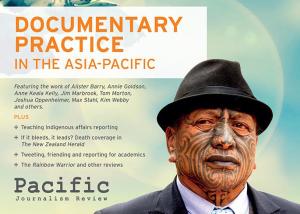
Congratulations to Pacific Journalism Review editors David Robie, Annie Goldson and Barry King on their newly released special edition ‘Documentary Practice in the Asia-Pacific’.

I was honoured to be invited by research colleague Associate Professor Tom Morton from UTS to co-write an article centred upon the law and ethics behind his ABC Background Briefing documentary ‘The Man Without A Name’, broadcast in 2014. In the article we detail the story behind the documentary and the legal and ethical challenges we faced in navigating the publishing restrictions of the NSW Mental Health Act and some related legislation.

PJR Special Edition vol21(2) OP FINAL CORRECTED 685wide_0

Cover of the special Pacific Journalism Review edition Volume 21 (2)

Here is our abstract:

This article explains a collaborative and critically reflective journalism research project stemming from the wish of an incarcerated forensic mental health patient to be named in public communication about his case. The authors are academics and journalists who embarked upon a combination of journalism, legal processes and academic research to win the right to name Patient A in a radio documentary and in academic works—including this journal article and research blogs. As a case study, it explains the theoretical and ethical considerations informing the journalism and the academic research, drawing upon traditions of documentary production, the principle of open justice and the ethical framework of ‘mindful journalism’. It concludes by drawing lessons from the project that might inform future practitioners and researchers embarking upon works of journalism and research involving vulnerable people and a competing set of rights and public interests.

Full contents of the edition and subscription details can be seen here.

———–

Disclaimer: While I write about media law and ethics, nothing here should be construed as legal advice. I am an academic, not a lawyer. My only advice is that you consult a lawyer before taking any legal risks.

© Mark Pearson 2015

Leave a comment

Filed under blogging, Buddhism, citizen journalism, Eightfold Path, free expression, media ethics, mental health, social media, Uncategorized

A reflection on the ‘Media Wars’ 20 years on

By MARK PEARSON

It has been 20 years since the start of the so-called ‘Media Wars’ – the spat between cultural studies and journalism educators triggered by the provocative (and likely tongue-in-cheek) proclamation by cultural studies academic John Hartley that journalism research was a ‘terra nullius’ of epistemology and Keith Windschuttle’s retaliatory attack on the ‘obscurantism’ of cultural studies as an academic discipline.

I have partnered with two colleagues – Roger Patching and Lisa Wilshere-Cumming – to write a reflection on that episode and an assessment of the path of journalism research since that debate.

Our article appears in the August 2015 edition of Media International Australia (No. 156, just released), the contents of which are viewable here.

Here is our abstract:

A conceptual matrix of journalism as research two decades after ‘Media Wars’

Mark Pearson, Roger Patching and Lisa Wilshere-Cumming

It is 20 years since John Hartley (1995) positioned journalism as the subject of academic research rather than as a research method in its own right. In 1999, Media International Australia devoted a themed edition to the debate over journalism in the academy (‘Media Wars’), which prompted further scholarly discourse over the role and location of journalism as a field of study. This article reassesses that debate in the light of the acknowledgement of journalism studies and journalism creative works in the Excellence in Research for Australia (ERA) system, the use of journalism methods as a research methodology and the development of conceptual paradigms for journalism as research. The article surveys the relationship between journalism and research over the ensuing two decades and proposes a conceptual matrix of the journalism–research nexus.

© Mark Pearson 2015

Disclaimer: While I write about media law and ethics, nothing here should be construed as legal advice. I am an academic, not a lawyer. My only advice is that you consult a lawyer before taking any legal risks.
Leave a comment

Filed under journalism, journalism education, Uncategorized

Techniques and challenges of new models for journalism: The Undercurrent

By MARK PEARSON

As legacy media outlets grapple with the challenges of retaining and engaging their audiences, new media entrepreneurs experiment with new forms of journalism and novel ways of winning funding.

My guest this week in our Introduction to Journalism class was Jen Dainer, Head Writer and Co-Producer at The Undercurrent
[Twitter: @TheUCNews | @jendainer ] who has developed with co-founder Dan Graetz a new model of satirical advocacy journalism drawing upon their considerable creativity, skill base, and life and work experience.

Our interview spanned a range of topics including Jen’s own background, the objectives of The Undercurrent, how it differs from other news and current affairs products, the importance of impeccable research in avoiding legal action, and how they plan to gain traction and financial support.

You can view the interview here:

[Aug 4, 2015 / 26 mins. Camera work: Bevan Bache ]

Please contact Jen Dainer direct @jendainer / jen@theundercurrent.com if you would like to be involved in the project or support it in some way.

https://twitter.com/MarkTordai/status/628358500016455680

https://twitter.com/NeverForTheFall/status/628358062307348481

© Mark Pearson 2015

Disclaimer: While I write about media law and ethics, nothing here should be construed as legal advice. I am an academic, not a lawyer. My only advice is that you consult a lawyer before taking any legal risks.
Leave a comment

Filed under Uncategorized

Benefits of using Twitter from Day One in a news writing class

By MARK PEARSON

Almost 30 years ago my first colleague in journalism education – the late Charles Stuart – summarised the curriculum of a journalism degree.

“In the first year you teach them how to write an intro (lead),” he said.

“In year two you teach them how to write the body of the story.

“And in their final year you revise the intro.”

While Charles’ advice was delivered tongue in cheek, he certainly hit upon one of the greatest challenges facing students of basic news reporting – how to sum up the key elements of a story in an interesting way in just a few words.

I recalled that conversation as I set the in-class exercises for my Introduction to Journalism tutorials this week and turned to Twitter to help out.

Twitter has its pluses and minuses as a social medium, but there is no doubting its value as a platform for clear and concise expression.

Its 140 character format equates to 20-22 words and thus it lends itself to an exercise where students can try their hand at a basic news lead.

Our 300 first year students were prepped on the basics in their lecture and briefed on the importance of Twitter in modern day journalism as a means of communication with colleagues and sources, finding useful news angles, and in accessing contacts and basic information when a news event unfolds.

We decided the course code #1508HUM made a suitable class hashtag and assigned students to live tweet the lecture to reinforce its value.

https://twitter.com/MarkTordai/status/625820992963645442

As an example of an effective use of Twitter in journalism I showed them the Twitter feed from ABC PM presenter Mark Colvin’s to the 85,000 followers of his @Colvinius handle and explained that it was a badge of honour for Twitter users if Colvinius ever retweeted your tweets.

One of my live tweeters approached me in the lecture break to show me his dialogue with @Colvinius during my class.

Quite a coup. Clearly Jake gets it. (BTW, thanks @Colvinius).

Students who did not have Twitter accounts signed up for them prior to the tute and we started the session with an exercise requiring students to interview a classmate and introduce them to the group by spelling their name very clearly and stating an interesting fact about them.

We then talked about news values and what might make news for a campus community.

We embarked on our Twitter news hunt, wandering the campus in search of stories using our five normal senses plus the students’ evolving “news sense”.

Some of the stories came from noticeboards, although I explained a journalist would call to verify any information found there.

Others were based on interesting happenings around the campus during our 20 minute walk, including a cheerleader squad practice, an interview with a student events officer, and an array of photos and interviews from the student clubs sign-on stalls.

The exercise has the following benefits:

  • It teaches students the art of summing up a story in just a few words in an era when the attention span of news audiences is just a few seconds.
  • It introduces them to one use of social media in modern journalism.
  • It allows students to experiment with multi-media reportage if they attach photos, sound or vision.
  • It allows debate over the news value of campus-based stories.
  • And it does all of this within the comfort of a hashtag that allows them to experience publishing their first news story that technically all the world can see while in reality very few people other than their peers and tutors will actually view it.

You can see some highlights below, or even visit the #1508HUM hashtag if you are really interested.

I’d certainly recommend such an exercise to colleagues not already doing something similar in their first news writing classes.

https://twitter.com/MarkTordai/status/625856023958392833

https://twitter.com/tomobrien1997/status/626936785415745536

https://twitter.com/ByronRedpath/status/626267774445223936

© Mark Pearson 2015

Disclaimer: While I write about media law and ethics, nothing here should be construed as legal advice. I am an academic, not a lawyer. My only advice is that you consult a lawyer before taking any legal risks.

2 Comments

Filed under Uncategorized

Journalists, whistleblowers and the law – the end of the era of the confidential Watergate-style source? My #AusCERT2015 address

By MARK PEARSON

My speech to the AusCERT2015 conference on the Gold Coast, Queensland, on Friday June 5.

Abstract

The practicalities of protecting confidential sources are a huge challenge for journalists in the modern era. New shield laws excusing journalists revealing the identity of a whistleblower in court seem pointless if litigants or government agencies have already been able to detect them using the surveillance regime that is ubiquitous in modern society. It prompts the serious questions: Could the Watergate investigation by the Washington Post three decades ago happen in the modern era? How long would Carl Bernstein and Bob Woodward’s White House source ‘Deep Throat’ remain anonymous today? This presentation considers the toll of the era of geo-locational tracking, phone and social media e-records, CCTV in private and public spaces, email logs, surveillance technologies and drones on journalists and their sources. It reviews the key laws in the field of confidentiality, privacy and national security to assess the level of whistleblower and journalist protection they really offer.

Audio available here:

© Mark Pearson 2015

Disclaimer: While I write about media law and ethics, nothing here should be construed as legal advice. I am an academic, not a lawyer. My only advice is that you consult a lawyer before taking any legal risks.

Leave a comment

Filed under national security, terrorism, Uncategorized

Towards a mindful approach to media law and ethics

By MARK PEARSON

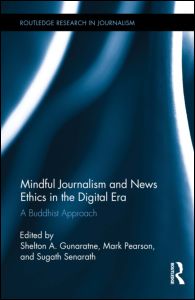
Our book Mindful Journalism and News Ethics in the Digital Era: A Buddhist Approach (Shelton Gunaratne, Mark Pearson and Sugath Senarath eds; Routledge, NY, 2015)  explored the possibilities of applying mindfulness techniques to journalism practice.

How might we begin to apply Buddhist ethical systems to the analysis of media law and ethics?

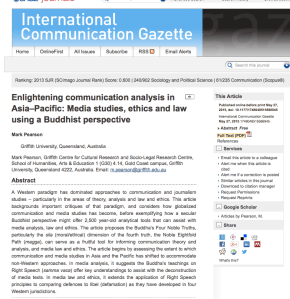
I explore this question in an article just published online and to appear in a forthcoming print edition of the International Communication Gazette.

It is titled ‘Enlightening communication analysis in Asia-Pacific: Media studies, ethics and law using a Buddhist perspective’. Its abstract and link to the full article is available here.

Screen Shot 2015-05-29 at 3.08.59 pmThe article backgrounds important critiques of the Western approach to communication  studies, and considers how globalized communication and media studies has become, before exemplifying how a secular Buddhist perspective might offer 2,500 year-old analytical tools that can assist with media analysis, law and ethics.

The article proposes the Buddha’s Four Noble Truths and their associated Noble Eightfold Path (magga) can be fruitful tools for informing communication theory and analysis, and media law and ethics.

The article begins by assessing the extent to which communication and media studies in Asia and the Pacific has shifted to accommodate non-Western approaches.

In media analysis, it suggests the Buddha’s teachings on Right Speech (samma vaca) offer key understandings to assist with the deconstruction of media texts. In media law and ethics, it extends the application of Right Speech principles to comparing defences to libel (defamation) as they have developed in four Western jurisdictions.

Here is a brief extract on that aspect:

In this globalised, multi-cultural and multi-jurisdictional Web 2.0 era there should be no reason why the Judeo-Christian lens should have a monopoly on our examination of communication law. A mindful reading of defamation law benefits from a consideration of both Right Speech principles and concepts of necessary truth-telling. While it is far-fetched to expect judges and legislators in the West would turn to Buddhism for the reform of defamation law, an effort to abide by truth-telling and Right Speech principles could operate effectively when professional communicators are attempting to avoid libel litigation when pursuing their stories. Further, they present excellent tools for an alternative analysis.

Analysis of the development of defamation defences in Canada, the UK, Australia and the U.S. benefit from a Buddhist reading. In Grant v. Torstar Corp., 2009 SCC 61, [2009] 3 S.C.R. 640, the Supreme Court of Canada developed a ‘responsible communication’ defence to defamation for matters which might not have been able to be proven absolutely as true, but were still diligently reported and were clearly in the public interest to be aired within the spirit of the Canadian Charter of Rights and Freedoms protection of free expression. ..

It is possible to implement a Buddhist approach using the Right Speech teachings from the Noble Eightfold Path to conduct an analysis in this area of communication law. The author proposes to do this more thoroughly in future work. However, for the purposes of this argument we might return to the Abhaya Sutta cited earlier and contrast these defences as they have been developed in these jurisdictions (Thanissaro, 1997). Crucial to the Canadian ‘responsible communication’ defence and its qualified privilege cousins in the UK and Australia is the extent to which reporters and publishers honestly believe in the truth of the defamatory material published, even though they might not have the firm evidence to prove this in court. They would pass the Buddhist (mindful journalism) test if they had an honest belief the material was “factual, true, beneficial” while perhaps being “unendearing and disagreeable to others”, as long as they had chosen the “proper time” for reporting it (Thanissaro, 1997). However, the U.S. defences driven by the First Amendment takes this liberty a step too far under this schema, because it allows unbeneficial, unendearing and disagreeable material to be published about public figures as long as it has not been done with malice. It also allows for untruthful gossip-mongering, as identified earlier in the Saleyyaka Sutta (Nanamoli, 1994) as ethically problematic. Such analysis shows promise in the field of media law analysis, reform and policy development because it provides a working ethical framework to apply to legislation and the fact scenarios of particular cases.

The article applies the ‘Right Speech’ principles of Buddhist ethics to analysis of the Royal family prank call episode which resulted in a High Court appeal in Australia and to a racial discrimination case heard in Australia’s Federal Court over comments on a West Australian news website.

———–

Disclaimer: While I write about media law and ethics, nothing here should be construed as legal advice. I am an academic, not a lawyer. My only advice is that you consult a lawyer before taking any legal risks.

© Mark Pearson 2015

2 Comments

Filed under blogging, Buddhism, citizen journalism, Eightfold Path, free expression, media ethics, mental health, social media, Uncategorized

Mindful Journalism in action – in dialogue with University of Canterbury students

By MARK PEARSON

Graduate students in journalism from the University of Canterbury studying under Associate Professor Donald Matheson interviewed me via Skype on the principles of mindful journalism.

With their permission, I provide the recording of that interview here for the interest of those exploring the application of Buddhist ethical systems to their journalism work.

Our book Mindful Journalism and News Ethics in the Digital Era: A Buddhist Approach (Shelton Gunaratne, Mark Pearson and Sugath Senarath eds; Routledge, NY) was published in February 2015.

Review copies are available from Routledge by filling out this request form. Please see the publisher’s synopsis.

MindfulJournalismCoverThe term ‘mindful journalism’ is a concept I introduced more than a year ago in the inaugural UNESCO World Press Freedom address at AUT University Auckland, drawing upon the earlier substantive work by my esteemed colleague (and lead editor of our book), Emeritus Professor Shelton Gunaratne, who has been working for decades on the intersection between Buddhism and journalism.

I developed my application of this in a paper to the International Association for Media and Communication Research (IAMCR) conference in Dublin in July 2014, which was revised for publication as an article in Ethical Space published in December 2014.

It is being published as part of the Routledge New York Research in Journalism series. My key point was that one does not have to be a Buddhist to incorporate the key principles of mindful journalism into one’s work. In fact, most of these very moral principles are evident in the teachings of all the world’s great religions. However, for those who lack a moral framework for their ethical decision-making, a secular application of these non-theistic principles can offer a moral compass. They offer a series of normative or aspirational goals we can strive for, but rarely reach. They also provide a schema for the analysis of ethical decision-making by journalists.

Interested? You can read further extracts from the book using the “Look Inside” interface at Amazon. Enjoy.

———–

Disclaimer: While I write about media law and ethics, nothing here should be construed as legal advice. I am an academic, not a lawyer. My only advice is that you consult a lawyer before taking any legal risks.

© Mark Pearson 2015

1 Comment

Filed under blogging, Buddhism, citizen journalism, Eightfold Path, free expression, media ethics, mental health, social media, Uncategorized

Lessons in ‘Right Speech’ and mindful communication in Queensland defamation case

By MARK PEARSON

THE comedians on the Ten network’s ‘The Project’ had some fun with defamation last Friday when they used a fairly sobering Queensland case as the reason to interview me on the basics of that law.

First up, a clarification. Near the end of the segment they seemed to imply quite incorrectly that I am a lawyer which, of course, I am not!

Mark Pearson (@journlaw) interviewed on The Project about defamation 24.4.15 [At 33 mins 15 secs]

Mark Pearson (@journlaw) interviewed on The Project about defamation 24.4.15 [At 33 mins 15 secs]

There is a serious side to this. The Queensland case they used as the segue to my very rudimentary explanation of defamation law was Sierocki & Anor v Klerck & Ors (No 2) [2015] QSC 092 where Justice Flanagan had ordered a total of $260,000 in damages be awarded to the plaintiff and his company over various Internet slurs against them by his former business partner and others.

The defendants had earlier failed in their attempt to prove the truth of the imputations that the plaintiff was fraudulent; was a conman; had committed adultery; had used illegal drugs; was evil; was a thief; was a liar; and preyed on the innocent and that his company’s services were disreputable; unprofessional and encouraged threatening behaviour. Quite a slur indeed.

33671_GAZThe Courier Mail reported earlier that the plaintiff was also suing Google for $2.6 million over its search results linking him to the sites containing those imputations.

The case is interesting for media law students for a range of reasons – the large award of damages, the fact that they were Internet publications, and for the proposed action against Google.

But I find the most instructive lesson is the extent to which a dispute between business partners can escalate so far out of control that one should take to the Internet to cast these kinds of aspersions against the other.

Justice Flanagan noted in the judgment that the cause of the original dispute was unknown, but the result has been enormous financial and emotional cost to all parties.

Our new book Mindful Journalism and News Ethics in the Digital Era: A Buddhist Approach (Shelton Gunaratne, Mark Pearson and Sugath Senarath eds; Routledge, NY) examined some of the causes of such disputes and the damage that language can cause to reputations and relationships.

I take this further in a forthcoming article in a special issue of the academic journal International Communication Gazette, edited by my Mindful Journalism lead editor Shelton Gunaratne.

In that article I examine the religious origins of defamation law and proceed to link it to the Buddhist concept of “Right Speech”, writing:

In this globalised, multi-cultural and multi-jurisdictional Web 2.0 era there should be no reason why the Judeo-Christian lens should have a monopoly on our examination of communication law. A mindful reading of defamation law benefits from a consideration of both Right Speech principles and concepts of necessary truth-telling. While it is far-fetched to expect judges and legislators in the West would turn to Buddhism for the reform of defamation law, an effort to abide by truth-telling and Right Speech principles could operate effectively when professional communicators are attempting to avoid libel litigation when pursuing their stories. Further, they present excellent tools for an alternative analysis.

The basic premise of Right Speech in Buddhism is that words should not be spoken (or written or published) if they are not factual or true, or if they are unbeneficial, unendearing or disagreeable to others. All of these elements seemed to apply in this case, or at least that was the tenor of the judgment. Of course, sometimes hard truths do need to be told, but we need to ensure they are provable as true or that we can operate under some other defence excusing their publication.

The Internet offers inordinate opportunities to those seeking to defame others. This is the latest in a series of judgments demonstrating that even when one side wins a record damages payout for defamation, nobody is really a winner when reputations are damaged for no defensible reason.

We need to look to our moral compass when speaking or writing ill of others and ask whether we have an ethical foundation for doing so.

———–

Disclaimer: While I write about media law and ethics, nothing here should be construed as legal advice. I am an academic, not a lawyer. My only advice is that you consult a lawyer before taking any legal risks.

© Mark Pearson 2015

1 Comment

Filed under blogging, Buddhism, citizen journalism, Eightfold Path, free expression, media ethics, mental health, social media, Uncategorized

New edition has a section on contract law for PR and new media entrepreneurs

By MARK PEARSON

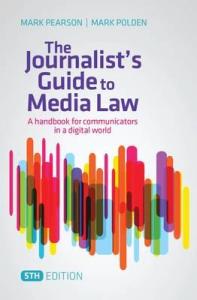
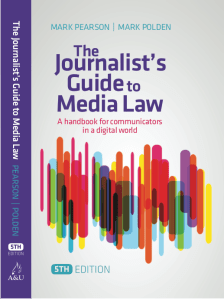
Our latest edition of The Journalist’s Guide to Media Law (Mark Pearson & Mark Polden, Allen & Unwin, 2015) has a whole chapter on law for public relations, freelancing and new media entrepreneurs.

the-journalist-s-guide-to-media-lawOne of the key topics arising for such people is the law of contract, which is a complex field requiring expert legal advice.

We’ve mapped out the very basics though for the benefit of such professional communicators. Here’s a short excerpt:

A breach of an important contract can be devastating to the financial viability of a public relations consultancy or freelance writer, and it can ruin the prospects of a start-up media venture getting off the ground. While the law of contract can get very complex, the basic concept of a contract is fairly simple: a contract is a legally enforceable promise. It is something crucial to the effective operation of a business, because our financial system operates on the principle of promises being kept rather than broken, so that there is an element of trust and predictability in our dealings. Contracts play a role in a variety of situations in the PR and news business. They can cover the terms of employment for a freelance journalist or other staff, the agreed price and timelines for professional services being offered, and the division of royalties that might flow to investors from a creative news product you are bringing to market. Gibson and Fraser (2011: 305–6) list the essential elements of a contract:

  • an intention to contract
  • an agreement between the parties (including an offer and acceptance)
  • ‘consideration’—what Gibson and Fraser (2011: 305–6) describe as ‘something of value passing from one party to another in return for a promise to do something’.

Contract law can be a specialised area, and constitutes a subject in law degrees—partly because there is a body of case law over the circumstances in which a contract might be deemed valid by a court. In determining a contract’s validity, a court will consider the legal capacity of the parties who have entered into the contract, evidence of their consent, the legality of the purpose of the contract and the form the contract takes (Gibson and Fraser, 2011: 307). The action for ‘breach of contract’ arises when one or more terms of the contract have not been met—which might include work not being completed within an agreed timeline. This is usually where lawyers enter the fray, and a contract dispute can involve long and expensive court action, although alternative forms of dispute resolution are becoming more common. Griggs, Clark and Iredale (2009: 85) recommend that managers follow these steps when they are drawing up a business contract:

  • reducing the agreement to writing and ensuring it contains all the agreed terms
  • drafting it in plain English that does not require interpretation
  • ensuring it contemplates obvious problems and presents a process for a solution
  • ensuring compliance with any relevant legislation
  • limiting exposure to liability
  • identifying the law that should apply, particularly in international contracts.

A complex sub-branch of the law of contract is the law of agency—the term used to describe the authority you might assign to someone to enter into contracts on behalf of your business. An example of a contract dispute over public relations services was a West Australian District Court case involving a consultant to a South African mining company considering buyouts or mergers with other mining companies (Mining PR case, 2004). The dispute surrounded a ‘partly written, partly oral and partly implied’ agreement to provide ‘public relations, lobbying, consulting, networking, facilitating and co-ordinating’ services. The problem was that very little was detailed in the agreement, forcing the judge to look at previous work done by the consultant and to come to an estimate of the number of hours he had worked and their value on this occasion. He awarded him $830 per day for eight weeks, totalling $33 200 plus expenses.

References

Gibson, A. and Fraser, I. 2011, Business Law, 6th edn, Pearson Education, Sydney.

Griggs, L., Clark, E. and Iredale, I. 2009, Managers and the Law: A Guide for Business Decision Makers, 3rd edn, Thomson Reuters, Sydney.

Cases

Mining PR case: Newshore Nominees Pty Ltd as trustee for the Commercial and Equities Trust v Durvan Roodepoort Deep, Limited [2004] WADC 57, <www.austlii.edu.au/cgi-bin/sinodisp/au/cases/wa/WADC/2004/57.html>.

© Mark Pearson 2015

Disclaimer: While I write about media law and ethics, nothing here should be construed as legal advice. I am an academic, not a lawyer. My only advice is that you consult a lawyer before taking any legal risks.

Leave a comment

Filed under Uncategorized

New @journlaw updates posted in privacy, anti-terror and confidentiality of sources #MLGriff

By MARK PEARSON

We have just posted numerous updates to the fifth edition of The Journalist’s Guide to Media Law – A handbook for communicators in a digital world (Mark Pearson & Mark Polden, A&U, 2015) on the journlaw.com blog.

Thanks to Leanne O’Donnell (mslods.com / @mslods), Virginia Leighton-Jackson and Griffith University media freedom interns and students we have been posting fresh material via this blog’s Media Law Updates menu.

You can find updates on recent cases, legislation and Australian and international media law news on the following topic areas:

Social Media Law

Free Expression

Legal and regulatory systems

Open Justice and Freedom of Information

Contempt of Court

Covering Court

Defamation

Secrets, Confidentiality and Sources

Anti-terror and hate laws

IP and copyright

Privacy

Law of PR, Freelancing and New Media Entrepreneurship

The sheer pace of change in all areas of media law is astounding so we have have built several mentions of journlaw.com into the chapters and discussion questions as a go-to resource for media law students.

We would also appreciate your input – whether you are a student, journalist, academic or lawyer.

Please email any contributions to these update sections to me, Mark Pearson, at journlaw@gmail.com .

Of course, the book and the journlaw.com examples are not meant to offer actual legal advice. Professional communicators must seek that advice from a lawyer when confronted with a legal problem. The most we claim to do is offer an introduction to each area of media law so that journalists, PR consultants and bloggers can identify an emerging issue and thus know when to call for help.

Order via Booktopia: http://www.booktopia.com.au/the-journalist-s-guide-to-media-law-mark-pearson/prod9781743316382.html

Disclaimer: While I write about media law and ethics, nothing here should be construed as legal advice. I am an academic, not a lawyer. My only advice is that you consult a lawyer before taking any legal risks.

© Mark Pearson 2015

Leave a comment

Filed under blogging, citizen journalism, contempt of court, free expression, journalism, media ethics, media law, Media regulation, social media, sub judice, Uncategorized