Category Archives: Uncategorized

Stakeholder theory as a way of viewing social media policies and risk

By MARK PEARSON

My Skype guest of the week for our Social Media Law and Risk Management course this week is Professor Andrew Crane from York University in Toronto, Canada, the author of one of our key readings for the week on stakeholder theory.

The article is co-authored with Trish Ruebottom and is titled ‘Stakeholder Theory and Social Identity: Rethinking Stakeholder Identification’, Journal of Business Ethics, Vol. 102, Supplement 1: Ethics, Corporations, and Governance (2011), pp. 77-87

We discussed the application of stakeholder theory to social media risk management and policy development. Professor Crane starts by explaining the basics of stakeholder theory (video and transcript below). Enjoy!

INTERVIEW TRANSCRIPT

Mark Pearson (@Journlaw): I am delighted to be joined here today by Professor Andrew Crane who is the George R Gardiner Professor of Business Ethics and Director of the Centre of Excellence in Responsible Business at the Schulich School of Business in the York University in Toronto, Canada. Welcome Andy.

Professor Andrew Crane: Thank you Mark, it’s a pleasure to meet you.

MP: Well you’ve done a lot of research and writing in Stakeholder Theory, and my students have actually been reading one of your co-authored articles on the topic. And for postgrad students who are relatively new to this theory, would you mind just giving a nutshell summary for them?

AC: Sure. Stakeholder Theory is a pretty simple idea in many respects, you know. It’s really about the idea that corporations in particular are not just there to serve the interests of shareholders. So Stakeholder Theory was designed to give us a way of thinking about other ways of understanding both the ownership of corporations, but in particular how decisions should be made. So, who should be involved in decision making, and how should the benefits that are, driven by corporations, the value that is created by them; who should it go to? So Stakeholder Theory is really about those sorts of questions, so who can affect organisations, but also who is affected by them, and what sort of rights do they have in respect to that stake they have, how should they be consulted, how should they be involved in the decision making, and those sorts of things. So it’s a very broad theory, and I saw that in one of your other readings you had the paper What Stakeholder Theory is Not, because there is a whole sort of set of different ways of understanding what it is – you know, it’s a very simple idea: there are multiple constituencies in any organisation, but then when it comes to [the question] of well, who is actually included and what are the implications of that, then it becomes a much broader discussion of the purpose of corporations.

MP: Yes, and we see that at its simplest level, I guess it’s just simply a matter of stakeholders being there to serve the interests of a company, and the main stakeholders being the shareholders and the customers and the corporate directors. But really your article and the other one you mentioned certainly extends that a lot further and it enters that corporate ethics field, where a company and its decisions have so many more stakeholders interests at play.

AC: Exactly

MP: So, coming to your article which starts to talk about social identity and basically presenting a grid which shows some intersection of what might be seen as a traditional role in relation to a corporation, and other social roles someone might play. Would you mind just talking us through the basic principles there and your spin on that?

AC: The basic way we understand stakeholders is the kinds of interactions that they have with the firm; so we think about them as either customers or employees and suppliers, regulators or NGOs or whatever else they might be. That’s typical kind of transactional view of who those different constituencies are. But the reason why different groups may actually mobilise or try and gain legitimacy in relation to firm, how they might press their claims, the kind of stake that they think they have, is not always about those simple transactions that they are engaged with. The reasons that people do things, the reasons people collect together to collaborate and press their claims upon firms are also about who people believe they are, about their social identity. So what are the bonds that connect me to other people that means these are the things that bring people together and make them mobilise in a social movement or some sort of pressure towards companies. So it may well be that I’m a customer of a firm, but I’m might simultaneously also be an employee, I might also hold shares in that firm; and I’ve got all kinds of different relationships with that firm at any one time. What we are trying to do with (Stakeholder) Theory with our paper is to say well, when people actually do try and press their claims, it is often about who we feel connected to that’s important. So the fact that I’m a white, British male for example who lives in Canada, that is very important for why I may be involved, why I might connect with certain firms. For example, it might be very different if I was a woman or a person of colour, or any other kind of quality which might impact on how I connect with companies.

MP: Well it seems, because of that very reason, to lend itself to an examination of social media in relation to a corporation; and particularly in the case of an emerging crisis because people with different social identities might fluctuate more towards social media for different reasons and in different places. Have you thought yourself about the interaction of Stakeholder Theory and social media in the corporation?

AC: I think one of the important ways of connecting up Stakeholder Theory and social media as well if a firm is trying to work out who it should be communicating with through social media; who the constituencies who are important; Stakeholder Theory provides a framework for that, because it gives us a way of thinking through who are the legitimate constituencies that we should be connecting with, how can we distinguish between legitimate and illegitimate, and also between who are the more powerful or less powerful that we should be connecting with. Stakeholder Theory is often seen in very instrumental terms in that sense; it is a strong instrumental approach there which says firms will care about stakeholders that matter – those that have power, those that have legitimacy, those whose stakes are very urgent. So social media is all about power in many respects; it’s about who you can influence, who you can connect to, how many people in your list of Twitter followers and what have you. So for firms it provides a framework for them to establish who matters in terms of their different constituencies. If we take it in an ethical dimension, take it in a more normative perspective, we say well ‘what rights do those people then have’? What sort of rights do you have as an employee, as a consumer, as a broader stakeholder of an organisation in relation to how it is going to communicate to you – in terms of protection of privacy, protection of various rights in terms of bullying and other things through social media?

MP: Yes – and also I think it can catch some corporations by surprise if they haven’t thought through particular social media stakeholders, or people who are using social media who may be stakeholders. And we see this with these grassroots campaigns against major corporations where they’ve underestimated the power of public momentum and social conscious using social media – which fits with your social identity perspective on that, doesn’t it?

AC: Absolutely. I think one of the interesting things here is that we tend to think of stakeholders in terms of a hub with spokes, right? Here’s the firm, here’s the decision making unit, and here’s the employees, here’s the consumers, here’s the suppliers, here’s the others; but social media is all about interconnections between different stakeholders and between different groups. You can’t think in those terms anymore if you’re trying to understand social media. Stakeholder Theory has limits in its traditional view and understanding it, unless you take it to a much more networked, much more nuanced kind of understanding of the types of environments that firms are interacting with.

MP: Well, while Stakeholder Theory might be very useful in research and the academic and looking at corporations and their interaction with various stakeholders, how useful is it as a practical tool in an organisation? So if you were a marketing manager or a public relations manager and you wished to avert some crisis in your company by trying to ascertain who the various stakeholders are and their respective interests.

AC: It can be very useful. It depends how you use it. It can be very effective at helping firms become prepared for identifying the various constituencies they need to be concerned about. If you take it seriously you need to be creative about trying to imagine who those constituencies are, because it is not just who is going to affect you now, when you think about a particular decision, who is going to be affected further down the line. So it can help you to identify these constituencies, but it can also help you to start thinking about, well, how can we predict what the type of response will be from those constituencies, depending upon how much power they have, how much influence, leverage, whether they are connected to other stakeholders in ways that mean they can leverage even greater influence and those sorts of things. So you can start to predict the kind of responses that may happen based on simple stakeholder framework that then gets into the idea of who has power, who can influence what is going to happen in the firm.

MP: And could you see it fitting in any way into the planning and drafting of a social media policy within an organisation?

AC: Certainly, yes. Both in terms of identifying who should be included in that policy, but perhaps more importantly, who should actually be involved in even devising the policy. Stakeholder Theory is all about who should be involved in decision making, so the question will be can we just set up a policy and then kind of send it out and everyone is going to abide by it. Well, realistically, that is not how social media works is it? It is a very unruly phenomenon. So it’s also thinking about who should be involved in the decision making. Who are the parties who are affected by this, and with our social identity card on it. So it’s not just ‘okay we need to involve our employees, or we need to involve our consumers’, but what particular subgroups of those employees or consumers might we need to be concerned with? So Facebook had its big issues with lesbian, gay, bisexual and trans community a couple of years ago by making sure that everyone had their real name as part of their Facebook profiles. This community was saying that they wanted also to express other identities as part of their names. So if you don’t have those groups involved when you’re setting up that policy in the first place, you’ve got all sorts of problems down the line when you realise you’ve upset core constituencies without thinking what it is that bind us all together in terms of our identity.

MP: Well that’s terrific, thanks Professor Crane. It’s great to have one of the authors of our readings talking to us about the subject matter at hand, and I would really thank you for your time today.

AC: It’s been a pleasure, thank you very much.

© Mark Pearson 2015

Disclaimer: While I write about media law and ethics, nothing here should be construed as legal advice. I am an academic, not a lawyer. My only advice is that you consult a lawyer before taking any legal risks.
Leave a comment

Filed under Uncategorized

Journlaw running updates to The Journalist’s Guide to Media Law

By MARK PEARSON

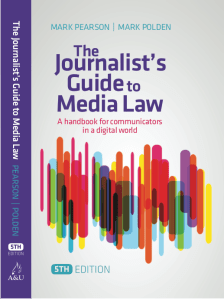
OUR fifth edition of The Journalist’s Guide to Media Law – A handbook for communicators in a digital world (Mark Pearson & Mark Polden, A&U, 2015) is now in bookshops and I will be running updates on each topic area via journlaw.com as we work towards the next edition.

Thanks to Leanne O’Donnell (mslods.com / @mslods), Virginia Leighton-Jackson and Griffith University media freedom interns and students we will be posting fresh material via this blog’s Media Law Updates menu.

There will be updates on recent cases, legislation and Australian and international media law news on the following topic areas:

Social Media Law

Free Expression

Legal and regulatory systems

Open Justice and Freedom of Information

Contempt of Court

Covering Court

Defamation

Secrets, Confidentiality and Sources

Anti-terror and hate laws

IP and copyright

Privacy

Law of PR, Freelancing and New Media Entrepreneurship

The sheer pace of change in all areas of media law is astounding so we have have built several mentions of journlaw.com into the chapters and discussion questions as a go-to resource for media law students.

We would also appreciate your input – whether you are a student, journalist, academic or lawyer.

Please email any contributions to these update sections to me, Mark Pearson, at journlaw@gmail.com .

Of course, the book and the journlaw.com examples are not meant to offer actual legal advice. Professional communicators must seek that advice from a lawyer when confronted with a legal problem. The most we claim to do is offer an introduction to each area of media law so that journalists, PR consultants and bloggers can identify an emerging issue and thus know when to call for help.

Order via Booktopia: http://www.booktopia.com.au/the-journalist-s-guide-to-media-law-mark-pearson/prod9781743316382.html

Disclaimer: While I write about media law and ethics, nothing here should be construed as legal advice. I am an academic, not a lawyer. My only advice is that you consult a lawyer before taking any legal risks.

© Mark Pearson 2015

Leave a comment

Filed under blogging, citizen journalism, contempt of court, free expression, journalism, media ethics, media law, Media regulation, social media, sub judice, Uncategorized

‘Mindful Journalism’ out Feb 24: excerpt and review copy request form here

By MARK PEARSON

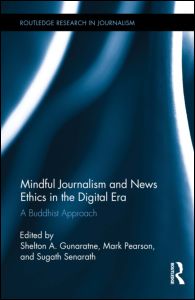
We are excited that our book Mindful Journalism and News Ethics in the Digital Era: A Buddhist Approach (Shelton Gunaratne, Mark Pearson and Sugath Senarath eds; Routledge, NY) will be available from February 24.

Review copies are available from Routledge by filling out this request form. Please see the publisher’s synopsis.

MindfulJournalismCoverThe term ‘mindful journalism’ is a concept I introduced more than a year ago in the inaugural UNESCO World Press Freedom address at AUT University Auckland, drawing upon the earlier substantive work by my esteemed colleague (and lead editor of our book), Emeritus Professor Shelton Gunaratne, who has been working for decades on the intersection between Buddhism and journalism.

I developed my application of this in a paper to the International Association for Media and Communication Research (IAMCR) conference in Dublin in July 2014, which was revised for publication as an article in Ethical Space published in December 2014.

It is being published as part of the Routledge New York Research in Journalism series. My key point was that one does not have to be a Buddhist to incorporate the key principles of mindful journalism into one’s work. In fact, most of these very moral principles are evident in the teachings of all the world’s great religions. However, for those who lack a moral framework for their ethical decision-making, a secular application of these non-theistic principles can offer a moral compass. They offer a series of normative or aspirational goals we can strive for, but rarely reach. They also provide a schema for the analysis of ethical decision-making by journalists.

To give you a taste of mindful journalism, I offer this short extract from my chapter on ‘The Journalist and Mental Cultivation’ in Mindful Journalism where I explore the possibilities of Buddhism’s ‘Right Mindfulness’ (meditation) for journalism:

A journalist could find value in several elements of this process – from the pausing to think about the duration of a single breath for calming purposes, followed by a self-assessment of thoughts, perspectives and feelings about the story or matter at hand, including breaths to acknowledge the changing nature of things, the separation of the journalist’s ego from the story, and breaths devoted to the implications of the story for those it might impact upon, from the individual who might suffer through their actions being exposed through to others who might benefit by learning from that person’s experience. Thinking about those thoughts might bring clarity to decisions related to the story – suitable priorities, whom to interview, what to check, questions to be asked, and how the facts might best be presented. Recording those thoughts – in a note or audio form – might offer a retrospective justification for the journalist’s actions if they are later called to account. Such metacognition can even become evidence in some court proceedings resulting from a story to demonstrate a journalist has acted in good faith in making “reasonable inquiries,” even if the publisher cannot prove the truth of the reputation-damaging material, as is the case with criteria for the qualified privilege defence in some jurisdictions.

Interested? You can read further extracts from the book using the “Look Inside” interface at Amazon. Enjoy.

———–

Disclaimer: While I write about media law and ethics, nothing here should be construed as legal advice. I am an academic, not a lawyer. My only advice is that you consult a lawyer before taking any legal risks.
© Mark Pearson 2015

Leave a comment

Filed under blogging, Buddhism, citizen journalism, Eightfold Path, free expression, media ethics, mental health, social media, Uncategorized

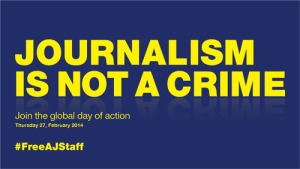
Greste release is welcome, as would be a free media in Australia #FreeAJStaff

By MARK PEARSON

My contribution to the Griffith Red Couch blog, first published here. Follow the Red Couch Blog for commentary from Griffith University academics.

Australian Prime Minister Tony Abbott celebrated the release of journalist Peter Greste after 400 days in an Egyptian prison with these words at the National Press Club in Canberra on February 2:

 “…sometimes as Australians we do take our most precious freedoms for granted. And as a former journalist myself it would be remiss of me at such a gathering of journalists not to express my personal delight and our nation’s relief at the overnight release of Peter Greste and to reiterate our support as a government and as a people for a free media and a free press.”

Peter_Greste_2012_WikiCommons

Australian journalist Peter Greste – jailed for a year in Egypt. Photo: Wikimedia Commons

GlobalFreeAJSTAFFactionThe Prime Minister was quite correct in stating Australians often take free expression for granted, but they might take the lead from both his government and the former Labor government in doing so. The Paris-based NGO Reporters Without Borders (RSF) ranked Australia 28th of 180 countries on its World Press Freedom Index last year.

That is relatively high in the league table, and Australia rarely jails its journalists and has never murdered them. Such acts are more common in nations much lower down the press freedom ladder.

According to the Committee to Protect Journalists, Peter Greste and his al Jazeera colleagues were among 221 imprisoned globally in 2014 and already this year 15 journalists have lost their lives in the course of their work.

However, Mr Abbott’s expressed “support as a government and as a people for a free media and a free press” rings somewhat hollow in the context of recent moves by Australian governments to shackle that freedom.

It is ironic that in the same week he made that statement the Prime Minister was calling for bipartisan support for his data retention laws which would force telecommunications companies to retain – and make available to government agencies – metadata including the time and location of phone calls, texts, emails, internet browsing, social media discussions and webcam communications.

That step alone – taken in the name of better national security – stands to damage irreparably the confidentiality of journalists’ sources.

This is just one of several indicators that Australia has recently embarked upon a shift towards a “state of secrecy”.

It comes against the backdrop that, unlike the United States, the United Kingdom, Canada, New Zealand and even Papua New Guinea, Australia has no national Bill of Rights or written constitutional or legislative protection of free expression or a free media.

Australia has only an “implied freedom” that our High Court justices have sadly read down over many decisions.

In its first year in office, the Abbott Government:

This is not simply an Abbott Liberal-National conservative government phenomenon. Governments have a natural inclination to control public debate. If they have the resources, mechanisms and opportunities available to them they will do so.

Australia’s previous Labor government wanted a new mechanism of media accountability because they were copping so much unfair criticism from the Murdoch press. Their knee-jerk reaction was to try to install a regulatory mechanism that any government of whatever political persuasion could use in the future.

All these measures undermine the role of Australia as a beacon of free expression in the Asia-Pacific region.

Whistleblowers are being snared by the various surveillance laws and the technologies available to detect them. They are being found and they are going to court. The proposed data retention laws will increase that likelihood.

In the area of spin, the media finds it very hard to gain access to and report upon asylum seekers and detainees – stories that are really an international human rights issue of legitimate public interest.

Australia has at least purported to be some sort of exemplar to the region of media freedom, transparency and good governance. It has spent millions on aid projects designed to enhance such values internationally. But sadly Australia is moving towards a “state of secrecy” with no constitutional brake on censorship.

A perfect storm of factors has contributed to this including the rise of spin (we now have more PR practitioners than journalists), the demise of traditional media and its budgets to defend and lobby for media freedom, and the political capital available to parties of all political persuasions in getting tough on terrorism and immigration.

We can quite rightly celebrate free expression with the release of Peter Greste after more than a year of imprisonment for simply doing his job as a journalist.

But my great fear is that fragile freedom is seriously under threat in the very country he calls home.

© Mark Pearson 2015

Disclaimer: While I write about media law and ethics, nothing here should be construed as legal advice. I am an academic, not a lawyer. My only advice is that you consult a lawyer before taking any legal risks.

4 Comments

Filed under national security, terrorism, Uncategorized

New course helps manage social media risk

By MARK PEARSON

Griffith University has issued the following release on our fully online global social media law course which I will be teaching from March 2015.

social-media-law-risk-management-postgraduate-degree-griffith

New course helps manage social media risk

Managing your social media risk and protecting your brand is the focus of a fully online global social media law course to be offered at Griffith University from March 2015.

Social Media Law and Risk Management is aimed at professional communicators internationally who want an introduction to the laws impacting on social media use and other strategies for strategic social media management.

“It addresses one of the key organisational and crisis communication phenomena of the modern era – engaging effectively and internationally with a range of stakeholders using social media while being cognisant of laws, risks and policies,’’ says course convenor Professor Mark Pearson.

“The course examines the dynamic role of social media law and risk management in a range of social and political contexts internationally, particularly in averting communication crises.

“It provides advanced knowledge and skills in the use of social media by government, non-governmental organisations, business and the general public.”

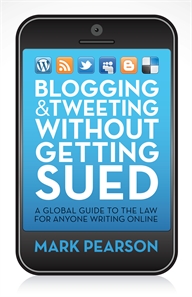
Professor Pearson is the author of Blogging and Tweeting Without Getting Sued – A Global guide to the Law for Anyone Writing Online, co-author (with Mark Polden) of The Journalist’s Guide to Media Law and the Australian correspondent for Reporters Without Borders. His Twitter handle is @journlaw.

Social Media Law and Risk Management is offered online as a stand-alone course or as part of a suite of four courses in the Graduate Certificate in Crisis Communication for students who can visit Griffith University’s Gold Coast or Nathan campuses for their other three courses.

Media Contact: Deborah Marshall, 0409 613 992, d.marshall@griffith.edu.au

—-

Please drop me a line at m.pearson@griffith.edu.au if you would like further information after reading the course brochure available here.

© Mark Pearson 2014

Disclaimer: While I write about media law and ethics, nothing here should be construed as legal advice. I am an academic, not a lawyer. My only advice is that you consult a lawyer before taking any legal risks.
Leave a comment

Filed under Uncategorized

Course outline for global social media law course starting in March

By MARK PEARSON

WE have now posted the course profile for our fully online global social media law course which I will be teaching from Griffith University, starting in March 2015.

social-media-law-risk-management-postgraduate-degree-griffith


Titled ‘Social Media Law and Risk Management’, the course is targeted at professional communicators internationally who want an introduction to the laws impacting on social media use and other strategies for strategic social media management including social media policies and risk analysis.

The course can be undertaken as a fully online, stand-alone unit if you just want these skills and may not be able to attend in person, or as part of a suite of four courses in the Graduate Certificate in Crisis Management for students who can visit Griffith University’s Gold Coast or Nathan campuses for their other three courses.

You can read more about the entry requirements, application procedures and fees for the social media law course here.

The course outline, including the learning activities and assessment, can be viewed here.

The course examines the dynamic role of social media law and risk management in a range of social and political contexts internationally, particularly in the averting of communication crises. It provides advanced knowledge and skills in the use of social media by government, non-governmental organisations, business, and the general public. Its special focus is on law and risk management in social media in a global context.

After explaining the basic legal concepts required for effective analysis and understanding, and the elements of stakeholder theory underpinning the course, we then proceed to examine key areas of the law arising internationally when professional communicators use social media. These include defamation, contempt of court, privacy, confidentiality, discrimination, copyright, consumer law and censorship. This feeds into a critical examination of the terms of use of social media providers, effective social media policy formulation and social media risk management – all key skills and understandings for crisis communication.

The course can be completed online with no requirement for on-campus attendance. For on-campus students two meetings per semester will be held on the Nathan and Gold Coast campuses for students to meet colleagues and workshop material with instructors. Learning activities will include video lectures, readings, online discussion board activity, social media interaction, multiple choice quizzes and problem-based learning. Each module is focused upon a social media law or risk scenario where students are challenged to draw upon their readings, case studies and professional experience to map out an appropriate diagnosis and strategic course of action.

‘Social Media Law and Risk Management’ addresses one of the key organisational and crisis communication phenomena of the modern era – engaging effectively and internationally with a range of stakeholders using social media while being cognisant of laws, risks and policies.

The course integrates theory and practice by introducing both stakeholder theory and jurisprudential theory of legal systems in the first module and then applying both in the balance of the course throughout learning activities and assessment tasks. The readings, learning problems and portfolio are designed to allow students to find recent cases from within their own jurisdictions internationally to make their learning most relevant to their particular nation, state or territory of professional practice.

Of course, social media is an international medium and therefore all students need to be broadly aware of the laws and risks applying globally. The course bears a direct relationship to students’ professional needs as crisis communicators in a variety of career roles – public relations, journalism, government communications, corporate communications, social media moderation, marketing, human resources and law.

Assessment includes a reflective learning journal, online multiple choice quizzes, and a written assignment involving the critical appraisal of a social media policy.

Please drop me a line at m.pearson@griffith.edu.au if you would like further information after reading the course brochure available here.

© Mark Pearson 2015

Disclaimer: While I write about media law and ethics, nothing here should be construed as legal advice. I am an academic, not a lawyer. My only advice is that you consult a lawyer before taking any legal risks.

Leave a comment

Filed under Uncategorized

Griffith Uni to offer online global social media law course

By MARK PEARSON

WE are now taking applications for a fully online global social media law course which I will be teaching from Griffith University, starting in March 2015.

social-media-law-risk-management-postgraduate-degree-griffith


Titled ‘Social Media Law and Risk Management’, the course is targeted at professional communicators internationally who want an introduction to the laws impacting on social media use and other strategies for strategic social media management including social media policies and risk analysis.

The course can be undertaken as a fully online, stand-alone unit if you just want these skills and may not be able to attend in person, or as part of a suite of four courses in the Graduate Certificate in Crisis Management for students who can visit Griffith University’s Gold Coast or Nathan campuses for their other three courses.

You can read more about the entry requirements, application procedures and fees for the social media law course here.

The course examines the dynamic role of social media law and risk management in a range of social and political contexts internationally, particularly in the averting of communication crises. It provides advanced knowledge and skills in the use of social media by government, non-governmental organisations, business, and the general public. Its special focus is on law and risk management in social media in a global context.

After explaining the basic legal concepts required for effective analysis and understanding, and the elements of stakeholder theory underpinning the course, we then proceed to examine key areas of the law arising internationally when professional communicators use social media. These include defamation, contempt of court, privacy, confidentiality, discrimination, copyright, consumer law and censorship. This feeds into a critical examination of the terms of use of social media providers, effective social media policy formulation and social media risk management – all key skills and understandings for crisis communication.

The course can be completed online with no requirement for on-campus attendance. For on-campus students two meetings per semester will be held on the Nathan and Gold Coast campuses for students to meet colleagues and workshop material with instructors. Learning activities will include video lectures, readings, online discussion board activity, social media interaction, multiple choice quizzes and problem-based learning. Each module is focused upon a social media law or risk scenario where students are challenged to draw upon their readings, case studies and professional experience to map out an appropriate diagnosis and strategic course of action.

‘Social Media Law and Risk Management’ addresses one of the key organisational and crisis communication phenomena of the modern era – engaging effectively and internationally with a range of stakeholders using social media while being cognisant of laws, risks and policies.
The course integrates theory and practice by introducing both stakeholder theory and jurisprudential theory of legal systems in the first module and then applying both in the balance of the course throughout learning activities and assessment tasks. The readings, learning problems and portfolio are designed to allow students to find recent cases from within their own jurisdictions internationally to make their learning most relevant to their particular nation, state or territory of professional practice.

Of course, social media is an international medium and therefore all students need to be broadly aware of the laws and risks applying globally. The course bears a direct relationship to students’ professional needs as crisis communicators in a variety of career roles – public relations, journalism, government communications, corporate communications, social media moderation, marketing, human resources and law.

Assessment includes a reflective learning journal, online multiple choice quizzes, and a written assignment involving the critical appraisal of a social media policy.

Please drop me a line at m.pearson@griffith.edu.au if you would like further information after reading the course brochure available here.

© Mark Pearson 2014

Disclaimer: While I write about media law and ethics, nothing here should be construed as legal advice. I am an academic, not a lawyer. My only advice is that you consult a lawyer before taking any legal risks.

Leave a comment

Filed under Uncategorized

Mindful Journalism in a nutshell: @journlaw keynote to JEANZ

By MARK PEARSON

EARLIER this month I had the honour of delivering the keynote address to the Journalism Education Association of New Zealand annual conference in Christchurch.

MindfulJournalismCoverThe topic was “Mindful Journalism: towards a new ethics of compassion”, and I offer the summary here (pdf: JEANZMindfulJsm2014) in the form of my Powerpoint slides presented at that conference.

The term ‘mindful journalism’ is a concept I introduced more than a year ago in the inaugural UNESCO World Press Freedom address at AUT University Auckland, drawing upon the earlier substantive work by esteemed colleague, Emeritus Professor Shelton Gunaratne, who has been working for decades on the intersection between Buddhism and journalism.

I developed my application of this in a paper to the International Association for Media and Communication Research (IAMCR) conference in Dublin in July 2014, which was revised for publication as a forthcoming article in Ethical Space due to be published this month (December).

Professor Gunaratne and I refined our thoughts further in a book co-edited with Sri Lankan colleague Dr Sugath Senarath [pdf file] from the University of Colombo, with Professor Gunaratne as lead editor and contributions from a range of other scholars.

Routledge New York accepted our proposal for hard cover publication in March 2015 as part of its Research in Journalism series.

Our book is titled Mindful Journalism and News Ethics in the Digital Era: A Buddhist Approach and it features chapters by several scholars from Asia, North America, Australia and Europe. Please see the publisher’s synopsis.

My address to journalism education colleagues in Christchurch this month picked up on some of the key themes of Mindful Journalism, particularly those linked to the Eightfold Path.

My key point was that one does not have to be a Buddhist to incorporate the key principles of mindful journalism into one’s work. In fact, most of these same moral principles are evident in the teachings of all the world’s great religions. However, for those who lack a moral framework for their ethical decision-making, a secular application of these non-theistic principles can offer a moral compass to those who feel they lack one because they offer a series of normative or aspirational goals we can strive for, but rarely reach. They also provide a schema for the analysis of ethical decision-making by journalists.

———–

Disclaimer: While I write about media law and ethics, nothing here should be construed as legal advice. I am an academic, not a lawyer. My only advice is that you consult a lawyer before taking any legal risks.

© Mark Pearson 2014

1 Comment

Filed under blogging, Buddhism, citizen journalism, Eightfold Path, free expression, media ethics, mental health, social media, Uncategorized

Is Australia an emerging Secret State?

By MARK PEARSON

My speech to the Pacific Journalism Review 20th Anniversary conference in Auckland, on November 27, 2014 was titled: ‘Suppression, sentences, surveillance, security and cynical spin: Is Australia an emerging Secret State?’

PJR Review Conf Notice 2014 550wideYou can read an abridged version of that speech in The Conversation here.

You can also hear the full audio of my presentation here.

In it I track the first year in office the Abbott Government, where it has:

  • blocked the media from information on the important human rights issue of the fate of asylum seekers
  • initiated major budget cuts on the publicly funded ABC
  • used anti-terror laws to win a ‘super injunction’ on court proceedings that might damage its international relations
  • ramped up surveillance powers of national security agencies and banning reporting of security operations
  • proposed increased jail terms for leaks about security matters
  • moved to stop not-for-profits advocating against government policy in their service agreements
  • abolished the Office of the Information Commissioner for abolition, promising tardy FOI appeals
  • proposed the taxing of telcos to pay for its new surveillance measures, potentially a modern version of licensing the press.

Australia has at least purported to be an exemplar of media freedom, transparency and good governance throughout the region, but continues to censor those who teach and counsel on those initiatives throughout the region. Here is the standard gag clause from the most current ($3 million Transparency International) contract:

Gagclause

My conclusion is that Australia might not be a secret state like North Korea but it is certainly moving towards a “state of secrecy” and it is doing so with no constitutional brake in our country on censorship.

It is now sending a mixed message to the region on free expression, transparency and good governance.

You can read an abridged version of that speech in The Conversation here.

You can also hear the full audio of my presentation here.

© Mark Pearson 2014

Disclaimer: While I write about media law and ethics, nothing here should be construed as legal advice. I am an academic, not a lawyer. My only advice is that you consult a lawyer before taking any legal risks.

Leave a comment

Filed under national security, terrorism, Uncategorized

Accuracy, independence and impartiality – Kellie Riordan #jeraa2014 live blog

LIVE BLOG

By MARK PEARSON

Australian Broadcasting Corporation’s Kellie Riordan reported to the Journalism Education and Research Association of Australia’s conference in Sydney on her recent report on how legacy media and digital natives approach ethical standards in the digital age.

ABC's Kellie Riordan addressing the JERAA conference on her research into digital and legacy media ethics

ABC’s Kellie Riordan addressing the JERAA conference on her research into digital and legacy media ethics

She recently served as a fellow at the Oxford Reuters Institute for the Study of Journalism where she looked at three traditional and three new media providers and their ethical standards and approaches.

Riordan noted a shift in the notion of accuracy.

“Now we are equally looking to journalists to tell us what is not true, and the best example is the BBC’s User Generated Content Hub,” she said.

It was set up to debunk myths, and originated with the myth that there was a power surge in the London Underground when in fact the London bombings had occurred.

She also identified corrections were now being issued that were much more open and honest and developed brand trust. These were done particularly well by digital media.

“Traditionally newsrooms have been closed organisations and we haven’t let the public in on how we came to decisions,” she said.

She showed an example from the digital outlet Grantland which gave an extensive debriefing on how they came to an editorial decision when they got something wrong.

Riordan profiled The Quartz qz.com site which does not subscribe to impartiality as a standard but boast about their transparency and honesty with their audience.

On the issue of independence, she gave several examples of advertorials in some outlets that were not necessarily flagged as paid content on search engines.

She cited Buzzfeed’s Ben Smith arguing that audiences were already quite literate about different types of sponsored content on the Internet, whereas others felt the journalism brand required the disclosure of advertising.

She found a range of views across new media on the issue of impartiality and that Quartz advocated an ‘evidence driven, facts based’ style of journalism.

User generated content, interaction with audiences and more extensive use of hyperlinks for attribution were important developments to improve accountability and transparency, she said.

Riordan concluded by calling for greater transparency, more open forms of journalism, and ‘a voice that is of the web driven by reporters rather than news brands’.

She suggested digital tools like hyperlinks, context for corrections, more voices and transparency would add to accountability.

https://twitter.com/roza_gee/status/537039270666465280

https://twitter.com/roza_gee/status/537038912032497664

https://twitter.com/johanBalance/status/537038514487971840

https://twitter.com/SrinidhiParanji/status/537038310888050688

https://twitter.com/roza_gee/status/537037347791986689

https://twitter.com/roza_gee/status/537036927875039233

https://twitter.com/roza_gee/status/537036275706896384

https://twitter.com/SrinidhiParanji/status/537036124741320704

https://twitter.com/roza_gee/status/537035851419492353

https://twitter.com/roza_gee/status/537035308064202753

https://twitter.com/roza_gee/status/537034767888179201

© Mark Pearson 2014

Disclaimer: While I write about media law and ethics, nothing here should be construed as legal advice. I am an academic, not a lawyer. My only advice is that you consult a lawyer before taking any legal risks.

Leave a comment

Filed under Uncategorized