Category Archives: Uncategorized

Journalism privileges and accountability in the digital age – Denis Muller #jeraa2014 live blog

LIVE BLOG

By MARK PEARSON

The digital age has increased both possibilities and risks for journalism, according to media ethicist Dr Denis Muller from the Centre for Advancing Journalism at the University of Melbourne.

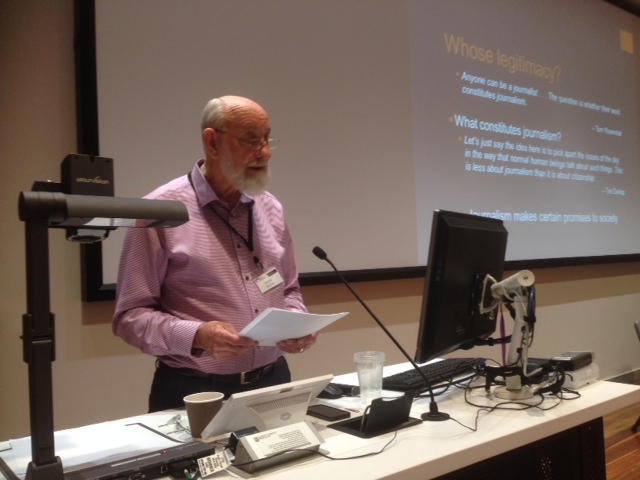
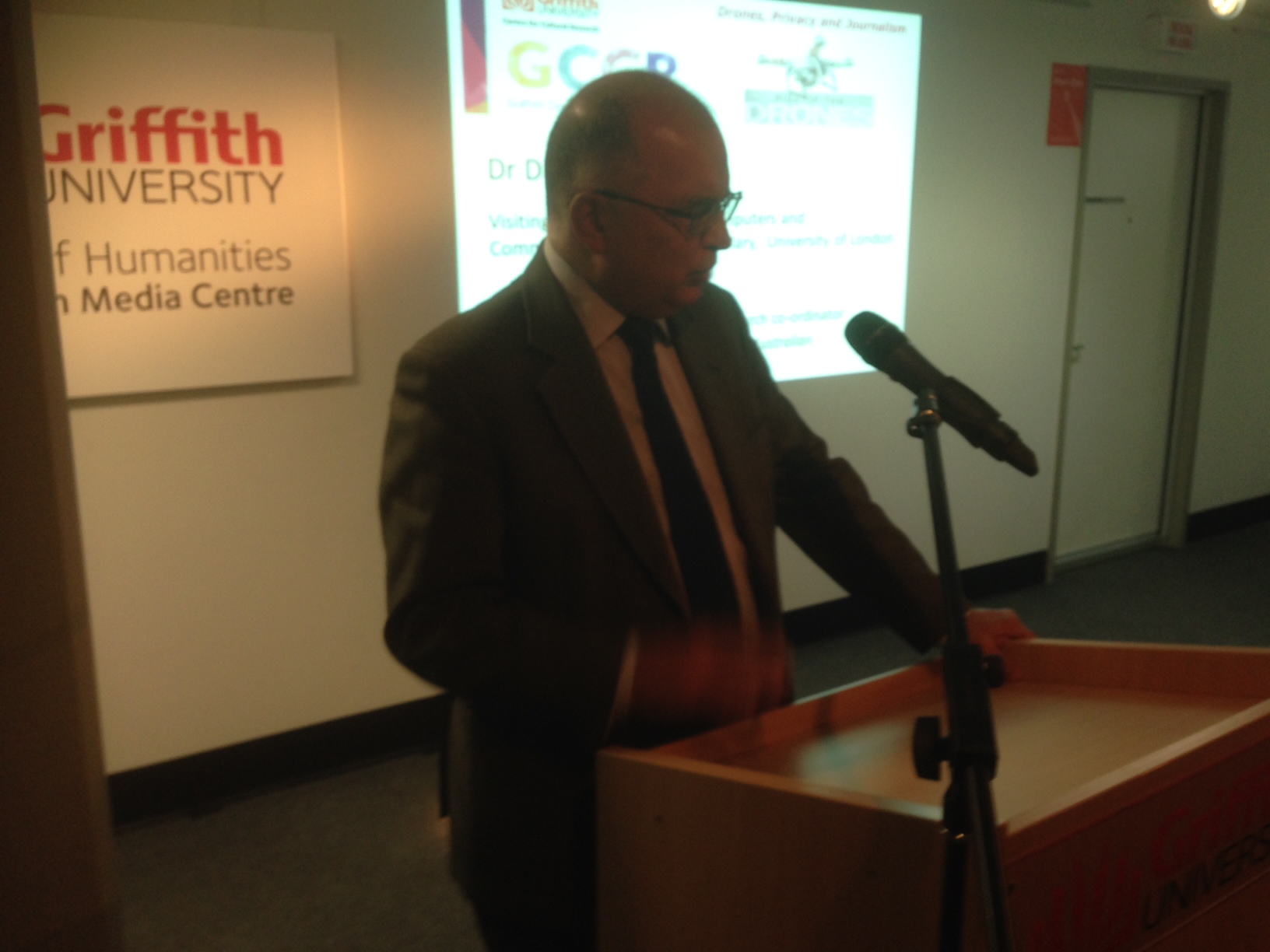
Denis Muller addresses the JERAA conference on the legitimacy of journalism

Denis Muller addresses the JERAA conference on the legitimacy of journalism

Muller was addressing the privileges, legitimacy and accountability of journalism at the annual conference of the Journalism Education and Research Association in Sydney.

He said the types of privilege offered to journalism were access to powerful people, places to observe events, and certain legal protections, however the digital revolution had made the privileges for those from big media inadequate for others like bloggers.

“This is a narrow and increasingly irrelevant basis for conferring legitimacy,” he said.

“Legitimacy of the journalistic function has more important bases than this.”

He said legitimacy of journalism as a function in a democracy is grounded in a combination of rights and socio-political necessity.

Journalism had a contrctual relationship with the community based on factual and constextual reliability, impartiality, separation of fact from comment and provision of a “bedrock of trustworthy information”.

The legitimacy of the journalistic function rests on the indispensability of its function, its capacity to animate free speech and the keeping of its promises,” Dr Muller said.

He highlighted privileges at law under the Commonwealth Privacy Act and State Shield laws – contingent on media organisations being signed up to an accountability mechanism.

Others not contingent on such accountability were the privileges under the Australian Consumer Law and the Commonwealth shield laws.

The latter protected anyone providing news to the public, seemingly including bloggers and others reporting news.

He reviewed the regulatory recommendations of the Finkelstein Review, the Convergence Review and the Leveson Inquiry and explained there was no accountability mechanism for journalists outside of the Media Entertainment and Arts Alliance sanctions for its members breaching its Code of Ethics.

He said he had worked with colleague Dr Judith Townend from City University London’s Centre for Law, Justice and Journalism comparing the suggested accountability mechanisms for the Australian news media.

They argued for

  • access to incentives in the form of privileges,
  • contingent on signing up to accountability mechanism,
  • and that this mechanism be open to all who practise journalism.

The first step was the creation of a consensual set of ethical standards – professional norms and standards, they argued.

“News organisations should take a ‘get in’ rather than a ‘get you’ approach,” he said.


https://twitter.com/Aimee_Saaib/status/537029945482960896

https://twitter.com/SrinidhiParanji/status/537029762007326720


© Mark Pearson 2014

Disclaimer: While I write about media law and ethics, nothing here should be construed as legal advice. I am an academic, not a lawyer. My only advice is that you consult a lawyer before taking any legal risks.

Leave a comment

Filed under Uncategorized

On the Crisis in Journalism – Barbie Zelizer #jeraa2014 live blog

LIVE BLOG

By MARK PEARSON

Raymond Williams Professor of Communication at the Annenberg School of Communication at the University of Pennsylvania Dr Barbie Zelizer took issue with the framing of a ‘crisis of journalism’ for her keynote address to the Journalism Education and Research Association of Australia conference in Sydney today (November 25).

zelizer

Professor Barbie Zelizer addresses the 2014 JERAA conference


She said notion of a crisis in journalism was a culturally determined phenomenon anchored in the Enlightenment.

She drew on definitions of crisis as disruption, suddenness, loss, urgency and helplessness.

The label of ‘crisis’ could change murky developments into a manageable phenomenon.

“Crisis is a temporarily defined moment,” she said. “Crisis is identifiable, finite, something that can be grasped, treated and controlled. It gives us a sense of closure.

“By offering us closure, concreteness and coherency, crisis offers us certainty and control.”

“As an institution journalism has always had an affinity with a certain kind of modernity,” she said.

“It was born of a particular time and place.”

She argued the discipline of journalism studies developed because it needed to challenge traditional narratives of journalism.

There was a reliance on a modern Anglo-American mindset and crisis offered a way out of murky, out of control challenges.

The gravitation to ‘crisis’ followed a pattern of how journalism had traditionally talked about itself.

“Across the board we hear that journalism is over. What’s different about today is that durability is no longer assured.”

She asked whether journalism’s mass audience ever as mass as assumed and whether there had ever had been agreement about what journalism is or is for.

Earlier points in time such as the development of radio, the wire photo and television presented challenges and disagreements.

“There is value in both rupture and in continuity,” she said.

These narratives see crisis as resolvable or apocalyptic.

“All of this is a long way of saying today’s journalistic environments are contingent and diverse,” she said.

“Uncertainty rules in institutional settings, generally without us being aware of it.”

She concluded by suggesting:

1. We assume the centrality of crisis but rarely find data to support it;

2. We identify various nodes supporting the technological determination of the crisis frame; and

3. We assume an overturning of value – what was once seen as central (the newspaper, objectivity) is now seen as toxic.

“Uncertainty is ours to live with not to control or eradicate,” she said.

“The question remains whether uncertainty can ever end in a landscape that is institutionally driven.”

She concluded with a quote from T.S. Eliot: “If you aren’t in over your head how do you know how tall you are?”

https://twitter.com/jennineak/status/537008931998945280

© Mark Pearson 2014

Disclaimer: While I write about media law and ethics, nothing here should be construed as legal advice. I am an academic, not a lawyer. My only advice is that you consult a lawyer before taking any legal risks.

Leave a comment

Filed under Uncategorized

Governor enters the Twittersphere with Who’s Who pics of #G20

Congratulations to Griffith University journalism students on their excellent coverage of the G20 from our South Bank newsroom and to their mentors at the Brisbane Times and 4BC.
This story by Elizabeth Andal about the former chief justice and now Governor of Queensland Paul de Jersey entering the Twittersphere with his photos with G20 dignitaries is just a taste. See the sourcenews.com for the full coverage.

thesourcenews's avatarThe Source News

ELIZABETH ANDAL

Queensland Governor Paul de Jersey has entered the Twittersphere with a series of posts of himself with G20 dignitaries.

His most recent post featured Twit pics of him greeting Russian President Vladimir Putin with a handshake upon his arrival in Brisbane airport last night.

Governor de Jersey also tweeted a picture of himself casually chatting with Singapore Prime Minister Lee Hsien Loong.

On Wednesday the governor proudly posted his first tweet, and staff followed with the official announcement that he had entered the Twittersphere, featuring a photograph of him writing and posting that historic first tweet.

View original post 181 more words

Leave a comment

Filed under Uncategorized

International studies point to best practice for reporting Islam and stories involving Muslims

By MARK PEARSON

Three key international studies counsel journalists to reflect carefully on their practice when they are reporting news and issues involving Islam and people who follow it.

Griffith University colleague Dr Jacqui Ewart and I have been funded to explore the best practice in reporting upon the Islamic religion and Muslim people with a view to developing educational resources and training materials.

The project has involved a literature review of the field, the identification of case studies in the Australian media highlighting different approaches to such coverage, and the analysis of extended interviews we are conducting with journalists, educators, students, media relations personnel and other experts the topic.

An important part of the literature review has been to identify similar studies conducted internationally on the topic – ably conducted by one of our research assistants, experienced journalist Guy Healy.

We have identified these three reports as offering excellent guidance to journalists and educators working in this space and we would appreciate hearing from those of you willing to engage in dialogue on the topic.


Screen Shot 2014-11-13 at 6.36.02 PMRupar, Verica (2012). Getting the facts right: Reporting ethnicity and religion. A study of media coverage of ethnicity and religion in Denmark, France, Germany, Greece, Hungary, Italy, Lithuania, Slovakia and the United Kingdom.[Project Report]. Brussels: International Federation of Journalists. Available at: http://ethicaljournalisminitiative.org/en/contents/eji-study-2012

This report from Associate Professor Dr Verica Rupar of Cardiff University (now with AUT University, Auckland) aims to improve “…the media’s ability to accurately and fairly report on people, events and issues that touch upon ethnicity and religion.” It draws upon interviews with 117 journalists in nine EU countries and the analysis of almost 200 news stories.

While its scope goes well beyond the reporting of Islam and Muslims, many of its examples and recommendations apply to this religion and its followers.

The study highlights immigration as a topic conflated with Muslims and Islam.

The report suggests the main obstacles to good reporting are the poor financial state of the media, overloading of reporters, lack of time, lack of knowledge, and lack of in-house training.

Overall, it identifies the media’s tasks as:

* Reporting factually and accurately on acts of racism and intolerance

* Being sensitive when writing about tensions between communities

* Avoiding derogatory stereotypical depiction of members of religious groups

* Challenging the assumptions underlying intolerant remarks made by speakers in the course of interviews, reports, and discussion programs.

It calls upon journalists to become more familiar with with anti-discrimination legislation, use broader networks of expert sources, ensure facts are put in context, avoid negative labels, portray people as human beings instead of members of an ethnic or religious group, organize in-house training and adopt internal editorial guidelines.


Screen Shot 2014-11-13 at 6.39.00 PMGreater London Authority (2007). The Search for Common Ground: Muslims, non-Muslims and the UK media. A report commissioned by the Mayor of London. London: Greater London Authority. Available at: http://www.insted.co.uk/search-for-common-ground.pdf

This major study on British media coverage of Islam and Muslims was commissioned by the Greater London Authority in the wake of the London bombings and perceived polarisation of coverage in the media.

It involved opinion poll reviews, studies of recent books and stories, a randomised survey of one week’s news stories, examination of stories about political correctness, interviews with Muslim journalists, and analysis of a television documentary. The researchers were commissioned to inquire into whether the media stimulated informed debate about building a multicultural society, or oversimplified and provided insufficient background that pandered to reader anxieties and prejudices. Other key questions focused on whether stories fostered anxiety, fear and hostility between non-Muslims and Muslims, and whether reportage increased or decreased a sense of common ground, shared belonging and civic responsibility.

Its principal recommendations included (at p. 133):

  • News organisations should review their coverage of issues and events involving Muslims and Islam.
  • They should consider drawing up codes of professional conduct and style guides about use of terminology.
  • News organisations should recruit more journalists of Muslim heritage.

Screen Shot 2014-11-13 at 6.40.35 PMPintak, Lawrence and Franklin, Stephen (eds) (2013). Islam for Journalists; A Primer on Covering Muslim Communities in America. [Digital newsbook]. US Social Science Research Council; Edward R Murrow College of Communication, Washington State University. Available at: http://www.rjionline.org/newsbooks/islam-for-journalists

This 343-page e-book was released in 2011 and has since been updated. It contains chapters by several journalists and educators and is presented as an online course in covering stories related to Islam and Muslims. It features a useful glossary of Arabic terms and an extended list of resources.

In his afterward, titled ‘Islam on Main Street’ Lawrence Pintak states that the coverage of Islam is in many ways no different than the coverage of other topics, except that it is potentially inflammatory.

He suggests:

* carefully assess the bona fides of so-called experts, and make sure the audience is provided with the information they need to weigh the credibility of speakers.

* provide background and context when quoting non-academic “experts” and be transparent about their sponsorships and allegiances.

* turn to academics for guidance because many will offer a more researched and balanced perspective on the topic.


We look forward to hearing from others working in this space.

———–

Disclaimer: While I write about media law and ethics, nothing here should be construed as legal advice. I am an academic, not a lawyer. My only advice is that you consult a lawyer before taking any legal risks.

© Mark Pearson 2014

1 Comment

Filed under blogging, citizen journalism, free expression, Islam, journalism, journalism education, media ethics, Media regulation, Muslim, Press freedom, social media, Uncategorized

Presenting the best of @Griffith_Uni student news blogs

By MARK PEARSON

THE greatest reward for a teacher at any level of education is in celebrating your students’ successes. Colleague Mic Smith and I did this today as we announced the winners of various awards to our students in the course Online News Production, where students were assigned to create multimedia news content and post them to their own news blogs.

I hope you agree as you browse the winners’ work that there are some outstanding examples of multimedia journalism and social media engagement here across a host of topics.

Congratulations students on aiming for excellence … and achieving it!

Cheers,

Mark (@journlaw)

NathanWinners2014

Brisbane students of Griffith University celebrate their Online News Production Golden Mouse Awards for excellence in news blogs. Photo: Jimmy Wall

GCwinners2014-2

Gold Coast Griffith University students proudly display their Golden Mouse awards for excellence in news blogging. Photo: Kirsty Schmitt

Golden Mouse Awards 2014 – Brisbane 

Golden Mouse Award for Best Overall Blog

Screen Shot 2014-10-29 at 1.37.11 PMErin Maclean

Lady Game Bug

http://ladygamebug.wordpress.com/


Golden Mouse Award for Best Multimedia News Story

Screen Shot 2014-10-29 at 1.38.37 PMNatasha Hoppner

‘Police say vested interests will prevent power abuse’

B4G20 blog

http://b4g20.wordpress.com/2014/09/24/84/


Golden Mouse Awards – Gold Coast

Golden Mouse Award for Best Overall Blog

Screen Shot 2014-10-29 at 1.42.41 PMPaul Eyers, James Laidler and Tom Mann

Waterways News Gold Coast

http://waterwaysnewsgoldcoast.wordpress.com/about/


Golden Mouse Award for Best Multimedia News Story

Screen Shot 2014-10-29 at 1.44.21 PMDanielle Laing

‘Food safety, fraud and what it means for organic farming in China’

Organic in China blog

http://organicinchina.tumblr.com/post/98375795557/food-safety-fraud-and-what-it-means-for-organic


Other category finalists and winners (Brisbane)

Best education or arts blog finalists

A Reel Film Focus http://areelfilmfocus.wordpress.com/

Jordan Towning, Jane Orme, Joshua Wells, Riley Jackson

Best education or arts blog winner

 Art Student Q : artstudentq.wordpress.com

Tara Ingham

Best human rights / international blog

Tamara Sydenham and Gabrielle Smith

Brisbane Universities Amnesty International Clubs

http://brisuniamnesty.wordpress.com/

Best community blog

Emma McCluney

Ambush the Airwaves

http://communityradiocompanion.wordpress.com/

Most mindful blog on social issues finalist

Jimmy Wall

Fork: Privacy and Cryptography News http://fork.dokterw.me/

 Most mindful blog on social issues winner

Christopher Da Silva and Tim Noyes (NA)

Hard Core Truth Australia

http://hardcoretruthaustralia.wordpress.com/

 Best multicultural or indigenous issues blog

Audrey Courty

Indigenous Pulse
http://
indigenouspulse.wordpress.com

Best mental health blog finalist

Daniel Conaghan: A Different Perspective

http://dcmentalhealth.wordpress.com/

Best mental health blog winner

Talkin‘ About Mental Health 

http://talkinaboutmentalhealth.wordpress.com/

Krystal Gordon and Rachel Harding

Best sports blog

Nickolas Feldon and Jonathan Najarro

Round 13

www.13thround.wordpress.com

Best nature, science or environment blog finalist

Amy Mitchell-Whittington: Fishes for Thought

fishesforthought.wordpress.com

Best nature, science or environment blog winner

Simon Graham: Returning Cuckoo

http://returningcuckoo.wordpress.com/


Finalists and winners (Gold Coast)

Best education or arts blog finalists

Lydia Collins Donlon – Chasing Swell – http://chasingswell.wordpress.com/

Phil Kimmins Ubud Letters – ubudletters.com

 Kirsty Schmitt – Educating Alice- http://educatingalice.wordpress.com

 Best education or arts blog winner

 Janis Hanley

Digital storytelling for learning

https://digitalstorytellingforlearning.wordpress.com

Best human rights / international blog finalists

Gold Coast Refugee Australia

 http://goldcoastrefugee.wordpress.com

Pratsiri Setthapong

Best human rights / international blog winner

Africa: The Real Picture

Ruth Goodwin, Uduakobong Etukudo, Ohimai Longe

http://africatherealpicture.wordpress.com/

Best community blog finalist

Sophie Wood 

Do Good Brisbane

dogoodbrisbane.wordpress.com

Best community blog winners

Gabrielle Quinn and Jayde Austin

The Hidden Wonders

thehiddenwonders.squarespace.com/home

Most mindful blog on social issues finalists

Maleika Halpin: appleadayblog.com

Courtney Kelly  and Daphne Maresca: http://boundbyculture.wordpress.com/

Most mindful blog on social issues winner

Samuel Turner:

What are the Odds: Gambling in Australia

http://gamblinginaustralia.wordpress.com/

Best multicultural or indigenous issues finalists

Courtney Kelly – Bound By Culture –  http://boundbyculture.wordpress.com/

Best multicultural or indigenous issues blog winner

Kaylene Lawson

Street Culture

www.stculture.com

Best health, nutrition and fitness blog

Jessica O’Donnell

Healthy Mind and Body

http://healthymindandbodyblog.com/

Best mental health blog finalists

Sarra Davis – Sincerely Sarra http://www.sincerelysarra.wix.com/sincerelysarra  

Crystal-Rose Fleming- Youthful Health – http://youthfulhealth.wordpress.com/

Best mental health blog winners

Jo-Anne Wormald and Emma Lasker (GC)

Golden Oldies News

www.goldenoldienews.wordpress.com

Best sports blog finalists

Brooke Dalton and Alexandra Purser

SEQ Sports Report

http://seqsportsreport.wordpress.com 

Best sports blog winner

Mathilda Andersson

The Sunny Side of Hockey

http://www.thesunnysideofhockey.wordpress.com

Best nature, science or environment blog finalists

Bjorg Hildrum Saltveit and Tone Skredderbakken

UniUniverse

http://uniuniverse.wordpress.com 

Best nature, science or environment blog winner

Kelly Campbell

Plastic For Fence Sitters
http://kellyanncampbellwp.wordpress.com/

Best fashion or lifestyle finalist

Gabriella Ruiz

Brisbane Fashion Bloom

http://brisbanefashionbloom.wordpress.com/

Best fashion or lifestyle winner

Casey Brown

The Fashion Connection 2014

http://thefashionconnection2014.wordpress.com/

———–

Disclaimer: While I write about media law and ethics, nothing here should be construed as legal advice. I am an academic, not a lawyer. My only advice is that you consult a lawyer before taking any legal risks.

© Mark Pearson 2014

1 Comment

Filed under blogging, citizen journalism, journalism, journalism education, media ethics, social media, Uncategorized

Why The Australian is un-Australian: all ego and little heart

First they came for journalism educator Julie Posetti, for simply tweeting some critical comments made publicly by a former staffer of The Australian. [That time I did write a commentary in Crikey about why editors shouldn’t sue for defamation.]

Then they came for Matthew Ricketson, Greg Jericho, Margaret Simons, Wendy Bacon, Martin Hirst and Jenna Price and to my shame I said very little.

Well, this week they came for a good friend and colleague, Penny O’Donnell from the University of Sydney, and I refuse to remain silent. Enough is enough.

She is one of the most committed and respected journalism educators I know – in both research and teaching – and has shown the greatest courage in her personal life in recent years that has elevated my esteem for her even higher.

Sadly, the reputation of The Australian newspaper has followed the opposite trajectory. It is celebrating its 50th birthday this year, and my view is that the first 40 were far better than the last ten.

For many years I’ve been torn between my loyalty to The Australian as my former masthead where I learned a great deal as a young journalist in the early 1980s – and that very newspaper’s antipathy towards journalism education, the career I left it to pursue, and towards the people who do it.

[Note to colleagues: my comments here are about The Australian as a masthead and its leadership and branding – not about the scores of high quality journalists who produce stellar work there in both reporting and production. Similarly, I do not argue that every journalism educator is a saint or that every course is perfect.]

I’ve decided that the problem with The Australian as a masthead is that it is narcissistic and, like the Tin Man in The Wizard of Oz, it lacks a heart. It is dry, unforgiving and remarkably impolite, often downright bitchy, to its media competitors and its enemies of the moment.

Sadly, like a true narcissist, it lets its own interests, agendas and catfights affect the quality of the journalism in its pages.

For a so-called intellectual broadsheet dealing with extremely complex political, scientific and social phenomena, The Australian has a remarkably simple and narrow world view.

WellfightIslamTheAustralianAs far as The Australian is concerned, it seems to be all about The Australian. And that’s about whether you are on the Left or the Right and whether you fit with its commercial objectives or stand in their way.

It does this blatantly in the media domain.

Like broadcaster Alan Jones it takes a ‘pick and stick’ approach to its friendships – and God help you if you are a perceived enemy.

The Media section is a corporate propaganda sheet. Its stories fit comfortably within the newspaper’s agenda, achievements of any competitors or political enemies are played down or absent, the latest circulation figures are skewed to suit its image, while the corporate and self-marketing line is front and centre.

Just peruse the Media Diary section every Monday and you get a stream of bile against people from the perceived enemy camps of Fairfax, the ABC, Media Watch, the Guardian, journalism education, the Daily Mail and commercial enemies all and sundry.

To use sporting parlance with political currency right now, the newspaper takes a ‘win at all costs’ approach to its market share and issues on its agenda. Alternative voices either don’t get a mention or are derided as ‘strident critics’ or belittled for their political allegiances.

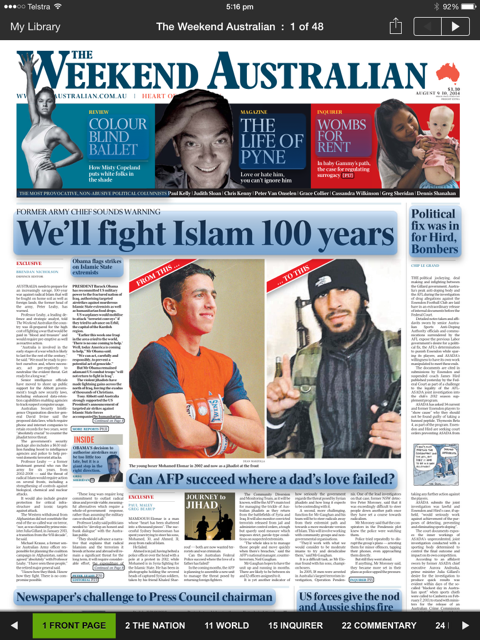
It will jump at a stereotypical jingoistic headline on its front page – ‘We’ll fight Islam 100 years’ [see image] – without considering the potential consequence on sections of the community. Then, rather than apologise, it will blame the person it was quoting.

In its editorial on journalism education this week, the latest in a wave of assaults, The Australian conceded many of its own editors and journalists held a journalism degree. And that they should be critical and independent. But it seems that does not allow for criticism of Murdoch or The Australian.

This week the Media section attacked Penny O’Donnell for being critical of Murdoch and The Australian. We won’t go into the reporter’s misuse of the term “undercover” or the ethical issues associated with such matter if indeed it was one. That’s in JOUR101. I don’t deny The Australian the right to investigate and report upon journalism education. There is undoubtedly much that can be improved. But please do it fairly.

For mine, Penny O’Donnell would have been negligent in her job at the University of Sydney if she had not been critical of the current government’s media policy or of Murdoch and News Corp.

Any journalist that is not critical of any government’s media policy is not worth their salt.

And, as for News Corp, if it was The Australian pursuing a pharmaceutical story, and there was a big pharma company that had been pilloried by the likes of the Leveson Inquiry for criminal wrongdoing with its ensuing trials and jailings of journalists and editors, and such a big pharma had thrown its considerable weight behind a political party at the recent federal election, how could a reporter not be critical of it?

Memo The Australian: It’s not always about you, or about Left or Right or on which side of your so-called ‘culture wars’ someone might sit.

It’s about what some of your top investigative reporters like Tony Koch and Hedley Thomas have revealed in important areas of social injustice and corruption that you allowed them investigate and report upon fairly.

So, The Australian, you’ve won a new critic. You’ve finally managed to alienate a loyal former staffer who has publicly defended you on many occasions.

I usually pick my friends and stick with them too, but you’ve lost me for now.

No, I’m not of the political Left or Right. I see the 21st century world is a tad more complex than that. I’m for a fair, accurate, mindful, independent journalism with a heart that can help change society for the better.

You know, journalism that afflicts the comfortable and comforts the afflicted and all that … fair, accurate and compassionate reportage, without the influence of major political or commercial interests.

The sort you should be doing if you really were what we aspire to as ‘Australian’. The egalitarian little digger, perhaps a little anti-authoritarian, but with a Chesty Bond sized heart.

Instead, your so-called ‘undercover’ operations are really the equivalent of the iconic ‘underarm bowl’ – the sporting moment we would rather forget.

Wake up, Australian. Open up your agenda to other perspectives and go visit the Wizard of Oz and get yourself a heart. You might win some of us back again.

—-

Have your say on social media …

https://twitter.com/VinceRugari/status/522933124561268736

https://twitter.com/julieposetti/status/522980777341255681

https://twitter.com/leysie/status/522985646390927360

https://twitter.com/nicchristensen/status/522987972715479040

© Mark Pearson 2014

Disclaimer: While I write about media law and ethics, nothing here should be construed as legal advice. I am an academic, not a lawyer. My only advice is that you consult a lawyer before taking any legal risks.

2 Comments

Filed under Uncategorized

See @ConversationEDU for @journlaw’s five reasons the Australian #natsec laws damage media freedom

By MARK PEARSON

The Abbott government’s latest tranches of national security and counter-terrorism laws represent the greatest attack on the Fourth Estate function of journalism in the modern era. They are worse than the Gillard government’s failed attempts to regulate the press.

Unlike most other Western democracies, Australia has no constitutional instrument protecting free expression as a human right. Few politicians can resist the temptation to control the flow of information if the law permits.

Here are five reasons that this latest move is damaging the democratic cornerstone of press freedom:

  1. It is legislative over-reach
  2. It gags reportage of a key public issue
  3. It compromises the separation of powers
  4. It spells the end for the confidential source
  5. Exemptions effectively license old media over new media.

See The Conversation today for the full article.

[Thanks to media freedom interns Jasmine Lincoln and Satoshi Horiuchi for their research assistance.]

https://twitter.com/DrRimmer/status/521490182785081346

https://twitter.com/Natural_Justice/status/521570220633112576

https://twitter.com/MsCastan/status/521566552248705024

© Mark Pearson 2014

Disclaimer: While I write about media law and ethics, nothing here should be construed as legal advice. I am an academic, not a lawyer. My only advice is that you consult a lawyer before taking any legal risks.

Leave a comment

Filed under national security, terrorism, Uncategorized