Category Archives: Uncategorized

Why we can name this forensic mental health patient, but you can’t: open justice in action

By MARK PEARSON

Almost 13 years ago an interpreter at the Community Relations Commission in Ashfield in Sydney – Ms Radmilla Domonkos – died in a fire that had been deliberately lit. Two colleagues were critically injured.
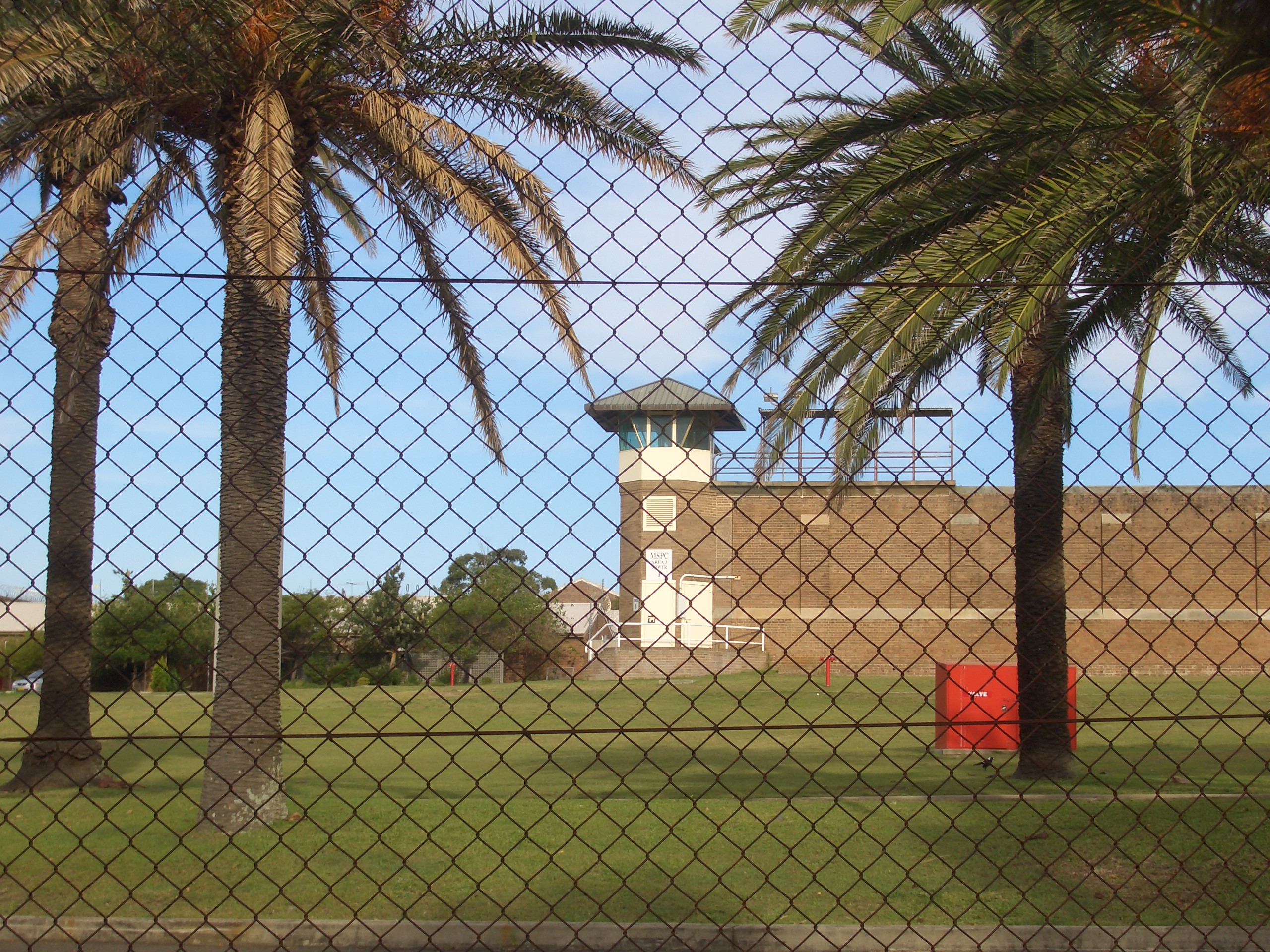
Long_Bay_Jail_2

Long Bay Correctional Centre in Sydney. Photo: JBar, WikimediaCommons

A co-worker was charged with her murder and with maliciously damaging property by fire with intent to endanger life.

After two years of court processes in March 2004 the accused was found not guilty on the ground of mental illness and has since then been held for treatment at the Long Bay Prison Hospital under the Mental Health (Forensic Provisions) Act (1990).

As in many other jurisdictions, the Mental Health Act (2007) prohibits at s. 162 the publication of the names of such patients even if they wish to be named.

As my colleague and research partner Associate Professor Tom Morton explained in an ABC Radio National Background Briefing program – The Man Without A Name – earlier this year, this patient has been prevented from telling his own story because of such anonymity provisions.

As he reported there, the ABC prepared a detailed application for permission to name the patient in that program and we attended a special hearing of that application before the Mental Health Review Tribunal in Sydney last September.

That application was approved, and Tom was able to name the patient in that program that aired in April this year.

However, were advised that such permission was limited to that single publication of the patient’s name. In other words, even though you can listen to a podcast of that program available here to discover his name, we would not be allowed to repeat it in our research outputs without further permission.

Earlier this year we went through that process, and I am pleased to advise that the Mental Health Review Tribunal has granted us permission to name the patient in our research publications and also in this blog.

I believe this is somewhat of a first – an academic research blog being granted permission to name a forensic patient – so journlaw.com is likely breaking new ground here as we do so.

The order states:

The means of publication are restricted to the following outlets for academic scholarship:

1. Academic journal articles, books and book chapters authored by Professor Morton and / or Professor Pearson.

2. Academic research blogs authored by Professor Morton and/or Professor Pearson.

It proceeds to require that any such publication must indicate our authorship, that the Tribunal can withdraw the consent at any time, and that any publication must carry the following notice:

“Notice: It is an offence under the Mental Health Act 2007 (NSW) section 162 to publish or broadcast the name of any person to whom a matter before the Mental Health Review Tribunal relates or who appears as a witness before the Tribunal in any proceedings or who is mentioned or otherwise involved in any proceedings under the Mental Health Act 2007 or the Mental Health (Forensic Provisions) Act 1990, unless consent has first been obtained from the Tribunal. The author has obtained such consent to publish Mr Dezfouli’s name.”

That should make it clear why we can name the patient but you cannot – at least without going through this whole process of application detailed in the Tribunal’s Practice Direction on s. 162, viewable here (pdf file).

So, after that extended preamble, I shall now reveal the patient’s name.

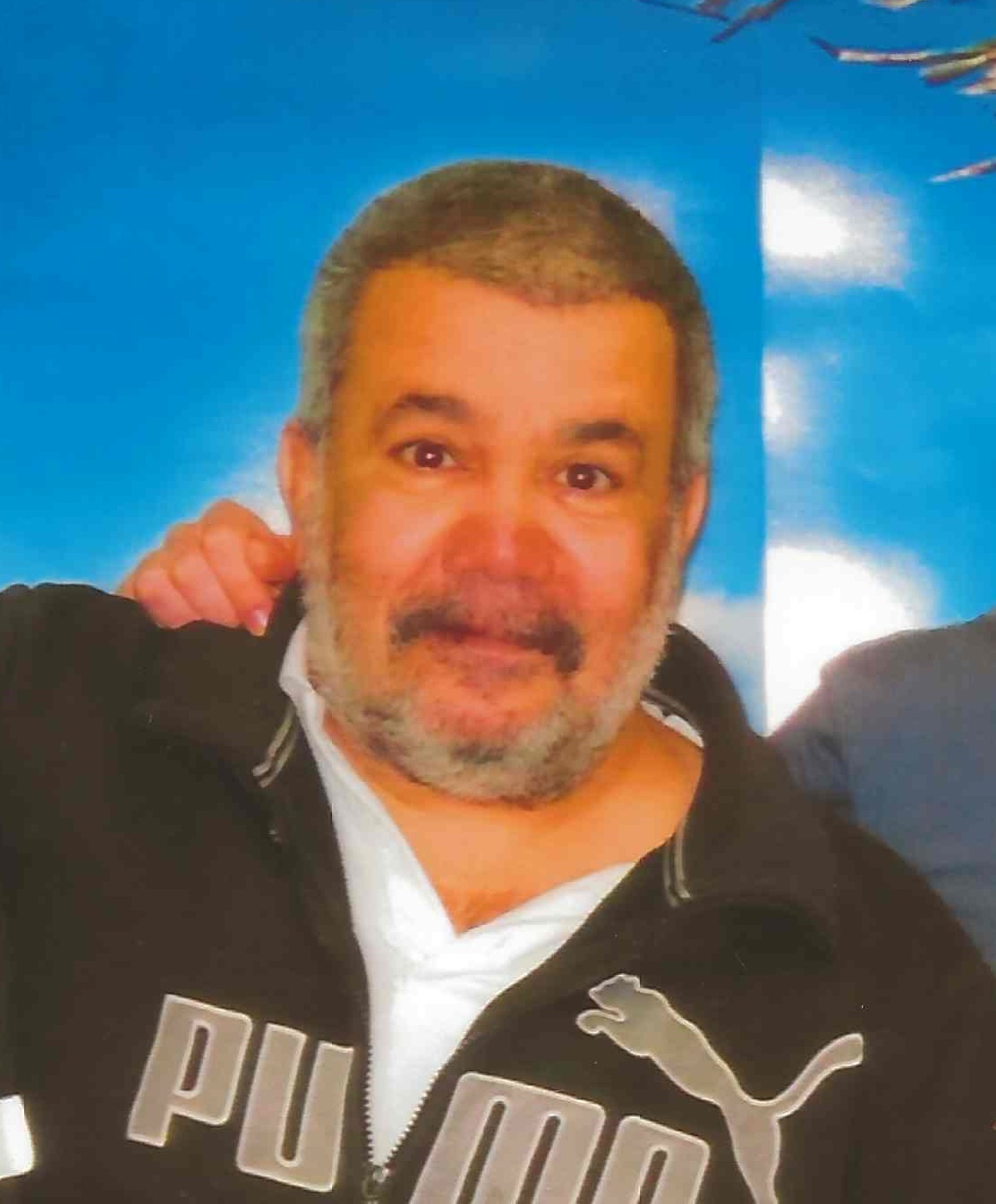
It is Mr Saeed Sayaf Dezfouli.
dezfouli

Forensic patient Saeed Dezfouli. Photo: Justice Action

In coming months we will be publishing our academic outputs on the research and journalistic processes involved in our pursuit for permission to identify Mr Dezfouli, kindly funded by a Rule of Law Institute of Australia grant.

Clearly, there are many competing rights and interests at stake in such a situation, including the patient’s right to privacy and effective treatment, their liberty, community safety, the reputations of their treatment team, and the welfare of victims and their families.

There are also the important legal principles of open justice, free expression, and the public’s right to know about the workings of the mental health and criminal justice systems. We will be exploring such issues in our academic publications.

Meanwhile, if you are interested in the Tribunal’s processes you might wish to read the Tribunal’s Official Report of an uncannily similar case (pdf file) it has published on its website using the name “Mr Ephram”.

The prisoner rights advocacy group Justice Action has also applied for, and obtained, permission to name Mr Dezfouli on its website and you can read more about his situation there.

Also, if you search for his name in a web browser you will find some other instances of him being named in the media, although it is unknown whether there were any legal consequences for the outlets which identified him.

(Tom Morton’s ABC Background Briefing program ‘The Man Without A Name’ – 20 April 2014)

———–

Disclaimer: While I write about media law and ethics, nothing here should be construed as legal advice. I am an academic, not a lawyer. My only advice is that you consult a lawyer before taking any legal risks.

© Mark Pearson 2014

Leave a comment

Filed under blogging, citizen journalism, free expression, media ethics, mental health, social media, Uncategorized

Journalists face jail for reporting intelligence operations – with no public interest defence

By MARK PEARSON

The Australian Government’s passage this week of the National Security Legislation Amendment Bill (No. 1) 2014 is highly likely to impact on Australia’s standing in international media freedom rankings like Reporters Without Borders’ (RSF’s) World Press Freedom Index.

Media Watch cites this journlaw post

ABC Media Watch cites this journlaw post in its 6 October 2014 episode

The legislation amended the Australian Security Intelligence Organisation Act 1979 (‘ASIO Act), and the Intelligence Services Act 2001 (bizarrely abbreviated as the ‘IS Act’).

The new law leaves journalists and bloggers liable to up to five years in jail for ‘unauthorised’ disclosure of information related to a special intelligence operation – and up to 10 years if the disclosure ‘endangers the health or safety’ of anyone or will ‘prejudice the effective conduct of a special intelligence operation’ (Section 35P of the ASIO Act).

The legislation seems aimed at whistleblowers like Edward Snowden or Wikileaks, but as Ben Grubb reported in smh.com.au, it casts its net so wide that it relies on the goodwill of the government of the day not to pursue ordinary journalists and commentators if they happen to stumble across such an operation and report upon it.

35P Unauthorised disclosure of information

(1)  A person commits an offence if:

(a)  the person discloses information; and

(b)  the information relates to a special intelligence operation.

Penalty: Imprisonment for 5 years.

Speaking to The Australian’s legal affairs editor Chris Merritt this week, I suggested an operation like that involving former Gold Coast doctor Mohamed Haneef in 2006 might have triggered such a consequence if it had been deemed a ‘special intelligence operation’.

That particular arrest was the result of an Australian Federal Police investigation, but it is not beyond the realms of possibility to see ASIO involved in future such operations.

It was only thorough investigative reporting based upon leaks that led to a Gold Walkley Award for journalist Hedley Thomas at The Australian that exposed the flaws in the prosecution case against Haneef, and led to his later release and exoneration.

While Thomas and other national security writers would not want to compromise an anti-terror operation, you could certainly see them pursuing rigorous reporting of such a matter if a serious injustice appeared to be done or public safety was being placed in jeopardy.

And that is the problem – there is no ‘public interest’ defence available under the laws that have just passed both houses of the Australian Parliament.

Further, there is nothing that would prevent prosecution of a journalist who inadvertently disclosed information about such an intelligence operation in the course of their normal reporting.

I was discussing this today with another Walkley Award winning editor of a regional newspaper who was concerned that an operation conducted in a regional centre would be such big news that it would be difficult not to cover it.

That might well meet the definition of such a disclosure, and the reporters dealing with it would likely not be as well briefed in national security laws as their national and metropolitan counterparts.

Either way, and as I explained to Chris Merritt in that interview this week, the law now presents journalists with a potential new conflict between their code of ethics and the law over which they might face jail.

Journalists have traditionally been willing to go to prison to protect their confidential sources – and in fact three Australian journalists have done time for just that over the past three decades.

Now we have this new situation where some journalists might be willing to defy this new law – and face up to 10 years in jail – if they see an overriding public interest in revealing the nature of such an operation.

If they choose to do so, sadly there will be no defence available to them.

This is just one of a series of detrimental developments for media freedom in Australia in recent months which I have documented previously – all of which are likely to see Australia’s ranking decline in the RSF index which is being compiled over the next two months.

The Australian measures are already on the international radar, as a recent World Association of Newspapers (WAN-IFRA) blog by media academic Julie Posetti demonstrated.

My frank view is that Australia is an ‘emerging Secret State’ – a topic I will be addressing at an upcoming conference marking the 20th anniversary of the Pacific Journalism Review in Auckland in November.

Of course I do not suggest Australia is at the far end of the spectrum like North Korea, China or Vietnam. We do not have the licensing of journalists or the jailing or torture of those opposing the government’s line.

However, when compared with other Western democracies we do not have the safeguards of free expression protections in a Bill of Rights or in a major constitutional amendment as in the US.

Sadly, this means new gags like this measure can be rushed through Parliament by a government seeking a tougher anti-terror image and an Opposition fearful of being seen to go soft on national security.

https://twitter.com/mjwill1991/status/519111179214401536

https://twitter.com/TheFourthNoodle/status/518196070481166337

© Mark Pearson 2014

Disclaimer: While I write about media law and ethics, nothing here should be construed as legal advice. I am an academic, not a lawyer. My only advice is that you consult a lawyer before taking any legal risks.

Leave a comment

Filed under national security, terrorism, Uncategorized

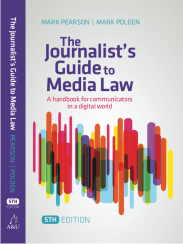
Hot off the press – our 5th edition of The Journalist’s Guide to Media Law

By MARK PEARSON

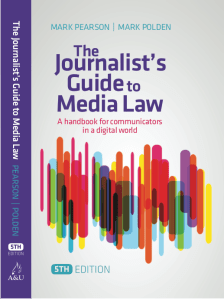
I was delighted to receive from publisher Allen & Unwin my first copy of the fifth edition of The Journalist’s Guide to Media Law (co-authored with Mark Polden).

Much has changed since our last edition in 2011, particularly in the fields of news media, communication technologies and practices, tertiary education and the law. We have reshaped and updated this edition of the book to accommodate those developments.

The book is still titled The Journalist’s Guide to Media Law, but its new subtitle—‘A handbook for communicators in a digital world’—encapsulates the seismic shifts that have prompted our considerable revisions. Our target audience has broadened with each edition as technologies like the internet and social media have combined to transform journalism and its allied professional communication careers. Thus our prime audience of Australian journalists working for traditional media outlets has widened to embrace public relations consultants, bloggers, social media editors and new media entrepreneurs,  as they fill new professional occupations dealing with media law, once the domain of mainstream reporters and editors.  Crucial questions which recur through the book include: ‘What is a journalist?’, ‘Who is a publisher?’, ‘How does media law affect this new communication form?’ and ‘Who qualifies for this protection?’ Some of the answers are still evolving, as legislators, the judiciary and the community grapple with the implications of every citizen now having international publishing technology literally at their fingertips on mobile devices.

Such shifts have prompted major new inclusions in the content of the book. So much publishing now transcends Australia’s borders via social media, blogs and other online platforms that we have expanded this edition to contain many more international comparisons and cases. This has been accommodated by reducing some of the forensic examination of precise legislation in various Australian states and territories, found in previous editions. Instead of attempting to document every statutory instrument in all nine Australian jurisdictions, we have directed readers to the resources that contain those details.

All of this has necessitated design and pedagogical changes to the book’s format and contents. While the chapter structure is generally in accord with previous editions, there are new sections within the chapters addressing these issues. Their order varies slightly according to topic, but most chapters now include some key concepts defined at the start, some international background and context to the media law topic, a more detailed account tailored to Australian legislation and case law, a review of the ‘digital dimensions’ of the topic with special focus on internet and social media cases and examples, an account of self-regulatory processes if they apply to that topic, some tips for journalists and other professional communicators for mindful practice in the area, a nutshell summary, some discussion questions, and relevant readings and case references.

The introduction of ‘tips for mindful practice’ encapsulates the authors’ aim that professional communicators need to build into their work practices and routines an informed reflection upon the legal and ethical implications of their reportage, commentary, editing, publishing and social media usage. This approach is explained in greater detail in Chapter 2, but it essentially links safe legal practice and the responsible and strategic use of free expression with the personal moral framework and professional ethical strictures of the digital communicator—whether a journalist, public relations consultant, media relations officer or serious blogger.


Those changing roles are reflected in a new final chapter, Chapter 13, which deals with the law of PR, freelancing and media entrepreneurship. It replaces a chapter on self-regulation in earlier editions. (The role and application of the various industry regulatory, co-regulatory and self-regulatory bodies, such as the Australian Communications and Media Authority (ACMA) and the Australian Press Council (APC), are now introduced in Chapter 3, but they are then referred to in the chapters where their functions and decisions seem most relevant). We saw this area of media law as significant because those who occupy those roles  are now grappling with special dimensions of media law—and several other legal topics relevant to their work—and deserve a new chapter dedicated to their roles and the legal dilemmas that are emerging in relation to them. The chapter also reflects the fact that many former journalists are now working in these allied occupations, and that student journalists need to start their careers with a broad understanding of the legal considerations which govern allied professional communication industries.

The sheer pace of change in all areas of media law is astounding. Many changes were mooted as this edition was going to press—including important developments in the laws of privacy, copyright, hate speech and court reporting. Rather than render the book dated as soon as it is printed, we have opted to use co-author Professor Mark Pearson’s journlaw.com blog (this one!) as the venue for updates to material, and have built several mentions of that resource into the chapters and discussion questions.

Apart from an array of new cases and examples—many from the international arena and many more from social media—some highlights of important new content covered in this edition include the following:

  • There are significant cases on increased statutory powers, allowing courts to make suppression and non-publication orders, and on the relationship between free speech, open justice and the right of parties to settle disputes privately. Recent cases at the borderline between ridicule and defamation, and on the application of freedom of information laws to immigration detention centres are included, as are cases on the application of sub judice contempt to internet content hosts and ‘celebrity’ claims of privacy invasion.
  • Recommendations of the ALRC on copyright reform are included, together with a discussion of the new copyright fair dealing defence that applies to satire. The book presents a wide range of examples, across different legal categories, relating to the use of the internet and social media, which will be of growing importance for current and future professional practise in communication, reportage and media advice.
  • A separate chapter on secrets (Chapter 9) covers the new journalists’ shield laws and their relevance to micro-bloggers and non-traditional publishers.
  • Chapter 10, on anti-terrorism and hate laws, includes the recommendations for reform of anti-terror laws and discusses the high-profile Andrew Bolt case and related proposals for reform of the Commonwealth Racial Discrimination Act 1975.
  • The recommendations of the Leveson Inquiry in the United Kingdom, and the Finkelstein Inquiry and Convergence Review in Australia, are subjected to critical analysis in view of their potential impact upon notions of a free press.

There is also an increased emphasis on real-time reportage, as the traditional print media increase their online presence and depth of click-through coverage in a 24/7 news cycle, with concomitant risks in the areas of defamation and contempt in their own work and that of third-party commentators on their websites and social media pages.

Without going into exhaustive detail on all of these matters, the book remains true to its original aim: to provide professional communicators and students with a basic working understanding of the key areas of media law and ethical regulation likely to affect them in their research, writing and publishing across the media. It tries to do this by introducing basic legal concepts while exploring the ways in which a professional communicator’s work practices can be adapted to withstand legal challenges.

In designing this edition, we have tried to pay heed to the needs of both professional communicators and media students. The book is best read from front to back, given the progressive introduction of legal concepts. However, it will also serve as a ready reference for those wanting guidance on an emerging problem in a newsroom or PR consultancy. The cases cited illustrate both the legal and media points at issue; in addition, wherever possible, recent, practical examples have been used instead of archaic cases from the dusty old tomes in the law library. Rather than training reporters, bloggers and PR practitioners to think like lawyers, this book will achieve its purpose if it prompts a professional communicator to pause and reflect mindfully upon their learning here when confronted with a legal dilemma, and decide on the appropriate course of action. Often that will just mean sounding the alarm bells and consulting a supervisor or seeking legal advice.

Of course, the book is not meant to offer actual legal advice. Professional communicators must seek that advice from a lawyer when confronted with a legal problem. The most we claim to do is offer an introduction to each area of media law so that journalists, PR consultants and bloggers can identify an emerging issue and thus know when to call for help.

Booktopia is offering pre-orders on their website: http://www.booktopia.com.au/the-journalist-s-guide-to-media-law-mark-pearson/prod9781743316382.html

Disclaimer: While I write about media law and ethics, nothing here should be construed as legal advice. I am an academic, not a lawyer. My only advice is that you consult a lawyer before taking any legal risks.

© Mark Pearson 2014
https://twitter.com/mattcdef2000/status/514585070149988352

https://twitter.com/MsLods/status/514583564600373250

3 Comments

Filed under blogging, citizen journalism, contempt of court, free expression, journalism, media ethics, media law, Media regulation, social media, sub judice, Uncategorized

‘Mindful Journalism’ – the topic of our forthcoming book with Routledge

By MARK PEARSON

THE term ‘mindful journalism’ is a concept I introduced more than a year ago in the inaugural UNESCO World Press Freedom address at AUT University Auckland.

I fleshed it out further in a paper delivered to the International Association for Media and Communication Research (IAMCR) conference in Dublin in July 2014, which was revised for publication as a forthcoming article in Ethical Space to be published in December.

Screen Shot 2014-09-19 at 4.18.23 PM

Our book preview on the Routledge website

My esteemed colleague, Emeritus Professor Shelton Gunaratne has been working for decades on the intersection between of Buddhism and journalism, and I was honoured to be invited onto a book project he was developing with Sri Lankan colleague Dr Sugath Senarath [pdf file] from the University of Colombo.

We were delighted when Routledge New York accepted our proposal for hard cover publication in March 2015 as part of its Research in Journalism series.

Our book is titled Mindful Journalism and News Ethics in the Digital Era: A Buddhist Approach and it features chapters by several scholars from Asia, North America, Australia and Europe.

As outlined in the publisher’s synopsis:

“This book aims to be the first comprehensive exposition of “mindful journalism”—drawn from core Buddhist ethical principles—as a fresh approach to journalism ethics. It suggests that Buddhist mindfulness strategies can be applied purposively in journalism to add clarity, fairness and equity to news decision-making and to offer a moral compass to journalists facing ethical dilemmas in their work. It comes at a time when ethical values in the news media are in crisis from a range of technological, commercial and social factors, and when both Buddhism and mindfulness have gained considerable acceptance in Western societies. Further, it aims to set out foundational principles to assist journalists dealing with vulnerable sources and recovering from traumatic assignments.”

My chapter on ‘The Journalist and Mental Cultivation’ addresses the application to journalism of the final three steps of the Buddha’s Noble Eightfold Path – the mental cultivation (or concentration) dimension of the magga; namely Right Effort (samma vayama), Right Mindfulness (samma sati) and Right Concentration (samma samadhi).

The section on Right Effort calls for journalists to apply a steady, patient and purposeful path to the achievement of ethical practice. It suggests the need for an effort to find and implement sound perspectives and practices that one lacks and to shore up those that one already possesses.

The section on Right Mindfulness explains how journalists might take time out of a stressful situation to focus upon breathing; to pause to meditate upon the rationale for pursuing a story in a certain way, to weigh implications of reportage on stakeholders and to find peace for strategic planning and clarifying context for one’s role and career trajectory.

The section on Right Concentration compares the phenomenon the expression “grace under fire” that is required of consummate professionals in the midst of covering a major news event. It is at this time that top journalists actually enter “the zone” and are able to draw on core ethical values and ingrained professional skills to report within deadline.

The chapter offers several examples from journalism to illustrate the approach and suggests techniques that can be implemented in a secular way by journalists from a range of cultural and religious backgrounds to enhance their ethical practice and the public significance of their reportage.

We are excited at the potential for the project – particularly in a period when journalists and bloggers are accused of having lost their ‘moral compass’ – and we are on track to submit all chapters within the publisher’s October 1 deadline.

https://twitter.com/prbizdaily/status/512866457156194304

———–

Disclaimer: While I write about media law and ethics, nothing here should be construed as legal advice. I am an academic, not a lawyer. My only advice is that you consult a lawyer before taking any legal risks.

© Mark Pearson 2014

Leave a comment

Filed under blogging, Buddhism, citizen journalism, Eightfold Path, free expression, media ethics, mental health, social media, Uncategorized

Media freedom concerns over federal demands for ABC interview tapes

By MARK PEARSON

[Research assistance kindly provided by media freedom intern Mardi Reason]

JUST as the Australian Government proposes tougher national security powers for its agencies and penalties for whistleblowing we have learned this week that the Australian Federal Police has asked the ABC for unedited current affairs interview footage in its pursuit of a former spy and a lawyer.

Screen Shot 2014-09-04 at 7.57.38 PM

Senator Nick Xenophon’s questions of Attorney-General George Brandis about AFP investigation.

Attorney-General George Brandis confirmed in the Senate on Monday (see inset) that Australian Federal Police started an investigation into the sources of leaks of classified information after it was revealed Australia spied on East Timor during sensitive oil and gas treaty negotiations.

The targets of the investigation are reported to be lawyer Bernard Collaery (a former ACT Attorney-General now in London about to represent East Timor in The Hague) and a former Australian Secret Intelligence Service (ASIS) agent who was allegedly the whistleblower.

The Australian Security Intelligence Organisation (ASIO) raided Collaery’s Canberra office last December and seized documents.

Tom Allard reported in the Sydney Morning Herald on Monday that the latest investigation had prompted requests from the AFP for the raw footage of Mr Collaery’s interviews with programs including 7.30, Lateline and Four Corners.

A report by Conor Duffy on 7.30 last December also featured actors’ voices reading an affidavit from the former ASIS agent which the Herald has speculated could be important evidence the AFP needs for its investigation into the identity of the whistleblower.

However, in the Hansard record of Senator Brandis’ comments on Monday (inset), the Attorney-General claims there are some inaccuracies in the Herald report. In particular, he claims it is inaccurate that he ordered the AFP investigation. Rather, it was ASIO-driven, he told the Senate.

As reported earlier at journlaw.com, the Australian government introduced the National Security Legislation Amendment Bill (No. 1) 2014 on July 14 which would extend security agencies’ powers to search and use surveillance devices in the new communication environment, introduce a new ‘multiple warrants’ regime, offer immunity to intelligence personnel who break all but the most serious laws, while increasing penalties for whistleblowing and criminalising the reporting of leaked intelligence-related information.

Importantly, it would introduce a new offence carrying a five year jail term for anyone disclosing information relating to special intelligence operations.

This latest episode demonstrates how easily journalists and media organisations can get caught up in such investigations. It threatens to expose them to contempt penalties if they refuse to co-operate and will inevitably make sources reluctant to talk to reporters covering the important round of national security, particularly as it coincides with a push for even greater surveillance powers for federal agencies.

Sources:

Allard, T. 2014, ‘Government wants East Timor spy charged’, The Sydney Morning Herald, 31 August 2014, http://www.smh.com.au/federal-politics/political-news/government-wants-east-timor-spy-charged-20140831-10aoad.html

Safi, M. 2014 , ‘Timor-Leste spy case: Brandis denies referring lawyer to police’, The Guardian, 1 September 2014 http://www.theguardian.com/world/2014/sep/01/timor-leste-spy-case-brandis-denies-referring-lawyer-to-police

Fernandes, C. 2014, ‘Our land is girt by oil-rich sea … that we steal from East Timor’, Crikey, 2 September 2014 http://www.crikey.com.au/2014/09/02/our-land-is-girt-by-oil-rich-sea-that-we-steal-from-east-timor/

Commonwealth of Australia, 2014, September 1 (14:32). Hansard. Parliamentary Debates – Senate. Questions Without Notice – East Timor. (Senators Xenophon and Brandis). http://parlinfo.aph.gov.au/parlInfo/genpdf/chamber/hansards/49cdeae9-b762-449e-9e05-7239b8940f5f/0044/hansard_frag.pdf;fileType=application%2Fpdf

© Mark Pearson 2014

Disclaimer: While I write about media law and ethics, nothing here should be construed as legal advice. I am an academic, not a lawyer. My only advice is that you consult a lawyer before taking any legal risks.

Leave a comment

Filed under national security, terrorism, Uncategorized

Memo #RSF Paris: Australian media freedom at risk from anti-terror laws

By MARK PEARSON

[Research assistance from media freedom intern Jasmine Lincoln]

Memo to: Benjamin Ismail, Bureau Asie-Pacifique, Reporters sans frontiers (RSF – Reporters Without Borders), Paris.

From: Mark Pearson, RSF correspondent, Australia

RSFlogo-enI regret to advise that several events and policy proposals have impacted negatively on the state of media freedom in Australia.

They are highly likely to threaten Australia’s ranking on your forthcoming RSF World Press Freedom Index.

A raft of new laws and policies proposed by the conservative Abbott Government has placed its stamp on media law and free and open public commentary.

https://twitter.com/JournLaw/status/504463626552373249

The initiatives follow in the steps of the prior Labor Government that had proposed a new media regulatory regime with potentially crippling obligations under the Privacy Act.

In the course of its first year in office the Abbott Government has:

– imposed a media blackout on vital information on the important human rights issue of the fate of asylum seekers;

– initiated major budget cuts on the publicly funded ABC;

– used anti-terror laws to win a ‘super injunction’ on court proceedings that might damage its international relations (see your earlier RSF release on this, which I cannot legally reproduce here for fear of a contempt charge);

– moved to stop not-for-profits advocating against government policy in their service agreements, meaning they lose funding if they criticise the government;

– slated the Office of the Information Commissioner for abolition, promising tardy FOI appeals;

– proposed the taxing of telcos to pay for its new surveillance measures, potentially a modern version of licensing the press;

– proposed ramped up surveillance powers of national security agencies and banning reporting of security operations (See Prime Minister’s August 5 release here);

– proposed increased jail terms for leaks about security matters (you issued a release on July 22 the impact for whistleblowers);

– mooted a new gag on ‘incitement to terrorism’;

– proposed new laws reversing the onus of proof about the purpose of their journey for anyone, including journalists, travelling to Syria or Iraq.

Major media groups have expressed their alarm at the national security proposals in a joint submission stating that the new surveillance powers and measures against whistleblowers would represent an affront to a free press.

Over the same period the judiciary has presided over the jailing of a journalist for breaching a suppression order, the conviction of a blogger for another breach, and several instances of journalists facing contempt charges over refusal to reveal their sources. There have also been numerous suppression orders issued, including this one over a Victorian gangland trial.

Other disturbing signs have been actions by police and departmental chiefs to intimidate journalists and media outlets.

  • The Australian Federal Police raided the Seven Network headquarters in Sydney in February, purportedly in search of evidence of chequebook journalism, triggering an official apology this week.
  • Defence Chief General David Hurley wrote to newly elected Palmer United Party Senator Jacqui Lambie in March, warning her not to use the media to criticise the military.
  • Freelance journalist Asher Wolf received a threatening letter from the secretary for the Department of Immigration and Border Protection (DIBP) Martin Bowles following her co-written article for the Guardian Australia on February  19, 2014 titled ‘Immigration Department data lapse reveals asylum seekers’ personal details.’ The public service mandarin’s letter implied Wolf had obtained the material on which the article was based by ‘dishonest or unfair means’ and demanded Wolf agree not to publish the contents and ‘return all hard and soft copies of the information’ including any her storage devices. See the letter here: WolfDIBP to The Guardian – A Wolf. The Sydney Morning Herald later reported that the DIBP was hiring private contractors to trawl social media and order pro-asylum seeker activists to remove their protesting posts.

I am sure you will agree that these developments are not what we would expect to be unfolding in a Western democracy like Australia where media freedom has previously been at a level respected by the international community.

Kind regards,

Mark Pearson (@journlaw)

—–

Sources for further detail on the national security reforms:

(6 August, 2014). Inquiry into the National Security Legislation Amendment Bill (No. 1) 2014 Submission. Retrieved from: file:///C:/Users/jasmine/Downloads/17.%20Joint%20media%20organisations%20(1).pdf.

Criminal Code Act 1995 (Qld) s. 5.4 (Austl.).

Grubb, B. (19 August, 2014). Anti-leak spy laws will only target ‘reckless’ journalists: Attorney-General’s office. Retrieved from: http://www.smh.com.au/federal-politics/political-news/antileak-spy-laws-will-only-target-reckless-journalists-attorneygenerals-office-20140818-1059c7.html.

Grubb, B. (30 July, 2014). Edward Snowden’s lawyer blasts Australian law that would jail journalists reporting on spy leaks. Retrieved from: http://www.smh.com.au/digital-life/consumer-security/edward-snowdens-lawyer-blasts-australian-law-that-would-jail-journalists-reporting-on-spy-leaks-20140730-zyn95.html.

Hopewell, L. (17 July, 2014). New Aussie Security Laws Would Jail Journalists for Reporting on Snowden Style-Leaks. Retrieved from: http://www.gizmodo.com.au/2014/07/new-aussie-security-laws-would-jail-journalists-for-reporting-on-snowden-style-leaks/.

Murphy, K. (17 August, 2014). David Leyonhjelm believes security changes restrict ordinary Australians. Retrieved from: http://www.theguardian.com/world/2014/aug/17/david-leyonhjelm-security-changes-restrict-australians.

Parliament of Australia (15 August, 2014). Parliamentary Joint Committee on Intelligence and Security, 15/08/2014, National Security Legislation Amendment Bill (No. 1) 2014. Retrieved from: http://parlinfo.aph.gov.au/parlInfo/search/display/display.w3p;adv=yes;db=COMMITTEES;id=committees%2Fcommjnt%2F2066f963-ee87-4000-9816-ebc418b47eb4%2F0002;orderBy=priority,doc_date-rev;query=Dataset%3AcomJoint;rec=0;resCount=Default.

The Greens (1 August, 2014). Brandis presumption of terror guilt could trap journalists, aid workers. Retrieved from: http://greens.org.au/node/5617.

https://twitter.com/richardaedy/status/504514808532566018

https://twitter.com/deanprocter/status/504516241269071874

https://twitter.com/RobMax4/status/504522206290788352

https://twitter.com/JournLaw/status/504547130518679552

https://twitter.com/MmichaelLlucy/status/504514567515287552

https://twitter.com/apicot/status/504514324786728960

https://twitter.com/JLLLOW/status/504514037825019904

https://twitter.com/NadyatEl/status/504489933776510976

https://twitter.com/bjbrike/status/504472790842355712


© Mark Pearson 2014

Disclaimer: While I write about media law and ethics, nothing here should be construed as legal advice. I am an academic, not a lawyer. My only advice is that you consult a lawyer before taking any legal risks.

4 Comments

Filed under free expression, national security, Press freedom, terrorism, Uncategorized

MsLods’ news round-up: law + technology

Another great curation of media law and technology law cases and articles here from @mslods . It starts with a particularly useful Storify from @mslods debating whether it is reasonable to use the term ‘copyright theft’ when talking about copyright infringement. Any media law geek should subscribe to this blog.

mslods's avatarMsLods

Copyright

Is copyright infringement theft?  | MsLods storify | https://storify.com/MsLods/theft-and-copyright-law

You’ve got 1 week! Input sought on online copyright infringement proposals.  | Australian Digital Alliance | http://bit.ly/1AJTMG2 & my collection of #copdis resources: http://bit.ly/1oJVhjr

How many jobs does IP actually create? A US analysis. | Mercatus Center | http://bit.ly/1txKnhn

Anti-piracy firm wants to fine Canadian and Aussie file-sharers. | TorrentFreak | http://bit.ly/1vaZS1R

New Zealand: Another alleged music pirate pinged under ‘Skynet’. | Stuff | http://bit.ly/1BR1nns

Village Roadshow no-show for online piracy forum. | ZDNet | http://zd.net/1qCG9RJ

Defamation & media law

North Coast Children’s Home Inc. v Keith Martin, the perils of digital defamation, by Yvonne Kux. | INFORRM | 

Careful with your coverage of the Redfern murder case – especially pics. | Journlaw | http://bit.ly/1t3Mig3

Financial services group WCS serves online forum Whirlpool over negative post. | The Age | http://bit.ly/1pcvHTP

Privacy & information security

iiNet on mass data retention: is…

View original post 202 more words

Leave a comment

Filed under Uncategorized

Court restrictions on identifying children in Australia – a guide for journalists

By MARK PEARSON

We have removed the comparative reporting restrictions tables from the  fifth edition of The Journalist’s Guide to Media Law (Allen & Unwin, 2014) which will be published later this year.

Co-author Mark Polden and I have decided to move these comparative tables on reporting restrictions throughout Australia across to this blog – journlaw.com – so we could free up space in the new edition to discuss other important issues such as media law for public relations consultants and the implications of digital and social media.

We will work to update the reporting and publishing restrictions tables over coming months, but for the moment I am publishing them as they stood at the date of our fourth edition in 2011.

As I upload them over coming weeks I would appreciate any students or colleagues using the comments section below to advise of any updates in your jurisdictions and I will act to update the tables accordingly.

Looking forward to your collaborative input!

——

Restrictions on reports of proceedings involving children

Note: NO identification of parties or witnesses in any way under the Commonwealth Family Law Act s. 121.

Jurisdiction Law  Exceptions  Legislation 
ACT  Reports of proceedings: Media allowed to report. ID: Cannot be identified. Cannot publish account of family group conference— None mentioned.  Criminal Code 2002, s. 712A. Children and Young People Act 2008, s. 77. 
NSW Reports of proceedings: Media allowed to stay and report. ID: No ID of child mentioned or otherwise involved (including victims and witnesses) living or dead, during or after proceedings, or their siblings.— Court may close proceedings. Court may allow ID or children aged 16 or over can authorise.(Seek legal advice on this.) Or senior next of kin or court (if deceased).


Children (Criminal Proceedings)Act 1987, s. 15A; Children and Young Persons (Care and Protection) Act 1998, ss. 104 and 105; Young Offenders Act 1997, s. 65. 
NT  Reports of proceedings: Open court and reports allowed. ID: No restriction.— Magistrate may close court or order suppression.  Youth Justice Act 2005, ss. 49, 50. 
Qld  Reports of proceedings: No. ID: No ID of child accused without court’s permission. No ID of child witness in sexual matter. ID of child witness okay in other matters unless ordered otherwise. Cannot ID authorised officer or police officer in matters with child witnesses. No ID info about child victims. No ID of children subject to allegations of harm or risk of harm or in state custody or guardianship.— Judge may order publication of identifying information for heinous crimes. Court can permit reporting when otherwise prohibited.Child victim can consent after becoming adult if fully informed of publication matter, audience and reason. Youth Justice Act 1992, ss. 234, 301. Child Protection Act 1999, ss. 189, 192, 193. 
SA  Reports of proceedings: Court open to ‘genuine representatives of news media’. No family care proceedings reports. ID: No ID of child parties, witnesses or victims,or other persons other than in official capacity without their permission, including name, address or school. Documentaries may be approved under strict conditions.— Courts can authorise some reports and ID.  Youth Court Act 1993, s. 24; Young Offenders Children’s   Protection Act 1993, s. 59, Children’s Protection Act 1993, s. 13; 59A. 
Jurisdiction  Law  Exceptions  Legislation 
Tas Reports of proceedings: No provision for media to be present without permission of court. ID: No ID of youths or youth witnesses.— Permission of court.  Youth Justice Act 1997, ss. 30, 31; Magistrates Court (Children’s Division) Act 1998, ss. 11, 12. 
Vic Reports of proceedings: Open court and media allowed to report. ID: No identification of child accused or any witnesses to case. No mention of court venue. Long list of banned ID particulars for children and witnesses including: name, title, pseudonym, alias of the person, home or work address or localit0, school or locality; physical description or style of dress; occupation or calling; relationship to identified others; interests or beliefs; real or personal property. No photos.— Permission of court.  Children, Youth and Families Act   2005, ss. 523, 534. 
WA  Reports of proceedings: Yes ID: No ID on child involved in proceedings in any way. No ID of child subject of a protection application or order.— Court can exclude persons. Supreme Court can authorise ID of child.  Children’s Court of Western Australia Act 1988, ss. 31, 35, 36, 36A. Children and Community Services Act 2004, s. 234 

—————

Disclaimer: While I write about media law and ethics, nothing here should be construed as legal advice. I am an academic, not a lawyer. My only advice is that you consult a lawyer before taking any legal risks.

© Mark Pearson 2014
3 Comments

Filed under blogging, contempt of court, courts, media ethics, mental health, social media, Uncategorized

Careful with your coverage of the Redfern murder case – especially pics #Wran

By MARK PEARSON

A media scrum gathered outside a Sydney court this morning where Harriet Wran – the youngest daughter of the former premier of New South Wales Neville Wran who died this year – was charged with murder and other offences.

I will not go into the details of the crimes Harriet Wran is alleged to have committed with a co-accused – to which she is pleading not guilty – but they relate to the death of 48-year-old Daniel McNulty and the stabbing of another man, Brett Fitzgerald, at an inner Sydney apartment block on Sunday night.

Celebrity is a driving news value and leads reporters into dangerous territory in cases like this, as co-author Mark Polden and I explain in the fifth edition of The Journalist’s Guide to Media Law, to be published later this year.

I have already seen numerous images of the accused – which is problematic if identification of either accused has any likelihood of being at issue in the trial. Any potential impact on witness identification – or any indication of the guilt of an accused – can be deemed sub judice contempt of court over which publishers can face hefty fines and jail terms if a court deems their coverage represented a real risk of prejudice to a trial.

The Latin phrase sub judice literally means ‘under or before a judge or court’ and applies to the period during which there are limitations placed on what the media may report about a case. The restrictions start from the moment someone has been arrested or charged.

In this case that period is well and truly under way, with court proceedings having commenced.

The courts have attempted to balance the competing rights and interests of those involved in court cases and those reporting on them by restricting what may be published about a case while it is before the courts. The restrictions are considered necessary to avoid ‘trial by media’, where free speech interferes with the usual safeguards of the legal system with dire consequences for the case at hand and for the public confidence in the administration of justice.

The practical concern the courts have here is the potential influence such a media trial might have on prospective jurors (and, to a lesser degree, on witnesses). The fear is that their judgment (or testimony) might be tainted by media coverage of the case before or during trial, to ‘poison the fountain of justice before it begins to flow’, as one judge expressed it in Parke’s case in 1903. The courts place stringent tests on the admissibility of evidence and respect certain rules of procedure known as ‘natural justice’, protocols that have no tradition in media coverage.

There is a ‘public interest’ defence – but that is highly unlikely to apply in a case where the only real public interest is the fact that one of the accused happens to have come from a famous family.

When deciding whether a publication is in contempt, the courts look to its ‘tendency’ to interfere with pending proceedings. As the NSW Law Reform Commission expressed it in 2000:

To amount to contempt, a publication must be shown to have a real and definite tendency, as a matter of practical reality, to prejudice or embarrass particular legal proceedings.

When considering whether the publication has the ‘tendency’ to interfere with proceedings, the courts gauge the potential effect of the sub judice material, not whether the material actually caused harm, with the test applied at the time of publication rather than at some later date. Even if the accused in the publicised trial eventually pleads guilty or even dies before the trial, the publication can still be held in contempt.

The courts take into account a number of relevant factors in determining whether there is such a real possibility of prejudice, including the prominence of the item printed or broadcast; the images accompanying it; the time lapse between publication and likely trial; the social prominence of the maker of contemptuous statements; and the extent or area of publication. In other words, a prominent sensational account of an imminent trial published in a major newspaper in the very area from which the jury would be selected would be much more likely to be held in contempt than a sober account in a small community radio news bulletin in a provincial town, some distance from the likely trial venue. This should not be taken as advice to knowingly publish a contempt in such cases. On the contrary: there is a tendency for prosecuting authorities to charge all media outlets that published contemptu­ous stories at the same time as the main sensational item that prompted their action.

Internet and social media coverage complicates the matter of course – particularly when publishers from far afield are publishing into the very jurisdiction where the jurors and witnesses live.

Watch those images of the accused

In 1994 Time Inc., publisher of the magazine Who Weekly, and the magazine’s editor were both fined for publishing on its front cover a photo­graph of Ivan Milat, the man accused (and later convicted) of murdering seven backpackers.

The publication came in another crucial time zone—after Milat had been arrested and charged but before his trial. Identification was going to be a crucial issue. In finding Who Weekly in contempt, the NSW Supreme Court held that the photograph tended to interfere with the due course of justice in the prosecution of Milat. It ran the risk of polluting the recollection of witnesses in that they may not be able to distinguish between what they had witnessed at the crucial time and their recollection of the image in the photograph.

While it was unlikely to have influenced the two key witnesses, who were overseas at the time of publi­cation, the photograph ran the risk of affecting the testimony of witnesses who had not yet come forward. Even if the publication prompted new witnesses to contact the police, their testimony would be questionable because it had been influenced by the photograph.

The court ruled that publication of a picture of an accused person would normally be regarded as carrying a risk of interference with the due course of justice, unless the iden­tification were so clear-cut that neither party would dispute it.

And don’t think that because everyone else is doing it you’ll be safe. In the Mason case in 1990 the NSW Attorney-General charged two newspapers and four television stations with contempt over their coverage of an alleged murderer’s confession to police after he had been charged, but before the trial. The outlets with the less sensational reports attracted lower fines ($75,000 as against $200,000), and the question arises: would they have been charged at all if their competitors had not published these more sensational accounts?

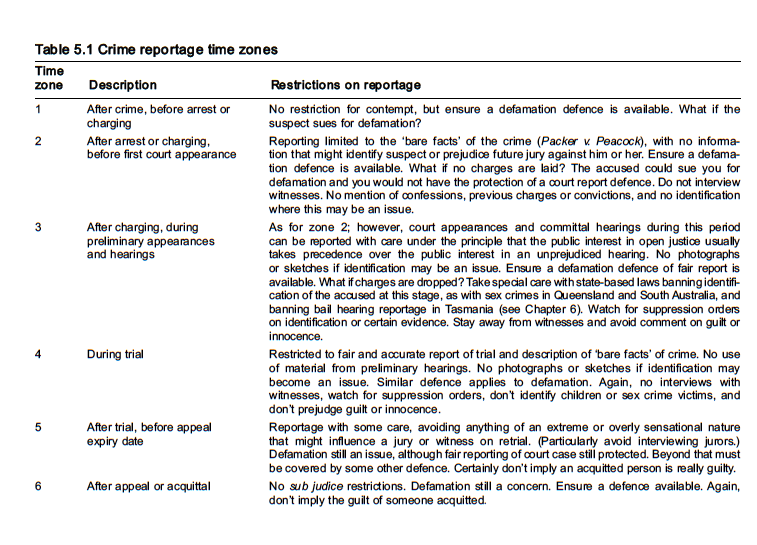
It is vital that media outlets work within these time zone restrictions when reporting on newsworthy cases like this one.

Screen Shot 2014-08-14 at 1.00.09 PM

Table: Crime reportage time zones, from Pearson, M. (2007) The Journalist’s Guide to Media Law (3rd ed, Allen & Unwin, Sydney)

Disclaimer: While I write about media law and ethics, nothing here should be construed as legal advice. I am an academic, not a lawyer. My only advice is that you consult a lawyer before taking any legal risks.

© Mark Pearson 2014

4 Comments

Filed under blogging, citizen journalism, contempt of court, free expression, journalism, media ethics, media law, Media regulation, social media, sub judice, Uncategorized