Tag Archives: censorship

Budget cuts to FOI body could prompt delays

By guest blogger EVE SOLIMAN – press freedom intern

Australian journalists face the possibility of extra delays in their freedom of information appeals with Australian federal budget cuts doing away with the Office of the Australian Information Commissioner (OAIC) by January 2015.

The cut is meant to save $10.2 million a year, but dissolving  the OAIC will mean the duties that the agency carried out will have to be shifted into four other bodies.

The privacy functions that are carried out by the Privacy Commissioner will continue as an independent legislative position within the Human Rights Commission.

The external examination of Freedom of Information (FOI) will be adopted by the Administrative Affairs Tribunal.

The Commonwealth Ombudsman will take the responsibility of filing and treatment of FOI complaints.

The last function will be divided into the Attorney General’s Department, whose responsibility will include the administering of “FOI guidelines, collecting statistics and providing explanatory material on the operation of the Freedom of Information Act 1982” (Office of the Information Commissioner disbanded as part of budget reforms, Ashurst Australia).

The budget cuts aimed at saving $10.2 million annually but will only save $3.3 million in direct financing this year and the cost of financing the continued duties, once carried out by the federal budget will be passed onto the four separate departments that it absorbed into.

The Attorney General’s Office will be funding $500,000 this year and $900,000 annually in the following years, the Human Rights Commission will contribute $2.7 million in 2015 and around $5.5 million annually the following years and the Administrative Appeals Tribunal will pay $300,000 this year and half a million dollars annually in the following years.

The reasons behind the budget cut can only be speculated, but could have a negative impact on the freedom of information and ways that the functions can be met.

A major critique by the government, agencies and other commentators on the OAIC, is that it has been inefficient in delivering information and reviewing FOI applications.

But despite claims of the OAIC’s efficiency, or viewing the institution as unnecessary there is copious amounts of evidence on the accomplishments and progress of OAIC to counter the arguments.

The completion of cases per day has increased from .37 cases in the first year and a half of its establishment, to 4.7 cases per day, the completion and cessation of FOI requests and privacy complaints also increased substantially.

The OAIC was formed in 2010 as an independent bureau within the Attorney General’s Department that’s purpose involved several elements of information dispersal and management: privacy, FOI and policy.

Predating the formation of the OAIC, the Privacy Commissioner belonged to the Human Rights Commission. The OAIC has 76 staff.

The OAIC has accomplished many things within the spectrum of privacy, freedom of information and information policy.

The agency had conducted an audit of the information management policies belonging to 191 Australian government agencies.

OAIC also resolved a total of 1,191 appeal applications and requests for information and published the reasoning for 186 of those cases, handled 4521 phone enquiries and 1891 written enquiries involving freedom of information and closed 394 FOI complaints.

In 2011, the OAIC hosted a National Information Policy Conference, that was attended by hundreds of people and created and dispersed the Principles on open public sector information which the government utilises and relies on.

References:

http://www.oaic.gov.au/news-and-events/statements/australian-governments-budget-decision-to-disband-oaic/australian-government-s-budget-decision-to-disband-oaic

file:///C:/Users/Eve/Downloads/Privacy%20Update%20-%2014%20May%202014.pdf

http://www.smh.com.au/it-pro/government-it/abbott-government-uncomfortable-with-freedom-of-information-laws-opposition-20140514-zrc1r.html

http://www.abc.net.au/pm/content/2014/s4005459.htm

http://www.zdnet.com/budget-2014-oaic-disbanded-as-privacy-foi-oversight-redistributed-7000029426/

© Eve Soliman 2014

Leave a comment

Filed under Uncategorized

How the ABC cuts will damage media freedom in the region

By MARK PEARSON Follow @Journlaw

[Thanks to press freedom intern Eve Soliman for her research assistance here.]

One of the saddest aspects of Tuesday’s budget cuts to the ABC and SBS and the axing of the $220 million Australia Network contract is the impact on media freedom in the Asia-Pacific region.

Screen Shot 2014-05-16 at 11.13.07 AMAmong the Australian values the Australia Network has advocated to neighbouring countries has been the effective operation of a genuinely independent national broadcaster – funded by the government yet producing high quality Fourth Estate journalism exposing corruption and questioning policy in the public interest.

Its current affairs schedule has included top shelf news and current affairs programs like 7.30, Dateline, Lateline, Foreign Correspondent, Q&A, The World This Week and of course ABC News Breakfast. Add to that the online curation via the Australian News Network website and you have a showcase of the media playing a watchdog role in a functioning democracy.

Many of the countries receiving the Australia Network fare much worse than Australia’s 28th position on Reporters Without Borders (RSF) World Press Freedom Index, including Vietnam (174th), Singapore (150th) and Malaysia (147th).

These are nations where ‘public broadcasting’ means something quite different and journalists are subjected to licensing regimes and even jail, with 232 imprisoned in Vietnam in 2012 and, according to the Committee to Protect Journalists, more this month.

Our quality public broadcasting content has operated as an exemplar of how journalism can work in a properly functioning democracy.

The Australia Network commitment was one of the few budgetary investments in media freedom made by this country – and now it is gone.

So too will many journalism jobs if ABC management is unable to find further cuts in its tight administrative budget – which is unlikely according to managing director Mark Scott.

The Budget announcement that the ABC was suffering only a 1 per cent cut over four years might not sound much, but this needs to be combined with inflation of around 3 per cent increasing operating costs.

Anyone familiar with compound interest would understand that this 4 per cent annual deterioration represents an escalating erosion of the ABC’s budget over that period – down to 96% of its current budget in the first year, 92% in the second, 88% in its third, and 84.5% in the fourth.

You can see how – when combined with inflation – the 1 per cent haircut actually becomes a 15% decrease over those four years.

That means either fewer staff, fewer programs, or low cost junior personnel replacing experienced colleagues at the public broadcasters in coming years.

Australia Network viewers seem less likely to have the opportunity to view some of the Walkley Award winning reportage brought to them through its programming in recent years.

Our Asian and Pacific neighbours have been witness – via the Australia Network – to corruption being exposed in all quarters by leading Australian journalists whose media organizations are now under threat.

The network also relayed other news stemming from the work of Kate McClymont of the Sydney Morning Herald which led to many of the recent revelations by the Independent Commission Against Corruption (ICAC).

They have also heard news of the Royal Commission into Child Abuse – also triggered by top notch investigative reporting by the Newcastle Herald’s Joanne McCarthy.

But recent Fairfax redundancies and pressures on other news organizations combines with this Budget decision to send a somber message to the region  – the quality and quantity of news and current affairs in this Western democracy is on the decline.

It will be interesting to see how this development feeds into Australia’s ranking in the 2015 RSF World Press Freedom Index.

Disclaimer: While I write about media law and ethics, nothing here should be construed as legal advice. I am an academic, not a lawyer. My only advice is that you consult a lawyer before taking any legal risks.

© Mark Pearson 2014

2 Comments

Filed under Uncategorized

Why Australians should care about World Press Freedom Day: My blog for No Fibs

By MARK PEARSON Follow @Journlaw

CITIZEN journalism site No Fibs has just posted my latest blog on today’s international marking of World Press Freedom Day.

It got a nice nod from Paul Barry of ABC’s Media Watch. Cheers Paul!

You can view the full piece here, but here is a taste:

—-

Readers of the NoFibs site reap the rewards of citizen journalists expressing their news and views with a high level of free expression by world standards.

So why should Australians care about media freedom on World Press Freedom Day 2014?

Quite simply, because it is a ‘fragile freedom’ – continually under threat and only noticed by most people once they have lost it.

Just ask any of the refugees who have fled to Australia over the past century from regimes that have robbed them of their human rights. One of their first responses is typically that they love their new home country because it is ‘free’ and they can express themselves freely here.

Screen Shot 2014-05-05 at 4.50.16 PMWhen you look at international indices of media freedom like that of Reporters Without Borders, Australia (ranked 28th) sits in stark contrast to the censorship and intimidation of journalists in many other countries like Vietnam (174th), China (175th) and Somalia (176th).

Journalists are not usually jailed in this country (although Melbourne broadcaster and blogger Derryn Hinch was a recent exception) – and they are certainly not tortured or murdered for exercising their right to free expression here.

At least in Hinch’s case he was duly tried and convicted (for breach of a suppression order) in a legal system that is open, just and in accordance with the rule of law.

The same cannot be said of another jailed Australian journalist, Peter Greste, who remains in jail in Egypt after 130 days along with five of his Al Jazeera media colleagues (and 14 others) on trumped up charges of defaming the country and of consorting with the Muslim Brotherhood.

While Greste’s plight has been highlighted here because of his nationality, he is just one of 168 journalists jailed throughout the world this year for just doing their job. The expression ‘shoot the messenger’ takes on a chilling reality when you also consider the 25 journalists, bloggers and citizen journalists killed already in 2014.

Australia’s relatively good performance in these press freedom rankings belies the fact that there are ongoing and emerging threats to free expression.

… and that’s just half of it. Read the full blog at No Fibs.

Disclaimer: While I write about media law and ethics, nothing here should be construed as legal advice. I am an academic, not a lawyer. My only advice is that you consult a lawyer before taking any legal risks.

© Mark Pearson 2014

Leave a comment

Filed under Uncategorized

#Hinch (@HumanHeadline), #Morcombe and open justice – lessons in media law

By MARK PEARSON

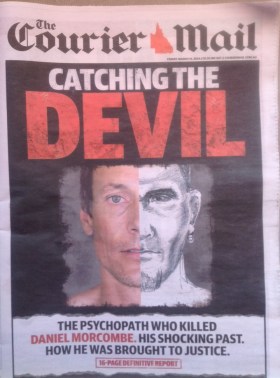
It is timely that in the space of a week we should see the Human Headline (@HumanHeadline) Derryn Hinch released from jail for a publication offence and a serial offender receive a life sentence for the sex murder of teenager Daniel Morcombe.

CatchingTheDevil(Morcombefrontpage14-3-14)C-M

Courier Mail front page 14-3-14

We learned yesterday after Brett Peter Cowan was convicted of that 2003 crime that he had served time twice earlier for similar offences.

He is exactly the kind of individual that Hinch wants placed on a public sex offender register for exactly the reason most talkback callers and social media commenters are asking this question: How can we release such individuals anonymously into our communities when we cannot be sure they will not strike again?

Hinch asked it again this morning:

Hinch became the first Australian journalist jailed this millennium for a publishing offence when he was jailed for 50 days refusing to pay a $100,000 fine for breaching a suppression order on the prior convictions of Adrian Ernest Bayley – the accused sex murderer of ABC worker Jill Meagher in Melbourne in 2012.

In 2011 he was sentenced to five months of home detention for publicly naming two sex offenders at a rally and on his website in defiance of such anonymity orders.

In 1987 he was jailed on a contempt of court charge after broadcasting the criminal record of a former priest Michael Glennon accused of child sex offences and implying his guilt in his high rating Melbourne radio program.

It was only by a 4-3 majority that the High Court later stopped short of overturning Glennon’s conviction on those sex charges on the grounds of Hinch prejudicing his fair trial. (Glennon died in jail this year.)

Journalists and media law students have much to learn from the events of the past week.

While the crimes themselves left a trail of human destruction, the Hinch and Morcombe stories make for ideal case studies in a media law module covering open justice, contempt of court and court reporting – the exact module my students will be starting next week.

They will get to research and debate these kinds of important questions that arise from the week’s events:

  • What public policy issues are at play that see a journalist jailed for reporting the past convictions of an individual convicted of a high profile crime?
  • What does such a penalty say about Australia’s standard of media freedom?
  • Why is Australia’s approach to this level of suppression different from that applying in the United States?
  • Why should the mainstream media be prevented from reporting such material when social media platforms and certain websites are full of it?
  • Why would Hinch’s blog and Twitter feed where he breached the suppression orders over Bayley not represent a ‘real risk of prejudice’ to the trial, when mainstream media coverage might do so?
  • How can juries be quarantined from such information and – if they can’t – why shouldn’t the media be allowed to publish it?
  • Do other methods of dealing with juries – judges’ instructions, training, sequestering etc – mean we no longer need to suppress such material?
  • Are the past offences of such criminals matters of such overwhelming social importance and public concern that suppression of the details should be considered contrary to the public interest?
  • Should the Courier-Mail’s front page heading of February 21, 2014 – ‘Daniel’s Killer’ – have forced the trial to be aborted? Should it be grounds for a sub judice contempt charge? Should it be grounds for Cowan’s appeal?
  • How can a journalist report upon such proceedings in an interesting and timely way while navigating the various restrictions that apply?
  • How ‘open’ should ‘open justice’ be in such high profile trials? Should cameras and smartphone recordings be allowed in court? Should tweeting and other social media usage be allowed in court?
  • Is it appropriate in the modern era of communication that a major television network has to rely on a presenter standing outside a courthouse relaying sentencing information to the audience from a court reporter on the inside via telephone?
  • How much social media commentary should be tolerated about such cases while an accused is facing trial?

I’m sure many other questions arise too – and would be keen for other educators, journalists, lawyers and students to use the Comments section here to pose them so my students can take them up in lecture and tutorial discussions.

———–

Disclaimer: While I write about media law and ethics, nothing here should be construed as legal advice. I am an academic, not a lawyer. My only advice is that you consult a lawyer before taking any legal risks.

© Mark Pearson 2014

Leave a comment

Filed under blogging, contempt of court, courts, free expression, media ethics, Media freedom, media law, Press freedom, sub judice, suppression, Uncategorized

The Human Headline legacy – the jailed Hinch, suppression and free expression

By MARK PEARSON

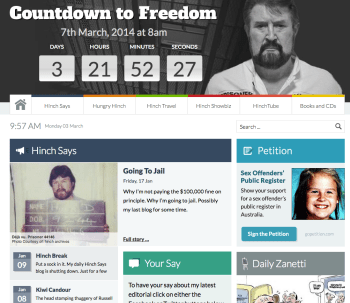
Broadcaster, tweeter, blogger and veteran journalist Derryn Hinch – the self-proclaimed ‘Human Headline’ – has been released from jail after serving a 50 day sentence for breaching a suppression order. 

Derryn Hinch's 'Human Headline' blog - Countdown to Freedom

Derryn Hinch’s ‘Human Headline’ blog – Countdown to Freedom

Hinch had refused to pay a $100,000 fine over his blog and Twitter comments including suppressed background material on Adrian Ernest Bayley, accused of the Melbourne murder of Irish woman Jill Meagher.

Hinch has been jailed twice, fined and sentenced to home detention for his contemptuous reportage and commentary about sex offenders over more than a quarter of a century.

While much of the coverage of his prosecutions and trials has focused on his cavalier and principled stance in the vein of his ‘Human Headline’ moniker, he has also been responsible for a body of case law covering sub judice contempt, the naming of a child sexual assault victim and the defiance of suppression orders – in his television and talkback radio programs, blogs and Twitter feeds.

I am preparing a paper for the ANZCA conference in Melbourne in July, reporting on a legal and textual analysis of eight key Victorian and High Court cases involving Hinch as a party in 1986, 1987, 1996, 2011 and 2013.

It reviews these key cases involving Hinch as a defendant and an appellant since 1986 – including Magistrates, Supreme Court, Court of Appeal and two High Court judgments – and identifies the key media law principles shaped in the process.

It concludes that the Hinch legacy is far more significant than his shallow ‘Human Headline’ title suggests – and ventures into important human rights questions arising in the complex legal and moral terrain where free expression, the ‘public interest’ and the ‘public right to know’ compete with an accused’s right to a fair trial, an ex-prisoner’s right to rehabilitation and a child’s right to protection from sexual predators.

For example, Hinch’s appeal to the High Court over his contempt conviction in 1987 was unsuccessful but resulted in a broadening of the public interest defence to sub judice contempt.

His latest case offers an excellent summary of the relevant factors considered in deciding whether there is a real risk of prejudice to a trial, because Hinch was acquitted on a second contempt charge that his blog ‘had a tendency, or was calculated, to interfere with the due administration of justice in the trial of Bayley’.

Victorian Supreme Court Justice Stephen Kaye ruled that three factors combined to reduce the tendency of Hinch’s blogging to prejudice potential jurors: the small readership of the article, the period of delay between the publication of the article and the likely trial date of Bayley, and other prejudicial material about Bayley circulating in the media and social media at the time (para 114). While ‘highly prejudicial’, Justice Kaye had a ‘reasonable doubt’ in light of those three factors that the article would have prevented Bayley getting a fair trial.

I will post updates on this paper as the research and writing unfolds. Meanwhile, no matter what you think of Hinch’s bravado in his naming and shaming of sex offenders, at least this week we should be able to celebrate the release of an Australian journalist from jail.

———–

Disclaimer: While I write about media law and ethics, nothing here should be construed as legal advice. I am an academic, not a lawyer. My only advice is that you consult a lawyer before taking any legal risks.

© Mark Pearson 2014

3 Comments

Filed under blogging, contempt of court, courts, free expression, media ethics, Media freedom, media law, Press freedom, sub judice, suppression, Uncategorized

RSF names 39 leaders as Press Freedom Predators

3 May 2013
World Press Freedom Day

Media release from Reporters Without Borders – RSF (See http://www.rsf.org)

Website: http://en.rsf.org/asia,2.html
Twitter: @RSFAsiaPacific, @RSF_Asia (中文)
Facebook : facebook.com/reporterssansfrontieres
Skype: rsfasia


39 leaders, groups named as Predators of Freedom of Information in 2013

On World Press Freedom Day, Reporters Without Borders is releasing an updated list of 39 Predators of Freedom of Information ­– presidents, politicians, religious leaders, militias and criminal organizations that censor, imprison, kidnap, torture and kill journalists and other news providers. Powerful, dangerous and violent, these predators consider themselves above the law.

“These predators of freedom of information are responsible for the worst abuses against the news media and journalists,” Reporters Without Borders secretary-general Christophe Deloire said. “They are becoming
more and more effective. In 2012, the level of violence against news providers was unprecedented and a record number of journalists were killed.

“World Press Freedom Day, which was established on the initiative of Reporters Without Borders, must be used to pay tribute to all journalists, professional and amateur, who have paid for their commitment with their lives, their physical integrity or their freedom, and to denounce the impunity enjoyed by these predators.”

Five new predators have been added to the list: the new Chinese president, Xi Jinping, the Jihadi group Jabhat Al-Nosra from Syria, members and supporters of Egypt’s Muslim Brotherhood, Pakistan’s Baloch armed groups, and Maldives’ religious extremists. Four predators have been dropped from the list: former Somali information and communications minister Abdulkadir Hussein Mohamed, Burmese President Thein Sein, whose country is experiencing unprecedented reforms despite the current ethnic violence, the ETA group, and the Hamas and Palestinian Authority security forces, which are harassing journalists less.

To draw attention to their abuses, Reporters Without Borders has drafted indictments against some of these predators in the hope that they will one day be brought before competent courts. To better highlight the gulf between propaganda and reality, the statements of some of them have been contrasted with the facts. And to show how some predators really think, we have presented their innermost thoughts in the first person. We had to use a little imagination, of course, but the facts alluded to conform to reality.

New names in the list of predators

A predator goes and is replaced by another. It is no surprise that Xi Jinping has taken former Chinese President Hu Jintao’s place as predator. The change of person has not in any way affected the repressive system developed by China’s Communist Party.

The list of predators has been impacted by the repercussions from the Arab Spring and uprisings in the Arab world. Members and supporters of Egyptian President Morsi’s party, the Muslim Brotherhood, have been responsible for harassing and physically attacking independent media and journalists critical of the party.

Jabhat Al-Nosra’s entry into the predators list reflects the evolution in the Syrian conflict and the fact that abuses are no longer attributable solely to the regime, represented on the list by Bashar al-Assad, but also to opposition armed groups, which are proving to be more and more intolerant and suspicious towards the media. At least 23 journalists and 58 citizen-journalists have been killed in Syria since 15 March 2011 and seven journalists are currently missing.

In Pakistan, Baloch armed groups, including the Balochistan Liberation Army, Baloch Liberation Front and Baloch Musallah Defa Army, have turned the southwestern province of Balochistan into one of the world’s most dangerous regions for journalists. Consisting of armed separatist groups and opposing militias created to defend the central Pakistani government, they have spread terror in the media and created information “black holes.” Pakistan’s intelligence agencies are also on the predators list because of their abuses against the media.

Ever since the army mutiny that overthrew President Mohamed Nasheed in the Maldives in 2012, extremist religious groups have tried to use their nuisance power to extend their influence. They have become more aggressive as the July 2013 presidential election approaches, intimidating news media and bloggers and using freedom of expression to impose a religious agenda while denying this freedom to others.

Unacceptable impunity for predators

Physical attacks on journalists and murders of journalists usually go completely unpunished. This encourages the predators to continue their violations of human rights and freedom of information. The 34 predators who were already on the 2012 list continue to trample on freedom of information with complete disdain and to general indifference.

The leaders of dictatorships and closed countries enjoy a peaceful existence while media and news providers are silenced or eliminated. Such leaders include Kim Jong-un in North Korea, Issaias Afeworki in Eritrea and Gurbanguly Berdymukhammedov in Turkmenistan. In these countries, as in Belarus, Vietnam, Uzbekistan and other Central Asian countries, the international community’s silence is not just shameful, it is complicit.

Reporters Without Borders urges the international community not to hide behind economic and geopolitical interests. Thanks to their rich natural resources, Azerbaijan’s Ilham Aliyev and Kazakhstan’s Nursultan Nazarbayev are confident that no one will rap their knuckles. Economic interests come before everything else, as they do with China. It is the same with countries that the West regards as “strategic.”

Iran’s two predators – President Mahmoud Ahmadinejad and the Supreme Leader, Ayatollah Ali Khamenei – have already taken steps to deter the media from providing independent coverage of next June’s presidential election. The waves of arrests of journalists that began on 27 January, “Black Sunday,” are clear evidence of this.

Criminal organizations and paramilitary groups that are often linked to drug trafficking – Mexico’s Zetas, Colombia’s Urabeños and the Italian Mafia – continue to target journalists and media they regard as too curious, independent or hostile. In Mexico, a country that is especially deadly for media personnel, 87 journalists have been killed and 17 have disappeared since 2000. Justice has not been properly rendered in any of these cases.

Since Vladimir Putin’s return to the presidency in Russia, the authorities have tightened their grip even further in response to unprecedented opposition protests. The country remains marked by a completely unacceptable level impunity for those responsible for violence against journalists. A total of 29 have been murdered since 2000, including Anna Politkovskaya.

Why are predators never brought to justice?

The persistently high level of impunity is not due to a legal void. There are laws and instruments that protect journalists in connection with their work. Above all, it is up to individual states to protect journalists and other media personnel. This was stressed in Resolution 1738 on the safety of journalists, which the United Nations security
council adopted in 2006.

Nonetheless, states often fail to do what they are supposed to do, either because they lack the political will to punish abuses of this kind, or because their judicial system is weak or non-existent, or because it is the authorities themselves who are responsible for the abuses.

The creation of a mechanism for monitoring adherence to Resolution 1738, which Reporters Without Borders has proposed, would encourage member states to adopt specific provisions for penalizing murders, physical attacks and disappearances that target journalists, would extend Statesʼ obligations to non-professional “news providers” and would reinforce their efforts to combat impunity for such crimes.

At the international level, the legal protection of journalists is also guaranteed by the Universal Declaration of Human Rights, the International Covenant on Civil and Political Rights, the Geneva Conventions and other instruments. The United Nations recently published an Action Plan on the safety of journalists and measures to combat impunity for crimes of violence against them.

The International Criminal Court’s creation has unfortunately not helped advance the fight against impunity for those responsible for the most serious crimes of violence against journalists, although journalists play a fundamental role in providing information and issuing alerts during domestic and international armed conflicts. The ICC only has jurisdiction when the crime takes place on the territory of a state that is a party to the Rome Statute (which created the ICC) or if the accused person is a citizen of a state party.

Furthermore, the Rome Statute provides for no specific charge for deliberate physical attacks on journalists. Article 8 of the statute needs to be amended so that a deliberate attack on media professionals is regarded as a war crime.

Dropped from the predators list

Abdulkadir Hussein Mohamed
Also know as “Jahweyn,” this Somali politician is no longer minister of information and telecommunications. His successor does not seem to be directly responsible for harassment, intimidation or other abuses against media personnel. Journalism nonetheless continues to be very dangerous in Somalia, with a total of 18 journalists killed in 2012.

Burmese President Thein Sein
Installed as president in March 2011, Thein Sein no longer qualifies as a predator of freedom of information. Under his presidency, the military junta has disbanded and all jailed journalists and bloggers, including Democratic Voice of Burma’s 17 video-journalists, have been freed. In 2012, prior censorship was abolished and many exile media began operating openly inside the country. The first privately-owned daily newspapers appeared in early 2013.

Hamas and Palestinian Authority security forces
The security forces of the Palestinian Authority in the West Bank and those of the Hamas government in the Gaza Strip have been dropped from this year’s list of predators because the number of their press freedom violations has fallen considerably in the past four years. The situation of freedom of information in the West Bank and Gaza Strip is nonetheless still the subject of concern. The Hamas government recent banned local journalists from working for Israeli media, and many journalists are prosecuted for insulting President Mahmoud Abbas.

ETA
The organization ETA has been dropped from the 2013 list. It announced the “definitive end to armed actions” in 2011 and has carried out no attacks on journalists or news media since then. Reporters Without Borders has
of course not forgotten all the journalists who were physically attacked or killed by ETA and continues to demand justice for those crimes of violence. Reporters Without Borders will also continue to be on the lookout for any future threat to media freedom by ETA.

_______________________

3 mai 2013
JOURNEE MONDIALE DE LA LIBERTE DE LA PRESSE

39 Prédateurs de la liberté de l’information recensés par RSF en 2013

A l’occasion de la Journée mondiale de la liberté de la presse, Reporters sans frontières publie une liste de 39 Prédateurs de la liberté de l’information, chefs d’Etats, hommes politiques, chefs religieux, milices et organisations criminelles qui censurent, emprisonnent, enlèvent, torturent et parfois assassinent les journalistes et autres acteurs de l’information. Puissants, dangereux, violents, ces Prédateurs se considèrent au-dessus des lois.

“Ces prédateurs de la liberté de l’information sont responsables des pires exactions contre les médias et leurs représentants. Leurs actions sont de plus en plus efficaces : 2012 a été une année historiquement violente pour les acteurs de l’information, avec un nombre record de journalistes tués”, déplore Christophe Deloire, secrétaire général de Reporters sans frontières. “La Journée mondiale de la liberté de la presse, instaurée à l’initiative de Reporters sans frontières, doit être l’occasion de rendre hommage à tous les journalistes, professionnels et amateurs, qui payent leur engagement de leur vie, leur intégrité physique ou leur liberté, et de dénoncer l’impunité dont bénéficient ces prédateurs.”

Cinq nouveaux prédateurs rejoignent la liste : le nouveau président chinois Xi Jinping, le groupe djihadiste Jabhat Al-Nosra en Syrie, les membres et partisans des Frères musulmans en Egypte, les groupes armés baloutches du Pakistan et les extrémistes religieux des Maldives. Quatre prédateurs ont disparu de la liste : l’ancien ministre somalien de l’Information et des Télécommunications, Abdulkadir Hussein Mohamed ; le président birman Thein Sein, dont le pays connaît une ouverture sans précédent, malgré une situation instable ; le groupe ETA, ainsi que les forces de sécurité du Hamas et de l’Autorité palestinienne, dont les exactions envers les médias sont en sensible diminution.

Pour mieux dénoncer les Prédateurs, Reporters sans frontières formule des actes d’accusation étayés dans l’espoir que ces individus ou ces mouvances soient un jour forcés de rendre des comptes à la justice. Pour mettre en évidence le décalage entre leurs propagandes et la vérité, leurs assertions officielles sont confrontées aux faits. Pour démontrer leurs intentions profondes, Reporters sans frontières se met dans leurs têtes et présente leurs pensées au style direct, à la première personne. La transcription est librement établie par l’organisation, mais les faits invoqués conformes à la réalité.

De nouveaux noms dans la liste des Prédateurs

Un prédateur en remplace un autre : Xi Jinping reprend sans surprise la place de prédateur de l’ancien président chinois Hu Jintao. Le changement d’individu ne remet en rien en cause le système liberticide porté à bout de bras par le Parti communiste chinois.

La liste des prédateurs subit elle aussi le contre-coup des printemps arabes et des mouvements de soulèvements populaires. Les membres et partisans du parti des Frères musulmans en Egypte se rendent responsables d’actes d’agressions, de pressions et de harcèlement envers les médias indépendants et les journalistes critiques du parti et du président Morsi.

L’entrée de Jabhat Al-Nosra symbolise l’évolution du conflit syrien et le fait que les exactions ne sont plus du seul fait du régime, représenté dans la liste des prédateurs par Bashar Al-Assad, mais également de groupes armés de
l’opposition, qui s’avèrent de plus en plus intolérants et suspicieux envers les médias.
Du 15 mars 2011 au 3 mai 2013, au moins 23 journalistes et 58 citoyens-journalistes ont été tués en Syrie. A ce jour, 7 journalistes sont toujours portés disparus.

Au Pakistan, les groupes armés Balochistan Liberation Army (BLA), Baluch Liberation Front (BLF) et Musallah Defa font du Balochistan l’une des régions les plus dangereuses au monde pour les journalistes. Ils ont instauré la terreur au sein des médias, assassiné des journalistes et créé des trous noirs de l’information. A noter que les services de renseignement pakistanais, également responsables d’exactions contre la presse, figurent déjà dans la liste des prédateurs.

Aux Maldives, depuis la mutinerie militaire de 2012, qui a renversé le président Mohamed Nasheed, les groupes religieux extrémistes tentent d’user de leur force de nuisance pour étendre leur influence dans le pays. A l’approche des élections présidentielles de juillet 2013, ils durcissent leurs positions. Ils intimident les médias et les
blogueurs et instrumentalisent la liberté d’expression pour imposer un agenda religieux en refusant que cette liberté soit étendue aux autres.

Ces Prédateurs qui jouissent d’une intolérable impunité

Les agressions et assassinats de journalistes se soldent généralement par une impunité totale des responsables. C’est pour les Prédateurs un encouragement à poursuivre les violations des droits de l’homme et de la liberté d’information. Les trente-quatre Prédateurs qui figuraient déjà sur la liste 2012 continuent de piétiner la liberté d’information dans le dédain le plus complet et l’indifférence générale.

Les dirigeants des régimes dictatoriaux et des pays les plus fermés coulent des jours paisibles tandis que la presse et les acteurs de l’information étouffent ou ont été réduits au silence. C’est le cas de Kim Jong-un en Corée du Nord, Issaias Afeworki en Erythrée ou Gourbangouly Berdymoukhamedov au Turkmenistan. Pour ces pays, ainsi que pour le Bélarus, le Vietnam, l’Erythrée et les autres dictatures d’Asie centrale (Ouzbékistan en tête), le silence de la communauté internationale est plus que coupable, il est complice. RSF appelle la communauté internationale à ne plus se cacher derrière les intérêts économiques et géopolitiques. Forts de leurs ressources naturelles, Ilham Aliev en Azerbaïdjan, et Noursoultan Nazarbaïev au Kazakhstan savent pertinemment que nul ne viendra leur taper trop fort sur les doigts. Les intérêts économiques passent avant tout, comme avec la Chine. Même scénario pour des Etats ‘stratégiques’ pour les pays occidentaux.

Les deux prédateurs iraniens – le président Mahmoud Ahmadinejad et le Guide Suprême, l’Ayatollah Khamenei – ont déjà pris des mesures pour dissuader les médias d’assurer une couverture indépendante de l’élection présidentielle du 14 juin 2013. En témoignent les vagues d’arrestations de journalistes et détentions préventives qui se succèdent depuis le dimanche noir, 27 janvier 2013.

Les organisations criminelles ou paramilitaires, souvent liées au narcotrafic – Zetas au Mexique, Urabeños en Colombie ou mafias italiennes – continuent de prendre pour cibles journalistes et médias jugés trop curieux, trop indépendants, souvent hostiles. Pays particulièrement meurtrier pour les journalistes, le Mexique en compte 86 tués et 17 disparus depuis 2000. Justice n’a été réellement rendue dans aucune de ces affaires.

En Russie, un tour de vis répressif a été mis en place depuis le retour à la présidence de Vladimir Poutine, en réponse à une mobilisation sans précédent de l’opposition. Le pays reste marqué par l’impunité intolérable de nombreux assassins et agresseurs de journalistes. Pas moins de 29 journalistes ont été tués en lien direct avec leur activité professionnelle depuis l’année 2000, dont la journaliste Anna Politkoskaïa.

Pourquoi les prédateurs échappent-ils à la justice ?

La persistance d’un haut niveau d’impunité ne s’explique pas par l’existence d’un vide juridique. Des normes et des mécanismes existent pour protéger les journalistes dans l’exercice de leur profession. La protection des journalistes et autres acteurs médiatiques incombe en premier lieu aux États comme le rappelle la résolution 1738 relative à la sécurité des journalistes, adoptée par le Conseil de sécurité des Nations Unies en 2006. Pourtant, les Etats sont trop souvent défaillants, soit par manque de volonté politique de réprimer de telles exactions, soit parce que leur appareil judiciaire est inexistant ou affaibli, soit encore parce que les autorités sont responsables de ces exactions. La mise en place d’un mécanisme de contrôle du respect et du suivi de la résolution 1738 par les Etats membres des Nations unies, proposée par Reporters sans frontières, inciterait les Etats à adopter des dispositions pénales spécifiques incriminant les crimes, agressions et disparitions de journalistes, à étendre les obligations des États envers les acteurs de l’information non-professionnels et à renforcer leur lutte contre l’impunité.

Au niveau international, la protection juridique des journalistes est également garantie par la Déclaration universelle des droits de l’homme, le Pacte international relatif aux droits civils et politiques, les Conventions de Genève entre autres textes. Les Nations unies ont récemment publié un Plan d’Action sur la sécurité des journalistes et la lutte contre l’impunité.

La mise en place d’une Cour pénale internationale n’a malheureusement pas fait progresser la lutte contre l’impunité des auteurs des crimes les plus graves contre les journalistes, malgré leur rôle fondamental d’information et d’alerte pendant les conflits armés internes et internationaux. La CPI n’est compétente que lorsque les faits ont lieu sur le territoire d’un Etat partie ou si la personne accusée du crime est ressortissant d’un Etat partie. En outre, le Statut de Rome (constitutif de la CPI) ne prévoit aucune incrimination spécifique des attaques délibérées contre les journalistes. Un amendement à l’article 8 est nécessaire pour que les attaques délibérées contre les professionnels des médias soient considérées comme un crime de guerre.

Ces personnalités et mouvements qui sortent de la liste des Prédateurs

Abdulkadir Hussein Mohamed
Surnommé “Jahweyn”, cet homme politique somalien a quitté son poste de ministre de l’Information et des télécommunications. Son successeur ne semble pas directement responsable de pressions, d’intimidations ni d’exactions à l’encontre de la presse. L’exercice du métier d’informer reste certes très périlleux en Somalie (où 18 morts ont été recensés en 2012).

Le président birman Thein Sein
Au pouvoir depuis mars 2011, Thein Sein ne mérite plus le qualificatif de prédateur de la liberté de la presse. C’est sous sa présidence que la junte militaire a été dissoute et que tous les journalistes et blogueurs emprisonnés, y compris les 17 vidéo-journalistes de la Democratic Voice of Burma, ont été libérés. En 2012, la censure préalable a été abolie, nombre de médias en exil sont rentrés. Les premiers quotidiens privés sont parus début 2013.

Les forces de sécurité du Hamas et de l’Autorité palestinienne
Les forces de sécurité de l’Autorité palestinienne en Cisjordanie et celles du gouvernement du Hamas à Gaza sortent cette année de la liste des prédateurs. Le nombre de violations de la liberté de la presse qu’elles ont commises a considérablement diminué au cours des quatre dernières années. Toutefois, la situation de la liberté de l’information reste préoccupante, en Cisjordanie et à Gaza. Le gouvernement du Hamas a récemment interdit aux journalistes gazaouis toute collaboration avec des médias israéliens, et très nombreux sont les procès pour ‘insulte à la personne du Président Mahmoud Abbas’.

ETA
L’organisation a été retirée de la liste des Prédateurs en 2013. ETA a en effet annoncé en 2011 la “fin définitive de ses actions armées” et depuis n’a pas réalisé d’attentats contre des journalistes ou médias. Reporters sans frontières n’oublie naturellement pas les journalistes tués ou agressés par ETA et continue de demander que justice soit faite pour les actes commis. A l’avenir, RSF demeurera extrêmement vigilante, attentive au moindre indice de menace contre la liberté de la presse dont se rendrait coupable ETA.

Benjamin Ismaïl
Head of Asia-Pacific Desk
Reporters Without Borders

Website: http://en.rsf.org/asia,2.html
Twitter: @RSFAsiaPacific, @RSF_Asia (中文)
Facebook : facebook.com/reporterssansfrontieres
Skype: rsfasia

Leave a comment

Filed under Uncategorized

Press regulatory ‘stick’ so tough it’s licensing #mediareforms

By MARK PEARSON (@journlaw)
It’s a great shame when political and commercial vested interests drown out compelling and principled arguments for free expression in this Australian media reform debate.
Firstly, I declare my own interest as Australia’s correspondent for Reporters Without Borders (RSF) – an interest in free expression and media freedom.
That said, here are my three reasons the proposed Public Interest Media Advocate proposal for control of press regulation deserves a sudden death.
1. It amounts to de facto licensing. I don’t believe the plan was sinister or Stalinist – I just don’t think the policy wonks looked at the impact of the ‘stick’ end of the ‘carrot and stick’ approach to ‘enforced self-regulation’. As I blogged last week, it would mean ‘death by a thousand consent forms’ for any newspaper/online company who refused to sign up (with $3m plus turnover). Why? The Privacy Act exemption for journalism exists for good reason: the Act is designed for government departments, banks, insurance companies and other large corporates and we all know that journalism is not “just another business”. Those bodies have predictable dealings with customers and are not in the business of publishing stories about them. The revised Privacy Act – effective from 2014 – gives the Privacy Commissioner tough new powers to audit corporations, wielding civil penalties of up to $1.7 million (See Mallesons brief). A relatively small newspaper group would reach the required $3 million annual turnover threshold to qualify and would be crippled by the paperwork involved in complying with the Privacy Act – consent authorities for all personal information collected – the very lifeblood of community news reporting such as people’s ages, workplaces, political and union affiliations. It would require consent from anyone identifiable in photographs – including those in the background. It would thus set up a statutory market differentiation between such a news organisation and its competitors – other media not subject to the Act, including newspaper groups in a press council, broadcast media not subject to this provision, and smaller media of all types exempt from the Privacy Act threshold. Law firm Minter Ellison issued a release on March 14 with the following stark advice: “The potential loss of the media exemption in the Privacy Act could make it difficult, if not impossible, for news media organisations to effectively continue their operations.”
So, it’s not a ‘stick’ but a shotgun to the head of newspaper companies to be in a registered press council or be out of business. That’s licensing – and ‘prior restraint’ on a news outlet’s ability to publish – a situation abhorrent to our system of law for centuries.
2. The Bill’s very terms are self-defeating and damage free political speech. Section 14 of the Bill proclaims that nothing within it should counter the High Court’s freedom to communicate on matters of politics and government. But the very mechanism does that in two ways. Firstly, the overall effect is to force newspaper companies into a regulated ‘self-regulator’. The alternative, as per point 1 above, is almost certain death. Newspapers have long been a key forum for political and governmental debate in our society. How informed about candidates for the upcoming election would voters in Tamworth be without their Northern Daily Leader and its website? Well, that would be the plight that community would face if its owner – Fairfax – decided to leave the Press Council on principle, could no longer afford the membership fee, or was expelled. Secondly, the very Privacy Act that is being held as the threatened ‘stick’ deems ‘trade union membership’ and ‘political affiliation’ as ‘sensitive information’ – subject to even more red tape. The mechanism forces a recalcitrant news organisation into a disadvantaged position in its election coverage because its hands would be tied by this level of bureacratic compliance. This would mean – at the very least – that the flow of political and government opinion in the community would be unacceptably delayed by privacy consent paperwork. Imagine the impact of such a brake on the web-based and social media divisions of such a newspaper – getting consent from everyone identifiable through a comment thread! This would give ample ammunition for a High Court challenge.
3. The instrument has already damaged Australia’s standing as a free Western democracy. We have no written constitutional free expression protection, which sets us apart from other democracies. Both Communications Minister Stephen Conroy and Prime Minister Julia Gillard cited RSF’s World Press Freedom Index in recent days, using the argument that Finland is in number one position there despite having a statutory mechanism for its press regulation. Perhaps – but Finland also has a section in its Constitution guaranteeing free expression and the free flow of information so all laws are formed and applied against that backdrop. It also lacks the hundreds of other media laws impacting on free expression that we have in this country which place us at number 26 on that same Index. We languish there partly because of the very threats to media freedom posed by the recent inquiries into its regulation. The UK’s latest move is also set against a European human rights free expression framework and is a reaction to much more heinous media acts than we have seen in this country. Australia has spent millions over recent decades ‘counselling’ our Pacific Island and Asian neighbours against exactly these kinds of government interference with a free media – in the form of AusAID training courses and other diplomatic interventions. Now we send the clear signal that the Australian government is willing to offer a handy lesson in managing adverse publicity – using a cynical device to subject non-compliant newspapers to death by red tape.
There you have it – a vent from someone whose only agenda is to encourage truth-seeking and truth-telling in our society through the long-established right of free expression. Oh, I do have another agenda – preserving an employment market for journalism graduates. And it looks like that challenge may get even harder!

PS. Find an inaccuracy here and I’ll correct it immediately and record that correction in a note below.

© Mark Pearson 2013

Disclaimer: While I write about media law and ethics, nothing here should be construed as legal advice. I am an academic, not a lawyer. My only advice is that you consult a lawyer before taking any legal risks.

1 Comment

Filed under Media regulation

‘Self-regulation’ oxymoron heralds the era of ‘death by a thousand consent forms’ #mediareforms

By MARK PEARSON

The oxymoron in the name of the proposed media reform legislation says it all: It is the “News Media (Self-regulation) Bill 2013”. (See here).

Here we have a piece of legislation proposing a statutory mechanism for the supervision of industry-based self-regulation of print and online news media.

That, dear readers, is “regulation”.

Just as it is troubling when proposed legislation purports to be what it is not, it is of even greater concern when a government moves to rush such laws through Parliament in just one week.

This blog is about media and social media law and regulation and their impact on free expression – not about politics.

But it is politics that has cruelled this whole media regulation review over the past 18 months.

The Independent Media Inquiry, chaired by former Federal Court justice Ray Finkelstein, was mired in politics when it was announced in late 2011 against the backdrop of both Labor and Greens stoushes with Murdoch titles.

And it seems to be politics that is now driving the desire to enact ‘something’ in the life of this government.

But that ‘something’ is problematic on a range of measures.

The basic ‘self-regulatory’ proposal is that a Public Interest Media Advocate be appointed with the power to declare bodies like the Australian Press Council to be a suitable ‘news media self-regulation body’.

If such bodies do not meet the government-appointed Advocate’s criteria, their member media outlets would be stripped of their current Privacy Act exemptions – leaving them exposed to potential privacy compensation orders and a bureaucratic reporting regime that would cripple their news operations.

At present, media organisations just have to be signed up to the Press Council or an equivalent body and be ‘publicly committed to observe’ its privacy standards.

If a media company falls foul of the self-regulator, refuses to join one, or joins one that does not meet the requirements, then the new Public Interest Media Advocate would have the power to strip them of their Privacy Act exemption under Section 7B(4) – leaving them obliged to follow all the privacy protocols associated with ‘obtaining, keeping and disclosing of personal information’ related to any of their stories and photographs.

This would leave the newspaper or online news company having to get every person in a group photograph to sign consent forms and to refrain from publishing sensitive personal information about people like their financial dealings, medical conditions, employment history and a host of other material commonly appearing in news stories.

They would also have to go to the expense of safely storing all the personal information they gathered for news reports and deal with requests from individuals who might want to withdraw their permission for them to retain that information about them.

There is no ‘public interest’ exemption to this requirement under the Privacy Act – other than formally seeking a ‘public interest determination’ from the Privacy Commissioner in a specific case.

Of course, there may be other protections for investigative reporters – perhaps the permission to publish details already released under the privacy provisions of Freedom of Information laws, and of course privileges extending to material tabled in court or Parliament.

There might also be an argument that the High Court’s implied freedom to communicate on matters of government and politics might apply to some private information in limited circumstances, although recent decisions from that court seem to render that freedom problematic and dependent on the views of individual judges.

There is a long principle ‘against prior restraint’ in our legal system – shackles by governments and courts to stop the news media before they have the opportunity to publish something.

The most famous example were the attempts in earlier centuries to license the printing presses – government measures opposed by famous statesmen and jurists like John Milton, John Stuart Mill and our own colony’s first Chief Justice, Sir Francis Forbes.

This proposal is for a system of de facto licensing because the statutory alternative to joining the self-regulatory regime would almost guarantee financial ruin for a newspaper company in this environment, when they are already facing huge challenges retaining readership and winning advertising in the Web 2.0 era.

The Privacy Act provisions would only apply to media companies earning more than $3 million per year – which is the threshold for corporations – and the proposed bill also offers a ‘small business’ exemption to its requirements.

This would potentially leave us with a two-speed news media – small operators, bloggers, citizen journalists and social media users sharing private information willy-nilly while larger news organisations falling outside the ‘self-regulatory’ regime are left to expend valuable time and resources filling out all that privacy paperwork.

Unlike other Western democracies, Australia has no written constitutional protection of free expression in the form of a Bill of Rights or a regional human rights document. The explanatory notes to the proposed laws go through the usual routine of giving a ‘Statement of Compatibility with Human Rights’, in accordance with Part 3 of the Human Rights (Parliamentary Scrutiny) Act 2011.

But the imposition of the proposals on free expression is dispensed with in just three paragraphs excusing it because of its capacity for respecting the privacy and reputations of other citizens.

There is no doubt Australia’s media self-regulation can be improved, and there is even scope for some fine-tuning of media laws.

It is also evident that the Australian Press Council has markedly improved its systems and funding under the leadership of its chair, Professor Julian Disney.

There are already several hundred media laws in this country – enough to fill at least three major journalism textbooks in the field and several more in the specialist areas of torts, criminal law and intellectual property.

Even a tort of privacy invasion with a strong public interest exemption for journalism would be preferable to this proposal for a system of ‘death by a thousand consent forms’ for struggling news organisations who should have the right to be lone wolves and refuse to play the government’s game.

Call it what you like, but this Bill is not ‘self-regulation’.

© Mark Pearson 2013

Disclaimer: While I write about media law and ethics, nothing here should be construed as legal advice. I am an academic, not a lawyer. My only advice is that you consult a lawyer before taking any legal risks.

14 Comments

Filed under Uncategorized

Terror is no laughing matter – lessons from the #twitterjoketrial

By MARK PEARSON

Twitter and Facebook are great outlets for one-liners and satire, but police and security agencies are not known for their sense of humour. Trainee accountant Paul Chambers, 27, learned that the hard way when he was arrested on UK terrorism charges for jokingly tweeting a threat to blow up a British airport. Air traffic was delayed by a heavy snowfall and Chambers was desperate to visit a female friend in Northern Ireland, so he light-heartedly tweeted to her and his 650 followers: ‘C***! Robin Hood Airport closed. You have got a week to get your s*** together, otherwise I’m blowing the airport sky high!’ Police swooped a week later and he was questioned on the terrorism charges before being convicted and fined £1,000 on a lesser charge of causing nuisance. He later won an appeal in the High Court when the Lord Chief Justice agreed it had been a humorous remark rather than a threat. The case became known as the ‘Twitter joke trial’. I’m fairly confident Chambers would not go through all that angst again over a not so witty one-liner.

Journalist, blogger, tweeter and lawyer David Allen Green ( @DavidAllenGreen ‘Jack of Kent’ ) spoke recently on the issue to the Open Rights Group.

Across the English Channel, 23-year-old unemployed Frenchman François Cousteix was surprised one evening to find French police and US FBI agents arrive at his front door. Operating under the name ‘Hacker Croll’, he had made it his hobby to access celebrities’ social media accounts just for fun. He had accessed the social media account of celebrity Britney Spears but came to international security agencies’ attention when he hacked into the Twitter account of US President Barack Obama. He escaped with a five month parole sentence.

There is a simple lesson from these cases: do not joke about national security matters.

Governments throughout the world ramped up their national security laws in the wake of the terrorist attacks on the US in September 2001. Even in countries with a high regard for civil liberties and free expression, new powers were handed to security agencies and police to aid in the detection and arrest of suspected terrorists. Pressure mounted in western democracies for even tougher laws after the Bali bombings in 2002 and 2005 and the 7/7 London attacks in 2005.

Publishing restrictions in the name of national security existed long before 9/11. Sedition and treason laws encouraging public unrest, violence and the overthrow of rulers date back to feudal times when governments tried to enforce loyalty upon ordinary citizens. While many countries have phased out these ancient crimes, such laws are still used in some places as mechanisms for intimidation and repression. Anti-terrorism laws were also used in western democracies well prior to 2001. The UK passed special laws to respond to Irish Republican Army terrorism throughout the 20th century, while New Zealand introduced new restrictions after the French bombing of the Greenpeace boat the Rainbow Warrior in 1985.

But the early 21st century attacks on the West triggered a wave of new anti-terror laws impacting on the free expression of journalists and Internet users. Hundreds of anti-terror laws were introduced in the first decade of the 21st century under the banner of the so-called ‘War on Terror’.

America led the way with its USA ‘Patriot’ Act of 2001, in which the letters stand for: ‘Uniting (and) Strengthening America (by) Providing Appropriate Tools Required (to) Intercept (and) Obstruct Terrorism’. President Barack Obama’s administration extended the legislation for a further four years from 2011.

Others followed suit, including the UK, Canada, Australia and New Zealand. Ottawa software developer Momin Khawaja became the first person charged under Canada’s anti-terror laws but in 2011 challenged his conviction on constitutional grounds. In Australia, Belal Saadalah Khazaal was sentenced to 12 years in jail in 2009 for ‘making a document connected with assistance in a terrorist act’ after he created an e-book titled “Provisions on the Rules of Jihad” which allegedly targeted foreign governments and leaders. The High Court upheld his conviction in 2012.

There were too many anti-terror laws introduced internationally to detail here, but some can impact upon you if you are a cyber-journalist or blogger. They include:

  • Increased surveillance powers for spy agencies and police;
  • New detention and questioning regimes;
  • Seizure of notes and computer archives;
  • Exposing confidential sources to identification;
  • Closing certain court proceedings so they are unreportable;
  • Exposing bloggers to fines and jail if they report on some anti-terror operations;
  • Making it an offence to merely ‘associate’ or ‘communicate’ with those suspected of security crimes; and
  • Exposing bloggers and social media users to criminal charges if you publish anything seen as inciting terrorism.

Governments also go straight to search engines and ISPs and demand they remove material and, as Google’s Transparency Report documents, they often comply. But some have complained Google and Youtube have not responded quickly enough when asked to take down terrorism material. Burst.net certainly acted fast when the FBI advised it that some blogs it hosted under the free WordPress blogetery.com site contained terrorist material suspected of being used by the group al-Qaeda. It shut the site down, along with the 70,000 blogs it hosted. Blogetery resurfaced a month later under a different host.

The United Nations introduced a range of protocols that countries adopt minimum standards for combating terrorism. At the same time, the OECD acted to encourage Internet freedom by asking nations to open up cyberspace to freer and speedier communication. To the average blogger, the two positions might seem at odds.

A Mexican radio commentator and a maths tutor were jailed and faced a maximum 30 year prison sentence in 2011 on terrorism and sabotage charges after they tweeted false reports that gunmen were attacking schools in the city of Veracruz. The misinformation prompted parents to panic and some were involved motor accidents as they rushed to fetch their children.

“Here, there were 26 car accidents, or people left their cars in the middle of the streets to run and pick up their children, because they thought these things were occurring at their kids’ schools,” an official told Associated Press. The false reports followed weeks of gangland violence in the city.

“My sister-in-law just called me all upset, they just kidnapped five children from the school,” tutor Gilberto Martinez Vera allegedly tweeted. He followed that message with: “I don’t know what time it happened, but it’s true.” The other accused had retweeted the false reports to her followers. Experts described the tweeting as poor use of the medium, but not deserving of terrorism charges.

[Adapted from my book, Blogging and Tweeting Without Getting Sued. A Global Guide to the Law for Anyone Writing Online. (Allen & Unwin, 2012).

Disclaimer: While I write about media law and ethics, nothing here should be construed as legal advice. I am an academic, not a lawyer. My only advice is that you consult a lawyer before taking any legal risks.

© Mark Pearson 2012

Leave a comment

Filed under Uncategorized

Counter-terror laws under review – our appearance at COAG

By MARK PEARSON

Griffith University colleague Associate Professor Jacqui Ewart (@jacquiewart) and I appeared before the Council of Australian Governments (COAG) hearing into the review of counter-terrorism laws conducted in Brisbane yesterday.

We explained our collaborative research on the subject, and called upon the committee to take account of the importance of free expression, open justice and transparency of process to a democracy like Australia.

The laws under review are listed here.

I began by explaining that national security laws introduced since September 2001 affected the ability of journalists to investigate into and report upon particular incidents, identify and communicate with sources of information for such reportage, preserve the confidentiality of such sources, report fairly and accurately court proceedings related to counter-terrorism, expose miscarriages of justice, and  to draw upon actual examples when covering the broader issues of national security and counter-terrorism.

Australia differed from other democratic nations in that it lacks written constitutional protection of free expression.

I suggested that given the absence of any such free expression protection here, there was a crucial need for public interest or media exemptions to provisions threatening free expression.

Perhaps the committee could appoint an independent adviser or a representative from a body such as the Australian Press Council to review any proposed legislation with an eye to its implications for free expression.

Dr Ewart made the following points in our submission:

When the anti-terrorism legislation was introduced in 2004 and 2005 there was much discussion about the potential impacts these laws would have on journalists and the public right to know about terrorism cases, but much of that discussion was at the time speculation. Since then we have seen demonstrable evidence of the impacts of those laws on the ability of journalists to report on national security matters and to inform the public. These impacts include but are not limited to:

  • Suppression orders are now routinely invoked in terrorism-related court cases to prevent journalists’ from reporting details of cases that may be in the public interest and may not be against national security interests. While there was recently a move towards cooperation between the media and the judiciary in relation to suppression orders (Operation Pendennis court trials under J Bongiorno), this is not standard practice.
  • Sedition laws have restricted freedom of expression in the media. The legal provisions regarding journalists reporting the detention of suspects under the ASIO Act have implications for journalists, and much broader consequences for individuals’ freedom of speech.
  • Media reliance on official spokespeople has increased because of arrest, questioning and detention restrictions once a suspect has been arrested, as evidenced by the controls of information flows by the Australian Federal Police in the arrest and charging of Dr Mohamed Haneef.
  • Recent demands by judges for journalists to reveal their sources of counter-terror stories, evidenced by the making of such demands upon The Australian’s Cameron Stewart regarding leaks from the Federal Police over the Holsworthy Barracks raids.
  • Further to the preceding point, the freezing of information about counter-terror operations by government agencies after the above incident where The Australian published an account of one operation before it started. This led to police/media protocols for future counter-terrorism stories.
  • The potential for the confidentiality of a journalist’s source being compromised through the investigative powers of anti-terror agencies. This may erode the public’s confidence in the media, preventing members of the public from approaching journalists with stories or information.
  • The readiness of counter-terror agencies and prosecutors to make use of raw footage and interview material captured by journalists as prosecution evidence in their cases against terror suspects, as per the Jack Thomas trial.
  •  A warning from an Attorney-General to an academic about his research involving the interviews with suspected terrorists overseas renders journalists’ interviews with terrorists on foreign territory problematic.

We are also unaware of potential problems for those arrested or questioned under the ASIO Act because of the restrictions placed on individuals in relation to telling others including the media they have been arrested or questioned and those restrictions extend to journalists.

This means that the ability of the media to freely – real national security implications notwithstanding – fairly and accurately report terrorism cases has been at times severely hindered by the legislation.

We concluded by recommending the review of the legislation specifically examines the question of the impacts of the legislation on journalists’ ability to cover terrorism cases and terrorism-related court cases, in order to ensure the protection of the public interest in such cases. We provided the committee with an extended explanation in the form of an article on the topic we recently submitted to an international refereed journal.

© Mark Pearson and Jacqueline Ewart 2012

Leave a comment

Filed under Uncategorized