Tag Archives: free expression

Election postscript: a mindful analysis of media coverage

By MARK PEARSON

[This blog was first published in the St James Ethics Centre’s Living Ethics newsletter, Issue 93, Spring 2013. See here.]

Australian journalists operate under an array of ethical guidelines, including the MEAA Code of Ethics and numerous employer and industry codes of practice.

hogansWhile these documents differ widely in their wording, they espouse common values of truth, accuracy, fairness and the public’s right to information. They disapprove of invasions of privacy, disclosure of confidential sources, discriminatory language, subterfuge, deception, plagiarism and conflicts of interest.

When it comes to assessing the ethics of news coverage of an event as broad in scope as a federal election we find some guidance in such codes but other moral frameworks can add value.

Although I am not a Buddhist, I have recently found value in applying some of that religion’s foundational principles – in a secular way – to the assessment of journalism ethics and have been sharing this approach with colleagues and students through my writing and teaching.

It is also a useful lens through which to review some key elements in media coverage of the 2013 federal election.

The approach centres on the belief that journalists can adopt a mindful approach to their news and commentary which requires a reflection upon the implications of their truth-seeking and truth-telling as a routine part of the process. It calls upon them pause and think carefully about the consequences of their reportage and commentary for the stakeholders involved, including their sources and their audiences.

Truth-seeking and truth-telling are still the primary goal, but only after gauging the resulting social good or harm.

Each of the constituent steps of Buddhism’s Eightfold Path – understanding free of superstition, kindly and truthful speech, right conduct, doing no harm, perseverance, mindfulness and contemplation – provides a framework for such analysis.

Space prohibits the examination of all of them here, but at least three issues arose in the election worthy of such reflection.

  1. Fact checking. The Buddhist notion of ‘right views’ focuses on a deeper explanation of root causes and the clinical testing of claims. The emergence of the ‘fact checker’ was a welcome development via Politifact Australia, the ABC’s Fact Checking Unit and The Conversation’s Election FactCheck. A longer term impact of such a tool might be that politicians are prompted to think twice before issuing scaremongering and outlandish statements.
  2. The News Corp anti-Labor campaign. The principle of ‘right intent’ calls upon us to reflect upon the genuine motivations for Rupert Murdoch’s Australian newspapers adopting such a blatant and belittling attack on the incumbent government. Cynical mock-ups like the Daily Telegraph’s ‘Hogan’s Heroes’ and the Courier Mail’s ‘Send in the Clown’ front pages might be excused as tabloid fun but they hardly indicate ‘right intent’ and ‘right speech’ in the Buddhist moral framework. The motivation could surely not have been to gain circulation, given the fact that the coverage stood to alienate perhaps one third of readers. It will be fascinating to see at the next audit whether this stance accelerated the decline of those newspapers’ circulations. If the intent was to win influence with the likely government, then this should have been disclosed.
  3. Presidential-style coverage. Just because political parties choose to run a presidential style of campaign does not oblige news organisations to embrace it. The Buddhist principle of ‘right effort’ invokes a steady, patient and purposeful path and ‘right mindfulness’ demands a considered and reflective approach to reportage. Each of these is difficult when reporters are assigned to traipse around the nation and cover political leaders engaging in stage-managed, superficial appearances at factories, schools and sausage sizzles. It is belittling to the enterprise of journalism to see some of its leading lights – and notable watchdogs – being led by the leash as mere lapdogs. It was particularly noticeable in a campaign where neither leader made a notable gaffe. We are left to imagine what might have been revealed if only these political journalism superstars had been afforded the time to do some real digging. Sometimes being ethical demands us to say ‘no’ to an under-utilisation our talents, which was clearly the case here.

livingethicscoverThe ultimate test of ethical political reporting in a democracy is the extent to which that journalism best informs the citizenry to maximize the value of each and every vote. In that respect, Australian journalism still has much to learn.

———–

Disclaimer: While I write about media law and ethics, nothing here should be construed as legal advice. I am an academic, not a lawyer. My only advice is that you consult a lawyer before taking any legal risks.

© Mark Pearson 2013

2 Comments

Filed under blogging, Buddhism, citizen journalism, Eightfold Path, free expression, media ethics, social media, Uncategorized

Updated: Privacy in Australia – a timeline from colonial capers to racecourse snooping, possum perving and delving drones

By MARK PEARSON

The interplay between the Australian media and privacy laws has always been a struggle between free expression and the ordinary citizen’s desire for privacy. I have developed this timeline to illustrate that tension.

1827: NSW Chief Justice Francis Forbes rejects Governor Ralph Darling’s proposal for legislation licensing the press, stating: “That the press of this Colony is licentious may be readily admitted; but that does not prove the necessity of altering the laws.” (Historical Records of Australia, Series 1, Vol. 13, pp. 290-297)

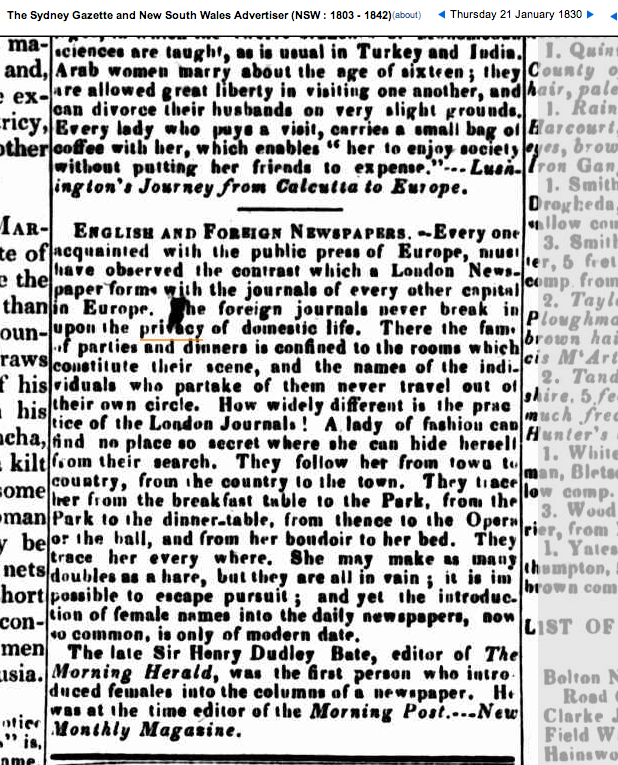
PrivacySydneyGazetteExtract1830

The extract from the Sydney Gazette in 1830

1830: The Sydney Gazette and New South Wales Advertiser publishes an extract from London’s New Monthly Magazine on the prying nature of the British press compared with its European counterparts, stating: “The foreign journals never break in upon the privacy of domestic life”. But the London newspapers would hound a ‘lady of fashion’ relentlessly: “They trace her from the breakfast table to the Park, from the Park to the dinner-table, from thence to the Opera or the ball, and from her boudoir to her bed. They trace her every where. She may make as many doubles as a hare, but they are all in vain; it is impossible to escape pursuit.”

1847: NSW becomes the first Australian state to add a ‘public benefit’ element to the defence of truth for libel – essentially adding a privacy requirement to defamation law (ALRC Report 11, p. 117)

1882: First identified use of the phrase ‘right to privacy’ in an Australian newspaper. Commenting on a major libel case, the South Australian Weekly Chronicle (22.4.1882, p.5) states: “A contractor having dealings with the Government or with any public body has no right to privacy as far as those dealings go.”

1890: In a landmark Harvard Law Review article, the great US jurist Samuel D. Warren and future Supreme Court Justice Louis D. Brandeis announce a new ‘right to privacy’ in an article by that very name. There is a ripple effect in Australia with several mentions of the term in articles between 1890-1900.

1937: A radio station used a property owner’s land overlooking a racecourse to build a platform from which it broadcast its call of the horse races. The High Court rules the mere overlooking of the land did not consti­tute an unlawful interference with the racing club’s use of its property. The decision viewed as a rejection of a common law right to privacy: Victoria Park Racing and Recreation Grounds Co. Ltd v. Taylor (1937) 58 CLR 479.

1948: Universal Declaration of Human Rights is proclaimed in Paris. Article 12 provides: “No one shall be subjected to arbitrary interference with his privacy, family, home or correspondence, nor to attacks upon his honour and reputation. Everyone has the right to the protection of the law against such interference or attacks” (United Nations Universal Declaration of Human Rights, GA. Res 217A(III), UN Doc A/Res/810 (1948).)

1966: The International Covenant on Civil and Political Rights (ICCPR) is proclaimed, protecting privacy at Article 17. (16 December 1966, [1980] ATS 23, entered into force generally on 23 March 1976)

1972: Australia signs the ICCPR.

1979: Australian Law Reform Commission releases its first major report on privacy – Unfair Publication: Defamation and Privacy, ALRC 11. It recommends a person be allowed to sue for damages or an injunction if ‘sensitive private facts’, relating to health, private behaviour, home life, and personal or family relationships, were published about him or her which were likely in all the circumstances to cause distress, annoyance or embarrassment to a person in the position of the individual. Wide defences were proposed allowing publication of personal information if the publication was relevant to the topic of public interest. (pp. 124-125).

1980: Australia ratifies the ICCPR and the Organisation for Economic Co-operation and Development (OECD) expert group led by Australian Justice Michael Kirby issues its Guidelines on the Protection of Privacy and Transborder Flows of Personal Data.

1983: Australian Law Reform Commission releases its Privacy (ALRC Report 22), recommending the establishment of a Privacy Act to establish information privacy principles and the appointment of a Privacy Commissioner.

1984: Australian Journalists’ Association (AJA) revises its 1944 Code of Ethics to include a new clause (9) requiring journalists to “respect private grief and personal privacy and shall have the right to resist compulsion to intrude on them”.

1988: The Privacy Act 1988 is enacted, applying initially only to the protection of personal information in the possession of Australian Government departments and agencies.

1999: Media Entertainment and Arts Alliance (MEAA) issues another revised Code of Ethics preserving the grief and privacy elements in clause 11.

2000: Privacy Act 1988 provisions are extended to larger private sector organisations, and 10 National Privacy Principles (NPPs) are introduced, determining how companies must collect, use and disclose, keep secure, provide access to and correct personal information. Media organisations are exempted from the provisions as long as they ascribe to privacy standards published by their representative bodies.

2001: High Court rejects an argument for a company’s right to privacy after animal liberationists trespass to film the slaughter of possums in a Tasmanian abattoir and someone gives the footage to the ABC, but the court leaves the door open for a possible personal privacy tort: Australian Broadcasting Corporation v. Lenah Game Meats (2001) 208 CLR 199.

2003: A Queensland District Court judge rules the privacy of the former Sunshine Coast mayor Alison Grosse had been invaded by an ex-lover who continued to harass her after their affair had ended. She is awarded $108,000 in damages: Grosse v. Purvis [2003] QDC 151.

2007: Victorian County Court Judge Felicity Hampel SC holds that a rape victim’s privacy was invaded when ABC Radio broadcast her identity in a news report despite state laws banning the identification of sexual assault complainants. She is awarded $110,000 damages: Jane Doe v ABC & Ors [2007] VCC 281.

2008: Australian Law Reform Commission releases its For Your Information: Australian Privacy Law and Practice (ALRC Report 108) recommending a cause of action for breach of privacy where an individual has a ‘reasonable expectation of privacy’, with a cap for non-economic loss of $150,000.

2011: Federal Government releases an Issues Paper floating a proposal for a Commonwealth cause of action for a serious invasion of privacy.

2012

  • The Privacy Amendment (Enhancing Privacy Protection) Act 2012 (Privacy Amendment Act) passed, to take effect in 2014, featuring new Australian Privacy Principles (APPs), more powers for the Australian Information Commissioner, tougher credit reporting rules and new dispute resolution processes. Media exemption remains unchanged.
  • Independent Media Inquiry (Finkelstein Review) releases its report recommending a News Media Council take over from the existing Australian Press Council and Australian Communications and Media Authority with a streamlined news media ethics complaints system with teeth. Refusal to obey an order to correct or apologise could see a media outlet dealt with for contempt of court. Privacy breaches cited as a reason for the move.
  • Commonwealth Government’s Convergence Review releases its final report rejecting the Finkelstein model but instead proposing a ‘news standards body’ operating across all media platforms, flagging the withdrawal of the privacy and consumer law exemptions from media outlets who refuse to sign up to the new system.

2013

  • The federal attorney-general directs the Australian Law Reform Commission to conduct an inquiry into the protection of privacy in the digital era. The inquiry will address both prevention and remedies for serious invasions of privacy with a deadline of June 2014.
  • At the same time the government introduces legislation to establish a Public Interest Media Advocate with the power to strip media outlets of their Privacy Act exemptions. That part of the legislation is later withdrawn.
  • The federal attorney-general seeks state and territory input on the regulation of drones following the Privacy Commissioner’s concerns that their operation by individuals was not covered by the Privacy Act.

2014

  • The Australian Law Reform Commission (ALRC) releases a Discussion Paper, Serious Invasions of Privacy in the Digital Era (DP 80, 2014)The proposed elements of the action include that the invasion of privacy must occur by: a. Intrusion into the plaintiff’s seclusion or private affairs (including by unlawfulsurveillance); or b. Misuse or disclosure of private information about the plaintiff. The invasion of privacy must be either intentional or reckless. A person in the position of the plaintiff would have had a reasonable expectation of privacy in all of the circumstance. The court must consider that the invasion of privacy was ‘serious’, in all the circumstances, having regard to, among other things, whether the invasion was likely to be highly offensive, distressing or harmful to a person of ordinary sensibilities in the position of the plaintiff. The court must be satisfied that the plaintiff’s interest in privacy outweighs the defendant’s interest in freedom of expression and any broader public interest in the defendant’s conduct.

———–

Disclaimer: While I write about media law and ethics, nothing here should be construed as legal advice. I am an academic, not a lawyer. My only advice is that you consult a lawyer before taking any legal risks.
© Mark Pearson 2013/2014

2 Comments

Filed under Privacy, Uncategorized

Mindful ethics for bloggers

By MARK PEARSON

[This blog was first published on the citizen journalism election site No Fibs, edited by Margo Kingston.]

Bloggers and citizen journalists come from an array of backgrounds and thus bring varied cultural and ethical values to their blogging.

No Fibs asks its citizen journalists to follow the MEAA Code of Ethics, and the journalists’ union has recently made a concerted effort to bring serious bloggers into its fold through its FreelancePro initiative.

This would have bloggers committing to a ‘respect for truth and the public’s right to information’ and the core principles of honesty, fairness, independence, and respect for the rights of others. Specifically, they would subscribe to the 12 key principles of fair and accurate reporting; anti-discrimination; source protection; refusal of payola; disclosure of conflicts of interest; rejection of commercial influences; disclosure of chequebook journalism; using honest newsgathering methods and protecting the vulnerable; disclosing digital manipulation; not plagiarising; respecting grief and privacy; and correcting errors. These can be overridden only for ‘substantial advancement of the public interest’ or where there is ‘risk of substantial harm to people’.

A decade ago in the US, Cyberjournalist.net cherry-picked the lengthy  Society of Professional Journalists Code of Ethics and proposed its own Bloggers’ Code of Ethics.

All this is fine for bloggers who are former working journalists, student journalists who hope to work in that occupation, and for serious bloggers who view their work as journalism even though it might only be a hobby or attract a pittance in payment. But many bloggers make the conscious decision not to identify as journalists, and thus need to revert to a personal moral framework in their work.

I have been exploring this in recent months and have coined the expression ‘mindful journalism’ after finding that many fundamental Buddhist principles – applied in a secular way – lend themselves to serious blogging when other moral compasses might be absent. Parts of this blog are drawn from my paper delivered to the IAMCR conference in Dublin in June, 2013.

Please do not interpret this as an attempt to convert bloggers to Buddhism. I am not a Buddhist and believe that followers of any of the world’s major religions will find core values in their scriptures that serve this process just as well.

It is just that Buddhism’s Eightfold Path is a simple expression of key moral values that can underscore ethical blogging: understanding free of superstition, kindly and truthful speech, right conduct, doing no harm, perseverance, mindfulness and contemplation.

It was while writing my recent book Blogging and Tweeting Without Getting Sued (Allen & Unwin, 2012) that I decided a guide to safe online writing required more than a simple account of ‘black letter law’. It forced a re-examination of the fundamental moral underpinnings of Internet and social media communication. Being safe legally normally requires a careful pre-publication reflection upon the potential impacts of one’s work upon one’s self and others – or what a Buddhist might explain in terms of ‘mindfulness’ and ‘karma’.

Dalai Lama’s recent book – Beyond Religion – Ethics for a Whole World (2011) – explored his vision of how core ethical values might offer a sound moral framework for modern society while accommodating diverse religious views and cultural traditions. Buddhist practices like mindfulness and meditation have been adopted broadly in Western society in recent decades and have been accepted into clinical psychology. Even the MEAA Code of Ethics states: “Ethical journalism requires conscientious decision-making in context.”

This is premised on the belief that journalists and serious bloggers can adopt a mindful approach to their news and commentary which requires a reflection upon the implications of their truth-seeking and truth-telling as a routine part of the process. They would be prompted to pause and think carefully about the consequences of their reportage and commentary for the stakeholders involved, including their audiences. Truth-seeking and truth-telling would still be the primary goal, but only after gauging the social good that might come from doing so.

So what are these core principles and how might they apply to an election blogger?

Each of the constituent steps of the Eightfold Path – understanding free of superstition, kindly and truthful speech, right conduct, doing no harm, perseverance, mindfulness and contemplation – has an application to the modern-day practice of truth-seeking and truth-telling – whether that be by a journalist working in a traditional media context, a citizen journalist or a serious blogger reporting and commenting upon political news.

Let’s explore its eight steps.

1. Right views.  A fundamental principle of Buddhism is that all things in the world are at once impermanent, unsatisfactory and non-substantial. News, too, is about the impermanent and the unsatisfactory. It is premised upon identifying to audiences what has changed most recently, focusing especially on the most unsatisfactory elements of that change. The notion of ‘right views’ can incorporate a contract with audiences that accepts a level of change at any time, and focuses intention upon deeper explanations of root causes, strategies for coping and potential solutions for those changes prompting the greatest suffering. In election blogging, it moots for less scare-mongering, more careful consideration of policies and the clinical testing of claims.

2. Right intent. This calls upon the blogger to reflect upon the genuine motivating reasons why he or she is blogging at all, then why they might be writing this particular commentary, and finally why they are selecting a particular turn of phrase or quote to make a point. Such a reflective approach can be revealing. How is humanity being improved by this action? Is it motivated in some way by ego or for the betterment of society? This might prompt a change in mindset from bringing news ‘first’ in a competitive sense but ‘best’ and most meaningfully to an audience in a qualitative sense. Of course, it would not be ‘news’ if were not delivered relatively soon after its occurrence, but in this era of instant communication this step reinforces the notion of ‘responsible truth-seeking and truth-telling’ – authoritative and credible news and commentary, obtained ethically, and delivered as soon as possible (after such reflection) to retain its relevance and utility without losing its veracity.

3. Right speech. This step relates to both truthful and charitable expression and, interpreted narrowly, that second element could present a fundamental challenge to the very concept of political commentary as we know it. It certainly places serious questions about the gossip and mud-slinging orientation of much political coverage. The notion of telling the truth and being accurate lies at the heart of journalism practice and is foremost in most ethical codes internationally. While a single empirical fact might be subject to scientific measurement and verification, any conclusions drawn from the juxtaposition of two provable facts can only constitute what a scientist would call a ‘theory’ and the rest of us might call ‘opinion’. Gossip about the private lives of politicians, barbed commentary, imposing labels upon them like the “Flimflam Man”, the “Mad Monk” or “Dr No”, and cynical mock-ups like the Daily Telegraph’s Hogan’s Heroes front page all fail the test of ‘right speech’. That is not to say harsh and uncomfortable truths must not be told.  It is the way they are told that is crucial to this principle.

4. Right conduct. The fourth step of ‘right conduct’ goes to the core of any moral or ethical code and invokes a reflection on the actual practices involved. Here, journalism codes offer useful guidance in their lists of “do’s” and “do not’s.” Even journalism ethical codes can gain wider understanding and acceptance by appealing to fundamental human moral values and not just offering a proscriptive list of prohibited practices. A recent example is the Fairfax Media Code of Conduct which poses questions employees might ask themselves when faced with ethical dilemmas that might not be addressed specifically in the document, including:

  • Would I be proud of what I have done?
  • Do I think it’s the right thing to do?
  • What will the consequences be for my colleagues, Fairfax, other parties and me?
  • What would be the reaction of my family and friends if they were to find out?
  • What would happen if my conduct was reported in a rival publication?

While this approach seems to focus on the potential for shame for a transgressor, it offers an example of a media outlet attempting to encourage its employees to pause and reflect in the midst of an ethical dilemma – what educationalist Donald Schön (1987, p. 26) called ‘reflection-in-action’.

5. Right living. The Buddha identified certain livelihoods that were incompatible with a morally pure way of living, shaped of course by the cultural mores of his place and time 2500 years ago. They included poison peddler, slave trader, prostitute, butcher, brewer, arms maker and tax collector. Some of these occupations might remain on his list today. We are left to wonder how the worst of political coverage – intrusion, rumor-mongering, name-calling, mud-slinging, and agenda-pushing for commercial purposes – advances the enterprise of journalism or the personal integrity of an individual journalist who chooses to ply that trade. This is where political bloggers working outside the mainstream media can distinguish themselves by applying a mindful approach to their work.

6. Right effort. The step of ‘right effort’ was directed by the Buddha in a predominantly spiritual sense – a steady, patient and purposeful path to enlightenment. However, we can also apply such principles to the goal of ethical blogging and citizen journalism in a secular way. We might sometimes see the hurried scoop and accompanying kudos as an end in itself. There can also be an emphasis on productivity and output at the expense of attribution and verification. Of course, stories and blogs could evolve into lengthy theses if they were afforded unlimited timelines and budgets. Commercial imperatives and deadlines demand a certain brevity and frequency of output. Both can be achieved with continued attention to the core principle of purposeful reflection upon the ethics of the various work tasks and a mindful awareness of the underlying mission of one’s enterprise. External factors will continually threaten a blogger’s commitment to this ethical core, requiring the ‘right effort’ to be maintained at that steady, considered pace through every interview, every blog, every working day and ultimately through a full career. As the Dalai Lama wrote in Beyond Religion: “The practice of patience guards us against loss of composure and, in doing so, enables us to exercise discernment, even in the heat of difficult situations (p. 142).” Surely this is a useful attribute for the reporter, citizen journalist and blogger.

7. Right mindfulness. This is the technique of self-examination I have selected as central to an application of these principles to blogging and citizen journalism. Effective reflection upon one’s own thoughts and emotions is crucial to a considered review of an ethical dilemma in a publishing context. It is also essential to have gone through such a process if you are later called to account to explain their actions. Many ethical decisions are value-laden and inherently complex. Too often they are portrayed in terms of the ‘public interest’ when the core motivating factor has not been the greater public good but, to the contrary, an ego or a commercial imperative. The Leveson Report into the excesses of the British press detailed numerous instances where such forces were at play, often to the great detriment to the lives of ordinary citizens. Buddhists (and many others) adopt mindfulness techniques in the form of meditation practice where they reflect upon their thoughts and emotions without reacting to them. While I have found this practice useful, I am by no means suggesting citizen journalists or bloggers adopt the lotus position in the midst of a breaking news to peacefully contemplate their options. The extent to which individuals might want to set aside time for meditation in their own routines is up to them, but at the very least there is much to be gained by adopting the lay meaning of ‘being mindful’. In other words, bloggers might pause briefly for reflection upon the implications of their actions upon others – the people who are the subjects of their blogs, other stakeholders who might be affected by the event or issue at hand, the effects upon their own reputations and the community standing of others, and the public benefits ensuing from this particular truth being told in this way at this time. There is a special need to be mindful of the vulnerabilities of some individuals you write about. Our own research has examined how coverage might impact on those who might belong to a ‘vulnerable group’ or who might simply be ‘vulnerable’ because of the circumstances of the news event. This concern for others also invokes the notion of compassion for other human beings, a tenet central to the teachings of all major religions, and a hallmark of Buddhism. The Dalai Lama explains that true compassion for others requires that sometimes we must call to account those who abuse power: “Depending on the context, a failure to respond with strong measures, thereby allowing the aggressors to continue their destructive behaviour, could even make you partially responsible for the harm they continue to inflict (Dalai Lama, 2011, p. 59).”

8. Right concentration. Some have compared ‘right concentration’ to being in ‘the zone’ in elite sporting terminology – so focused on the work at hand that there is a distinctive clarity of purpose. It is such concentrated attention that is required of consummate professionals in the midst of covering a major event. It is at this time that we actually enter ‘the zone’ and are able to draw on core ethical values to produce important reportage and commentary within tight deadlines, paying due regard to the impact of their work upon an array of individual stakeholders and to the broader public interest. It is in this moment that it all comes together for the mindful journalist or blogger – facts are verified, comments from a range of sources are attributed, competing values are assessed, angles are considered and decided and timing is judged. And it all happens within a cool concentrated focus, sometimes amidst the noise and mayhem of a chaotic news event.

We cannot expect the millions of bloggers and citizen journalists internationally to abide by a unified moral or ethical code. Some will draw upon foundational principles from the Koran, the Bible, the Torah or Confucianism. Others will reflect upon classic secular guidelines like Dale Carnegie’s How to Win Friends and Influence People or Rudyard Kipling’s If. And some of us might find guidance in these eight steps developed more than two millennia ago.

———–

Disclaimer: While I write about media law and ethics, nothing here should be construed as legal advice. I am an academic, not a lawyer. My only advice is that you consult a lawyer before taking any legal risks.

© Mark Pearson 2013

3 Comments

Filed under blogging, Buddhism, citizen journalism, Eightfold Path, free expression, media ethics, social media, Uncategorized

Media law basics for election bloggers

By MARK PEARSON

[This blog was first published on the citizen journalism election site No Fibs, edited by Margo Kingston.]

Countless laws might apply to the serious blogger and citizen journalist because Web 2.0 communications transcend borders into places where expression is far from free.  

Even in Australia there are nine jurisdictions with a complex array of laws affecting writers and online publishers, including defamation, contempt, confidentiality, discrimination, privacy, intellectual property and national security.

If you plan on taking the ‘publish and be damned’ approach coined by the Duke of Wellington in 1824, then you might also take the advice of Tex Perkins from The Cruel Sea in 1995: “Better get a lawyer, son. Better get a real good one.”

(A quick disclaimer: My words here do not constitute legal advice. I’m not a lawyer.)

The problem is that most bloggers can’t afford legal advice and certainly don’t have the luxury of in-house counsel afforded to journalists still working for legacy media.

So if you’re going to pack a punch in your writing you at least need a basic grasp of the main areas of the law, including the risks involved and the defences available to you.

Defamation remains the most common concern of serious writers and commentators because blog posts so often risk damage to someone’s reputation – but it does have some useful defences.

Political commentary has been much livelier over the past two decades since the High Court handed down a series of decisions conveying upon all citizens a freedom to communicate on matters of politics and government.

However, it is still refining its own decisions on the way this affects political defamation, and most of us aren’t as fortunate as Darryl Kerrigan in The Castle – we don’t all befriend a QC willing to run our High Court appeal pro bono.

That leaves us trying to work within the core defamation defences of truth and ‘honest opinion’ (also known as ‘fair comment’). (Of course there is also the defence protecting a fair and accurate report of court, parliament and other public occasions if you are engaging in straight reporting of such a major case or debate and a range of other less common defences).

Truth as a defence has its challenges because you need admissible evidence to prove the truth of defamatory facts you are stating – and you also need evidence of defamatory meanings that might be read into your words (known as ‘imputations’).

That can be difficult. You might have the photograph of a shonky developer handing a politician some cash – but you’d need more evidence than that to prove she is corrupt.

Serious allegations like these need to be legalled.

Harsh criticism of public figures can usually be protected by the defence of honest opinion or fair comment if you review the criteria carefully each time you blog.

This defence is based on the idea that anyone who has a public role or who puts their work out into a public forum should expect it to be criticised and even lampooned by others.

To earn it you will normally need to ensure that the target of your critique is indeed in the public domain. This covers criticism of such things as the quality and service of hotels and restaurants; reviews of creative works like music, books and artworks; critiques of sports and entertainment performances; and reflections on the role and statements of politicians and other public officials.

Your defamatory material needs to be your honest opinion, based upon provable facts stated in the material.

While facts might be provable, you obviously can’t prove the truth or falsity of opinions themselves, which are much more subjective in their nature.

As I explain in Blogging and Tweeting Without Getting Sued (Allen & Unwin, 2012) the law will not allow you to parade a fact as an opinion. For example, you could not write “In my opinion, Jones is a rapist and the judge must be demented”. In such a case, the court would view both allegations as statements of fact, and you would need to prove the truth of each. However, if you had drawn on provable facts to prove Jones had indeed committed serious sexual offences and had just been convicted of rape, you might write your honest opinion.

You might write something like: “The one year jail sentence Jones received for this rape is grossly inadequate. It is hard to imagine how someone who has caused such damage to this woman will walk free in just 12 months. Judge Brown’s sentencing decision is mind-boggling and out of all proportion to sentences by other judges for similar crimes. His appointment is up for renewal in February and, if this sentence is any indication, it is high time he retired.” This way you can express a very strong opinion within the bounds of this defence as long as you are basing your comments on a foundation of provable facts.

That is not to say that you can just say what you like and just add the clause ‘This is just my opinion’. The defence will succeed only where the opinion clearly is an opinion, rather than a statement of fact.

It must be based on true (provable with evidence) facts or absolutely privileged material (for example, parliamentary debate) stated or adequately referred to in the publication.

It must be an honestly held opinion, the subject to which it relates matter must be in the public domain or a matter of public interest, and the comment must be fair (not neces­sarily balanced, but an opinion which could be held, based on the stated facts).

Matters like the private conduct of a public official do not earn the defence unless the conduct affects the official’s fitness for office.

If the facts on which the opinion is based are not provable as true or not protected in some other way, you stand to lose the case. The facts or privileged material on which the opinion is based should normally appear in our piece, so the audience can see clearly where the opinion has originated and judge for themselves whether they agree or disagree with it. They can also be based on matters of ‘notoriety’, not expressed in the publication, although it is safer to include them.

The defence is defeated by malice or a lack of good faith, so forget it if you’re a disgruntled former staffer trying to take revenge on your old boss.

Do all that and you can give that pollie the serve they deserve.

Fail to do it and you could lose your house and savings.

On a brighter note, the Media, Entertainment and Arts Alliance offers its freelance members professional indemnity and public liability insurance. See the details here.

———–

Disclaimer: While I write about media law and ethics, nothing here should be construed as legal advice. I am an academic, not a lawyer. My only advice is that you consult a lawyer before taking any legal risks.

© Mark Pearson 2013

Leave a comment

Filed under Uncategorized

To have and to hold? Newspapers (just) surviving 12 years after this …

By MARK PEARSON

I just found this piece I wrote for the Otago Daily Times in New Zealand for its 140th anniversary issue almost 12 years ago.

My brief was to gaze into my crystal ball and foretell the future for newspapers. Futurology is always fraught, but on reflection I think I called it reasonably well at the time. What do you think?

(Of course, it’s quite a different outlook now!)

——

‘To have and to hold: newspapers on way back’, Otago Daily Times, December 11, 2001, p. 39

By Mark Pearson

Five years ago the Internet seemed to have scripted the death of newspapers.

Here was a hypertextual, instant, multi-level, multimedia technology with the potential to spawn new communities, reinvigorate old ones, and to fulfill the roles of all preceding media in a single interactive device.

Predictions of the death of newspapers were so common during the dot.com boom they had become almost trite.

Converts to the Web thumbed their noses at newspaper executives and compared them with the bosses of the stagecoach industry at the turn of the last century: while the future of horses as a species was assured, their function as the primary form of transport was destined for extinction.

Writer and academic Neil Postman even ventured to question the future of journalism in the modern era.

“What is the problem to which the profession of journalism is the solution?” he asked.

Postman argued that in the nineteenth century, journalism answered the problem of scarce information, but by the end of the last millennium the problem had become a glut of information.

“The problem is how to decide what is significant, relevant information, how to get rid of unwanted information,” he said.

When applied to newspapers, others suggested the problem was exacerbated by competition from other media, the loss of the notion of “community” in modern society, and the increasing pressures upon the average consumer’s time.

Add to this the fact that media consumers in Western democratic nations had experienced more than 20 years of relative peace and prosperity (in other words, little of large-scale importance to read about) and it seemed there were few remaining reasons why anyone would want to buy a newspaper.

One scholar, the US historian C. John Sommerville, pointed to another inherent problem in the news media: it is the business of products like newspapers to make the front page every day look like their contents are important and relevant, even though nothing earth-shattering might have actually happened in the preceding 24 hours.

Sommerville argues that over time this has dulled audiences to the contents of news products, leaving them with a lack of trust in the relative importance of the day’s headlines.

In his book How the News Makes Us Dumb, Sommerville says the news makes citizens “dumb” by dissecting reality, leaving the public with no idea of what to make of our times.

Nevertheless, two important events in the recent past have changed much of that and have allowed newspapers the opportunity to recapture the attention and loyalty of ordinary citizens.

One was the dot.com crash, the other the events of September 11, 2001.

The collapse of the financial markets’ confidence in Internet companies sent investors and consumers back to safer, reliable and tangible media commodities. And the newspaper was as safe and reliable and tangible a medium as one could find.

Despite generally declining circulations and dwindling titles since the 1950s, newspapers had continued to hold, if not improve, their share of the advertising dollar in an increasingly competitive media market. And all along the way they were recognized as wielding tremendous influence over important decision-makers in society, and for setting the agenda for competing media outlets.

The dot.com crash restored advertisers’ confidence in the safety of a quarter page advertisement in the morning daily over the ethereal promise of a million hits on some start-up backyard enterprise’s web site.

Like a good old-fashioned bride or groom, the newspaper was something “to have and to hold”, and it was somewhat comforting for advertisers to know their quarter page ad in the Daily Planet was going to land on a finite, countable number of front lawns in its shrink-wrap cover before breakfast the next morning.

The terrorism attack on America on September 11 and its aftermath also found newspapers back in their element as a chronicle and interpreter of world-shattering news within hours of its occurrence.

Certainly, there had been a shift in the role of newspapers as a medium since their heyday reporting the Second World War in the 1940s.

Then, with radio as their only competitor, they were bringing the actual news of distant events to their readers.

On September 12, 2001, they still delivered that news, but they offered much more: graphic colour photographic coverage and pages of background information and analysis that other media could not match.

As I stumbled down my driveway to pick up my local newspaper on that historic morning, having just seen the news report on the television, I was amazed that my local newspaper had been able to produce several pages of coverage of an event that had not even happened when I went to bed the night before.

The sheer thought of producing a printed product of considerable sophistication within that timeline reminded me of why the newspaper, something most of us take for granted, once earned the nickname “The Daily Miracle”.

Newspapers the world over relished the opportunity to cover such an important happening and interpret it for their readers.

And readers appreciated it, with newspaper titles throughout the world returning record circulations since that event as readers sought out tangible details on the attacks and the ensuing war and looked to newspapers for reliable expert comment and analysis.

This important news puts newspapers in their element, and its scarcity over the past half century has combined with other factors to erode the daily reading habit.

Newspaper executives hope their extra investment in the terrorism coverage will win back many of those lost readers.

We have yet to see whether that strategy is successful, but either way it would be a brave soothsayer who would predict the imminent death of newspapers.

We live in hope that events like those of September 11 will not recur and that the world will soon return to relative peace.

Even if that scenario comes to pass, newspapers will not die in the short to medium term.

Their circulations might decline gradually, and the number of newspaper titles might continue to diminish.

But those that survive will continue to play an important role in democratic societies and their influence among decision-makers and power brokers will continue to exceed their actual circulations.

© Mark Pearson 2001 and 2013

Leave a comment

Filed under Uncategorized

Dealing with cybersquatters in your precious domain

By MARK PEARSON

Since the advent of the Internet, profiteers have tried to exploit the registration of domain names of unwitting celebrities, businesses and organisations. Lawmakers are still trying to work out how to deal with this problem, and quite often there is absolutely nothing the courts can do because the offender lives in a different jurisdiction. Disputes often end up in the hands of international and national domain registration agencies who engage in arbitration between the parties to try to resolve the argument over who is really entitled to the name. The Internet Corporation for Assigned Names and Numbers (ICANN) will work with national bodies to withdraw a domain name from a cybersquatter.

It is in your best interests as a blogger to keep a close eye on your domain name registration and to register in advance any close wording variants, especially if you are using your blog to any commercial ends. You never actually ‘own’ your URL – you are only licensed to use it for a certain period by the registration body. Cybersquatters keep a close eye on the registration process and pounce once a popular name becomes available. They then use might use it for selling advertising, stealing your identity theft or trying to sell it back to you at an inflated price.

You can’t register every possible variation on the spelling of your name so some spyware and phishing operators register common misspellings of the URLs of famous people and corporations – a practice known as ‘typosquatting’.

Even trademark law is inconsistent in the area of domain names and courts will often not grant relief unless someone clearly demonstrates an intent in ‘bad faith’ to profit from the deception within the same jurisdiction as the victim.

The international dispute resolution processes for domain names might be less expensive than litigation, but they can be beyond the means of the ordinary blogger or small business. WIPO’s Arbitration and Mediation Center charges between US$1500 and US$5000 for their services, depending how many domain names are contested and the number of independent panelists needed for the adjudication. They claim they can process such claims within two months of filing. The domain name cases they have handled – listed here  – make for interesting reading and feature many of the world’s leading brands winning URL registration back from shysters and spammers from remote corners of the planet.

Major social media network and blog hosts like Facebook and WordPress also have rules to deter you from registering under other people’s or corporations’ names. They claim they will act to shut down the offender’s account if the target person or organisation complains. But they are sometimes slow to respond and complaints get lost in their bureaucracies. PBS reported on the difficulties a Georgia mother faced removing a fake Facebook profile on her 13-year-old daughter. This was despite the social network’s Statement of Rights and Responsibilities requiring users to use their real names and not ‘create an account for anyone other than yourself without permission’. On the other hand, Twitter tolerates numerous impersonation ‘handles’ set up for comedic purposes. Its policy allows users “to create parody, commentary, or fan accounts”.

[Adapted from my book, Blogging and Tweeting Without Getting Sued. A Global Guide to the Law for Anyone Writing Online. (Allen & Unwin, 2012).

Disclaimer: While I write about media law and ethics, nothing here should be construed as legal advice. I am an academic, not a lawyer. My only advice is that you consult a lawyer before taking any legal risks.

© Mark Pearson 2013

Leave a comment

Filed under Uncategorized

Moral rights – taking the high ground

By MARK PEARSON

International conventions and the laws of many countries grant you ‘moral rights’ over your work in addition to your actionable economic rights over copyright. They give you the right to claim authorship of your work through attribution and also the right to object to any changes others might make to your work that might damage your integrity as the creator.

Even if you transferred the copyright in your work to someone else – as you might have done as a freelance blogger or if you were writing as an employee in a government or media organisation – you would still retain your moral rights as an author. This means you can take action against those who might put their own names to your work or those who have put your name to the work but have changed it to your disadvantage. It operates in part to protect you from unfair attacks and parodies where your work has been mutilated, distorted beyond recognition, or reproduced in a thoroughly inappropriate context that damages your honour.

It won’t protect ‘reasonable’ criticism of your work or any critique you have agreed to. It also does not prevent employers or clients leaving your name off work if you have contracted to allow them to do so. But it sends a warning to others that they shouldn’t mess with your work or republish it without giving you due credit. As a blogger, it also means you should be careful when writing parodies pretending to be someone else or denigrating their content and style by chopping and changing it to your satirical ends.

A recent Australian case resulted in the award of $10,000 in damages over a moral rights breach to international rap/hip-hop recording star ‘Pitbull’ (Armando Perez) by an Australian DJ and promoter who had altered one of his songs and played it automatically when his website was visited and at nightclub performances. Freehills executive counsel Melanie Bouton gives an excellent summary of the case here

The issue of moral rights also raises copyright issues for the blogger or social media user writing under the name of someone famous – beyond the hazards we considered earlier in this book.

Many parts of the world have limitations on how you can use the name and image of others – particularly if you are making a profit out of it. These are often called ‘personality rights’.

In European and other civil law jurisdictions there are tough limits on how you can use the likenesses of others – all bundled up in the laws of privacy. You can’t just cut and paste someone’s photo from the Internet and use it in your blog – especially if it appears to be endorsing your enterprise in some way.

In common law countries like Australia and the UK there is an action called ‘passing off’ which can be launched against you if you have used someone’s name or likeness to imply they have entered into some commercial arrangement to endorse your product or service in some way. In its basic form, it offers simple protection to businesses against those who pretend to have some connection with them or endorsement from them. It has been extended in the creative arts to protect newspaper columnists from deceptive parodies of their work being published under their names in competing publications and also to protect the ‘pen-names’ of authors being used by their former employers after they have moved on to another title.

The US offers a property right known as the ‘right to publicity’ and several states have passed laws to extend its basic common law protections. It gives people the right to protect their name, image and other identifying features against commercial exploitation by others. However, like so many areas of US law, it is limited by the First Amendment so it usually only encompasses blatant cases of exploitation that lack a free expression rationale.

[Adapted from my book, Blogging and Tweeting Without Getting Sued. A Global Guide to the Law for Anyone Writing Online. (Allen & Unwin, 2012).

Disclaimer: While I write about media law and ethics, nothing here should be construed as legal advice. I am an academic, not a lawyer. My only advice is that you consult a lawyer before taking any legal risks.

© Mark Pearson 2012

Leave a comment

Filed under Uncategorized

Press freedom, social media and the citizen: My 2013 UNESCO World Press Freedom Day Lecture

By MARK PEARSON (@journlaw)

[This is the full text of my 2013 UNESCO World Press Freedom Day Lecture, delivered at the Pacific Media Centre, AUT University, Auckland on May 3, 2013. Further details, interviews about the material, and vision of the address can be accessed at the PMC’s website.]

Press freedom, social media and the citizen

Mark Pearson*

UNESCO World Press Freedom Day 2013 lecture

Pacific Media Centre, Sir Paul Reeves Building, AUT University, Auckland, New Zealand

May 3, 2013

Firstly I wish to acknowledge the tangata whenua of Tamaki Makaurau and to thank UNESCO, my hosts here at AUT’s Pacific Media Centre and the School of Communication Studies for your hospitality this week.


The Pacific region can lay claim to several ‘press freedom warriors’ over recent decades. It would be a mistake to try to name such individuals in a forum like this because you inevitably leave someone off the list – and they are usually sitting in the very room where you are giving your address!

A ‘press freedom warrior’ is someone who has made a substantial sacrifice in the name of free expression and a free media.

For some, that sacrifice has taken the form of physical injury or danger – perhaps even death. According to the Committee to Protect Journalists, more than 100 journalists died in the course of their work internationally last year, and more than 20 have been killed already in 2013 (CPJ, 2013). Some were relatively close to home in the Asia-Pacific region, with at least 72 Philippine journalists killed over the past decade.

Throughout the Pacific islands, many others have suffered physical violence or have been imprisoned in recent years because of what they have reported.

I also include in my definition of a ‘press freedom warrior’ those who have suffered in other ways because of their commitment to truth-seeking and truth-telling. Some have been the victims of lawsuits and have had to pay damages to those who have set out to gag them. Others have forsaken lucrative positions in government or public relations so they can continue as Fourth Estate watchdogs in preference to becoming political or corporate lapdogs.

We are honored to be in the company of press freedom warriors in this room today or watching via webcast and I ask you to join with me in a round of applause to salute them. [APPLAUSE].

I am not a press freedom warrior. I have made none of these sacrifices. I prefer to describe myself as a “press freedom worrier” – because much of my work has centred upon my public expressions of worry about a continuing array of regulatory, technological, economic, corporate and ethical threats to free expression and a free media.

I shall try to address some of these here tonight and I look forward to some robust discussion afterwards.

Before we proceed too far, however, we need to position the concept of free expression – and its offspring, ‘press freedom’ – in the modern world.

The free expression of certain facts and views has always been a dangerous practice in most societies.

There have been countless millions put to death for their attempted expression of their so-called ‘dissident’ religious or political views throughout history. Many more have been imprisoned, tortured or punished in other ways for such expression.

A classical free expression martyr was Socrates, who in 399 BC was forced to drink hemlock poison by the government of the day because he refused to recant his philosophical questioning of the official deities of the time (Brasch and Ulloth, 1986, p. 9).

It was the invention of the printing press and the burgeon­ing of the publishing industry over the 16th and 17th centuries in the form of newsbooks and the ‘pamphleteers’ that first prompted repressive laws and then the movement for press freedom (Feather, 1988: 46). It is interesting that these individuals were the forerunners of the citizen journalists and bloggers we know today – often highly opinionated and quick to publish speculation and rumour.

But the pamphleteers took umbrage at government attempts at imposing a licensing system for printers from the mid-16th century (Overbeck, 2001: 34) Political philosopher and poet John Milton very publicly took aim at this in 1644 with his missive Areopagitica, a speech to the parliament appeal­ing for freedom of the presses. He went on to utter the famous free speech quote (Patrides 1985: 241):  “Give me the liberty to know, to utter, and to argue freely according to conscience, above all liberties. “

Milton was an early free press warrior because he boldly inscribed his name on the title page of his unlicensed work, in defiance of the very law he was criticising. So with this series of events the notion of free expression spawned its offspring – press freedom – which we celebrate today.

Of course, the definitive example of that development was the enactment of the First Amendment to the US Constitution as part of the Bill of Rights in 1791. The relevant 14 words would fit comfortably within a modern day 140 character tweet: “Congress shall make no law … abridging the freedom of speech, or of the press.” The US Supreme Court has applied a broad interpretation of those words to an array of writing and publishing scenarios. It has been held to cover the gamut of traditional and online expression, by ordinary citizens, journalists and bloggers – particularly if they are addressing a matter of genuine public concern. But even in the US the First Amendment cannot guard against government erosion of media freedoms, and that nation languishes at number 32 behind Ghana and Suriname on the Reporters Without Borders World Press Freedom Index (RSF, 2013).

In fact, nowhere in the world has there ever been unshackled free speech or a free media. We operate on an international and historical continuum of press freedom or censorship, from whichever perspective you wish to view it.

It is only over the past half century that the notion of free expression and a free media has gained traction on a broader scale internationally.

The key international document is the United Nations Universal Declaration of Human Rights, which in 1948 enshrined free expression at Article 19: “Everyone has the right to freedom of opinion and expression; this right includes freedom to hold opinions without interference and to seek, receive and impart information and ideas through any media regardless of frontiers.”

At face value, this statement seems to give all the world’s citizens a right to free expression. But it was only ever meant to be a declaration of a lofty goal and has many limitations.

Stronger protections came internationally in 1966 when the UN adopted the International Covenant on Civil and Political Rights, prompting a series of binding treaties. The covenant introduces a right to free expression for the world’s citizens, again at Article 19: “Everyone shall have the right to freedom of expression; this right shall include freedom to seek, receive and impart information and ideas of all kinds, regardless of frontiers, either orally, in writing or in print, in the form of art, or through any other media of his choice.”

It sounds like it was almost written for bloggers and citizen journalists. However, the right is limited because the covenant imposes special duties for the respect of the rights and reputations of others and for the protection of national security, public order, public health or morals. Add to this the fact that many countries have not ratified the covenant and you are left without much real protection at this level. Complaints about individual countries’ breaches can be brought to the Office for the High Commissioner for Human Rights, but the processes can take several years and are often not resolved, as their annual reports demonstrate.

A positive of the UN right was that it fed through into regional conventions and in turn into the laws of their nations. Rights charters exist in Africa, the Americas and Europe and free expression or a free press is guaranteed by the constitutions of many countries internationally.

In the Pacific region we have no such rights charter, although many nations including Papua New Guinea and New Zealand have either constitutional or legislative rights protections for free expression. Pacific Media Centre director David Robie (2004) has critiqued the ease with which governments in Fiji and Tonga have changed such provisions when this has suited their political ends.

Theorists have attempted to group different functions of the press within government systems. Most notable was Frederick Siebert’s Four Theories of the Press (Siebert et al. 1963), which categorised press systems into ‘Authoritarian’, ‘Libertarian’, ‘Soviet-Communist’ or ‘Social Responsibility’. Others have criti­cised the Siebert approach for its simplicity and outdatedness, with Denis McQuail (1987) adding two further categories: the development model and the democratic-participant model.

Some countries justify their stricter regulation of the press, and limitations of media freedom, on religious, cultural or economic grounds. There has been an ongoing debate about the lack of press freedom in the Asia-Pacific region. Malaysia, Singapore, Brunei and Fiji have state licensing systems in place for their newspapers. Malaysia also has its Internal Security Act 1960, restricting publications on such topics as the position of rulers, the position of Malays and natives, the status of Malay as the national language and citizenship (Syed, 1998: 124).

As Rejinal Dutt noted in 2010, ‘Singaporeans have been led to believe that their model of news media suits the interests of their wider society and that the media’s role is to support the government in its quest to promote harmony, solidarity, tolerance and prosperity, rather than to question the existing social, political and economic structures’ (Dutt, 2010, p. 90). He showed how the Fijian regime had modelled its own approach to media regulation on the Singapore structure in its Media Industry Development Decree (Dutt, 2010).

As a ‘press freedom worrier’ my concerns are not limited to Singapore and Fiji.

My major worry is the ever-increasing government regulation of media and social media everywhere. My observation has been that governments are quick to enact laws to control emerging social and technological situations but are loathe to wind them back when they prove unjust or the reasons for their existence have long gone. Examples of such laws that are an anachronism in the modern era – and still exist in many Pacific nations – are laws of sedition, criminal libel and blasphemy.

Add to these the spate of anti-terror laws introduced since 9/11 and you start to get a potential armory of tools available to governments and their security agencies for surveillance or intimidation of the media.

Even laws endowing journalists with special privileges are worrying because they require a definition of who or what constitutes a ‘journalist’. Shield laws are a good example. At their best they offer journalists sanctuary when being pressed to reveal their confidential sources in court. However, the downside is that a shield law for journalists requires a court to deem who is, or is not, a ‘journalist’ – a process which, when taken to its extreme, can constitute a licensing system.

It is even more problematic now that citizen journalists and bloggers are covering stories of public importance when they might not meet a government’s definition of ‘journalist’.

As a press freedom worrier I am also concerned by the technological intrusions into free expression and a free media. As an avid blogger and social media user I can attest to the utility and reach of these media and we have seen via the Twitter revolutions in North Africa how social media can be a useful tool for dissident mobilization in autocratic regimes.

Web 2.0 communication has further empowered ordinary citizens who can now publish at their whim in the form of blogs, tweets, podcasts, Facebook postings and Instagram and Flickr images. Citizen journalists can crowdsource funding for important stories and not-for-profits can operate their own news platforms to compete with the legacy media.

Yet at the same time the Internet has given audiences and advertisers so many new choices that the financial model of those traditional media is under chronic stress. The important Fourth Estate journalism once funded by the ‘rivers of gold’ in the form of classified advertising to newspapers has all but lost its funding base.

Investigative reporting calling governments to account does not come cheaply. It involves weeks of groundwork by senior journalists, photojournalists and videojournalists and funding of their salaries, travel expenses and equipment. It typically requires further investment in the time of expert editors and production staff.

But the former multinational newspaper companies that once funded this investigative enterprise have been shedding staff, rationalizing operations and slashing budgets. There is a ripple effect throughout the Pacific of the impact of such measures in major Australian, New Zealand and North American newsrooms.

It is not just their domestic investigative reportage that suffers – but also their international reportage and foreign correspondence. This means the policies of governments in Pacific island nations are exposed to less international scrutiny and that breaking news is more likely to be covered ‘on the cheap’ by so-called ‘parachute journalists’ who fly in and out to report in a superficial way.

An unfortunate byproduct of the financial demise of big media is that they no longer have the deep pockets to fund the lobbying for media freedom they have conducted over recent decades. Tighter budgets mean less funding for submissions to government opposing media threats, appeals to higher courts on points of law and free press principle, and a greater tendency to settle out of court to reduce court costs and potential exposure to higher damages. Bloggers and citizen journalists are left stranded without the resources to defend legal threats unless they can garner the support of a union or an international NGO.

Another downside to the technological revolution is the level of surveillance of the journalistic enterprise available to governments and their agencies. Anti-terror laws introduced internationally – modeled on the US PATRIOT Act – typically give intelligence agencies unprecedented powers to monitor the communications of all citizens.

There is also an inordinate level of surveillance, logging and tracking technologies in use in the private sector – often held in computer clouds or multinational corporate servers in jurisdictions subject to search and seizure powers of foreign governments.

This has disturbing implications for journalists’ protection of their confidential sources – typically government or corporate ‘whistleblowers’ who risk their reputations, jobs and even lives if they reveal information to reporters. I blogged recently asking whether the Watergate investigation could even happen in this modern surveillance era because it was premised upon the absolute confidentiality of the White House source known as ‘Deep Throat’ (recently revealed as FBI executive Mark Felt) (Pearson, 2013). Today the Washington Post reporters Carl Bernstein and Bob Woodward and their secret source would have to contend with geo-locational tracking of their phones and vehicles, tollpoint capture of their motorway entry and exit, easily accessible phone, email and social media records, CCTV in private and public places, and facial recognition in other people’s images, perhaps posted to Facebook. The use of new technologies like drones and Google Glass will equip journalists with significant newsgathering capabilities but will at the same time risk further compromising the identities of their confidential sources.

All this might sound terribly pessimistic, but despite my ‘press freedom worrier’ status I am actually an inherent optimist, although probably not quite as hopeful as the stated theme for today’s UNESCO World Press Freedom Day – “Safe to speak: Securing freedom of expression in all media”. While we might aim to secure the ideal of freedom of expression in all media it can only ever be an aspiration – there is always a looming threat of censorship in even the most liberal societies.

Perhaps it is time for a new approach to media ethics and regulation. While I do not approve of the Malaysian, Singaporean and Fijian application of the ‘development model’, I am not sure the libertarian model strongly identified with British and US media in the 20th century is the only workable approach.

Winston Churchill once described democracy as the ‘least worst’ option? (House of Commons, 11 November 1947). Is the libertarian model of press freedom also the ‘least worst option’? Or can we have press freedom within some other system of regulation, implying a different ethical framework for truth seeking and truth telling?

There is no doubt that press freedom is entrenched in the libertarian traditions of western democracies and it is sometimes seen as another feature of colonialism that has been imposed upon societies – including those here in the Pacific – as a compulsory add-on to democracy.

But that implies that truth-seeking and truth-telling can only be part of Western culture, and that is clearly not the case.

My very first academic article in 1987 took up the issue of information sharing in indigenous Australian societies and questioned whether the techniques of modern journalism were well suited to interviewing and reporting upon indigenous issues. Information exchange in indigenous societies had cultural implications related to the status of the parties involved and the period of time allowed for the communication process (Pearson, 1987).

Veteran New Zealand journalism educator Murray Masterton had already noted codes of practice within Samoan society, where in some situations it was even a taboo to ask a question of an individual with a higher social status (Masterton, 1985, p. 114). Countering that, Samoa also had the tradition of the revered ‘tusitala’ or ‘story teller’ – the name conferred on the great author Robert Louis Stevenson when he lived there for the four years before his death in 1894 (Spencer, 1994, p. 7-A).

Papuan tribal societies also valued communication highly and can in some ways be seen as the consummate news reporters through their use of the garamut and the smaller kundu drum to send clear and simple messages across hilltops and through dense jungle. However, journalists in Papua New Guinea face challenges through their own cultural practices of wantok and payback which imply both an obligation to members of their own social network and retribution against others for wrongs done to their kin (Trompf, p. 392). It renders the roles of whistleblower and investigative reporter even more isolating and socially reprehensible despite a clear constitutional guarantee of a free media in that nation’s constitution.

When used to describe approaches of governments to media regulation, the libertarian model has been most commonly associated with the private ownership of newspapers and their active watchdog role as the Fourth Estate in a Western democratic society. Even liberal democratic societies have adopted a ‘social responsibility’ approach to the regulation of broadcast media, given the public or collective interest in control of a scarce resource, given the traditionally limited number of radio and television frequencies available for allocation (Feintuck & Varney, 2006, p. 57).

Recent inquiries into media regulation in the UK (Leveson, 2012), Australia (Finkelstein, 2012) and New Zealand (Law Commission, 2013) have proposed extending that social responsibility model to print and new media regulation, despite the fact that the scarcity of resource argument is diminishing. Rather than taking a libertarian approach and reducing the government regulation of the broadcasters because the frequency scarcity and media concentration arguments are diminishing, the reform bodies have recommended mechanisms to bring newspaper companies within the ambit of stronger government control.

Their motivation for doing so stems from public angst – and subsequent political pressure – over a litany of unethical breaches of citizens’ privacy over several years culminating in the News of the World scandal in the UK with an undoubted ripple effect in the former colonies. I am at grave risk of over-simplifying this important issue because many other factors are at play, including some less serious ethical breaches by the media in both Australia and New Zealand, evidence of mainstream media owners using their powerful interests for political and commercial expediency, and the important public policy challenge facing regulators in an era of multi-platform convergence and citizen-generated content.

So press systems and ethical frameworks are on the agenda in all societies, and we are challenged to accommodate free expression and its close relative press freedom within new technological and cultural contexts.

If we are to stick with the libertarian model and continue with ‘light touch’ media regulation by governments, we clearly need more meaningful ethical guidelines than the ones that do not always seem to work in mainstream journalism.

Pacific Media Centre director Professor David Robie (2011, p. 237) has been among those exploring how a ‘peace journalism’ model could be applied to the reporting of conflict in the South Pacific and to the education of journalists in this region. It requires a deeper understanding of the context and causes of a conflict, a commitment to ensuring the views of all sides are reported, comments from those condemning any violence, reducing emphasis on blame or ethnicity, and offering suggestions for solutions.

This kind of approach has great merit – and I am currently examining ways it might be extended to a new framework for reporting more generally by implementing some of the key principles of the world’s great religions in a secular context. When you look closely at Christianity, Islam, Hinduism, Confucianism and Buddhism you find common moral and ethical principles that we might reasonably expect journalists to follow in their work, including all of those attributes of peace journalism identified by Robie.  The Dalai Lama’s recent book – Beyond Religion – explores how core ethical values can offer a sound moral framework for modern society while accommodating diverse religious views and cultural traditions.

I believe this sits well with a modern trend to apply basic principles of mindfulness and compassion to a range of human endeavors and I will be exploring and applying this to journalism in a conference paper I will be presenting in Dublin next month where I call it ‘Mindful Journalism’. It suggests we should educate journalists, serious bloggers and citizen journalists to adopt a mindful approach to their news and commentary which requires a reflection upon the implications of their truth-seeking and truth-telling as a routine part of the process.

They would be prompted to pause and think carefully about the consequences of their reportage and commentary for the stakeholders involved, including their audiences. Truth-seeking and truth-telling would still be the primary goal, but only after gauging the social good that might come from doing so.

The recent inquiries into poor journalism ethics have demonstrated that journalism within the libertarian model appears to have lost its moral compass and we need to recapture this.

Even today, young people choose journalism as a career with a view to ‘make a difference’ in society. Like teaching and nursing, the choice of the occupation of truth-seeking and truth-telling in our societies has an element of a ‘mission’ or a ‘calling’ about it. I this in a secular rather than a religious way – a deep sense of social responsibility to expose wrongdoing and injustice and to facilitate the exchange of ideas on important social issues.

All societies need their ‘tusitalas’ – their storytellers – in whatever form they might take.

With the advent of citizen journalism and the widespread use of social media we can no longer claim this as the exclusive preserve of journalism and journalists.

Social media and blogging seems to have spawned an era of the new super-pamphleteer – the ordinary citizen with the power to disseminate news and commentary internationally in an instant.

We are quickly losing the distinction between journalists and other communicators, accelerated by the fact that their traditional employers forcing journalists into the blogosphere as the old model suffers under the strain. Journalists’ codes of ethics have long been associated with the traditional mainstream media and have usually been documented and administered by unions or professional associations. But we now have many ordinary citizens producing the reportage and commentary that was once the preserve of those who called themselves ‘journalists’. We need new ethical codes of practice that are inclusive of these new serious bloggers and citizen journalists.

The printing press spawned free expression’s offspring – the right of ‘press freedom’ – as pamphleteers fought censorship by governments in the ensuing centuries.

Events are unfolding much more quickly now. It would be an historic irony and a monumental shame if press freedom met its demise through the sheer pace of irresponsible truth-seeking and truth-telling today.

Our challenge is to educate our fellow citizens on the mindful use of this fragile freedom before their elected representatives take further steps to erode it.

—-

* Professor of Journalism and Social Media, Griffith University, Australia and Australian correspondent for Reporters Without Borders

REFERENCES

Brasch, W.M. & Ulloth, D.R. (1986). The Press and the State: Sociohistorical and Contemporary Interpretations. Lanham: University Press of America.

CPJ (2013). Committee to Protect Journalists – Defending Journalists Worldwide. Retrieved from http://www.cpj.org/killed/2012/.

Dalai Lama, (2011). Beyond Religion – Ethics for a whole world. London: Rider.

Dutt, R. (2010). The Fiji media decree: A push towards collaborative journalism. Pacific Journalism Review, 16(2): 81-98.

Feather, John (1988). A History of British Publishing. London: Routledge.

Feintuck, M. and Varney, M. (2006). Media Regulation, Public Interest and the Law, second edition. Edinburgh: Edinburgh University Press.

Finkelstein, R. (2012). Report of the independent inquiry into the media and me­dia regulation. Canberra: Department of Broadband, Communications and the Digital Economy.

Law Commission (NZ) (2013). The news media meets ‘new media’: rights, responsibilities and
 regulation in the digital age. 
(Law Commission report 128). Law Commission: Wellington.

Leveson, B. (2012). Report of An Inquiry into the Culture, Practice and Ethics of the Press (The Stationery Office, 2012) [Leveson Report].

Masterton, M. (1985). Samoa, where questioning is taboo. Australian Journalism Review 7 (1&2): 114-115.

Pearson, M. (2013, April 26). Surveillance and investigative reporting: How would Deep Throat stay anonymous today? Journlaw.com blog. Retrieved from: jourlaw.com/2013/04/26/surveillance-and-investigative-reporting-how-would-deep-throat-stay-anonymous-today/

Pearson, M. (2012). The media regulation debate in a democracy lacking a free expression guarantee. Pacific Journalism Review, 18(2): 89-101.

Pearson, M. (1987). Interviewing Aborigines: a cross-cultural dilemma. Australian Journalism Review, 9 (1&2): 113-117.

Robie, D. (2011). Conflict reporting in the South Pacific – Why peace journalism has a chance, The Journal of Pacific Studies, 31 (2): 221–240. Retrieved from: http://www.academia.edu/1374720/Conflict_reporting_in_the_South_Pacific_Why_peace_journalism_has_a_chance

Robie, D. (2004). The sword of Damocles in the South Pacific: Two media regulatory case studies. Pacific Journalism Review, 10(1): 103-122. Retrieved from http://www.pjreview.info/articles/sword-damocles-south-pacific-two-media-regulatory-case-studies-617

RSF. (2013). Reporters Without Borders World Press Freedom Index. Retrieved from http://en.rsf.org/press-freedom-index-2013,1054.html

McQuail, D. (1987) Mass Communication Theory: An Introduction. London: Sage Publications.

Siebert, F.S., Peterson, T. & Schramm, W. (1963) Four Theories of the Press. Urbana: University of Illinois Press.

Spencer, G. (1994). Samoa rediscovers ‘Tusitala’ Stevenson. Daily News (Bowling Green, Kentucky). July 19, p. 7A.

Syed, Arabi Idid (1998) Malaysia. In Asad Latif (ed.) Walking the Tightrope: Press Freedom and Professional Standards in Asia. Singapore: Asian Media Information and Communication Centre, pp. 119–27.

Overbeck, Wayne (2001) Major Principles of Media Law, Fort Worth, TX: Harcourt College Publishers.

Patrides, C.A. (ed.) (1985) John Milton: Selected Prose, New and Revised Edition. Columbia: University of Missouri Press.

Trompf, G.W (1994). Payback: The Logic of Retribution in Melanesian Regions. Cambridge University Press: Cambridge.

© Mark Pearson 2013

Disclaimer: While I write about media law and ethics, nothing here should be construed as legal advice. I am an academic, not a lawyer. My only advice is that you consult a lawyer before taking any legal risks.

3 Comments

Filed under free expression, Media freedom, media law, Media regulation, Press freedom, Uncategorized

Watch my UNESCO World Press Freedom Day lecture live on May 3

Press Release – AUT University

UNESCO WORLD PRESS FREEDOM DAY LECTURE
Hosted by the Pacific Media Centre and supported by the New Zealand National
Commission for UNESCO and the School of Communication Studies

Press freedom, social media and the citizen

Professor Mark Pearson
Griffith University

Friday, May 3, 5.30-7.30pm
Communications Precinct
Lecture Theatre WG126
Sir Paul Reeves Building
2 Governor Fitzroy Place
Auckland City

Speech starts at 4pm AEST, Friday May 3, with live streaming link at AUT On Demand: http://tinyurl.com/cryjgu6

Does social media mean press freedom is now for everyone?

The theme for this year’s UNESCO World Press Freedom Day on May 3, “Safe to speak: Securing freedom of expression in all media”, broadens the debate. It opens the way for an exploration of the libertarian origins of press freedom and the advent of social media and citizen journalism at a time when we are looking for new models of media responsibility and ethics – beyond a social responsibility model – some of which embrace cultural and religious notions of truth and story-telling.

Dr Mark Pearson is Professor of Journalism and Social Media at Griffith University, Australia, and has long been an advocate of press freedom. He is the Australian correspondent of the Paris-based global media freedom advocacy organisation Reporters Sans Frontières (Reporters Without Borders). Professor Pearson has combined careers in teaching and journalism. He was special reports editor of The Australian newspaper and his work has been published in the Wall Street Journal, Far Eastern Economic Review, The Fiji Times, the Pacific Area Newspaper Publishers Association Bulletin and Crikey.com.au

Over the past two decades, Professor Pearson has also been involved with Pacific journalism at several levels. As author of The Journalist’s Guide to Media Law (4th edition with Mark Polden, Allen & Unwin, 2011), he has conducted media law training sessions for Pacific journalists in Fiji, Papua New Guinea, Samoa and Tonga. Professor Pearson is on the editorial board of the Pacific Journalism Review and is a former editor of the Australian Journalism Review. His latest book is Blogging and Tweeting Without Getting Sued (Allen & Unwin, 2012). He blogs from journlaw.com and tweets from @journlaw
Also, the new International Federation of Journalists (IFJ) documentary Media Freedom in the Pacific will be screened.

Live streaming link at AUT On Demand: http://tinyurl.com/cryjgu6

Content Sourced from scoop.co.nz

Leave a comment

Filed under Uncategorized

A taste of PR law #publicrelations #auslaw

By MARK PEARSON

I have just completed a legal chapter for a public relations text edited by colleague Jane Johnston. In researching the chapter I came across several Australian cases where PR practitioners had found themselves in legal tangles. Here is a taste of them, but you’ll have to wait for Jane’s new book to get more detail!

According to the Australasian Legal Information Institute (www.austlii.edu.au), the term ‘public relations’ has only been spoken 10 times in High Court judgments, with none of the cases having public relations as a key factor in the decision-making. The mentions did, however, give some indication of the way our leading justices viewed the profession and some hints of the legalities of PR. For example, the 2004 case of Zhu v Treasurer of NSW [2004] 218 CLR 530 involved a dispute between the Sydney Organising Committee of the Olympic Games (SOCOG) in 2000 and a sub-contractor who had been licensed to market an “Olympics Club” package to residents of China. ‘Public relations’ formed part of the intellectual property he was licensed to use, which included “letterheads, stationery, display materials and other advertising, promotional and public relations materials approved by SOCOG to promote the Olympic Club” (para 59).  The case establishes both contract law and intellectual property law as important to the role of PR professionals.

In Sankey v Whitlam (1978) 142 CLR 1, the High Court identified the importance of keeping secrets and confidentiality in government media relations.  Acting Chief Justice Gibbs quoted an earlier British case where Chief Justice Lord Widgery had acknowledged the practice of ‘leaking’ as a PR tool: “To leak a Cabinet decision a day or so before it is officially announced is an accepted exercise in public relations, but to identify the Ministers who voted one way or another is objectionable.”(para 41).

The term ‘public relations’ has been used much more frequently in other courts and tribunals, with Austlii returning 1387 mentions of the term across all its case law databases. It was used in a host of contexts, including defamation, confidentiality, industrial relations, PR advice as lawyer-client privilege and whether public relations expenses could be claimed as part of a damages claim.

Here is a sampler:

Defamation

Words spoken at a media conference in Adelaide were at the centre of a defamation action in 2012. A Hindley Street nightclub owner sued a neighbouring travel agency operator over a statement she had uttered almost two years earlier in the midst of a media conference he had called to announce an initiative to increase public safety and reduce violence in the central Adelaide precinct. He alleged the travel agency owner had announced loudly to the media gathered at the conference that he – the nightclub owner – was responsible for all the violence in Hindley Street. After hearing from several witnesses (including the nightclub’s public relations consultant) the District Court judge found for the defendant. He said it was more likely the interjector had not made such a blatant defamatory allegation against the nightclub owner and, even if she had, he would only have awarded $7500 in damages. There was no evidence of any actual recording of the words she had spoken despite numerous media representatives being present at the time: Tropeano v. Karidis [2012] SADC 29.

In a Western Australian case in 2006, the consultancy Professional Public Relations (PPR) was ordered to provide all records they had about a DVD recording criticising a proposed brickworks which the director of a building materials company claimed made defamatory statements about him and his company. He suspected a rival building materials company – a client of PPR – was behind the production, and wanted this confirmed so that he could commence legal action: Bgc (Australia) Pty Ltd v Professional  Public Relations  Pty Ltd & Anor [2006] WASC 175.

Contempt

The most famous sub judice breach in a PR context came in 1987 when former NSW Premier Neville Wran called a media conference where he stated that he believed his friend – High Court Justice Lionel Murphy – was innocent of serious charges he was facing. Sydney’s Daily Telegraph published the comments under the heading ‘Murphy innocent—Wran. Court orders retrial’. Both Wran and the Daily Telegraph were convicted of contempt, with Wran fined $25,000 and the newspaper $200,000: Director of Public Prosecutions (Cth) v. Wran (1987) 7 NSWLR 616.

Trespass

Nine Network’s A Current Affair program had to pay $25,000 in damages to a property owner in 2002 after they had been invited by the Environment Protection Authority to accompany them when raiding his property for suspected environmental offences. The crew had cameras rolling as they entered the property and confronted the owner. The court held there was an implied licence for journalists to enter the land to request permission to film, but not to film without permission. The court also warned public authorities not to invite journalists on such raids, known as ‘ride-alongs’: TCN Channel Nine Pty Ltd v. Anning [2002] NSWCA 82.

Contract law

A West Australian District Court case involved a consultant to a South African mining company considering buyouts or mergers with other mining companies. The dispute surrounded a “partly written, partly oral and partly implied” agreement to provide “public relations, lobbying, consulting, networking, facilitating and co-ordinating” services: Newshore Nominees Pty Ltd as trustee for the Commercial and Equities Trust v. Durvan Roodepoort Deep, Limited [2004] WADC 57. The problem was that very little was detailed in the agreement, forcing the judge to look at previous work done by the consultant and to come to an estimate of the number of hours he had worked and their value on this occasion. He accepted that an agreement had been reached, and concluded that $250 per hour was a reasonable sum for the services provided, but could not accept that the consultant had worked 14 hour days for 64 days. Instead, he awarded him $830 per day for eight weeks, totalling $33,200 plus expenses.

Consumer law

The public relations consultancy Essential Media Communications used Victorian consumer law to win a Supreme Court injunction to stop another PR firm – EMC2 – from using that abbreviation of their name. They claimed it could ‘mislead and deceive’ their clients, some of whom knew them by that acronym. The court also accepted Essential Media Communications’ argument that EMC2 might have been ‘passing off’ their business as that of the plaintiff:  Essential Media Communications Pty Ltd v EMC2 & Partners [2002] VSC 554. The Federal Court issued an injunction in similar circumstances in an earlier case to stop a public relations company using the name “Weston”, when an existing consultancy was already operating under that name: Re Weston Communications Pty Ltd v Fortune Communications Holdings Limited and the Weston Company Limited [1985] FCA 426.

© Mark Pearson 2013

Disclaimer: While I write about media law and ethics, nothing here should be construed as legal advice. I am an academic, not a lawyer. My only advice is that you consult a lawyer before taking any legal risks.

1 Comment

Filed under Uncategorized