Tag Archives: journalism

Lessons in ‘Right Speech’ and mindful communication in Queensland defamation case

By MARK PEARSON

THE comedians on the Ten network’s ‘The Project’ had some fun with defamation last Friday when they used a fairly sobering Queensland case as the reason to interview me on the basics of that law.

First up, a clarification. Near the end of the segment they seemed to imply quite incorrectly that I am a lawyer which, of course, I am not!

Mark Pearson (@journlaw) interviewed on The Project about defamation 24.4.15 [At 33 mins 15 secs]

Mark Pearson (@journlaw) interviewed on The Project about defamation 24.4.15 [At 33 mins 15 secs]

There is a serious side to this. The Queensland case they used as the segue to my very rudimentary explanation of defamation law was Sierocki & Anor v Klerck & Ors (No 2) [2015] QSC 092 where Justice Flanagan had ordered a total of $260,000 in damages be awarded to the plaintiff and his company over various Internet slurs against them by his former business partner and others.

The defendants had earlier failed in their attempt to prove the truth of the imputations that the plaintiff was fraudulent; was a conman; had committed adultery; had used illegal drugs; was evil; was a thief; was a liar; and preyed on the innocent and that his company’s services were disreputable; unprofessional and encouraged threatening behaviour. Quite a slur indeed.

33671_GAZThe Courier Mail reported earlier that the plaintiff was also suing Google for $2.6 million over its search results linking him to the sites containing those imputations.

The case is interesting for media law students for a range of reasons – the large award of damages, the fact that they were Internet publications, and for the proposed action against Google.

But I find the most instructive lesson is the extent to which a dispute between business partners can escalate so far out of control that one should take to the Internet to cast these kinds of aspersions against the other.

Justice Flanagan noted in the judgment that the cause of the original dispute was unknown, but the result has been enormous financial and emotional cost to all parties.

Our new book Mindful Journalism and News Ethics in the Digital Era: A Buddhist Approach (Shelton Gunaratne, Mark Pearson and Sugath Senarath eds; Routledge, NY) examined some of the causes of such disputes and the damage that language can cause to reputations and relationships.

I take this further in a forthcoming article in a special issue of the academic journal International Communication Gazette, edited by my Mindful Journalism lead editor Shelton Gunaratne.

In that article I examine the religious origins of defamation law and proceed to link it to the Buddhist concept of “Right Speech”, writing:

In this globalised, multi-cultural and multi-jurisdictional Web 2.0 era there should be no reason why the Judeo-Christian lens should have a monopoly on our examination of communication law. A mindful reading of defamation law benefits from a consideration of both Right Speech principles and concepts of necessary truth-telling. While it is far-fetched to expect judges and legislators in the West would turn to Buddhism for the reform of defamation law, an effort to abide by truth-telling and Right Speech principles could operate effectively when professional communicators are attempting to avoid libel litigation when pursuing their stories. Further, they present excellent tools for an alternative analysis.

The basic premise of Right Speech in Buddhism is that words should not be spoken (or written or published) if they are not factual or true, or if they are unbeneficial, unendearing or disagreeable to others. All of these elements seemed to apply in this case, or at least that was the tenor of the judgment. Of course, sometimes hard truths do need to be told, but we need to ensure they are provable as true or that we can operate under some other defence excusing their publication.

The Internet offers inordinate opportunities to those seeking to defame others. This is the latest in a series of judgments demonstrating that even when one side wins a record damages payout for defamation, nobody is really a winner when reputations are damaged for no defensible reason.

We need to look to our moral compass when speaking or writing ill of others and ask whether we have an ethical foundation for doing so.

———–

Disclaimer: While I write about media law and ethics, nothing here should be construed as legal advice. I am an academic, not a lawyer. My only advice is that you consult a lawyer before taking any legal risks.

© Mark Pearson 2015
1 Comment

Filed under blogging, Buddhism, citizen journalism, Eightfold Path, free expression, media ethics, mental health, social media, Uncategorized

For those who missed it – the @RNMediaReport story on the Bayley suppression order #auslaw

By MARK PEARSON

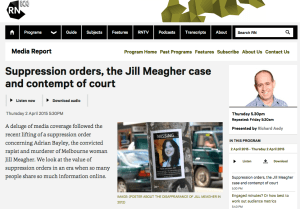
As most people were heading off for their Easter vacation, Radio National’s Media Report ran a segment on how we discovered the new edition of our textbook was in breach of a suppression order on the name of Adrian Bayley – the man who murdered Jill Meagher.

My article in  The Conversation (excerpted below) explained what happened, and RN Media Report’s Richard Aedy followed it up with this interview last week:

Screen Shot 2015-04-10 at 5.17.41 PM


March 27, 2015 blog:

How the Adrian Bayley suppression order forced the reprinting of our new media law book #auslaw ]

It is somewhat alarming when a media law academic finds himself on the wrong side of a media law. But that is exactly what happened to me when I discovered the new edition of our textbook was in breach of a suppression order on the name of Adrian Bayley – the man who murdered Jill Meagher.

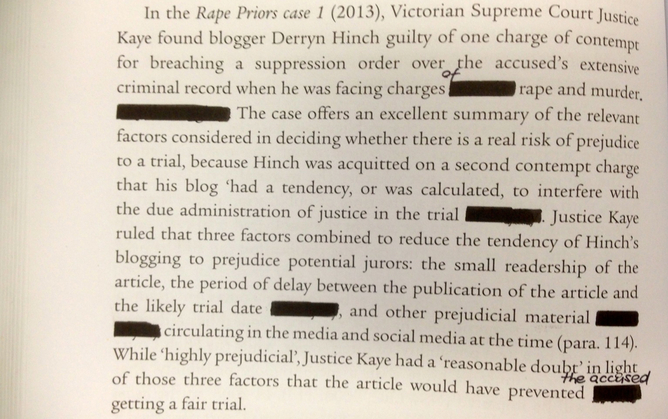
One of the manually redacted pages sent out to reviewers before our book was reprinted

One of the manually redacted pages sent out to reviewers before our book was reprinted

Our experience highlights serious problems with the system of suppression orders in the courts today as they try to grapple with the ever-increasing challenge of keeping internet-savvy jurors from having access to reports of the past trials or convictions of the accused.

Victorian County Court judge Sue Pullen issued the suppression order against anyone publishing “any information relating to previous convictions, sentences, or previous criminal cases of the accused”. The orders were lifted on Thursday after Bayley was convicted of raping three other women before he raped and murdered Meagher in September 2012.

On one view, Pullen’s orders constituted a “super injunction” because they suppressed mention of the proceedings – and therefore of the suppression order itself. Perhaps understandably, news of the order had not spread beyond the inner circle of lawyers and mainstream court reporters and editors, mainly in Victoria.

The suppression order only came to my knowledge as a Queensland-based academic when I happened to be sitting on a conference panel in Melbourne with a media lawyer and a judge last year discussing the futility of suppression orders in the modern era.

The media lawyer told the audience of court officers, lawyers, journalists and academics that he had recently appeared in court several times to try to have this particular suppression order overturned – without success. He said he could not be specific about the suppressed identity of the accused (wisely, as representatives of that court were sitting in the audience).

But when he mentioned the notorious crime itself my heart skipped a beat. It dawned on me that our new edition of The Journalist’s Guide to Media Law, which was sitting in the publisher’s warehouse awaiting distribution, was in clear breach of the order. Bayley had been named and linked to the Meagher murder on three pages of the book. He also appeared in its index.

Continue reading the full version of this commentary in The Conversation

Disclaimer: While I write about media law and ethics, nothing here should be construed as legal advice. I am an academic, not a lawyer. My only advice is that you consult a lawyer before taking any legal risks.

© Mark Pearson 2015
Leave a comment

Filed under blogging, citizen journalism, contempt of court, free expression, journalism, media ethics, media law, Media regulation, social media, sub judice

How the Adrian Bayley suppression order forced the reprinting of our new media law book #auslaw

By MARK PEARSON

It is somewhat alarming when a media law academic finds himself on the wrong side of a media law. But that is exactly what happened to me when I discovered the new edition of our textbook was in breach of a suppression order on the name of Adrian Bayley – the man who murdered Jill Meagher.

One of the manually redacted pages sent out to reviewers before our book was reprinted

One of the manually redacted pages sent out to reviewers before our book was reprinted

Our experience highlights serious problems with the system of suppression orders in the courts today as they try to grapple with the ever-increasing challenge of keeping internet-savvy jurors from having access to reports of the past trials or convictions of the accused.

Victorian County Court judge Sue Pullen issued the suppression order against anyone publishing “any information relating to previous convictions, sentences, or previous criminal cases of the accused”. The orders were lifted on Thursday after Bayley was convicted of raping three other women before he raped and murdered Meagher in September 2012.

On one view, Pullen’s orders constituted a “super injunction” because they suppressed mention of the proceedings – and therefore of the suppression order itself. Perhaps understandably, news of the order had not spread beyond the inner circle of lawyers and mainstream court reporters and editors, mainly in Victoria.

The suppression order only came to my knowledge as a Queensland-based academic when I happened to be sitting on a conference panel in Melbourne with a media lawyer and a judge last year discussing the futility of suppression orders in the modern era.

The media lawyer told the audience of court officers, lawyers, journalists and academics that he had recently appeared in court several times to try to have this particular suppression order overturned – without success. He said he could not be specific about the suppressed identity of the accused (wisely, as representatives of that court were sitting in the audience).

But when he mentioned the notorious crime itself my heart skipped a beat. It dawned on me that our new edition of The Journalist’s Guide to Media Law, which was sitting in the publisher’s warehouse awaiting distribution, was in clear breach of the order. Bayley had been named and linked to the Meagher murder on three pages of the book. He also appeared in its index.

Continue reading the full version of this commentary in The Conversation

Disclaimer: While I write about media law and ethics, nothing here should be construed as legal advice. I am an academic, not a lawyer. My only advice is that you consult a lawyer before taking any legal risks.

© Mark Pearson 2015
1 Comment

Filed under blogging, citizen journalism, contempt of court, free expression, journalism, media ethics, media law, Media regulation, social media, sub judice

New @journlaw updates posted in privacy, anti-terror and confidentiality of sources #MLGriff

By MARK PEARSON

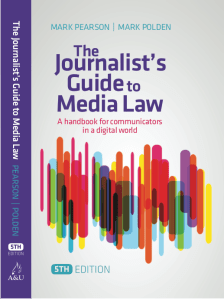
We have just posted numerous updates to the fifth edition of The Journalist’s Guide to Media Law – A handbook for communicators in a digital world (Mark Pearson & Mark Polden, A&U, 2015) on the journlaw.com blog.

Thanks to Leanne O’Donnell (mslods.com / @mslods), Virginia Leighton-Jackson and Griffith University media freedom interns and students we have been posting fresh material via this blog’s Media Law Updates menu.

You can find updates on recent cases, legislation and Australian and international media law news on the following topic areas:

Social Media Law

Free Expression

Legal and regulatory systems

Open Justice and Freedom of Information

Contempt of Court

Covering Court

Defamation

Secrets, Confidentiality and Sources

Anti-terror and hate laws

IP and copyright

Privacy

Law of PR, Freelancing and New Media Entrepreneurship

The sheer pace of change in all areas of media law is astounding so we have have built several mentions of journlaw.com into the chapters and discussion questions as a go-to resource for media law students.

We would also appreciate your input – whether you are a student, journalist, academic or lawyer.

Please email any contributions to these update sections to me, Mark Pearson, at journlaw@gmail.com .

Of course, the book and the journlaw.com examples are not meant to offer actual legal advice. Professional communicators must seek that advice from a lawyer when confronted with a legal problem. The most we claim to do is offer an introduction to each area of media law so that journalists, PR consultants and bloggers can identify an emerging issue and thus know when to call for help.

Order via Booktopia: http://www.booktopia.com.au/the-journalist-s-guide-to-media-law-mark-pearson/prod9781743316382.html

Disclaimer: While I write about media law and ethics, nothing here should be construed as legal advice. I am an academic, not a lawyer. My only advice is that you consult a lawyer before taking any legal risks.

© Mark Pearson 2015
Leave a comment

Filed under blogging, citizen journalism, contempt of court, free expression, journalism, media ethics, media law, Media regulation, social media, sub judice, Uncategorized

Journlaw running updates to The Journalist’s Guide to Media Law

By MARK PEARSON

OUR fifth edition of The Journalist’s Guide to Media Law – A handbook for communicators in a digital world (Mark Pearson & Mark Polden, A&U, 2015) is now in bookshops and I will be running updates on each topic area via journlaw.com as we work towards the next edition.

Thanks to Leanne O’Donnell (mslods.com / @mslods), Virginia Leighton-Jackson and Griffith University media freedom interns and students we will be posting fresh material via this blog’s Media Law Updates menu.

There will be updates on recent cases, legislation and Australian and international media law news on the following topic areas:

Social Media Law

Free Expression

Legal and regulatory systems

Open Justice and Freedom of Information

Contempt of Court

Covering Court

Defamation

Secrets, Confidentiality and Sources

Anti-terror and hate laws

IP and copyright

Privacy

Law of PR, Freelancing and New Media Entrepreneurship

The sheer pace of change in all areas of media law is astounding so we have have built several mentions of journlaw.com into the chapters and discussion questions as a go-to resource for media law students.

We would also appreciate your input – whether you are a student, journalist, academic or lawyer.

Please email any contributions to these update sections to me, Mark Pearson, at journlaw@gmail.com .

Of course, the book and the journlaw.com examples are not meant to offer actual legal advice. Professional communicators must seek that advice from a lawyer when confronted with a legal problem. The most we claim to do is offer an introduction to each area of media law so that journalists, PR consultants and bloggers can identify an emerging issue and thus know when to call for help.

Order via Booktopia: http://www.booktopia.com.au/the-journalist-s-guide-to-media-law-mark-pearson/prod9781743316382.html

Disclaimer: While I write about media law and ethics, nothing here should be construed as legal advice. I am an academic, not a lawyer. My only advice is that you consult a lawyer before taking any legal risks.

© Mark Pearson 2015

Leave a comment

Filed under blogging, citizen journalism, contempt of court, free expression, journalism, media ethics, media law, Media regulation, social media, sub judice, Uncategorized

‘Mindful Journalism’ out Feb 24: excerpt and review copy request form here

By MARK PEARSON

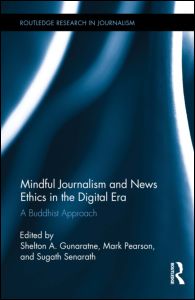
We are excited that our book Mindful Journalism and News Ethics in the Digital Era: A Buddhist Approach (Shelton Gunaratne, Mark Pearson and Sugath Senarath eds; Routledge, NY) will be available from February 24.

Review copies are available from Routledge by filling out this request form. Please see the publisher’s synopsis.

MindfulJournalismCoverThe term ‘mindful journalism’ is a concept I introduced more than a year ago in the inaugural UNESCO World Press Freedom address at AUT University Auckland, drawing upon the earlier substantive work by my esteemed colleague (and lead editor of our book), Emeritus Professor Shelton Gunaratne, who has been working for decades on the intersection between Buddhism and journalism.

I developed my application of this in a paper to the International Association for Media and Communication Research (IAMCR) conference in Dublin in July 2014, which was revised for publication as an article in Ethical Space published in December 2014.

It is being published as part of the Routledge New York Research in Journalism series. My key point was that one does not have to be a Buddhist to incorporate the key principles of mindful journalism into one’s work. In fact, most of these very moral principles are evident in the teachings of all the world’s great religions. However, for those who lack a moral framework for their ethical decision-making, a secular application of these non-theistic principles can offer a moral compass. They offer a series of normative or aspirational goals we can strive for, but rarely reach. They also provide a schema for the analysis of ethical decision-making by journalists.

To give you a taste of mindful journalism, I offer this short extract from my chapter on ‘The Journalist and Mental Cultivation’ in Mindful Journalism where I explore the possibilities of Buddhism’s ‘Right Mindfulness’ (meditation) for journalism:

A journalist could find value in several elements of this process – from the pausing to think about the duration of a single breath for calming purposes, followed by a self-assessment of thoughts, perspectives and feelings about the story or matter at hand, including breaths to acknowledge the changing nature of things, the separation of the journalist’s ego from the story, and breaths devoted to the implications of the story for those it might impact upon, from the individual who might suffer through their actions being exposed through to others who might benefit by learning from that person’s experience. Thinking about those thoughts might bring clarity to decisions related to the story – suitable priorities, whom to interview, what to check, questions to be asked, and how the facts might best be presented. Recording those thoughts – in a note or audio form – might offer a retrospective justification for the journalist’s actions if they are later called to account. Such metacognition can even become evidence in some court proceedings resulting from a story to demonstrate a journalist has acted in good faith in making “reasonable inquiries,” even if the publisher cannot prove the truth of the reputation-damaging material, as is the case with criteria for the qualified privilege defence in some jurisdictions.

Interested? You can read further extracts from the book using the “Look Inside” interface at Amazon. Enjoy.

———–

Disclaimer: While I write about media law and ethics, nothing here should be construed as legal advice. I am an academic, not a lawyer. My only advice is that you consult a lawyer before taking any legal risks.

© Mark Pearson 2015
Leave a comment

Filed under blogging, Buddhism, citizen journalism, Eightfold Path, free expression, media ethics, mental health, social media, Uncategorized

Course outline for global social media law course starting in March

By MARK PEARSON

WE have now posted the course profile for our fully online global social media law course which I will be teaching from Griffith University, starting in March 2015.

social-media-law-risk-management-postgraduate-degree-griffith


Titled ‘Social Media Law and Risk Management’, the course is targeted at professional communicators internationally who want an introduction to the laws impacting on social media use and other strategies for strategic social media management including social media policies and risk analysis.

The course can be undertaken as a fully online, stand-alone unit if you just want these skills and may not be able to attend in person, or as part of a suite of four courses in the Graduate Certificate in Crisis Management for students who can visit Griffith University’s Gold Coast or Nathan campuses for their other three courses.

You can read more about the entry requirements, application procedures and fees for the social media law course here.

The course outline, including the learning activities and assessment, can be viewed here.

The course examines the dynamic role of social media law and risk management in a range of social and political contexts internationally, particularly in the averting of communication crises. It provides advanced knowledge and skills in the use of social media by government, non-governmental organisations, business, and the general public. Its special focus is on law and risk management in social media in a global context.

After explaining the basic legal concepts required for effective analysis and understanding, and the elements of stakeholder theory underpinning the course, we then proceed to examine key areas of the law arising internationally when professional communicators use social media. These include defamation, contempt of court, privacy, confidentiality, discrimination, copyright, consumer law and censorship. This feeds into a critical examination of the terms of use of social media providers, effective social media policy formulation and social media risk management – all key skills and understandings for crisis communication.

The course can be completed online with no requirement for on-campus attendance. For on-campus students two meetings per semester will be held on the Nathan and Gold Coast campuses for students to meet colleagues and workshop material with instructors. Learning activities will include video lectures, readings, online discussion board activity, social media interaction, multiple choice quizzes and problem-based learning. Each module is focused upon a social media law or risk scenario where students are challenged to draw upon their readings, case studies and professional experience to map out an appropriate diagnosis and strategic course of action.

‘Social Media Law and Risk Management’ addresses one of the key organisational and crisis communication phenomena of the modern era – engaging effectively and internationally with a range of stakeholders using social media while being cognisant of laws, risks and policies.
The course integrates theory and practice by introducing both stakeholder theory and jurisprudential theory of legal systems in the first module and then applying both in the balance of the course throughout learning activities and assessment tasks. The readings, learning problems and portfolio are designed to allow students to find recent cases from within their own jurisdictions internationally to make their learning most relevant to their particular nation, state or territory of professional practice.

Of course, social media is an international medium and therefore all students need to be broadly aware of the laws and risks applying globally. The course bears a direct relationship to students’ professional needs as crisis communicators in a variety of career roles – public relations, journalism, government communications, corporate communications, social media moderation, marketing, human resources and law.

Assessment includes a reflective learning journal, online multiple choice quizzes, and a written assignment involving the critical appraisal of a social media policy.

Please drop me a line at m.pearson@griffith.edu.au if you would like further information after reading the course brochure available here.

© Mark Pearson 2015

Disclaimer: While I write about media law and ethics, nothing here should be construed as legal advice. I am an academic, not a lawyer. My only advice is that you consult a lawyer before taking any legal risks.

Leave a comment

Filed under Uncategorized

Mindful Journalism in a nutshell: @journlaw keynote to JEANZ

By MARK PEARSON

EARLIER this month I had the honour of delivering the keynote address to the Journalism Education Association of New Zealand annual conference in Christchurch.

MindfulJournalismCoverThe topic was “Mindful Journalism: towards a new ethics of compassion”, and I offer the summary here (pdf: JEANZMindfulJsm2014) in the form of my Powerpoint slides presented at that conference.

The term ‘mindful journalism’ is a concept I introduced more than a year ago in the inaugural UNESCO World Press Freedom address at AUT University Auckland, drawing upon the earlier substantive work by esteemed colleague, Emeritus Professor Shelton Gunaratne, who has been working for decades on the intersection between Buddhism and journalism.

I developed my application of this in a paper to the International Association for Media and Communication Research (IAMCR) conference in Dublin in July 2014, which was revised for publication as a forthcoming article in Ethical Space due to be published this month (December).

Professor Gunaratne and I refined our thoughts further in a book co-edited with Sri Lankan colleague Dr Sugath Senarath [pdf file] from the University of Colombo, with Professor Gunaratne as lead editor and contributions from a range of other scholars.

Routledge New York accepted our proposal for hard cover publication in March 2015 as part of its Research in Journalism series.

Our book is titled Mindful Journalism and News Ethics in the Digital Era: A Buddhist Approach and it features chapters by several scholars from Asia, North America, Australia and Europe. Please see the publisher’s synopsis.

My address to journalism education colleagues in Christchurch this month picked up on some of the key themes of Mindful Journalism, particularly those linked to the Eightfold Path.

My key point was that one does not have to be a Buddhist to incorporate the key principles of mindful journalism into one’s work. In fact, most of these same moral principles are evident in the teachings of all the world’s great religions. However, for those who lack a moral framework for their ethical decision-making, a secular application of these non-theistic principles can offer a moral compass to those who feel they lack one because they offer a series of normative or aspirational goals we can strive for, but rarely reach. They also provide a schema for the analysis of ethical decision-making by journalists.

———–

Disclaimer: While I write about media law and ethics, nothing here should be construed as legal advice. I am an academic, not a lawyer. My only advice is that you consult a lawyer before taking any legal risks.

© Mark Pearson 2014

1 Comment

Filed under blogging, Buddhism, citizen journalism, Eightfold Path, free expression, media ethics, mental health, social media, Uncategorized

Accuracy, independence and impartiality – Kellie Riordan #jeraa2014 live blog

LIVE BLOG

By MARK PEARSON

Australian Broadcasting Corporation’s Kellie Riordan reported to the Journalism Education and Research Association of Australia’s conference in Sydney on her recent report on how legacy media and digital natives approach ethical standards in the digital age.

ABC's Kellie Riordan addressing the JERAA conference on her research into digital and legacy media ethics

ABC’s Kellie Riordan addressing the JERAA conference on her research into digital and legacy media ethics

She recently served as a fellow at the Oxford Reuters Institute for the Study of Journalism where she looked at three traditional and three new media providers and their ethical standards and approaches.

Riordan noted a shift in the notion of accuracy.

“Now we are equally looking to journalists to tell us what is not true, and the best example is the BBC’s User Generated Content Hub,” she said.

It was set up to debunk myths, and originated with the myth that there was a power surge in the London Underground when in fact the London bombings had occurred.

She also identified corrections were now being issued that were much more open and honest and developed brand trust. These were done particularly well by digital media.

“Traditionally newsrooms have been closed organisations and we haven’t let the public in on how we came to decisions,” she said.

She showed an example from the digital outlet Grantland which gave an extensive debriefing on how they came to an editorial decision when they got something wrong.

Riordan profiled The Quartz qz.com site which does not subscribe to impartiality as a standard but boast about their transparency and honesty with their audience.

On the issue of independence, she gave several examples of advertorials in some outlets that were not necessarily flagged as paid content on search engines.

She cited Buzzfeed’s Ben Smith arguing that audiences were already quite literate about different types of sponsored content on the Internet, whereas others felt the journalism brand required the disclosure of advertising.

She found a range of views across new media on the issue of impartiality and that Quartz advocated an ‘evidence driven, facts based’ style of journalism.

User generated content, interaction with audiences and more extensive use of hyperlinks for attribution were important developments to improve accountability and transparency, she said.

Riordan concluded by calling for greater transparency, more open forms of journalism, and ‘a voice that is of the web driven by reporters rather than news brands’.

She suggested digital tools like hyperlinks, context for corrections, more voices and transparency would add to accountability.

https://twitter.com/roza_gee/status/537039270666465280

https://twitter.com/roza_gee/status/537038912032497664

https://twitter.com/johanBalance/status/537038514487971840

https://twitter.com/SrinidhiParanji/status/537038310888050688

https://twitter.com/roza_gee/status/537037347791986689

https://twitter.com/roza_gee/status/537036927875039233

https://twitter.com/roza_gee/status/537036275706896384

https://twitter.com/SrinidhiParanji/status/537036124741320704

https://twitter.com/roza_gee/status/537035851419492353

https://twitter.com/roza_gee/status/537035308064202753

https://twitter.com/roza_gee/status/537034767888179201

© Mark Pearson 2014

Disclaimer: While I write about media law and ethics, nothing here should be construed as legal advice. I am an academic, not a lawyer. My only advice is that you consult a lawyer before taking any legal risks.

Leave a comment

Filed under Uncategorized

Journalism privileges and accountability in the digital age – Denis Muller #jeraa2014 live blog

LIVE BLOG

By MARK PEARSON

The digital age has increased both possibilities and risks for journalism, according to media ethicist Dr Denis Muller from the Centre for Advancing Journalism at the University of Melbourne.

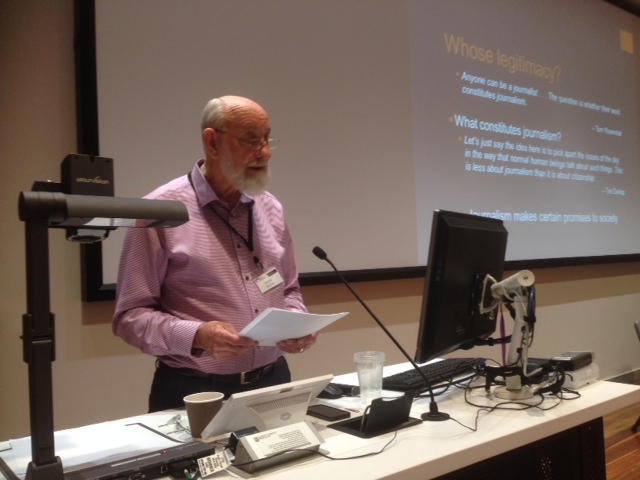
Denis Muller addresses the JERAA conference on the legitimacy of journalism

Denis Muller addresses the JERAA conference on the legitimacy of journalism

Muller was addressing the privileges, legitimacy and accountability of journalism at the annual conference of the Journalism Education and Research Association in Sydney.

He said the types of privilege offered to journalism were access to powerful people, places to observe events, and certain legal protections, however the digital revolution had made the privileges for those from big media inadequate for others like bloggers.

“This is a narrow and increasingly irrelevant basis for conferring legitimacy,” he said.

“Legitimacy of the journalistic function has more important bases than this.”

He said legitimacy of journalism as a function in a democracy is grounded in a combination of rights and socio-political necessity.

Journalism had a contrctual relationship with the community based on factual and constextual reliability, impartiality, separation of fact from comment and provision of a “bedrock of trustworthy information”.

The legitimacy of the journalistic function rests on the indispensability of its function, its capacity to animate free speech and the keeping of its promises,” Dr Muller said.

He highlighted privileges at law under the Commonwealth Privacy Act and State Shield laws – contingent on media organisations being signed up to an accountability mechanism.

Others not contingent on such accountability were the privileges under the Australian Consumer Law and the Commonwealth shield laws.

The latter protected anyone providing news to the public, seemingly including bloggers and others reporting news.

He reviewed the regulatory recommendations of the Finkelstein Review, the Convergence Review and the Leveson Inquiry and explained there was no accountability mechanism for journalists outside of the Media Entertainment and Arts Alliance sanctions for its members breaching its Code of Ethics.

He said he had worked with colleague Dr Judith Townend from City University London’s Centre for Law, Justice and Journalism comparing the suggested accountability mechanisms for the Australian news media.

They argued for

  • access to incentives in the form of privileges,
  • contingent on signing up to accountability mechanism,
  • and that this mechanism be open to all who practise journalism.

The first step was the creation of a consensual set of ethical standards – professional norms and standards, they argued.

“News organisations should take a ‘get in’ rather than a ‘get you’ approach,” he said.


https://twitter.com/Aimee_Saaib/status/537029945482960896

https://twitter.com/SrinidhiParanji/status/537029762007326720


© Mark Pearson 2014

Disclaimer: While I write about media law and ethics, nothing here should be construed as legal advice. I am an academic, not a lawyer. My only advice is that you consult a lawyer before taking any legal risks.

Leave a comment

Filed under Uncategorized