Tag Archives: law

Diary of a cyberbullying victim

By MARK PEARSON

My research and writing on social media law got all too personal last week when a cyberbully threatened to open a website claiming I am a rapist.

Some months ago I posted to my research blog journlaw.com a fair and accurate report of a Fair Work Commission (FWC) decision that this individual had been fairly dismissed from his workplace.

It was an interesting case in social media law because his termination resulted from his offensive Facebook remarks about his workplace, a client and a prospective colleague.

According to the judgment, he had previously been warned about using company time and resources to start a private website.

Tellingly, the Commission’s decision stated the individual had shown no apology or regret for his behaviour and had maintained he was entitled to do it, offering his employer and the Commission ‘little comfort that similar incidents would not occur in the future’.

Other legal and HR experts posted summaries of the decision to their blogs and websites, including some of Australia’s leading law firms.

A fortnight ago he wrote to several of us asking that we change some elements of our coverage detailing the Commission’s finding that he had written sexually harassing comments about a colleague. He also wrote to senior staff at my university about the matter.

I responded that I believed my report of the case constituted a fair and accurate report of material on the public record.

However, I explained that I understood the blogs might be causing him ongoing angst and that their appearance on search engines could have other implications for him. I had therefore replaced his name throughout my post with the initials of his name, although I had left his full name in the case citation.

I said I was keen to correct any inaccuracies and asked him to point out any errors in my reporting. I ended the note by suggesting he seek counselling if the episode had caused him undue distress and I provided the Beyond Blue and Lifeline toll free numbers.

A few days later this bombshell landed in my inbox:

“Your article makes it seem like I sexually harassed a work colleague and it appears that you do not understand the impact this can have.

“To help give you a little perspective I am currently registering markpearsonisarapist@wordpress

“If you have a change of heart please feel free to send me an email.”

Attached to the message was this graphic illustrating the availability of the website he was threatening to establish:

GraphicOfWordpressRapistPearsonThreatI have written books and articles citing scores of examples where cyberbullies have attacked other victims.

But you only appreciate the anxiety and powerlessness of cyber-victimhood when you are the direct target of such a threat and your own name and reputation are on the line.

My recent research and writing has been exploring ‘mindful’ approaches to journalism and social media law and ethics, so I did not want to engage in an email flame war with this individual or give a heated kneejerk response.

The official cyberbullying sites like the Australian Government’s cyber(smart) recommend a “talk, report, support” approach, advising a victim should talk about the threat to someone they trust, avoid retaliating or responding, block the bully and change privacy settings, report the abuse to the service, and collect the evidence.

I took some of this advice by discussing it with family and friends, screen capturing the correspondence, and advising the other bloggers who had reported the case that he had issued this serious threat against me.

However, given he had not yet registered the offensive site, I thought I would appraise him of the illegality of his threat and give him 24 hours to withdraw it and apologise.

I wrote explaining his email threat was likely in breach of several state and federal laws carrying the risk of substantial fines and jail terms, including blackmail, misuse of a carriage service, stalking and harassment and that I was prepared to press such charges against him.

Five hours later he responded:

“Your panic is not needed. I have not registered any accounts citing that you are a rapist, I simply exclaimed that I would to wonderfully illustrate my point about making damaging claims against others.

“Isn’t it a little funny how you’re happy to publish articles that insinuate that an individual is a sexual predator but once somebody propositions you with the same action you instantly threaten to contact the authorities?

“I understand that you have no intention of taking this matter any further, are probably just a little bored and like myself enjoy sticking to your principles and engaging in a good argument. I would have thought that you’d have something more important to be working on but I guess I was wrong, either way, I have a lot of time also. 😛

“Please advise when [my original blog post] has been removed entirely.”

So there it stands. It seems the threat has dissipated, but I’m unsure of what – if anything – I should do next.

A mindful approach involves reflecting upon the implications of one’s actions for all stakeholders and seeking counsel.

I thought it would be a useful learning experience for the 200 students in my Media Law course, so I put my dilemma to them in last week’s lecture. I also asked them to vote on which of three courses of action they recommended I should take.

Here are the options, with some of the students’ observations:

  1. Have him charged. About half the students in the lecture voted for this option. They felt that’s how you should deal with cyberbullies. The guy has ‘form’ and has clearly not learnt his lesson. He has escalated his tactics with this serious and intimidating threat. Next time his victim might be a much more vulnerable individual than a university professor who researches and publishes in the field. It might be someone in a fragile emotional state and there could be tragic consequences – just like we saw in the royal prank call episode.
  2. Do nothing and let it drop. About one quarter of students voted for this. I’ve made my point and he may well be terrified. While you cannot excuse his actions, you can certainly empathise with his despair at this digital archive of his transgressions available with a simple Google search of his name. Perhaps my response has been enough to make him stop his anti-social online behaviour. My original blog post on his dismissal remains live, so prospective employers are still on notice about him. Besides which, he himself might be vulnerable and further pressure might be detrimental to him. The research shows cyberbullies often have a mental illness, a personality disorder or engage during substance abuse. Worse still, it might prompt him to escalate the matter and perhaps retaliate by carrying out that threat or something worse.
  3. Blog about it. The remaining quarter of students thought this was the best course of action. It spreads the message to other potential bullies, educates the community about the problem, and it’s what I do best. It could be as little as writing a piece like this.

Of course, the other options are still available to me now I have posted this blog, and I can still proceed with pressing charges. I’d appreciate your advice if you’d care to comment below.

For information about cyberbullying go to cybersmart.gov.au or contact Lifeline on 13 11 14.

Thanks to these tweeps for your supportive comments:

https://twitter.com/gvandersee/status/465682966652260353

© Mark Pearson 2014

Disclaimer: While I write about media law and ethics, nothing here should be construed as legal advice. I am an academic, not a lawyer. My only advice is that you consult a lawyer before taking any legal risks.
9 Comments

Filed under Media regulation, mental health, social media, Uncategorized

Cyberbullying and the law in Australia: key legislation and cases

By MARK PEARSON

If you are looking for an excellent summary of the main laws controlling cyberbullying in Australia you need look no further than here:

Where does Cyber-bullying fit in the Current Australian Criminal Framework?.

It covers key Commonwealth and State laws including misuse of telecommunications services, stalking and harassment, and criminal defamation.

See also these previous posts on journlaw.com:

…  from my public lecture ‘Social Media – Risks and Rewards’] We hear a great deal about the downside of social media …  in schools. There have been well publicised examples of cyberbullying, defamation of teachers and principals, stalking of children by …
…  sad news of the death of television personality Charlotte Dawson over the weekend,  I repost this commentary I wrote for The …  in the near tragic saga of TV personality Charlotte Dawson and Twitter. [2014 note: clearly, it is now tragic] Andthose lessons must …
…  from my public lecture ‘Social Media – Risks and Rewards’] Administrators andparents are indeed concerned about social media – partly because the …  committed to it, one might be excused for believing cyberbullying had driven young people to the depths of depression and anxiety …
…  MARK PEARSON Follow @Journlaw [Professor of Journalism and Social Media, Griffith University, Australia] Public lecture presented …  in schools. There have been well publicised examples of cyberbullying, defamation of teachers and principals, stalking of children by …
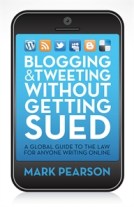
…  issue of discriminatory abuse in my new book  – Blogging and Tweeting Without Getting Sued: A global guide to the law for anyone writing …  to their type, scale, andjurisdiction. They include: cyberbullying, cyberstalking, online trolling, malicious online content, using …


For information about cyberbullying go to cybersmart.gov.au or contact Lifeline on 13 11 14.

© Mark Pearson 2012 and 2014

Disclaimer: While I write about media law and ethics, nothing here should be construed as legal advice. I am an academic, not a lawyer. My only advice is that you consult a lawyer before taking any legal risks.

1 Comment

Filed under Media regulation, mental health, social media, Uncategorized

Barrister and co-author Mark Polden chats with @journlaw on #defamation defences: #MLGriff

By MARK PEARSON

Defamation laws can be intimidating for journalists, bloggers and other professional communicators. The key, according to barrister Mark Polden, is in researching and writing to the basic defences.

Mark Polden was in-house counsel at Fairfax Media for many years before going to the Bar, and is my co-author of The Journalist’s Guide to Media Law (Allen & Unwin).

In this 11 minute interview with @journlaw, he outlines in simple terms the three ‘bread and butter’ defences used by writers and publishers – truth, fair report and honest opinion (fair comment).

———–

Disclaimer: While I write about media law and ethics, nothing here should be construed as legal advice. I am an academic, not a lawyer. My only advice is that you consult a lawyer before taking any legal risks.
© Mark Pearson 2014

Leave a comment

Filed under blogging, contempt of court, courts, free expression, media ethics, Media freedom, media law, Press freedom, sub judice, suppression, Uncategorized

On Skype with @journlaw – barrister and co-author Mark Polden on #defamation basics: #MLGriff

By MARK PEARSON

Exactly what is defamation and how does it apply to your average journalist or blogger?

That’s what I asked barrister Mark Polden in this short interview on defamation basics. Mark Polden was in-house counsel at Fairfax Media for many years before going to the Bar, and is my co-author of The Journalist’s Guide to Media Law (Allen & Unwin).

Here he offers a lay definition of defamation and gives some examples of how journalists, bloggers and other professional communicators might write to minimise the threat of legal action.

———–

Disclaimer: While I write about media law and ethics, nothing here should be construed as legal advice. I am an academic, not a lawyer. My only advice is that you consult a lawyer before taking any legal risks.
© Mark Pearson 2014

Leave a comment

Filed under blogging, contempt of court, courts, free expression, media ethics, Media freedom, media law, Press freedom, sub judice, suppression, Uncategorized

15 mins with @journlaw – Peter Gregory on the art of court reporting #MLGriff #medialaw

By MARK PEARSON

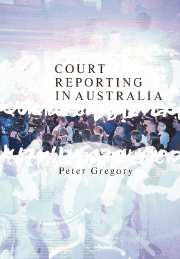
What is the secret to good court reporting? Highly experienced court reporter and academic Peter Gregory [@petergregory17] – author of Court Reporting in Australia (Cambridge University Press, 2005) – tells @journlaw the essential techniques needed by a journalist wanting to cover the court reporting round.

CourtReportinginAustraliacoverGregory explains how he recently returned to duty when he filled in to cover the sentencing of Adrian Bayley for the murder of Jill Meagher – in a marathon 12 hour shift!

He discusses the court reporter’s difficulties in writing fair and accurate reports of trials, particularly when they might be unfolding in different courtrooms at the same time.

He also gives tips on how a journalist might stand up in court to oppose a suppression order being imposed by a judge or magistrate.

Useful viewing for journalism and law students – and for anyone wanting an insight into the work of the court reporter.

———–

Disclaimer: While I write about media law and ethics, nothing here should be construed as legal advice. I am an academic, not a lawyer. My only advice is that you consult a lawyer before taking any legal risks.
© Mark Pearson 2014

1 Comment

Filed under blogging, contempt of court, courts, free expression, media ethics, Media freedom, media law, Press freedom, sub judice, suppression, Uncategorized

Blended learning and instructional scaffolding in a Media Law course

By MARK PEARSON

I’m thoroughly enjoying a revitalised enthusiasm for my media law teaching thanks to the Blended Learning team at Griffith University.

I’ve recently been a student in an Online Course Development course run by expert faculty in my Arts, Education and Law group and have been keenly trying to build the various blended learning strategies into the Blackboard interface for both the on-campus and Open Universities Australia versions of my Media Law course.

The Media Law course’s pedagogy and assessment tasks are built around both problem-based learning and instructional scaffolding.

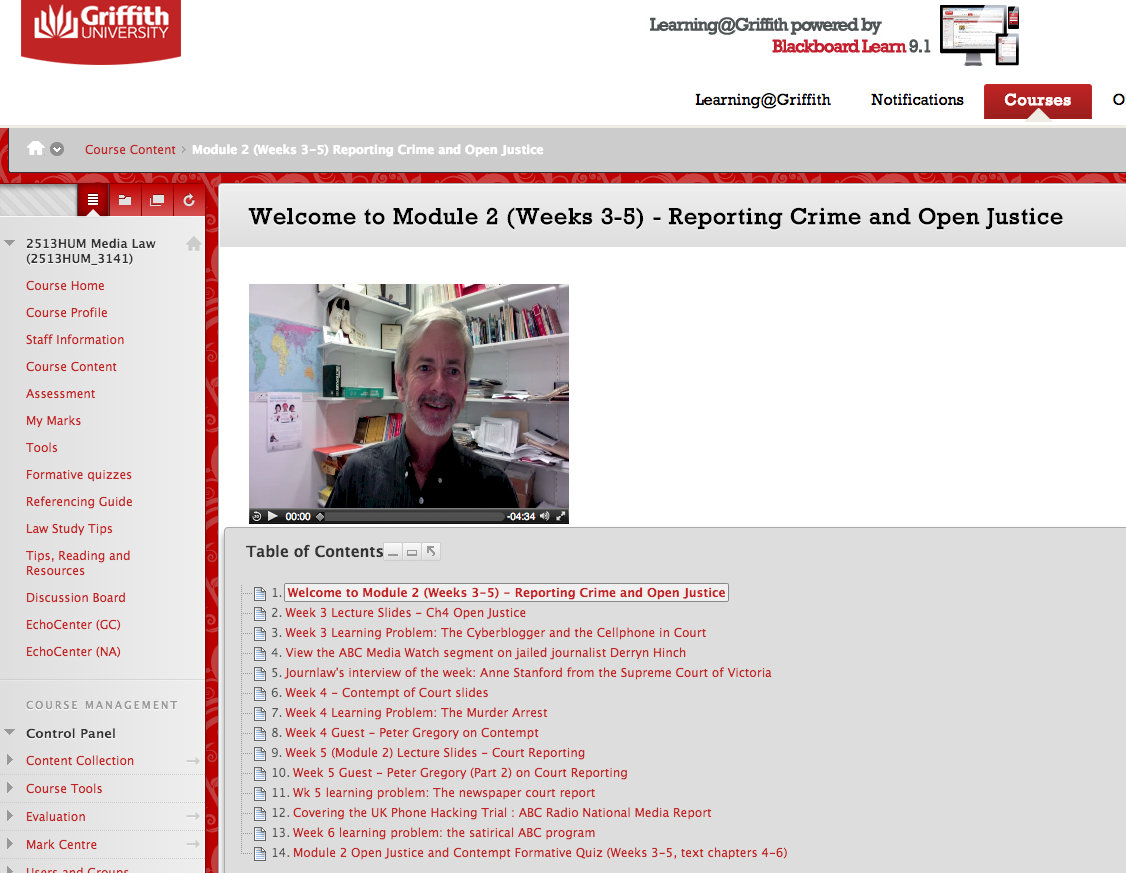
It is module-based, with each module’s integrated learning tools and materials contained in the Course Content area (see screen capture).

The Course Content part of the Learning@Griffith site for the Media Law course

The Course Content part of the Learning@Griffith site for the Media Law course

The modules are designed so that students progressively learn the material and work towards their assessment as the semester unfolds, whether they are studying on-campus or online, or via a combination of the two (‘blended learning’).

They are aware that their learning tasks each week feed directly into their end of semester examination, which is essentially requires them to demonstrate summatively their skills and understandings they have already been workshopping in a formative sense throughout the semester.

Each week’s problem is centred upon the module’s readings (including a textbook chapter) and other learning activities, including lectures, short video introductions to each module, tutorials, video interviews of 10-15 mins with an expert ‘guest of the week’, and  discussion board and social media engagement. [Some of these techniques I have also refined through my recent  enrolment in ‘Massive Open Online Courses’ offered by Coursera and Canvas.]

The instructional scaffolding approach to assessment links attendance and online participation with assessment items that relate directly to those activities.

For example, students complete Weekly Learning Reflections about the media law problem of the week (submitted and assessed twice in the semester as collated portfolios). These then form the basis of questions in students’ end of semester examination and their written preparation for their weekly learning problem rubrics become their actual study notes for their open-book final exam. This leads to a purposive approach to student weekly readings and other learning tasks, aimed to enrich their learning through its focus on a problem and an ultimate assessment reward.

Similarly, students complete a short multiple choice online quiz at the end of each learning module – which is at that stage non-assessable (formative) and is only available for a two week period after that module has ended. They know their final end of semester summative multiple choice quiz will later be drawn from the pool of these very questions, rewarding students who have completed their reading and undertaken the formative assessment along the way.

Do you have other techniques you have been using effectively in teaching media law? Please let me know via the Comments section here or via Twitter at @journlaw.

© Mark Pearson 2014

Disclaimer: While I write about media law and ethics, nothing here should be construed as legal advice. I am an academic, not a lawyer. My only advice is that you consult a lawyer before taking any legal risks.
Leave a comment

Filed under Media regulation, Uncategorized

15 mins with @journlaw – Peter Gregory on ‘contempt and the court reporter’ #MLGriff #medialaw

By MARK PEARSON

We hear about the many types of contempt affecting the role of the court reporter – but how does a journalist manage this in practice?

That is exactly the issue I raised with veteran court reporter (now academic) Peter Gregory [@petergregory17] in this interview covering the main types of contempt of court affecting court reporting – contempt in the face of the court, disobedience contempt, sub judice (prejudicial reporting) and interference with the deliberations of jurors.

Gregory – author of Court Reporting in Australia (Cambridge University Press, 2005) – explains how court reporters might be affected by such forms of contempt, offers examples from his own career, and suggests how journalists might adjust their own practice to minimise risk.

CourtReportinginAustraliacoverHe looks at the impact of new technologies – particularly social media – in the courtroom. Finally, he assesses the dynamics of social media and traditional media at play in the major Victorian trial of the murderer of Irishwoman Jill Meagher (Adrian Bayley) which resulted in the jailing of blogger Derryn Hinch on a contempt charge after disobeying a suppression order.

———–

Disclaimer: While I write about media law and ethics, nothing here should be construed as legal advice. I am an academic, not a lawyer. My only advice is that you consult a lawyer before taking any legal risks.

© Mark Pearson 2014

Leave a comment

Filed under blogging, contempt of court, courts, free expression, media ethics, Media freedom, media law, Press freedom, sub judice, suppression, Uncategorized

Ten minutes with @journlaw – Anne Stanford from @SCVSupremeCourt talks open justice #MLGriff

By MARK PEARSON

In this week’s interview (actually 14 minutes!) I chat with the Strategic Communication Manager at the Supreme Court of Victoria, Anne Stanford, about open justice, suppression orders and general court reporting guidelines.

Listen to Supreme Court of Victoria Strategic Communication Manager Anne Stanford on open justice.

Listen to Supreme Court of Victoria Strategic Communication Manager Anne Stanford on open justice.

———–

Disclaimer: While I write about media law and ethics, nothing here should be construed as legal advice. I am an academic, not a lawyer. My only advice is that you consult a lawyer before taking any legal risks.

© Mark Pearson 2014

Leave a comment

Filed under blogging, contempt of court, courts, free expression, media ethics, Media freedom, media law, Press freedom, sub judice, suppression, Uncategorized

#Hinch (@HumanHeadline), #Morcombe and open justice – lessons in media law

By MARK PEARSON

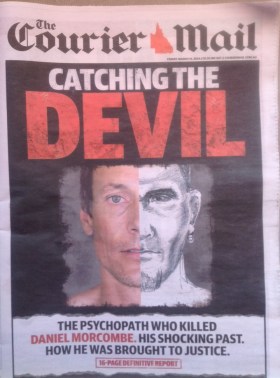
It is timely that in the space of a week we should see the Human Headline (@HumanHeadline) Derryn Hinch released from jail for a publication offence and a serial offender receive a life sentence for the sex murder of teenager Daniel Morcombe.

CatchingTheDevil(Morcombefrontpage14-3-14)C-M

Courier Mail front page 14-3-14

We learned yesterday after Brett Peter Cowan was convicted of that 2003 crime that he had served time twice earlier for similar offences.

He is exactly the kind of individual that Hinch wants placed on a public sex offender register for exactly the reason most talkback callers and social media commenters are asking this question: How can we release such individuals anonymously into our communities when we cannot be sure they will not strike again?

Hinch asked it again this morning:

Hinch became the first Australian journalist jailed this millennium for a publishing offence when he was jailed for 50 days refusing to pay a $100,000 fine for breaching a suppression order on the prior convictions of Adrian Ernest Bayley – the accused sex murderer of ABC worker Jill Meagher in Melbourne in 2012.

In 2011 he was sentenced to five months of home detention for publicly naming two sex offenders at a rally and on his website in defiance of such anonymity orders.

In 1987 he was jailed on a contempt of court charge after broadcasting the criminal record of a former priest Michael Glennon accused of child sex offences and implying his guilt in his high rating Melbourne radio program.

It was only by a 4-3 majority that the High Court later stopped short of overturning Glennon’s conviction on those sex charges on the grounds of Hinch prejudicing his fair trial. (Glennon died in jail this year.)

Journalists and media law students have much to learn from the events of the past week.

While the crimes themselves left a trail of human destruction, the Hinch and Morcombe stories make for ideal case studies in a media law module covering open justice, contempt of court and court reporting – the exact module my students will be starting next week.

They will get to research and debate these kinds of important questions that arise from the week’s events:

  • What public policy issues are at play that see a journalist jailed for reporting the past convictions of an individual convicted of a high profile crime?
  • What does such a penalty say about Australia’s standard of media freedom?
  • Why is Australia’s approach to this level of suppression different from that applying in the United States?
  • Why should the mainstream media be prevented from reporting such material when social media platforms and certain websites are full of it?
  • Why would Hinch’s blog and Twitter feed where he breached the suppression orders over Bayley not represent a ‘real risk of prejudice’ to the trial, when mainstream media coverage might do so?
  • How can juries be quarantined from such information and – if they can’t – why shouldn’t the media be allowed to publish it?
  • Do other methods of dealing with juries – judges’ instructions, training, sequestering etc – mean we no longer need to suppress such material?
  • Are the past offences of such criminals matters of such overwhelming social importance and public concern that suppression of the details should be considered contrary to the public interest?
  • Should the Courier-Mail’s front page heading of February 21, 2014 – ‘Daniel’s Killer’ – have forced the trial to be aborted? Should it be grounds for a sub judice contempt charge? Should it be grounds for Cowan’s appeal?
  • How can a journalist report upon such proceedings in an interesting and timely way while navigating the various restrictions that apply?
  • How ‘open’ should ‘open justice’ be in such high profile trials? Should cameras and smartphone recordings be allowed in court? Should tweeting and other social media usage be allowed in court?
  • Is it appropriate in the modern era of communication that a major television network has to rely on a presenter standing outside a courthouse relaying sentencing information to the audience from a court reporter on the inside via telephone?
  • How much social media commentary should be tolerated about such cases while an accused is facing trial?

I’m sure many other questions arise too – and would be keen for other educators, journalists, lawyers and students to use the Comments section here to pose them so my students can take them up in lecture and tutorial discussions.

———–

Disclaimer: While I write about media law and ethics, nothing here should be construed as legal advice. I am an academic, not a lawyer. My only advice is that you consult a lawyer before taking any legal risks.

© Mark Pearson 2014

Leave a comment

Filed under blogging, contempt of court, courts, free expression, media ethics, Media freedom, media law, Press freedom, sub judice, suppression, Uncategorized

Now that’s how you review a book! Thanks Prof

By MARK PEARSON

BloggingTweetingNewCover

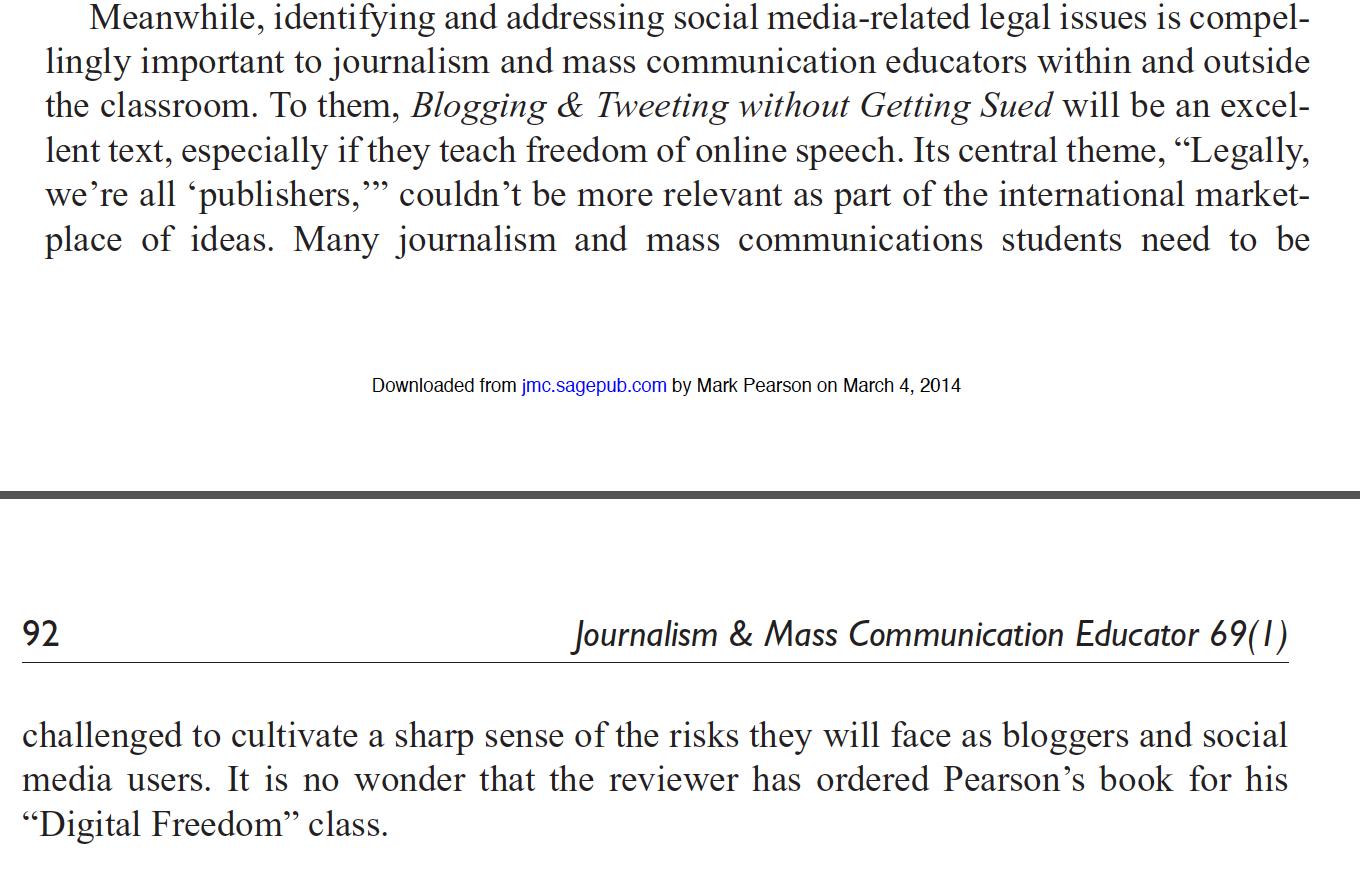
The top media law academic in the US, Professor Kyu Ho Youm, has just reviewed my recent book Blogging and Tweeting Without Getting Sued in the leading journal Journalism & Mass Communication Educator.

Prof Youm is Jonathan Marshall First Amendment Chair at the University of Oregon School of Journalism and Communication and immediate past president of the 3700 member Association for Education in Journalism and Mass Communication.

His review was a lesson in academic book reviewing. He did considerably more than just criticise or praise the book (though he did both at various points!). Prof Youm manage to inject new gems of knowledge and insight about the field in the process, including the suggestion of additional reading and cases that have been since decided.

He concludes by recommending it as a text:-).

Screen Shot 2014-03-06 at 5.23.20 PM

Read the full review at http://jmc.sagepub.com/content/69/1/90.citation.

© Mark Pearson 2014

Disclaimer: While I write about media law and ethics, nothing here should be construed as legal advice. I am an academic, not a lawyer. My only advice is that you consult a lawyer before taking any legal risks.

Leave a comment

Filed under Media regulation, Uncategorized