Tag Archives: law

The Human Headline legacy – the jailed Hinch, suppression and free expression

By MARK PEARSON

Broadcaster, tweeter, blogger and veteran journalist Derryn Hinch – the self-proclaimed ‘Human Headline’ – has been released from jail after serving a 50 day sentence for breaching a suppression order. 

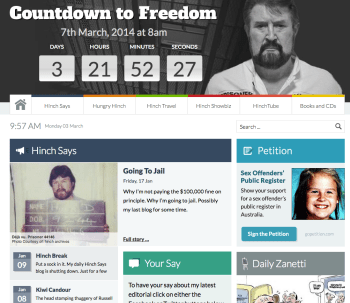
Derryn Hinch's 'Human Headline' blog - Countdown to Freedom

Derryn Hinch’s ‘Human Headline’ blog – Countdown to Freedom

Hinch had refused to pay a $100,000 fine over his blog and Twitter comments including suppressed background material on Adrian Ernest Bayley, accused of the Melbourne murder of Irish woman Jill Meagher.

Hinch has been jailed twice, fined and sentenced to home detention for his contemptuous reportage and commentary about sex offenders over more than a quarter of a century.

While much of the coverage of his prosecutions and trials has focused on his cavalier and principled stance in the vein of his ‘Human Headline’ moniker, he has also been responsible for a body of case law covering sub judice contempt, the naming of a child sexual assault victim and the defiance of suppression orders – in his television and talkback radio programs, blogs and Twitter feeds.

I am preparing a paper for the ANZCA conference in Melbourne in July, reporting on a legal and textual analysis of eight key Victorian and High Court cases involving Hinch as a party in 1986, 1987, 1996, 2011 and 2013.

It reviews these key cases involving Hinch as a defendant and an appellant since 1986 – including Magistrates, Supreme Court, Court of Appeal and two High Court judgments – and identifies the key media law principles shaped in the process.

It concludes that the Hinch legacy is far more significant than his shallow ‘Human Headline’ title suggests – and ventures into important human rights questions arising in the complex legal and moral terrain where free expression, the ‘public interest’ and the ‘public right to know’ compete with an accused’s right to a fair trial, an ex-prisoner’s right to rehabilitation and a child’s right to protection from sexual predators.

For example, Hinch’s appeal to the High Court over his contempt conviction in 1987 was unsuccessful but resulted in a broadening of the public interest defence to sub judice contempt.

His latest case offers an excellent summary of the relevant factors considered in deciding whether there is a real risk of prejudice to a trial, because Hinch was acquitted on a second contempt charge that his blog ‘had a tendency, or was calculated, to interfere with the due administration of justice in the trial of Bayley’.

Victorian Supreme Court Justice Stephen Kaye ruled that three factors combined to reduce the tendency of Hinch’s blogging to prejudice potential jurors: the small readership of the article, the period of delay between the publication of the article and the likely trial date of Bayley, and other prejudicial material about Bayley circulating in the media and social media at the time (para 114). While ‘highly prejudicial’, Justice Kaye had a ‘reasonable doubt’ in light of those three factors that the article would have prevented Bayley getting a fair trial.

I will post updates on this paper as the research and writing unfolds. Meanwhile, no matter what you think of Hinch’s bravado in his naming and shaming of sex offenders, at least this week we should be able to celebrate the release of an Australian journalist from jail.

———–

Disclaimer: While I write about media law and ethics, nothing here should be construed as legal advice. I am an academic, not a lawyer. My only advice is that you consult a lawyer before taking any legal risks.

© Mark Pearson 2014

3 Comments

Filed under blogging, contempt of court, courts, free expression, media ethics, Media freedom, media law, Press freedom, sub judice, suppression, Uncategorized

Republished: We all must learn from the #CharlotteDawson saga

With the sad news of the death of television personality Charlotte Dawson over the weekend,  I repost this commentary I wrote for The Australian in September, 2012 after she had attempted to take her own life.

———-

By MARK PEARSON

[Note: First published in The Australian on September 3, 2012.]

THERE are important lessons for us all in the near tragic saga of TV personality Charlotte Dawson and Twitter. [2014 note: clearly, it is now tragic]

And those lessons must be learnt not just by the media, but also by policymakers and the broader community.

The story of Dawson’s hospitalisation [in 2012] after receiving a torrent of life-threatening and demeaning tweets contained all the contradictions of our Web 2.0 world: risk versus reward, connection versus alienation, celebrity versus anonymity and freedom versus censorship.

When Dawson revealed a Monash University staffer was the source of some earlier postings and the employee was suspended, that “outing” triggered the final spate of insults and threats, and Dawson’s own sad messages from her @MsCharlotteD handle before her hospitalisation. The tweets raised the contentious legal issues of defamation, cyber-bullying, confidentiality, privacy, racial discrimination, jurisdiction and even unfair dismissal.

Dawson is [was] a former fashion model who has traded on her own harsh comments to contestants in a reality-TV program and in newspaper interviews where she has pilloried her home country of New Zealand.

Like many celebrities she has established a strong Twitter following of 21,450 [in 2012]- now seen as a crucial dimension to any wannabe A-lister’s public profile. In May, she tweeted a call for someone to “please kill” a fashion blogger, @BryanBoy, which she defended as a joke.

Of course, none of this justifies anonymous trolls threatening her life or urging her to kill herself, but it provides some context to the vitriol. It also defies the simplistic media story line of “evil social media causes real-life tragedy”. Dawson has previously spoken of life events that have rendered her emotionally vulnerable.

The issue of the media’s interaction with the vulnerable in our society recently gained traction with changes to journalism ethical codes in the wake of the federal government’s Mindframe media training initiative and associated research projects.

Some of that research demonstrated the flow-on effect of celebrity suicides and threats upon their vulnerable fans, making this example even more concerning.

Mindframe has been extended to schools, public relations courses and the courts, but social media proves the sensitivities of the vulnerable have not yet pierced the consciousness of many ordinary citizens.

It’s just one example of the rift between traditional and digital media in the Dawson event and its reportage. Journalists and executives in the old media are frustrated by the two-speed regulatory system. News organisations face legal and ethical brakes on their coverage while rumour, gossip and vitriol run wild on social media in defiance of legal prohibitions. Despite the predictable opportunism of some politicians, the case does not call for tougher laws to “control” social media. They already exist.

Earlier this year [2012], the Federal Court ordered News Limited to pay $12,000 to the mother of indigenous boys killed in a car accident over anonymous comments it hosted on its website Perthnow.

A Queensland “troll” was jailed last year [2011] for defacing the Facebook tribute pages of two slain children. In 2010, an anonymous poison penner in Victoria was hit with a $30,000 defamation judgment over comments about a Perth businessman.

[Former] Communications Minister Stephen Conroy has lobbied US-based social media platforms such as Twitter and Facebook to provide speedier action over breaches of their terms of use.

But legal proceedings are unlikely to have any effect given the First Amendment and legislative protection for internet hosts in the US.

Instead of introducing more gags on free expression and policing them, politicians should invest those resources in funding education and training initiatives for responsible social media use in schools, tertiary institutions and the broader community.

For information about cyberbullying go to cybersmart.gov.au or contact Lifeline on 13 11 14.

© Mark Pearson 2012 and 2014

Disclaimer: While I write about media law and ethics, nothing here should be construed as legal advice. I am an academic, not a lawyer. My only advice is that you consult a lawyer before taking any legal risks.

6 Comments

Filed under Media regulation, mental health, social media, Uncategorized

‘Right speech’, media law and mindful journalism – a work in progress

By MARK PEARSON

Media law is much more than a set of edicts in the form of cases and legislation as presented in many texts and as taught in many courses.

Professional communicators and students can gain insights into the law as it stands – and into how it might be reformed – by tracing it to its origins, revisiting it in its modern context, and by applying fresh perspectives to its analysis. It can also inform their newsroom decision-making on legal and ethical matters.

Screen Shot 2014-02-08 at 10.44.34 AM

Gunaratne’s seminal text – The Dao of the Press. A Humanocentric Theory

Defamation is a good example. Historically, people’s reputations were seen as part of their spiritual beings. As such, defamation proceedings were often brought in the ecclesiastical courts of the Church of England before the Reformation (Rolph, 2008, pp. 39-48.

A stab at someone’s reputation was viewed as an attack on their soul – to be judged only by God’s earthly adjudicators, the clergy. From the 16th century, defamation actions were increasingly brought in the common law courts, with the courts developing a list of allegations with which they would deal, without needing proof of actual damage being caused by the defamation (Morison & Sappideen 1989, p. 173). Yet even today the Catechism of the Catholic Church lists ‘detraction’ (essentially gossip – or disclosing ‘another’s faults and failings to persons who did not know them’) as a sin – or an ‘offense against truth’.

Modern defences to defamation – like truth and qualified privilege – have been shaped by changing cultural, philosophical and political values, with truth as a defence heavily influenced by libertarians like Locke, Mill and Jefferson.

My recent work has involved the investigation of the ways Buddhist ethics might offer a useful framework for both journalism and media law. You can find an excerpt on my paper on ‘mindful journalism’ I presented to last year’s IAMCR convention in Dublin here.

I am not a Buddhist but I have seen the value of its application to modern phenomena and clinical situations like ‘Mindfulness Based Cognitive Therapy’ where meditation techniques have assisted with the treatment of anxiety and depression (Segal et. al, 2013).

Back in 2005 I attempted to use the Tibetan Buddhist mandala as a device to explain the complex competing interests involved when weighing up an issue involving privacy in the newsroom. (Pearson, 2005, see here.)

I have recently attempted to apply a Buddhist framework to the contexts of political blogging and election reportage. Colleague Tom Morton from UTS and I are using mindful journalism as a framework for examining a case study of an individual who wants a ban on his identity overturned by the Mental Health Review Tribunal in NSW.

My interest has come to the attention of a pioneer in the application of Buddhist systems theories to journalism – Professor Shelton Gunaratne – who wrote the seminal work in the field – The Dao of the Press – A Humanocentric Theory – in 2005.

He has compared his designated goals of Buddhist journalism with many of the traits of modern Western journalism in his insightful article in Javnost – The Public in 2009: ‘Buddhist goals of journalism and the news paradigm’.

Prof. Gunaratne has generously asked me to collaborate in a new project on mindful journalism also involving Dr Sugath Senarath from the University of Colombo.

Meanwhile, I will be attempting to articulate some of these principles – particularly the relationship between Buddhist notions of ‘right speech’ to defamation and celebrity journalism – in a paper I’ll be delivering to the Media Talk Symposium to be hosted by Associate Professor Jacqui Ewart in Brisbane on April 23-24 (schedule TBA).

That paper will be titled “Mindful media talk: exploring a Buddhist ‘right speech’ ethic in journalism and social media”. Its abstract reads:

Defamation and privacy laws – and journalism ethics codes – are problematic as guidance tools for news communication in the globalised, multi-cultural and multi-jurisdictional Web 2.0 era. This paper draws upon systems methodology (Gunaratne, 2005) to foreshadow an application of the Buddhist ethic of ‘right speech’ to journalistic and social media communication. The path of ‘right speech’ (samma vaca) was one step in Buddha’s Eightfold Path to enlightenment. However, taken at a secular level, it offers a useful theoretical framework by which to analyse media talk and guidance for those engaging in reportage and citizen journalism. Right speech invokes the avoidance of falsehood, divisive and abusive speech and gossip mongering. This paper explains its elements, distinguishes them from media laws and professional ethical codes, and uses examples to examine the extent to which it might accommodate ‘public interest’ / Fourth Estate journalism and celebrity news.

Watch this space for more posts on ‘mindful journalism’ as we explore its value as an analytical device and – perhaps more importantly – as a newsroom tool for ethical decision-making.

——————–

Key references

Gunaratne, S. A. (2005). The Dao of the Press: A humanocentric theory. Cresskill, NJ: Hampton Press.

Gunaratne, S. A. (2007). A Buddhist view of Journalism: Emphasis on mutual causality. Communication for Development and Social Change 1 (3): 17-38. (Paper originally presented at the University of Queensland on March 8, 2006.)

Gunaratne, S. A. (Feb. 15, 2009). Buddhist principles can revolutionize news and journalism. The Buddhist Channel.  Available at <http://www.buddhistchannel.tv/index.php?id=70,7781,0,0,1,0#.UuMttWTnb-k&gt;

Morison, W.L. & Sappideen, C. (1989) Torts: Commentary and Materials, 7th edn.

Sydney: Law Book Company.

Pearson, M. (2005) The privacy mandala: Towards a newsroom checklist for ethical decisions. Refereed paper presented to the Journalism Education Conference, Griffith University, Tuesday 29th November – Friday 2nd December, 2005, Gold Coast International Hotel, Surfers Paradise, QLD Australia. Available: http://epublications.bond.edu.au/cgi/viewcontent.cgi?article=1263&context=hss_pubs

Rolph, D. (2008). Reputation, Celebrity and Defamation Law. Ashgate: Aldershot. Available: http://books.google.com.au/books?id=d7YO44MvD8QC&source=gbs_navlinks_s

Segal, Z., Williams, M., Teasdale, J. and Kabat-Zinn, J. (2013). Mindfulness-Based Cognitive Therapy for Depression, Second Edition. Guilford Publications: NY.

———–

Disclaimer: While I write about media law and ethics, nothing here should be construed as legal advice. I am an academic, not a lawyer. My only advice is that you consult a lawyer before taking any legal risks.

© Mark Pearson 2014

3 Comments

Filed under blogging, Buddhism, citizen journalism, Eightfold Path, free expression, media ethics, mental health, social media, Uncategorized

Abbott’s attack on ABC proves politicians are free press chameleons

By MARK PEARSON

Politicians are free expression chameleons. Regardless of their political colours, they are inevitably staunch advocates of a free media and the free flow of information while in opposition.

When they win government they tend to shut down criticism and negative press by implementing policies and passing laws to limit scrutiny.

Tony_Abbott

Australian Prime Minister Tony Abbott … called the ABC ‘unpatriotic’. [Image: Google free usage]

We saw this happen in Australia this week Prime Minister Tony Abbott’s criticisms of the Australian Broadcasting Corporation on the eve of his government’s announcement of an ‘efficiency study’ on the independent national broadcaster.

Less than a year ago, the former Gillard Labor government’s proposed media regulations which risked journalists and media organisations being shackled by a new privacy bureaucracy.

Less than two years ago the Finkelstein Report had journalists potentially being jailed or fined for disobedience of its proposed regulatory regime.

At the time I blogged about the potential implications of the Finkelstein recommendations (The Drum: ‘Media Inquiry: Be Careful What You Wish For’) and then communications minister Stephen Conroy’s poorly named News Media (Self-Regulation) Bill. [Also see my commentary in The Conversation putting all this in an international media freedom context.]

Those proposals arose in a highly politicised context where the then government believed some media outlets were biased against them.

The new Abbott conservative government – despite having opposed those reforms under the banner of press freedom – now seems to have adopted the public soap box and budgetary strategies with the ABC directly in its sights.

Prime Minister Abbott used a populist radio program to label the ABC ‘unpatriotic’ following the broadcaster’s publication of claims by asylum seekers that they had suffered burns during an Australian navy operation. [Well detailed by former ABC Media Watch host Jonathan Holmes here in The Age.]

In the same radio interview Mr Abbott criticised the ABC’s reportage of the Edward Snowden NSA leaks, including the revelation that Australia’s spy agency had secretly tapped the phones of Indonesian president Susilo Bambang Yudohoyono and his wife in 2009. He questioned the funding of the ABC’s FactCheck Unit which a few days earlier disproved his claim asylum seekers who alleged mistreatment by the Navy were breaking the law.

His criticisms came only hours prior to the Minister for Communications Malcolm Turnbull announcing an “efficiency review” of the ABC and its sister national broadcaster SBS (Special Broadcasting Service). The review will be looking for cost-saving measures in the lead-up to the May budget.

Reporters Without Borders has a long history of dealing with governments that demand national broadcasters be more patriotic in their coverage under threats to withdraw funding. But these cases rarely occur in Western democracies with a relatively high media freedom ranking. (Australia’s was 26/179 in 2013).

A free news media and a truly independent national broadcaster should be neither patriotic nor unpatriotic – such calls to nationalism are anathema to genuine truth-seeking and truth-telling in society.

An independent national broadcaster is not the equivalent of the marketing arm of a large corporation.

The ABC’s reportage of both the asylum seeker allegations and the spying scandal is understandable given the Australian Government’s policy of withholding information about the fate of asylum seekers who have attempted to reach Australian shores by boat.

The Australian Government’s policy of refusing to provide the media with details of such operations and in limiting media access to detention centres deprives Australian citizens and the international community of important information on a key human rights issue.

When journalists are deprived of basic information they are within their rights to publish serious allegations like those of the asylum seekers who claimed to have been injured at the hands of Australian defence forces, particularly if government sources are refusing to offer information about the circumstances.

They are simply reporting the truth that the allegations have been made. Authorities and other media or citizen journalists can set the record straight with evidence if the allegations are unfounded.

It is quite different from false allegations about an individual citizen – where that person could sue for defamation.

There is a policy reason large corporates and government entities like the Navy cannot sue for defamation over such allegations: in a democratic society such assertions deserve circulation so citizens can weigh their credibility.

Even if ultimately proven false, the allegations of mistreatment of asylum seekers had an element of plausibility when made because the Australian authorities – including the Navy, national security agencies and the border protection regime – had ‘form’.

It may be unpatriotic to say this, but documented incidents suggest it would be naïve to give Australian governments (of whatever persuasion) and agencies the benefit of the doubt in such situations.

They include (at the very least):

  • The ‘Children Overboard’ Affair in 2001 where Howard Government and defence claims about events concerning the Norwegian freighter MV Tampa proved to be politicised and misleading.
  • The recent revelations that Australian agents eavesdropped on the Indonesian President and spied on East Timor during oil and gas negotiations.
  • The Howard Government’s dogged determination to pursue Gold Coast doctor Mohamed Haneef, damage his reputation and cancel his visa as its terrorism allegations against him evaporated in 2007.
  • A litany of examples of unpublicized incidents at immigration detention centres, evident only months after the event through Freedom of Information requests and appeals by determined citizen journalists.
  • Recent allegations of ritual sexual abuse by Australian Navy personnel on board ships used for border protection duties.

The free flow of information is crucial to the democratic standing of a country like Australia. Such attacks by political leaders and calls for patriotism are what we expect from nations ranking much lower on RSF’s World Press Freedom Index.

The Australian Government should direct its energies to improving the free flow of information in society and granting better access and information to journalists and other citizens instead of name-calling, threats of fund cuts, and bizarre calls for media patriotism.

Hear my ABC 91.7 local radio interview on the issue:

Screen Shot 2014-02-04 at 1.24.20 PM


© Mark Pearson 2014

Disclaimer: While I write about media law and ethics, nothing here should be construed as legal advice. I am an academic, not a lawyer. My only advice is that you consult a lawyer before taking any legal risks.

5 Comments

Filed under Freedom of Information, Media regulation, Uncategorized

Immigration case shows process can take the news out of FOI requests

By MARK PEARSON

A recent decision by the Australian Information Commissioner has demonstrated that persistence with a Freedom of Information application can pay off – if you are willing to wait the year or more for the appeal process to take its course. 

Farrell and Department of Immigration and Border Protection [2013] AICmr 81  (21 November 2013) was decided recently and may well be subject to further appeal.

GlobalMailDetention

FOI data used in The Global Mail multimedia coverage

On November 15, 2012, he applied to the Department of Immigration and Border Protection for access to a series of incident reports about five self-harming events logged on the department’s FI disclosure log.

On January 14, 2013, the Department provided Mr Farrell with edited copies of five documents totalling 23 pages related to his request, citing its ‘operations of agency’ and ‘personal privacy’ exemptions under sections 47E and 47F of the Commonwealth FOI Act as its reasons for the deletion of material. On February 14, 2013, Mr Farrell applied to the Information Commissioner for review of the information exempted by the Department under s 47E.

The Privacy Commissioner ruled on November 21, 2013 that the Department’s decision should be set aside and the exempted information should be released to Mr Farrell. The exemption under  Section 47E(d) provides: ‘[a] document is conditionally exempt if its disclosure under this Act would, or could reasonably be expected to…(d) have a substantial adverse effect on the proper and efficient conduct of the operations of an agency’.

The Department had argued its operations would have been adversely affected if details had been released about an incident of self-harm while an individual was about to be deported from Australia on a scheduled commercial flight. It argued the information might help others avoid deportation by adopting the same behaviours. The Privacy Commissioner ruled (at paras 12 and 13):

“Much of the information exempted by the Department in document 1 is already in the public domain in the form of media articles relating to similar instances where disruptive behaviour had led to individuals being unable to be deported on commercial flights and charter flights having to be subsequently arranged. I have examined an unedited copy of document 1. Given that information of this nature is already publicly available, I do not consider that its disclosure would, or could reasonably be expected to have, a substantial adverse effect on the proper and efficient conduct of the Department’s operations or would result in the Department being required to alter its processes for deporting individuals.”

Lessons for journalists

The case holds important lessons about the workings of FOI and the exemptions that are available.

On the one hand, Farrell and his colleagues were able to publish a substantial body of material on their detentionlogs.com.au site as a result of numerous FOI requests – information later published as stories, searchable databases and graphics on other news sites including The Guardian, The Global Mail and New Matilda.

However, the case also provides an insight into the bureaucratic, technical and time-consuming side of the FOI application process. A request had taken a full year to be filed, rejected and reviewed, and the Department still had 28 days to appeal to have the Privacy Commissioner’s decision reviewed by the Administrative Appeals Tribunal. That would then open the way to a series of court appeals over the decision if either party chose to pursue them.

Theoretically, it could take years before the release of the information which might then be only of historical value rather than of news value.

© Mark Pearson 2013

Disclaimer: While I write about media law and ethics, nothing here should be construed as legal advice. I am an academic, not a lawyer. My only advice is that you consult a lawyer before taking any legal risks.

1 Comment

Filed under Freedom of Information, Media regulation, Uncategorized

‘Dinosaur Wrangler’ sacked from ‘Jurassic Park’: Fair Work Commission upholds dismissal over Facebook abuse

By MARK PEARSON

Australia’s Fair Work Commission  this week (December 10) added to its developing body of social media case law by upholding the sacking of a worker who described himself as a ‘dinosaur wrangler’ at ‘Jurassic Park’.

The latest is cited as:

Cameron Little v. Credit Corp Group Ltd [2013] FWC 9642 (U2013/11522) 10 December 2013. < http://decisions.fwc.gov.au/ >

jurassic

‘Dinosaur Wrangler’ sacked from ‘Jurassic Park’. Photo: Flickr (free to use or share)

C.L. had worked as a customer relationship manager for Credit Corp Group for three years when in June 2013 he used his personal Facebook account to criticise an organisation he dealt with on behalf of his employer (Christians Against Poverty (CAP)) and to make sexually suggestive comments about a new colleague. L. had listed his employment on his Facebook account as a ‘Dinosaur Wrangler’ at ‘Jurassic Park’ but other details on his page made it possible to identify him as an employee of the Credit Corp Group. He dealt with Christians Against Poverty when the not-for-profit group was negotiating new debt arrangements with Credit Corp on behalf of their clients. He posted to their page:

‘For reals bro, you should put a little more of funding into educating consumers on how the world works rather than just weaseling them out of debt, blah blah blah, give a man a fish/teach a man to fish.’

and

‘No thanks, just take my advice and try to educate people about things like ‘interest’ and ‘liability’ rather than just weasel them out of contracts. #simple’

L. posted the following comment about his new work colleague:

 ‘On behalf of all the staff at The Credit Corp Group I would like to welcome our newest victim of butt rape, [colleague’s name]. I’m looking Forward to sexually harassing you behind the stationary cupboard big boy.’

The day after the posts came to the attention of his employer, he was called to a meeting where his employment was terminated. Two weeks later he filed a claim for unfair dismissal.

Fair Work Commission Deputy President Peter Sams ruled the dismissal had been fair, pointing to the following relevant factors:

  • L. had been issued with the Employee Handbook and the Employee Code of Conduct and made aware of their contents.
  • He had attended an induction at the commencement of his employment in 2010 and a ‘Working Together’ module in August 2012.
  • His employment contract stated that the company’s policies and procedures were directions from the employer to the employee.
  • He had the ability to access and change the privacy settings for his account.
  • It was irrelevant that L. had created the social media posts out of work hours.
  • It was implausible that L. believed his Facebook page was ‘private’ and he did not understand how Facebook worked.
  • He had been formally warned about an earlier incident where he had posted an inappropriate comment to a website.

The decision affirmed earlier Fair Work decisions in the Good Guys case (2011) and the Linfox case (2012). Those in the position of employer need to ensure all staff are fully aware of – and trained in – your organisation’s social media policy and that it is fair and up to date. Employees need to keep abreast of their organisation’s social media policy and ensure their social media accounts are set to private and that they do not post material related in any way to their work – and certainly not anything that is discriminatory or critical of colleagues, management or clients. This applies both during work hours and when off duty.

Co-author Mark Polden and I will be using this as a Key Case in a new chapter on Law for PR, Freelancers and New Media Entrepreneurs in our forthcoming fifth edition of The Journalist’s Guide to Media Law (Allen & Unwin, 2014), due for release mid-year.

© Mark Pearson 2013

Disclaimer: While I write about media law and ethics, nothing here should be construed as legal advice. I am an academic, not a lawyer. My only advice is that you consult a lawyer before taking any legal risks.

Leave a comment

Filed under Media regulation, Uncategorized

Beware the co-regulators … key bodies wielding power over publishers

By MARK PEARSON

Several self-regulatory and co-regulatory bodies hold powers that can impinge on the work of journalists, PR consultants and new media entrepreneurs. They include:

  • The Australian Communications and Media Authority (ACMA). < http://www.acma.gov.au/ > The broadcast regulator’s powers can impact upon public relations consultants, freelancers and new media entrepreneurs in a range of ways. PR consultants need to ensure their audio packages and video news releases (VNRs) comply with the code of conduct and classification requirements of the particular broadcast media they are targeting (community, commercial radio, pay television etc). The ACMA also administers the national Do Not Call Register where citizens withdraw their phone numbers from telemarketing dial-ups. It also polices the Spam Act 2003 – the legislation ensuring you can unsubscribe from junk mail posts to your email, mobile phone and messaging services. It is important public relations consultants and new media startups work within the bounds of this legislation or they could face heavy fines. For example, in 2013 Cellarmaster Wines received a $110,000 infringement notice from the ACMA for sending marketing messages in breach of the Spam Act. Some of the messages were sent without an opt-out choice, while others were sent to customers who had earlier selected to opt out of the company’s email promotions (ACMA, 2013).
  • The Classification Board. < http://www.classification.gov.au/About/Pages/Classification-Board.aspx >. This is a unified system of classification of films, video games and some publications, established under the Classification Act 1995. Public relations consultants and new media entrepreneurs need to be aware of its requirements because almost all films and computer games have to be classified before they are legally permitted to be made available. The Board decides which of the classifications such as violence, sex, language, themes, drug use and nudity should apply. The Board also classifies material submitted by the police, Customs and the ACMA including internet sites, imported publications, films and computer games.
  • Advertising Standards Bureau (ASB). <http://www.adstandards.com.auThe Advertising Standards Bureau administers a national system of advertising self-regulation through the Advertising Standards Board and the Advertising Claims Board.  The ASB handles consumer complaints about advertisements across a range of media. For example, a complaint about the Facebook page for the beer Victoria Bitter in 2012 was upheld on the grounds that people had posted comments to the social networking site that were in breach of advertising standards. They included coarse language, sexual references and comments demeaning of women and homosexual people. Comments on the page were managed by an agency under the supervision of the Carlton and United Breweries marketing team which agreed to improve its frequency and effectiveness of comment moderation after the decision (ASB, 2012) [pdf file].
  • Therapeutic Goods Administration (TGA). < http://www.tga.gov.au/ > The TGA is a Commonwealth Government agency with the power to regulate therapeutic goods (medicines, medical devices and blood products). Some advertisements directed at consumers require approval before they can be broadcast or published while advertising prescription-only and some pharmacist-only medicines to the general public is prohibited. The term ‘advertisement is defined broadly in the Therapeutic Goods Act 1989 to include “any statement, pictorial representation or design, however made, that is intended, whether directly or indirectly, to promote the use or supply of the goods”. This can cover public relations material and advertorials so freelance health writers and public relations consultants to pharmaceutical companies need to be well versed in its requirements and restrictions.
  • Australian Securities and Investments Commission (ASIC). < http://asic.gov.au/ >. ASIC is an independent Commonwealth entity operating as Australia’s corporate, markets and financial services regulator. Its role is to ensure Australia’s financial markets are fair and transparent, supported by confident and informed investors and consumers. It is set up under the Australian Securities and Investments Commission Act 2001 (ASIC Act), and enforces large sections of the Corporations Act. Public relations consultants, freelance financial reporters and new media entrepreneurs need to be especially cautious about its restrictions on ‘rumourtrage’ – the spreading of false or misleading rumours about a company’s float or performance  which are associated with market manipulation – and its policing of the powers and duties of company directors. It also has tough requirements that advertisements for financial products do not mislead. For example, in August 2013 ASIC investigated advertisements for a 1% interest discount on a specified home loan package offered by Credit Union Australia Limited (CUA), run on television, in cinemas, on the company’s website and on public transport in major cities. However, it had not specified some of the terms and conditions of the discount in its ads. ASIC accepted ‘enforceable undertakings’ from CUA that it would honour the discount to all customers on the package as an alternative to court action (ASIC, 2013).

© Mark Pearson 2013

Disclaimer: While I write about media law and ethics, nothing here should be construed as legal advice. I am an academic, not a lawyer. My only advice is that you consult a lawyer before taking any legal risks.

Leave a comment

Filed under Media regulation, Uncategorized

The man without a name to get one – a small victory for open justice

By MARK PEARSON

We have won a small victory for open justice by persuading the NSW Mental Health Tribunal to allow the Australian Broadcasting Corporation to use the name of a forensic patient in a Background Briefing program on Radio National next year.

**Update: Tom Morton’s radio documentary ‘The man without a name’ was aired on Radio National Background Briefing on April 20, 2014 and can be heard (and transcript read) here.

We later applied to the Mental Health Review Tribunal for permission to name the patient in our scholarly publications, including this research blog. The Tribunal granted that permission on May 9, 2014 after a hearing to consider our application on 20 March 2014.

We can now reveal that the patient is Mr Saeed Sayaf Dezfouli.

This publication is conditional upon this publication carrying this notice:

“Notice: It is an offence under the Mental Health Act 2007 (NSW) section 162 to publish or broadcast the name of any person to whom a matter before the Mental Health Review Tribunal relates or who appears as a witness before the Tribunal in any proceedings or who is mentioned or otherwise involved in any proceedings under the Mental Health Act 2007 or the Mental Health (Forensic Provisions) Act 1990, unless consent has first been obtained from the Tribunal. The author has obtained such consent to publish Mr Dezfouli’s name.”

MORTON

Dr Tom Morton

[Earlier blog continued … ] Colleague Associate Professor Tom Morton from the University of Technology Sydney and I have been conducting an applied research project about publicity of mental health proceedings – centred upon the case of a Sydney patient who wishes to be identified in reportage on his situation.

We are presenting a progress report on our study at the Journalism Education Association of Australia annual conference in Mooloolaba, Queensland today (December 4, 2013).

Dr Morton is an accomplished radio journalist and has started work on the documentary to be aired in coming months. We are collaborating on the academic side of the project – using my research into mental health reporting and logging our ethical decision-making to create a documented mindful reflection on the project.

Dr Morton briefed ABC lawyer Hugh Bennett who presented our case for the identification of Patient A when we appeared before the Mental Health Tribunal in September.

Section 162 Mental Health Act (NSW) bans ID of anyone involved in either tribunal or forensic proceedings, with further requirements under the Mental Health (Forensic Provisions) Act. A breach can incur a fine of $5500 or a 12 month jail term.

A Supreme Court application for the identification of Patient A had failed in 2012 on technical grounds (A v Mental Health Review Tribunal (2012) NSWSC293).

The Tribunal’s consent to the identification of Patient A appears to be limited to the broadcast, so I am not naming him here.

Patient A is an Iranian refugee who until 2002 was employed at a government office in Sydney.

In 2002 he set fire to that building and a co-worker died of smoke inhalation.

In 2003 the Supreme Court of NSW found that Patient A was unfit to be tried for murder, and a jury subsequently found him not guilty of manslaughter by reason of mental illness. He is thus deemed a ‘forensic patient’ – a person whose health condition has led them to commit, or be suspected of, a criminal offence’ (AIHW, 2010, p. 140).

I have previously published compared the complex array of mental health reporting restrictions in Australia and New Zealand. (See here.)

Last year I compared three cases in WA, Victoria and the UK involving the identification of mental health patients. The case of Patient A has strong parallels with the Albert Lazlo Haines [pdf] case in the UK where a patient won an appeal to be named in reportage of his review proceedings.

This Australian case adds to that body of literature and is interesting from that media law perspective. It also interests us from an ethical perspective, and we will be using it as the focus for an exploration of the application of the principles of ‘mindful journalism’ I have described previously.

We plan to write an academic article on this process to date (the events leading to this Tribunal decision), followed by a research journalism output including an exegesis on mindful journalism ethics after Dr Morton’s Background Briefing documentary has been broadcast. Stay tuned.

———–

Disclaimer: While I write about media law and ethics, nothing here should be construed as legal advice. I am an academic, not a lawyer. My only advice is that you consult a lawyer before taking any legal risks.

© Mark Pearson 2013

3 Comments

Filed under blogging, Buddhism, citizen journalism, Eightfold Path, free expression, media ethics, mental health, social media, Uncategorized

The MEAA Code of Ethics: all spin and no stick

By MARK PEARSON

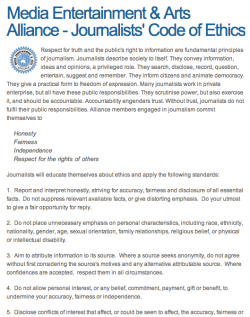
The go-to document for journalists refusing to ‘fess up their sources or taking the high ethical ground is the MEAA Journalists’ Code of Ethics – but the irony is that the journalists’ union uses notoriously ineffective and opaque processes to police this high profile code.

Screen Shot 2013-11-26 at 12.40.47 PMUnlike the Australian Press Council, the ethics panel of the Media, Entertainment and Arts Alliance (MEAA) has actual disciplinary powers at its disposal for use against individual journalists who breach its Code of Ethics – but it has rarely used them. Its powers extend to any journalists who are members of the Alliance. However, these days large numbers of journalists throughout the industry are not members.

In 1999, the alliance updated the code to a twelve-item document, requiring honesty, fairness, independence and respect for the rights of others. The alliance’s ethical complaints procedures are outlined in Section 8 of the Rules of the  MEAA (2009), summarised on the union’s website. Complaints must be in writing stating the name of the journalist, the unethical act and the points of the Code that have been breached. The judiciary committee (made up of experienced journalists elected every two years by state branch members) then meets to consider the complaint. They can dismiss or uphold the complaint without hearing further evidence, call for further evidence and hold hearings. Hearings involve the committee, the complainant and the journalist and follow the rules of natural justice. Lawyers are excluded. Penalties available to the committee include a censure or rebuke for the journalist, a fine of up to $1000 for each offence, and expulsion from the union. Both parties have 28 days to appeal to an appeals committee of three senior journalists in each state elected every four years and then to a national appeals committee of five journalists.

Because of the secrecy surrounding the cases and their outcomes there are few ethics panel case studies to work with. In 2003 Chris Warren provided me with the judgment of a 2002 case involving a complaint against a Sydney cartoonist who, the complainant alleged, portrayed the then opposition leader Kim Beazley as a person with a ‘physical and intellectual disability’, in breach of clause 2 of the code. The complaint also suggested the depiction was ‘inaccurate, unfair and dishonest’ and denied Mr Beazley a ‘right of reply’, in breach of clause 1. He also complained of a ‘continuing and malicious campaign of denigration of Labor leaders by this cartoonist’. The cartoonist’s defence was that all cartoonists regularly breached the letter of several clauses every time they did their work, but that this was the nature of artistic expression and satire. The complaint of unethical behaviour was dismissed on the basis that there was no ‘malicious bias’ and that any inaccuracy ‘was consistent with the satirical traditions of newspaper cartoons’.

Under Rule 67(h), the decisions and recommendations of the ethics panel shall be published in accordance with any guidelines that may be issued by the National Journalists’ Section Committee. When I interviewed MEAA federal secretary Chris Warren in 2003, he said the issue of publication of adjudications was a difficult one because of potential defamation action by participants. This makes it difficult to get information about MEAA ethics panel cases. Muller (2005: 185) wrote: ‘The practical result of this is that no one other than the parties, the panel and the MEAA executive ever hear about the complaints that are lodged, or what happens to them. This not only severely circumscribes the effectiveness of the procedure as a mechanism of accountability, but it offends against the principles of free expression, openness and transparency, and leaves the profession open to accusations of hypocrisy.’

While the MEAA’s website outlines the complaints procedures, it does not feature any records of complaints against journalists. Thus, both its journalist members and the general public remain ignorant of the nature and progress of any complaints against its members. In 2003 Chris Warren confirmed that the organisation received very few complaints each year, and that most were referred to the Australian Press Council. The Walkley Magazine in 2006 noted that the committee received only 67 original complaints and held five appeals between 2000 and January 2006, but could not deal with 34 of the complaints because they were to do with journalists who were not MEAA members. This meant only 33 complaints were handled in five years, an average of just over six per year. A separate tally of complaints to the Victorian branch of the MEAA by Muller (2005: 183) found that over the ten years 1993–2002 inclusive, just 23 complaints were received by the ethics panel of the Victorian branch. He provided a summary of each of them (Muller 2005: 187-8).

MEAA National Secretary Chris Warren told the Independent Media Inquiry last year that since the revised code was adopted in 1999 only three members had been censured or rebuked and that no member had been expelled for almost four decades (Finkelstein, 2012, p. 195). The reality is that with membership voluntary, the MEAA needs someone else to discipline its members when they act unethically. Its return to Press Council membership in 2005 opened the way for the MEAA to refer most complaints to that body or to the ACMA rather than having its own ethics panel deal with them at the risk of an embarrassing finding and the potential loss of a member.

There are scores of ethical codes of practice and guidance documents across the various media industry platforms – far too many for a single journalist to reflect upon while encountering a particular ethical dilemma. The irony is that the MEAA ‘Code of Ethics’ is the best known and most highly regarded ethical statement for the profession but there is a remarkably ineffective mechanism for its enforcement.

———–

Disclaimer: While I write about media law and ethics, nothing here should be construed as legal advice. I am an academic, not a lawyer. My only advice is that you consult a lawyer before taking any legal risks.

© Mark Pearson 2013

2 Comments

Filed under Media freedom, Media regulation, Press freedom

Whither media reform under Abbott?

By MARK PEARSON

Where will the new Liberal-National Coalition government led by Prime Minister Tony Abbott head with the reform of media regulation? Communications Minister Malcolm Turnbull and Attorney-General George Brandis were vocal opponents of the former Gillard Government’s proposals to merge press self-regulation with broadcast co-regulation into a new framework.

TurnbullCommons

Communications Minister Malcolm Turnbull … can he concoct the magic media self-regulation formula? [Image: commons.wikimedia.org]

Recent inquiries into media regulation in the UK (Leveson, 2012), Australia (Finkelstein, 2012) and New Zealand (Law Commission, 2013) have recommended major changes to the regulation of media corporations and the ethical practices of journalists. Their motivation for doing so stemmed from public angst – and subsequent political pressure – over a litany of unethical breaches of citizens’ privacy over several years culminating in the News of the World scandal in the UK and the subsequent revelations at the Leveson Inquiry (2012) with an undoubted ripple effect in the former colonies.

Many contextual factors have informed the move for reform, including some less serious ethical breaches by the media in both Australia and New Zealand, evidence of mainstream media owners using their powerful interests for political and commercial expediency, and the important public policy challenge facing regulators in an era of multi-platform convergence and citizen-generated content.  Minister Turnbull is an expert on the latter element and it is hard to imagine him not proposing some new, perhaps ‘light-touch’, unified regulatory system during this term in office.

By way of background, two major inquiries into the Australian news media in 2011 and 2012 prompted a necessary debate over the extent to which rapidly converging and globalised news businesses and platforms require statutory regulation at a national level.  Four regulatory models emerged – a News Media Council backed by recourse to the contempt powers of courts; a super self-regulatory body with legislative incentives to join; a strengthened Australian Press Council policing both print and online media; and a government-appointed  ‘Public Interest Media Advocate’.

The $2.7 million Convergence Review, announced in late 2010, was meant to map out the future of media regulation in the digital era (Conroy, 2010). However, revelations of the UK phone hacking scandal and Labor and Green disaffection with Rupert Murdoch’s News Limited in Australia, prompted the announcement in September 2011 of a subsidiary inquiry – the $1.2 million Independent Media Inquiry – specifically briefed to deal with the self-regulation of print media ethics. Its architects – former Federal Court judge Ray Finkelstein assisted by University of Canberra journalism professor Matthew Ricketson – argued they could not decouple print news self-regulation from broadcast ‘co-regulation’ in the digital era, so devised a statutory model including both in their report of February 28, 2012, two months prior to the release of the report of its parent Convergence Review (Finkelstein, 2012).

The Independent Media Inquiry (Finkelstein) report was an impressive distillation of legal, philosophical and media scholarship. Among many sensible proposals, it called for simpler codes of practice and more sensitivity to the needs of the vulnerable. But its core recommendation for the ‘enforced self-regulation’ of ethical standards prompted fierce debate. It proposed a News Media Council to take over from the existing self-regulatory Australian Press Council and co-regulatory Australian Communications and Media Authority to set journalistic standards with a streamlined complaints system with teeth (Finkelstein, 2012, pp. 8-9) The body would cover print, online, radio and television standards and complaints. It would have a full-time independent chair (a retired judge or ‘eminent lawyer’) and 20 part-time members evenly representing the media and the general citizenry, appointed by an independent committee (Finkelstein, 2012, pp. 290-291). The government’s role would be limited to securing the body’s funding and ensuring its decisions were enforced, but “the establishment of a council is not about increasing the power of government or about imposing some form of censorship” (Finkelstein, 2012, p. 9).

The report stressed the model would be ‘enforced self-regulation’ rather than ‘full government regulation’;

…an independent system of regulation that allows the regulated parties to participate in the setting and enforcement of standards (as is presently the case), but with participation being required, rather than voluntary (Finkelstein, 2012, p. 287).

Nevertheless, refusal to obey an order to correct or apologise would see a media outlet referred to a court which could issue an order to comply with further refusal – triggering a contempt charge and fines or jail terms for recalcitrant publishers. (Finkelstein, 2012, p. 298). Such a court would be charged with the relatively straightforward task of determining whether the publisher had disobeyed an order of the statutory News Media Council. Only then might publishers get the opportunity for an appeal – again by a judge in court.

The ‘Finkelstein inquiry’ was only ever meant to be an advisory to its parent Convergence Review, chaired by former IBM Australia managing director Glen Boreham, which released its final report in April, 2012 (Convergence Review, 2012).  News media regulation represented a much smaller element of the Convergence Review’s overall brief, particularly after this topic had been hived off to the Finkelstein inquiry, so this matter constituted a relatively small part of its report. While the Convergence Review report shared Finkelstein’s concerns about shortcomings with existing regulatory systems, it proposed that ‘direct statutory mechanisms … be considered only after the industry has been given the full opportunity to develop and enforce an effective, cross-platform self-regulatory scheme’. In other words, it was offering the media industry ‘drinks at the last chance saloon’ for a three year period under its model (Convergence Review, 2012, p. 53). Its mechanism centred upon the establishment of a ‘news standards body’ operating across all media platforms – reinforcing the overall review’s preference for ‘platform neutrality’ (Convergence Review, 2012, p.51). The news standards body ‘would administer a self-regulatory media code aimed at promoting standards, adjudicating complaints, and providing timely remedies’ (Convergence Review, 2012, p. 153).

Unlike Finkelstein, the Convergence Review decided not to be prescriptive about the constitution or operational requirements for such a body, beyond some broad requirements. The largest news media providers – those it deemed ‘content service providers’ – would be required by legislation to become members of a standards body. Most funding for the new body should come from industry, while taxpayer funds might be drawn upon to meet shortfalls or special projects (Convergence Review, 2012, p. xiv). It would feature:

–       a board of directors, with a majority independent from the members;

–       establishment of standards for news and commentary, with specific requirements for fairness and accuracy;

–       implementation and maintenance of an ‘efficient and effective’ complaints handling system;

–       a range of remedies and sanctions, including the requirement that findings be published on the respective platform. (Convergence Review, 2012, p. 51)

The review’s definition of ‘content service enterprises’ (control over their content, a large number of Australian users, and a high level of revenue drawn from Australia) would catch about 15 media operators in its net. Others might be encouraged to join the body with a threat to remove their current news media exemptions to privacy laws and consumer law ‘misleading and deceptive conduct’ provisions (Convergence Review, 2012).

Both inquiries acknowledged – and rejected – the notion of a revamped Australian Press Council proposed in various submissions and appearances by its chair, Professor Julian Disney. (The Press Council was established in 1976 as a newspaper industry ‘self-regulatory’ body – a purely voluntary entity with no powers under law.) Nevertheless, during and after the reports, and with new support from most of its members, the Press Council moved quickly to ramp up its purview and powers to address many of its documented shortcomings such as the refusal of some member newspapers to publish its findings and the threat of withdrawal of funding from others (Simpson, 2012). It locked its members into four year commitments and established an independent panel to advise on its review of its content standards. Those standards are due to be announced soon.

In 2013 the Gillard Labor Government introduced a ‘News Media (Self-regulation) Bill’ to establish a new role of ‘Public Interest Media Advocate’ with the power to deregister bodies, like the Australian Press Council, if they failed to police effectively the ethical standards of their newspaper and online members. Ultimately, the proposal might leave media outlets without their current exemptions from compliance with the Privacy Act in their newsgathering operations. The Labor government later withdrew the proposal when it could not garner enough support in the Parliament – in the face of strong opposition from the mainstream media and the Coalition (now government) with Turnbull and Brandis as the lead naysayers.

The big question now centres upon not if, but when, they choose to propose some new regulatory system where serious media ethical breaches across all media platforms are channelled through a single – self-regulatory? – body. And the further – and crucial issue – will be whether they can do this without ultimate recourse to criminal sanctions for recalcitrant journalists and media groups. It is vital that they do so, given that Australia is rare among Western democracies in that free expression is not enshrined in our Constitution.

Australia’s global free press standing depends upon them devising the magic formula the earlier inquiries failed to concoct.    

References

Conroy, S. (2010, December 14). Convergence Review. Terms of Reference (media release). Available: http://www.minister.dbcde.gov.au/media/media_releases/2010/115

Convergence Review (2012). Convergence Review. Final Report. Department of Broadband, Communications and the Digital Economy: Canberra. Available: http://www.dbcde.gov.au/__data/assets/pdf_file/0007/147733/Convergence_Review_Final_Report.pdf

Convergence Review (2012). Convergence Review. Final Report. Department of Broadband, Communications and the Digital Economy: Canberra. Available: http://www.dbcde.gov.au/__data/assets/pdf_file/0007/147733/Convergence_Review_Final_Report.pdf

Day, M. (2012, April 9.) A shame Seven West should quit Press Council. The Australian. Available: http://www.theaustralian.com.au/business/opinion/a-shame-seven-west-should-quit-press-council/story-e6frg9tf-1226321637864

Finkelstein, R. (2012). Report of the Independent Inquiry Into the Media and Media Regulation. Department of Broadband, Communications and the Digital Economy: Canberra Available: http://www.dbcde.gov.au/__data/assets/pdf_file/0006/146994/Report-of-the-Independent-Inquiry-into-the-Media-and-Media-Regulation-web.pdf

Law Commission (NZ) (2013). The news media meets ‘new media’: rights, responsibilities and
 regulation in the digital age. 
(Law Commission report 128). Law Commission: Wellington.

Leveson, B. (2012). Report of An Inquiry into the Culture, Practice and Ethics of the Press (The Stationery Office, 2012) [Leveson Report].

Simpson, K. (2012, July 20). Journalism standards set for an updating. smh.com.au Available: http://www.smh.com.au/business/journalism-standards-set-for-an-updating-20120719-22czm.html

———–

Disclaimer: While I write about media law and ethics, nothing here should be construed as legal advice. I am an academic, not a lawyer. My only advice is that you consult a lawyer before taking any legal risks.

© Mark Pearson 2013

2 Comments

Filed under Media freedom, Media regulation, Press freedom