Tag Archives: mindfulness

Sexual offences publishing restrictions in Australia – a guide for journalists

By MARK PEARSON

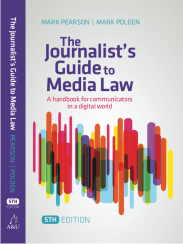
Our fifth edition of The Journalist’s Guide to Media Law (Allen & Unwin, 2014) goes to the printer this week for publication later this year.

Co-author Mark Polden and I have decided to move some of the comparative tables on reporting restrictions throughout Australia across to this blog – journlaw.com – so we could free up space in the new edition to discuss other important issues such as media law for public relations consultants and the implications of digital and social media.

We will work to update the reporting and publishing restrictions tables over coming months, but for the moment I am publishing them as they stood at the date of our fourth edition in 2011.

As I upload them over coming weeks I would appreciate any students or colleagues using the comments section below to advise of any updates in your jurisdictions and I will act to update the tables accordingly.

Looking forward to your collaborative input!


Sexual offences publication restrictions

Jurisdiction  Law Exception Legislation
ACT Complainant must not be identified by name, ‘reference or allusion’, including allowing someone to find out their ‘private, business or official address, email address or telephone number’.


Complainant may consent. (Seek legal advice on proving consent.) Evidence (Miscellaneous Provisions) Act 1999, s. 40.
New South Wales
Complainant must not be identified, even after proceedings disposed of. With permission of court. Consent of complainant aged over 14. (Seek legal advice.) With consent of court for   complainants aged under 16.


Crimes Act 1900, s. 578A; Children (Criminal Proceedings) Act 1987, s. 15A.
Northern Territory
Complainant must not be identified at all. Accused cannot be identified until after committal. No mention of ‘name, address, school or place of employment’ for either.


With permission of court. Sexual Offences (Evidence and Procedure) Act 1983, ss. 6, 7 and 11(2).
Queensland Complainant must not be identified at all. Accused cannot be identified until after committal. No mention of ‘name, address, school or place of employment’ for either. With permission of court.Protection for accused only applies to ‘prescribed sexual offences’:
(a) rape;
(b) attempt to commit rape;
(c) assault with intent to commit rape;
(d) an offence defined in the Criminal Code, section 352.1. Seek legal advice about other offences.


Criminal Law (Sexual Offences) Act 1978, ss. 6 and 7.
South Australia Case and related proceedings including identity of accused cannot be reported until accused has been committed for trial. Complainant must not be identified at any stage.Publishers must publish prominent report of result of proceedings they have covered at earlier stage when accused has been identified.


  • Pre-committal reports can be made with permission of accused. (Seek advice.)
  • Complainant can be identified with his/her permission or order of court unless child victim.
Evidence Act 1929, ss. 71A and B.
Tasmania Complainant and witnesses other than defendant must not be identified, even if dead. Also bans ‘any picture purporting to be a picture of any of those persons’.


Court may allow identification ‘in the public interest’. Evidence Act 2001, s. 194K.
Victoria Complainant must not be identified, even if proceedings not pending. If proceedings not pending, with permission of court or complainant (seek legal advice) or on proof that no complaint of offence had yet been made to police. If proceedings pending, with permission of court only.


Judicial Proceedings Reports Act 1958, s. 4.
Western Australia Complainant and their school must not be identified. With authorisation in writing by complainant aged over 18 and mentally capable of making decision. (Seek legal advice.)


Evidence Act 1906, s. 36c.

—————

Disclaimer: While I write about media law and ethics, nothing here should be construed as legal advice. I am an academic, not a lawyer. My only advice is that you consult a lawyer before taking any legal risks.

© Mark Pearson 2014

Leave a comment

Filed under blogging, contempt of court, courts, media ethics, mental health, social media, Uncategorized

Announcing the fifth edition of The Journalist’s Guide to Media Law

By MARK PEARSON

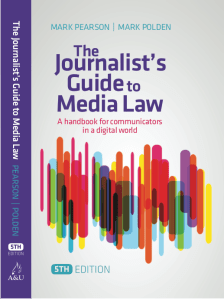
Co-author Mark Polden and I are in the final stages of production of the fifth edition of The Journalist’s Guide to Media Law, to be published later this year.

We are re-engaging with the print medium as we apply our eagle eyes to the final hard copy galley proofs – our last chance for amendments and updates – before it goes to the printer for the production process.

Much has changed since our last edition in 2011, particularly in the fields of news media, communication technologies and practices, tertiary education and the law. We have reshaped and updated this edition of the book to accommodate those developments.

The book is still titled The Journalist’s Guide to Media Law, but its new subtitle—‘A handbook for communicators in a digital world’—encapsulates the seismic shifts that have prompted our considerable revisions. Our target audience has broadened with each edition as technologies like the internet and social media have combined to transform journalism and its allied professional communication careers. Thus our prime audience of Australian journalists working for traditional media outlets has widened to embrace public relations consultants, bloggers, social media editors and new media entrepreneurs,  as they fill new professional occupations dealing with media law, once the domain of mainstream reporters and editors.  Crucial questions which recur through the book include: ‘What is a journalist?’, ‘Who is a publisher?’, ‘How does media law affect this new communication form?’ and ‘Who qualifies for this protection?’ Some of the answers are still evolving, as legislators, the judiciary and the community grapple with the implications of every citizen now having international publishing technology literally at their fingertips on mobile devices.

Such shifts have prompted major new inclusions in the content of the book. So much publishing now transcends Australia’s borders via social media, blogs and other online platforms that we have expanded this edition to contain many more international comparisons and cases. This has been accommodated by reducing some of the forensic examination of precise legislation in various Australian states and territories, found in previous editions. Instead of attempting to document every statutory instrument in all nine Australian jurisdictions, we have directed readers to the resources that contain those details.

All of this has necessitated design and pedagogical changes to the book’s format and contents. While the chapter structure is generally in accord with previous editions, there are new sections within the chapters addressing these issues. Their order varies slightly according to topic, but most chapters now include some key concepts defined at the start, some international background and context to the media law topic, a more detailed account tailored to Australian legislation and case law, a review of the ‘digital dimensions’ of the topic with special focus on internet and social media cases and examples, an account of self-regulatory processes if they apply to that topic, some tips for journalists and other professional communicators for mindful practice in the area, a nutshell summary, some discussion questions, and relevant readings and case references.

The introduction of ‘tips for mindful practice’ encapsulates the authors’ aim that professional communicators need to build into their work practices and routines an informed reflection upon the legal and ethical implications of their reportage, commentary, editing, publishing and social media usage. This approach is explained in greater detail in Chapter 2, but it essentially links safe legal practice and the responsible and strategic use of free expression with the personal moral framework and professional ethical strictures of the digital communicator—whether a journalist, public relations consultant, media relations officer or serious blogger.

Those changing roles are reflected in a new final chapter, Chapter 13, which deals with the law of PR, freelancing and media entrepreneurship. It replaces a chapter on self-regulation in earlier editions. (The role and application of the various industry regulatory, co-regulatory and self-regulatory bodies, such as the Australian Communications and Media Authority (ACMA) and the Australian Press Council (APC), are now introduced in Chapter 3, but they are then referred to in the chapters where their functions and decisions seem most relevant). We saw this area of media law as significant because those who occupy those roles  are now grappling with special dimensions of media law—and several other legal topics relevant to their work—and deserve a new chapter dedicated to their roles and the legal dilemmas that are emerging in relation to them. The chapter also reflects the fact that many former journalists are now working in these allied occupations, and that student journalists need to start their careers with a broad understanding of the legal considerations which govern allied professional communication industries.

The sheer pace of change in all areas of media law is astounding. Many changes were mooted as this edition was going to press—including important developments in the laws of privacy, copyright, hate speech and court reporting. Rather than render the book dated as soon as it is printed, we have opted to use co-author Professor Mark Pearson’s journlaw.com blog (this one!) as the venue for updates to material, and have built several mentions of that resource into the chapters and discussion questions.

Apart from an array of new cases and examples—many from the international arena and many more from social media—some highlights of important new content covered in this edition include the following:

  • There are significant cases on increased statutory powers, allowing courts to make suppression and non-publication orders, and on the relationship between free speech, open justice and the right of parties to settle disputes privately. Recent cases at the borderline between ridicule and defamation, and on the application of freedom of information laws to immigration detention centres are included, as are cases on the application of sub judice contempt to internet content hosts and ‘celebrity’ claims of privacy invasion.
  • Recommendations of the ALRC on copyright reform are included, together with a discussion of the new copyright fair dealing defence that applies to satire. The book presents a wide range of examples, across different legal categories, relating to the use of the internet and social media, which will be of growing importance for current and future professional practise in communication, reportage and media advice.
  • A separate chapter on secrets (Chapter 9) covers the new journalists’ shield laws and their relevance to micro-bloggers and non-traditional publishers.
  • Chapter 10, on anti-terrorism and hate laws, includes the recommendations for reform of anti-terror laws and discusses the high-profile Andrew Bolt case and related proposals for reform of the Commonwealth Racial Discrimination Act 1975.
  • The recommendations of the Leveson Inquiry in the United Kingdom, and the Finkelstein Inquiry and Convergence Review in Australia, are subjected to critical analysis in view of their potential impact upon notions of a free press.

There is also an increased emphasis on real-time reportage, as the traditional print media increase their online presence and depth of click-through coverage in a 24/7 news cycle, with concomitant risks in the areas of defamation and contempt in their own work and that of third-party commentators on their websites and social media pages.

Without going into exhaustive detail on all of these matters, the book remains true to its original aim: to provide professional communicators and students with a basic working understanding of the key areas of media law and ethical regulation likely to affect them in their research, writing and publishing across the media. It tries to do this by introducing basic legal concepts while exploring the ways in which a professional communicator’s work practices can be adapted to withstand legal challenges.

In designing this edition, we have tried to pay heed to the needs of both professional communicators and media students. The book is best read from front to back, given the progressive introduction of legal concepts. However, it will also serve as a ready reference for those wanting guidance on an emerging problem in a newsroom or PR consultancy. The cases cited illustrate both the legal and media points at issue; in addition, wherever possible, recent, practical examples have been used instead of archaic cases from the dusty old tomes in the law library. Rather than training reporters, bloggers and PR practitioners to think like lawyers, this book will achieve its purpose if it prompts a professional communicator to pause and reflect mindfully upon their learning here when confronted with a legal dilemma, and decide on the appropriate course of action. Often that will just mean sounding the alarm bells and consulting a supervisor or seeking legal advice.

Of course, the book is not meant to offer actual legal advice. Professional communicators must seek that advice from a lawyer when confronted with a legal problem. The most we claim to do is offer an introduction to each area of media law so that journalists, PR consultants and bloggers can identify an emerging issue and thus know when to call for help.

Booktopia is offering pre-orders on their website: http://www.booktopia.com.au/the-journalist-s-guide-to-media-law-mark-pearson/prod9781743316382.html

Disclaimer: While I write about media law and ethics, nothing here should be construed as legal advice. I am an academic, not a lawyer. My only advice is that you consult a lawyer before taking any legal risks.

© Mark Pearson 2014

Leave a comment

Filed under blogging, citizen journalism, contempt of court, free expression, journalism, media ethics, media law, Media regulation, social media, sub judice, Uncategorized

Justice Open and Shut – and the man without a name revisited

By MARK PEARSON

I’m looking forward to presenting with colleague Associate Professor Tom Morton from UTS (pictured) at the Australian Centre for Independent Journalism’s ‘Justice Open and Shut’ Symposium this week.

MORTON

Dr Tom Morton

Below is the full program for the conference from the ACIJ website.

It’s a stellar line-up of Australian media law experts with the welcome guest presentation from Judith Townend from the Centre for Law, Justice and Journalism at City University, London, on ‘Transluscent justice? Digital and physical access to UK courts’.

Keynote speaker is the Hon. Philip Cummins, former Supreme Court judge and Chair of the Victorian Law Reform Commission, Chair of the Victoria Law Foundation and Chair of the Protecting Victoria’s Vulnerable Children Inquiry.

Dr Morton and I are speaking about progress with our research project on a forensic mental health patient we called ‘The Man Without A Name” because of restrictions on identifying people involved in NSW Mental Health Tribunal proceedings. Section 162 Mental Health Act (NSW) bans ID of anyone involved in either tribunal or forensic proceedings, with further requirements under the Mental Health (Forensic Provisions) Act. A breach can incur a fine of $5500 or a 12 month jail term.

See my earlier blog on this and Tom’s Background Briefing piece by the same name for Radio National.

We have won permission to name him in our academic writing – including on this blog – but I will hold back on that for today so I do not spoil the presentation for those attending on Wednesday.

I have previously compared the complex array of mental health reporting restrictions in Australia and New Zealand. (See here.)

In 2012 I compared three cases in WA, Victoria and the UK involving the identification of mental health patients. The case of Patient A has strong parallels with the Albert Lazlo Haines [pdf] case in the UK where a patient won an appeal to be named in reportage of his review proceedings.

This Australian case adds to that body of literature and is interesting from that media law perspective. It also interests us as an ethical case study, and we will be using it as the focus for an exploration of the application of the principles of ‘mindful journalism’ I have described previously.

———–


Conference program:

Justice Open and Shut: Suppression orders and open justice in Australia and the UK

“There is one hell of a fight going on in Australia to preserve our free press. We are increasingly seeing the rich and powerful resort to litigation to pursue journalists’ sources or lodge defamation writs purely to stop the publication of stories and scare off the rest of the media.”

Nick McKenzie, Fairfax Media, 2014 Press Freedom Australia Address

The increasing use of suppression orders undermines fair and accurate reporting of the courts and the fundamental principle of open justice.  This workshop will explore the operations and impact of suppression orders on reporting in Australia and the UK.

A workshop for journalists, lawyers, academics and anyone with an interest in open justice, the media and freedom of the press.

The  conference schedule is now available.

Keynote address: ‘Open Courts: Who Guards the Guardians?’

Keynote speaker: Hon. Philip Cummins – former Supreme court judge and Chair of the Victorian Law Reform Commission, Chair of the Victoria Law Foundation and Chair of the Protecting Victoria’s Vulnerable Children Inquiry.

Other speakers:

  • Peter Bartlett: Partner Minter Ellison, Chair of the Advisory Board at the Centre for Advanced Journalism ast Melbourne University. Author of the law precis for MEAA State of Pres Freedom in Australia. Bartlett has represented Fairfax media and others in relation to suppression orders. He will speak on the use of suppression orders and its impact on the media and journalism, the operation of take down laws and trends observed since the introduction of the new Acts.
  • Miiko Kumar: Barrister, Jack Shand Chambers and Senior Lecturer, Faculty of Law, University of Sydney. Kumar appears regularly in applications for suppression orders on behalf of government agencies. She will provide an overview of the law relating to different forms of suppression orders, as well as recent cases involving Gina Rinehart and her attempted use of suppression orders in relation to court proceedings.
  • Judith Townend: Centre for Law, Justice and Journalism, City University, London. Townend will speak on ‘Transluscent justice? Digital and physical access to UK courts’.
  • Academics and journalists Mark Pearson (Griffith) and Tom Morton (University of Technology, Sydney): Open justice, investigative journalism and forensic patients.
  • Elissa Hunt: has been a court and legal affairs reporter with the Herald-Sun in Victoria for more than 13 years.  Her work has been recognized through numerous awards from the Victorian Law Foundation, including the 2014 Law Foundation’s Reporter of the year on Legal Issues. Elissa has recently been appointed as the Digital News Editor.
  • Adele Ferguson: a multi-award winning senior business writer and columnist for the Age and the Sydney Morning Herald and author of the best selling unauthorised biography Gina Rinehart: The Untold Story of the Richest Woman in the World. Prior to joining the Age and the SMH, Adele was a senior commentator with the Australian. She has also worked at BRW Magazine as deputy editor and chief business commentator, leading many major investigations into the corporate sector.
  • Jason Bosland: Deputy Director of the Centre for Media and Communications Law at Melbourne Law School where he teaches communications and intellectual property law. He holds degrees from Melbourne and the London School of Economics. His primary research interests lie in media law, including defamation and privacy, open justice and the media, contempt of court and freedom of speech.

This workshop is hosted by the Rule of Law Institute of Australia and the Australian Centre for Independent Journalism and is supported by the Centre for Cosmopolitan Civil Societies, University of Technology, Sydney.

Media Enquiries:

Tom Morton tom.morton@uts.edu.au

Kate Burns kate@ruleoflaw.org.au

When

4 June 2014
10:00 am – 4:30 pm

Where

Venue: Mary Anne House, Level 3, 645 Harris St, Ultimo, Sydney.

—————

Disclaimer: While I write about media law and ethics, nothing here should be construed as legal advice. I am an academic, not a lawyer. My only advice is that you consult a lawyer before taking any legal risks.

© Mark Pearson 2014

Leave a comment

Filed under blogging, Buddhism, citizen journalism, Eightfold Path, free expression, media ethics, mental health, social media, Uncategorized

‘Right speech’, media law and mindful journalism – a work in progress

By MARK PEARSON

Media law is much more than a set of edicts in the form of cases and legislation as presented in many texts and as taught in many courses.

Professional communicators and students can gain insights into the law as it stands – and into how it might be reformed – by tracing it to its origins, revisiting it in its modern context, and by applying fresh perspectives to its analysis. It can also inform their newsroom decision-making on legal and ethical matters.

Screen Shot 2014-02-08 at 10.44.34 AM

Gunaratne’s seminal text – The Dao of the Press. A Humanocentric Theory

Defamation is a good example. Historically, people’s reputations were seen as part of their spiritual beings. As such, defamation proceedings were often brought in the ecclesiastical courts of the Church of England before the Reformation (Rolph, 2008, pp. 39-48.

A stab at someone’s reputation was viewed as an attack on their soul – to be judged only by God’s earthly adjudicators, the clergy. From the 16th century, defamation actions were increasingly brought in the common law courts, with the courts developing a list of allegations with which they would deal, without needing proof of actual damage being caused by the defamation (Morison & Sappideen 1989, p. 173). Yet even today the Catechism of the Catholic Church lists ‘detraction’ (essentially gossip – or disclosing ‘another’s faults and failings to persons who did not know them’) as a sin – or an ‘offense against truth’.

Modern defences to defamation – like truth and qualified privilege – have been shaped by changing cultural, philosophical and political values, with truth as a defence heavily influenced by libertarians like Locke, Mill and Jefferson.

My recent work has involved the investigation of the ways Buddhist ethics might offer a useful framework for both journalism and media law. You can find an excerpt on my paper on ‘mindful journalism’ I presented to last year’s IAMCR convention in Dublin here.

I am not a Buddhist but I have seen the value of its application to modern phenomena and clinical situations like ‘Mindfulness Based Cognitive Therapy’ where meditation techniques have assisted with the treatment of anxiety and depression (Segal et. al, 2013).

Back in 2005 I attempted to use the Tibetan Buddhist mandala as a device to explain the complex competing interests involved when weighing up an issue involving privacy in the newsroom. (Pearson, 2005, see here.)

I have recently attempted to apply a Buddhist framework to the contexts of political blogging and election reportage. Colleague Tom Morton from UTS and I are using mindful journalism as a framework for examining a case study of an individual who wants a ban on his identity overturned by the Mental Health Review Tribunal in NSW.

My interest has come to the attention of a pioneer in the application of Buddhist systems theories to journalism – Professor Shelton Gunaratne – who wrote the seminal work in the field – The Dao of the Press – A Humanocentric Theory – in 2005.

He has compared his designated goals of Buddhist journalism with many of the traits of modern Western journalism in his insightful article in Javnost – The Public in 2009: ‘Buddhist goals of journalism and the news paradigm’.

Prof. Gunaratne has generously asked me to collaborate in a new project on mindful journalism also involving Dr Sugath Senarath from the University of Colombo.

Meanwhile, I will be attempting to articulate some of these principles – particularly the relationship between Buddhist notions of ‘right speech’ to defamation and celebrity journalism – in a paper I’ll be delivering to the Media Talk Symposium to be hosted by Associate Professor Jacqui Ewart in Brisbane on April 23-24 (schedule TBA).

That paper will be titled “Mindful media talk: exploring a Buddhist ‘right speech’ ethic in journalism and social media”. Its abstract reads:

Defamation and privacy laws – and journalism ethics codes – are problematic as guidance tools for news communication in the globalised, multi-cultural and multi-jurisdictional Web 2.0 era. This paper draws upon systems methodology (Gunaratne, 2005) to foreshadow an application of the Buddhist ethic of ‘right speech’ to journalistic and social media communication. The path of ‘right speech’ (samma vaca) was one step in Buddha’s Eightfold Path to enlightenment. However, taken at a secular level, it offers a useful theoretical framework by which to analyse media talk and guidance for those engaging in reportage and citizen journalism. Right speech invokes the avoidance of falsehood, divisive and abusive speech and gossip mongering. This paper explains its elements, distinguishes them from media laws and professional ethical codes, and uses examples to examine the extent to which it might accommodate ‘public interest’ / Fourth Estate journalism and celebrity news.

Watch this space for more posts on ‘mindful journalism’ as we explore its value as an analytical device and – perhaps more importantly – as a newsroom tool for ethical decision-making.

——————–

Key references

Gunaratne, S. A. (2005). The Dao of the Press: A humanocentric theory. Cresskill, NJ: Hampton Press.

Gunaratne, S. A. (2007). A Buddhist view of Journalism: Emphasis on mutual causality. Communication for Development and Social Change 1 (3): 17-38. (Paper originally presented at the University of Queensland on March 8, 2006.)

Gunaratne, S. A. (Feb. 15, 2009). Buddhist principles can revolutionize news and journalism. The Buddhist Channel.  Available at <http://www.buddhistchannel.tv/index.php?id=70,7781,0,0,1,0#.UuMttWTnb-k&gt;

Morison, W.L. & Sappideen, C. (1989) Torts: Commentary and Materials, 7th edn.

Sydney: Law Book Company.

Pearson, M. (2005) The privacy mandala: Towards a newsroom checklist for ethical decisions. Refereed paper presented to the Journalism Education Conference, Griffith University, Tuesday 29th November – Friday 2nd December, 2005, Gold Coast International Hotel, Surfers Paradise, QLD Australia. Available: http://epublications.bond.edu.au/cgi/viewcontent.cgi?article=1263&context=hss_pubs

Rolph, D. (2008). Reputation, Celebrity and Defamation Law. Ashgate: Aldershot. Available: http://books.google.com.au/books?id=d7YO44MvD8QC&source=gbs_navlinks_s

Segal, Z., Williams, M., Teasdale, J. and Kabat-Zinn, J. (2013). Mindfulness-Based Cognitive Therapy for Depression, Second Edition. Guilford Publications: NY.

———–

Disclaimer: While I write about media law and ethics, nothing here should be construed as legal advice. I am an academic, not a lawyer. My only advice is that you consult a lawyer before taking any legal risks.

© Mark Pearson 2014

3 Comments

Filed under blogging, Buddhism, citizen journalism, Eightfold Path, free expression, media ethics, mental health, social media, Uncategorized

The man without a name to get one – a small victory for open justice

By MARK PEARSON

We have won a small victory for open justice by persuading the NSW Mental Health Tribunal to allow the Australian Broadcasting Corporation to use the name of a forensic patient in a Background Briefing program on Radio National next year.

**Update: Tom Morton’s radio documentary ‘The man without a name’ was aired on Radio National Background Briefing on April 20, 2014 and can be heard (and transcript read) here.

We later applied to the Mental Health Review Tribunal for permission to name the patient in our scholarly publications, including this research blog. The Tribunal granted that permission on May 9, 2014 after a hearing to consider our application on 20 March 2014.

We can now reveal that the patient is Mr Saeed Sayaf Dezfouli.

This publication is conditional upon this publication carrying this notice:

“Notice: It is an offence under the Mental Health Act 2007 (NSW) section 162 to publish or broadcast the name of any person to whom a matter before the Mental Health Review Tribunal relates or who appears as a witness before the Tribunal in any proceedings or who is mentioned or otherwise involved in any proceedings under the Mental Health Act 2007 or the Mental Health (Forensic Provisions) Act 1990, unless consent has first been obtained from the Tribunal. The author has obtained such consent to publish Mr Dezfouli’s name.”

MORTON

Dr Tom Morton

[Earlier blog continued … ] Colleague Associate Professor Tom Morton from the University of Technology Sydney and I have been conducting an applied research project about publicity of mental health proceedings – centred upon the case of a Sydney patient who wishes to be identified in reportage on his situation.

We are presenting a progress report on our study at the Journalism Education Association of Australia annual conference in Mooloolaba, Queensland today (December 4, 2013).

Dr Morton is an accomplished radio journalist and has started work on the documentary to be aired in coming months. We are collaborating on the academic side of the project – using my research into mental health reporting and logging our ethical decision-making to create a documented mindful reflection on the project.

Dr Morton briefed ABC lawyer Hugh Bennett who presented our case for the identification of Patient A when we appeared before the Mental Health Tribunal in September.

Section 162 Mental Health Act (NSW) bans ID of anyone involved in either tribunal or forensic proceedings, with further requirements under the Mental Health (Forensic Provisions) Act. A breach can incur a fine of $5500 or a 12 month jail term.

A Supreme Court application for the identification of Patient A had failed in 2012 on technical grounds (A v Mental Health Review Tribunal (2012) NSWSC293).

The Tribunal’s consent to the identification of Patient A appears to be limited to the broadcast, so I am not naming him here.

Patient A is an Iranian refugee who until 2002 was employed at a government office in Sydney.

In 2002 he set fire to that building and a co-worker died of smoke inhalation.

In 2003 the Supreme Court of NSW found that Patient A was unfit to be tried for murder, and a jury subsequently found him not guilty of manslaughter by reason of mental illness. He is thus deemed a ‘forensic patient’ – a person whose health condition has led them to commit, or be suspected of, a criminal offence’ (AIHW, 2010, p. 140).

I have previously published compared the complex array of mental health reporting restrictions in Australia and New Zealand. (See here.)

Last year I compared three cases in WA, Victoria and the UK involving the identification of mental health patients. The case of Patient A has strong parallels with the Albert Lazlo Haines [pdf] case in the UK where a patient won an appeal to be named in reportage of his review proceedings.

This Australian case adds to that body of literature and is interesting from that media law perspective. It also interests us from an ethical perspective, and we will be using it as the focus for an exploration of the application of the principles of ‘mindful journalism’ I have described previously.

We plan to write an academic article on this process to date (the events leading to this Tribunal decision), followed by a research journalism output including an exegesis on mindful journalism ethics after Dr Morton’s Background Briefing documentary has been broadcast. Stay tuned.

———–

Disclaimer: While I write about media law and ethics, nothing here should be construed as legal advice. I am an academic, not a lawyer. My only advice is that you consult a lawyer before taking any legal risks.

© Mark Pearson 2013

3 Comments

Filed under blogging, Buddhism, citizen journalism, Eightfold Path, free expression, media ethics, mental health, social media, Uncategorized

Election postscript: a mindful analysis of media coverage

By MARK PEARSON

[This blog was first published in the St James Ethics Centre’s Living Ethics newsletter, Issue 93, Spring 2013. See here.]

Australian journalists operate under an array of ethical guidelines, including the MEAA Code of Ethics and numerous employer and industry codes of practice.

hogansWhile these documents differ widely in their wording, they espouse common values of truth, accuracy, fairness and the public’s right to information. They disapprove of invasions of privacy, disclosure of confidential sources, discriminatory language, subterfuge, deception, plagiarism and conflicts of interest.

When it comes to assessing the ethics of news coverage of an event as broad in scope as a federal election we find some guidance in such codes but other moral frameworks can add value.

Although I am not a Buddhist, I have recently found value in applying some of that religion’s foundational principles – in a secular way – to the assessment of journalism ethics and have been sharing this approach with colleagues and students through my writing and teaching.

It is also a useful lens through which to review some key elements in media coverage of the 2013 federal election.

The approach centres on the belief that journalists can adopt a mindful approach to their news and commentary which requires a reflection upon the implications of their truth-seeking and truth-telling as a routine part of the process. It calls upon them pause and think carefully about the consequences of their reportage and commentary for the stakeholders involved, including their sources and their audiences.

Truth-seeking and truth-telling are still the primary goal, but only after gauging the resulting social good or harm.

Each of the constituent steps of Buddhism’s Eightfold Path – understanding free of superstition, kindly and truthful speech, right conduct, doing no harm, perseverance, mindfulness and contemplation – provides a framework for such analysis.

Space prohibits the examination of all of them here, but at least three issues arose in the election worthy of such reflection.

  1. Fact checking. The Buddhist notion of ‘right views’ focuses on a deeper explanation of root causes and the clinical testing of claims. The emergence of the ‘fact checker’ was a welcome development via Politifact Australia, the ABC’s Fact Checking Unit and The Conversation’s Election FactCheck. A longer term impact of such a tool might be that politicians are prompted to think twice before issuing scaremongering and outlandish statements.
  2. The News Corp anti-Labor campaign. The principle of ‘right intent’ calls upon us to reflect upon the genuine motivations for Rupert Murdoch’s Australian newspapers adopting such a blatant and belittling attack on the incumbent government. Cynical mock-ups like the Daily Telegraph’s ‘Hogan’s Heroes’ and the Courier Mail’s ‘Send in the Clown’ front pages might be excused as tabloid fun but they hardly indicate ‘right intent’ and ‘right speech’ in the Buddhist moral framework. The motivation could surely not have been to gain circulation, given the fact that the coverage stood to alienate perhaps one third of readers. It will be fascinating to see at the next audit whether this stance accelerated the decline of those newspapers’ circulations. If the intent was to win influence with the likely government, then this should have been disclosed.
  3. Presidential-style coverage. Just because political parties choose to run a presidential style of campaign does not oblige news organisations to embrace it. The Buddhist principle of ‘right effort’ invokes a steady, patient and purposeful path and ‘right mindfulness’ demands a considered and reflective approach to reportage. Each of these is difficult when reporters are assigned to traipse around the nation and cover political leaders engaging in stage-managed, superficial appearances at factories, schools and sausage sizzles. It is belittling to the enterprise of journalism to see some of its leading lights – and notable watchdogs – being led by the leash as mere lapdogs. It was particularly noticeable in a campaign where neither leader made a notable gaffe. We are left to imagine what might have been revealed if only these political journalism superstars had been afforded the time to do some real digging. Sometimes being ethical demands us to say ‘no’ to an under-utilisation our talents, which was clearly the case here.

livingethicscoverThe ultimate test of ethical political reporting in a democracy is the extent to which that journalism best informs the citizenry to maximize the value of each and every vote. In that respect, Australian journalism still has much to learn.

———–

Disclaimer: While I write about media law and ethics, nothing here should be construed as legal advice. I am an academic, not a lawyer. My only advice is that you consult a lawyer before taking any legal risks.

© Mark Pearson 2013
2 Comments

Filed under blogging, Buddhism, citizen journalism, Eightfold Path, free expression, media ethics, social media, Uncategorized

Mindful ethics for bloggers

By MARK PEARSON

[This blog was first published on the citizen journalism election site No Fibs, edited by Margo Kingston.]

Bloggers and citizen journalists come from an array of backgrounds and thus bring varied cultural and ethical values to their blogging.

No Fibs asks its citizen journalists to follow the MEAA Code of Ethics, and the journalists’ union has recently made a concerted effort to bring serious bloggers into its fold through its FreelancePro initiative.

This would have bloggers committing to a ‘respect for truth and the public’s right to information’ and the core principles of honesty, fairness, independence, and respect for the rights of others. Specifically, they would subscribe to the 12 key principles of fair and accurate reporting; anti-discrimination; source protection; refusal of payola; disclosure of conflicts of interest; rejection of commercial influences; disclosure of chequebook journalism; using honest newsgathering methods and protecting the vulnerable; disclosing digital manipulation; not plagiarising; respecting grief and privacy; and correcting errors. These can be overridden only for ‘substantial advancement of the public interest’ or where there is ‘risk of substantial harm to people’.

A decade ago in the US, Cyberjournalist.net cherry-picked the lengthy  Society of Professional Journalists Code of Ethics and proposed its own Bloggers’ Code of Ethics.

All this is fine for bloggers who are former working journalists, student journalists who hope to work in that occupation, and for serious bloggers who view their work as journalism even though it might only be a hobby or attract a pittance in payment. But many bloggers make the conscious decision not to identify as journalists, and thus need to revert to a personal moral framework in their work.

I have been exploring this in recent months and have coined the expression ‘mindful journalism’ after finding that many fundamental Buddhist principles – applied in a secular way – lend themselves to serious blogging when other moral compasses might be absent. Parts of this blog are drawn from my paper delivered to the IAMCR conference in Dublin in June, 2013.

Please do not interpret this as an attempt to convert bloggers to Buddhism. I am not a Buddhist and believe that followers of any of the world’s major religions will find core values in their scriptures that serve this process just as well.

It is just that Buddhism’s Eightfold Path is a simple expression of key moral values that can underscore ethical blogging: understanding free of superstition, kindly and truthful speech, right conduct, doing no harm, perseverance, mindfulness and contemplation.

It was while writing my recent book Blogging and Tweeting Without Getting Sued (Allen & Unwin, 2012) that I decided a guide to safe online writing required more than a simple account of ‘black letter law’. It forced a re-examination of the fundamental moral underpinnings of Internet and social media communication. Being safe legally normally requires a careful pre-publication reflection upon the potential impacts of one’s work upon one’s self and others – or what a Buddhist might explain in terms of ‘mindfulness’ and ‘karma’.

Dalai Lama’s recent book – Beyond Religion – Ethics for a Whole World (2011) – explored his vision of how core ethical values might offer a sound moral framework for modern society while accommodating diverse religious views and cultural traditions. Buddhist practices like mindfulness and meditation have been adopted broadly in Western society in recent decades and have been accepted into clinical psychology. Even the MEAA Code of Ethics states: “Ethical journalism requires conscientious decision-making in context.”

This is premised on the belief that journalists and serious bloggers can adopt a mindful approach to their news and commentary which requires a reflection upon the implications of their truth-seeking and truth-telling as a routine part of the process. They would be prompted to pause and think carefully about the consequences of their reportage and commentary for the stakeholders involved, including their audiences. Truth-seeking and truth-telling would still be the primary goal, but only after gauging the social good that might come from doing so.

So what are these core principles and how might they apply to an election blogger?

Each of the constituent steps of the Eightfold Path – understanding free of superstition, kindly and truthful speech, right conduct, doing no harm, perseverance, mindfulness and contemplation – has an application to the modern-day practice of truth-seeking and truth-telling – whether that be by a journalist working in a traditional media context, a citizen journalist or a serious blogger reporting and commenting upon political news.

Let’s explore its eight steps.

1. Right views.  A fundamental principle of Buddhism is that all things in the world are at once impermanent, unsatisfactory and non-substantial. News, too, is about the impermanent and the unsatisfactory. It is premised upon identifying to audiences what has changed most recently, focusing especially on the most unsatisfactory elements of that change. The notion of ‘right views’ can incorporate a contract with audiences that accepts a level of change at any time, and focuses intention upon deeper explanations of root causes, strategies for coping and potential solutions for those changes prompting the greatest suffering. In election blogging, it moots for less scare-mongering, more careful consideration of policies and the clinical testing of claims.

2. Right intent. This calls upon the blogger to reflect upon the genuine motivating reasons why he or she is blogging at all, then why they might be writing this particular commentary, and finally why they are selecting a particular turn of phrase or quote to make a point. Such a reflective approach can be revealing. How is humanity being improved by this action? Is it motivated in some way by ego or for the betterment of society? This might prompt a change in mindset from bringing news ‘first’ in a competitive sense but ‘best’ and most meaningfully to an audience in a qualitative sense. Of course, it would not be ‘news’ if were not delivered relatively soon after its occurrence, but in this era of instant communication this step reinforces the notion of ‘responsible truth-seeking and truth-telling’ – authoritative and credible news and commentary, obtained ethically, and delivered as soon as possible (after such reflection) to retain its relevance and utility without losing its veracity.

3. Right speech. This step relates to both truthful and charitable expression and, interpreted narrowly, that second element could present a fundamental challenge to the very concept of political commentary as we know it. It certainly places serious questions about the gossip and mud-slinging orientation of much political coverage. The notion of telling the truth and being accurate lies at the heart of journalism practice and is foremost in most ethical codes internationally. While a single empirical fact might be subject to scientific measurement and verification, any conclusions drawn from the juxtaposition of two provable facts can only constitute what a scientist would call a ‘theory’ and the rest of us might call ‘opinion’. Gossip about the private lives of politicians, barbed commentary, imposing labels upon them like the “Flimflam Man”, the “Mad Monk” or “Dr No”, and cynical mock-ups like the Daily Telegraph’s Hogan’s Heroes front page all fail the test of ‘right speech’. That is not to say harsh and uncomfortable truths must not be told.  It is the way they are told that is crucial to this principle.

4. Right conduct. The fourth step of ‘right conduct’ goes to the core of any moral or ethical code and invokes a reflection on the actual practices involved. Here, journalism codes offer useful guidance in their lists of “do’s” and “do not’s.” Even journalism ethical codes can gain wider understanding and acceptance by appealing to fundamental human moral values and not just offering a proscriptive list of prohibited practices. A recent example is the Fairfax Media Code of Conduct which poses questions employees might ask themselves when faced with ethical dilemmas that might not be addressed specifically in the document, including:

  • Would I be proud of what I have done?
  • Do I think it’s the right thing to do?
  • What will the consequences be for my colleagues, Fairfax, other parties and me?
  • What would be the reaction of my family and friends if they were to find out?
  • What would happen if my conduct was reported in a rival publication?

While this approach seems to focus on the potential for shame for a transgressor, it offers an example of a media outlet attempting to encourage its employees to pause and reflect in the midst of an ethical dilemma – what educationalist Donald Schön (1987, p. 26) called ‘reflection-in-action’.

5. Right living. The Buddha identified certain livelihoods that were incompatible with a morally pure way of living, shaped of course by the cultural mores of his place and time 2500 years ago. They included poison peddler, slave trader, prostitute, butcher, brewer, arms maker and tax collector. Some of these occupations might remain on his list today. We are left to wonder how the worst of political coverage – intrusion, rumor-mongering, name-calling, mud-slinging, and agenda-pushing for commercial purposes – advances the enterprise of journalism or the personal integrity of an individual journalist who chooses to ply that trade. This is where political bloggers working outside the mainstream media can distinguish themselves by applying a mindful approach to their work.

6. Right effort. The step of ‘right effort’ was directed by the Buddha in a predominantly spiritual sense – a steady, patient and purposeful path to enlightenment. However, we can also apply such principles to the goal of ethical blogging and citizen journalism in a secular way. We might sometimes see the hurried scoop and accompanying kudos as an end in itself. There can also be an emphasis on productivity and output at the expense of attribution and verification. Of course, stories and blogs could evolve into lengthy theses if they were afforded unlimited timelines and budgets. Commercial imperatives and deadlines demand a certain brevity and frequency of output. Both can be achieved with continued attention to the core principle of purposeful reflection upon the ethics of the various work tasks and a mindful awareness of the underlying mission of one’s enterprise. External factors will continually threaten a blogger’s commitment to this ethical core, requiring the ‘right effort’ to be maintained at that steady, considered pace through every interview, every blog, every working day and ultimately through a full career. As the Dalai Lama wrote in Beyond Religion: “The practice of patience guards us against loss of composure and, in doing so, enables us to exercise discernment, even in the heat of difficult situations (p. 142).” Surely this is a useful attribute for the reporter, citizen journalist and blogger.

7. Right mindfulness. This is the technique of self-examination I have selected as central to an application of these principles to blogging and citizen journalism. Effective reflection upon one’s own thoughts and emotions is crucial to a considered review of an ethical dilemma in a publishing context. It is also essential to have gone through such a process if you are later called to account to explain their actions. Many ethical decisions are value-laden and inherently complex. Too often they are portrayed in terms of the ‘public interest’ when the core motivating factor has not been the greater public good but, to the contrary, an ego or a commercial imperative. The Leveson Report into the excesses of the British press detailed numerous instances where such forces were at play, often to the great detriment to the lives of ordinary citizens. Buddhists (and many others) adopt mindfulness techniques in the form of meditation practice where they reflect upon their thoughts and emotions without reacting to them. While I have found this practice useful, I am by no means suggesting citizen journalists or bloggers adopt the lotus position in the midst of a breaking news to peacefully contemplate their options. The extent to which individuals might want to set aside time for meditation in their own routines is up to them, but at the very least there is much to be gained by adopting the lay meaning of ‘being mindful’. In other words, bloggers might pause briefly for reflection upon the implications of their actions upon others – the people who are the subjects of their blogs, other stakeholders who might be affected by the event or issue at hand, the effects upon their own reputations and the community standing of others, and the public benefits ensuing from this particular truth being told in this way at this time. There is a special need to be mindful of the vulnerabilities of some individuals you write about. Our own research has examined how coverage might impact on those who might belong to a ‘vulnerable group’ or who might simply be ‘vulnerable’ because of the circumstances of the news event. This concern for others also invokes the notion of compassion for other human beings, a tenet central to the teachings of all major religions, and a hallmark of Buddhism. The Dalai Lama explains that true compassion for others requires that sometimes we must call to account those who abuse power: “Depending on the context, a failure to respond with strong measures, thereby allowing the aggressors to continue their destructive behaviour, could even make you partially responsible for the harm they continue to inflict (Dalai Lama, 2011, p. 59).”

8. Right concentration. Some have compared ‘right concentration’ to being in ‘the zone’ in elite sporting terminology – so focused on the work at hand that there is a distinctive clarity of purpose. It is such concentrated attention that is required of consummate professionals in the midst of covering a major event. It is at this time that we actually enter ‘the zone’ and are able to draw on core ethical values to produce important reportage and commentary within tight deadlines, paying due regard to the impact of their work upon an array of individual stakeholders and to the broader public interest. It is in this moment that it all comes together for the mindful journalist or blogger – facts are verified, comments from a range of sources are attributed, competing values are assessed, angles are considered and decided and timing is judged. And it all happens within a cool concentrated focus, sometimes amidst the noise and mayhem of a chaotic news event.

We cannot expect the millions of bloggers and citizen journalists internationally to abide by a unified moral or ethical code. Some will draw upon foundational principles from the Koran, the Bible, the Torah or Confucianism. Others will reflect upon classic secular guidelines like Dale Carnegie’s How to Win Friends and Influence People or Rudyard Kipling’s If. And some of us might find guidance in these eight steps developed more than two millennia ago.

———–

Disclaimer: While I write about media law and ethics, nothing here should be construed as legal advice. I am an academic, not a lawyer. My only advice is that you consult a lawyer before taking any legal risks.

© Mark Pearson 2013
3 Comments

Filed under blogging, Buddhism, citizen journalism, Eightfold Path, free expression, media ethics, social media, Uncategorized