
By MARK PEARSON Follow @Journlaw
Drones – unmanned aerial vehicles – raise a host of legal and ethical issues but responsible journalism should be exempted from many legal restrictions, according to international media law expert Dr David Goldberg.
Dr Goldberg was co-author (with the ABC’s Mark Corcoran and Oxford’s Robert G. Picard) of the Oxford Reuters Institute for the Study of Journalism report ‘Remotely Piloted Aircraft Systems and Journalism’ in June, 2013.

Dr David Goldberg and ABC drones co-ordinator and foreign correspondent Mark Corcoran at the G20 Drones Symposium at Griffith University
He was addressing the Drones, Privacy and Journalism symposium at the Griffith University campus at South Bank in Brisbane tonight (November 4).
He was joined by former ABC Foreign Correspondent reporter Mark Corcoran (now with ABC News Online and leading the ABC’s drones program) and The Australian’s legal affairs editor Chris Merritt who formed the panel responding to Dr Goldberg’s address.
“My claim is that drones both can and pointedly should be allowed to be used for the purposes of newsgathering, journalism and media production,” Dr Goldberg said.
“The reason that they should is that they are basically adjuncts for newsgathering techniques.
“In themselves, the drone is nothing. The drone is just a flying object. In itself it is nothing – it’s what you can click onto it, either a camera or data sensor that makes a drone useful in the context of journalism or newsgathering.”
‘Drones’— which Dr Goldberg prefers to call ‘remotely piloted aircraft’ (RPAs) — are evolving from predominantly military to civilian applications. The presentations focused exclusively on using RPAs for newsgathering, aka ‘drone journalism’ or, ‘dronalism’.
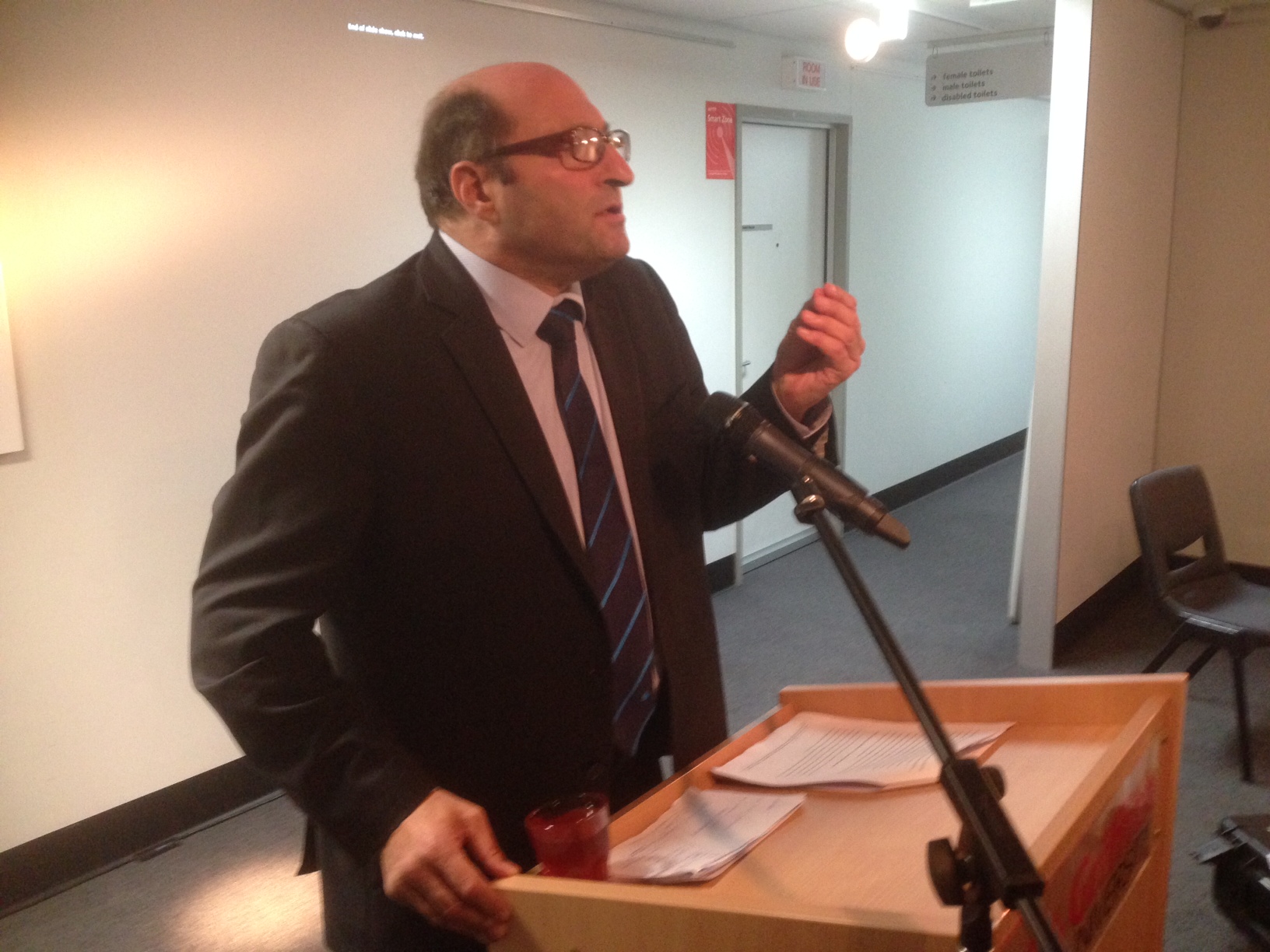
Dr David Goldberg arguing for a responsible media exemption to privacy laws when using drones
Dr Goldberg displayed Air Services Australia regulations for the G20 event, showing the special permissions accredited media need to be able to use aircraft, particularly “civil unmanned aerial systems”.
“Whatever we call these things, the technically correct language of ‘remotely piloted aircraft’ (RPAs) establishes … that they are not unmanned, they are remotely piloted. The fact there is no pink fleshy object in the front doesn’t mean there is no human connection to the object.
“They’re called unmanned but it’s far from unmanned.
“The second is that they are aircraft … and therefore covered by air law and by the aviation regulators.”
He said there were many regulatory issues to be resolved before drones could be used for reporting in an urban environment.
“The use of these gizmos by the media is a protected activity – for the purposes of distribution of information to the public to which it has a right to know. I’m only talking about public interest journalism and make a conceptual distinction from ‘paparazzism’.”
He explained that drones were simply the next stage in the evolution of the camera.
“There is no reason why drones cannot be included as types of cameras. There is a constitutional with a small ‘c’ protection for their use. (I know you don’t have a constitutional right to freedom of the press in Australia.)”
He said he was unconcerned about the issue of privacy.
“We cannot let the privacy freaks, the privacy lobby, drive the discussion of drones,” he said.
He argued the taking of private images had been done for decades. The invention of the Kodak Brownie camera had liberated the image-taking from being a static to a mobile phenomenon and the drone was simply an evolution of that technology.
“It may be that some individuals are more sensitive about their images being taken,” he said.
He quoted from the recent Australian Law Reform Commission report, Serious Invasions of Privacy in the Digital Era, situating the issue of privacy in the area of serious and systemic intrusions into privacy.
He distinguished this from the accidental or incidental capture of images in pursuit of a public interest story.
He noted the ALRC had proposed there should be a defence of ‘responsible journalism’.
He was concerned the aviation regulator might become a censorship body.
“What is the right of appeal to a decision by CASA?” he asked.
“If there is no right of appeal they are turning into a censorship body, and that’s not something CASA might have thought it would be.”
He noted the UK had imposed a ‘no fly zone’ over the Glasgow Commonwealth Games which meant drones could not be legally used.
However, there was the issue of them being used illegally by amateur enthusiasts, or ‘cowboys’.
He suggested drones might contain a microchip for identification purposes to assist with regulation.
——
ABC foreign correspondent Mark Corcoran explains the national broadcaster’s drones program
ABC News remotely piloted aircraft research co-ordinator and symposium panellist Mark Corcoran explained he first imagined the use of drones by the media when he saw their use by the Israeli military in the Gaza in 2006.

Drones symposium panelists (left to right) Mark Corcoran, David Goldberg and Chris Merritt debate the law and ethics of media drone use
He later saw them used by the US military in Afghanistan as a reconnaissance tool to ensure safety before rescuing troops from a dangerous situation.
The advent of the smartphone had generated the boom in the past three or four years, with the ABC making substantial progress in the past year.
He said the technology was cheap and highly effective in certain circumstances.
Their special advantage was to identify exit routes in dangerous reporting situation.
“This sort of technology gives another perspective,” he said. “It’s an occupational health and safety tool and it can keep you alive.”
He said the basic investment in an RPA by the ABC was now a relatively inexpensive $1500 when equipped with a camera.
He said the recent use of a drone to take footage above protesters in Hong Kong would not fall within the ABC’s guidelines for their use and would not meet Australian aviation regulations.
‘We make a choice under our existing policies not to show certain images – even though they are there,” he said.
“We believe the existing laws are adequate. We believe it’s about editorial control and the ABC makes judgments about that every week.”
The ABC was working on its operating procedures. The broadcaster had brought in external operators with CASA approval to fly RPAs.
“We need highly specialist people who not only have operating certificates that are cinematographers as well,” he said.
“There really are only a few in the country and we’ve hired them to do certain jobs.”
Most of the stories where the ABC had used drones to date had been in more of a documentary style – such as on Four Corners, Australian Story and in special outside broadcasts.
“If you can’t get a helicopter it’s fantastic technology. The ABC has a long history in aviation. It is well aware of the risks of aviation. We lost three very good friends in a helicopter crash three years ago. We do get that it’s a complex area,” Corcoran said.
He explained that CASA had flagged they would change the regulations for the sub-2kg commercial operation of RPAs.
Hobbyists could fly a drone in the park without regulatory concern.
“However, if I am a journalist and I want to film an event with that same craft then I need an operating licence,” he said.
CASA had determined it was an acceptable risk to do away with the sub-2kg regulations after doing impact tests.
“This is a bit like being hit by a flying lawnmower. They can do some damage,” he said.
“We’ve put our own regulations around this, we’ve implemented our own trial training regime in anticipation of that change.
“We think this is terrific in a controlled, contained environment.”
He said rural and regional Australia was where the ABC could best realise the potential of the technology.
“At the end of the day this is an aviation activity – it’s not just a flying smartphone,” he said.
—-
Better options than a privacy tort for controlling media use of drones, says legal journalist Merritt
Panellist Chris Merritt – legal affairs editor of The Australian – said the ALRC had not properly examined the question of whether Australia really needed a privacy tort.
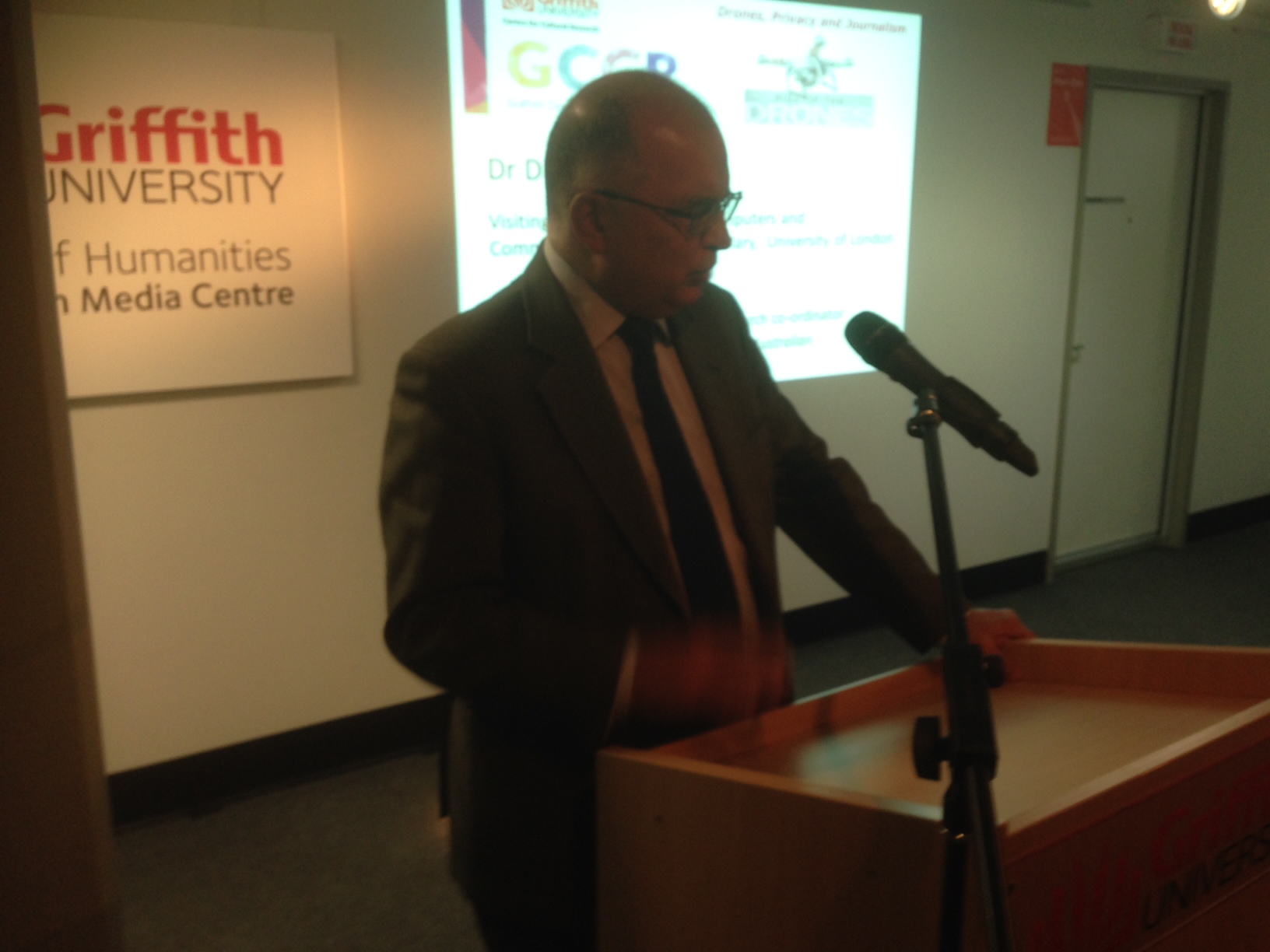
The Australian’s legal affairs editor Chris Merritt cautions against a rush to a tort of invasion of privacy
“Lawyers have a natural disposition to see the formal court process as a way of solving society’s ways,” he said.
But this would not work for the media or the ordinary citizen.
“I’m not saying there should be no remedy
“A better remedy for the potential of invading privacy by these gizmos is to build on what is already there.”
He pointed to media exemptions under the Privacy Act as a model for handling the privacy issues associated with responsible media use of drones.
“The issue’s not going to go away – there are breaches of privacy by the media,” he said.
“When Lord Leveson it became clear to me that this is something that the media can’t ignore. It’s a problem.
“So what’s the remedy? There are abuses of privacy by print media but there are nowhere near as many of them as there are in electronic media.”
He said “tabloid television programs” were the worst offenders, but the federal regulator of these programs does not use the mechanisms that are in place.
“Mainstream print media is not as pure as driven snow. We make mistakes. If we are going to make greater use of these things we need to take control and build on that exemption from the Privacy Act by ensuring mainstream media operators of these things are registered not just in how to operate them but in privacy law to ensure we do not create an opening for our enemies.”
—-
© Mark Pearson 2014
Disclaimer: While I write about media law and ethics, nothing here should be construed as legal advice. I am an academic, not a lawyer. My only advice is that you consult a lawyer before taking any legal risks.




 journlaw
Updated: Privacy in Australia – a timeline from colonial capers to racecourse snooping, possum perving and delving drones
By MARK PEARSON Follow @Journlaw
The interplay between the Australian media and privacy laws has always been a struggle between free expression and the ordinary citizen’s desire for privacy. I have developed this timeline to illustrate that tension.
1827: NSW Chief Justice Francis Forbes rejects Governor Ralph Darling’s proposal for legislation licensing the press, stating: “That the press of this Colony is licentious may be readily admitted; but that does not prove the necessity of altering the laws.” (Historical Records of Australia, Series 1, Vol. 13, pp. 290-297)
The extract from the Sydney Gazette in 1830
1830: The Sydney Gazette and New South Wales Advertiser publishes an extract from London’s New Monthly Magazine on the prying nature of the British press compared with its European counterparts, stating: “The foreign journals never break in upon the privacy of domestic life”. But the London newspapers would hound a ‘lady of fashion’ relentlessly: “They trace her from the breakfast table to the Park, from the Park to the dinner-table, from thence to the Opera or the ball, and from her boudoir to her bed. They trace her every where. She may make as many doubles as a hare, but they are all in vain; it is impossible to escape pursuit.”
1847: NSW becomes the first Australian state to add a ‘public benefit’ element to the defence of truth for libel – essentially adding a privacy requirement to defamation law (ALRC Report 11, p. 117)
1882: First identified use of the phrase ‘right to privacy’ in an Australian newspaper. Commenting on a major libel case, the South Australian Weekly Chronicle (22.4.1882, p.5) states: “A contractor having dealings with the Government or with any public body has no right to privacy as far as those dealings go.”
1890: In a landmark Harvard Law Review article, the great US jurist Samuel D. Warren and future Supreme Court Justice Louis D. Brandeis announce a new ‘right to privacy’ in an article by that very name. There is a ripple effect in Australia with several mentions of the term in articles between 1890-1900.
1937: A radio station used a property owner’s land overlooking a racecourse to build a platform from which it broadcast its call of the horse races. The High Court rules the mere overlooking of the land did not constitute an unlawful interference with the racing club’s use of its property. The decision viewed as a rejection of a common law right to privacy: Victoria Park Racing and Recreation Grounds Co. Ltd v. Taylor (1937) 58 CLR 479.
1948: Universal Declaration of Human Rights is proclaimed in Paris. Article 12 provides: “No one shall be subjected to arbitrary interference with his privacy, family, home or correspondence, nor to attacks upon his honour and reputation. Everyone has the right to the protection of the law against such interference or attacks” (United Nations Universal Declaration of Human Rights, GA. Res 217A(III), UN Doc A/Res/810 (1948).)
1966: The International Covenant on Civil and Political Rights (ICCPR) is proclaimed, protecting privacy at Article 17. (16 December 1966, [1980] ATS 23, entered into force generally on 23 March 1976)
1972: Australia signs the ICCPR.
1979: Australian Law Reform Commission releases its first major report on privacy – Unfair Publication: Defamation and Privacy, ALRC 11. It recommends a person be allowed to sue for damages or an injunction if ‘sensitive private facts’, relating to health, private behaviour, home life, and personal or family relationships, were published about him or her which were likely in all the circumstances to cause distress, annoyance or embarrassment to a person in the position of the individual. Wide defences were proposed allowing publication of personal information if the publication was relevant to the topic of public interest. (pp. 124-125).
1980: Australia ratifies the ICCPR and the Organisation for Economic Co-operation and Development (OECD) expert group led by Australian Justice Michael Kirby issues its Guidelines on the Protection of Privacy and Transborder Flows of Personal Data.
1983: Australian Law Reform Commission releases its Privacy (ALRC Report 22), recommending the establishment of a Privacy Act to establish information privacy principles and the appointment of a Privacy Commissioner.
1984: Australian Journalists’ Association (AJA) revises its 1944 Code of Ethics to include a new clause (9) requiring journalists to “respect private grief and personal privacy and shall have the right to resist compulsion to intrude on them”.
1988: The Privacy Act 1988 is enacted, applying initially only to the protection of personal information in the possession of Australian Government departments and agencies.
1999: Media Entertainment and Arts Alliance (MEAA) issues another revised Code of Ethics preserving the grief and privacy elements in clause 11.
2000: Privacy Act 1988 provisions are extended to larger private sector organisations, and 10 National Privacy Principles (NPPs) are introduced, determining how companies must collect, use and disclose, keep secure, provide access to and correct personal information. Media organisations are exempted from the provisions as long as they ascribe to privacy standards published by their representative bodies.
2001: High Court rejects an argument for a company’s right to privacy after animal liberationists trespass to film the slaughter of possums in a Tasmanian abattoir and someone gives the footage to the ABC, but the court leaves the door open for a possible personal privacy tort: Australian Broadcasting Corporation v. Lenah Game Meats (2001) 208 CLR 199.
2003: A Queensland District Court judge rules the privacy of the former Sunshine Coast mayor Alison Grosse had been invaded by an ex-lover who continued to harass her after their affair had ended. She is awarded $108,000 in damages: Grosse v. Purvis [2003] QDC 151.
2007: Victorian County Court Judge Felicity Hampel SC holds that a rape victim’s privacy was invaded when ABC Radio broadcast her identity in a news report despite state laws banning the identification of sexual assault complainants. She is awarded $110,000 damages: Jane Doe v ABC & Ors [2007] VCC 281.
2008: Australian Law Reform Commission releases its For Your Information: Australian Privacy Law and Practice (ALRC Report 108) recommending a cause of action for breach of privacy where an individual has a ‘reasonable expectation of privacy’, with a cap for non-economic loss of $150,000.
2011: Federal Government releases an Issues Paper floating a proposal for a Commonwealth cause of action for a serious invasion of privacy.
2012
2013
2014
———–
Disclaimer: While I write about media law and ethics, nothing here should be construed as legal advice. I am an academic, not a lawyer. My only advice is that you consult a lawyer before taking any legal risks.
© Mark Pearson 2013/2014
2 Comments
Filed under Privacy, Uncategorized
Tagged as Australian media, blogging, Code of Ethics, defamation, election, fair comment, free expression, honest opinion, journalism, law, mark pearson, MEAA, media, media ethics, media history, media law, political commentary, press freedom, privacy, privacy law, right to privacy, social media law