Category Archives: Uncategorized

‘Dinosaur Wrangler’ sacked from ‘Jurassic Park’: Fair Work Commission upholds dismissal over Facebook abuse

By MARK PEARSON

Australia’s Fair Work Commission  this week (December 10) added to its developing body of social media case law by upholding the sacking of a worker who described himself as a ‘dinosaur wrangler’ at ‘Jurassic Park’.

The latest is cited as:

Cameron Little v. Credit Corp Group Ltd [2013] FWC 9642 (U2013/11522) 10 December 2013. < http://decisions.fwc.gov.au/ >

jurassic

‘Dinosaur Wrangler’ sacked from ‘Jurassic Park’. Photo: Flickr (free to use or share)

C.L. had worked as a customer relationship manager for Credit Corp Group for three years when in June 2013 he used his personal Facebook account to criticise an organisation he dealt with on behalf of his employer (Christians Against Poverty (CAP)) and to make sexually suggestive comments about a new colleague. L. had listed his employment on his Facebook account as a ‘Dinosaur Wrangler’ at ‘Jurassic Park’ but other details on his page made it possible to identify him as an employee of the Credit Corp Group. He dealt with Christians Against Poverty when the not-for-profit group was negotiating new debt arrangements with Credit Corp on behalf of their clients. He posted to their page:

‘For reals bro, you should put a little more of funding into educating consumers on how the world works rather than just weaseling them out of debt, blah blah blah, give a man a fish/teach a man to fish.’

and

‘No thanks, just take my advice and try to educate people about things like ‘interest’ and ‘liability’ rather than just weasel them out of contracts. #simple’

L. posted the following comment about his new work colleague:

 ‘On behalf of all the staff at The Credit Corp Group I would like to welcome our newest victim of butt rape, [colleague’s name]. I’m looking Forward to sexually harassing you behind the stationary cupboard big boy.’

The day after the posts came to the attention of his employer, he was called to a meeting where his employment was terminated. Two weeks later he filed a claim for unfair dismissal.

Fair Work Commission Deputy President Peter Sams ruled the dismissal had been fair, pointing to the following relevant factors:

  • L. had been issued with the Employee Handbook and the Employee Code of Conduct and made aware of their contents.
  • He had attended an induction at the commencement of his employment in 2010 and a ‘Working Together’ module in August 2012.
  • His employment contract stated that the company’s policies and procedures were directions from the employer to the employee.
  • He had the ability to access and change the privacy settings for his account.
  • It was irrelevant that L. had created the social media posts out of work hours.
  • It was implausible that L. believed his Facebook page was ‘private’ and he did not understand how Facebook worked.
  • He had been formally warned about an earlier incident where he had posted an inappropriate comment to a website.

The decision affirmed earlier Fair Work decisions in the Good Guys case (2011) and the Linfox case (2012). Those in the position of employer need to ensure all staff are fully aware of – and trained in – your organisation’s social media policy and that it is fair and up to date. Employees need to keep abreast of their organisation’s social media policy and ensure their social media accounts are set to private and that they do not post material related in any way to their work – and certainly not anything that is discriminatory or critical of colleagues, management or clients. This applies both during work hours and when off duty.

Co-author Mark Polden and I will be using this as a Key Case in a new chapter on Law for PR, Freelancers and New Media Entrepreneurs in our forthcoming fifth edition of The Journalist’s Guide to Media Law (Allen & Unwin, 2014), due for release mid-year.

© Mark Pearson 2013

Disclaimer: While I write about media law and ethics, nothing here should be construed as legal advice. I am an academic, not a lawyer. My only advice is that you consult a lawyer before taking any legal risks.

Leave a comment

Filed under Media regulation, Uncategorized

Beware the co-regulators … key bodies wielding power over publishers

By MARK PEARSON

Several self-regulatory and co-regulatory bodies hold powers that can impinge on the work of journalists, PR consultants and new media entrepreneurs. They include:

  • The Australian Communications and Media Authority (ACMA). < http://www.acma.gov.au/ > The broadcast regulator’s powers can impact upon public relations consultants, freelancers and new media entrepreneurs in a range of ways. PR consultants need to ensure their audio packages and video news releases (VNRs) comply with the code of conduct and classification requirements of the particular broadcast media they are targeting (community, commercial radio, pay television etc). The ACMA also administers the national Do Not Call Register where citizens withdraw their phone numbers from telemarketing dial-ups. It also polices the Spam Act 2003 – the legislation ensuring you can unsubscribe from junk mail posts to your email, mobile phone and messaging services. It is important public relations consultants and new media startups work within the bounds of this legislation or they could face heavy fines. For example, in 2013 Cellarmaster Wines received a $110,000 infringement notice from the ACMA for sending marketing messages in breach of the Spam Act. Some of the messages were sent without an opt-out choice, while others were sent to customers who had earlier selected to opt out of the company’s email promotions (ACMA, 2013).
  • The Classification Board. < http://www.classification.gov.au/About/Pages/Classification-Board.aspx >. This is a unified system of classification of films, video games and some publications, established under the Classification Act 1995. Public relations consultants and new media entrepreneurs need to be aware of its requirements because almost all films and computer games have to be classified before they are legally permitted to be made available. The Board decides which of the classifications such as violence, sex, language, themes, drug use and nudity should apply. The Board also classifies material submitted by the police, Customs and the ACMA including internet sites, imported publications, films and computer games.
  • Advertising Standards Bureau (ASB). <http://www.adstandards.com.auThe Advertising Standards Bureau administers a national system of advertising self-regulation through the Advertising Standards Board and the Advertising Claims Board.  The ASB handles consumer complaints about advertisements across a range of media. For example, a complaint about the Facebook page for the beer Victoria Bitter in 2012 was upheld on the grounds that people had posted comments to the social networking site that were in breach of advertising standards. They included coarse language, sexual references and comments demeaning of women and homosexual people. Comments on the page were managed by an agency under the supervision of the Carlton and United Breweries marketing team which agreed to improve its frequency and effectiveness of comment moderation after the decision (ASB, 2012) [pdf file].
  • Therapeutic Goods Administration (TGA). < http://www.tga.gov.au/ > The TGA is a Commonwealth Government agency with the power to regulate therapeutic goods (medicines, medical devices and blood products). Some advertisements directed at consumers require approval before they can be broadcast or published while advertising prescription-only and some pharmacist-only medicines to the general public is prohibited. The term ‘advertisement is defined broadly in the Therapeutic Goods Act 1989 to include “any statement, pictorial representation or design, however made, that is intended, whether directly or indirectly, to promote the use or supply of the goods”. This can cover public relations material and advertorials so freelance health writers and public relations consultants to pharmaceutical companies need to be well versed in its requirements and restrictions.
  • Australian Securities and Investments Commission (ASIC). < http://asic.gov.au/ >. ASIC is an independent Commonwealth entity operating as Australia’s corporate, markets and financial services regulator. Its role is to ensure Australia’s financial markets are fair and transparent, supported by confident and informed investors and consumers. It is set up under the Australian Securities and Investments Commission Act 2001 (ASIC Act), and enforces large sections of the Corporations Act. Public relations consultants, freelance financial reporters and new media entrepreneurs need to be especially cautious about its restrictions on ‘rumourtrage’ – the spreading of false or misleading rumours about a company’s float or performance  which are associated with market manipulation – and its policing of the powers and duties of company directors. It also has tough requirements that advertisements for financial products do not mislead. For example, in August 2013 ASIC investigated advertisements for a 1% interest discount on a specified home loan package offered by Credit Union Australia Limited (CUA), run on television, in cinemas, on the company’s website and on public transport in major cities. However, it had not specified some of the terms and conditions of the discount in its ads. ASIC accepted ‘enforceable undertakings’ from CUA that it would honour the discount to all customers on the package as an alternative to court action (ASIC, 2013).

© Mark Pearson 2013

Disclaimer: While I write about media law and ethics, nothing here should be construed as legal advice. I am an academic, not a lawyer. My only advice is that you consult a lawyer before taking any legal risks.

Leave a comment

Filed under Media regulation, Uncategorized

The man without a name to get one – a small victory for open justice

By MARK PEARSON

We have won a small victory for open justice by persuading the NSW Mental Health Tribunal to allow the Australian Broadcasting Corporation to use the name of a forensic patient in a Background Briefing program on Radio National next year.

**Update: Tom Morton’s radio documentary ‘The man without a name’ was aired on Radio National Background Briefing on April 20, 2014 and can be heard (and transcript read) here.

We later applied to the Mental Health Review Tribunal for permission to name the patient in our scholarly publications, including this research blog. The Tribunal granted that permission on May 9, 2014 after a hearing to consider our application on 20 March 2014.

We can now reveal that the patient is Mr Saeed Sayaf Dezfouli.

This publication is conditional upon this publication carrying this notice:

“Notice: It is an offence under the Mental Health Act 2007 (NSW) section 162 to publish or broadcast the name of any person to whom a matter before the Mental Health Review Tribunal relates or who appears as a witness before the Tribunal in any proceedings or who is mentioned or otherwise involved in any proceedings under the Mental Health Act 2007 or the Mental Health (Forensic Provisions) Act 1990, unless consent has first been obtained from the Tribunal. The author has obtained such consent to publish Mr Dezfouli’s name.”

MORTON

Dr Tom Morton

[Earlier blog continued … ] Colleague Associate Professor Tom Morton from the University of Technology Sydney and I have been conducting an applied research project about publicity of mental health proceedings – centred upon the case of a Sydney patient who wishes to be identified in reportage on his situation.

We are presenting a progress report on our study at the Journalism Education Association of Australia annual conference in Mooloolaba, Queensland today (December 4, 2013).

Dr Morton is an accomplished radio journalist and has started work on the documentary to be aired in coming months. We are collaborating on the academic side of the project – using my research into mental health reporting and logging our ethical decision-making to create a documented mindful reflection on the project.

Dr Morton briefed ABC lawyer Hugh Bennett who presented our case for the identification of Patient A when we appeared before the Mental Health Tribunal in September.

Section 162 Mental Health Act (NSW) bans ID of anyone involved in either tribunal or forensic proceedings, with further requirements under the Mental Health (Forensic Provisions) Act. A breach can incur a fine of $5500 or a 12 month jail term.

A Supreme Court application for the identification of Patient A had failed in 2012 on technical grounds (A v Mental Health Review Tribunal (2012) NSWSC293).

The Tribunal’s consent to the identification of Patient A appears to be limited to the broadcast, so I am not naming him here.

Patient A is an Iranian refugee who until 2002 was employed at a government office in Sydney.

In 2002 he set fire to that building and a co-worker died of smoke inhalation.

In 2003 the Supreme Court of NSW found that Patient A was unfit to be tried for murder, and a jury subsequently found him not guilty of manslaughter by reason of mental illness. He is thus deemed a ‘forensic patient’ – a person whose health condition has led them to commit, or be suspected of, a criminal offence’ (AIHW, 2010, p. 140).

I have previously published compared the complex array of mental health reporting restrictions in Australia and New Zealand. (See here.)

Last year I compared three cases in WA, Victoria and the UK involving the identification of mental health patients. The case of Patient A has strong parallels with the Albert Lazlo Haines [pdf] case in the UK where a patient won an appeal to be named in reportage of his review proceedings.

This Australian case adds to that body of literature and is interesting from that media law perspective. It also interests us from an ethical perspective, and we will be using it as the focus for an exploration of the application of the principles of ‘mindful journalism’ I have described previously.

We plan to write an academic article on this process to date (the events leading to this Tribunal decision), followed by a research journalism output including an exegesis on mindful journalism ethics after Dr Morton’s Background Briefing documentary has been broadcast. Stay tuned.

———–

Disclaimer: While I write about media law and ethics, nothing here should be construed as legal advice. I am an academic, not a lawyer. My only advice is that you consult a lawyer before taking any legal risks.

© Mark Pearson 2013

3 Comments

Filed under blogging, Buddhism, citizen journalism, Eightfold Path, free expression, media ethics, mental health, social media, Uncategorized

Student news blogs lead the way in citizen journalism

Colleague Mic Smith and I were delighted with the standard of the news blogs created by our students in the capstone subject Online News Production in the semester just finished.

Mic is an accomplished blogger (see his project Mic Smith Geographic).

We gave students the option to work as individuals, pairs or teams and you can see the variety of their topics and approaches in this blogroll of their best work.

It offers hope that these talented young people can carve out a career despite the shrinking opportunities in mainstream media. Enjoy!


The Rural Yarns blog ... best overall

The Rural Yarns blog … best overall

Ruralyarns
Winner of Best Mental Health Story – ‘On rural issues with social media’ by Gavin Coote.
Winner of Best News Story – ‘The Great Beef Divide’ by Guy Creighton.
‘Ruralyarns’ covers news from around rural SEQ/NENSW.

Eyes on Lilley
Winner of Best Political Blog – Eyes on Lilley by Clarissa Carden.
‘Eyes on Lilley’ looks at the electorate of Lilley and looks at the issues during the electoral campaign.

Living Gold Coast
Winner of Best Multicultural Blog – LivingGC by Maddison Johnstone and Steph Kent.
‘Living Gold Coast’ is an online news source is independently-run and is aimed at the Chinese population on the Gold Coast, whether touring or residing.

Brookfield and Beyond
‘Brookfield and Beyond’ looks at Brookfield, Pullenvale and Moggil, which are all suburbs that possess a certain country town vibe, which continues to provide a healthy musical culture in the area.

Parental Guidance
‘Parental Guidance’ is a blog which consists of all things family related in the south-east Brisbane/Logan area, including local family events, parenting courses and activities

Savvy, Willing & Able
Winner of Best Mental Health Blog – Savvy, Willing & Able by Kathryn Stumpf.
‘Savvy, Willing & Able’ is a blog for Australians experiencing mental illness, and for those who love us and want to learn more.

Technology in Real Life
Winner of Best Technology Blog (Nathan) – Technology in Real Life by Dan Smith.
A technology blog with news, reviews, and how technology and life intersect.

Degag
Winner of Best International Online Story – ‘When relationship and money talks’ by Nannaphat Sritakoonrut.
Winner of Best International Student Blog – Degag by Kan Jiang, Milani Mudannayake, Hauwa Yahaya Sani, Yina Zhang and Nannaphat Sritakoonrut
Winner of Best Visual in a Blog – ‘Photo of a gagged woman’ by Nannaphat Sritakoonrut.
‘Degag’ seeks to examine the current state of media censorship internationally. ‘Degag’ shall focus primarily on the state of media censorship in China, Nigeria, Thailand, Singapore and the United States.

Kanjiang2
‘Kanjiang2′ is a lifestyle blog, living and discovering elsewhere through foreigner’s eyes.

Music Industry on the Inside
Winner of Best Music Blog – Music Industry on the Inside by De-anne Whelan.
‘Music Industry on the Inside’ will find news and articles on the Business and Art of the Music Industry. From big name artists to Indie favorites and fresh new faces, as well as content on the inside of the business.

Unsuppress
A blog looking at censorship issues in and outside of Australia.

Australia’s Refugee Policy: PNG Solution
An insight into issues surrounding the PNG solution presented by the Australian government.

Basically Brisbane
Basically Brisbane is a blog about culture and its influence on the city of Brisbane, A combination of photographs, news stories, and various other media, our blog attempts to focus on the human experience of culture within the city.

Game On
Winner of Best Investigative Story – 
‘Under the influence of dopes’ – by Matt Hardie.
Winner of Best Sports Blog – Game on Brisbane by Denis Boca, Matt Hardie, Phillip Harsant and Benjamin Scott.
A sports blog about sport and Australia.

Gen-Y + Wear
GEN-Y+WEAR is a fashion blog that enters the lives of Brisbane’s young fashion community. The inspiration that lies behind this blog is the risqué fashion choices of those known as Generation Y.

Photojournwatch
PHOTOJOURNWATCH is a blog about photographers, photojournalist and documentary photographers alike. It is a source of information and news about photographers working in this field, their work and current exhibitions and the struggles of working in the industry.

Something Blue Destinations
Winner of Best Online Disability Story – ‘Brisbane hotels neglect disability needs’ by Arna-Leah Bullivant.
This blog is about weddings and surrounding topics in Australia and overseas.

VAST News
Winner of Best Online Investigative Story (GC
) – ‘Hendra vaccine: virus protection’ by Natasha Borg.
This blog covers a wide range of journalism and current topics throughout the world.

The Election Connection
Winner of Best Audio in a Blog – ‘Young Voices are Missing’ by Chloe Pickard.
Winner of Best Blog Feature – ‘High Speed Rail Future Uncertain’ by John Ray.
Winner of Best Political Story – ‘Young Voices are Missing’ by Chloe Pickard.
This blog will act as a valuable resource for people starting to take an interest in politics or wanting to know how politics affect them.

Pine Rivers Time
Winner of Best Community Journalism – Pine River Times by Chris McMahon.
The Pine Rivers Times is a news features blog that is centering on news that affects the Pine Rivers region.

Queensland Next Generation
Winner of Best Community Journalism (GC Campus) – QLD Next Generation by Shirley Bredenkamp.
This blog addresses the issue of the decreasing Show participation of the younger generation and the ‘Next Generation’ movement towards improving these numbers in South East Queensland.

Y Health Matters
Winner of Best Current Affairs Story – ‘Synthetic drugs and background’ by Mala Mistry.
Winner of Best Health Blog – Y Health Matters by Caitlin McArthur, Mala Mistry and Jordanna Tucker.
Winner of Best Online Indigenous Story – ‘Australian Indigenous Students Aim High’ by Caitlin McArthur.
Winner of Most Creative Video – ‘It’s not just about Equality’  by Jordanna Tucker.
Winner of Best Team News Blog – Y Health Matters by Mala Mistry, Jordanna Tucker and Caitlin McArthur.
This blog looks at generation Y and its health and how to know about all health related issues.

Blog-Her
Winner of Best International Online Story (GC) – ‘UN urges Indonesia to stop performing FGM’ by Alexandra Sheehy.
Winner of Best Multimedia Coverage of an Event – ‘Swell Sculpture Festival has biggest year’ by Tiara Swain.
Winner of Best News Blog (GC) – Blog-Her by Alexandra Sheehy and Tiara Swain.
Gold Coast journalists delivering local, national and international news on topics and issues of interest to women worldwide.

The Twinternet
Winner of Best Lifestyle Blog – The Twinternet by Tristan Lal.
The Twinternet is to provide a virtual arena for recent news, basic information, and feature stories about twins and multiple births.

Kieren Bond
Winner of Best Mental Health Story (GC) – ‘Elucidating eating disorders and the journeys to recovery’by Kieren Bond.
A blog on eating disorders and the road to recovery.

Arts in Swing
Winner of Best Political Blog (GC) – Arts in Swing by Beau Gosney.
This blog covers news and opinion in relation to Australian arts and politics.

Why So Serious News
Winner of Best Popular Culture Blog – Why So Serious News by Lewis Warner and Rhys Woosnam.
Australian-based news blog devoted to debunking social myths and misconceptions.

Needle on the Pulse
Winner of Best Popular Culture Blog (Nathan) – Needle on the Pulse by Ben Pratt.
Needle on the pulse: a blog for the record community of Brisbane, with information, interviews and reviews from record fairs, record stores and record events.

The Social Effect
Winner of Best Use of Social Media – ‘Journalism – where does it stand in the digital world?’ by Melanie Richards.
Winner of Best Media Blog – The Social Effect by Melanie Richards and Richard Nguon.
A blog focusing on the effects of social media on society.

The Fencesitter Manifesto
Winner of Most Creative Video (Nathan) – ‘The Fence Files’ by Matt Innes.
A blog looking at Australian politics and current events from the point-of-view of those with no point-of-view.

Sekend Chance
Winner of Best Social Issues Blog – Sekend Chances Blog by Samantha Leeson and Rhiannon Smith.
The aim of the blog is to create links between people with convictions and the community.

GC Fit
Winner of Best Sports Blog (GC) – GC Fit by Roxann Grover, Shannen Kiely, Shae Killey, Chloe Patterson and Matilda Revere.
This blog providing news and tips on health, fitness and food.

Surf or Stack
Winner of Best Blog Graphics – Surf or Stack by Brett Loccisano.
Surf or Stack is a unique space that compares the rural mining town of Mount Isa with the thriving coastal city of the Gold Coast.

Kent Street Style
Winner of Best Fashion or Beauty Blog – Kent Street Style by Lucinda Kent.
Kent Street is dedicated to comprehensive coverage of issues facing the Australian fashion industry including interviews from designers, stylists, photographers, and buyers.

Terri Talks Beauty
Winner of Best Fashion or Beauty Blog (GC) – Beauty and a Blog: Terri Talks Beauty by Terri Hayward.
This blogs includes, a video interview with make-up artist, Ashton Wood and a story on YouTube blogging with various bloggers around Australia.

The Otaku’s Study
Winner of Best Technology Blog – The Otaku’s Study by Sam Worboys.
The main goal of The Otaku’s Study is to help promote companies and their releases to the public through regular news articles, along with helping everyone who reads the site to hopefully make informed decisions in what they should purchase in respect to the quality of the products.

The Animal Agenda
Winner of Best Online Animal Rights Story – ‘The Forgotten Animals’ by Laura Thornton.
Animal Agena is a place for animal lovers to come for the latest, local animal news and events.

The Source News
News written by Griffith University students. Curated by Claire D’hooghe, Cassandra McDonald and Emma Rayward.

Well done all!

1 Comment

Filed under Uncategorized

Election postscript: a mindful analysis of media coverage

By MARK PEARSON

[This blog was first published in the St James Ethics Centre’s Living Ethics newsletter, Issue 93, Spring 2013. See here.]

Australian journalists operate under an array of ethical guidelines, including the MEAA Code of Ethics and numerous employer and industry codes of practice.

hogansWhile these documents differ widely in their wording, they espouse common values of truth, accuracy, fairness and the public’s right to information. They disapprove of invasions of privacy, disclosure of confidential sources, discriminatory language, subterfuge, deception, plagiarism and conflicts of interest.

When it comes to assessing the ethics of news coverage of an event as broad in scope as a federal election we find some guidance in such codes but other moral frameworks can add value.

Although I am not a Buddhist, I have recently found value in applying some of that religion’s foundational principles – in a secular way – to the assessment of journalism ethics and have been sharing this approach with colleagues and students through my writing and teaching.

It is also a useful lens through which to review some key elements in media coverage of the 2013 federal election.

The approach centres on the belief that journalists can adopt a mindful approach to their news and commentary which requires a reflection upon the implications of their truth-seeking and truth-telling as a routine part of the process. It calls upon them pause and think carefully about the consequences of their reportage and commentary for the stakeholders involved, including their sources and their audiences.

Truth-seeking and truth-telling are still the primary goal, but only after gauging the resulting social good or harm.

Each of the constituent steps of Buddhism’s Eightfold Path – understanding free of superstition, kindly and truthful speech, right conduct, doing no harm, perseverance, mindfulness and contemplation – provides a framework for such analysis.

Space prohibits the examination of all of them here, but at least three issues arose in the election worthy of such reflection.

  1. Fact checking. The Buddhist notion of ‘right views’ focuses on a deeper explanation of root causes and the clinical testing of claims. The emergence of the ‘fact checker’ was a welcome development via Politifact Australia, the ABC’s Fact Checking Unit and The Conversation’s Election FactCheck. A longer term impact of such a tool might be that politicians are prompted to think twice before issuing scaremongering and outlandish statements.
  2. The News Corp anti-Labor campaign. The principle of ‘right intent’ calls upon us to reflect upon the genuine motivations for Rupert Murdoch’s Australian newspapers adopting such a blatant and belittling attack on the incumbent government. Cynical mock-ups like the Daily Telegraph’s ‘Hogan’s Heroes’ and the Courier Mail’s ‘Send in the Clown’ front pages might be excused as tabloid fun but they hardly indicate ‘right intent’ and ‘right speech’ in the Buddhist moral framework. The motivation could surely not have been to gain circulation, given the fact that the coverage stood to alienate perhaps one third of readers. It will be fascinating to see at the next audit whether this stance accelerated the decline of those newspapers’ circulations. If the intent was to win influence with the likely government, then this should have been disclosed.
  3. Presidential-style coverage. Just because political parties choose to run a presidential style of campaign does not oblige news organisations to embrace it. The Buddhist principle of ‘right effort’ invokes a steady, patient and purposeful path and ‘right mindfulness’ demands a considered and reflective approach to reportage. Each of these is difficult when reporters are assigned to traipse around the nation and cover political leaders engaging in stage-managed, superficial appearances at factories, schools and sausage sizzles. It is belittling to the enterprise of journalism to see some of its leading lights – and notable watchdogs – being led by the leash as mere lapdogs. It was particularly noticeable in a campaign where neither leader made a notable gaffe. We are left to imagine what might have been revealed if only these political journalism superstars had been afforded the time to do some real digging. Sometimes being ethical demands us to say ‘no’ to an under-utilisation our talents, which was clearly the case here.

livingethicscoverThe ultimate test of ethical political reporting in a democracy is the extent to which that journalism best informs the citizenry to maximize the value of each and every vote. In that respect, Australian journalism still has much to learn.

———–

Disclaimer: While I write about media law and ethics, nothing here should be construed as legal advice. I am an academic, not a lawyer. My only advice is that you consult a lawyer before taking any legal risks.

© Mark Pearson 2013

2 Comments

Filed under blogging, Buddhism, citizen journalism, Eightfold Path, free expression, media ethics, social media, Uncategorized

Timor-Leste journalists decide on ethics code and press council as tougher laws loom

By MARK PEARSON Follow @Journlaw

AN historic congress of Timor-Leste journalists held in Dili over the weekend (October 25-27) voted for their first code of ethics and a seven-member press council.

But the next hurdle for media freedom in the small Asia-Pacific nation will be a press law currently before the national parliament which it is feared will feature a journalist licensing system and criminal penalties.

20131027-201852.jpg

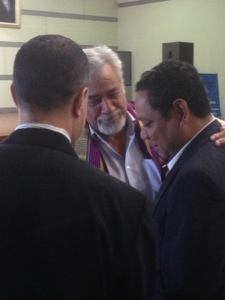
Timor-Leste PM Xanana Gusmao greets officials at the national journalists’ congress on Friday. Photo © Mark Pearson 2013

The media law proposed by a committee of journalists advising the government featured self-regulatory controls. However, the final version includes amendments proposed by the Secretary of State for Social Communication, Mr Nélio Isaac Sarmento, rumoured to include the licensing and criminal sanctions.

Opening the congress on Friday, Prime Minister Xanana Gusmao scolded journalists for not having developed adequate self-regulation when he had warned them to do so in 2009.

But he congratulated the media associations on their latest efforts to unify for a code of ethics and press council; stating that press freedom was important to democracy, but that freedom should be exercised responsibly.

More than 150 journalists in attendance on Sunday – representing several journalism associations – voted for the 10 point code of ethics, featuring a preamble affirming the importance of free expression and media self-regulation and clauses on: accuracy and impartiality, opposition to censorship, defence of the public interest, anti-discrimination, separation of fact from opinion, confidentiality of sources, quick correction of inaccuracies, rejection of plagiarism, protection of identity of victims, and rejection of financial inducements.

That final clause will present major challenges for Timor-Leste journalists, many of who freely admit to accepting payments from politicians for positive coverage.

Media sources say reporters are often paid US$5-20 at press conferences and up to US$40 by officials when accompanying ministers on tours to the provinces.

Such payments represent a substantial influence, given media outlets only pay their reporters about US$140 per month plus lunch and travel expenses.

Other problems facing the industry are a lack of training, a dependence on government advertising and the endemic drift of journalists to public service positions when they become available. This leaves editors and news directors with newsrooms staffed by inexperienced personnel.

The congress was funded by the European Union’s 1 million euro Media Support Program, co-ordinated by Portugal.

Foreign experts sharing their own countries’ experiences with self-regulation included the chairman of the Indonesian Alliance of Independent Journalists (AJI) Eko Maryadi, Christiana Chelsia Chan from the Press Council of Indonesia, Portuguese journalism academics Joaquim Fidalgo and Carlos Camponez, and @journlaw (Mark Pearson, Professor of Journalism and Social Media, Griffith University, Australia). [See a summary of my speech in my earlier post].

© Mark Pearson 2013

Disclaimer: While I write about media law and ethics, nothing here should be construed as legal advice. I am an academic, not a lawyer. My only advice is that you consult a lawyer before taking any legal risks.

Lopes

Under-resourced … the director of the Jornal Independente, Mouzinho Lopes de Araujo, in his Dili office. Photo © Mark Pearson 2013

20131027-201915.jpg

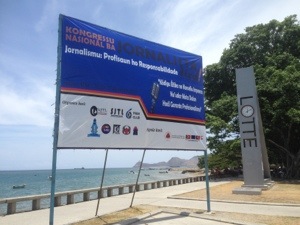
A port-side banner in Dili advertising the congress. Photo © Mark Pearson 2013

20131027-201941.jpg

Timor-Leste Prime Minister Xanana Gusmao addresses the journalism congress. Photo © Mark Pearson 2013

20131027-202001.jpg

Timor-Leste journalists vote on their ethical code. Photo © Mark Pearson 2013

20131027-202020.jpg

Media freedom – blooming amidst the razor wire. Photo © Mark Pearson 2013

20131027-202039.jpg

Leaders of some of Timor-Leste’s many journalism associations preside over the congress. Photo © Mark Pearson 2013

20131027-202057.jpg

Education and training … crucial to the strength of the media in Timor-Leste. Photo © Mark Pearson 2013

1 Comment

Filed under Uncategorized

Images from Timor Leste

About 300 Timorese journalists have decided on a code of ethics after a three day national congress in Dili.
Here are some photos.
I will post more details later.

20131027-201852.jpg

20131027-201915.jpg

20131027-201941.jpg

20131027-202001.jpg

20131027-202020.jpg

20131027-202039.jpg

20131027-202057.jpg

Leave a comment

Filed under Uncategorized

Speech in Timor Leste – top ten media regulation lessons from Australia

By MARK PEARSON

I’ve arrived in Dili, Timor Leste, to deliver an address tomorrow (Friday, October 25) to this small nation’s National Congress of Journalists. The congress is working towards introducing a new code of ethics and a press council. Here is a preview of some highlights from my speech…

Dili, Timor Leste. (Credit: Google free use search / Flickr)

Dili, Timor Leste. (Google free use / Flickr)

Firstly I wish to thank the organisers and sponsors for allowing me the privilege of being here for this important congress. I also wish to formally pay my respects to the six journalists who were killed here in 1975 – including three Australians – and the countless Timorese people who have over decades paid a high price for daring to seek and tell the truth.

As journalists and editors you are so often in competition for your stories and for your audiences that it is a rare treat to see you gather as a professional group in a spirit of collaboration to progress the elevation of ethical standards through self-regulation.

…As a developed western democracy Australia drew heavily upon British and US traditions of politics and government, resulting in a relatively high level of free expression by international standards. It usually ranks in the top 30 countries of the world in the various media freedom indices such as those issued by Reporters Without Borders in Paris and Freedom House in New York.

But Australia is certainly not a shining light of media freedom. In at least two important ways Australia actually has lessons to learn from Timor Leste. One is that, unlike most democracies, the Australian Constitution makes no reference to freedom of expression or a free press. This distinguishes it from Timor Leste, where your Constitution goes to some length to spell out the freedom of speech and information at section 40 and the freedom of the press and mass media at section 41. A second important indicator is that Australia still has criminal defamation on the books in most states. This is a law abused by governments internationally throughout history, and Timor Leste should be applauded for removing it in 2009.

… Two major inquiries into the Australian news media in 2011 and 2012, followed by the Australian government’s attempts to introduce legislative reforms in 2013, prompted a necessary debate over the extent to which rapidly converging and globalised news businesses and platforms require statutory regulation at a national level. Four regulatory models emerged – a News Media Council backed by recourse to the contempt powers of courts; a super self-regulatory body with legislative incentives to join; a federal government proposal for a new Public Interest Media Advocate with control over the self-regulators; and the status quo with a strengthened Australian Press Council policing both print and online media.

… There are several ways journalists in other countries considering regulatory models can learn from this recent experience in Australia.

  1. Comparisons can be dangerous. Even in a democracy with a long history of relatively free expression politicians and governments will seek out and seize any opportunity to regulate the media. International comparisons can be dangerous because we operate within different political and cultural frameworks. When they were arguing for their media reforms, both Communications Minister Stephen Conroy and Prime Minister Julia Gillard cited RSF’s World Press Freedom Index, using the argument that Finland remained in number one position there despite having a statutory mechanism for its press regulation. They failed to mention that Finland also has a section in its Constitution guaranteeing free expression and the free flow of information so all laws are formed and applied against that backdrop. It also lacks the Australia’s hundreds of other media laws that impact on free expression, which place it at number 26 on that same Index. Australia languishes there partly because of the very threats to media freedom posed by these recent inquiries.
  2. Beware regulation creep. Existing laws such as defamation and contempt that apply to all citizens go a long way towards controlling media behavior. I have seen few serious ethical breaches that could not be handled by existing laws. Once media laws have been introduced it is hard to claw back eroded freedoms. Australia passed more than 50 new anti-terror laws after the September 2001 attacks on the US – many impacting on the media – and few of those have been wound back (Ewart et. al, 2013).
  3. Don’t trade press freedom. Well meaning journalists and academics are sometimes willing to sacrifice media freedom because of the misbehavior of some media personnel. Several academics and small publishers stepped up to give the Finkelstein model their approval and a leading journalism educator helped draft it (Conversation, 2012). When you offer governments new powers to control the misbehaviour of some elements in the media you need to accept that those same powers might be used against you at some later stage.
  4. Beware de facto licensing. There is the temptation to issue journalists with accreditation and registration in actual or de facto licensing schemes. The narrow defining of journalists and journalism by governments presents a real danger to free expression because it privileges some citizens over others as communicators. This gives those issuing and revoking such licenses influence over the message itself. It is even less appropriate in a new era of blogging and social media because the nature of news and journalism is even harder to define. Citizens might become reporters temporarily because of the scale of an event or issue or on an ongoing basis in a narrow field of interest that might momentarily become of broader public interest. It is inappropriate that they should have to seek registration or licensing as a journalist or that they should be punished for reporting without such official licence. Rather, their words or actions should be subject only to the communication limitations placed on all citizens, and in a working democracy they should be limited to only extreme breaches
  5. Look to the ultimate sanction. The best test when trying to gauge the potential impact of new media regulations is not the assurances of their proponents that they will be used only rarely and only in extreme cases. The real test is to look at the ultimate sanctions available and if these involve the potential jailing or fining of journalists then they are anathema to press freedom in a democracy.
  6. Media freedom is above politics. This was certainly a long overdue debate in Australia, but it was politicised from the outset which undermined the likelihood of the implementation of any of the proposals. Labor and Greens applauded it and pushed for its enactment, having demanded such an inquiry in the midst of the News of the World scandal in the UK and continued adverse coverage about them in News Limited publications locally (Kitney et.al, 2012). A basic human right like free expression are above politics, yet most governments will strive to limit it.
  7. Media freedom is above commercial interest. Opponents of media regulation need to be careful they are not being seen as simply protecting their own commercial enterprises. Criticism of the recommendations by the larger Australian media groups on free expression grounds – particularly by Murdoch executives – were dismissed as a defence of their vested interests (Meade and Canning, 2012). Such pigeon-holing of all advocates of media freedom and critics of regulation proposals is misplaced. It helps to recruit other senior intellectuals in defence of media freedom – including academics, business leaders and other public intellectuals.
  8. Look to carrots instead of sticks. The Convergence Review’s suggestion that some existing media exemptions to certain laws (particularly consumer law) might be linked to their membership of a media council is worth exploring because it avoids introducing new sanctions on the media. However, these must be carefully scrutinised to ensure they are not stemming the free flow of information or establishing a de facto licensing system.
  9. Adopt a universal ethics code. A uniform code of practice across all news media is a vital. It is in journalists’ best interests that they have one, because it is these very ethical standards that distinguish them from the many new voices seeking audiences in the new media environment. Australia has far too many self-regulatory and co-regulatory documents guiding ethical standards of journalists and their outlets.
  10. Training and education in law and ethics is crucial. Media outlets need to be more pro-active in developing better in-house processes for assessing ethical decisions and in explaining those decisions to their audiences. All reforms will, of course, need to be supplemented with better training of journalists about their rights and responsibilities and broader education of ordinary citizens to raise their understanding of the important role of the media in a democracy.

Nowhere in the world has there ever been unshackled free speech or a free media. Media regulatory systems and ethical frameworks are on the agenda in many countries, and we are challenged to accommodate free expression and its close relative press freedom within new technological and cultural contexts.

Some countries justify their stricter regulation of the press, and limitations of media freedom, on religious, cultural or economic grounds. There has been an ongoing debate about the lack of press freedom in the Asia-Pacific region. China, Vietnam, Malaysia, Singapore, Brunei, Fiji and some others have state licensing systems in place for their media.

The argument by governments in such countries is that the economy and political system are too fragile to allow freedom of the press. The reality is that freedom of the press is too fragile to allow governments to limit it. Censorship can only shackle democracy which is itself dependent upon the free flow of information and opinion to inform the voting citizen.

Too often journalists and academics get so caught up in devising new ethical codes that they start to invite governments into the control of sanctions for their breach. But the moment we let governments get involved we rarely have self-regulation. We then have what are commonly known as ‘laws’ – legislated by governments and enforced by the courts – and that is called regulation. The most important lesson from Australia is that it is all too easy to give away basic liberties in our pursuit of recalcitrant colleagues and in our scramble for public acknowledgment of the status of journalism as a profession.

© Mark Pearson 2013

Disclaimer: While I write about media law and ethics, nothing here should be construed as legal advice. I am an academic, not a lawyer. My only advice is that you consult a lawyer before taking any legal risks.

2 Comments

Filed under death penalty, Media freedom, Media regulation, Press freedom, Uncategorized

Ten minutes with @journlaw – Dr Joseph Fernandez (@DrJM_Fernandez) discusses his new book

By MARK PEARSON

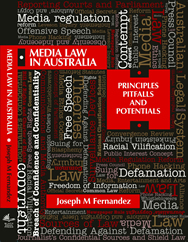
fernandez coverRespected colleague Dr Joseph Fernandez (head of journalism at Curtin University) has just published an impressive addition to the scholarship of journalism law.

In Media Law in Australia – Principles, Pitfalls and Potentials (Black Swan Press, 2013), Fernandez offers a comprehensive and meticulously referenced coverage of the territory – at 372 pages and something more than 275,000 words.

The book’s 12 chapters cover freedom of speech, the public interest, law making, defamation and its defences, confidentiality and secrecy, privacy, freedom of information, courts and parliament, offensive speech, copyright and regulation.

There is some refreshing new material covering the proposed media regulatory reforms in Australia and the UK.

I look forward to the opportunity to review it in greater detail for an academic journal, but meanwhile please enjoy Joseph’s reflection on the authorship process in his ‘Ten minutes with @journlaw’.

Disclaimer: While I write about media law and ethics, nothing here should be construed as legal advice. I am an academic, not a lawyer. My only advice is that you consult a lawyer before taking any legal risks.

© Mark Pearson 2013

Leave a comment

Filed under Uncategorized

Amnesty International, journalism and the death penalty

By MARK PEARSON

Amnesty International is marking the World Day Against the Death Penalty today (October 10) by holding vigils to build public pressure to persuade countries to abolish execution as a form of punishment.

I have the honour of delivering a short address to the Gold Coast gathering – looking at the relationship between journalism and the death penalty – and thought I would share my comments with you here.

The last person officially executed in Australia was Ronald Ryan who was hung in Melbourne more than 40 years ago – on February 3, 1967. The media coverage of the event and its associated protests were enough to pierce my consciousness as a nine-year-old schoolboy and distract my attention from my rock collecting, kite flying, yabbie fishing and marble trading in a small town in central western NSW.

I remember being both fascinated and disturbed by the notion of a government taking someone’s life and I’m sure I asked my parents many difficult questions about both the practicalities and the morality of the event.

It is significant that it happened in a period of history when our national government was routinely issuing a different type of death penalty to a generation of young Australian men in the form of balloted conscription to two years of military service.

The Vietnam War claimed the lives of 521 Australians – many of them conscripts – and injured and scarred the lives of thousands more.

The next public execution of Australians to impact upon me was that of the heroin traffickers Kevin Barlow and Brian Chambers in 1986 who were hung in Malaysia on July 7, 1986.

I was working on The Australian newspaper as a sub-editor and recall vividly some of the graphic coverage and images of the event and the commentary about how primitive it was that a government should carry out such a punishment.

Yet it was only two years earlier – in 1984 – that Western Australia became the last Australian state to abolish the death penalty in this country.

Thankfully we have not seen it return since, but we need to stay vigilant in our efforts to prevent it ever being reintroduced here and to get it abolished elsewhere.

Why? Because the death penalty is still widespread and governments should not have the right to take their citizens’ lives – no matter how serious their crimes.

Amnesty International’s latest report on the judicial use of the death penalty tells us at least 680 people were put to death by governments last year and more than 1700 citizens in 58 countries received a death sentence.

Those figures are conservative, particularly when China deems such information a state secret and Amnesty estimates that at least that number are executed each year in China alone.

Amnesty argues there is no real explanation for the death penalty other than revenge because there is little evidence that it acts as a deterrent, there are alternative means of punishment for proven crimes, all major religions and human rights conventions oppose murder, and far too many of those executed have later been proven innocent.

Of course, one of the direst consequences of the death penalty is that it delivers a disturbing message to formative minds like that nine-year-old boy that was me back in 1967 – it tells children that it’s okay to use violence because sometimes even our governments are allowed to kill some of us.

As a journalism and social media professor I am particularly interested in the interface between the death penalty and the media, and today I will focus briefly on four key aspects of this relationship.

  • Coverage of death penalty news. Traditional and new media channels are crucial to our understanding of who is being executed by governments and their circumstances. The truth of this needs to be circulating as reliable and verified information in news reports so that citizens are aware of its scale and are reminded of the expert advice against it.
  • Shooting the messenger. Of special interest – and the situation where the death penalty is open to the greatest abuse – is the use of jail and execution by governments to silence the voices of those who disagree with them. Intellectuals, religious figures, opposition politicians and journalists continue to suffer this fate simply because they hold a certain belief or have stated a particular truth. In journalism we call it ‘shooting the messenger’. Amnesty’s report gives the example of Ethiopia where anti-terror laws are used against various people, including the journalist Eskinder Nega who received an 18 year sentence on charges carrying the death penalty. He is the recipient of the 2012 PEN/Barbara Goldsmith Freedom to Write Award.
  • De facto capital punishment. Of great concern is the de facto capital punishment that happens to journalists covering wars or killed by criminal elements with suspected links to government or whose activities are not pursued by authorities because of corruption or their sheer fear of consequences. Sadly, the Committee to Protect Journalists has already confirmed the deaths of 37 journalists in these kinds of circumstances this year.
  • Innocence projects. Finally, one of the best arguments against the death penalty – that sometimes innocent people are executed – has been bolstered in recent years by a combination of investigative journalism, DNA testing and legal representation. Efforts by members of the international Innocence Network reported their efforts led to 22 exonerations of convicted criminals last year. The Innocence Project reported that 18 of the 311 who received DNA-related exonerations had served time on death row.

While the exoneration of death row criminals is one of the strongest arguments against the death penalty, we do not all have the time, resources or expertise to be actively involved with innocence projects.

There is also the reality that many people sitting on death rows internationally have been convincingly proven guilty of their crimes – sometimes using DNA testing – and some even admit to them.

But our campaign against the death penalty should not be won or lost on the basis of prisoners’ guilt or innocence of their crimes.

The arguments of human rights organisations like Amnesty International centre on the guilt of the system itself.

While we might question the conviction of individuals, there is no disputing the guilt of the governments who are murdering them with capital punishment.

We do not ask for the leaders of those governments to be put to death for this crime against the world’s citizens.

Rather, we call upon them to put this archaic and inhumane form of punishment to death and we ask all right thinking and compassionate people to help us in our efforts.

Active membership of Amnesty International is a wonderful starting point.

© Mark Pearson 2013

Disclaimer: While I write about media law and ethics, nothing here should be construed as legal advice. I am an academic, not a lawyer. My only advice is that you consult a lawyer before taking any legal risks.

2 Comments

Filed under death penalty, Uncategorized