Tag Archives: journalism

The MEAA Code of Ethics: all spin and no stick

By MARK PEARSON

The go-to document for journalists refusing to ‘fess up their sources or taking the high ethical ground is the MEAA Journalists’ Code of Ethics – but the irony is that the journalists’ union uses notoriously ineffective and opaque processes to police this high profile code.
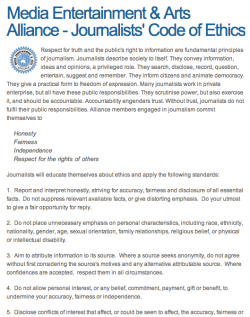
Screen Shot 2013-11-26 at 12.40.47 PMUnlike the Australian Press Council, the ethics panel of the Media, Entertainment and Arts Alliance (MEAA) has actual disciplinary powers at its disposal for use against individual journalists who breach its Code of Ethics – but it has rarely used them. Its powers extend to any journalists who are members of the Alliance. However, these days large numbers of journalists throughout the industry are not members.

In 1999, the alliance updated the code to a twelve-item document, requiring honesty, fairness, independence and respect for the rights of others. The alliance’s ethical complaints procedures are outlined in Section 8 of the Rules of the  MEAA (2009), summarised on the union’s website. Complaints must be in writing stating the name of the journalist, the unethical act and the points of the Code that have been breached. The judiciary committee (made up of experienced journalists elected every two years by state branch members) then meets to consider the complaint. They can dismiss or uphold the complaint without hearing further evidence, call for further evidence and hold hearings. Hearings involve the committee, the complainant and the journalist and follow the rules of natural justice. Lawyers are excluded. Penalties available to the committee include a censure or rebuke for the journalist, a fine of up to $1000 for each offence, and expulsion from the union. Both parties have 28 days to appeal to an appeals committee of three senior journalists in each state elected every four years and then to a national appeals committee of five journalists.

Because of the secrecy surrounding the cases and their outcomes there are few ethics panel case studies to work with. In 2003 Chris Warren provided me with the judgment of a 2002 case involving a complaint against a Sydney cartoonist who, the complainant alleged, portrayed the then opposition leader Kim Beazley as a person with a ‘physical and intellectual disability’, in breach of clause 2 of the code. The complaint also suggested the depiction was ‘inaccurate, unfair and dishonest’ and denied Mr Beazley a ‘right of reply’, in breach of clause 1. He also complained of a ‘continuing and malicious campaign of denigration of Labor leaders by this cartoonist’. The cartoonist’s defence was that all cartoonists regularly breached the letter of several clauses every time they did their work, but that this was the nature of artistic expression and satire. The complaint of unethical behaviour was dismissed on the basis that there was no ‘malicious bias’ and that any inaccuracy ‘was consistent with the satirical traditions of newspaper cartoons’.

Under Rule 67(h), the decisions and recommendations of the ethics panel shall be published in accordance with any guidelines that may be issued by the National Journalists’ Section Committee. When I interviewed MEAA federal secretary Chris Warren in 2003, he said the issue of publication of adjudications was a difficult one because of potential defamation action by participants. This makes it difficult to get information about MEAA ethics panel cases. Muller (2005: 185) wrote: ‘The practical result of this is that no one other than the parties, the panel and the MEAA executive ever hear about the complaints that are lodged, or what happens to them. This not only severely circumscribes the effectiveness of the procedure as a mechanism of accountability, but it offends against the principles of free expression, openness and transparency, and leaves the profession open to accusations of hypocrisy.’

While the MEAA’s website outlines the complaints procedures, it does not feature any records of complaints against journalists. Thus, both its journalist members and the general public remain ignorant of the nature and progress of any complaints against its members. In 2003 Chris Warren confirmed that the organisation received very few complaints each year, and that most were referred to the Australian Press Council. The Walkley Magazine in 2006 noted that the committee received only 67 original complaints and held five appeals between 2000 and January 2006, but could not deal with 34 of the complaints because they were to do with journalists who were not MEAA members. This meant only 33 complaints were handled in five years, an average of just over six per year. A separate tally of complaints to the Victorian branch of the MEAA by Muller (2005: 183) found that over the ten years 1993–2002 inclusive, just 23 complaints were received by the ethics panel of the Victorian branch. He provided a summary of each of them (Muller 2005: 187-8).

MEAA National Secretary Chris Warren told the Independent Media Inquiry last year that since the revised code was adopted in 1999 only three members had been censured or rebuked and that no member had been expelled for almost four decades (Finkelstein, 2012, p. 195). The reality is that with membership voluntary, the MEAA needs someone else to discipline its members when they act unethically. Its return to Press Council membership in 2005 opened the way for the MEAA to refer most complaints to that body or to the ACMA rather than having its own ethics panel deal with them at the risk of an embarrassing finding and the potential loss of a member.

There are scores of ethical codes of practice and guidance documents across the various media industry platforms – far too many for a single journalist to reflect upon while encountering a particular ethical dilemma. The irony is that the MEAA ‘Code of Ethics’ is the best known and most highly regarded ethical statement for the profession but there is a remarkably ineffective mechanism for its enforcement.

———–

Disclaimer: While I write about media law and ethics, nothing here should be construed as legal advice. I am an academic, not a lawyer. My only advice is that you consult a lawyer before taking any legal risks.

© Mark Pearson 2013

2 Comments

Filed under Media freedom, Media regulation, Press freedom

Whither media reform under Abbott?

By MARK PEARSON

Where will the new Liberal-National Coalition government led by Prime Minister Tony Abbott head with the reform of media regulation? Communications Minister Malcolm Turnbull and Attorney-General George Brandis were vocal opponents of the former Gillard Government’s proposals to merge press self-regulation with broadcast co-regulation into a new framework.

TurnbullCommons

Communications Minister Malcolm Turnbull … can he concoct the magic media self-regulation formula? [Image: commons.wikimedia.org]

Recent inquiries into media regulation in the UK (Leveson, 2012), Australia (Finkelstein, 2012) and New Zealand (Law Commission, 2013) have recommended major changes to the regulation of media corporations and the ethical practices of journalists. Their motivation for doing so stemmed from public angst – and subsequent political pressure – over a litany of unethical breaches of citizens’ privacy over several years culminating in the News of the World scandal in the UK and the subsequent revelations at the Leveson Inquiry (2012) with an undoubted ripple effect in the former colonies.

Many contextual factors have informed the move for reform, including some less serious ethical breaches by the media in both Australia and New Zealand, evidence of mainstream media owners using their powerful interests for political and commercial expediency, and the important public policy challenge facing regulators in an era of multi-platform convergence and citizen-generated content.  Minister Turnbull is an expert on the latter element and it is hard to imagine him not proposing some new, perhaps ‘light-touch’, unified regulatory system during this term in office.

By way of background, two major inquiries into the Australian news media in 2011 and 2012 prompted a necessary debate over the extent to which rapidly converging and globalised news businesses and platforms require statutory regulation at a national level.  Four regulatory models emerged – a News Media Council backed by recourse to the contempt powers of courts; a super self-regulatory body with legislative incentives to join; a strengthened Australian Press Council policing both print and online media; and a government-appointed  ‘Public Interest Media Advocate’.

The $2.7 million Convergence Review, announced in late 2010, was meant to map out the future of media regulation in the digital era (Conroy, 2010). However, revelations of the UK phone hacking scandal and Labor and Green disaffection with Rupert Murdoch’s News Limited in Australia, prompted the announcement in September 2011 of a subsidiary inquiry – the $1.2 million Independent Media Inquiry – specifically briefed to deal with the self-regulation of print media ethics. Its architects – former Federal Court judge Ray Finkelstein assisted by University of Canberra journalism professor Matthew Ricketson – argued they could not decouple print news self-regulation from broadcast ‘co-regulation’ in the digital era, so devised a statutory model including both in their report of February 28, 2012, two months prior to the release of the report of its parent Convergence Review (Finkelstein, 2012).

The Independent Media Inquiry (Finkelstein) report was an impressive distillation of legal, philosophical and media scholarship. Among many sensible proposals, it called for simpler codes of practice and more sensitivity to the needs of the vulnerable. But its core recommendation for the ‘enforced self-regulation’ of ethical standards prompted fierce debate. It proposed a News Media Council to take over from the existing self-regulatory Australian Press Council and co-regulatory Australian Communications and Media Authority to set journalistic standards with a streamlined complaints system with teeth (Finkelstein, 2012, pp. 8-9) The body would cover print, online, radio and television standards and complaints. It would have a full-time independent chair (a retired judge or ‘eminent lawyer’) and 20 part-time members evenly representing the media and the general citizenry, appointed by an independent committee (Finkelstein, 2012, pp. 290-291). The government’s role would be limited to securing the body’s funding and ensuring its decisions were enforced, but “the establishment of a council is not about increasing the power of government or about imposing some form of censorship” (Finkelstein, 2012, p. 9).

The report stressed the model would be ‘enforced self-regulation’ rather than ‘full government regulation’;

…an independent system of regulation that allows the regulated parties to participate in the setting and enforcement of standards (as is presently the case), but with participation being required, rather than voluntary (Finkelstein, 2012, p. 287).

Nevertheless, refusal to obey an order to correct or apologise would see a media outlet referred to a court which could issue an order to comply with further refusal – triggering a contempt charge and fines or jail terms for recalcitrant publishers. (Finkelstein, 2012, p. 298). Such a court would be charged with the relatively straightforward task of determining whether the publisher had disobeyed an order of the statutory News Media Council. Only then might publishers get the opportunity for an appeal – again by a judge in court.

The ‘Finkelstein inquiry’ was only ever meant to be an advisory to its parent Convergence Review, chaired by former IBM Australia managing director Glen Boreham, which released its final report in April, 2012 (Convergence Review, 2012).  News media regulation represented a much smaller element of the Convergence Review’s overall brief, particularly after this topic had been hived off to the Finkelstein inquiry, so this matter constituted a relatively small part of its report. While the Convergence Review report shared Finkelstein’s concerns about shortcomings with existing regulatory systems, it proposed that ‘direct statutory mechanisms … be considered only after the industry has been given the full opportunity to develop and enforce an effective, cross-platform self-regulatory scheme’. In other words, it was offering the media industry ‘drinks at the last chance saloon’ for a three year period under its model (Convergence Review, 2012, p. 53). Its mechanism centred upon the establishment of a ‘news standards body’ operating across all media platforms – reinforcing the overall review’s preference for ‘platform neutrality’ (Convergence Review, 2012, p.51). The news standards body ‘would administer a self-regulatory media code aimed at promoting standards, adjudicating complaints, and providing timely remedies’ (Convergence Review, 2012, p. 153).

Unlike Finkelstein, the Convergence Review decided not to be prescriptive about the constitution or operational requirements for such a body, beyond some broad requirements. The largest news media providers – those it deemed ‘content service providers’ – would be required by legislation to become members of a standards body. Most funding for the new body should come from industry, while taxpayer funds might be drawn upon to meet shortfalls or special projects (Convergence Review, 2012, p. xiv). It would feature:

–       a board of directors, with a majority independent from the members;

–       establishment of standards for news and commentary, with specific requirements for fairness and accuracy;

–       implementation and maintenance of an ‘efficient and effective’ complaints handling system;

–       a range of remedies and sanctions, including the requirement that findings be published on the respective platform. (Convergence Review, 2012, p. 51)

The review’s definition of ‘content service enterprises’ (control over their content, a large number of Australian users, and a high level of revenue drawn from Australia) would catch about 15 media operators in its net. Others might be encouraged to join the body with a threat to remove their current news media exemptions to privacy laws and consumer law ‘misleading and deceptive conduct’ provisions (Convergence Review, 2012).

Both inquiries acknowledged – and rejected – the notion of a revamped Australian Press Council proposed in various submissions and appearances by its chair, Professor Julian Disney. (The Press Council was established in 1976 as a newspaper industry ‘self-regulatory’ body – a purely voluntary entity with no powers under law.) Nevertheless, during and after the reports, and with new support from most of its members, the Press Council moved quickly to ramp up its purview and powers to address many of its documented shortcomings such as the refusal of some member newspapers to publish its findings and the threat of withdrawal of funding from others (Simpson, 2012). It locked its members into four year commitments and established an independent panel to advise on its review of its content standards. Those standards are due to be announced soon.

In 2013 the Gillard Labor Government introduced a ‘News Media (Self-regulation) Bill’ to establish a new role of ‘Public Interest Media Advocate’ with the power to deregister bodies, like the Australian Press Council, if they failed to police effectively the ethical standards of their newspaper and online members. Ultimately, the proposal might leave media outlets without their current exemptions from compliance with the Privacy Act in their newsgathering operations. The Labor government later withdrew the proposal when it could not garner enough support in the Parliament – in the face of strong opposition from the mainstream media and the Coalition (now government) with Turnbull and Brandis as the lead naysayers.

The big question now centres upon not if, but when, they choose to propose some new regulatory system where serious media ethical breaches across all media platforms are channelled through a single – self-regulatory? – body. And the further – and crucial issue – will be whether they can do this without ultimate recourse to criminal sanctions for recalcitrant journalists and media groups. It is vital that they do so, given that Australia is rare among Western democracies in that free expression is not enshrined in our Constitution.

Australia’s global free press standing depends upon them devising the magic formula the earlier inquiries failed to concoct.    

References

Conroy, S. (2010, December 14). Convergence Review. Terms of Reference (media release). Available: http://www.minister.dbcde.gov.au/media/media_releases/2010/115

Convergence Review (2012). Convergence Review. Final Report. Department of Broadband, Communications and the Digital Economy: Canberra. Available: http://www.dbcde.gov.au/__data/assets/pdf_file/0007/147733/Convergence_Review_Final_Report.pdf

Convergence Review (2012). Convergence Review. Final Report. Department of Broadband, Communications and the Digital Economy: Canberra. Available: http://www.dbcde.gov.au/__data/assets/pdf_file/0007/147733/Convergence_Review_Final_Report.pdf

Day, M. (2012, April 9.) A shame Seven West should quit Press Council. The Australian. Available: http://www.theaustralian.com.au/business/opinion/a-shame-seven-west-should-quit-press-council/story-e6frg9tf-1226321637864

Finkelstein, R. (2012). Report of the Independent Inquiry Into the Media and Media Regulation. Department of Broadband, Communications and the Digital Economy: Canberra Available: http://www.dbcde.gov.au/__data/assets/pdf_file/0006/146994/Report-of-the-Independent-Inquiry-into-the-Media-and-Media-Regulation-web.pdf

Law Commission (NZ) (2013). The news media meets ‘new media’: rights, responsibilities and
 regulation in the digital age. 
(Law Commission report 128). Law Commission: Wellington.

Leveson, B. (2012). Report of An Inquiry into the Culture, Practice and Ethics of the Press (The Stationery Office, 2012) [Leveson Report].

Simpson, K. (2012, July 20). Journalism standards set for an updating. smh.com.au Available: http://www.smh.com.au/business/journalism-standards-set-for-an-updating-20120719-22czm.html

———–

Disclaimer: While I write about media law and ethics, nothing here should be construed as legal advice. I am an academic, not a lawyer. My only advice is that you consult a lawyer before taking any legal risks.

© Mark Pearson 2013

2 Comments

Filed under Media freedom, Media regulation, Press freedom

Election postscript: a mindful analysis of media coverage

By MARK PEARSON

[This blog was first published in the St James Ethics Centre’s Living Ethics newsletter, Issue 93, Spring 2013. See here.]

Australian journalists operate under an array of ethical guidelines, including the MEAA Code of Ethics and numerous employer and industry codes of practice.

hogansWhile these documents differ widely in their wording, they espouse common values of truth, accuracy, fairness and the public’s right to information. They disapprove of invasions of privacy, disclosure of confidential sources, discriminatory language, subterfuge, deception, plagiarism and conflicts of interest.

When it comes to assessing the ethics of news coverage of an event as broad in scope as a federal election we find some guidance in such codes but other moral frameworks can add value.

Although I am not a Buddhist, I have recently found value in applying some of that religion’s foundational principles – in a secular way – to the assessment of journalism ethics and have been sharing this approach with colleagues and students through my writing and teaching.

It is also a useful lens through which to review some key elements in media coverage of the 2013 federal election.

The approach centres on the belief that journalists can adopt a mindful approach to their news and commentary which requires a reflection upon the implications of their truth-seeking and truth-telling as a routine part of the process. It calls upon them pause and think carefully about the consequences of their reportage and commentary for the stakeholders involved, including their sources and their audiences.

Truth-seeking and truth-telling are still the primary goal, but only after gauging the resulting social good or harm.

Each of the constituent steps of Buddhism’s Eightfold Path – understanding free of superstition, kindly and truthful speech, right conduct, doing no harm, perseverance, mindfulness and contemplation – provides a framework for such analysis.

Space prohibits the examination of all of them here, but at least three issues arose in the election worthy of such reflection.

  1. Fact checking. The Buddhist notion of ‘right views’ focuses on a deeper explanation of root causes and the clinical testing of claims. The emergence of the ‘fact checker’ was a welcome development via Politifact Australia, the ABC’s Fact Checking Unit and The Conversation’s Election FactCheck. A longer term impact of such a tool might be that politicians are prompted to think twice before issuing scaremongering and outlandish statements.
  2. The News Corp anti-Labor campaign. The principle of ‘right intent’ calls upon us to reflect upon the genuine motivations for Rupert Murdoch’s Australian newspapers adopting such a blatant and belittling attack on the incumbent government. Cynical mock-ups like the Daily Telegraph’s ‘Hogan’s Heroes’ and the Courier Mail’s ‘Send in the Clown’ front pages might be excused as tabloid fun but they hardly indicate ‘right intent’ and ‘right speech’ in the Buddhist moral framework. The motivation could surely not have been to gain circulation, given the fact that the coverage stood to alienate perhaps one third of readers. It will be fascinating to see at the next audit whether this stance accelerated the decline of those newspapers’ circulations. If the intent was to win influence with the likely government, then this should have been disclosed.
  3. Presidential-style coverage. Just because political parties choose to run a presidential style of campaign does not oblige news organisations to embrace it. The Buddhist principle of ‘right effort’ invokes a steady, patient and purposeful path and ‘right mindfulness’ demands a considered and reflective approach to reportage. Each of these is difficult when reporters are assigned to traipse around the nation and cover political leaders engaging in stage-managed, superficial appearances at factories, schools and sausage sizzles. It is belittling to the enterprise of journalism to see some of its leading lights – and notable watchdogs – being led by the leash as mere lapdogs. It was particularly noticeable in a campaign where neither leader made a notable gaffe. We are left to imagine what might have been revealed if only these political journalism superstars had been afforded the time to do some real digging. Sometimes being ethical demands us to say ‘no’ to an under-utilisation our talents, which was clearly the case here.

livingethicscoverThe ultimate test of ethical political reporting in a democracy is the extent to which that journalism best informs the citizenry to maximize the value of each and every vote. In that respect, Australian journalism still has much to learn.

———–

Disclaimer: While I write about media law and ethics, nothing here should be construed as legal advice. I am an academic, not a lawyer. My only advice is that you consult a lawyer before taking any legal risks.

© Mark Pearson 2013
2 Comments

Filed under blogging, Buddhism, citizen journalism, Eightfold Path, free expression, media ethics, social media, Uncategorized

Speech in Timor Leste – top ten media regulation lessons from Australia

By MARK PEARSON

I’ve arrived in Dili, Timor Leste, to deliver an address tomorrow (Friday, October 25) to this small nation’s National Congress of Journalists. The congress is working towards introducing a new code of ethics and a press council. Here is a preview of some highlights from my speech…

Dili, Timor Leste. (Credit: Google free use search / Flickr)

Dili, Timor Leste. (Google free use / Flickr)

Firstly I wish to thank the organisers and sponsors for allowing me the privilege of being here for this important congress. I also wish to formally pay my respects to the six journalists who were killed here in 1975 – including three Australians – and the countless Timorese people who have over decades paid a high price for daring to seek and tell the truth.

As journalists and editors you are so often in competition for your stories and for your audiences that it is a rare treat to see you gather as a professional group in a spirit of collaboration to progress the elevation of ethical standards through self-regulation.

…As a developed western democracy Australia drew heavily upon British and US traditions of politics and government, resulting in a relatively high level of free expression by international standards. It usually ranks in the top 30 countries of the world in the various media freedom indices such as those issued by Reporters Without Borders in Paris and Freedom House in New York.

But Australia is certainly not a shining light of media freedom. In at least two important ways Australia actually has lessons to learn from Timor Leste. One is that, unlike most democracies, the Australian Constitution makes no reference to freedom of expression or a free press. This distinguishes it from Timor Leste, where your Constitution goes to some length to spell out the freedom of speech and information at section 40 and the freedom of the press and mass media at section 41. A second important indicator is that Australia still has criminal defamation on the books in most states. This is a law abused by governments internationally throughout history, and Timor Leste should be applauded for removing it in 2009.

… Two major inquiries into the Australian news media in 2011 and 2012, followed by the Australian government’s attempts to introduce legislative reforms in 2013, prompted a necessary debate over the extent to which rapidly converging and globalised news businesses and platforms require statutory regulation at a national level. Four regulatory models emerged – a News Media Council backed by recourse to the contempt powers of courts; a super self-regulatory body with legislative incentives to join; a federal government proposal for a new Public Interest Media Advocate with control over the self-regulators; and the status quo with a strengthened Australian Press Council policing both print and online media.

… There are several ways journalists in other countries considering regulatory models can learn from this recent experience in Australia.

  1. Comparisons can be dangerous. Even in a democracy with a long history of relatively free expression politicians and governments will seek out and seize any opportunity to regulate the media. International comparisons can be dangerous because we operate within different political and cultural frameworks. When they were arguing for their media reforms, both Communications Minister Stephen Conroy and Prime Minister Julia Gillard cited RSF’s World Press Freedom Index, using the argument that Finland remained in number one position there despite having a statutory mechanism for its press regulation. They failed to mention that Finland also has a section in its Constitution guaranteeing free expression and the free flow of information so all laws are formed and applied against that backdrop. It also lacks the Australia’s hundreds of other media laws that impact on free expression, which place it at number 26 on that same Index. Australia languishes there partly because of the very threats to media freedom posed by these recent inquiries.
  2. Beware regulation creep. Existing laws such as defamation and contempt that apply to all citizens go a long way towards controlling media behavior. I have seen few serious ethical breaches that could not be handled by existing laws. Once media laws have been introduced it is hard to claw back eroded freedoms. Australia passed more than 50 new anti-terror laws after the September 2001 attacks on the US – many impacting on the media – and few of those have been wound back (Ewart et. al, 2013).
  3. Don’t trade press freedom. Well meaning journalists and academics are sometimes willing to sacrifice media freedom because of the misbehavior of some media personnel. Several academics and small publishers stepped up to give the Finkelstein model their approval and a leading journalism educator helped draft it (Conversation, 2012). When you offer governments new powers to control the misbehaviour of some elements in the media you need to accept that those same powers might be used against you at some later stage.
  4. Beware de facto licensing. There is the temptation to issue journalists with accreditation and registration in actual or de facto licensing schemes. The narrow defining of journalists and journalism by governments presents a real danger to free expression because it privileges some citizens over others as communicators. This gives those issuing and revoking such licenses influence over the message itself. It is even less appropriate in a new era of blogging and social media because the nature of news and journalism is even harder to define. Citizens might become reporters temporarily because of the scale of an event or issue or on an ongoing basis in a narrow field of interest that might momentarily become of broader public interest. It is inappropriate that they should have to seek registration or licensing as a journalist or that they should be punished for reporting without such official licence. Rather, their words or actions should be subject only to the communication limitations placed on all citizens, and in a working democracy they should be limited to only extreme breaches
  5. Look to the ultimate sanction. The best test when trying to gauge the potential impact of new media regulations is not the assurances of their proponents that they will be used only rarely and only in extreme cases. The real test is to look at the ultimate sanctions available and if these involve the potential jailing or fining of journalists then they are anathema to press freedom in a democracy.
  6. Media freedom is above politics. This was certainly a long overdue debate in Australia, but it was politicised from the outset which undermined the likelihood of the implementation of any of the proposals. Labor and Greens applauded it and pushed for its enactment, having demanded such an inquiry in the midst of the News of the World scandal in the UK and continued adverse coverage about them in News Limited publications locally (Kitney et.al, 2012). A basic human right like free expression are above politics, yet most governments will strive to limit it.
  7. Media freedom is above commercial interest. Opponents of media regulation need to be careful they are not being seen as simply protecting their own commercial enterprises. Criticism of the recommendations by the larger Australian media groups on free expression grounds – particularly by Murdoch executives – were dismissed as a defence of their vested interests (Meade and Canning, 2012). Such pigeon-holing of all advocates of media freedom and critics of regulation proposals is misplaced. It helps to recruit other senior intellectuals in defence of media freedom – including academics, business leaders and other public intellectuals.
  8. Look to carrots instead of sticks. The Convergence Review’s suggestion that some existing media exemptions to certain laws (particularly consumer law) might be linked to their membership of a media council is worth exploring because it avoids introducing new sanctions on the media. However, these must be carefully scrutinised to ensure they are not stemming the free flow of information or establishing a de facto licensing system.
  9. Adopt a universal ethics code. A uniform code of practice across all news media is a vital. It is in journalists’ best interests that they have one, because it is these very ethical standards that distinguish them from the many new voices seeking audiences in the new media environment. Australia has far too many self-regulatory and co-regulatory documents guiding ethical standards of journalists and their outlets.
  10. Training and education in law and ethics is crucial. Media outlets need to be more pro-active in developing better in-house processes for assessing ethical decisions and in explaining those decisions to their audiences. All reforms will, of course, need to be supplemented with better training of journalists about their rights and responsibilities and broader education of ordinary citizens to raise their understanding of the important role of the media in a democracy.

Nowhere in the world has there ever been unshackled free speech or a free media. Media regulatory systems and ethical frameworks are on the agenda in many countries, and we are challenged to accommodate free expression and its close relative press freedom within new technological and cultural contexts.

Some countries justify their stricter regulation of the press, and limitations of media freedom, on religious, cultural or economic grounds. There has been an ongoing debate about the lack of press freedom in the Asia-Pacific region. China, Vietnam, Malaysia, Singapore, Brunei, Fiji and some others have state licensing systems in place for their media.

The argument by governments in such countries is that the economy and political system are too fragile to allow freedom of the press. The reality is that freedom of the press is too fragile to allow governments to limit it. Censorship can only shackle democracy which is itself dependent upon the free flow of information and opinion to inform the voting citizen.

Too often journalists and academics get so caught up in devising new ethical codes that they start to invite governments into the control of sanctions for their breach. But the moment we let governments get involved we rarely have self-regulation. We then have what are commonly known as ‘laws’ – legislated by governments and enforced by the courts – and that is called regulation. The most important lesson from Australia is that it is all too easy to give away basic liberties in our pursuit of recalcitrant colleagues and in our scramble for public acknowledgment of the status of journalism as a profession.

© Mark Pearson 2013

Disclaimer: While I write about media law and ethics, nothing here should be construed as legal advice. I am an academic, not a lawyer. My only advice is that you consult a lawyer before taking any legal risks.

2 Comments

Filed under death penalty, Media freedom, Media regulation, Press freedom, Uncategorized

Ten minutes with @journlaw – Dr Joseph Fernandez (@DrJM_Fernandez) discusses his new book

By MARK PEARSON

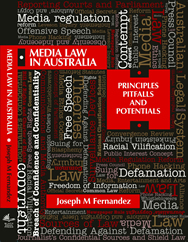
fernandez coverRespected colleague Dr Joseph Fernandez (head of journalism at Curtin University) has just published an impressive addition to the scholarship of journalism law.

In Media Law in Australia – Principles, Pitfalls and Potentials (Black Swan Press, 2013), Fernandez offers a comprehensive and meticulously referenced coverage of the territory – at 372 pages and something more than 275,000 words.

The book’s 12 chapters cover freedom of speech, the public interest, law making, defamation and its defences, confidentiality and secrecy, privacy, freedom of information, courts and parliament, offensive speech, copyright and regulation.

There is some refreshing new material covering the proposed media regulatory reforms in Australia and the UK.

I look forward to the opportunity to review it in greater detail for an academic journal, but meanwhile please enjoy Joseph’s reflection on the authorship process in his ‘Ten minutes with @journlaw’.

Disclaimer: While I write about media law and ethics, nothing here should be construed as legal advice. I am an academic, not a lawyer. My only advice is that you consult a lawyer before taking any legal risks.

© Mark Pearson 2013
Leave a comment

Filed under Uncategorized

Amnesty International, journalism and the death penalty

By MARK PEARSON

Amnesty International is marking the World Day Against the Death Penalty today (October 10) by holding vigils to build public pressure to persuade countries to abolish execution as a form of punishment.

I have the honour of delivering a short address to the Gold Coast gathering – looking at the relationship between journalism and the death penalty – and thought I would share my comments with you here.

The last person officially executed in Australia was Ronald Ryan who was hung in Melbourne more than 40 years ago – on February 3, 1967. The media coverage of the event and its associated protests were enough to pierce my consciousness as a nine-year-old schoolboy and distract my attention from my rock collecting, kite flying, yabbie fishing and marble trading in a small town in central western NSW.

I remember being both fascinated and disturbed by the notion of a government taking someone’s life and I’m sure I asked my parents many difficult questions about both the practicalities and the morality of the event.

It is significant that it happened in a period of history when our national government was routinely issuing a different type of death penalty to a generation of young Australian men in the form of balloted conscription to two years of military service.

The Vietnam War claimed the lives of 521 Australians – many of them conscripts – and injured and scarred the lives of thousands more.

The next public execution of Australians to impact upon me was that of the heroin traffickers Kevin Barlow and Brian Chambers in 1986 who were hung in Malaysia on July 7, 1986.

I was working on The Australian newspaper as a sub-editor and recall vividly some of the graphic coverage and images of the event and the commentary about how primitive it was that a government should carry out such a punishment.

Yet it was only two years earlier – in 1984 – that Western Australia became the last Australian state to abolish the death penalty in this country.

Thankfully we have not seen it return since, but we need to stay vigilant in our efforts to prevent it ever being reintroduced here and to get it abolished elsewhere.

Why? Because the death penalty is still widespread and governments should not have the right to take their citizens’ lives – no matter how serious their crimes.

Amnesty International’s latest report on the judicial use of the death penalty tells us at least 680 people were put to death by governments last year and more than 1700 citizens in 58 countries received a death sentence.

Those figures are conservative, particularly when China deems such information a state secret and Amnesty estimates that at least that number are executed each year in China alone.

Amnesty argues there is no real explanation for the death penalty other than revenge because there is little evidence that it acts as a deterrent, there are alternative means of punishment for proven crimes, all major religions and human rights conventions oppose murder, and far too many of those executed have later been proven innocent.

Of course, one of the direst consequences of the death penalty is that it delivers a disturbing message to formative minds like that nine-year-old boy that was me back in 1967 – it tells children that it’s okay to use violence because sometimes even our governments are allowed to kill some of us.

As a journalism and social media professor I am particularly interested in the interface between the death penalty and the media, and today I will focus briefly on four key aspects of this relationship.

  • Coverage of death penalty news. Traditional and new media channels are crucial to our understanding of who is being executed by governments and their circumstances. The truth of this needs to be circulating as reliable and verified information in news reports so that citizens are aware of its scale and are reminded of the expert advice against it.
  • Shooting the messenger. Of special interest – and the situation where the death penalty is open to the greatest abuse – is the use of jail and execution by governments to silence the voices of those who disagree with them. Intellectuals, religious figures, opposition politicians and journalists continue to suffer this fate simply because they hold a certain belief or have stated a particular truth. In journalism we call it ‘shooting the messenger’. Amnesty’s report gives the example of Ethiopia where anti-terror laws are used against various people, including the journalist Eskinder Nega who received an 18 year sentence on charges carrying the death penalty. He is the recipient of the 2012 PEN/Barbara Goldsmith Freedom to Write Award.
  • De facto capital punishment. Of great concern is the de facto capital punishment that happens to journalists covering wars or killed by criminal elements with suspected links to government or whose activities are not pursued by authorities because of corruption or their sheer fear of consequences. Sadly, the Committee to Protect Journalists has already confirmed the deaths of 37 journalists in these kinds of circumstances this year.
  • Innocence projects. Finally, one of the best arguments against the death penalty – that sometimes innocent people are executed – has been bolstered in recent years by a combination of investigative journalism, DNA testing and legal representation. Efforts by members of the international Innocence Network reported their efforts led to 22 exonerations of convicted criminals last year. The Innocence Project reported that 18 of the 311 who received DNA-related exonerations had served time on death row.

While the exoneration of death row criminals is one of the strongest arguments against the death penalty, we do not all have the time, resources or expertise to be actively involved with innocence projects.

There is also the reality that many people sitting on death rows internationally have been convincingly proven guilty of their crimes – sometimes using DNA testing – and some even admit to them.

But our campaign against the death penalty should not be won or lost on the basis of prisoners’ guilt or innocence of their crimes.

The arguments of human rights organisations like Amnesty International centre on the guilt of the system itself.

While we might question the conviction of individuals, there is no disputing the guilt of the governments who are murdering them with capital punishment.

We do not ask for the leaders of those governments to be put to death for this crime against the world’s citizens.

Rather, we call upon them to put this archaic and inhumane form of punishment to death and we ask all right thinking and compassionate people to help us in our efforts.

Active membership of Amnesty International is a wonderful starting point.

© Mark Pearson 2013

Disclaimer: While I write about media law and ethics, nothing here should be construed as legal advice. I am an academic, not a lawyer. My only advice is that you consult a lawyer before taking any legal risks.

2 Comments

Filed under death penalty, Uncategorized

Updated: Privacy in Australia – a timeline from colonial capers to racecourse snooping, possum perving and delving drones

By MARK PEARSON

The interplay between the Australian media and privacy laws has always been a struggle between free expression and the ordinary citizen’s desire for privacy. I have developed this timeline to illustrate that tension.

1827: NSW Chief Justice Francis Forbes rejects Governor Ralph Darling’s proposal for legislation licensing the press, stating: “That the press of this Colony is licentious may be readily admitted; but that does not prove the necessity of altering the laws.” (Historical Records of Australia, Series 1, Vol. 13, pp. 290-297)

PrivacySydneyGazetteExtract1830

The extract from the Sydney Gazette in 1830

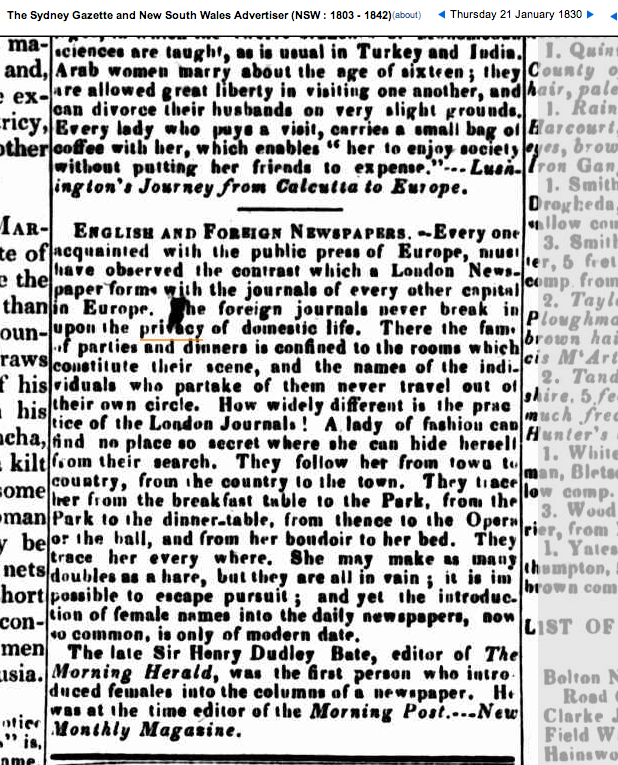
1830: The Sydney Gazette and New South Wales Advertiser publishes an extract from London’s New Monthly Magazine on the prying nature of the British press compared with its European counterparts, stating: “The foreign journals never break in upon the privacy of domestic life”. But the London newspapers would hound a ‘lady of fashion’ relentlessly: “They trace her from the breakfast table to the Park, from the Park to the dinner-table, from thence to the Opera or the ball, and from her boudoir to her bed. They trace her every where. She may make as many doubles as a hare, but they are all in vain; it is impossible to escape pursuit.”

1847: NSW becomes the first Australian state to add a ‘public benefit’ element to the defence of truth for libel – essentially adding a privacy requirement to defamation law (ALRC Report 11, p. 117)

1882: First identified use of the phrase ‘right to privacy’ in an Australian newspaper. Commenting on a major libel case, the South Australian Weekly Chronicle (22.4.1882, p.5) states: “A contractor having dealings with the Government or with any public body has no right to privacy as far as those dealings go.”

1890: In a landmark Harvard Law Review article, the great US jurist Samuel D. Warren and future Supreme Court Justice Louis D. Brandeis announce a new ‘right to privacy’ in an article by that very name. There is a ripple effect in Australia with several mentions of the term in articles between 1890-1900.

1937: A radio station used a property owner’s land overlooking a racecourse to build a platform from which it broadcast its call of the horse races. The High Court rules the mere overlooking of the land did not consti­tute an unlawful interference with the racing club’s use of its property. The decision viewed as a rejection of a common law right to privacy: Victoria Park Racing and Recreation Grounds Co. Ltd v. Taylor (1937) 58 CLR 479.

1948: Universal Declaration of Human Rights is proclaimed in Paris. Article 12 provides: “No one shall be subjected to arbitrary interference with his privacy, family, home or correspondence, nor to attacks upon his honour and reputation. Everyone has the right to the protection of the law against such interference or attacks” (United Nations Universal Declaration of Human Rights, GA. Res 217A(III), UN Doc A/Res/810 (1948).)

1966: The International Covenant on Civil and Political Rights (ICCPR) is proclaimed, protecting privacy at Article 17. (16 December 1966, [1980] ATS 23, entered into force generally on 23 March 1976)

1972: Australia signs the ICCPR.

1979: Australian Law Reform Commission releases its first major report on privacy – Unfair Publication: Defamation and Privacy, ALRC 11. It recommends a person be allowed to sue for damages or an injunction if ‘sensitive private facts’, relating to health, private behaviour, home life, and personal or family relationships, were published about him or her which were likely in all the circumstances to cause distress, annoyance or embarrassment to a person in the position of the individual. Wide defences were proposed allowing publication of personal information if the publication was relevant to the topic of public interest. (pp. 124-125).

1980: Australia ratifies the ICCPR and the Organisation for Economic Co-operation and Development (OECD) expert group led by Australian Justice Michael Kirby issues its Guidelines on the Protection of Privacy and Transborder Flows of Personal Data.

1983: Australian Law Reform Commission releases its Privacy (ALRC Report 22), recommending the establishment of a Privacy Act to establish information privacy principles and the appointment of a Privacy Commissioner.

1984: Australian Journalists’ Association (AJA) revises its 1944 Code of Ethics to include a new clause (9) requiring journalists to “respect private grief and personal privacy and shall have the right to resist compulsion to intrude on them”.

1988: The Privacy Act 1988 is enacted, applying initially only to the protection of personal information in the possession of Australian Government departments and agencies.

1999: Media Entertainment and Arts Alliance (MEAA) issues another revised Code of Ethics preserving the grief and privacy elements in clause 11.

2000: Privacy Act 1988 provisions are extended to larger private sector organisations, and 10 National Privacy Principles (NPPs) are introduced, determining how companies must collect, use and disclose, keep secure, provide access to and correct personal information. Media organisations are exempted from the provisions as long as they ascribe to privacy standards published by their representative bodies.

2001: High Court rejects an argument for a company’s right to privacy after animal liberationists trespass to film the slaughter of possums in a Tasmanian abattoir and someone gives the footage to the ABC, but the court leaves the door open for a possible personal privacy tort: Australian Broadcasting Corporation v. Lenah Game Meats (2001) 208 CLR 199.

2003: A Queensland District Court judge rules the privacy of the former Sunshine Coast mayor Alison Grosse had been invaded by an ex-lover who continued to harass her after their affair had ended. She is awarded $108,000 in damages: Grosse v. Purvis [2003] QDC 151.

2007: Victorian County Court Judge Felicity Hampel SC holds that a rape victim’s privacy was invaded when ABC Radio broadcast her identity in a news report despite state laws banning the identification of sexual assault complainants. She is awarded $110,000 damages: Jane Doe v ABC & Ors [2007] VCC 281.

2008: Australian Law Reform Commission releases its For Your Information: Australian Privacy Law and Practice (ALRC Report 108) recommending a cause of action for breach of privacy where an individual has a ‘reasonable expectation of privacy’, with a cap for non-economic loss of $150,000.

2011: Federal Government releases an Issues Paper floating a proposal for a Commonwealth cause of action for a serious invasion of privacy.

2012

  • The Privacy Amendment (Enhancing Privacy Protection) Act 2012 (Privacy Amendment Act) passed, to take effect in 2014, featuring new Australian Privacy Principles (APPs), more powers for the Australian Information Commissioner, tougher credit reporting rules and new dispute resolution processes. Media exemption remains unchanged.
  • Independent Media Inquiry (Finkelstein Review) releases its report recommending a News Media Council take over from the existing Australian Press Council and Australian Communications and Media Authority with a streamlined news media ethics complaints system with teeth. Refusal to obey an order to correct or apologise could see a media outlet dealt with for contempt of court. Privacy breaches cited as a reason for the move.
  • Commonwealth Government’s Convergence Review releases its final report rejecting the Finkelstein model but instead proposing a ‘news standards body’ operating across all media platforms, flagging the withdrawal of the privacy and consumer law exemptions from media outlets who refuse to sign up to the new system.

2013

  • The federal attorney-general directs the Australian Law Reform Commission to conduct an inquiry into the protection of privacy in the digital era. The inquiry will address both prevention and remedies for serious invasions of privacy with a deadline of June 2014.
  • At the same time the government introduces legislation to establish a Public Interest Media Advocate with the power to strip media outlets of their Privacy Act exemptions. That part of the legislation is later withdrawn.
  • The federal attorney-general seeks state and territory input on the regulation of drones following the Privacy Commissioner’s concerns that their operation by individuals was not covered by the Privacy Act.

2014

  • The Australian Law Reform Commission (ALRC) releases a Discussion Paper, Serious Invasions of Privacy in the Digital Era (DP 80, 2014)The proposed elements of the action include that the invasion of privacy must occur by: a. Intrusion into the plaintiff’s seclusion or private affairs (including by unlawfulsurveillance); or b. Misuse or disclosure of private information about the plaintiff. The invasion of privacy must be either intentional or reckless. A person in the position of the plaintiff would have had a reasonable expectation of privacy in all of the circumstance. The court must consider that the invasion of privacy was ‘serious’, in all the circumstances, having regard to, among other things, whether the invasion was likely to be highly offensive, distressing or harmful to a person of ordinary sensibilities in the position of the plaintiff. The court must be satisfied that the plaintiff’s interest in privacy outweighs the defendant’s interest in freedom of expression and any broader public interest in the defendant’s conduct.

———–

Disclaimer: While I write about media law and ethics, nothing here should be construed as legal advice. I am an academic, not a lawyer. My only advice is that you consult a lawyer before taking any legal risks.

© Mark Pearson 2013/2014

2 Comments

Filed under Privacy, Uncategorized

The new ‘multi-journalism’: close to the mark or way off?

By MARK PEARSON Follow @Journlaw

From my 1999 PhD thesis, “The New ‘Multi-journalism’: Journalists’ and educators’ perceptions of the influences of the Internet upon journalism and its implications for journalism education”, available from http://epublications.bond.edu.au/cgi/viewcontent.cgi?article=1232&context=hss_pubs (pp. 405-7)

The influences of the Internet upon the context in which journalism is practised and upon the very practice of journalism itself are so momentous that they represent the emergence of an endeavour which, while retaining many of the characteristics of journalism as it has been known, is too fragmented, multi-dimensional and multi-purposed to be classified as such, a notion which has profound implications for journalism education. The term “Multi-Journalism” has been coined to describe this new manifestation of journalism as an occupation.

The term “Multi-Journalism” has been coined to encapsulate the multi-dimensional nature of journalism as it emerged from the analysis. While some of the scholars cited above were pessimistic about the transitional role of journalism and its longer term prospects, the data suggested journalism was not dying, but was transforming into a disparate combination of new and old practices at multiple sites, serving numerous social purposes. Whether or not they boasted new media titles such as Content Editor, Producer or Webmaster, a common thread of journalism linked the discussants simply because they appeared to view themselves as journalists. Thus, on the one hand, the term “journalism” and its accompanying complex meanings founded in history and tradition, should not be discarded. However, the influences of the Internet meant that this occupation, while retaining many of the qualities of journalism as it has been known, was now too fragmented, multi-dimensional and multi-purposed to be classified as such, and was better prefixed by “Multi” to encapsulate this complexity.

The new term might accommodate the complex mosaic of occupations and practices which might emerge from the Internet influence within the journalism domain, ranging from the new media positions mentioned above through to the traditional provincial newspaper reporter whose role will undoubtedly continue for the foreseeable future. Equally, it might account for the computer-assisted reporter using sophisticated database searching techniques to undertake investigative journalism as well as the “information specialist” as described by Newhagen and Levy (1998, p. 20) who might provide information processing or Internet navigation services.

Whether the work undertaken by such individuals at multiple sites and for multiple purposes is still “journalism” will be dependent upon their own conceptions of that function, their self-perception, and the judgment of their societies and audiences. Thus, “Multi-Journalism” is a movable entity, changing its guise according to the social roles and functions it performs and the shifting
conceptions of its practitioners and its constituents.

The Core Category also allows us to move some way towards answering Postman’s question: “What is the problem to which the profession of journalism is the solution?” (Fulton, 1996, p. 22). “Multi-Journalism” offers multiple solutions to a diverse range of problems in a complex array of contexts, all centred upon the provision of reliable news and information for the social good. Such solutions might be as a “pathfinder” through the Internet environment (Newhagen and Levy, 1998, p. 18), an “information specialist” (Newhagen and Levy, 1998, p. 20), a “facilitator of responsible public discussion” (Aufderheide, 1998, p. 54), or as a quality controller or “sense-maker” (Singer, 1998). Or they could find meaning in a host of other social functions for a range of audiences or clients. Nevertheless, despite the diversity of their roles and occupational sites, they would be bound by commonalities of meaning in their conception of “journalism”.

Well? How close was my crystal ball 14 years ago? Close to the mark or way off? Let me know by posting a comment below or by messaging me @journlaw

Leave a comment

Filed under citizen journalism, journalism, multimedia journalism

Ten minutes with @journlaw – Nic Christensen (@nicchristensen) from Mumbrella

By MARK PEARSON

I’m teaching a subject called Online News Production at Griffith University this semester and we are featuring a range of industry guests – in person and via link.

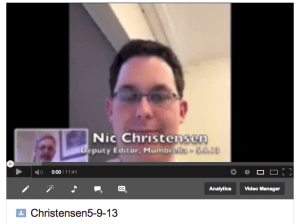
Today I interviewed Nic Christensen, deputy editor at Mumbrella, about life on one of Australia’s most successful online startups.

In this Skype interview, Nic talks about his job at Mumbrella, introduces us to his colleagues including editor-in-chief Tim Burrowes, drops his laptop during the newsroom tour, and discusses multimedia reporting and employment prospects for journalism graduates.

Meet Nic Christensen:

Screen Shot 2013-09-05 at 5.39.10 PM

Ten Minutes with @journlaw – Nic Christensen. YouTube video will start.

If you just want to see him drop his laptop, that’s at 2 mins 10 secs!

Nic’s an avid social media user in his reporting.

https://twitter.com/nicchristensen/status/375444827338326016

Follow him @nicchristensen

Disclaimer: While I write about media law and ethics, nothing here should be construed as legal advice. I am an academic, not a lawyer. My only advice is that you consult a lawyer before taking any legal risks.

© Mark Pearson 2013
Leave a comment

Filed under Uncategorized

If #cyberbullying is up, why is youth #suicide down?

By MARK PEARSON

[Extracted from my public lecture ‘Social Media – Risks and Rewards’]

Administrators and parents are indeed concerned about social media – partly because the little they know about it has been informed via the lens of the news media and war stories like those I have related above. Their perceptions are also skewed by the new industry of cyber-safety – everything from net nanny systems for your IT system through to speakers and consultants ready to advise on the evils of trolls and cyber-predators. I am not suggesting such inputs are unnecessary, but I wonder about their impact on policy at a time when parents and administrators are already approaching Web 2.0 with trepidation.

With all these resources committed to it, one might be excused for believing cyberbullying had driven young people to the depths of depression and anxiety and were consequently taking their own lives at an alarming rate. The fact is that in the decade 2000-2010 – a period during which both Internet and social media usage grew rapidly – youth suicide in Australia actually declined. It declined across the whole 15-24 year age group, with suicides among males in that age group decreasing by 34 per cent. That is not to say, however, that the rate of youth suicide is not alarming. The number of suicides is still far too high and like all stats this figure can have a range of explanations – better counselling, changes in media coverage, the efforts of campaigns like Beyond Blue and RU OK? (partly on social media),  and improved medicines for psychiatric conditions. …While it is tragic for any young person to take their life for such a reason, there seems to be no hard data that Internet and social media usage is driving more young people to this level of despair (ABS, 2012).

After all, social media is in many ways just a microcosm of our broader lives, and problems like bullying have always existed. These platforms present new channels for the demonstration of such behaviours, replacing or supplementing replacing the schoolyard taunts, the prank calls, the practical jokes and the toilet graffiti.

See the full lecture at: https://journlaw.com/2013/08/29/social-media-risks-and-rewards-journlaws-public-lecture/

© Mark Pearson 2013

Disclaimer: While I write about media law and ethics, nothing here should be construed as legal advice. I am an academic, not a lawyer. My only advice is that you consult a lawyer before taking any legal risks.

2 Comments

Filed under courts, media law, Media regulation, social media