Tag Archives: journalism

Announcing the fifth edition of The Journalist’s Guide to Media Law

By MARK PEARSON

Co-author Mark Polden and I are in the final stages of production of the fifth edition of The Journalist’s Guide to Media Law, to be published later this year.

We are re-engaging with the print medium as we apply our eagle eyes to the final hard copy galley proofs – our last chance for amendments and updates – before it goes to the printer for the production process.

Much has changed since our last edition in 2011, particularly in the fields of news media, communication technologies and practices, tertiary education and the law. We have reshaped and updated this edition of the book to accommodate those developments.

The book is still titled The Journalist’s Guide to Media Law, but its new subtitle—‘A handbook for communicators in a digital world’—encapsulates the seismic shifts that have prompted our considerable revisions. Our target audience has broadened with each edition as technologies like the internet and social media have combined to transform journalism and its allied professional communication careers. Thus our prime audience of Australian journalists working for traditional media outlets has widened to embrace public relations consultants, bloggers, social media editors and new media entrepreneurs,  as they fill new professional occupations dealing with media law, once the domain of mainstream reporters and editors.  Crucial questions which recur through the book include: ‘What is a journalist?’, ‘Who is a publisher?’, ‘How does media law affect this new communication form?’ and ‘Who qualifies for this protection?’ Some of the answers are still evolving, as legislators, the judiciary and the community grapple with the implications of every citizen now having international publishing technology literally at their fingertips on mobile devices.

Such shifts have prompted major new inclusions in the content of the book. So much publishing now transcends Australia’s borders via social media, blogs and other online platforms that we have expanded this edition to contain many more international comparisons and cases. This has been accommodated by reducing some of the forensic examination of precise legislation in various Australian states and territories, found in previous editions. Instead of attempting to document every statutory instrument in all nine Australian jurisdictions, we have directed readers to the resources that contain those details.

All of this has necessitated design and pedagogical changes to the book’s format and contents. While the chapter structure is generally in accord with previous editions, there are new sections within the chapters addressing these issues. Their order varies slightly according to topic, but most chapters now include some key concepts defined at the start, some international background and context to the media law topic, a more detailed account tailored to Australian legislation and case law, a review of the ‘digital dimensions’ of the topic with special focus on internet and social media cases and examples, an account of self-regulatory processes if they apply to that topic, some tips for journalists and other professional communicators for mindful practice in the area, a nutshell summary, some discussion questions, and relevant readings and case references.

The introduction of ‘tips for mindful practice’ encapsulates the authors’ aim that professional communicators need to build into their work practices and routines an informed reflection upon the legal and ethical implications of their reportage, commentary, editing, publishing and social media usage. This approach is explained in greater detail in Chapter 2, but it essentially links safe legal practice and the responsible and strategic use of free expression with the personal moral framework and professional ethical strictures of the digital communicator—whether a journalist, public relations consultant, media relations officer or serious blogger.

Those changing roles are reflected in a new final chapter, Chapter 13, which deals with the law of PR, freelancing and media entrepreneurship. It replaces a chapter on self-regulation in earlier editions. (The role and application of the various industry regulatory, co-regulatory and self-regulatory bodies, such as the Australian Communications and Media Authority (ACMA) and the Australian Press Council (APC), are now introduced in Chapter 3, but they are then referred to in the chapters where their functions and decisions seem most relevant). We saw this area of media law as significant because those who occupy those roles  are now grappling with special dimensions of media law—and several other legal topics relevant to their work—and deserve a new chapter dedicated to their roles and the legal dilemmas that are emerging in relation to them. The chapter also reflects the fact that many former journalists are now working in these allied occupations, and that student journalists need to start their careers with a broad understanding of the legal considerations which govern allied professional communication industries.

The sheer pace of change in all areas of media law is astounding. Many changes were mooted as this edition was going to press—including important developments in the laws of privacy, copyright, hate speech and court reporting. Rather than render the book dated as soon as it is printed, we have opted to use co-author Professor Mark Pearson’s journlaw.com blog (this one!) as the venue for updates to material, and have built several mentions of that resource into the chapters and discussion questions.

Apart from an array of new cases and examples—many from the international arena and many more from social media—some highlights of important new content covered in this edition include the following:

  • There are significant cases on increased statutory powers, allowing courts to make suppression and non-publication orders, and on the relationship between free speech, open justice and the right of parties to settle disputes privately. Recent cases at the borderline between ridicule and defamation, and on the application of freedom of information laws to immigration detention centres are included, as are cases on the application of sub judice contempt to internet content hosts and ‘celebrity’ claims of privacy invasion.
  • Recommendations of the ALRC on copyright reform are included, together with a discussion of the new copyright fair dealing defence that applies to satire. The book presents a wide range of examples, across different legal categories, relating to the use of the internet and social media, which will be of growing importance for current and future professional practise in communication, reportage and media advice.
  • A separate chapter on secrets (Chapter 9) covers the new journalists’ shield laws and their relevance to micro-bloggers and non-traditional publishers.
  • Chapter 10, on anti-terrorism and hate laws, includes the recommendations for reform of anti-terror laws and discusses the high-profile Andrew Bolt case and related proposals for reform of the Commonwealth Racial Discrimination Act 1975.
  • The recommendations of the Leveson Inquiry in the United Kingdom, and the Finkelstein Inquiry and Convergence Review in Australia, are subjected to critical analysis in view of their potential impact upon notions of a free press.

There is also an increased emphasis on real-time reportage, as the traditional print media increase their online presence and depth of click-through coverage in a 24/7 news cycle, with concomitant risks in the areas of defamation and contempt in their own work and that of third-party commentators on their websites and social media pages.

Without going into exhaustive detail on all of these matters, the book remains true to its original aim: to provide professional communicators and students with a basic working understanding of the key areas of media law and ethical regulation likely to affect them in their research, writing and publishing across the media. It tries to do this by introducing basic legal concepts while exploring the ways in which a professional communicator’s work practices can be adapted to withstand legal challenges.

In designing this edition, we have tried to pay heed to the needs of both professional communicators and media students. The book is best read from front to back, given the progressive introduction of legal concepts. However, it will also serve as a ready reference for those wanting guidance on an emerging problem in a newsroom or PR consultancy. The cases cited illustrate both the legal and media points at issue; in addition, wherever possible, recent, practical examples have been used instead of archaic cases from the dusty old tomes in the law library. Rather than training reporters, bloggers and PR practitioners to think like lawyers, this book will achieve its purpose if it prompts a professional communicator to pause and reflect mindfully upon their learning here when confronted with a legal dilemma, and decide on the appropriate course of action. Often that will just mean sounding the alarm bells and consulting a supervisor or seeking legal advice.

Of course, the book is not meant to offer actual legal advice. Professional communicators must seek that advice from a lawyer when confronted with a legal problem. The most we claim to do is offer an introduction to each area of media law so that journalists, PR consultants and bloggers can identify an emerging issue and thus know when to call for help.

Booktopia is offering pre-orders on their website: http://www.booktopia.com.au/the-journalist-s-guide-to-media-law-mark-pearson/prod9781743316382.html

Disclaimer: While I write about media law and ethics, nothing here should be construed as legal advice. I am an academic, not a lawyer. My only advice is that you consult a lawyer before taking any legal risks.

© Mark Pearson 2014

Leave a comment

Filed under blogging, citizen journalism, contempt of court, free expression, journalism, media ethics, media law, Media regulation, social media, sub judice, Uncategorized

Australian Press Council Chair Julian Disney with @journlaw

By MARK PEARSON

I recently had the chance to interview Australian Press Council chair Professor Julian Disney on the role and direction of the Council.

In this interview he discusses the recent reforms to the Council, the move to improve its editorial standards, and the future for media ‘self-regulation’ as broadcast, print, online and social media formats continue to converge.

(12 mins, recorded 17 March 2014). Apologies for some audio sync issues!

© Mark Pearson 2014

Disclaimer: While I write about media law and ethics, nothing here should be construed as legal advice. I am an academic, not a lawyer. My only advice is that you consult a lawyer before taking any legal risks.

Leave a comment

Filed under free expression, journalism, media ethics, Media freedom, Media regulation, Press freedom, Uncategorized

Justice Open and Shut – Suppression Orders and Open Justice – live blog #openshut

By MARK PEARSON

I’m at the Australian Centre for Independent Journalism’s ‘Justice Open and Shut’ Symposium at UTS Sydney today and will be writing this live blog of highlights from today’s speakers as the day unfolds. Drop in if you’re in the neighbourhood to Mary Anne House, Level 3, 645 Harris St, Ultimo, Sydney.

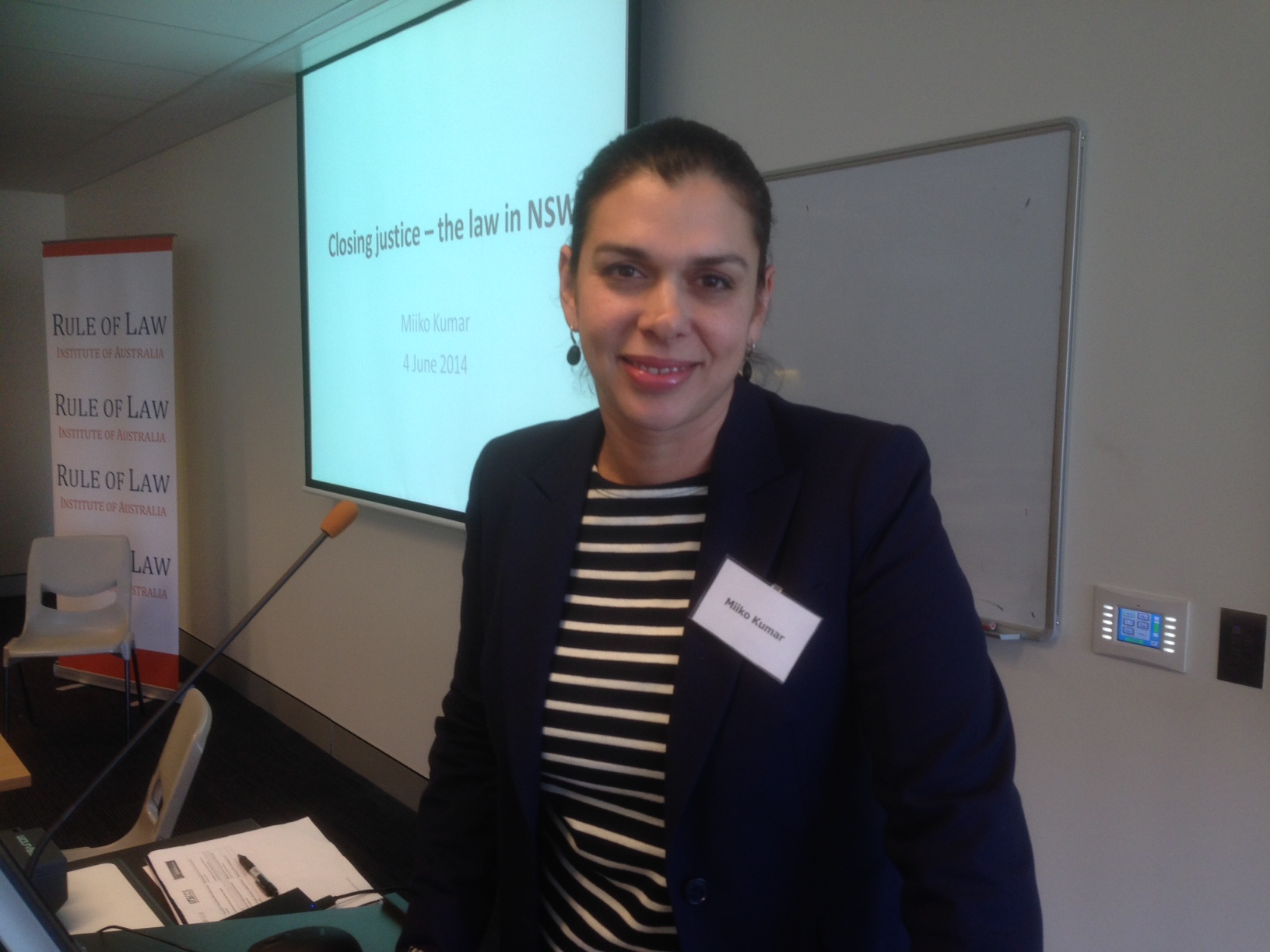
Testing the law in NSW with the ‘Keeper of Secrets’ Miiko Kumar

The open justice system incorporates open reasons for decisions as well, says media law barrister and academic Miiko Kumar.
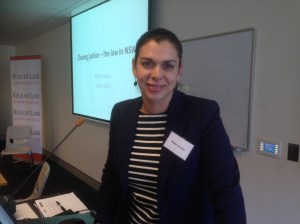
Media law barrister Miiko Kumar

Media law barrister Miiko Kumar

Open justice ensures justice is imparted fairly and openly, the senior lecturer in law at the University of Sydney told the Justice Open and Shut conference at UTS.

Kumar said justice can be closed by excluding the public, restricting access to confidential information, non-publication orders, pseudonym orders, witnesses giving evidence via CCTV or from behind screens, and through the use of secret evidence.

Secret evidence is where a party tenders evidence that the other parties do not see, but that is rare.

Both the common law and key statutes give courts their power to suppress in NSW, including Court Suppression and Non-Publication Act 2010 and the Civil Procedure Act. Of course, other legislation exists for specific types of witnesses, such as the Children (Criminal Proceedings) Act 1987.

She said the common law test for the issue of a suppression order was a ‘test of necessity’, not a balancing test.

“It does not mean it is just convenient or to save someone embarrassment – that is not enough,” she said.

A wide section of people have standing to apply for a suppression order in NSW, and it can be made at any time during a trial.

The NSW legislation was tested in the recent Gina Rinehart case when she applied for a stay of proceedings along with a suppression order on the grounds that the confidentiality of the proceedings would be breached.

The court was open but there was a non-publication order over the proceedings.

[ Welker & Ors v. Rinehart [2011] NSWSC 1094 (Brereton J) 13/9/11 … Appeal: Rinehart v. Welker & Ors [2011] NSW CA (Tobias AJA) 31/10/11 … Appeal: Rinehart v. Welker [2011] NSWA 403 (Bathurst CJ and MColl JA; Young JA) 19/12/11].

Suppression order was lifted in that final appeal.

“The decision shows us that the court takes the administration of justice seriously,” she said.

“The media was the one who objected to the order. It is important for the media to know when the orders are made because they are usually the ones who will object.

“The parties are more concerned about their case so they are focussed on that.”

Kumar also explained public interest immunity where a court determines a claim by having the document that is the subject of a claim and considering it in closed session.

https://twitter.com/NatashaKrnjaic/status/474044254977683458

Victoria – the state of suppression

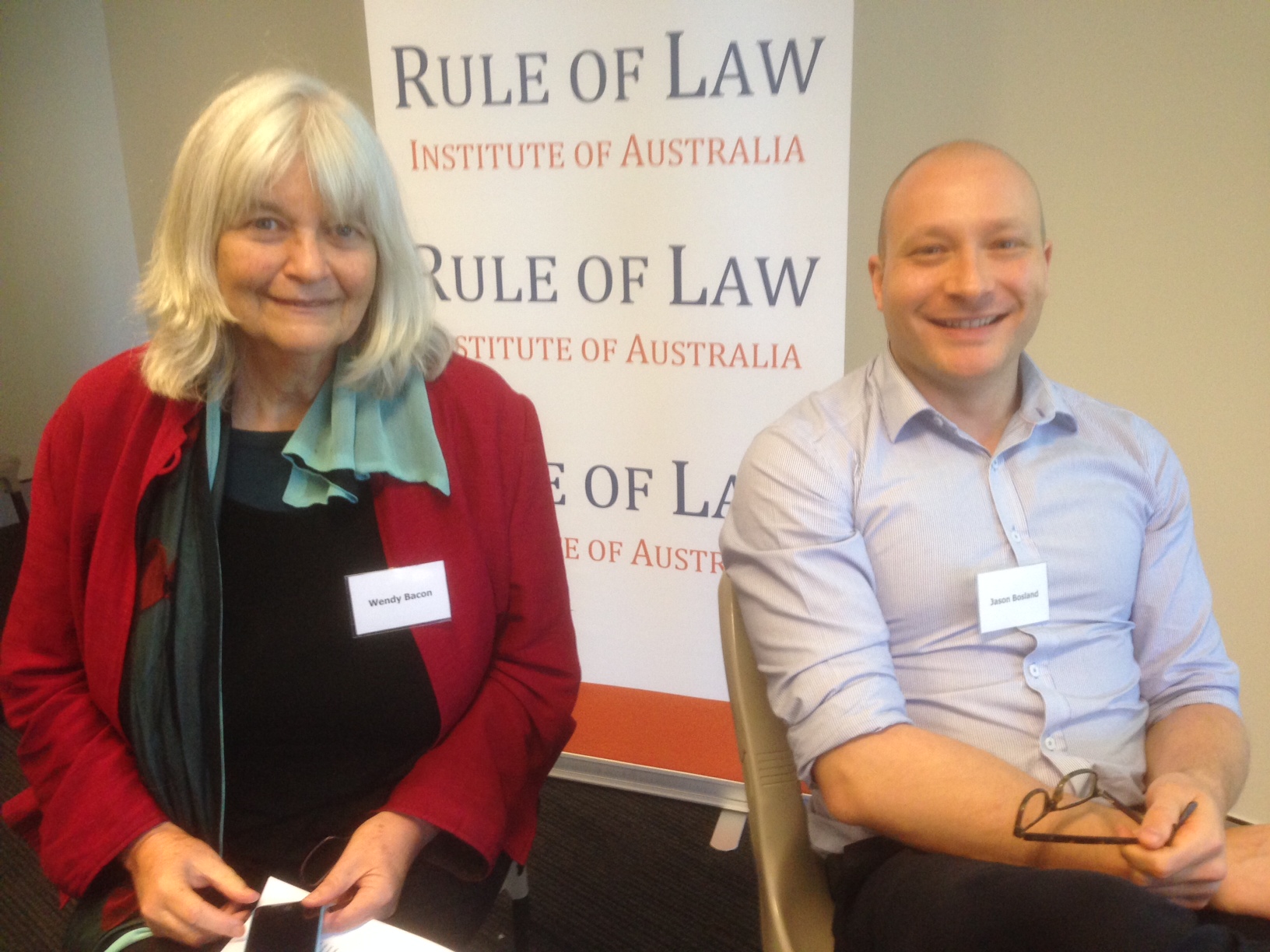
A study of non publication orders over a five year period in Victoria found that more than 1500 had been imposed across the state’s court system , according to the deputy director of the Centre for Media and Communications Law at the Melbourne Law School, Jason Bosland.
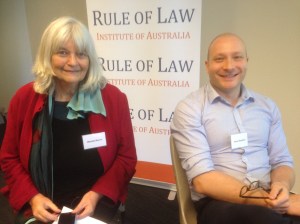
UTS professor Wendy Bacon and Melbourne Law School's Jason Bosland

UTS professorial fellow Wendy Bacon and Melbourne Law School’s Jason Bosland

Mr Bosland reported to the  ‘Justice Open and Shut’ Symposium at UTS Sydney on his team’s research on the breakdown of legislative or common law powers under which the various courts imposed suppression orders.

Some orders were made under the provisions of an act of parliament that did not even give the courts power to issue orders.

About 70 per cent of all orders made by Victorian courts did not contain an end date or any other temporal limitation to bring them to an end. The Magistrates Court made 398 orders without a specified end date over the period. Only 128 orders revoked 202 suppression orders over the period.

More than half of the suppression orders were ‘blanket orders’ – banning the whole of proceedings from publication – including about 80 per cent of non-publication orders in the state’s County Court.

“There were real problems with ambiguity and breadth,” Mr Bosland told the conference.

Many of the orders related to the revelation of the identity of a victim in circumstances where other legislation might already prohibit this publication.

Mr Bosland has also been researching the suppression of judicial reasons. He found that in Western Australia 47 judgments of the Supreme Court and 17 of the Court of Appeal had been withheld from publication, with nine across the Supreme, appeal and district courts in NSW, and about 20 in Victoria.

He further found a simple search of the terms “Judgment Suppressed” and “Judgment Restricted” into the database Austlii generated several pages of search results.

—-

The UK situation: Translucent justice? Digital and physical access to UK courts

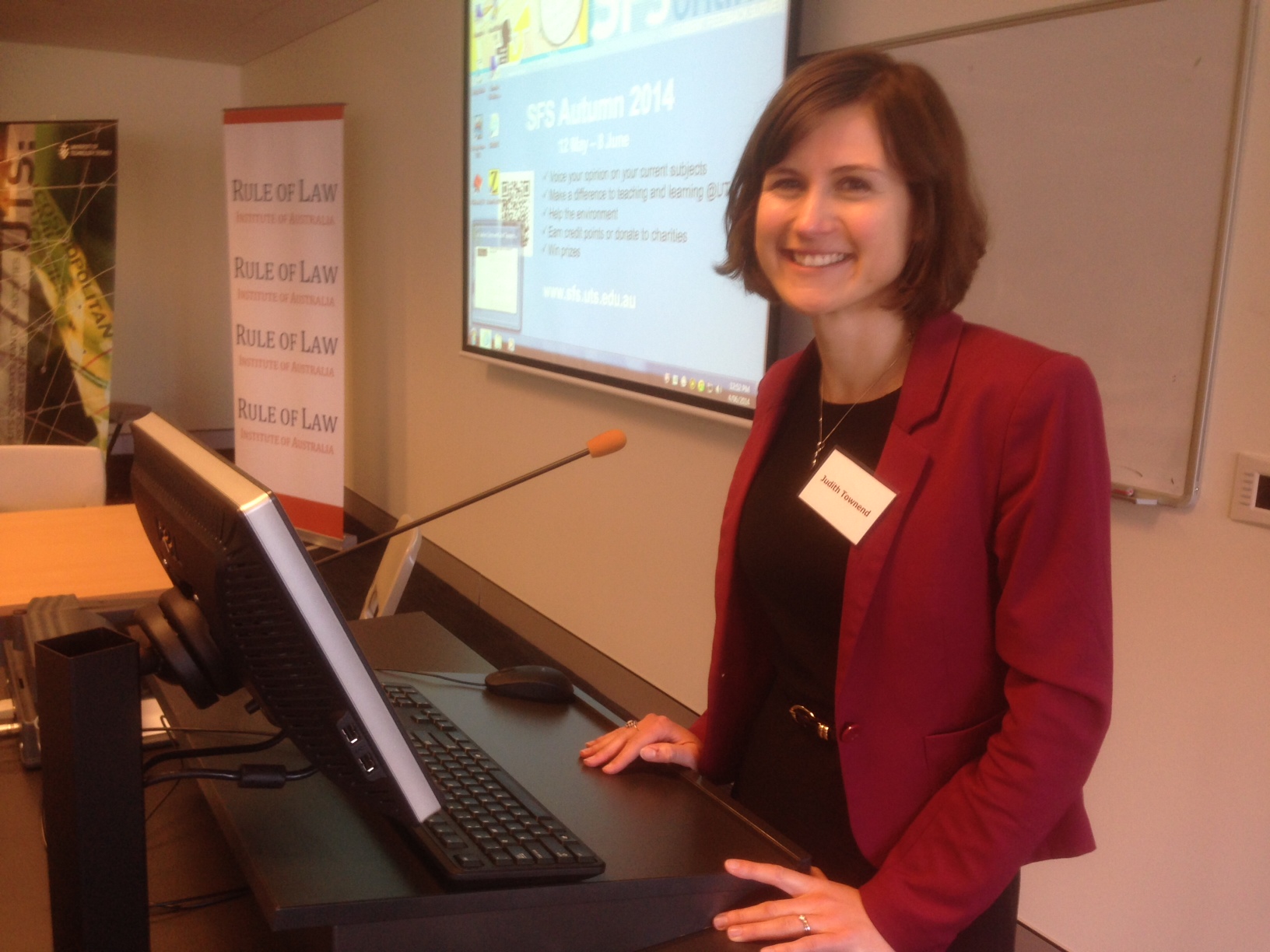
The physical doors to UK courts are ‘open’, but virtual legal information is not, says UK researcher Judith Townend from City University London.
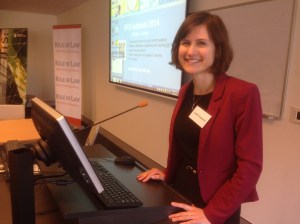
jude

Judith Townend, City University London

The notion of open justice seems to stall at the online level. Very little can be systematically documented about what is happening in the courts, she said.

For example, there is no systematic recording of data on the outcome of defamation claims.

“It’s a given that we do want to have open access to the courts but there are particular challenges that need to be considered,” she said.

She cited the recent development of a ‘right to be forgotten’ as an emerging issue standing in the way of open justice online, along with copyright, defamation, spent convictions and the tort of misuse of private information.

She explained the proliferation of so-called ‘super injunctions’ in the UK from 2009-2011.

“Particularly worrying were the sorts of injunction where the fact that they existed could not even be reported – and these were the so-called ‘super injunctions’, Townend told the  ‘Justice Open and Shut’ Symposium at UTS Sydney.

“It is not known how many existed, but it is thought there was a small number of the truly ‘super’ kind.”

Her research has been investigating the fate of a reporting restrictions database proposed in England and Wales in 2007. Despite a freedom of information request, she was unable to find out why it had not been implemented despite an effective simple operating in the Scottish jurisdiction.

The Law Commission had found a simple system similar to the Scottish online list of orders in force would cost a government department no more than three to four hours of labour per month. It recommended such a system should be introduced, also specifying the details of the order.

However, there was a “lack of momentum to carry the proposal forward”.

She said the proposal raised questions of who should be able to access such a database, what it would cost for users, and longer term issues over the liability for breach of the orders on such a list (particularly if an order was left off the list).

Townend drew parallels with proposals in Australia for a restricted access with full details of suppression orders.

“The focus is very much on the media … but there is a broader question we need to make about public access,” she said.

“What if you are an ordinary member of the public? Should courts be obliged to share details of restrictions with the wider public?”

There are strong arguments for better data collation, she said.

“Systematic recording of injunctions would allow media and academic scrutiny of orders in different courts – types, reasons and frequency,” Townend explained.

“There would be practical benefits for reporters to help avoid inadvertent contempt and it would help inform legal policy development around contempt.”

Keynote address ‘Open Courts: Who Guards the Guardians?’ – former justice Philip Cummins

Suppression orders should only be made as a last resort, not as a first resort, former Supreme Court justice and Victorian Law Reform Commission chair Philip Cummins told the  ‘Justice Open and Shut’ Symposium at UTS Sydney today.
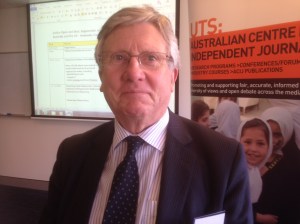
cummins

Justice Philip Cummins

Quoting Kafka, Bentham and several higher court judgements, Justice Cummins said in his keynote address ‘Open Courts: Who Guards the Guardians?’ that it was the essence of the judicial process that it was public.

“The two functions of transparency of the justice system are that abuses may flourish undetected without it and it maintains the integrity of the courts. They are splendid principles often enunciated by the courts,” Justice Cummins said.

“The courts, rightly, have traditionally resisted pressure to function in private. Sometimes that pressure is from high motives, sometimes base… but it is ever present and must be resisted.

“It’s plain that courts cannot be open in every case. There are plainly justifications for courts to be closed.”

He cited sexual matters, terrorism trials and others involving safety of witnesses.

“Those categories are justifiable … in individual cases the orders are not justified even though the category has been made out,” he said.

“They need to be looked at on a case by case basis. The critical thing is that suppression orders should only be made as a last resort, not as a first resort.”

He labelled the path of reasoning required of judges under legislation when called upon to grant a suppression order was ‘erroneous reasoning’.

“It introduces a balancing of interests that should not be balanced – they are not equal,” he said.

He said instead there were key questions judges should consider:

  • orders shouldn’t be made if they were already covered by other legislation;
  • if the principle of sub judice applies. it would be erroneous if the principle of sub judice was replaced by suppression orders: “Sub judice needs to be protected by all of us. It would be a very profound error for suppression orders to take over the function of sub judice.”;
  • orders should not be made on therapeutic or prophylactic or prudential grounds instead of essential; and
  • there was a lack of understanding of the integrity of the jury system.

“We know that juries are robust. We know that they are living entities and that they see various things in the course of a trial,” he said.

“I have great confidence juries are robust and I think it is a profound mistake for judges to underestimate the robustness and integrity of juries.”

He said the gangland trials were over, but the question arises: “Has the culture changed?”

In some ways there was a judicial culture that worked against open justice. He said judges were usually supportive of open justice in principle – but sometimes until it came to the case at hand.

“If the culture of the courts is erroneous then the appeal system is not the solution. My tipstaff once said to me ‘whoever discovered water, it wasn’t a fish’,” he said.

But he rejected a suggestion by media lawyer Peter Bartlett that judges saw the media as a ‘nuisance’. Rather, Justice Cummins said, it was a question of priorities because their main goal was to ensure a fair trial.

“I do think that the judiciary is concerted in applying itself to these sorts of issues. In my 22 years on the bench not once was I let down by the media,” he said.

“Parliament has a significant role to play in advancing open justice,” he said.

On the question of court public information officers, he said they had been very valuable and had not proven to be ‘second guessing’ the court as some naysayers had predicted before the role was introduced two decades ago.

“I think a media officer can perform a very valuable function,” he said.

Justice Cummins agreed a ‘two speed’ system of coverage of major criminal trials had developed with the mainstream media more shackled because of its broader coverage.

“With a lot of the technology that a lot of us have spoken about it is morphing into a new set of issues we have to be astute to,” he said.

Media lawyer Peter Bartlett said that issue was not necessarily a new one.

“Traditionally we have found that print media has been sued more often than radio or television,” he said.

“I think there is a two speed [system developing] in that mainstream media is sued far more often. There is an increasing number of actions against online sites or blogs but their level of circulation is restricted so their level of damage is restricted.”

—————-

The media and suppression orders in Victoria: reporters’ experiences

The increase in suppression orders during the gangland trials in Victoria had not diminished since the trials finished, Digital News Editor at the Herald-Sun Elissa Hunt told the  ‘Justice Open and Shut’ Symposium at UTS Sydney today.
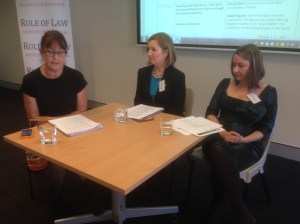
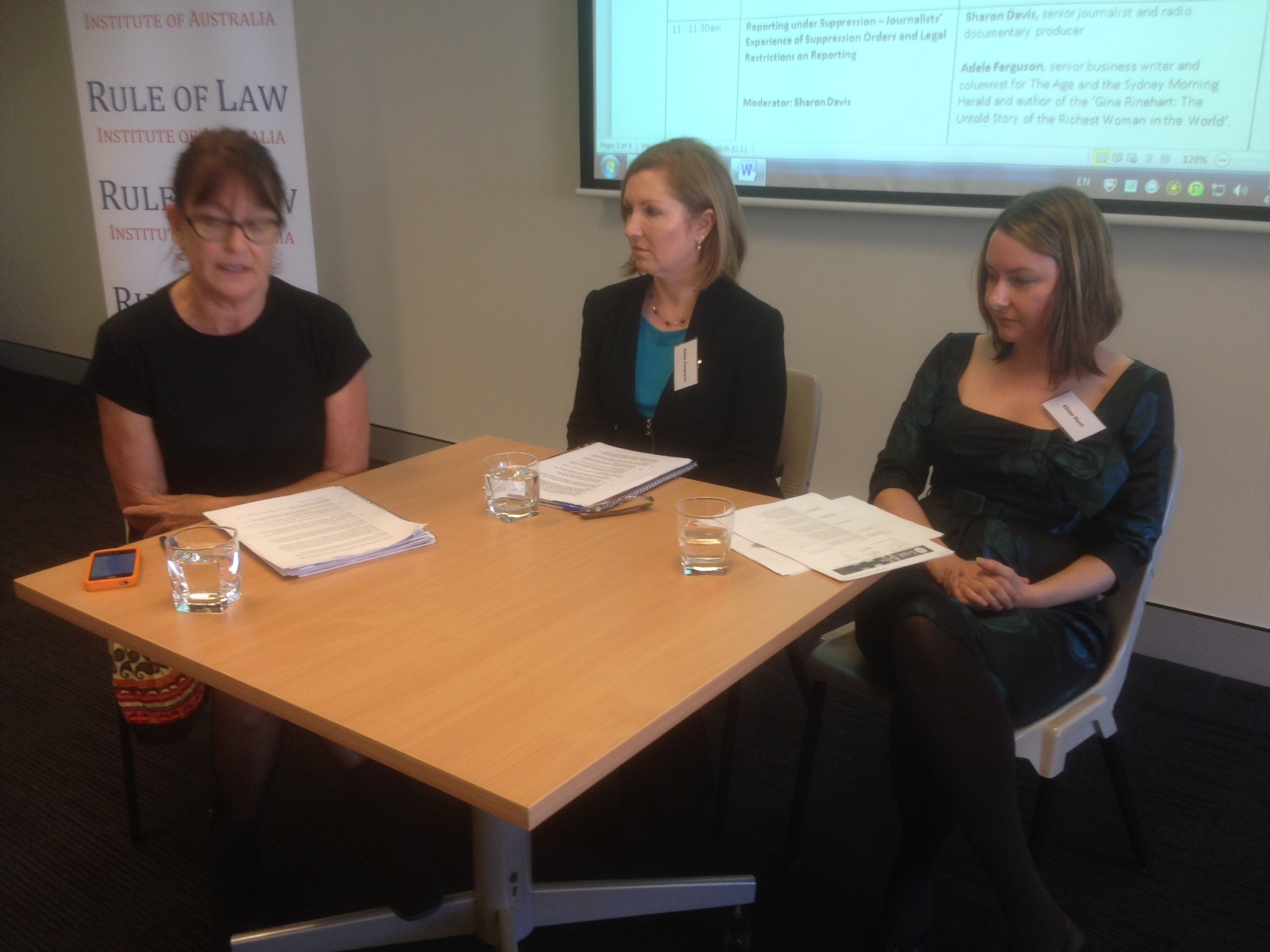
fergusonShe was joined on a panel by Gina Rinehart biographer and Fairfax senior business writer Adele Ferguson (centre) who shared  her courtroom experiences on reporting under suppression – and senior journalist and documentary producer Sharon Davis (left).

“We do write in different ways as journalists now and have to think on our feet all the time and update for the web,” Hunt said.

“There’s not time to sit down with a lawyer and negotiate whether we can get away with this or that.

“You just had to know what you could or couldn’t say.

“Yesterday I did a dump of the suppression orders logged on our system this year and I counted 144. We’re on track for maybe 300 suppression orders this year.

“I’m not seeing a decrease in the number of orders.”

Ferguson said suppression orders take many forms. She cited the spent convictions provisions under the Crimes Act as an example of material that could not be published about a corporate regulation executive who had been in a partnership with a criminal history.

She mentioned the Gina Rinehart subpoena order against her demanding her sources last year where Steve Pennells from the West Australian was also served. Rinehart eventually backed down. She had two other subpoenas year as well.

Hunt explained the phenomenon of the ‘silent listing’ where courts would not reveal where a trial was being held, leaving reporters unable to engage lawyers to challenge the suppression.

When she queried such a silent listing she was told it was a security issue. She showed the symposium a form where people could apply to have their listings made silent under a practice direction from the Victorian Chief Magistrate.

Their outdated computer system meant courts could not use a pseudonym so the only way to keep their name off the list was the only mechanism to protect a witness.

Photos of victims that had been published many times were also suppressed by Victorian courts, Hunt said. In one case such a suppression was applied to a photo of a baby who was a high profile crime victim so juries were not prejudiced.

“I think it’s a worry we have so many judges who think the jury system is this fragile thing … our own judges don’t trust the system enough to let the jury do what they are meant to do,” she said.

Ferguson agreed with Davis  individuals are using the law more creatively to take advantage of the diminished resources of the major groups to challenge orders.

“It’s really time consuming and it’s costly and I think without doubt you are seeing more subpoenas issued and more defamation,” she said.

Hunt said: “The reality is that the only ones fighting a suppression order are the media. Unless they are doing it nobody else will be. We just can’t be there for all of them.”

She explained the complicated process involved in extracting material from the digital world once a suppression order or take down order has been issued.

—-

Media can’t afford to oppose as many suppression orders, says top media lawyer

Dwindling media resources have impacted on free expression because news organisations do not have the resources to oppose as many suppression orders as they did previously, Minter Ellison Lawyers partner Peter Bartlett told the  ‘Justice Open and Shut’ Symposium at UTS Sydney today.

Screen Shot 2014-06-04 at 10.14.48 AM

“It does not happen as much as it used to because the rivers of gold have evaporated,” he said.

Because the media is not there to oppose applications for suppression orders there was a risk more and more will be issued that go further than they should go.

Mr Bartlett is speaking on ‘Suppression Orders: A Fine Balance”, where he is examining topical case studies including The Rolf Harris trial, ‘Lawyer X’, Julian Assange and Oscar Pistorius.

Judges will say open justice is an important principle ‘but’ … and that ‘but’ is the problem, he said.

“The trouble is you get judges who quite rightly are focused on prepartion for the trial … that they do not spend enough time on whether an application for a suppression order should be granted and just go ahead and approve that order.

It is a difficult task for the judge in balancing the right to a fair trial and the right to free expression.

“There is no doubt that where there is a clash the right to a fair trial should take precedence.

“A proper instruction to a jury reduces the need for a suppression order in many cases.”

He commended recent Victorian legislation giving the media a right to appear to oppose suppression orders and making it clear there should be an end date to suppression orders. Previously it was difficult getting older suppression orders lifted because all the parties had to be found and brought to court. However, some recent suppression orders had been issued without the recommended end dates, he said.

He said there were at least four or five suppression orders issued each day in Victoria.

He was receiving many applications to take down historical articles because of their potential effect on a trial.

He noted the seeking of urgent injunctions by high profile wealthy individuals and linked this to the ‘reasonableness’ test for defamation defences which requires defendants to have sought a reply from the plaintiff prior to publication.

Three times in the past 18 months he had experienced injunctions being sought after an approach by a journalist to get a comment from a high profile individual about allegations against them.

This had sometimes led to long delays, including one example of a judge ordering a story be held from December until the next May so the matter could be tried.

He criticised the assumption of some judges that any media coverage would lead to an unfair trial.

He suggested the orders made against the Underbelly program in Victoria were futile because people found other means of access.

The Rolf Harris trial raised interesting issues where Australian newspapers could cover the trial which was suppressed in the UK but not put it on their websites. Fairfax newspapers included a warning to others not to publish the material online. The stories ran without a byline to avoid difficulties for the reporter sitting in the London court covering the trial.

https://twitter.com/JTownend/status/473991814706245634

Media law experts line up in Sydney for open justice seminar

It’s a stellar line-up of Australian media law experts with the welcome guest presentation from Judith Townend from the Centre for Law, Justice and Journalism at City University, London, on ‘Transluscent justice? Digital and physical access to UK courts’.

Keynote speaker is the Hon. Philip Cummins, former Supreme Court judge and Chair of the Victorian Law Reform Commission, Chair of the Victoria Law Foundation and Chair of the Protecting Victoria’s Vulnerable Children Inquiry.

Dr Tom Morton and I are speaking about progress with our research project on a forensic mental health patient we called ‘The Man Without A Name” because of restrictions on identifying people involved in NSW Mental Health Tribunal proceedings. Section 162 Mental Health Act (NSW) bans ID of anyone involved in either tribunal or forensic proceedings, with further requirements under the Mental Health (Forensic Provisions) Act. A breach can incur a fine of $5500 or a 12 month jail term. See my earlier blog on this and Tom’s Background Briefing piece by the same name for Radio National.

———–

Conference program:

Justice Open and Shut: Suppression orders and open justice in Australia and the UK

“There is one hell of a fight going on in Australia to preserve our free press. We are increasingly seeing the rich and powerful resort to litigation to pursue journalists’ sources or lodge defamation writs purely to stop the publication of stories and scare off the rest of the media.”

Nick McKenzie, Fairfax Media, 2014 Press Freedom Australia Address

The increasing use of suppression orders undermines fair and accurate reporting of the courts and the fundamental principle of open justice.  This workshop will explore the operations and impact of suppression orders on reporting in Australia and the UK.

A workshop for journalists, lawyers, academics and anyone with an interest in open justice, the media and freedom of the press.

The  conference schedule is now available.

Keynote address: ‘Open Courts: Who Guards the Guardians?’

Keynote speaker: Hon. Philip Cummins – former Supreme court judge and Chair of the Victorian Law Reform Commission, Chair of the Victoria Law Foundation and Chair of the Protecting Victoria’s Vulnerable Children Inquiry.

Other speakers:

  • Peter Bartlett: Partner Minter Ellison, Chair of the Advisory Board at the Centre for Advanced Journalism ast Melbourne University. Author of the law precis for MEAA State of Pres Freedom in Australia. Bartlett has represented Fairfax media and others in relation to suppression orders. He will speak on the use of suppression orders and its impact on the media and journalism, the operation of take down laws and trends observed since the introduction of the new Acts.
  • Miiko Kumar: Barrister, Jack Shand Chambers and Senior Lecturer, Faculty of Law, University of Sydney. Kumar appears regularly in applications for suppression orders on behalf of government agencies. She will provide an overview of the law relating to different forms of suppression orders, as well as recent cases involving Gina Rinehart and her attempted use of suppression orders in relation to court proceedings.
  • Judith Townend: Centre for Law, Justice and Journalism, City University, London. Townend will speak on ‘Transluscent justice? Digital and physical access to UK courts’.
  • Academics and journalists Mark Pearson (Griffith) and Tom Morton (University of Technology, Sydney): Open justice, investigative journalism and forensic patients.
  • Elissa Hunt: has been a court and legal affairs reporter with the Herald-Sun in Victoria for more than 13 years.  Her work has been recognized through numerous awards from the Victorian Law Foundation, including the 2014 Law Foundation’s Reporter of the year on Legal Issues. Elissa has recently been appointed as the Digital News Editor.
  • Adele Ferguson: a multi-award winning senior business writer and columnist for the Age and the Sydney Morning Herald and author of the best selling unauthorised biography Gina Rinehart: The Untold Story of the Richest Woman in the World. Prior to joining the Age and the SMH, Adele was a senior commentator with the Australian. She has also worked at BRW Magazine as deputy editor and chief business commentator, leading many major investigations into the corporate sector.
  • Jason Bosland: Deputy Director of the Centre for Media and Communications Law at Melbourne Law School where he teaches communications and intellectual property law. He holds degrees from Melbourne and the London School of Economics. His primary research interests lie in media law, including defamation and privacy, open justice and the media, contempt of court and freedom of speech.

This workshop is hosted by the Rule of Law Institute of Australia and the Australian Centre for Independent Journalism and is supported by the Centre for Cosmopolitan Civil Societies, University of Technology, Sydney.

Media Enquiries:

Tom Morton tom.morton@uts.edu.au

Kate Burns kate@ruleoflaw.org.au

When

4 June 2014
10:00 am – 4:30 pm

Where

Venue: Mary Anne House, Level 3, 645 Harris St, Ultimo, Sydney.

—————

Disclaimer: While I write about media law and ethics, nothing here should be construed as legal advice. I am an academic, not a lawyer. My only advice is that you consult a lawyer before taking any legal risks.

© Mark Pearson 2014

Leave a comment

Filed under blogging, Buddhism, citizen journalism, Eightfold Path, free expression, media ethics, mental health, social media, Uncategorized

Justice Open and Shut – and the man without a name revisited

By MARK PEARSON

I’m looking forward to presenting with colleague Associate Professor Tom Morton from UTS (pictured) at the Australian Centre for Independent Journalism’s ‘Justice Open and Shut’ Symposium this week.

MORTON

Dr Tom Morton

Below is the full program for the conference from the ACIJ website.

It’s a stellar line-up of Australian media law experts with the welcome guest presentation from Judith Townend from the Centre for Law, Justice and Journalism at City University, London, on ‘Transluscent justice? Digital and physical access to UK courts’.

Keynote speaker is the Hon. Philip Cummins, former Supreme Court judge and Chair of the Victorian Law Reform Commission, Chair of the Victoria Law Foundation and Chair of the Protecting Victoria’s Vulnerable Children Inquiry.

Dr Morton and I are speaking about progress with our research project on a forensic mental health patient we called ‘The Man Without A Name” because of restrictions on identifying people involved in NSW Mental Health Tribunal proceedings. Section 162 Mental Health Act (NSW) bans ID of anyone involved in either tribunal or forensic proceedings, with further requirements under the Mental Health (Forensic Provisions) Act. A breach can incur a fine of $5500 or a 12 month jail term.

See my earlier blog on this and Tom’s Background Briefing piece by the same name for Radio National.

We have won permission to name him in our academic writing – including on this blog – but I will hold back on that for today so I do not spoil the presentation for those attending on Wednesday.

I have previously compared the complex array of mental health reporting restrictions in Australia and New Zealand. (See here.)

In 2012 I compared three cases in WA, Victoria and the UK involving the identification of mental health patients. The case of Patient A has strong parallels with the Albert Lazlo Haines [pdf] case in the UK where a patient won an appeal to be named in reportage of his review proceedings.

This Australian case adds to that body of literature and is interesting from that media law perspective. It also interests us as an ethical case study, and we will be using it as the focus for an exploration of the application of the principles of ‘mindful journalism’ I have described previously.

———–


Conference program:

Justice Open and Shut: Suppression orders and open justice in Australia and the UK

“There is one hell of a fight going on in Australia to preserve our free press. We are increasingly seeing the rich and powerful resort to litigation to pursue journalists’ sources or lodge defamation writs purely to stop the publication of stories and scare off the rest of the media.”

Nick McKenzie, Fairfax Media, 2014 Press Freedom Australia Address

The increasing use of suppression orders undermines fair and accurate reporting of the courts and the fundamental principle of open justice.  This workshop will explore the operations and impact of suppression orders on reporting in Australia and the UK.

A workshop for journalists, lawyers, academics and anyone with an interest in open justice, the media and freedom of the press.

The  conference schedule is now available.

Keynote address: ‘Open Courts: Who Guards the Guardians?’

Keynote speaker: Hon. Philip Cummins – former Supreme court judge and Chair of the Victorian Law Reform Commission, Chair of the Victoria Law Foundation and Chair of the Protecting Victoria’s Vulnerable Children Inquiry.

Other speakers:

  • Peter Bartlett: Partner Minter Ellison, Chair of the Advisory Board at the Centre for Advanced Journalism ast Melbourne University. Author of the law precis for MEAA State of Pres Freedom in Australia. Bartlett has represented Fairfax media and others in relation to suppression orders. He will speak on the use of suppression orders and its impact on the media and journalism, the operation of take down laws and trends observed since the introduction of the new Acts.
  • Miiko Kumar: Barrister, Jack Shand Chambers and Senior Lecturer, Faculty of Law, University of Sydney. Kumar appears regularly in applications for suppression orders on behalf of government agencies. She will provide an overview of the law relating to different forms of suppression orders, as well as recent cases involving Gina Rinehart and her attempted use of suppression orders in relation to court proceedings.
  • Judith Townend: Centre for Law, Justice and Journalism, City University, London. Townend will speak on ‘Transluscent justice? Digital and physical access to UK courts’.
  • Academics and journalists Mark Pearson (Griffith) and Tom Morton (University of Technology, Sydney): Open justice, investigative journalism and forensic patients.
  • Elissa Hunt: has been a court and legal affairs reporter with the Herald-Sun in Victoria for more than 13 years.  Her work has been recognized through numerous awards from the Victorian Law Foundation, including the 2014 Law Foundation’s Reporter of the year on Legal Issues. Elissa has recently been appointed as the Digital News Editor.
  • Adele Ferguson: a multi-award winning senior business writer and columnist for the Age and the Sydney Morning Herald and author of the best selling unauthorised biography Gina Rinehart: The Untold Story of the Richest Woman in the World. Prior to joining the Age and the SMH, Adele was a senior commentator with the Australian. She has also worked at BRW Magazine as deputy editor and chief business commentator, leading many major investigations into the corporate sector.
  • Jason Bosland: Deputy Director of the Centre for Media and Communications Law at Melbourne Law School where he teaches communications and intellectual property law. He holds degrees from Melbourne and the London School of Economics. His primary research interests lie in media law, including defamation and privacy, open justice and the media, contempt of court and freedom of speech.

This workshop is hosted by the Rule of Law Institute of Australia and the Australian Centre for Independent Journalism and is supported by the Centre for Cosmopolitan Civil Societies, University of Technology, Sydney.

Media Enquiries:

Tom Morton tom.morton@uts.edu.au

Kate Burns kate@ruleoflaw.org.au

When

4 June 2014
10:00 am – 4:30 pm

Where

Venue: Mary Anne House, Level 3, 645 Harris St, Ultimo, Sydney.

—————

Disclaimer: While I write about media law and ethics, nothing here should be construed as legal advice. I am an academic, not a lawyer. My only advice is that you consult a lawyer before taking any legal risks.

© Mark Pearson 2014
Leave a comment

Filed under blogging, Buddhism, citizen journalism, Eightfold Path, free expression, media ethics, mental health, social media, Uncategorized

ABC RN Law Report host @damien_carrick talks privacy with @journlaw

By MARK PEARSON

The interviewer became the interviewee when I had the opportunity to chat with the host of the ABC Radio National Law Report (@LawReportRN), Damien Carrick (@damien_carrick), about the law of privacy and the media in Australia and the UK.

Damien was a visiting journalist fellow at the Reuters Institute for the Study of Journalism at Oxford University where he attended the Leveson Inquiry and interviewed journalists and media lawyers to prepare a report titled ‘Privacy, Regulation and the Public Interest’ which is available at https://reutersinstitute.politics.ox…. .

In this interview he discusses the interaction between the rights of free expression and privacy, the scope for coverage of celebrity news if there is a tort of privacy invasion, the difference between the UK and the Australian contexts, and the feasibility of the Australian Law Reform Commission’s proposal of a new statutory tort for the serious invasion of privacy.


[Recorded 19 May 2014, length 14 mins 54 secs]

© Mark Pearson 2014

Disclaimer: While I write about media law and ethics, nothing here should be construed as legal advice. I am an academic, not a lawyer. My only advice is that you consult a lawyer before taking any legal risks.

Leave a comment

Filed under Media regulation, Uncategorized

The lowdown on IP from expert Angus Macinnis @AequoEtBono – 15 mins with @journlaw

By MARK PEARSON


Intellectual property law – particularly copyright – can be one of the most complex areas of the law for journalists, bloggers and other professional communicators.

Thankfully, commercial lawyer Angus Macinnis from StevensVuaran Lawyers (@AequoEtBono) makes Australian IP law all a bit clearer in this short interview with me, @journlaw, covering everything from the basics of IP through to whether a simple Tweet might be actionable for breach of copyright.

[Recorded 5-5-14, 14 mins 50 secs]

© Mark Pearson 2014

Disclaimer: While I write about media law and ethics, nothing here should be construed as legal advice. I am an academic, not a lawyer. My only advice is that you consult a lawyer before taking any legal risks.

Leave a comment

Filed under Media regulation, Uncategorized

#Hinch (@HumanHeadline), #Morcombe and open justice – lessons in media law

By MARK PEARSON

It is timely that in the space of a week we should see the Human Headline (@HumanHeadline) Derryn Hinch released from jail for a publication offence and a serial offender receive a life sentence for the sex murder of teenager Daniel Morcombe.

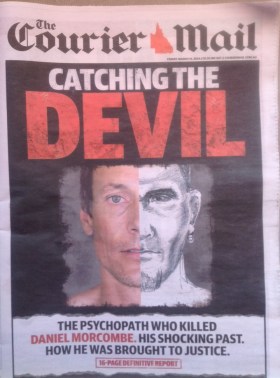
CatchingTheDevil(Morcombefrontpage14-3-14)C-M

Courier Mail front page 14-3-14

We learned yesterday after Brett Peter Cowan was convicted of that 2003 crime that he had served time twice earlier for similar offences.

He is exactly the kind of individual that Hinch wants placed on a public sex offender register for exactly the reason most talkback callers and social media commenters are asking this question: How can we release such individuals anonymously into our communities when we cannot be sure they will not strike again?

Hinch asked it again this morning:

Hinch became the first Australian journalist jailed this millennium for a publishing offence when he was jailed for 50 days refusing to pay a $100,000 fine for breaching a suppression order on the prior convictions of Adrian Ernest Bayley – the accused sex murderer of ABC worker Jill Meagher in Melbourne in 2012.

In 2011 he was sentenced to five months of home detention for publicly naming two sex offenders at a rally and on his website in defiance of such anonymity orders.

In 1987 he was jailed on a contempt of court charge after broadcasting the criminal record of a former priest Michael Glennon accused of child sex offences and implying his guilt in his high rating Melbourne radio program.

It was only by a 4-3 majority that the High Court later stopped short of overturning Glennon’s conviction on those sex charges on the grounds of Hinch prejudicing his fair trial. (Glennon died in jail this year.)

Journalists and media law students have much to learn from the events of the past week.

While the crimes themselves left a trail of human destruction, the Hinch and Morcombe stories make for ideal case studies in a media law module covering open justice, contempt of court and court reporting – the exact module my students will be starting next week.

They will get to research and debate these kinds of important questions that arise from the week’s events:

  • What public policy issues are at play that see a journalist jailed for reporting the past convictions of an individual convicted of a high profile crime?
  • What does such a penalty say about Australia’s standard of media freedom?
  • Why is Australia’s approach to this level of suppression different from that applying in the United States?
  • Why should the mainstream media be prevented from reporting such material when social media platforms and certain websites are full of it?
  • Why would Hinch’s blog and Twitter feed where he breached the suppression orders over Bayley not represent a ‘real risk of prejudice’ to the trial, when mainstream media coverage might do so?
  • How can juries be quarantined from such information and – if they can’t – why shouldn’t the media be allowed to publish it?
  • Do other methods of dealing with juries – judges’ instructions, training, sequestering etc – mean we no longer need to suppress such material?
  • Are the past offences of such criminals matters of such overwhelming social importance and public concern that suppression of the details should be considered contrary to the public interest?
  • Should the Courier-Mail’s front page heading of February 21, 2014 – ‘Daniel’s Killer’ – have forced the trial to be aborted? Should it be grounds for a sub judice contempt charge? Should it be grounds for Cowan’s appeal?
  • How can a journalist report upon such proceedings in an interesting and timely way while navigating the various restrictions that apply?
  • How ‘open’ should ‘open justice’ be in such high profile trials? Should cameras and smartphone recordings be allowed in court? Should tweeting and other social media usage be allowed in court?
  • Is it appropriate in the modern era of communication that a major television network has to rely on a presenter standing outside a courthouse relaying sentencing information to the audience from a court reporter on the inside via telephone?
  • How much social media commentary should be tolerated about such cases while an accused is facing trial?

I’m sure many other questions arise too – and would be keen for other educators, journalists, lawyers and students to use the Comments section here to pose them so my students can take them up in lecture and tutorial discussions.

———–

Disclaimer: While I write about media law and ethics, nothing here should be construed as legal advice. I am an academic, not a lawyer. My only advice is that you consult a lawyer before taking any legal risks.

© Mark Pearson 2014
Leave a comment

Filed under blogging, contempt of court, courts, free expression, media ethics, Media freedom, media law, Press freedom, sub judice, suppression, Uncategorized

The Human Headline legacy – the jailed Hinch, suppression and free expression

By MARK PEARSON

Broadcaster, tweeter, blogger and veteran journalist Derryn Hinch – the self-proclaimed ‘Human Headline’ – has been released from jail after serving a 50 day sentence for breaching a suppression order. 

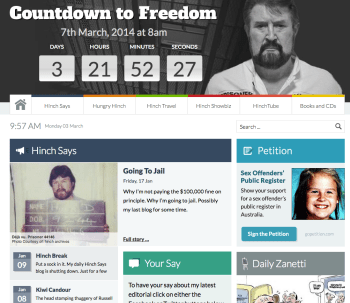
Derryn Hinch's 'Human Headline' blog - Countdown to Freedom

Derryn Hinch’s ‘Human Headline’ blog – Countdown to Freedom

Hinch had refused to pay a $100,000 fine over his blog and Twitter comments including suppressed background material on Adrian Ernest Bayley, accused of the Melbourne murder of Irish woman Jill Meagher.

Hinch has been jailed twice, fined and sentenced to home detention for his contemptuous reportage and commentary about sex offenders over more than a quarter of a century.

While much of the coverage of his prosecutions and trials has focused on his cavalier and principled stance in the vein of his ‘Human Headline’ moniker, he has also been responsible for a body of case law covering sub judice contempt, the naming of a child sexual assault victim and the defiance of suppression orders – in his television and talkback radio programs, blogs and Twitter feeds.

I am preparing a paper for the ANZCA conference in Melbourne in July, reporting on a legal and textual analysis of eight key Victorian and High Court cases involving Hinch as a party in 1986, 1987, 1996, 2011 and 2013.

It reviews these key cases involving Hinch as a defendant and an appellant since 1986 – including Magistrates, Supreme Court, Court of Appeal and two High Court judgments – and identifies the key media law principles shaped in the process.

It concludes that the Hinch legacy is far more significant than his shallow ‘Human Headline’ title suggests – and ventures into important human rights questions arising in the complex legal and moral terrain where free expression, the ‘public interest’ and the ‘public right to know’ compete with an accused’s right to a fair trial, an ex-prisoner’s right to rehabilitation and a child’s right to protection from sexual predators.

For example, Hinch’s appeal to the High Court over his contempt conviction in 1987 was unsuccessful but resulted in a broadening of the public interest defence to sub judice contempt.

His latest case offers an excellent summary of the relevant factors considered in deciding whether there is a real risk of prejudice to a trial, because Hinch was acquitted on a second contempt charge that his blog ‘had a tendency, or was calculated, to interfere with the due administration of justice in the trial of Bayley’.

Victorian Supreme Court Justice Stephen Kaye ruled that three factors combined to reduce the tendency of Hinch’s blogging to prejudice potential jurors: the small readership of the article, the period of delay between the publication of the article and the likely trial date of Bayley, and other prejudicial material about Bayley circulating in the media and social media at the time (para 114). While ‘highly prejudicial’, Justice Kaye had a ‘reasonable doubt’ in light of those three factors that the article would have prevented Bayley getting a fair trial.

I will post updates on this paper as the research and writing unfolds. Meanwhile, no matter what you think of Hinch’s bravado in his naming and shaming of sex offenders, at least this week we should be able to celebrate the release of an Australian journalist from jail.

———–

Disclaimer: While I write about media law and ethics, nothing here should be construed as legal advice. I am an academic, not a lawyer. My only advice is that you consult a lawyer before taking any legal risks.

© Mark Pearson 2014
3 Comments

Filed under blogging, contempt of court, courts, free expression, media ethics, Media freedom, media law, Press freedom, sub judice, suppression, Uncategorized

‘Right speech’, media law and mindful journalism – a work in progress

By MARK PEARSON

Media law is much more than a set of edicts in the form of cases and legislation as presented in many texts and as taught in many courses.

Professional communicators and students can gain insights into the law as it stands – and into how it might be reformed – by tracing it to its origins, revisiting it in its modern context, and by applying fresh perspectives to its analysis. It can also inform their newsroom decision-making on legal and ethical matters.

Screen Shot 2014-02-08 at 10.44.34 AM

Gunaratne’s seminal text – The Dao of the Press. A Humanocentric Theory

Defamation is a good example. Historically, people’s reputations were seen as part of their spiritual beings. As such, defamation proceedings were often brought in the ecclesiastical courts of the Church of England before the Reformation (Rolph, 2008, pp. 39-48.

A stab at someone’s reputation was viewed as an attack on their soul – to be judged only by God’s earthly adjudicators, the clergy. From the 16th century, defamation actions were increasingly brought in the common law courts, with the courts developing a list of allegations with which they would deal, without needing proof of actual damage being caused by the defamation (Morison & Sappideen 1989, p. 173). Yet even today the Catechism of the Catholic Church lists ‘detraction’ (essentially gossip – or disclosing ‘another’s faults and failings to persons who did not know them’) as a sin – or an ‘offense against truth’.

Modern defences to defamation – like truth and qualified privilege – have been shaped by changing cultural, philosophical and political values, with truth as a defence heavily influenced by libertarians like Locke, Mill and Jefferson.

My recent work has involved the investigation of the ways Buddhist ethics might offer a useful framework for both journalism and media law. You can find an excerpt on my paper on ‘mindful journalism’ I presented to last year’s IAMCR convention in Dublin here.

I am not a Buddhist but I have seen the value of its application to modern phenomena and clinical situations like ‘Mindfulness Based Cognitive Therapy’ where meditation techniques have assisted with the treatment of anxiety and depression (Segal et. al, 2013).

Back in 2005 I attempted to use the Tibetan Buddhist mandala as a device to explain the complex competing interests involved when weighing up an issue involving privacy in the newsroom. (Pearson, 2005, see here.)

I have recently attempted to apply a Buddhist framework to the contexts of political blogging and election reportage. Colleague Tom Morton from UTS and I are using mindful journalism as a framework for examining a case study of an individual who wants a ban on his identity overturned by the Mental Health Review Tribunal in NSW.

My interest has come to the attention of a pioneer in the application of Buddhist systems theories to journalism – Professor Shelton Gunaratne – who wrote the seminal work in the field – The Dao of the Press – A Humanocentric Theory – in 2005.

He has compared his designated goals of Buddhist journalism with many of the traits of modern Western journalism in his insightful article in Javnost – The Public in 2009: ‘Buddhist goals of journalism and the news paradigm’.

Prof. Gunaratne has generously asked me to collaborate in a new project on mindful journalism also involving Dr Sugath Senarath from the University of Colombo.

Meanwhile, I will be attempting to articulate some of these principles – particularly the relationship between Buddhist notions of ‘right speech’ to defamation and celebrity journalism – in a paper I’ll be delivering to the Media Talk Symposium to be hosted by Associate Professor Jacqui Ewart in Brisbane on April 23-24 (schedule TBA).

That paper will be titled “Mindful media talk: exploring a Buddhist ‘right speech’ ethic in journalism and social media”. Its abstract reads:

Defamation and privacy laws – and journalism ethics codes – are problematic as guidance tools for news communication in the globalised, multi-cultural and multi-jurisdictional Web 2.0 era. This paper draws upon systems methodology (Gunaratne, 2005) to foreshadow an application of the Buddhist ethic of ‘right speech’ to journalistic and social media communication. The path of ‘right speech’ (samma vaca) was one step in Buddha’s Eightfold Path to enlightenment. However, taken at a secular level, it offers a useful theoretical framework by which to analyse media talk and guidance for those engaging in reportage and citizen journalism. Right speech invokes the avoidance of falsehood, divisive and abusive speech and gossip mongering. This paper explains its elements, distinguishes them from media laws and professional ethical codes, and uses examples to examine the extent to which it might accommodate ‘public interest’ / Fourth Estate journalism and celebrity news.

Watch this space for more posts on ‘mindful journalism’ as we explore its value as an analytical device and – perhaps more importantly – as a newsroom tool for ethical decision-making.

——————–

Key references

Gunaratne, S. A. (2005). The Dao of the Press: A humanocentric theory. Cresskill, NJ: Hampton Press.

Gunaratne, S. A. (2007). A Buddhist view of Journalism: Emphasis on mutual causality. Communication for Development and Social Change 1 (3): 17-38. (Paper originally presented at the University of Queensland on March 8, 2006.)

Gunaratne, S. A. (Feb. 15, 2009). Buddhist principles can revolutionize news and journalism. The Buddhist Channel.  Available at <http://www.buddhistchannel.tv/index.php?id=70,7781,0,0,1,0#.UuMttWTnb-k&gt;

Morison, W.L. & Sappideen, C. (1989) Torts: Commentary and Materials, 7th edn.

Sydney: Law Book Company.

Pearson, M. (2005) The privacy mandala: Towards a newsroom checklist for ethical decisions. Refereed paper presented to the Journalism Education Conference, Griffith University, Tuesday 29th November – Friday 2nd December, 2005, Gold Coast International Hotel, Surfers Paradise, QLD Australia. Available: http://epublications.bond.edu.au/cgi/viewcontent.cgi?article=1263&context=hss_pubs

Rolph, D. (2008). Reputation, Celebrity and Defamation Law. Ashgate: Aldershot. Available: http://books.google.com.au/books?id=d7YO44MvD8QC&source=gbs_navlinks_s

Segal, Z., Williams, M., Teasdale, J. and Kabat-Zinn, J. (2013). Mindfulness-Based Cognitive Therapy for Depression, Second Edition. Guilford Publications: NY.

———–

Disclaimer: While I write about media law and ethics, nothing here should be construed as legal advice. I am an academic, not a lawyer. My only advice is that you consult a lawyer before taking any legal risks.

© Mark Pearson 2014
3 Comments

Filed under blogging, Buddhism, citizen journalism, Eightfold Path, free expression, media ethics, mental health, social media, Uncategorized

The man without a name to get one – a small victory for open justice

By MARK PEARSON

We have won a small victory for open justice by persuading the NSW Mental Health Tribunal to allow the Australian Broadcasting Corporation to use the name of a forensic patient in a Background Briefing program on Radio National next year.

**Update: Tom Morton’s radio documentary ‘The man without a name’ was aired on Radio National Background Briefing on April 20, 2014 and can be heard (and transcript read) here.

We later applied to the Mental Health Review Tribunal for permission to name the patient in our scholarly publications, including this research blog. The Tribunal granted that permission on May 9, 2014 after a hearing to consider our application on 20 March 2014.

We can now reveal that the patient is Mr Saeed Sayaf Dezfouli.

This publication is conditional upon this publication carrying this notice:

“Notice: It is an offence under the Mental Health Act 2007 (NSW) section 162 to publish or broadcast the name of any person to whom a matter before the Mental Health Review Tribunal relates or who appears as a witness before the Tribunal in any proceedings or who is mentioned or otherwise involved in any proceedings under the Mental Health Act 2007 or the Mental Health (Forensic Provisions) Act 1990, unless consent has first been obtained from the Tribunal. The author has obtained such consent to publish Mr Dezfouli’s name.”

MORTON

Dr Tom Morton

[Earlier blog continued … ] Colleague Associate Professor Tom Morton from the University of Technology Sydney and I have been conducting an applied research project about publicity of mental health proceedings – centred upon the case of a Sydney patient who wishes to be identified in reportage on his situation.

We are presenting a progress report on our study at the Journalism Education Association of Australia annual conference in Mooloolaba, Queensland today (December 4, 2013).

Dr Morton is an accomplished radio journalist and has started work on the documentary to be aired in coming months. We are collaborating on the academic side of the project – using my research into mental health reporting and logging our ethical decision-making to create a documented mindful reflection on the project.

Dr Morton briefed ABC lawyer Hugh Bennett who presented our case for the identification of Patient A when we appeared before the Mental Health Tribunal in September.

Section 162 Mental Health Act (NSW) bans ID of anyone involved in either tribunal or forensic proceedings, with further requirements under the Mental Health (Forensic Provisions) Act. A breach can incur a fine of $5500 or a 12 month jail term.

A Supreme Court application for the identification of Patient A had failed in 2012 on technical grounds (A v Mental Health Review Tribunal (2012) NSWSC293).

The Tribunal’s consent to the identification of Patient A appears to be limited to the broadcast, so I am not naming him here.

Patient A is an Iranian refugee who until 2002 was employed at a government office in Sydney.

In 2002 he set fire to that building and a co-worker died of smoke inhalation.

In 2003 the Supreme Court of NSW found that Patient A was unfit to be tried for murder, and a jury subsequently found him not guilty of manslaughter by reason of mental illness. He is thus deemed a ‘forensic patient’ – a person whose health condition has led them to commit, or be suspected of, a criminal offence’ (AIHW, 2010, p. 140).

I have previously published compared the complex array of mental health reporting restrictions in Australia and New Zealand. (See here.)

Last year I compared three cases in WA, Victoria and the UK involving the identification of mental health patients. The case of Patient A has strong parallels with the Albert Lazlo Haines [pdf] case in the UK where a patient won an appeal to be named in reportage of his review proceedings.

This Australian case adds to that body of literature and is interesting from that media law perspective. It also interests us from an ethical perspective, and we will be using it as the focus for an exploration of the application of the principles of ‘mindful journalism’ I have described previously.

We plan to write an academic article on this process to date (the events leading to this Tribunal decision), followed by a research journalism output including an exegesis on mindful journalism ethics after Dr Morton’s Background Briefing documentary has been broadcast. Stay tuned.

———–

Disclaimer: While I write about media law and ethics, nothing here should be construed as legal advice. I am an academic, not a lawyer. My only advice is that you consult a lawyer before taking any legal risks.

© Mark Pearson 2013

3 Comments

Filed under blogging, Buddhism, citizen journalism, Eightfold Path, free expression, media ethics, mental health, social media, Uncategorized