Tag Archives: media freedom

Memo #RSF Paris: Australian media freedom at risk from anti-terror laws

By MARK PEARSON

[Research assistance from media freedom intern Jasmine Lincoln]

Memo to: Benjamin Ismail, Bureau Asie-Pacifique, Reporters sans frontiers (RSF – Reporters Without Borders), Paris.

From: Mark Pearson, RSF correspondent, Australia

RSFlogo-enI regret to advise that several events and policy proposals have impacted negatively on the state of media freedom in Australia.

They are highly likely to threaten Australia’s ranking on your forthcoming RSF World Press Freedom Index.

A raft of new laws and policies proposed by the conservative Abbott Government has placed its stamp on media law and free and open public commentary.

https://twitter.com/JournLaw/status/504463626552373249

The initiatives follow in the steps of the prior Labor Government that had proposed a new media regulatory regime with potentially crippling obligations under the Privacy Act.

In the course of its first year in office the Abbott Government has:

– imposed a media blackout on vital information on the important human rights issue of the fate of asylum seekers;

– initiated major budget cuts on the publicly funded ABC;

– used anti-terror laws to win a ‘super injunction’ on court proceedings that might damage its international relations (see your earlier RSF release on this, which I cannot legally reproduce here for fear of a contempt charge);

– moved to stop not-for-profits advocating against government policy in their service agreements, meaning they lose funding if they criticise the government;

– slated the Office of the Information Commissioner for abolition, promising tardy FOI appeals;

– proposed the taxing of telcos to pay for its new surveillance measures, potentially a modern version of licensing the press;

– proposed ramped up surveillance powers of national security agencies and banning reporting of security operations (See Prime Minister’s August 5 release here);

– proposed increased jail terms for leaks about security matters (you issued a release on July 22 the impact for whistleblowers);

– mooted a new gag on ‘incitement to terrorism’;

– proposed new laws reversing the onus of proof about the purpose of their journey for anyone, including journalists, travelling to Syria or Iraq.

Major media groups have expressed their alarm at the national security proposals in a joint submission stating that the new surveillance powers and measures against whistleblowers would represent an affront to a free press.

Over the same period the judiciary has presided over the jailing of a journalist for breaching a suppression order, the conviction of a blogger for another breach, and several instances of journalists facing contempt charges over refusal to reveal their sources. There have also been numerous suppression orders issued, including this one over a Victorian gangland trial.

Other disturbing signs have been actions by police and departmental chiefs to intimidate journalists and media outlets.

  • The Australian Federal Police raided the Seven Network headquarters in Sydney in February, purportedly in search of evidence of chequebook journalism, triggering an official apology this week.
  • Defence Chief General David Hurley wrote to newly elected Palmer United Party Senator Jacqui Lambie in March, warning her not to use the media to criticise the military.
  • Freelance journalist Asher Wolf received a threatening letter from the secretary for the Department of Immigration and Border Protection (DIBP) Martin Bowles following her co-written article for the Guardian Australia on February  19, 2014 titled ‘Immigration Department data lapse reveals asylum seekers’ personal details.’ The public service mandarin’s letter implied Wolf had obtained the material on which the article was based by ‘dishonest or unfair means’ and demanded Wolf agree not to publish the contents and ‘return all hard and soft copies of the information’ including any her storage devices. See the letter here: WolfDIBP to The Guardian – A Wolf. The Sydney Morning Herald later reported that the DIBP was hiring private contractors to trawl social media and order pro-asylum seeker activists to remove their protesting posts.

I am sure you will agree that these developments are not what we would expect to be unfolding in a Western democracy like Australia where media freedom has previously been at a level respected by the international community.

Kind regards,

Mark Pearson (@journlaw)

—–

Sources for further detail on the national security reforms:

(6 August, 2014). Inquiry into the National Security Legislation Amendment Bill (No. 1) 2014 Submission. Retrieved from: file:///C:/Users/jasmine/Downloads/17.%20Joint%20media%20organisations%20(1).pdf.

Criminal Code Act 1995 (Qld) s. 5.4 (Austl.).

Grubb, B. (19 August, 2014). Anti-leak spy laws will only target ‘reckless’ journalists: Attorney-General’s office. Retrieved from: http://www.smh.com.au/federal-politics/political-news/antileak-spy-laws-will-only-target-reckless-journalists-attorneygenerals-office-20140818-1059c7.html.

Grubb, B. (30 July, 2014). Edward Snowden’s lawyer blasts Australian law that would jail journalists reporting on spy leaks. Retrieved from: http://www.smh.com.au/digital-life/consumer-security/edward-snowdens-lawyer-blasts-australian-law-that-would-jail-journalists-reporting-on-spy-leaks-20140730-zyn95.html.

Hopewell, L. (17 July, 2014). New Aussie Security Laws Would Jail Journalists for Reporting on Snowden Style-Leaks. Retrieved from: http://www.gizmodo.com.au/2014/07/new-aussie-security-laws-would-jail-journalists-for-reporting-on-snowden-style-leaks/.

Murphy, K. (17 August, 2014). David Leyonhjelm believes security changes restrict ordinary Australians. Retrieved from: http://www.theguardian.com/world/2014/aug/17/david-leyonhjelm-security-changes-restrict-australians.

Parliament of Australia (15 August, 2014). Parliamentary Joint Committee on Intelligence and Security, 15/08/2014, National Security Legislation Amendment Bill (No. 1) 2014. Retrieved from: http://parlinfo.aph.gov.au/parlInfo/search/display/display.w3p;adv=yes;db=COMMITTEES;id=committees%2Fcommjnt%2F2066f963-ee87-4000-9816-ebc418b47eb4%2F0002;orderBy=priority,doc_date-rev;query=Dataset%3AcomJoint;rec=0;resCount=Default.

The Greens (1 August, 2014). Brandis presumption of terror guilt could trap journalists, aid workers. Retrieved from: http://greens.org.au/node/5617.

https://twitter.com/richardaedy/status/504514808532566018

https://twitter.com/deanprocter/status/504516241269071874

https://twitter.com/RobMax4/status/504522206290788352

https://twitter.com/JournLaw/status/504547130518679552

https://twitter.com/MmichaelLlucy/status/504514567515287552

https://twitter.com/apicot/status/504514324786728960

https://twitter.com/JLLLOW/status/504514037825019904

https://twitter.com/NadyatEl/status/504489933776510976

https://twitter.com/bjbrike/status/504472790842355712


© Mark Pearson 2014

Disclaimer: While I write about media law and ethics, nothing here should be construed as legal advice. I am an academic, not a lawyer. My only advice is that you consult a lawyer before taking any legal risks.

4 Comments

Filed under free expression, national security, Press freedom, terrorism, Uncategorized

Maintain the rage: support for Greste heartening, but needs to be escalated. Sign up. #FreeAJStaff

By MARK PEARSON

Additional research by journalism student MELANIE WHITING

AS Australian journalist Peter Greste languishes in an Egyptian jail just three weeks into his seven year sentence for simply doing his job reporting for Al Jazeera, it was heartening to see friends and colleagues rally in his support in Melbourne yesterday (July 14).

Clearly, the problem faced by all such political prisoners is that pressure for their release can diminish after their initial sentence disappears from the news agenda.

Almost 11,000 people have now signed the Canadian Journalists for Free Expression (CJFE) petition for the release of Greste and his colleagues, which will be sent tomorrow (July 16). Please go to http://www.thepetitionsite.com/583/945/591/fr/ and sign it.

In the days following the verdict political leaders including US Secretary of State John Kerry and Australian Prime Minister Tony Abbott expressed shock and condemnation over the Egyptian court’s decision on June 23.

Labor foreign affairs spokesperson Tanya Plibersek has been supportive and Greens leader Christine Milne has called upon the Abbott Government to escalate its diplomatic efforts on Greste’s behalf.

Media companies, unions and free expression groups have been united in their push for the release of Greste and his Al Jazeera colleagues.

Representatives of News Corp Australia and Fairfax Media told AdNews they saw the  sentence as a threat to press freedom.

The Media Entertainment and Arts Alliance (MEAA) issued a statement on their website condemning the verdict and maintained that Greste had acted as an ethical and responsible journalist.

A group of top international journalists united to send a letter to the Egyptian President asking for Greste and his colleagues to be released.

Petitions are important, so please sign any or all of these:

Go ahead – please sign them all NOW!

[The MEAA petition at http://www.alliance.org.au/peter-greste-petition has now closed.]

© Mark Pearson 2014

Disclaimer: While I write about media law and ethics, nothing here should be construed as legal advice. I am an academic, not a lawyer. My only advice is that you consult a lawyer before taking any legal risks.

Leave a comment

Filed under free expression, journalism, Media freedom, Media regulation, national security, Press freedom, suppression, terrorism, Uncategorized

Threats to media freedom in Australia so far in 2014

This semester I have had the privilege of working with two capable press freedom interns who have been helping me research my reports to Reporters Without Borders in Paris as their Australian correspondent.

Reporters-Without-BordersHere is a summary of the posts from TONI MACKEY and EVE SOLIMAN:

13/03/2014

ABC’s Two Independent Audits Clear Accusation of Biased Coverage

There were two cases where ABC was accused of having a biased coverage. These cases were the news coverage of the 2013 Election against the Prime Minister Tony Abbott and the news coverage on Australian Asylum Seeker issues. Andrea Wills conducted an audit of 23 items that involved radio coverage of the 2013 election and found the items all followed the ABC’s Editorial Policies found in section 4. Gerald Stone conducted the audit on the asylum seeker issue and analysed 97 reports. He found the 93 were unbiased and followed ABC’s Editorial Policies. Source: http://www.theaustralian.com.au/media/audits-exonerate-abc-over-bias-claims/story-e6frg996-1226852398864

Malcolm Turnbull’s Media Reform

Malcolm Turnbull is proposing media reforms however Labor is opposing them because they are worried that it will affect local TV news. These reforms could affect Nine Entertainment, Seven West Media and the Ten Network in preventing them owning regional affiliates. Turnbull is also considering repealing the laws that prevent anyone from owning two out of three media outlets in the one market. Source: http://www.theguardian.com/world/2014/mar/12/malcolm-turnbull-has-opened-a-can-of-worms-on-media-reform-labor

 18/03/2014

Rinehart’s Court Order to help the introduction of uniform shield laws

Mining magnate Gina Rinehart demanded Adele Ferguson to release her sources, however a court has ruled in Ferguson’s favour with Rinehart’s business having to pay all of her court costs. This case is also being used in support of uniform shield laws for journalists throughout Australia. There have been several previous cases in Australia where journalists have been threatened and charged over not releasing sources. Source: http://www.abc.net.au/news/2014-03-15/rinehart-ordered-to-pay-journalist27s-costs/5323084

Politician warned over releasing media statements regarding the military unless given permission

Defence Chief General David Hurley has warned the newly elected Jacqui Lambie against using the media to criticise the military. This was after she released a statement about abuse being an intractable problem in the forces. He sent her a letter stating that if she had any problems with the military then she should take them up with him and not via the media. Source: http://www.abc.net.au/news/2014-03-14/tasmanian-senator-elect-jacquie-lambie-labels-a-letter-from-the/5320106?section=tas

26/03/2014

Proposed Legislation Changes Freedoms on Hate Speech

Section 18C of the Racial Discrimination Act –  making it illegal to publicly offend, insult, humiliate on the grounds of race – has been slated for removal in a reform. The proposed legislation states : “it is unlawful for a person to do an act, otherwise than in private, if a) the act is reasonably likely (i) to vilify another person or a group of persons; or (ii) to intimidate another person or group of persons.” Section 18D would be repealed and replaced with “ this section does not apply to words, sounds, images, or writing spoken, broadcast, published or otherwise communicated in the course of participating in the public discussion of any political, social, cultural, religious, artistic, academic or scientific matter.” Source: http://www.abc.net.au/news/2014-03-25/racial-discrimination-act-changes-george-brandis/5343464

01/04/2014

Prime Minister Supports Australian Journalist in Egyptian Jail

Prime Minister Tony Abbott has finally intervened and asked the Egyptian President for the release of journalist Peter Greste. The President has assured Tony Abbott that Greste’s case would be subject to a fair and just trial. He has assured Greste’s family that he would receive all the legal support and assistance that is needed. This comes after a previous article reporting the Opposition Labor Party had pushed for the PM to intervene. They have also declared their support and assistance towards this matter. Source: http://www.heraldsun.com.au/news/breaking-news/grestes-family-hail-pms-intervention/story-fni0xqi4-1226867971205?from=herald+sun_rss

02/04/2014

Gag Order involving Gangland Lawyer X by the Victorian Supreme Court placed on Media Outlets

The Herald Sun  in Melbourne has received a gag order from the Victorian Supreme Court. This order is to prevent publication of any information involving Lawyer X which could give away his identity. This order was extended to all media outlets the following day. It is suspected that the lawyer was a police informant from 1996 to 2010. Source: http://www.heraldsun.com.au/news/victoria/herald-sun-silenced-in-latenight-court-case-from-telling-you-more-about-lawyer-x/story-fni0fit3-1226871611414


08/04/2014

Dob in a public servant campaign

Public servants have been urged to dob in their colleagues for posting political criticisms on social media. This comes under the Australian Public Service Code of Conduct and breaches of this act include “harsh or extreme in their criticism of the Government, Government policies, a member of parliament from another political party, or their respective policies, that they could raise questions about the employee’s capacity to work professionally, efficiently or impartially.” It covers posts that are made on facebook, twitter, youtube, pinterest, flikr, blogs, forums and wikipedia. Source: http://www.dailytelegraph.com.au/news/nsw/colleagues-told-dob-in-political-web-posts/story-fni0cx12-1226875635588

Seven Network’s reputation damage by the Australian Federal Police

Seven Network suffered damages to its reputation after an Australian Federal Police raid that was looking for evidence of a deal with Schapelle Corby. The network says that even if there was a deal, there was no criminal offence and that because of the raid it has suffered damage to its corporate image from it imply they have committed an offence. They stated that they complied with the instructions to hand over documents to the AFP, however it was implied that there was further material that was being withheld. Source: http://www.theguardian.com/world/2014/apr/07/seven-network-says-it-suffered-reputational-damage-after-afp-raids

09/04/2014

Mamma Mia Faces Possible Contempt of Court

Mamma Mia journalist Kate Leaver’s article included alleged prejudicial remarks on the Hughes case. At this time however the jury was still in session, the article was published with a headline that did not state the subject of Robert Hughes which meant that the jury members could have been exposed to biased information. Coverage on this possible conviction of contempt of court was banned to be reported on until after the trial was over. The article involved accusations against Hughes’ wife. Judge Zahra referred the matter to the NSW Attorney General Source: http://mumbrella.com.au/mamamia-face-possible-contempt-court-charges-robert-hughes-case-219065

15/04/2014

Clive Palmer may back Cross Media Law Changes

Clive Palmer has said that he is considering voting for the repeal of cross media ownership. This is because of the introduction of new media outlets such as internet. Source: http://www.smh.com.au/business/media-and-marketing/clive-palmer-mulls-vote-for-cross-media-law-change-20140407-368xn.html

Journalist Wins First Round in Court Case

Natalie O’Brien has sued ABC’s Media Watch over defamatory remarks critiquing her reporting. She has won the first round of legal battles. This is in regards to her report over poisonous chemicals detected near a children’s playground in July last year. Source: http://www.theaustralian.com.au/media/broadcast/journalist-wins-first-round-in-court-case/story-fna045gd-1226883045684#

13/05/2014

Australian Journalist Deported

An Australian journalist was deported from Myanmar. This was because he was covering a press freedom demonstration. The authorities accused him of breaching the terms of his business visa. They believe that he was taking part in the demonstration. This follows a previous journalist working for the same website Democratic Voice of Burma, being sentenced a year in jail. Source: http://www.abc.net.au/news/2014-05-09/australian-journalist-deported-from-myanmar/5440830

Photographer attacked

The photographer  Sam Mooy was taking photographs of former boyfriend of previous PM Julia Gillard. Bruce Wilson is reported to have just lashed out and struck the photographer’s equipment, grabbed him by the collar and attempted to strike him. Source: http://www.theaustralian.com.au/national-affairs/policy/julia-gillards-exboyfriend-bruce-wilson-attacks-photographer/story-fn59noo3-1226914699235

20/05/2014

A Senate Inquiry found that the AFP bungled the raid on the Seven Network and that sources should be protected.

A government inquiry has found that the AFP raid on Seven network attempting to gather evidence of chequebook journalism being used in an exclusive interview with Schapelle Corby was incompetent and costly. The inquiry also found that sources should be protected in the case of such raids. Source: http://www.theaustralian.com.au/media/afp-bungled-seven-network-raid-and-sources-should-be-protected-senate-inquiry-finds/story-e6frg996-1226919836654#mm-premium

21/05/2014

Budget Cuts Get Rid of Office of the Australian Information Commissioner

The Federal Budget has called for the disassembly of the Office of the Australian Information Commissioner by 1 January 2014. This is an effort to save $10.2 million a year. This dissolution means the duties will have to be relocated to four other bodies. Source: http://www.smh.com.au/it-pro/government-it/abbott-government-uncomfortable-with-freedom-of-information-laws-opposition-20140514-zrc1r.html

27/05/2014

Treasurer Joe Hockey Suing Fairfax

Treasurer Joe Hockey is suing Fairfax over articles published that defamed him. They are about a fundraising event alleging in exchange for donations the donors gained access to him. He believes he has been greatly injured, shunned and avoided. His lawyers say his reputation has been brought into disrepute, odium, ridicule and contempt. He is claiming damages, interest and costs. Source: http://www.theaustralian.com.au/media/the-media-debate-over-hockey-suing-fairfax/story-e6frg996-1226931129296#

Budget Media Cuts

Treasurer Joe Hockey’s budget contains a 1% cut to ABC and SBS funding for the next four years. Although this may seem minute in reality this also includes the media outlet not benefiting from the 3% inflation rate adjustments and remaining stagnant. The 1% cut amounts to an annual decrease of $9 million the first year, also the complete cancellation of funding for The Australia Network. ACMA (The Australian Communications and Media Authority) also is receiving a $3.3 million cut over four years. Source: http://www.theaustralian.com.au/media/abc-news-to-feel-effect-of-australia-network-axe/story-e6frg996-1226917173980

Asher Wolf Case

Asher Wolf is a freelance journalist reporting of privacy breaches made by the Department of Immigration. However they then demanded Asher Wolf to hand over the materials relevant to the story. This breach was found on the Department of Immigration’s website where complete personal information of over 10,000 (1/3) of Australia’s asylum seekers with full name, birth date, arrival, placement etc. was accessible to unauthorized personnel. Source: http://www.theguardian.com/world/2014/feb/19/asylum-seekers-identities-revealed-in-immigration-department-data-lapse

Morcombe’s publicly call for a Change in Laws

Father of murdered schoolboy Daniel Morcombe, Bruce Morcombe,  has publicly pleaded for a change in law to allow juries to know about a defendant’s past crimes when they are on trial. Morcombe believes that “members of the public are smart enough to hear the truth in court”. During the murder trial the jury heard about the past crimes of another suspect, but not of the defendant’s. Source: http://www.theaustralian.com.au/news/bruce-morcombe-calls-for-jurors-to-hear-past-crimes-of-defendants-after-his-son-daniels-killer-brett-peter-cowan-was-tried-without-his-criminal-history-being-revealed/story-e6frg6n6-1226905141811

Government Snooping

Accusations have arisen regarding Government bodies snooping on the public’s social media pages. It started from a tweet from the Department of Immigration and Border Protection (DIBP) to a pro-asylum seeker activist that gave the impression that they had seen posts on her private Facebook page. On April 4 2014, the DIBP sent Vanessa Powell a twitter message stating “it’s come to our attention that a Facebook post on your wall contains an offensive remark directed at a staff member”.  The tweets from the DIBP stated “If you do not remove your Facebook post with immediate effect, we will consider our options further” and “Post in question is dated yesterday, with a picture of a bus and contains a comment by George Georgiadis”.  This last tweet is in response to Ms Powell asking what tweet they were referring too. This post has since been removed from Ms Powell’s Facebook page. According to a Sydney Morning Herald article the DIBP hires private contractors who monitor social media every day to determine Australian perceptions on different policies. Source: http://www.smh.com.au/national/public-service/government-cyber-snoops-scouring-social-media-20140410-36gen.html

Australia-based African Defamation Case

Australian- based Zimbabwe African National Union Patriotic Front writer Reason Wafawarova is being sued for defamation by former Zimbabwe Envoy ambassador Jacqueline Zwambila. Zwambila filed for a lawsuit back in 2011 where she claimed that Wafawarova defamed her in an article published in the Zimbabwean state media in 2010. This article claimed that a former Zimbabwean envoy had stripped in front of embassy staff. She has claimed that the article has followed her around, her name had been stigmatised and that it had taken dignity away from the country. Wafawarova has said that he is unable to receive a fair trial because his witnesses are Zimbabwean diplomats that have since been redeployed from the embassy and that their governments had refused his request for their appearances. He has also argued that the article was about something that happened on Zimbabwean soil and in a Zimbabwe newspaper so therefore Australia should have no jurisdiction over the matter. Source: http://www.swradioafrica.com/2014/05/12/former-envoy-sues-zanu-pf-writer-for-200000/

Senator Faulkner and Spy Cameras

Senator Faulkner has accused the Department of Parliamentary Services (DPS) of spying on him using CCTV cameras, which he says is a breach of parliamentary privilege. The head of DPS has been questioned by Senator Faulkner in a Senate Estimates hearing, where she has admitted to the footage being accessed “to gather evidence in a potential code of conduct case around an individual, yes”. It is believed by media that the reason behind this was to identify a whistleblower who was leaking information to the Senator. Source: http://www.theaustralian.com.au/national-affairs/parliamentary-cameras-monitored-john-faulkner-with-whistleblower/story-fn59niix-1226931722580#

Fairfax Defamation Cases

Nick Di Girolamo who was the former chief executive of Australian Water Holdings is also suing Fairfax media in a $12.5 million defamation suit. He says that his reputation was trashed by stories published in the Sydney Morning Herald. These stories were from 2012 and 2013 and investigated involvement of the corrupt former Labor Minister Eddie Obeid in the water company. Sources: http://www.theguardian.com/world/2014/may/23/nick-di-girolamo-launches-125m-defamation-suit-against-fairfax-mediahttp://www.theaustralian.com.au/media/media-diary/obeids-to-sue-fairfax-for-50m/story-fnab9kqj-1226931115298#

Australian journalists face the possibility of extra delays in their freedom of information appeals with Australian federal budget cuts doing away with the Office of the Australian Information Commissioner (OAIC) by January 2015.

The cut is meant to save $10.2 million a year, but dissolving  the OAIC will mean the duties that the agency carried out will have to be shifted into four other bodies.

The privacy functions that are carried out by the Privacy Commissioner will continue as an independent legislative position within the Human Rights Commission.

The external examination of Freedom of Information (FOI) will be adopted by the Administrative Affairs Tribunal.

The Commonwealth Ombudsman will take the responsibility of filing and treatment of FOI complaints.

The last function will be divided into the Attorney General’s Department, whose responsibility will include the administering of “FOI guidelines, collecting statistics and providing explanatory material on the operation of the Freedom of Information Act 1982” (Office of the Information Commissioner disbanded as part of budget reforms, Ashurst Australia).

The budget cuts aimed at saving $10.2 million annually but will only save $3.3 million in direct financing this year and the cost of financing the continued duties, once carried out by the federal budget will be passed onto the four separate departments that it absorbed into. Source:

http://www.oaic.gov.au/news-and-events/statements/australian-governments-budget-decision-to-disband-oaic/australian-government-s-budget-decision-to-disband-oaic

© Toni Mackey and Eve Soliman 2014

Leave a comment

Filed under Uncategorized

Budget cuts to FOI body could prompt delays

By guest blogger EVE SOLIMAN – press freedom intern

Australian journalists face the possibility of extra delays in their freedom of information appeals with Australian federal budget cuts doing away with the Office of the Australian Information Commissioner (OAIC) by January 2015.

The cut is meant to save $10.2 million a year, but dissolving  the OAIC will mean the duties that the agency carried out will have to be shifted into four other bodies.

The privacy functions that are carried out by the Privacy Commissioner will continue as an independent legislative position within the Human Rights Commission.

The external examination of Freedom of Information (FOI) will be adopted by the Administrative Affairs Tribunal.

The Commonwealth Ombudsman will take the responsibility of filing and treatment of FOI complaints.

The last function will be divided into the Attorney General’s Department, whose responsibility will include the administering of “FOI guidelines, collecting statistics and providing explanatory material on the operation of the Freedom of Information Act 1982” (Office of the Information Commissioner disbanded as part of budget reforms, Ashurst Australia).

The budget cuts aimed at saving $10.2 million annually but will only save $3.3 million in direct financing this year and the cost of financing the continued duties, once carried out by the federal budget will be passed onto the four separate departments that it absorbed into.

The Attorney General’s Office will be funding $500,000 this year and $900,000 annually in the following years, the Human Rights Commission will contribute $2.7 million in 2015 and around $5.5 million annually the following years and the Administrative Appeals Tribunal will pay $300,000 this year and half a million dollars annually in the following years.

The reasons behind the budget cut can only be speculated, but could have a negative impact on the freedom of information and ways that the functions can be met.

A major critique by the government, agencies and other commentators on the OAIC, is that it has been inefficient in delivering information and reviewing FOI applications.

But despite claims of the OAIC’s efficiency, or viewing the institution as unnecessary there is copious amounts of evidence on the accomplishments and progress of OAIC to counter the arguments.

The completion of cases per day has increased from .37 cases in the first year and a half of its establishment, to 4.7 cases per day, the completion and cessation of FOI requests and privacy complaints also increased substantially.

The OAIC was formed in 2010 as an independent bureau within the Attorney General’s Department that’s purpose involved several elements of information dispersal and management: privacy, FOI and policy.

Predating the formation of the OAIC, the Privacy Commissioner belonged to the Human Rights Commission. The OAIC has 76 staff.

The OAIC has accomplished many things within the spectrum of privacy, freedom of information and information policy.

The agency had conducted an audit of the information management policies belonging to 191 Australian government agencies.

OAIC also resolved a total of 1,191 appeal applications and requests for information and published the reasoning for 186 of those cases, handled 4521 phone enquiries and 1891 written enquiries involving freedom of information and closed 394 FOI complaints.

In 2011, the OAIC hosted a National Information Policy Conference, that was attended by hundreds of people and created and dispersed the Principles on open public sector information which the government utilises and relies on.

References:

http://www.oaic.gov.au/news-and-events/statements/australian-governments-budget-decision-to-disband-oaic/australian-government-s-budget-decision-to-disband-oaic

file:///C:/Users/Eve/Downloads/Privacy%20Update%20-%2014%20May%202014.pdf

http://www.smh.com.au/it-pro/government-it/abbott-government-uncomfortable-with-freedom-of-information-laws-opposition-20140514-zrc1r.html

http://www.abc.net.au/pm/content/2014/s4005459.htm

http://www.zdnet.com/budget-2014-oaic-disbanded-as-privacy-foi-oversight-redistributed-7000029426/

© Eve Soliman 2014

Leave a comment

Filed under Uncategorized

How the ABC cuts will damage media freedom in the region

By MARK PEARSON Follow @Journlaw

[Thanks to press freedom intern Eve Soliman for her research assistance here.]

One of the saddest aspects of Tuesday’s budget cuts to the ABC and SBS and the axing of the $220 million Australia Network contract is the impact on media freedom in the Asia-Pacific region.

Screen Shot 2014-05-16 at 11.13.07 AMAmong the Australian values the Australia Network has advocated to neighbouring countries has been the effective operation of a genuinely independent national broadcaster – funded by the government yet producing high quality Fourth Estate journalism exposing corruption and questioning policy in the public interest.

Its current affairs schedule has included top shelf news and current affairs programs like 7.30, Dateline, Lateline, Foreign Correspondent, Q&A, The World This Week and of course ABC News Breakfast. Add to that the online curation via the Australian News Network website and you have a showcase of the media playing a watchdog role in a functioning democracy.

Many of the countries receiving the Australia Network fare much worse than Australia’s 28th position on Reporters Without Borders (RSF) World Press Freedom Index, including Vietnam (174th), Singapore (150th) and Malaysia (147th).

These are nations where ‘public broadcasting’ means something quite different and journalists are subjected to licensing regimes and even jail, with 232 imprisoned in Vietnam in 2012 and, according to the Committee to Protect Journalists, more this month.

Our quality public broadcasting content has operated as an exemplar of how journalism can work in a properly functioning democracy.

The Australia Network commitment was one of the few budgetary investments in media freedom made by this country – and now it is gone.

So too will many journalism jobs if ABC management is unable to find further cuts in its tight administrative budget – which is unlikely according to managing director Mark Scott.

The Budget announcement that the ABC was suffering only a 1 per cent cut over four years might not sound much, but this needs to be combined with inflation of around 3 per cent increasing operating costs.

Anyone familiar with compound interest would understand that this 4 per cent annual deterioration represents an escalating erosion of the ABC’s budget over that period – down to 96% of its current budget in the first year, 92% in the second, 88% in its third, and 84.5% in the fourth.

You can see how – when combined with inflation – the 1 per cent haircut actually becomes a 15% decrease over those four years.

That means either fewer staff, fewer programs, or low cost junior personnel replacing experienced colleagues at the public broadcasters in coming years.

Australia Network viewers seem less likely to have the opportunity to view some of the Walkley Award winning reportage brought to them through its programming in recent years.

Our Asian and Pacific neighbours have been witness – via the Australia Network – to corruption being exposed in all quarters by leading Australian journalists whose media organizations are now under threat.

The network also relayed other news stemming from the work of Kate McClymont of the Sydney Morning Herald which led to many of the recent revelations by the Independent Commission Against Corruption (ICAC).

They have also heard news of the Royal Commission into Child Abuse – also triggered by top notch investigative reporting by the Newcastle Herald’s Joanne McCarthy.

But recent Fairfax redundancies and pressures on other news organizations combines with this Budget decision to send a somber message to the region  – the quality and quantity of news and current affairs in this Western democracy is on the decline.

It will be interesting to see how this development feeds into Australia’s ranking in the 2015 RSF World Press Freedom Index.

Disclaimer: While I write about media law and ethics, nothing here should be construed as legal advice. I am an academic, not a lawyer. My only advice is that you consult a lawyer before taking any legal risks.

© Mark Pearson 2014

2 Comments

Filed under Uncategorized

Why Australians should care about World Press Freedom Day: My blog for No Fibs

By MARK PEARSON Follow @Journlaw

CITIZEN journalism site No Fibs has just posted my latest blog on today’s international marking of World Press Freedom Day.

It got a nice nod from Paul Barry of ABC’s Media Watch. Cheers Paul!

You can view the full piece here, but here is a taste:

—-

Readers of the NoFibs site reap the rewards of citizen journalists expressing their news and views with a high level of free expression by world standards.

So why should Australians care about media freedom on World Press Freedom Day 2014?

Quite simply, because it is a ‘fragile freedom’ – continually under threat and only noticed by most people once they have lost it.

Just ask any of the refugees who have fled to Australia over the past century from regimes that have robbed them of their human rights. One of their first responses is typically that they love their new home country because it is ‘free’ and they can express themselves freely here.

Screen Shot 2014-05-05 at 4.50.16 PMWhen you look at international indices of media freedom like that of Reporters Without Borders, Australia (ranked 28th) sits in stark contrast to the censorship and intimidation of journalists in many other countries like Vietnam (174th), China (175th) and Somalia (176th).

Journalists are not usually jailed in this country (although Melbourne broadcaster and blogger Derryn Hinch was a recent exception) – and they are certainly not tortured or murdered for exercising their right to free expression here.

At least in Hinch’s case he was duly tried and convicted (for breach of a suppression order) in a legal system that is open, just and in accordance with the rule of law.

The same cannot be said of another jailed Australian journalist, Peter Greste, who remains in jail in Egypt after 130 days along with five of his Al Jazeera media colleagues (and 14 others) on trumped up charges of defaming the country and of consorting with the Muslim Brotherhood.

While Greste’s plight has been highlighted here because of his nationality, he is just one of 168 journalists jailed throughout the world this year for just doing their job. The expression ‘shoot the messenger’ takes on a chilling reality when you also consider the 25 journalists, bloggers and citizen journalists killed already in 2014.

Australia’s relatively good performance in these press freedom rankings belies the fact that there are ongoing and emerging threats to free expression.

… and that’s just half of it. Read the full blog at No Fibs.

Disclaimer: While I write about media law and ethics, nothing here should be construed as legal advice. I am an academic, not a lawyer. My only advice is that you consult a lawyer before taking any legal risks.

© Mark Pearson 2014

Leave a comment

Filed under Uncategorized

Threatening letters from officialdom chill free expression – @journlaw blog #MLGriff

By MARK PEARSON Follow @Journlaw

[With research assistance from RSF interns Toni Mackey and Eve Soliman]

Intimidating letters sent by two of Australia’s most senior public servants in recent weeks sound alarm bells for free expression and a free media.

The first – from the secretary for the Department of Immigration and Border Protection Martin Bowles – was directed to freelance journalist Asher Wolf following her co-written article for the Guardian Australia on February  19, 2014 titled ‘Immigration Department data lapse reveals asylum seekers’ personal details‘.

The database Wolf had sourced via the Department’s own public website contained personal details of one third of all asylum seekers held in Australia – almost 10,000 adults and children.

The department secretary’s letter implied Wolf had obtained the material on which the article was based by ‘dishonest or unfair means’. She says the data was simply sitting on the department’s website. Bowles demanded Wolf agree not to publish the contents and ‘return all hard and soft copies of the information’ including any her storage devices.

You can view the letter here: WolfDIBP to The Guardian – A Wolf.

And in this 11 minute interview Wolf explains the episode in her own words:

On advice from her lawyers she wrote back, refusing to provide the department with anything and cited her ethical obligation as a journalist to protect her sources. To date there has been no further word from the department since that February 26 reply.

Wolf explained to @journlaw: “The response from the Government was to reframe the issue rather than sort of saying ‘whoops we made a mistake, sorry, let’s fix it up’. It was to frame it as though it had been illicitly accessed, that the confidential information had to be given back, that the files had to be given back.”

The second intimidating letter was to a politician rather than a journalist, but is no less alarming for its potential chilling effect on free expression – and all the more alarming because it involved a military chief writing direct to a senator-elect.

Chief of the Australian Defence Force General David Hurley wrote to Palmer United Party senator-elect Jacqui Lambie on March 7, following the Tasmanian politician’s claims in a media release that sexual abuse in the military was ‘an intractable problem’.

His letter stated he was disappointed she issued a media release before raising her concerns with him and encouraged her to first provide him an opportunity to reply to any such claims in the future. See the letter here: HurleyToLambieLetter

In her response (LambieReply to Australia’s Chief of Defence’s letter of complaint), Lambie – a former soldier – described General Hurley’s letter as disrespectful, condescending and improper.

“For you as the head of our defence force to take the unprecedented and extraordinary step of trying to influence an elected member of parliament by sending a letter with such a patronizing and condescending tone is a disgrace,” she wrote.

She raised the possibility of the letter constituting a contempt of parliament as an improper interference “with the free performance by a senator of the senator’s duties as a senator”.

Of course, that might be too long a stretch, but it is certainly of concern when top military and immigration officials start writing direct to journalists and politicians chiding them for their public statements and implying some wrongdoing on their part.

It is spin and ‘media management’ gone way too far – and is symptomatic of nations far lower down Reporters Without Borders’ World Press Freedom Index than Australia’s.

Both Immigration Secretary Bowles and General Hurley undoubtedly have a host of excuses for penning those letters. Bowles was clearly trying to limit the damage from the privacy leak, and indeed has obligations under the Privacy Act to demonstrate his department has done what it can to retrieve leaked information and minimise any damage caused. Hurley was clearly frustrated by a politician’s insistence on making unspecified claims of abuse when there were inquiries and other avenues for complaints to be made.

But many other strategies were available to them to deal with these issues short of writing stern reprimands from their own desks, directly to a journalist and a politician. The democratic doctrine of ‘separation of powers’ is somewhat blurry in Australia, and it is made all the more so when senior members of the executive engage in public spats with the media and politicians.

I cannot imagine that such high level officials would not realise, or be advised, that their intimidating letters would not reach the public domain. If they thought they would remain secret, then we must ask important questions about how frequently this technique is being used. If they understood their letters would likely go public, then the threat to free expression is all the more chilling.

Disclaimer: While I write about media law and ethics, nothing here should be construed as legal advice. I am an academic, not a lawyer. My only advice is that you consult a lawyer before taking any legal risks.

© Mark Pearson 2014

Leave a comment

Filed under free expression, Media freedom, Media regulation, Uncategorized

10 mins with Journlaw: RSF correspondent Bob Howarth discusses media freedom and Timor Leste

By MARK PEARSON Follow @Journlaw

IN the latest episode of 10 Minutes With Journlaw, I interview Reporters Without Borders correspondent for Timor Leste about media freedom issues there and elsewhere in the region.

Screen Shot 2014-03-07 at 3.09.20 PM

10 Minutes With Journlaw: Mark Pearson interviews RSF correspondent Bob Howarth

Howarth is a veteran newspaper reporter, editor and manager who has worked throughout the Australia-Asia-Pacific region for more than four decades.

He is Reporters Without Borders (RSF) correspondent for Papua New Guinea, Timor Leste and the Solomon Islands.

In this interview we talk about media freedom issues in the region.

(10 mins, recorded 6 March 2014).

[See a summary of my speech to last October’s journalism congress in Timor Leste in my earlier post].

Read Lindsay Murdoch’s March 5 story in The Age about the state of media freedom in East Timor here.

Disclaimer: While I write about media law and ethics, nothing here should be construed as legal advice. I am an academic, not a lawyer. My only advice is that you consult a lawyer before taking any legal risks.

© Mark Pearson 2014

Leave a comment

Filed under Uncategorized

Timor-Leste journalists decide on ethics code and press council as tougher laws loom

By MARK PEARSON Follow @Journlaw

AN historic congress of Timor-Leste journalists held in Dili over the weekend (October 25-27) voted for their first code of ethics and a seven-member press council.

But the next hurdle for media freedom in the small Asia-Pacific nation will be a press law currently before the national parliament which it is feared will feature a journalist licensing system and criminal penalties.

20131027-201852.jpg

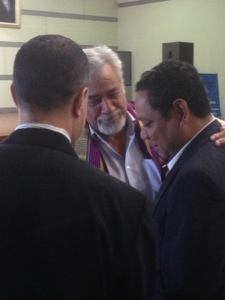
Timor-Leste PM Xanana Gusmao greets officials at the national journalists’ congress on Friday. Photo © Mark Pearson 2013

The media law proposed by a committee of journalists advising the government featured self-regulatory controls. However, the final version includes amendments proposed by the Secretary of State for Social Communication, Mr Nélio Isaac Sarmento, rumoured to include the licensing and criminal sanctions.

Opening the congress on Friday, Prime Minister Xanana Gusmao scolded journalists for not having developed adequate self-regulation when he had warned them to do so in 2009.

But he congratulated the media associations on their latest efforts to unify for a code of ethics and press council; stating that press freedom was important to democracy, but that freedom should be exercised responsibly.

More than 150 journalists in attendance on Sunday – representing several journalism associations – voted for the 10 point code of ethics, featuring a preamble affirming the importance of free expression and media self-regulation and clauses on: accuracy and impartiality, opposition to censorship, defence of the public interest, anti-discrimination, separation of fact from opinion, confidentiality of sources, quick correction of inaccuracies, rejection of plagiarism, protection of identity of victims, and rejection of financial inducements.

That final clause will present major challenges for Timor-Leste journalists, many of who freely admit to accepting payments from politicians for positive coverage.

Media sources say reporters are often paid US$5-20 at press conferences and up to US$40 by officials when accompanying ministers on tours to the provinces.

Such payments represent a substantial influence, given media outlets only pay their reporters about US$140 per month plus lunch and travel expenses.

Other problems facing the industry are a lack of training, a dependence on government advertising and the endemic drift of journalists to public service positions when they become available. This leaves editors and news directors with newsrooms staffed by inexperienced personnel.

The congress was funded by the European Union’s 1 million euro Media Support Program, co-ordinated by Portugal.

Foreign experts sharing their own countries’ experiences with self-regulation included the chairman of the Indonesian Alliance of Independent Journalists (AJI) Eko Maryadi, Christiana Chelsia Chan from the Press Council of Indonesia, Portuguese journalism academics Joaquim Fidalgo and Carlos Camponez, and @journlaw (Mark Pearson, Professor of Journalism and Social Media, Griffith University, Australia). [See a summary of my speech in my earlier post].

© Mark Pearson 2013

Disclaimer: While I write about media law and ethics, nothing here should be construed as legal advice. I am an academic, not a lawyer. My only advice is that you consult a lawyer before taking any legal risks.

Lopes

Under-resourced … the director of the Jornal Independente, Mouzinho Lopes de Araujo, in his Dili office. Photo © Mark Pearson 2013

20131027-201915.jpg

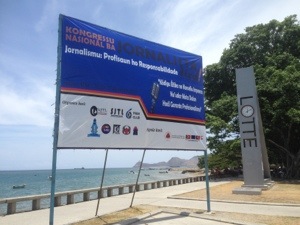
A port-side banner in Dili advertising the congress. Photo © Mark Pearson 2013

20131027-201941.jpg

Timor-Leste Prime Minister Xanana Gusmao addresses the journalism congress. Photo © Mark Pearson 2013

20131027-202001.jpg

Timor-Leste journalists vote on their ethical code. Photo © Mark Pearson 2013

20131027-202020.jpg

Media freedom – blooming amidst the razor wire. Photo © Mark Pearson 2013

20131027-202039.jpg

Leaders of some of Timor-Leste’s many journalism associations preside over the congress. Photo © Mark Pearson 2013

20131027-202057.jpg

Education and training … crucial to the strength of the media in Timor-Leste. Photo © Mark Pearson 2013

1 Comment

Filed under Uncategorized

Press freedom, social media and the citizen: My 2013 UNESCO World Press Freedom Day Lecture

By MARK PEARSON (@journlaw)

[This is the full text of my 2013 UNESCO World Press Freedom Day Lecture, delivered at the Pacific Media Centre, AUT University, Auckland on May 3, 2013. Further details, interviews about the material, and vision of the address can be accessed at the PMC’s website.]

Press freedom, social media and the citizen

Mark Pearson*

UNESCO World Press Freedom Day 2013 lecture

Pacific Media Centre, Sir Paul Reeves Building, AUT University, Auckland, New Zealand

May 3, 2013

Firstly I wish to acknowledge the tangata whenua of Tamaki Makaurau and to thank UNESCO, my hosts here at AUT’s Pacific Media Centre and the School of Communication Studies for your hospitality this week.


The Pacific region can lay claim to several ‘press freedom warriors’ over recent decades. It would be a mistake to try to name such individuals in a forum like this because you inevitably leave someone off the list – and they are usually sitting in the very room where you are giving your address!

A ‘press freedom warrior’ is someone who has made a substantial sacrifice in the name of free expression and a free media.

For some, that sacrifice has taken the form of physical injury or danger – perhaps even death. According to the Committee to Protect Journalists, more than 100 journalists died in the course of their work internationally last year, and more than 20 have been killed already in 2013 (CPJ, 2013). Some were relatively close to home in the Asia-Pacific region, with at least 72 Philippine journalists killed over the past decade.

Throughout the Pacific islands, many others have suffered physical violence or have been imprisoned in recent years because of what they have reported.

I also include in my definition of a ‘press freedom warrior’ those who have suffered in other ways because of their commitment to truth-seeking and truth-telling. Some have been the victims of lawsuits and have had to pay damages to those who have set out to gag them. Others have forsaken lucrative positions in government or public relations so they can continue as Fourth Estate watchdogs in preference to becoming political or corporate lapdogs.

We are honored to be in the company of press freedom warriors in this room today or watching via webcast and I ask you to join with me in a round of applause to salute them. [APPLAUSE].

I am not a press freedom warrior. I have made none of these sacrifices. I prefer to describe myself as a “press freedom worrier” – because much of my work has centred upon my public expressions of worry about a continuing array of regulatory, technological, economic, corporate and ethical threats to free expression and a free media.

I shall try to address some of these here tonight and I look forward to some robust discussion afterwards.

Before we proceed too far, however, we need to position the concept of free expression – and its offspring, ‘press freedom’ – in the modern world.

The free expression of certain facts and views has always been a dangerous practice in most societies.

There have been countless millions put to death for their attempted expression of their so-called ‘dissident’ religious or political views throughout history. Many more have been imprisoned, tortured or punished in other ways for such expression.

A classical free expression martyr was Socrates, who in 399 BC was forced to drink hemlock poison by the government of the day because he refused to recant his philosophical questioning of the official deities of the time (Brasch and Ulloth, 1986, p. 9).

It was the invention of the printing press and the burgeon­ing of the publishing industry over the 16th and 17th centuries in the form of newsbooks and the ‘pamphleteers’ that first prompted repressive laws and then the movement for press freedom (Feather, 1988: 46). It is interesting that these individuals were the forerunners of the citizen journalists and bloggers we know today – often highly opinionated and quick to publish speculation and rumour.

But the pamphleteers took umbrage at government attempts at imposing a licensing system for printers from the mid-16th century (Overbeck, 2001: 34) Political philosopher and poet John Milton very publicly took aim at this in 1644 with his missive Areopagitica, a speech to the parliament appeal­ing for freedom of the presses. He went on to utter the famous free speech quote (Patrides 1985: 241):  “Give me the liberty to know, to utter, and to argue freely according to conscience, above all liberties. “

Milton was an early free press warrior because he boldly inscribed his name on the title page of his unlicensed work, in defiance of the very law he was criticising. So with this series of events the notion of free expression spawned its offspring – press freedom – which we celebrate today.

Of course, the definitive example of that development was the enactment of the First Amendment to the US Constitution as part of the Bill of Rights in 1791. The relevant 14 words would fit comfortably within a modern day 140 character tweet: “Congress shall make no law … abridging the freedom of speech, or of the press.” The US Supreme Court has applied a broad interpretation of those words to an array of writing and publishing scenarios. It has been held to cover the gamut of traditional and online expression, by ordinary citizens, journalists and bloggers – particularly if they are addressing a matter of genuine public concern. But even in the US the First Amendment cannot guard against government erosion of media freedoms, and that nation languishes at number 32 behind Ghana and Suriname on the Reporters Without Borders World Press Freedom Index (RSF, 2013).

In fact, nowhere in the world has there ever been unshackled free speech or a free media. We operate on an international and historical continuum of press freedom or censorship, from whichever perspective you wish to view it.

It is only over the past half century that the notion of free expression and a free media has gained traction on a broader scale internationally.

The key international document is the United Nations Universal Declaration of Human Rights, which in 1948 enshrined free expression at Article 19: “Everyone has the right to freedom of opinion and expression; this right includes freedom to hold opinions without interference and to seek, receive and impart information and ideas through any media regardless of frontiers.”

At face value, this statement seems to give all the world’s citizens a right to free expression. But it was only ever meant to be a declaration of a lofty goal and has many limitations.

Stronger protections came internationally in 1966 when the UN adopted the International Covenant on Civil and Political Rights, prompting a series of binding treaties. The covenant introduces a right to free expression for the world’s citizens, again at Article 19: “Everyone shall have the right to freedom of expression; this right shall include freedom to seek, receive and impart information and ideas of all kinds, regardless of frontiers, either orally, in writing or in print, in the form of art, or through any other media of his choice.”

It sounds like it was almost written for bloggers and citizen journalists. However, the right is limited because the covenant imposes special duties for the respect of the rights and reputations of others and for the protection of national security, public order, public health or morals. Add to this the fact that many countries have not ratified the covenant and you are left without much real protection at this level. Complaints about individual countries’ breaches can be brought to the Office for the High Commissioner for Human Rights, but the processes can take several years and are often not resolved, as their annual reports demonstrate.

A positive of the UN right was that it fed through into regional conventions and in turn into the laws of their nations. Rights charters exist in Africa, the Americas and Europe and free expression or a free press is guaranteed by the constitutions of many countries internationally.

In the Pacific region we have no such rights charter, although many nations including Papua New Guinea and New Zealand have either constitutional or legislative rights protections for free expression. Pacific Media Centre director David Robie (2004) has critiqued the ease with which governments in Fiji and Tonga have changed such provisions when this has suited their political ends.

Theorists have attempted to group different functions of the press within government systems. Most notable was Frederick Siebert’s Four Theories of the Press (Siebert et al. 1963), which categorised press systems into ‘Authoritarian’, ‘Libertarian’, ‘Soviet-Communist’ or ‘Social Responsibility’. Others have criti­cised the Siebert approach for its simplicity and outdatedness, with Denis McQuail (1987) adding two further categories: the development model and the democratic-participant model.

Some countries justify their stricter regulation of the press, and limitations of media freedom, on religious, cultural or economic grounds. There has been an ongoing debate about the lack of press freedom in the Asia-Pacific region. Malaysia, Singapore, Brunei and Fiji have state licensing systems in place for their newspapers. Malaysia also has its Internal Security Act 1960, restricting publications on such topics as the position of rulers, the position of Malays and natives, the status of Malay as the national language and citizenship (Syed, 1998: 124).

As Rejinal Dutt noted in 2010, ‘Singaporeans have been led to believe that their model of news media suits the interests of their wider society and that the media’s role is to support the government in its quest to promote harmony, solidarity, tolerance and prosperity, rather than to question the existing social, political and economic structures’ (Dutt, 2010, p. 90). He showed how the Fijian regime had modelled its own approach to media regulation on the Singapore structure in its Media Industry Development Decree (Dutt, 2010).

As a ‘press freedom worrier’ my concerns are not limited to Singapore and Fiji.

My major worry is the ever-increasing government regulation of media and social media everywhere. My observation has been that governments are quick to enact laws to control emerging social and technological situations but are loathe to wind them back when they prove unjust or the reasons for their existence have long gone. Examples of such laws that are an anachronism in the modern era – and still exist in many Pacific nations – are laws of sedition, criminal libel and blasphemy.

Add to these the spate of anti-terror laws introduced since 9/11 and you start to get a potential armory of tools available to governments and their security agencies for surveillance or intimidation of the media.

Even laws endowing journalists with special privileges are worrying because they require a definition of who or what constitutes a ‘journalist’. Shield laws are a good example. At their best they offer journalists sanctuary when being pressed to reveal their confidential sources in court. However, the downside is that a shield law for journalists requires a court to deem who is, or is not, a ‘journalist’ – a process which, when taken to its extreme, can constitute a licensing system.

It is even more problematic now that citizen journalists and bloggers are covering stories of public importance when they might not meet a government’s definition of ‘journalist’.

As a press freedom worrier I am also concerned by the technological intrusions into free expression and a free media. As an avid blogger and social media user I can attest to the utility and reach of these media and we have seen via the Twitter revolutions in North Africa how social media can be a useful tool for dissident mobilization in autocratic regimes.

Web 2.0 communication has further empowered ordinary citizens who can now publish at their whim in the form of blogs, tweets, podcasts, Facebook postings and Instagram and Flickr images. Citizen journalists can crowdsource funding for important stories and not-for-profits can operate their own news platforms to compete with the legacy media.

Yet at the same time the Internet has given audiences and advertisers so many new choices that the financial model of those traditional media is under chronic stress. The important Fourth Estate journalism once funded by the ‘rivers of gold’ in the form of classified advertising to newspapers has all but lost its funding base.

Investigative reporting calling governments to account does not come cheaply. It involves weeks of groundwork by senior journalists, photojournalists and videojournalists and funding of their salaries, travel expenses and equipment. It typically requires further investment in the time of expert editors and production staff.

But the former multinational newspaper companies that once funded this investigative enterprise have been shedding staff, rationalizing operations and slashing budgets. There is a ripple effect throughout the Pacific of the impact of such measures in major Australian, New Zealand and North American newsrooms.

It is not just their domestic investigative reportage that suffers – but also their international reportage and foreign correspondence. This means the policies of governments in Pacific island nations are exposed to less international scrutiny and that breaking news is more likely to be covered ‘on the cheap’ by so-called ‘parachute journalists’ who fly in and out to report in a superficial way.

An unfortunate byproduct of the financial demise of big media is that they no longer have the deep pockets to fund the lobbying for media freedom they have conducted over recent decades. Tighter budgets mean less funding for submissions to government opposing media threats, appeals to higher courts on points of law and free press principle, and a greater tendency to settle out of court to reduce court costs and potential exposure to higher damages. Bloggers and citizen journalists are left stranded without the resources to defend legal threats unless they can garner the support of a union or an international NGO.

Another downside to the technological revolution is the level of surveillance of the journalistic enterprise available to governments and their agencies. Anti-terror laws introduced internationally – modeled on the US PATRIOT Act – typically give intelligence agencies unprecedented powers to monitor the communications of all citizens.

There is also an inordinate level of surveillance, logging and tracking technologies in use in the private sector – often held in computer clouds or multinational corporate servers in jurisdictions subject to search and seizure powers of foreign governments.

This has disturbing implications for journalists’ protection of their confidential sources – typically government or corporate ‘whistleblowers’ who risk their reputations, jobs and even lives if they reveal information to reporters. I blogged recently asking whether the Watergate investigation could even happen in this modern surveillance era because it was premised upon the absolute confidentiality of the White House source known as ‘Deep Throat’ (recently revealed as FBI executive Mark Felt) (Pearson, 2013). Today the Washington Post reporters Carl Bernstein and Bob Woodward and their secret source would have to contend with geo-locational tracking of their phones and vehicles, tollpoint capture of their motorway entry and exit, easily accessible phone, email and social media records, CCTV in private and public places, and facial recognition in other people’s images, perhaps posted to Facebook. The use of new technologies like drones and Google Glass will equip journalists with significant newsgathering capabilities but will at the same time risk further compromising the identities of their confidential sources.

All this might sound terribly pessimistic, but despite my ‘press freedom worrier’ status I am actually an inherent optimist, although probably not quite as hopeful as the stated theme for today’s UNESCO World Press Freedom Day – “Safe to speak: Securing freedom of expression in all media”. While we might aim to secure the ideal of freedom of expression in all media it can only ever be an aspiration – there is always a looming threat of censorship in even the most liberal societies.

Perhaps it is time for a new approach to media ethics and regulation. While I do not approve of the Malaysian, Singaporean and Fijian application of the ‘development model’, I am not sure the libertarian model strongly identified with British and US media in the 20th century is the only workable approach.

Winston Churchill once described democracy as the ‘least worst’ option? (House of Commons, 11 November 1947). Is the libertarian model of press freedom also the ‘least worst option’? Or can we have press freedom within some other system of regulation, implying a different ethical framework for truth seeking and truth telling?

There is no doubt that press freedom is entrenched in the libertarian traditions of western democracies and it is sometimes seen as another feature of colonialism that has been imposed upon societies – including those here in the Pacific – as a compulsory add-on to democracy.

But that implies that truth-seeking and truth-telling can only be part of Western culture, and that is clearly not the case.

My very first academic article in 1987 took up the issue of information sharing in indigenous Australian societies and questioned whether the techniques of modern journalism were well suited to interviewing and reporting upon indigenous issues. Information exchange in indigenous societies had cultural implications related to the status of the parties involved and the period of time allowed for the communication process (Pearson, 1987).

Veteran New Zealand journalism educator Murray Masterton had already noted codes of practice within Samoan society, where in some situations it was even a taboo to ask a question of an individual with a higher social status (Masterton, 1985, p. 114). Countering that, Samoa also had the tradition of the revered ‘tusitala’ or ‘story teller’ – the name conferred on the great author Robert Louis Stevenson when he lived there for the four years before his death in 1894 (Spencer, 1994, p. 7-A).

Papuan tribal societies also valued communication highly and can in some ways be seen as the consummate news reporters through their use of the garamut and the smaller kundu drum to send clear and simple messages across hilltops and through dense jungle. However, journalists in Papua New Guinea face challenges through their own cultural practices of wantok and payback which imply both an obligation to members of their own social network and retribution against others for wrongs done to their kin (Trompf, p. 392). It renders the roles of whistleblower and investigative reporter even more isolating and socially reprehensible despite a clear constitutional guarantee of a free media in that nation’s constitution.

When used to describe approaches of governments to media regulation, the libertarian model has been most commonly associated with the private ownership of newspapers and their active watchdog role as the Fourth Estate in a Western democratic society. Even liberal democratic societies have adopted a ‘social responsibility’ approach to the regulation of broadcast media, given the public or collective interest in control of a scarce resource, given the traditionally limited number of radio and television frequencies available for allocation (Feintuck & Varney, 2006, p. 57).

Recent inquiries into media regulation in the UK (Leveson, 2012), Australia (Finkelstein, 2012) and New Zealand (Law Commission, 2013) have proposed extending that social responsibility model to print and new media regulation, despite the fact that the scarcity of resource argument is diminishing. Rather than taking a libertarian approach and reducing the government regulation of the broadcasters because the frequency scarcity and media concentration arguments are diminishing, the reform bodies have recommended mechanisms to bring newspaper companies within the ambit of stronger government control.

Their motivation for doing so stems from public angst – and subsequent political pressure – over a litany of unethical breaches of citizens’ privacy over several years culminating in the News of the World scandal in the UK with an undoubted ripple effect in the former colonies. I am at grave risk of over-simplifying this important issue because many other factors are at play, including some less serious ethical breaches by the media in both Australia and New Zealand, evidence of mainstream media owners using their powerful interests for political and commercial expediency, and the important public policy challenge facing regulators in an era of multi-platform convergence and citizen-generated content.

So press systems and ethical frameworks are on the agenda in all societies, and we are challenged to accommodate free expression and its close relative press freedom within new technological and cultural contexts.

If we are to stick with the libertarian model and continue with ‘light touch’ media regulation by governments, we clearly need more meaningful ethical guidelines than the ones that do not always seem to work in mainstream journalism.

Pacific Media Centre director Professor David Robie (2011, p. 237) has been among those exploring how a ‘peace journalism’ model could be applied to the reporting of conflict in the South Pacific and to the education of journalists in this region. It requires a deeper understanding of the context and causes of a conflict, a commitment to ensuring the views of all sides are reported, comments from those condemning any violence, reducing emphasis on blame or ethnicity, and offering suggestions for solutions.

This kind of approach has great merit – and I am currently examining ways it might be extended to a new framework for reporting more generally by implementing some of the key principles of the world’s great religions in a secular context. When you look closely at Christianity, Islam, Hinduism, Confucianism and Buddhism you find common moral and ethical principles that we might reasonably expect journalists to follow in their work, including all of those attributes of peace journalism identified by Robie.  The Dalai Lama’s recent book – Beyond Religion – explores how core ethical values can offer a sound moral framework for modern society while accommodating diverse religious views and cultural traditions.

I believe this sits well with a modern trend to apply basic principles of mindfulness and compassion to a range of human endeavors and I will be exploring and applying this to journalism in a conference paper I will be presenting in Dublin next month where I call it ‘Mindful Journalism’. It suggests we should educate journalists, serious bloggers and citizen journalists to adopt a mindful approach to their news and commentary which requires a reflection upon the implications of their truth-seeking and truth-telling as a routine part of the process.

They would be prompted to pause and think carefully about the consequences of their reportage and commentary for the stakeholders involved, including their audiences. Truth-seeking and truth-telling would still be the primary goal, but only after gauging the social good that might come from doing so.

The recent inquiries into poor journalism ethics have demonstrated that journalism within the libertarian model appears to have lost its moral compass and we need to recapture this.

Even today, young people choose journalism as a career with a view to ‘make a difference’ in society. Like teaching and nursing, the choice of the occupation of truth-seeking and truth-telling in our societies has an element of a ‘mission’ or a ‘calling’ about it. I this in a secular rather than a religious way – a deep sense of social responsibility to expose wrongdoing and injustice and to facilitate the exchange of ideas on important social issues.

All societies need their ‘tusitalas’ – their storytellers – in whatever form they might take.

With the advent of citizen journalism and the widespread use of social media we can no longer claim this as the exclusive preserve of journalism and journalists.

Social media and blogging seems to have spawned an era of the new super-pamphleteer – the ordinary citizen with the power to disseminate news and commentary internationally in an instant.

We are quickly losing the distinction between journalists and other communicators, accelerated by the fact that their traditional employers forcing journalists into the blogosphere as the old model suffers under the strain. Journalists’ codes of ethics have long been associated with the traditional mainstream media and have usually been documented and administered by unions or professional associations. But we now have many ordinary citizens producing the reportage and commentary that was once the preserve of those who called themselves ‘journalists’. We need new ethical codes of practice that are inclusive of these new serious bloggers and citizen journalists.

The printing press spawned free expression’s offspring – the right of ‘press freedom’ – as pamphleteers fought censorship by governments in the ensuing centuries.

Events are unfolding much more quickly now. It would be an historic irony and a monumental shame if press freedom met its demise through the sheer pace of irresponsible truth-seeking and truth-telling today.

Our challenge is to educate our fellow citizens on the mindful use of this fragile freedom before their elected representatives take further steps to erode it.

—-

* Professor of Journalism and Social Media, Griffith University, Australia and Australian correspondent for Reporters Without Borders

REFERENCES

Brasch, W.M. & Ulloth, D.R. (1986). The Press and the State: Sociohistorical and Contemporary Interpretations. Lanham: University Press of America.

CPJ (2013). Committee to Protect Journalists – Defending Journalists Worldwide. Retrieved from http://www.cpj.org/killed/2012/.

Dalai Lama, (2011). Beyond Religion – Ethics for a whole world. London: Rider.

Dutt, R. (2010). The Fiji media decree: A push towards collaborative journalism. Pacific Journalism Review, 16(2): 81-98.

Feather, John (1988). A History of British Publishing. London: Routledge.

Feintuck, M. and Varney, M. (2006). Media Regulation, Public Interest and the Law, second edition. Edinburgh: Edinburgh University Press.

Finkelstein, R. (2012). Report of the independent inquiry into the media and me­dia regulation. Canberra: Department of Broadband, Communications and the Digital Economy.

Law Commission (NZ) (2013). The news media meets ‘new media’: rights, responsibilities and
 regulation in the digital age. 
(Law Commission report 128). Law Commission: Wellington.

Leveson, B. (2012). Report of An Inquiry into the Culture, Practice and Ethics of the Press (The Stationery Office, 2012) [Leveson Report].

Masterton, M. (1985). Samoa, where questioning is taboo. Australian Journalism Review 7 (1&2): 114-115.

Pearson, M. (2013, April 26). Surveillance and investigative reporting: How would Deep Throat stay anonymous today? Journlaw.com blog. Retrieved from: jourlaw.com/2013/04/26/surveillance-and-investigative-reporting-how-would-deep-throat-stay-anonymous-today/

Pearson, M. (2012). The media regulation debate in a democracy lacking a free expression guarantee. Pacific Journalism Review, 18(2): 89-101.

Pearson, M. (1987). Interviewing Aborigines: a cross-cultural dilemma. Australian Journalism Review, 9 (1&2): 113-117.

Robie, D. (2011). Conflict reporting in the South Pacific – Why peace journalism has a chance, The Journal of Pacific Studies, 31 (2): 221–240. Retrieved from: http://www.academia.edu/1374720/Conflict_reporting_in_the_South_Pacific_Why_peace_journalism_has_a_chance

Robie, D. (2004). The sword of Damocles in the South Pacific: Two media regulatory case studies. Pacific Journalism Review, 10(1): 103-122. Retrieved from http://www.pjreview.info/articles/sword-damocles-south-pacific-two-media-regulatory-case-studies-617

RSF. (2013). Reporters Without Borders World Press Freedom Index. Retrieved from http://en.rsf.org/press-freedom-index-2013,1054.html

McQuail, D. (1987) Mass Communication Theory: An Introduction. London: Sage Publications.

Siebert, F.S., Peterson, T. & Schramm, W. (1963) Four Theories of the Press. Urbana: University of Illinois Press.

Spencer, G. (1994). Samoa rediscovers ‘Tusitala’ Stevenson. Daily News (Bowling Green, Kentucky). July 19, p. 7A.

Syed, Arabi Idid (1998) Malaysia. In Asad Latif (ed.) Walking the Tightrope: Press Freedom and Professional Standards in Asia. Singapore: Asian Media Information and Communication Centre, pp. 119–27.

Overbeck, Wayne (2001) Major Principles of Media Law, Fort Worth, TX: Harcourt College Publishers.

Patrides, C.A. (ed.) (1985) John Milton: Selected Prose, New and Revised Edition. Columbia: University of Missouri Press.

Trompf, G.W (1994). Payback: The Logic of Retribution in Melanesian Regions. Cambridge University Press: Cambridge.

© Mark Pearson 2013

Disclaimer: While I write about media law and ethics, nothing here should be construed as legal advice. I am an academic, not a lawyer. My only advice is that you consult a lawyer before taking any legal risks.

3 Comments

Filed under free expression, Media freedom, media law, Media regulation, Press freedom, Uncategorized