Tag Archives: media law

The MEAA Code of Ethics: all spin and no stick

By MARK PEARSON

The go-to document for journalists refusing to ‘fess up their sources or taking the high ethical ground is the MEAA Journalists’ Code of Ethics – but the irony is that the journalists’ union uses notoriously ineffective and opaque processes to police this high profile code.
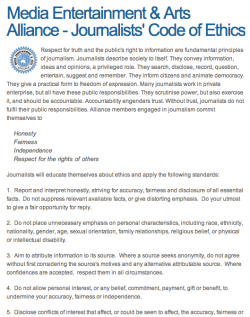
Screen Shot 2013-11-26 at 12.40.47 PMUnlike the Australian Press Council, the ethics panel of the Media, Entertainment and Arts Alliance (MEAA) has actual disciplinary powers at its disposal for use against individual journalists who breach its Code of Ethics – but it has rarely used them. Its powers extend to any journalists who are members of the Alliance. However, these days large numbers of journalists throughout the industry are not members.

In 1999, the alliance updated the code to a twelve-item document, requiring honesty, fairness, independence and respect for the rights of others. The alliance’s ethical complaints procedures are outlined in Section 8 of the Rules of the  MEAA (2009), summarised on the union’s website. Complaints must be in writing stating the name of the journalist, the unethical act and the points of the Code that have been breached. The judiciary committee (made up of experienced journalists elected every two years by state branch members) then meets to consider the complaint. They can dismiss or uphold the complaint without hearing further evidence, call for further evidence and hold hearings. Hearings involve the committee, the complainant and the journalist and follow the rules of natural justice. Lawyers are excluded. Penalties available to the committee include a censure or rebuke for the journalist, a fine of up to $1000 for each offence, and expulsion from the union. Both parties have 28 days to appeal to an appeals committee of three senior journalists in each state elected every four years and then to a national appeals committee of five journalists.

Because of the secrecy surrounding the cases and their outcomes there are few ethics panel case studies to work with. In 2003 Chris Warren provided me with the judgment of a 2002 case involving a complaint against a Sydney cartoonist who, the complainant alleged, portrayed the then opposition leader Kim Beazley as a person with a ‘physical and intellectual disability’, in breach of clause 2 of the code. The complaint also suggested the depiction was ‘inaccurate, unfair and dishonest’ and denied Mr Beazley a ‘right of reply’, in breach of clause 1. He also complained of a ‘continuing and malicious campaign of denigration of Labor leaders by this cartoonist’. The cartoonist’s defence was that all cartoonists regularly breached the letter of several clauses every time they did their work, but that this was the nature of artistic expression and satire. The complaint of unethical behaviour was dismissed on the basis that there was no ‘malicious bias’ and that any inaccuracy ‘was consistent with the satirical traditions of newspaper cartoons’.

Under Rule 67(h), the decisions and recommendations of the ethics panel shall be published in accordance with any guidelines that may be issued by the National Journalists’ Section Committee. When I interviewed MEAA federal secretary Chris Warren in 2003, he said the issue of publication of adjudications was a difficult one because of potential defamation action by participants. This makes it difficult to get information about MEAA ethics panel cases. Muller (2005: 185) wrote: ‘The practical result of this is that no one other than the parties, the panel and the MEAA executive ever hear about the complaints that are lodged, or what happens to them. This not only severely circumscribes the effectiveness of the procedure as a mechanism of accountability, but it offends against the principles of free expression, openness and transparency, and leaves the profession open to accusations of hypocrisy.’

While the MEAA’s website outlines the complaints procedures, it does not feature any records of complaints against journalists. Thus, both its journalist members and the general public remain ignorant of the nature and progress of any complaints against its members. In 2003 Chris Warren confirmed that the organisation received very few complaints each year, and that most were referred to the Australian Press Council. The Walkley Magazine in 2006 noted that the committee received only 67 original complaints and held five appeals between 2000 and January 2006, but could not deal with 34 of the complaints because they were to do with journalists who were not MEAA members. This meant only 33 complaints were handled in five years, an average of just over six per year. A separate tally of complaints to the Victorian branch of the MEAA by Muller (2005: 183) found that over the ten years 1993–2002 inclusive, just 23 complaints were received by the ethics panel of the Victorian branch. He provided a summary of each of them (Muller 2005: 187-8).

MEAA National Secretary Chris Warren told the Independent Media Inquiry last year that since the revised code was adopted in 1999 only three members had been censured or rebuked and that no member had been expelled for almost four decades (Finkelstein, 2012, p. 195). The reality is that with membership voluntary, the MEAA needs someone else to discipline its members when they act unethically. Its return to Press Council membership in 2005 opened the way for the MEAA to refer most complaints to that body or to the ACMA rather than having its own ethics panel deal with them at the risk of an embarrassing finding and the potential loss of a member.

There are scores of ethical codes of practice and guidance documents across the various media industry platforms – far too many for a single journalist to reflect upon while encountering a particular ethical dilemma. The irony is that the MEAA ‘Code of Ethics’ is the best known and most highly regarded ethical statement for the profession but there is a remarkably ineffective mechanism for its enforcement.

———–

Disclaimer: While I write about media law and ethics, nothing here should be construed as legal advice. I am an academic, not a lawyer. My only advice is that you consult a lawyer before taking any legal risks.

© Mark Pearson 2013

2 Comments

Filed under Media freedom, Media regulation, Press freedom

Whither media reform under Abbott?

By MARK PEARSON

Where will the new Liberal-National Coalition government led by Prime Minister Tony Abbott head with the reform of media regulation? Communications Minister Malcolm Turnbull and Attorney-General George Brandis were vocal opponents of the former Gillard Government’s proposals to merge press self-regulation with broadcast co-regulation into a new framework.

TurnbullCommons

Communications Minister Malcolm Turnbull … can he concoct the magic media self-regulation formula? [Image: commons.wikimedia.org]

Recent inquiries into media regulation in the UK (Leveson, 2012), Australia (Finkelstein, 2012) and New Zealand (Law Commission, 2013) have recommended major changes to the regulation of media corporations and the ethical practices of journalists. Their motivation for doing so stemmed from public angst – and subsequent political pressure – over a litany of unethical breaches of citizens’ privacy over several years culminating in the News of the World scandal in the UK and the subsequent revelations at the Leveson Inquiry (2012) with an undoubted ripple effect in the former colonies.

Many contextual factors have informed the move for reform, including some less serious ethical breaches by the media in both Australia and New Zealand, evidence of mainstream media owners using their powerful interests for political and commercial expediency, and the important public policy challenge facing regulators in an era of multi-platform convergence and citizen-generated content.  Minister Turnbull is an expert on the latter element and it is hard to imagine him not proposing some new, perhaps ‘light-touch’, unified regulatory system during this term in office.

By way of background, two major inquiries into the Australian news media in 2011 and 2012 prompted a necessary debate over the extent to which rapidly converging and globalised news businesses and platforms require statutory regulation at a national level.  Four regulatory models emerged – a News Media Council backed by recourse to the contempt powers of courts; a super self-regulatory body with legislative incentives to join; a strengthened Australian Press Council policing both print and online media; and a government-appointed  ‘Public Interest Media Advocate’.

The $2.7 million Convergence Review, announced in late 2010, was meant to map out the future of media regulation in the digital era (Conroy, 2010). However, revelations of the UK phone hacking scandal and Labor and Green disaffection with Rupert Murdoch’s News Limited in Australia, prompted the announcement in September 2011 of a subsidiary inquiry – the $1.2 million Independent Media Inquiry – specifically briefed to deal with the self-regulation of print media ethics. Its architects – former Federal Court judge Ray Finkelstein assisted by University of Canberra journalism professor Matthew Ricketson – argued they could not decouple print news self-regulation from broadcast ‘co-regulation’ in the digital era, so devised a statutory model including both in their report of February 28, 2012, two months prior to the release of the report of its parent Convergence Review (Finkelstein, 2012).

The Independent Media Inquiry (Finkelstein) report was an impressive distillation of legal, philosophical and media scholarship. Among many sensible proposals, it called for simpler codes of practice and more sensitivity to the needs of the vulnerable. But its core recommendation for the ‘enforced self-regulation’ of ethical standards prompted fierce debate. It proposed a News Media Council to take over from the existing self-regulatory Australian Press Council and co-regulatory Australian Communications and Media Authority to set journalistic standards with a streamlined complaints system with teeth (Finkelstein, 2012, pp. 8-9) The body would cover print, online, radio and television standards and complaints. It would have a full-time independent chair (a retired judge or ‘eminent lawyer’) and 20 part-time members evenly representing the media and the general citizenry, appointed by an independent committee (Finkelstein, 2012, pp. 290-291). The government’s role would be limited to securing the body’s funding and ensuring its decisions were enforced, but “the establishment of a council is not about increasing the power of government or about imposing some form of censorship” (Finkelstein, 2012, p. 9).

The report stressed the model would be ‘enforced self-regulation’ rather than ‘full government regulation’;

…an independent system of regulation that allows the regulated parties to participate in the setting and enforcement of standards (as is presently the case), but with participation being required, rather than voluntary (Finkelstein, 2012, p. 287).

Nevertheless, refusal to obey an order to correct or apologise would see a media outlet referred to a court which could issue an order to comply with further refusal – triggering a contempt charge and fines or jail terms for recalcitrant publishers. (Finkelstein, 2012, p. 298). Such a court would be charged with the relatively straightforward task of determining whether the publisher had disobeyed an order of the statutory News Media Council. Only then might publishers get the opportunity for an appeal – again by a judge in court.

The ‘Finkelstein inquiry’ was only ever meant to be an advisory to its parent Convergence Review, chaired by former IBM Australia managing director Glen Boreham, which released its final report in April, 2012 (Convergence Review, 2012).  News media regulation represented a much smaller element of the Convergence Review’s overall brief, particularly after this topic had been hived off to the Finkelstein inquiry, so this matter constituted a relatively small part of its report. While the Convergence Review report shared Finkelstein’s concerns about shortcomings with existing regulatory systems, it proposed that ‘direct statutory mechanisms … be considered only after the industry has been given the full opportunity to develop and enforce an effective, cross-platform self-regulatory scheme’. In other words, it was offering the media industry ‘drinks at the last chance saloon’ for a three year period under its model (Convergence Review, 2012, p. 53). Its mechanism centred upon the establishment of a ‘news standards body’ operating across all media platforms – reinforcing the overall review’s preference for ‘platform neutrality’ (Convergence Review, 2012, p.51). The news standards body ‘would administer a self-regulatory media code aimed at promoting standards, adjudicating complaints, and providing timely remedies’ (Convergence Review, 2012, p. 153).

Unlike Finkelstein, the Convergence Review decided not to be prescriptive about the constitution or operational requirements for such a body, beyond some broad requirements. The largest news media providers – those it deemed ‘content service providers’ – would be required by legislation to become members of a standards body. Most funding for the new body should come from industry, while taxpayer funds might be drawn upon to meet shortfalls or special projects (Convergence Review, 2012, p. xiv). It would feature:

–       a board of directors, with a majority independent from the members;

–       establishment of standards for news and commentary, with specific requirements for fairness and accuracy;

–       implementation and maintenance of an ‘efficient and effective’ complaints handling system;

–       a range of remedies and sanctions, including the requirement that findings be published on the respective platform. (Convergence Review, 2012, p. 51)

The review’s definition of ‘content service enterprises’ (control over their content, a large number of Australian users, and a high level of revenue drawn from Australia) would catch about 15 media operators in its net. Others might be encouraged to join the body with a threat to remove their current news media exemptions to privacy laws and consumer law ‘misleading and deceptive conduct’ provisions (Convergence Review, 2012).

Both inquiries acknowledged – and rejected – the notion of a revamped Australian Press Council proposed in various submissions and appearances by its chair, Professor Julian Disney. (The Press Council was established in 1976 as a newspaper industry ‘self-regulatory’ body – a purely voluntary entity with no powers under law.) Nevertheless, during and after the reports, and with new support from most of its members, the Press Council moved quickly to ramp up its purview and powers to address many of its documented shortcomings such as the refusal of some member newspapers to publish its findings and the threat of withdrawal of funding from others (Simpson, 2012). It locked its members into four year commitments and established an independent panel to advise on its review of its content standards. Those standards are due to be announced soon.

In 2013 the Gillard Labor Government introduced a ‘News Media (Self-regulation) Bill’ to establish a new role of ‘Public Interest Media Advocate’ with the power to deregister bodies, like the Australian Press Council, if they failed to police effectively the ethical standards of their newspaper and online members. Ultimately, the proposal might leave media outlets without their current exemptions from compliance with the Privacy Act in their newsgathering operations. The Labor government later withdrew the proposal when it could not garner enough support in the Parliament – in the face of strong opposition from the mainstream media and the Coalition (now government) with Turnbull and Brandis as the lead naysayers.

The big question now centres upon not if, but when, they choose to propose some new regulatory system where serious media ethical breaches across all media platforms are channelled through a single – self-regulatory? – body. And the further – and crucial issue – will be whether they can do this without ultimate recourse to criminal sanctions for recalcitrant journalists and media groups. It is vital that they do so, given that Australia is rare among Western democracies in that free expression is not enshrined in our Constitution.

Australia’s global free press standing depends upon them devising the magic formula the earlier inquiries failed to concoct.    

References

Conroy, S. (2010, December 14). Convergence Review. Terms of Reference (media release). Available: http://www.minister.dbcde.gov.au/media/media_releases/2010/115

Convergence Review (2012). Convergence Review. Final Report. Department of Broadband, Communications and the Digital Economy: Canberra. Available: http://www.dbcde.gov.au/__data/assets/pdf_file/0007/147733/Convergence_Review_Final_Report.pdf

Convergence Review (2012). Convergence Review. Final Report. Department of Broadband, Communications and the Digital Economy: Canberra. Available: http://www.dbcde.gov.au/__data/assets/pdf_file/0007/147733/Convergence_Review_Final_Report.pdf

Day, M. (2012, April 9.) A shame Seven West should quit Press Council. The Australian. Available: http://www.theaustralian.com.au/business/opinion/a-shame-seven-west-should-quit-press-council/story-e6frg9tf-1226321637864

Finkelstein, R. (2012). Report of the Independent Inquiry Into the Media and Media Regulation. Department of Broadband, Communications and the Digital Economy: Canberra Available: http://www.dbcde.gov.au/__data/assets/pdf_file/0006/146994/Report-of-the-Independent-Inquiry-into-the-Media-and-Media-Regulation-web.pdf

Law Commission (NZ) (2013). The news media meets ‘new media’: rights, responsibilities and
 regulation in the digital age. 
(Law Commission report 128). Law Commission: Wellington.

Leveson, B. (2012). Report of An Inquiry into the Culture, Practice and Ethics of the Press (The Stationery Office, 2012) [Leveson Report].

Simpson, K. (2012, July 20). Journalism standards set for an updating. smh.com.au Available: http://www.smh.com.au/business/journalism-standards-set-for-an-updating-20120719-22czm.html

———–

Disclaimer: While I write about media law and ethics, nothing here should be construed as legal advice. I am an academic, not a lawyer. My only advice is that you consult a lawyer before taking any legal risks.

© Mark Pearson 2013
2 Comments

Filed under Media freedom, Media regulation, Press freedom

Election postscript: a mindful analysis of media coverage

By MARK PEARSON

[This blog was first published in the St James Ethics Centre’s Living Ethics newsletter, Issue 93, Spring 2013. See here.]

Australian journalists operate under an array of ethical guidelines, including the MEAA Code of Ethics and numerous employer and industry codes of practice.

hogansWhile these documents differ widely in their wording, they espouse common values of truth, accuracy, fairness and the public’s right to information. They disapprove of invasions of privacy, disclosure of confidential sources, discriminatory language, subterfuge, deception, plagiarism and conflicts of interest.

When it comes to assessing the ethics of news coverage of an event as broad in scope as a federal election we find some guidance in such codes but other moral frameworks can add value.

Although I am not a Buddhist, I have recently found value in applying some of that religion’s foundational principles – in a secular way – to the assessment of journalism ethics and have been sharing this approach with colleagues and students through my writing and teaching.

It is also a useful lens through which to review some key elements in media coverage of the 2013 federal election.

The approach centres on the belief that journalists can adopt a mindful approach to their news and commentary which requires a reflection upon the implications of their truth-seeking and truth-telling as a routine part of the process. It calls upon them pause and think carefully about the consequences of their reportage and commentary for the stakeholders involved, including their sources and their audiences.

Truth-seeking and truth-telling are still the primary goal, but only after gauging the resulting social good or harm.

Each of the constituent steps of Buddhism’s Eightfold Path – understanding free of superstition, kindly and truthful speech, right conduct, doing no harm, perseverance, mindfulness and contemplation – provides a framework for such analysis.

Space prohibits the examination of all of them here, but at least three issues arose in the election worthy of such reflection.

  1. Fact checking. The Buddhist notion of ‘right views’ focuses on a deeper explanation of root causes and the clinical testing of claims. The emergence of the ‘fact checker’ was a welcome development via Politifact Australia, the ABC’s Fact Checking Unit and The Conversation’s Election FactCheck. A longer term impact of such a tool might be that politicians are prompted to think twice before issuing scaremongering and outlandish statements.
  2. The News Corp anti-Labor campaign. The principle of ‘right intent’ calls upon us to reflect upon the genuine motivations for Rupert Murdoch’s Australian newspapers adopting such a blatant and belittling attack on the incumbent government. Cynical mock-ups like the Daily Telegraph’s ‘Hogan’s Heroes’ and the Courier Mail’s ‘Send in the Clown’ front pages might be excused as tabloid fun but they hardly indicate ‘right intent’ and ‘right speech’ in the Buddhist moral framework. The motivation could surely not have been to gain circulation, given the fact that the coverage stood to alienate perhaps one third of readers. It will be fascinating to see at the next audit whether this stance accelerated the decline of those newspapers’ circulations. If the intent was to win influence with the likely government, then this should have been disclosed.
  3. Presidential-style coverage. Just because political parties choose to run a presidential style of campaign does not oblige news organisations to embrace it. The Buddhist principle of ‘right effort’ invokes a steady, patient and purposeful path and ‘right mindfulness’ demands a considered and reflective approach to reportage. Each of these is difficult when reporters are assigned to traipse around the nation and cover political leaders engaging in stage-managed, superficial appearances at factories, schools and sausage sizzles. It is belittling to the enterprise of journalism to see some of its leading lights – and notable watchdogs – being led by the leash as mere lapdogs. It was particularly noticeable in a campaign where neither leader made a notable gaffe. We are left to imagine what might have been revealed if only these political journalism superstars had been afforded the time to do some real digging. Sometimes being ethical demands us to say ‘no’ to an under-utilisation our talents, which was clearly the case here.

livingethicscoverThe ultimate test of ethical political reporting in a democracy is the extent to which that journalism best informs the citizenry to maximize the value of each and every vote. In that respect, Australian journalism still has much to learn.

———–

Disclaimer: While I write about media law and ethics, nothing here should be construed as legal advice. I am an academic, not a lawyer. My only advice is that you consult a lawyer before taking any legal risks.

© Mark Pearson 2013

2 Comments

Filed under blogging, Buddhism, citizen journalism, Eightfold Path, free expression, media ethics, social media, Uncategorized

Timor-Leste journalists decide on ethics code and press council as tougher laws loom

By MARK PEARSON Follow @Journlaw

AN historic congress of Timor-Leste journalists held in Dili over the weekend (October 25-27) voted for their first code of ethics and a seven-member press council.

But the next hurdle for media freedom in the small Asia-Pacific nation will be a press law currently before the national parliament which it is feared will feature a journalist licensing system and criminal penalties.

20131027-201852.jpg

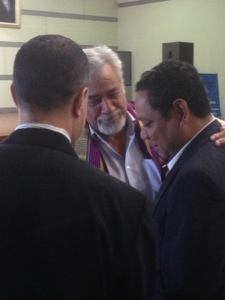
Timor-Leste PM Xanana Gusmao greets officials at the national journalists’ congress on Friday. Photo © Mark Pearson 2013

The media law proposed by a committee of journalists advising the government featured self-regulatory controls. However, the final version includes amendments proposed by the Secretary of State for Social Communication, Mr Nélio Isaac Sarmento, rumoured to include the licensing and criminal sanctions.

Opening the congress on Friday, Prime Minister Xanana Gusmao scolded journalists for not having developed adequate self-regulation when he had warned them to do so in 2009.

But he congratulated the media associations on their latest efforts to unify for a code of ethics and press council; stating that press freedom was important to democracy, but that freedom should be exercised responsibly.

More than 150 journalists in attendance on Sunday – representing several journalism associations – voted for the 10 point code of ethics, featuring a preamble affirming the importance of free expression and media self-regulation and clauses on: accuracy and impartiality, opposition to censorship, defence of the public interest, anti-discrimination, separation of fact from opinion, confidentiality of sources, quick correction of inaccuracies, rejection of plagiarism, protection of identity of victims, and rejection of financial inducements.

That final clause will present major challenges for Timor-Leste journalists, many of who freely admit to accepting payments from politicians for positive coverage.

Media sources say reporters are often paid US$5-20 at press conferences and up to US$40 by officials when accompanying ministers on tours to the provinces.

Such payments represent a substantial influence, given media outlets only pay their reporters about US$140 per month plus lunch and travel expenses.

Other problems facing the industry are a lack of training, a dependence on government advertising and the endemic drift of journalists to public service positions when they become available. This leaves editors and news directors with newsrooms staffed by inexperienced personnel.

The congress was funded by the European Union’s 1 million euro Media Support Program, co-ordinated by Portugal.

Foreign experts sharing their own countries’ experiences with self-regulation included the chairman of the Indonesian Alliance of Independent Journalists (AJI) Eko Maryadi, Christiana Chelsia Chan from the Press Council of Indonesia, Portuguese journalism academics Joaquim Fidalgo and Carlos Camponez, and @journlaw (Mark Pearson, Professor of Journalism and Social Media, Griffith University, Australia). [See a summary of my speech in my earlier post].

© Mark Pearson 2013

Disclaimer: While I write about media law and ethics, nothing here should be construed as legal advice. I am an academic, not a lawyer. My only advice is that you consult a lawyer before taking any legal risks.

Lopes

Under-resourced … the director of the Jornal Independente, Mouzinho Lopes de Araujo, in his Dili office. Photo © Mark Pearson 2013

20131027-201915.jpg

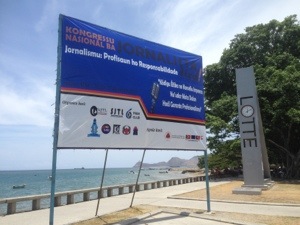
A port-side banner in Dili advertising the congress. Photo © Mark Pearson 2013

20131027-201941.jpg

Timor-Leste Prime Minister Xanana Gusmao addresses the journalism congress. Photo © Mark Pearson 2013

20131027-202001.jpg

Timor-Leste journalists vote on their ethical code. Photo © Mark Pearson 2013

20131027-202020.jpg

Media freedom – blooming amidst the razor wire. Photo © Mark Pearson 2013

20131027-202039.jpg

Leaders of some of Timor-Leste’s many journalism associations preside over the congress. Photo © Mark Pearson 2013

20131027-202057.jpg

Education and training … crucial to the strength of the media in Timor-Leste. Photo © Mark Pearson 2013

1 Comment

Filed under Uncategorized

Ten minutes with @journlaw – Dr Joseph Fernandez (@DrJM_Fernandez) discusses his new book

By MARK PEARSON

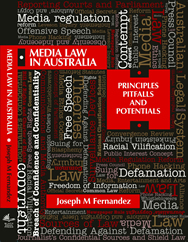
fernandez coverRespected colleague Dr Joseph Fernandez (head of journalism at Curtin University) has just published an impressive addition to the scholarship of journalism law.

In Media Law in Australia – Principles, Pitfalls and Potentials (Black Swan Press, 2013), Fernandez offers a comprehensive and meticulously referenced coverage of the territory – at 372 pages and something more than 275,000 words.

The book’s 12 chapters cover freedom of speech, the public interest, law making, defamation and its defences, confidentiality and secrecy, privacy, freedom of information, courts and parliament, offensive speech, copyright and regulation.

There is some refreshing new material covering the proposed media regulatory reforms in Australia and the UK.

I look forward to the opportunity to review it in greater detail for an academic journal, but meanwhile please enjoy Joseph’s reflection on the authorship process in his ‘Ten minutes with @journlaw’.

Disclaimer: While I write about media law and ethics, nothing here should be construed as legal advice. I am an academic, not a lawyer. My only advice is that you consult a lawyer before taking any legal risks.

© Mark Pearson 2013
Leave a comment

Filed under Uncategorized

Updated: Privacy in Australia – a timeline from colonial capers to racecourse snooping, possum perving and delving drones

By MARK PEARSON

The interplay between the Australian media and privacy laws has always been a struggle between free expression and the ordinary citizen’s desire for privacy. I have developed this timeline to illustrate that tension.

1827: NSW Chief Justice Francis Forbes rejects Governor Ralph Darling’s proposal for legislation licensing the press, stating: “That the press of this Colony is licentious may be readily admitted; but that does not prove the necessity of altering the laws.” (Historical Records of Australia, Series 1, Vol. 13, pp. 290-297)

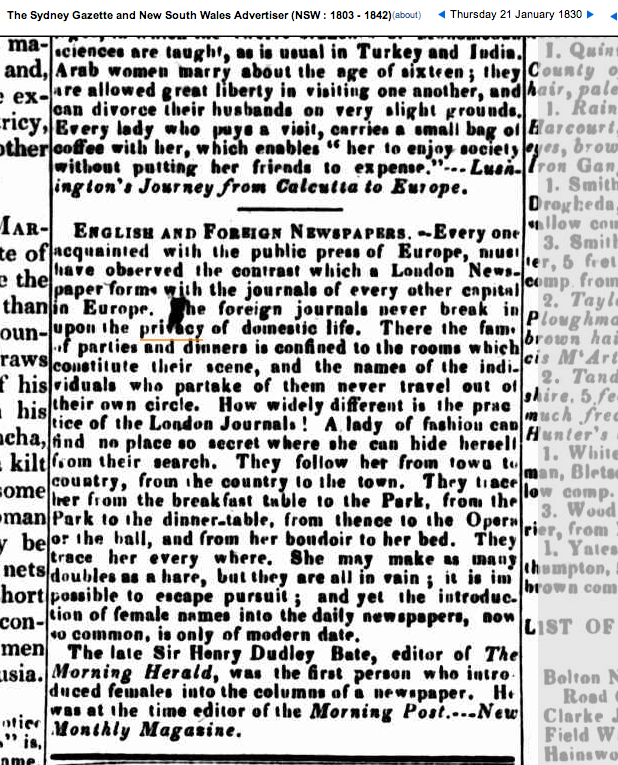
PrivacySydneyGazetteExtract1830

The extract from the Sydney Gazette in 1830

1830: The Sydney Gazette and New South Wales Advertiser publishes an extract from London’s New Monthly Magazine on the prying nature of the British press compared with its European counterparts, stating: “The foreign journals never break in upon the privacy of domestic life”. But the London newspapers would hound a ‘lady of fashion’ relentlessly: “They trace her from the breakfast table to the Park, from the Park to the dinner-table, from thence to the Opera or the ball, and from her boudoir to her bed. They trace her every where. She may make as many doubles as a hare, but they are all in vain; it is impossible to escape pursuit.”

1847: NSW becomes the first Australian state to add a ‘public benefit’ element to the defence of truth for libel – essentially adding a privacy requirement to defamation law (ALRC Report 11, p. 117)

1882: First identified use of the phrase ‘right to privacy’ in an Australian newspaper. Commenting on a major libel case, the South Australian Weekly Chronicle (22.4.1882, p.5) states: “A contractor having dealings with the Government or with any public body has no right to privacy as far as those dealings go.”

1890: In a landmark Harvard Law Review article, the great US jurist Samuel D. Warren and future Supreme Court Justice Louis D. Brandeis announce a new ‘right to privacy’ in an article by that very name. There is a ripple effect in Australia with several mentions of the term in articles between 1890-1900.

1937: A radio station used a property owner’s land overlooking a racecourse to build a platform from which it broadcast its call of the horse races. The High Court rules the mere overlooking of the land did not consti­tute an unlawful interference with the racing club’s use of its property. The decision viewed as a rejection of a common law right to privacy: Victoria Park Racing and Recreation Grounds Co. Ltd v. Taylor (1937) 58 CLR 479.

1948: Universal Declaration of Human Rights is proclaimed in Paris. Article 12 provides: “No one shall be subjected to arbitrary interference with his privacy, family, home or correspondence, nor to attacks upon his honour and reputation. Everyone has the right to the protection of the law against such interference or attacks” (United Nations Universal Declaration of Human Rights, GA. Res 217A(III), UN Doc A/Res/810 (1948).)

1966: The International Covenant on Civil and Political Rights (ICCPR) is proclaimed, protecting privacy at Article 17. (16 December 1966, [1980] ATS 23, entered into force generally on 23 March 1976)

1972: Australia signs the ICCPR.

1979: Australian Law Reform Commission releases its first major report on privacy – Unfair Publication: Defamation and Privacy, ALRC 11. It recommends a person be allowed to sue for damages or an injunction if ‘sensitive private facts’, relating to health, private behaviour, home life, and personal or family relationships, were published about him or her which were likely in all the circumstances to cause distress, annoyance or embarrassment to a person in the position of the individual. Wide defences were proposed allowing publication of personal information if the publication was relevant to the topic of public interest. (pp. 124-125).

1980: Australia ratifies the ICCPR and the Organisation for Economic Co-operation and Development (OECD) expert group led by Australian Justice Michael Kirby issues its Guidelines on the Protection of Privacy and Transborder Flows of Personal Data.

1983: Australian Law Reform Commission releases its Privacy (ALRC Report 22), recommending the establishment of a Privacy Act to establish information privacy principles and the appointment of a Privacy Commissioner.

1984: Australian Journalists’ Association (AJA) revises its 1944 Code of Ethics to include a new clause (9) requiring journalists to “respect private grief and personal privacy and shall have the right to resist compulsion to intrude on them”.

1988: The Privacy Act 1988 is enacted, applying initially only to the protection of personal information in the possession of Australian Government departments and agencies.

1999: Media Entertainment and Arts Alliance (MEAA) issues another revised Code of Ethics preserving the grief and privacy elements in clause 11.

2000: Privacy Act 1988 provisions are extended to larger private sector organisations, and 10 National Privacy Principles (NPPs) are introduced, determining how companies must collect, use and disclose, keep secure, provide access to and correct personal information. Media organisations are exempted from the provisions as long as they ascribe to privacy standards published by their representative bodies.

2001: High Court rejects an argument for a company’s right to privacy after animal liberationists trespass to film the slaughter of possums in a Tasmanian abattoir and someone gives the footage to the ABC, but the court leaves the door open for a possible personal privacy tort: Australian Broadcasting Corporation v. Lenah Game Meats (2001) 208 CLR 199.

2003: A Queensland District Court judge rules the privacy of the former Sunshine Coast mayor Alison Grosse had been invaded by an ex-lover who continued to harass her after their affair had ended. She is awarded $108,000 in damages: Grosse v. Purvis [2003] QDC 151.

2007: Victorian County Court Judge Felicity Hampel SC holds that a rape victim’s privacy was invaded when ABC Radio broadcast her identity in a news report despite state laws banning the identification of sexual assault complainants. She is awarded $110,000 damages: Jane Doe v ABC & Ors [2007] VCC 281.

2008: Australian Law Reform Commission releases its For Your Information: Australian Privacy Law and Practice (ALRC Report 108) recommending a cause of action for breach of privacy where an individual has a ‘reasonable expectation of privacy’, with a cap for non-economic loss of $150,000.

2011: Federal Government releases an Issues Paper floating a proposal for a Commonwealth cause of action for a serious invasion of privacy.

2012

  • The Privacy Amendment (Enhancing Privacy Protection) Act 2012 (Privacy Amendment Act) passed, to take effect in 2014, featuring new Australian Privacy Principles (APPs), more powers for the Australian Information Commissioner, tougher credit reporting rules and new dispute resolution processes. Media exemption remains unchanged.
  • Independent Media Inquiry (Finkelstein Review) releases its report recommending a News Media Council take over from the existing Australian Press Council and Australian Communications and Media Authority with a streamlined news media ethics complaints system with teeth. Refusal to obey an order to correct or apologise could see a media outlet dealt with for contempt of court. Privacy breaches cited as a reason for the move.
  • Commonwealth Government’s Convergence Review releases its final report rejecting the Finkelstein model but instead proposing a ‘news standards body’ operating across all media platforms, flagging the withdrawal of the privacy and consumer law exemptions from media outlets who refuse to sign up to the new system.

2013

  • The federal attorney-general directs the Australian Law Reform Commission to conduct an inquiry into the protection of privacy in the digital era. The inquiry will address both prevention and remedies for serious invasions of privacy with a deadline of June 2014.
  • At the same time the government introduces legislation to establish a Public Interest Media Advocate with the power to strip media outlets of their Privacy Act exemptions. That part of the legislation is later withdrawn.
  • The federal attorney-general seeks state and territory input on the regulation of drones following the Privacy Commissioner’s concerns that their operation by individuals was not covered by the Privacy Act.

2014

  • The Australian Law Reform Commission (ALRC) releases a Discussion Paper, Serious Invasions of Privacy in the Digital Era (DP 80, 2014)The proposed elements of the action include that the invasion of privacy must occur by: a. Intrusion into the plaintiff’s seclusion or private affairs (including by unlawfulsurveillance); or b. Misuse or disclosure of private information about the plaintiff. The invasion of privacy must be either intentional or reckless. A person in the position of the plaintiff would have had a reasonable expectation of privacy in all of the circumstance. The court must consider that the invasion of privacy was ‘serious’, in all the circumstances, having regard to, among other things, whether the invasion was likely to be highly offensive, distressing or harmful to a person of ordinary sensibilities in the position of the plaintiff. The court must be satisfied that the plaintiff’s interest in privacy outweighs the defendant’s interest in freedom of expression and any broader public interest in the defendant’s conduct.

———–

Disclaimer: While I write about media law and ethics, nothing here should be construed as legal advice. I am an academic, not a lawyer. My only advice is that you consult a lawyer before taking any legal risks.

© Mark Pearson 2013/2014

2 Comments

Filed under Privacy, Uncategorized

Ten minutes with @journlaw – Nic Christensen (@nicchristensen) from Mumbrella

By MARK PEARSON

I’m teaching a subject called Online News Production at Griffith University this semester and we are featuring a range of industry guests – in person and via link.

Today I interviewed Nic Christensen, deputy editor at Mumbrella, about life on one of Australia’s most successful online startups.

In this Skype interview, Nic talks about his job at Mumbrella, introduces us to his colleagues including editor-in-chief Tim Burrowes, drops his laptop during the newsroom tour, and discusses multimedia reporting and employment prospects for journalism graduates.

Meet Nic Christensen:

Screen Shot 2013-09-05 at 5.39.10 PM

Ten Minutes with @journlaw – Nic Christensen. YouTube video will start.

If you just want to see him drop his laptop, that’s at 2 mins 10 secs!

Nic’s an avid social media user in his reporting.

https://twitter.com/nicchristensen/status/375444827338326016

Follow him @nicchristensen

Disclaimer: While I write about media law and ethics, nothing here should be construed as legal advice. I am an academic, not a lawyer. My only advice is that you consult a lawyer before taking any legal risks.

© Mark Pearson 2013

Leave a comment

Filed under Uncategorized

If #cyberbullying is up, why is youth #suicide down?

By MARK PEARSON

[Extracted from my public lecture ‘Social Media – Risks and Rewards’]

Administrators and parents are indeed concerned about social media – partly because the little they know about it has been informed via the lens of the news media and war stories like those I have related above. Their perceptions are also skewed by the new industry of cyber-safety – everything from net nanny systems for your IT system through to speakers and consultants ready to advise on the evils of trolls and cyber-predators. I am not suggesting such inputs are unnecessary, but I wonder about their impact on policy at a time when parents and administrators are already approaching Web 2.0 with trepidation.

With all these resources committed to it, one might be excused for believing cyberbullying had driven young people to the depths of depression and anxiety and were consequently taking their own lives at an alarming rate. The fact is that in the decade 2000-2010 – a period during which both Internet and social media usage grew rapidly – youth suicide in Australia actually declined. It declined across the whole 15-24 year age group, with suicides among males in that age group decreasing by 34 per cent. That is not to say, however, that the rate of youth suicide is not alarming. The number of suicides is still far too high and like all stats this figure can have a range of explanations – better counselling, changes in media coverage, the efforts of campaigns like Beyond Blue and RU OK? (partly on social media),  and improved medicines for psychiatric conditions. …While it is tragic for any young person to take their life for such a reason, there seems to be no hard data that Internet and social media usage is driving more young people to this level of despair (ABS, 2012).

After all, social media is in many ways just a microcosm of our broader lives, and problems like bullying have always existed. These platforms present new channels for the demonstration of such behaviours, replacing or supplementing replacing the schoolyard taunts, the prank calls, the practical jokes and the toilet graffiti.

See the full lecture at: https://journlaw.com/2013/08/29/social-media-risks-and-rewards-journlaws-public-lecture/

© Mark Pearson 2013

Disclaimer: While I write about media law and ethics, nothing here should be construed as legal advice. I am an academic, not a lawyer. My only advice is that you consult a lawyer before taking any legal risks.

2 Comments

Filed under courts, media law, Media regulation, social media

Social media risk and literacy in the new Australian civics curriculum

By MARK PEARSON

[Extracted from my public lecture ‘Social Media – Risks and Rewards’]

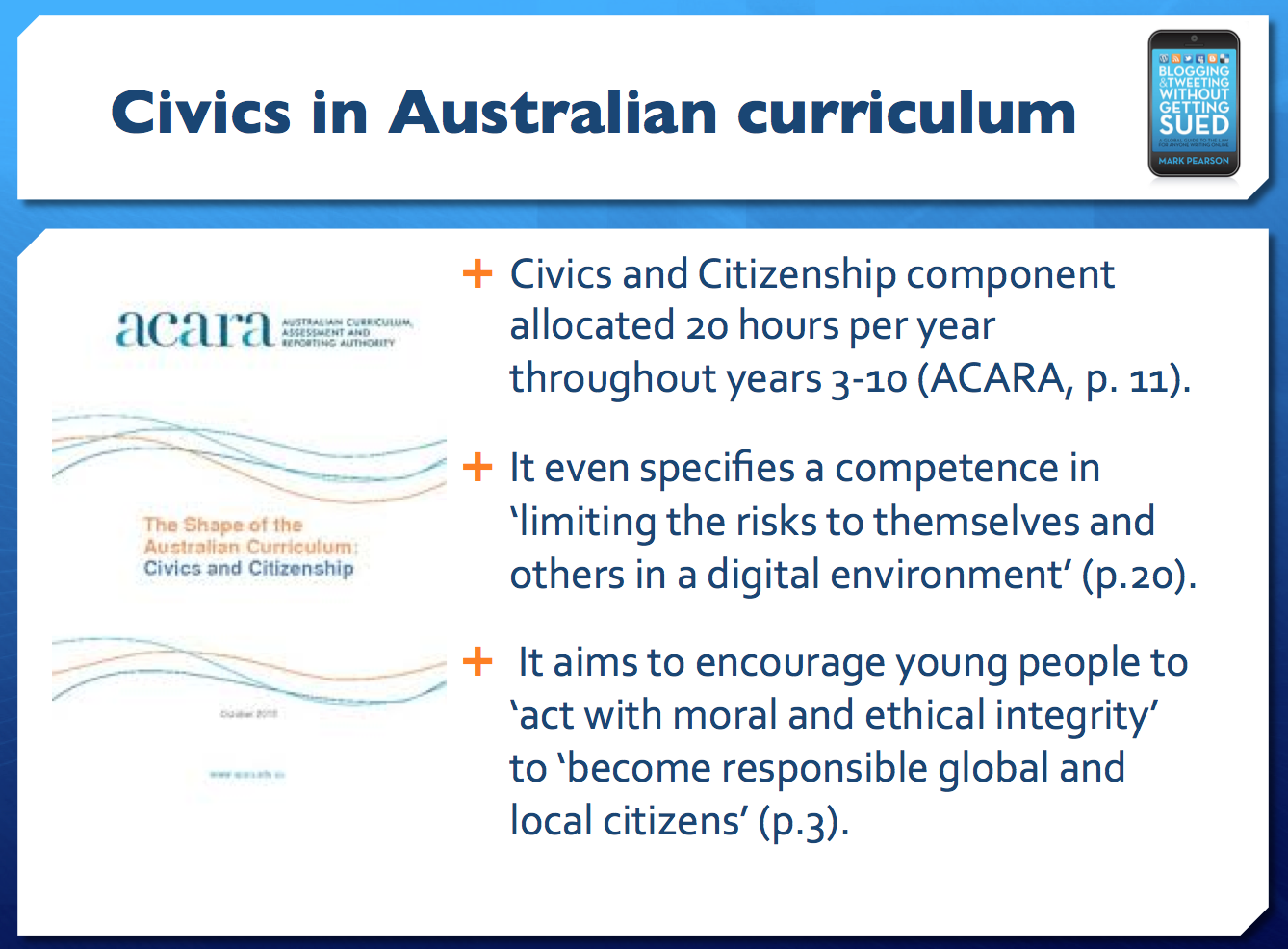
Screen Shot 2013-08-28 at 9.21.21 AMAt the very least an important foundational literacy one must have to empower one to assess social media risk – especially the legal risks involved – is an education in civics that explains the rights and responsibilities of individuals, the legal consequences of actions, and the systems in which these operate. Australia has lacked a consistent approach to civics education but fortunately the new Australian curriculum has a Civics and Citizenship component covering these kinds of issues at an allocated 20 hours per year throughout years 3-10 (ACARA, p. 11). It even specifies a competence in ‘limiting the risks to themselves and others in a digital environment’ (p.20). It aims to encourage young people to ‘act with moral and ethical integrity’ to ‘become responsible global and local citizens’ (p.3).

Frankly, this is where I believe the best approach lies. If we are going to reap the potential of new technologies we cannot become so risk averse that we ‘lock and block’ the opportunities as we try to minimise the dangers. The Gold Coast private school that recently banned its students from using social media on its grounds continues to allow its students to engage in contact sports with far greater potential risks to their minds and bodies than any Internet platform might present. They do so because they perceive the ongoing social and educational benefits of team sports as outweighing the very real risk of physical injuries. They invest in the expert staff to coach, they qualify them with first aid training, and they teach the children the code of behavior expected on a sporting field. And I would not for a moment suggest they should not. Yet they choose to ‘lock and block’ some of the most valuable communication tools developed in the history of human invention.

I suggest the answer is not in deprivation and censorship, but in sensible social media guidelines and foreshadowed consequences for misuse, accompanied by a foundation in moral and ethics education of citizenship presented in the new Australian curriculum. The educational theory of ‘reflective practice’ coined by Donald Schön two decades ago invokes a mindful approach to learning where professionals ‘reflect-in-action’ upon their learning as they face technical and ethical decisions in their working careers. There is no reason why a properly invoked civics and citizenship curriculum should not do the same for our pupils as they engage with new media as a laboratory for the greater challenges that real life presents.

See the full lecture at: https://journlaw.com/2013/08/29/social-media-risks-and-rewards-journlaws-public-lecture/

© Mark Pearson 2013

Disclaimer: While I write about media law and ethics, nothing here should be construed as legal advice. I am an academic, not a lawyer. My only advice is that you consult a lawyer before taking any legal risks.

Leave a comment

Filed under courts, media law, Media regulation, social media

Schools, social media and cyberbullying

By MARK PEARSON

[Extracted from my public lecture ‘Social Media – Risks and Rewards’]

We hear a great deal about the downside of social media use in schools. There have been well publicised examples of cyberbullying, defamation of teachers and principals, stalking of children by online sexual predators, and the dismissal of teachers for their own misuse of the medium. As a journalism academic, I can tell you that these make news because they involve deviant behavior, they result from important changes in society, they typically involve some sort of conflict or intrigue, and they are unusual enough to be interesting to audiences. They are not the norm, which explains their newsworthiness.

The norm is actually the millions of social media postings that are either mundane – like YouTube clips of cats – or are actually performing some public good – providing online counseling and support to those in need; creating useful communication channels between children, peer groups and parents; and opening a wealth of learning opportunities if managed appropriately. Of course, none of this means that we should ignore the risks – only that we should take steps to manage them and work with the medium within a relatively safe environment.

One Gold Coast private school made the local television news earlier this month with its principal’s bold announcement that he was banning social media use by students while at school. The school’s published policy also prohibits mobile phones and other entertainment devices (ASAS, 2009). This policy is known in the literature as the ‘lock and block’ approach. It is clearly one option available to schools and is risk averse in that it reduces the likelihood of the misuse of social media platforms during school hours. But is it a little like the Mercer Hotel in New York banning the use of telephones because Russell Crowe happened to disconnect a faulty one and hurl it at a worker in the foyer?

Screen Shot 2013-08-28 at 9.20.43 AMIf we seek to assess the educational opportunity cost of such a policy measure, we can look to the academic literature tracking the teaching and learning benefits of social media platforms. The European eTwinning project was established in 2005 as the main action of the European Commission’s eLearning Programme. Its Central Support Service is operated by European Schoolnet, an international partnership of 33 European Ministries of Education developing learning for schools, and its portal has 170,000 members and over 5300 projects between two or more schools across Europe. Its profile states:

Whenever we talk about internet safety we must also talk about responsible use. Similarly, when we talk about the safe use of social media we must also talk about the responsible use of social media. Unfortunately some people still believe that the only way to keep children safe online is to ‘lock and block’ access to parts of the internet though web filtering. The reality of this is that this doesn’t remove the actual dangers (perceived or otherwise) and it also makes it almost impossible for educators to deliver key internet safety and responsible use messages. The fundamental requirement to keeping children and young people safe online is to make sure that they have received an appropriate education in how to use tools and services appropriately. (eTwinning, 2012).

Screen Shot 2013-08-28 at 9.20.54 AMSome teachers have become quite activist in their opposition to a ‘lock and block’ approach, with the arguments of UK schools challenging this approach articulated in the Cloud Learn Research Report. Their main points are:

–       social media allow stimulating collaboration between teachers and pupils internationally and across cultures

–       the wealth of free material accessible online and via social media can reduce equipment and resource budgets

–       social media and devices enhance independent learning

–       social media open up innovative new communication channels for teachers, parents and pupils

–       they can bring introverted and disabled students into communication circles, along with those home-bound by illness

–       there are too many creative classroom ideas making use of Twitter, Facebook, Youtube, blogs and other social media platforms – to document (Heppell & Chapman, 2011).

Screen Shot 2013-08-28 at 9.21.03 AMEuropean Schoolnet’s SMILE (Social Media In Learning and Education) action research project offered some examples of effective in-class use of social media, including:

–       A Twitter snow lesson where a teacher’s Twitter network was asked where they lived and if it was snowing. The tweets were plotted on to Google Map and imported into Google Earth where real-time satellite imagery could be overlaid onto the map. The pattern that emerged provided an excellent context for discussing the weather, weather patterns and weather systems;

–       Google Plus in classrooms with a free ten-seat videoconference solution to allow face-to-face collaboration with peers and experts across geography and time zones;

–       YouTube used to create a school television station;

–       Developing research skills by collecting data using tools like SurveyMonkey and Facebook Polls;

–       Classroom blogs or blogs used as an ePortfolio used to generate audiences for young writers. (European Schoolnet, 2013).

This latter example raises the issue of the importance of written expression, particularly via blogs, for students. Writing in the journal The Psychiatrist, researchers Wuyts, Broome and McGuire (2011) cited several studies that demonstrated that keeping a personal blog could ‘have a therapeutic effect, by reducing stress and improving subjective well-being, and could be considered especially useful for people experiencing mental health problems’. This was because self-disclosure on a blog could impact on someone’s perception of their social integration and their so-called ‘bonding social capital’. The study focused on extended written blogs rather than social networking or ‘micro-blogging’ like Twitter and Facebook, but the sensible use of social media could have the same benefits, as found recently by a team of researchers from the Australian Catholic University here in Brisbane. They concluded:

“Facebook use may provide the opportunity to develop and maintain social connectedness in the online environment, and that Facebook connectedness is associated with lower depression and anxiety and greater satisfaction with life (Grieve et al, 2013).”

Screen Shot 2013-08-28 at 9.21.12 AMDespite the benefits, there is no disputing the sad fact that practices like cyberbullying continue. It is indeed that sensible or ‘mindful’ use of social media that should inform social media policies in schools, education departments, and in other government and corporate organisations. Cyberbullying has been a key point of focus and education systems have now developed policies in this area. The Australian Communications and Media Authority (ACMA) has an excellent ‘cyber(smart):’ site with a wealth of resources and lists the various education systems’ social media and cyberbullying policies (ACMA, 2013). For example, the Queensland Department of Education, Training and Employment features guides for parents, teachers and students at its Cybersafety site (DETE, 2012). At least the Education Department does not devolve the responsibility for cyber-safety to an automated Internet filter. Its site states: “Being cybersafe and a good cybercitizen is primarily about learning how to behave in the online environment. While technical solutions are part of ensuring safety and security, cybersafety in schools depends on people acting appropriately.” (DETE, 2012).

It is sage advice. Administrators and parents are indeed concerned about social media – partly because the little they know about it has been informed via the lens of the news media and war stories like those I have related above. Their perceptions are also skewed by the new industry of cyber-safety – everything from net nanny systems for your IT system through to speakers and consultants ready to advise on the evils of trolls and cyber-predators. I am not suggesting such inputs are unnecessary, but I wonder about their impact on policy at a time when parents and administrators are already approaching Web 2.0 with trepidation.

With all these resources committed to it, one might be excused for believing cyberbullying had driven young people to the depths of depression and anxiety and were consequently taking their own lives at an alarming rate. The fact is that in the decade 2000-2010 – a period during which both Internet and social media usage grew rapidly – youth suicide in Australia actually declined. It declined across the whole 15-24 year age group, with suicides among males in that age group decreasing by 34 per cent. That is not to say, however, that the rate of youth suicide is not alarming. The number of suicides is still far too high and like all stats this figure can have a range of explanations – better counselling, changes in media coverage, the efforts of campaigns like Beyond Blue and RU OK? (partly on social media),  and improved medicines for psychiatric conditions. Indeed, the policy measures noted above might well have helped save a few young lives. While it is tragic for any young person to take their life for such a reason, there seems to be no hard data that Internet and social media usage is driving more young people to this level of despair (ABS, 2012).

After all, social media is in many ways just a microcosm of our broader lives, and problems like bullying have always existed. These platforms present new channels for the demonstration of such behaviours, replacing or supplementing replacing the schoolyard taunts, the prank calls, the practical jokes and the toilet graffiti.


See the full lecture at: https://journlaw.com/2013/08/29/social-media-risks-and-rewards-journlaws-public-lecture/

© Mark Pearson 2013

Disclaimer: While I write about media law and ethics, nothing here should be construed as legal advice. I am an academic, not a lawyer. My only advice is that you consult a lawyer before taking any legal risks.

2 Comments

Filed under courts, media law, Media regulation, social media